Golden Age, July 28, 1926
Download: PDF — Golden Age, July 28, 1926
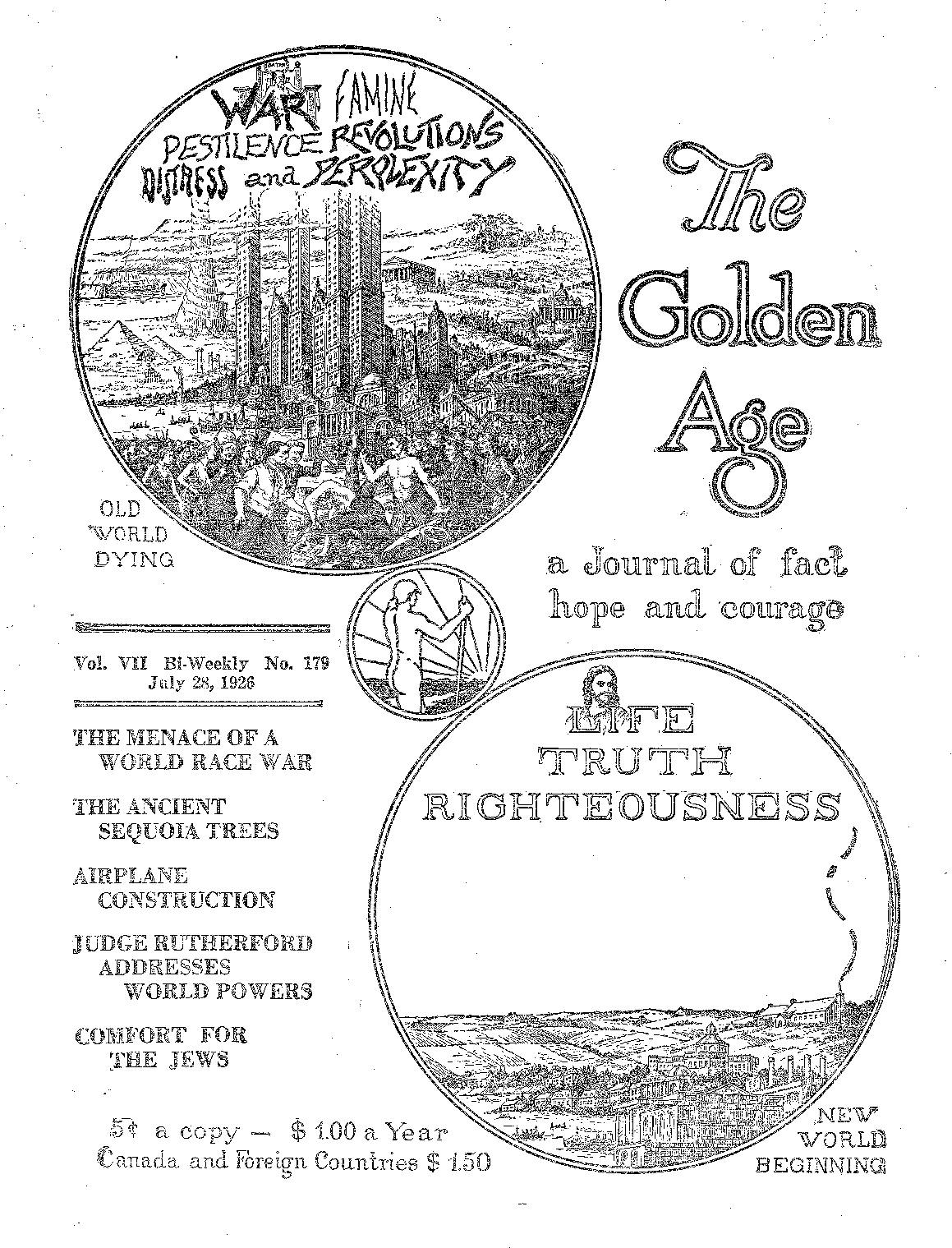
Contents of the Golden Age
=*!&*
Labob and Economics
.At Home and .Abroad . ... . . . . . North Carolina Will Investigate the Mills Royalty in Massachusetts ....... Strike-Breaking Illegal in Mexico .... Davor-Saving Devices Do Save Labor , . .
Social and Educational Mundane Things in the Bible ....... Improved Mailing System ........ Headlines in Newspapers .........
Radio Programs ............
Finance—Commekce—Tbanspobtation
Cloth Cut by Machinery ...........
Motors to Go Overhead............
Armored Cars in Christian New York .......
Anton Plettner’s Rotor Ship . . . ... . . . . Transmission of Checks by Radio ........ Better Transportation for Colombia .......
Airplane Construction and Operation .......
Political—Domestic No Church Property in Mexico . . Mexican Constitution of 1917 . . .
Spanish Royalty to Visit America Hooking Up with Big Business , . The Menace op a World Race Was
and Foreign
Ik Defence of
Agricultube and Husbandry the Ponies ..........
A Trip to An Homesteading
Travel and Miscellany Ancient Sequoia Grove . . . . in Eastern Montana .....
Religion and Philosophy
World Powers Addressed .........
Judge Rutherford’s Address .......
Comfort for the Jews..........
Bible Questions and Answers .......
Studies in “The Harp of God” ......
Published every other Wednesday at 18 Concord Street, Brooklyn, N. Y.„ U. S. A., by WOODWORTH, HUD G INGS & MARTIN
Copartners and Proprietors Address: 18 Concord Street, Brooklyn, N. F., U. S. A, CLAYTON J. WOODWORTH . . . Editor ROBERT J. MARTIN . Business Manager WM. F. HUDGINGS . . Sec’y and Treas.
Five Cents a Copy—$1.00 a Year Make Remittances to THE GOLDEN AGE
Foreign Offices : British.....34 Craven Terrace, Lancaster Gate, London W. 2
Canadian ......... 38-40 Irwin Avenue, Toronto, Ontario Australasian ....... 495 Collins Street, Melbourne, Australia South African ...... 6 Lelie Street, Cape Town, South Africa
Entered as second-class matter at Brooklyn, N. Y., under the Act of March 3, 1879
Golden Age
Volume VII Brooklyn, N.Y., Wednesday, July 28, 1926 Number 179
At Home and Abroad
Some of the Big Earnings
OME of the big earnings in 1925 are The American Telephone and Telegraph Company, $107,000,000; the General Motors Corporation, $106,000,000; the Ford Company, $94,-000,000; the United States Steel Corporation, $90,000,000, and the Standard Oil Company, $111,000,000. Ninety-four American corporations each earned over $10,000,000 in 1925.
Cloth Costs Cut by Machinery
MERICAN high speed machinery has enabled cotton manufacturers here to so reduce costs of cotton cloth manufacture that it is claimed that American cloth can be and is sold to cloth dealers in India cheaper than it can be produced in that country by the poorest paid labor on earth. Incidentally it is observed that on a given line of goods Americans receive slightly less per yard than their British cousins; but they operate more, faster and better machines, and they live in a country where it costs much more to live.
Trying to Get Back His Money
NCLE SAM is trying to get back $439,-210.64 which he paid during the war to the
Alaska Packers’ Association of San Francisco for salmon which was not packed until it had become so bad that it ’was not fit to eat. Here is hoping that Uncle Sam gets his money and uses it for bonuses. It is bad enough for boys to have to go to war, wuthout somebody trying to feed them rotten fish.
Copper Production Here May Cease rpilE fear is expressed that copper production -A- in the United States may come to a standstill because of vast deposits discovered in the Belgian Congo area, where unlimited quantities of black labor can be had for twenty cents per day. It is claimed that this African copper can be smelted and delivered in New York for about half the cost of American production. A tariff on copper importation is being asked in order to help cover the situation.
Another Shipload of Ivory Soap
NOTIIER ship has come into New York harbor loaded down with whale oil for Proctor and Gamble. In a nine months cruise near the South Pole the whaler captured and killed 531 whales. The whales produce on an average over seventy barrels of oil apiece, the value per barrel being about $30. The whales are 75 to 100 feet in length. Whaling is considered one of the most dangerous of occupations.
An Earthquake Off Cape Horn
HRHE New York Times contains an interesting story of a marine earthquake off Cape Horn. Fish by the thousands were thrown to the surface, including forty-seven whales and many cowfish, sharks and seals. The ship which was in the midst of the disturbed area shook violently, as it would have done in striking a reef. The masts whipped and bent like fishpoles.
The concussions of the rocks beneath caused the surface of the ocean to give forth hoarse murmurs.
Heat in the Arctie
THEORETICALLY the North Pole, on June 21st each year, receives the most heat of any point on earth. But the temperature is kept down on account of the ice in the Arctic Sea. The sea itself is relatively warm. Explorers in the arctic sometimes camp over a hole in the ice, to keep warm. Sunburn is not unusual in the arctic regions, and for six weeks in summer the temperature above the Arctic Circle frequently rises to 90 degrees Fahrenheit. Probably the coldest place in the world is Verhoyansk, Siberia, where temperatures of 90 degrees below zero have been registered • but in the summer time Verhoyansk sometimes has temperatures of 90 degrees above.
Many More Attempts at the Pole
rpHIS year and next will witness many more attacks on the North Pole. Two expeditions will attempt to reach it by airplane, since Byrd and Amundsen met with success, by both airplane and airship. A French expedition will try by a neve form of motor-driven sledge, which it is claimed will go anywhere a dog can go.
The lee Caves of Pennsylvania
HERE are at least two ice caves in Pennsylvania, both located on the northern slopes of hillsides, where in winter they are subjected to prolonged blasts of very cold air. This air finds its way into crevices in the rocks, and when it emerges in the summer time reduces the sinner moisture to ice. At the principal cave, near Coudersport, Pa., ice accumulates in summer, in the bottom of the cave, to a depth of several feet. An admission fee is charged and as many as three hundred persons have visited the mine in one day.
Perpetual Steam Power in California
OLLO WING the example of Italy in making use of underground natural steam, a concern in California has drilled a number of wells to a depth of several hundred feet in volcanic territory. The steam pressures obtained vary from 220 to 300 pounds. The wells are near Healdsburg.
Miles Darden, North Carolina Giant
iles Darden, born in North Carolina in 1798, was seven and one-half feet in height, and
at the time of his dearth, January 23, 1857, weighed a little over 1,000 pounds. In 1839 his coat was buttoned around three men, each of whom weighed over 200 pounds, and together they "walked in it across the square at Lexington, Kentucky. Mr. Darden was twice married and left children, all of whom are of normal size. He was without doubt the largest man that ever lived; a quiet, peaceable, almost unknown man, except for his unusual stature. ,
North Carolina Will Investigate the Mills
IELDING to pressure of women’s organizations and trades unions throughout the state, the governor of North Carolina will now investigate the conditions in the cotton mills of that state, -with a view to ending the night labor of "women and children which, in the words of one humane mill owner, can. be justified by neither morals nor common sense. The industry as a "whole can be benefited only by prying the cover off and revealing the facts.
Royalty in Massachusetts
HE only royalty we have in the United States consists of those rare souls who are always on the job, rain or shine, and who always do the thing expected of them. One of these is the seventy-six-year-old drawbridge tender on the Revere Beach railroad, who has just finished fifty years work at the same job, in the same place, without a working day off in all that time.
Four-Year-Old Saves 101 Lives ..
T GARNETT, Kansas, four-year-old Zelma Hininger saved the life of her two-year-old baby brother and one hundred baby chicks "when the brooder house caught fire. Her mother was out at the time, but when Zelma saw the flames she turned the baby chicks out doors, grabbed the baby and ran for a place of safety. Who dares say after this that children are of no use?
Little Girl With a Big Maternal Instinct
LITTLE girl of Yonkers, New York, a Miss
Muriel Hausner, ten years of age, is the proud possessor of a typewriter given her on her birthday which, together wnth an unusual maternal instinct for one so young, and a generous fund of imagination to boot, put her on the front pages of the daily papers. A few days ago she tried to lay claim to a baby boy left in a subway station. She created great excitement for a time when she claimed the baby to be her own, but the plan failed.
The Great State of Texas
O GREAT is the state of Texas, and so vast are the supplies of raw materials that are there produced or gathered for export, that the total exports of the state now exceed the exports passing through the port of New York.
Texas produces one-tenth of all the crops in the country, manufactured products worth a billion dollars, and crude oil in immense quantities. It is one of the great storehouses of raw materials for the manufacturing districts of Europe.
Thirty Dollars a Month Rent
ALLOWING that money is worth six percent interest, a rental of $30 per month will amount in ten years to $4,745; in twenty years it will amount to $13,243; in thirty years it will amount to $28,460.88. The payment of rent, when it is at all possible to begin paying for a property, is a great mistake.
Motors to Go Overhead
NEW YORK CITY seems to have decided to put its motor traffic overhead and to leave the surface for pedestrians. Probably this is as good a solution of the problem as is possible at tills time. Pittsburgh already has such an overhead motor road for some distance. No doubt this will become the custom now in all places where the street traffic is so congested that it cannot conveniently be cared for.
Armored Cars in Christian New York
THE fifty-one armored cars in New York used for transporting cash to and from banks, are each in charge of four expert men, who train every day in the week in a shooting gallery. One of the men remains in the car with a machine gun covering the others as they carry the money. Each car is insured for five million dollars.
The Rotorship in New York
Antok Flettner’s Rotor Ship aroused immense interest when it came up New York harbor with all engines shut off, propelled solely by the rotors. The rotors, which have the appearance of large stacks covered by a projecting cap at the top, are used in practice as a fuel saving device. It is not intended that, ordinarily, they should constitute the sole propulsive power. In a stiff breeze, however, it is practical to shut off the engines and move by the wind alone. This enables the navigator to make the best combination of calm and storm. In the one ease he uses his engines; in the other he saves fuel.
Transmission of Checks by Radio
NOW that checks have been transmitted from
London to New York entirely by radio, and been reproduced, endorsed and cashed here in twenty minutes, it is evident that a new stage is set in world finance. Hereafter there will be no tedious delay in the exchange of international papers, but transactions can be completed on both sides of the Atlantic in a few moments.
Labor-Saving Devices Do Save Labor
TT OW labor-saving devices do actually do away with labor i$ shown in the switching yards of the Illinois Central Railroad system at Chicago, where the’ inauguration of automatic brakes and interconnected microphones has reduced the switching force from 288 men to 27, The cars are even weighed automatically, their weights being recorded on a tape as they pass. No brakemen are needed to slow up the cars after they cross the hump in the yards.
Where the Surplus Corn Went
T AST year produced a bumper corn crop.
Some of us wondered what would be done with the corn. Would it be burned for fuel, or what would be done with.it? Results show that it went into pork, with the effect that the hogs shipped into the Chicago yard this spring were the heaviest ever known. The corn will be largely used as human fuel after all.
Headed for the Ash Can
npiIE League of Nations appears to be headed for the ash can. Germany, Poland, Spain, Brazil and China are all demanding a place in the Council. The entrance of every one of these, except Germany, is opposed by some members of the present Council, and as the decisions of the Council must be unanimous in electing new member states, there is a deadlock which, bids fair to mark the end of the League.
Strike-Breaking Illegal in Mexico
MEXICO has a new law providing that if a majority of the workers in an industry declare a strike it is illegal for the minority to continue work, and it is also illegal to employ strike-breakers unless the strike has first been settled by the board provided for the purpose.
No Church Property in Mexico
OR over half a century there has been no legal holding of property by the church of Mexico. This dates from the time of Juarez. Since 1917 it has been illegal for foreign-born clergymen to preach or teach in Mexico, on account of the fact that these have always been found' hostile to the Mexican government, and ready to foment strife whenever possible. Predictions are freely made that Mexico’s latest effort to run her own affairs without interference by priests born in foreign countries will result in another Mexican crisis. The. foreign-born priests are already crying ■"Persecution”, when, as a matter of fact, they are the real trouble makers themselves, because of their refusal to obey the laws of the land. They could have been prosecuted criminally, and it was an act of toleration and mercy merely to deport them instead of locking them up.
Mexican Constitution of 1917
IN 1917 Mexico adopted a new constitution, setting aside for the use of the Mexican people all subsoil mineral rights of lands upon which ground had not been broken by that time. The view of some in the United States is that ownership of the soil above, no matter by what tricky method the title was obtained, gives perpetual rights to everything above and beneath. The deported foreign-born priests are using their great influence to push this view. They are apparently trying to use the United States government as a catspaw to get them chestnuts out of the fire, even if they have to bring on a war between Mexico and the United States in order to do it. Why is it that in all ages priests and preachers have always been first and foremost in egging nations into war? Is that their mission? If so, ■who gave it to them, and when? It looks like the devil’s business and the devil’s program.
Better Transportation for Colombia
RIENDS of the United States of Colombia will be glad to know of her plans to spend $100,000,000 in the next ten years in improving and extending her railways and other transportation facilities. Colombia is very rich in natural resources but is enclosed by mountain chains difficult of penetration. Her inferior transportation facilities have held her back from development.
Canada’s New. Method of Paying Teachers
NEW method of paying teachers is under consideration in Canada. It is proposed to grade the teachers 20% each on personality, scholarship and teaching, and 10%' each on methods, impartiality, interest in home life and interest in public life. Teachers would have to make a total of 70% in order even to hold their positions, and those above that would be paid accordingly.
Will Try Hudson Bay Route
FTEB dallying with the -subject for many years the Canadian government has decided to give the Hudson Bay route a trial. The last ninety miles of the road will be built at once. It then remains to be seen whether grain can be shipped that way to Europe at a saving of fifteen cents a bushel, as claimed by the ■western farmers, or whether the route is impracticable on account of ice in the strait, ten months in the wear, as claimed by others.
A Sensible Tax on Expensive Meals
HE Province of Quebec will hereafter tax all meals which exceed $1. The amount of the tax, which is 5%, will be devoted to the maintenance of hospitals and will be listed on the meal check as a hospital tax. People who can afford dollar meals ought to be willing to pay something for the care of those less fortunate, and probably will not object to doing so.
British Coal Commission Report
A FTER months of deliberation the British
Coal Commission recommends the purchase of all British mines by the state, but to be operated by private enterprise. It thinks wages must be lowered or hours of labor increased, and that the least profitable mines must be closed.
$150 to See the Sun
PLEASURE party of six persons chartered an airplane at Croydon, England, and went aloft to a distance of 6,500 feet, where they cruised about in the sunshine for some time, apparently enjoying it immensely. On their return to earth, they said that they felt that the expense of $150 was fully justified; it was such a pleasure to be above the fog and in the sunshine again.
Achievements in Acoustics
LONDON engineer has invented a machine with which it is possible to make complete sentences in imitation of the human voice. A considerable number of house to house telephone conversations have now been held between persons at points in Great Britain and points in the eastern part of the United States. The conversations were carried on without a hitch.
Gradually Learning How to Eat
HE human family is gradually learning how to eat. The juices of boiled vegetables, once thrown away, are now known to be the most valuable part of the vegetables, as they contain the mineral salts. All England is greatly interested in this subject at this time on account of the complete recovery to health of Lady Fisher, wife of the British Secretary of the Treasury, who had been ill for many years with anaemia and autointoxication, and who used fruit and vegetable juices to effect a cure.
Palaces are Desolate Places
THE Bishop of London, salary $50,000 a year, wishes to rent his place for six months while he goes on a trip around the world. The bishop claims, and not without reason, that most of the upkeep of the great palace is clear waste, as he ordinarily uses only two rooms, one to work in and one to sleep in. It takes a staff of ten servants to care for the palace. The Prophet Job had a good sense of proportions when he described a palace as a desolate place. A modest six-room house is every way preferable.
F/are of Demonism Sweeping Sweden
WAVE of demonism is sweeping Sweden, associated, as usual, with so-called miraculous healings and the speaking with unknown tongues. The movement is tied to some two or three religious denominations which are under spiritistic influence. Several people have died and some have gone insane as a result of giving heed to these seducing doctrines of demons.
Spanish Royalty to Visit America
MEBICA is off the beaten track of royalty.
Not many kings or queens have ever corne here, and presumably not many would wish to visit the world’s greatest experiment in getting along without those superfluous personages. Nevertheless, the Spanish king and queen hava promised to visit the Sesquieentennial Exposition at Philadelphia, in August; and we have also lately had with us the crown princes of Britain and SwTeden.
The Koenigswusterhausen Sending Station
T KOENIGSWUSTERHAUSEN, Ger many, the German government has a radio sending station which, with its antenna mast, is two feet higher than the famous Eiffel tower oi Paris. The sending station itself is 754 feet above the earth, and is reached by a one man tubular elevator, 35 inches in diameter, in four minutes time. Access to the sending station is also had by a spiral stairway which winds around the elevator shaft and takes one-half hour to climb. The tov7er is triangular in form, built of steel and aluminum, and is guaranteed to be earthquake proof and storm proof.
Hooking Up with Big Business
EVERY little while the papers announce a new loan by New York bankers to the Catholic Church. A little vfliile ago a loan was made to the Vatican. Now the Church in Bavaria is getting a loan of $5,000,000. The Catholic Church knov^s that in America big business is the real ruler; and it is making a good, safe bet to be on the winning side. AVith millions of dollars tied up in the Catholic Church, big business can be depended upon to do v’hatever is asked; and that is no doubt the real object in obtaining these loans. No one can conceive that the papacy, with its colossal income and money-getting tactics, really needs to borrow money from the banks. It is out for something better. It vmnts porver, and is going about in a good 'way to get its desire.
Mussolini Continues to Stir Italy
THERE is no danger that Italy will go to sleep again while Mussolini is on the job. However much or however little anybody may like his methods, it cannot be denied that he gets results. Late expressions indicate that his purpose is to have more colonies, to rebuild Rome on a colossal scale, and to raise the Roman galleys w’hich have been lying 300 feet under the surface of Lake Neini for two thousand years.
The Menace of a World Race War
THERE are many great minds that begin to realize that the world’s peace is again being threatened. The Rev. A. H. Clarke, writing in the Nineteenth Century Magazine, said:
?<o one who surveys the world of the future with' open mind can fail to see at a glance that so far from peace being in sight, mankind is on the eve of four great wars: (1) A war between East and West; (2) a war between Jew and Gentile; (3) a war between Protestantism and Romanism; (4) a war between what is commonly known as Capital and Labor.
All of these wars are well on the way. The first is perhaps not so clearly discerned by the majority as yet. But it is seen looming in the foreground by those who are carefully observing. The various differences and legitimate grievances which are alleged to exist between white and tan, and which constitute good reasons for dissatisfaction on the part of the colored races, are along the following lines:
The world’s population is estimated to be about 1,800,000,000. Of these there are only approximately 600,000,000 whites, so that the proportion of colored peoples to the whites, is in the ratio of three to one. Alongside these figures, the recently awakened colored races are finding that although the world’s habitable land surface is estimated at fifty-three million square miles, nevertheless forty-seven million of those square miles are under 'white dominance, comprising nearly nine-tenths of the whole area of the habitable earth. Tims two-thirds of the world’s population have only one-tenth of the earth to call their own.
The yellow races, chiefly China and Japan, occupy about four million square miles of land, with a population of approximately 500,000,000. Hence they have to house and feed nearly one-third of the world’s people on less than onethirteenth of the earth’s habitable surface, in other words, the yellow races are crowded to 125 persons to the square mile.
Compare this with Australia, a modern white man’s land, with its total population of only 5,500,000 (less than London alone), but which has three million square miles of land surface—less than two persons to the square mile. Japan is only' one-twentieth the size of Australia, yet it has to support ten times the population.
Australia could (in spite of her deserts) easily support twenty-five times as many people as
By William Harrison
she now possesses; yet her government has deliberately closed her doors to Chinese or Japanese immigrants, on the plea that if they were admitted they would soon cause an economic crisis in Australia, by reason of their willingness to work for low wages, on account of their lower standards of life and comfort requirements, as compared with those enjoyed and practised by Europeans.
New Zealand, Canada and the United States have adopted a similar attitude and economic policy towards the colored races; yet at the same time they maintain their hold upon vast territories of land which, by location and ancient heritage, more rightfully belong to the colored groups. Wherever the white man goes, he confiscates the land as far as possible, and treats the native as an inferior being—a barbarian.
The United States, with its vast territory of three million square miles, has a population of but 105,000,000; while China, with only half the area of land, supports nearly four times as many inhabitants.
In Africa the natives are being robbed wholesale of their land by the whites who go there. The whites tax the blacks, and make them work to fill the white man’s pockets; then if the black man asks for a vote in the elections of Parliament or of the Provincial Councils, “the fat is in the fire.”
In India, the British Government claims the right to seize the land and utilize its vast mineral and food resources, and dominate 320,000,000 colored peoples; and if they dare to protest they are liable to treatment similar to that which 10,000 Indians got at Amritsar in April, 1919, when a British regiment, under General Dyer, opened fire upon this vast crowd, without even warning them to disperse, killed 380, and wounding over 1000, who were left unattended; or else have bombs dropped on whole villages, as has more recently been done.
A day of reckoning is approaching. There are ominous signs that the growing intelligence of the colored races will not always tolerate the arrogant dominance of the white. Japan, with her modernized army and navy, her universities and educational system, and her industrial achievements, is already recognized to be a world power, and others are following fast upon her heels; all clamoring for a place in the sun, and for control of a fair proportion of the world,
with the right to direct the current of their own lives and destinies.
Now, with one voice, the educated Indian, the Chinese, the Japanese, the Arab, the Egyptian and the Negro, are all asking that they should be free to use and expand the powers of mind and body which they possess; and are fast reaching the point when, if the white man continues to assert his authority and resist these demands, they will by militant power enforce them.
Another alleged cause leading up to a clash between the white and the colored races is the growing feeling of resentment that is now rankling in the minds of thousands of educated blacks, browns and yellows, over the boasted "superiority” of the white races; and the constant refusal of the white governments to allow the colored races equality of opportunity with the whites along the lines of education, industry, wages, conditions of labor, privileges of franchise, security from mob violence, non-pre-judiced legal decisions and,, last but not least, the perpetual ostracism that is shown to them by the petty rules and customs set up by the whites for the purpose of segregating the colored peoples, as a reminder that they are members of "inferior” races. Well doth the scripture say, "Pride goeth before destruction, and a haughty spirit before a fall.”
We could not, under present conditions, advocate indiscriminate mixing of the races, nor intermarriage; but all should recognize the general truth expressed by St. Paul at Athens, “God hath made of one blood all nations of men for to dwell on all the face of the earth.”
After all, there are but three distinct races in the earth, the sons of Shem, Ham and Japheth; and the present supremacy of Japheth is, in fact, modern. It began about the sixteenth century, A. I)., when, as Dr. Vaughan Cornish SEiys'
Western Europe, including the British Isles, became (owing to trans-oceanic voyages) the centre, instead of the terminus, of maritime communications, which thus brought new requirements in practical astronomy; and there soon followed great improvements in mathematics, in the instruments for recording time and measuring angles, and in optical aids to observation. On this foundation was modern physics built, and hence the mastery of chemical and physical forces which resulted was localized in Europe, where oceanic navigation originated. .
In Macaulay’s "History of England” (Chapter 1), \ve further read:
Nothing in the early existence of Britain indicated the greatness to which she was destined, to attain. Hei inhabitants, when first they became known to the Tyrian mariners, were little superior to the natives ol the Sandwich Islands.
. Before this the time was when the Egyptians and the Asiatics were far ahead of Europeans in such sciences as chemistry, physics, mathematics and astronomy. The modern rise of the white man, viewed in the long perspective of human history, is almost a mushroom growth; and not much to his credit when we realize that he has ofttimes allowed the grossest forms of selfishness to cause him to use his lately acquired advantage to the detriment and boycott of those peoples who were once his superiors.
Too often has it been true that the explorer has merely paved the way for the exploiter. Christian missions to the heathen have ofttimes been used as the gateway of entrance for white profiteers and scheming politicians', who, animated by self-interest, have robbed and subjugated the heathen by force, confiscated their’ lands, used the natives as mere pawns and chattels, and treated them worse than mere animals.
The causes of race hatreds, enmities and distinctions are not hard to trace, but when examined in the light of facts they are quite superficial. The barriers that now separate men and nations are mostly artificial, locally induced or inculcated. The fact that a white child wilt often dearly love and show a marked preference for its black doll, brown teddy-bear or black "mammy”, proves that the color bar is not instinctively present in the child, but is put there through suggestion and "education” by the adult, as a necessary by-product of our so-called higher civilization.
The war of 1914-1918 revealed the fact that men of different races and colors can join hands and co-operate side by side in a common cause. Remove from the world the economic and educational disabilities, the political antagonism, the confusion of tongues and the religious bigotries and superstitions, and there would be little left of the color line.
One thing only would then be necessary, i. o., a change of heart. How can this be accomplished? Some look upon the League of Nations as the coming panacea; but this is a forlorn hope, for the whites dominate the League. Man will need some help from heaven, and that help will come only by and through the
promised kingdom of Messiah, in which both Jew and Gentile, Christian, white, black, brown and yellow, will realize their highest hopes and noblest desires. •
A Trip to an Ancient Sequoia Grove
THE great sequoias, or giant redwoods, are the oldest living things on this planet; from the annual growth-rings of cut specimens their age is proven to be not less than 6,000 years. In fact, a giant stump whose rings have been carefully counted shows a warped and stunted growth-ring which occurs at the right place and synchronizes with the Biblical date of the flood, when the young 1,600-or-so-year-old tree was submerged in the swirling waters of the descending canopy.
To gaze up at these living giants which were in existence throughout the antediluvian world, with its misrule of materialized angels and evil giant progeny; which have lived on through the present evil world, and were old trees when Abraham was called, and when the Great Pyramid was build; which were ancient when David lived and Solomon reared the temple, and hoary with age when Christ walked the earth and the flame of gospel truth began its illuminating work with the apostles of the Lamb; which have lived on through all the changing events of church and state of the Gospel Age, and which stand today, alive, gigantic, stately, impressing upon all who have eyes to see the majestic lesson of the power of nature’s God to give continuing life—to gaze up at these mighty monarchs of time lends a new and thrilling meaning to the words, “As the days of a tree shall be the days of my people!”
And these trees, living on into the third world, the golden age of Messiah’s reign, will doubtless see the countless myriads of the race of man springing up to perfection of life and health, and will be a factor in the wholesome schooling of that age of life, the Millennium. In a peculiar way they represent what man might have been, had he remained in accord with the laws of his being; for they are as old as man, began their life at approximately Adam’s creation, and may meet man at the close of the great seventh creative epoch-day—the omy living earthly things with unbroken existence from paradise lost to paradise regained!
By H. A. Seklemiem
The Sierras of Western America contain many groves of these wonderful trees. General Grant Park and Sequoia Park, in California, are notable for them. I will recount'a trip made on June 21st to General Grant Park, from Fresno.
Two autos, a Ford and a Chevrolet, neither of them very new nor very excellent, were the conveyances. Seven Californians, one of whom had never before looked upon a Sequoia (to our shame, be it said) comprised the party. Wise in the wmys of the mountains, our mentor instructed us to start our trip at four o’clock in the morning, with the first glimmer of day; for there is just one thorn in the rose of these particular mountain trips—the well-made and well-kept roads are not as yet graveled or paved through the mountains; and with summer sun and increasing traffic the dirt road, no matter how good, will become dreadfully dusty.
We did our best to get an early start, and succeeded in leaving town by five a. m. We w’ere blessed with a breezy day. By leisurely travel, letting all who wished pass us by, and then slowing down to widen the space between us and the car ahead, we had practically no dust to breathe, and consequently could enjoy the wonders of the ever-changing and ever-increasing beauties of the California hills.
Through the vineyards and orchards of the Valley of the Sun, we traveled due east on Ventura Avenue to Centerville; then to the right, beneath the ancient lumber flume, up the road between Jesse Morrow Mountain and Mt. Campbell, then over the many bridges of the many channeled Kings River. We could not have missed the road if we had tried, for it was well traveled and well sign-posted all the way; through hills and valleys, and valleys and hills, but ever ascending to a higher level. Through Squaw Valley, Dunlap, Pinehurst, we saw the dusty oaks of the lower foothills change to the smiling pines and firs of the higher mountains. Again and again, in my dense valley ignorance, I shouted “Sequoia” at sight of a towering tree overtopping the beautiful landscape; but our patient mountain guide Would smilingly explain, “Another yellow pine.”
The children with us were far more interested in the vistas of new and surpassingly lovely mountain flower beds than in historic sequoias. Time and again we yielded to their pleadings and stopped to let them pick “just one or two”. It is mountain ethics to pick very few wild flowers, because if all the thousands who traverse these mountain passes should pick to their hearts’ content there would soon be no flowers left along the roadways; and within the boundaries of the parks signs are posted, warning visitors to pick no flowers whatsoever, “under penalty of the la’w.”
At last our guide signaled a halt. We looked about for a reason. "We pointed and asked, wistfully, “Sequoia?” “Kot that one,” smiled the guide, “that’s another yellow pine. There is your first sequoia 1” “What? That little midget? That——” I was speechless. The guide laughed outright at his little joke, a standard one among mountaineers. “Why, certainly,” he explained; “a baby sequoia, of course! Did you think that all sequoias are 6000 years old?” I was squelched and thoroughly crestfallen.
Not only do. “great oaks from little acorns grow”, but the cone of the sequoia is much smaller than is the usual cone of mountain trees, being only about an inch and a half in length; and its seeds are like dwarf’s purses, averaging hardly a quarter of an inch in breadth, and like the thinnest paper in thickness. The baby giant that springs from that tiny seed is almost un-noticeable among the thronging life of the verdant hillsides.
But the mature sequoia towers like a mighty pillar over two hundred feet into the air, its outstanding characteristic being that its top is but little less in diameter than its base—between twenty and forty feet—and its foliage seems grotesquely insufficient and scraggly to support the life of that majestic trunk. If leaves represent professions, this might well picture how the great characters among men, the giants in all walks of life, are usually sparing in their professions concerning themselves. But that is getting ahead of our story.
We were approaching the park entrance. We now saw great, black, burned stumps along the vmy—the relies of the depredations of greedy lumber companies of bygone days, before a thoughtful people reserved these parks for themselves and their children. Going around one more of the countless bends of the road, and we found ourselves at the ranger station, the entrance to General Grant Park, some sixty-four miles from Fresno.
None of the grades had been difficult, and wo already felt infinitely well repaid for our trip. It would have been more than worth while, even if we had been forced to turn back at the gate of the park! But the best wonderland was yet before us. A fifty cent fee for each of our two cars, which gave us certificates entitling us to free access to that park for the remainder of the year (cheap enough), and we passed on up the grade.
We were now in the park! At sixty-six miles from home we were at the administration buildings of the park, where we paused to wash'up (the facilities being clean and modern to the last degree); and we lingered there for awhile beneath the towering firs and pines, so cool and restful!
It was now just nine o’clock in the morning, with a whole day of inspiring, genuine pleasure before us! We wandered through the photo studio (but we meant to take our own photos— a privilege freely permitted, with the one stipulation that the trees themselves be not climbed); we secured maps and booklets at the administration buildings, through the courteous uniformed ranger; the children ran down to the green mountain meadow, visible through the trees, and disported themselves awhile on the lawn; and then we proceeded about a mile beyond to the famous sequoias themselves!
“Ah! The giants at last!” everyone exclaimed. We were inclined to stop at sight of the first one, right at a turn in the road; but a signboard warned us to keep going, for many other cars were behind us. We soon stopped beneath the grove. The mighty monarchs were all about us now! We all stood in silent amazement. There was a reverential greatness about them, that makes it inspiring to jfist look at them. The breeze was pungent with that sweetest of all perfumes in the world—the ozone of a mountain forest.
At our feet, adorning the springy needle-floor of the sequoia grove, were ferns and flowers in abundance. Some of us almost wept at our inability to call them by their names; while others, more practical and ready of mind, asked shamelessly of anyone and everyone for information and were answered with the ready courtesy of the mountains, or else proceeded to give each new form of life a brand new name!
We admired the tiny “star-dust flowers” which smiled in pink beauty at the feet of the giant redwoods, and talked of the “candle-bushes” seen on the way, with their candle-like bloom; while others informed us of the rare blood-red snow flowers, which appear when snow is on the ground, peering out from the whiteness to be loved and admired by possible passers by. We found several of these rare plants during the day.
Several score automobiles were parked in the grove; the laughter of romping innocent children seemed strangely sweet and fitting as it resounded through this primeval forest. We joined the happily wandering throngs, read each sign of warning and instruction, and gazed to our heart’s content at the ancient glory before us, meanwhile posing for various photographs in obedience to the persistent pleadings of our camera-owning member.
Every state of the Union is represented in the sequoia grove. Of course, we took our picture in front of the “California” tree. But the redwoods far outnumber the forty-eight states. “General Grant” was the name of the largest, forty feet in diameter and considerably over two hundred feet in height. But “General Lee” was unanimously voted to be the handsomest of them all. There were “General and Lady Washington”, side by side; then the “Twin Sisters”, 'which actually join at their base; the “Quintuple”, or five close-set giants; and many, many unnamed ones on up the trails.
Finally we came to the “Fallen Monarch”! Through its hollow interior we passed—a mounted rider could easily enter its great baseend—then w’e mounted upon its mighty back for the inevitable photograph.
Lunch, unusually appetizing amid such surroundings, was served on a spread armyblanket, on the slope beneath immense firs and pines, where centuries of falling needles had
made a rich, loamy carpet, adorned by tiny wild roses in full bloom. The park water, piped from near-by springs, was clear, cold and refreshing, and was everywhere accessible. We ate and drank and thanked the Lord; and then some of us took luxurious siestas of an hour or two in nature’s paradise. '
Then we took hikes on this trail and that, by this warbling mountain streamlet and that; while some of the more venturesome of our party took the precipitous trip of some four miles to Sequoia Lake—a journey hard on the car but voted well worth while. Beautiful Lake Sequoia, the special gift of the people to the children, affords unusual fishing, rowing and bathing, and additional delightful hikes around its scenic borders.
Half past five, and all assembled for the parting. We announced ourselves hungry again, and ate to the tune of some ringing yodelling, emanating from some camps in the depth of the park. There were real tears in our eyes as we bade goodby to our giant friends, with sincere promises of another visit to them soon.
On the way down the slope, a mile below the park entrance, the first path to the right after passing a great overhanging rock, we posed for our last picture upon a 6,000-ringed stump, appropriated for souvenirs several pieces of its venerable bark (permissible because outside the park), and then speedily retraced our course home—the darkness of night overtaking us on the way. We were home, tired but happy, and most of us in bed by 9: 35, at the end of a truly wonderful day.
The ideal way -would, be to go up the mountains one day, stay over night (free camping for all, or—for those who make reservations weeks in advance—room at the park hotel), and then spend another day to see the park. Lake Sequoia alone is worth a separate visit. One could profitably spend many days amid these inspiring surroundings. But for most of us, pressed with the duties of life and of the truth, a day or two must suffice. The memory of the experience, however, lasts forever, and becomes one of the blessed treasures of life itself.
“Touched by a light that hath no name, A glory never sung,
Aloft on sky and mountain wall Are God’s great pictures hung.
“The valley holds its breath; no leaf Of all its elms is twirled:
The silence of eternity
Seems falling on the world.”
In Defence of the Ponies
. ■ i
THERE is no man or group of men who can figure out a law that will help the farmer out of his present difficulties and problems. He must get out the best way he can, all by himself; for there is no outside help for him. The farming industry is the only industry that continually takes advice from men who would actually starve to death if they themselves had to farm.
What do men who live in the cities know about the practical side of farming, or of its hardships and hazards? Do they really think that they are in a position to give the farmer sound advice about something -with which they have never had experience? The farmers are easier picking for these smooth-tongued gents than are any other class in the world. Let some clever fellow, who has it all figured out to his own benefit, come out to the guileless farmer and talk knowingly, and the farmer often will go into debt to buy his -wares.
One thing that is threatening financially to ruin the average American farmer (it has already ruined many) is the hasty purchase of automobiles, trucks and tractors. The automobile salesman tells the farmer that if any one needs an automobile it is he, so that he can go to town quickly and return to his farm quickly ■—to produce more of something of which we find we already have too much, when we try to dispose of it at a fair price. This modern rush 4s further lowering prices on farm produce, and is gradually bringing the farmers into abject slavery to big business. Of course the gas wagon salesman does not explain this side of the proposition, perhaps he does not see it; but these are the inevitable results of the present pace.
Then, after inducing Mr. Farmer to get a, good car, the oily salesman next tells him that he must have a tractor, so that he can farm more land; that he should plow up even his pastures and meadows and put them to grain, of which he already has too much for selling at a profit. So the tractor, like the automobile, further lowers farm produce prices.
Then the farmer is told that he needs a truck, so that he can very quickly deliver to town what he produces. But when the farmer gets to town with his fine truck full of produce, he finds that there are too many other truck-loads of produce there already; then he has his choice of either selling at less than it cost him- to raise it and
By Paul Everett Saddlemire ,
“truck” it to market, or else take it all back home.
Then the farmer is told that he can sell his produce by advertising. The dairyman pays for an ad which says, “Drink more milk,” or “Eat more wholesome butter”. The hog and cattle raiser advertises, “Eat more pork and beef,” notwithstanding the fact that most people already eat far too much meat for their good. The poultryman urges “Eggs”; the fruit grower says, “Eat fruit”; while the grain growers’ ad asks the public to “Eat more bread, oatmeal and mush”, even though they do not eat much of it themselves. But the farmer finds that his advertising merely helps the city dealer, while his own prices stay as low as ever.
Now the farmer should be like other business men; he should patronize “home industry”. A coal operator would laugh at a man who would try to sell him wood, nor could the coal dealer sell anthracite to a lumber camp. Let the farmer, likewise, be more independent of the city, and cease letting smooth-talking town gents who never drove a plow tell him how and what to raise.
There seems to be a lot of worry nowadays about the surplus farm products that the farmer raises. Some people think that we have too much land under cultivation for the requirements of the country’s population. Perhaps we have, under the modern methods of farming. But let the farmers go back to the horse and plow, and turn some of their cultivated land into pastures and meadows, and they will soon see a very big difference in prices for their produce. This is the very thing that big business does not w’ant the farmer £o do. They would rather keep the farmer over-stocked, buy his produce at a lower figure, and then traffic in it on the floor of the exchange. It gives them more to sell, several times over, and each time at a profit. If the farmer should get over his present craze for automobiles, and should return to his everfaithful friend the horse, he would not raise so much, but it would mean higher prices for what he does produce, and more time and leisure for himself. .
This would, of course, mean a big decline in the sale of automobiles, tractors and trucks, which in turn would mean less money for the already overflowing coffers of big business. This would cause a calamity hovvfl from big business; for it Wants all the money that it can get its greedy hands upon, at the same time keeping the farmers and other common folks as poor as possible.
The farmer should do some advertising. He should advertise the horse, the same as big business advertises the automobile. This automobile riding is a temporary fad. The grownups have gone in for the automobile the same as children do for roller skates. The same may be said of bobbed hair, bare knees, lip stick and painted faces—they are passing fads which quickly yield to new ones.
There is just as much genuine pleasure in riding in a rubber-tired buggy, drawn by a gentle pony, at seven miles an hour, as there is in riding in a dusty auto at fifty—and a good deal safer. Once in a while you have heard of a train bumping into a horse and buggy, but never of a buggy bumping into a train, as so many automobiles do.
I admit that you cannot ride so fast in a buggy as you can in a car; but what is the necessity of covering so much ground during a pleasure jaunt? Why try to be a speed demon and run risk of meeting an early death? You can not even see and enjoy the scenery when you try to go as fast as the wind; but in a buggy you have time to enjoy the beautiful landscape. True, you cannot go so far in a day in a buggy as you can in an automobile. But why go fifty miles to look for a nice place to eat your lunch, when you can find an equally pretty place ten miles away? If you cannot, you had better move to a new location.
One solution of. the present difficulty in which most of the farmers find themselves would be for them to organize into one big union and pledge themselves to use the horse wherever possible; then put some of their cultivated land back to pasture and meadow; and feed up some of their surplus farm products. This course would deal a death blow to the aspirations of scheming and grasping big business, which seeks to reduce the farmer to absolute serfdom. It Avould push up the price of farm produce, and thereby make the farmers a more prosperous class. This is the very thing that big business wishes to prevent. Let the farmers' dues In their organization be one dollar a year, and from that fund hire a good advertising man to advertise and popularize the horse.
And why should we not advertise the horse ? There never was a friend that the farmer has ever- had that has been more true, loyal and reliable than he. Is it fair to despise now the faithful ponies who have borne such hard burdens for their masters ? Horses have been, and still are, our most dependable possessions. Without them the development of a large part of this country would have been an impossibility. They made it possible for us to become a mighty nation, and shall we now relegate these true and ever-faithful animals to the background, or exchange them for automobiles, tractors and motor trucks to our detriment ?
Are we to discard our truest, most loyal friends simply because some glib-tongued salesman seeks to secure our hard-earned cash in exchange for something that we do not need, and in many cases can scarcely afford?
Many of the American ponies, indeed almost all of them, are gentle, patient and longsuffer-ing; and this is something that no auto salesman can say for his stock in trade. Horses are almost human in their feelings, and can actually sympathize with their owner when they discern signs of distress on his part.
Many people may think that the horse has about passed away; but the fact is, there are still over twenty million ponies in our country. It is true that the ponies can not do as much work as a tractor, or draw as heavy a load as a truck; but I repeat, why do so much work when it only means lower prices for what we have to sell?
Let us go back to the horse, and stop squandering money for what big business wants us to buy, simply that they may grow even more rich. There are certain places where the horse cannot thrive as well as autos and trucks: and here is where it would be proper to bar the horse. But elsewhere the horse should have undisputed sway. In the golden age, now so close at hand, I believe that horses will be used by lovers of God's creatures, rather than inanimate trucks and tractors. I venture the assertion that the ponies will outlast the automobile fad and will come once more into their own.
There will be many labor-saving devices as the New Day dawns; but horses as useful domestic companions will undoubtedly be allowed to come once more into man’s affections.
Those who have never ridden on the back of
a gentle and lovable pony have missed many a. pleasant thrill. I for one would rather have just one pony, gentle and patient, than to own all the autos and trucks in the world.
Let others have the auto, The honking old tin-can;
But let me have the pony, The-proven friend of man.
Homesteading in Eastern.
T WISH to add a little to Mr. Bogard’s article on “Western Canada as I Know It”, published in The Golden Age some time ago. Having spent thirty-five years in the Northwest, I have gone through all of the things spoken of in the article mentioned.
In late years the loan companies have put a few more kinks into the manner of loaning money on homestead land, especially here in eastern Montana. In many instances the loan company requires the applicant to make out an application for a loan wherein many strange questions are asked, such as: “What do you ■want to use the money for?” Then the questionnaire closes by demanding the signature of the applicant to the fact that he will use the money only to stock his homestead with sheep or cattle.
This agreed to, the applicant states how much money he wants on his land; then the agent for the loan company gives the applicant a' check on a bank, for several hundred dollars of the amount asked for, without any further security.
That part of the transaction seems very generous, and very strange—giving an applicant money on the strength of a mere application for a loan, seemingly without ample security. But the iron-clad feature of the proposition is not long in reaching the applicant, double shod, pressed down and running over.
A mortgage is demanded of the borrower, covering the loan in such amount as the loan company has deemed sufficient to loan on the land; taking into account the applicant, his surroundings, his ability, his standing in the community and, last but in no wise least, his ability to get away from the tight clutches of the ironclad mortgage.
In addition to the amount of the loan, with interest agreed upon, there is another or second mortgage made up for him to sign. This the agent claims is only a “protective” mortgage, and “'not to be placed on file”. This second mort-
Montana Bt/ S. R. Grabill
gage covers the whole amount of the interest that will accumulate during the whole of the time the original mortgage is to run, which is generally three to five years, with all the compound interest, taxes and lawyers’ fees that can be added to it. '
Now how does this plan work out? The applicant has no interest coming due until the first year of the term of the loan has expired. If the loan is made in April, the first interest payment is due January 1st following. Then complications begin to enter the deal. The applicant usually does not buy cattle or sheep with the loan money. Both parties to the contract knew he would not. Instead, he finds some one to sell the land to, perhaps for a few dollars more, or less, than the loan on the land.
Now the party who buys keeps the land until the first year’s interest comes due. Usually he cannot pay, or does not want to pay, and the mortgage company forecloses, first filing that second mortgage, which calls for all of the interest for the full term of the loan. The loan company thereby gets judgment against the original owner of the land for the loan plus interest.
In a case I had to do with the loan called for $1700. When the courts were through with the foreclosure the judgment against the original owner of the land, as well as against the purchaser thereof, was approximately $2400. While most of these transactions might be declared highway robbery by a higher court, where will the homesteader get the money to clear himself of an unjust debt of $2400 legally settled upon him by the lower court?
Add these loan steals to all the other hardships that a homesteader, either in Canada or in the United States, has to contend with, before you “go west” and file; and I think you will conclude that you are better off where you are. May God speed the time when His kingdom shall rule on earth as in heaven.
Airplane Construction and Operation
THE readers of The Golden Age are probably better informed on general subjects than are the readers of any other one magazine; but there are some topics, among which is airplane building and the metals used therein, also the airplane’s speed and durability, which have not been dwelt on to any length in these columns.
The principal thing about airplane construction, if you could read the machinist’s thoughts, would be the precision required in finishing the working surfaces. This accuracy is absolutely required by an efficient corps of inspectors; and rightly so, as faulty fitting that would allow gas and oil leakage, as well as poor compression, would probably cause another fatality.
Air travel has reached such proportions in the short time since the Wright Brothers began their experiments of a few years ago, that many inventive minds are now constantly employed searching for less resistance, lighter metals, surer oiling and better landing places; all of which go to insure safer passenger and freight transportation via air. The U. S. Mail planes call for continuous flight, and have experienced a very small percent of fatalities.
At present a well-known airplane firm of Buffalo, at which plant the writer is employed, is building the fastest plane on record. The engine weighs less per horsepower developed than any one yet built elsewhere. The age of the engine in miles averages 80,000, which means an average of over 1000 hours.
One thing above all others which has been used to overcome the air is duraluminum, a metal one-half as heavy as steel and capable of sustaining a pressure of 128,000 pounds per square inch. This metal enters very largely into the construction of both engine and fuselage, or body; in fact the only large parts of the engine that are composed of steel are crank shaft, connection rods and the cylinders.
The oiling system of the engine has received considerable attention. Every time more miles have been added more speed is developed, and lubrication must therefore be assured. Then the propeller which, until terrific speed was developed, was constructed of wood, has been replaced by a light metal. Wood will stand approximately 1400 revolutions and then fly apart, while metal propellers stood the strain of the 1925 races, In which all records were broken. The foreign-
By David Finch
built planes which entered were away behind.
After the engine has been constructed and the inspection department is satisfied, the next step toward completion of the graceful invention is the test room. In applying the tests a mechanical contrivance, called the hydrometer, is connected to the engine. This registers the speed attained and the horse power developed; and if the requirements are not met, then there is some imperfection, either in the metal used or in the machining and construction. The speed reached in test is from 2300 to 2600 per minute and the horse power about 260. After having undergone these tests, the engine is now installed in the' very front of the airplane. We should say that the engine draws the plane instead of drives, as the propeller is in front.
…