Golden Age, June 2, 1926
Download: PDF — Golden Age, June 2, 1926
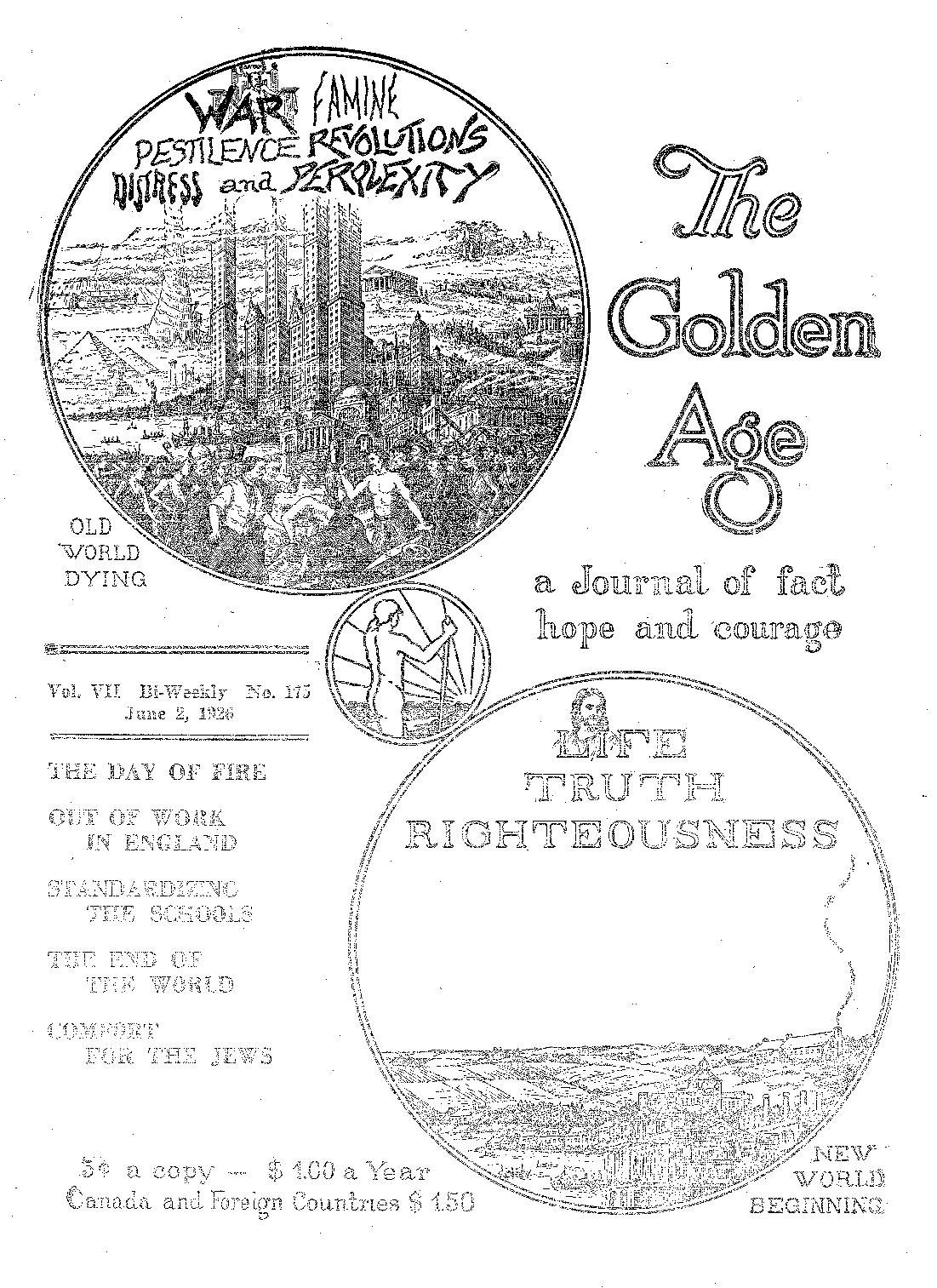
BS!
Contents of the Golden Age
--------- - '.:w—- :
Labor and Economics
Oct of Work and the "Dole” . . ............ 555
1'he High Cost of Living ................ 560
Social and Educational
On American Shores .................. 553
A British Editor’s View of the Golden Ace ......... 556
The Channel Islands .557
Twenty Years a Newspaper Man . . . . . . . . . . . , . 558
Behind My Garden Wall ................ 561
The Work of God’s Hands ................ 563
Standardizing the Schools ............... 564
Photograph of a Very Old Man .............. 566
Eadio Programs ................. . . . . 574
Political—Domestic and Foreign'
The Day of Fire ................... 547
The Speaker of the Evening (Cartoon) . . . 550
From Our Glasgow Correspondent ............. 558
Zeal fob the I.aw in South Africa . . . , ... . . . . . 569
Agriculture and Husbandry
Some More New Fruits ........... 553
Five Square Miles of Cantaloupes ............ 554
The New Vegetable Topepo ............... 554
Airplane Dusting of Cotton Fields ............ 554
Grasshoppers in February ................ 569
Science and Invention
Something About Oub Sun ............... ,552
Home and Health
Plain Food Versus Feasting ............... 566
More About Dandelions the Year Abound .......... 566
Religion and Ptitt.osorhy
The Time of the End ................... 565
The End of the World .................. 567
Some Observations on Parasites ............. 568
Comfort fob the Jews ................. 570
Studies From "The Harp of God” ............. 575
J’ablished every other Wednesday at 18 Coneord Street, Brooklyn, N. 16, U. S. A., by WOODWORTH, HUDGINGS & MARTIN
Copartners and Proprietors Address: 18 Concord Street, Brooklyn, U.S.A.
CLAYTON J. WOODWORTH . . . Editor ROBERT J. MARTIN . Business Manager WM. U. HUDGINGS . . Sec’y and Treas.
Five Cents a Copy—$1.00 a Year Make Remittances to THE GOLDEN AGE
Foreign Offices: British.....34 Craven Terrace, Lancaster Gate, London W. 2
Canadian......... 38-40 Irwin Avenue, Toronto, Ontario
Australasian ....... 495 Collins Street, Melbourne, Australia South African ...... 6 Lelie Street, Cape Town, South Africa
Entered as second-class matter at Brooklyn, N. Y., under the Act of March 3, 18J9
ov Golden Age
Volume VII Brooklyn, N. Y., Wednesday, June 2, 1926 Number 171
The Day of Fire
RUSSIA, Turkey, Greece, Spain, Italy and England—one after another they have all capitulated before the onward urge of the facismo spirit of the dictator! In alleged apprehension of the red propaganda calculated to seduce the arrny and navy, the British “conservative” elements have been quietly consolidating an organization really intended to break the stranglehold of union labor on insular industries. '
Last month the psychological time seemed to the British conservatives to have arrived for them to show their hand. Confronted with general paralysis of industry the government invoked the Emergency Powers Act, passed as a war measure in 1914, whereby Premier Baldwin automatically assumed dictatorial powers, with full authority to requisition and operate the mines, transportation and other branches of industry by the government, using the army, marine and air forces to quash all opposition on the part of the strikers who refused to work increased hours for decreased pay. The government even announced that it would commandeer all radio broadcasting stations, presumably for conservative propaganda and to keep the unionists “off the air”. Now they may say that they won—but the final conflict is merely posponed.
Following the brief ascendency of labor during the war, the conservative element has regained its prestige and materially strengthened its hand. Furthermore union labor, it must be admitted, sometimes acts in complete though unavowed accord with its nominal adversary, to defraud the public; while communism, having gravitated into a phase of capitalism, though not stifled has nevertheless been curbed; and the ever present threat of red activities has provoked a white reaction, the most spectacular form of which is known as fascismo—dictatorship, autocracy in the fullest sense.
. Fascismo, originated in Italy soon after the
By 0. L. Bosenkrans, Jr.
war, has achieved supremacy with startling ease and rapidity, first in its home land, and then has spread out like a white plague through Europe ■—into Spain, Greece, France, Germany, Austria, Poland, Denmark, the Balkans and Great Britain. Even in India the British “conservatives” are organizing fascist clubs in protest against the Swaraj movement of the native workers.
What Fascism Stands For
UNDAMENTALLY fascism represents a movement to supersede constitutional govits civilizing program of modernizing'institutions, is under the thumb of a fascist dictator, Kemal Pasha. In Greece, General Pangalos the dictator is an exact replica of General De Bivera, the dictator of Spain; and both are imitators of the Italian dictator Mussolini.
ernment by dictatorship in the hands of ona. on whom the conservative moneyed powers can implicitly rely, who is expected to arbitrarily override popular liberties wherever they interfere with the attainment of the “interests’ ” goal. Virtually it amounts to an adaptation of the Bolshevist, idea to subserve the aims of the master-class instead of the proletariat.
Mussolini, the founder of fascism, is himself a renegade Socialist. The movement, which is curiously reminiscent of Hellenic “tyrannico” and the Caasarian imperatorship, at first seemed to be out of sympathy with the Vatican; but latterly, it is observed, has won the warm approval of the Catholic hierarchy.
Our American press has systematically sought to convey the impression that fascism is endemic to the Latin peoples, that it represents their innate propensity to establish a clique in power rather than to perpetuate representative government. That, however, is but a superficial view of it, and contradictory to its ominous aspect as a world-phenomenon. The fact that fascismo has the backing of capitalism has been studiously kept in the background in every land.
The fascismo spirit of reactionary despotism is manifesting itself in countries which ostensibly condemn it. In Russia the Soviet system has been changed and crystallized into a veritable fascist bureaucracy. Turkey, in spite of 647 "
Signs of the Times
THE late Pastor Russell discerned a regular -*• sequence of human events portrayed in Biblical prophecy and Apocaliptic symbolism, as introductory to the establishment of Messiah’s kingdom. These signs of the times as he saw them outlined were:
(1) The international armament race of the past twenty-five- years.
(2) The outbreak of the World War as a natural sequence.
(3) A subversion of sectarian disagreements by the Protestant bodies and a rapproachment with the Papal See.
(4) An overwhelming triumph of capitalism ever the radical elements, accompanied by an abrogation of popular liberties, which capitalistic reaction in concert with confederated ecclesiasticism would inaugurate a drastic persecution of nonconformists to their regime, ostensibly on “patriotic” grounds; but the triumph of “Babylon” would be evanescent, owing to the widespread diffusion of education among the masses and of liberty-loving ideals; then despotism (fascism) being rife would become unendurable.
(5) World-wide revolution would ensue on a hitherto unprecedented scale, and the setting up of “beastly” revolutionary governments, under which civilization would gradually go to wreck.
(6) A steady growth of the Zionist movement, and the rehabilitation of 4he Holy Land.
(7) Finally becoming incensed at Jewish nonconformity with their program of communism and atheism, and envious of their material prosperity, the “beastly” red governments would band together and launch a crusade against Palestine, the “land of unwalled villages”.
(8) Though meeting with initial successes, these revolutionaty governments would collapse more suddenly than they arose, before a special and direct manifestation of divine anger and judgment.
(9) Armageddon, universal anarchy, would Eupervene.
(10) Then, by divine intervention, order would be restored out of chaos, and a new government would arise, based upon righteousness and truth, the kingdom of Messiah. .
I personally see no valid reason for particularly amending this schedule. The signs are being conspicuously fulfilled in current history. The World War, when “the hills did tremble and their carcasses 'were torn [by shells] in the midst of the streets”, is in retrospect. The Protestant churches are striving to confederate themselves, though the Methodists still hold aloof. Anglicanism poses as the source of authority for Protestantism at large. However, this “rolling together” is yet in a tentative stage. Capitalism has regained its prestige over the radical elements since the Avar. Zionism is meeting with predicted success. In fact, all the aforementioned “signs” are manifesting themselves in true prophetic order, leading up to the final Armageddon conflict.
Whither Are We Drifting?
WE IN the United States are accustomed to felicitate ourselves on our democratic institutions, yet we nevertheless are being reminded frequently of late by certain sections of the press that our constitutional rights are being progressively infringed on in these post-bellum days, and that federal and state governments show an increasing tendency toward paternalist encroachments and a centralizing policy prejudicial to local autonomy and bordering on fascism. Blue laws are passed on the sly, making it illegal for the quiet citizen to hoe his garden on Sunday, though it is all right for the hilarious bounder to “'tank up on moon” and run over people with his car. Prohibition is cited as an example of sumptuary legislation which infringes on the rights of individuals. The statute books are being crowded with a mass of new and superflous laws, while even the old ones suffer for lack of enforcement.
Now steps forward Senator Capper of Kansas, erstwhile staunch opponent of conscription, with his Universal Draft Bill, which has the enthusiastic endorsement of the American Legion because the ex-service men imagine that it will hit the war-profiteers,-against whom they nourish a grudge. This bill, according to its pompous announcer, is designed primarily “to promote peace . . . and next, to see to it that there shall be in the event of another emergency no slackers and no profiteers”. The intent of the Capper Bill is to conscript both men and money. It contemplates government control of both public and private resources for use in the national defence. By it, the president is empowered, whenever he shall consider an emergency to have arisen, to supersede constitutional government by a military dictatorship, to put the whole community under martial law.
The excuse made for such a revolutionary abrogation of our constitutional guarantees is that if capital became alarmed over the prospect of its own conscription the contingency of war would become remote. To us this reasoning has the appearance of shallow subterfuge, transparently camouflaging a more sinister purpose; for if the moneyed interests exercise such a potent influence over the federal government that they can instigate a declaration of war, is it not absurd to draw the inference that their influence is inadequate t.o prevent a conscription of capital. ?
Conversely, if the popular suspicion be a just one, that polities is the tool of finance and legislation directed by lobbying, is it unreasonable to surmise that Congress is unlikely to offend the big intei-ests? If the Capper Bill is enacted does it not seem probable that capital will supervise the final drafting of it in such a way that, there will be no serious interference with profits? Nay, we can conceive of a financial ‘■'emergency” carefully planned by Wall Street, and a public educated by systematic propaganda to accept it as such. Would the public then be treated to the edifying spectacle of witnessing steel drafting oil and oil drafting the automobile interests, or would all three combine to draft the sawings of the common people? ■
Hw Fascism Works
SSUMINCr that this proposed nominal mili-' tary dictatorship be sponsored by big interests, it is patent what stupendous powers would become vested in the bureaucracy, whose membership must consist chiefly of their own appointees. And neither war nor the threat of it need be requisite to bring about this virtually fascist revolution in America. A railroad strike or other “emergency” might precipitate it. Once established, it might become self-perpetuating.
.Can we American citizens, with our traditions of personal liberty and our heritage of fre® speech, free. assembly, freedom of conscience, the habeas corpus and trial by jury, view without consternation the prospect of forfeiting.our inalienable rights to choice of residence and occupation; and of finding ourselves suddenly placed under military discipline in a time of profound peace, with the minions of organized graft arbitrarily assigning to each man and woman a job, however - uncongenial and unsuitable, and forced to accept whatever meager wage is determined by the bureaucracy as sufficient to maintain us at a level of “efficiency”, driven by “bucko” foremen and punished for “slacking” if we cannot- keep up the gruelling pace?
Shall the common American citizen find himself and his moderate savings confiscated under the plea of war necessity when there is no war, while the same old profiteers, masquerading as government officials, are reaping enormous profits? Yea, and shall the commonalty find itself herded to chapel to listen with mutinous ears to unctuous sermonizings on patriotism and the unpardonable sin of “slacking”? Patriotism might be made a fetish; and ths flag, the symbol of our liberties, may thus be degraded into a symbol of our enslavement to incarnate greed. As usual, the riff-raff could be hounded on to manhandle anyone displaying lukewarm enthusiasm, and conscientious objectors would be rated as slackers and “courtmartialed” at will.
Does it seem incredible that the freest people upon this planet should lose their heritage of liberty overnight? Are we forgetful of the incalculable power of propaganda when skilfully directed by experts? .Every agency would be brought into requisition—-press, pulpit, lecture platform, schools, billboards, books, pamphlets, magazines, leaflets, megaphones, electric-signs, moving pictures, and the radio. Mob psychology would be invoked; the power of suggestion relied on. Against this prodigious array, what chance would a few feeble protests have of being heard? Almost everybody would become an ardent “patriot”, for the time being, and kiss their chains.
Now I discern no good reason for doubting Pastor Bussell’s conception of the time of trouble, as manifesting itself in throes of world war, world revolution, and world-wide anarchy, with, intermittent “easements” or lulls of traa«
TH® SPEAKER OF THE EVENING
^TO-DAY, GENTLEMEN, OUR COUNTRY 'FACES ITS GREATEST ERA OF PROSPERITY—THE DAWN OF A NEW, 100% AMERICAN'CIVILIZATION/*.
Copyright, Life Publishing Company
quillity. At present we are enjoying such an interlude of comparative “peace and safety", while Babylon is laying Machiavellian plans to consolidate its power by stealing the Socialists’ “thunder’. The public is being soothed and tickled while they are braiding the knout. The public may be taken off its guard and crushed into servitude to international finance; but the triumph will be brief, for the reason that the current generation has been imbibing a doctrine of skepticism and self-worship which intrinsically unfits it to continue long as the docile subjects of despotic mammon.
The ascendency of fascisino will probably effect an adjustment of grievances among the capitalistic governments, especially with respect to war debts. Meanwhile the screaming of the war-eagles serves to distract public attention from the more important business of solidifying the dictatorships.
Perils, Yellow and Otherwise
THE epoch of revolutions may witness the overthrow of white dominance on the planet, together with nationalist governments in the Orient. The colors have a score to settle with the sons of Japheth, and we may look for reprisals. Already the Chinese are becoming expert in handling modern military equipment; soon they may turn to manufacturing their own. The Chinese are an ingenious and adaptive race.
There may be no conspicuous resort to chemical warfare until the crusade against the Zion slate terminates in catastrophe and a universal homicidal mania obsesses mankind. The world will be reckless of consequences then, eager only to kill and burn. .A masculinized womanhood will be as savage as the men. Then may be realized the horrors previsioned in No. 172 of The Coldest Age, under the caption, “'Prohibition of Poison Gas War.” Then smiling madmen from hidden power stations may by radio direct the course of unmanned airplanes and aerial torpedoes which dart hither and thither broadcasting destruction, and pandemonium will break loose. .
The compact, thickly-populated, highly-industrialized centers of civilization will be drenched with gases, bathed with liquid-fire and sown with bacteria. Unquenchable conflagrations will overspread the sky with a blanket of smoke, almost impenetrable to light, hiding the orbs of day and night and the constellations, reacting on the human mind to plunge it into hopelessness and gloom. Perhaps some previous preparation will have been made of elaborate subterranean tunnels and chambers in anticipation of this awful time. Then fugitives will climb the “ragged rocks” of the mountain peaks to “seek sweet safety out”.
The World War disclosed what prodigious havoc can be wrought by modern explosives, even to the soil itself. But imagine all Christendom become a “No Man’s Land”, subjected to manifold greater harassment, by more terrible war engines ’ Is it altogether unworthy of belief that a universal chemical war might pollute the soil and kill all vegetation, poison the streams and fountains, effect chemical changes in the sea-rvater until “every living soul” died therein; yea, “consume the birds of the heavens” and cause the very elements to “melt”; i. e., vary their proportions in the atmospheric admixture of gases ?
The Day of Fire may be intended with a literal as well as symbolical significance, reducing great areas of the earth’s surface to the condition described in Jeremiah 4: 23-27. Of course the planet itself would remain intact, though the crust might be subjected to unprecedented seismic convulsions. After all, does not'the literalness of the Deluge of Waters seem to afford a precedent for expecting a literal Day of Fire?
Sun’s Rays Made Destructive
OU lack of space I must endeavor to crowd into a few short paragraphs an argument which deserves at least as many pages. This argument'is based on the theories of Prof. Isaac N. Vail, originator of the “Annular Evolution” hypothesis. I refer the interested reader to his works, contenting myself with summarizing in the boldest sense his conjectures concerning the scheme of nature-economy which obtained during the antediluvian world, which he identified with the Pliocene age, during which time he surmised that all conditions of life were regulated by activities of certain solar rays so> at variance with those familiar to our scientists as to be virtually outside the sphere of our comprehension.
His view was that the solar ray then transmitted through a canopy of aqueous vapors, was greatly modified in its activities, being partly divested of its actinic properties.. Since the solar orb is the fountain head of both life and death on the planet all life becomes immediately responsive to the slightest variation in its activities. Prior to the flood, for a long- period the actinic power of the solar beam had been unable to function in full, consequently plant growth was prolonged, with slowness of maturity, and decay reduced to a minimum. Correspondingly animal life was torpid. There were no rain and ho wind. The excess of CO2 was absorbed by the luxuriant vegetation. There were no extremes of temperature or seasonal changes.
' The open skies and sunshine of the postdiluvial times exposed life to the dual functioning of the sunbeams. Oxidation was accelerated, hastening the processes of growth and decay, progeneration and degeneration. With quickened pulse beats and exposure to frigidity, man was fain to repair his wasted tissues and lay up reserves of potential energy by eating meat.
The weight of polar ice-caps brought into being the ecliptic to serve as a balance wheel for our complex system of nature-economy. Air circulation, an attendant phenomen, intrinsically affected all life, which has become so intimately interrelated and interdependent that the supposition that man can exist in solitary immunity while life in general is involved in the cycle of growth and decay, is unthinkable. So long as this inexorable law prevails so long will man share, with all life, subjection to it. Nothing can mitigate the destructive power of the solar rays except some change transpire in the atmospheric medium through which the sun’s rays are transmitted.
My assumption is that this atmospheric transformation will be accomplished during the Day of Fire. How it will be done is perhaps yet unguessable. Some scientists believe that our recently discovered stratosphere of helium and hydrogen has only lately been formed by the combustion of coal and mineral oil in these engine-driven latter days. They believe that the top of our photosphere marks the ancient limit of our air. We may assume that a gigantic chemical war with resultant conflagrations might likewise affect profound changes in our air, immediately destructive, but eventually of eternal benefit to planetary life.
Eyen as the deluge revolutionized natureeconomy so that the “world that was” was speedily forgotten, so the “new heavens and new earth” will be so different and so surpassingly more conducive to health and happiness than the “present evil world” that the latter will neither be remembered nor come into mind, except by special effort.
Nevertheless, since it is written, “Yet will I not make a full end,” we may infer that Palestine, through direct interposition of Providence, will pass through the fiery ordeal (Jer. 30 :11), the Jews being aided to readjust their physical organisms to the new atmosphere. Palestine will serve as the nucleus of a new culture of righteousness in a regenerated earth, purged by fire from sin and the reminders of sin.
The incorrigible sinner, not being able to survive under the new conditions, will be like a fish out of its natural element. But the equinox will continue, as it is written, “While the earth re-maineth, seed-time and harvest, and cold and heat, and summer and winter, and day and night shall not cease.”'—Genesis 9: 22.
Something About the Sun
ASTRONOMERS regard our sun as a dwarf.
It looks to be about the size of the moon, because it is 400 times as far away, but its diameter is actually about 400 times that of the moon, and it is 500,000 times brighter than the moon. One million planets like our earth could be put into our sun if it were a shell. There are known to be approximately 1,500,000,000 suns, one of which, Rigel, is at least 10,000 times brighter than ours; and two of them, Betelgeuse and Antares, have bulks which are nearly 40,000,000 times greater than our own Sol. Some suns are white and brilliant, some ruddy and fading, some are non-luminous. Spectroscopy shows that there is no element in any of the suns that is not in the earth beneath our feet; and there is nothing in the human organism that is not in the earth and the suns, all bearing evidence of their common origin at the hands of our Creator.
On American Shores
Mechanical Telephone Service
fTVHE nerve-racking job of telephone operator will be a thing of the past some day ere long. Automatic equipment is being gradually installed here and there all over the country. The operation of an automatic telephone exchange is one of the most fascinating things in the world. It takes but an instant for a mechanical finger to find an empty wire for the subscriber’s use and the connection is made without any operator. At the end of the month the registers are read by camera, which makes the hills mechanically perfect.
Same Collection Lifted Twice
IN FRESNO, California, a firm of evangelists had just made their evening haul, which they estimated at $30, and had put it into a bag, all ready for deposit in the bank next day. But while the audience was engaged in prayer some godless thief swiped the bag and managed to get .away without being caught. There is no clew to the guilty man.
Reducing Blindness in the United States
THERE are still in the United States about one hundred thousand blind persons, one-half of whom need never have been blind. Ten years ago the National Committee for the Prevention of Blindness consisted of three philan-thropically inclined individuals. Now there are fourteen thousand persons, and their combined efforts have reduced certain forms of blindness by as much as one-half. Proper attention to newborn infants, abolition of roller towels and the use of larger and clearer type are some of the items advocated extensively by the committee.
Principal Ports of the Nation t
LAST year there were nineteen ports in the United States that handled more than a million tons of cargo each. New York was first, with 22,000,000 tons, New Orleans second with 9,000,000. Philadelphia had 6,000,000; Baltimore 5,000,000; Los Angeles 4,000,000; Buffalo, Galveston, Norfolk and San Francisco each had 3,000,000; Boston, Houston, Port Arthur and Newport News each had 2,000,000, and Baton Rouge, Mobile, Perth Amboy, Cleveland, Seattle and Portland (Ore.) each had 1,000,000.
Los Angeles the Metropolis
THE port of Los Angeles has risen to the considerable dignity of being the fifth port in the United States, its commerce in 1925 being exceeded only by that of New York, Philadelphia, Baltimore and New Orleans. Its tonnage of exports and imports for last year was 3,751,700, while the combined tonnage of the ports of San Francisco, Portland and Seattle was only 4,727,370. Los Angeles has thus become the metropolis of the West.
Limiting the Sky Line
NEW YORK has eighty-six buildings of twenty stories and upwards, and seventeen of thirty and upwards. The Christian Missionary Building will be sixty-five stories high, eight feet higher than the Woolworth Building. .\New York is not moving wisely in erecting such high buildings. Street congestion about these high buildings gets worse and worse all the time and the subways are jammed to suffocation. In Los Angeles there is a city ordinance limiting the height of new construction.
The Grassyfork Fisheries
WE ARE informedin Commerce and Finance that “the largest goldfish farm in the United States and probably in the world is in Indiana, the Grassyfork Fisheries. Here some five million young goldfish are raised annually from some ten thousand mother fish, and their care requires the constant attention of fifteen experienced people.” The farm has 600 acres of rolling lands in which there are 180 ponds, with an unfailing supply of fresh water.
Some More New Fruits '
T) RETTY soon they will be raising in Florida
the monistera deliciosa from Trinidad, which looks like a large ear of corn and tastes like a blend of strawberry, pineapple and banana; the carissa from Natal, a green plumb-like fruit that makes a delicious salad; the sapodilla, which looks like an Irish potato growing on a tree but tastes like a sweet apple; also the manzanillo jambolin, the canis'tel, limequat, papaya, the banana melon, the custard and Jamaica apple; the rose apple and the Key, Persian and Ranjpur lime. These are only a few of the new fruits.
The New Vegetable Topepo
NEW vegetable is on limited sale in New
York, Philadelphia, Washington, Chicago and some other large centers. The name of the vegetable, which is a combination of the tomato and the bell pepper, is the topepo. The fruit is from six to eight inches in diameter, combining the pungency of the pepper with the flavor of the tomato.
Five Square Miles of Cantaloupes
IN THE Imperial Valley, California, the area planted to cantaloupes this year aggregates 31,000 acres, in addition to which there are 1,500 acres of honey dew melons; so that, taken together, the total area to cantaloupes in that one district is over five square miles. Shipments start about May 5.
Necessities of Life
HE necessities of life are not the potatoes, bread and stew meat, tea and coffee, which go to make up the food supply of thousands of the poorer families of the cities, but the green vegetables, butter, eggs, milk and fruit which they are unable to get. Thousands of city children are really starving, as far as nourishment goes, even though they do have sufficient to sustain life. In other words, they are alive but not enjoying life. It is of first importance to the future of any city that its present children be well fed.
Where Taxes Are Lowest
HE State Commission of Housing and Regional Planning, after a study of the taxes of New York State, reports that the smallest taxes were not in the counties having the siall-est populations, where as a matter of fact they are very high, nor in counties having large cities, where they are also high; they are less per family in counties of 50,000 to 100,000 population.
Ebony Ties in Mexico
HE Texas, Mexico and Orient line is building an extension of its railway down in Old
Mexico. The only timber available for ties in the section which is being constructed is ebony, so hard that holes must be drilled before spikes can be driven. But it is believed that this hardness insures the ties’ lasting for generations.
Intensive Farming in Florida
EAR Green Cove Springs, Florida, some twenty miles south of Jacksonville, is an intensive farming experiment where any family that can support itself for a year is allowed to come and raise what it can and sell it and move on, if not satisfied to purchase and remain. But the thirty odd families that have tried the new plan have elected to stay.
Airplane Dusting of Cotton Fields
HE airplane dusting of cotton fields has grown from almost nothing in 1921 to 50,-000 acres in 1925. The charge for airplane dusting is $5.35 per acre for the first three applications and $1.00 per acre for each additional application. Figures show a net gain of $33.14 per acre in value of the crop where dusting is practised.
Difficulties of Transatlantic Telephony
HE New York Times, speaking of the remarkably successful half day conversation which was held between New York and London on the occasion of the fiftieth birthday of the telephone, calls attention to the fact that at sunset it is impossible to maintain satisfactory communication, and that the variation in conditions is so great that there are times when ten thousand times as much transmitted power is required as under favorable conditions.
Mann School Abandons Fractions
A CONSIDERABLE step forward has been made by the Horace Mann School of New York which has abandoned a considerable part of the study of fractions, which was once the bane of child life. This was done because it was found, after a survey, that very few business men make much use of these troublesome things, but resort to decimals, every way more practical.
Care of Blind Babies
HE states of New York, Pennsylvania, Arkansas and North Dakota each pay $1.50 per day for the care, maintenance and education of blind babies or small children who are blind. If you know of any blind babies in those states who are not receiving the state aid, communicate at once with the State Board of Education at the capital for further information.
Out of Work and the “Dole”
TN A RECENT issue of- The Golden Age, under the heading “The World and its News”, appeared an item entitled “Do Something and Be Something’", in which was cited the case of a British ex-service man who sang in the streets of London instead of “having his hand out for the dole”. I always look forward to the arrival of your magazine with pleasure; it is good for us to see ourselves as others see us. But I venture to think that if you could come into personal contact with many of those who (perforce) “held out their hand for the dole” your remarks would be somewhat different. ,
The following observations may give some light on one phase of the labor situation in England, which culminated last month in the greatest industrial deadlock in the world’s history.
I feel as one who has had some slight experience in your land of large opportunities, and realize that it is rather difficult for our American brothers to understand the limitations of this comparatively small land of ours, with its class distinction and prejudices. I live in Lancashire, where most of the cotton mills are to be found and where much privation and suffering have been experienced since our profiteers, politicians and parsons made our land “fit for heroes to live in”; and I know from experience the difficulty of finding work other than that to which one has been accustomed.
When Johnny leaves school he is sent into the mill, there to learn spinning. He begins as a pieeer and works his way up until he becomes a minder—if he lives long enough and sticks fast to the one job at the one mill. But woe betide him if he for any reason finds himself out of work. He may get work elsewhere, but he must begin again at the bottom; and if he seeks any other occupation except a menial one he is met with the question, “Have you done this before?” If his answer is No, his services are not required.
These are some of the difficulties experienced in “normal times”; but just before the strike, over a million persons were idle, and the majority of them had no voice to speak of. Having no prospects of obtaining a home anywhere, even if it were possible to obtain so much as a temporary job, many were compelled to hold out the hand, not for a dole, because a dole means charity, a free gift, but for the unemployment benefit to which he had been compelled to contribute when
By Ernest Butterworth (England'')
at work, and which he is justly and lawfully entitled to when unemployed; which benefit the brazen-faced politicians, assisted by a corrupt press, have sought to bamboozle and shame him out of by calling it a dole, charity, something which any man worthy of the name would be ashamed to accept if he could possibly avoid it.
[We thank you for this information and humbly ask your forgiveness.—Ed. ]
Perhaps some facts concerning the experience of one in search of a job would be of interest. Every male manual employe in Britain from the age of eighteen upwards is compelled to submit to' a weekly deduction of one shilling and two pence, part of which goes to provide him with a pittance (in the event of his becoming unemployed) of eighteen shillings per week. (What other Insurance Company would have the audacity to call such benefit a “dole”?)
But let not the innocent reader think that Johnny has nothing to do but sit at home waiting for a job, and trotting off every Friday holding out his hand for the “dole”. Oh no, the fact that he has paid his premium (and if he only does one day’s work in the week he must pay up) is no guarantee that he will receive his benefit. Strikers get no “dole”, of course.
In the first place, the employer is required to send a statement as to the reason for his discharge. Then Johnny is required to go to the Labour Exchange - and sign on as unemployed. There he enters into the “dole” atmosphere: He is made to feel that he is almost committing a crime in being out of work at all. He must state where he worked, how long, and why he left; where he worked before that, how long, and so on, as far back as he can remember; then he must attend two or three times a week to sign on, as long as he is unemployed.
But even, now he is by no means sure of receiving his “dole”, though he may “hold out his hand for it”; if he happens to be a young single man with a father at work he receives no benefit at all, however long he may have paid his insurance assessments to the benefit fund. Furthermore, if he is to. maintain his claim to medical benefits he can only do so by making good the arrears covering his period of unemployment. If his “benefit”, is charity it is indeed a doubtful blessing. .
And now, to make it still harder for labor to get the benefit to which it is entitled the philan-
4hropic gentlemen who control the destinies of this fair land have decreed that Johnny must obtain a written declaration from the firm where he has been seeking a job, in proof that he has been genuinely seeking employment. What this means will be apparent from the enclosed clipping, which describes a mob of 2000 seeking to fill an opening of six jobs at manual labor. Truly this is a land fit for heroes to live in.
If in spite of all this a man, down and out, maintains his claim to his insurance benefits, then he must sign on for one week before it begins to count, and then he must also sign on the second week and the third, and finally at the end of the third week he receives one week’s pittance, that.is, eighteen shillings.
Now after he has received his benefit for a certain number of weeks he comes to a period known as “The Gap’’, wherein he must wait six weeks without any “dole” at all, presumably to allow him to spend any benefit money that he may have saved through extraordinary economy, and to help him to ever appreciate the “dignity of labor”—in reality to shift the burden of the state onto the shoulders of the local authorities, thus making the unemployed unfortunate indeed dependent on charity. Can we wonder if in time he loses his self-respect and his efficiency as a workman ?
I have not written this in a spirit of faultfinding and criticism but just to draw attention to the other side of the “dole” question, and to show how these men, whose only fault in many cases is that they were workless, are slandered and misrepresented by those who know better. Surely we long for the arrival of the Golden Age, _
When men shall live by reason
And not alone for gold,
With man to man united, And every wrong thing’ righted J The world shall then be lighted, As Eden was of old.
. A British Editor’s View of the Golden Age
(Itepriiited from The New Age, a weekly -review of politics, literature and arts.)
A COPY of The Golden Age, (Brooklyn, N.Y., magazine), dated February 24th, which has been sent us by a reader, contains an article on the Channel Islands written by an inhabitant. In the course of it he says
The islands are self-governed. Although nominally they belong to the King of England, yet they do not come under the authority of the British Parliament. The islands came under the control of William, Duke of Normandy, in 1061, before that gentleman conquered England. They own their allegiance to the British King only as William’s successor.
An interesting situatioii has arisen over Britain’s war debt. Parliament claims that the islands should pay towards the same, but it has no constitutional power to impose taxes on us. Guernsey made a grant in 1919 of £100,000 towards this debt . . . raised by a tax of four-pence a basket on tomatoes. Many growers were summoned because of refusal to pay. Guernsey has since made an additional offer of £200,000 as a final payment. » , . This lias been neither accepted nor rejected, but a committee of the King’s Privy Council has been appointed to inquire into the ability of the islands to pay a war tax.
The islands had their own banking systems and currency until after the war. Now the currency has been changed to English money, and the shareholders of the island banks have been bought out by British bankers. . . . Now the erstwhile self-governed islands are under the control of the real rulers of Britain—the financiers, who will no doubt make interesting suggestions through the privy councillors concerning a war tax.
The writer is evidently a student of real politics. From what he says it is dear that the independence of the islands, guaranteed constitutionally, is being lost all the same by the external exercise of financial power. It was inevitable, too; for the islands, with their low taxation (income ta'x 4d., wines, spirits and tobacco lightly taxed'—e, g., tobacco, a blend bearing 18s. tax in Britain bears 8s. there), constitute a leakage in the general taxing system.
The writer refers to the suggestion that “many patriotic people have come to reside here from England because of the small income tax.” Parliament cannot do anything about it; but the Masons of the Privy Council can.
* ' * *
In the same magazine a note says that the Catholic Church of Bavaria is borrowing something like £6,000,000 from the bankers of New York,. and that Cardinal Hayes has also arranged for a large loan to the Vatican. Another note we reproduce verbatim:—
At the moment it looks as though the Standard Oil interests, operating through France and Turkey, had failed to retain the oil region about Mosul. The Anglo-Persian Oil Company, operating through Great Britain and the League of Nations, has decided to award Mosul to Irak, which means that the Dutch Shell Oil Company, and not the Standard Oil Company, gets Mosul. Turkey is making threats that she will fight to keep Mosul. We wait to see.
These notes are supplemented by a long article on money and usury, very simply written. 'The whole magazine is well worth reading. Its main preoccupation is with the prophetic scriptures (Judge Rutherford’s addresses receiving a good deal of attention), but as a whole it presents an admirably balanced synthesis of sociological, economic and scientific facts and discussions.
For instance, in an article, “Interesting Items about Light,” we notice a reference to Flam-marion’s suggestion that the time will come when science will discover in light the principle of every movement, and the inner reason of things; together with the comment: “If science ever makes such a discovery it will discover the Creator, but it will be done by the eye of fidth. "God is light, and in Him is no darkness at all.’ ” That light is the one Absolute in a universe of Relativity is a concept which certain of our readers will remember hearing enunciated by Mr. D. Mitrinovic in one of his recent lectures.
The Channel Islands
AS A constant reader of The Golden Age ever since it began to be published, I have enjoyed the articles appearing in that most interesting magazine; but never were my emotions so stirred as by the article appearing in the issue of February 24, 1926, the title of which was “The Channel Islands”, by Z. Widell.
You will readily understand why this article . so strongly appealed to me when I state that I happened to be born on the most beautiful one of all the group mentioned, viz., Guernsey; and I was surprised and delighted to know that The Golden Age is a welcome visitor to those islands.
Two of the smallest islands in the group, Herm and Jethon, were not mentioned in the article. They are so close together that people can cross from one to the other at low tide. They are only a very short distance from Guernsey.
In my early days, I have visited all of those islands, and remember especially my visit to Sark, six miles from Guernsey. Going over on the little Guernsey steam-boat and landing in the pretty little harbor, we climbed the hill through the tunnel bored through the cliff. It is a very hard climb; but well worth the effort. As we reached the table-land on top, we were rewarded with a beautiful panoramic view of Guernsey and the other smaller islands, including a splendid view of the Atlantic'Ocean, as
By Walter J. Thorn
the glittering sun shone upon it in all its glory.
As to how Guernsey became my birthplace necessitates my.relating a little history. A short time before the Civil War in America several Guernsey people emigrated to the States. A-mong them were William Thorn, a Britisher, and Rosaline Domaille, a French girl, who were married later in Cincinnati, Ohio. The oldest son, a minister in the Church of England, now residing in Bournemouth, England, and four other children, were born in Cincinnati; but I had not yet come upon the scene.
Father joined the Ohio National Guard, and when the Civil War broke out he was drafted and served for several months; but at the close of the war he returned with his family to Guernsey. There three other children were born, two sons and a daughter, I being one of the three born in Guernsey.
My parents always remembered America and their residence there. My father received a pension from the United States government for his services in the war, until his death. When I was twenty years of age he suggested that I go to America, as he did not want me to spend all my life on that little channel island. So I left Guernsey and came to the States and landed in Boston, Mass., nearly forty years ago, eventually becoming an American citizen.
The English poet named Smith, who visited the channel islands a few years ago, said truly:
“Jersey, Guernsey, Alderney and Sark, Four little islands all in the dark.”
Had I remained there all my life, in all probability I would not have been able to see and comprehend the wonderful divine plan for the salvation of the human race, as I now see it.
I have been privileged to travel over nearly all the United States and Canada, first in the colporteur service and latex- in doing evangelistic work fox* the International Bible Students ’Association, for nearly thirty-five years; and now my heart rejoices to read in The Gowen Age that even in the Channel Islands
“Colporteurs are there, working with their might, To flood those dismal islands with God-given light.”
Truly- the poet Cowper was right when ha penned those beautiful lines,
“God moves in a mysterious way, His wonders to perform.
Ho plants his footsteps in the sea, And rides upon the storm.”
As it is now nearly7 forty7 years since I left my beautiful little channel island home of Guernsey, I would enjoy7 so much to make a visit there once more; but y7our splendid article was almost as good as a visit.
You have my kindest regards and a prayer that The Golden Age may continue to be a means of comforting and cheering all its readers, by7 pointing to the future glories of the Golden Age under the reign of earth’s new King.
Twenty Years A Newspaper Man By John A. Mackays
I HAVE been twenty years in the newspaper.
business in Europe, in this country and in the tropics, and the last ten years have had a knowledge of the truth; and I urge you NOT to change your editorial policy. Especially are the “Digest of World News” and the letters from foreign correspondents valuable. They contain stuff that is never mentioned by' the newspapers and most valuable to all who are “watchmen”. The reason you get such a proportion of religious stuff is that the saints think it is the only thing they7 dare write on—at least some of them are that way.
From Our Glasgow Correspondent (Peter l)unn)
Duke Declines a Challenge at York
LIE Duke of Northumberland, prior to the strike, refused a challenge to debate questions of land ownership. Ue said, “The demand for a debate came only from an insignificant society of robbers.” Mr. Clynes, Labor M. P., replied that the truth is that there is a significant and growing section of the people who are not out for robbery-, but who are now chasing the insignificant few who have robbed society7 for generations. He said further:
An enlightened people of future ages will rock with laughter when they look back upon our times, wherein the people permitted an insignificant portion of the population to own and control the land which should have been the property of the nation.
If the Duke of Northumberland thought fit to decline a challenge he ought to do it with the grace which his station demands, and not descend to the language of the vulgar to denounce those who question a privilege which has no root in moral law or in national liberty.
Monarchs have by agreement forfeited their authority in many countries for the mutual good of the country. But the great landowners are as tight now as ever, and dukes who ought to depend upon their brains and ability7 for a living insist upon getting a good living from the labor and brains of others.
Is Scotland Protestant?
WE ONCE thought that Scotland was a Protestant country-, or at least that the University.of Glasgow was a Protestant institution; but alas, there seems little or no difference between Catholicism and Protestantism in this country7 today.
The late Cardinal Mercier, according to a report by7 Professor Sarolea in The Scotsman, was offered by7 the authorities of the University of Glasgow the honorary ( ?) degree of Doctor of Divinity; but he refused it. As a Catholio priest, he could not accept this honor from his Protestant brethren. Then the report continues to say that the authorities protested to Mercier that the University of Glasgow is not a Protestant institution, that indeed it owes its foundation to the bull of a pope.
Thus the daughter (the Protestant church) recognizes her mother, the holy (?) Roman Catholic church.
Continuing, a little further on in his report Professor Sarolea says: “To a Catholic, toleration means a desire to cooperate in all good works with his Protestant brethren, notwithstanding fundamental differences of principle. To a Protestant, toleration means the refusal to admit that any such fundamental distinctions exist.” So now we know who is a Protestant and ■who is a Catholic; if there is any difference they are both alike.
Television Now
TELEVISION station is soon to broadcast pictures in London. A young electrical engineer, Mr. J. L. Baird, has invented the “Televisor”, a machine capable of transmitting an image of the human face, which is said to show the exact play of expression, in light and shade.
The invention has been taken over by a company called Television, Ltd., who have been granted a license by the Postmaster-General to broadcast from London.
Tim instrument is about 24 inches square with a tunnel projection, through which the objects are seen. It is said that it can be fitted to almost any wireless receiving set.
Driverless Trains to Carry Mails
ONDON’S smallest tube, in which driverless trains will carry mails between railway stations and postoffiees, will be in operation towards the end of this year, if labor does not prevent. .
It is six and a half miles long, and connects . Whitechapel and Paddington, with intermediate stations at the various' post offices. The permanent way lias been laid, and practically all that remains to be done is the electrical installation.
When it is working there will be thirty trains of three cars each in the tube, and a two minute service. Each car will carry 10 cwt., and the tube will carry altogether ninety tons of mails
per hour. As a result the greater part of 600 or 700 Post Office mail vans will disappear from the London streets. . .
It is estimated that on the average the tube will save half an hour in the transit of mails between railway stations and post offices. There will be no drivers or conductors on the trains; they will be controlled by operators in cabins in the various stations. Between stations the trains will run at thirty-five miles an hour, and on reaching a stopping place will be automatically slowed down to eight miles an hour and then brought to a halt.
Lord’s Prayer in Many Tongues
CCORDING to a report from Budapest, a professor of religious instruction has been collecting for the past thirty years the Lord’s Prayer in foreign languages, and has presented the collection of about 1000 versions to the pope. It is doubtful if this will do him much good; for it is evident that the pope does not understand the Lord’s Prayer, even in his own native tongue.
Escalators for Safety
MISHAP on the tube escalator of Tottenham Court Road lately is the first accident that has ever occurred on any of the escalators of the London Underground Railway. This is a marvelous record, seeing that it is fourteen years since moving stairways were first introduced on the tube railways, and that they carry tens of thousands of people every day. Records show that the escalators are even safer than fixed stairways, and that fewer people trip or fall on them.
New Bridge for O.ld in Twenty-Four Hours
USH tactics were adopted by the London and Northeastern Railway Company in
Edinburgh prior to the great strike, when within twenty-four hours the old railway bridge crossing Abbey Hill at Milton Street was removed and a new bridge put in its place.
The old structure, one of the plate girder type, had served for fifty years; and the new bridge is of a corresponding design. As this bridge takes the main line traffic no time was lost in the transaction.
A staff of thirty men, and a huge crane, did the work. Late on Saturday night the old bridge was loosened and slowly lifted out of its posi-tioa. While it was oeing removed another squad were already at work fitting in the new Structure. It lay at the side of the gap, and all that needed to be done was to roll it into position and fix it firmly in its place. The new bridge was then tested by an engine prior to the passing of the 10:50 p. m. train from Waverly (Edinburgh) to London.
This quick work is in contrast to the observation of the American traveler who came to visit the Clyde, and who as lie was sailing up the river, which is narrow and bounded on both banks by shipyards, noticed posted here and there along the banks large signboards with the word “Slow”. Then as they neared the shipyards he saw one sign which said “Dead Slow”. Turning to the friend who was with him he remarked : “Well, I had heard that the Scots are slow; but I never knew before that they advertised it.”
Flexible Glass ■
NEW flexible glass has been .invented by two Austrian scientists. The material has many of the properties of ordinary glass, but is an organic substance, and is described as “organic glass”.
It is perfectly transparent and colorless, retaining its water-clear appearance under all atmospheric conditions, is sufficiently hard to be safe from accidental scratching due to handling or cleaning, and yet is flexible enough to bend under stress to a marked extent without fracture.
It can also be broken with the bare hands without risk, because the edges of the fracture are not sharp or jagged. It does not break off in sharp splinters. It is only half the specific gravity of glass; in other words, a given sheet of the new material is only half the weight of a sheet of glass of corresponding size and thickness.
Sheets and rods of “organic glass” can be bent between the hands to a sharp curve, or can be dropped on the floor without damage.
During tests a small ball made of the new substance was dropped onto a stone floor, and it rebounded almost to the height from which it was dropped. When flung down violently it bounced to a height of twenty feet. Subsequent examination of its surface showed it to be undamaged.
Who is the Shylock?
IN THE matter of war debts, Great Britain is owed £2,000,000,000, and is asking her debtors for repayment of £960,000,000 of the amount, so she can in turn repay' her debt to America. The balance of £1,000,000,000 she is shouldering. Every tax-payer in the empire is, in effect, making an annual gift of money to the taxpayers of almost every other country in Europe. Roughly we are giving away £2 for every £1 we hope to receive.
Two Eggs Per Week
IT IS estimated that in Great Britain the population eat about two eggs per week per head. Half of these eggs are of foreign origin. The interesting facts are revealed in a report just issued by the Ministry of Agriculture.
The home production of eggs is put at. 1,800,000,000; the number imported in 1924 was 2,433,000,000, of which 33,000,000 were re-exported.
The age of an egg may be approximated with ease. In every egg there is a certain amount of air space. When.a day old this air space, at-the large end, does not. occupy more than onesixteenth of an inch. As the egg gets older the amount of air space increases.
The largest amount allowed under the Marketing of Eggs Act of the Parliament of Northern Ireland is one-quarter of an inch. This can be ascertained by holding up the egg against a strong light.
The Sifgli Cost ©f Living By Wm. T. Knight
Tpl HEAR much about the high cost of liv-i I ing. Did you ever notice the cost of a package of breakfast, cereal and what is in it I Com flakes run up around $12 a bushel and puffed wheat holds the top at $36 a bushel. Thore are only four ounces of wheat in a package that sells for fifteen cents, and it takes sixty pounds to make a bushel of wheat. Kellogg’s “all bran” sells for twenty-four cents a pound. I wonder what the farmer gets for the grain that is thus doled out to consumers at from $12 to $36 a bushel!
Behind My Garden Wall
STATISTICS show that between the ages of eighteen and thirty-three the average American makes enough above comfortable living expenses to own his (or her) home, but that this surplus is wasted; that nine-tenths of the city dwellers do not owm even their latch key, but live in stuffy apartments, the kiddies dependent upon the painted and soiled lava of city street life for recreation and education; that ninety percent of criminals get their education in the same school. The life insurance companies tell us that out of every one hundred men fifty-three are homeless at the age of sixty and must be housed by others. . '
' What man needs is a home, one that is honest to goodness, where real lives are lived. While happiness is not geographical but conditional, surroundings help the color scheme a whole lot. A basic factor towards happiness is your own hearthstone and a “back to the soil” bent of mind. If we are city dwellers and cannot afford to buy, let us get roof or backyard privileges. Such a spot can be transformed into a sanctuary where the Creator of things walks and talks with you in the cool of the day. The love of the soil is fundamental to human nature, and if cultivated will enlarge our perspective. We shall be able to weigh life with a nearer balanced mind.
Under the Starlit Skies
T HAD a talk with a business man one day.
During the war lie had joined the expeditionary forces just to get away from the Wall Street mill. With the shifting of expediencies he had landed in Texas, where the troops were training and hardening for action. He never got his call overseas. But he did get a vital and workable understanding with the Infinite. He said that he used to lie sprawled out flat on the ground whole nights at a time, gazing into the busy workshop above.
Of course a Texas sky is a thing you can get only by going to Texas. Nowhere else is it equaled, not even in Italy. In our northern sky we see- only the big suns like our own; the smaller lights are veiled because of atmospheric humidity. But down there they have three or four more layers. The stars are so thick that they almost tread on each other’s toes. People are recognizable a block away in the moonlight;
By 'John Sanford
at times in the great open spaces you can read a newspaper with ease at midnight.
He got to pondering, he said. The latest telescope records 125 million suns, each with a planetary system as large as our own, or larger. These trillions of planets with orderly design-must have back of them not only an intelligent Creator, but an immensity of purpose of which man is an integral, infinitesimal unit. He said that by and by something penetrated his dull material mind, whose voice declared, “It is I.” His experiences changed his standard of values.
“I have never been the same since,” he said. “How small and sordid seemed my past! I felt that I had never really lived before. I had merely existed along with the hogs that eat the acorns and never behold the source of supply. I awoke, and like Edwin Markham
“ ‘I found me in a palace with God for guest;
…