Golden Age, April 21, 1926
Download: PDF — Golden Age, April 21, 1926
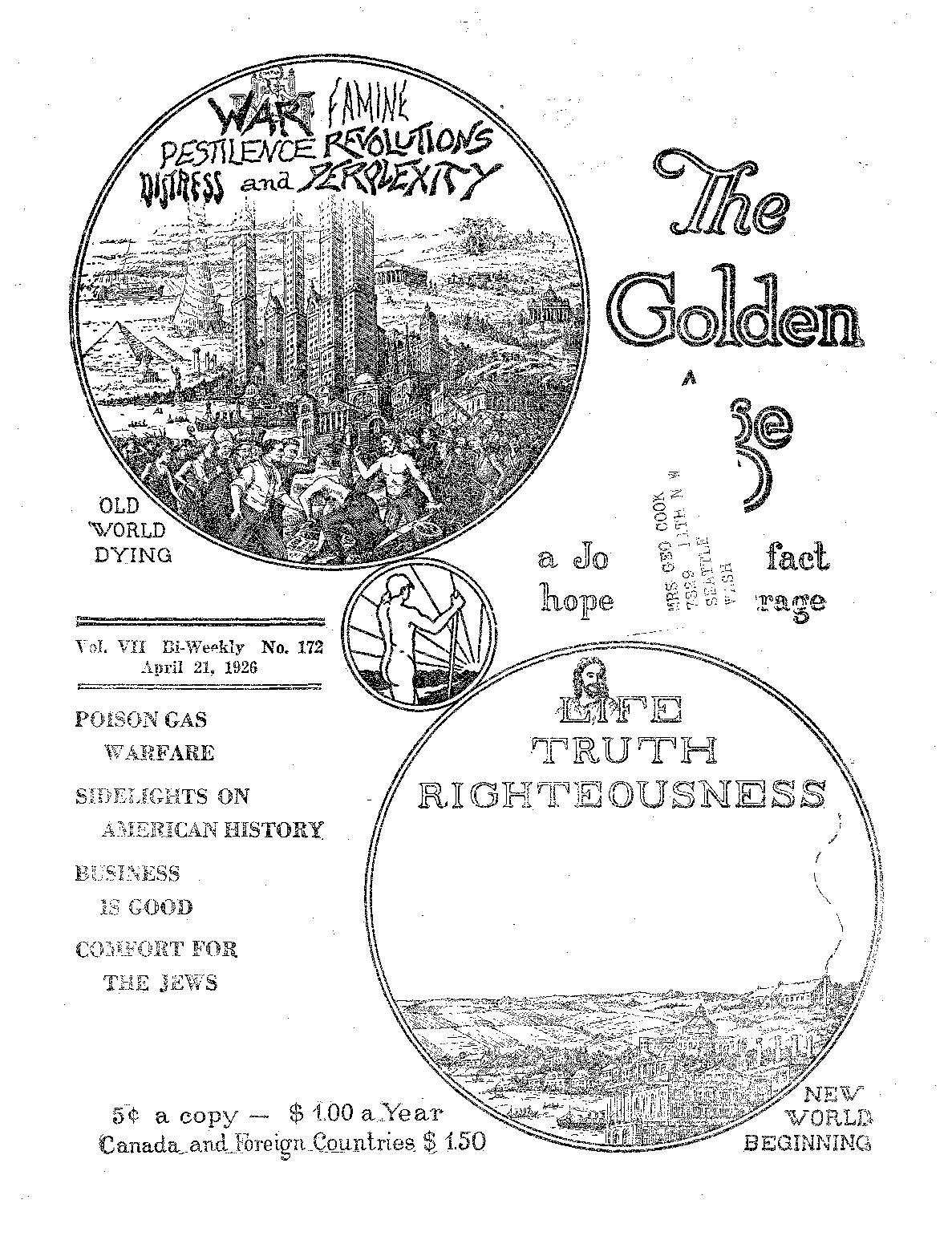
Contents of the Golden Age
■ ■■ .......1 . ...
■ Labor and Economics
Few Farm Laborers Left
Union Labor Life Insurance
Florida Does Not Need Clerks
“Business is Good” ...
Social and Educational The Puritans
Education and Athletics ....
Radio Pbogbams ..................
Finance—Commerce—Transportation Railroad Passenger Traffic Stabilized ...
A Brief History of Steel .......
Political—Domestic and Foreign An Irritating Lobby at Washington..........
Since the League Came to Town
The Prohibition of Poison Gas Wab..........
SlDSLIGHTS ON AMERICAN HlSTOBY
Cause of the Revolutionary War
Democracy ...................
Preparing for More Trouble
" Science and Invention
New Fruits and Vegetables
Strange Things in Radio . .
. Home and Health '
Herbs fob the Service of man ............... 463
Some Simple Remedies
The Town of Don’t-You-Wobby (Poem)
Travel and Miscellany Valuable Finds in Ontario ...
Colorado Jack-Rabbit Dbive ......
Religion and Philosophy - Thirty-Five Ministers Apply for One Job
COMFOBT FOB THE JEWS ................. 473 Jewish Articles of Faith ............. .
Abraham’s Faith Tested
Studies in “The Harp of God”
Published every other Wednesday at 18 Coneord Street, Brooklyn, N. Y., U. S. A., by WOODWORTH, HUDGINGS & MARTIN
Copartners and Proprietors Address: IS Concord Street, Brooklyn, 'N.Y., U.S.A.
CLAYTON J. WOODWORTH . . . Editor ROBERT J. MARTIN . Business Manager WM. F. HUDGINGS . . Sec’y and Treas.
Five Cents a Copy—$1.00 A Year. Make Remittances to THE GOLDEN AGE
Foreign Offices : British ..... 84 Craven Terrace, Lancaster Gate, London W. 2 Canadian......... 38-40 Irwin Avenue, Toronto, Ontario
Australasian...... . 495 Collins Street, Melbourne, Australia
South African ...... 6 Lelie Street, Cape Town, South Africa
Entered as second-class matter at Brooklyn, N. Y., under the Act of March 3, 1879
•tiWirnrinriirr
Golden Age
, _________________■ ...................... ■ |----—
Volume VII Brooklyn, N. Y., Wednesday, April 21, 1926 Number 173
On American Shores
Thirty Percent Increased Production
THE Federal Reserve Board reports that although there were actually fewer workers in American factories in 1925 than there were in 1919, yet the total output of the factories was thirty percent greater. Of this thirty percent increased production, one-fourth went to the workers in the form of increased wages and the other three-fourths went elsewhere.
Few Farm Laborers Left
AMERICAN farmers are rapidly adopting such mechanical appliances and so arranging their work as to get along without the assistance of farm help. There are now in New York State less than 26,000 hired men on farms, which is only one-third the number so employed in the same territory ten years ago.
What is a Fair Price?
THE demand that farmers and others receive fair prices for their products seems reasonable. But what is a fair price! When the supply of a product is liberal the public consumes more of it. Then the supply is reduced and prices rise. When the supply of a product is restricted the public avoids it. Then the supply is increased and prices fall. No earthly Solomon can decide today what will be a fair price for anything six months hence.
Some of the New Fruits and Vegetables
OOME of the new fruits which Uncle Sam’s 0 Department of Agriculture specialists have found in other countries and will try to grow in the United States are the Chinese Yang Tao (a new-flavored berry), a delicious blue raspberry from India, and a diminutive apple which makes excellent jelly. Among the vegetables are Ming cabbages, which weigh forty pounds apiece; Japanese carrots, as big as a man’s leg; Philippine Bikas, -which make good jelly; and Turkestan melons, which have the flavor of cantaloupes but are as large as watermelons. An effort will also be made to popularize bamboo sprouts, which have been a Chinese table delicacy for generations.
Union Labor Life Insurance
UNION labor, which has succeeded so well in its banking projects, and which is now making its entrance into housing, has also embarked in the life insurance field. The new company issues the standard forms of personal, health, accident and casualty insurance and accepts premiums monthly.
Vermont Has the Most Cows
rp AKING the country as a whole, every person has a one-fourth interest in a cow. That is to say, there are one-fourth as many cattle in America as there are humans. But in Vermont, where the most attention is paid to cattle breeding, there are more cattle than there are humans, and additionally the cattle average to be worth fifty percent more apiece than they are elsewhere.
Wild Deer in New York City
HDIIE game laws have so operated to protect J- wild life that it is now claimed there are several small herds of white-tailed deer running wild in the upper part of New York City, as well as in the adjoining towns of Pelham and Yonkers. In some instances they have done considerable damage by knocking down vines and frameworks.
Air Mail Service Facts
A IB mail service has its drawbacks. Letters recently mailed in San Francisco to two Pennsylvania points required ninety-six hours, which is about all the time that the railway mail service requires to accomplish the same service at one-twelfth the cost per letter.
Railroad Passenger Traffic Stabilized
FOR a time it looked as though the operation of motor busses would bleed the railroad passenger traffic business white, but the year 1925 showed a fraction of only one percent loss in railway passenger traffic over the previous year, showing that for long rides the busses are not a serious competitor with a well managed railway service. The busses accomplish a good work in promoting better railway service and preventing unreasonable charges.
Your Weight in Paper Annually
IN THE year 1923, in the United States, the per capita consumption of paper was 167.5 lbs., which is surely considerably in excess of the average weight, so that in fact each inhabitant of the country uses up each year an amount of paper in excess of his own weight. The United States uses per capita about sixteen times as much paper as the rest of the world, consuming about fifty percent of the world’s production.
Paper at Forty Miles an Hour
THE International Paper Company is installing at Three Rivers, Quebec, four newsprint paper machines which have a maximum capacity of forty miles of newsprint paper per hour when all are in operation. One of the machines is already installed and operating at this rate of speed.
Housing Commission’s Report
THE New York State Housing Commission reports that inasmuch as the city now supplies at cost the water supply, sewage disposal, recreation facilities, parks, streets and roads, all of which were once supplied by individual initiative, it sees no reason why it should not go a step further and supply the walls and roofs which the common people need as badly as they do these other things. It questions if society can permit the general security to be endangered in the face of conditions which are growing progressively worse.
Twenty Dollars a Day for Drugs
THE New York State Commissioner of Correction declares that the crime wave in America is largely due to the efforts of drug addicts to raise the twenty dollars per day which they spend foi the drugs of their addiction. The per capita consumption of such drugs in America is ten . times what it is in Italy, five times what it is in Germany, three times what it is in England and two and one-half times what it is in France.
Mixed Food in Moderation
ONE thing the human family seems to be learning is that health is not promoted by the heavy, many-course dinners which were once considered quite the proper thing. Most ailments start in the intestines, and fruits and vegetables are best for keeping the intestinal tract healthy. But man was designed to be omnivorous in his food, as is indicated by the structure and arrangement of his teeth; and most people will keep fairly healthy if they use a variety of plain foods, provided only they do not use them to excess. White bread is a deadly foe to the digestive apparatus.
Florida Does Not Need Clerks
THE National Association of Travelers’ Aid Societies has been making a survey of four of Florida’s principal cities,and finds what everybody ought to known that they would find; namely, that in building up that great state it is noc white collar workers that are wanted but manual workers of all kinds, including stenographers, however, who are always needed everywhere.
Stenographers Always in Demand
TI IS known that there were stenographers in Rome in the days of Cicero, and now from the great mass of manuscripts discovered at Oxyrhynchus, Egypt, it is learned that in the year 155 A. D. shorthand writing was an established trade in Egypt, but the form of the writing is not clear.
An Irritating Lobby at Washington
ONE of the irritating lobbies at Washington is that of the country printers who are in arms against the action of the government in printing return addresses on government envelopes at ten cents for 500 envelopes. The government has been doing this for over fifty years, to the immense benefit of the postal service and all its users, including the country printers who now get millions of their papers delivered in their home counties free of charge, and who would charge $1 for the service for which the government now charges but ten cents. The country printers take the position that the government lias no right to engage in printing or to have it done by contract. That being the case what right does it have to pay for carting the country papers all over every county and get nothing for it'? The country papers should let well enough alone. Those who are looking for trouble sometimes find it.
Threshing Cones in British Columbia
THE object of threshing any article is to free the seed which it encloses. A new threshing instrument is in use at New Westminster, B. C., in which are threshed the cones of Douglas firs, Sitka spruces and red cedars. The seed, of which three hundred pounds are obtained every twenty-four hours, is used for reforestation. About sixty-five percent of the seeds germinate when planted.
Thirty-Five Ministers Apply for One Job
WHEN a Philadelphia church advertised for a minister recently, thirty-five men of the cloth made application for the coming vacancy. Several of the applicants were from a different denomination, but willing to take the job if it would pay them more money than the affiliation with which they were then connected. But in most instances they made it clear that they did not want their congregations to know that they were willing to leave the old fold for a new one, for a money consideration.
The Drift Toward Autocracy
WITHIN a few weeks recently, three American statesmen, James M. Beck, former solicitor general of the United States, Senator Wadsworth of New’ York and Senator Wheeler of Montana, have called attention to the dictatorships in Russia, China, Italy, Spain, Greece, Germany, Hungary, etc., and have stated boldly that America’s greatest danger at present is not red propaganda but the drifting toward a centralized government conducted by executive order in defiance of the will of the people as expressed by their representative bodies.
America Hates Murder
NOTHING is clearer than that the American people at heart hate and abominate the legalized murder which is called war. While military toys are still manufactured and sold in Germany and Japan, all efforts to popularize these toys in America have faded, and they should fail.
IFftat Jefferson Believed
HD homas Jeffersox, who was called the “father of democracy”, did not believe in the League of Nations or the World Court. On one occasion he wrote:
Determined as we are to avoid, if possible, wasting the energies of our people in war and destruction, we shall avoid implicating ourselves with the powers of Europe, even in the support of principles which we ■ mean to pursue. They have so many interests different from ours that we must avoid being entangled with them.
Since the League Came to Town
SINCE the League of Nations came to town Uncle Sam has put through the Washington Limitation of Armaments conference, the Dawes report, contributed four or five billion dollars in relief loans, and made approximately fifty international agreements. In every way the United States has made a better record.single-handed than has the aggregation of nations which is supposed to have all wisdom in the earth.
Valuable Finds in Ontario
TN ONTARIO, Canada, two recent discoveries of natural wealth have attracted widespread attention. One is of helium, which promises to be the greatest supply of this rare gas to be found in the British Empire. The other is of gold, in the Red Lake district, 140 miles from the railway, where unsurveyed claims have already sold for as high as $50,000.
Strange Things in Radio
STRANGE things are happening in radio reception in California. Increasing numbers of people are.reporting the reception of beautiful music without the use of radio receiving sets. The thought has been advanced that this music was not broadcast from any earthly station but was of spiritistic origin; and so good a paper as the San Francisco Examiner says that • this view of the matter is skilfully presented by one of its readers in a letter which, however, it neglected to publish.
The Prohibition of Poison-Gas War
(Translated from the Barmen-Elberfeld Stadt-Anzeiger.
rpHjil general commission of the International Conference for the control of the traffic in arms has endorsed unanimously the text of the protocol regarding chemical and bacteriological war, the signatory powers ratifying the confirmation of the treaties previously made regarding the prohibition of war material and of dealings conflicting with the international law. The wording prohibits explicitly the use of gases with suffocating, poisoning or similar effects, as well as all means of a bacteriological war. Germany declared at Geneva that it would be ready to desist from poison-gas war, the understanding being, of course, that a corresponding convention of all powers would agree to it.
But too little, as yet, does the imagination of a large part of the peoples of all nations seem to be able to comprehend what war of the future, that may break out any day, really means. There still prevails with many the illusion that the next war will begin like the previous one, after a fashion of historical lawfulness, diplomatic tension, tdtimate exchange of notes, recall of ambassadors, mobilizing of armies, enlisting of reserve troops and making ready their equipment, skirmishing at the front, clearing-up and reconnoitering activities, and finally the regular war. '
But that is an empty and meaningless illusion. Anyone who participated in the last war knows from bitter experience that in the course of a struggle involving millions, the men and the masses (as active, organic, animated sources of power) stepped to the background and transferred their sway to the machine which, however, too often turned against its own army; for instance, in cases where the artillery by mistake bombarded their own ranks or where the enemy trained his fire on the sanitary stations harboring his own captive wounded men.
Yet this last war had its organization, however abominable and deficient it may have been. There were yet men who by means of it created great things, and by it alone were enabled to do so, and that not merely for the benefit of their own country, but also for proof of what man can really do in the future. But in the long run the organization grew beyond men and crushed them and, throwing them like chaff to the wind, became a machine that lived in and through the war.
The last war developed more and more from a war between men to a machine-war, gradually taking away from man the only thing he,cannot do without even when pertaining to evil things, namely, his personal will! This last war was not merely a war of masses on a huge scale though immense masses participated in it. But above all that mass concurrence was as an impersonal, terrible and menacing automaton that destroys itself.
This war was about to devour itself, when a charitable God spared us the uttermost. The fight was broken off, but it is not finished. It longs for a continuation, like everything else that happens in life, and wants to come to a conclusion. Hence the tension in which we are living, hence the fear of a new war that wishes to continue the old and throw up the yet unfermented matter of its terror to a finish.
That renewal, when it comes, will be the poison-gas war, the chemical war, that will perfect the machine war and thereby overcome it; the war that will make an end with man as having a will, as a living organism, as animated force. We shall then return to nature, but in a different sense than any man ever thought of. The poisonous vapors of hellish swamps, thebenumbing gases from deep chasms of the earth, the dangerous air of primeval forests, the hard to breathe atmosphere of high altitudes; all these places where natural death lives, where it inflicts injury on life, are as nothing compared with the pestilential infection that will then commence.
Does one really believe that in the next war the armies will draw up in battle-array? Does one dare to doubt that, even before the official declaration of war, unmanned, electrically propelled air squadrons, loaded with vast quantities of poison-gas, will make the enemy’s country a desert?
A march of the reserves to join the regular army, a transport of a standing army to. the “front” (which, by the way, does not exist any more) is a ridiculous illusion. Who will march? The one poisoned in his home? Where will the barracks be, and the officers who are to oversee the mobilization and getting the civilians ready for enlistment and marching? Where is the organization for the reserves and for the provision of the homeland and for maintenance of oi’der? Are not these things hallucinations of a better past?
We live in benumbed history and do not know that the war, beginning in 1914, began as a 19 th century war, and was taken over-into the first epoch of the 20th century. But today a war, when it breaks out, will be a war of our days, a modern war in the truest and most demoniac sense. The last war was yet capable of development; the long (preceding) peace had stunted it or had a stunting effect; but the next war will be a completion and therewith an annihilation ! There will be poison and explosion everywhere, beneath the whole canopy of the heavens; and soon there will be nobody living on the earth that could give it a name. If there were a little more imagination in the world, it would be superfluous to suggest these things.
Supposing there had been soldiers in the past war who, gripped by Satanic delight in the machine and the power it bestows, had become obsessed; these could yet have been overcome. But now let us imagine that in the next war there would be an engineer somewhere, full of profound scientific knowledge of the powers which he can unchain, but which in the final end will control him.
lie and a few of his kind are the masters of death of whole districts and countries! They understand the secret of the power, and they know how to bridle it, if they desire to do so. Where is the soul that can endure this vast power without becoming insane ? But who can then command this man to cease sending out death; who can force or compel him ? Poison will be mechanically wafted forward and backward by unmanned airplanes, going up into the atmosphere and descending to the earth. Who may endure in such a hellish region?
The next war will breed men, mighty in destructive powers, 'who will be the dictators of chaos. The prophetic Dostojewski had a presentment of the possibility of the future death of mankind in that “bacillus dream” of Raskol-nikow, where it is related how mentally and morally diseased mankind will disintegrate into atoms by means of poisons; how in the whole • world only a few could save themselves, those blameless ones and chosen ones, designed to be the founders of a, new race.
Will it become as bad as pictured or not? Who knows? It may become as bad or worse. But even if “only”’ certain districts are completely devastated and not the entire earth; if “only” local pestilences and troubles break out and hot general chaos; if “only”’ Berlin, Paris, Vienna or London is destroyed, and there are “only” three times as many dead and crippled as in 1914-1918, who could bear the responsibility for “only” that much?
Sidelights on American History By j. a. Robinson
AMERICAN history, as commonly understood to refer to the events of the American Republic, is but brief. Necessarily so, since this country is now only7 in its second or third century7, according as the matter is viewed. Though short, this period has been filled with events of important historic note. Little Mary’s school book is filled with accounts of patriotism by which the early colonists brought into being this glorious republic. There is a number of highlights in American history, connected to -which are numerous interesting sidelights. The object of this brief treatise is to view both highlights and their attending sidelights.
That this review may7 differ somewhat from the story given in the school books is to be expected; for upon investigation we have learned that subsidization does not' stop with the newspapers. As the power of propaganda has been put to unlimited use in all branches affecting human welfare, for the purpose of supporting a wobbly system of civilization, we should not be surprised that school histories also have been tinctured by the propagandist’s pen. But whatever the sidelights herein given may lack in inspiration or “patriotic” fervor, they make up in truthfulness.
The historic sidelights treated herein are, The Puritans, The Slave Trade, The Boston Tea Party7, The Cause of the Revolution, and Democracy. These will be sufficient for present consideration ; to upset the entire order of history Would be disastrous.
The Puritans
PROBABLY the largest human cargo ever transported across the “Big Pond” in any one vessel came over in the celebrated “Mayflower” on her voyage across the seas to the land of the free and the home of the brave. This must be so, because there is not a prominent family in America whose ancestors were not first cabin passengers on that world renowned trip. No “Leviathan” ever carried a larger or more precious cargo.
The Puritans were Protestants who, according to our school histories, braved the turbulent seas and the dangers of a wild country in order to escape unbearable religious persecution.
The real truth is that the Puritans of Cromwell's days persecuted the Catholics, and when the Catholics saw fit to return the compliment with interest and the Puritans found they were getting the worst of it they packed up and left the country in favor of more peaceful climes. Mr. Oscar Ameringer, a noted socialist, describes them rather humorously as “a pious, bigoted and intolerant lot who regarded a chronic fit of the 'blues’ as the natural state of man, and who embodied their vinegar ideas into a set of laws called the ‘Blue Laws’”.
So intolerant and blue, so pious and bigoted, were these Puritan forefathers that when they found a Quaker who worshiped God in the wrong way they burned a hole through his tongue; and this right after thanking God for their deliverance from the dangers of the sea. Also they penalized with the greatest severity the teller of a harmless joke, and if one should so forget himself as to laugh at it the stake and burial in “unhallowed ground” was his reward. Witch burning was their favorite pastime, and when more humane folks put a stop to it they invented the , gluttony of Thanksgiving and got even.
Not all the Puritans came to America, only those who lacked sufficient courage to remain and fight it out. Americans who delight in tracing their ancestry back to the “Mayflower” had better leave that subject alone or they are liable to find that “that colonial dame” from whom they are descended was not so noble as we have been given to believe. More than one American bachelor exchanged a bale of frost-bitten tobacco for that which in our ignorance we were wont to look upon with pride.
The Slave Trade
TN THE year 1662 Charles II, who ruled Britain -*■ “by the grace of God” and who was the bold and intrepid “Defender of the Faith”, bearing the very weighty title of “His Majesty”, chartered a company'known as “The Company of Royal Adventurers Trading to Africa”, with the purpose in view of supplying the British colonies with 3,000 African slaves per year. This company failed. Another was chartered by the same “Defender of the Faith” in 1672.
In 1692 the British governing body allowed other English merchants to ply the trade in “black ivory”. Merchants from the American colonies shouted loud for an opportunity to engage in this slave traffic, and those who shouted loudest were the Puritans—those pious, noble, Christian, 100% American ancestors of ours. They insisted that the coins in those days must bear the inscription, “In God we trust.” What they evidently meant was that God alone is trusted—all others must pay cash.
Another rather interesting feature of the slave trade is that the traders lectured before religious bodies, the Y. M. C. A., etc., and sat in the front pews at church. Let us hope that the descendants of such a pious people would shun profiteering, franchise grabbing, bribing of legislatures, and corrupting of councils, and thus not fall into the errors of some of our “best citizens”.
The Boston Tea Party
WITH what inspiration and strong patriotic fervor welling up in our bosoms do we study the account of the pouring of English tea into Boston Harbor because of the heavy tax imposed thereon, as shown in our school books. This event gave opportunity to show real 100% Americanism. How dare the British tax the tea the worker never drank because he could not afford it?
Surely something is wrong here; for George, as silly as he was, would never be allowed by his advisers to make such a terrible mistake as to antagonize Britain’s “best people” who owned plantations in the American colonies. The truth is, tea was doubly taxed, both export and import. The English merchants had to pay both, but our 100% Puritan American smugglers paid only the export and avoided the import tax by landing their tea at some dark corner of
our extensive coast line. This saving of import duty, made it possible for the American merchant to sell cheaper than the English merchant; therefore English tea accumulated in Boston Harbor unsold. .
Our good patriot John Hancock appears to have been one of the chief smugglers. In fact on the day of the battle of Lexington John was to have appeared before the Admiralty Court of Boston, charged with robbing the English Government of $500,000 in import duties. His estimable lawyer was John Adams. Now we understand why they said, “We must hang together or hang separately.”
The British Government finally cancelled the import duty on tea to America so that the English merchant could compete with the smugglers, who were Hot paying it anyway, whereupon the latter dumped all the accumulated British tea into the Boston Harbor to forestall competition, and continued their business as usual.
Cause of the Revolutionary War ■
GAIN we.must not look into little Maryas school history for the full facts; for there we shall read a regular fairy story with merely the “Once upon a time” left off. The real cause of the revolution was the property owner who disliked paying taxes to the British government. It was perfectly proper to tax the serf, but when the tax collector came too near to the pocketbook of the rich landowners he touched a very tender spot. A tax on tea could not affect the working class of 1774, because they could afford only native sassafras, upon which there was no tax. The tax on rum and molasses did not bother the worker; for the rum and molasses were used in the slave trade, and the worker had no slaves. The rum paid for the slaves, and the molasses was made into rum; so it was a merrygo-round of rum, slaves and molasses. Neither was there reason for the workers to go to war because of taxation without representation. The working class had no vote; but it was the property owner who was taxed, and he could vote.
Ben Franklin told the story of a man in Philadelphia who voted because he owned a mule. One day the mule died and the man lost his vote. Franklin asked, “Was it the man or the mule that voted?” and we agree that it was the mule.
So the workers had nothing in common with the revolt, nothing to gain or to lose; yet by the use of high-sounding phrases, as found in Mary’s schoolbook, their masters provoked them to war with England. They put guns into the hands of the workers, but did not say, “Here, defend that. $500,000 we stole.” Then at the close of the war the people were asked in still higher sounding phrases not to bring shame upon the new country by repudiating legitimate debts, and thus the common people were induced both to fight and to pay for a war which enriched only their aristocratic masters.
The father of his country, even though he refused to tell a lie, became very rich. His sense of gratitude is well shown by his refusal to voice a protest or to assist in any way America’s greatest friend and supporter, Thomas Paine, when illegally imprisoned in France.
Democracy
TAEMOCRACY, often explained as “a government of, for and by the people”, is a phrase which sounds well but which is shallow in fact. After the war, with the resulting independence as the reward of victory, we were told that we had gotten rid of a feudal government with its king and nobles; but we had a rude awakening, having found our cherished democracy but autocracy under another name.
Suppose that the common people who rule themselves (?) desire a certain thing, and suppose that that which the people wish is what the moneyed interests do not wish. Do the people get what they want? They do—NOT. The same four checks which are upon the people of England were incorporated into the constitution as checks upon the people of America; and when a law is proposed that is inimical to the “interests”, the bill must first pass the House, who can refuse to vote, and thus promptly defeat it. But if they do pass it, then the Senate has a chance to throw it out. If the Senators should happen to pass it to appease the voters back home who elected them, then the President can veto it. And if he should so forget his place and purpose as to not veto it, then the ex-corporation lawyers on the Supreme Court bench.can promptly read its obituary. One old lawyer can thwart the voice of ten million American voters with the mere swipe of his pen; and there is no referendum or appeal from his dictum. Democracy, thou art a fair lady; would that we might hold thy hand and call thee ours.
What is the Matter?
WHAT is wrong with the man who fights for tea. he never tastes, who goes to war to obtain slaves he does not and cannot possess, who kills his brother for land that is not his own? From the eyebrow’s dow7n the average common man is a 'worker, w’ell suited to his blue denim uniform; but from the eyebrow’s up there is a certain amount of empty space which he allows the rapacious rich, the unscrupulous politician and a degenerate clergy to fill wiili well-worded, propagandized suggestions. Thus we have allowed ourselves to become the cats-paw of unscrupulous profiteering masters.
If finally the workers attempt to think or act for themselves, or to enjoy some of the liberty they have let slip, the masters hire spies, detectives, strikebreakers and thugs, meanwhile invoking court injunctions to restrain and beat thorn, and the workers continue to vote the “straight ticket” and put into office the very men their masters nominate. But the dust and mist of the past w7ill not always becloud the brains of the common people. A better day is now’ dawning, in which blindness -will be removed and injustices rectified.
A Brief History of
TilIS article is written with the intention of giving the readers of The Golden Age- a fairly good idea of the art of tempering and a brief sketch leading up to the present use of steel.
Those living in the remote sections wdiere they have occasion to temper their own tools will possibly find these remarks of interest and beneficial in their labors.
The book of Genesis, gives us an account of Tubal Cain, w’ho was “an instructor of every artificer in brass and iron” .(Genesis 4: 22), but we are not informed as to the use to v’hich iron ■was put in those ancient times.' As no steel ■was probably made before the Noachic flood, very likely iron was used for rough implements, even as tools of stone, copper, brass and bronze were common. Sometime after the flood, in the city of Bagdad in Assyria, they had furnaces, possibly used for making glass, and the compositions used in making brass and bronze, as excavations have revealed.
Iron was used by the ancient Egyptians for blood medicine and for inks and dyes only.
The African Negro urns evidently the first man to mine and smelt iron, making the iron over into steel by mixing it w’ith w’ood charcoal, bone charcoal, and old scraps of leather, now7 knowm as carbon. Their stone furnaces w’ere usually at the w’indwmrd side of a hill, goatskins being used for bellow’s.
The Arabians wrere the first to make a crucible, an invention which wras adopted by other nations.
Steel By John (J. Miller
India brought the next advancement in steel, by mixing “wootz”, now knowm as “ferro manganese”, with iron. This early steel wms all used for the making of swords, cutlery and hand tools, such as saws, chisels, axes, razors, etc. Unfortunately there has been no record kept of the nation who made the first razor, or the first grindstone upon which the first razor wms ground.
The greatest and parent invention of all inventions is the wheel. No record was ever kept of the first nation to make a wheel, although some credit the Egyptians w’ith making the first W’heel from granite rock.
All means of modern transportation, locomotion, paddle wheels, propellers, faucets of water systems, installation of electrical devices, automobiles, airplanes, submarines, and in fact all rotary or revolutionary plants, valves, etc., are merely extensions and improvements over the ancient stone wheel.
The fine masonry work of ancient history wras a secret of its own simplicity. Their method w7as this: They sawed their pillars and blocks of stone, setting them-unfaced or unfinished, except where the blocks were to be brought together. These sides were faced by highly carbonized steel chisels and highly tempered copper chisels; then the sides now finished were coated with a coating of gum arabic, made thin by using salt and water. The blocks w’ere then brought tight and evenly together by the use of w’et ropes made of hemp flax, reeds, or anything that would contract or draw in when drying. They were bound around the base block, thence upward* around the block to be set, and so on up to the height wanted.
The fresh damp skins of newdy killed animals, steers and cows, were also used; the contracting of the ropes and skins drawing in and men guiding and gently pushing on the blocks brought an even and exact setting. The facing or finish was then chiseled, the dust of the chiseled blocks filling in the crevices, which with the gum arabic liquid formed a cement almost as hard as the stone and almost completely hiding the joining of the two blocks.
Damascus, one of the oldest of all ancient cities, was filled with men of an artistic temperament and nature. Some of these men turned from their arts and pursuits and went into the tempering of steel. With their art and talent these deep-minded men of Damascus soon outclassed all others, and by keeping their secrets to themselves they soon led the world in the art of tempering steel.
Following are the colors of the steel tools when taken from the fire, as worked by the smith, as well as the degree of temperature. By the use of a charcoal fire, and by sprinkling borax upon a sword while in the fire, they would make a sword the point of which would bend to the hilt, and spring back to normal position while the edge would cut in two either a feather pillow or a piece of wrought iron.
Lancets (very pale yellow) ............... 220°
Surgical instruments and razors
(straw color) ................................... 230° to 235°
Penknives and common razors
(golden yellow) .................................. 240° to 245°
Scissors, cold chisels, shears (brown) ..............................255°
Axes and planes (brown dappled with purple) ,._..2653 Table knives and large shears (purple)...... 275° to 280°
Springs, watch springs and swords
(bright blue) .................. 285° to 290°
Fine saws and augers (full blue) .................290° to 295°
B'and saws and large saws (dark blue) ...... 315°
Up to the present time these colors have never been improved upon, and as these colors were used only on edge tools the temper driven was of a very small degree of penetration. The farthest that temper ever has been driven into furnace steel is one-eighth of an inch. The sudden plunge into cold water or oil causes a “chill” to come over the steel; the steel is then cold on the ouside but warm in the inside, as the “chill” cannot penetrate into the middle of heavy furnace steel after its strength has been spent. Thus the outside is hard while the middle remains soft.
After the “science of war” developed from hand-to-hand fighting, fire arms and cannon made from furnace steel were used; but the cannon was (and now is) defective, resulting in the frequent bursting of the cannon—the heavy firing tearing aside the softness in the inside of the steel and cracking through the temper, thus bursting the cannon. The railroads using the furnace steel for rails have also showed up the weakness of the very best of heavy furnace steel.
An English gentleman named Dodd invented what was known as “Dodd’s Process”, which was to coat the already tempered steel rail with a preparation of his mixture and temper the rail a second time, bringing about a second or double thickness of temper; but this was not successful. It is now known as “case hardening”.
The broken rail,is the bugaboo and nightmare to every railroad man, from president down to section hand. The broken rail has all train crews, agents, telegraph operators, electricians, roadmasters and section foremen continually on the alert.
The cause of the broken rail is this: Beyond the one-eight of an inch of temper the rail is filled with soft material possessing much hollow space between the atoms of the molecules, while still smaller spaces exist between the electrons within the atoms.
The heat of summer and the cold of winter cause an expansion and contraction of this soft material, which eventually produces a crack in the rail. The rain and the dews of night, and the melting frost or snow, seep in, penetrating the molecules, then freeze, causing the rail to snap under the power of pressure. This is especially so in damp and grassy sections, where dews are heavy, or in exposed places where the frost and air are keen.
All railroads use what is known as anti-creepers or rail anchors, to keep the rails from expanding or contracting; but as yet they are not very successful.
The present system of steel-making is defective, but by and by this will be overcome and travel will be made safe and lives more secure. The future holds many pleasant surprises for us all. -
, Colorado Jack Rabbit
JACK RABBITS are prolific, and increase so rapidly throughout the western states that they become a pest, a menace to croppage, and means must be employed for their partial extermination or the country would soon be overrun by these destructive animals, and the crops would be damaged beyond toleration. The method of elimination is what is known as rabbit drives at intervals and conducted in the following manner:
All ranchmen, farmers, gardeners, etc., within a radius of say ten to fifteen miles are notified that on a certain day there is to be a rabbit drive in a certain section or district, and to be on hand with gun and dogs and stationed on horseback at a certain point, and at a designated time start in a certain direction towards a common center perhaps five miles or more distant. To this point the rider goes and carries out instructions. At the stated hour he proceeds with shoutings towards the central point, as do all the other riders in the big circle.
In other words a large band of men on horses form a circle twenty to fifty miles in circumference and with accompanying dogs of every description and gunnery and abundant ammunition close in gradually at a central point jumping rabbits as they proceed and driving them onward to the place of their destruction.
At the start of the big drive these horsemen are a hundred or more yards apart, and as the circle narrows and becomes gradually smaller by the onward march the riders come closer and closer together unt il at the end of the drive they are solidly packed and are sometimes two or three deep in the now restricted circle. The rabbits are by this time so massed as to be in each other’s way and they climb one on top of the other. Sometimes a rabbit “back fires” and escapes between the riders, but not often. He is usually shot before he gets away.
From the saddle or from afoot the drivers shoot the frightened creatures until all are slain. In one of the rabbit drives just south of the town of Haxtum 22,000 rabbits were dispatched, and were then sent by free cartage to the Denver Post and were gratuitously distributed among the city's people. Anyone.could have as many rabbits as his family could eat or dispose of to friends and neighbors.
It was Rabbit Day in Denver, Colorado. The
Drives By J. A.Bohnet
butchers were out of luck. Some of the rabbits w ere sent to Omaha, and some of them may have gone to the Mexican quarter for the making of “chicken” tamalas—such things have happened.
At another jack rabbit drive in the same locality 33,000 rabbits were slaughtered, and altogether 70,000 of the pests were killed in one winter in about four townships thereabouts. The drive was towards Holyoke—eastward—in the north-western part of the state.
Sometimes the ammunition becomes exhausted in one part of the death circle, and as the firing of guns ceases in that quarter the rabbits charge that section by hundreds and escape between the legs of the horses and men. Often the line has to be silently held for hours to enable the riders to secure a fresh supply of cartridges and shells. Case after case of ammunition is used at each of these big rabbit drives.
Another style of jack rabbit drive is to form the horsemen in a large semicircle five to fifteen miles in length without gun or dog and proceed with yellings to a central point where a V-shaped fence with a circular pocket at the narrow (or pointed) end has been erected, of wire netting or fence picketing, and into which the rabbits are driven. Then the aperture is closed •when the annuals are all inside, and they are killed -with clubs.
When the rabbits find themselves cornered with no way of escape, and they see their companions being clubbed to death and hundreds and thousands of dead ones lying about on every hand throughout the netted enclosure, many of the frightened creatures set up a pitiful cry very much like the wail of an infant. It seems cruel to continue the slaughter. It is enough to make one sick at heart. Yet they are pests and the killing goes on until not a live rabbit is left in the pen.
There are various other styles of these jackrabbit drives, but the above-mentioned are the most common. The latter style was practised near Bakersfield in central lower California when rabbits were numerous there. At one of these California drives 36,000 rabbits were killed. At one place the dead rabbits piled so high against the fence that the posts gave way and hundreds of rabbits made their escape by jumping over the pile of dead ones before a line could be formed to block their egress.
Those rabbits were also sent to large cities for consumption, and some people ate them as chicken tamala and probably did not flnow the difference. The Italians are specially fond of jack rabbit meat.
Jack rabbits are gray in summer and white in winter. The cotton-tail rabbit runs with its fore quarters low and its hind quarters high. The jack rabbit runs with its fore quarters high and its hind quarters pressed low like a kangaroo.
In a rabbit drive the wise one hugs its cover and escapes destruction. The startled one is a nimble jack and hops up and with long, quick jumps scampers off rather unconcerned until it meets the oncoming opposite drove. Then things become serious and some avenue of escape is sought but now all too late; he is in for the killing and is notched as another number of the slaughtered.
Holyoke, Colorado, is about twenty miles east of Haxtum, and in daylight is wholly invisible behind the prairie swells. At night its lights are plainly seen by mirage elevation of the lights. Not merely a reflected glow blit the lights themselves are mirrored in the sky, so that each individual light is clearly discernable, like the appearance of a large, well-lighted factory or mill, two or three miles away. This phenomenon can be accounted for only by the peculiar atmospheric condition so often existing in the prairie lands.
The atmosphere in this part of Colorado is so clear that a star of the first magnitude can be seen directly on the horizon. As one traverses the country at night he may be fooled into thinking that a city or town is a mile or two away, when in reality it may be fifteen or twenty miles distant.
Education and Athletics By h. e. Coffey
OUR modern thinkers have agreed that reading and writing, with a knowledge of accounts, do not constitute an education. Horace Mann lias stated that education in its dominion extends over the threefold nature of man. This is the twentieth century idea, namely:
(1) That the body should be trained by the systematic and intelligent observance of those laws which promote health, increase strength and prolong life.
(2) That the mind should be so cultivated that it will be invigorated and, with the gaining of knowledge, come to possess in as large degree as possible all those talents which are allied with virtue.
(3) That the moral and religious susceptibilities of man’s nature should be so enlarged as to dethrone selfishness and enthrone in its place conscience, with affections outwardly of goodwill toward man and upwardly of gratitude and reverence for God. These are high ideals and can be realized by help from the right source— the Lord. They cannot be realized by the feeble efforts of man alone.
The foregoing ideas account for the fact that 'during this century athletics has come to assume a very important place in the curricula of our schools and colleges. This condition of affairs has, of course, been criticised by many.
But in answer to the critic George E. Johnson of Harvard says:
Neighborhood jealousies, race prejudices, mob violence, perhaps wars, exist largely because in the education of children and youth the instincts and emotions under stress have not been brought under control of the will and reason. It is notable that where inter-institutional and inter-community games are rare, control, justice and courtesies between opposing factions are rare; and where such games are most frequent, the best order prevails.
Mr. Roy Bedichek in the Interscholastic Leaguer contends that athletic sports bring about a laudable contempt of softness (manifested in the proper scorn of the “jelly-bean”), intrepidity, courage, loyalty, surrender of selfinterest, self-control under exasperating conditions, and courteous treatment of rivals. Other authorities might be quoted, but the foregoing gives us a very good idea of the modern educator’s viewpoint.
The Word of divine authority informs us that the wisdom of this world is foolishness with God. I find this is invariably true. There are both good and bad in athletics. Erom what personal contact I have had with this branch ofi modern wisdom I am of the opinion that the bad overbalances the good, proving it to be foolishness.
■" \
Not from the idealistic viewpoint of the educator but from the realistic standpoint of everyday facts let us examine into athletics with the searchlight of truth. The first game of sport on the athletic calendar of schools and colleges in America is football. The hard-fought games are, at times, almost as thrilling as the gladiatorial combats of old, and often prove quite as strenuous to the combatants.
1 have witnessed men fighting in these games who were in a thoroughly dazed condition from the treatment received from the opposing team. Others seemed to be in a crazed condition and able to stay in the combat by an almost supernatural strength which the applause and yells of their .supporters seem to give. Often serious and permanent bodily injury is the reward to some of the contestants.
L have stated that these games are combats. The coach of each team seeks to instill into each individual of his team the fighting spirit. “1 don’t want to see a smile on the faces of a one of you when you go into the game,” were the words of a coach to his team before an important game of last season. Another coach insisted on a player continuing in a practice game even after he had sustained a broken rib.
During every college game of importance a physician is kept on hand with a First Aid kit and a stretcher. These are not undue precautions. Every team has its reserve men to replace those who are injured during the combat. I have seen players carried from the field suffering from broken ribs, broken collar bones, broken legs, various internal injuries and sprains.
True, the rules of football have been somewhat modified in an endeavor to make it a less dangerous game; but these rules cannot be changed greatly to alleviate the conditions which I have mentioned without changing this sport entirely. .
Basket ball is a less dangerous game than football ; and since only five players are required to the team it is adapted to the use of small rural schools. Where the rules of basket ball are observed, and where the referee requires their observance, the game is a fast one, but nevertheless a rather tame sport.
In the rural districts, however, the rules are not often observed. The game then assumes the. nature of a rough and tumble fight, with
Bnooxirx, N. T,
the victory to the stronger team. Certain classes of spectators enjoy the game only when it is of this nature.
Baseball, as a college game, is usually played toward the close of the college year. It is not a dangerous game if all the players are skillful and believe in “fail’ play”. However some serious accidents have occurred during baseball games. More players on amateur teams are injured than on the professional teams.
There is some gambling on college games but not to the extent that we find on the National League games. . .
Schools and colleges have attempted to bar the professional athlete by prohibiting anyone from playing on a school oi’ college team who receives pay for it. However this rule is not entirely satisfactory. Sometimes, oftentimes, the best athletes from small schools are induced to come to the larger schools by offers of free board, free tuition, and other inducements. Thus the professional spirit continues to be encouraged.
That althletics often does irreparable injury to many youths is admitted by medical science. Many of the best athletes die young. The growing youth can engage in too strenuous exercise, or can overtax his physical strength, by playing in a hard game too long. The result is that mere youths often develop heart disease, since the heart is usually the first organ affected by overexercise.
As athletes grow old or lose their ability to win in contests they often settle down to a sedentary life and cease to use their 'well developed muscles to any extent. This is a leading cause for their being short-lived. The athlete who would live to a ripe old age must continue to use his developed muscles and “keep physically fit”.
We find among the military men of our day a number of athletes; we find some athletes among our professional men, and a few athletes may occasionally be found among our great thinkers. However with few exceptions our great thinkers and educators belong in a separate class from athletes.
It is a truth which must be admitted by those who will investigate the facts that one who would be a skilled athlete does not have the time to train his mind also that he may became a great thinker. One cannot do his best toward
developing his mind and body at the same time. He will neglect the one or the other. This is because of mental and physical imperfections under which the human race labor.
However, proper athletics (the training and developing of the body) and education are inseparably linked. Every activity in which humankind should engage is linked with education. What I am attempting to show is that athletics as it exists today is not what it should be. It cannot contain that which is only wholesome and best until the world’s present educator and coach, Satan, is replaced by the world’s future educator-in-chief, Christ. The educational policy of the former has been shaped with a selfish object in view, the retention of himself in power at any cost.
With the beaming in of the morning rays of earth’s new day an angel of light and dazzling splendor has appeared on the horizon. Knowledge has been increased. Mankind have looked up to this angel of knowledge and hoped for great, things. Education has been heralded aa a panacea for every ill that besets civilization. But something else is also needed.
Athletics has failed to achieve what its promoters promised. Every branch of education has failed in the fullest sense to accomplish that which it promised to accomplish. The angel of light is waning in his splendor. In due time the world will not look to him for leadership. They will find a greater Leader who will give them true wisdom from above. And under the leadership of Christ Jesus throughout the golden age we may expect that the greatest athletes the world has ever known, yea much greater than the world could dream of, will be developed. The prophet says, “They shall run and not be weary.” (Isaiah 40: 31) Think of it! No athlete of today can do this. -
Herbs for the Service of Man
ONE of the Biblical prophets wrote: “He causeth the grass to grow for the cattle, and herbs for the service of man.” (Psalm 104: 14) In this article we shall consider the value of herbs. .
There is or should be, but one idea, but one main object in medical practice, and that is the improvement «f the quality and circulation of the blood; for the blood is the life. By this process all growth is accomplished and all repairs must be made. Therefore remedial measures are valuable only as they act upon the blood and circulation, removing impurities therefrom and restoring the correct chemical balance of the former and insuring its efficient distribution throughout the system.
Nutrition is the physical basis of life, and the disturbance of this function such as expressed in the words “mal-nutrition” and “mal-assimila-tion” must of necessity be regarded as potent factors in the host of ailments to which mankind is subject. The state of nutrition in any organism, whether it be plant or animal, determines the state of health of that organism.
Man seems ever to be at variance with natural law, and in no way does he violate nature more than in his indulgence in eating and drinking.
By Erie F. Powell, Herbalist, England
The body can assimilate only a certain amount of nourishment each day, and all food taken in excess of the quantity assimilated becomes waste matter; and if this is not speedily eliminated from the system, auto-intoxication (selfpoisoning) results. Ill health is bound to follow sooner or later, and man becomes the poor victim of a thousand ill-considered efforts to restore health by the means of poisonous drugs and stimulants which only add to the trouble and eventually leave him a physical and mental wreck.
'When the normal condition of the digestive, assimilative, and circulatory organs is interfered with in any way defective circulation is the result; hence the importance of correct eating and drinking. Wrong feeding means poor blood, chemical unbalance. A clogged body is the outcome of such a condition. In proportion as the body is diseased in that proportion functional activity is suspended. The vital organs slow down, and until normal function is restored health is an impossibility. Nature sometimes makes an effort at elimination. That is, the body makes an effort to overcome the clogged condition and eliminate the cause of the trouble. Hence the colds, fevers and inflammations to which we are subject; fever is nature’s effort
literally to bum up toxins and thus help restore the normal condition. •
No machine will work properly if clogged and dirty, and it is exactly the same with the human mechanism. Health is a matter of purity of body and mind, and it is the writer’s object in this brief article to give some simple but powerfully effective information for the purification of the body.
. Much has been said in The Golden Age on the vital question of diet, and your readers are no doubt fully acquainted with the fact that commercialized foods are little better than useless ; the natural produce of the earth being the ideal food for man, supplying the essential mineral salts and vitamins in which “faked” food is almost entirely deficient.
A most important point to impress, however, is that many of our cultivated foods are far from being perfect. Wrong and excessive manuring of the soil has most disastrous effects upon the health of vegetation and in some cases actually renders it unfit for human consumption. Also plants raised year after year on the same soil upon which no other crops have been grown are known to be deficient in organic mineral elements, the continual production of the one species without change having exhausted the soil of these elements. We are just beginning to learn something about correct fertilization; and a little while along the stream of time, when adverse influence has been withdrawn from the atmosphere of our planet and when it is fully under the control of a divine government, then and not until then will the earth yield her increase and produce perfect food suitable for a race of beings destined to live for ever if in entire harmony with the laws of the new government. ‘
We find Hint wild herbs are rich in the vital elements so essential to life. All down through the ages herbs have been successfully used for. the elimination of disease and the promotion of health. Herbs, noted for their virtues in certain disorders, have come down to us today, having withstood the acid test of time; and many of them stand unrivaled as specifics in certain diseases. What ancient herbalists learned from experience and observation modern science has enlarged upon.
Herbs that have been of value in diseases marked by a deficiency in one or more mineral elements have been found to be rich in the very element required, thus supplying nature with the thing she needed. Moreover, nearly all herbs have a powerful eliminative action, and morbid material is speedily eliminated through the system’s appointed channels. By clearing out the waste matter, supplying the essential chemical elements, and supplying nourishment at the same time, herbs come first in the rank's of therapeutical agents calculated to be harmless and effective in combating disease.
Many years’ experience in various branches of healing has confirmed the above statements and the writer would pin his faith to simple herbal remedies, combined with reconstructive diet, before any other known system. Herbs assist in eliminating the root cause underlying the symptoms produced. Most drugs are entirely foreign to the system and tend to suppress nature’s healing effects; they interfere with all the vital functions and. only add evil to evil. You cannot cast out the devil by Beelzebub.
…