Golden Age, April 7, 1926
Download: PDF — Golden Age, April 7, 1926
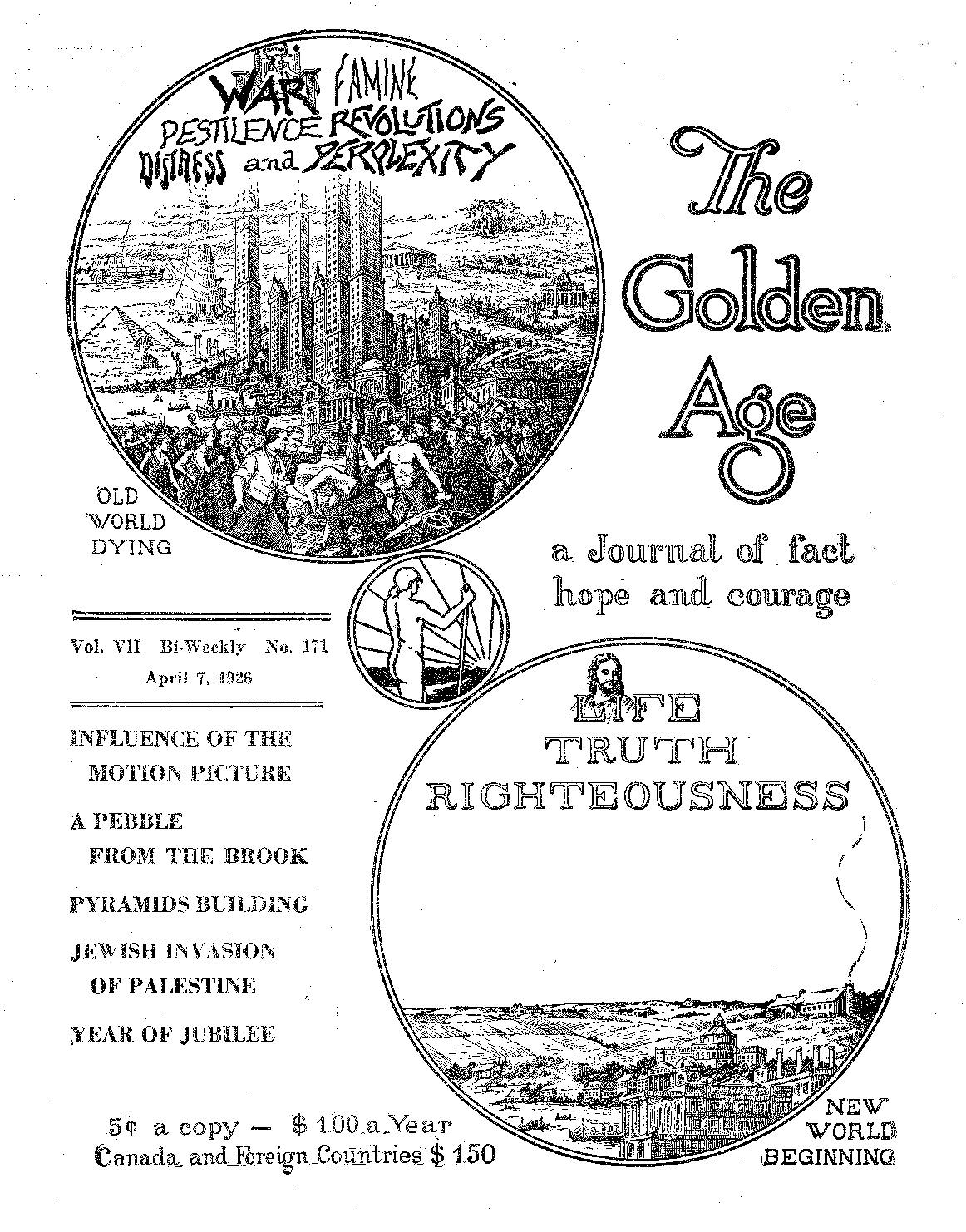
... -4;i
OLD
'WORLD DYING
a. Journal of. fact hope and courage
Vol. VII Bi-Weeklv No. 171
April 7, 1926
INFLUENCE OF THE
MOTION PICTURE
A PEBBLE
FROM THE BROOK
PYRAMIDS BUILDING
JEWISH INVASION
OF PALESTINE
YEAR OF JUBILEE
>5'
fife
5$ a copy — $ 100_a Year
Canada andJForeignJCouiitries; $. 150
Jfe^NEV’
VORLB
BEGINNING
Contents of the Golden Age J
«*»=----■....... ........■■ r- «:
Labor and Economics Losses of Miners and Operators
Key Men and Big Business
Social and Educational
A Pebble fbom the Brook '
Exemplary Ancestry .
The New Freedom
Hebe and thebe Throughout the World
The Motion Picture
Radio Programs
Finance—-Commerce—Trakstoktation Twelve Thousand Unloaded Cars ......... 424
Dodge Brothers’ Voteless S«oek
Political—Domestic and Foreign
Twenty Years to Get a Law Enforced
Celebrating the Kaiser’s Birthday ............ 425
Touching Petition of Alaskans
Mexico Deports Foreign Nuns and Priests ......... 426
Science and Invention Barlow’s Flying Torpedo .
Awakening the Dead ...............
How Were the Great Limestone Struct cues Built? . . . . . 433
Where Are the Missing Links?
Home and Health The Importance of the Home .
The Small Twigs on the Family Tree . .
The No-Breakfast Idea .........
An Adventure in the Wilds of Tonsillectomy
Travel and Miscellany Shawnee—“Burning with Unquenchable Fike”..... .
The Jewish Invasion of Palestine.......... .
Religion and Philosophy
The Theological Fake (Poem) ............. 440
The Year oj? Jubilee .........
Studies in “the Harp of God” ....
Published every other Wednesday at 18 Concord Street, Brooklyn, N. Y., U. S. A., by WOODWORTH, HUDGINGS & MARTIN
Copartners anil Proprietors Address: IS Coneord Street, Brooklyn, N. Y., TJ. S. A. CLAYTON J. WOODWORTH . . . Kditor ROBERT J. MARTIN . Business Manager WM. IL HUDGINGS . . Sec’y and Treas.
Five Cents a Copy—$1.00 a Year Make Remittances to THE GOLDEN AGE
Foreign Offices ; British ..... 34 Craven Terrace, Lancaster Gate, London W. 2 Canadian....... . 38-40 Irwin Avenuo, Toronto, Ontario
Australasian ....... 495 Collins Street, Melbourne, Australia South African ...... 6 Leila Street, Cape Town, South Africa
Entered as second-class matter at Brooklyn, N. Y., under the Act of March 3, 1879
Golden Age
X hiriiniTiiririiiinffiiiiiiifiitr- y.~ ? .'j~ r~ uTTi ii-~oiwt—/ -| j.r । m "iiiiininrr ~ /Mi iiinHwrjniriirwii-'.' y "i — ""ii u mriirr'iiiniTrrr:r • • t-it '
Volume VII Brooklyn, N.Y., Wednesday, April 7, 1926 Number 171
A Pebble from the Brook (Cont rib tiled')
IT IS regrettably a part of the mental makeup of the critic to point out the moral obliq-is i ties and deflections of the human family; but withal to fail to discern the true philosophy, the original causes, the history of the case, and the final remedy. The physician who visits his patient, studies the diseased parts of the delicate anatomical structure, and gives an able and accurate diagnosis, is still hopelessly handicapped if lie is unable to prescribe the necessary treatment, how to be administered, the proper diet, and the care of the patient in general.
Moreover, any person of ordinary intelligence can identify a case of measles or smallpox when he sees it, and perhaps he may describe the patient’s experience with the eloquent tongue of an Ingersoll or the prolific pen of a Wells. But for this he would deserve no special laurels as a benefactor of the patient in distress. However, the doctor may explain that the visible marks of the sickness are evidences that the dangerous stages thereof have been passed, that the patient is on the way to recovery, and that there is no cause for special excitement. The hope of all—patient, doctor, and family—-is that the disease will be destroyed, but that the patient will survive.
Calamity Howlers
THE annals of history disclose that in every generation and age since man has been upon this earth there have been well-meaning writers and prophets who have frantically sounded alarms against the people of their time, and heroically warned them of their sinful course. Of such were the three comforters of Job and their kind, the would-be reformers of the dark ages and the evangelistic manikin of defunct religions of our day.
But these should not be mistaken for the true ‘■messengers of hope” who, when warning their contemporaries of impending crises, have also shown them the possibility of escape if the flood of degeneracy and sin should be stemmed in an orderly and timely manner. The Christian’s equanimity enables him to sympathize with the people, individually'and in the aggregate. He understands that for the most part the people are victims of circumstances and conditions over which man has no control.
The critic who cruelly attempts to bare the moral and physical laxity of society without due allowance for the conditions is on the same plane as the sky-pilot who is obsessed with the spirit of pedantry, but whose crescendo voice makes melody mostly to himself, since it is heard but within the narrow walls of his own church edifice or sphere. It is the height of ineptitude and tragedy to warn people of impending judgments when they have not understood the conditions of release from responsibility. .
Exemplary Ancestry
IN EVERY generation there seems to have been an inclination to focus the light of scorn upon the people by pointing them to the virtues of our parents and ancestors as notable examples. The same is true today. We exculpate ourselves from current sins, and make panoply from the good points we do possess by th© time-worn and generation-accustomed wail, “What is the world coming to ?” A hypocrite is not one who merely betrays his profession; he is more. He is one who can deftly focus attention to the wrong-doer elsewhere, engaging the minds of the public by means of mob psychology, the meanwhile overlooking the real issues of which he may be an integral part.
But the heralded examples of our defunct ancestors, instead of proving to be inspiring towards lessons of righteousness, law enforcement and orderly living, have on the contrary often, proved to be skeletons carefully hidden away in
concealed places, whose keys were closely guarded from public possession lest we should learn some sorrowful lessons from them. On the other hand many a well-meaning parent has indulgently and exultantly pointed to juvenile propensities, and with a measure of pride hard to conceal, exclaimed, “A chip of the old block!" Is the child blameworthy if it inanely attempts a reproduction of the ideal which the parent has thus established before its mind? If the children’s teeth are set on edge is it not proof conclusive that the fathers have eaten the sour grape?
Take for instance those stormy objects of the omnipresent subject ever under discussion, “the flapper," and her male counterpart, “the cake-eater," as they are commonly and vulgarly called. It is admitted that they are lawless, disobedient, haughty, pleasure-loving, sex-perverted creatures, who for the most part demonstrate an inaccessibility to reason, emanating from good parental teaching’ and influence. They have more ingenuity than sense; more knowledge than wisdom; more energy by far than virtue. They are traveling at a shocking speed with incredible liberty and premature sophistication, noticeably perverting youthful innocence and adolescence. But is it fair to place the blame upon them to any great degree as object lessons in the survival of the unfit?
Perhaps the best lessons we could learn in this connection can be had by drawing effectively on our memories of days gone by. Our grandfathers and grandmothers could tell us of conditions almost equally voluptuous but for the opportunities of expression. According to the .standards of the Divine Judge, the seed of thought entertained is tantamount to the deed committed. He who slays with the sword commits murder; but he who with murderous proclivities hates his brother is equally guilty of the deed and cannot see life as long as he remains in that attitude. Moreover, our “grannies” could place the blame in turn upon their forefathers, back to the first man, from whose date, place and circumstances the fault begins to count. True, we are reaping the whirlwind; but why especially castigate the reapers, many of whom are innocent ?
The young man of our time is saturated with bootlegging, speedways, money, wine, women and song, aided and abetted by the chic college influence. He is cy nical, disparaging wise counsel, and crystallizes each season into a state of incarnate youth more popularly styled, “The smart set.” But is this the special object of God's wrath at this time, and the reason for His vengeance upon mankind? If so, why have we no reference to it in His Word? Neither by precept nor by example are we authorized or justified in parading the moral delinquencies of youth as an evidence of a decadence of spirit.
Disrespect for Law and Religion
OUR distinguished American forefathers of earliest history through noble and worthy legislation bequeathed to us the priceless legacy of liberty and the right to pursue happiness. But they did it in spite of themselves and not because of tender solicitude for our welfare. Talk about their being shocked at our twentieth century monstrosities! Some of the most flagrant cases of bigotry, intolerance and crime are. recorded against those fathers whose conduct is now paraded before us as inspirational and exemplary!
God forbid a recrudescence of witchcraft, the pillory, the whipping-post, stocks, the branding-iron and other persecutions, all of which are distinct marks of sin in its most conscienceless form 1 It seemed cruelly inevitable that the precious souls who first came to this country, and hazarded life itself as the price of their new-found liberty, should suffer the lash of the dark-age dragon’s tail! A few of the very tortures they suffered in Europe found their way to the new country. But not for long.
Indeed our present-day enlightenment, used or abused, deserves neither praise nor rebuke by invoking the blessing of our ancestors. It is the unerring hand of Providence that shapes our ends and prepares our destiny, and not the wrinkled, cruel hand of the well-meaning but mistaken puritan. Such comparisons are odious to the fair and impartial student of God’s plan for human ^welfare, as well as of events past and present.
Certainly crime in. this generation is ever on the increase and all good people deplore it. But which would shock the finer sensibilities the more, the morning paper whose headlines give a vivid description of the latest hold-up or murder de-luxe, the lurid conjugal troubles bared in scandal, or to witness the latest extraordinary efforts to punish criminals by means of whippings and beatings until their flesh is pulp, with holy intention of forcibly instilling good behavior? Our present-day methods of prison rule and mismanagement are but lamentable relics of mediaeval stupidity and barbarism, but a few degrees in advance of those ancient methods. But they are a trifle of improvement.
. One cannot altogether like the greased, camouflaged, precocious young folk of our day, but neither can one dislike them nor despise them. It is probable that the giddy-headed, silly, empty-brained, spineless, and fickle youth who know nothing about general decorum and care less, may have less difficulty in the incoming kingdom of Christ than the ultra-religious who have their heads crammed and cramped with respect (?) for hypocritical piety and demon-istic creeds. After all, an empty brain is to be preferred to a smoky and ill-ventilated intellect.
Talk about priceless ancestral consolation derived . from their deference and respect for things spiritual! It is to smile! Instead of a true understanding of the Scriptures they had dogma; instead of faith they had superstition; instead of a beautiful and true reverence for God they had a slavish fear of judgment both here and hereafter. This represents the situation in general. There were grand and noble exceptions, but they were greatly in the minority.
The Auto and Modern Speed
THE multitudinous devices of machinery manufactured by men who are for the most part discoverers, not inventors, created from the products of a resourceful earth and intended for sensible use by an intelligent people, obviously make clatter and din as their wheels move with increased rapidity, rasping, jarring and shocking the nervous system almost beyond the power of human endurance. These are not mixed blessings. They are more properly blessings of mixed usage. The only evil attached to these material things is that which exists in the minds and purposes of those who misuse them, the critic with the single-track mind included. “Unto the pure all things are pure.”
Luxury is the parent of ease, and readily begets vice and disease of the mind as well as of the body. But it must not be mistaken for convenience. All luxury is a convenience to selfgratification, but not all convenience is a luxury by any means. To fix the blame of a feverish and nerve-enervated society, giving itself to reckless abandonment, upon modern conveniences, intellectually and materially, is grotesque. The toll of recklessness is indeed appalling, despite the continuous appeal to the mind with the slogan, “Safety first.” Life is cheap and the public mind is apathetic in the face of danger.
It is safe to conclude that these modern blessings have come to stay. Only the mind set in mediocrity and puerility could possibly wish to revert to the old-fashioned customs and mannerisms. Man is about to step into that glorious era of prophetic declaration when, as it is promised, he shall “subdue the earth”. It must be remembered that many of the present-day blessings and discoveries are still in their infancy, in the experimental stage. Moreover, it is as necessary to fit man for the enlightenment as it is to fit the enlightenment to man. The initial experience is costly, and the pathway fraught with insurmountable difficulties, not the least of which are the foolish caution and almost bitter opposition by well-meaning but squeamish 'folk who can see only evil in the works of highly scientific and skillful men.
Mental and mechanical ingenuity, even at the cost of enormous expenditures of monies and the lives of men, is still to be preferred above indisposition to progress. To refuse men the opportunities of scientific and material research would inevitably result in a lethargic and stagnate condition. The toll of human lives and the endangering of society’s welfare, compared with the progress made, is so small that it is negligible.
Tenantry
THE housing facilities of the highly congested cities are pitiably inadequate. The atmosphere, literally and morally, is impure. The standards are far from high. One's senses ache at seeing the incredible rows of houses where thousands suffer an existence with interminable shifting and moving from one apartment to another. The very walls stand as grim sentinels on duty, exacting their toll of human energy and happiness. One’s still more delicate senses are plentifully shocked at the backyard sights, sounds and odors of this unnatural state of affairs of the teeming populations, heterogeneous and cosmopolitan,
But this 'did not .ome about suddenly nor by the volition of the people. Gradually and almost imperceptibly these urban populations swelled to their present numbers; and many of them would change their conditions if they could. But the true critic should know that equally motley are the silver glare of sky-scrapers, the broadways, the fifth avenues, and the swell sections of the ultra rich, many of whom have lived by their wits at the expense of their less fortunate brothers and sisters, but who must yet pay for their ill-gotten gains. ,
And yet behind all this, the people have a heart that is capable of better things when properly taught. There is a reality that is gratifying, and the dark cloud has its silver lining of peace and good will.
Suppose we take the errors and superstitions ©f the dark ages, the brazen splendor of ancient Babylon,- the lust for power of Persia, the human wisdom of Greece, the tyranny of Rome, and add to this mixture the combined fraterni-; ties and societies of our day with their narrow; mindedness. Then add for spicing, the pride,, vanity, selfishness and insubordination of men in all ages, including the present, and place them . in a caldron. If kept there for a sufficient time this potpourri will bring to the surface a scum which to decent public opinion and common sense is highly offensive. But this undesirable : matter must not be mistaken for the true hearts of mankind who at this very time must witness just such a process, due to God’s retributive judgments upon man-made and man-worshiped systems. ’
The New Freedom
Trip ever increasing number of divorces obtained each year seems to strike terror to the hearts of our elders. Likewise is the discussion of birth-control a cause for consternation. These subjects would have been banned by a fastidious public at one time, both in conversation and in literature. It was once considered the height of indelicacy merely to think of such things, much less to talk about them even in the most private instances. Now the writers of our magazines and periodicals treat both subjects with a frankness that is often considered indecorous and indecent. But such "prudery” is of course openly challenged by the ‘'purest and the best” minds of our day. They explain that it is the secret things, that turn into magic and present an irresistible lure , and charm, and that when the sunlight of public thinking and. discussion is turned onto any subject, the false and the sham flee away. .
Why not have our young folks who contemplate marriage, calmly and soberly discuss their future affairs with utmost frankness, commensurate with the advanced knowledge on sex relations? Such intimate matters deserve as much consideration as financial projects, the prospect of furnishing a home, and their mutual welfare in general. Are not information and instruction quite warranted if thereby they can lessen the weight of the burden afterward? Why have compunctions against mentioning things before marriage whose stark realities must be faced sooner or later regardless ? .
The false tenderness, modesty and piety that characterized the pre-marr i age ’conduct of i the children of ye olden times was soon metamorphosed into a new realism, which brought in its wake shocked sensibilities, rude awakenings, heart aches, disappointments, etc. Oh, the bitterness, the irony, the fate of a life whose details must be so closely guarded against honest discussion until it is too late! As much as we rightly deplore the silly banter and the caricaturing of this subject, it has done no more harm than the foolish concealment of things pure and good within themselves. • .
The discussion of birth-control is not inelegant nor crude,, certainly not immoral. It is our honorable duty to give some reasonable and proper concern for and study to this matter. When any subject is denied discussion, criticism, and made sacrosanct, the way is paved for revolutions and disaster. A true philosopher will get at the root of the matter and thus his tree of knowledge will bring forth worthy fruit.
The inertia of a lazy, slothful womanhood which acquaints itself with knowledge along this line only for the purpose’of shirking or escaping the responsibilities of child-bearing and child-rearing of course deserves rebuke; but certainly not at the hands of prudes, nor of those who envy this life of ease, and who would do similarly but for the lack of knowledge of nature’s inexorable laws. It is an inescapable fact that there is a popular demand by all classes of people for literature along this line. All honor and thanks to the sincere person or persons who offer the information to worthy people (regardless of its abuse by unworthy ones)/in these days of rigid economy, costly foods, high rents, and close quarters.
The husbandman of the vineyard tells us that the fewer the branches, the better the fruit. The farmer tells us that the smaller the acreage, the better the attention possible. Fewer and better children might not be an elegant verbal slogan, but the principle of it is commendable.
Let it not be overlooked that the prophetic declaration is equally strong to the effect that in the age to come there will be no more children born upon this earth, no more infants of days. Rather, the time and energy will be devoted to the regeneration and rerearing of all mankind. Perhaps this agitation over birth-control is more than an indication of decline of spirit. It may be an evidence of the dawn of the new day. There may await a ruder awakening for the so-called moralists than for the so-called “eugenics”.
There are extenuating causes for divorces, and when justified there can be no honorable scruples against them. There are certain states in this country where divorces cannot be granted except for the reason given in Holy Writ. This seems good! But why should a state' which makes no effort to bring its other affairs up to the standards of Christian ethics bind its subjects to this particular rule? A man who makes no profession of religion may break every other commandment but this one. He may be a tyrant, a brute, but if he keeps the seventh commandment of Moses inviolate he is considered a model husband! The state, therefore, is often the more direct cause of wrong-doing than are its subjects ’
Two people living together under utterly contentious and impossible domestic circumstances, are committing greater offences against themselves, against society, and against God than by honorably seeking and obtaining release.
Moreover if the judgments of this day will mean a disintegration of things financial, social, ecclesiastical, why should it surprise us if there is a general shaking of things marital and conjugal? Do not the Scriptures foretell that in the resurrection they will neither marry nor be given in marriage? Perhaps the decline of marital respect and reverence is indirectly an evidence of the new day!
Of course the male of the species is the harder hit of the two. He has been proudly perverse to the invasion (?) of the sanctum of his headship and its inherent prerogatives, by the female. It has obviously made an appreciable difference in the administration of domestic affairs. But let him cheer up. There are more invasions ta follow.
The Spirit of the Times
DESPITE the selfishness rampant, the harshness, decay, debauchery, senility, the earth is beautiful and life is sweet. As we journey onward through the transition from the old to the new, our emotions are difficult to control. There is so much which is intrinsically good, but which withal demands thoughtful and intelligent reasoning in the use thereof. We glorify and beautify the things of nature, which God has placed upon this earth for its possession and habitation, almost to the extent of a worshipful regard.
With the increased knowledge we have material advantages, the use of which is bound to bring delight to the senses almost to the degree of exhilaration. All the forces of nature, animate and inanimate seem surcharged with a renewed hold upon life at this time. Just a few efforts here, a bit of chiseling and shaping there, and straightway the unsightly obstacles to our views are removed and the rough places made smooth and harmonious. The attractiveness of things mundane is the design of a benevolent Creator.
But the misuse of nature’s forces and resources, while freely admitted, may be properly likened to the scaffolding of a building, whose existence is temporary, but which for the time noticeably obstructs the exquisite architectural design, jarring and distracting the public eye. The scaffolding is, however, necessary and useful. It supports the materia] and enables the workmen to build therefrom. This lesson is true of the entire period of the reign of sin and death. Experience is positively man’s best teacher concerning the parts that are wrong; and when the scaffolding of evil is far removed then the ability and power of the Master Workman will shine forth upon mankind with an effulgence of joy hitherto undreamed of. Man, in the perfected state, will in turn be a credit and a joy unto his Maker.
Here and There the World Over
Flames Five Hundred Feet High
THE recent fire in the top of the Equitable
Building, New York, is said to have been the highest big fire in the world. The fire was confined to the thirty-fifth floor, to a pipe shaft and to the roof, where the flames were five hundred feet above the pavement. Three men who fled to the roof were rescued with some difficulty. No lives were lost.
TwelvcThousand Unloaded Cars
WHEN the anthracite strike ended it found in the railroad yards around New York City twelve thousand cars of coke and soft coal, which the public suddenly decided they did not want at any price if they could get anthracite. Some of this coke 'was bought for $15 a ton at the ovens and some of the coal was brought from Illinois at a freight rate of $9.25 on each ton. New York fuel merchants have a big problem on their hands to get rid of this material.
Losses to Miners and Operators
LOSSES to miners by the anthracite coal strike are said to be about $125,000,000 in wages and to the operators about $50,000,000 in profits. As there are over 125,000 miners affected their average losses are less than $1,000 apiece. As there are about a dozen operators their losses seem to be about $4,000,000 apiece. In other words, while the average miner earns $1,000 the average operator earns four thousand times as much. This makes it appear that it is much more profitable to be an 100% profit American than to be any kind of miner at all.
Rosetta Felig and Ping Pong
Rosetta Felig lived in a New York slum, took sick, had no doctor, and af ter battling till eleven years old with foul air and poor food died and was buried in a free grave at a total expense of $38. Ping Pong was a dog of the same age, owned by a wealthy New York woman. He died the same day, and after an elaborate funeral was buried in a costly grave at a total expense of $1,500. A small part of this sum would have kept Rosetta alive. We doubt if the average 100% profit American really believes at heart that any dog is worth forty times as much as a child, even if these figures do seem to indicate that proportion.
Twenty Years to Get a Law Enforced
TN WASHINGTON, D. C., there has been in force for twenty years a law protecting the motormen from having to use trolley cars which have open fronts, i. e., which have front windshields but leave the sides exposed. Action has just been taken to compel the offending company to obey the law.
Operators Endear Themselves
SOFT coal operators endeared themselves to the public during the anthracite strike. That is to say, the coal which they had been selling at $2.41 per ton they made dear by selling at $6.60 per ton; though the men who mined it received the same wages at the high price that they did at the low.
Progress in Forty-One Years
TT HAPPENS that in the year 1885 a Housing'
Commission pointed out by name and number twenty-three tenement houses in New York City which were at that time considered a menace to the health of the city. Since that time nine of those menaces have been torn down, but the remaining fourteen are still wholly or partially occupied as human dwelling although, as a matter of fact, they are hardly fit for pigs. The Wall Street owned and managed Trinity Church corporation is considered the star landlord of buildings of this class. Righteousness of this sort pays large dividends. See Matthew 23: 2-36.
Dodge Brothers Voteless Stockholders
K FEW weeks ago it was disclosed that a New York bank had bought the Dodge Brothers automobile concern for $146,000,000. Attention is now called to the fact that the money was raised by the sale of non-voting stock, while . the bank kept the voting stock for itself. In other words, the public bought the Dodge Brothers concern with its own money and then made an outright gift of the property to the bank that will hereafter manage it. The public will . probably get some dividends but it will have absolutely nothing to say about the management of the company which its funds have purchased. ■ This is like buying a house and turning it over to a stranger who will control it and may or . may not return something in rents to the purchaser. It is high finance.
What St. Louis Adores
T710LL0WING the example set by Chicago, where many of the most prominent men of the city attended the funeral of a gunman, St. Louis has just distinguished herself by flowers costing $10,000, and a funeral cortege two miles long, in memory of the leading rum runner operating between New Orleans and that city.
Peace Hath Her Defeats
PEACE hath her victories no less than, war, but she hath her defeats too. In the year 1925 the statistics show that 87,000 men, women and children were killed in accidents on the streets, in the homes and in industrial workshops. Of this number 21,000 were killed by automobiles and 25,000 at work.
Barlow’s Flying Torpedo
Lester P. Barlow, United States bomb expert, has invented a flying torpedo, capable of a sustained flight of 1,000 miles, having room in its fuselage for 5,000- pounds of high explosive and vast quantities of concentrated poison gas, and able to destroy an entire city. The torpedo is directed by radio from the ground.
Mr. Burbank's Associates
A FEW weeks ago Mr. Luther Burbank, noted plant specialist, attracted wide attention by proclaiming himself an infidel. Two weeks later he went into more details on the subject. The dispatches report that on the last occasion the infidel sat between two ministers and that both congratulated Mr. Burbank at the end of his talk. The talk was given in a San Francisco Congregational church.
Awakening the Dead '
WITHIN the past few years several accounts have been published of people who have ’died and been awakened to life by injections of adrenalin. In Cleveland, Ohio, recently, a well-known business man, E. F. Hauserman, died while undergoing an operation for appendicitis. The attending surgeon immediately made a large incision under his heart and reached in and massaged that organ until life returned. Breathing had stopped completely, but the man is now on the road to health, minus his appendix.
Celebrating the Kaiser’s Birthday
A HUNDRED thousand people celebrated the
Kaiser’s birthday in Berlin by gathering in front of the former Imperial Palace and demanding that the ex-potentates and princes be given nothing. One of the processions carried a pole from which an effigy of the ex-Kaiser Wilhelm was hanging by a rope, with the inscription : “Cheers for the Hohenzollerns.”
Prohibition Brethren in Discord
A FEW years ago, during the time of the war, the brethren of all denominations seemed locked in one another’s arms, all espousing the same causes and sharing the same purse. Now Cardinals Hayes and O’Connell are out denouncing prohibition, the Episcopalians are badly split as to which way to go, while the Methodists of three varieties and the United Brethren have joined in a manifesto declaring that prohibition has built a new prosperity, raised the standard of living, improved the diet, housed the homeless, clothed the naked, filled the schools, increased the savings and lowered the death rate, and that they can never consent, to its abandonment. They point out that the liquor traffic was a ninety-two percent beer traffic.
The Rescue of the “Antinoe” Crew
COMMENTING on the rescue of the “Antinoe” crew the Manchester Guardian said:
If we harbored a fear that the great humane traditions of the sea might have been weakened by the sneaking barbarity of the submarine and mine or by the arrogant force of giant liners, we must be relieved by the story of the rescue by the “President Roosevelt” of the crew of the sinking British ship “Antinoe”. The sea has many fine records of bravery and sacrifice, and this is worthy of a place with the noblest of them. The two ships spent together in mid-Atlantic four days of terrible strain in a pitiless sea which baffled many attempts at rescue. But in the end lifeboats from the American ship, manned by volunteers who risked their lives in the effort, took all the members of the exhausted British crew from the wreck. Two American sailors sacrificed their lives. No wonder that bonfires blazed from the hillside of Queenstown when the “President Roosevelt” drew in on Saturday night, that her captain and crew received official welcomes of honor in the Irish port and at Plymouth, and that King George and President Coolidge exchanged messages across the Atlantic! It was only what one sailor does for another, but it stirred the heart of the world.
Strides Made in South America.
ATTENTION of the world is being diverted more and more toward South America.
^Various exploring expeditions, the airplane ' flight of Ramon Franco from Spain to Buenos PAires, the British concession in Bolivia and ' many other events have led the minds of men in that direction of late.
British Desire Work When Available
HE hunger for work in Britain was demonstrated in Manchester early this year when two thousand men applied for work offered to six unskilled men. A near riot developed when it was found that the places had been filled by friends of employes of the company overnight, but after three of their number had been employed and fifty more had been listed for future vacancies the crowd dispersed.
Touching Petition of Alaskans
IN A petition, to Congress the natives of southern Alaska say:
We are a fishing people; our food from generation to generation has been the salmon, that''once swarmed in our streams. Our right to catch salmon in the many bays and rivers of Alaska was first exercised by our ancestors. Today our fishing rights are ignored, and we have been ordered out of the bays where our forefathers fished and from favorable places for fishing with the form of fishing gear to which we are accustomed, while the large cannery interests are permitted to fish unrestrictedly in the places that are favorable to the use of their mammoth fishing machines. The salmon that are not caught by these large machines are migrating to our fishing grounds, but we are forbidden to take them.
Hard Times in Poland
OLAND is having hard times. At intervals during the past winter more than half of her 600,000 miners were idle, and of those who were working a large proportion worked only part time.
Mexico Deports Foreign Nuns and Priests
I SPAT CHES from Mexico declare the intention of the Attorney General to arrest and deport all priests who are not natives; and arrests have already begun. Additionally, several convents have been closed and sealed and the French and Spanish nuns will be returned to France and Spain. All church property ia Mexico was nationalized in 1850 and since that time the church could not legally own any property in that country. For the past nine years it has been illegal for religionists of any foreign nationality to teach religion in Mexico,
A New Method of Keeping Fruit
AFTER seventeen years of experimentation, in which time 888 experiments were tried, & San Francisco wholesaler of fruit has invented a system of packing freshly picked fruit in metal containers, filled with a gas known only to himself, but said to be cheaply made. In these containers fruits and flowers have been shipped half way around the world, arriving at destination in the same condition as when they were packed. The fruit is picked shortly before it is fully ripe and is allowed fully to mature after reaching its destination. The containers are carried in temperatures not warmer than fifty degrees,
The Importance of the Home 'Sy h. f. Kendall
THE importance of the home cannot be overestimated. Early settlers endured great, privation and risked their lives to establish and maintain their homes. Under the cultural, refining influence of the home the men whose names we revere developed the ability and character to establish this great democracy.
The Town Meeting, at which the citizens gathered to conduct their public affairs, could not have been successful had there not been the home influence. Their decisions rested upon their abiding faith in their homes. To protect their homes they lived and died. The same spirit animated the pioneers who steadily marched westward, until the whole country became settled.
With the growth of cities and the increase in factory production a change has come. Year by year more people are living outside the influence of home life, thus losing its fireside fellowship, cultural influence and fraternal spirit. The effect of this change is clearly seen in our political, economic, social and religious life.
Believing that this lessening of home influence upon the affairs of the community, state and nation is very detrimental, and that nothing else can so well promote human welfare, I urge that a specific and determined effort be made to restore the influence of the home in public affairs.
The home stands supreme as an agency to strengthen character, mold sentiment and pro- mote human welfare. The sacred influence of the home, the fellowship of the fireside and its fraternity spirit can develop and organize a public opinion that will favorably react in public affairs, simplify national and international questions, promote world peace, and help to establish the reign of good will on earth.
. President Coolidge has well said, “Look well, then, to the hearthstone. Therein all hope of America lies.”
I suggest that citizens initiate a home movement, a fireside fraternity. I believe that the hope of humanity rests considerably upon the home and its influence. All the forces that center in the home should be used for the common good. The purpose of such a movement may be expressed in these words : To establish justice in all human relations. This means that love must be the directing influence. The golden rule must be the guide in all social, political and industrial affairs. Let our watchwords be:
Fraternity with one another. ■ Fellowship with truth. '
Service to humanity.
Beginning in the home, the creative source of life, there must go forth the new spirit of unselfish service in social, political and industrial life to establish liberty, equality and fraternity, with justice to all mankind.
The Small Twigs on the Family Tree By Mrs. g.Graffis
TRAIN up a child in the way he should go; and when he is old, he will not depart from it.” (Proverb 22: 6) For the last six thousand years the insidious disease of sin has eaten at the heart of father Adam’s family tree. For a long time the various limbs, branches and twigs were able to maintain a certain degree of greenness and respectability; but now even the tiny twigs, the children, show to a marked degree the withering blight of sin-sickness.
Human ingenuity has planned, schemed and investigated for many years along various lines in order to better the human family, but has, alas, neglected the trouble that hinders at the very source, the youth, the child, the small twig on the family tree. *
It is only since the light of the new day has cast its searching beams upon human society, that the children and their welfare have come into consideration.
Parental love, of course, has always thrown its protecting care around its young; but to sense the real importance of rearing children who are afterwards to become the men and women of the world has been a thing lost sight of by the majority.
The mad struggle to exist has often caused the parents to look upon children as a necessary evil instead of, in any way, a blessing. So year after year, while the canker of sin has eaten deeper and deeper into the heart of the human family, more and more the children have suffered and felt its evil effect.
Until very recent years little or no. legislation was ever enacted in any country for the protection of its children. Our country has only recently witnessed a struggle in our lawmaking body, making for its end an amendment to the Constitution, for the protection (?) of oui- children. '
It seems that the adult mind has at last awakened to the importance of child care and training, but almost too late; for among the criminals of “the last evil days of the old order” we find many children, poor children, with “teeth on edge” from “'the sour grape” of sin which their forbears ate!
A number of years ago Charles Dickens sought to bring reforms into the schools and orphanages of England, and he did a wonderful work with his forceful writing. Judge Ben Lindsey and others of America have, each in his own way, endeavored to lift the moral, mental and physical standard of youth; and this shows a fine spirit, too.
However, while these steps taken by a nation or by individuals for children as a whole are all proper and right, the real place to plan for chil-Hren and their future is in their own home and at the very beginning of their young life. A child should be planned for years before it is born. This is necessary because of the canker at the heart of Adam’s family tree. Only Almighty God can cure that, and He will do so through the work of His Son during the golden age that is now dawning.
A parent should consider that each child is endowed differently by nature. Each must be handled in a different way. However, there is a general rule or principle by which all children can be managed, and that is the power or principle of love.
Love is a general expression of benevolence which embodies a number of elements—gentleness, kindness, goodness, etc. Exercised in behalf of the child, these give it confidence and courage instead of fear.
The tiny infant must learn from some one. Therefore great care should be taken as to who does the bending of the small twig and as to how it is done; for assuredly there is no greater truth than that voiced in the line, “Just as the twig is bent the tree’s inclined.”
Every act, every look, every word and tone will be observed and, more than likely, copied by the child. The things he learns gradually become habit and involuntarily the little one indulges in them to his good or to his hurt. As soon as he begins to think and reason (and that comes now at a very early age) he begins to ask questions. A wise and observant person once said, “A child shows its desire to exercise its own reasoning faculties by asking “Why?’ in its attempt to find the balance between the true and the false; and the answer ‘Because I told you so’ may silence but never satisfy.”
A normal child, free from the restraints of custom, is simple, unaffected and charmingly truthful as a rule. Generally his ideas of right and wrong are not warped till he comes in contact with the world; and his ability to judge fairly is sometimes amazing.
A trait in children that is often labeled stubbornness or wilfulness is simply decisiveness : ©r determination. These are splendid traits of character if, as a proper balance wheel for them, we cultivate in the child a love of justice. With a strong sense of justice he will never overrun the other fellow’s rights. A child of this kind, grown up, makes a strong-minded man or woman, which is adorable if he uses “the spirit of a sound mind” to mix in with this particular ingredient in the cake of character. It behooves a parent, therefore, to stand on a basis of absolute justice in relationship to the child; and it will thus learn fair play at home.
One element of love that a successful parent must have is sympathy. He must sympathize with the child in all its aims and ambitions. Early in life it will have opinions and theories of its own. Carefully and sympathetically point out any error in its reasoning or judgment, seeking continually to cultivate good traits in the child.
The parent is supposed to be rich in wisdom and experience; and the child will look up to him for counsel and advice, if invited by an attitude of understanding sympathy. Ofttimes confidence is withheld because of fear on the part of the child. As a result it may receive advice from the wrong quarter, or come to wrong conclusions in its own immature mind.
A child should never be forced into anything until the parent first explains why the step is necessary. Many people demand obedience of their children while wholly ignoring the question that arises, “sometimes to the lips, and sometimes to the eyes.” Children have minds, and can think and reason; and they have a right to know why they are called upon to do certain things. They think and feel even more keenly than their elders; for their minds are free from impressions of passions that mar the older minds.
The parent who continually uses coercion to obtain obedience from the child may gain immediate results; but usually the after results are baneful. Generally one of two things follows: The child has a broken spirit and obeys through fear; or he is bold and defiant, with a bitterness that finally hardens the young heart and teaches it the indifference voiced in the saying, “A scolding does not hurt, and a whipping does not last long.” When these children leave the parental care they usually “break out” and run wild, having been in restraint so long that something is bound to happen.
Who does not remember “Pip” and “the tickler” of Dickens’ fame? Pip’s sister and the tickler were a waking and sleeping terror to him. Her bringing up “by hand” was also administered without stint, with the result that he lied to her, stole from her, and found nothing in his hungry Httle heart for her but fear. Not so with Joe, his sister’s husband. He sought and found protection, sympathy and understanding from Joe; and this continued to the end.
Punishment as a rule should be as nearly as possible free from force. Grown-ups do not like to be treated with force, and children are miniature men and women. Even the best and most careful of parents, however, will acknowledge that there are times when it is necessary to use “the rod”. And when it is used it should be done in a thorough manner, and as a last resort for open disobedience.
To deprive a child of something it likes very much is a commendable method of punishment. Many times disobedience may be forestalled by appealing to a child’s sympathies, or expressing confidence in its goodness or honesty; and very bad children have been reached by gaining their interest in nature—birds, flowers and trees.
The moral and religious training of a child should never be left entirely to another, however capable that one may be. It is a privilege, a duty, and should be a deeply joyful experience to take the pliable, tender twigs on the family tree and bend them as you will. What parent can look wi„th lightness on so solemn a responsibility! It is an awe-inspiring and mighty task to mould the character of a little child; for that character, once formed, crystallizes either for good or for ill, and who can change it then ?
Not long ago a Cincinnati paper contained an editorial entitled “Parents”, in which this question was asked: “If a child could choose its parents would it choose you and me ? Could we qualify to its satisfaction?” If our faults and virtues were enumerated, would our faults stand out so glaringly that the child would turn from us? Are my children’s faults to be laid at my door? These are questions that every parent should ask himself or herself.
If self-complacency and egotism did not hold the adult so firmly we might be able to see where trouble with the children lies.
So in summing the matter up, we find (heredity and environment notwithstanding) that “disobedience to parents”, one of the signs of the end of the age, is brought about in most cases directly, in some indirectly, by the parents’ management or rather mismanagement of their children. Wake up, parents! We must see our responsibilities. The new day dawns! We must get into and keep in the light!
Key Men and. Big Business By Joseph Greig
BIG BUSINESS has again become nervous over the methods now employed by labor to win its points. The “unholy trinity” holds control of the press and the ballot, but labor has measured up to the occasion by ignoring these channels- and by resorting to secret ways of strangling injunctions at birth, operating a system of “key men” in every phase of industry.
These sentinels, I am informed, instantly report to headquarters anything that is unfavorable to labor’s interests. If the matter is critical, these “keys” throw the tumblers in the locks of big business at a moment’s notice, to the extent of wrecking an industry in fourteen days.
No one but the officers of the labor organization knows who these “keys” are, but whole regiments of workers are caused to hearken to their dictates “as to a voice from heaven”. This principle has already operated, some say, in certain recent hold-ups of mail trains, the bonus men of the army giving tips to their less fortunate comrades on the outside.
In view of the above it is not hard to see that the symbolical “earthquake” which is scheduled to follow the “winds” of war, could easily be set in motion the moment the Almighty would let loose upon society the “four winds” hitherto held in leash.
No wonder the comics of Mutt and Jeff sense that there is “something rotten in Denmark”. For has not the Governor of Ohio come out into the open and declared that less than fifty percent of the tax moneys ever reach their destination, but invariably become “gravy for the boys” in oiling the machinery of distribution?
Space would fail us to enumerate the needs which cry out for the divine remedy and for vengeance upon the heads of tyrants! Surely the day of the oppressor is short; and beyond is the golden age, the happy day, bringing in emancipation and deliverance by the great Peace Prince, such as earth has never seen. No other medicine can cure this case of political and religious disorders.
The Motion Picture By F. Leon Scherrer
SPEAKING of the tremendous influence of the modern schools of life and thoughtpower, a writer in Collier's says:
Have you ever happened to consider the great developing forces of our national life? What influences are most likely to show their effect on American life and character? What are the underlying powers which are destroying the ethical life and determining America’s future ? There is the power of the school, the power of the church, the power of the government; and, more potential than either of the above is the power of the press; but today we have the power of the screen, a mighty dynamic force of which we desire to speak more particularly.
The average attendance at all the public schools in this country is a little more than 15,000,000. For every three children attending public school, two people are watching motion pictures during the school term. But the schools .£top in the summer, while the movies go on. And for every hour spent in the church, more than three hours are spent in the movies. And tills tremendous new factor upon civilization, according to the Ethical Motion Picture, is "the greatest moral force in the world, potentially powerful for either good or evil, acting daily on millions of minds, the majority of them young and impressionable, who are given over almost entirely to being entertained by that which is only a short step at best, from being an absolute affront to mature intelligence”.
In 1921 there were 17,824 theaters in the United States alone, exclusively given to the si lowing of motion pictures, Ten million people a day watch the news reels, spending as many hours each day at the movies as are spent on all the daily papers.
We are what our impressions make us. Take a child of finest instincts and inheritance, bring him up in the slums, surround him with an environment that impresses upon his developing mind evil only; and you soon have a first-class crook. We receive our most indelible impressions through the eye. It has been said:
That which goes into one ear escapes through the other ear, and is soon forgotten; but that which enters the eye cannot escape, making a lasting impression upon the mind.
Viscountess Astor says"
We have learned from psychologists that vivid impressions of things seen with the eye do not leave peo-
4S0 pie’s minds, especially children’s minds. We ought to aim therefore at demanding a very high standard in every respect from the cinema motion picture entertainments that show. distorted ideas and ideals, that misrepresent life, where the taste and moral code and conduct of the individuals are cheap and stupid, and lower by just so much the ideas and ideals, taste, character and conduct,
The Movie as an Educator
rpilEBE are 22,000 newspapers published in the United States and Canada. Their aggregate circulation, morning and evening, is 31,000,000; their Sunday circulation is 15,000,000. The influence of these newspapers is varied ia character, serving to mold the impressionable minds of the readers along the lines of education, religion and politics, science, art,, literature, world movements, and along the issues of life. But the motion picture, while not so far-reaching, nor along so many lines of thought, is perhaps a more potent factor in the ethical impressions and influences on the mind, and thus can be made a mighty power for good or evil in moulding or undermining character.
The Episcopal Churchman says:
We can make the motion picture one of the most potent powers for good that has come to the world for amusement and education. Shall the church and the school treat the movie as a menace and a risk, or as an opportunity ? We can do no other than treat it as a moral opportunity;
Says Paul Smith in the Lookout, Cincinnati, Ohio: __
There is no longer any doubt of the motion picture’s place in the academic, ethical, moral and spiritual education of humanity; it has been proven in so conclusive a maimer that colleges and universities, civic betterment organizations and churches have recognized and adopted the film as a means toward the accomplishment of their aims.
The Literary Digest, quoting from Ilie Adrian, Mich., Telegram, lias this to say :
The moving picture industry is much more than a mere industry. It is a moral, civic, artistic and social influence of the utmost importance, and urgently needs the work of high minds and strong hands.
The Charleston, S. C., News and Courier says:
The only purpose of the motion picture industry so far discernable has been a purpose to make money; hence
■ it has subordinated everything else, including art and morals, to that end. Wherefore, we are not surprised to find an anonymous writer informing us:
“I am in the business myself and usually am acquainted with the leading film that is to be shown; and about three times out of four I will not give my children permission to go nor do- I care to go myself; and yet where we live in a residential suburb, the pictures are shown one evening each week at the Parish House of the leading church. The member of the congregation who selects the films is a motion picture exhibitor of wealth and influence. He is able to comb the entire motion picture market for the best films. Where they are shown, almost the entire community turns out to see them. Looking for only one good picture a week we cannot find it.
. “And again I have done one thing that comparatively. few active motion picture men seem to find it possible to do: I have managed to keep in close touch with the .world beyond the motion picture horizon. Among my rather close friends I am fortunate enough to number newspaper editors, college professors, business men, farmers, novelists. It is this somewhat unusual background and association that has kept me in motion pictures.
“'Something always of an observer and something of an outsider, coming in contact with the disagreeable as well as with the fascinating side of film production, I have been forced to realize not only how tremendous is the influence exerted by the motion picture today, but how greatly that influence is abused. On account of their stupidity the movies today are one of the greatest dangers threatening our entire social fabric. The intelligence, the standard of taste and character, and the morality of the whole country are gradually being undermined by this unending stress of photoplays watched by millions, open-mouthed. The great power exerted by motion pictures today is a menace to the morals of the . rising generations.
“They are not going to reform, because they cannot; they do not know how! It is not intentional evil that ails them; it is ignorance. It is because of the -lack of knowledge that practically every movement for better pictures has, to date, been either an empty sham or a flat failure. Why did the movie industry go wrong? It was left to the mercy of whosoever wanted to fool with such trifles and, beyond a casual interest in its mechanical side, there was nothing about it to attract scientists or educators or publishers or bankers.
“Aside from the waste, carelessness, exorbitant prices, rentals, and salaries on. every side, easy money and sloppy methods, with inferior human material in charge, are still characteristic of the average studio. To . improve the film output, to change and better the quality of the hundreds of photoplays that are going out yearly, to determine in part what the character of the American citizen of ten or fifteen years hence is going to be, we have got to fight the still present condition of cheapness, overpayment, waste, inefficiency and excessive commercialism that permeates the entire industry.”
Yes, this is the industry that is turning out the filing that nearly ten millions of people a day go ip watch. Youth and Ignorance are sitting at the feet of Incompe-ence, Inefficiencyand Greed.
But, says Collier's editorially:
The seriousness of this rests in the fact that the men who make the movies are in effect the teachers of our children, teaching them distorted views of life and character, misrepresentations of humanity. The pity of it is that millions of impressionable young Americans should sit nightly at the feet of these little men, men of relatively low intelligence, utterly unfitted for the positions of leadership, which through force of circumstances they occupy.
We desire systems of examination to select the best teachers for the schools of the country; long courses of study are necessary. The authors of the country are subjected to a drastic process of elimination before their efforts finally find their way into print. We are unwilling to read books or hear sermons or to let our children be taught by people who do not know what they are talking about. Yet in the realm, of motion pictures we allow our children, and go ourselves, to watch photoplays produced on such a low scale of intelligence that our own untrained minds can detect their weaknesses and obvious absurdities. Instead of asking them to educate us up we are allowing them to educate us down, at a rate of millions and millions of hours of influence a day.
Through their influence on the minds of millions, day after day, motion pictures are affecting the character, little by little, of our entire citizenry. Literally they are undermining America.
Leading in Wrong Direction
AS A CASE in point I quote from GoodHou.se-keeping, from an article by Wm. B. Joyce, president of the National Surety Company of New York, captioned, “Teach Your Son to be Honest.” We read:
This is a new and changing era, not only of living, but of moral standards. With the adoption of new standards we have created for ourselves and our children a new and false “necessity”; false, but as effective an incentive and motive for dishonesty as that of the common thief who steals to satisfy his hunger.
Now it is under such conditions as these that you and I are sending out our sons today to start upon their business careers; we are putting upon them a terribly dangerous handicap. What are we going to do about it? I do not mean to say that our changed ideas of moral standards have banished all ideal of old-fashioned honesty and square dealing. There is more real honesty in the business world today than there ever was, even if for no other reason than that it has been found to pay, that to be honest is good policy. What I do mean to say is, not only is the moral education of the present generation shamefully neglected, but that the education that they do receive both inside and outside of the home points diametrically in the opposite direction.
…