Golden Age, March 10, 1926
Download: PDF — Golden Age, March 10, 1926
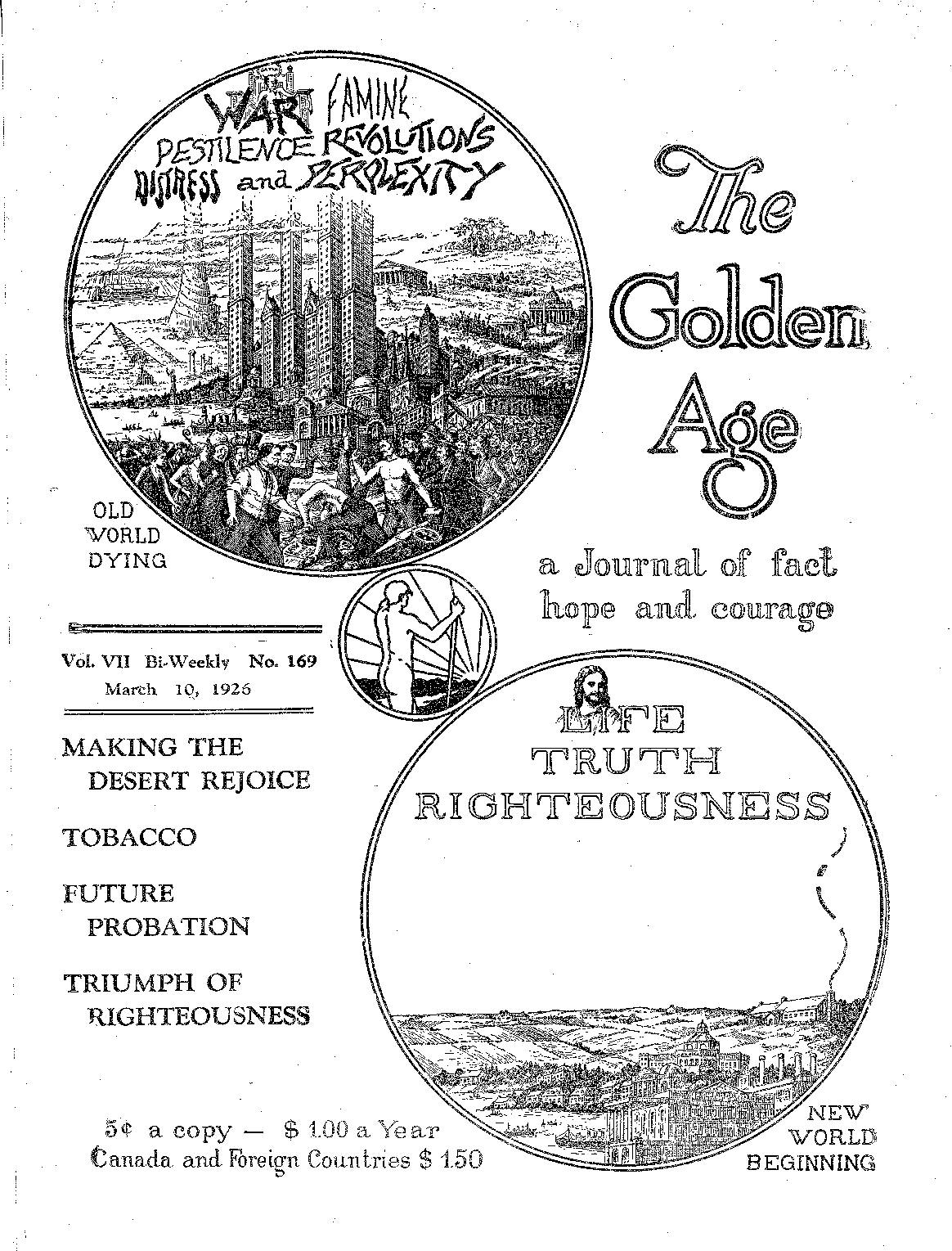
TOBACCO
MAKING THE
DESERT REJOICE
FUTURE
PROBATION
TRIUMPH OF
RIGHTEOUSNESS
Vol. VII Bi-Weekly No. 169
March 10, 1926
50 a copy — $ 1.00 a Ye ar
Canada and Foreign Countries $ 150
OLD
WORLD
DYING
a Journal of fact Iwpe and courage
NEV
WORLD BEGINNING
Contents of the Golden Age
OMi: w ' ' .-.zxlgggPl:
Labor and Economics
Making the Desert Rejoice
The Choice of Lands .............
Methods of Irrigation ........
National. Reclamation Program . .. . . ... . .. . .... . . 357
Colorado River and Imperial Valley ........... 357
South American and European Projects.......
Some Items about Tobacco...... .........
Social and Educational
News and Views of the World ............. 361
Radio Reunites Families
" Tuberculosis arid Genius
From our Canadian Correspondent . .... . . . . .
Children •
Inspection of Wisconsin Hotels .....
Radio Programs ..................'..
Finance—Commerce—Transportation
Who Gets the Benefit?..........
One-Fifth Did Not Want Bonus . .
Britain’s Power Problem ..............
Political—Domestic and Foreign
World Court is a Servant .......
1926 Starts Out Hopefully .......
Science and Invention
Voices from the Skies Cheer Sailors ........... 361
'Ihe Twentieth Century . ..........
Automobiles in the Sahara . .........
Glands ......
Religion and Philosophy
Is “Future Probation” Heresy?
Sea of Oblivion (Cartoon) ............... 373
The Tri uii ph oe Righteousness
The Hook-Up Between Mussolini and the Pope
Studies in “The Harp of God” .............. 383
Published every other Wednesday at IS Concord Street, Brooklyn, N. Y„ U. S. A., by WOODWORTH, BUDDINGS & MARTIN
Copartners and Proprietors Address: IS Concord Street, Brooklyn, N.Y., U.S.A. CLAYTON J. WOODWORTH . . . Editor ROBERT J. MARTIN . Business Manages WM. F. HUDGINGS . . Sec’y and Treas.
Fivb Cents a Copy—$1.00 A Ybab Make Remittances to THE GOLDEN AGE
Foreign Offices : British ..... 34 Craven Terrace, Lancaster Gate, London W. 2 Canadian .... .... B8-40 Irwin Avenue, Toronto, Ontario
Australasian . . . . . . . 495 Collins Street, Melbourne, Australia
. South African ...... 0 Belie Street, Cape Town, South Africa
Entered s» second-class matter at Brooklyn, N.Y., under the Act of March 3, 1878
Golden Age
Volume VII
Brooklyn, N. Y., Wednesday, March 10, 1926
Number 169
Making the Desert Rejoice
WHEN Congress passed its first Irrigation Bill in 1894 there were many wise men in both houses who doubted whether the act would ever accomplish anything. In substance the act merely offered one million acres of semi-arid land to any state that would undertake to irrigate the same and sell it to actual homesteaders.
It is related of Senator Hoar of Massachusetts that when the bill came up in the Senate he jingled his keys and gravely said, “I don’t believe it can be done, but I will vote for this measure. It promises to make the desert blossom as the rose. It sounds very nice, but I don’t believe it can be done.”
The work of Senator Hoar and others has borne such results that four hundred thousand people are now employed and housed on irrigated or reclaimed land in the United States, and there are areas where the farmers and fruit growers think nothing of raising crops which bring them $1,000 an acre from such land. Five states, Colorado, Wyoming, Idaho, Oregon and Washington took advantage of the original offer.
The original act, passed in 1894, provided that when ninety percent of the land had passed into the hands of private owners, the project would be turned over to the settlers themselves. As a whole the act worked well. Some of the land got into the hands of speculators, who made great fortunes at the expense of their fellows; but every good thing has its drawbacks.
In 1902 Congress passed the Reclamation Act, which provided that all funds in excess of five percent received from the sale of public lands in the Rocky Mountain and Pacific Coast states, should be set apart for works of irrigation in those states. The cost of the irrigation works is charged against the acreage, and paid back by the settlers in ten annual installments.
Today there are permanently installed in the cloak-room of the House of Representatives at
Washington two beautiful paintings of twenty-four Irrigation Areas in the Far West, representing the world’s master effort in reclaiming arid areas for productive agricultural purposes.
The Choice of Lands '
THE most important part of any irrigation system is the choice of lands which are to be irrigated. In making such a choice it is necessary to examine the character and depth of the soil, its behavior when irrigated, the slope and evenness of the surface, the presence of injurious salts, and the facilities for drainage.
The soil is best judged by what grows upon it. If sagebrush, buffalo grass or cactus are growing upon it the soil is usually fertile, easily tilled and well drained. But if the soil produces crops of greasewood, creosote bush, saltwort or salt weeds, it is less suitable. Before diverting water from a stream, advice must be sought from the proper state officials, to prevent lawsuits and wasted efforts.
Irrigation is one of the oldest of practices and one of the newest of sciences, i. c., it is new. as a science because there is so little known about the scientifically correct use of a given quantity of water.
Of the many ways of obtaining water for irrigation purposes, the gravity system of drawing a supply in ditches from the headwaters and mountain lakes is the cheapest. Storage is expensive, pumping from lakes or rivers is expensive, pumping from underground is more so.
A vast amount of water is lost by evaporation and absorption in any gravity system. Concrete lining is the most practicable and satisfactory method, because the results are certain, and permanent; but it is much more expensive than oiling, puddling, silting or lining with wood.
The cooperative irrigator, is compelled to cooperate with his neighbors. The man who thinks only of himself is about as popular in a community living on irrigated land as a jazz orchestra would be at a funeral. He is entirely out of place. Moreover, it is now known that the old type of irrigation hog who took all the water he could get, disregarding the interests of his neighbor, got smaller crops and did not have his land in as good condition at the end of the season as the man who took only the right quantity.
25S . .
Methods of Irrigation
IN THE border method of irrigation the field to be irrigated is divided into strips by low, flat levees extending usually in the direction of the steepest slope. Sufficient water is turned into each strip And allowed to move down the slope in a thin , sheet, moistening the soil to a given depth as it advances toward the lower end. The cost of preparing land for the border method is low as compared with that of most other methods. This method is fully described in Farmers Bulletin No. 1243, obtainable free from the Department of Agriculture at Washington.
In the irrigation of potato crops the water is not allowed to come in contact with the tubers at any stage of their growth. Between each two rows there runs a little ditch, which is called an irrigation lateral. The water in this is carried at such a height that it wets the rootlets but cannot reach the potatoes. The consequence is that when the potatoes are dug they are perfectly sound and have exceptional shipping qualities.
To have overhead irrigation a pressure of twenty-live to forty pounds at the head of the sprinkling line is best. The irrigation lines are forty to sixty feet apart, depending on the water pressure, and up to 500 feet in length. At intervals of three or four feet along the pipes there are nozzles from which the water is distributed over the fields in a mistlike gentle shower. When one section has been watered the whole pipe line is rolled on its axis, by means of a lever, and a new space is watered. With any system of irrigation too much watering or too long watering is worse on the crops and on the soil than a prolonged drouth.
Many plants can get along with such a little water that it has been proposed to shoot into the soil periodically, at a given distance from each plant, an icicle, made artificially from such limited supplies as might be available. It seems as though this might be practical in some light soils. The ice bullet system is designed to make one gallon of water do the irrigation work of a barrel.
Conservation of Resources
MANKIND is about entering the golden age it seems appropriate that we find so many studying and discussing the conservation of earth’s resources.
Only a few years ago it would have been thought a singular thing to pay heed to the quantity of snow on the mountain tops; but now, in the Pacific Northwest, the snow is carefully measured by means of the snow gauge, and its water content determined, so that the farmers who will depend upon these snows for irrigation purposes can plan their crops accordingly.
The farmers of the Northwest commonly refer to the snow caps as white gold. In the spring the local surveyor bores a two-inch hole into the packed drift or snow field to the earthen foundation. Into this is lowered the measuring stick which is also a snow meter, an aluminum spring balance making possible the immediate determination of the water content of any snow depth.
So advanced are the views of some of our conservationists that they even claim that every gallon of water that falls in rain should be stored away until needed. Not only do they wish to keep the waters which are so valuable for plant growth, but they wish to save the fertile soils that are now washed out to sea, and on the other hand they wish to save, as far as possible, the marshes and inland lakes which constitute the natural homes of waterfowl, fishes, fur-bearing animals and other forms of wild life.
As a sample of what is taking place, note the changed attitude toward marsh lands. A few years ago the general course was to drain these as quickly as possible, but now it often happens that marsh land is more valuable for muskrat farms, cranberry culture, or something of that sort, than are the more fertile lands that surround it.
In actual practice it is found that fifty-six percent of irrigated areas are devoted to the raising of alfalfa, and that such special crops as fruit, cotton, and sugar beets constitute relatively small percentages of these areas, so that alfalfa may he said to be the backbone of irrigation culture. Up to date not four percent of the arid lands of the United States are irrigated. In the year 1909 the total area of irrigated lands in the United States was 10,000,000 acres.
National Reclamation Program
THE last government report on irrigation shows that there are now 32,835 irrigated farms, with a population of 125,214, and a town population within the same areas of 324,289. Lands in these areas once held at $10 an acre or less have sold at $300 to $400 an acre, and some as high as $1,500.
In 1902, in the state of Washington, only two carloads of apples left Wenatchee during the whole year. Nineteen years later there were 16,000 carloads shipped from that station in a single season, which was a greater quantity than was produced by any other whole state. This was the result of irrigation.
There have been complaints that irrigation has been overdone. The government has been accused of squandering money in the irrigation of worthless or unfit lands from which the farmers could not make enough to repay into the treasury what is really a revolving fund. In other instances the farmers have withheld payment, in the hope that they could contrive to escape it altogether. The government adjusts charges to suit the production.
The government owes it to the Indians to complete the reclamation projects upon Indian reservations. This will involve an expense of something like $32,000,000, and will irrigate an area equal to 1,392,397 acres. It will help the Indians to exist independent of government aid.
In the present Congress efforts will be made to adopt a general reclamation program which will include the subjects of drainage of swamp lands in the South, removal of stumps from cut-over lands in the Great Lakes region, restoration of soil in New England states, flood control on the Colorado and other rivers, construction of dams for hydro-electric power, and irrigation projects generally. This ambitious program has the appearance of being designed to gain support from all sections for a drive for irrigation funds for projects "where the government will be the greatest investor and the surest loser.
The principal government irrigation projects to date are at Belle Fourche, (S. D.), North.
Platte (Neb.), Grand Valley and Uncompahgre (Colo.), Rio Grande and Carlsbad (N. M.), Salt River (Ariz.), Strawberry Valley (Utah), Riverton and Shoshone (Wyo.), Huntley, Little Yellowstone, Fort Peck, Milk River, Blackfeet, Sun River and Flathead (Mont.), Minidoka, King Hill and Boise (Ida.), Okanagan and Yakima (Wash.), Umatilla and Klamath (Ore.), Newlands (Nev.), Orland and Imperial Valley (Calif.).
Colorado River and imperial Valley
WHAT is now the Imperial Valley was once the Gulf of California. As the gulf became filled with silt from the Colorado river, and the river at length made a new channel for itself farther east and south, the valley came into being which is now the site of one of the richest agricultural developments on the American continent.
In the year 1924 there were 352,225 acres under cultivation in Imperial county. The 50,000 population had an assessed property valuation of a little less than a thousand dollars a head, and shipped a carload of crops for each inhabitant of the district. This district depends for its existence upon the Colorado river.
The Colorado river is like no other on earth. Once a year, in the spring, for about thirty days, while the winter snows are melting, it is a raging, roaring flood-mad stream, tearing at its banks, and carrying such a quantity of silt that every year it builds itself a new bed one foot higher than the old one of the last year. Once, after having created the Imperial Valley, it threatened to destroy it all; and the valley was saved only by shoving into the break in the levee a whole train of cars loaded with stone. No attempt was made to save the cars.
Now the seven states through which the Colorado runs are a unit in asking Congress to tame the Colorado, to protect Imperial Valley, and to make possible the irrigation of an area of desert lands which would support as many people as are now living in the entire United States. This could be done by building at Boulder Canyon a dam some six hundred or seven hundred feet in height. The electric power thereby developed would be half that developed at present in the entire country.
Not only would this dam create an inland lake eighty-five miles long, six miles wide and upwards of 500 feet deep, but it would be so much greater than the world’s greatest dam at Assouan, Egypt, that whereas the Assouan dam holds back a sufficient quantity of water to cover 3,500,000 acres with water a foot deep, the Boulder Canyon dam, if constructed, would hold something over nine times as much.
Not 'waiting for the construction of the Boulder Canyon dam, the city of Los Angeles, on its own account, is constructing in the Pacoima Canyon a dam 375 feet high, and which will cost $1,500,000, intended to serve the joint purpose of flood control and for irrigation purposes. The Pacoima creek drains an area of about thirty square miles. .
Forty-six percent of the present enormous fruit crop of California is produced on irrigated lands. . .
Washington and Idaho Projects
WE HAVE already referred to the marvelous results obtained by irrigation in the Wenatchee district of Washington. There have been years in which the average acre yield of irrigated lands in the .Wenatchee valley was over $480 an acre.
In the Big" Bend country of Washington there is enough water available in the Columbia river to redeem something more than a million acres, and in due time this will no doubt be done.
The diversion of waters from the Snake river has returned untold wealth to the state of Idaho. The American Falls project, centered on that stream, will be completed in about two years and will irrigate a quarter of a million acres of land, as well as create an artificial lake some thirty miles long.
The Arrowrock Dam on the Boise river, Idaho, 349 feet high, is said to be at present the highest dam in the world.
Utah and Arizona Projects
THE first systematic attempts by Americans at irrigation on a large scale were made by the Mormons in Utah. They entered Salt Lake Valley in 1847 andhave transformed into a para-adise what then was a desert. The productivity is so great that 175,000 inhabitants are maintained on 350,000 acres, or a person for each two acres.
Only recently private capital has reclaimed 7,250 acres of land lying between Salt Lake City and the Great Salt Lake. Tests showed that an
apparently desolate and salt-encrusted, tract of land, is capable of great fertility. '
In Arizona one man made a fortune and reclaimed an immense territory because he discovered that the water-bearing strata of the San Francisco mountains of northern Arizona could be tapped advantageously at an 8500 foot elevation. The underground rivers of Arizona are commonly called sun-dodgers; for they are so plentiful. They seem to seek to hide their waters from the evaporation which would follow their exposure to the rays of the hot sun. Often they are but a fewT feet beneath the surface. . . . .
There is a subterranean river near Lockhart, Texas, which is said to furnish more water than an adjacent surface river of considerable size. This stream was found by accident, and was located at a point where it comes within only four feet of the parched surface.
The Elephant Butte Dam, on the Rio Grande, New Mexico, is 306 feet high and therefore worthy of note in an article of this kind.
Reclamation in the East
THE East has all the water it wants; .sometimes it has too much, hence reclamation in the East takes the form of drainage. One of the most important of eastern drainage projects is that in the Piedmont section of North Carolina, where 30,000 acres which have lain under water for ages are now recognized as the richest lands in the state. Without any kind of fertilizer they will grow unparalleled crops of corn, cotton, grain, hay, potatoes and truck crops.
The Mattamuskeet drainage district, still larger, covers 100,000 acres, including a lake bottom of 49,000 acres. In all there are some 150 drainage projects in North Carolina. The increased value of the reclaimed areas, from a health standpoint, is more than an offset to their cost.
Most important of all the drainage projects in the United States is the one which has undertaken the reclamation of Lake Okechobee and the Everglades, and which centers on Miami, Florida. The construction of the drainage canals from Lake Okechobee to the Atlantic Ocean near Miami forcibly brought to light the basis upon which the present boom in Florida real estate actually rests. It was found that the muck soil, three to five feet deep, overlays a stratum of limestone, which makes as nearly
Th* QOLDEN AGE
Masch to, isaa
ideal soil for a truck garden as could be devised. On this-soil, without fertilizers, three or more crops can be raised annually. The climate is fine, the nights agreeably cool, and malaria is practically unkno wn. Miami is certain to become the I.os Angeles of the East.
There is a great surplus of water in eastern Canada also. Near London, Ontario, are considerable areas of what are called “drowned lands”, which will be very valuable when the drainage of the area is accomplished.
South American and European Projects
IRRIGATION has been practised in the neighborhood of Mendoza, Argentine, for not less than eight hundred years. The works were laid out under the direction of the eighth Inca of Peru, and are still in use. These works reveal the high civilization attained by the Incas. They have now been extended and suffice for the intensive cultivation of 100,000 acres of land.
Unique in conception and remarkable in their scale of operations are the reclamation works which have done so much to make Holland what it is. Holland alone of all countries has invaded the ocean, and from time to time erects more and greater dykes to rob the seas of lands which they have covered for ages. .
Just at present the Dutch have under way a project that will cost them $185,000,000, which has as its objective the damming and drainage ■of the Zuyder Zee. This body of water, covering 1,350 square miles, is to be enclosed by dams and the lake within reduced to an area of 450 square miles. The balance, something over 900 square miles, will be reclaimed.
Experience shows that these lands wrested from the ocean take seven years to reach complete fertility, and in the case of some of them it takes as much as thirty years. The dam will probably be completed by 1934. During the last three generations the Dutch have added to their territory by reclamation 2,000 square miles.
Portions of Spain, southern France, and the great plains of northern Italy, particularly the valley of the Po, are indebted to systematic irrigation. Over $10,000,000 were expended in constructing the dikes along the Po river and the reservoirs in which the flood waters are preserved for irrigation purposes. Some of these works were begun in the days of the Roman Empire.
The Foundation Company of New York is engaging in a' reclamation work' for the Greek government, involving the control of the Vardar river and the drainage of lakes and swamps calculated to bring 260 square miles of land under cultivation.
Asia, Africa, Australia
MOST of our readers are familiar with the works of reclamation now under way in Palestine, doubtless to be followed-by more important works soon. One of these plans is to use the Sea of Galilee as storage for a system of irrigation works that will line both banks of the Jordan. The plan is said to be some two thousand years old. A more ambitious plan contemplates the cutting of a canal through from the Mediterranean to the Dead Sea, and transforming the climate of the whole Jordan valley thereby.
India has 22,500,000 acres of irrigated lands. The British government has completed a vast system of irrigation here in connection with the Ganges river. The canal is two hundred feet wide and ten feet deep, and is carried across four great streams. It almost pays for itself every year. A still more extensive undertaking, the Sutlej project, which will irrigate 3,500,000 acres of excellent farm lands, will be completed in about seven years.
China has maintained extensive irrigation works since the dawn of history. In the province of Szechuan (the Beautiful), a population of 60,000,000 people is supported on approximately 90,000 square miles. These great "works, constructed by Li Ping, about 200 B. C\, were so well planned and superbly built that the original canals have been in constant use until this day.
One of the interesting irrigation developments of China is in the Mongolian desert, where a Belgian lias founded a thriving city of 2,500 families in a district previously uninhabitable,, There are now eighteen European families living in this area. The Chinese call the district “Desert Blossom’’,
In Africa, from time immemorial, the surplus, waters of the Nile have been caught in reservoirs and used for irrigation. One canal is known t® be four thousand years old. It is 230 feet wide on the bottom and carries a current eighteen feet deep. It waters 340,000 acres, and another waters 1,000,000 acres. The soil is so rich that three crops are raised each year. The British are constantly improving and expanding the uses of the Nile for irrigating purposes, all the way to its headwaters.
In South Africa the project is being urged of damming the Chobe river and diverting it from its new channel into the old channel, running 500 miles to the south and now utterly obliterated. It is hoped by this means to renew Lake Ngami, which in Livingstone’s day was an inland sea of 50,000 square miles, but which is now dried up. Because of the drying up of this lake the Kalahari Desert has grown in size until it threatens the whole southern end of the continent.
One of the principal irrigation works of Australia is the Mildura pumping project, with Ive batteries of pumps, capable of raising 30,000 cubic feet of water a minute from the sand-submerged Murray river. The Mildura project has 70 miles of mains, 100 miles of laterals and 207 miles of subsidiary channels; and provides irrigation for 45,000 acres. There are many other considerable irrigation projects in the same district.
Gradually the earth is being made over, the wastes and solitary places are being made glad, and the deserts are beginning to rejoice and blossom as the rose.
Who Gets the Benefit? By Wm. F. Withers
IF PUBLIC funds be used to develop power, heat and light from the Colorado river, and to divert the water to the dry, fertile lands adjacent, who would be benefited thereby? The people at large who would be taxed to furnish the funds, or only the owners of lands thus made valuable?
And if we develop at public expense “The Great Areas of Natural Resources Adjacent to Our .Highways of Travel”, “the mineral, coal and petroleum resources of Alaska and the tropical isles of the Pacific,” if we improve the great rivers, if we build good roads, if we do every thing conceivable to make the earth more productive, would not all of the financial benefit go to the owners of the lands while the rest of the people toil as. always for a bare subsistence? Even an appropriation for education results only in furnishing the exploiting class with efficient help at lower wages.
Positively nothing that can be done will lift the masses out of the slough as long as we permit a few people to monopolize the bounties of nature; to call their own what the Creator has provided for all.
People are wont to say that the followers of Henry George regard land value taxation as a panacea. That is far from true. That philosopher stood for nothing less than absolute equality of right to life and liberty, and advocated every true reform; but it is plain that no other reform can avail while we permit private appropriation of rent. .
A number of articles in The Golden Age have pointed to this truth, and it was clearly illustrated a short time ago in the story of the Nile improvement; but people so soon forget. They need to be reminded often, and The Golden Age can do effective work on this line. Its readers do not have to be told that the Creator has provided abundantly for the needs of all His creatures; but we do need to be reminded that He has' assigned man the duty of’developing the resources and distributing the products.
The Longest Bridge
TN ONE of your issues you gave an account of J- the longest bridges in the world, but you omitted the longest one of all; namely, the one on the Southern Pacific Railroad across the Great Salt Lake. This bridge is 33 miles long. It has a switch and a small depot near the middle of it.
By George W. Transue
[The above bridge was built by command of E. H. Harriman, the railroad magnate, when he was at the height of his power. The engineers who first studied the problem declared the bridge could not be built. Back came the command from Mr. Harriman, “Build it anyway,” and they did. This bridge has been described in our columns previously.—Ed.]
News and Views of the World
Cardinal O’Connell Criticises Munsey
Cardinal O’Connell makes a just criticism of the late Frank A. Munsey, publisher, when he calls attention to the fact that Mr. Munsey left forty million dollars to art, but nothing . for the sick, the poor or for those who helped him make his millions. Money left for art accomplishes comparatively little; if left for getting people out of purgatory it accomplishes nothing. Cardinal O’Connell does not intimate that Mr. Munsey should have left any money for the latter purpose, and we think he was wise in omitting it from the list of worthy causes.
One-Fifth Did Not Want Bonus ■
ONE-FIFTH of Uncle Sam’s soldier boys did not want the bonus, even when all they had to do was to reach out and take it. About 3,500,000 were entitled to the bonus according to the law, but something like seven hundred thousand have failed to apply for their adjusted compensation. The soldier boys are now scattered in every part of the world.
Voices from the Skies Cheer Sailors
THE New’ York Times has a pleasing item respecting the experiences of storm-tossed sailors on the steamship “Hallimoor”. During the voyage life-boats were washed away, the life-boat deck was smashed, the iron bridge ladder was wrenched off and other serious damage done. When the storm was at its height some of the sailors listening in on the radio were cheered by hearing a singer in London render beautifully the song, “O God, Our Help in Ages Past.”
Radio Reunites Families
TN OHIO a woman who had not seen her brother for forty years and did not know his whereabouts, broadcast an appeal to him from one of the Ohio stations and it reached the man direct, sitting by his fireside in Arkansas. A reunion followed. In New York, a boy who had run away from home was similarly located at about the same time.
Variable Growths of Boys and Girls
STUDIES of the growth of children, which have been made by the Carnegie Institution at Washington, show that during early childhood boys are generally taller than girls of the same age. At eleven years of age girls become the taller. At fifteen years of age the boy overtakes the girl and thereafter retains his advantage.
The Twentieth Century
THE first quarter of the twentieth century -witnessed three of the greatest earthquakes ever known: Messina, in which 200,000 lost their lives, San Francisco and Tokio. It witnessed the greatest war of all time; also the greatest revolution, in Russia. Besides all this, it witnessed the discoveries of both the North and South Poles, and the inventions of the airplane, the wireless, and the radio. '
Elephants Upset the Dominoes
HHHREE hitherto well-behaved elephants got peeved when some scenery fell on them New Year’s night, in a theatre on 125th Street, New York; so they decided to leave the show and go out and see the town. After chasing several blocks through the streets, defying traffic rules and making several people step lively to get out of their way, they plunged through the doors of a police station, and terminated their spree by upsetting several tables at which policemen were playing dominoes.
Waste of Milk Bottles
Very time you buy five quarts of milk you also pay for a milk bottle, because only four out of five bottles left at the door are ever returned. The dealers must get their money back, so it is inevitable that the price of the bottles lost is added to the price charged for milk. The machines which wash the returned bottles will handle 250,000 per day.
Tuberculosis and Genius
AMONG the long list of geniuses that have suffered from tuberculosis in some form are: Austen, Balzac, Beaumont, Blackmore, Elizabeth Browning, Butler, Calvin, Channing, Chopin, Cicero, Coleridge, De Quincey, Descartes, Emerson, Fitzgerald, Gibbon, Goethe, Hawthorne, Hood, Irving, Samuel Johnson, Kant, Keats, Kingsley, Lanier, Locke, Milton, Moliere, Mozart, Paganini, Pope, Raphael, Richelieu, Rousseau, Ruskin, Schiller, Scott, Shakespeare, Shelly, Southey, Spinoza, Stevenson, Tennyson, Thoreau and Voltaire.
World Court Is a Servant
rFHE World Court is a servant. The League of Nations elects the judges, fixes the salaries, pays the judges, fixes the pensions of the judges and fixes the status of all the employes. The League of Nations alone has the power and authority to enforce the judgements of the court. No such power is invested in the court itself. The court is merely a servant of the League.
1926 Starts Out Hopefully
IT IS considered that, generally speaking, the year 1925 was a good year for the nations.
It brought about the Locarno treaties, which seem on the surface to indicate that Europe has at last really made peace. It brought about a series of debt settlements between debtor nations and the United States. And Bolshevism made little or no progress during the year.
- Big Cut in Immigrant Rates to Canada
IMMIGRANTS from Great Britain to Canada have been favored with a great reduction of rates. To eastern ports of Canada the rate is now only three pounds as against' fifteen pounds, five shillings; to Winnipeg the rate is five pounds, ten shillings, as against twenty pounds, ten shillings; to Vancouver the rate is only nine pounds as against twenty-five pounds.
Pretty Soft for the Dogs
LONDON now has dog parlors where a woman can leave her dog and have it cared for by an expert while she does her shopping. There is a diet kitchen attached, from which the dog will be fed any food desired. Besides, it will be washed, have its hair curled and perfumed and be allowed to rest in luxury until its mistress returns.
Britain’s Power Problem
THE British people are coming to realize that they are slipping to the rear because of their failure to furnish cheap power. The cost for power in Britain averages about three times as much as in the United States. In America, more and more work is being done mechanically, because men are scarce and power is plentiful. In Britain opposite conditions prevail, Britain’s way out is to turn all the coal into power at the mines. That alone will do it.
The Labors of a Duke
THE Duke of Northumberland, whose net income from royalties on coal is over $500 a day, thinks that he is not overpaid. When asked what services he renders to mankind in return for such compensation he stated that he paid taxes, maintained houses and built new ones, made efforts to improve the amenities of life for the miners and did what he could to explain to the miners the disastrous course in which they were being led by labor leaders.
Great Floods in Europe -
THE latter part of December and the first part of January witnessed the worst floods that have been seen in Europe in forty years. The devastation has been general. In Belgium conditions were so bad that it is said the damage caused was as great as that experienced during the World War. Thousands of farms all over Europe have been inundated and the live stock drowned, while the damage to cities and towns is beyond belief.
Another Hurricane in Samoa
EVERY few years there is a hurricane in Samoa. Another one struck there early in January of this year, which was so severe that it not only blew down the lightly-built thatched houses of the natives, but great trees were literally blown from the mountainside and serious landslides were caused thereby. An appeal to the United States has been made.
Rheims is Overbuilt
THE New York Times states that in the reconstruction of the city of Rheims the city has been overbuilt. The city was reconstructed to care for the population of 115,000, which it housed prior to the war, but it seems that at present there is business enough for only 80,000 and, as a consequence, there is a glut of property in the market at ruinously low prices.
Automobiles in the Sahara
A DISPATCH in the New York Times tells that six-wheeled automobiles have enabled the establishment of a regular Sahara freight and passenger service between the oases of South Tunis and South Algeria,
From Our Canadian Correspondent
THAT the Roman Catholic element has not lost any of its power over the Liberal Government of Canada is well illustrated in the disposition recently made of some 20,000 acres of the Saddle Lake Indian Reserve surrendered to the government about a year ago for the purposes of settlement by British immigrants under the new British Settlement Plan. As far as the British immigrant is concerned he will not get much of the land, as the following press report in the Toronto Sentinel clearly shows:
The country immediately east of the reserve is a mixed settlement,'the Freneh-Canadians having a slight majority. As soon as it became known that the reserve was to be opened the Freneh-Canadians quietly sent Father Tessier down here to arrange with Hon. Charles Stewart to stop the sale of the land to British settlers and have it sold to local residents, which. means the French settlers; for the British settlers were kept in the dark about selling to local residents. '
It is well remembered here in Ottawa that Father Tessier spent a good deal of time with the departments concerned. He had to deal with the Soldier Settlement Board and the Immigration Department. It is now learned that after many interviews Father Tessier suc-'-reded in having a new arrangement made whereby the last half of the portion surrendered by the Indians will be sold to the local applicants. Practically every influential man here was interviewed to push the deal through as a favor to the French.
. It is learned that the greatest secrecy was maintained to keep the information from the British settlers until the French had applied for the whole tract. Word was given out in three of the French Roman Catholic churches in the parish of St. Paul-des-Metis that any of the members of the congregations who wished to get part of this land MAKE APPLICATION TO THE PRIEST, BUT NOT TO SPREAD THE NEWS AROUND. Some of the land, it is reported, has been sold by the priest to French settlers, and the British settlers knew nothing whatever about its being available. The representation made here in Ottawa was that the French settlers desired the land for their sons. In that way the whole area could be taken up before an Englishspeaking settler would know anything about it.
The questions that arise are—why, in the first place, was this fertile, accessible tract not kept for the original purpose of settling British families; and, in the second place, why does the government allow the public domain to be administered through' a church organization in-/ stead -of through the regular Dominion Land Office?
The whole transaction will be ventilated when Parliament meets, and the ministers affected will have to explain and defend their action.
Sometimes it is well to take an inventory of this dominion and visualize what some day, under proper government, it may become. That Canada ranks with the richest countries in the world is conceded, and that it can support a population of twelve or fifteen times its present one is no idle dream. Even today, with the comparatively isolated efforts made to develop its natural resources, it shows most marvelous returns.
This country has been called the bread basket of the empire with millions of acres of fertile land still awaiting the touch of the plow—agriculture, the backbone of its wealth. It has been claimed that its fisheries could be made to pay its national debt. Six hundred million acres of its surface, one-quarter of the whole country, has been estimated by the Department of the Interior to be covered with forest growth, and one-quarter of this with heavy timber of marketable size.
Many millions of dollars are yielded annually from Canadian furs; while our coal supply is said to be equal to one-sixth of that of the entire world. Canada’s known supply of iron is placed at 600,000,000 tons. Its water power has been estimated at something over 18,000,000 horse-power at ordinary minimum flow, with more than 32,000,000 dependable horse-power for six months in the year. It has oil and natural gas in quantities yet unknown.
There are said to be 200,000,000 acres of land available for agriculture in the Prairie Provinces, and only a comparatively small part of it now under cultivation. Yet Canada’s wheat production approaches that of the Lmited States. While the forest resources are not known, the Dominion Forestry Branch has made an estimate of the country’s supply of saw timber at more than five hundred thousand million feet, board measure, and pulpwood at nearly thirteen hundred million cords.
Canada’s mineral resources are regarded by those who should know as surpassing by far all other lands. Besides gold, silver, copper, iron, zine, platinum and other metals, Canada produces 85 percent of the world’s supply of nickel. It also produces 85 percent of the world’s supply of asbestos, and numerous other non-metalic minerals.
Now Northern Ontario is apparently to add to Canada’s wealth by the discovery of the world’s richest deposit of china clay and silica
sand. And half the story has not been told, for in many parts of Saskatchewan valuable clay deposits of almost incalculable extent are being revealed by research work, and the whole far north of the province, of the same formation as Northern Ontario, is as yet unexplored.
In view of the marvelous potential wealth here shown to exist, its exploitation for the benefit of a few moneyed men, foreigners in many cases, and by financial interests controlled in foreign countries, is shameful; especially as we must continue to face a constant flow of native or naturalized Canadians from their homeland to foreign countries to seek a living.
However, that a few steps in the right direction have been taken is shown in the fact that some of the nation’s assets are being developed under national control for the benefit of the people as a whole. Labor, a newspaper published in Washington, D. C. by the. Railroad Workers of America, comments on Canada’s forward steps as follows:
The Government of Canada is running the biggest, single railroad system in the world, and is beginning to make a financial success of it. It is managing its own merchant marine. The Province of Ontario is developing its water power by public action for the benefit of all the people, and visitors are coining from distant lands to see how it is done. Canada has Government telegraphs and a Government radio. Its farmers are successfully handling a gigantic “wheat pool”, thus ensuring better prices, and are talking about a “flour pool” to mill their wheat and supply the finished product to a hungry world.
This, the Toronto Globe says, is very, different from the timid opinion presented by many of our own public men and industrial leaders as to what has been accomplished in the Dominion and of what promises to be accomplished in the near future. It would seem as if in order to obtain a view of the Dominion in the right perspective, it is necessary to go abroad for information regarding Canada. In the words of the Globe:
The fact is that in no country in the world today is wealth so evenly distributed, the prospect for the ordinary man so attractive or the future of the inhabitants so assured as in Canada. If her people will but be true to her and her destiny, nothing can impede her progress or prevent her attaining her goal as a great and prosperous nation.
Concerning the present status of the National Hallway System, conflicting interests tell differing tales. Says the Moose Jaw Times, under the caption “Making Good”:
For the month of October, 1925, net revenues of Canadian National Railways, after payment of operating expenses, were $8,159,958, ah' increase of $3,466,115 over October 1924, and of $2,974,941 over October 1923.
For the ten months of 1925, January to October, inclusive, net revenues of the "National System amounted to $20,485,210, as compared with $10,769,664 in the same period of 1924 and $12,144,712 in 1923.
Gross earnings of the system for October, 1925 amounted to $27,175,821, an increase of $4,335,123 as " against the corresponding month of 1924 and an in crease of $918,048 over October 1923. 'For ten months period gross earnings of the system amounted to $196,444,081 as compared with $195,325,323 for the corresponding ten months of 1924, and $206,395,341 for the corresponding months of 1923. Operating expenses of the system were $19,015,863 in October, 1925, as against $18,146,855 in October 1924, and $21,072,756 in October 1923, operating expenses for ten months of 1925 were $175,958,360 and in corresponding periods of 1924 and 1923, they were $184,555,659 and $194,280,290.
Ratio of operating expenses to revenues continues to show marked improvements. In October, 1925, operating ratio was 69.97 percent as compared with 79.45 percent in October 1924; and 80.25 percent in October 'A 1923. Operating ratio for the ten months’ period ot 1925 was 89.59 percent against 94.49 percent in 1924, and 94.13 percent in 1923.
The Canadian Nationals are making good. No railway having the national sweep of the Canadian Nationals could make such a record except in a country enjoying a large degree of prosperity. The earnings of our two great railway systems and the sane optimism of Mr. Beatty [President of the C. P. R.] and Sir Henry Thornton [President of the C. N. R.] will help to overcome the injury done the country by Mr. Heighten’s campaign of gloom for political effect. [Mr. Meighen is leader of the Government opposition.]
In the same newspaper, under the caption “Getting Worse”, the following appears:
While it is gratifying to learn from Sir Henry Thornton that the operations of the Canadian National Railways are likely to result in a substantial surplus of operating revenue over expenditures, it is impossible to regard with equanimity the enormous increase in the debt of the national lines. According to a statement just issued by the Government, through the Bureau of Statistics, the debt now stands at $2,096,181,513. That figure comprises $1,142,268,435 due to the Dominion Government, with accrued interest, and $913,268,083 due to the public. In 1924 the debt due to the Dominion Government increased $28,085,159 ; due to the public, §>90,814,027, Comparative figures show that during the last six years the debt due to the Dominion Government has increased $140,949,117.
This return bears out the statement made on several occasions that during last year the railway debt increased at approximately the rate of two million dollars a week. It may fairly be asked if any country with the population of Canada can long stand this frightful drain on it.
. It would appear that the Times finds it difficult to determine editorially as to whether the railroad is an asset or a liability. The first extract given was evidently designed to support the Liberal Government, the second possibly a change of sentiment occasioned by receipt of a t^x bill. ___________
The Times-Herald newspapers next get down to the presentation of a few figures dealing with national economy. After reviewing the success of the British “Geddes Commission” and the American “Dawes Commission” in restraining enthusiastic departmental spending, it states:
Canada has neglected to do the one thing that must be the foundation of any movement for national economy and reduction of taxation; that is, providing for an examination of all avenues of outlay to ascertain where savings may be made. One result of this lack of expert study of conditions is revealed by a comparison of present civil service costs with those of 1913, in which year more work was being done than now, in most of the Government departments. In 1913, there were in Canada 8,709 Government employes, with salaries of $8,000,000. In 1919, we had 12,742 employes, with salaries of $13,000,000. In 1923, the number was 39,204 employes and the salary list $50,000,000. Here is a $42,000,000 increase in ten years.
The Calgary Herald says that this is just one set of figures that should make the public think:
Every tax increase and every reduction of taxation affects the prosperity of the individual citizen. Tax money that is unnecessarily taken from the people and spent, removes so much money from their savings, or prevents it going back into reproductive employment. High taxation kills or retards investment of capital, thus restricting development, employment and prosperity. As Mr. Sweatman [former President of the Winnipeg (Man.) Board of Trade] puts it, “the ultimate consumer is the ultimate goat.” Governments do not shed their bad habits easily. An informed, aroused and vigorous public opinion has to insist upon reform.
Coming back again to Canada’s wonderful showing when favorable conditions permit of her producing her wealth: The most recent figures published by the Dominion Government indicated a total wheat crop for Canada approximately 422,000,000 bushels, which is- about 30,000,000 bushels more than its previous estimate, and 160,000,000 greater than the 1924 crop. Says the Times-Herald newspapers;
The Government’s provisional estimate as at November 10 of the total value of the chief fodder crops produced during 1925 was $296,653,000, which compared with $277,780,000 for 1924.
Under the Federal Government test a new variety of wheat to be known as “Garnet” has been perfected, and this it is anticipated will prove a boon to the farmers of Western Canada, particularly in the northern areas, as the ripening stage is reached within 100 days of sowing and the danger from frost is minimized. When Marquis wheat was first developed, the period of time between sowing and reaping was reduced from 120 to 110 days, and this resulted in millions of acres of western lands being brought within the wheat belt. A relatively small quantity of the new grain will be available for distribution for sowing next year. While not claimed to be rust resistant, its earlier maturity decreases its susceptibility to disease.
Cattle of good quality continue to meet with a ready demand. With an abundant corn.crop in the United States, particularly in Iowa, and prices much lower than those of a year ago, the possibility of arranging for importations of Canadian feeder cattle to the Middle Western States is being discussed. Shipments of cattle to Great Britain for the first 10 months of the year numbered 87,797, as compared with 67,073 and 48,540 in 1924 and 1923, respectively.
It has been said that when agriculture pays a satisfactory profit the people will go back to the farms. There is now a distinct slackening of migration from the farms to the cities, and signs are not wanting, that satisfactory prices for farm products have prompted many to return to the land.
When one contemplates the denudation of the western plains of their tremendous herds of bison which roamed the prairies one hundred years ago, one is apt to deplore the passing of the outstanding zoological phenomena of America. Canada, however, took steps some years ago to preserve the remnants of the vanishing cattle, and in 1907 the Government purchased from Michael Pablo of Montana 709 members of his herd and gave them pasturage^ and protection in Wainwright (Alberta) National Park. In sixteen years the original 709 have increased to twelve thousand head. Owing to the danger of overstocking the government desired to split the herd and. transport part of it to other-stamping” grounds.
The Regina Daily Post gives the following report of this operation:
From time to time a certain number have -been slaughtered and a commercial disposition made of the meat and robes. As a further experiment, during the past summer, over 1,600 yearling and two-year-old buffalo were shipped from Wainwright northward about 700 miles by rail and water to the Wood Buffalo park, near Fort Smith, Northwest Territories. Ten thousand five hundred square miles of natural pasture are included in the Wood Buffalo park, which was primarily set aside for the protection of wild wood buffalo herds. While it is too soon to say positively what the outcome of this experiment will be, the outlook is most encouraging.
The movement of the buffalo from Wainwright began in the early part of June. Their destination was a point known as l.a Butte on the Slave river, .the eastern boundary of the Wood Buffalo park. Substantial corrals and loading platforms were built at. Wainright and weekly shipments of 200 to 250 each were made in special cars divided into sections and fitted with watering and feeding facilities. The first trainload left Wainwright on June 15 and reached the end of steel at Waterways, Alberta, on the 17th. At this point the buffalo were placed in specially constructed corrals where they were watered, fed, and rested for thirty-six hours. They were then reloaded on two barges, and, after an uneventful trip down the Clearwater, Athabasca and Slave rivers, arrived at their destination on June 21. The buffalo were released at the gateway, of their new home by means of an enclosed wharf and laneway from which they raced for a few hundred yards and then settled down to graze on the inviting grass before further exploration.
Seven times during the summer' this unique flotilla made the river journey, and during the first week in August the last shipment reached the northern park. Since then the wardens, who for some years have been guarding the wood buffalo against trespassers and who are now responsible for the new arrivals, have reported that the plains and wood buffalo are mingling freely and that there is every prospect of complete amalgamation of the two herds.
Considei’ing the ever accelerating rate of increase, with proper protection these herds should constitute, in a few years, another natural resource asset for Canada.
The new immigration policy of the government may produce some good fruit if it is rigidly carried out and the immigrants as carefully handpicked, as seems to be necessary to justify the assistance rendered. Both the Dominion and the British Governments will need to put up larger payments on the assisted passage basis, the immigrants themselves furnishing approximately only $17.00 for passage to Halifax, $25.00 to Winnipeg, $35.00 to Edmonton, and $45 to Vancouver.
Last year 724 families comprising 3600 individuals emigrated to Canada under this scheme, as well as one thousand single farm workers and one thousand household workers. Twelve hundred more families are already in prospect for this year and a corresponding number of single workers.
An interesting comment on the weather “forecasting’’ is contained in a recent editorial in the Toronto Globe. In view of a recent article in The Golden Age concerning this science the Globe's comment under the heading “Is the Climate Changing?” is quite pertinent:
Ou the last day of 1925 the Edmonton Bulletin announced to the world in large display type that that city was basking in springtime weather, that the whole northern country on the Pacific well up to the Arctic Ocean was enjoying mild, and genial atmospheric conditions, and that the prophets were predicting a permanent change of climate in the region once given over to polar gales and glacial ice. Those long acquainted with, the Far North are. inclined to attribute this phenomenon to “a conspiracy” on the part of the Japanese Current, the Gulf Stream and the chinook winds.
That there is real ground for attributing the genial conditions at present prevailing in Northern Alberta to a permanent change in the climate is to be doubted, but it can readily be understood with what jubilation any such prospect is welcomed by the inhabitants of that Province. Instead of shivering under fur coats with, the thermometer registering 40 degrees below, and still lower during the, long winter days, the. as-, surance of subtropical weather even when Boreas did his worst would be delightful indeed. It would add a valuable asset, too, to the many valuable assets which Alberta now possesses. With mild mountain air blowing all the year round from the ’Rockies, the region would become a vast health resort and an irresistible attraction to the tourist. Millions of acres of rich and fertile land would yet further increase the already immense agricultural possibilities of the Dominion, and the vast Peace River country would prove the strongest lure to the immigrant and the restless element of older Canada.
The Bulletin indulges a spirit of optimism which, let us hope, will not soon be blasted by the biting breath of the north wind. It supports the predictions of permanently milder climatic conditions by publishing a despatch f rom Anchorage, Alaska, telling of the return of volcanic activity in Mount KcKinley, and the prevalence there of a springlike atmosphere unparalleled in the experience of the oldest inhabitant. Streams usually ice-bound at this season are reported to be open, and green vegetation has taken the place of snow-bound landscape.
All this is pleasant, in view of the prophecies of a bitterly cold winter which were made by our “most reliable” weather prophets at the close of last autumn. Of course there are some months of possibly severe weather yet before us, in which Edmonton may have a rude: awakening from its dreams of changed climatic conditions. Let us hope, however, that the Japanese Current, the Gulf Stream and the chinooks will persist in their plots to dethrone the boreal tyrant of the Peace River region and endow the Pacific and the whole Northwest with an atmosphere of eternal spring.
There may be more of an element of reliability about governmental weather guesswork than the kind on the patent medicine almanac but it seems as though in practice, the. one has as much chance of being right as the other. They both seem to be responsible for the “lie” in “reliable”. .
Children By J. A. Boknet
MUCH has been said about children, much they readily detect faults and imperfections in has been written about them, and much their neighbors’ children.
more can be said and written about them. It has been said that a home without children is like a garden without flowers. Who said that? Was it the parent, or was it the neighbor who has no children ? '
Let the children-loving parent answer these questions: If children are so great a blessing in the home, why will the loving heavenly Father, following the Millennium, deprive homes of the blessing of children? Why not have children throughout eternity for the blessing of the people of earth? Does not the heavenly Father know that humankind in general will then be better off without any little children in the homes of men?
If children are so great a blessing in the home, why do not the loving parents want their offspring always to remain children, and never grow up to adulthood? If children, as children, are so great a blessing in the home, why do not the loving parents want the children of somebody else in their home? „
Why would not some other person’s child be just as great a blessing in your home as your own children are said to be? If these simple questions are not answerable in the affirmative is it not self-evident that selfishness exists in the heart of the parent and warps his reason in favor of his own flesh and blood?
Parents love their children simply because the children are their own offspring. And because they are their offspring they are slow to see any faults and imperfections in them, though
Why are parents thus blind to these simple acts? Would not the perfect man have equal love and appreciation for all children, for his. own and for his neighbors’ alike? Can an imperfect human being realize such unselfish love? Imperfect creatures may vigorously declare that such a proposition is utterly unreasonable and impossible. But what did the perfect Jesus mean when He asked, Who is my mother, my brother, my sister and loved family members? Did He not mean to infer that all people should be alike dear and precious to one another?
Will not such a condition of unselfishness exist after the Millennium? And if so, where will be the need or advantage of children for home blessings (or annoyances) ? Broad-mindedness must here come into play. The narrow mind will file a probable protest.
A colt, as a colt, is of no value. A calf, as a calf, is of no value. A chick, as a chick, is of no value; nevertheless they are liked and admired. Then of what real value is a child as a child? Nevertheless the child is loved and cared for. But no one wants his child to remain a child. Why not? I repeat: If children are indeed such blessings in the home why should not parents wish them to remain children and thus continue the home blessing perpetually?
…