Golden Age, January 27, 1926
Download: PDF — Golden Age, January 27, 1926
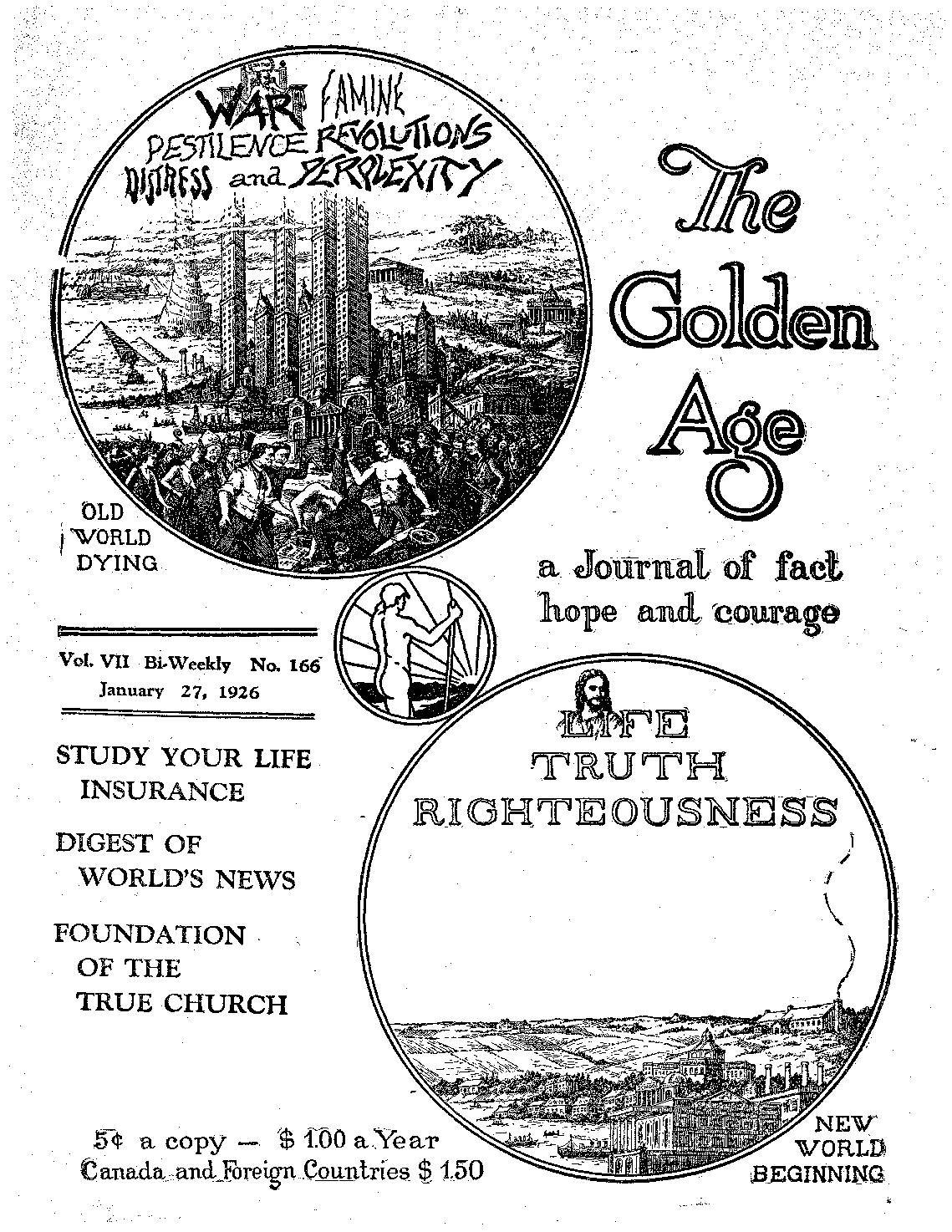
jwORLD DYING
DIGEST OF
WORLD’S NEWS
STUDY YOUR LIFE
INSURANCE
FOUNDATION
OF THE
TRUE CHURCH
s
VoL VII Bi-Weekly No. 166
January 27, 1926
a copy — $ 100 a Year Canada- and Foreign Couritries $ 1.50
a Jouraal of fact Kope aiulcowag®
NEw
VORLD (BEGINNING
Contents of the Golden Age
' Labor and Economics
Digest or the World's News............. . , 268
, Why American Wages Are High........
Labor Savers Displace Labor ... . . . . . . ... .
Metropolitan Life’s Housing Investment .
Europe’s Poorly Paid Woodworkers . . .’ . . . . ... . . .
r Social and Educational
Increased State and Local Taxes
America Headed for a Caste System
A Sample Prison Labor Contract
Russia’s Child Criminal Problem ...
AnEditor’s Predicament
More About “Handling the kiddies” . . ..... . z. . . . 278
Another Bachelor Offers Parental Advice . .
Experiences of a Farm-Hand’s Wife
Radio Programs
Finance—Commerce—Transportation
Study Your Life Insurance ............
The Loan Value of Insurance Policies......... .
Rate-Making Explained
Dividends—Refunds r .
■ Political—Domestic and Foreign
Miscellaneous Items About Italy
Liberia as Large as Texas
From Our Canadian Correspondent
i Britain Preparing for Anarchy . . . . '
' Agriculture and Husbandry '
Reforestation In California
Iowa Has a Banner Com Crop
1925 A Year of Pests
Religion and Philosophy '
Faith Healing in Vancouver ............. . , 271
The Foundation of the True Church ........ ' ; . . 282
How to Become A Member ...
“The Gates of Hell” ............. ...
Studies in “The .Harp of God” . ...............
Published every other Wednesday at IS Concord Street, Brooklyn, N.Y., U.S.A., by WOODWORTH, HUDGIN'GS & MARTIN
Copartners and Proprietors Address: 18 Concord Street, Brooklyn, N. Y., U.S.A. CLAYTON J. WOODWORTH . . . Editor ROBERT J. MARTIN . Business Manages WM. F. HUDGINGS . . Sec’y and Treas.
Fivn Cents a Copy—$1.00 a Year Maks Remittances to THE GOLDEN AGE Fobbiun Orness: British.....34 Craven Terrace, Lancaster Gate, London W. 3
Canadian 38-40 Irwin Avenue, Toronto, Ontario
Australasian ....... 495 Collins Street, Melbourne, Australia South African ...... 0 Leila Street, Cape Town, South Africa
Entered ai second-ciaee matter at Brooklyn, N. Y., under the Act of March 3, 1878
Golden Age
Volume VII Brooklyn, N.Y., Wednesday, January 27, 1926 . Number 168
Study Your Life Insurance By M. E. Riemer
THE above heading is the title of one of Roger can think that they are really getting something W. Babson’s letters to his clients, the finan- for nothing; but in fact they are paying very
cial gods of this country. If this advice is financially profitable and beneficial to them, why will it not be proportionately so to all holders of life insurance policies ?
One writer has said: “There is nothing in which so much money is involved and upon which the welfare of so many people is dependent as life insurance.” So we will not argue its benefits which, I feel sure, are manifest on every side and to all of us.
Of all the institutions of this world is there any one that smacks more of sacrifice, love and self-denial on behalf of others than does pure protection life insurance? As originally planned life insurance was a pure protection measure in behalf of one’s dependents, the “left-behinds”. Of this kind of life insurance Mr. Babson says that it is “a form of applied religion, where a group of people unite and all contribute to help the unfortunate one”.
The predictions of the “housetop saints” of life insurance are that the time will come when insurance will return to this original form. This time will come when the debauch of investment insurance will have passed away and either when people will think or when law-makers appointed to protect them are forced to their duty.
Modern or Investment Insurance
UT noble as this institution was, selfishness has prostituted it; and the evil seed sown has brought forth its evil fruitage to all concerned. The statements, “What do I get out of it?” and “I do not want to put my money into anything that I have to die to beat”, have caused pure life insurance almost to disappear from the earth, or to so formulate itself that the golden straw could be drawn through the mouths of the greedy and selfish so that they dearly for the little they get or leave to their dependents. We refer to so-called investment insurance.
Why should such a necessary thing as the protection of one’s wife and children be tampered with by adding features which militate against the very purpose of life insurance, such as investment features, and which make this much-needed protection so costly that those w’ho need it most cannot take sufficient of it to really bring the needed protection to their families? Investment insurance is from 100 percent to 400 percent and 800 percent higher than pure protection life insurance. One has said of investment life insurance that “the more you pay for it the less of it you have”.
Why are not these investment features added to fire, automobile and liability insurance? Simply because the one paying the premium gets the protection. In life insurance the protection is for some one else; and to satisfy the selfishness of the individual paying but getting nothing, these investment features are added; and he pays dearly for them. If he gets the benefit of the investment, his beneficiaries lose the protection.
Under the caption of this article, and in heavy type, Mr. Babson states: “Clients, however, who have the self-control to save of their own accord need not purchase life insurance as an investment. Buy life insurance as protection, the same as you would buy fire insurance or automobile insurance, but think twice before buying it as an investment.” This last statement should be underlined, and we shall endeavor to substantiate it in what follows. ;
It is the purpose of this article to show the reader why investment insurance is so expensive, also to point out how he may, if he haa been led into this trap by high-pressure sales-
men with glib tongues, get back some of the hard-earned cash he Jias been .talked out of, which in some cases mounts up into the thousands of dollars, and still keep his dependents under as much insurance protection at less cost and oftentimes at no cost at all.
Since, for the most part, the readers of The Golden Age are of that class who are using what they are and have in behalf of their fellow men, we feel that at least a "part of this regained money will be -used to invite the golden age of blessing nearer, and hasten its advent to this poor groaning creation, -
What Investment Insurance Means -
DURING the year 1922, the total income of 260 life companies, as given by the official Insurance Year Book .was ^,137,294,355. During that year they paid out to policy holders only $1,006,931,734, thus leaving in their hands for the year 1922 alone, $1,130,362,621. Less than half of what the public paid was realized by them as benefits.
While all life insurance is 'assessment insurance, investment insurance is additionally an assessment upon a man's iestate at death, to pay his insurance money to, in some instances, as much as almost 100 percent of the face value of the policy. In other words, investment insurance is making your insurance company a joint participator with your left-behind dependents to the extent of, in some cases, as much as 50 percent. Again, it oftentimes robs the wife and orphans of all the insurance originally intended for them. Investment life insurance also makes the cost of insurance so high that the necessary amount cannot be carried upon one’s self to the loss of the widow and orphans.' We shall endeavor to prove this.
Investment insurance is any kind of life insurance other than pure protection, or straight life insurance. Any policy carrying cash surrender, or loan values is investment insurance. Under this heading come the endowment policies, in 10, 15, 20, 25, and 30 year terms; also the limited payment life insurance policies for the same year periods and ordinary life policies. These are practically the only policies written by the so-called old-line companies, with the exception of the term/policies and the yearly renewal step-rate policies.
The Life Insurance Bargain Counter
fpO STUDY life insurance both as investment and as pure protection we will introduce them under the names of The Skinner Life Insurance Company and The Blesser Life Insurance Company. Under the Skinner Company will be represented all investment insurance companies; under the Blesser Company, a1’ straight or pure protection life insurance companies; and the rates used for each will be those of the most representative company in each class.
The Skinner Company has the following prices at which $1000 of life insurance is offered to a man thirty-five years of age:
v Annual Premium
Ten-Year Term $ 14.50
Twenty-Year Term
Whole Life ,
Twenty-Pay Life
Fifteen-Pay Life ,
Twenty-Year Endowment
Fifteen-Year Endowment ' ' 69.52
Ten-Year Endowment 105.87
Foregoing we find $1000 of life insurance presented at eight different prices under term, whole life, limited-pay life, and endowment life insurance. Let us translate this into the cloth? ing business, letting a suit of clothes take the place of the $1000 life insurance, the prices at which it is offered indicating the kind of policy being illustrated.
After you have picked out the suit you want, the salesman offers you the following methods of payment:
If you take the suit in ten days the cost will be $14.50.
If you want twenty days in which to callfor it $16.24.
If you want to call and get it any time you please, then you must pay $28.11.
If you want to call for it any .time, and also desire the privilege of returning it before wearing it and receiving $20 in exchange for it, the price is $38.34.
If you want the suit and in addition want a chance on an overcoat of the same value, and in case you win .the overcoat you lose.the suit, then I must charge you $105.87.
What would you think of a firm offering a suit at such an array of prices, or of a shoe dealer having eight or ten prices for the same pair of shoes?
Let us suppose that eight men all thirty-five years of age, A, B, C, D, E, F, G, and H, should each take out one of these policies with the Skinner Company, for $1000; A taking a 10-year term policy, B a 20-year term policy, and so on down the list respectively to H, who took the 10-year endowment policy. And let us also suppose that they all died from a pestilence during the tenth year of their policy life. Each would leave behind just $1000 in insurance, regardless of how much each had paid, whether it was $14.50 per year or $105.87 per year. Let us note the various amounts each paid for $1000 of insurance: A $145.00; B $162.40; C $383.40; D 383.40; E 459.10; F 519.10; G $695.20; and H $1058.70. II would have paid in 58.70 more than he leaves in insurance.
Now, if the Skinner Company solicits insurance for $1000 for ten years at $14.50 per year, it must make money at that rate; and it does, for insurance would not be offered at that price unless it were not only self-sustaining but profitable. How much then does each of the other seven kinds of policies bring in to the plethoric purse of the Skinner Company?
Counting money worth 4 percent interest, , compounded annually (whereas the insurance companies make 6 percent and more on their investments), the sum each would donate over and above the $145.00 which A would pay in in ten years to the Skinner Company for the cost of his insurance, would be as follows:
A $145.00
B 145.00 plus $ 21.73 C 145.00 ” 45.08
D 145.00 ” 297.76
E 145.00 ” 392.31 :
F 145.00 ” 467.25
G 145.00 ” 687.20
H 145.00 ” 1141.21
" Now notice that the amounts in the righthand column are additional to the $145 at which A got his insurance. These ad.ded amounts, are, therefore, absolute donations to the company or, in other words, they represent assessments against the policy holder with which to pay his own insurance.
Note also that H, who carried an endowment policy, in his anxiety to get the $1000 himself instead of leaving it to his dependents, actually paid out $1,141.20 more than it would have cost him to leave $1000 to his beneficiary. In other words, had H taken a ten-year term policy at $14.50 per year, same as A, and then placed the difference between this and what he paid for an endowment policy into a savings bank giving him 4 percent interest compounded annually, his widow would have received at his death the full $1000 life insurance, and the bank account would have also netted her in the meantime $1,141.20, giving her in all $2,141.20; whereas the Skinner Company gave her $1000 on the endowment policy and has the $1,141.20 for itself.
Now what is true of II and the miserable unbusinesslike bargain he got in his endowment policy, is true of all holders of investment insurance policies; and that in proportion to tha amounts paid as premiums above what straight life insurance really costs per year. Fortunately these sums can be regained by a proper manipulation of one’s insurance, be the policies three or thirty years old, as I shall herein show.
The Loan Value of Insurance Policies
ITT let us examine further into the “good” features of this investment insurance.
Let us note their loan values. We will suppose that D took the twenty-pay life policy at the age of twenty-five and has paid his 20th and last payment. He now feels like Jack Horner, commending his wisdom and prudence in making such a good investment. But unlike J ack, who took out a plum, D has just put in his last plum. D, now forty-five years of age, becomes hard pressed for money; he wants to buy an auto; and seeing that he has a $500 loan value in his insurance policy, he borrows this amount from the Skinner Company and pays 6 percent on the money, which is $30 per year. Like 90 percent of all policy holders who borrow upon a policy, D never paid back the money. Some three or four years later D, having suffered an auto accident, is brought home dead. After his burial his wife looks up his $1000 life insurance policy and finds that she can realize only $500 upon it, the other $500 having been borrowed by D three or four years previously.
All this time D had been paying $30.00 a year to maintain this $500 insurance upon his life. He could have merely accepted the $500 loan and let his insurance lapse; but to maintain the $500 insurance he, must pay $30 a year interest on it. At this rate D has been paying for insurance at the rate of $60 per $1000. When he started at the age of twenty-five he paid $31.80 per $1000; but now, after having finished his
Iasi payment (?) he must continue to pay and pay double; that is, he must pay $30 interest on $500, or at the rate of $60 per $1000. A fine investment this!
Let us suppose that after D had carried his policy for fifteen years he borrowed $340 on it, which was its loan value at that time. He must continue to pay $31.80 premium for $1000 insurance but has only 660 insurance actually. In addition thereto he must pay $20.40 interest on the $340 he has borrowed, making in all $52.20 per year for his $660 life insurance. At this rate he pays $80.00 for $1000 life insurance, whereas when starting he paid $31.80 per $1000. Note well how cheap (?) it gets the longer you have it! Truly, the more you pay the less you have.
“But,” says D, “my policy has a cash surrender value”; meaning that at any time after the third year he can surrender his policy and by cancelling his insurance accept a certain amount of cash instead. At the end of the 20th year* when it is paid up, he insists, it will have a cash value of $500. But let us see how much of a bargain this is. How comes this policy to have this cash surrender value in it? Answer:
Above the paying for $1000 of life insurance, or very nearly that, D has been paying enough in addition which at only 3 percent interest has matured an amount of $500 in twenty years. This is called a reserve, and is a feature of each investment life insurance policy. Now if D wants this amount at any time he loses all his insurance that he has been paying for. If he leaves this cash with the company and dies, his beneficiary gets only the insurance he has been paying for and the company appropriates to itself the reserve or the cash surrender value he has been accumulating, which at maturity is about 50 percent of the face value of the policy.
In.other words, when D dies he makes the insurance company a participator in his estate to the extent of the cash surrender value in his policy. When he paid his first premium his policy made to his beneficiary became his will to her; and as he (by paying excessive premiums) accumulated the cash value therein in addition to paying for his life insurance he was increasing the insurance company’s part therein, until at its maturity or at his death the policy vested the company with the full rights io this cash surrender value or reserve, thus making the company a joint participator in his will along with his left-behinds.
Now upon maturity D’s policy has $500 cash value and $500 insurance in it. He can get the $500 if he will consent to losing the $500 insurance. He must leave the $500 cash to keep the $500 insurance. To anyone, $500 is worth $30. per year, which is 6 percent interest on that amount. This $500 left with the company makes D pay $30 per year for his $500 insurance, or $60 a year per $1000. Of course there are some “dividends”, but these are not contracted for in the policy and so are not to be depended upon. We will treat the matter of dividends later; but in no case do the dividends make the investment a paying one to the insured.
Pure Protection Life Insurance
ET us suppose that D at the age of twenty-five years had taken a policy with the Blesser
Company for $1000 straight life insurance. His annual premium would have been $12.55, instead of the Skinner Company’s assessment of $31.80—a saving of $19.25 per year. Instead of putting this $19.25 into the Skinner Insurance Company's funds he places it.in a savings account at 4 percent interest, compounded annually, and after twenty years finds he has $596 in the bank. 1
Now to get this money he simply asks his banker for it, and receives it; and his insurance is in no wise affected. He need not borrow it; for it is his own money. Hence there is no interest to pay. Having this $596 in his hands, he still has $1000 life insurance in the Blesser Company. Instead of paying the Skinner Company $30 for $500 insurance, he pays the Bless-er Company $12.55 for $1000 insurance, or about one-fifth of the Skinner Company’s rate. And instead of making the Skinner’ Company , a beneficiary in his insurance testament to the , extent of $500 (the cash value of his policy with them) thus robbing lais family of the amount, D leaves $1000 insurance for his widow with the Blesser Company, and $596 in his bank account, totaling $1596 to the widow instead of $1000 . as with the Skinner Company’s policy. -
If D with his policy in the Blesser Company places his $596 at 6 percent interest, which is very easily done, it nets him $35.76 per year. He then pays out of this sum $12.55 for his insurance and has $23.21 to add to his savings account, or to use as a good Golden Age reader would use it. Thus having taken out pure protection life insurance and taking charge of his own investment, he has insurance not only self-sustaining, hut has the cash value in his own name and control. Furthermore he receives as interest from his banker a nice additional sum of $23.21 each year, larger than any -o-called insurance dividend would ever be, which he can use as he pleases; and he is not required to pay 6 percent for the use of his own money as with the Skinner Company’s policy, but can get 6 percent on it himself.
If D takes out an investment policy on the 20-pay plan, he makes the Skinner Insurance Company his banker as well as his insurance custodian; and while the Skinner Company assumes both roles it cannot or will not fulfil both for him. He must choose between his insurance protection for Iris family on the one hand, and his cash value in his policy, on the other. To keep his insurance in force he must forfeit his cash, the Skinner Company acting as insurance custodian. To get his cash value he must lose his insurance, the Skinner Company acting as his banker. So it is plainly evident that both roles are impossible; for the Skinner Company while claiming to serve in both capacities, fulfils only one. If a banker appropriates . your investments to his own funds he would soon be serving time in Atlanta or Leavenworth; but an Insurance Company with its complicated investment scheme which takes advantage of legal technicalities, is perfectly immune. Would a sane person, understanding such a contract, enter therein?
When D keeps the insurance business and the investment business separate, by taking life insurance in the Blesser Company and placing his savings money with the banker, he or his beneficiary will receive full value of both the insurance and the investment, which is the logical and proper way to do.
Evils of Cash Surrender Values
ASH surrender and loan values attached to life insurance are a detriment to the very purpose which life insurance is intended to serve, viz., protection for the left-behind ones. Borrowing upon one’s insurance policy is called in insurance circles “Borrowing from the widow and orphans”. Statistics show that nine out of ten who thus borrow on their policy never pay the loan back. Since the widow's insurance money is minus the amount of the loan the husband has really borrowed from his widow- and never pays her back; and we all know that very seldom is a father over-insured, especially among the common people.
Cash surrender values are more tempting the larger they become; and when an automobile fever or an oil fever or some other investment craze takes hold of a man he -will usually sacrifice his insurance to get the cash surrender value out of his policy. How many times has a widow found, to her sorrow and to the loss of her children in educational necessities, that the expected insurance money was either entirely gone or greatly reduced through the husband’s having made use of these good (?) investment features in his policy I
If a man cannot care for his family out of his salary and must therefore use up some of his insurance policy value in a loan, how can he expect his -widow to make a go of it when his salary stops entirely at his death and his insurance is minus the loan he made on it and did not pay back? These investment features only tend to thwart the real purpose and blessing that pure-life insurance was intended to bring. How many widows have wished that their husbands’ insurance policies had had no loan nor surrender values attached!
For one to get the best of the Skinner insurance Company’s policy contract he must do the impossible—he must die to leave his insurance money to his family, and he must live to keep the insurance company from appropriating his cash accumulations to their own funds. Since he cannot do both, he is bound to lose one or the other. Why enter into a contract where you are bound to lose, which is the case in every investment life insurance policy?
The cash surrender value of a policy varies in proportion to the age of entry, the land of policy, and the number of years in force. The ordinary or whole life policies have the lowest cash value, the limited-pay life policies coming next, and the endowment policies having the largest cash value. These cash values are simply accumulations of what you have paid above what pure protection life insurance would have cost you.
I have before me a list of the fifty-five largest companies in the United States, and opposite
w s n. QOLDEN AQE *am'"
each company Is amount of the total cash surrender values of the policies they had in force during 1923. These amounts are really appalling. One company holds more than one and one-quarter billion dollars which really belong to the people and which are subject to their demand at any time they awaken to their privilege or need of it. If this is not withdrawn by the people it will be need, instead of the company’s funds, to pay their insurance policies at death. Many of these companies quote these investment figures to show how financially strong they are. But these investments do not belong to the companies and= therefore do not represent an item of strength hut rather the reverse. They represent a weak spot in these companies, which may yet prove to be their undoing in this dawn of that terrible day.
Golden Age readers know what to expect in the not distant future, in respect to the overthrow of present institutions in a great time of trouble. Let us suppose that a real financial calamity or panic should visit this country, which -is not unlikely. Then suppose the securities in which a great insurance company has invested $1,250,000,000 of the people’s money would immediately shrink to a fraction of their par value. After this financial stringency has been on the people a short time their ready cash would become exhausted. Then they would look up their insurance policies and realize what they have of cash value in them, and would make a simultaneous demand upon the companies for these sums.
How could these companies pay these sums, with securities dropped to say 50 percent of normal? Their inability to turn their securities into cash to pay back the investments of their policy holders would render the companies insolvent ; and the policy holders would lose not only their cash values but their insurance as ■Well. So a company doing otherwise a normal insurance business may be bankrupted over night by its investment business. Greed, having changed insurance, originally a benevolent institution, into a selfish banking business, may bring its own destruction upon itself as well as a loss to the greedy demanders of investment insurance yho cry, What do I get out of it? "So are the ways of everyone that is greedy of gain; which take th away the. life of the owners thereof'.’’—Proverbs 1:19.
There are about 260 life insurance companies in the United States. ’Hie fifty-five largest ones hold in the way of cash surrender values on policies over $8,000,000,000 of the people’s money, which is almost t wice-as much money as there is currency in circulation in our country. How much all the 260 companies hold would be interesting information. >
Since these’cash surrender values are accruea from big charges for life insurance in addition to the real cost of insurance, they plainly appear as assessments of the individuals to pay their own insurance; and yet these very companies cry down assessment insurance, when in fact all insurance is assessment. Since the so-called dividend money is larger or smaller according to the increased or lessened expenses of the companies, it is plainly evident that they assess the people yearly, as well as in a lump sum with a vengeance when the policy holder’s cash value is seized upon at his. death to make up his insurance money for his beneficiary. While doubly andgrossly assessing their clients, they have the audacity to cry down "assessment” insurance!
How to Realize on the Bad Investment
IN THE article referred to foregoing, Mr.
Babson cites the following illustration of what it meant to one man to study his life insurance. The case was that of a man fortyeight years of age, who had just completed his last payment on a $10,000 life insurance policy on the 20-pay plan. He was pleased to think that he had finished his installments and had such a good bargain. But Mr. Babson called to his attention the fact that he had a cash surrender value of $5,340 in his policy, and that by taking the cash and surrendering his policy he could place this $5,340 out on 6 percent interest, which would net him $320 per year; and that he could then take out $10,000 in pure protection life insurance for only $317 per year, leaving him $3 to the good. Then should he die, he would leave $15,340 behind, instead of $10,000, and thus increase his estate $5,340, or more than 50 percent of what his insurance was, and at not one single cent cost to himself. The "dividends” which he would lose in the transaction, Mr. Babson showed would be a negligible quantity. Mr. Babson also laid stress on the matter of getting his new policy before sur-
Tendering the old, to Be sure he could pass the physical examination.
In proportion to the age of entry, the kind of policy, and the length of time in force, all so-called investment insurance policies have these cash surrender values, with the exception of term policies. And amounts of cash proportionate to that in the case cited by Mr. Babson are possible from all such policies. But one should make sure that he can stand the physical examination to get a new life policy of pure protection insurance before cancelling his Skinner policy.
“But,” someone will say, “insurance companies cannot carry on -without the funds represented in cash surrender values.” To prove to the contrary, let me cite the case of the insurance company whose rates for life insurance are given under the name of the Blesser Life Insurance Company. This company charges $12.55 for $1,030 life insurance as its yearly premium for age twenty-five. Where the Skinner Company charges $28.11 for ordinary life insurance per year at age thirty-five, the Blesser Company charges $17.68; yet the Blesser Company ranks second in safety of all the fifty-five largest insurance companies in the United States. By this is meant that there is only one company that has more money per $1,000 of insurance in force with which to pay risks than the Blesser Company. The company whose rates are used under the name of the Skinner Company, has a little more than one-half as much money with which to pay death claims per $1,000 of insurance in force as the Blesser Company has, though its rates are almost double that of the Blesser Company. Manifestly the Skinner Company’s excessive premium income goes to pay extravagant “expenses”, huge salaries to officials, etc.
Rate-Making Explained
O ILLUSTRATE how rate-making is done and also to show how insurance companies can make a “go of it” and also a profit on such reasonable rates as real life insurance protection costs, we will explain that the American Mortality Table shows how many people out of each age will die each year per 1000 individuals. At thirty-five years of age 8.95 people out of each 1000 will die at that age. Now if the 1000 each pay only $8.95 per year per $1000 there will be $8,950 ; and thus $1000 insurance can be paid for each death, out of the premiums on 1000 policies issued at this rate. Each additional 1000 policies would net the company a profit of $8950 in premiums annually.
Similarly at age of forty-five there will be 11.16 deaths in a thousand, making the rate $11.16 per 1000 of insurance. At the age of fifty, there will be 13.78 deaths per 1000, making the premium $13.78 per $1000 of insurance.
Now to give a flat rate that does not increase, a mean or average rate is made of all the rates; and this is the level mortuary premium. Thus we see that at the lower ages more must be paid than is due according to the natural death rate, and that those who take out insurance young and do not live to a ripe old age have paid the insurance company too much money.
Now to this natural premium all insurance companies add an amount to take care of the expense of keeping the insurance in force, and thus a pure protection insurance premium is arrived at. But the investment insurance companies of the Skinner type add a reserve premium to this, which makes up the loan and cash surrender values; and on top of this so-called “safety money” is still added a premium from which the so-called dividends are paid to the lucky (?) investor. (But more of this dividend business later.) This entire amount makes the big fat premium of the investment policy.
Since, as pointed out above, the giving of a level premium throughout life makes all who do not attain a good old age pay more than they should, we can see one fruitful source of income or profit. Furthermore, insurance examinations keep out the poor list; and only healthy, sound people get insurance. Hence very few insurance companies have a death rate as high as fifty percent of what the premium will allow, called the expected death rate. Here we see where more of their money comes from.
Science, hygiene and dietetics have lengthened the span of life beyond what was common when this mortality table was figured, which was some sixty years ago. Again the large amount of lapses adds to their funds. Out of 1000 taking but life insurance 577 drop their policies before death, leaving only 423 death claims to pay out of each 1000 policies issued. All these factors tend to make premiums in mutual pure protection companies low compared with resuits received; but they seem to have no effect upon investment insurance.
In taking out life insurance as pure protection, which is the cheapest and best, see that the policy has neither cash surrender nor loan values. Term insurance has lower premiums; but since we know not how long it may be needed, it is not best to take this form. If the proper company is found one can get a whole life or ordinary life policy for about what a twenty year term policy will cost, and the premium will be sufficiently low that it will not ■work a hardship upon anyone.
In a pure protection life insurance company of the Blesser type there is only one rate for insurance no matter what kind of insurance you take, be it an ordinary life, a 20-pay life, or an endowment Life policy. Any money put into a protection life policy, above the regular life rate, is not forfeited to the company but at the time of death is added to the face of policy with 4 percent interest compounded annually. Or it will be given to you at any time upon demand, with interest; and in no wise is your insurance affected, this being maintained at the regular insurance rate.
Dividends—Refunds
NOW with reference to the dividends let me add a word of explanation. Almost all of us have had experience with dividends and know by actual experience what they have amounted to in the past; but no company will place in their contract or policy a specified amount promised for the future. Dividends are not to be depended upon. They fluctuate; and during the late war, it is said, they disappeared in some instances entirely.
The word dividend as used in connection with an insurance policy is absolutely a misnomer; so much so that some states have ruled against the use of this name and require that they be rightfully named refunds. The name dividend is chosen artfully so that the unsophisticated can be made to believe that they have an investment in their life insurance policy; and such get a real “kick” out of their investment^), so complete has the deception been made. The fact is, these “dividends” are nothing but the returning of overcharges—the pulling of a sweetened straw through the policy holders’ mouths. People say that if they sell investment insurance there must be dividends, too. Both terms are misnomers and delusive. Since all insurance is in reality assessment insurance^ the dividend scheme has been invented to blindfold the people so they can be assessed yearly for their insurance w’ithout knowing it, being made to think that they have a dividend-paying investment. To realize how successful these companies have been one needs only to listen to the dividend talk indulged in and note the large amount of investment insurance that is sold yearly.
In every life insurance premium there is, in addition to the other items referred to above, an amount for expense, for maintaining the policy in effect, called expense money. But not desiring to confine themselves to this stipulated amount, and fearing the cost of life insurance may advance sometime through unforeseen circumstances arising, the so-called investment insurance companies have added another amount from which the so-called dividends are paid, called in the inner circle “safety money”. It is from this so-called safety money that the excessive expenditures, above the stipulated expense money in the premium, are paid. As this expenditure increases the so-called dividends decrease, and vice versa.
To show how thrifty these companies are in spending money, 202 life insurance companies, in 1923, exceeded their expense allowance in their premiums by the sum of $58,461,026. In 1924, there were 210 companies that exceeded their expense allowance by $75,416,021. Policy holders had to pay for this prodigality. If the companies would have held their expenses down to their allowances in 1924, a total of $75,416,021 more would have had be to handed back to the people as refunds, as required by law, from premium overcharges, called by the high-sounding name of dividends.
This “safety money” acts as a sort of buffer between the policy holder and the company, by which the companies can give full rein to their marvelous' spending powers, and through which they can keep the policy holder believing he has a dividend-paying investment. The president of a western life insurance company in addressing his agents said:
Dividends can be paid only because the premiums collected were too high, it is in no sense a profit. To get dividends one must literally buy them, the increased premium paid being the price. Dividends are merely the return of that part of the premium in excess of the amount necessary for the company to pay all its expenses and losses and to set aside the .required reserve.
How wonderful all this is! Just take note: You pay all the expenses; you pay the losses (that is, your own insurance) and also your cash surrender and loan values. You get one of these and then get the thrill of thinking that what is left, if any, is a “dividend”; that is, if you do not know any better. Cannot a person with only half an eye see that this is purely an assessment arrangement, the price of insurance varying as the dividends fluctuate?
In event that unforeseen circumstances such as famine, pestilences, wars, etc., should force the cost of insurance up, the so-called dividends would go down; and when these dividends would reach the zero mark, no more money being available from the policy holder, the company would be bankrupt and the insurance would be lost; whereas if the so-called level premium, which is anything but what its name implies, did not limit the assessment, a little more may tide over a crisis and save all for the policy holder and later possibly return to normal.
Whenever spendthrift organizations, such as the investment insurance companies have proven themselves to be, are given an amount such as the “safety money”, throughout all the lengths and breadths of which they may let their prodigality meander at will without fear of legal restraint, you can bet your last dollar that expenses will not be held down to anything like the minimum; and statistics bear out this fact.
One insurance paper, which incidentally has ceased to exist, doubtless due to its unappreciated activities in showing up existing conditions, tabulated the expenditures of the leading insurance companies and showed how much each company expended to keep $1000 of insurance in force per year. The company whose rates are quoted above under the name of the Blesser Company ranked first of all the companies in economy, spending $2.85 per year to keep $1000 of insurance in force. This company makes no premium charge for more than its economical expenditures, and consequently pays no dividends. It limits itself to its allowances. It has a true level premium. Among the other companies the expense to keep $1000 of insurance in. force per year runs as high as $15.31. So one can see for how little insurance can be maintained, and also how much can be spent to maintain it if sufficient latitude is given in the “safety money”.
In a late issue of The Literary. Digest and also in the Pictorial IlevLiv there appeared a full-page advertisement of an insurance company calling itself the largest, in which the entire page. was used to advertise investments; while its supposed business of life insurance was never once touched upon. The 'words Life Insurance appeared only when the company name was used. How many other publications were used for this ad is not known, but the amounts expended for these two pages are indeed no widow’s mite.
Public utilities, state and national, exist to investigate and regulate public serving institutions and their charges. But the largest and most universal servant of the people, -the insurance business, goes uninvestigated and unregulated. Probably some of this “safety money” that is not returned as so-called dividends is used to make and keep the companies sale from investigation and regulation. Bills correcting these evils and providing for-the cash value in a policy, being paid together with the insurance money to the beneficiary, have been introduced into some state legislatures; but needless to say, they all died in committee. The insurance lobby is a powerful institution, having the total amount of “safety money” behind it.
As long as the people can be made to believe that a forefeiture of their cash to the insurance company is investment and that the refund of a portion of the gross overcharge, after extravagant expenditures out of it have been made, is a dividend, just so long 'will investment insurance be sold. Barnum was right.
Should one desire, to regain his invested (?) money he should heed the foregoing advice which Mr. Babson gave; that is, “if he can stand the physical examination” for taking out the pure protection policy. Do not cancel any insurance policy until you have your new policy in hand. Take out insurance in a company paying no “dividends”, having no loan value, or any cash surrender value whatsoever, attached to their policies. With these expensive features eliminated you will get pure protection life insurance at reasonable rates. If you must have a limited-pay policy, see that you get the kind of
288 n* QOLDEN AQE BEOOKI'rN'N- *
policy in which your cash accumulation is yours on demand without forfeiture of your insurance, and without interest; also that in case of death this accumulation is added to the face value of the policy, and not made a part of it. Ask for a blank policy to read and study, before taking the insurance.
We are glad that soon life insurance will be unnecessary, being replaced by perpetual Hfe assurance. Jesus said: “This is life eternal [assured life], that they might know thee, the only true God, and Jesus Christ, whom thou hast sent.” (John 17:3) It will fully assure the policy holders against accident and disease, and the premium will be a consecration of one’s all to the President of that assurance company, Jehovah; Jesus being the General Manager as well as the Medical Examiner.
Digest of the World’s News
War Itself is a Crime
Senator Bokah, Chairman of the Foreign Relations Committee, is reported as favoring the scrapping of submarines, a suggestion recently made by several British statesmen; but 7he would add to this agreement among the nations the definite declaration that war itself is : a crime. It is a good thing for Mr. Borah that he is living in 1925, not in 1918; for in those days anybody who voiced such sentiments was in a fair way to get a free one-way ride to Atlanta.
Increased State and Local Taxes
THE National Industrial Conference Board, Inc., calls attention to the fact that while federal taxes have come down so that they are forty percent less than in 1919, yet state and local taxes have gone steadily up without a hitch, from 1890 to the present time, until now state governments take eleven times as much money from the American people as they did in 1890, and other district authorities such as cities, etc., require nine times as much to pay their bills.
Why American Wages are High
IN AN address in Worcester Owen D. Young, of the General Electric Company, pointed out that the reason why wages are high in America is that the 29,000,000 horsepower in America’s factories do the work of 290,000,000 workers. In order to maintain high wage levels
Mr. Young advocates putting more and more after their feathers become oil soaked. The fish, power back of each worker, and thus making too, are damaged; and their location in the him more and more a manager of median- waters cannot be so readily determined, as the
ical labor than a mere laborer .
Labor Savers Displace Labor
TTEMS appear in the press more and more frequently of late which show that the truth is being gradually driven home that labor-saving machinery actually does in fact displace labor. An item is now going the rounds that on American farms if only the tool power of 1850 were available it would be necessary to employ nineteen million more men. Just now Union Labor is taking a particular interest in the question as to how the benefits which accrue from the displacement of labor by machinery are to be divided between the machinery owners and the workers.
Trucks and Busses Frighten Railroads
RAILROADS in the Northwest are frightened, and properly so, by the inroads which the motor trucks and busses are making in their business.. Railroad managers are openly pleading with their employes to urge that these vehicles pay an adequate tax. The concluding paragraph of one of these appeals says: “Let us protect ourselves our homes and our jobs against this peril, tlpit like the boa constrictor of the jungles, is sloyly but surely crushing the life out of the railroads on which we work.”
Nuisance of Too Much Oil
THE general and increasing use of oil for ship propulsion has its disadvantages as well as its good points. It causes the death of many gulls, which find themselves unable to fly gulls are a guide to their whereabouts.
Oil Development in Arkansas
rpiIE New York Trust Company points out that the gain in American oil production for 1925 over that of 1924 was largely caused by developments in Arkansas. It is declared that a third producing sand has "been discovered in Arkansas beneath the two upper strata from which oil has hitherto been taken, and that oil can perhaps be obtained at any depth to which the drill can penetrate.
Reforestation in California
CALIFORNIA has begun the work of reforestation, and expects that in one hundred years the new redwoods now being planted will be fit to cut, at just the time they will be needed. Two years ago a start was made, when 800 acres -were reforested; a year later 3,000 acres were planted; this year the reforestation of 6,000 acres is being undertaken.
Iowa Has a Banner Corn Crop
IOWA had the banner crop of her history this past season. The average yield was forty-three bushels to the acre. The federal'•statistician who figured out what this means tells us that if the total crop of Iowa’s ear corn were put into a crib eight feet wide and twelve feet high the crib would reach from Washington, D. C., to San Francisco.
1925 a Year of Pests
ACCORDING to the Department of Agriculture the year 1925 was an exceptionally troublesome one from the standpoint of insect pests. These pests seemed to be in greater numbers and more widely scattered than hitherto. Among the pests that had an unusually wide distribution were grasshoppers, chinch bugs corn earworms, apple maggots and beet webworms. '
What Bishop Thirkfield Thinks
AT AN address in Buffalo, Bishop Thirkfield of Chattanooga, Tennessee, is said to have declared that the United States is beastly rich and is turning toward the path down which Rome staggered to her doom. He declared that “the effect of our wealth on morals is inevitable, and we see it in increasing softness, luxury, lawlessness and corruption”.
America Headed for a Caste System
THE president of Colgate University is quoted as saying that if present hopes and expectations are realized they will result in a caste system in America as rigid as that of India, on the basis that the intelligent quotient of a-child rarely changes and that it will be possible to determine beforehand what shall be his future occupation and hence his training for it. Colgate University was founded by a penniless lad whose one equipment when he came to New York was that he knew how to make soap. If soap making had been his highest possible position in life he would have left his fortune for no other purpose and we would now have no Colgate University and thus no chance to get our caste system started. This would have left the president of Colgate University out of luck. Not having any job as a caste starter he might have had to take a job making eastile soap; and unless he knew how to make good soap and plenty of it it is doubtful whether he would ever have gotten out of the soap business into the education game. Perhaps this would have made the caste system seem much less desirable.
Girls at Bryn Mawr May Smoke
BRYN MAWR College has given way to the present-day attitude that women may smoke, as Well as the men, if they wish to do so. The college has formally withdrawn its objection to women smoking, and has set aside one room in each building where those may indulge who wish. It is said that about half the young women there have already contracted the habit. In some theatres in New York the women now share with the men the smoking rooms designed only for the men.
Metropolitan Life’s Housing Investment
THE Metropolitan Life Insurance Company, in the effort to provide good homes for New York and Brooklyn people of moderate means who cannot pay the high rents demanded by many landlord’s, has now some seven million dollars invested in apartments in the Borough of Queens, providing homes for 2,125 families at a monthly rental of $9 per month per room. The city is being urged to use its credit to provide homes of this class and of this rental for those who need them.
Fire Losses Show an Increase
THE people are getting more and more careless about fires. The first half of 1925 showed an increase in fire losses of ten percent over the same period of 1924. The loss in money in these fires is about $400,000,000 per year. That is bad enough. But more serious still is the annual toll of fifteen thousand lives. New York City’s annual fire record is one fire to every 266 persons in the city.
Brooklyn’s Immense Fire Trap
BROOKLYN has one immense fire trap a mile square. Within this section there is but one brick building, a schoolhouse; and all the other buildings are of wood, separated by alternate spaces of three and six feet. In the rear of these houses are garages of the same construction. All that is needed is a good start for a fire, with the wind just right; and Brooklyn may lay claim any day to having one of the greatest conflagrations in history.
Hashish Fields in New York City
IT SEEMS that hashish is a certain kind of dope that is sometimes put into women’s cigarettes, the objective being to make them dope fiends so that when they try to give up the use of tobacco they will not be able to do so. Great was the surprise, therefore, of members of the city’s narcotic squad to learn that within the confines of Greater New York was until recently a hashish field as large as six city blocks. It is believed to have been planted by accident.
Parents Teach a Child to Kill
WITHOUT knowing what they were doing, a father and a mother in Tenth Avenue, New York, taught their three-year-old child to kill his father. They laughed repeatedly as he aimed a toy pistol at his father and exploded toy caps. Then he got his father’s revolver, mined and fired as before; and his father fell with a bullet so near his heart that he died an hour later.
Candy by the Ton
T) ROBABLY the American candy man who •*- advertised that in 1924 the American people ate two billion pounds of candy may have stretched matters a little, but health statistics are enough to suggest that they ate too much. Too much candy is bad for the teeth, bad for the stomach and intestines, bad for the kidneys and for the skin. Many health advocates refuse to touch it.
To Dodge Tuberculosis
A CCORDING to Alfred W. McCann, the great dietician, if you want to dodge tuberculosis eat whole grain bread, whole grain cereals, natural brown rice, whole oatmeal, honey, fresh unskimmed milk, plenty of butter, fruit and green salads and vegetables with all their juices. Once a day there may be a moderate consumption of eggs, meat, fish, fowl or cheese, but never any fried food, pastry, white flour, polished rice, farina, cornflakes, refined cornmeal or other denatured breakfast foods.
Grade Crossings Must Go
DEATHS at railroad crossings continue.
New York state reports about one a day. Every cement highway adds to the traffic problems of the country at well as the city. It encourages additions to our already overburdened highways of more vehicles which rival locomotives in speed. The better the highways the higher the speeds, and the greater the number of accidents per mile.
Locomotives are Temperamental
LOCOMOTIVES, like musicians and other artists, are temperamental, so it seems.
During the first few hundred miles of their lives it is not safe to have them travel more than twenty miles an hour. This accounts for the fact that a solid train of new locomotives from Philadelphia to Havana, Cuba, took about fifteen days to make the trip.
Selling Costs and Distribution
THE former head of the Rock Island railway system has figured out that the farmer receives for his cabbages about one-fourth of the amount paid by the consumer, less than one-third for his tomatoes, and in the case of watermelons less than one-eighth. A large part of the population of our cities live from off the differences; for produce of this nature passes through many hands before it reaches its final destination, and all must take their toll
Why New England is Worried
NEW ENGLAND is frankly worried because so many of her industries have slipped and are still slipping to the South and the West. A reason given for this, at a recent conference of New England’s most prominent business men, is that too many industries have been governed by tradition and fixed policies and by absentee directors, rather than by live men who keep in daily and constant touch with the needs of the public.
A Sample Prison Labor Contract
THE contract between the state of Oklahoma and the largest prison labor contracting corporation in the world provides that the state of Oklahoma shall establish a plant for the manufacture of work shirts and women’s house dresses, provide suitable heat, light, ventilation, storage, cutting tables and. benches, keep the inmates well fed, housed, clothed and disciplined, transport all materials to and from the railroad station, after which, the contractor agrees to pay only fifty to sixty cents per dozen for making garments -such as other manufacturers must pay $2.60 to $2.90 per dozen to have made in their own shops outside the prison.
Two Thousand Fur Farmers
FUR. farming has becoming one of the staple industries of the United States and Alaska.
The Department of Agriculture asserts that there are now two thousand fur farmers in these areas, with a total investment in the business of some fifteen to eighteen million dollars. Most of these fur farmers are raising silver and blue foxes.
Seamen’s Union Exposes Smuggling
THE President of the Seamen’s Union declares that much of the smuggling of aliens into the United States is done by ships carrying crews made up, in large part, of immigrants disguised as sailors. On arrival in America these desert the ships in which they arrive and are lost to view. A favorite trick of the old Chinese who wish to return home is to arrange for one of these bogus Chinese sailors to take his place here. $1,000 bonus is paid to effect these entries.
Riot at Northwestern University
TN CELEBRATION of a football victory the students of Northwestern University burned an unoccupied house, stunned the mayor of the city of Evanston with a blow on the head, broke two ribs of a policeman, damaged a quantity of fire hose, and were barely dissuaded from setting fire to the stands of their athletic field. All this is supposed to be manly and noble.
Radio Operates Tugs Economically
THE New York Times reports that experiments in the operating of tugs in New York harbor by means of radio control show a saving of about $500 per month per tug. Tows can be augmented after they are started, boats can be dropped if the shipper changes his order, and the tug is at all times in instant communication with the office.
Wonders of Micro-Engraving
THE Scientific Monthly for December contains an article which mentions that in the Smithsonian Institution at Washington, D. C., they have the Lord’s Prayer micro-engraved to such small dimensions that it is shown inside the eye of a common sewing needle. The Bureau of Standards has micro-engravings so small that it would take 220,000,000 letters to cover one square inch of writing surface.
Phosphorescent Seas Off Cuba
OFF the western end of Cuba the navy aircraft tender Patoka recently encountered at sea a phosphorescent band of light about six miles wide, extending north and south as far as the eye could see. The night was dark and clear, but the light from the phosphorescent waves was so good that a newspaper could be read on the open deck. The light was doubtless caused by an unusual aggregation of billions of luciferin, the tiny sea creatures whose production of cold light is the wonder and despair of scientists. Perhaps they were having a convention.
Faith Healing in Vancouver
A FEW years ago Vancouver went into ecstasies over faith healing. A careful investigation of 278 supposedly cured persons reveals the fact that only 5 seemed to be improved, 212 showed no improvement, 22 were . aistinctly worse, and 39 had died. Vancouver ! is recovering sanity.
। Protestant Motion Pictures
THE Federal Council of Churches is going in for motion pictures. Out of 800 reels of re-t ligious or semi-religious subjects, eleven were I selected and tried out in various Protestant church buildings in the vicinity of New York, with some increase in attendance resulting. In 1914 Pastor Russell’s Photo Drama of Creation, consisting of about the same number of reels and some five hundred slides, accompanied by ninety-six pithy lectures on the subjects shown, was presented free of charge to about twelve million people.
Alaskan Volcanoes Active
FOR some time scientists have been predict-ing that this winter would be a severe one, that next summer would be a cold one, and the following summer would have almost no hot weather at all. This is based upon a study of the weather following certain sun spot phenomena. These predictions seem further confirmed by the fact that Alaskan volcanoes are now more active than in twenty-five years past, and It is known that it takes about two years for volcanic dust to leave the air. This dust, while in suspension, acts as a vail to cut off light and heat from the sun.
Europe's Poorly Paid Woodworkers
ON THE continent of Europe the woodworkers are said to receive an average wage of about twenty cents an hour, calculated on the basis of American money. In England the conditions are better. The wages are about twice as high; but work is scarce, so that the net result is the same. In the United States work is plentiful, and wages are about six times what they are on the continent. .
Berengaria Encounters Terrific Storm
THE storms which beset the Atlantic in winter came unusually early this year and with almost unprecedented ferocity. In the English Channel the gales at times reached ninety miles an hour. The “Berengaria” ran into a storm which injured twenty-six of her passengers, and for three hours tossed the big ship about so savagely that the loss in crockery and other broken items was estimated at about ten thousand dollars. A porthole window more than three inches thick was smashed to atoms by the waves.
Britain Preparing for Anarchy
0 HIVERING at every mention or thought of Russia, the British nobility are organizing for the fight which they think may come next spring. They have enrolled thousands of volunteers who will see to it that in an emergency supplies are maintained. It is even said that 150,000 British Fascisti, equipped as in Italy with black shirts, are ready for the fray. The British Home Secretary has formally sanctioned the formation of the Organization for the Maintenance of Supplies, or the O. M. S., as it is called for short.
…