Golden Age, October 23, 1925
Download: PDF — Golden Age, October 23, 1925
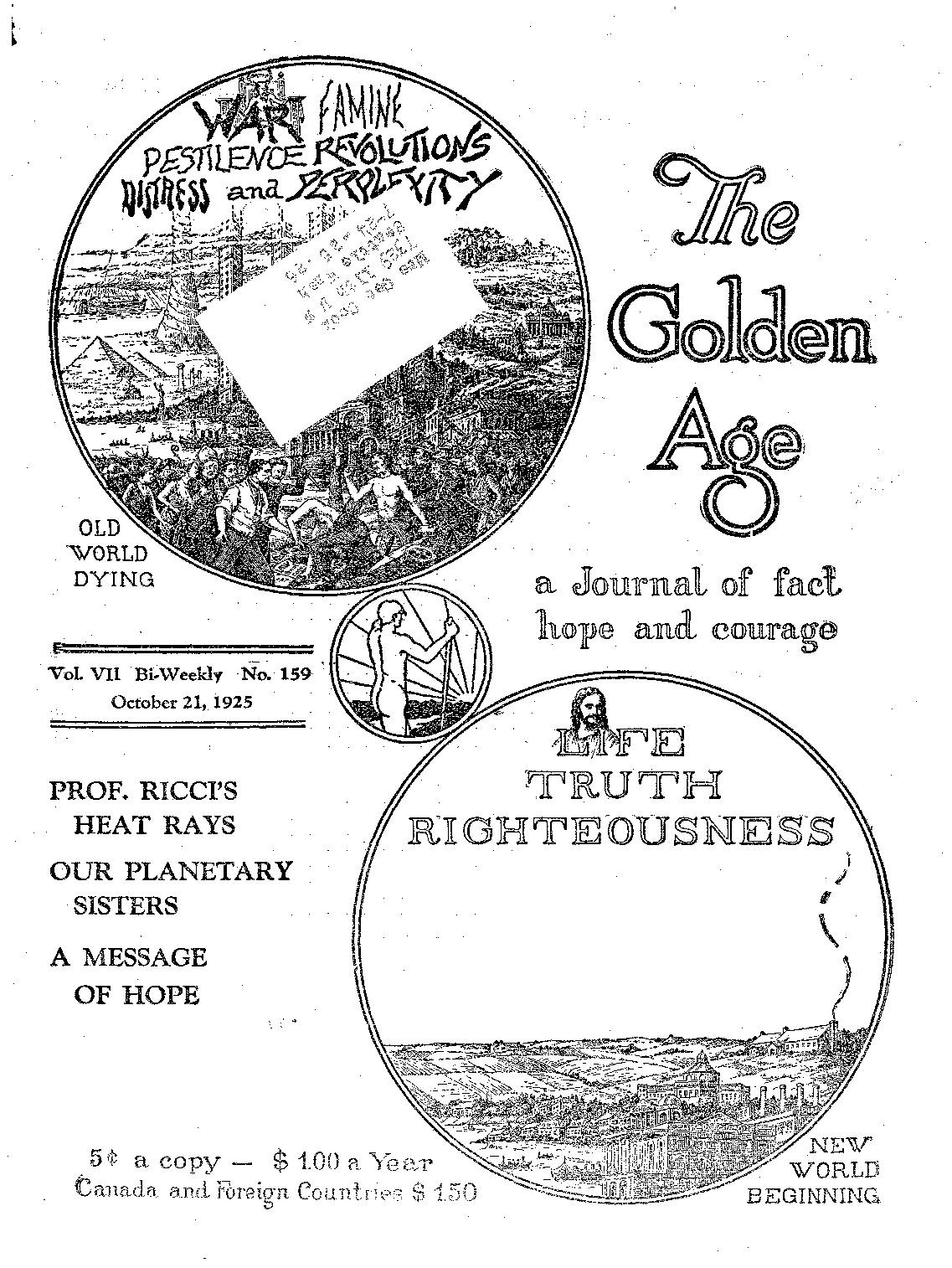
Contents of the Golden Age
**- —......' ...
L • ~ -.4
Social and Educational
Pere and There Throughout the World
Rapid Destruction of Niagara
Preliminaries of the French Revolution........ . 39
Political—Domestic and Foreign
A National Crime Commission ............. 30
Vast Unexplored Areas of Brazil
Something New in Injunctions ......
Science and Invention .
Prof. Ricci’s Heat Rays ................ 42
A Study of Oue Sister Planets .............
“Lost Worlds” . ....... . . 47
Finance—Commerce—Transportation
New England Textile Conspiracy . ...........36
Meat Packers Get Back their Halo..... 38
' Home and Health
Women Live Longer than Men
Dandelion Greens the Year Round .
Breaking Up of Colds . . ..
Ill Effects of Hot Baths . ...............49
Handling the "Kiddies” ....... 51
Religion and Philosophy
Harpooning the Evolution Theory......... 48
The Only Support for the Ministry
The General Convention at Indianapolis . .
Message of Hope
A Standard fob the People ...............55
Be Still and Know that I Am God (Poem) ......... 57
The Resurrection of the New Creation........ .
Studies in “The Harp of God” ................
Published every other Wednesday at 18 Concord Street, Brooklyn, N. T., U. S. A., by WOODWORTH, HUDGINGS & MARTIN
Copartners and Proprietors Address: is Concord Street, Brooklyn, U. F., £7. £. A.
CLAYTON J. WOODWORTH . . . Editor ROBERT J. MARTIN . Business Manager WM. F. HUDGINGS . . Sec’y and Treas.
Five Cents a Copy—$1.00 a Teas Make Remittances to THE GOLDEN AGE
Fobbign Offices : British,.....34 Craven Terrace, Lancaster Gate, London W. 2
Canadian ......... 38-40 Irwin Avenue, Toronto, Ontario Australasian ....... 405 Collins Street, Melbourne, Australia South African......6 Leiie Street, Cape Town, South Africa
Entered as second-ciass matter at Brooklyn, N. X., under the Act of March 3, 1872
Golden Age
J.. ....... " ............. i' ■ . .... .......... ................ ---If
Volume VI Brooklyn, N.Y., Wednesday, October 21, 1925 Number 158
Here and There Throughout the World
[Radiocast, with other items, from Watchtower WBBU on a wave length of 272.6 meters by the Editor.]
Cheap Fuels and Fertilizers Coming
THE German secret of making synthetic motor fuel is now known on this side of the water and assurances are given in the chemical magazines that in a short time the two most important chemical compounds in this country will be synthetic ammonia for use as a cheap fertilizer and synthetic methanol for use as a cheap motor fuel. Eight chemical manufacturing concerns have already obtained licenses to manufacture under the new process.
Cures Asthma by Cleanliness
A PHYSICIAN in San Francisco cured a patient of bronchial asthma by having the patient’s bedroom thoroughly cleaned and thus getting rid of the germ-charged dust which was causing the trouble. The fewer dust catchers there are in a bedroom, the healthier the room as a sleeping apartment.
Weldon Gould’s Educated Crow
Weldon Gould, Columbus, Ohio, high school student, has an educated crow. The crow lives in a tree opposite the Gould homestead and follows members of the family wherever , they go. Young Gould has a paper’ route and the crow goes along with him, supervising the deliveries. Attempts have been made to steal him and he has found means to bring this to his master’s attention. The affection came about through young Gould’s caring for the crow when the bird was young.
Rapid Destruction of Niagara
THE shape of Niagara Falls is changing. The
Horseshoe Falls, on the Canadian side, are becoming more and more elliptical in form, due to the rapid cutting aw’ay of the center. A few years ago the rate of recession of the Falls was only a few inches a year; now it is five feet; the rock is getting softer and a gorge is forming. Niagara will ultimately destroy itself.
Novel Reason for Welfare Work
THE president of the Poinsett mills, Green--T ville, S. C., testified in a tax case that the welfare work among the employes of his company was “necessary to produce an attitude of contentment toward the company among its employes, to equalize the lesser wage established in the section in which the company operated with a somewhat higher scale paid in other sections, and to reduce the volume of labor turnover.”
Sure of a Coal Strike
AT THIS writing there is every indication that the year 1925 will end in an anthracite coal strike. The operators have large stocks of coal on hand, some of them sufficient to last for six months; and a strike will suit them very well, as it will mean fancy prices for their surplus stock.
Under the Guise of Religion
ALL things have been done in the name of religion, but it remains for Oklahoma to start a new thing under the sun. Under the guise of religion bands of strikers have been praying for the souls of strike breakers in their hearing, and so successfully that the sheriff of the county has ordered all these outdoor prayer meetings on mine property to cease.
Army of Women Workers
IF THE number of women workers in the
United States all lived in the same city, and nobody else lived in it, that city would have a larger population that London. If they all traveled on the same train at the same time the train would be over a thousand miles long.
The Progress of a Generation
OMMENTING on the muddy unpaved streets of a generation ago, and introducing other interesting items, Mr. Alvin E. Dodd, of the United States Chamber of Commerce, recently said: “Nowadays the not-so-tired business man leaves his office, or his golf club, rides home in his Detroit automobile over streets of Trinidad asphalt, enters his house of Portland cement and Georgia pine and filled with Grand Rapids furniture and Brussels carpets, eats his dinner of Texas beef and Maine potatoes off a Limoges china plate and afterwards sits down at leisure to smoke a cigar wrapped in Sumatra tobacco grown in Connecticut and reads a Chicago mail order catalogue printed on paper made from Canadian pulp, offering to ship him anything from a cold remedy to a cold chisel.”
New England Textile Conspiracy
EW ENGLAND is suffering from a conspiracy of the textile manufacturers to reduce wages, in spite of the fact that wages in all other lines are being maintained, and that the textile workers will have to pay as much for their necessities as before. Moreover, their buying power will be reduced, and a general unsettlement industrially is liable to result.
The World’s Champion Bricklayer
N INDIAN ex-footballplayer has established world’s record for laying brick on a highway near Kansas City, Mo. In one day he laid three and one-half carloads of brick, necessitating the service of five men to keep him supplied with brick. His wages are $16 a day.
Honesty of Dyers and Cleaners ~
OST of us have received back valuable items of personal value which we unintentionally left in the pockets when we sent out things to the tailor. Now comes the Dyers and Cleaners’ Association at. Atlantic City to tell us that Americans are so careless of wealth that fifty percent of the clothing received at their establishments contain articles of value.
Great Damage by Mischievous Boys
OYS at New Brunswick, New Jersey, broke into the grounds of the New Jersey State 'Agricultural College, pulled up the marking
stakes which Ehd been set to identify a special type of corn, and ruined four years of scientific work by roasting and eating the special corn itself. The so-called comic supplements probably conveyed to their minds the idea that this sort of fun is all right. ■
Robbers, Robbers Everywhere
OR a time it seemed that shipment of valuables by airplane would provide at least one method of almost absolute security against robbers, but now that hope is shattered by the robbery of an air mail in San Francisco before the valuables could be taken from the landing field to the post office.
Automobile Deaths in 57 Cities ■
HO HE United States Department of Commerce is keeping a watch of the deaths by automobile in 57 cities. From week to week over one hundred persons are killed in these cities. New York City had 501 killed from January 1 to July 18, 1925.
Chicago’s Crime Situation Beyond Control ’
WHILE ago we had word that the cleaning up of Philadelphia seems to be beyond human power. Now comes the director of the Chicago Crime Commission and makes a similar admission with regard to Chicago. All this is the natural fruit of throwing away the Bible and taking evolution instead. Indeed, evolution does not regard crime as a crime at all. Chicago has annually more murders and holdups than England and Wales put together.
A National Crime Commission
RIGHTENED, and properly so, the leading business men of the country are advocating
a National Crime Commission to see what can be done to mop back the ocean now rising. The New York World blames the tide upon legislators, lawyers and judges. They must bear a share, but there is a large share resting upon the business men themselves for their crooked practices, and most of all upon the clergy for not properly preaching and teaching the Word of God instead of the fossilized theology of the dark ages and then throwing away the Bible altogether in a mad scramble to become evolutionists. -
Manor Heads Crime Syndicate
THE Mayor of Chelsea, Massachusetts, has been indicted as the head of a crime syndicate operating a rum trust throughout eastern Massachusetts. It is charged that the rum fleet landed liquor at Chelsea under police protection and that rum cargoes were moved through the streets under police escort. Ten members of the police department and thirty-three other men were indicted along with the mayor.
Women Live Longer than Men
STATISTICS of the New York State Department of Health show that women are expected to live about three years longer than men. In 1920 the expectation of life for men in New York State was 52 years, 10 months, while for women it was 55 years, 8 months. The expectation has increased greatly in the past twenty years. In 1901 it was less than fifty years for both sexes.
Natural Ice Industry Passing
ONE after another of the old industries passes away, its place having been taken by some better method of accomplishing the same result. It used to be that four million tons of ice were cut on the Hudson River every year. Now almost all the ice used in New York City is artificial.
Great System of Land Cables
THE American Telephone and Telegraph Company has finished the construction of an overland cable from New York to Chicago costing some thirty thousand dollars per mile and carrying five hundred wires. The route, 861 miles long, is via Reading, Pittsburgh and Cleveland. Other cables are contemplated.
All that Happened to St. Christina
FOR the first time in history the Roman Catholic church has imported into the IT.
S. A. a package said to contain the bones of a saint, namely St. Christina. A very expensive church will be built to house the saint at Cleveland, Ohio. According to the New York World all that happened to St. Christina was that her body was torn with hooks, she was hung over a fire, was thrown into a lake with a stone tied around her neck, was burned five days in a furnace, was thrown, among serpents, had her tongue cut out and was finally killed by being shot full of arrows. The price paid for the saint is said to have been about $100,000, i. e., that was the amount it was necessary to leave in Italy in order to get it. Previous efforts of American prelates to get an honest-to-goodness sure-enough saint for use on this side of the water have hitherto proved unavailing, but the $100,000 seems to have done the trick. The Pope did not want to let it go, because he was afraid the Italian people would miss it; but the $100,000 persuaded him. The church authorities admit that they do not know anything about St. Christina except that she was a saint.
A Seven Million Dollar Private Home
THE Cornelius Vanderbilt home at Fifth Avenue and Fifty Seventh Street, New York, did not present such a grand appearance, but it nevertheless sold for seven million one hundred thousand dollars. The house cost more than three million dollars to erect. The lot was assessed at $4,700,000.
Unique Punishments for Autoists
INDIANAPOLIS will require that hereafter any person who kills another by automobile must spend one hour alone in the same room in which lies the body of the one killed. In another place it is proposed to escort the killers about town in an iron cage mounted on wheels.
A Sizable Fishing Industry
ALTHOUGH Americans are not fish eaters to any extent as compared with the natives of the British Isles, Scandinavia and France, yet there are six thousand vessels engaged in American fisheries, with a total personnel of about two hundred thousand, and an annual catch worth over $100,000,000.
Strange Things Happen to Mails
OCCASIONALLY strange things happen to the mails. A letter or several letters disappear completely and what becomes of them no one knows. The other day a postman in New York delivered a post card that was sixteen and one-half years old and had spent all that time going a few miles in New York City. No one knows where it has been.
First Month of Overnight Air Mails '
TN THE first month of overnight air mails beA tween New York and Chicago there were about seven thousand pounds of mail each way, amounting altogether in postage fees to some $21,600. The mails are growing heavier daily. The rate between the two cities is ten cents per ounce. New Hampshire, for one month in the summer, has a rural delivery of mail by airplane to the summer colonies on the north shore of Lake Winnepesaukee.
Meat Packers Get Back Their Halo
FIVE years ago the meat packers expected to go to jail, so they voluntarily submitted to a judicial decree enjoining them from certain practices of which they had been guilty. The first day after election last fall they presented a request to have the decree vacated. It has been done. The meat packers now have their halo back and can safely do that for which they expected to go to jail five years ago.
Something New in Injunctions
ILLINOIS has a new law making it illegal for a judge to issue an injunction prohibiting peaceful picketing. This law has successfully met its first test. . Judge Pam in the Superior Court of Cook County upheld its constitutionality and set forth a definition of peaceful picketing such as can be done without any injunction being issued against the picketers.
Haifa Ton of Tuna-fish
ALMOST everybody likes tuna fish salad.
Somebody will have some surely, as a result of a 1165 pound tuna fish recently caught off Manasquan, New Jersey. The fish did not want to be caught. Before he gave up the fight he managed to throw overboard two of sixteen fishermen who had hold of him; but they finally brought him to shore after a two-hour battle.
Decreased Sales of Postcards
THE new postal law is not working out well in one item; namely, in that which fixes the postal rate at two cents each for other than government cards. The result is that people have stopped buying cards to such an extent that the ten-cent stores are putting in only half the usual supply. The government will probably get less revenue from this item under the new rates than it did when cards were only half as much. The law as a 'whole, however, is all right, and is producing about fifteen percent more revenue than the old one.
Five Million Radio Sets
A SURVEY of the radio sets in use indicates about five million sets, of which two-thirds are factory sets and the remainder assembled at home. The average cost is about $100, with five-tube sets the most popular, and practically all of that class fitted with loud speakers. The fad is largely a masculine one.
Talking Movie Already Here
"VT 0 SOONER do we get reconciled to the thought of pictures by radio than the radio announces that moving pictures can be transmitted by that means; and now an inventor in Washington, C. Francis Jenkins, has added the Talking Movie to the list. Mr. Jenkins’ apparatus works and has been designed as an attachment to standard radio receiving sets.
The Scott Death, Stroke -
TV- Edwix R. Scott, pupil of the late Dr.
Steinmetz, announces the discovery of an invention which he claims will destroy all life on land, sea or in the air, within a radius of twenty miles, or destroy any structure at a distance of ten miles. In experiments animals were killed at seven miles.
Is This Part of a College Education?
IN A letter to the London Daily Mail, Dr.
G. J. Rousseau, Pastor of the First Baptist Church of Pensacola, Florida, made the statement: “Professors in America have written ponderous volumes, circulating them among college students under plain wrappers, in which promiscuous relations between the sexes are advocated on the ground that men are mere animals, and that the restraints of the social order were the impositions of the mediaeval bigotry.”
Vast Unexplored Areas of Brazil
SO GREAT is the vast country of Brazil that there are said to be in it not less than a million square miles of forest areas that have never been explored. Scientists are now attacking the exploration of these areas with' greater and greater persistency, in spite of all the terrors with which the forests abound.
Preliminaries of the French Revolution By J. L. Bolling
ALL revolutions, of course, have their preliminary causes. Sometimes they are “bloodless” ; but these are few and far between, and belong more particularly to our own period. If ,we will study and analyze the history of the past four hundred years, we will note a progression from one line of achievement to another, leading up to what is called “modern progress”. Really, modern invention and discovery backgrounds largely in the past. The great influx, however, was reserved, under Divine Providence, for the “Time of the End”. This period, prophetic students agree, began in 1799.
The sixteenth century was the epoch of the arts and the birth of creeds. Beginning with Luther’s reformation one reform after another was launched in quick suecession. During this period the Great Harlot of Romanism gave Furth to many children -sectarian systems—■ which are still with us. With the introduction of the seventeenth century came a revival of learning; and this is usually designated the period of letters, while the eighteenth and nineteenth centuries seem to have been specially set apart for the development of science, which had its inception immediately following the beginning of the “Time of tie End”, and has progressed by leaps and bounds, under divine supervision, up to the present day.
This has been a time of awakening and renovation all along the line. During this great epoch men like Franklin, Volta, Galvani, Edison, Tesla and Marconi, have come forward with remarkable discoveries in the realm of physics. From Franklin’s lightning-rod and Volta’s battery, to telegraph, telephone, radio, and giant dynamos is a far cry, and as our vision sweeps the past and beholds the present we stand amazed at the magnificent changes wrought in two short centuries, especially during the past fifty years.
And all other sciences have kept pace; mathematical analysis, botany, zoology, geology, and chemistry have been laid on firmer foundations than ever before, although there is still room ifor improvement.
It has been these wonderful, revolutionary changes in living conditions and social life which have given rise to the pernicious doctrine of evolution. Man fancies that he is in a selfcreated “Brain Age”, whereas he is in the dawn
of the Millennium. Thus is verified the admonition that “a little learning is a dangerous thing”. God has merely given mankind a firmer grasp on the laws of nature, and made him their master to a certain degree, but by no means their absolute controller.
Literature Used as a Weapon
DURING the eighteenth century literature invaded everything and became a dominant factor in regulating government and society in general. Thus while the physicists were uncovering new and strange forces and the navigators were discovering new lands, the writers were revealing a new world of thought and intellect. Literature broke the fetters of art, and refused to submit longer to its control. It claimed, on the contrary, the right to regulate. “Advancement of the public welfare” was the watchword, and it was this cry which led up to the French and American Revolutions and now forecasts the one impending which today bids fair to wreck all the governments of earth in a gulf of anarchy.
Frenchmen with virile force and unpoetie speech first took up the cudgel and labored unceasingly for needed reforms. Fine verses, flowery oratory and high-flown phrases were in the discard, and the aim was to give utterance and expression to practical maxims. These writers and spell-binders were bent upon reforming human society. Literature was converted into a weapon, which both the skilful and the imprudent sought to wield.
But by a strange “trick of fate” (or shall we say, divine providence?) the ones who approved and applauded the invasion of new literary genius into the political field were the very ones who were ultimately destined to suffer most from its influence! They took fire into their bosoms unwittingly. The “cockatrice eggs” hatched by Voltaire and his contemporaries broke out into “fiery flying serpents” of retribution to bite those who hitherto had looked on the eggs with admiring glances of approval.—■ Isaiah 14:29; 59:5.
Voltaire, Montesquieu, Rousseau
WHILE this was a frivolous and sensuous age, nevertheless talent was. greatly admired and coveted, much as it is in our own day.
aa
Three outstanding characters came on the scene and took charge of the movement:
(1) Head and shoulders above all was the fiery and passionate Voltaire. His was not an angelic character, by any means; no one would care to hold him up as a paragon of virtue; yet, be it said to his credit, he was a life-long champion of human rights and liberty of thought and expression. He detested Papacy and, mistak-ingly believing the Bible to be the supporter of its abominable practices, hurled his literary thunderbolts against both with equal fury.
(2) Next came Montesquieu, who specialized on the study of civil governments and their laws. He advocated a thorough examination and comparison of the constitutions of the various countries and states in order that the common people might select the best. He looked upon the English constitution as the most conducive to human liberty and progress.
(3) Lastly came Rousseau, who proclaimed the theory of universal suffrage and national sovereignity in his “Social Contract”.
Grouped on each side of this triumvirate of French literary genius were the “encyclopedists”. Their function was to review human knowledge and then enunciate and set it forth frequently in a way which bodied ill for the established order of things, social and political. Their teachings were always hostile to religion and the Bible. :
Later on, Quesnay brought forward a new Science, called political economy, which many erroneously assume is a sole and exclusive product of our time. Present political economy is based largely upon the teachings of Quesnay and contemporary writers, but has been elaborated upon by modern writers on the subject and made more elastic to fit present conditions.
Disagreement Between Ideas and Institutions
HE guns of infidel writers were trained upon everything in sight; human thought assumed a new role; it clothed itself with the garments of authority and overleaped the barriers which had previously confined it to merely metaphysical and religious philosophizing and speculation, or what was called “the unselfish worship of the Muses”. It unhesitatingly sallied forth to attack the most baffling problems of society. 'All saw their solution in liberty and still more liberty, the cry for which grew more and more Insistent and swelled louder in volume until it resounded throughout the French Monarchy, and echoed and reechoed from the Alps to the Pyrenees, kindling the fires of revolt and revenge which were later to break forth in all their fury as a devouring flame to consume the old order’ of thing's and make way for the new.
At this juncture in the preliminaries of the French Revolution there was clearly a disagreement between ideas and institutions; the new order was trying to supplant the old; radicalism was in the very air and “would not down”! It was a struggle of a 1i1tle light against great darkness. But to the French the morning had come when they were to make a bold and blessed strike for liberty, when they would break the chains of superstition and emerge free. But' while the morning dawned, we now behold at this distance, a queer paradox; there was a gathering darkness which grew blacker’ and thicker until, like the darkness of Egypt, it could be felt.
Why was this? Because God was not the instigator of the French Revolution, but Satan himself. It was a wicked scheme of his own devising, but one which God could, when the great crash came, overrule for the ultimate good of mankind and cause to redound, like all the other wrath of men and devils, to his own glory! By the force of circumstances and the hard logic of events He caused many to see that those who make war with heaven are their own worst enemies and really fight against themselves, eventually working their own destruction.
Here we note a peculiar thing: Before the advent of Voltaire and his colleagues the people and their rulers were almost wholly concerned with discussion of religious dogmas; but now they were occupied solely and exclusively with earthly things; the people became materialists and completely discarded religion as a fraud and a sham under the tutelage of their leaders. Terrestrial matters were their chief and only concern. This led to proscription of the Bible and persecution of all who defended it or sought to preserve it. Study of the divine character, God’s will and His grace were cast aside and in their stead were substituted as superior the rights of man, society and its obligations.
The middle ages and feudalism had left their fragments of the most shocking injustices, inequalities and oppressions; confusion reigned everywhere, and even the brightest of leaders were at sea. Complaints poured in on every gide; the monarchy was pressed to do something to relieve the sufferings of the masses, but it remained mute and oblivious to the thousands of appeals which ascended, not to the Throne of Heaven, but to the throne of French royalty.
Faith in a living God and in His providences had perished, due to the influence of the Pope and his hypocritical emissaries! As one historian of the period expressed it, '‘'Government • . . had become a frightful labyrinth wherein the most clever must lose his way.” It was rapidly becoming a “government without a foundation”.
Materialism, graft, greed, and love of ease and luxury were the sovereign masters of the king and queen and the nobility. The public treasury was constantly pillaged and robbed by the king and his coterie of ministers and other officials. Property was confiscated while personal liberty and safety were never secure from the lettres de cachet or orders of arrest which were invariably of the most arbitrary character and usually without the slightest justification or provocation.
The royal criminal code had back of it the horrible Inquisition, and the civil code was likewise a monstrous piece of inequity. Land and other property had drifted, under this system, into the hands of the nobility; and the poor, which included the vast majority, were reduced to a serfdom in comparison with which American Negro slavery was a luxury and a blessing. Country produce was tolled and taxed so repeatedly en route to the city markets that the farmer could not make a profit, but usually came out in debt. It was under these terrible conditions that the French populace were finally goaded to desperation and arose in their might and fury to throw off the power which was strangling them.
Getting Rid of Undesirables
ITHERTO the Papacy had imposed its dogmas upon the French people under penalty of death; but now the people demanded religious toleration and a revamping of civil laws along more nearly just and rational lines, with a view to lifting up the downtrodden. They, through their leaders and representatives, called for an end of autocracy and a recognition of the rights of all the people instead of those of the “special interests”, the privileged few.
Bossism was doomed and must go; false religious and political prophets must be scourged from out the high places. Weights and measures must be standardized and unified ; taxes must be paid by everyone, instead of continually practising extortionate taxation on the poverty-stricken masses while exempting the wealthy from taxation. Labor demanded its rights; it must be emancipated, and there should and must be free competition, instead of monopolistic combines. Public offices should be bestowed on a basis of merit, and favoritism to birth and fortune should be abolished. To bring about all these sweeping changes a revolution was absolutely necessary, and no one doubted that it was coming.
In proof of this, note Fenelon’s remark concerning the monarchy as early as 1719: “The dilapidated machine still continues to work because of the former impetus imparted to it, but it will go to pieces at the first shock.”
But his statement did not apply to France alone; it applied to all of "what was then known as “absolutist Europe”. If, in some places, the common people did not feel the need of reforms, they were undertaken anyway by some of the princes. Some of these encouraged industry, agriculture and science, and constructed canals, roads and schools, abolished abuses and privileges, and exiled the Jesuits who, they claimed, “embodied all the evil influences of the past.” Therefore, one of their first concerns was to get rid of them; and in the light of the history of Papacy as outlined in the Word of God and on the pages of secular history, can we blame the French people? Surely, the first thing to do in order to bring relief to the people would be to get rid of Antichrist! But what they did along this line was as nothing compared with what was to come, as we shall see.
The emancipation spirit spread. Marshes were converted into fertile fields in various parts of Europe. Some of the European people were emancipated from “feudal taxes”. Joseph II of Austria abolished the tithing system, forced labor, etc. He made the church subject to the state. In Sweden torture was forbidden, church festivals were almost abolished and the output of the iron and copper mines was greatly increased.
The reforms extended to Russia, and Catherine the Great cultivated the friendship of Voltaire and others who were advocating revolution with the view to influencing public opinion through them. She hypocritically had drawn up a wonderful constitution which was never executed, and consequently amounted to nothing. She had magnificent schools built, but no one attended them; it was all a fake, designed to impress the people with her loving (?) concern for their welfare 1 Finally the governor of Moscow wrote her in despair, commenting on the situation. She replied: “My dear prince, do not complain that the Russians have no desire to learn. If I set up schools, it is not for our own sake, but because of Europe, which is watching us. As soon as our peasants wish to become enlightened, neither you nor I shall remain in our places.”
Quite true! It is enlightenment in this dawn of the New Day of Christ’s glorious presence which has given us in our own day an almost crownless Europe and threatens to engulf present institutions in anarchy and destruction! “It is dangerous to make men too learned,” declared Cardinal Pole at the commencement of the Reformation. Dangerous for the crowned head and Satan’s empire, most assuredly I
At this juncture the situation was tense; the air was charged with chain lightning, and the great storm was about to break. A spirit of reform and liberty was breathing over all Europe. Men thought reform, preached reform, urged reform and longed and hoped for reform ■—social reform.
Monks and theologians did not participate in this preaching. The princes, however, taking advantage of the movement, placed themselves in command of it, in the hope that it would profit them in the long run, as they had reaped a rich profit in the same manner from having church property “secularized” during the Lutheran and Anglican Reformations.
Therefore, they for once concerned themselves about the welfare of the dear people, whom they had been busy exploiting until they saw the storm brewing. Liberty and freedom were given them at the expense of the clergy and the nobility.
Heavy burdens were lifted, and the people were given a breathing spell and a time of rest from their troubles—a precious boon to them, no matter from what quarter it came nor the motives in giving it. The real purpose of the princes, of course, was to increase their own revenues and influence with their subjects. “My trade is to be a royalist,” expressed their real attitude and conviction.
In truth and in fact, nothing was changed; the power which feudal anarchy had allowed them to grasp was preserved, and it was this which was endangered by the ever-increasing and enlarging interests of the people.
Thus the way was paved for the great revolt with the salient features of which we are all more or less familiar. The same conditions are now operating throughout the world on a vastly larger scale, and will soon bring on the great time of trouble and wrath predicted in Scripture—“a time of trouble such as never was since there was a nation”—immediately preceding the establishment of Messiah’s kingdom.
Professor Ricci’s Heat Rays
From the Schweizer Freie Presse (Translation by F. Leon Scheerer)
A SCIENTIFIC gathering held in Paris recently has opened up an amazing view of the possibilities of the near future. Professor Ricci of Rome introduced his famous “Heat Rays”. The modest little man was quite reticent. There was little need for explanatory words. His secret consists in transforming light rays into heat rays of unusual power.
His apparatus is not much larger than a cigar box. A copper kettle, when hit by a Ricci ray, becomes red hot. A miniature ship loaded with ammunition and floating on a small pond, explodes when hit by a Ricci ray. A small aeroplane hit by the same death ray in its fuel tank, a balloon struck in its gas bag, all are subject to the Ceterum Genseo of the little spectacled Italian.
Ricci is a pacifist. At least he asserts it with a sphinx-like smile, and his aim is to make war an impossibility. His rays will bring flaming death to both city and village, singe and blind whole armies at great distances as soon as he causes the required force to be brought to bear. Forests may be consumed in flames, while all objects within reach of the fire would turn to a glowing white heat. But Professor Ricci does not aim at destruction; his primary object is to utilize his invention for economic productivity.
From a central station, light and heat are to be transmitted to every dwelling without wires. Ricci rays are to do the heating, lighting and cooking. The Thermidor of the little Italian will turn our entire domestic economy topsyturvy. Electrical works will have outlived their purpose. Gas works will belong to the past; coal dealers will be unable to dispose of their supplies, while heating plants will undergo radical changes. There would be neither coal nor gas nor current burning in the kitchen. At the smelters the furnace fires could be extinguished. Industries, trade, all will be made over by means of the new energies created by Ricci.
In the ocean, the great icebergs, a menace to ships, will be melted like butter before the sun. Scott and his brave companions would still be living today, had. they been in possession of Ricci’s Thermidor. Over and over again Professor Ricci emphasized in his sober manner that he was allowed only to use much reduced rays for demonstration.
At the interesting meeting one of the guests (protected with goggles) held a cigar in his mouth to which the weakest ray was directed but for the fraction of a second, and this caused the cigar to light instantly. A pan of water, upon which the ray had been directed for less than a minute, was made to boil. The eyes of the feminine guests were literally beaming. What sunrays will not Professor Ricci focus into the kitchen, bathroom, laundry, in fact the entire household!
That the world is "advancing” at a rapid rate is readily discerned even by those of our fellow men who have come over from the easy-going “last century”. But not with gladness always. Much that is new has surprised us. One sensation follows another. Often it requires effort to habituate ourselves repeatedly to the changes which are demanded of us.
We are still heavy travelers on the treadmill of tradition. It is a long stretch from Goethe to Shaw, equally far it is from Roentgen to Ricci. And if we assume all possibilities as having been exhausted, and regard the slogan 'thus far and no farther’ as fulfilled, then the last miraculous invention carries us suddenly over every wall reared by our senses and aspirations.
But the Ricci rays are fearful. The criminal could set houses on fire invisibly. With Ricci rays an enemy might blind his victim from a small pocket lantern. Wars as at present will become an impossibility, but they will simply be conducted in another way. All progress concerns itself with both the physical and the mental phases. We are made up of both divinity and deviltry, and . know immediately how to translate into fiendish devilishness every advantage attained through study and research. Thus man maintains firm foothold on terra firma. We remain humans, even though our spirits may soar to the spheres and know how to delve into the secret forces of the universe. But as the London Tidbits observes:
“Some of the most useful gifts of science were first revealed to mankind in a malevolent rather than a benevolent aspect. But even the most destructive agencies may in the course of time be brought into the constructive service of the human race.”
Dandelion Greens the Year Round
THE season of dandelion greens may be made perpetual. A dish of these, daintily seasoned with butter, is a real addition to the bill of fare. Do you know that one can have greens in the winter time, too? Simply clean as for cooking; put a thin layer of salt into a crock, then a layer of greens, etc., as you would do in salting down cucumbers; weight down, and tie a cloth over the crock, when full. They make'their own brine.
If the cloth has not been removed for some time, a thick mold may be found on top of the brine. This has not harmed the greens. Before freshening, swish them, a few at a time, through two or three waters, to rinse the brine away. It is best to freshen by washing away all the old salt, and to season with new salt. They will not smell like new greens, while freshening, any more than do salted cucumbers smell like new; but they will have a pleasing taste when served.
A Study of Our Sister Planets By w. L. Pelle
THE study of astronomy is one of the most fascinating of all the sciences. Among other tilings it proves to us how little we really are. Says Professor Mottram, of the University of London:
f4 Mankind lives on a second-rate satellite of a fourth' fate and moribund star. Once we thought we were the center of the universe—that the sun, moon and stars rose for our benefit and bowed down to us. That conceited view was smashed by Copernicus, and now we feel lost In the universe-—a mere speck—rather as an ant might feel, had it a human intellect, when alone in a cathedral.
Naturally man has stretched out his hands across space in the hope of meeting other hands. It is so terribly lonely if we believe that the vast halls of space are untenanted by other thinking beings. That we are the only human beings in the unmeasurable universe is too horrible to many, and therefore, wrongly unthinkable. Yet, to prove the contrary is well-nigh impossible. That is the fatal fascination of the problem.
The number of people who are measurably acquainted with the stars and their movements is quite small. The majority of people imagine that the orbs of light that they see in the sky are all practically alike. They little realize that at least seven of the nearest “stars” are worlds like our own, some having reached a point of development similar to the earth, while others are far from it. Three of these orbs are easily distinguished from the myriads of others, while the others tire either invisible to the naked eye, or appear the same as an “ordinary star”.
The Solar Family
PLANET is a heavenly body which revolves around a sun as a center. There are secondary planets called satellites which revolve around their primary planets. Our moon is one of them. Excepting the planets of our solar system, all the stars we see are gigantic suns or groups of suns, many of them estimated by astronomers to be many millions of times larger than our sun. The orbit of a planet lies in one plane and is elliptical in shape. This explains why our earth is farther from the sun at some seasons of the year than at others. All the planets rotate on their axis, but not all in the same period of time. Jupiter, for instance, is said to make one rotation every ten hours.
The major planets of our solar system are eight in number. In their relative position from the sun they are as follows: Mercury, Venus,
Earth, Mars, Jupiter, Saturn, Uranus, and Neptune. Of these, all are visible to the naked eye with the exception of Neptune. Uranus is also invisible much of the time. Uranus was visible without the aid of a telescope during the month of September this year, 1925. Venus and Jupiter, and Mars most of the time, are easily distinguished from the “fixed stars” on account of their superior brightness, while the others are distinguished because of their own known positions. Mercury and Venus are called inferior planets in that the planes of their orbits lie between the earth and the sun; while the others are known as exterior planets because their orbits are on the opposite side of the earth from the sun. .
Some astronomers are of the opinion that there are yet at least two more planetary members of the solar family, the one having its orbit between that of Mercury and the sun, and the other outside Neptune. In fact, they are so sure concerning the infra-Mercury planet, that they have given it a name: Vulcan. The reason given for these assertions is the peculiar restlessness of both Mercury and Neptune. The reason bears much weight in that Neptune was discovered by astronomers who were trying to explain the peculiar actions of Uranus.
Some of these days it may be that a telescope will be invented which will so diminish the rays of the sun that Vulcan will appear in all his glory, that is if he is there. And likewise, some astronomer in searching the limitless expanse of the starry skies might accidentally stumble over the as yet unnamed planet sailing through the depths of those dark seas beyond Neptune’s orbit and calling, “Ah! at last you have found me. I have been out here in the cold all this time, but you didn’t know it.” Who will be the lucky astronomer that will bring to light this hidden child of Old Sol?
The latter part of July of this year (1925) witnessed quite an interesting grouping of our planets. Hicks’ Almanac for 1925 had told us:
Moon will pass only ten minutes to the north of Venus on the twenty-second at 8:40 p. m. (Central Time), a chance of a lifetime to see them so close together at the right hour of observation. Venus will be only six minutes north of Mercury on the tenth at 8: 00 p. m. At 9: 00 p. m. of the same evening Mercury will be only fifteen minutes north of Mars, and at 10:00 p. m. the same evening Venus will be only twenty-two minutes north of Mars; some grouping we must say— Mercury, Venus, and Mars all in a close cluster at the same hour, and at a splendid time for observation, but real low towards sunset.
Neptune is also included in this grouping, but is invisible to the naked eye. Toward the latter part of July, Jupiter reached his point of “opposition” ; that is, he arose just as the sun was setting. Saturn was at quadrature, or on the meridian at sunset. Those possessing telescopes were able to see six of our planets on the same evening at the same hour. ’Uranus, the seventh, was invisible on account of being morning star at that time.
The Baby of the Solar Family
THE smallest of the known planets and the closest to the sun is the planet Mercury. Its diameter is only about three thousand miles and its volume one-eighteenth that of the earth. Mercury is just two and three-fourths times as large as our moon. If a person weighs 150 pounds on the earth he would weigh only 60 pounds on Mercury. Mercury’s period of revolution around the sun is only eighty-eight of our days. Some astronomers claim that this diminutive planet rotates on its axis once every twenty-four hours, while later investigations seem to have proven that this rotation requires eighty-eight days, the length of its year. This would mean, then, that the same side of the fleet little body would be toward the sun all the time and baked in perpetual sunshine, while the other side would be freezing in eternal winter. However, recent observations with a heat measuring apparatus indicate that the dark side of the planet radiates much heat, and this might indicate after all that the time of rotation is as first computed, i. e., once every twenty-four hours.
Mercury seems to be an appropriate name for this eccentric little fellow, as it changes its apparent position in the sky quite rapidly. It is possible for it to be morning or evening star at four different seasons of the year, and this is something no other primary planet can boast of. The eccentricity of its orbit is greater than that of any other planet of the solar system, its greatest and least distance from the sun differing by almost fifteen million miles. When Mercury is nearest the sun it travels faster, and this has caused astronomers to make the assertion that there is at least one other planet between it and the sun. There seems to be present an influence which cannot be accounted for in any other way.
Most people have not seen Mercury to their knowledge, since it is not visible more than two hours before sunrise or two hours after sunset, and then there is usually a smoky haze near the horizon that hinders clear observation. Mercury’s brightness is usually a little more than that of a first magnitude star, but it is difficult to locate with the naked eye because of its nearness to the sun. Like Venus and the Moon, this little planet appears with phases; but these can be seen only with the aid of a telescope.
Evidently Mercury has no atmosphere, and hence could not support life. Its reflecting power is quite low, practically the same as that of the moon, and hence its surface must be rocky and barren, and without moisture or the elements necessary to support life.
The Queen of the Planets
rPHE planet Venus is just a little smaller than -*■ our earth, and is the next planet between us and the sun. It is about thirty million miles closer to the sun than we are. Its diameter is about 7500 miles and the length of its year is 224 of our days. Venus is said to rotate on her axis in twenty-three and a half hours.
The surface of the planet is not visible to us because of the heavy veil of clouds which obscures it; and furthermore because when the planet is nearest the earth it appears as a small crescent, the greater part of its disc being hidden in the darkness of the night. For this reason little or nothing is positively known of conditions existing thereon, and anything that might be said on that subject is therefore largely conjecture.
Sometimes Venus approaches as close as twenty-six million miles to the earth, which is but a short distance, telescopically speaking; but on account of the heavy veil she wears, no one has actually seen her face. Every now and then the beclouded lady passes directly between us and the sun. She then appears merely as a black spot on the disc of that fiery orb, and this spot is surrounded by a bright ring -which is nothing more or less than the cloudy veil.
Venus is the brightest of all the planets. It would be still brighter if we could see the entire disc at its nearest approach to the earth. It is an especially beautiful object in the western sky, getting brighter and brighter from June 1925 until the spring of 1926. Since it is an inferior planet (that is, its orbit lies between us and the sun) it cannot be seen longer than about four hours after sunset if it is evening star, or for a similar period before sunrise if it is morning star.
The Red Planet Mars
THE red planet Mars is next for our consideration. It is the first of the exterior planets outside the earth’s orbit and smallest in size, ranking next to Mercury in that respect, when all the planets of our solar system are taken into consideration. It is about 4500 miles in diameter and rotates on its axis in about the same time that our earth does. The length of a year on Mars is equal to about one and nine-tenths of our years.
On August 23, 1924, Mars approached very close to us, the closest he has been for 120 years, and the closest he will be for the next century. The brightness of the planet exceeded that of the planet Jupiter; but now on account of his remoteness his brilliancy is less than that of a first magnitude star. Mars at his closest was still thirty-five million miles away from us, just a little too far for a parachute jump. Nevertheless, this close proximity was the occasion for the training of hundreds of telescopes upon him.
The theory had been advanced that the war planet is inhabited. That was the time to test it out. On the day just mentioned many eagle eyes were watching for flashes to come from the Martians, but apparently none were sent. No radio signals were received, and astronomers must wait until we swing around again to the same relative position. It might be noted here that the science of astronomy has made rapid strides since the last time Mars paid us such a close visit, and it was hoped that the theory of life on the planet would be verified. We can be sure also that we will learn much more in every way before the time for another Martian call rolls around.
Mars is similar to the earth in many respects. There are marked lines on his surface which are supposed to be canals. There are polar ice-caps which decrease in summer and increase in winter. Mars has two moons, but they are baby moons compared to ours. One is only eighteen miles in diameter while the other is just twenty-two miles. One of our modern express trains could run around either of them in less than an hour; and an airplane, conditions favoring, could cover the entire distance in a few minutes. The smaller of these two satellites turns on its axis in the short period of seven hours and forty minutes.
The Giant of the Solar family
THE four outermost planets, beginning with
Jupiter, are especially different from the four innermost by reason of their sizes. Thus Uranus, the smallest of the outer group, is larger in diameter than the earth, the largest of the inner group, by some twenty-three thousand miles. Another distinguishing feature of this group of major planets is the period of axial rotation. The time of rotation of the outer group averages nearly ten hours while that of the inner group is nearly twenty-four hours. The number of satellites of the outer group is twenty-four, and that of the inner group only three.
Jupiter is the largest of all the planets of our system. Its volume is greater than the combined volume of all the rest. Some interesting comparisons were made by Charles N. Holmes in “Science'and Invention” for Sept., 1923. According to the figures presented there, Jupiter’s diameter is equal to twenty-nine Mercury diameters. It would take 425,000,000 Brooklyn Bridges to bridge the gap between Jupiter and the sun. Jupiter’s diameter is equal to eighteen thousand times the distance from the Battery to Central Park, New York city.
Jupiter is not cool and solid like the earth, but is quite gaseous, much the same as the earth was at one time. On account of the rapid rate of rotation he is considerably flat at the poles. It is estimated that the axial diameter is five thousand miles shorter than that at the equator.
Jupiter has an interesting retinue of moons, nine in number. The four largest were discovered just after the invention of the telescope by Galileo. The other five have been found since 1892. The two most distant satellites are said to revolve about their primary in a direction contrary to the others, and contrary to the usual direction of solar revolution. The farthest moon is fifteen and a half million miles from the center of its primary. Two of Jupiter’s moons are larger than the planet Mercury, and three of them larger than our moon. The periods of revolution of the secondaries vary from twelve hours to nearly three years.
The Three Outermost Planets
HE planet Saturn, next in order, is distinguished from all others by its great rings.
The latest thought concerning the rings is that they are not gaseous, but composed of myriads of smaller satellites, evidently in a partially liquid state. The earth at one time was in a similar condition, but this was before there vzas any form of life higher than plant life- If it were possible for intellig’ent beings to live on Saturn, they would have to live nearly thirty of our years before they would be one year old on that planet. In other words, it takes Saturn nearly thirty of our years to make one trip around the sun.
Saturn has ten satellites, two of which are said to be like the two of Jupiter—revolving in a contrary direction to all the others. It surely would be interesting if we could for a few moments have a view of the sky from the surface of Saturn. Of course, since the planet is gaseous, at least on the outside, we would require some special means, of support. But at any rate, aside from the stars which could be seen, there would be Saturn’s ten satellites whirling through the sky in two directions; there would be the bright luminous rings stretching themselves across the heavens, and the sun would be one of the most inconspicuous objects of all, appearing not much larger than Venus does to us (providing Saturn has the same valency as has our earth). No doubt the time will come when Saturn will cool, solidify, precipitate its rings upon its surface, and begin to support life the same as does our mother Earth.
Not much is known about Uranus and Neptune. Both of these distant relatives were unknown as planets a little over a century ago. Uranus had been observed merely as a star. But the peculiar actions of both Saturn and Jupiter led astronomers to believe that there were disturbing influences which affected them, influences which could be none other than those of another planet. In the year 1781 it vzas definitely determined that, after all, that which vzas supposed to be a star was really a member of our solar system.
Neptune was discovered in a similar way, due to the restlessness of Uranus. Two astronomers were at work about the same time on the same proposition; a young Englishman named Adams, and a Frenchman named D’Arrest. It had been observed that Uranus was sometimes late in putting in an appearance where he should, and so young Adams argued that there must be something to pull the planet out of its course. He made a series of calculations and sent them to the Astronomer Royal of England. While the astronomers were somewhat skeptical at first, they at length determined to try out the figures presented. The result was that Neptune was discovered. This was in the year 1846.
Now, astronomers have been looking for an extra-Neptune planet. The reasons for this are the same as the ones which led to the discovery of both Uranus and Neptune. If there is a planet outside the orbit of Neptune, its year must certainly be a long one. Since the last Neptune year began, all the events since the War of Independence have been enacted on the earth; for a year on Neptune is equal to about 164 years on the earth. Besides this, to this extraNeptune planet, the sun would appear small, so small that some of the fixed stars would appear to exceed it several times in size. If there is such a planet what a cold, dark world it must be I
“Lost Worlds”
THE following editorial taken from a recent issue of the Washington Post will be read with interest:
The eminent archaeologist, Dt. Thomas Gann, discoverer of the famous Lost City of Maya, in British
Honduras, who sailed recently to complete his survey of the ruins, hopes to find in one of the great burial chambers which have been unearthed some of the codices buried with every Maya high priest, which may give the story of these strange people and their mysterious wanderings. -
Harpooning the Evolution Theory
THE word “evolution”, as applied to all forms of life, means to evolve, or gradually change from one stage of life to another, presumably to a higher or better order, by adapting itself, to the conditions or environment it finds itself in. Evolutionists insist that even man has evolved from some lower form of animal. However, the Bible shows that man was made in the image of the Creator, and was perfect in the day that he was created.
We will not here discuss the creation of man. The book of Genesis describes that sufficiently to satisfy most people. But some Bible students incline to believe in evolution so far as the lower animals are concerned, rather than contradict the theory in toto; especially since the Genesis narrative is general and seems to reveal very little of how animals were created. But why believe in the unproven evolution hypothesis at all ? It has well been said that life is a cycle, or circle, which starts and finishes where it begins ; but the evolutionist would have us believe that it works in a spiral or corkscrew fashion.
A fly deposits its eggs in some decaying matter, which soon hatch into maggots, and these subsequently change into flies. This constitutes a complete cycle, which brings the fly-life back to its starting point. A butterfly deposits eggs, from which will emerge caterpillars. These in turn roll themselves up in their own silk into a cocoon, and in due season they come out as butterflies. This is also a life cycle. A frog lays eggs which, when hatched, develop into tadpoles and later into frogs. This is a cycle. A hen lays eggs, and chickens are hatched. This is a cycle. Most animals give birth to their young direct into their own image. This is a cycle but a shorter one.
Not even an evolutionist can change any of the species into other species. Each is distinct and separate, and can produce only its kind. This also applies to vegetation. (See Genesis 1:11.) But we must not overlook the fact that there are many varieties of each species. This shows the wisdom of the Creator. What would happen, for instance, if people all looked alike? Children would not know their parents from any others, and this would cause some confusion.
Variety is pleasing and necessary. Take horses, for example; you can mix the breeds and get many types and colors, yet they remain
By J. Whitehouse
horses; and in a few generations they come back to the starting point. A mule is outside the cycle and cannot reproduce its kind. God made all things perfect (Deuteronomy 32:4), and pronounced them good. He fixed the species when He created them.
Evolutionists point to the fact that certain fish in the very deep sea have places for eyes, but no eyes. Of course not; they do not need them when they live continually in the dark. But is not here a link which connects them with a higher order of fish with eyes? No. If human eyes be covered and not used for years they would eventually go blind; and if the matter were perpetuated through a few generations they would unquestionably wither away. Any part of the body which is not used will become useless through inactivity.
…