Golden Age, October 7, 1925
Download: PDF — Golden Age, October 7, 1925
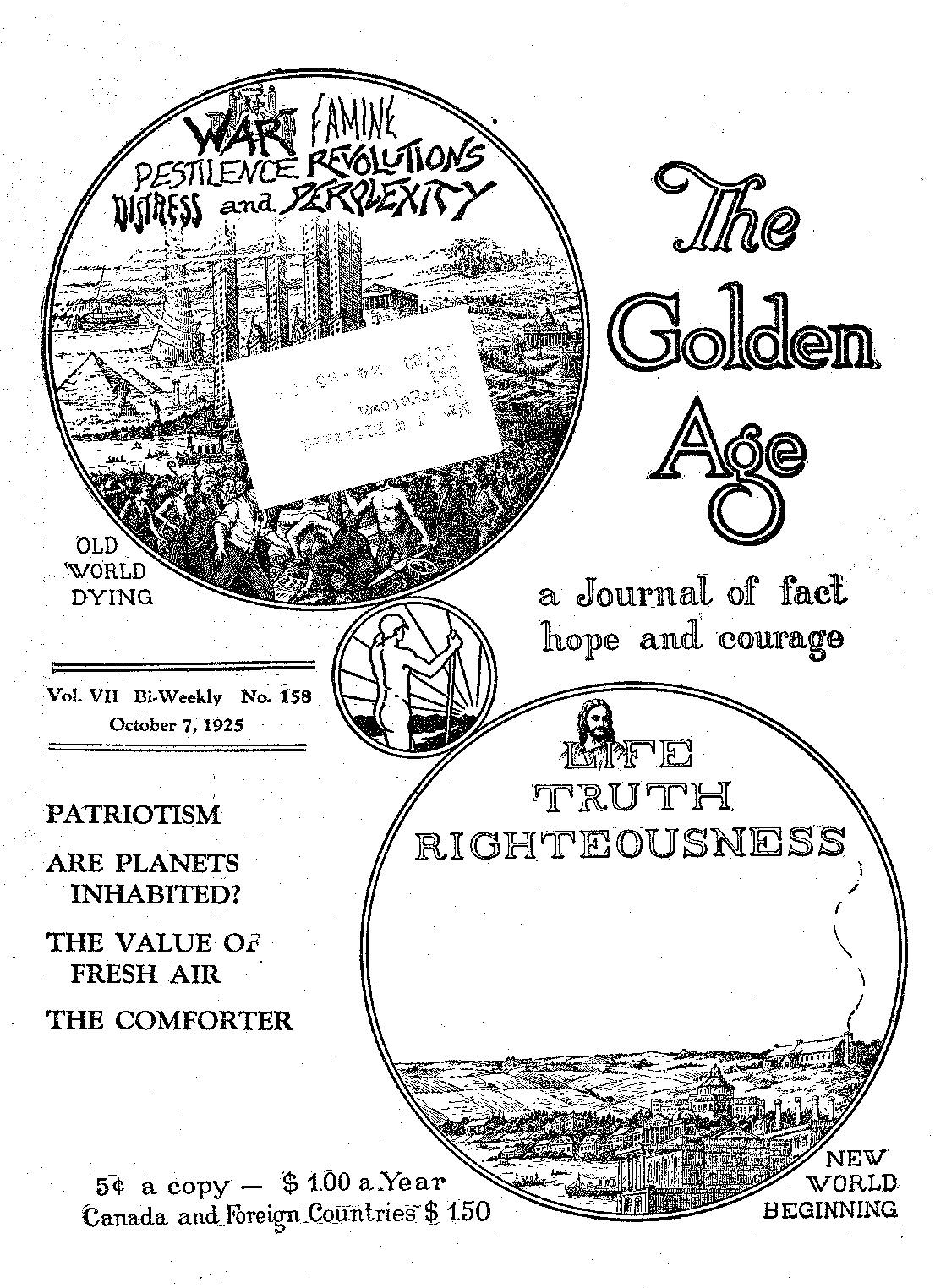
ww
PATRIOTISM
THE COMFORTER
ARE PLANETS INHABITED?
THE VALUE OF FRESH AIR
OLD 'VO'RLD DYING
Vol. VII Bi-Weekly No. 158
October 7, 1925
5$ a copy — $ 100 a Year
Canada and Foreign.Countries' $. 150
a Journal of fact hope aiul courage
NEV
VORLD BEGINNING
Contents of the Golden Age
<*t-............■........ ■■ ■ — ............
Social and Educational What Every Man Knows ...
Political—Domestic and Foreign Patriotism .....................,
Suppression of Opium in Formosa
Eloquence in Pueblo .......... . .
Science and Invention ‘ Are the Planets Inhabited?
The Intolerable Conceit of Evolutionists ...
Home and Health Three Recipes for.Making Whole-Wheat Bread ....... 12 The Value of Fresh Air
Travel and Miscellany More About Canada
The Beauty of Dandelions
A Miniature British Empire tn Mississippi ...
Thoughts on the Baat.bec Ruins ...
New Findings in Palestine
Copious Rains in Abid Spain ............
Religion and Philosophy The End of the World in 1925?
"LOCATION OF THE First MISSING Link .....
Exorcising Evil Spirits
The Morning Star
Sudden Deaths of Infidels and Christians .
The Comforter ..............: ...... 26
Confirmations of the Bible.................
Studies in “The Harp of God”
Published every other Wednesday at 18 Coneord Street, Brooklyn, N. Y., U. S. A. by WOODWORTH, HUDGINGS & MARTIN
Copartners and Proprietors Address: 18 Concord Street, Brooklyn, V. Y., U S A CLAYTON J. WOODWORTH . . . Editor ROBERT J. MARTIN . Business Manazer WM. F. HUDGINGS . . Sec’y and Treas.
Five Cents a Copy—$1.00 A Year Make Remittances to THE GOLDEN AGE
Foreign Offices : British.....34 Craven Terrace, Lancaster Gate, London W. 2
Canadian.....«... 38-40 Irwin Avenue, Toronto, Ontario
Australasian 495 Collins Street, Melbourne, Australia
South African......6 Lelie Street, Cape Town, South Africa
Entered as second-class matter at Brooklyn, N. Y., under the Act of March 3, 1879
BSSES
czAe Golden Age
Volume VII Brooklyn, N.Y., Wednesday, October 7, 1925 Number 158
Patriotism By Lydia Q. Wentworth
IT WAS Abraham Lincoln, ,in his inaugural address, who said:
This country, with its institutions, belongs to the people who inhabit it. Whenever they shall grow weary of the existing government they can exercise their constitutional right of amending it, or their revolutionary right to dismember or overthrow it.
The same “unpatriotic” idea was also held by Kant when he wrote:
-All actions relating to the rights of other men are unjust if the maxims on which they are based are not compatible with publicity.
Garrison also wrote:
Moral influence, when in vigorous exercise, is irresistible. It has an immortal essence.
The words “patriot” and “patriotism” have been used more frequently during the past few years than they were a decade or more ago, owing to the sudden thrusting of the World War into our lives; and because this more frequent usage has always been in direct reference to claims and requirements of war, the meanings of these words have become so restricted in the popular mind that to most people patriot signifies only one who is willing to be in military and naval service or who approves of war; and patriotism is supposed to be shown only through approval of war and warlike activities.
It is greatly to be regretted that such restricted significance should be fastened upon words whose original meanings are so beautiful and are capable of such wide application. If you look in any standard dictionary for the words under consideration, you will find that patriotism is defined as “love of one’s country”; and that a patriot is “one who loves and is devoted to his country and its welfare”, or words to that effect. Yet the idea that one could do as efficient work and serve his country and prove his love for it as well by living and working for it as by dying or becoming a helpless public charge, in consequence of participation in war, would appear to be recognized by only an insignificant
minority. But who shall dare assert that there are not many deeds and activities besides those relating to war that are truly and deeply patriotic? ,
That to a person of liberal mind and culture the word patriotism is capable of much elasticity of application and does not necessarily signify approval of any special or concrete policy of goverment is well shown by a phrase in “The American Commonwealth”, by Lord Bryce, where he says: “The patriotism which is so proud of the real greatness of the Union as to acknowledge its defects.” And an excellent example of legitimate use of patriot is found iri a remark recently made about the senator from the far west through whose efforts the political scandal has been revealed which has so stirred our entire country. It is said of him that he was “denounced as a muck-raker in 1922, acclaimed as a patriot today”. May the idea penetrate deeply into our national consciousness that exposure of corruption in high places is genuine patriotic service! Instances of usage similar to those quoted should be constantly given to the public to offset the limited and deplorable idea of patriotism that now obtains. At present, instances of such usage are so few and far between that they make little or no impression on the popular mind whose one conception of patriot and patriotism is indissolubly connected with warlike activities. This common interpretation of patriotism implies tacit acceptance of the thoughtless and stupid slogan, “My Country, right or wrong,” which is in direct opposition to the noble interpretation exemplified by the quotation from Lord Bryce, and indicates an attitude of mind wholly at variance with the deliberative quality which the happy phrase of Lord Bryce assumes is capable of rendering mature judgment. Do we need to consider long and seriously to decide which type of patriotism we would prefer to represent! ' '
Wliat is represented as patriotism by leaders ■who strive-, to form public opinion at special or critical periods is merely a spirit of narrow nationalism invoked for political purposes. This confounding of a narrow nationalistic spirit with a patriotism that should be broad, liberal, generous and far-seeing leads to great danger. It was doubtless this misconception of patriotism that Dr. Johnson was excoriating when he declared, nearly two hundred years ago, that patriotism was “the last refuge of a scoundrel”. One cannot believe that what he had in mind was the feeling of combined longing and love that wells up in the heart of a wanderer from his homeland and his pride in the accomplishments and achievements of his people. And is it not that same unfortunate, one-sided and inadequate estimate that provoked Bertrand Russell to write, “It might come to be understood that patriotism is the blackest crime of which a man in our age can be guilty. A man who murders one man with his own hands is executed by the law, but a man who, by preaching patriotism, causes millions to' kill millions, is universally respected and has statues put up to him when he dies. Those of us who do not wish to see our whole civilization go down in red ruin have a great and difficult duty to perform— to guard our minds against patriotism.”
Such usage is all in keeping with the perverted and false significance that today befuddles the minds of people everywhere. For patriotism, as at present used, has direct reference to the upholding of policies of government by citizens whether or not these may be for the best interests of the people. Perhaps it is hardly to be w’ondered at that the populace should accept this ignoble meaning as the chief one, since it must be admitted that this has been held up before them for so long by leaders of opinion that the really comprehensive significance has practically disappeared. Yet the spirit of patriotism in its lofty and beautiful sense persists, in truth it cannot be destroyed, even if the wTord is degraded and debased; but why not rally to the saving of the word’s true meaning? In the same paragraph with the foregoing quotation, Mr. Russell says: “Nationalism cannot survive without false beliefs,” thereby giving conclusive proof that he regards patriotism and nationalism as synonymous. There is the mistake, as sharp discrimination should constantly be drawn between these two words. Nationalism can easily survive, but it should not be allowed to masquerade as patriotism. One other statement from the same paragraph of Mr. Russell’s article serves to elucidate still further my contention: “I mean that we should view impartially any dispute between our own country and another, that we should teach ourselves not to believe our own country superior to others, and that even in time of Avar we should view the whole matter as a neutral might view it. This is part of the larger duty of pursuing truth.” What does that quotation express but the very quintessence of patriotism, pure and exalted, in complete accord with the sentiment previously given from “The American Commonwealth” ? Lord Bryce affirms that patriotism acknowledges defects. Mr. Russell speaks of “pursuing truth”. How is it possible to pursue truth without acknowledging existing defects? And where is the high-minded citizens who would repudiate the ideal of patriotism designated by Lord Bryce?
The words country and government need clear defining and accurate usage as well as patriotism and nationalism. Country and gover-ment are not necessarily synonymous terms though government officials, politicians and their hirelings have so generally succeeded in making the ordinary person believe them to be. The patriotic fervor one may feel for his country does not of necessity include the government of that country. Instance Russia, Poland, Hungary, as familiar examples in past years of peoples where love of native land and countrymen has survived long oppressive rule and fired many a heart with strength for valiant resistance, for martyrdom if need be!
It is the spirit of nationalism that is invoked when it is considered necessary by those having authority to arouse the mob spirit in the populace under the plea that this is the time for them to evince their patriotism. The fact is that those are the times when a misconception as to the real significance of patriotism is given to the public and sways their minds. The far-reaching effects of the bigoted nationalistic spirit becomes apparent to one reading the analytical and instructive article by Prof. Harry Elmer Barnes, “Assessing the Blame for the War,” in Current History for May, where he says: “Serbia . . . was a backward political society, in which intrigue, murder and wholesale assassinations had not yet been transformed into orderly party government. It was also inflamed by an intense nationalism, fed by the sufferings and aspirations of centuries of oppression.” That is no true patriotism which breeds intolerance of other lands or of that love which other people feel for theii' native country. It is not patriotism, it is the spirit of nationalism that foments trouble. Patriotism, on the contrary, is not inconsistent with internationalism since patriots of other countries would have the same end in view, and mutual recognizance -would produce a spirit of mutual helpfulness and conciliation. It is nationalism that should be condemned, not patriotism. Patriotism begins where nationalism ends. The truth should be fully realized and widely broadcasted that one cannot be an intelligent patriot and approve all governmental procedures so long as a country’s government rests in the hands of men who are unscrupulous or self-seeking. When the seats of the mighty are filled by men and women whose only thought is for the advancement of the people there will be a different story! Let it be remembered that, if Washington, Jefferson, Patrick Henry, Samuel Adams and others of that period, who sympathized with the cause those men espoused, had been patriots in the present so widely-accepted meaning, there would have been no Revolution. They rebelled against their government and were, therefore, traitors! The Tories were loyal patriots!
From the earliest times people have continually been exhorted to be loyal to the existing government or have been forced into submission to it. Seldom in all history can be found the record of a ruler who felt it to be his great and glorious duty and privilege to apply himself unreservedly to the advancement of his people. Yet why should this not be! Always the people have been called upon to be patriotic. It might be suggested that it is as much the duty of a government to display patriotism in its attitude toward its people, to show devotion to their interests, as it is for the populace to evince devotion to their government. If a government does not make every possible effort for the advancement of its citizens, what reasons can be given for their devotion to it—especially when such devotion demands the sacrifice of their very lives? The prevailing unrest, the turmoil among laboring classes today in every land, not excepting our own, what is this but an expression by the people of a demand for reciprocity of patriotic sentiment between governors and governed?
In considering this subject from an unfamiliar viewpoint there is no slightest intention or thought of denying or detracting from the merit of what in the past has been esteemed the loftiest manifestation of patriotism. The nobility of spirit which yields self as sacrifice for love of country or humanity cannot be questioned. But ideas and ideals that have prevailed in past ages must give way before higher ones in a changed epoch. If we are to progress our customs must improve and our ideals become more advanced. One instance of such change is that duelling, considered a most gentlemanly method of settling disputes somewhat more than a century ago, has been abolished, or outlawed, through force of progressive opinion. In these times conditions exist similar to those which furnished the provocative causes for duelling a few generations ago. And human nature has not changed. Yet today it would not only not be considered an exhibition of bravery, or a necessity, for either of two irascible acquaintances to become a homicide to vindicate his honor; it would be adjudged plain murder punishable by process of law.
We must not lose sight of deeds of patriotism in bygone times that have had no connection with war, yet have given the strongest possible evidence of love of country and willingness to sacrifice self. One of the most widely known of these that comes to mind is the story of the little Dutch boy who sat for hours, nearly benumbed with cold, stopping up a hole in a dike to prevent the water from flowing through and flooding the country; and there are abundant illustrations of patriotic heroism that have been displayed by private individuals and by statesmen who have held their country’s welfare above personal aggrandisement—deeds wholly disconnected from warlike activities.
We have good cause to think seriously about the reason, or motive, for stressing with insistence the meanings so generally given to the words under consideration—that to be considered a patriot, or to feel patriotism, one must approve of war and militarism; and also why it is that, in popular acceptation and understanding, anypne who declares himself to be opposed to war, military service and preparation for war—in fact, anyone who maintains a firm and consistent belief in non-militaristic methods for the continuance and final establishment of peace—is called unpatriotic. Would anyone affirm that a war of aggression could by any amount of explanation be counted as a patriotic enterprise or act? But where do we find a nation willing to admit that it would countenance aggressive warfare? What government ever deliberately announces to its people that it is preparing to wage offensive, or aggressive, warfare? When, the time comes that war is favored by a powerful faction the machinery for instruction of the public is set in motion and the spirit of the people inflamed by deliberate propaganda. There can be no doubt of the sincerity of the feeling on the part of the people, but that it is roused by misrepresentation there is equally no doubt. Look back to the time of the Mexican War, denounced by William E. Channing, Theodore Parker, William Lloyd Garrison, James Russell Lowell and other public-spirited and courageous men, and women as well; and so bitterly denounced as an outrage and an unpardonable aggression on the part of the United States by Abraham Lincoln, then a representative in congress, that he barely escaped impeachment. Shall we judge that Lincoln was unpatriotic, even guilty of treason, as is said of war opposers in these exciting days ? Or who doubts today that he was truly patriotic?
For months before the outbreak of the World War every government in Europe knew that a tremendous struggle was coming—as did also many individuals who foresaw to what the governmental policies would inevitably lead. In France, Jean Jaures devoted himself with unstinted zeal to the task of averting the threatening conflict. His assassination resulted. Will anyone assert that, in spite of his opposition to the policies of his government, Jaures was not a true patriot, a lover of his country and his countrymen? Or can one honestly hold the conviction that those whose procedures doomed their land to vast destruction of property, the blighting or death of millions of young, aspiring lives and virtual bankruptcy of the nation were the real patriots—when it is known that if reason had prevailed all the horror might have been
avoided? In Germany, the renowned pacifist Nicolai, who, with a group of earnest friends, ceaselessly opposed the militaristic policy of his government, was imprisoned for his activities and barely escaped execution by managing to flee the country in an airplane. Were he and his associates the patriots or the German militarists who precipitated the war? In England the invincible pacifist who was treated with scorn, whom the powerful tried to intimidate and humiliate, yet who maintained his serene poise throughout all the terrible days of the war, is it his vindication that he now [1924] occupies the position of Prime Minister of the British Empire ? Will anyone venture to assert that he was less patriotic in those days than now, when he is bending all energies to the rehabilitation of Europe? It will doubtless be readily conceded that patriotism is a state of mind. How vital, then, in our present exigency, when decision for or against the possibility of future conflict is being settled, how supremely vital becomes the widespread recognition and immediate voluntary adoption of that state or attitude of mind whose applied policy would save the world from a repetition of the upheaval of 1914 to 1918! .
To raise the question as to whether or not war has been necessary in the past for cultural progress, as some authoritative writers have held, or has accomplished any good, is futile. No amount of discussion as to the merits of, or need for, past Avars can lead to any decision. A person who holds the opinion that Avars have played an important part in the Avorld’s history toAAmrd the dissemination of culture from nation to nation is not likely to be convinced of error in the main, even though he might be willing to admit that the conflict precipitated by France in 1870 led to trouble which has not yet been Aviped away and which certainly had no relation to cultural progress—except perhaps to retard it. The point to be considered is what need of the world can be supplied by war today or in the future, what substantial benefit can accrue to any nation or the AA’orld in general by the continuation of the system of organized collective homicide. And, unless distinct benefit to the human race, or some particular portion of it, can be clearly proved as a consequence of Avar, the question that arises is whether any citizen proves his patriotism best by favoring the eon-tinuance of war and militarism or by opposing them absolutely. A definite attitude is indispensable. There is no half-way choice or stand.
Love of one’s family neither implies nor necessitates hatred or even dislike for one’s neighbors. Love of community or state, and pride in them, need not engender animosity toward neighboring cities or states or remote ones. It is plainly for the benefit of individuals and families that they maintain pleasant relations with their neighbors and live at peace with them. The benefit is mutual. This same principle holds in regard to countries, and the oft-quoted example of the long unbroken peace between Canada and the United States serves as a powerful argument. History furnishes numerous instances of the union of small states for mutual aid or protection against invasion, though the lust for conquest on the part of a stronger nation has sometimes rendered such union futile. And in this our day and generation, in spite of the high degree of civilization of which we boast, it is the lust for conquest and possession that leads to bitter, ferocious struggle between nations. It is not that the honor of a country has been assailed that war is declared. Such books as “How Diplomats Make War”, by Francis Neilson, written when the author was a member of Parliament; and “Why War?” by F. C. Howe, for several years Commissioner of Immigration at the Port of New York; or “How the "War Came”, by the Earl Loreburn, give ample testimony in refutation of that untenable idea. If honor were at stake it ought to be universally agreed:
“That Honor is a holy thing, too dear To leave to the arbitrament of arms, To fatal hazard of chance shot and shell.”
The word honor is used as a pretext by which the uninformed people, en masse, can be roused to frenzy. It is disconcerting, to say the least, to imagine what could and might happen if people as a whole knew how completely they had been deceived regarding the underlying causes of the World War, which every accredited authority now informs us was a war chiefly of commercial rivalry. On the other hand, if such knowledge were suddenly to come to everyone, it might create nothing more alarming than such revulsion against war that no people could ever again be induced or even forced to wage war upon another people, but that they would reply to such a summons by telling their national leaders and the instigators of the war to fight their own battles and let the common people live their lives in the peace they desired.
War was not primarily, and never has been, an expression of the struggle for bread, as some writers have asserted. War is in no way related to the real struggle for existence by humankind. That fallacy should be most emphatically exploded. The struggle for existence is aided and supported by cooperation of individuals or societies of men combining against the common enemies of unhealthy or too rigorous climate ; poor soil; pestilence and disease; ignorance, vice and crime; the innumerable small pests that infest the vegetable kingdom whose products supply mankind with the essentials of food, clothing and shelter; and against other' circumstances and conditions of nature the overcoming and controlling of which enable the race to exist and progress. The struggle for existence has no connection with war except it be that war exercises an adverse influence upon this struggle by the slaughter of large numbers of individual members whose brain and brawn are needed for the common weal of their societies or race. Nicolai, than whom there is no higher authority, tells us in his “Biology of War”: “Eagerness to acquire property was originally the cause and object of war”; “Man, as even Aristotle knew, is from his very nature a social animal. Universal brotherhood among men is older and more primitive than all combat, which was not introduced among men until later.” After showing that animals of the same species never kill each other, for example, lions, tigers, swine, et cetera, he writes that: “War between creatures of the same kind is wholly unthinkable unless they are either cannibals or possessed of something of which it is worth while robbing them. This latter hypothesis is by far the more important of the two.” Then discussing instincts of human beings and drawing the conclusion: “This imperfect knowledge explains why we think it nobler and more honorable to be out of date, and consequently warlike, than up to date and peaceful,” he closes that section of the book by saying:
Would man but realize that there is nothing natural, nothing great, and nothing noble about war, but that it is merely one of the numberless consequences of the introduction of property! In short, war in. its essence is a business, like thousands of others, except that it is unnatural and assumes certain violent forms.. This, however, does not alter the fact that it is essentially the same thing.
It is not so very long since that the head of a business house as well as the leader of a troop of soldiers was called captain (capitano), so that the lieutenant of today need not look down so proudly on, a mere clerk. They are both brothers.
No apologies are needed for pacifists or pacifism today—rather it is the militarists who must defend their policy. The world has learned fairly well its lesson of what results from militarism and war through the desperate suffering of recent years, a long-drawn-out suffering whose sum total can never be estimated. This is no time to uphold the criminal system of government which permitted such an exhibition of savagery—displayed by the most cultured and scientific nations of the world. This is the time for all people who can think for themselves— think clearly—think logically—think sanely-—to declare that loyalty to country and countrymen is a far higher thing than submission to a government that would decree untold and endless suffering by continuance of a custom not only needless but wholly incompatible with reason, with morality, with religion and with civilization. Now is the time to recall and apply such messages as Lowell gives us in the lines:
“We owe allegiance to the state, but deeper, truer, more, To the sympathies that God hath set within our spirit’s core, .
Our country claims our fealty, we grant it so, but then Before Man made us citizens, great Nature made us men.
“He’s true to God who’s true to men; wherever wrong is done
To the humblest and the weakest, ’neath the all-beholding sun,
That wrong is also done to us, and they are slaves most base
VJhose love of right is for themselves and not for all their race”;
and the challenge of Theodore Parker in the ringing words: “I think lightly of what is called treason against a government. It may be your duty today or mine. But treason against the people, against mankind, against God is a great sin not lightly to be spoken of.” Need it be asked whether or not war is treason against mankind and God? For one who hesitates to avow a clear-cut decision perhaps no better answer could be found than the words of Garrison to his critics in the days of our sectional conflict, words as applicable to war in these times as in those:
. . . the peace principles are as beneficent and glorious as ever and are neither disproved nor modified by anything now transpiring in the country of a warlike character. If they had been long since embraced and carried out by the people, neither slavery nor war would now be filling the land with violence and blood. Where they prevail no man is in peril of life or liberty; where they are rejected, and precisely to the extent they are rejected, neither life nor liberty is secure. How their violation, under any circumstances, is better than a faithful adherence to them, we have not the moral vision to perceive. They are to be held responsible for nothing which they do not legitimately produce or sanction. As they neither produce nor sanction any oppression or wrongdoing, but elevate the character, control the passions and lead to the performance of all good offices, they are not to be discarded for those of a hostile character. ...
What is war? Is it not the opposite of peace, as slavery is of liberty, as sin is of holiness, as Belial is of Christ? And is slavery sometimes to be enforced—is sin in cases of emergency to be committed—is Belial occasionally to be preferred to Christ, as circumstances may require? These are grave questions, and the redemption of the world is dependent on the answers that may be given to them. . . . Eye for eye, tooth for tooth, life for life, is not the way to redeem or bless our race. Sword against sword, cannon against cannon, army against army, is it thus that love and good-will are diffused through the world, or that right conquers wrong ?
Basing my conclusion on accredited definitions I consider the words “patriot” and “pacifist” as practically synonymous. A pacifist is of course unalterably opposed to war; and as war is the most destructive and baleful force that can be brought against one’s country, invariably bringing other forces of injury and destruction in its wake, it would seem to follow logically that a true patriot, one wfliose dominant desires must be to save his country from ruin (the unavoidable accompaniment of war) must be a pacifist. To me the word country includes not merely its “rocks and rills” and “woods and templed hills”, not merely the land and water that are contained within its boundary lines, but its population and their prosperity. Anything that would undermine the prosperity of the people as well as what would devastate the soil must be regarded as a menace to be prevented by loyal patriots. That is why we need to increase the number of our staunch pacifists.
I repeat: The best patriot is one who strives to promote his country’s interests -and save it from disaster ; and what disaster is greater than war or has more far-reaching and sorrowful consequences physically, mentally and morally to individuals and economically to the nation as a whole ? It is time that the general public was awakened to the understanding that the highest patriotism consists in endeavoring to promote the best interests of one’s native land or chosen abode and that this can best be done by preventing the curse of war from blighting it. Anyone therefore who raises the cry of “unpatriotic” in reference to pacifist demonstrations or activities should be met squarely by the rejoinder that the pacifist is the truest patriot, since his endeavors are to save his country, and incidentally the world, from the crime which is the aggregate of all evils.
General John F. O’Ryan goes so far as to say, “I would be a traitor to my country if I did not do all in my power to abolish war.” The time has come for the public to be told and insistently taught that the generally accepted idea of patriotism must give way to a different one, the right one, a far higher and more inspiring ideal, one that will lead away from the horrors and destruction of warfare and its subsequent distress and anguish to peace and prosperity for every one. If enlightened public opinion abhors and condemns homicide of individual by individual should it not far more vehemently abhor and condemn homicide on a vast scale—the collective homicide of nation by nation ? The time is ripe, the day has come, for Avar to be outlawed without reservation or equivocation. Whatever purpose it may have served in the past, today it is an outrage upon humanity and decency. Peoples everywhere fear, dread and loathe it while they are still cajoled into believing in the false patriotism that asserts that to prove they have the proper spirit they must be willing to yield their lives by organized massacre. Again I insist this is not patriotism, it is a submission which can be successfully commanded and enforced only because the victims are ignorant of the actual truth. The truth is that Avar no longer serves any purpose but what is degenerative and demoralizing. It is the world’s greatest curse; and yet, though it stands threatening the extinction of civilization, perhaps of the human race, those Avho oppose it and avouIJ eradicate it from every system of living are dubbed unpatriotic by the ignorant mob that follows, like unthinking sheep, an equally unthinking leader!
No person who feels the slightest degree of concern regarding world peace need apprehend danger to any existing institution from agitation by pacifists, except danger to the inhuman system of war. The pacifist movement is humanity thinking in terms of social progress. Truth and right cannot be injured by exposure and discussion. Right will Avin out in the end though progress toward it may appeal* a snail’s pace. “Agitation is the marshaling of a nation’s conscience to mould its la.Avs,” said Sir Robert Peel. So the agitation noAv to the fore concerning pacifism will serve the purpose of arousing the public conscience and obtaining public judgment. We may rest content Avith the final verdict. If institutions and customs noAv prevailing- be true and right they will be maintained. If not, if a change for a loftier standard is to come, the sooner it arrives the better ! A pacifist is not a dreamer—is no mere visionary. He is a peacemaker, the most practical kind of person in this world, which will remain unpractical so long as government and men are dominated by the spirit of militarism and Avar; by a spirit of narrow nationalism, falsely presented as patriotism; by the idea that force can ever compel willing submission. The human mind is not so constituted or attuned that it Avill ever accept unjust dominance without rebellion. “The great need is an understanding of the nature and mechanism of human association, a realization of its more fundamental Iuavs,” as Norman Angell puts it. The philosophy of force, demonstrated so savagely by militarism and war, has had its day. It upholds destruction as a means of beneficial accomplishment. But is it not evident to the meanest intellect that the poAver of destruction serves no purpose at all? Are more proofs needed than we already have that the continuance of force in its application by militarism presages the possible extinction of humankind? Yet the hold of militaristic ideas is even now so strong on the uninformed multitude—people can still be so swayed by those whom they consider their superiors—that much effort is yet essential to prevent the possibility of future terrific conflict.
le
To prevent the curse of war from fastening itself again on the country we love we must exert ourselves to work against it till it is banished from the earth. All are needed in this great work. Youth and age alike can share in it and help hasten the day when peace and goodwill shall reign. For that time is sure and inevitable and, whether the force that will bring it be a moral or an economic one, the world is headed for universal peace. In spite of its long sad war history the change is coming, the end of warfare is at hand and the era of peace is ahead.
Bsooklyx, M. T.
In the natural process of events peace is bound to come—as were public schools and equal suffrage. It may be retarded by ignorance and stupidity—it cannot be prevented. And the day of its coming can be hastened by definite pacifist activity, individual and collective, on the part of every citizen who desires to evince patriotism of the highest type and loyalty to those ideals and principles which should be the foundation of every government—yet which, though claimed, are so seldom found in such operation as leads to the highest welfare of the citizenry.
What Every Man Knows By Wm. R. Schwartz
WHAT Every Woman Knows, is the title of an article which was written by a woman and went the rounds of the press in May, 1925. The average husband was pictured as earning most of the money in the United States. His wife was pictured as spending most of what he earned. An article may be timely; its view may point to facts; and those facts may just be passing, in or out of time. Another point of view of the facts should now appear in the magazines under the title, What Every Man Knows.
In the article first mentioned Helen P. McCormick, for some time assistant district attorney of Brooklyn, N. Y., puts the case this way:
r Taking the coldest possible view of the matter; say a woman is married to a man with an earning capacity of $5,000 a year. He represents in terms of money approximately $75,000, yielding six or seven percent dividend. Let him become incapacitated, the $75,000 investment is wiped out.
To estimate the average husband as you would stocks and bonds is certainly the coldest possible viewpoint. To leave his wife entirely outside of this estimate, on such a really vital subject, is worse than a cold viewpoint. Certainly it is not fair. Who is using her money? What became of her earning capacity of $5,000 a year which she had single-handed before she married? Did she become incapacitated, or was her $75,000 investment simply wiped out when she became his “partner”?
Most men occasionally use enough thought to remember that times are changing; and time will answer these questions correctly. There was a time when the “capital” of the household brought home a portion of his earnings, with or without love and commanded his wife to begin and end at home, but to be sure to make both ends meet I He felt perfectly free to dispose of his other possessions as it pleased him, outside of the home. Perhaps those white wifely fingers had a perfectly good right to get into his trousers’ pockets in order to conserve his earning capacity.
It often happens that when the husband’s ever-decreasing store of latent energy falls below par, the good wife with the empty pocketbook manages to make the living for the whole family. Sometimes he hands her $10 for foodstuff and generously suggests that if she can strike a bargain and save a dollar out of it she might spend it on herself. Gratefully she takes the money; but sometimes she remembers that the top ten-center of each dollar has already been smoked off by the head of the house.
Father Time is now writing some good, straight words in our statute books, laws that are based on truth and justice. Marriage is coming to be properly regarded as a partnership wherein both contracting parties become joint owners.
Today, in the affairs of home and business life the average woman fearlessly meets the average man upon equal grounds. She frequently succeeds where he would fail, if conditions were made as severe for him as they are often made for her.
If we men would play fair we must pay due respect to our wives and treat them as partners. We will find much to esteem, much to love, and much less to complain about. Really a “part-net”, rich or poor, is the only type of man that -is worthy of a wife. >'
Is There Life on the Other Planets? By w. L. Pelle
IS THERE life on any of the other planets of our solar system? This is a question that cannot be definitely and positively answered; the closest is merely conjecture. There have been arguments advanced on both sides of the question and arguments which seem to have some foundation. Mars and Venus have been special objects of study along this line. It is certain that there is no life on Jupiter and the planets beyond, for the period of axial rotation is so short and their density shows that they are still in a preparatory state, much the same as the earth was before the start of animal life.
With respect to higher forms of life on the planet Venus, it has been suggested that such is possible and highly probable. However, the great cloudy veil which hides the face of the brilliant planet forbids our looking thereon because of its impenetrable thickness, estimated to be thirty miles deep. It has been suggested that the surface of that rvorld would be full of oceans and very misty. Rains fall almost incessantly.
According to recent investigations Venus enjoys an average temperature of 113 degrees Fahrenheit, but a large percent of this heat is absorbed by the cloudy blanket. Evidently the temperature at the poles would be such as to warrant expectation of the existence of higher forms of life.
Science has made some interesting speculations regarding the forms of creatures on Venus. It is claimed that flying would be easy on account of the heavy atmosphere, therefore possibly aviation would be developed to a great extent. It is also suggested that the oceans are large and deep, the rivers swollen, and the continents consequently small. Hence, the Venusi-ans would have to be well adapted to water. For these reasons, at least, the conclusions are that if there are animals on Venus, they must be of the flying-fish variety. The ends of their wings could be formed so as to be used as hands, and their bodies arranged so that instead of skin there would be a scaly covering or, still differently, their flesh could be similar to that of a whale.
It is doubtful if the sun ever shines on the surface of the planet, and hence the Venusians must ascend to the lofty heights to get a glimpse of. that fiery orb, which would, of course, appear much larger than it does to us here on earth.
If the above speculations are anything near correct, what a dreary thing life must'be on tha planet Venus. Nevertheless, while it may seem so to us, we might be sure that the Venusians are perfectly happy in their environment. A fish could not be happy out of water, neither would a cat enjoy being in the water all the time. Contentment comes from trying, at least, to conform ourselves to our environment and making the best use of the opportunities we have. While conditions on the earth are not just conducive to happiness at all times, yet the prospects are that the time will come when such will be the case. At any rate, when a very gloomy day comes along’we might congratulate ourselves in that we do not have to endure conditions like that all the time, as the Venusians do. On the other hand we can see and enjoy the sun's light and heat most of the time. .
Nov’ as to Mars Camille Flammarion, the celebrated French astronomer, said:
I do incline to the belief in people on Mars. Its climate seems to be temperate in the main, more temperate than our earth; for their polar ice melts, and ours does not. You know how fiercely life will seize a chance to take root. Why not on Mars? Also their seasons change faster than ours. That means variety of crops—-food. The spectroscope shows, too, a composition much like that of the earth, with perhaps less water. Then there are these long, straight lines across its surface. These lines seem to have been made by sentient mind.
The late Professor Percival Lowell, of Harvard, believed that Mars is inhabited. He said:
I have absolute proof that the planet Mars is inhabited. Every discovery I make increases my conviction that Mars is not only habitable but inhabited. It is evident that in the canals the circumstantial evidence points unmistakably to local intelligence now dominant on Mars. The motive for them is the scanty amount of water on the planet. Water is necessary for human existence and water is scarce. There is a supply at the poles. Here is a motive of the most compelling kind, the primal motive of self-preservation.
Standing opposed to these ideas are the suggestions that the canals are not water channels, nor vegetation growing along water channels, but that they are either bands of moistened soil or vegetation growing thereon. The main objection to the above explanation is that w’e find the same kind of canals and lakes in certain sheltered regions upon the moon. The lunar canals are much smaller, however.
The late Professor W. H. Pickering stated that in order for these Martian canals to be visible, they would have to be at least twenty-five miles wide; and said he: “No race of the order of Ferdinand and Miranda could drive canals twenty-five miles wide the two thousand odd miles between the Martian poles and the equator.”
Professor Lowell wrote:
Look at Mars and you will see pictured the future fate of your own Earth, when by the insensible flight of the gases of the atmosphere, seas, rivers, and lakes alike will leave you, and nothing will remain but arid deserts and the wintry Arctic and Antarctic. Thence alone will you be able to derive moisture for the sustenance of the vegetation, which in its turn will sustain a more ethereal, wasted race of men; and like the Martians you too will have to build canals thousands of miles long, employing all the resources of your engineering skill thus to keep your pallid life within you.
In contrast to this worldly wisdom of one of the world’s wise men we have the more sure word of divine testimony concerning the earth, a testimony that is surer than all the worldly testimony put together. We have it in the Divine Word that “the desert shall rejoice and blossom as the rose”, and “in the wilderness shall waters break out and streams in the desert”.
Will there be life on the planets ? The affirmative answer to this question is the only reasonable one. The mighty mind that formed our solar system does not cause its planets to whirl through space for no purpose. Hidden in the pages of Holy Writ is the suggestion that in due time all the planets will be inhabited by intelligent, reverential, and happy creatures who will bring glory, honor, and pleasure to their all-wise Creator.
Three Recipes for Making Whole Wheat Bread
WE REPRINT, by request, the recipe for making whole-wheat bread, and two other recipes sent in by enthusiasts for getting well and keeping well:
THE KLEINHAUS RECIPE
Two cups of milk brought to scald, three tablespoons sugar, two cups warm water, one tablespoon salt, two tablespoons shortening, one Fleischmann’s yeast-cake, five cups whole wheat flour, three cups white flour, two cups bran. Mix the ingredients into one another, one after the other, in the order named. Let rise over night. In the morning put into pans and let rise once. Prick the loaves to release the gas and bake in a moderate oven.
THE ENRIGHT RECIPE
Dissolve one compressed yeast-cake in one-half cup warm water and let it stand until it bubbles, which will take about fifteen minutes. Then add this to one quart of warm water, together with one tablespoon of salt, one tablespoon of sugar and one tablespoon of shortening, and mix together. Then add two quarts of wholewheat flour and mix well. Set this to rise until it has about doubled its bulk, which will take from two and one-half to three hours. Then punch it down, and let it rise again until it has about doubled its bulk. Then put it into the pans and bake in a medium hot oven for a little more than an hour.
THE VANCE RECIPE
My bread is light and delicious. The day before I bake I put a small cup of flour into a crock or pan with a half cup of brown sugar. Mix this well at noon. Strain the potato water into this, mixing it smooth. I use about a quart of the water. When cook add one yeast-cake. I use Royal, first dissolving the yeast in a little warm water. Set aside to rise. If it is foamy by bedtime put1 into a cool place. It does not hurt to chill, once the mixture has foamed. In the morning make the dough in the usual W’ay, using whole-wheat flour or half Graham and half whole-wheat. In making the dough put in about a quart of new milk. It does not need to be quite so stiff as with white flour. Set to rise. This takes about one hour, as it does not need to be more than double its size. Make into loaves when it has risen once.
Do not let it rise too long. Have the oven hot for the first half-hour and cooler after that, This makes nice bread and gives a delicious nutty taste lacking in the white flour. I do not put salt into the potatoes when boiling, but add to the dry flour before mixing.
The Best of Reasons
Village doctor (to old elder): But surely, Saunders, you’ll have a drop of something before you go ?
Elder Saunders: No, thank ye, Doctor, I’ve three good reasons for refusing your hospitality. First, I’m chairman of the local temperance society; second, I’m just gaeing tae a kirk meeting; and, third, I’ve just had one.
The Value of Fresh Air
ONCERNINGr the cause and prevention of colds I)r. Harvey H. Wiley, former chief of the Bureau of Chemistry, Department of
Agriculture at Washington, D. C., once said: “It is a crime for anybody’s child to have a cold. A man came to me whose children all had colds, and wanted a cough medicine that did not contain alcohol. I told him I could tell him of a remedy that did not contain alcohol; that was to go home and put the windows of their sleeping rooms wide open. People in the far North do not have colds. But when they get back to civilization they have colds.” One would never have a cold if he did not breathe foul air.
“Sleep is nature’s sweet restorer.” While we are asleep nature does the repairing or renewing of our bodies. And in providing the right conditions for the renewing of our bodies we need the purest air, because the purest material is necessary for the rebuilding of all parts. While asleep we are very susceptible to poisoned air. Many people fear that they will take cold when the windows are opened in cold weather, or when going out on very cold days; when, as a matter of fact, pure dry air is extremely stimulating and prevents the taking of cold. The healing potencies in the pure air and sunshine with nourishing foods are now the great remedies for tuberculosis. Even in the coldest weather tubercular patients are kept outdoors most of the time, day and night.
The healing powers of nature are such that when allowed, they do infinitely more for her children than they could possibly do for themselves. Our best physicians admit that about all they can really do for a sick person is to keep him in the condition most favorable for nature’s healing. It follows, then, that the greater the physician the less he depends upon drugs, and the more he relies upon natural methods to heal. When one is suffering from the violation of nature’s laws, nature is trying to throw off the refuse matter of the body, to get rid of the excess poisons from overnutrition, food half-digested and only partially assimilated, and the broken down tissues of the body. To exclude the fresh air or to force more nutriment upon the patient is dangerous.
We all know how robust the American Indians were before they began to live in houses. As long as they lived in the open they -were exempt from many of the diseases which they now
By Mrs. Andrew J. Holmes
suffer from as victims of civilization. It would be a great benefit to any people if they would adopt outdoor sleeping rooms the year around. When the kingdom of heaven is established and we have a desirable government the people will not be allowed (neither will they be forced for economic reasons) to live in poorly ventilated houses and workshops.
No one can be in a strong vigorous condition without exercise in the pure air, and there is no substitute for brisk walking in the open air. Those who live within a mile or two of their place of business would find themselves invigorated for the day’s work and would keep in much better health if they walked to their work in the morning instead of riding. In vigorous outdoor exercise we are compelled to take much longer, deeper breaths, and we all know we are invigorated by this exercise. As a matter of fact, in ordinary breathing we bring only a very small part of the lungs into play; the apex of the lungs is not filled with air. The result is that the unexercised cells are not filled with air, but are filled with dust and irritating particles and inflammation is set up, especially if there is a tendency to consumption. Deep breathing is one of the most important features in building up a strong, vigorous condition of the body; and the lack of deep breathing is one of the reasons why we have so many weaklings.
There are many persons who do not know how to breathe properly. They do not inhale enough oxygen to be invigorated and build up the staying powers so much desired and needful to meet the daily duties of life. To breathe properly the shoulders should be raised during inhalation, and the air should be slowly drawn into every quarter of the lungs and as slowly exhaled. A good breathing exercise is as follows: Slowly exhale through the nostrils until the lungs are almost emptied. Then slowly inhale until the lungs are full. Hold the breath a moment and then as slowly exhale. This will possibly cause dizziness at the outset, but persist until you can take a dozen full breaths without dizziness. You will find that this exercise will build health as no other physical exercise will.
The stooping habit formed by those working over desks or in stooping positions has reduced the lung capacity so much that their ordinary breathing is not deep enough to take in sufficient oxygen to completely fill the lung surface and
to properly aerate the blood. All the venous blood in the body is pumped from the heart against one side, of the lung surface. On the other side we breathe in air (which should always be pure) and through this delicate membrane of more than twelve hundred square feet (in adults) the exchange of the life-giving properties of the oxygen in the air and the poisonous carbonic acid gas, the debris, the worn-out tissues in the sewage blood takes place, thus transforming the poisonous venous blood into the pure arterial blood. This exchange takes place about twenty times a minute, thus showing the great importance of proper breathing of pure fresh air day and night. When you are breathing deeply and fully of the great lifepower you are taking in that great mysterious energy which is the life-giving quality of all breathing animals, including man. If every one would pay more attention to proper breathing of pure air, the health question would not be the serious problem it is today.
There should be a free circulation of pure air through our homes and workshops day and night; for when we close up a room the air begins to deteriorate and absorbs poisons exhaled by the occupant. The life-giving oxygen is consumed very soon unless constantly renewed by a current from the outside air. Our energy, our vitality, our life is dependent upon the air we breathe, and if this is insufficient or vitiated we suffer accordingly. The foul odors which we detect in a closed sleeping room are simply the poisonous excretions from the broken-down tissues of the body. They are deadly poison.
With an average of seventy beats a minute, the heart delivers to the lungs for aeration, five ounces of blood at every beat, or nearly 3,400 gallons a day. In other words, the lungs handle in twenty-four hours 105 barrels of blood. How necessary, then, that the air wc breathe should he absolutely pure. And yet, in spite of the tremendous task which the heart and lungs are called upon to perform in the aeration of the blood, it seems that men and women do everything possible to make the task more difficult.. The closed windows and doors, the unventilated homes, workshops, and foul air of public buildings, theatres, churches, depots, post-offices, etc., are a few of the handicaps which prevent the lungs from getting oxygen. ,
; If the body is to perform its normal functions unencumbered, oxygen must be freely supplied to the blood at all times; for according to reliable statistics the average amount of air taken into the lungs during ordinary breathing is about thirty cubic inches at each single inspiration. At the rate of eighteen breaths a minute, there would pass in and out of the lungs 777,600 cubic inches, or 450 cubic feet every day.
Surely, then, good judgment would lead one to choose as far as absolutely possible between pure air day and night, or poisoned, foul air. Only one lacking in common sense would hesitate to choose between the two. Yet every day we see people shut themselves away from the life-giving oxygen found in pure fresh air, and breathing over and over the same old air, poison-laden. A woman to whom I was talking complained to her neighbor about her bad feelings. She has not been out of the house for eight or ten months with the windows and doors closed, and the air reeking with tobacco smoke and other odors. Her neighbor told her that she was getting her purgatory for her sins, so she could not sympathize with her, and that if she did not deserve her purgatory she would not get it. The woman replied that she did not know what she had ever done that God should punish her so with poor health. How the devil has deceived the poor groaning creation into believing that God sends affliction upon them, when as a matter of fact all they-need is pure air and exercise to get their blood circulating!
The list of so-called “cold weather diseases” is a long one including, as it does, respiratory disorders that range from the “cold in the head” to pneumonia and consumption, the grippe, whooping-cough, measles, diphtheria, scarlet fever, the various throat troubles, and many other diseases. The season of cold weather must have something to do with these diseases, but does the cold weather cause them ? It is between the months of November and March that these diseases are most prevalent and that the death rate is the highest. Is the cold weather the direct or indirect cause of these diseases and of the high death rate during this period?
To keep warm is the chief aim of the average dweller in our northern latitude during at least six months of the year, and usually at the expense of his health. With the approach of winter he proceeds to fortify his home against the exhilarating winds and Jack Frost. And in so doing he gives very little, if any, thought to ventilation. Heat is the main thing; all else that appertains to health and hygiene is not considered. It is taken for granted that all the air needed gets in some way. But what the some way is, they do not take the trouble to find out. But proper ventilation does not creep in under the doors. It is accidental ventilation which is blown through the crevices between window sashes and which rushes in when the doors are opened. This does not supply all the pure, sweet air with its life-giving qualities so needful to maintain good health. Every breath of pure air means .additional strength and energy. And when we feel languid, sleepy, disinclined to exertion, we are living in an atmosphere that is lacking in the life-giving oxygen and charged with impurities seeking lodgment in weakened constitutions in which the powers of resistance to attacks of-disease have been reduced by inhaling a heated and foul atmosphere for months in succession. In such a condition one is more likely to be affected by diseases when one’s constitution is not able to resist them.
The conclusion that is reached in regard to cold weather ailments is this: Such diseases are only indirectly the result of the cold season. Their prevalence during the winter is largely due to our methods of housing ourselves during the cold weather. Instead of heating having the first consideration ventilation should be planned first, and heating second. There are indications of a general reaction against this form of criminality of coddling. The doctrine of pure air for healing of disease promises to become respected principally because physical cultur-ists have demonstrated the efficacy of fresh air in building up and maintaining good health. The doctrine of fresh air should be preached and practised by every one. But superstitions and ancient false theories die hard.
It will be objected by some that ventilation first and heating next in preparing our homes for winter will, during the cold months, bring discomfort to the healthy and be even dangerous to the delicate, old and young. But it will soon become apparent that objection to low temperature is due to a very great extent to the coddling to which the most of us have been subjected from childhood up, and that there was never an invalid or baby yet that was not benefited by being exposed to the bracing pure air of
winter ; that is, if they were kept warm by proper clothing. In the winter, when the temperature becomes lower and you feel the cold, all you need to do is add to your clothing by day; and an extra blanket or two at night should keep you as comfortable as in summer. "
…