Golden Age, August 26, 1925
Download: PDF — Golden Age, August 26, 1925
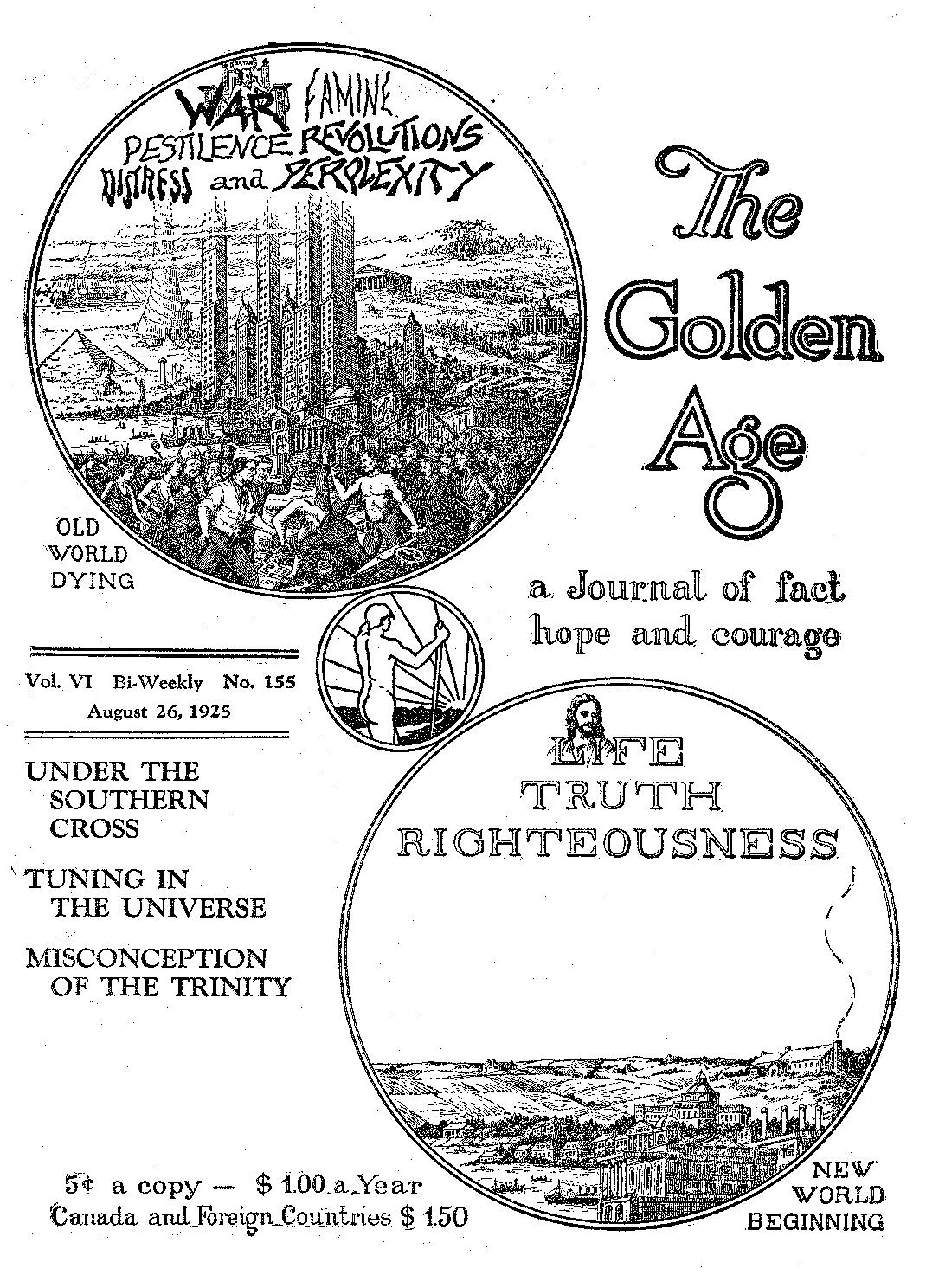
TRUnTH
MISCONCEPTION OF THE TRINITY
5$ a copy — $ lOO.aAear Canada andJoreign_Cpjiiitries. $ 150
x TUNING IN THE UNIVERSE
UNDER THE SOUTHERN CROSS
Vol. VI Bi-Weekly No. 155
August 26, 1925
OLD VORLD DYING
a. Journal of fact Kope and courage
NEV
VORLD BEGINNING
F— ' ■ ......', " ------------l„„ ,;..........;.,:\r.T ........
Contents of the Golden Age
. - .■ '"8g^>t=:z—............. .— .... j
Social and Educational ~
Odds and Ends of Wobld News
Bareheaded Men in New York
A Professional Perfumery Sniffer .......
Suicides in the German Army........... .
! Portuguese Accused of Slavery
Mexican and Chinese Pawn-shops .......... .
The Fly on the Wall
Political—Domestic and Foreign
Abandonment of War Brides
Priests Jailed in the Ukraine . . . . ■
Spanish Soldiers in Morocco
Tacna-Arica Province ■ .
When London Burns , ..........,■.
Why didthb United States Enter the Wab? .
Science and Invention
The Origin of Evolutionism
Tuning in the Universe ......
Travel and Miscellany
Under the Southern Cross
The Yankee and the Spaniard
Venezuela the Uneasy
A Glimpse at the Guianas
Peru—The Country of No Rain .
Chile—The California of South America . . .
Brazil—A Coining World Power........... .
Sao Paulo—The Coffee City .
Argentine the Progressive .......... 747
Palestine Becoming a New Land
’ Religion and Philosophy
The Night and Morning of Man’s Experience
Misconceptions of the Trinity
The Bull of the Dead . .............. .
Perpetual Masses fob Only Ten Dollars !......... 766
Babylon (Poem) ...
Studies fbom “The’Habp of God”.............767
Published every other Wednesday at 18 Concord Street, Brooklyn, N. Y., U. 3. A., by WOODWORTH, HUDGINGS & MARTIN
Copartner* and Proprietors Address: IS Concord Street, Brooklyn, Y., V-S. A. CLAYTON J. WOODWORTH . . . Editor ROBERT J. MARTIN . Business Manager WM. F. HUDGINGS . . Sec’y and Treas.
Five Cents a Copy—$1.00 A Ykab Make Remittances to THE GOLDEN AGE
Foreign Offices : British.....34 Craven Terrace, Lancaster Gate, London W. 2
Canadian 38-40 Irwin Avenue, Toronto, Ontario
Australasian 405 Collins Street, Melbourne, Australia
South African ...... 6 Lelie Street, Cape Town, South Africa
JBntered as second-class matter at Brooklyn, N. X., under the Act of March 3, 1873
The Golden Age
Volume VI Brooklyn, N.Y., Wednesday, August 26, 1925 Number 155
Under the Southern Cross
STRANGELY enough, the South American Revolution, which lasted twenty years, and which resulted toward the close of the year 1824 in the breaking of the Spanish power in South America, had its start in an uprising against Joseph Bonaparte, who had been placed on the throne of Spain by Napoleon in lieu of the supposedly legitimate king, Ferdinand VII. Like many another king Ferdinand was an unprincipled tyrant and despot, and deserved what he got. Fifty years before the revolted colonies gained their independence the British government is said to have frequently agitated the idea of revolutionizing them and separating them from Spain, with the avowed object of opening up the continent to British commerce.
The plans which Britain made for enlarging her trade with South America proved a success. Before the World War British interests constructed and controlled eighty-five percent of South America’s railroads, harbors and public works, fifty percent of the shipping, commerce and finance and a large part of the industrial and agricultural activity. But the Germans were making inroads into British trade as the Great War broke out in 1914.
The World War turned everything upside down. Britain and Germany each had its hands full, and the United States was forced to take over a large part of their western trade. South America was the only part of the world that was at peace; it was making money hand over fist supplying the nations that were at war; it had money to spend, and spent it freely in the United States, not having any way to reach the usual sources of supply.
This sudden thrusting of a great market upon the United States aroused new interest in the continent to the south of us. To be sure, America has had the Monroe Doctrine for a hundred years or more, which implies a big brotherly interest in the countries to the south, but that doctrine was not an American idea. It was first suggested by Britain and has always received British support. Since the war ended, Britain has recovered most of her supremacy in South American countries.
North Americans are now well established throughout South America also, hence it i« quite in order for us to make some effort to study our great continental neighbor, which is admitted to be the largest custodian of raw materials of any country now on the planet. Like Africa, South America is in effect an island, and enjoys steamship service on all sides and all around its coasts. It is common now for North Americans to visit the southern continent and make the grand circular tour, as in olden times university students used to make the grand tour of European capitals, and as others now, by the Dollar Line steamships, make the grand tour of the world via Panama and Suez.
The Yankee vs. the Spaniard
YANKEES and Spaniards do not naturally mix very well. The one is blunt to the point of discourtesy, the other is accustomed to express himself in the finest, most carefully chosen phrases. One may address a Yankee in almost any manner and give no offense, but courtesy demands that a Spaniard be addressed only in certain ways, and language which may be used in addressing a Spaniard in one station in life may not be used with another. The Yankee is cool to the point of exasperation, the Spaniard is hot-blooded; the Yankee is content to wait on the law, the Spaniard is prone to gain his point by insurrection; the Yankee is Protestant, the Spaniard is Catholic. The Yankee will take a substitute for what he orders and will give a substitute; the Spaniard wants what he orders and nothing else. Americans have lost millions of dollars in South American trade by failing to fill orders exactly as given. The British and Germans are much more careful in this respect.
, Along with the rest of the world, South ’America is pulsating with the heart throbs of the new era. A few years ago the common people of that Undeveloped country were hopelessly submerged. The wealth was all in the hands of a few families. The children of the wealthy were given the best of educations at European and other universities; they were educated to rule; little or nothing was done for the actual workers. But now this is changing.
Throughout South America there are still the inclosed grounds, the walls or high iron fences, the iron window shutters and doors, and the other signs of exclusiveness which mark the dwellings of the rich, but they do not represent what they did a generation ago, nor even a decade ago. There is still evidence of the manana (put it off till tomorrow) spirit on the part of the elderly, but the younger Spaniards are on the march toward the dawn.
The country is still without the fine country homes with which North America abounds, and without fine roads; the governments still own and conduct lotteries, and the tickets are hawked on every street comer; roulette wheels are common; duels are frequent; liquor is unrestrained ; admixture of races is considered inevitable and is not specially discountenanced. In an editorial on “The Spiritual State of South America” Evangelical Christendom of London says:
Bishop Every, who has for many years been Anglican Bishop in South America, says, “There is unfortunately no question as to the debased moral atmosphere of Latin American lands, and it is impossible not to hold the church largely responsible. There is no Christian or partially Christian public opinion. Integrity and clean living are not expected. Honor and truth are exceptional. There is a general lax attitude of tolerance to vice. Among the mass of educated men faith is dead. Beligion is a matter of custom, not conviction.
One would almost think the Bishop is describing conditions in Europe or North America!
Colombia
WE WILL take a brief glance at the several South American countries, from north to south, first noting something respecting the Andes, extending along the whole west coast of the continent, a distance of 4,400 miles. There are only fifteen known passes across the Andes mountains, except in the southern part of Chile, where the height is not excessive. Some idea of the magnitude of this range of mountains may be gathered from the fact that the average height of these fifteen passes, all of which lie ■ comparatively near each other, is 14,057 feet, 'i
Most of these passes are narrow, steep and 'dangerous, passing through gorges, across yawning chasms, and up nearly perpendicular rocks; nor can they be attempted except by the active and well-practised native or the courageous and well-provided traveler. Two railroads get over the passes in Peru and one between Chile and Argentine. In the range there are many volcanoes, in a state of either constant or occasional action, and frequent earthquakes.
Colombia, the northernmost state of South America, is a country twice the size of France. It has thirty-two emerald mines and unknown treasures of gold, silver, platinum, copper, lead, mercury, iron, coal, petroleum, salt, and other minerals. Bogota, its capital, located only 200 miles from the Pacific coast and 300 from the Caribbean Sea, has hitherto been accessible only by a ten-days trip, made up of short and unsatisfactory trips by river steamers and short lines of circuitous railroad; but it is now reached from the coast in three hours by airplane.
Bogota is in a beautiful valley, circular in form, some thirty miles in diameter. It is about 9,000 feet above sea level, and is considered to have one of the most delightful climates anywhere to be found. The boundaries of Colombia are in dispute on all sides. The population of the country is only 4,300,000, including perhaps 150,000 uncivilized Indians. Two-thirds of the country is practically uninhabited. The principal export is coffee, of which $46,000,000 was shipped last year; also cocoa, tobacco, vegetable ivory, dye woods, rubber, salt, vanilla, cattle, hides, bananas, tolu and minerals, especially emeralds, platinum and gold.
From 1830 to 1861 there was a revolutionary outbreak in Colombia every second year; but the constitution now provides that in case of war the president becomes a dictator, with the right to claim for military service every ablebodied citizen, the age limits being disregarded in practice. In 1899 a civil war cost the lives of 50,000 men. For consenting to rape of Panama from Colombia the United States after twenty years delay awarded Colombia $25,000,000, payable in five annual installments of $5,000,000 each. It is noteworthy that this humanitarian agitation to award all this American money to Colombia did not materialize until some of our patriots discovered oil and other valuable resources in that country.
Venezuela the Uneasy
ENEZUELA, adjoining Colombia on the east, is famous as the birthplace of General
Simon Bolivar, the liberator of South America; but strangely enough Venezuela probably has less liberty today than any other country on the continent. For some reason Venezuela has seemed to lend itself to repeated and long-con-< tinned tyrannies and dictatorships.
The generation that is now passing from the stage recalls the cruel, witty, resourceful and successful strutter and bragger, General Castro, who ruled Venezuela with an iron hand for so many years. It was impossible for anybody to do anything with him except yield to his whims. The foreign offices of a half-dozen governments at once were in a ferment over his atrocious rulings, but found no way to bring him to book.
Castro called himself the man of destiny, the Napoleon of South America. He imagined himself Another Kaiser Wilhelm, and in his fondness for uniforms, gilt braid, brass buttons, epaulets and swords, was the Kaiser in miniature. He talked of conquering Colombia and Ecuador and of eventually forming a United States of South America with himself at the head.
His prisons were diabolical in design and management. Some of the cells were purposely designed so that at high tide the water came in up to the prisoner’s waist. Many prisoners that passed through the gates of these prisons were never heard of later. The official answer always was, “He escaped.” A favorite joke was to chain together face to face two prisoners who were known to be enemies to each other.
After General Castro died his place was taken by General Gomez, who has a hand-picked congress to give an official sanction to his curious acts. General Gomez has appointed one of his brothers as first vice president and one of his sons as second vice president of the republic. His treatment of prisoners was revealed recently. When relatives claimed the body of a j young man of thirty-six who had become insane ' and died in prison, they found his body covered with marks similar to those of the inquisition.
His hair was snowy white, and his skin showed the wrinkles of an aged man........
Perhaps the dictatorship of General (^omez will give way to that of his principal antagonist, General Cedeno. The latter has found a way to utilize the Oronoco river and its mud-covered plains as a way to wear down the army of the dictator. With his army of rough riders he crosses the river at a time when the water is low and the plains are dry. General Gomez raises an army and rushes to attack, only to have his army again and again caught in the rising waters of the next flood, with General Cedeno and his followers safely on the other side of the river.
Waters and Forests Abound
THE eastern part of Venezuela is given over to the plains of the Oronoco; the western part contains Lake Maracaibo, a little Mediterranean Sea, lying within a Y-shaped range of the Andes opening out on the Caribbean. It was Lake Maracaibo which gave Venezuela its name. When Amerigo Vespucci sailed up into the lake he found the natives living in houses erected on long poles standing in the shallow waters and called it Little Venice, which, in Spanish, is Venezuela.
The piles are so well driven, and the buildings so well constructed, that they show no signs of shakiness in the greatest storms. Each house has two rooms, reached by means of a dugout canoe and a rough ladder made of a small tree trunk and its severed branches. The houses are grouped in villages and connected by planks reaching from door to door. The shores of Lake Maracaibo, although in full sight of perpetual snow, are said to be the hottest place on the continent.
The area of Venezuela is 394,000 square miles, over half of which is covered with forests. The total population is less than 3,000,000, of whom about one-tenth are Indians. One-eighth of the adults can read and write. Vast regions of the country are as yet unexplored.
In the mountainous borderland between Venezuela and Colombia is an interesting race of dwarfs, somewhat resembling the pigmies found by Stanley in Africa. These people, the Macoas, seem to have a mania for living as remote from each other as possible. A small village will be scattered over several square miles, each house on its own hilltop, perhaps a mile, or more from the nearest neighbor. The fields, are still further away. The Venezuelans fear the Macoas and keep far away from their .mountain retreats.
The principal occupation of Venezuela is agriculture. - The fields of the Oronoco plains are specially well adapted to cattle raising. There are large exportations of the hides of cattle, sheep and goats. Aside from this the principal products are coffee, cacao, nuts, fruits, cotton, sugar, rubber, copal, dye woods and drug products, especially quinine and sarsaparilla. Fifty million tortoise eggs are taken annually for their oil. The annual production of pearls is about $100,000.
J. Glimpse at the Guianas
THE one place in South America where European nations have an official foothold is to the east of Venezuela in the country that is commonly referred to as “The Guianas”, where, ranging from west to east, the British, the Dutch and the French govern a combined area of something like 165,000 square miles. The British have over half of this area and the French about one-sixth. The Dutch have the balance. The Guianas are claimed by Brazil and Venezuela, but those two countries have about as much chance of getting them as they have of capturing the western part of Europe.
The Guiana coast is low and swampy. The forests are so dense that access into the interior is obtained only by the rivers. The insects of this region are unrivalled for brilliancy of color. The population is a grand mixture of Indians, Italians, Spaniards, Portuguese, Chinese, Hindus, French, Dutch and British.
The Guiana Indians have a system of enumeration of which the human hand is the basis. Six is a hand and one finger. Twelve is two hands and two fingers. Twenty-seven is a man, a hand and two fingers. Fifty-four is two men, two hands and four fingers. The system is practical and works well.
The principal exports are cacao, sugar, coffee, bananas, rice, maize, rum, molasses, gold, timber, precious woods, charcoal and diamonds. It is known that the mountain ranges are rich in gold, iron, sapphire, mercury, garnets and plumbago, but, the almost impassable forests retard the development of the mineral wealth. The famous Cayenne pepper comes from the neighborhood of the capital of French Guiana.
Brooklyn, N. J.
The French have not made a success of their part of the Guianas. They have used it principally as a penal settlement, and a bad one at that. At present they are discussing the project of raising monkeys on a large scale for surgical purposes, in the rejuvenation of elderly men. The forests of the Guianas swarm with the animal life of the tropics.
Ecuador—the Equator Country
CUADOR is named after the equator, in recognition of the fact that the country lies directly upon the equator, its capital city, Quito, being only fifteen miles distant from the meridian. Quito is located 9,600 feet above the sea, on the flank of a mountain, and enjoys a climate that is temperate and springlike throughout the year. As there is almost no variation in the climate Quito is said to be one of the best places in the world for the cure of tuberculosis. For fear of earthquakes there is not a stove, stovepipe or chimney in the town; cooking is done over charcoal fires.
The Indians in the highlands of Ecuador and adjacent countries have a bad name as head hunters. They have a method of extracting the bones of the skull and by means of hot stones shrinking the head to the size of a fist, with all the features perfectly preserved. Two European travelers in the country recently became separated from one another and one was horrified to have his friend’s head offered to him for about $100, which is about the going price. The medical students of Quito have learned the art and are said to be injuring the head market somewhat, although the work of the natives still brings the higher prices.
Ecuador is the owner of the Galapagos Islands, or the Archipelago of Colon, as the Ecuadorians like to call it. This island group is famous for its prodigious turtles and other reptilians. Until recently the islands have been used only as a penal settlement.
The best Panama hats of the world are made in Ecuador. The laces made in Quito are also famous. Cotopaxi, on the line of the railway from the seacoast to Quito, is the highest active volcano in the world, being 19,614 feet above sea level.
The Ecuadorean peonage system, recently abolished, has freed about 500,000 workmen who were to all intents and purposes slaves. . The total population of the country is 1,500,000.
The industries are mining, stock raising, dairying, lumbering and the production of cocoa, coffee, sugar, tobacco, grain and grapes.
Peru—The Country of No Rain
ORDINARILY there is no rain in western Peru. The country is normally a desert, though sheltered by rolling clouds from a pitiless sun. The reason is that the Peruvian shore is usually laved by the cold Humboldt current; but when winds from the Pacific blow over the heated plains the moisture-laden clouds simply expand and do not part with their waters.
One of the common features of Peru is the traveling sand dunes of fine gray crystal sand, with their horns pointing toward the south, whence come the winds. These dunes range from fifteen to thirty feet high, about twenty feet wide across the center, and perhaps a hundred feet long. They move with imperceptible slowness, but so surely that if they threaten a railroad the road has usually to be altered to go around them. An analysis of the dunes shows that all they need is water to make them very fertile.
In the early part of 1925 strange to say, the ocean current off the Peruvian shore suddenly changed its course. Warm currents from the north took the place of the cold Humboldt current from the south, with the astonishing result that rain now falls in torrents in districts where previously it was unknown. The effect of such unexpected rains in a country where every roof is a sieve and most walls are made of mud, not having been built as a protection from rain, may be vividly imagined. The annual guano deposit, estimated as worth $9,000,000, was washed away, thus hitting the United States fertilizer factories a hard blow. The change in temperature of the ocean currents caused the death of myriads of the ocean jellyfish and of the fish and aquatic birds which feed upon them. Within three days the desert was bursting with green, and in two weeks emaciated cattle looked as though they had been corn fed. The rains were so heavy that gardens, farms, and in some instances whole towns, were washed away.
Every Variety of Climate
ON ACCOUNT of the fact that Peru lies on both sides of the Andes it has every variety of climate, and on the eastern side of the mountains has copious rains. The headwaters of the Amazon rise in Peru, and the valleys of these streams are clothed with dense forests, including millions of rubber trees which are so common throughout the northern part of South America. The line of perpetual snow is about 16,000 feet above the sea. In its passage over the Andes the Oroya railroad climbs to an altitude higher than Pike’s Peak.
Ijima, the capital of Peru, is a city of considerable culture and refinement. The University of Lima, founded in 1551, is the oldest seat of learning in the western hemisphere. The undisputed area of Peru is 480,000 square miles, and its population totals 4,600,000, of whom sixty percent are Indians still speaking their native language.
Peru has important mineral resources. It is the chief source of supply of vanadium, used in small quantities in steel to give greater strength and ductility, as well as increased power to resist shock and the effects of vibration and friction. This steel is much used in automobile construction. Other precious metals are tungsten and molybdenum. In twenty years the output of Peruvian mines has increased sevenfold.. Coal is plentiful. Peru is one of the largest producers of petroleum in South America. It ranks third in the world’s production of silver and has the largest source of low-cost copper in the world. Mica is also found.
The chief exports of Peru are wool, alpaca, cotton, coffee, sugar, cocoa, rice, tobacco, grapes, wheat, oranges, maize, ramie, silk, quinine and dyes. Ijima, the capital, is a city of 140,000 inhabitants, a short distance inland from the chief port, Callao, with which it is connected by a railroad running alongside the Rimae river. This river is about 150 feet wide and, prior to the recent rains, nearly all its water was regularly used for irrigation and city water for Lima. Lima reminds visitors of the Orient. There are many Mongolians in the city. Earthquakes are frequent.
Chile—The California of South America
WHAT California is to the United States Chile is to the continent of South America, Both are in the extreme southwest of the Americas, very long and quite narrow, partly desert and partly paradise, rich in minerals and fruits, and each has an aggressive and progressive citizenry and many Japs. In all these and other characteristics the two are very similar.
' Like California, Chile has a coast range of mountains, and also one farther back, and the valleys between constitute the source of her greatest permanent wealth. The length of Chile is 2,629 miles, but its average width is only 101. The north is a hot desert; the extreme south is a cold region of almost incessant rains. Punta Arenas, Chile, is the most southerly town in the world.
Santiago, the capital and chief city, is situated about 2,000 feet above sea level. It is the fourth city in size in South America and next to Rio Janeiro is considered the most beautiful. The trolley conductors of Santiago are ’women with white aprons, who wear little sailor caps perched on their heads. Santiago has great contrasts of riches and poverty. The rich are very rich; the poor are very poor; there are plenty of limousines but few Fords. There is no plumbing to speak of. The houses of the workingmen are mostly of one room. There are plenty of rich churches and bronze and marble monuments.
Valparaiso, half the size of Santiago, is the principal seaport and is sometimes called “The Chicago of South America” because of its enterprise and commercial activity. The country as a whole is wealthy and prosperous. It owns 2,836 miles of municipal railway, sufficient to more than liquidate the national debt. Much of its prosperity is due to its nitrate deposits.
The curse of Chile has been that the whole country has been pretty well owned by about 100 influential Roman Catholic families from the Basque provinces of the Spanish Pyrenees. An unwritten law has made the president of the country a figurehead, subservient to the senate; and the control of the senate, by the same unwritten law, has remained within these few families. Little by little the people have been pressing their claims and the aristocracy are gradually receding as education and other reforms spread. ’
The country is calling for settlers; and agents in Tokio have offered to every homesteader forty acres of good land, with twenty acres for each son of eighteen years or over, a yoke of oxen, a set of agricultural implements and a sum of money equivalent to fifteen dollars per month for the first year of residence. Considerable numbers of Japanese have taken advantage of the offer.
Like all other South American countries to the north of it Chile has great resources in timber which will some day be commercially available. The region about Santiago is celebrated for grapes, figs, melons and other fruit. Grapes grow in bunches eighteen inches long; and the melons, every bit equal to American melons in flavor, grow to be four or five times as large. Chile is the second largest silver-mining country in South America and the third largest copper producer in the world.
Bolivia—The Cloudland Republic '
OLIVIA is situated for the most part about 12,000 feet above sea level and is to all intents and purposes buried alive. It is on the roof of South America, with no way to get down. Its population is 2,000,000, of whom thirteen percent are pure white. It is really an Indian republic.
Two miles above sea level is Lake Titicaca, the size of Lake Erie, the highest navigable body of water on the globe. About its shores the Indians live as they did four hundred years ago, before the coming of the Spaniards. The Indian women often wear eight or nine skirts at once, making them look like perambulating umbrellas.
Bolivia is the second tin-producing country in the world and is sometimes called “The Land of Ten Thousand Silver Mines”. Thousands of men have been worked to death in Bolivian mines since the Spanish conquered the country. In ancient times Bolivia was a part of Peru. It takes its present name from Simon Bolivar, South America’s liberator.
An indication of the push which has characterized the Standard Oil Company may be gathered from the fact that in this most inaces-sible of countries they have undertaken to build roads, haul machinery through the jungles and transport supplies in order to develop an oil field 320 miles distant from the nearest railroad. Such a company ought to succeed.
The principal exports of Bolivia are precious metals, gems, rubber, cocoa, coffee and wool. The imports are cloth, clothing, hardware and machinery. Some American farmers who migrated to Bolivia a year ago were glad to return to America penniless in order to get a fresh start in a land where conditions of life are not so primitive as in Bolivia.
Brazil A Coming World Power
THE world’s greatest storehouse of materials is in Brazil. Thus far civilization has done little more than stand upon the threshold and gaze upon a land which will some time house billions of people, literally. Here is a land larger than the combined area of the United States of America and a goodly portion of western Europe thrown in, traversed from end to end with the greatest system of navigable rivers on the planet, a soil that will produce anything, and a good foundation already laid for the country’s development, which will now take place rapidly. Even now Brazil controls the world coffee markets; already its capital and chief city, Rio de Janeiro, "with its million population, claims to be the world’s most beautiful city, and there seems to be no doubt that in its natural setting the claim is well made.
Brazil has been somewhat delayed in development because its people have felt that Europeans and North Americans could not be trusted, and they have therefore neglected to seek and to use the capital which is needed and is available. They wish to have their country developed, but do not care to see its profits carried elsewhere. They do not wish to see the Brazilian people work for low wages in order that great financiers in Europe and America may have more than heart can wish. They prefer to wait a little and have their own people reap the rewards which are sure to come.
The people of Brazil are an unusual people engaged in an unusual experiment. A general fusion of whites, Negroes and Indians is in progress. No color line is drawn, absolutely none, in business, government or socially, with the result that a new race is coming into existence. These people are sober, quiet and serious. They are not drinkers. If it were not for the whites there would not be a bar-room in the country. Most Brazilians think of Americans as a wild, fighting, cursing, illiterate, drunken people; and for this they cannot be blamed. They judge by what they have 'witnessed. An intoxicated native in Brazil is rarely seen. The sight is so unusual as to attract general attention.
Brazil is such a large country that it has many 'distinctly different tribes of Indians. Some of these are much more debased than the North 'American Indians; but an explorer, J. G. Culbertson, says of one of the tribes which he visited, the Machigina, that “the South American interior is today the safest place I know, far safer than any of our cities. The people are the most honest people I have found in the world. Nowhere in the world is a woman so respected as among these people, and the only danger to the explorers comes through disrespect of the native women.” One tribe of black dwarfs lives in holes covered over with leaves and sticks.
Another explorer, George R. White, in the South American Messenger says:
With one honorable exception, all the Roman Catholic priests with whom I came in contact during my journey were immoral, drunken and ignorant; every mission which they had started had utterly failed to accomplish the christianizing of the Indians, and the tribes who have come under priestly care are decidedly inferior in morals, industry and order to the tribes who refuse to have any intercourse whatever with the whites.
The population of Brazil at the last census was 30,553,509, or about the population of the United States in the year 1860. The language of the country is Portuguese; about twenty-five percent of the people can read and write. Negro slavery was abandoned in 1889. The Moorish custom prevails of carrying burdens atop the head.
The Brazilian Government
NTIL 1889 Brazil was a kingdom. The last of the emperors, Dom Pedro II, was deposed in that year. He was a highly educated man and exerted every effort to increase the knowledge of his subjects. He is believed to have had at heart the true interests of the Brazilians and is said to have been completely broken-hearted at the ingratitude of the people for whom he had labored.
The constitution of Brazil is the same as that of the United States of America, but in actual practice the component states exercise more of their state rights and occasionally ignore and sometimes defy the federal laws. The senate, not the president, is the controlling factor in the government. Road committees in the more thickly settled parts of Brazil are now cooperating with the government in putting a network of automobile roads over the farm sections.
The national capital, Rio de Janeiro, is confidently claimed to have the most beautiful driveways in the world. One of those skirts the shore for miles. On the one side are broad mosaic walks; on the other the waves rushing and roaring and breaking on snow-white sands; in the center are parkways filled with tropical palms and flowers. At the end of the driveway is Sugarloaf Mountain, access to the top of which is gained by an electric basket cable car holding twenty passengers. The view from the top is magnificent. At another point Mount Corcovado, 2,200 feet high, is ascended by a cog railway, and the view is unsurpassed.
The shopping center of Rio de Janeiro, the Rua Ovidor, is unlike any other shopping district in the western world or perhaps on the globe. The street is barely twenty-five feet wide, but no wheel traffic of any kind is permitted, and the street proper, as well as the sidewalks, is paved with glazed tiling.
The shops have no front walls but open out directly on the street, and it is confidently claimed that there is nothing anywhere in the world that money can buy that is not to be found in those shops. Moreover, it is characteristic of all shops in Brazil, even in the smallest towns, that the polishing cloth is in constant use, so that the glass is unspecked and the woodwork at all times is absolutely dustless.
Rio de Janeiro’s water supply and sanitation are strictly up to date and there is an almost total absence of flies and mosquitoes, so much so that no screens are used. The hot months are December, January and February. Winter comes in June, July and August.
Sao Paulo—The Coffee City
RAZIL was originally called the country of Brazilwood by that ubiquitous gentleman, 'Amerigo Vespucci, who had such a remarkable faculty of naming things and having the names stick. Amerigo thought that the country would be famous for supplying a dye needed in Europe, But Brazil has done more than furnish dyes for man’s exterior adornment. She supplies seventy-five percent of the coffee wherewith he is wont to decorate his interior, morning noon and night. To be sure coffee is poison, and everybody knows it, but everybody loves it and everybody drinks it until splintered nerves make it necessary to take up Postum or preferably the new denatured coffee, Sanka, from which ninety-seven percent of the caffeine has been removed. Sanka is really a very fine drink, tasting precisely like coffee. No; we do not get any commission! But when we learn of a really good thing we like to let our readers know of it.
Sao Paulo produces eighty percent of Brazil’s coffee, or something like fifty-five to sixty percent of all the coffee in the world; and as a result of careful study this town now maintains a nearly perpetual corner on the coffee market, and is making money by the barrel. The state of Sao Paulo is the size of New England and New York state combined. Its coffee output is fixed and limited to thirty-five thousand bags per day, so as to hold up the price. Before any wealth may be moved out of the state of Sao Paulo it must pay an export tax. The Sao Paulo state government maintains a snake farm, where serums to cure snake bites are prepared and distributed. It is said that the average arrivals of snakes at this farm, from all parts of Brazil, are five hundred a day.
The Riches of Brazil
OF THE fifty-five largest rivers in the world thirty-three are wholly or largely within the boundaries of Brazil. Not only is the Amazon the largest river in the ■world but it drains an area wider than the Mississippi, Missouri, Danube and Nile combined. Seventeen of its tributaries are from 1,000 to 2,300 miles in length. Its shores are lined with impenetrable primeval forests thronged with monkeys, parrots, sloths, boa constrictors, anacondas and pumas. Its waters teem with turtles, crocodiles, water fowl, tapirs, and fishes of at least 1163 varieties. Half a hundred steamers suffice at present for carrying a trade that will some day fill the river with craft. Sunstroke in the Amazon valley is unknown.
The famous Brazil nut grows on a large straight tree that rises to a height of 100 feet or more before it branches. The nuts are the size of a man’s head, weigh several pounds and fall with force sufficient to kill. Each nut contains eighteen to twenty-four kernels, fitted to each other with such perfect skill that once disturbed they can never be replaced. These nuts supply the finest watchmaker’s oil. They are highly regarded as a preventive of constipation and bowel disorders.
The soil of Brazil is so rich that plowing is not done. The only agricultural instrument used
is the hoe. Corn is planted by making holes in . the ground with a sharp stick and. dropping the seed into the holes, but although there is no cultivate on of the soil crops of twenty-five to forty bushels to the acre are not uncommon.
Brazil was at one time the leading diamond country of the world. Iron ore is found in great quantities in several of the states. It has vast and fertile pastures upon which millions of cattle will some time be raised. Even now it exports large quantities of meats, hides, wool, . goat and sheep .skins. Other important crops . are sugar, tobacco, cotton, Paraguay , tea, rub. her, cocoa, timber, dye woods, drugs.
Paraguay
T) ARAG UAY seems like a little country on -®- the map but it is the size of California; and although it lost 1,200,000 inhabitants in its futile and foolish effort to subjugate Argentina sixty years ago, it still has a population of 631,347, including 50,000 Indians. Luscious oranges may be had in Paraguay at the rate of eight for a cent. Immense forests yield valuable timber. Building marble and valuable clays abound. Wild animals are numerous. Education is free and compulsory. Rain is abundant. Snow is unknown. Thunder storms with high winds are frequent. Immigration is encouraged by un. usually liberal grants of land and other concessions. ..
Uruguay
URUGUAY is the smallest country of South America. About the size of North Dakota, with a population of 1,094,688, it is principally an outlying territory for the magnificent city of Montevideo (Mountain View) which is its capital and one of the chief seaports of South America. As in Paraguay education in Uruguay is compulsory. The chief exports are hides, tallow, meats, Paraguay tea, wool, rubber, skins and furs. Large areas are still covered with forests. Seals abound in the islands off the coast. Montevideo, with a population of 291,465, is considered one of the most cosmopolitan cities ... in the world. Nearly every language is spoken in its streets. Duels are still fought in Uruguay, ,. sanctioned both by law and by public opinion. . . Great attention is paid to the-improvement of live stock.
Argentina the Progressive .
IT IS generally agreed that.the thing which has made. Argentina the most progressive country in South America is the influence of one man, Sarmiento, born in the little, tow’n of San Juan in 1811. Sarmiento had unlimited thirst for education and unlimited ambition that others might have the same. As a direct result of his influence Argentina has today the best school system in Latin America. Her teachers are better paid than even in the United States.
In marked contrast with the United States the schools of Argentina are under the direct control of the government. They have had the effect of turning the people in the direction of socialism, with the consequent restlessness, of labor, and the spread of cooperation. When Argentina has a strike everything is tied up tight. In the early part of 1919, when the dock workers' strike was on, not a ship entered the port of Buenos Aires in three months.
The temper of the Argentinians is shown in their independent withdrawal from the League of Nations, because of their belief that the present League is dominated by questions arising out of the World War and is not impartial in its handling of world problems.
Buenos Aires (Good Air), with its 2,310,441 inhabitants is the sixth city in the world as regards population and the largest city of any kind south of the equator. Some idea of the magnificence of its public buildings may be gained from the fact that they have cost $40,000,000. Argentina is now building numerous roads. Aviation is popular, as are also radiocasting and reception.
Argentina (Argentum, silver) is principally a stock raising country.. It exports 240,000 tons of wool annually. The plains are cold and bleak in winter and hot and dusty in summer. Patagonia has been wiped out, having been divided, rocks, ice, penguins, Patagonians and all, between Argentina and Chile. Ships rounding the southern extremity of Patagonia pass within ten degrees of the Antarctic circle. .
On the border line between Argentina and Chile stands the famous Christus statue, the symbol of eternal peace between the two countries. At the base of the statue is this imprint: “Sooner shall these mountains crumble into dust than the people of Argentina and Chile break the peace which they have sworn, to maintain at the feet ©f Christ the Redeemer."
Odds and Ends of World News
[Radiocast, with other items, from Watchtower WBBR on a wave length of 272.6 meters, by the Editor]
London Traffic Problem Grows
Abandonment of War Brides
TYURING the year 1924 the motor vehicles licensed in Great Britain numbered 194,000 more than the previous year, bringing the total up to 1,266,416. During the year 1924 there were 845 people killed in accidents on the streets of London, besides 82,708 other accidents to persons or property, On with the dance!
Bareheaded Men in New York
TT IS claimed that there are two thousand men going bareheaded in New York this summer. Considerable numbers of them are to be seen in the Columbia Heights section of Brooklyn, also in the Concord Street section and in various places in Manhattan. The custom is spreading to outlying towns and has cut down the sale of straw hats considerably.
A Professional Perfumery Sniffer
0KL0H0MA CITY has one of the world’s most expert perfumery sniffers, Mrs Cavitt. Mrs. Cavitt has been summoned to Paris to see if she can detect the manner of composition of a perfume taken from an Egyptian tomb. Incidentally she has insured her nose for $50,000 for the period of the trip abroad and paid $400 to have its usual effectiveness guaranteed.
Russia’s Revenue Increasing
THE Russian Soviet’s budget for next year will amount to 3,560,000,000 rubles, which is about 1,000,000,000 more than last year. 1,568,000,000 will come from taxes, 1,260,000,000 from transportation and 500,000,000 from other state property. The Soviet Commissar has announced that Russia will now discuss the settlement of prewar debts.
Suicides in German Army
FRIENDS of Germany have been shocked to learn that during a given period in which there were 187 deaths in the army from natural causes there were 185 deaths from suicide. The German people are thoroughly discouraged as they compare the present with the past, but if they can only look ahead the future holds all the blessings they have sought, and when these blessings come they will be for all people over the whole wide earth.
FRANCE is considerably stirred, and properly so, by thirty cases of French war brides, sent over from America in a month with their children for a vacation in the homeland, only to be deserted. In some instances the Americans have obtained divorces on the ground that their wives have abandoned them, without even notifying the wives of what they have done.
Priests Jailed in the Ukraine
FOR exploiting the superstitions of the peasantry by supporting a legend that Christ had miraculously appeared to a village shepherd, and by causing the peasantry to erect on the spot some seventeen thousand huge wooden crosses, the Ukraine government has caused the imprisonment of eight priests for various terms. The priests consecrated the crosses at so much per.
Getting Religious in Jacksonville
JACKSONVILLE, Florida, is getting religion. The pastor of the First Baptist church spoke there recently on the spiritually uplifting topic, “The Most Valuable Piece of Real Estate in South Jacksonville.” There were two choirs for the service, The Booster Band and the regular choir, in all some sixty voices. These worthy efforts to get religion will be followed in a practical way by engaging during the week in the sale of real estate, which is now the occupation of everybody in Florida.
Portuguese Accused of Slavery
CHARGES against the Portuguese government of maintaining slavery in Africa have been made to the League of Nations Slavery Commission at Geneva, accompanied by enumeration of more than one hundred cases investigated by two American college professors and vouched for by a committee of America’s best known citizens. Natives, under pretense of collection of taxes, are forced to work in fields months and even years without pay; thousands of workers have been deported; women with babies on their backs have keen compelled to work on roads; flogging is prevalent and medical attention unknown. This is from the New York World.
Crusoe’s Experiences Over Again
THE experiences of Robinson Crusoe were lived over again by the crew of a three-masted Chilean schooner, which foundered off Pascua Island, a lone dot in the South Seas, in May, 1924. The captain of the schooner committed suicide and several of the crew died from the hardships, but after the lapse of more than a year several of the crew and the wife of the captain were found and brought back safely to Chile.
Palestine Becoming a New Land
AFTER three months in Palestine Abraham
Friedland, superintendent of Cleveland Hebrew Schools, returned saying, “New plants, new flowers are discovered every day. A row of trees, planted four years ago in De Gania Alaf is big and beautiful now. New houses are being erected. Men and women coming to Palestine, heart hungry from oppression, soon forget their troubles. The Tiberias is so blue, the slopes of Mount Carmel so green, the air so invigorating, that it is no wonder white-bearded aristocrats, hands unmarred by toil, plough the fields and are happy.”
What Was Lincoln's Religion?
THE Elizabeth City, North Carolina, Independent, in an editorial on Lincoln’s religion, says in part:
Just what was the religion of Abraham Lincoln and why did he never join a church ? Let Lincoln himself answer. “I have never united myself to any church because I have found difficulty in giving my assent without mental reservations to the long, complicated statements of Christian doctrine which characterize their articles of belief and confessions of faith. When any church will inscribe over its altar, as its sole qualification for membership, the Savior’s condensed statement of the substance of both law and gospel, ‘Thou shalt love the Lord thy God with all thy heart, and with all thy soul, and with all thy mind, and thy neighbor as thyself,’ that church will I join with all my heart and all my soul!” There are millions of men living today who feel on the subject of religion just as Lincoln did, but the church has no more use for them today than it had in Lincoln’s time. Jesus said, ‘Love me and keep my commandments.’ The church says, “Subscribe to my creeds, bow down to my authority and pay the assessments I levy upon you or you go to hell.”
Spanish Soldiers in Morocco - ■ '
Frederick H. Houck, in the New York Sunday
World, claims that for the Spanish soldiers in Morocco there are no sanitary precautions, no regulations regarding personal cleanliness, no delousing stations; but that there are rifles of 1898 model, uniforms that can be hit at a distance of miles, impossible footwear with rope soles, the cruelest of officers and strict censorship of mails. It seems impossible that such a condition should exist in our enlightened day. It exists in Spain because the revenues for the upkeep of the state church are so burdensome that there is no money for uptodate fighting clothes and modern implements of war.
Tacna-Arica Province
THE dispute between Chile and Peru over
Tacna-Arica, about which the newspapers have bad so much to say of late, is really a dispute between the two countries to see which shall have the privilege of controlling Bolivia’s exports and imports; for the terminus of Bolivia’s railroad is at Arica. Bolivia at one time owned a strip of country about the terminus of her railroad, but in a controversy over taxes payable by a Chilean mining country the Chilean army invaded the territory. Bolivia called in Peru as an ally, but Chile with her superior forces defeated both countries and seized the province, Tacna-Arica.
The treaty made at the time agreed that after a period of ten years a plebiscite should be held tb determine whether Peru or Chile should have the conquered province, but the terms of the plebiscite were not clear and the plebiscite was not held. By agreement between Chile and Peru, in which the president of the United States was named as arbitrator, President Coolidge has decided that the plebiscite shall shortly be held.
There seems small question but that the province will go to Chile, the country now holding it. The maximum reserve strength of Peru’s army is 90,000, while Chile’s army numbers 600,000. Only two percent of the Peruvians are of pure Caucasian blood,' while the 4,000,000 Chileans are virtually all Caucasians. Peru is backward; Chile is progressive. And possession is nine points of the law. The provinces have been thoroughly colonized by Chileans.
When London Burna
Sidney B. M. Potter, Airman in the World
War, tells in The New Leader what will happen in the next war. The first intimation of war will be the crash of high explosive bombs blowing up the railway termini, gas plants and electrical power stations; next will come phosphorus and other incendiary bombs unquenchable by water; next will come bombs of diclor-' ethy sulphide, one drop of which will disable and a few drops burn to death, leaving a gas behind which persists for weeks, or Lewisite, a solid which becomes a smoke and penetrates most respirators, causing excruciating pain and madness.
When London burns, according to Mr. Potter, gas masks will be of little avail. Mr. Potter says: “A mask is a very unpleasant thing to wear (I have had men vomit inside them); and many persons, women and old people particular-ly, would find themselves physically unable to use them, while the difficulties where young children are concerned are obvious.” Mr. Potter says that only those who have seen a panic-stricken civil population in flight can imagine the horror of vast hordes of human beings trampling one another under foot like wild beasts in their vain attempt to escape. Airplanes will chase them with rains of explosive bullets. Defense will be hopeless, because clouds of smoke will be spread at once over all defensive batteries.
Mexican and Chinese Pawn-shops
TN MEXICO and in China and perhaps in other countries there are government owned and operated pawn-shops to which any person who has valuables and who is in need of money can go and obtain on loan a certain proportion of the value of the thing pawned. A fixed rate of interest per annum is charged for the use of the money thus loaned. If the article is not redeemed in the stipulated time it is offered at a continually lowered price until sold.
Testing Cows for Tuberculosis
W E ARE asked to express our views on testing cows for tuberculosis. As we understand the matter this is a government requirement, having the force of law, and whether or not we had confidence in the ability of the inspectors we would feel in duty bound, in a matter like this where conscience is not involved, to “submit yourselves unto every ordinance of man, for the Lord’s sake”.
Why' Did the United States Enter the War?
[Reprinted from Golden Age No. 57.)
IF ANY reader of The Golden Age wishes to inquire why the United States entered the World War let him write to Hon. M. A. Michaelson, of Illinois, member of Congress in the House of Representatives, Washington, D. C., and request of him a copy of his “Resolution Asking for Investigation of Foreign Propaganda in America”, presented to the house on May 26,1921. •
The resolution, accompanied by the usual legal phraseology and proposals for investigation, sets forth the following allegations. It is doubtful whether Congress will have the courage or the character to make a public investigation of these charges, and it is certain in advance that the press association and the newspapers of the country would never give them honest publicity if they did so. The United States is now in a position where any gang of plug-hat thugs, if they have means to finance the propaganda in hand, can murder men by the hundreds of thousands and rob the people to the tune of billions of dollars, and reduce them to slavery—all in the most “respectable” manner possible, by corrupting the truth and causing the people to read and believe and then give governmental support to lies, and hence to liars and murderers.
On February 9, 1917, a formal statement was inserted in the Congressional Record in the House of Representatives of the Congress of the United States bearing upon the entrance of the United States, as a nation, into the conflict of the great World War then in progress, such statement appearing upon pages 2947 and 2948 of the Congressional Record of the date mentioned in exact words as follows:
“Mr. Calloway: Mr. Chairman, under unanimous consent I insert in the Record at this point a statement showing the newspaper combination, which explains their activity in this war matter, just discussed by the gentleman from Pennsylvania [Mr. Moore] :
“ ‘In March, 1915, the J. P. Morgan interests, the steel, shipbuilding, and powder interests, and their subsidiary organizations, got together 12 men high up in the newspaper world and employed them to select the most influential newspapers, in the United States and sufficient number of them to control generally the policy of the daily press of the United States.
“ ‘These 12 men worked the problem out by selecting 179 newspapers, and then began, by an elimination process, to retain only those necessary for the purpose of controlling the general policy of the daily press throughout the country. They found it was only necessary to purchase the control of 25 of the greatest papers. The 25 papers were agreed upon; emissaries were sent to purchase the policy, national and international, of these papers; an agreement was reached; the policy of the papers was bought, to be paid for by the month; an editor was furnished for each paper properly to supervise and edit information regarding the questions of preparedness, militarism, financial policies, and other things of national and international nature considered vital to the interests of the purchasers.
“ ‘This contract is in existence at the present time, and it accounts for the news columns of the daily press of the country being filled with all sorts of preparedness argument and misrepresentations as to the present condition of the United States Army and Navy, and the possibility and probability of the United States being attacked by foreign foes.
“ ‘This policy also included the suppression of everything in opposition to the wishes of the interests served. The effectiveness of this scheme has been conclusively demonstrated by the character of stuff carried in the daily press throughout the country since March, 1915. They have resorted to anything necessary to commercialize public sentiment and sandbag the National Congress into making extravagent and wasteful appropriations for the Army and Navy under the false pretense that it was necessary. Their stock argument is that it is “patriotism”. They are playing on every prejudice and passion of the American people? ”
In addition to the information and charges filed by Congressman Calloway in the foregoing statement M. Gabriel Hanoteaux, formerly minister of foreign affairs of the Republic of France, in his history of the late war, states in effect that France was ready to make peace in the latter part of the year 1914, but was dissuaded from doing so by three Americans — namely, Robert Bacon, of the financial house of J. P. Morgan & Co., fiscal agents for the British Government; Myron T. Herrick; and William G. Sharp—and that these men represented to French officials that if France would continue the war these three men would organize a propaganda to put the United States into the war on the side of the Allies, and M. Hanoteaux further stated that the sum of money which was provided to goad the United States into the war was too large even for American comprehension.
The charges filed by Congressman Calloway and the statements made by M. Hanoteaux allege that there was a definite and widespread conspiracy operating in the United States to plunge the Government of the United States into war.
In addition to the information and charges filed by Congressman Calloway and the statements made by M. Hanoteaux, the report of Sir Gilbert Parker, who was in charge of the circulation of British propaganda in the United States, recites that large numbers of resident professors and teachers were employed and newspapers were engaged to publish articles tending to excite the people of America and influence them to enter the war in behalf of Great Britain.
No formal investigation of these grave charges has ever been undertaken by the Congress of the United Stats to determine their truth or falsity.
To allow them to go unchallenged is to cause serious reflection on the purpose of the United States in entering the war.
As a result of the war, this Nation is bowed in grief over the death, maiming, and ruined health of hundreds of thousands of its young manhood, and the people of our country are burdened with an unprecedented national debt, and with resulting high taxes and living costs unprecedented in magnitude and oppression.
The Origin of Evolutionism By a. n. Kent
SOME twenty-five years ago an acquaintance, learning of the writer’s belief .in the Bible account of the creation of man, and himself being a zealous Darwinite, offered me the loan of a book on evolution. The loan was accepted.
The title of the book has now passed from my memory; but the subject matter was on the (supposed) origin of species and the so-called descent or evolution of mankind. In order to know a subject well one must of necessity know more than one side. To believe or to disbelieve is impossible without some knowledge. Therefore at the earliest convenient moment I began my study. I found, however, that the cheeking up of scientific data that had required the lifetime of a devoted scientist to collect, was quite different from following a plow or pitching alfalfa, which from my youth had been my habitual pastime.
However, I proceeded to wade from page to page. Occasionally I came across statements I partially understood, but had about concluded that my brain lacked a few million years of evolutionary development to permit of comprehension when, to my unbounded relief I found that at the end the author volunteered the information that neither he nor other learned evolutionists had yet found a single unquestionable proof of the evolution of man, although they hoped to uncover that evidence at any time. He seemed to have no difficulty in trailing man up from nothing (with no trail even to start with) through fishes, reptiles, birds, and the various lower animals, to the monkey—but there he lost the trail. If he had admitted that he was on the monkey’s track all the time and then, when he caught the monkey, had ended the chase, as Mr. Darwin was finally obliged to do, the book might have had some value. If Mr. Darwin ever found any proof of the evolution of man from the monkey he certainly never published it.
…