Golden Age, March 11, 1925
Download: PDF — Golden Age, March 11, 1925
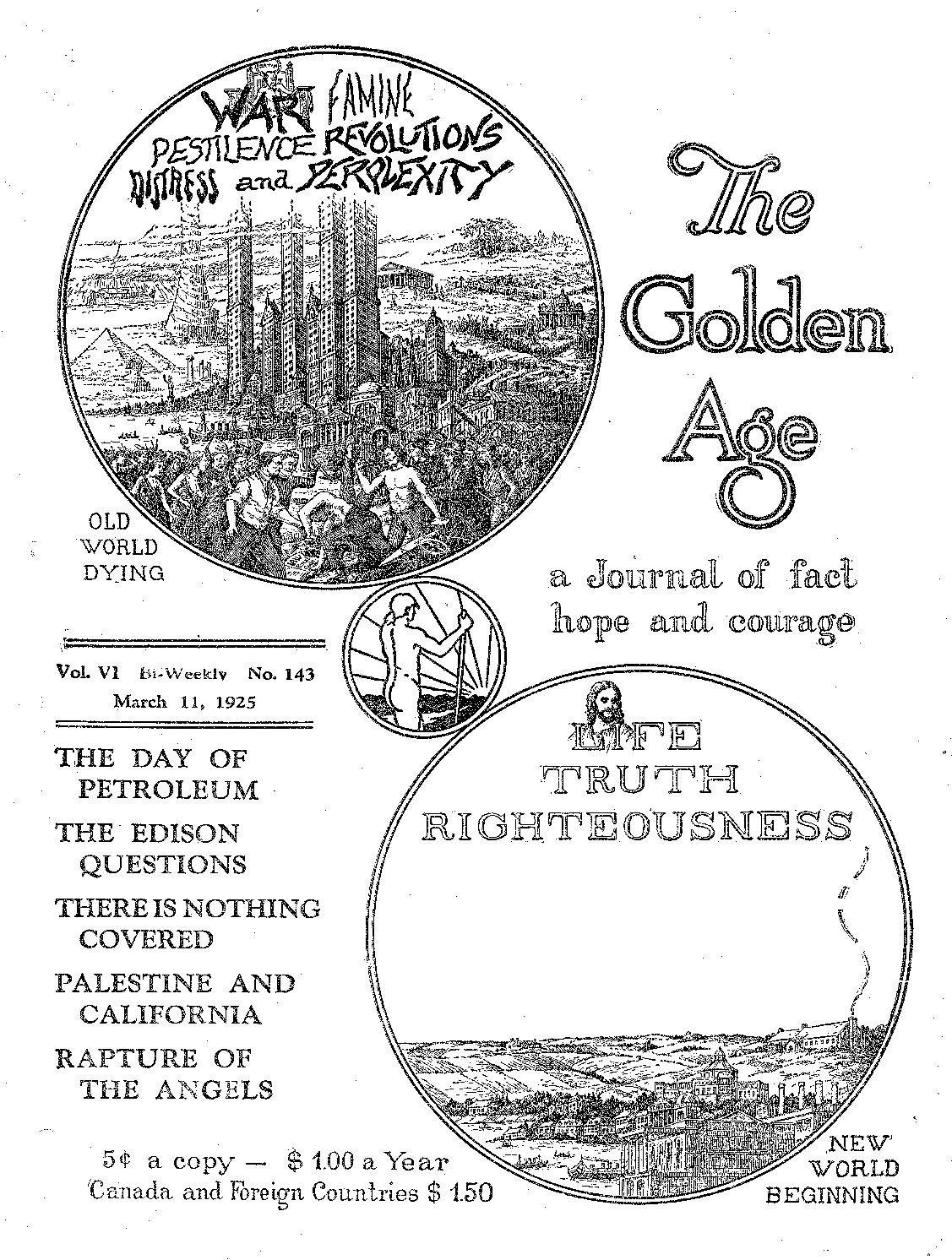
Contents of the Golden Age
....... .......K*
Social and Educational Rumania’s Revolution ...
The Edison Questions
Change in Broadcasting Program .......... .
Manufactures and Mining Miracle in American Production ......
Political—Domestic and Foreign The Day of Petroleum .........
History of Petroleum
Importance of Oil ......... .
.. Distribution of Oli ....
' Petroleum in Shales
’ American Oil Items
Transportation and Heating .............. 360 Bits of News from All oveb the World .
. The Unfought Campaign of 1919 ............ 361
How Governments Do Things
Progress in Spain ......
। Germany, Italy, Albania
Miscellaneous Items
Home and Health What You Do When You Vaccinate
Travel and Miscellany Zebras Hard to Handle
Palestine and Southern California ......... .
Religion and Philosophy Christ Cometh Not with Observation
Bible Translated into Seven Hundred Seventy-Seven Languages . .331 “There is Nothing Covered That Shall Not Be Revealed” . . 369 Meditation in a Cemetery
Rapture of the Angels
Angels in Official Capacity ........
The Great Conspiracy .............. .
Angelic Statement a Prophecy ....
Stdies in “The Habp of God” .....
Published every other Wednesday at 18 Concord Street, Brooklyn, N. Y., U. S. A., by WOODWORTH, HUDGINGS & MARTIN
Copartners and Proprietors Address: IS Concord Street, Brooklyn, N. T., V. S. A, CLAYTON J. WOODWORTH . . . Editor ROBERT J. MARTIN . Business Manager WM. F. HUDGINGS . . Sec’y and Treas.
Fits Cents a Copt—$1.00 A Year Maks Remittances to THB GOLDEN AGE.
Fobbion Omtces s British ..... 34 Craven Terrace, Lancaster Gate, London W. 2 Canadian ..... o .. . B8-40 Irwin Avenue, Toronto, Ontario Australasian . . „ s t , 495 Collins Street, Melbourne, Australia South African......6 Lelie Street, Cape Town, South Africa
Entered as second-class matter at Brooklyn, N. Y., under the Act of March 3, 1879
(rhe Golden Age
yr-T -JSTTrs-,.'■ ,;■ ,■ 1111 '........ ,. ...... .....n— ' ...'■" -■«
Volume VI Brooklyn, N.Y., Wednesday, March 11, 1925 Number 143
The Day of Petroleum
SO-CALLED scientists have wearied themselves in the effort to account for the presence in the earth of great quantities of petroleum which occupy so important a part of the world’s activities and the world’s news at this time.
They have tried to tell us of the origin of oil, and have evolved five theories, some of which are partly right and some of which are evidently wholly wrong. For instance, one of the theories is that the intense heat of the interior of the earth, coining in contact with water, turns the water into steam. Inasmuch as steam occupies seventeen hundred times the space of a given quantity of water, the thought is that this steam, broken up, forces its way into cracks and crevices, the gas gets thicker and thicker, and ultimately becomes a fluid mineral oil. All this is very foolish.
If these scientists would give a little real, reverent attention to the Bible, they would find the origin of petroleum plainly hinted at in the very first chapter of the Book. The creative days of Genesis agree perfectly with the findings of geologists that vegetation preceded the higher forms of animal life.
The Bible as well as the geologists agrees that in the third creative day vegetation was extremely rank. Mosses, ferns, and vines grew immensely larger and more rapidly than now; for the atmosphere was full of carbonic and nitrogenous gases, so full, in fact, that breathing animals could not then have lived.
Plants which now grow only a few inches or a few feet high even at the equator, then attained a growth of forty to eighty feet, and sometimes two or three feet in diameter, as is demonstrated by fossil remains. Under the conditions known to have then obtained, their growth not only would be immense, but must also have been very rapid.
At this period the coal beds and petroleum deposits were formed. Plants and mosses, having a great affinity for carbonic acid gas, stored up within themselves the carbon, while purifying the atmosphere for the animal life of the later epochs. These vast peat-bogs and mossbeds were repeatedly covered by upheavals and depressions of the earth’s surface, by tidal waves and further descending rings of the material held in suspension, resulting in the various strata of coal, clay, sand, limestone, etc., as we have them today.
History of Petroleum
TT IS plainly evident from the foregoing that petroleum is composed of the fats and oils once contained in plant and animal life. We say . animal life also, because it must be remembered that the first animals on the earth were of prodigious size, suited to the vegetation on which they fed. Their remains are more or less clearly marked in connection therewith.
It is possible that Adam knew of petroleum and used it in the Garden of Eden. It is certain that the “slime” used in building the Tower of Babel contained partly evaporated petroleum. One of the greatest oil deposits of the world is in Mesopotamia, where the tower stood; and it is found that the oldest buildings uncovered in that part of the world are bound together with that form of binder. .
When Sodom and Gomorrah were destroyed, the Lord used the oil-bearing soils, still present and still undeveloped in the vicinity of the Dead Sea, to overwhelm the doomed cities. The text which states that Moses was deposited in a little craft lined with pitch was the very thing that led the Standard Oil Company to locate the oil deposits since found in Egypt.
Petroleum was known and used in the time of Alexander the Great, the present Baku, Ru^
GOLDEN AGE
sian, field supplying the oil. Oil was also obtained in Sicily, and burned in the Temple of Jupiter about the beginning of the Christian era. j On the American continent the aborigines excavated pits along the waters of Oil Creek, Pennsylvania, near where Oil City now stands, the purpose of which must have been to collect oil. These pits are six to eight feet square, and are sometimes as much as twelve feet deep, lined with heavy timbers, and are always along streams where natural seeps of petroleum existed. The medicinal properties of petroleum were known to the American Indians and the Persians before America was discovered.
History of Oil in America
THE discovery of petroleum, upon which civilization at present so much depends, was purely accidental. Our forefathers needed salt and used it. They dug deeper and deeper for it, being often discouraged because the brines they obtained were spoiled by the black, oily liquid with disagreeable odor which so often came along with it.
In 1859, which is now but sixty-six years ago, Edwin L. Drake, near Titusville, Pennsylvania, brought into existence the first oil well ever drilled. He struck oil at a depth of seventy feet. Oil wells are now sometimes sunk as deep as 3,000 feet to obtain the same results.
The cost of drilling an oil well is $50,000 to $75,000. The area drained by each well is about five acres. The oil is principally found in sand, which seems to be its natural container. It is believed that the best of wells never extract more than thirty-five percent of the oil, the balance being unobtainable.
Old wells are sometimes re-shot nowadays, and with fairly good results. The powerful explosives now in use stir things up so effectively in the oil-bearing strata that good flows of oil can be obtained in wells that had been abandoned as dry, or played out.
It is remarked that salt water seems to have an affinity for oil. Oil men claim that salt water sometimes chases oil for miles and miles through various formations, until finally it is pressed into some closed sand structure from which it can not escape, resulting in an oil deposit. Few oil wells are sunk now without preliminary advice from trained geologists.
Bboobxtm, N. X.
Importance of Oil
fPHE wheels of diplomacy at present are all running in oil. Every international conference is proof of this, even though, none of it may appear on the outside. The “Literary Digest” says:
“It lurks in the background of virtually every problem now engaging the attention of world statesmen. European politics have become the politics of petroleum. Almost no move is made on that chessboard where Prime Ministers disport themselves with fates of nations that is not tinctured with oil.” ■
British papers are fond of referring to Mr. Hughes as the United States Secretary for Oil, but their own secretaries have an even better claim to the title. They have done their work with such characteristic British cleverness that Sir E. M. Edgar declares that Britain has cornered the oil supply of the world, and that in ten years the United States will have to buy every year five hundred million barrels of oil from British traders.
In a work entitled “The Great Betrayal” Mr. E. H. Bierstadt declares:
“The trail of oil leads not only through the doors of the Department of the Interior and into the Navy Department, but straight to the Department of State as well. Naval reserve oil, Mexican oil, and Mesopotamian oil are all threads of the same web. Touch one, and the rest will quiver.”
Mr. Bierstadt declares that it was the lust for oil that caused Great Britain, the United States, France, Russia, and Italy to betray Greece and to cripple the great philanthropic investment in Turkey. It was their aim, so he .maintains, to control the oil resources for the next war, and so dominate the Near East peninsula. But he adds that “whichever nation gets into the lead will have the others on its trail like a pack of wolves”.
The real secret of the unbending hostility of -the United States Department of State to a recognition bf the Soviet arrangement in Russia is declared to rest in the fact that the Standard Oil Company bought out the Swedish Nobel Oil Company interests at Baku, Russia (the largest oil field in the world); and that the Soviet refuses to recognize the claim, but insists on keeping these richest oil wells for the benefit of the Russian people.
Wasting What We Have
WHILE other governments and other countries are making desperate efforts to get and to hold oil deposits, Uncle Sam seems bent on squandering every last pint that lies beneath the soil anywhere between the two oceans. We do not refer merely to the Teapot Oil Dome and other naval reserves. The rush to get the oil out of the ground and to turn it into money is characteristic of the land where the object of worship of nearly all the people is really and truly the Almighty Dollar.
Whenever a crowd of highwaymen manage to steal a million dollars there are a million reasons, in the / minds of certain lawyers and judges, 'why nothing but honor should be bestowed upon them. It has been so with the Teapot Dome and other naval reserve oil leases. Without doubt the man who made the leases ■was told that he would be protected; and he has been, and will be. The Government has made three attempts to prove criminality regarding these leases; but the courts nullified one of the attempts, and for some reason or other both of the other attempts failed; Meantime, the oil which really belongs to the people is being given away, to all intents and purposes.
The pouring of the people’s oil into the market, together with a rush on the part of other producers to pump their oil out before some neighbor should get it, has led to a surplus of oil in the last two years, which means a great loss to the country as a whole.
Surplus oil is considered a white elephant. It requires expensive containers, and the loss from evaporation is high. When stored in open tanks, the most valuable part of the oil is lost by evaporation. How much more sensible to let the oil remain where the Lord put it, until it is needed!
The effect of the situation is that the United States is now providing about seventy percent of all the oil used in the world, and yet has in reserve only about twenty years’ supply, while other nations have seven times as much. The annual production of oil is now worth four times all the gold produced in the world.
Distribution of Oil
WE HAVE before us a map showing the distribution of the oil deposits of the world.
It shows that oil is to be found in almost every country in the world. Examining the map mors closely, we may outline twelve gigantic fields or areas which seem to be impregnated with oil:
1. A belt a thousand miles wide and three thousand miles long on the axis of Tampico, Beaumont, Shreveport, Cairo, Fostoria, and Quebec. The seaboard, except Nova Scotia, seems to be without oil.
2. A belt fifteen hundred miles wide and four thousand miles long, resting on Cairo and the Persian Gulf and extending north to the Arctic Circle, on the axis of Mosul and Baku.
3. A belt twenty-five hundred miles wide and five thousand miles long, including the Dutch East Indies, Philippines, Japan, Sakhalin, Korea, China, Burma, and Siam.
4. A circular belt two thousand miles in diameter, including Rumania, Algeria and all the countries between, to and including the British Isles. ,
5. A belt five hundred miles wide following the eastern edge of the Rocky Mountains four thousand miles to the mouth of the Mackenzie River, from the northern edge of New Mexico.
6. A narrow belt two thousand miles long, from the tip of Southern California to the shores of Puget Sound. .
7. A circular belt fifteen hundred miles in diameter around the edges of the Caribbean Sea, on all sides.
8. A narrow belt three thousand miles long on the axis of the Andes, the whole length of South America.
9. A belt a thousand miles wide and upwards of three thousand miles long, including all of New Zealand and Tasmania and the southern and southeastern shores of Australia.
10. A narrow belt twenty-five hundred miles long, from Liberia to Angola on the West Coast of Africa.
11. A narrow belt fifteen hundred miles long, from Victoria Nyanza to the upper part of Madagascar. A similar belt in northwest India.
12. A belt of undetermined width stretching across southern Alaska and the extreme northeastern portion of Siberia.
Scientists do not like the idea that the world’s supply of hydrocarbons is being used for fuel. These may sometime be needed for food. A gusher may be spectacular, thrilling and aweinspiring; but to the scientist it is a calamity, a dreadful waste.
The increased use of fuel oil is killing off ... millions of fish that now can not come near the cities which they once visited in search of food. The greatest cause of oil pollution is the discharge into the harbors of water that was stored in empty oil tanks for ballast. The British do not allow the dumping of this oily water inside the three mile limit. The Japanese do not allow it to be dumped at all. They save and use it.
Petroleum in Shales
GOTLAND has been a producer of petroleum for seventy years; but the oil comes
from shales, front which it is obtained by roasting. It is believed that these oil-soaked shales are nothing more nor less than clays impregnated with countless bodies of fish, which were caught in the descent of the various rings that once surrounded the earth. In many places the shales bear evidence of the remains of millions of fishes.
The Scotch shales contain about twenty-five gallons of oil to the ton. Similar shales are widely scattered over Australia, Russia, and other countries. In the, United States there are billions of tons of such oil-soaked shales, some of them containing as high as ninety gallons of oil to the ton.
The roasting of shales is expensive. It requires an expenditure of about one. and one-half million dollars for the construction of a plant before a dollar’s worth of oil can be obtained. Hence the present method of drilling for oil will probably continue here as. long as oil is obtainable by that method.
But when the pool oil gives out, it may be safely asserted that there is enough shale oil left to last at least a thousand years, so geologists tell us. Shale oil is produced in Sweden and Germany, as well as in Scotland. The Germans are also taking petroleum from coal.
Some Western Fields
ONE of the most startling discoveries in any western field was that obtained by the Imperial Oil Company in August, 1920, when a sixty-foot gusher of high grade oil was struck at the mouth of the Mackenzie River, near the Arctic Circle. !
, Geologists consider this one of the most promising fields in the world. There is said to be a large area in which the liquid oozes from the banks of the rivers, and spreads over the surface of the streams so thickly that it can be ladled in cups. 'In some places fires have been burning for years, where some oil-bearing rock has been struck by lightning. .
In the summer of 1921 there was a great rush of prospectors into the Mackenzie River field; but as the location is eleven hundred miles from the Peace River Crossing, the nearest railroad point, and the intervening country is a wilderness, the Northwest Police restrained many who would have entered. None were permitted to go who were not well equipped.
Throughout the summer of 1921 prospectors were carried by airplane from Peace River Crossing to Fort Norman, eleven hundred miles, at a fare of $1,000; and at that time the airplanes engaged in the service were booked for a year ahead. It will take time to build a pipe line over those eleven hundred miles.
The Mexican constitution of 1857 provided that the oil and mineral lands of Mexico should forever be the property of the Mexican people, never to be granted or sold to anybody. Every foreign concern doing business in Mexico knew of the existence of this constitution.
But Mexico has had its Teapot Dome statesmen, the same as America; and hence it comes, about that back in the eighties & Standard Oil man from Ohio who knew how to speak Spanish got into the Mexican cabinet, in the post of minister of finance; and the rest was easy.
Senior Enrique Creel, otherwise known in Ohio as Henry Creel, made all kinds of grants to various crowds of financiers who wanted Mexico’s oil. But he seems to have forgotten to tell them that it would be the decent thing, for shame’s sake, to pay something in the way of taxes for stealing what neither one of them had any right either to give or to take.
Anyway, xvitli a show of holy indignation, the taxes were withheld -from year to year, while our patriots at Washington were indulging in oil-soaked oratory about our duty to clean up Mexico. But in 1923 the idea suddenly seemed to break through their minds that it might be a good thing to pay something, after all. Since then Mexico has been comparatively quiet.
Farther south, it is interesting to note that as far back as 1692 the people of Peru were wrangling with one another over the petroleum rights of their country. This fact shows that oil is not so new as some have thought.
Some Eastern Fields
THE same Sinclair that trimmed the United
States so beautifully in the Teapot Dome lease undeniably has the money and the brains of a certain sort necessary to get what he wants in the way of oil concessions. In 1923 his companies were given rights for a period of thirty-six years over an area of 500 square miles in the Russian island of Sakhalin; and a year later the Persian government gave the same corporations ninety million acres of undeveloped land, constituting what was then reported as the largest undeveloped oil field to be found in the world.
The oldest oil field in the world, namely the Mesopotamian-Persian-Russian field, is undoubtedly the richest field in the world, and is more or less at the bottom of all the disturbances in the world regarding Turkey, Armenia, Palestine, Russia, etc.
Before the World War Germany had an ambition to have an oil-burning navy; and all her diplomacy was directed toward linking together all the countries from the North Sea to the Persian Gulf, so that she could get at the Mesopotamian oil without interference. During the war this result was actually achieved at one time, ■
It seems that in June, 1914, the Grand Vizier at Constantinople wrote a letter to Baron von Wagenheim, then German ambassador at that city, conveying to the Baron’s so-called Turkish Petroleum Company the right to exploit the Mesopotamian oil fields. The Vizier forgot that five years previously he had given the same right to Rear Admiral Chester of the United States Navy, acting for the Standard Oil Company.
Now see what happened. As soon as the war was over, the great British statesman, Lord Birkenhead, declared that the oils of Mesopotamia were rich enough to pay for the war twice over. When he said this, he was figuring that the Vizier’s letter to the Baron constituted Britain’s carte blanche to go ahead, inasmuch as Britain had whipped Germany.
But it so happened that early in the war Britain had promised France secretly that she should have the oil; so when the trouble-was over France claimed what was coming to her. Then came one of those famous conferences of Europe’s benevolent diplomats, at San Remo. When they got through talking, France was to get a quarter of the oil, the Dutch a quarter, and Britain the rest. The United States and Turkey were to get nothing.- Then it was that the world at large began to hear in earnest of the so-called Chester Concessions, Standard Oil’s share of the plunder. The foregoing is a brief outline of the real reasons why France backed Turkey in the Greek campaign in Asia Minor.
The struggle for possession of the Mesopotamian oil fields is a struggle for the future wealth that is to come from those regions. At present the oil wells of Mesopotamia are merely shallow pits, the same as those which the Indians used in America hundreds of years ago. The oil is dipped from the pits by hand. It is said that the natives are suspicious of modern methods of taking away their oil. Is not that strange ?
The New York “Nation” sums up the situation nicely in a paragraph when it says:
“Admiral Chester’s concession in Turkey is as orthodox a forward step in imperialism as could be conceived. It grew out of an expedition for the protection of missionaries; it includes oil, copper, iron, and railroads; it conflicts with claims advanced in behalf of the subjects of two other Great Powers, and has about as many possibilities of international squabbles hidden away in its clauses as could possibly be tucked into a single document.” -
Before the death of the Russian premier, Lenine, he expressed the belief that the expected Armageddon would be fought over petroleum.
American Oil items
S HAS been already stated, the United
States produces almost three-fourths of the world’s oil, and Mexico almost one-fourth. The remaining production is principally in Russia, Persia, Dutch East Indies, and Rumania, with lesser outputs from India, Peru, Galicia (Poland), Sarawak, Venezuela, Argentina, Trinidad, Japan and Egypt. The remaining output is small.
Texas has been fairly reeking with oil since the Beaumont gusher in 1900. During the past five years the craze has spread all over’ that large state, with the odd result that oil has been found almost everywhere. The people of Texas went crazy. Lawlessness became rampant. Prices went up 100 percent. No one was safe on the streets after dark. Oil from a new well is always tasted, to detect salt; for salt water quickly ruins an oil sand.
Prospectors in the Olympic Mountains, Washington, are trying to locate a lake of oil, which is known to be there, but the location of which the Indians are unwilling to reveal. From time immemorial the Indians in the vicinity have been using cedar sticks soaked in oil for fuel and light.
Standard Oil Company •
O ARTICLE on the petroleum industry would be complete without some reference to Standard Oil, which made the industry what it is today. It can not be denied that for efficiency, progressiveness, far-sightedness, and the ability to come out right side up from any difficulty into which it may be plunged, the Standard Oil Company stands at the top.
No one seems to know’ who is really the master genius back of this colossal enterprise, or series of enterprises. All that is known, as one Wall Street observer expressed it, is that “it is like a giant centipede, whose legs are ever in perfect lockstep, but which has no visible body to guide them.'’’ In 1911 The Standard Oil Company was dissolved—on paper.
The market value of the holdings of John D. Rockefeller, Jr., in the nine companies, that once made up the Standard Oil Trust is set at $410,764,399; and his income from these holdings about $12,000,000 per year. But he is not considered an oil man, and his father is virtually out of all the companies.
Transportation and Heating
EVER AL of the railroads of the West have used oil-burning locomotives for many years. It was but natural that the water-borne commerce of the world should turn to the same fuel. Oil has some disadvantages, however, namely, fluctuations in price, uncertainty of supply, and fire risk. But these are offset by the fact that an oil-driven ship requires only one-third as many firemen and travels about twenty percent faster than a coal-driven boat. There is a low first cost of equipment, no smoke, small storage space required, small amount of refuse, quick response to overload demands, and no banking losses. Bunkering can be done quickly in any kind of weather and at any time of day. Uniform steam pressure can be easily maintained, reducing the deterioration of boilors. Oil can be carried in nooks and crannies, between double bottoms, and in other places where neither coal nor cargo can be stored. In case of a storm beneficial results are obtained by pouring oil overboard on the weather side of the ship. A year ago there were about 3,110 oil-burning vessels afloat as against 501 in 1914.
Oil heating-plants are being rapidly installed in apartment houses, some 15,000 having been placed in Chicago alone. In New York, however, which is accustomed to smokeless hard coal, the oil has been found to deliver an oily, smutty grime all up through the building; and in numerous places the oil plants have been pulled out, and coal is again doing the work.
Revolution From Editorial Page, New York American
ACCORDING- to Prince Antoine Bibeseo,
Minister of Rumania to the United States, there has been a new law passed in Rumania. By virtue of this law, land which has hitherto been held under the control of a few great landlords, has been turned back to the actual farmers themselves.
The Prince said that he lost 20,000 acres by ' the law, but is glad to lose them, for the people have benefited.
According to The Broadcaster, this is just another way of adopting the Jubilee arrangement of the Jews, under which every fifty years land reverted to its original possessors.
Bits of News from All Over the World
[Radiocast, with other items, from Watchtower WBBR on a wave length of 272.6 meters, by the Editor]
Substitute for Sunlight
BRING the winter months the children of
London are so starved for sunlight that in certain sections it is now the custom to expose them for a number of minutes each day to the rays of light emanating from long-flame arc lamps. It is found that the ultra violet rays of these lamps afford a partial substitute for sunlight, in their healing properties.
Deaths in Airplane Accidents
I GUT persons were killed the day before Christmas, when one of the London to
Paris airplanes suddenly took a nose dive a few minutes after it had started for Paris. When the machine struck the ground, the gasoline tank burst, the flames rose sixty feet in the air, and all occupants were instantly burned to a cinder. There are no lingering deaths in airplane accidents.
Duke of Norfolk Loses $20,000,000
THE inheritance laws of Britain have cut $20,000,000 out of the Duke of Norfolk’s estate, leaving him only a beggarly $30,000,000. He has had to rent out all his ducal palaces and even his London home to some of the Pittsburgh crowd, and to travel so that he will not have to go to the expense of entertaining. It is very sad to be a Duke. But it will soon be over.
Modern Dresses Injure Royalty
ebecca West, of the London Daily News, the first woman reporter to write up an opening of Parliament, thinks that the pale shades and flimsy materials of modern dresses do not nearly so well fit the scheme of royalty as the stiff brocades worn by the old ladies with silver hair. Speaking of these modern dresses she says:
“It gives a curious effect, the packed crimson of the peers’ robes in the centre and this periphery of pale colors- and insignificant textures. It reminds one of the petals of a dying flower, faded and curling at the edges.”
tried during the past fourteen years, and are still being tried, to strengthen the pillars which support the great dome. The amount now needed for this job is estimated as $700,000. Better pull it down, boys.
Lancashire in a Bad Way
ANCASHIRE, the heart of England, the home of optimism, the center of the world’s textile industry, is in a bad way. For four years the 600,000 textile operatives have been getting along on insufficient work to keep them going decently, with fifteen percent of them registered as actually without any work at all.
The Unfought Campaign of 1919
OF THE unfought campaign of 1919 Winston
S. Churchill says:
“Had the Germans retained the morale to make good their retreat to the Rhine, they would have been assaulted in the summer of 1919 with forces and by methods incomparably more prodigious than any yet employed. Thousands of airplanes would have shattered their cities. Scores of thousands of cannon would have blasted their front. Arrangements were being made to carry simultaneously a quarter of a million men, ^together with all their requirements, continuous! y forward across country in mechanical vehicles moving ten or fifteen miles each day. Poison gases of incredible malignity, against which only a secret, mask (which the Germans could not obtain in time) was proof, would have stifled all resistance and paralyzed all life on the hostile front subjected to attack.”
France’s Balance Sheet
RANCE wound up the year 1924 by publishing, in a six-hundred-page book, her long-expected balance sheet. The summary shows France’s total assets, estimated at 796,-830,000,000 francs, and her debts, exclusive of American and British debts, at 660,320,000,000 francs. The American and British debts are, roughly speaking, just about what is left; namely, 136,510,000,000 francs. France is a going concern, but to all intents and purposes is bankrupt.
St. Paul’s on the Quicksands How Governments do Things
ST. PAUL’S Cathedral, in London, is gradual- "07 HEN, toward the close of 1924, it came ly settling and cracking to pieces. “It was ’ V time for the French government to grant built upon the sand.” Various schemes have been amnesty to a former Minister of the Interior, it
was brought to light that the defeatist paper with which he was connected and because of which he lost his citizenship, was being subsidized by the government to attack it. M. Malvy, tie victim, kept still, though knowing all the facts, rather than embarrass his government in the pursuit of its war policies. What ends were gained by the French government in maintaining a defeatist paper on their payroll were not stated. It was evidently run as a trap to catch pacifists.
Earth Turned Upside Down
THE social earth turned upside down was clearly revealed in Paris the other day when the Soviet Ambassador’s wife went to a leading store to get some dresses. The four clerks appointed to wait upon her each turned out to be former members of the Russian aristocracy; and all four flatly refused to recognize the new aristocracy, or to wait upon their customer.
Masonry Suppressed in Spain
THE strong hand of the Papacy is seen in the order issued by the so-called Spanish Government outlawing Masonry throughout Spain. It was evidently the success of this movement in Spain that led to the order of Mussolini that a similar law should be passed in Italy. All lodges in Spain have been warned to hold no more meetings or imprisonment will result.
Spanish Dictator Summons Ibanez
BECAUSE he bombarded several Spanish towns with leaflets ridiculing Alfonso, the Spanish military dictator has summoned the Spanish author Ibanez to come from Paris to Madrid to be tried. But Ibanez laughed when told the news, and said that he would as quickly throw himself into waters inhabited by hungry crocodiles or take refuge on a cannibal island as to visit Spain now. He thinks that soon it will have a civilized government; then he will go there.
Spain Abandons 250 Moroccan Towns
IN THE process of gradually crawling into its hole and pulling the hole in afterwards, the Spanish military regime has abandoned 250 of the towns and villages of Morocco formerly held by Spain, finding it impossible to retain their control. The present plan is to keep the Riffs away from the markets, and thus gradually starve them into submission.
Spain Actually Learning Something
TP HE naked Riffians having whipped the Spanish out of their territory, Spain is now inaugurating a decent modern system of government among the Moors over whom she still rules. These will now be given administrative, legislative, judicial and religious offices; while the Spanish will content themselves with maintaining order, thus imitating the French methods. The Riffs have conquered Spain through expert marksmanship, “sniping,” by scattered men. ’
Changing Names of Cities
FIRST we had to get used to the change of name from St. Petersburg to Petrograd, and then to the subsequent change to Leningrad. Now along comes Christiania, and demands henceforth to be known as Oslo, by which name the town was called until destroved by fire three hundred years ago. All right, Oslo 1
Religious Liberty in Poland
THE constitution of Poland guarantees religious liberty. The Southern Methodists bought a property there at Pustomyty, to be used as an orphanage, paying cash for it to a Polish senator. Before the deed was recorded, somebody referred it to the Roman Catholic archbishop; and he wrote on the margin that no good Catholic would ever permit such an institution to remain there. The result was that the government ordered the Methodists to sell out in thirty days, or it would expropriate the property. Such is Romanism, always.
Germany on a Raft
IN A speech in Berlin before the German bankers Dr. Schacht, President of the Reichsbank, said: “In the terrible storms of the last few years the German state "was wrecked, but the crew saved themselves on a raft. What we must find out is whether we can steer this raft safely into port and build a new ship for venturing out again on the world’s oceans.”
Germany Through with Monarchism
THE recent election in Germany, in which 30,000,000 votes were cast, reveals that both the monarchists and the communists have lost-ground. The vote is split up among nine political parties, 8,000,000 votes going to the Socialists, 6,000,000 to the Nationalists, 4,000,000 to the Catholic or Centre Party, 3,000,000 each to the Communists and the People’s Party, 2,000,000 to the Democrats, and the balance to the Fascists and other small parties.
Bavarian Teachers Protest
THE seizure of the public schools of Bavaria by the Papacy is n*t being accomplished without a protest. At a great meeting held in Nuremburg shortly after the seizure was announced, two thousand school teachers, with only one dissenting vote, denounced the placing of the public schools of Bavaria under the control of the priests and the nuns.
No Free Speech in Italy
THE New York American, referring to Mussolini’s desperate efforts to hang on as long as possible, says: “All newspapers not applauding the outlaw government have been suspended or suppressed. Those -who dared open criticism have seen their offices and plants invaded by the militia, their linotypes, machines, presses and furniture smashed, and their buildings burned to the ground.” Mussolini has reestablished the crucifix in all the schools.
Italian Masons Temporarily Dissolve
FACED by Mussolini’s threat of a new law demanding the publication of all their secrets, together with a complete roster of their membership, the Italian Grand Lodge of Free Masons has met and decided for the present upon the dissolution of Italian Freemasonry. Mussolini’s excuse for the new law is a professed desire to protect the Pope during the ~ latter’s holy year.
Italy Tiring of Anarchist Rule
Mussolini is like a strong man with a firm grip on the ears of a mad dog. Having started goverment by anarchy, he is in a fair way to get his anarchy without any government. None of the people’s representatives will have anything to do with his hand-picked Fascist! Parliament. He would like to have a new one, so that he might have a show of excuse to govern; but the king has refused to dissolve his present one.
Good Bye to Johnny Dundee
ON JANUARY 2nd the Pope is said to have bestowed a special blessing upon Johnny Dundee, the world’s champion featherweight prize-fighter. The manager of the champion also came in for his share of the blessing. At the time of the Spanish American war, the Pope officially bestowed his blessing on the Spanish fleet just before it came over to be sent to the bottom. The outlook for Johnny Dundee is pretty bad.
Albania’s Stormy Career ' '
A LBANIA, which gained its independence in 1912, has had a stormy career. It is the heart of the Balkans, torn with religious strife, and coveted by Serbia and Greece no less than by Italy, opposite to which it lies. The former Moslem premier has just come marching in from Serbia and, for the moment, caused the flight of Bishop Noli, premier for the last six months. Italy has warned both Greece and Serbia that they must not seize Albanian territory. Meantime Great Britain has also sent warnings to Serbia and Bulgaria, to the same effect.
Waters of Dead Sea Rising
AN ISLAND in the Dead Sea-which, in 1852, was ten feet above the level of the waters, has disappeared from view, owing to the fact that the waters are gradually rising. These rising waters have in time completely covered Sodom and Gomorrah, whose ruins lie beneath the sea.
Miss Pankhurst and the Jew
Miss Christabel Pankhurst, daughter of the militant suffragetie, Mrs. Emmeline Pankhurst, has been giving some addresses in New York. In one of these she observes correctly, Scripturally, that the return of the Jews to Palestine, which we see actually talcing place before our eyes, is “the supremely important factor in the world’s affairs today”. '
How China Serves Looters
HO AV China serves looters was illustrated on Christmas day, and the two days immediately following, when 1,065 soldiers who were found with loot or who confessed to having participated in looting, were lined up, blindfolded, on a railway bridge, at the ends of the ties, and then shot, falling thirty feet to the ice below. Our 100-p er cent-profit patrioteers had better keep out of China.
The Japanese Typewriter
THE Japanese typewriter has but one key, but it has 7,026 characters. An experienced operator will turn out sixty words per minute, which is about twice as fast as the characters can be made by hand. The machine prints from the bottom of the page to the top and from the right side to the left. Unusual characters are located by means of a directory which goes with the machine. The English alphabet is thrown in for good measure.
Christ Cometh Not with Observation
THE poor people of Sydney, Australia, who have built a $60,000 amphitheatre on a beach neai' there, have wasted their money. They would have done better had they studied their Bibles so that they might comprehend the force of the Master’s own words that “the kingdom of God cometh not with observation”. No fleshly eye 'will ever see the Spirit Christ.
Seven Hundred and Seventy Languages
THE various Bible societies and missionary organizations have now translated the Bible, in whole or in part, into seven hundred and seventy languages. Many of these tongues are spoken by people who have made but the first feeble steps toward civilization. Reducing their language to written form will greatly aid their enlightenment.
Perhaps Tutankhamen was Joseph
PROFESSOR Selikovitsch, a renowned Egyptologist, believes that when King Tutankhamen’s tomb is finally opened it will be found empty. He declares that Tutankhamen lived in Joseph’s time; that the man, whoever h® was, erased the names of the Egyptian gods from all the monuments, and substituted the name Adon, which in Hebrew, means Lord. Joseph’s bones, at his express request, were taken up out of Egypt to Palestine.
Sudan Plantations Syndicate Limited
'T'HIS very year, 1925, unless something unforeseen occurs to prevent, the one British concern, Sudan Plantations Syndicate Limited, will have 300,000 acres of cotton land under the plow, while at least 500,000 acres are projected for the immediate future. The largest cotton field in the United States has 15,000; acres. American cotton is hard hit.
Zebras Hard to Handle
T'lESCRIBING his experiences in bringing a South African zebra to Europe a writer in
The Cape Argus says:
“I found him awaiting me in an enclosure near Nairobi, and the first business was to get a headstall on him. While we were cutting an opening to get him out, the zebra jumped right through the barbed wires of the enclosure, and became thoroughly upset. When we went to adjust his headstall, which had gotten over one ear, he dashed straight for the gate. Knocking out two of the panels, he got the gate around his neck, and finished by turning a somersault, gate and all. Getting to his feet again, he broke out of the gate, leaving only the frame-work. That was the animal we had to lead for three miles across country I While I was looking after the elands, which were also giving trouble, the zebra broke away from the boys; but, being fleet-footed, they caught him again, and tied him to a post. Though this was almost as stout as a scaffold-pole, he pulled it out of the ground. Making another start, the zebra kicked himself free, and charged one of the boys, biting him through the arm and elbow. The zebra was prevented from doing more damage, and later was lassoed by a policeman, and tied to the back of a bullock wagon. All went well for a time; and then the zebra sat down. We could not drag him along: so we had to take him off. When he reached the train, he ran wild again. He was so wicked on board ship that he nearly kicked the panels out of his heavy traveling-box. As a rule zebras are quickly tamed and, after being tethered with quiet donkeys for a few days, are released and herded with the donkeys, and appear quite happy in captivity, frequently showing marked affection for horses, which they will follow from camp to camp, and eventually into the railway truck.”
The Edison Questions By h. e. Coffee.
Mr. Thomas A. Edison, the celebrated inventor, is a manufacturer as well, and employs hundreds of young men and women in his various enterprises. He has asserted that college graduates are “amazingly ignorant”. In proof of his assertion he claims that many with college diplomas fail to pass the examinations which he gives. Below is a list of Mr. Edison’s questions. He says that anyone so ill informed as to be unable to answer most of these questions is too ignorant to be employed by him. For the benefit of those who are not so well “posted” as Mr. Edison would have them be, I have appended the answers :
What countries bound France? Answer: Spain, Italy, Switzerland, Germany, and Belgium.
Who was Bessemer, and what did he do? Answer: Sir Henry Bessemer was an English inventor and engineer who lived from 1813 to 1898. He is usually given credit for having first discovered the Bessemer process for making steel. However, this process was really discovered by William Kelly eight years before Bessemer announced his discovery.
■Who was John Hancock? Answer: American Revolutionary patriot, President of the Continental Congress, and the first signer of the Declaration of Independence.
Who was Plutarch? Answer: Greek biographer and essayist, born at Chseronea, in Breotia, about A. D. 46.
Who was Hannibal? Answer: The greatest general and statesman of ancient Carthage (247-183 B. C.).
Who was Danton ? Answer: Georges Jacques Danton (1759-1794) was a French Revolutionary leader, born at Arcis-sur-Aube.
- Who was Solon? Answer: Solon (about 639-559 B. C.) was an Athenian statesman and one of the most famous lawyers of all time.
"Who was Francis Marion ? Answer: Francis Marion (1732-1795) was a very daring colonial leader in the American Revolution.
Who was Leonidas ? Answer: Leonidas was the Spartan king who opposed the Persian hosts under Xerxes at the narrow mountain pass Thermopylae.
Where did we get Louisiana from? Answer: Louisiana was obtained from France.
Who was Pizarro ? Answer: Francisco Pizarro (1471-1541), an illegitimate son of a Spaniard, Gonsalvo Pizarro, was a Spanish explorer noted for his conquest of Peru.
Who was Bolivar? Answer: Simon Bolivar, native of Caracas, was a celebrated leader of the revolutionary forces of Venezuela in the revolt of Spain.
Where does most of the coffee come from? Answer: Two-thirds of the world’s supply of coffee comes from Brazil.
Where is Korea? Answer: Korea is a mountainous peninsula southeast of Manchuria, between the Japan and the Yellow Sea in Asia.
Where is Manchuria? Answer: Manchuria is a province in Northeastern China, the original home of the Manchu.
"Where was Napoleon born? Answer: Napoleon was born at Ajaccio, capital of the island of Corsica.
What is the highest rise of tide on the North Atlantic coast? Answer: Sixty feet.
Who invented logarithms? Answer: John Napier, who published his tables in 1614.
"Who was emperor of Mexico when Cortez landed? Answer: Montezuma.
What and where is the Sargasso Sea? Answer: A tract of floating sea weed in the North Atlantic Ocean, covering an area greater than that of France.
What is the greatest known depth of the ocean ? Answer: 32,088 feet.
What is the name of a large inland body of water that has no outlet? Answer: The Caspian Sea.
What is the capital of Pennsylvania ? Answer: Harrisburg.
What State is the largest? Next? Answer: Texas; next California.
Rhode Island is the smallest state. What is the next, and the next? Answer: Delaware is the second smallest; Connecticut is third.
How far is it from New York to Buffalo? Answer: 439 miles.
How far is it from New York to San Fran-cisco? Answer: 3,331 miles.
How far is it from New York to Liverpool? Answer: 3,079 miles .
Of what state is Helena the capital? An-swer: Montana.
Of what state is Tallahassee the capital? Answer : Florida.
Where is the Imperial Valley, and what is it noted for? Answer: The Imperial Valley lies in the lower part of California. It is noted for its extensive irrigation system and its productions of fruits, etc.
What state has the largest copper mines? Answer: Arizona.
What state has the largest amethyst mines? Answer: Michigan.
What is the name of a famous violin-maker? Answer: Antonio Stradivarius.
Who invented the typesetting machine? Answer : Ottmar Mergenthaler.
Who invented printing? Answer: Johannes Gutenberg of Germany, and Laurens Coster, of Holland, invented printing with movable type. It is not known positively which of these inventors was first in the field.
How is leather tanned? Answer: By placing hides from which hair has been removed into a vat containing oak bark or hemlock bark solution. The strength of the solution is gradually increased. Bran and alum are sometimes substituted for tanbark.
What is artificial silk made from? Answer: Artificial silk is made by dissolving cellulose in suitable solvents and forcing the liquids through minute holes into some medium which immediately reforms the cellulose in fine threads which shine like silk.
What is a caisson ? Answer: In civil engineering, a water-tight box or casing.
What is shellac? Answer: A substance made by the lac, an insect which lives on fig and other trees in Assam, Bengal, and Siam.
What is celluloid made from? Answer: Celluloid is made from vegetable fiber (usually cotton), acids and camphor.
What causes the tides? Answer: Tides are caused by the attractive force of the sun and the moon as it is exerted on the earth.
To what is the change in the seasons due? Answer: To the revolution of the earth about the sun.
How many states in the Union? Answer: 48.
Where do we get prunes from? Answer: California, 'Washington, Oregon, France, Spain, Portugal, Germany, Bosnia, and Serbia.
Who was Paul Revere? Answer: Paul Revere (1735-1818) was a Revolutionary hero and engraver of the first paper currency of Massachusetts.
What city and country produce the finest China? Answer: (Experts do not agree upon a definite answer.) Dresden, Germany, has the reputation for producing the finest, though the credit really belongs to the city of Meissen, which is 14 miles from Dresden.
Where is the river Volga? Answer: In Russia.
What is the finest cotton grown? Answer: Sea-island cotton.
What city is the fur center of the United States? Answer: St. Louis, Mo.
What country is the greatest textile producer? Answer: The United States.
Is Australia greater than Greenland in area? Answer: Yes.
■Where is Copenhagen? Answer: In Denmark.
What is Spitzbergen? Answer: An arctic archipelago, to which no country lays definite claim.
In what country other than Australia are kangaroos found? Answer: New Guinea.
What telescope is the largest in the world? Answer: The Yerkes Observatory telescope, on the north shore of Lake Geneva, 'Wisconsin.
What is coke? Answer: Bituminous or soft coal, when burned with a limited supply of air in kilns, produces a variety of charcoal called coke.
From what part of the North Atlantic do we get codfish? Answer: The Grand Banks of Newfoundland and along the shores of New England.
Who reached the South Pole? Answer: Roland Amundsen; Scott.
What is a monsoon? Answer: The seasonal wind on the Indian Ocean, which blows in an almost steady gale from the southwest from April to October. .
Where is Magdalena Bay? Answer: Indefinite ; there are three by this name.
From where do we import figs? Answer: From countries around the Mediterranean sea, principally through the seaport of Smyrna.
From where do we get dates? Answer: North. Africa, Southwestern Asia, California, Texas, and Arizona.
Where do we get our domestic sardines? Answer: Along the Pacific coast, especially California.
What is the speed of sound? Answer: At the freezing point the speed of sound is 1,090 feet per second.
What is the speed of light! Answer186,000 miles per second.
What is the longest railroad in the world? Answer: The Trans-Siberian Railway.
"Where is Kenosha? Answer: The county seat of Kenosha County, Wisconsin.
Who was Cleopatra, and how did she die? Cleopatra was the name borne by several Egyptian queens, the most famous being Cleopatra VI. Tradition says that she died from the bite of an asp which she had placed on her arm. Some historians question the truthfulness of . this.
Where are condors found? Answer: In the South American Andes.
Who discovered the law of gravitation? Answer : Sir Isaac Newton.
"What is the distance between the earth and the sun? Answer: Its least distance from the sun is 89,897,000 miles; its greatest distance 92,963,000 miles.
Who invented photography ? Answer: Louis Jacques Mande Daguerre is given the credit, though it is doubtful that he deserves it.
What country produces the most wool? Answer: Australia. "
What is felt? Answer: It is an unwoven material made from wool, hair and fur, matted together by the aid of moisture and heat and by rolling.
What cereal is used in all parts of the world? Answer: Wheat is the most satisfactory bread material and should be universally used. However, no one cereal is used in all parts of the world.
What states produce phosphates? Answer: Florida and Tennessee.
Name three principal acids. Answer: Sulphuric acid, hydrochloric acid, and nitric acid.
Name three powerful poisons. Answer: White arsenic, carbolic acid, and strychnine.
Who discovered radium? Answer: Madame Curie.
Who discovered the X-ray? Answer: Professor "Wilhelm Roentgen.
Name three principal alkalis. Answer: Caustic alkali, sodium, and potassium.
What part of Germany do toys come from? Answer : Nuremberg.
What states bound West Virginia? Answer: Pennsylvania, Ohio, Kentucky, Virginia, and Maryland.
Where do we get peanuts from? Answers The Southern States.
What" is the capital of Alabama? Answer: Montgomery.
Who composed “Il Trovatore”? Answer: Giuseppe Verdi.
What is the weight of air in a room 20 by 30 by 10? Answer: At sea level, one square inch sustains the weight of about 14.7 pounds of air, from which information the problem may be solved.
"Where is platinum found ? Answer: In Russia, Colombia, Canada, Australia, New Zealand, and the islands of Borneo and Sumatra.
With what metal is platinum associated when found? Answer: Gold.
Where do we get sulphur from? Answer: Sicily and Louisiana. -
Who discovered how to vulcanize rubber? Answer: Charles Goodyear.
Where do we import rubber from? Answer: South America, Mexico, Africa, Malay Peninsula, and Ceylon.
Who invented the cotton-gin ? Answer: Eli Whitney.
What is the difference between anthracite and bituminous coal? Answer: Anthracite is hard coal, while bituminous is soft coal.
Where do we get benzol from? Answer: It' is obtained from the refinement of coal tar.
Of what is glass made? Answer: Sand, lime, sodium carbonate, etc. .
How is window’-glass made? Answer: By first blowing glass into a large cylinder form, and then cutting and flattening out this cylinder.
What is porcelain? Answer: A name applied to those varieties of pottery having a glasslike appearance.
What country makes the best optical lenses and what city? This question cannot be answered, as opinions differ.
What kind of machine is used to cut the facets on diamonds? Answer: Very simple tools made from other diamonds.
What is a foot-pound? Answer: The amount of work done in raising a weight of one pound a distance of one foot.
"Where do we get borax from? Answer: Death Valley, California.
Where is the Assuan Dam? Answer: Near Assuan, in Egypt. .
What large river in the United States flows from south to north? Answer: Red River of the North.
What are the Straits of Messina? Answer: The straits off the coast of Sicily, separating that island from Italy.
What is the highest mountain in the world? Answer: Mt. Everest.
Where clo we import cork from? Answer: Spain and Portugal.
Where is the St. Gothard tunnel? Answer: A railway thoroughfare through the St. Gothard pass, in the Alps. .
Where is Taj Mahal? Answer: In India.
Where is Labrador? Answer: The extreme eastern country of British North America.
"Who wrote the “Star-Spangled Banner”? Answer : Francis Scott Key.
Who -wrote “Home, Sweet Home” ? Answer: John Howard Payne.
Who was Martin Luther. Answer: See Volume Seven, Studies in the Scriptures.
What is the chief acid in vinegar? Answer: Acetic acid.
Wio wrote Don Quixote? Answer: Miguel de Saavedra Cervantes.
Who wrote Les Miserables? Answer: Victor Marie Hugo.
What place is the greatest distance below sea level? Answer: The Dead Sea.
. What are ax-handles made of? Answer: Hickory.
Who made The Thinker ? Answer: The sculptor, Auguste Rodin.
"Why is a Farenheit thermometer called Farenheit? Answer: From its inventor’s name, the German scientist, Gabriel Daniel Farenheit.
Who owned and ran the New York Herald for a long time? Answer: James Gordon Bennett.
What is copra? Answer: The dried meat or kernel of the cocoanut.
AYhat insect carries malaria? Answer: The 'Anopheles mosquito.
Who discovered the Pacific ocean? Answer: Vasco Nunez de Balboa.
What country has the.largest output of nickel in the world ? Answer: Ontario, Canada.
What ingredients are in the best -white paint? Answer: Linseed oil, white lead, zinc, and a drier.
What i§ glucose, and how made? Answer: A sugary syrup obtained from corn. It is made by treating the starch with hydrochloric acid, greatly diluted.
In what part of the world does it never rain ? Answer: Walfish Bay, on the west coast of Africa.
What was the approximate population of England, France, Germany and Russia before the war? Answer: 35,678,530; 39,402,739; 64,925,993; 178,378,800, respectively.
Where do we get quicksilver from ? Answer: From mines in Mexico, Spain, California, and Texas.
Of what are violin strings made? Answer: Of catgut.
What city on the Atlantic seaboard is the greatest pottery center? Answer: Jersey City, New Jersey.
The reader will notice that the foregoing are mostly practical queries. Only once does Mr. Edison broach things spiritual, and that in reference to Martin Luther, which is also an historical query. Hence one could not gain insight into one’s spiritual understanding from the results of an Edison test. Spiritual things do not interest the great inventor, as he has on more than one occasion admitted.
As some of us who have had experience in pedagogy may know, questions are more easily asked than answered; and anyone at all clever should be able to prepare a list of questions similar in number to the Edison list and quite as difficult to answer. No one can yet truthfully claim to be perfectly versatile on all lines of human knowledge; and no one will ever be able to make such claim until the Great Physician, Christ Jesus, effects the complete restoration of the human race. Meanwhile our time might be more profitably spent in searching out answers to spiritual interrogations. I venture the assertion that Mr. Edison would find it quite as difficult to answer or to attempt to answer the first one hundred and thirty questions in the Harp or God as do the majority of applicants to whom he presents his prepared list of questions. The point is that one should pride himself more in the knowledge of God’s truth— holy things—than in the knowledge of things worldly; “for the wisdom of this world is foolishness with God.”—1 Corinthians 3:19.
“There is Nothing Covered that Shall Not be Revealed”
ONE of our subscribers in Florida has sent us a letter which she received through the mail, and has requested us to make some comments. The letter is reproduced herewith by photo-reproduction methods, the name of the lady being deleted:
Brooklyn Years J923.
Dear sister Cl
De Funiak Springs Fla.
Greetings • For reasons which you being in the light- will readily comprehend; this communication must be considered confidential» ' . . ‘ ’
The wonderful and glorious revelations which I am •to impart to you must be edited and millions of copies printed before we are ready to. spread the tidings broadcast and. we are counting on you and your fellow students and workers in the cause to lend a willing and energetic hand in the distribution when you receive your quota of copies* ' We are considering the working out of plans where^r
.every radio broadcasting station in the world may simultaneously broadcast- the voice of our dear departed Brother. "R" who has been in communication with us over the raaiOu^U-iimss for several- days past* We are feverishly^Wt^sing to so strengthen our apparatus that »s will be not only able’ to receive his signals but be able’to pass mhern on to the world by radio broadcasting them.
Some of the sali&nt points brought out in his communications are The definite date which We are all so anxious‘to bs sure about - It is midnight, preceding the first day of July 1925, Another point of importance is ths -assurance of redemption by love and prayer, of those near to us,, by those of us who are Banctlfisd, . and it behoves us all to work diligently in this connection.
. The complete compilation, which will be mailed you shortly , will fully explain itself. ’
You will acquaint your fellcW students with this Information, and are at liberty to use the information but not its-source until We release the completed texts.
Please destroy this copy and abide in peace and joy.
' ' Yours for th© truth. '
'•Dictated TDR ' .
Upon receipt of the letter we gave it a cursory examination, and wrote to the lady as follows:
Mrs. ---------------
De Funiak Springs,
Florida.
Dear Sister:
We thank you for your favor of January 13.
The typewritten letter which you enclosed was evidently written in De Funiak Springs, and not on New Year’s Day but on January 5. The envelope shows that during that day it was taken to some station west of De Funiak Springs, but not as far west as Pensacola. It was mailed in the mail car of Louisville & Nashville Train No. 1, which passes through De Funiak Springs in the evening. It was stamped at De Funiak Springs Post Office at 5 o’clock the following morning. This is probably the work of some preacher, because it is inconceivable to us that- any other resident of your city would be low enough in his scale of mental and moral depravity to do such a disreputable, unmanly and halfwitted piece of work. If you think that you know who wrote the letter, we suggest that you go to him and accuse him of it.
…