Golden Age, January 14, 1925
Download: PDF — Golden Age, January 14, 1925
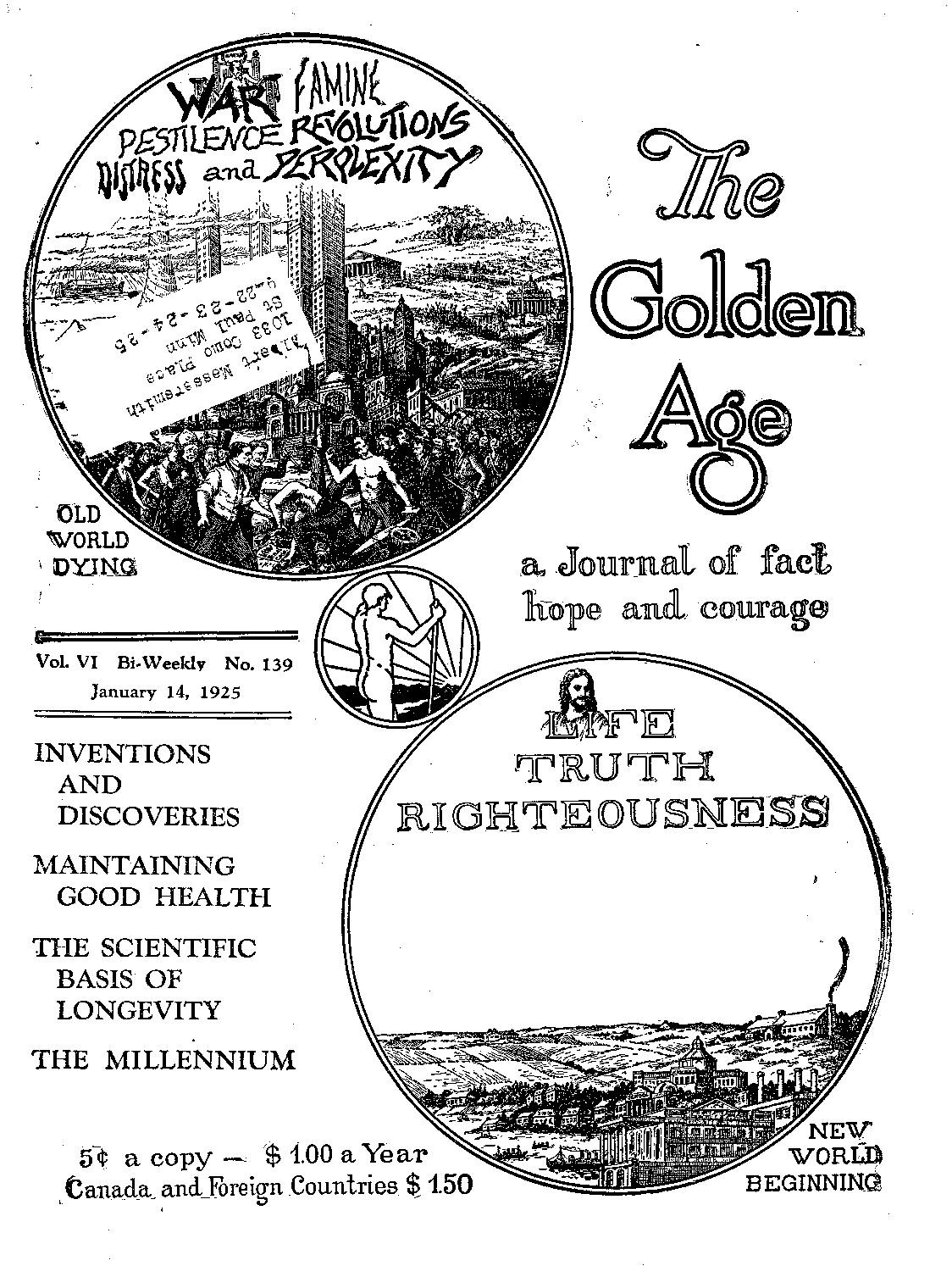
Contents of the Golden Age
............ WO
Labob and Economics Interesting Items of" American News
Labor Cost of a Ton of Coal ...
A Doctors’ Union
Social and Educational
Cooperation between Employer and Employes...... .
Rents Based upon Mortgages
Finance—Commerce—Transportation
New Financial Center in New York City
Bear Mountain Bridge
Political—Domestic and Foreign Good News from Florida
Transpiring Events at Washington
How Mb. Coolidge Came To Be President
Science and Invention
Something About Inventions and Discoveries .
Inventors Often Unrewarded
Inventors Need Common Sense
Some of the Inventions Desired
Renewed Interest in Water Power
Home and Health
Maintaining Good Health
The Digestion of Foods
The Scientific Basis of Longevity
Potassium Shortage
Religion and Philosophy Distressed When the People Learn
My Psalm (Poem)
The Oldest Text About Christianity
“We Clergymen”
Nominal Church Resorts to Extreme Measures to Keep Going 248 The Millennium
The Lord Rebukes Worldly Wisdom
The Brotherhood of Man (Poem)
Studies in “The Habp of God”
Published every other Wednesday at 18 Concord Street, Brooklyn, N. Y., V. S. A., by . WOODWORTH, HUDGINGS & MARTIN
Copartners and Proprietors Address: 18 Concord Street, Brooklyn, N. Y., V. S. A.
CLAYTON J. WOODWORTH . . . Editor ROBERT J. MARTIN . Business Manager WM. F. HUDGINGS . . Sec’y and Treas,
Five Cents a Cort—$1.00 A Year Make Remittances to THE GOLDEN AGE
Foreign Offices : British , . 34 Craven Terrace, Lancaster Gate, London W. 2
Canadian......... 38-40 Irwin Avenue, Toronto, Ontario
Australasian ....... 495 Collins Street, Melbourne, Australia South African......6 Lelie Street, Cape Town, South Africa
Entered as second-class matter at Brooklyn, N. Y., under the Act of March 3. 1878
The Golden Age
Volume VI Brooklyn, N.Y., Wednesday, January 14, 1925 Number 139
Something About Inventions and Discoveries
machine of 1846, Woodruff’s sleeping-car of 1856, Otis’ elevator of 1861, Westinghouse’s airbrake of 1869, Bell’s telephone of 1876, Edison’s phonograph of 1877, Edison’s incandescent lamp of 1878, Mergenthaler’s linotype of 1884, Eastman’s kodak of 1888, and Wright Brothers’ flying machine of 1903. All of these inventions also are epochal.
It is the British ancestry and the sudden changes of the American climate from extreme heat to extreme cold that have had most to do with making Americans inventive. It is literally true that necessity is the mother of invention. In a new country men must make one tool do the work of two.
Invention and Research
"MANY of the great inventions were purely accidental. Rather, we should say that they are to be attributed to the hand of God, the due time for them to appear having arrived. The invention of the cotton gin came about because a woman overheard some cotton planters protesting the great amount of labor required to gin the cotton by hand. She said to them: “Why not ask my friend, Mr. Whitney, to make a machine to do it? He can make a machine to do anything.”
The way the balloon came to be invented was that a French lady set her husband at work airing her gown. He tried airing it over a small fire, and noticed that when inflated it tended to rise. A half hour later he was sending up paper balloons, and subsequently he went up in a silk one.
The invention of the pneumatic tire came about by a length of rubber hose coming in contact with the wheel of a wheelbarrow. The stationary steam engine came into general use when a lazy boy discovered that if he tied a string to one of the engine parts he could make it move back and forth the slide valve which he had been paid to operate. A woman, simply
THE inventions that have changed the face of the world have been largely the work of the British and the Americans. To be sure, the world owes an incalculable debt to the Italian Marconi for his discovery of wireless, in 1896; but Italy has not been prolific of inventions.
The world owes a tremendous debt to France for the invention of the knitting machine by Jeandean in 1806, of the bicycle by Michaux in 1855, of the airship by Santos-Dumont in 1901, and for the discovery of radium by Madame Curie in 1898. But France is more noted for industry, economy, and style than for invention. The French are too industrious to be inventive.
In a sense the world owes infinite gratitude to Germany for Gutenberg’s invention of movable type in 1438, for the invention of Fahrenheit’s thermometer in 1709, and for Roentgen’s X-rays in 1895. But Germany’s inventions and discoveries as a rule have not been startling in their nature. They have been painstaking developments of inventions made by others, as witness the submarine.
It is when we get to Britain that we really get into inventive atmosphere. We have the steam engine of Watt in 1775, the iron plow of Small in 1784, the steel pen of Wise in 1803, the life preserver of Edwards in 1805, the locomotive of Stephenson in 1814, the calculating machine of Babbage in 1822, Guthrie’s use of chloroform in 1831, the discovery of the art of photographing on paper by Wm. H. Fox Talbot in 1839, Bessemer’s steel of 1856, and the rotary steam turbine of Parsons in 1891. All these inventions and discoveries are epochal, startling.
In the United States we have Whitney’s cotton gin of 1794, Fulton’s steamboat of 1807, Walker’s friction matches of 1827, Morse’s electric telegraph of 1832, McCormick’s reaper of 1834, Goodyear’s vulcanized rubber of 1839, Thurber’s typewriter of 1843, Howe’s sewing-227
changing the shape of a saucepan lid, made an invention that saves over sixty percent of the fuel used in cooking; for it prevented the waste of escaping steam and heat.
Some of Mr. Edison’s inventions have been accidental, but most of them have been the result of painstaking research and indefatigable industry. In searching for a filament for his incandescent lamp, he is said to have tried over eight hundred substances before he found what he wanted. Several years ago he had taken out more than nine hundred patents.
The greatest corporations now have their own research departments. The Bell Telephone Company owns literally thousands of patents, the majority of which were developed in their own laboratories. In these research departments highly trained men devote their entire time to studying industrial processes, trying to find a better, less expensive way.
It is research that has made the automobile what it is today. No expense has been spared to search out alloys of steel that ■would accomplish safely the service that is required of some automobile parts. A flaw in the part might mean death to the driver and the occupants of the car.
Inventors Often Unrewarded
IN Messrs. Bell, Marconi, Edison and Ford we see inventors turned into millionaires; but many excellent inventions have bestowed no material rewards upon those who brought them to perfection. Whitney’s invention of the cotton gin was stolen by a score of imitators; and though he was given $50,000 by the state of Georgia to recompense him for the great good he did to the state, yet it was insufficient to pay the lawyers he engaged to try to protect him in his patent rights. He made his living in other ways.
The inventor of the sewing-machine died worth $2,000,000, but his wife died from privations forced upon her while the machine was finding its way to popularity. At one time Howe himself was discharged from the works where his machines were being manufactured because he was not considered worth the $15 per week paid to him. At one time a half interest in his patent was sold for $500.
The inventor of roller skates made nothing out of his invention until just before his patents expired, when the country suddenly went rollerskate crazy and he became a millionaire. The inventor of the motion picture and the motion picture machine died in poverty in London in 1920, and was given a charity funeral by some who had made millions in the motion-picture industry. His name was W. Friese Greene. At one time he was imprisoned on charges growing out of his efforts to finance his inventions.
It sometimes happens that young mechanics or mill operatives make improvements which are valuable inventions, but do not know their value and part with them for nothing or for a song. A story is told that a person walking through the tape room of a Lancashire mill noticed that a taper had a device of his own on his machine which saved him work. The visitor asked all about the device, paid the taper a shilling, and subsequently made a fortune by patenting the device as his own idea.
It was five hundred years after the chemical discovery of ether before it was used as an anaesthetic to annul the shock of pain from the operating knife.
Encouragements and Discouragements
THE Miller-Reese-Hutchinson Company, Inc., Woolworth Building, New York, and the Society of Inventors, London, England, aim to provide facilities for poor inventors to complete their inventions, demonstrate their ideas, and gain legal and financial assistance in putting their inventions before the people. The London Society has 1,200 members all over the world.
On the other side of this proposition is the fact that most inventors lose out because they seek to interest others before their ideas have clarified even in their own minds. Some lose out because their patent attorneys are incompetent or crooked, and others because their ideas are worthless. Often a patent or series of patents amounts substantially only to the right to begin a series of expensive lawsuits, lasting from two to fifteen years.
The Patent Office is peculiar in that the laity cannot deal directly with it. The work must be done through lawyers, who usually receive $15 for filing an application and $20 for obtaining the patent. This is about the minimum. The Patent Office does not cost the public anything. The inventors pay the entire cost, and a great deal more, in their fees. In issuing a patent the Government does not guarantee anything. If there are infringements the inventor must fight for his rights in the courts.
Again, it often happens that after an idea has been patented it takes many years and several fortunes to get it into actual use. This was the case with the Cottrell multicolor press, the Ingersoll watch and the Blickensderfer typewriter. After the first patents were issued on the “Blick” it required an expenditure of $400,000 to fit it for the market.
Some patents are bought up by large corporations, and suppressed because better ways of accomplishing the same ends are subsequently found. No reasonable objection can be offered to this, from the standpoint of efficiency; but from the standpoint of public policy it is bad practice. It tends to make the great corporations ever greater, with a less and less chance for the common people.
Inventors Need Common Sense
IT SOMETIMES happens that inventors perfect a process for doing what nobody cares to have done, like the one who laboriously worked out the details of a plan to do away with metallic type in newspaper offices, only to find to his surprise that the same metal was used over and over again with no loss.
No doubt, too, most of our readers have heard of the man who invented a hen’s nest, so designed as to switch the newly laid egg out of sight, and thus bluff the hen into thinking she had not accomplished what she supposed, with a view of getting her to lay another in its place.
Perpetual-motion machines have caused six hundred people in Britain to part with their hard-earned money; and so many such machines have been offered for patent in this country that the Patent Office has a form letter which explains to the unfortunates that in the end their ideas will not work, and that they had better save their money.
Men have invented beds that would collapse unless lazy occupants rose at the proper time. Women have invented such useful articles as a cow-tail holder, a reinforced bowl in which to beat eggs, and an artificial eyelash, for which the immediate market is not apparent. However, artificial eyelashes may come into style at any moment.
No End to Inventive Genius
THERE will never be an end to human inventive genius. There will always be new things to discover, and plenty who will find their joy in trying to make the discoveries.
One of the clerks resigned from the Patent Office in 1833 because he was convinced that every possible idea had been invented and patented and that the office would soon have to close up shop. Since then, in one year, seventy thousand patents have been applied for. Four thousand a month is considered a small number.
The crazy idea of one generation becomes the home comfort of the next. When Thomas A. Edison first conceived the idea of the phonograph he thought it such a crazy idea that he even laughed at himself. Now in millions of homes the phonograph is the family’s source of entertainment.
A few years ago nobody knew anything about electricity, and nobody knows what it is even yet. But this strange force is now able to unmake the great cities which are such a blot upon the landscape, because all the comforts they furnish can now be distributed far and wide.
In the domain of war, invention has reached such a pitch that everybody now knows that our Lord foretold the exact situation confronting humanity when He prophesied of this day that “unless those days should be shortened there should no flesh be saved”. Even during the World War the Germans shot shells larger than a grown man a distance of seventy-fivo miles. But that is nothing in destructiveness to the new gas warfare. Every new scientific discovery gives rise to thousands of inventions.
Some of the Things Desired
SOME of the things that even now are wanted in the home are a furnace that will conserve most of the heat which it generates, a process that will make flannel unshrinkable, a key that will not lose its identification, a new game of skill, a plan by which house refuse can be easily and cheaply destroyed at home, and a greatly simplified clothing which is not strange in appearance.
In the mechanical arts there is desired a glass that will not bend, a motor engine that will not weigh more than one pound per horsepower generated, a method of reducing friction, an internal combustion turbine, a method of using atomic energy and the power of the tides, and an improved method of electrical storage and power transmission.
In the field of transportation there is desired a noiseless airplane, one that can be easily and safely managed by a boy or girl, a smooth road surface that will not be slippery in wet ■weather, a horse-shoe that will enable a horse to keep its feet on smooth surface roads, a motor headlight that will light the road surface without dazzling the eyes of others, and a means whereby a ship’s officers can inform themselves accurately of the position, speed and direction of approaching ships.
Some other things which are desired and upon which inventors are at work, as they are upon all the items just mentioned, are a process of instantaneous color photography, a selective method of radio communication with really sharp tuning, a method of conveying speech directly and readably to paper, and a means of regulating the rain supply or of inducing and preventing rain.
Social-Educational Inventions
ONE may go to a French post office, at any time since the first of the year 1924, write a letter on a revolving cylinder, illustrate the letter by charts or diagrams, and sign his name; and the whole matter will be received by telegraph by the person to whom the letter is addressed, with everything so accurately reproduced telautographically that the transmitted signatures are valid in court.
There is also now available but not yet in general use, a device for potting telephone messages. A calls up B, and finds him out. He sets in motion a recording instrument; and the message which he dictates is impressed upon a steel ribbon at the receiving end, which on being run through another simple device repeats the message as received.
Admiral Fiske has invented a vest-pocket machine which, if it comes into general use, will do away with fifty-nine sixtieths of the paper and ink now used in printing. A complete set of encyclopedias can be comfortably carried on the person and read with ease, all by a simple process of magnifying.
Another benefactor of the male species has invented a combined handle and rubber bulb which produces immediately and lays upon the face a rich lather, thus doing away with the old-time shaving brush. This device is said to be cleanly, and eminently satisfactory to those who have tried it. Some of the new shaving creams, put on with the finger tips, are also quick, easily applied and in every way desirable.
Agricultural Inventions
HE inborn desire of the Briton and the
Yankee to find some way to get work done without having to do it themselves will in time solve most of the problems of labor on the farm. Indeed, many of them have been solved already.
Ever since cotton was first used, the picking of it has been a drudgery. Now Mr. G. R. Bennett, of Wilkinsburg, Pa. has invented a machine which picks, cleans, and gins cotton in a single operation. This is bound to work vast changes in the South. It is estimated that the invention of this one machine will effect a saving of $500,000,000 a year. Concerning this invention the Pittsburgh Post naively says: “There is a possibility that some of the savings will be passed along to consumers of cotton goods.”
Another invention which is full of hope for the human family as a whole, even though it is filled with terror for the producer, is the container invented by Dr. H. Barringer Cox of Cleveland, Ohio, in which fruits and vegetables may be preserved indefinitely without the use of ice or chemicals, the earth’s magnetism being the preservative force.
Dr Cox has just died; and there is much wonderment as to what will become of his invention. He was a noted inventor; and this invention was declared by scientists who examined it to be simple, inexpensive, and practical. It would be an unspeakable calamity if his device should fall into the hands of the beef trust.
It is claimed that the new Hamshaw rotary plow pulverizes ninety percent of the soil in the first operation, chopping up all surface vegetation and mixing it thoroughly with the seedbed thirteen inches deep. It is expected that this will greatly reduce the farmer’s work of preparing his soil for seeding.
The invention of a Minneapolis man, Dr. Julius Hortvet, of the State Dairy and Food Commission, enables him to tell in eight minutes exactly what amount of water has been added to cows’ milk. This can be done, no matter how thin or how thick the milk was when first produced.
Inventions for the Home
San Francisco inventor named Eigholz has produced a non-inflammable, non-explosive and non-poisonous liquid which eradicates rust without the slightest injury to the metal; and which when poured upon the surface of ordinary wood, leaves no more effect than ordinary water.
A stainless silver has been discovered in England, and is actually on the market, much to the trepidation of dealers who are stocked with the old-style goods. They fear, and rightly so, that when people find that they can buy silver which never tarnishes, they will not purchase the kind that requires constant polishing to keep presentable. Any metal article may now be made stainless by an electro-deposition of chromium.
Inventions for Mechanics
lbert Oliver has invented a new machine for plastering which will do in one day as much work as is now done by eight men in the same time.
The thread from silk cocoons, hitherto unreeled by hand, is now unreeled by machinery, and may reduce the cost of silk to a point where it can compete with cotton and Hnen.
Richard Soderberg, of the Westinghouse Company at East Pittsburgh, has applied for patents for a device which controls the vibrations set up by small bodies revolving at high speeds. This invention is expected to prove of great value in railway and electrical work.
By means of the thermoinic valve it is possible to measure the two-billionth part of an inch or the one-billionth part of a second. By the use of this device, if a half grain of radium were to be divided into equal shares and distributed share and share alike to every person on earth, it would be possible to recognize any one of the shares.
Transportation Inventions
r. Alexander Graham Bell, inventor of the telephone, is credited with two important inventions in the field of transportation. One is a speed boat which literally flies over the water at a speed of seventy-one miles an hour. Another is a device for travelers crossing the desert. By breathing in air through the nose and expelling it through a glass tube into a bottle, as much as an ounce of water was obtained in an hour, sufficient to maintain life.
The rolling of steamships is counteracted by a U-shaped tank, placed crosswise of the vessel, and of such proportions that the period of oscillation of the water in the tank is exactly one-half the period of oscillation of the boat. As the ship tips one way, the water in the tank rises on the opposite side, with a steadying and quieting effect.
The Diesel motor is making such changes in shipping that as high as twenty-four men have been omitted from the crew of a single vessel after it has been equipped with these motors.
French aviators are said to regard as an event of the near future the mail airplane which will fly without a person aboard and deliver its cargo safely, guided to its destination by radio.
The necessity of some definite plan of traffic control has led a scientist to declare that within five hundred years all public thoroughfares will be underground and as smooth as a billiard ball. This seems like a wild guess, but it may be so. The present situation is intolerable.
Electricians predict that within the next six years the electric service will be doubled. This means that electricians will be called upon to create as much within that time as has been created so far in the entire history of the industry.
Mining and Sea Inventions
A NEW miners’ lamp has been invented which sings when the air of a coal mine contains more than two percent of firedamp, thus warning the miner of impending danger.
An engineer in Johannesburg has invented an automatic drill-sharpening furnace which, it is stated, will enable the profitable working of huge quantities of ore hitherto considered Unprofitable.
A Frenchman, M. Eugene Royer, has invented a device which enables a diver to light and operate an oxy-acetylene flame at a depth of 1.30 feet below the surface, and to saw through thick steel plates at the rate of fifteen inches per minute, or six times faster than by the old methods.
A Norwegian, Captain N. A. Lybeck, has constructed an apparatus which attracts fish by a powerful searchlight, catches them by a paddle wheel rotating at great velocity, and literally showers the deck with fish as the boat moves through the water. It is claimed to be the most efficient fishing device ever tried.
Power Transmission Inventions
IT WAS only fifteen years ago that electrica^ transmission of power was first attempted. The first transmission was over a line thirteen miles long. Today, in southern California, 220,-000 volts are transmitted 250 miles.
William Emmet’s invention of the mercury boiler is hailed as the most important since the steam turbine. It is hoped to drive both by mercury7 vapor and by water vapor from the same fuel source, resulting in a gain of about fifty percent in the work obtained from the fuel used.
There is an urgent need for economy in fuel. It is stated that at present out of 2,000 pounds actually exploited, 600 pounds of coal are lost in mining, 126 pounds consumed at the mine, 446 pounds go up the stack in gas, 102 pounds go into the ashpit, 650 pounds are lost in converting heat into power; and that only 76 pounds actually perform the work intended.
Inventors express themselves as thinking that discoveries along the lines of power production and power transmission mean more to the world than do any other. Samuel Insull, for many years Edison’s private secretary, believes that the age of transportation is now merging into the age of power.
With sufficient power at their disposal mankind can do almost anything. French engineers have estimated that with a unit of electricity equal to one horse-power for forty-five minutes sufficient power is developed to make nine pounds of ice, or boil two gallons of water, or grill fifteen cutlets, or plow one hundred twenty square yards of land a foot deep, or thresh one hundred forty sheaves of wheat, or make four hundred pounds of butter, or pump a thousand gallons of water into a tank fifty feet above ground, or light for twenty-five hours a hall thirty feet wide and fifty feet long.
Renewed Interest in Water Power
HE great things that have been done for the people of Ontario by the Hydro-Electric Power Commission are causing sane people on this side of the line to sit up and take notice. For $1.25 per month the Canadian within the territory covered by the Commission can light his house, wash his clothes, and cook his food. It used to cost him seven times as much.
The United States has a Federal Power Commission, struggling along with eighteen clerks and twelve other men, entrusted with the leasing of Uncle Sam’s water-power sites to private corporations. There is enough water power going to waste in the United States to do all the work of the country.
Experiments at Pittsburgh have demonstrated that 1,000,000 volts can be loaded upon a wire, and that with such a load electricity can be safely and economically transported a thousand miles. This means that no matter how remote the source of power it can be made to do useful work. A plant in the mid-Rockies would furnish power to any point west of the Missouri River; one in the mid-Appalachians, to any point east of it.
America is far behind Europe in water-power development. Perhaps three-fourths of the water-power sites of Switzerland, France, Germany, Italy, Norway, and Sweden are in use, while in New York State only about one-fourth is used. America has 35,000,000 horse-power undeveloped water power.
California is the most advanced of any Amer-~ ican state in the use of its water sites. It has an unbroken interconnected system twelve hundred miles long; and the Edison Company of Los Angeles is about putting another project into effect near the Imperial Valley that will cost $100,000,000.
Searching High and Low
HE search for power extends up into the clouds and down into the bowels of the earth. A German professor named Krist thinks that he has found a way to cause the upper atmosphere to discharge constantly its electrical energy and tension into receiving stations located upon terra firma; and that if his plans can be sufficiently developed, electrical storms will disappear. The Plauson plan, as it is termed, would require the use of batteries of stationary balloons, with metal covered surfaces. The first cost would be high.
The internal heat of the earth has been used in volcanic regions in Italy, Hawaii and Bolivia; and it may be used soon in California and some other American states where the earth’s crust is broken. But it does not seem possible to break the crust except where nature has assisted. It is estimated that at five miles depth we should reach 1,000 degrees Fahrenheit, which would give us superheated steam; but the deepest well ever bored never went deeper than a mile and a half.
Tidal power is utilized a little, in a few places. There are one or two points on the Pacific Coast and a few places in Europe where the tides are used; but the contrivances are admittedly clumsy makeshifts. Impounding of tide waters is declared impractical. Here is a problem of which inventors have not yet found the key. The power is there; but how to make a wise use of it appears not.
At a point in Utah where the winds are always vigorous there has been installed or will shortly be installed a gigantic wind turbine weighing 246 tons. Surplus power will be conserved by a system of electric storage batteries. This source of power might be much more widely used.
It is significant that Marconi and Steinmetz have both expressed their confidence that the ultimate source of power for mankind will come from the discovery of a way to utilize atomic power. Indeed, a Leipzig engineer reported in 1920 that he had actually discovered it; but as far as the public are concerned, the invention is still in the making. If this discovery is ever made, it will put an end to all transportation and power problems. A man could then carry on his person enough stored power to drive an aeroplane around the world.
We have no doubt that the Lord will permit such a discovery some time soon, perhaps just a little while before man is fit to use it. That seems to be the Lord’s way. Man knows so much about war now that he is afraid of himself. He knows that he has it in his power to destroy his race. In due time the Lord will teach him to use his powers for the good of all.
We close with reference to a new method of transmitting power discovered by a Rumanian professor. We have had five methods in use: Steam, direct mechanical, electric, compressed air, and hydraulic. The professor discovered a wave power which travels at the speed of sound through water, i. e., at about a mile a second ; and which will do, without danger of fire or explosion, anything that can be done by an alternating electric current. He discovered this through experimenting with a violin string. All of this goes to show the curious way in which inventions come about.
We cannot say that the Lord set the professor to playing with the violin string, although He might even have done that. But we do think that the Lord’s due time had come to make the secret known, and that He used such an instrumentality and such a method as suited His own purposes for bringing the truth to the light of day. He has done this regarding His plan of salvation, the greatest and best of all discoveries.
Distressed When
NOTHING distresses the clergy so much as to have the people learn anything about what the Bible teaches respecting the wages of sin. When the people find that the Bible really teaches that the wages of sin is death and not eternal torment, the clergy business ceases to be a paying proposition. This is the true explanation of the following despatch from Gadsden, Alabama, which appeared in the Birmingham News recently:
“Negroes of Gadsden, Attalla and Alabama City will gather at the Mt. Zion Church in Attalla Sunday after-
the People Learn
noon at 2:30 o’clock to burn a lot of books said to teach that there is no actual hell, that there is no eternal, conscious torture.
“It is said that the preachers and leaders among the Negroes of the three towns recently learned that many such books had been sold, and that they might have a bad influence on many of the race. As a consequence they went around and collected the books; and Sunday the volumes will make a big bonfire. It is said that the pastors of the white churches, at least of the Methodist and Baptist, will deliver addresses at this unique ceremony.”
Interesting Items of American News
[Radiocast, with other items, from Watchtower WBBR
Social and Educational
N OFFICIAL of the American Federation of Labor, testifying before a Senate committee, furnished the interesting information that the labor cost in a ton of anthracite coal, which sells in New England for $16 per ton, is $2.40. High cost of finance! Eh! What!
In the year 1919 the employes of General Motors Corporation saved and invested in the company’s savings and investment fund the average sum of $97.60. The company has just made a settlement for these loans, resulting in an average return to each investor of $292.70. The corporation adds fifty cents to each dollar saved and invested by the employe, and assures employes a minimum return of better than twenty percent a year for the five-year period.
The doctors of Washington have organized a union, officially known as the Medical Society of the District of Columbia. The rates for consultation vary from $2 to $10 and for major operations from $300 to $5,000. It is against the rules to diminish the fees except for motives of charity and benevolence. Offenders against the members will be blacklisted. Members agree to assist one another in the collection of obligations.
Near Syracuse, New York, a few days before Thanksgiving, thieves stole from an old man ninety-five years of age his flock of turkeys, upon which he depended for his support. A man who would stoop to so mean a robbery is in a class with the man who holds out to his fellows a prospect of eternal torture after their having lived and died in wretchedness and misery in this life.
Having millions more than he knew' what to do with, Joseph Leiter, a Massachusetts gentleman, foresaw prohibition coming and stocked his cellar with $50,000 worth of high-priced tanglefoot, only to have some ungracious hijackers invade the premises in his absence, break in his front door, and carry off all his wild juices in a truck. From now on he will have to depend upon the more or less regular, and more or less unsatisfactory, services of professional bootleggers.
In the city of Washington, D. C., there are thirty-three apartments that are mortgaged for nine million dollars more than they would sell for in a fair market. The tenants, few of whom on a wave length of 273 meters, by the Editor] could rightly be said to be overpaid if they work for the Government, are compelled to pay rents based upon the interest requirements of these mortgages; and two thousand of them have begged the President to give them army tents and places to camp in the parks so that they may not have to give all their earnings to the usurers.
Mary A. Kellogg, of Washington, D. C., writing to Labor, of that city, says: “I moved into the Clifton Terrace apartment house in 1920. My apartment has one room, a kitchenette and bath. I paid $27.50 a month when I moved in. I am now paying $40. I have received notice (three days after election) to sign a new lease at $55 if I wish to keep my apartment. My annuity from the Government, as retired employe, yields $55.16, a month. If I pay the rental now asked, it will leave me sixteen cents of my monthly pension.”
Finance and Transportation Items
EW YORK is developing a financial center around Fifth Avenue and Forty-fourth
Street, in the immediate vicinity of the Grand Central Station. In 1906 there were only five banks in this section. Now there are more than one hundred of them, twenty-five of this number being within one block of the point indicated. One of these banks, the Harriman National, has just paid $304 a square foot for an adjoining property, the highest price ever paid for land in New York. The bank will erect a $5,000,000 structure on the site.
At the close of 1923 sixteen of the great American corporations held cash and investments totaling $1,200,000,000. The steel trust headed the list with $346,000,000; the General Electric was next with $91,000,000; then came the American Telephone and Telegraph with $88,000,000, the Standard Oil Company of New Jersey with $87,000,000, the General Motors with $84,000,000. It is anticipated that the cash on hand at the end of 1924 will be still greater.
The foreign loans in the United States during 1924 were three times the total foreign loans of 1923 and twenty-five percent more than in any previous year. Since the close of the war the total foreign loans in the United States amount to over four billion dol-
lars, or about $40 for every man, woman and child in the country.
At least one Construction Company operating New York is paying off its men with money sent by airplane, fearing the holdups now so common on the highways. This is all right and ought to work well, until some hijacker who learned how to manage an airplane during the war concludes that he should turn his talent in that direction.
The motor vehicles of the United States travel three hundred million miles daily during the month of heaviest traffic, which is July. This information is gleaned from the amount of gasoline consumed. Where the roads are good, the same amount of mileage can be covered for seventy cents that will require one dollar where the roads are bad.
The Bear Mountain Bridge, fifty miles up the Hudson from New York, was opened on Thanksgiving Day, on which occasion five thousand automobiles crossed the bridge, connecting Peekskill with the western shore of the Hudson. This bridge has a total length of 2,257 feet, making it at this time the world’s longest suspension bridge.
The fastest distance run ever made was on the Lake Shore and Michigan Southern Railroad, between Chicago and Buffalo, October 25, 1895. The total weight of engine and train was 408,000 pounds. It made the 510 miles between Chicago and Buffalo in 7 hours, 50 minutes and 20 seconds, an average speed of 64.8 miles per hour. Between Erie and Buffalo it reached a speed of 92 miles an hour at one point.
Governmental Notes
IN THE christening of the ZR-3 the age-old custom of breaking a bottle of champagne on the bow of the giant airship was set aside. Reports had it that not even water was used, and certainly no one can say that any reason exists why any should have been. The reports at hand stated that the ceremony of christening would probably consist of Mrs. Coolidge’s pulling some ribbons and releasing some pigeons. This seems an eminently fitting ceremony. The old champagne custom was foolish, and harked back to the days when wine flowed freely everywhere.
There is good news from Florida. A county -sheriff, a county judge, and two deputy sheriffs have been indicted by a federal grand jury on a charge of peonage; and along with them there are also in the toils of the law two turpentine operators, a commissary manager and a bookkeeper. These folks could have kept out ofl trouble by subscribing to The Golden Age, and reading the thrilling expose of conditions there a few years ago, and the steps taken by the good people of Florida at that time to prevent a recurrence of such scandals.
Major W. O. Watts, former head of inspection service of the Veterans’ Bureau, District No. 2, is reported as having resigned because he could not see the wisdom or justice of a system which necessitated an average outlay of nearly $1,000 to pay $10 compensation to a disabled veteran. He thought that something ought to be done to cut down the expense and so resigned. He made a mistake. He should have stayed in, and made the other fellows resign. If the country had a few more real patriots like Mr. Watts the costs would come down, sure.
If Uncle Sam gets into another war he expects to save at least a billion dollars by getting into it so quickly that the other fallow will wonder how it happened. This, in effect, is alleged to have been the end in view When Mr. Gary of the steel trust, Mr. Schwab of Bethlehem, and other great industrialists visited West Point on November thirteenth and consulted with experts there as to the initial steps that would be taken in event of a new war. In Chicago, the day previous, 148 men were mobilized by radio inside of two hours.
In collecting the data from which its cotton crop reports are completed, the United States Department of Agriculture makes use of seven hundred county reporters, each of whom has four or five assistants. Then it receives reports from 16,000 cotton gins, 12,000 cotton planters, 1,000 rural carriers, and 15,000 special reporters ; such as bankers, merchants, etc.
Carl Thompson, Secretary of the Public Ownership League, asks the following questions: “If the city of Tacoma has found a way to deliver electric service to its people for one cent a kilowatt hour for cooking and heating in their homes, is there any reason why Tarkio and Trenton should not hear about it? If Cleveland has found a way to deliver electricity to its people for 3 cents a kilowatt while others pay 9, is it a crime for Chillicothe and Corning to hear about it? And if Ontario has discovered and applied the principles of a new system in the electric power field whereby a whole state is served with power at one-third the cost elsewhere, must the very pillars of the republic be pulled down rather than allow Osage, Onawa, and Odeboldt to find out about it ?”
Science and Health
ON THE night before Thanksgiving numerous European broadcasting stations were heard in various parts of the North American continent. Winters, California, received London, England; Regina, Saskatchewan, received Turin, Italy; Yakima, Washington, received Newcastle, England; Sedalia, Missouri, received Aberdeen, Scotland; Duluth, Minnesota, received Madrid, Spain.
Before shooting any more birds it would be a good idea to look up what the Department of Agriculture has to say about mice. In one Kansas orchard five thousand trees were girdled and ruined in a single fall before the middle of December. A mouse has no sense. It starts to gnaw, and gnaws clear around the tree in a circle until the tree is ruined. The natural foes of mice are owls, hawks, shrikes, cranes, herons, crows, and magpies. Foxes, skunks, raccoons, and weasels also give them plenty of excitement.
Dr. Charles H. Mayo, one of America’s most successful surgeons, announces that two Australians have discovered a method of curing rigid paralysis, which he has tried several times within the last year with success. By removal of certain sympathetic nerves, the patient’s ability to change his position quickly is restored; and after the operation the patient usually gains in muscular power.
One kind of trouble at once is enough for most people; but in the wholesale drug business they now have to keep track of 50,000 proprietary articles, each one of which is supposed to be good for something that ails somebody. The human family as a whole would be better off if they would dump all these on a scow, and take the scow out to sea and sink it.
When a horse has a holiday its caretaker, if he is wise, cuts down on its feed. When a human being has a holiday, he proceeds to stuff himself about twice as full as usual. The natural result follows that after every hohday, within about forty-eight .hours, there is always a marked increase in the number of sudden deaths of persons over forty years of age. After last Thanksgiving Day there were sixteen such deaths in New York city in forty-eight hours.
Miscellaneous Items
DMITTING, as all must, that the farmer is not the one that gets the money for the wheat which he produces, a hint as to the real situation is afforded by the organization of the $500,000,000 bakers’ trust, and the statement of its chairman: “The business of baking bread and cake looms brightly on the horizon of business enterprise. It is classed high in the scale of industries in the United States, and yet the baking business is in its infancy.” The new corporation plans to take over bakeries in all large cities of the United States.
A showman in Philadelphia was using three elephants in a vaudeville stunt, but they broke loose and put on an act not on the program. They became frightened at a balky automobile, broke their chains, and started to explore the city. It was breakfast time; and they came in through the back door of a house, taking the door with them. Incidentally they had smashed a fence on the way. Arrived in the kitchen, one of them was burned by the stove and became peevish, mussing up all that part of Philadelphia. They were finally captured.
Thousands of ducks, returning from their northern haunts to winter homes in the tropics, have lost their lives this past season by alighting in tanks of oil, mistaking these for water tanks. The oil permeates their feathers; and they never rise again even if, as is sometimes the case, they do manage to flop over the edge of the tank to the ground below. What a warning is this to the Teapot Dome oil magnates! Or is it?
Religion—Professional and Amateur
NDER this heading an editor, who might have put his time and space to better use, has collected some supposedly wise sayings of Bernard, Augustine, Faber, Galway, Hehel, and Caesarius to tell what a bad place purgatory is—a place not once mentioned in the Bible. The editor should have headed his article differently. It should have read “Unsanitary Thoughts”, instead of “Salutary Thoughts”. Fear always does harm; never does it do any good.
God dwelleth not in temples made with hands, said St., Stephen, just before martyrdom. Nevertheless Bishop Manning wants a twelvemillion dollar collection in January, so that he can complete the Cathedral of St. John the Divine; and he tells why he wants it, as follows : '
“The cathedral which we are now to build will bring the Church again into view. Standing on these heights, where nothing can obscure or hide it, with its great central tower rising 500 feet from the foundation, this great building will bring the Church back into the place which belongs to it in the sight of all the people.”
With a gasp we can only express our wonderment at what has become of the church built by jhe Carpenter of Nazareth and the fishermen and tax collectors of Capernaum and Bethsaida. Is it possible that they erred in not erecting a great cathedral with a steeple a mile high? Maybe so; but we wonder!
Referring to the acceptance of an ex-Baptist into the Presbyterian ministry in New York, and to his so-called Modernist answers to questions propounded to him, the Progress-Index says: “It will strike the average layman, perhaps, and certainly the average non-professor of Christianity, that a man who does not believe in the story of the Virgin birth, who does not believe the story that Christ called forth Lazarus from the tomb, and who believes that Joseph was the physical father of Christ, has no place in a Christian pulpit.” While the choosing of this so-called minister of the gospel was going on, the clerk of the session was obliged to say to the assembled clergymen, in an effort to control their boisterous outbursts of applause: “This is no tennis tournament, or ball game, or prizefight. This is a most sacred meeting; and I am ashamed of you men. You are acting disgracefully.”
My Psalm By J. a. Whittier
I mourn no more my vanished years: Beneath a tender rain,
An April rain of smiles and tears, My heart is young again.
The west winds blow, and, singing low, I hear the glad streams run;
The windows of my soul I throw Wide open to the sun.
No longer forward nor behind I look in hope or fear,
But, grateful, take the good I find.
The best of now and here.
The woods shall wear their robes of praise, The south winds softly sigh,
And sweet calm days, in golden haze, Melt down the amber sky.
Not less shall manly deed and word Rebuke an age of wrong;
The graven flowers that wreathe the sword Make not the blade less strong.
But smiting hands shall learn to heal, To build as to destroy;
Nor less my heart for others feel That I the more enjoy.
All as God wills, who wisely heeds To give ot to withhold,
And knoweth more of all my needs Than all my prayers have told.
Enough that blessings undeserved Have marked my erring track;
That whensoe’er my feet have swerved, His chastening turned me back;
That more and more a Providence Of Love is understood,
Making the springs of time and sense Sweet with eternal good;
That care and trial seem at last, Through memory’s sunset air, Like mountain ranges overpast, The purple distance fair;
That all the jarring notes of life Seem blending in a psalm,
And all the angles' of the strife Now rounding into calm.
And so the shadows fall apart, And so the west winds play;
And all the windows of my heart I open to the Day.
Transpiring Events at Washington By 'J. L. Bolling
THE Washington post-office used extra help J- to take care of the annual Christmas rush. Sixty extra trucks were employed to handle the increase in parcel post packages, and 450 clerks were added to the regular force. Between December 15 and 25 increase in letter mail is about 200 percent, and in parcel post 400 percent. The Washington post-office handled 9,500,000 letters and cards during this short interval last year. Three million of these were deposited December 21 and 22. There were also 180,000 large packages and 59,000 pieces for special delivery. Washington, according to the Postmaster General, mails out more Christmas mail in proportion to its size than any other city in the U. S. This is occasioned by the fact that more people live here whose home-folks are scattered all over the Union.
Despite the storm of protest in Washington and elsewhere, the U. S. S. Washington, superdreadnaught and first-line battleship, was towed from the League Island Navy Yard at Philadelphia, to the Virginia capes, on November 12, and after several days bombardment, was sunk in compliance with the Naval Disarmament Treaty with Great Britain, Japan and France. Desperate efforts were made in the courts here to save the great ship, which was 85 percent completed; but to no avail. Complaint was registered in the court by William B. Shearer, naval expert, that the sinking of the Washington represented a waste of the taxpayers’ money. He sought a “restraining order”, or injunction, against the proceeding on this and other grounds. But Secretary Wilbur was immovable in his determination to send her to the bottom. •
On Armistice Day President Coolidge visited the tomb of the “Unknown Soldier” at Arlington and placed a wreath on the same. Memorial services were also held in honor of Woodrow Wilson at the crypt in Mt. St. Albans Cathedral. It seems that there should be no soldiers unknown, in view of the finger-print system now in vogue. By a process of elimination in these files it would be easily possible for an expert to determine this soldier’s full name, birthplace, date of birth, parents, educational attainments and age.
During the Galveston flood an unidentified man was found drowned; his fingers were cut off and sent to Washington. When they arrived the skin had slipped off; but the expert made wooden fingers, pasted the skin on and in less than five minutes completely identified the man as an enlisted soldier !■
Lee Turner, an Indian prospector recently called on President Coolidge with reference to a gold mine which he claims to have discovered on land once in possession of Chief Geronimo, but which subsequently was taken over by the Government, and upon which Turner has staked out a claim. He hopes to secure the assurance of the President that he will be protected in his rights. It will be interesting to observe the outcome. As a rule, the Government cheats the Red Man, and it would be surprising if this lone Indian should receive fair treatment.
The Pension Bureau announces that there are 10,548 retired civil service employes drawing annuities at the close of the past fiscal year, in comparison to 9,334 for the previous year. The Bureau also states that there are 14,217 fewer pensioners on the Government rolls than last year. In 1924 it declares that $229,994,777 were paid out for pensions, as against $263,012,500 in 1923.
It is reported that the President will retain his present cabinet, and it is also stated that there will be no change in the new administration from that of the past fifteen months of his incumbency. It is declared that a great business boom is under way, as a result of the triumph of “conservatism”.
The United States Coast Guard has been organizing to fight the rum fleet along the Atlantic and Pacific coasts, and now announces that the end of the fleet is near. The Coast Guard has been enlarged considerably, and officials aver that the international purveyors of liquor can not hold out long against the organization. It is said that the worst localities at the present time are along the Atlantic coast from New England to the Chesapeake Bay, the Florida coast, Gulf of Mexico and the Southern California coast. The Coast Guard has put into service twenty old destroyers,
which have been reconditioned and revamped for the new service. Some idea of the herculean task which devolves upon this service is seen in the fact that it has something like 10,000 miles of coast line to patrol, all of which is menaced by the rum runners.
The Bureau of Standards, in cooperation with the Arlington Wireless Station, recently succeeded in setting the clock at the Bureau by wireless. It is announced that all clocks will eventually be regulated in this manner by wireless! Truly, the Millennium draws on apace!
How Mr. Coolidge Came to be President
[“The Arbitrator,” in its issue of November gives the following interesting information as to how Mr. Coolidge came to be President:]
IN 1919 the Boston police were working from
73 to 98 hours a week for comparatively small pay. In July 1,100 police joined the American Federation of Labor and Police Commissioner Curtis filed charges against 19 of the officers of their local union. Mayor) Peters appointed a committee of 34 citizens to investigate. They reported that the police should not affiliate with the A. F. of L., but that they were “shocked and humiliated” at the conditions under which the men were working. They suggested a compromise and, receiving no reply from Curtis, appealed to Governor Coolidge to avert the impending strike. He replied that it was not his duty to get mixed up in it, so he did nothing, although the Commissioner of Police was appointed by the Governor and not by the Mayor. On Sunday, September 7, the citizens committee endeavored to submit to Curtis a plan approved by them and the policemen’s union, but the Commissioner could not be found. Then they attempted to find Governor Coolidge, but he was away also at this critical period. Some say he was conferring with Curtis and that neither wanted the strike averted. Failing to find the Commissioner or the Governor the committee showed the plan to the newspapers and obtained the endorsement of eight editors. Mayor Peters told Curtis he approved of the plan, but Curtis dismissed the 19 policemen on September 8, and the strike which could have been avoided became inevitable. The Mayor and the committee then notified Governor Coolidge of the seriousness of the situation and requested 3000 troops to be present in Boston on the following day. Coolidge did nothing.
Commissioner Curtis insisted he was prepared to handle the situation with men he had been drilling, and it was not until after this assurance had been made public that the police voted to strike. About noon of Tuesday, Coolidge sent a letter to the Mayor refusing to take action and adding, “There is no authority in the office of the Governor for interference in the making of orders by the Police Commissioner. ... I am unable to discover any action that I can take.” Thus, in the fourth instance, Coolidge refused to act. At 5:45 P. M. the same day 1,100 policemen walked out. Curtis did not call the new men into service; and at 6 o’clock rioting began, continuing during the night without check. It is not known where Coolidge was that night, but he took no action to quiet the disorder. On Wednesday, Mayor Peters called out the State guard and restored order. He suggested to Curtis and the police that a compromise be made, but Curtis and his attorney Parker refused. Then Coolidge wired1 to Samuel Gompers, “There is no right to strike against the public service by anybody, anywhere, anytime.” He refused to consider the settlement proposed by the Mayor and increased the troops to 10,000 with 1,000 naval militia. 20,000 stands of new army rifles were shipped in from Camp Devens. Curtis advertised for new policeman at $500 more than the old men had received. Thirteen men were killed, some by the raw militia, and the loss of property was large. The cost to the State for the National Guard was $1,000,000 and the subsequent increase in police salaries was $700,000, although the strikers would have been satisfied with $227,000. The citizens committee reported, “By Thursday morning order had generally been restored in the city. On Thursday afternoon the Governor assumed control of the situation.”
As usual, the public did not know the facts, so elected Coolidge Vice-President.
Maintaining Good Health
[Radiocast from station WBBR on a wave length of 273 meters by C. E. Stewart.]
PEOPLE die in three ways: They die morally, they die mentally, they die physically.
The penitentiary, the asylum, and the hospital are from one viewpoint the ante-chamber of the cemetery. Moral delinquency is the worst of all diseases; mental disorders lead to all kinds of depravity; but physical ailments result from abuse and the wearing out of our organic machinery.
The penalty of death came upon the race legitimately; and in the dying process weaknesses and disorders have multiplied ..as the natural concomitants of the edict, “Dying thou shalt die.” Alienation from God, ignorance respecting the laws of nature, imperfect foods and the wrong method of their preparation, have all contributed to undermine the constitution of man, debilitating him, and rendering him unfit to meet the exigencies of life with the vigor and hardiness that one might reasonably expect of our enlightened age.
When a person is sick physically, he is ailing mentally to some degree; for when the human organism is diseased or sluggish there is bound to be a reaction upon the mental faculties. Reversely, when a person violates his conscience or wilfully perverts his reason, there is an influence or chemical action set up in the physical organism which is debilitating, however little it may be noticed. We quote:
“The mind could not be perfectly sound, while supported and nourished by an unsound body. The deranged stomach of the dyspeptic has a direct effect upon his mind, as well as upon his entire physical system. The person whose lungs are diseased cannot avoid a degree of mental impairment corresponding. Likewise, when other organs—the heart, the liver, the kidneys—are diseased and perform their functions imperfectly, the effect unquestionably is disordered blood, and a disordered nervous system, the center of which is the brain. Likewise the brain that is harassed by pain or that is imperfectly nourished through malnutrition or fevered through failure of the action of the secretive organs, is sure to be impaired in all its various functions; it cannot think and reason as correctly or as logically as if in perfect condition.”
If it hurt as much to have a mental or a moral ache as it does to have a physical ache, perhaps some would be more careful how they used their thinking machines. A tender conscience would gi ve grave concern, but many consciences are calloused. But we shall not now treat of mind and heart disorders particularly. Confining ourselves to the care of the body is our present privilege. According to the Bible, the time is coming in Messiah’s kingdom when there will not be a sick person in all the world, either mentally, morally, or physically. The imperfections we now have will all be eliminated during Christ’s reign; but when that time comes, it will require the cooperation of the individual himself to reap the benefits of the change. Meantime, let us do what we can do to get well and to stay well.
The increase of knowledge, peculiar to our day, makes it possible for us to glean something of the remarkable composition of man, his various organs, the way they function, and what is necessary for us to eat in the rebuilding of bone and tissue. There are many theories, but all of them register their failures. Each of us has an internal machine peculiar to himself ; and only by experimentation is it possible to approximate what gives the best results in each individual case. Set rules are disastrous.
The Digestion of Food
TRONG and heavy foods that are hard to digest should be taken only by those who have strong digestive organs and who have need of such food to maintain the normal condition. Light and easily digested foods should be the portion of the younger generation. Some parents feed their youngest children on a little of everything that is on the table, thus paving the way for a broken-down digestive apparatus later on. Light foods are good for all classes; for the stomach needs to rest. This is a fact that few people seem to realize.
…