Golden Age, December 3, 1924
Download: PDF — Golden Age, December 3, 1924
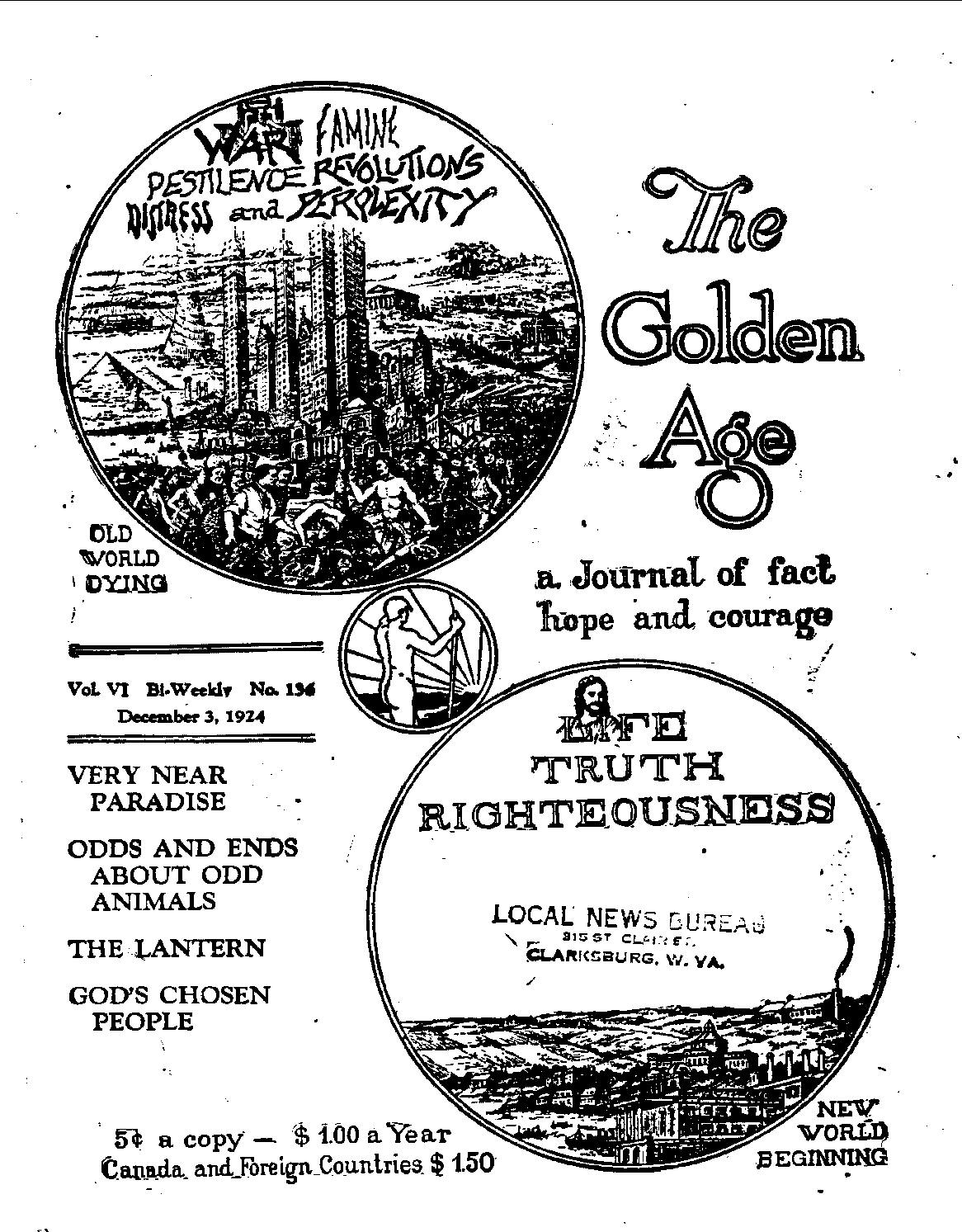
TRUTH
RIGHTEOUSNESS
*11. ’in
THE LANTERN
VERY NEAR PARADISE
ODDS AND ENDS ABOUT ODD ANIMALS
GOD’S CHOSEN PEOPLE
Vol VI Bl-Weekly No. IM Decembers, 1924
a copy —* $ 100 aVear
Canada.. andJoreign-Countries $ 150
OLD WORLD
a. Journal of fad
LOCAL NEWS GL>
CLARKSBURG, w. yjk
NEV VO
Contents of the Golden Age «—===■ ===*^l "■
T.iw ABB Tjnmrnwma
Intumiins Bns or NWws
Salaries at League Officials
PVBUC EMPLOYMENT Ohich Lum
Pocxitcal abb Social UnmetA Svwann Con . . i . . . . 138
Social aid Educattobal
Fatal Accident! in Highways Inoease ...".......
Bnidds among Child Immigrants in Canada
Peoebam os BaoADCAsmrs
I*~~~ C'HISEIT T~-RTTEBTITIW
States Double their Debts
Zionists to Hare a Steamship Uns......-.....
America and Britain Slowly Changing Places
German Bonds Go with a Bush
Ford’s Muscle Shoals Offer Withdrawn ...
Pna ar Gebat Stages or Gau (Poem)
To Atzam ana Manrranr a Wosu Peace
Foss's Rattjoab a Monbt-Makeb
i Poutical—Domebtw abb Paunar
New York to Peking in Sixty Hous.....
Reposts non Fowier Cobxxstohimsts—India, Canada . ... . 148
Tn Holt Fateh and Pannes
Aqkculturb abb Husbandry Odm ass Enm about Odo Animau ........... a 14T
Txatbl abb Miscellany *Ybt Nkaa mn T—bestbiit. Pabameb” ....... , . . . 137
Bblkhob abb Philosophy
Whem ass Wb Garnef ........
“Angels and Women” .................
\ ’■pywanwaar.n FULFILMENT OT PtOPHECY .......... ,151
Blemino Automoshm
The Lantebn
Who Pats ths Durf
Goa's Cxosaw Psons
Studies m “Tas Ham ar Goo”
PnbUabad wary other Wedaesday at 18 Concord Street, Brooklyn, N. Y„ XT. 8. A^ by WOODWORTH. HCTGING8 A MARTIN
Cepartaws and Brpprisiors Addrsse.- It Concord Street, Brooklyn. B. Y, TJ.3.A.
CLAX9OU L WOODWORTH . . . Editor ROBERT J. MARTIN . Reaiaeee Manaaar
WM. T. HDDQDW8 . . EoTy and Trees.
nea ons a Cwt—11.00 a Tana Man uawum to THB GOLD1H ash
names Olinsi BrMah.....M Oavan Twracs, Lancaster Gats, Loadoa W. S
Vaeodtaa .... ... 38-40 Irwin Arsons. Toronto, Ontario
Asatrsls.lon ....... 484 Collins Street, Melbourne, Australia Seath A/rieos......4 Leila Street, Cape Town, South ATrlea
BatSMd as ri—-----matter at BfiWIy. B. T, aadar the Ast st Marek A ASTS
The Golden Age
VoImm VI
Brooklyn, N.Y., Wednesday, December 3, 1924
Nanler 3* caaBBM
Interesting Bits of News >,
[Radiocast from WATCHTO Wkm WBBR on a ware length of 273 meters, by the Editor]
States Double Their Debts
ANYBODY can get into debt, but it takes a wise man to get out and to stay out. From 1915 to 1922, the net debt for the states of the United States more than doubled, and is now close to $1,000,000,000; while the per capita net debt advanced from $4.31 in 1915 to $8.12 in 1922.
150-Year-Old Grape-Vine Bears 600 Bunches
A GRAPE-VINE in Hampton Court, England, planted in the reign of George II, produced 600 bunches of magnificent hot-house grapes this season, some of the bunches weighing more than two pounds apiece. Constant pruning of the vine is necessary in order to prevent it from exhausting itself.
Zionism to Have a Steamship Line
THE Zionists have purchased the liner, President Arthur, and in March will begin a regular steamer service between New York and Palestine. At that time the President Arthur expects to sail from this port with over 600 prominent Jews. It is expected that other vessels will be added to the fleet.
Longest Bridge Span Just Connected
THE highway bridge across the Hudson River at Peekskill is not fully completed, and will not be,.open for traffic until next summer; but the span, 1623 feet in length, has been connected. The bridge is 2,350 feet long, and is 155 feet above the river at its center. It carries two roadways, and a sidewalk at each side.
How the Cost of House Construction is Divided
AFTER a Study covering the entire country, the Department of Commerce announces that in the construction of a home the average :
cost is distributed as follows: Architect and real estate fees, 6.4 percent; financing, 6.7 percent; contractor, 12.6 percent; land, 19 percent; labor, 26 percent; building material, 29.3 parcent
Fatal Accidents in the Highway Increase
THE Department of Commerce has finished a study of fatal accidents on the public highways, and reports a total for the year 1923 of 22,621 killed. It estimates that eighty-three percent of these highway fatalities, or 18,788, involve automobiles. This is at the rate of over fifty deaths a day, and means that every year, in every unit of 5,000 people, one person is killed by automobiles sometime during the year.
Horse-Chestnuts with a Sting in Them
A MOUNT VERNON, N. Y., lad had a new kind of experience with horse-chestnuts. He climbed a tree for some. Electrical construction was in progress in the neighborhood. By some accident the tree suddenly became charged while the lad was in its branches; and he found himself fastened to a limb, unable to move. However, when the current was shut off he was able to climb down unharmed.
The Two Worst Enemies of Beautiful Teeth
THE two worst enemies of teeth are white bread, which denies the teeth the minerals they need, and the nice, soft, creamy dentifrices, which make an ideal vehicle for carrying germs, giving them a soil in which they can multiply between the teeth. If you want to preserve your teeth indefinitely, brush them daily with baking soda, 15c worth of which will do you more good than all the dentifrices you can buy in a lifetime.
Mirage DU Not Do At Promised
ON OCTOBER 5, Cape May had a beautiful mirage, in which conditions were so perfect that with the aid of a glass directed toward the heavens people could be seen walking on the streets of Rehoboth, Delaware, twenty miles away, and vessels and tugs could be seen which had passed out of sight on the seas. Navigators predicted a great storm, to follow; but the storm did not come, the succeeding week being a period of ideally perfect weather. •
2Vew York to Peking in Sixty Hours
GENERAL William Mitchell, with the U. S.
Air Service, in an address before military men in Milwaukee stated that the difficulties of sustained flight are being rapidly mastered. Much to the surprise of some of his hearers, he also stated that conditions in the arctic regions are extremely favorable for flying, and that the flight from New York to Peking via the North Pole is only a matter of 6,300 miles. He thinks that in a short time such a flight may be possible, taking only sixty hours.
America and Britain Slowly Changing Places
ENGLAND has not been able to recover the position in world trade which she held prior to the war. Much of what she lost seems to have fallen permanently to the United States. At the outbreak of the. World War, America's share of the world’s trade was one-tenth; now it is one-sixth and growing. When the world trade of the United States during the past ten years is compared with what it was during the previous ten years, it is found to be over four times as much. • ' - -
Snowfall Defeated Everest Expedition
THE story of Mr. N. E. Odell, who reached a height of 26,000 feet on Mount Everest last spring, and who was the last to see Mr. Mallory and Mr. Irvine alive, shows that these two men when last seen were within 800 feet of the summit, but w£re two hours and fifty minutes be? hind their schedule. It is supposed that they went onward to the summit and may actually have reached it; but that on the way back they were overtaken by nightfall and perished in the cold. The British will make another attempt to climb Mount Everest in the spring oft 1926.
German Bonds Go with a Rush
IN THE international loan made to Germany the United States was allotted $110,000,000. 1100 banks and bond dealers began the sale at 10 o’clock on the morning of October 14. The books remained open only fifteen minutes, but in that time the loan was over-subscribed five times. It is taken for granted among financiers that this loan assures the success of the. Dawes Plan. It is expected that a loan to France as large or larger than the one to Germany will be floated in the American market at once.
Salaries of League Officials -
UNDER this heading, most Americana would expect us to discuss the phenomenal salaries paid to officials in the National League^ the American League, or some other association of ball players. But no, we are speaking of the League of Nations. For instance, Mr. Thomas, head of the League of Nations labor office^ receives a salary of $25,000 a year, free at income tax; and besides this he receives great traveling allowances. This is more money than is received by the French Prime Minister.
Agree on Vocational Training
TXT ITH the full consent and approval of the la-VV bor unions connected with the building, trades, all the apprentices in those trades in New York city are now receiving trade instructions in the public schools, under the direction of the " Board of Education. The labor unions are even furnishing funds to help carry on the instruction. Boys who attend regularly two evenings each week have one year cut from their apprenticeship term; and boys who do not attend regularly must now face their employers once in two weeks to explain why they are not attending. The improvement in their work is noticeable from the time the boys begin attendance at the trade schools.
Home Life in a Modern Apartment
A T THE convention of the Playground aid Recreation Association recently held at Atlantic City, one of the speakers bemoaned the disappearance of the good old family kitchen, saying that in those happy times “mother was not too busy to occasionally make candy or popcorn, and father and mother were not above playing games which the children could enjoy. Nowadays a large percentage of our children live in a place which has not much space between its four walls. They come in at evening time. Mother kills a couple of cans, and they have dinner. A door is opened, and a bed drops down. Father and mother go out for recreation, and the children hunt theirs.”
Old-Time Dredge Passes Away
THE old-time dredge, which slowly and labo-riously deepened the shallow places in New
York harbor, is no more. It has been replaced by a remarkably powerful and efficient suction pump, which removes the contents of a sand-bar in much the same way that a girl with a straw in her mouth removes the contents of a glass of soda water. The suction device is so rapid and successful in its work that the dredges have to proceed three times a day to the dumping •rounds, thirty miles out at sea. The quantity of material being thus carried out from New York harbor is so great that the dumping grounds are required to be changed frequently.
Suicide Among Child Immigrants in Canada
THE Vancouver Trades Council is stirred by the discovery that during the past year five child immigrants to Canada have committed suicide because they found the conditions of life too hard to be borne. Canada is not the only place where those in the prime of life are cruel to those whose powers are not fully developed or those whose powers have begun to fail. It was but two days ago that we heard a contractor cursing the day laborer. When he had discharged a poor man and it had been explained to him in a kind way that the workman was 75 years of age, and that he ought not expect too much, he turned again to the man and cursing him yet once again said: T did not know you were 75 years of age. You ought to be dead.” Let us have hope. The Bible shows that some time Christianity, real, true Christianity, will spread until it shall take in both Canada and the United States.
America’s New Zeppelin a Great Success
THE new zeppelin which Germany built for the
United States Government made the 5,066 miles from Friedrichshafen to Lakehurst, New Jersey, in 81 hours and 17 minutes. During the journey the ship encountered two storms, which it negotiated with complete success. The designer of this zeppelin states that he could easily design a ship five or six times the size of the ZR-3, capable of carrying perhaps 500 persons at a time, and able to cross the ocean in three days. One of the United States naval officers who made the trip from Germany states that at all times the vessel rode so smoothly that there was nothing to indicate to those aboard that they were moving. Everything about the car, when it arrived, was luxurious, neat and orderly. There is considerable discussion in the papers of the possibility of zeppelin routes between New York and London, New York and Los Angeles, and Los Angeles and Honolulu.
Ford’s Muscle Shoals Offer Withdrawn
OVER three years and three months ago
Henry Ford offered to take over the Government's water-power project at Muscle Shoals with the avowed intention of manufacturing fertilizers out of the nitrogen in the atmosphere at a fraction of what the farmers are now paying for this necessity of life. At the time he made the proposition, the Government heldy the Muscle Shoals plant in light esteem; but immediately after receipt of Mr. Ford’s letter, the politicians hailed the plant as one of the country’s greatest assets and began to quarrel over it As a consequence, Mr. Ford, after having waited over three years for an answer to his letter, has withdrawn his offer, and the Govern- > ment is where it was in the first place. It has at Muscle Shoals the best water power project possible in America, one which could be made ’ immensely valuable to the people. Now we shall , have to wait to see whether anything will be done with it, or whether it will become one of ' those items of public interest which are never ' finally solved but remain from generation to generation, as one wit has expressed the matter, “a thing of duty and a jaw forever.”
If You Are Out of Work
r’ YOU are out of work, write a postal card to the U. S. Employment Service, care of U. S. Department of Labor, Washington, D. C., and ask for the name and address of the nearest Public Employment Office. Such offices are maintained at Phoenix, Fort Smith, Hot Springs, Little Bock, Texarkana, Fresno, Long Beach, Los Angeles, Oakland, Sacramento, San Diego, San Francisco, San Jose, Stockton, Denver, Bridgeport, Hartford, New Haven, Norwich, Waterbury, Washington, Atlanta, Pocatello, Twin Falls, Aurora, Bloomington, Chicago, Cicero, Danville, Decatur, East St. Louis, Joliet, Peoria, Quincy, Rockford, Rock Island, Springfield (HL),. Anderson, East Chicago, Fort Wayne, Kokomo, Lafayette, Terre Haute, Creston, Des Moines, Sioux City, Emporia, Hutchinson, Kansas City (Kan.), Parsons, Salina, Topeka, Wichita, Louisville, New Orleans, Baltimore, Boston, Chelsea, Fitchburg, Framingham,LoweU,Lynn,Springfield (Mass.), Waltham, Westfield, Worcester, Battle Creeks Bay City, Detroit, Flint, Grand Rapids, Houghton, Jackson, Kalamazoo, Lansing, Marquette^, Muskegon, Saginaw^ Traverse City, Duluth,
Minneapolis. St. Paul. Kansas City (Mo.), St. Joseph, St. Louis, Billings, Bozeman, Butte, Great Falls, Kalispell, Lewistown, Livingston^ Missoula, Columbus (Neb.), Lincoln, Omaha, Carson City, Reno, Concord (N. H.), Atlantic City, Bayonne, Camden, Jersey City, Newark (N. J.), Paterson, Trenton, Albany, Binghamton, Brooklyn, Buffalo, Dunkirk, Elmira, New York, Oneonta, Rochester, Syracuse, Asheville, Charlotte, Greensboro, Raleigh, Wilmington (N. C.), Winston-Salem, Fargo, Akron, Cincinnati, Cleveland, Columbus (O.), Dayton, Dover, Hamilton, Middletown, Toledo, Van Wert, Warren, Youngstown, Enid, Muskogee, Oklahoma City, Tulsa, Eugene, Marshfield, Portland (Ore.), Salem, Allentown, Dubois, Erie, Harrisburg, Johnstown, Lancaster (Pa.), Oil City, Philadelphia, Pittsburgh, Reading, Scranton, Williamsport, Providence, Huron, Mitchell, Sioux Falla, Knoxville, Dallas, Dennison, Denton, Ft. Worth, Galveston, Houston, Richmond (Va.), Bellingham, Ellensburgh, Everett, Seattle, Spokane, Tacoma, Yakima, Charleston (W. Va.), Huntington, Ashland (Wis.), Green Bay, La Crosse, Madison, Milwaukee, Oshkosh, Racine, Sheboygan, Superior, Wausau, Casper (Wyo.).
Pile Up Great Stacks of Gold By B. Horton Cofyrove. (Dedicated to the Profiteer)
What is success? The sordid man will claim It is the piling up of all the gold you can; Let great possessions be your constant aim, E’en though compelled to rob your brother man.
Get gold 1 Pile up the coin in shining stacks 1 Grab every dollar that your hands can seizes E’en though you have to break some human backs And many plodding toilers starve and freeze.
Let not the children in the grinding mills, With faces blanched an<f wrinkled from their task. Nor women’s hearts, that crushing labor chills, Deter your purpose. Get gold is all I ask.
’Tis true your yean are short upon this earth;
Old Sheriff Time will soon his writ unfold;
And yet I can accord to you but little worth , Unless you pile great stacks of shining gold.
Pile up the gold f Seek millions to possess, Though meantime rags and hunger you behold. If yon would reach the summit of success I say to.you, Pile up great stacks of gold.
And while you’re piling, wear a pious TXlldl* Attend the church and sing a sacred song, In order that your villainies you may screen, And make folks think in heaven you belong.
Pile up the gold, and on a granite pillar write: “Here lies a man who great success achieved; He robbed his neighbors, filched the widow’s mite, And at his death left not one soul bereaved.
“A chance for gain this sordid man ne’er missed; He was in life what people call a Profiteer, And so, lest no one know he ever did exist, This granite pillar hath been erected here.”
His bust will not adorn the Hall of Fame, Nor will this pillar much attention hold;
The only fleeting notice it can claim: Who sleepeth here piled up great stacks of gold.
And now at last where are those millions won? Perhaps his daughter married a foreign lord. The lord, mayhap, quick through his millions run; And thus the dead man reaped his rich reward.
Political and Industrial Unrest—A Suggested Cure
By Howard S. Ross, of the Montreal Bar
MOST students of economics feel that the pressing need is'an economic plan under •which we may all (by applying our energy to the natural resources under conditions of equal freedom and opportunity) easily get food, clothing and shelter, and material wants generally, so that we may have ample leisure to develop our intellectual and spiritual powers.
We have conquered production, and must now master the problem of the equitable distribution of nature’s bounty. How disappointing that the wonderful inventions and discoveries of science have not given us an age of plenty for all! How tragic that many inventions and discoveries are too often used for other purposes than the building up of a worthy civilization! .We have the opportunity of abolishing overwork, overcrowding, and underfeeding. But we must see that we cannot save what we call wealth and at the same time live upon it.
Savings at interest is wealth to the individual owner, but a lien upon industry generally.
How pitiful that unemployment comes when there is a superabundance of goods! When the world is “wealthy”, the people starve. But this is unavoidable in face of the profit obsession, and our unfortunate condition will continue while we work under a system which causes each of us to do what we can to make commodities we deal in scarce so they will be expensive to others. We wish the ultimate consumer to get them; but if it is too easy, that is bad for business. And the greater the people’s need the more (as a rule) they pay. That is the cruel law of supply and demand which presupposes a victor and a vanquished in most transactions.
It is not at the point of production that our troubles arise, but at the point of exchange; hence the importance of more and intensive, disinterested study of the money question so that it may be made clear that while money gives the power to'buy goods it also has the power of preventing others from buying them even though the warehouses and elevators of the world are glutted. Surely we shall not consider this maladjustment, as on a par with catastrophe, famine, and pestilence, and despair of finding a better way of life in which we will work to live rather than live to work.
Our enlightened self-interest should, and will, urge us to adopt a plan under which none will be at a disadvantage, because until then there will be wasteful conflict between nations, groups, and individuals. A small part of this waste, avoidable under a sane economic system, would make us all comfortable and show how true a prophet was Benjamin Franklin when he said that if everyone would do his share of useful work, a few hours each day, our conflict would cease and we would not quarrel over material possessions, which would be as plentiful as water, that priceless gift of Nature.
Profit Incentive is Destructive
WE ARE beginning to see that the underlying cause of war is the same as that of unemployment and poverty. While w» should do all we can to give immediate relief in pressing cases calling for our sympathy and help, we should distinguish more clearly between real solutions and mere palliatives. This is asking much of a busy, fearful people who must perforce do the immediate tasks and spend long hours each day working to make up the waste.
The League of Nations, the World Court, world-wide labor organizations, and the many splendid and helpful religious and moral movements will be inadequate if we fail to find a method of accurately measuring our services ; and also if we fail to find a better incentive than the cruel profit incentive, while at the same time planning for a world both generous and wealthy.
How many, in addition to Davies the Welsh nature poet, are asking, plaintively and poignantly:
“What is this life if, full of care, ~ We have no time to stand and stare;
. No time to stand beneath the boughs And stare aa long as sheep and cows; No time to turn at Beauty’s glance, And watch her feet, how they can dance. A poor life this if, full of care, We have no time to stand and stare.”
It is not my thought that anyone should sacrifice for others, be pulled down (materially or spiritually), but rather that all should be lifted up. Think what the removal of fear would mean to all of us. Physicians tell us a great part of our diseases is the result of fear; and it—the fear of destitution—no doubt is the-source of most of the constant conflict between individuals, groups, and nations. With the suggested remedy we would live a less hectic life and have more leisure for meditation.
13S
In such social order as most persons long for, art and science would not so frequently be prostituted to commerce and war; and, freed from the struggle (except a few hours each day) for material needs, we humans would rise to the heights of which we are clearly capable.
Gradually we are coming to have more harmony of aim, but we cannot as yet say the same for our identity of conclusion. We are apt to spend too much time in elaborating the obvious faults ef our present system—or lack of system —and too little time en constructive plans.
Probably we have dwelt over long in the philosophic or wisdom stage, and so the world is anxious that wo should now advance to the science stage—of how to do it The virtue stage —doing it—how far off it is! While working for and hoping for the better days we can be as those “who, rowing hard against the stream, see distant gates of Eden gleam."
What stands in the way!
Equitist Plan Recommended
AN INCREASING number of persons believe that our present inequitable medium of exchange is the key to our difficulties; and there is steadily a growing interest in the United States and Canada in what is called the Equitist Plan, the basis of which are cooperation and indi-. vidualism. Experience has surely taught us that less, rather than more, government is desirable; and that we should depend less on acts of legis-. latures, which are for the most part substitutes for work and too often woefully unscientific. .
It does seem clear that we should encourage individual initiative, and preserve private property, the latter to' be used upon acts of production, accurately measured, rather than upon acts of legislatures. And in order to- be effective, the plan should make it not only possible but easy and natural for groups, individuals, and nations to cooperate and to attain that priceless state— self-government [We have one thousand years to wait for this.—Ed.] We are fond of saying, “It is results we wish.”
Let us see what results consist of. There, are two classes of things: There are those which exist through the exertion of persons, and those which exist regardless of the exertion of persons. The latter we call "natural resources”, normally the gift of nature to all of us—not to any one or any few of us.
“Results” are combinations of the two, human work and natural resources. The work is stored in the resources; but that does not alter the fact that resources belong to no one. No one creates them or contributes anything but the work—the human exertion. That is all anyone can give to or do for any one else.
We-exchange, only because we wish to get the benefit of the division of labor—because we wish to get more of the natural resources with less work. Who would claim that he wishes to get more work from others for less of their workf
If you can get in one way more from nature than can your neighbor, and he in another way can get more from nature than you with equal, effort, then, by exchanging (and this is a voluntary choice under the Equitist Plan) equitably ' —hour for hour of time worked—you both get. more from nature than either can by not exchanging. That is the essence of equitable exchange of our services or work, and all economists agree that the whole object of trade and business is to exchange services.
But if we exchange on the basis of quantity, or quality, or any other than time worked, one . or both will charge for the natural resources in which their labor is stored.
For instance: If a man works half of his time on each of two locations, growing corn, produo-ing fifty bushels on one and one hundred on the " other, and sells both in the result-unit market, * he gets the same for his work on each; and, in addition, he gets as much more for the extra-yield of nature on the latter location; And this is the basis of Ground Rent, the great privilege which always takes up the slack.
But if one sells on the work-unit basis, he gets the same for his work, and nothing for nature’s extra yield, which goes to consumers as the free gift it really is, from, nature. So each one pays for the work of production—in the price of the product—but nothing for the natural resources in which the work is stored. But under the result-unit basis, each one pays —gives work— not only for the work, but also for the natural resources in which the work is stored.
When we adopt a work-unit money (that is, agree that every dollar issued be issued solely for an hour’s adult human work), and promise that it will be accepted in return for an hour’s adult human work, no one could receive money for anything but human work, and no one would have to pay money for anything but human work.
It being easy for all, and as easy for one as for another, to get the material things we naturally crave for, our strife, incident to our struggle to get special privileges so that we may exact tribute, would cease. Fortunately we do not fight about the things easily attainable.
And if such a plan is sound, when may we expect its adoption ! When people generally have acquired sufficient knowledge. Much preliminary work must be done—the educational work. Human association (in such a chaotic condition as at present) cannot be soon put on an equitable foundation. Misconceptions must first he crowded out by knowledge of nature’s laws. Correct thinking must precede correct action.
[Note: The Lord’s kingdom is absolutely essential first, to break the money power' and bring those in control to their knees. We are able to see the possibilities, however, and the better day is not far off.—Ed.]
“Very Near The Terrestrial Paradise”
THE nama California comes from an old
Spanish romance, where the word is used to refer to a mythical island “on the right hand of the Indies, very near the Terrestrial Paradise.” Plenty of California people, and plenty of other people who have visited the state, think this reference to California as being very near to Paradise is not at all a bad idea.
California is a curious land. It has the tallest trees and the shortest grass, the highest waterfalls and the widest valleys, the coldest summers and the hottest winters, the highest mountains and the deepest depressions, the richest soil and the most barren deserts. There the railroads turn around in spirals to come down the mountains; and in one place, within a tunnel, there is a railroad bridge over a chasm of unknown depth.
The -upper three-fourths of the state has a much heavier rainfall than the lower portion, and hence has larger streams and greater forests. San Francisco Bay, next to Sydney, is reckoned the world’s best harbor. It has a shore line of 300 miles, and receives the drainage of the vast interior valleys of Sacramento and San Joaquin, which virtually comprise the upper three-fourths of the state. Its Golden Gate into the Pacific is only a mile wide.
In nearly all parts of California the nights are so cool as to necessitate the use of blankets. In San Francisco in midsummer it will be noticeably cold in the shade while it is very warm in the sun. In San Jose in the fall one may shiver under a half dozen blankets, although the thermometer is not down to freezing.
In Los Angeles, in midsummer, it may get to 125° in the shade; but within an hour or so one may, for a few cents, ride to the summit of Mount Lowe, where it is always cooL Los Angeles, and even San Diego, are accounted favorably as summer resorts as well as winter resorts, on account of the surrounding snowclad mountains.
Certain types of diseases are conspicious in California by their absence; namely, typhoid, malaria, fevers of all sorts, and summer dis-. eases of children.
The summers of California are so dry that for six months after May 1 there is practically no rain. During the winter the snows fall in the mountains 30 to 50 feet deep; and as they thaw out in the summer, they keep the valleys, below supplied with perpetual streams for irrigation purposes. The Sierra Nevada mountain range, which shuts off California from Nevada, is the largest and most interesting chain of mountains in the United States. At the snow line this chain of mountains is thirty miles wide, and almost a hundred at the base. There are about 1,500 glacial lakes in the state.
From the highest peak, Mount Whitney, 14,-522 feet (the highest mountain in the. United States), one looks down into Death Valley, 200 feet below sea level. In the Sierra Nevada* there are 172 mountains over 8,000 feet in height; and in the same territory is the highest waterfall in the world, the Pioneer, 3,270 feet
California's Wild History
VER since the United States seized California from Mexico almost without resistance, in 1845, the state has had aa exciting history. It started with the discovery of gold I by J. W. Marshall, of New Jersey, while enraged in digging a mil] race for a Swiss settler. Efforts were made to suppress the news, hut it spread like wildfire, and the East went mad.
Within a year 42,000 persons had made their way across the vast plains, and the rush continued for years. Communication with the East was maintained by the Pony Express. On one occasion the Pony Express covered the' 1,950 miles from the Missouri River to San Francisco in 7 days and 17 hours. The riders pressed forward in relays day and night at top speed. The postage on the letters was $5 per half ounce.
Following the gold excitement came the silver ’discoveries in Nevada, with an era of stock gambling the like of which was never know before nor since. In 1867 the Union Pacific was completed, and San Francisco was brought within four days of New York. In 1874, with less than 200,000 population, San Francisco had one hundred millionaires.
In 1886 the Santa F4 line was completed into southern California; and a boom of a different sort occurred, which is still on. Without any sly dig at this part of the world, we think we may safely class this boom as one in real estate.
As California has thus been filled up, the natives and other living creatures have died off. There are still 15,377 Indians in the state; and if the natives of any country have ever been worse treated than these poor creatures who have been despoiled of their lands, we wonder where they are.
The elks, which used to roam the hills by thousands, are no more. The bears once common are exceedingly scarce. There are few antelope; and few beavers where once there were many. Deer are still reasonably frequent Sea lions are still numerous along the coast The California condor is the largest bird living in North America.
Pnduett of California
ANYTHING that will grow anywhere will grow in California. It is the leading fruit state in the Union, producing two-fifths of the world’s oranges. Practically the entire orange output of the state is traceable to two seedless orange trees from Brazil, sent by the government to Riverside in 1873, although there were other varieties of oranges in the state before that time.
California is also the banner state for walnuts, almonds, and garden vegetables. Solid transcontinental trainloads of canteloupes, lettuce and other garden truck in season, are as common as the great shipments of oranges, pears, lemons, prunes, and raisins continually made to Eastern markets.
The largest big trees reach over 325 feet in height and are up to 38 feet in diameter, with an age of 5,000 years. The state is fifth in area of forests, but second in stand of lumber, being exceeded only by Oregon. Many of the streets of the southern part of the state are lined with palms, pepper trees from Peru, and eucalyptus from Australia.
California is a large producer of gold, silver, borax, soda, petroleum, salt, and asphaltum. It exceeds every other state in the average money deposited in savings banks per depositor. It leads the Union in enrollment of college students, 1 out of every 419 of the population being in college. San Francisco is the leading whaling port of the world.
California has such a variety of scenery and such clear air that it has become the accepted center for the making of moving pictures. The California pictures have a sharpness of outline not obtainable elsewhere. A sad feature of the business is that the thousands of girls who become movie-struck, and land in Los Angeles without money and without friends, find it difficult to obtain employment.
The banner days of the state are January to March, inclusive, when the oranges are ripe and the trees are in bloom for the next succeeding crop. Then there is plenty of rain, and southern California is as near a paradise on earth as one could hope to find. It looks dust-bedraggled in the autumn; but one can hardly expect to have his best clothes on all the time!
Californians who live there all the.time are so jealous about their state that we expect nothing from them in repayment of this friendly boost, nothing but their customary savage reward to all persons outside their boundaries who have the hardihood even to mention their wonderful state. And yet we call the attention of all our readers to the fact that we have not said one word about fleas—a subject they never like io have mentioned I
To Attain and Maintain a World Peace
By Theodore Cocheu (
AT PRESENT the world is like a sick man, and the cause of its sickness must be determined before a proper remedy can be applied.
We are living in a preeminently commercial age, just recovering from the shock of the greatest war of history and groping in darkness, seeking some plan of readjustment, confronted on every side and in every country by financial disturbance, until it seems certain that the first and greatest problem before us is that of Exchange.
How can obligations be exchanged for compensation?. How can the debts of nations to each other be liquidated? And how can exchanges between individuals be adjusted to the satisfaction of all parties? - .
As the first step toward that world peace for which every right-minded person prays, these questions must be correctly answered; and until they are correctly answered no real peace can be attained, however many prizes may be offered or what number of leagues' may be suggested.
To secure a real and lasting peace, we must begin by committing to memory the following words:
“Whatsoever ye would that men should do to you, do ye even so to them.”
Any successful plan must have this sentiment for its foundation; for without such a foundation failure is inevitable.
Just here it may be proper to say that no criticism is intended nor fault found with our banks or the banking system, if they are confined strictly to the banking business; but with respect to their issue of our money or acting as fiscal agents representing this government in any manner, that is an evil which must be speedily ended. The banking business is as legitimate and necessary as that of building, carpentry, mason work, tailoring, or any other branch of industry; but the banks should have to more connection with the government than has any other trade or calling.
The all-important question of exchange of values has for ages been left entirely in the hands of so-called financiers. In law-making bodies, finance committees are always made up of bankers, and all financial laws are formulated by them, and their plans invariably prove ex-
Vntten in March, 1924)
travagantly expensive to the people and correspondingly profitable to themselves. So they cannot escape responsibility for the present chaotic condition of the financial world, culminating in the great fiasco of the German mark issued in amounts running into billions and trillions uncountable by any human being and unredeemable by any human agency.
It is said-that money is the life-blood of commerce. Now human blood must be pure and function regularly, or the whole system becomes out of adjustment. So with the commercial body: If its money be unsound, the entire system is paralyzed or worse. Therefore in commercial affairs the paramount need is unimpeachable. money. .
The PligK . of Germany
LISTEN to the babble of the financiers or near financiers in the affairs of Germany. Having made Germany ridiculous in the eyes of the world, these financiers or near financiers propose that a gold mark be issued, apparently forgetting the bales of marks already issued, whose only value is in the promise to pay written on them. Will the promise to pay written on the face of a gold mark be any more sacred or binding than that on the mark now in usef Certainly not; and this is evidenced by the fact that outside parties are called in to underwrite the gold mark, and incidently to be well paid for such underwriting from taxes levied on the helpless people.
Poor Germany! A nation of scholars, scientists, skilled mechanics, and busy workmen, a nation having within itself all the elements of prosperity and happiness, yet it has been and is still being made the victim of ridiculous folly, a laughing stock to the whole world, were it not for the terrible tragedy of it all. Yet the men who have fooled and misled the people in the past continue to push themselves to the front, with nothing to justify their leadership but their incomparable gall or the simplicity of their victims. If this bunch of confidence men could be relegated to the rear, it would mean a long stride toward a sound and lasting world peace.
Today American money is the soundest and most stable in the world, because it is the obligation of this government Yet see what these
’ financial quacks would do to it, A presumably iwise professor of one of our leading colleges proposes to stabilize the American dollar. How! j Twenty-three grains of gold being considered 1 the basis of the dollar, he would have the government issue frequent bulletins giving the market price of gold, and announce that twenty-two grains would constitute a dollar if gold increased in price to that extent, or twenty-four grains if such a decrease in price took place. That is substantially his plan to stabilize our good dollar! Under that plan the dollar would chase the changes in gold up and down. It is as though a surgeon, about to perform a serious operation requiring a base of great stability, should select a light canoe anchored in a choppy sea for such base. But everything goes—if you own sufficient titles. So this eminent professor was quoted and copied by the public press.
Impossibility of Gold Payments
WHILE on this phase of the subject, let us refer to the recent foolish sayings of an eminent foreign statesman. There will be found in the "Literary Digest” of February 9,1924, an article entitled, "When War Debts are not War Debts,” a speech delivered to the Belgian Senate by its Vice-President, Henri La Fontain, who among other things said:
"The losses of Europe caused by the late war were 1,065,000,000,000 gold francs. The United States share of this debt is 440,000,000,000 gold francs.”
If we put these gold francs into gold dollars, they will equal 213 billion dollars. Now the United States Assay Office reports tell us that the total commercial gold of the whole world is less than ten billion dollars; but assuming Hint it is ten billion, which could all be mobilized to pay these debts, and divide the whole pro rata, each real gold dollar would have to pay twenty-one dollars of the debt. Scientific bankers have said that one gold dollar is good for a credit of five gold dollars. But I wonder if they would accept one gold dollar in payment of a debt of twenty-one gold dollars! Yet this is the way that finance is talked to the people.
Let us-yefer to one more of the people’s bumptious bosses, a man who poses as a financier, a former president of one of our largest banks, a man whose alleged financial articles have occupied many columns of space in the newspa* ers, until the present oil scandal in Washington rather crowded him out of the limelight, and who to resurrect himself instinctively descended to his normal condition of a common gossip. It would be well if that man in his next newspaper story were to relate the circumstances which made him president of that bank, why he was employed less than two years, and why 1 he was retired. If the whole story were told, undoubtedly the “Teapot Dome” would not seem so much of a muchness, after alL The mouth-ings of such men tend only to keep the world in a state of turmoil and tumult.
Manipulation try Bankers
THE whole subject of finance has been so misrepresented to the people that they are confused by the apparent immensity of it, and consequently balk at its simplest problems. Surely there is no great mystery in having a bank account upon which one may draw checks and transfer to the butcher, the baker, and the candlestick maker, the various amounts due to them. Yet that is fundamentally the whole money question in a nutshell.
Cheeks are the medium through which ninety-nine percent of all commerce is transacted. To ; t understand a simple financial question, we must first divest our minds of the what we might call superstition and fairy tales which have become rooted there, the result of generations of false teachings by conscienceless Shylocks.
It has already been said that American money is the best in the world, because every note is the obligation of a government which has never failed to pay its obligations when due. Its present circulating notes are less than one percent of its total wealth; but the professional financier has caused the people to question even this excellent money by having a law passed which binds the government to issue first its almost ideal note to the banks without interest, and the banks then pass on such note to the people who may be able to make a good note, give collateral, and pay six percent interest.
Even the government itself cannot use its own money without first giving to the bank its four percent or four and a half percent interestbearing bonds I Often even then the bonds are subject to a discount, while the stocks of New York city banks are at an average premium of t at least two hundred percent. I
It should, be remembered that the law makes these same banks the financial agents of the government ; and it is hard to believe that any sane man would employ an agent whose assets were far less than the employer’s, but whose management would give his own financial paper a market value one hundred times greater than that of the employer.
Government Pays Unjust Interest
ALREADY the government has thus purchased more than five billions of its own non-interest-bearingmoney, paying therefor not less than two hundred million dollars in interest per annum! In face of such unnecessary losses, the same law in Section 16 says: “The Federal Reserve Board shall have power to issue Federal Reserve notes at its discretion.” That is exactly what has been done with the German mark; but our bankers, being a little wiser than the Germans, have not yet killed the goose which so liberally is laying the golden eggs.
Section 14 of the same law says: "Every Federal Reserve Bank shall have power to exchange Federal Reserve Notes for gold, gold coin, or gold certificates.” Under that law the banks began systematically to appropriate gold certificates coming in for deposit, replacing them with Federal Reserve Notes; and in less than thirty months, between April, 1917, and August, 1919, the gold certificates thus appropriated were presented at the Treasury for redemption to the amount of nearly two billion dollars. Thus three-quarters of the gold belonging to the government was transferred to the ownership of the bank, and no human being knows how much since that time.
The Treasurer’s report makes it appear as though this gold is still in the Treasury, but a note says that it is held for note redemption. This was mentioned to the head of a department in a large book store, and he replied: “What does it matter whether the gold is owned by the banks or by the government?” If that man owned a thousand dollars in gold, and a hold-up man should blackjack him and take his gold, would it make any difference to him who owned it!
But we must pass on and find what we believe to be the only proper foundation for money, and then propose an issue practically identical with that now in circulation; except, that it
be issued by the government direct to its creditors without any interest charge, instead of being given to the banks and then bought back before going to the creditors. This little change in procedure would have saved the taxpayers about half a billion dollars.
Howl of Wall Street
AS A practical example of sound money, it may be said that during the war of the .. Rebellion there was a gold market established in Wall Street, by which the relative value of greenbacks and gold was advertised daily. Greatly to -the injury of the United States, the greenbacks sank as low as forty cents to. the dollar; and for what reason?
Secretary Chase first issued a.government note which stated on its face: "This note is redeemable for all public and private debts.” But their issue brought the whole Wall Street fraternity to Washington, with the inquiry, “How will you obtain gold for foreign purposes ? You must make your notes receivable for all debts except payment of duties, and collect duties in gold.”
Then the so-called greenbacks were issued, with the fatal words: "Except in payment of duties.” And being interchangeable with gold they sank, as before stated, to forty cents, it taking two and a half dollars of such currency to make one dollar of gold. The few remaining original notes without the word "Except” always stayed at par with gold even during the wildest gambling in that metal, though those notes had behind them security only identical with that of the greenbacks.
The few evils already mentioned have probably focused our minds on the real center of disturbance and unrest; and we shall now proceed to ascertain what will remove the source of trouble and bring peace to this disturbed world.
Sound and Convenient Money Needed
SOCIETY requires first of all a sound and convenient money for the proper exchange of service and the products of service. But what constitutes a sound and convenient money? Checks have all the elements of money save one. Though they may pass through the hands of several neighbors and be endorsed by them before reaching the bank, they have a limited circulation; and because of the limited
circulation they will not pass current, as money should do. We must therefore find some channel with an unquestioned store of assets and an integrity never violated or questioned as a medium of intercourse. _
The United States has more assets or larger credit basis than all the Rockefellers, Morgans, and the combined banks of this country. It has more gold, more real estate, more buildings, more vessels, besides the unlimited power of taxing the whole people. Therefore its checks or circulating notes are the very best that can be devised or imagined, and the only ones which should be used .by this people; and these notes should be put into circulation only in payment for service received ty the government and in the exact amount of the service received.
That the people have confidence in the notes of this government has been demonstrated through a period of more than sixty years, during which time they have steadily deposited gold with the government, jsccepting in exchange paper certificates to a value of two and one-half billion dollars, weighing more than four thousand tons; and in all those years not a single dollar has been lost by anyone through such exchanges, while meantime hundreds of banks have gone into bankruptcy.
Then let us see what is the real basis of sound money, and how may money and goods be equitably exchanged. All human values are the product of human effort, represented in every variety of human activity. When effort is used in the interest of another, it becomes service, and creates an obligation for a return of a like amount of service to the party who has rendered it A written or printed promise to pay a certain sum to bearer on demand means that the writer has received that amount of service and will return it as specified. The material upon which the promise is written does not in any way affect the obligation. It is a mere matter of convenience. Therefore, paper being the most convenient material for such purpose, it is gen-. erally used; and the paper is sound if the maker has sufficient assets to back up his promise to pay and has honesty to redeem his obligation.
We are.all fairly familiar with the present banking and checking system. For instance, when we give Mr. Jones our check for ten dollars, it is an acknowledgment that Jones had rendered- service to that amount, and it is an order to the bank to redeem our obligation to Jones by delivering to him that amount of cred-it to be taken from our account. When Jones has given the bank evidence of credit to his butcher and has received its full value in meat, Jones has been fully paid for his service; and our obligation to him is canceled.
Hand of Financiers Shown
THE word money means worth or value, and man has devised a system of measures by which the amount and value of everything exchanged by him may be determined exactly, and each of these measures has a legal unit to begin counting at Some American measures are as follows:
Long measure^ with the yard u its wait Weight measure, with the pound as its unit Time measure^ with the hour as its unit Value measure, with the dollar as its unit
None of these established measures or their units may be departed from or changed in any way without committing a crime subject to penalty except only in the case of the last and most important of all—the dollar.
On April 2, 1792, the Congress of the United States decreed that the term dollar should express the American unit of value, but failed to provide a penalty for its violation; and by re>» son of such failure, that law seems to be more honored in its breach than in its observance. Not so, however, with the other measures. Anyone violating by increase or decrease their proscribed and established units is subject to quick and serious punishment In the case of the dollar unit, professional financiers have succeeded in making it "elastic”; and it is in the power of the Federal Reserve Bank managers to increase or decrease our circulating money at their discretion. (See Section 16, Federal Reserve Law.) So both inflation and deflation bring revenue to the banks with corresponding loss to all others, with a constant incentive to the financier to keep his scheme going.
Suppose that the leading dry goods dealers were authorized by law to make the standard yard “elastic”. They could then use an India-rubber tape and make the yard longer when purchasing and shorter when selling, thus skinning the people both ways. This is precisely as the bankers do now.
During many years we have maintained that “once a dollar, always a dollar?’ But of course that was only the opinion of dreamers. But now comes one of the most learned and conservative bodies in the world, the German Court, which rules that “a mark is a mark, no matter what exchange may be.” Under that ruling, the only logical thing to do with their uncountable trillions of marks now in circulation is to repudiate them, as it is impossible to redeem them. The creation of these marks by the financiers was an evidence of either their stupidity or dishonesty—possibly both. Will the schemes of such people ever bring peace to the world?
The Remedy for Financial Ilie
THE writer’s plan to “Attain and Maintain a World Peace,” is as follows:
Let Congress be directed to pass a law substantially reading:
“All sections and parts of sections of the Federal Reserve Banking and Currency Law passed by the House December 22, 1913, and by the Senate December 23,1913, relatin'' to or authorizing the issue, receipt, or paying out or exchange of circulating notes by the Federal Reserve Banks, also their authority to act as fiscal agents or in any other business capacity for the United States, are hereby repealed.
“All sections and parts of sections of an Act to provide a national currency, passed February 25, 1863,relating to the issue, receipt, or paying out or in exchange of circulating notes, be and are hereby repealed.
“The United States shall issue its own notes for service received, payable on demand, in the amount of four billion dollars; and all Federal
Reserve Bank note, Federal Bank notes, National Bank notes, greenbacks, and other United States notes now existing, be retired as the new service notes are issued,
“Be it enacted that the four billion dollars of sendee notes provided for in the preceding sections shall be issued only to persons giving service or the product of service, and in exact amount of the service or product of service received therefor by the United States.
“Said service notes shall be legal tender for all debts, public and private.
“Any person who by any method whatsoever shall cause the value of these notes to be increased or decreased from that stated on their face shall be subject to a fine of five thousand dollars, or one year in prison, or both upon conviction.” ' .
The notes just described would average about forty dollars per capita of the population. They would always represent an exact amount of service, -and have as collateral security the whole resources of the United States with its unlimited power of taxation. There is not a civilized nation in the whole world that could not issue perfectly sound notes at forty dollars per capita of its population; and in such case circulating money might be made international, and a universal world money would surely draw nations and individuals doser together than even a universal language, for they would then be held in bonds of interest as well as convenience, and in such bonds the whole world could sing these words from an old Russian hymn:
“Now will Thy people with thankful devotion
Praise Him who saved them from peril and sword;
Shouting in chorus from ocean to ocean, Peace to the nations and praise to the Lord.”
Reports from Foreign Correspondents
FROM INDiA
THE monsoon, which usually sets in on the west coast in the early part of June, was somewhat delayed this year; but when it started, rains accompanied by strong winds began to pour in torrents and continued for days together. Consequently water in all the rivers of the west coast, and those of South India which have their sources in the Western Ghats, rose to heights never known to have risen, and overflowed the banks and spread in all directions, submerging a very large part of South India, Malabar, South Canara, and the states of Travancore, Cochin, and Mysore. There were strong currents which carried off everything found in their way. A large number of lives are said to be lost; accurate figures are not available now.
A few very important bridges and a very large number of culverts and bunds in the different railway lines and trunk roads in South India were destroyed. Hence all kinds e£
n. QOWEN AGE
IM
traffic was suspended for days, cutting off South India from the outside world for two weeks. Owing to the breakdown of telegraph wires, no telegraph messages could be sent or received from station to station for several days. We could not get out mails for nearly two weeks. Now mails are being carried by men who cross the rivers in boats, and so we get the mails though after much delay.
Not only has there been extensive damage to property, but also considerable loss of life. 'A wide area has been devastated. Appalling conditions are prevailing in South India, especially the west coast. The destruction committed by the flood extends over a wide area and affects thousands of people. The people of the submerged districts had to flee for their lives to higher levels, leaving their things behind. Thousands of refugees, especially the poor classes, had to be fed by public charity. The Government and other public bodies took active steps to concert relief measures by starting a relief fund. But such relief can be only temporary. It would take many years and millions of dollars to effect a complete restoration to normal conditions, humanly speaking.
Those who have visited the flood-affected areas for investigating the real conditions report the number of houses destroyed to be very large. The Malabar collector's report of fifty thousand houses as destroyed by the flood in Malabar district alone, is declared to be too conservative an estimate, according to the Madras Y. M. C. A. secretary, who personally inspected the devastated areas of Malabar. Thousands are rendered homeless.
Vast areas of rice fields are buried under sand and silt In some places courses of rivers have changed. Large stores of rice paddy and other food grains were under water for several days, and have decayed and thus have been rendered useless. The seed grains for the next sowing are wet. So seed grains have to be obtained from outside.
As a result of the flood, prices of all articles of food have risen considerably. Famine conditions are prevailing throughout Thousands are actually starving. The distress in affected areas has been acute, and those that have been left destitute are undergoing untold misery. Bice, the chief article of food, is sold at an abnormal price of 2% measures per rupee—an
BMOXUW. M.T.
indication of the degree of distress in these parts. The price of rice is steadily going up. Rice is getting scarce. In the absence of rice, and on account of the high prices, people in some parts subsist on the flour manufactured out of the palmyra tree.
In a few places the hungry mob began to be violent, and attempted to attack and loot the rich ,* and sufficient police force had to be called in to put down the rebellion. There is much discontent among the people, as the Government is not taking active steps to stop profiteering.
…