Golden Age, November 19, 1924
Download: PDF — Golden Age, November 19, 1924
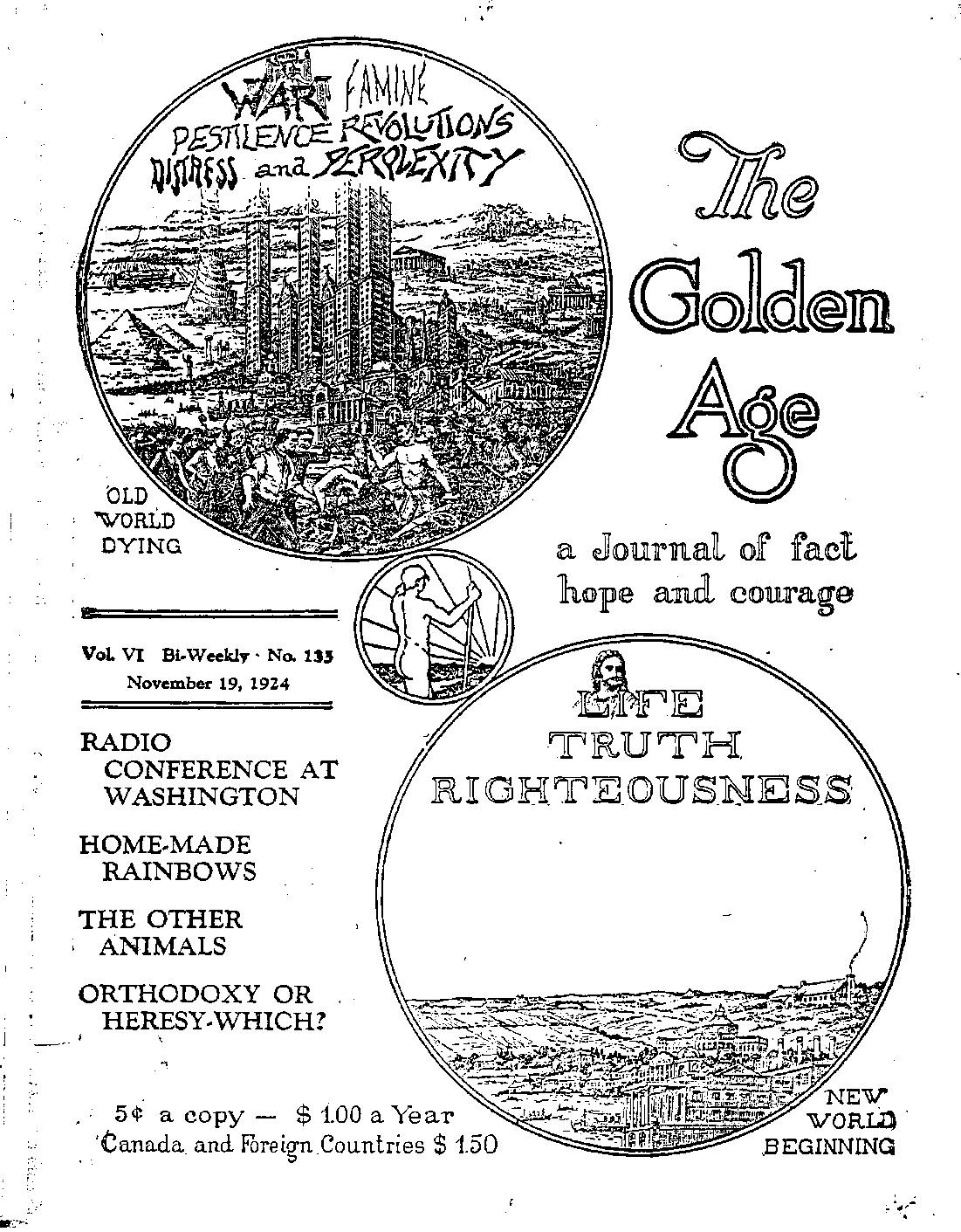
Contents of the Golden Age J o
' Labor and Economics
A Glimpse at the Would News.....
Unemployment in the United States . . . Cost of Reorganizing a Railroad . .
Social and Educational
Annual Cost of Crime in the United States Items Relative to Population ....... The Bobbed Hair Craze.........
Girl Contestants in Athletics.......
Important Radio Conference at Washington Secretary Hoover’s Address .......
Expert Engineers Present ........
Judge Rutherford’s Address .......
Radio Is God-Given ..........
Program of Broadcasting........
68 63
103 103
107 108 110
Finance—Commerce—Transportation
Items Concerning Automobiles .........
Arm New York's Motor Maniacs........
Political—Domestic and Foreign
Symptoms of World Sickness ...........
Southern and Eastern Europe ...........
Will the Earth Ever Learn the Hymn of Peace? (Cartoon)
* ? Agriculture and Husbandry
The Other Animate............
Travel and Miscellany
Home-Made Rainbows ..........
in
Religion and Philosophy
Others Mat—We Can Not ........
Orthodoxy or Heresy—Which? ......
Should Get Back to the Bible ......
That Ministerial “Call”......; .
Letter from the Apostle Paul (?) .....
Studies in “The Harp of God’*.......
102 118 11D 123 123
Published every other Wednesday at 18 Concord Street. Brooklyn, N.Y. U. S. A., by WOODWORTH, IICDGTN’GS A MARTIN
Copartners and Proprietors Address: 1A Concord Street, Brooklyn, N. 7., U. 8. A. CLATT0N J. WOODWORTH . . . Editor ROBERT J. MARTIN . Business Manager WM. F. HUDGINGS . . Sec'y and Treas.
Five Cents a Copt—$1.00 a Trar Mare Reuittanccs to THE GOLDEN AQB TwtiQVt Orness : British.....34 Craven Terrace. Lancaster Gare, London W. 2
Canadian.....- . . . .'•:s-4O Irwin Avenue, Toronto, Ontario
Australasian ....... 4D5 Collins Street, Melbourne, Australia South African......6 Leila Street, Cape Town, South Africa
Entered as second-class matter at Brooklyn, N. Y, under the Act of March 3, 1679
Golden Age y
Volume VI Brooklyn, N. Y., Wednesday, November 19, 1924 Number 135
A Glimpse at the World News
[Radiocast from WATCHTOWER WBBR on a wave length of 273 meters, by the Editor]
tabor and Economics
AFTER a five-year study of unemployment, the Russell Sage Foundation reports what everybody knows to be the truth; namely, that . taking one year with another, from ten to twelve percent of the workers of the United States are out of work during some part of ---the year. The Foundation hopes for some •public employment agency in America similar * those which have been for many years ii existence in Germany, where workingmen ma; register and may confidently look for employment without the necessity of paying out fees to employment sharks. On October 1 there were 300,000 men and women out of employment in New York city.
Arthur Brisbane says that ten thousand years from now, those then living can learn all they will ever wish to know about our civilization in - the story of Andreas Friedrinsk, sixty-eight years old, who had been a hard and honest worker for sixty years, and who lulled himself because he was worn out, could find no employment, and was destitute.
Mrs. Mary Koledo, 727 Prospect Place, Brooklyn, compelled to go out to work and un-• able to endure the thought of her two-year-old child remaining all day in a day nursery, finally decided, after crying about the matter several nights, to give her child away to persons who pvould be kind to the child and who would give aer the advantages of a good education. Our advice would have been for her to keep the child. In the school of adversity, under the sunshine of a mother’s love, a child would learn more valuable lesions than can ever be gained from books.
- The Interstate Commerce Commission is conducting an investigation to find out why, a few years agor it cost only 32c per thousand dollars to reorganize the Southern Railroad; whereas, it cost $7.43 per thousand dollars to bring about a reorganization more recently of the Missouri, Kansas & Texas system. An inquiry developed that the lawyers exacted for their services $500 per day when they worked a full day, or $65 per hour when they worked by the hour. Compared with the wages which common people receive, these charges are, of course, exorbitant.
Social Itm
THE fiftieth annual convention of American bankers expresses itself as staggered at the annual cost of crime in the United States, amounting to $3,500^000,000. We have a suggestion as to how they’can reduce this: Let them not undertake hereafter to crowd the United States Government into wars in France, ' Haiti, Honduras, Nicaragua, or elsewhere.
Let them cease to finance sugar steals, and -every other land of steal. Most of all, let them . .
discontinue their attempts to crowd the United k States Government into the World Court or into the League of Nations, the object of which, on \ their part, is the cancellation of the debt of $12,- - ■>
000,000,000 owed to the American people by Europe, so that the $3,000,000,000 loaned by these same bankers to European nations, and now practically a worthless investment, may be ' brought up to par. .£*
Somerset, Vermont, township is fading away. . . {• It did boast of twenty-seven citizens of all ' *. ages in the census of 1920. It then .had ten ’
voters; now it has but two. The Secretary of y-
State of Vermont has been appealed to for a decision as to what is best to be done under the ‘ circumstances. The rural districts of Vermont have largely been taken over by wealthy New. '7 Yorkers who live there only two months a year. Hence the population of the state remains sta- ; tionary or declines. ...
Aviators who have crossed the United States ■/'
' • - v
. >zfrom one coast to the other report themselves C '’•"as greatly inpresSed with the immensity of lonely, isolated territory beneath. The population is practically all strung along the railroads.
..'Away from the railroads there are hardly any ' signs of life.
v The Jewish Year Book shows that in New :■ York city alone there are now more than 1,500,000 Jews. Chicago and Philadelphia each have 1 over 200,000 Hebrews; while Cleveland, Boston, J St Louis, Pittsburgh, Baltimore, Newark and ■ Detroit each have 50,000 or more. The Jews ; ’ are to be found in large numbers wherever
■ . business is good, and they are not to be found
i * where business is bad.
■ ; Business men are complaining that the wars
■ in China, Honduras, Brazil, Ecuador, and Chile are hurting business, and for that reason they are in favor of peace. This discovery of , business men that war is a curse and a nuisance 'and ought to be abolished, is a valuable one.
It is almost as valuable in its way as the discovery by the preachers, five years after the war was over, that war is un-Christian and should not be encouraged.
Transportation Items
IT IS generally, supposed that Lieutenant Smith, commander of the American 'round the-world flight, is a man of iron nerve, unmoved in the face of the greatest dangers; but he met his Waterloo at San Diego. His mother rushed up to him and was kissing him all over his face. This would have been all right if the old man had kept out of it; but his dad reached for him, and planted a smack on his ear, the only place he could reach. This was too much for Smith, and he broke down and cried.
It seems incredible that the Ford Company should have manufactured and distributed over 10,000,000 machines, and should be able to put forward truthfully the claim that it constitutes the greatest transportation system in the world; i. e., greater than either the Pennsylvania or the New York Central railroad systems. In 1924 ; there werex registered in America 15,552,077 automobiles, or one for every seven persons in the country.
Deaths caused by automobiles have now reached the astounding number, in the United States, of 1400 per month. The speeds of ve-hides in the streets continue to increase.
GOLDEN AGE
Nearly every village and city has signs: “Speed limit 15 miles an hour.” But apparently no automobile driver pays the least attention to them: for speeds of 25 to 30 miles an hour in crowded city streets are matters of every-day occurrence. 17,000 persons hurled into death ; every year is certainly an intolerable situation.' At present most jurors drive automobiles, and it is hard to secure indictments and still harder to secure convictions.
Sundry American Items ■
T^HE “Physical Culture i_«gazine” has colA lected the opinion of several authorities all of whom agree that the bobbed hair craze is sure to lead to baldness, sooner or later. The reason’ for this is that human hair is like a tube sealed at the free end. When the hair is cut, the oils which are the life of the hair become dissipated. The reason why men grow bald so quickly is that they have their hair cut so frequently and, in addition, wear tightly fitting hats, which cut off the circulation of the scalp. The reason why women, hitherto, have had such beautiful hair is that they have not cut it; and the twisting and folding of the hair has helped to retain the natural oil. Many women have turned against the fashion of bobbing the hair, and are letting their hair grow again.
The Boston University Athletic Committee has decided that all girl contestants for athletic honors in that institution must stop smoking, must sleep eight hours each night, and must obtain at least seven hours outdoor exercise, weekly. Moreover, hereafter they are to be allowed but once a day, in the morning only, just one cup of tea or coffee, which some refer to as poison. '
Mount Shasta, the pride of California, which can be seen on the northbound trip by rail from 4 a. m. to 4 p. m. en route from Sacramento^ to Portland, has had a cave-in, the walls of Mua Creek Canyon having collapsed for a distance of eight miles.
Talk about “stepping on it'*! In the great storm which ravaged southern Wisconsin, the tornado removed the roof from Frank HedleFs barn, lifted an 1800 pound bull out of the barn, carried it over two fields, and buried it head first, deep enough so that only the hindquarters and the tail were visible.
k ymptoms of World Sickness
Frederick E. Covdert, international lawyer, just*returned from Europe, states that the Balkans are seethingwith discontent, that no one seems satisfied, and that Hungary is likely to have war with Rumania. He thinks that Germany will make the first two reparation payments on the Dawes Plan to get the»British out of Cologne and the French out of the territory they are holding; and that then payments will stop, and the real troubles will begin.
A writer in the New York Times analyzes the military conditions throughout the world and arrives at the logical result that Outside of Japan there is not, except in Europe, an army capable of aggression. He points out that the peace-time strength of the Allies in Europe today is twenty-five percent larger than were the armies of Germany, Austria-Hungary, Bulgaria, and Turkey in 1914. Today, the Allies have 2,000,-000 soldiers under arms, against 200,000 soldiers of the Central Powers, a superiority of ten to one. We quote a- pungent paragraph from his articles:
“The crux of this whole question of land disarmament is thus to be found in Europe. It is from Europe that the rest of the world has derived at once its munitions and its mind for war. Disarm Europe, and you relieve the tension along the frontiers of India, you deprive the tuchuns of China of their imported guns and ammunition, and you arrest the training of colored troops in Africa. Europe is the headquarters of war, and without Europe war within our time must be merely & local disorder.”
Japan’s successful insistence at the League of Nations arbitration conference that the exclusion by one country of immigrants from another must be considered outside of the field of arbitration, has led the French newspapers to predict an early outbreak of war between America and Japan.
Japan has been suffering from a rapidly-spreading plague of meningitis, taking the form of sleeping sickness. Most of those affected are over sixty years of age, with deaths in about half the cases. At one time the deaths reached nearly a thousand a day.
Northern apd Western Europe
TpNGLAND has endured the throes of a general election, the Tories having most unwisely, we think, made Mr. MacDonald’s position as premier untenable.
In the city of Lille, France, a state was so;; driven into the ground as to cut an electric j power cable supplying four big factories. An :■ elephant was tied to the stake, and suddenly became the busiest elephant in France. He ' rushed madly about, tugging frantically at his chain. In a few minutes up came the stake, and the elephant suddenly became calm-
Four factories were put out of commission by the loss of the electric current which had passed through the nervous system of the elephant. The elephant did not seem to be any the worse after taking the electric cure in this dramatic fashion. In the same city, on the previous day a mouse had caused a short circuit in the central electric generative plant, causing a $25,000 fire, and throwing half the city into darkness.
With ten passengers aboard and with their baggage as well as with mails for London, a French airplane has made the trip from Paris to London, 245 miles, in one hour and forty-seven minutes. It is hard for an American to realize that the capitals of these two great countries are so close together.
The largest restaurant in the world is at Lyons Corners, London. It has four floors and basement, seats 4,000 guests at one time, and feeds an average of 12,500 people a day.
At Luzerne, Switzerland, is a wooden bridge 600 feet long, built in the year 1333. This bridge is still in use. In the middle of the bridge is a tower, which was used as a prison for 360 years.
In Bern, Switzerland, the sidewalks are all under cover, malting one line of arches. Markets and display cases are on the outside of the sidewalk.
Southern and Eastern Europe
IN VENICE, the pigeons are fed regularly each day at 9 o’clock and at 2. Near the place where they are fed is a campanile in which the hours of the day have been struck for five centuries. Immediately when the clock strikes the hours of 9 and 2, the pigeons come by the thousands to the place where they are fed; but they pay no attention to the clock as it strikes the other hours of the day.
Realizing that his hold on Italy is. slipping because he cannot control the Fascisti organization of which he is the head, Premier Mussolini is now seeking to retain his grip upon the peo*
fet?v1C8' Th.
|g?ple by erecting in Rome the tallest and largest s ^ skyscraper in the world. The building is dc-
-^signed to have a height of 1100 feet, divided into 88 floors. It is planned as a civic center, and besides 4500 rooms will house a huge
. ^theatre, a gymnasium, and 100 large halls. This ^building, if constructed, will be 308 feet higher fe ' than the Woolworth building, and 100 feet high-
er than the Eiffel tower.
' Dr. Havichich, Minister of Jugoslavia, now in >; New York, reports that his country is recover-•Y.. fug splendidly from the devastation caused by ;the war; that the railroads are being changed f. from narrow gauge to standard gauge. Jugo-f : slavia produces a cement which so dries over-" night that roads made of it can be used the next *. day*
‘Efsj Brooklyn, N.X.
John Hallowell, an American mining engineer, who has been for several years in the Caucasus, states that since the inauguration of Soviet rule in the Caucasus, tens of thousands have been deported to Siberia, all the churches have been transformed into clubs and dance halls, all opposition newspapers and magazines have been suppressed, taxes have been increased enormously; and that when the recent revolution broke out, fifty-four men who had been held in prison as hostages for months were executed.
A great windstorm on September 23 swept the waters of th© Gulf of Finland over the city of Leningrad, washing away the wooden blocks with which the central part of Leningrad is paved. The storm did millions of dollars damage, and cost the lives of ten persons.
Others May—We Can Not {Selected)
IF GOD has called us to be really like Jesus, He will draw us into a life of crucifixion and humility and put upon us such demands of obedience that we will not be able to follow other people or to measure ourselves by other friends; and to many of us He will seem to permit other good people to do: things which He will not permit us to do.
Other friends who seem very religious and useful may push themselves, pull wires, and work schemes to carry out their plans; but we can not. If we attempt it, we shall meet ■with such failure and rebuke from the Lord as to make us sorely penitent.
Others may boast of themselves, of their work, of their addresses or their writings; but the holy spirit ■will not permit us to do any such thing. If we begin it, we shall be led into some deep mortification that will make us despise ourselves and all our good works.
Others may be allowed to succeed in making money, of may have a legacy left to them, but it is likely God will keep us poor; for He wishes us to have something far better than gold, viz., a helpless dependence on Him, that He may have the privilege of supplying our needs day by day out of an unseen treasury.
The Lord may let others be honored and be put forward, and keep us hidden in obscurity, because He wishes to produce more choice, fragrant fruit for His coming glory.
He may let others be great, but keep us small. He may let others do a work for Him and get the credit for it, but He will make us work and toil on without knowing how much we are doing. Then, to make our work still more precious, He may let others get the credit for the work which we have done, and thus make our reward ten times greater in the day of reckoning.
The holy spirit will put a strict watch over us with a jealous love and will rebuke us for little words and feelings, or for wasting our time, when our friends never seem distressed over such things. So make up your mind that God is an infinite Sovereign, and has a right to do as He pleases with His own. He may not explain .to us a thousand things which puzzle our minds in His dealings with us; but if we absolutely sell ourselves to be His love slaves, He will wrap us in a jealous love, and bestow upon us many blessings which come only to those who are in the inner circle.
Settle it then forever that we are to deal directly with God; and that He is to have the privilege of tying our tongues, of chaining our hands, of closing our eyes.
Now when you are so possessed with the living God that in your secret heart you are pleased and delighted over this peculiar, personal, private, jealous guardianship ’and management of the holy spirit over your life, you will have found the vestibule of heaven.
Important Radio'Conference at Washington
{Reported by our Special Correspondent)
THE third Radio Conference was held at Washington during the week of October 6th. The conference was called by Mr. Hoover, Secretary of the Department of Commerce. To - this conference he invited the government radio inspectors in each district in the United States and all owners of radio stations in the United States.
The conference opened on Monday evening at the Assembly Hall, Department of Interior, attended by about 500.
, The principal address was delivered by Mr. Hoover. Mr. Hoover’s address follows herein —in full:
Secretary Hoover’s Address
IT IS a pleasure to me to open the Third Annual
Radio Conference at this Department and to welcome you to its sessions. Your willingness to leave your usual business and give your time and attention to this conference bears witness both to the importance of radio in the lives of our people and to your desire to perform a public service.
Radio has passed from the field of an adventure to that of a public utility. Nor among the ‘ utilities is there one whose activities may yet come more closely to the life of each and every one of our citizens, nor which holds out greater possibilities of future influence, nor which is of more potential public concern. It must now be considered as a great agency of public service, and it is from that viewpoint that I hope the difficult problems coming before this conference will be discussed and solved.
. At the first radio conference I hazarded some ■ modest anticipations as to its development and use. Some thought them visionary; yet we ? passed every point of these anticipations within eighteen months. We have, in fact, established an entirely new communication system, national : in scopfe.
t' In the whole history of scientific discovery
there has never been a translation into popular use so rapid as in radio telephony. So late
i as the yea-f before I became Secretary of Com-
I merce there were no broadcasting stations. At
, the end of four years 53d are in operation, mak-
j. ing radio available to every home in the country.
A The sales of radio apparatus have increased . 103
from a million dollars a year to a million 'dot lars a day. It is estimated that over 200,000 men are now employed in the industry, and the radio audience probably exceeds twenty millions of people.
We may well be proud of this wonderful development, but in our self-congratulation let us not forget that the value of this great system does not lie primarily in its extent or even in its efficiency. Its worth depends on the use that is made of it It is not the ability to transmit but the character of what is transmitted that really counts. Our telephone and telegraph systems are valuable only insofar as the messages sent from them contribute to the business and social intercourse of our people. For the first time in human history we have available to us the ability to communicate simultaneously with millions of our fellow men, to furnish entertainment, instruction, widening vision of national problems and national events. An obligation* rests upon us to see that it is devoted to real service and to develop the material that is transmitted into that which is really worth while. For it is only by this that the mission of this latest blessing of science to humanity may be rightfully fulfilled.
The conferences of the past three years have been called in the belief that it was by your cooperation that the requirement of the law could best be met which declares it to be the duty of the Secretary of Commerce to "foster and promote the commerce of the United States".
Beyond this, certain minimum regulatory powers rest in the Department I have been convinced that development could be accomplished only by organized cooperation of the industry itself; and the industry is unique in that unless it has stringent rules of conduct ’ to which all elements 'adhere it will die of its own confusion.
At each succeeding conference we have had more difficult problems to solve, and those which we present today are of a complexity greater than ever before. In a large sense the purpose of this conference is to enable the listeners, the broadcasters, the manufacturers, and the marine and other services to agree among themselves as to the manner in which radio'activities are to be conducted.
s. Like the-two previous occasions, this may he called an experiment in industrial self-government. Radio activities, so long as they remain within the legislative restriction which holds for the government the fundamental control of the ether, are largely free. The industry’s future conduct with a single view to public interest, a voluntary imposition of its own rules . and a high sense of service would go far to make further new legislative or administrative i intervention unnecessary. The two past con. ferences have been successful in these purposes. . With only slight modifications made necessary ‘by changing conditions, the, Department has , I been able to follow their recommendations in . the performance of its duties. The industry _____ has supported and conformed to these recom' mendations cheerfully and uncomplainingly, although at some self-sacrifice. I congratulate you on this spirit, and know that you will enter upon your* new deliberations in the same attitude.
Broadcasting Programs
WHEN broadcasting first started, the phonograph was a sufficient attraction to the radio telephone listeners, who were swayed chiefly by curiosity and marvel at the new discovery. Public interest has long since passed this stage.
, The radio telephone would now die in twenty-i four hours if it were limited to transmission of ■ phonograph records. We have made great improvements in material transmitted. Original music, speeches, instruction, religion, political exhortation—all travel regularly by radio today. Program directing has become one of the skilled professions. I have indeed a great feeling for the troubles of the director in his efforts to find talent and to give to his audience the best that lies at his command. He has done extraordinarily well.
But’we require a still further advance in the character of material beyond the capacity of local station directors if the art is to emerge entirely from the curio and entertainment stage to that of fundamental service.
Experimental broadcasting upon a national scale during the past year has now brought us to the stage where we know it can be done. The local material available for the local pro--i. gram is not in my view enough to maintain "’I assured interest, and therefore the industry,
or to adequately fulfill the broadcasting mission. ■ So far as the art has developed, I think we '
all agree that for accuracy and regularity of -
reception we can depend only upon the local ? broadcasting stations. My proposition is that the local stations must be able to deliver every important national event with regularity. The / local station must be able to bring to its listeners the greatest music and entertainment of -; the nation, but far beyond this it must be able * to deliver important pronouncements of public men. it must bring instantly to our people a hundred and one matters of national interest. . To this it must add its matters of local interest. This can be accomplished only by regularly organized interconnection on a national basis * with nationally organized and directed programs for some part of the day in supplement to more local material.
It may be stated with assurance that the z greatest advance in radio since our last con- * ference is the complete demonstration of the feasibility of interconnection. We owe a debt of gratitude to those who have blazed the way. The pioneers have been the American Tele- . phone & Telegraph company in wire interconnection, and the Westinghouse Electric & Manufacturing Company in radio interconnection . through the use of short wave lengths. Their . experiments have involved technical skill of the-highest character which could be found or contributed by few other organizations in the world. Their expenditures, running into the hundreds of thousands of dollars, have -been made without direct consequential return. It 1 has been possible to broadcast many national events qver three-quarters of the United States during the past year, and the whole country has been covered twice. The service deserves ■ the appreciation of the public; for it has demonstrated this great thing to be practicable.
It is our duty to consider the possibilities and potentialities of interconnection as a regular daily routine of the nation. Unless it be systematically* organized we cannot expect its con-' tinuation. I realize that this matter, except insofar as it may be fostered and encouraged, does not lie in the Government. It would be unfortunate indeed if such an important, function as the distribution of information should ever ' fall into the hands of the Government. It would be still more unfortunate if its control should
> come under the arbitrary power of any person or group of persons. It is inconceivable that such a situation could be allowed to exist. But I am riot now dealing with monoply. Nor is this a question where any one lays claim to a
1 v monopoly. Interconnection is going on to local extent and over the wires of the telegraph companies, the telephone companies, and by radio itself. We have promises of super radio and we have promises of interconnection of j|ired wireless. If there are several methods, means that we might have several alternative programs always available. But whatever the method of interconnection may be, we are lack-j ing in a definite organization of a national sys-i tern of programs and a basis of support.
I I believe that the quickest way to kill broad-; casting would be to use it for direct advertis-; ing. The reader of the newspaper has an option > whether he, will read an ad or not; but if a speech by the President is to be used as the 1 meat in a sandwich of two patent medicine advertisements, there will be no radio left. To what extent it may be employed for what we now call indirect advertising I do not know, and only experience with the reactions of the listeners can tell. I do not believe there is any practical method of payment from the receivers. I wish to suggest for consideration the possibility of mutual organization by broadcasters of a service for themselves similar to that which the newspapers have for their use in the press associations, which would furnish programs of national events and arrange for their trans-mission and distribution on some sort of financial basis just as the press associations gather and distribute news among their members.
It may be that we can not find a solution at f this moment, but I believe that one result of this conference should be not only the consideration this question but the establishment of a con-: tinuing committee for its further consideration.
There are other matters to which I hope the conference will give its attention.
The Problem^ f Wave Lengths
ONE of the most important subjects for your consideration is the providing of operating channels for broadcasting stations. Of the present 530 stations. 57 are Class B, operating on from 500 to 1,000 watts and having a wide range, and 387 are Class A, many using small power and covering small areas. There are ■ still 86 Class C stations, most of which have low power, all on a wave length of 360 meters. •' Our chief trouble is with the Class B situation. ’’ They are all assigned within the band of 288 to 545 meters, within which there are, under the present system of allocation and excluding the Class C band, only 44 available channels, and only 33 that seem desirable at present. To assign these among the 57 stations necessarily means duplication, although it was the theory of the last conference that individual wave lengths could be assigned to each* At present, , 23 stations either have exclusive wave lengths or are sharing with stations so distant that both may operate simultaneously, while the remaining 34 are compelled to divide time. The greatest congestion is.intthe large cities, New York and Chicago particularly. A recent survey made by the Supervisors of the various districts shows that 21 new Class B stations are now under construction and that 25 others are contemplated, so that the question of allocation is one of increasing difficulty. It was the recommendation of the last conference,^and has been the practice of the Department, to separate stations in the same zone by at least 50 kilocycles, in adjoining zones by at least 20 kilocycles, and in separate zones by at least 10 kilocycles. In the light of scientific and technical development in both transmitting apparatus and receiving sets, it may be that a different plan of zoning or of station separation may now be used, thus creating additional wave lengths for assignment. It has been suggested also that the band now reserved for Class B might be somewhat broadened. Removals of Class C stations from the Class B band would likewise give some relief, depending on what proportion of the present Class C stations qualify for Class B licenses. I am not advising any particular method of solution, but recommend the entire subject to your careful consideration.
Power of Broadcasting Stations
ANOTHER question of importance is the limit of power to be used in broadcasting. Most Class B stations are now operating on 500 watts. A limitation of 1000 watts is imposed in the license. I understand that there are several stations erected or in course of construction
which contemplate 'the use of power up to 5000 [ watts, and I am aware of the suggestions of those who would go beyond even this. There is opposition to the plan. Its advocates tell us of the great advantages in the way of louder signals and more distant transmission, while - opponents complain of interference and drowning out of other stations. The latter fear is particularly acute when the powerful station is located in a congested receiving center. From the viewpoint of .nation-wide broadcasting, the question becomes as to whether we should aim to cover a large territory through a single ' powerful station, or through a number of interconnected smaller ones. We must not stifle progress in any direction. We must not do anything that will interfere with the programs of local stations on which many of our people 'depend, nor with the wide selective range which they now have. It may be that both purposes may be accomplished without loss to either. I recommend the subject for your most careful consideration, and hope that you may be able to reach a satisfactory conclusion.
General Tendencies in Development
THERE seems at present some tendency toward a decrease in the total number of broadcasting stations. September 1,1923, there were 563 licensed stations. On the same date this year, the number has fallen to 533, a loss of 30. This decrease, however, has occurred entirely among the smaller stations in Classes A and C. The more important stations, those of Class B, have substantially increased, the number then having been 44 as against 56 at present, with 46 others either under construction or proposed. As to whether this shows a permanent trend toward an abandonment of the smaller stations, with a corresponding additional reliance upon the larger ones even though more distant, it is too early to determine.
It is of some interest to classify and study the ownership of the stations, to know the probable motives that impel their owners to expend the large sums of money which are necessary for their^construction and operation, and for which there is usually no direct return. So far as is known to the Department, of the present stations, 196, or over one-third, are owned and operated by manufacturers of or dealers in radio apparatus, whose interest is of course
apparent. Department stores and similar mer-l cantile concerns add 39 to this number, and^ publishers 41, making a grand total of 276! known stations, of which 44 are Class B, which! may be said to have a direct interest in the^ publicity legitimately resulting from their own! broadcasting. On the other side we have 85J educational institutions, 35 churches, 12 city and: state agencies, 12 clubs, of which 7 are Class B; (4 schools, 2 state or city agencies, and 1 church),! all of which may be said to operate from more; altruistic motives. 4%
Marine Service
THOSE who are engaged in the use of radio for marine services between ship and shore,; and ship and ship, feel that the present band devoted to their use is too narrow. We must not forget that what is a convenience or a plea-, sure for us is a necessity for them, and that life may depend on the efficiency of their communication service. There is undoubtedly con-- ‘ gestion along opr coasts particularly in the1 vicinity of such harbors as New York, Boston, /. and San Francisco. There are two fundamental; troubles in the situation, and they are interdependent: First, the character of the apparatus' used; and second, the fact that most ships operate only on two wave lengths, GOO and 706 J meters. Practically all marine radio equipment is of the spark type. There can be no j economical use of wave lengths until this con-, dition is remedied.
The London Convention of 1912 contemplated ( that ship communication would be conducted on ( 300 or 600 meters, an alternative of 1,800 meters j being allowed under certain conditions. However advisable it may then have been to have । all ships on two wave lengths, it is certainly ; not practicable now. We have here an example, and it is not the only one, of the folly of putting^ a straight-jacket on such a rapidly growing
The situation among ships today is much the < same as existed in broadcasting at the time of I the last conference, when all stations were try- i ing to operate on 360 or 400 meters. The outstanding achievement of that conference was , the adoption of the idea of giving to each station । so far as possible an individual wavelength. If ! our ships had a class of equipment which would j allow it, I am not at all sure that a similar plan could not be worked out for them with separate :
wave lengths assigned to separate groups or classes of vessels. I fully realize that this can not be done at once. I know the financial and other difficulties that stand in the way of better apparatus. I believe, nevertheless, that some way should be found to encourage improvement and likewise to jnake the better equipment freely and reasonably available. Meanwhile, some consideration should be given to a method of temporary relief. The question is one of relation. There are not enough channels to provide wthat both the marine interests and the broadcasters may legitimately desire. It is a matter of accommodation between them, givingto each as much as possible with due regard to the other. Possibly additional wave lengths above ' 600 meters may be assigned for marine use. I commend the subject to your careful attention.
Outside Sources of Interference
I HAVE not attempted to list all the subjects that may come before you, but have merely re' ferred to a few which seem most troublesome from the administrative side. One matter that must be dealt with sometime, but over which there is no means of control at present, is the interference from non-radio sources. We listeners have all experienced frequently and to our great disgust the squeals and roars which we are told come from electrical devices of various sorts in which there is no purpose to cause audible disturbance. The Department has received a vast number of complaints based upon trespassing noises of this character. It is hard to trace them to their source, and difficult to deal with them when found. Some branch of our radio industry certainly should investigate and study them. Harmonics, too, are troublesome. It is useless to assign a station to a definite wave length if its signals go out not only on that one lljt on three or four others. Our amateurs, who - Drake up by far the largest element in the radio family outside of the listeners as a whole, are . particular sufferers, since the harmonics from , many stations have an especial tendency to invade the amateur band. Accurate and sharp transmission must be insisted upon.
. Co-operation of the Department
THE officials of the Bureau of Navigation, which has direct charge of administrative features and full familiarity with the entire
: situation, are ready to give you the benefit of ; their information and advice.
■ The Bureau of Standards has prepared a - report on many of the technical phases which ■ will come before you, and its personnel and [ facilities are at your disposal. The Interde-■ partinent Radio Committee has done prepara-i tory work; and its members will, I am sure, ' be glad to cooperate with you in the consideration of all matters which have a governmental bearing. The Radio Supervisors from all dis-_ stricts of the country are in attendance, with ' first-hand information as to conditions, and their knowledge, based on actual experience in the field. In short, the Department of Commerce is at your command. I believe that your membership includes every angle of radio interest. I look forward to your conclusions as a great step in the development and progress of the industry.
Expert Engineers Present
ADDRESSES were made;by expert engineers in radio construction, dealing with the technical part of radio. Some strongly advocated the granting by the government of the privilege to build and operate super-power stations. Mr. Saronoff, General Manager of the Radio Corporation of America, announced that his company was ready to construct within a short distance of the city of New York a fifty kilowatt station.
One can approximate what that size station would mean, when we call to mind that no broadcasting station in the United States now is permitted to use more than one kilowatt power, and that the major portion of the broadcasting stations in the United States are operating on 500 watts, or one-half kilowatt.
Several attending this conference strongly advocated increasing power in order that programs could be broadcast throughout the United States, and could be heard easily in Europe.
among those present was Judge Rutherford, President of the International Bible Students Association. He addressed the conference Wednesday, making the following specific recommendations :
(1) That stations be licensed and use higher power; ' b '(2) That the time for broadcasting be so divided and regulated by the Government that * it may not be monopolized by any single in-‘ terest;
“ (3) That programs be so designated by public I advertisement that the people may know what 1 to expect from each station at stated times.
b .We give Judge Rutherford's address in full:
Judge Rutherford's Address
ADIO broadcasting has quickly become a wide means of entertainment and amuse
ment It can be made a far greater medium of education.
■ While it is true that amusement and enter; tainment are important, yet proper instruction ■ and education of the people are more vitally important. Entertainment and amusement furnish a temporary diversion. The uplift and stabilizing of the people are of far more importance. Jazz music will furnish entertainment and amusement. Instructionjn the Bible and great truths upbuilds and stabilizes the people, and brings to them a satisfying blessing.
Europe is in a bad way. Most of her difficulties may be laid to selfishness. There are threatening conditions in America. One of the best means, I believe, for preventing America from following a similar course to that which has brought Europe to her present deplorable state is proper instruction and education.
Let the mind of man meditate upon high and noble things, and he ceases to be a dangerous animal
It is eminently proper that the people should be instructed concerning the development of science and invention, the building of highways and homes, the improvement of the land and the beautifying of the landscape, hygiene and health, as well as physical and mental culture.
It.is of equal, if not greater importance, that the people should learn more about the Creator who provided all these blessings for man. Let man be instructed that all the blessings he enjoys proceed from a kind and loving God, and such knowledge will produce in him a kind and thankful heart. This condition of thankfulness and gratitude leads to unselfishness, which is a proper definition of love.
Unselfish men look to the general welfare of the people; and the increase of unselfishness among the people brings to them contentment,
peace and prosperity. Men and women of this type are such as constitute the stay and bulwark of the nation. ■
It should be remembered that the men who laid the foundation of this nation were moved to" do so in order that here the people might be in-, structed concerning their God and the Lord Jesus Christ without let or hindrance. With these noble sentiments planted in the hearts, of the people, the nation has prospered more than any other nation that has ever been on the earth. «-•
Any nation or people that forgets God and the Savior of man will rapidly disintegrate.
Without doubt the radio was foretold in the Bible by the holy prophets of Jehovah long centuries ago; and it has come to light exactly at the proper- time for the benefit of mankind. Surely the nation that God has favored above all other nations should honor Him in some way with the use of this modern and wonderful means of communication which He has so generously provided for mankind.
Well has the Secretary of Commerce said: "An obligation rests upon us to see that radio is developed to real service, and to develop the material that is transmitted into that which is really worth while." ■
Nothing could be said to be more worth while than the proper instruction and education of the people along lines that would stabilize them, make of them better citizens, and create happier homes.
Responsibility of Safeguarding Public Welfare
WHILE the Government has obligations to provide for the entertainment and amusement of the people who desire such by the use of radio, it has an equal, if not a greater obligation to provide for the instruction of that growing class of people who wish to know abo^ weightier matters.
But let us not wholly commercialize this great means of communication. Such practice will work injury to the pioneers as well as to the public. Rather let us bear in mind that radio has now become a pu&Zic utility, and in its development and expansion let us keep prominently before us the general interest and welfare of the people. Radio invades the sacred precincts of the home. He who uses this great public utility as a means of communication has the responsibility of safeguarding the best interests and welfare of the home. If some want jazz music, let them have it. But others who want classical and sacred music and instruction on the higher things should be given full opportunity to receive it.
Our Association operates a radio broadcasting station on Staten Island, New York City, designated as W B B R. From reports received by us during the past six months, with positiveness I can state that there are great numbers of people who desire to listen to programs of the kind that we have been trying to give.
Our programs consist of lectures on the divine plan of the ages, instructing our hearers concerning the creation, fall and redemption of man, and the ultimate blessing of the human family on earth with health, strength, peace, life, liberty,, and happiness. Also lectures are given on the development of science and invention, health and hygiene, physical and mental improvement of men and women, together with appropriate lessons for children. These lectures are interspersed with high-class sacred and classical music, both instrumental and vocal, with current world news of first importance.
Ours is not a sectarian organization. It stands free from all denominations and creeds. We seek no membership. We solicit neither money nor men; and therefore we feel that we can properly claim that unselfishness prompts us in this work, which we do without any desire for or hope of a money remuneration. We neither ask nor receive contributions. The expense of operating is borne by men and women who have some money and who desire to spend it in the interest of humanity.
Higher Power Suggested
IN BROADCASTING our programs from our present station and from others that are now in course'of construction, we would like to use more power than is now permitted under existing governmental regulations, in order that the programs might be heard over a wider area of the United States and Canada and even across the sea, with the hope that these programs might bring some comfort and consolation to the sorrowing ones of bleeding Europe.
We therefore think it proper, and respectfully recommend, that the Government grant the use of greater power for broadcasting by
increasing the power limitation of Class B- v stations to at least two kilowatts, or even more, for use at stated times and under certain con* ditions. ,
Allocation of Time
PON the theory that radio broadcasting is a public utility, the Government now ;
exercises control of the ether. It therefore devolves upon the Government, in justly exercising its powers, to so regulate the use of the ether that the interests of all concerned will be safeguarded, and to the end that no one shall have or maintain a monopoly of time or any . wave length.
The present practice of granting to a broadcasting station the exclusive and unlimited control of the wave length under which it is licensed to operate is one of the obstacles to . the development and expansion of the radio art. Such a practice seems neither fair nor just It results at least in a partial monopoly. It is hardly reasonable to ask the public to listen to one station all day: The interests of the listeners should be considered.
I therefore suggest that, where there are two stations within the same district using the same wave length, they could well divide the time. Even four stations operating on the same wave length in the same district could divide the time properly. The hours between 7 and 11’ pm. being the best for radio broadcasting, if ' each of four stations operating on the same wave length could be given, say, two hours on . each of three and sometimes four evenings a week, such practice would enable the people to have a greater variety of programs and thus prove more satisfactory to both broadcaster and ■ listener. '
For example, suppose there are two stations in one district operating on the same wave . length. They should be requested to meet and properly divide the time. If either one fails or refuses thus to do, the Radio Supervisor : < should be clothed with authority to make a proper division of the time. It it manifestly unfair to the public, as well as to broadcasters, -; to grant a license to one station and pennit that ' station to have the unlimited privilege of controlling the entire twenty-four hours of each and every day. .
A station devoted to the broadcasting of pro- ' grams of the kind mentioned above could well be ^confined to two hours an evening and three to four evenings per week. '
It is true that certain bodies of men have blazed the way in bringing radio to its present state of efficiency. In this they have been greatly honored; and for such they should receive appropriate consideration in the use of the ether. It should be their privilege to broadcast for hire if they desire, and they might properly.be given a wider allotment of time for that purpose than are others.
This suggested method of time allocation under Governmental regulation would serve for general purposes. Special arrangements would necessarily be required to cover the occasional broadcasting of events of national importance through interconnected stations.
Classification of Programs
I FURTHER suggest that when an application for license is made, the applicant be required to state in his application the kind or nature of program he desires to broadcast; and that when the license is issued, the kind or nature or program shall be limited at least to what the application calls for; that then due public notice or advertisement be given of the kind or nature of the program of such station. This being done, the public will know what to expect from certain stations regularly, and will not be required to spend a large portion of the evening tuning in and tuning out stations, trying to find something desirable..
Conclusion
IN CONCLUSION I summarize the following recommendations:
(1) That the Government license stations such as above described to use higher power, within reasonable limitations;
(2) That , the time for broadcasting be so ’divided and regulated by the Government that it may not be monopolized by any single interest;
(3) That programs be so designated by public advertisement that the people may know what to expect ?rom each station at stated times.
Jehovah has honored America by permitting her to take the lead in the development of radio. Let the nation now honor Jehovah by making ample provision for the people to hear concerning His plan for the blessing of all the families of earth.
In view of the fact that radio has come to us clearly in fulfilment of divine prophecy, as I believe, it is of real interest to me to note that one of the pioneer companies of America which has done much in furthering radio broadcasting has for its Vice-President and General Manager a natural descendant of Abraham, the patriarch of Israel, whom God promised to use, in His due time, to bless all the families of earth. I venture the prediction that Abraham will yet stand in Jerusalem, the capital of the Holy'Land, and by the use of radio speak with authority and be heard by all the peoples o£ earth. '
Radio is God-Given
HIS was the only address to the Conference that called attention to the fact that the radio has come in fulfilment of prophecy; that due honor should be given to the Lord because He is the great Giver, and that hence the programs should embrace more about Jehovah, the Lord Jesus, and God's kingdom.
Broadcasting is, as we believe, one of the best methods of spreading the message of the truth concerning Messiah's kingdom, because it enables many to hear the message who would not attend a public meeting. Doubtless the Lord has brought this to light just at a time to suit His purposes.
When Judge Rutherford concluded his speech by calling attention to the fact that Abraham would yet’stand in Jerusalem and speak with authority to the people and be heard all over the earth, this was received with hearty applause from the delegates.
All Christians are interested in radio now, because it is a method of telling the peoples of . earth how the blessings are coming to them through God's arrangement.
Mr. Hoover appointed three general committees to consider matters of importance and report to his Department; after which, under the law, he will render his decision as to what shall be done with reference to increase, of power, the licensing of stations, and the character of the programs. -
I
Home-made Rainbows Sy B. R. Kent
“TTAVE you a little fairy in your home?” is . Ila well known and catchy question used by a manufacturer of soap to encourage clean; - liness and profit A fairy is supposed to be
w ■ good, and to shower blessings around to make
. folks happy. Soap and water, especially when
■ applied to the hands and faces of lit^e children,
tend toward happiness—at least to Mother, who does not particularly relish the transfer of jam, fruit juices, chewing gum and candy from sticky hands to freshly laundered table-cloths and center-pieces.
If the soap fairy is a good friend to have around to keep things clean in the home, why * not find a “rainbow” for keeping us in a “cheerful frame of mind”? Have you a little rainbow in your home?
The first rainbow appeared after Noah had . left the Ark, and during his offering of thanks to God for the transfer from the Old World into the New. This beautiful rainbow was God’s pledge that the earth would never again be overflowed with water, and was formed by the Lord through the operation of natural laws. The sun was its father, and the cloud was its mother. The pure, white ray of sunlight shining through ■ the bank of mist, which acted as a prisiu, was broken up into the various colors now visible in our rainbows. Light contains all colors. Darkness has no light and, therefore, has no colors.
God is personified by one of His great attributes, LOVE. “God is Love,” say the Scriptures. This promise of Jehovah to Noah, evidenced by the rainbow, guarantees that mankind will be spared to see the glories of His sweet, pure, noble, and wonderful character— the real rainbow. When will all see? A good question; but we are now anxious to glimpse in the home the little rainbow without which the beauties of the world rainbow can not be appreciated.
Light beautifully symbolizes love; water pictures truth. The sun’s rays penetrating mist > create, or form, the varicolored rainbow'— ‘ violet, indigo, blue, green, yellow', orange and J red. God’sdove, shining through the mind which ■r. has collected a “cloud-bank” of truth, is broken t' up into the various qualities of love; viz., peace,
, joy, hope, patience, faith, long-suffering, self-
;• ' control, benevolence, etc. As the literal bow adorns earth’s sky and horizon, so our mental bow beautifies the dome of the consecrated home, and excites wonder and admiration as its glow and cheer are observed and felt by all who are privileged to enter such a home.
Where true love dwells, there are peace and joy and the other graces, so beautiful, so satisfying to the heart which has realized by actual experience the darkness which oppresses to despair the soul unacquainted with divine tenderness and mercy. Guard well that priceless light of the mind, and the truth contained therein, and your bow will always be bright and shining! Lose them, by whatever means; and men and women are husbands and wives in name only—* a hideous, hollow mockery.
The Chastity of the Home
HE safest place to have the motto, "God Bless Our Home,” is not on the wall, but in the mind. ‘Husband/ St. Paul admonishes, ‘cherish your wife as your own flesh? (Ephesians 5:25, 29) Do you hate yourself? ‘Wife/ the same great Apostle instructs, ‘love your, husband.’ Christ cherishes His Church; and the Church loves her Husband and honors Him.
You, whoever you are, wherever you dwell, S whatever your color or race, be true to your marital vows. Let no thief in any guise take away that sweet fellowship and confidence which rightfully belongs to your mate, and to none other. To transfer your affections and the intimacy of mind from husband or wife to another means nothing less than mental adultery. The Scriptures indicate that one who persists in doing this wilfully shall be swallowed up of the second death. Therefore one who is inveigled into such an entanglement by the adversary’s working through the lower propensities of the' mind, and does not swiftly rectify this mistake, is in grave danger. Make a vow unto the Lordin respect to this and keep it—which is perfectly and demandably possible. A clarion note of warning has sounded from heaven: “Keep back thy servant also from presumptuous sins; let them not have dominion over me: then shall I be upright, and I shall be innocent from the groat transgression.”—Psalm 19:13.
Thom is nothing to replace this home rain- . bow, if it should go out, but darkness—the ab- ; sence of light, the absence of unselfish love. <
. in
The devil’s bow consists of the various shades of darkness: Hate, jealousy, strife, passion, cursings, bitter words, creepy suspicion, etc. il How many husbands help wash dishes, make beds, sweep floors and dust the furniture? How many wives study food charts to supply proper nourishment for hubby and the kiddies, darn socks and stockings, sew on buttons where they are needed, and keep a tidy house? How many ^husbands and wives kiss each other when the husband goes to work in the morning, and re-j turns in the evening? How many fathers con’ duct family prayers, and preside in true dignity .at the breakfast table to dispense natural food I and to encourage the partaking of spiritual I nourishment? How many parents are chaste ■ in word and conduct in the presence of their ■ children and before each other, taking to heart the face value of the words: “Let no corrupt communication proceed out of your mouth”?— Ephesians‘4:29.
It is the little tilings which count and go to make up a happy home, or the reverse. How many fathers and mothers look forward into t the future and see in vision their sons and daughters grown up and in favor with Christ in the Golden Age, and seek now to prepare th*ni for that great kingdom, training them up in the way in which they should go so that they will not be food for the jaws of eternal death? Responsibility in tills respect can not be shirked; and it may be that failure to instruct and control your children will decrease your own chances for life, and certainly dim your prospects for the “crown of life”.
Liberal Soul Grows Fat With Goodness
…