Golden Age, October 22, 1924
Download: PDF — Golden Age, October 22, 1924
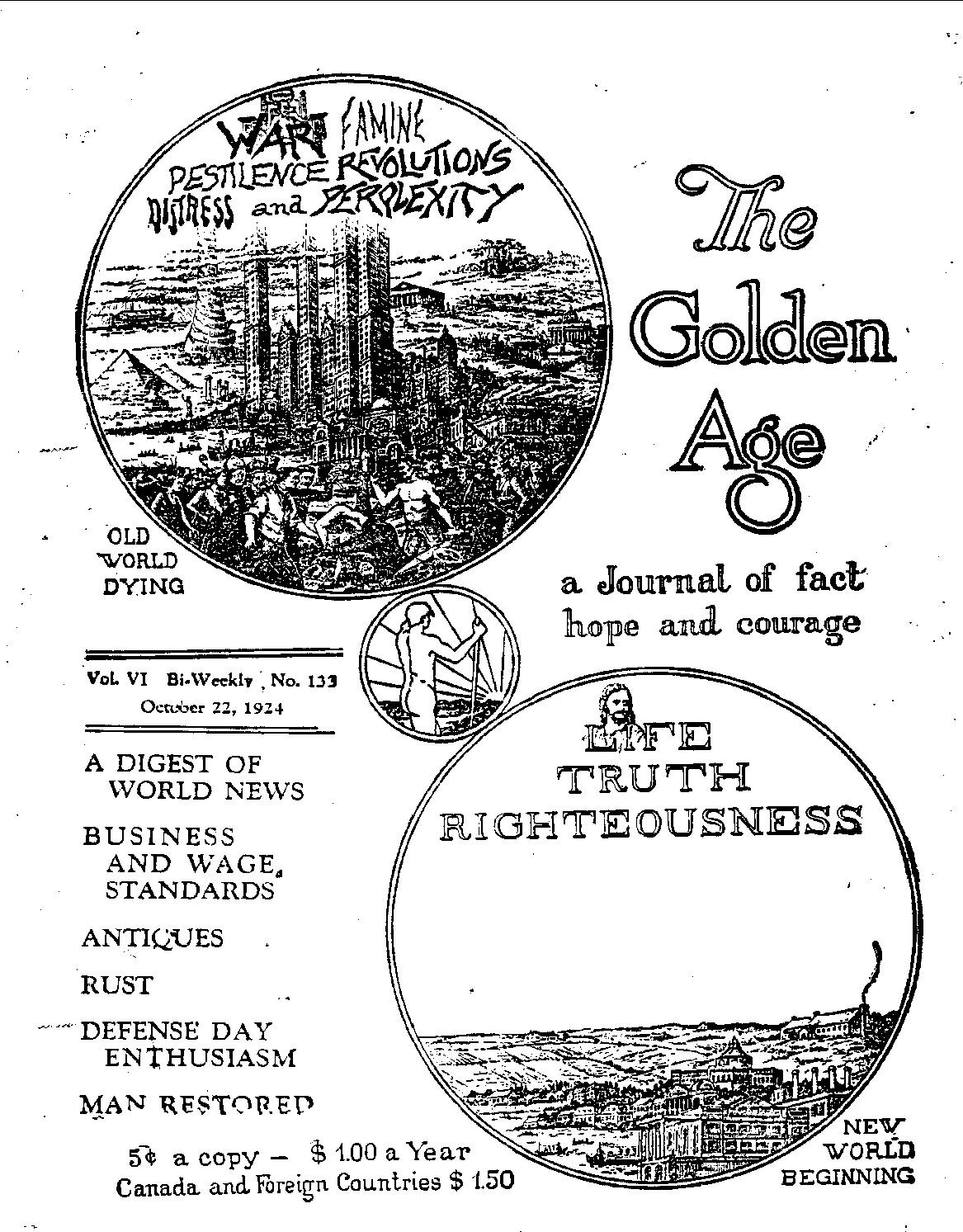
righteousness
ANTIQUES
RUST
A DIGEST OF WORLD NEWS
OLD ’VORLD DYING
BUSINESS AND WAGE STANDARDS
-DEFENSE DAY ENTHUSIASM
VoL VI Bi.Weekly . No. 133
October 22, 1924
MAN RESTORED
5$ a copy - $ 1-00 a Year Canada and Foreign Countries $ 1.50
a Journal of fact Kope andL courage
NEV VORLD BEGINNING
Contents of the Golden Age
11------- • —
Labob and Economics Digest o» Wotta News
Interesting Labor Items .............. . . 33
Social and Educational ANTTqCE3 AND THEIR SUPPOSED VALUE.........r , • 45
Live Thou Thy Life (Poem)
Finance—Commerce—Transpobtation Business—Wages—Standards
An Amun to Destroy the Grocers
Political—Domzsuo and Foreign
Negroes Would Colouize Liberia.........>...33
Militarism Losing Out in Sweden.............35
Portugal, France, Premier MacDonald Defines Socialism .... 30 How a Censorship Operates ...............37
Chippewa Indians of Minnesota Robbed
Defense Day Enthusiasm
What is Socialism f
. Science and Invention
Rust and its Obutebation.............. .
Home and Health Star .............. ...... , . , . 51 ’' Travel and Miscellany
Railroad up Mount Ararat . . ..............35
Is St Peter’s in Danger of Falling? ...
Waterspout in New York Harbor
The Moa or New Zealand (Illustrated)
Tbue Friendship
- - Religion and Philosophy Rip Van Winki* Awakening......... . ... . 44
Pining for Real Manhood..................
Fiuim Generation to Generation (Cartoon)
What it Costs to be a Cardinal
Man Restored .................., , 59
Concerning Apostolic Succession.............62
Studies in “the Habt or Goo”
Published every other Wednesday at 18 Coneord Street, Brooklyn, N. Y, tj. 3. A^ by WOODWORTH. HUDGINGS A MARTIN
Copartner! and Proprietor! Addrau: II Concord Street, Brooklyn, ,V. T., U. S. A.
CLAXTON J. WOODWORTH . . . Editor . ROBERT J. MABTIN . Buaineaa Msnaser
WM. y. HUDGING3 . . Sec*y and Trees.
Kiva Cssts a Copt—*1.00 a Yeas Maks RaMinANCsa to TEE GOLDEN AGE
Foastax Orness: British.....34 Craven Terrace, Lancaster Gate, Loudon W. 2
Canadian ......... 3S-40 Irwin Avenue. Toronto, Ontario
Auitralanian ....... 400 Collins Street, Melbourne, Australia
South African......0 Leite Street. Cape Town. South Africa
Katarad an saeond-clasa matter at Brooklyn, N. X., under the Act of March 3, 1879
>
CZfie GoldenAge
Val£d« VI Brooklyn, N.Y., Wednesday, October 22. 1924 Nwaber 133 .
— - II -in-1 !■ II -n--W=—=====E__—=M===__==—sscskxssasKsctsaanaa "
A Digest of World News
Radiocast from WATCHTOWER WBBR on, a wave length of 273 meters, by the Editor]
__ Helping the Boys to See Alaska
ANY boy who will personally earn $125 in the next year, and who can borrow $125 from his parents, may borrow a third $125 from George E. Buchanan of Detroit, Mich., and be taken next July by Mr. Buchanan through the Canadian Rockies to Alaska and points on the Canadian Yukon and return. Subsequently the boy returns the $125 to Mr. Buchanan, so that Im can help some other boy to take the same trip.
Railroad up Mount Ararat
AN ATTEMPT is being made by Armenians to procure funds for the building of a scenic railway to the summit of Mount Ararat 17,090 feet, with the intent of making it a resort for tourists, similar to that of Pike’s Peak. If this plan is carried out, it is not at all impossible that the remains of the Ark, said to have been seen in recent years near the summit, may be definitely located.
Russian Business Follows the Treaty
THE treaty between England and Russia had no sooner been consummated before the great union of Russian cooperatives placed with English manufacturers an order for agricultural machinery amounting to tens of thousands of pounds sterling. It is the successful diplomacy of Britain's Labor Government that has made this additional business for Britain possible.
The Russian Government is in hope to put a radio receiving set into every home, and with that end in view has begun the manufacture of radio sets to be sold to the people for ten dollars each. It isxdso furnishing the people with information as to how to make their own sets. The Government has begun the radiocasting of concerts. A small annual fee is charged. The reception of news from foreign countries is '
prohibited, however. • ■ <
Negroes Would Colonize Liberia .
THE Universal Negro Improvement Associa-’
tion had been invited by the Liberian gov- -'f ernment to establish a Negro colony made up of .. American Negroes. A group of engineers with materials and $50,000 was dispatched to Liberia within thirty days. Upon their arrival the Liberian government had developed opposition to • the movement. President Garvey of the Association blames a small group of politicians in Liberia, who were influenced by the financial interests of England and France, and a rubber company of the United States, who see in the colonization some enlightenment going into Liberia with the possibility of independence of thought and government. ..
White Slaves in a Negro City
TT MAKES interesting reading to learn that officials of the South African Government’s
Locust Expedition have found at Molopolole, in the district presided over by Sebele, about fifty white men and women, descendents of Dutch pioneers, who are slaves to the blacks, having no privileges of any kind. Millions of blacks have thus served whites, and some do • even yet.
Militarism Losing Out in Sweden
SWEDEN is stirred from end to end by an election which has militarism as its great issue. Hjalmar Branting, a one-time premier of Sweden, in seeking support for his policies as against the policies of the military party now in power in Sweden, said: “Hitherto the form- . ula invoked, ‘If you wish peace, prepare for war.' has offered an incorrect solution. Against
GOLDEN AGE
"•it we place the only correct formula, If you wish peace, prepare for peace.’ All the workmen in all the countries of the world have now entered '■ upon this path, and Sweden must enter upon it faLso.”
P-7 -
r'2s St PetcPs Dome in Danger of Falling?
A DESPATCH from Rome to the Chicago Daily News reports that an American architect has declared that the dome of St. Peter’s Cathedral is in danger of falling. It would be a strange incident if such an event should take place at the forthcoming Papal jubilee. The papers of Rome denounce this report as a scheme to cut off the city’s expected revenue from the great numbers of pilgrims invited.
.... Why Profen to Believe Untruths?
Rev. Basil G. $oubchieb, of Hampstead, England, says that when the sponsors of a ■'child are examined in the Anglican Church, at - ' the time of a child’s so-called baptism, they are ' asked: “Do you believe in the resurrection of the fleshf” they answer: "All this I steadfastly . believe,” when as a matter of fact they believe nothing of the kind. Rev. Basil says that, like the nation’s cradles, the seats and the pews grow emptier every year; and that the attempt to express truth today in the formulas of yesterday is “just as sensible as sending a twentieth century debutante to Court wearing her grandmother's crinoline.” Good for Rev. Basil!
France
DESPATCHES from France show that the French budget this year will have a deficit of between one billion and two billion francs. The military policy of France under the Poincare regime was a ruinous one. It is not believed in Paris that the French Government will ever be able to pay anything on the debt of’ 15,194,000,000 francs which she owes the United States, and will probably be able to pay nothing on the debt of equal amount owed to Great Britain. -
The futility of the ring of iron which France has put around Germany by the financing and arming of Poland, Czecho-Slovakia, Rumania, . and Jugoslavia may be seen in the fact that the Soviet diplomatic courier, Krastin, has eom-... pleted his more than 50th round trip by airplane between Berlin and Moscow (750 miles each way) without stepping foot on Polish soil.
Germany
IN THE effort to balance the budget, Germany has within the last few months discharged ;
400,000 State employes, or about one-fourth of ; the total number. At first this had a depressing effect, as many of those discharged were not able to find work elsewhere. .
Countless millions of caterpillars are destroy- . ing thousands of acres of forests on the border- j land between Germany and Poland. The combined noise of the caterpillers engaged in eating • the leaves is so great that it sounds like the roar J of a conflagration. All known methods of stop- I ping the pests have failed; and consideration is I being given to the use of the deadly poison gas ■ which, until now, has been intended for use only on human beings.
Portugal ‘
TWENTY years ago, when Portugal was on .
the verge of bankruptcy on account of the corruption of both of the old parties, King Carlos appointed as dictator an honest man, Senhor Joao Franco. Franco cut from the payroll two ladies of high rank, each receiving $2,000 a year for jobs in which they never did a tap of work. He stopped the salary of a man who was continuing to draw his fathers salary for fifteen j years after his fathers death. He cut from the payroll a Portuguese minister to China who had ; never set foot in that country and, in short effected economies in eighteen months amounting to $15,000,000. As a reward for this honesty, the crooked politicians of Portugal brought about the death of King Carlos and his son, and the expulsion of Franco from the coun- , try, just prior to the time when both the mon- f arch and his dictator had planned to restore a , constitutional government. .
Premier MacDonald Defines Socialism .
THE New York Times referring to Ramsay MacDonald's book on Socialism, quotes him as saying:
■‘A Socialist does, not sron the life of society to try new pxponnier.ts nor put a brui'.d-nc'.v system into operation. ... It unmet be ever-emphasized that public doles, 1’oplarieni, strikes for ire-reused wages, and lim-. itatinn of output not only are not, .socialism, but may mislead the spirit and policy o£ the Socialist move* - cent. Socialism calls men to give unstinted service in r~ return fof a reasonable reward, insured in terms of life; ’ and no one should be more impatient than the Socialist - with the fallacy that a man cannot be expected to give ' service before he gets a award.”
; How a Censorship Operates *
THERE is civil war in Brazn and, as a consequence, newspaper despatches telling of happenings there are not permitted to be sent :to the outside world until the Government gets .’ ready. A few days ago the residents of Buenos Aires read in their newspapers articles of commendation of the Argentine ambassador to • Brazil Some days later they learned that some . rebel sympathizer had exploded a bomb in front . of the Argentine embassy in Rio Janeiro. The explosion of the bomb was the occasion for the words of praise. .
Protestant Churches of Canada United
AFTER twenty five years of effort to arrive at ■ a basis of agreement, the Presbyterian. Methodist, and Congregationalist Churches of Canada have agreed to reorganize as the United Church of Canada. The basis of union is a document of 12,000 words, and may be described as one grand straddle. For example, concerning candidates for the ministry the document says:
“These candidates shall be examined upon the state-xnent of doctrine of the United Church and shall, before ordination, satisfy the examining body that they are in essential agreement therewith, and that as min-^ isters of the Church they accept the statement as in (distance agreeable to the teaching of the Holy Scriptures.'’
. In other words, this lets the aspiring preachers all in whether they believe anything or not, • and leaves the ministry just where it is now, in ' the hands of a certain number of people, most of whom do not believe the Bible at all. The . Union which the Scriptures teach is a unity of . spirit, a unity of devotion to the Lord, and not . a corporate union.
Waterspout in New York Harbor
NEW YORK harbor has been visited by a . waterspout, eihimated about 100 feet in ’ diameter. The tremendous up-current from the overhanging clouds was not sufficient to lift the lower end o> the spout more than about.fiftj? feet out of the water; but in the few minutes dur-? ing which the partially complete spout was ii operation, it washed overboard the greater parti of a deck load of lumber and barrels from the; only craft which happened to be in its way. • j
Because of continued low money rates ths large New York city banks continue eager to loan money; and when the kingdom of Belgium sought to borrow $30,000,000 one day, the. total subscriptions exceeded $200,000,000.
The Commerce Trust Company of Kansas City reports a saving of thousands of dollars in interest by transmitting its New York checks daily, by air mail. From $500,000 to $2,500,000 are transmitted daily in this way; and .the shipments are considered safer than when sent by: train. This is another evidence that we are in, a great transition period.
Spain-
FOLLOWING the system, which has really worked out well in America, of having all the telephones under one management, the lung of Spain has now approved the plan for turning over all Spanish telephone lines, whether state or private, to the International Telephone and Telegraph Corporation of New York, which will undertake to give Spain a first-class up-to-date system. Similar negotiations are under way in France and Italy.
Interesting Labor Items .
LESS than five years ago the labor unions organized their first bank. This bank meeting with marked success, others followed, until now there are thirty-five, with combined assets of $125,000,000. The Locomotive Engineers in Cleveland have the largest bank; the Central -Federation of Labor in New York has the next largest; the Garment Workers Union in New • York the third largest; and so on, with many more to follow. Labor banks not only encourage thrift among the workers but assist labor by loaning and investing their money where it does labor the most good.
The United States Bureau of Labor points out that there are in America boot and shoe factories where the output per worker for each day is two pairs of shoes; and there are other factories where the output per worker for each
GOLDEN AGE
fviay.is twelve pairs of shoes. In the lumber bus--iness the differences are still greater; some sawmills turn out 120 board feet per man a day, Awhile others turn out more than twenty-one i^times as much.
Sfv-The National Industrial Conference Board (^reports its findings in a recent survey of labor ^conditions in twenty-three industries employing 1700,000 workers. Since 1914, wages have been £ advanced 127.3 percent; the cost of living has ^advanced about 100 percent; the laborer is thus ^benefited about 27 percent. This result is ac-
• credited to the lower cost of living since 1917, the price of commodities declining a little in advance of the lower wage scales.
The American Federation of Labor claims that the National Coal Association has started a propaganda to reduce miners' wages in cer-
tain localities. The slowing up of industries and close buying of coal have been bad for the miners. Wages in the anti-union fields are down to the 1917 basis, and in some places range from $2 to $3 a day. Even in some union fields the miner gets only $1.25 a ton for digging the coal, while the retail price ranges from $7.50 to $14.50 a ton.
It is estimated that the farmers of America have gained $200,000,000 by the increased prices paid for the large wheat crop; but on the other hand, it is also estimated that during the months of June, July and August the wages of factory workers throughout the country dropped to the extent of $600,000,000. Workers, therefore, have just this much less to spend.
Chippewa Indians of Minnesota Robbed
COUNSEL for the Chippewa Indians of Minnesota claims that in the thirty-five years since the treaty between the United States Government and the Chippewas was signed, not a single provision of the treaty has been properly carried out; that the Indians have been literally robbed of thousands of dollars by improper classification of swamp lands anddimber lands; and that in some instances whole rows of townships of the best lands in the reservation have been stolen outright from the Indians.
Real Americans Get Vote
FOR the first time in the history of the United States the American Indian, who is of age t *nd otherwise qualified, may vote in the fall
Blown*, M.T.
election. A new law has been passed. It is entitled: “An Act to authorize the Secretary of the Interior to issue certificates of citizenship to Indians.’’ This country is the home of the Indians; it always has been; and now after robbing him of his home, killing him off, and driving him within the confines of reservations, we do the magnanimous thing of granting him franchise! We have about 150,000 Indians, and we hope that from now on they will be able to see the bright side of life.
SL Louis Churches Barely Solvent
A SURVEY of the churches of St Louis, Mo., made by an experienced worker in these lines, Reverend H. Paul Douglas, concludes with the following paragraph:
“St. Louis churches as a body are keeping just * little ahead of the forces of dissolution and failure.' The question of the future is frankly that of hanging together or hanging separately. It is entirely possible that the whole colossal fabric of the St Louis church may be worth less than its carrying chargee tomorrow. Only by a succession of vigorous steps is there any assurance that the second million of St Louis people will be better served than the first million, or that the church and city of tomorrow will be more worthy than those of today.”
A Bishop Says More Than He Realises
Bishop Shayler of the Episcopal Church, Nebraska, told more than he realized in
a recent sermon in Omaha, when he said: j
“The churches of the world are tottering to their j fall in the sense of self-sufficiency, denominational dis-sension, or in an attempt to build up a political eccle- 1 siastical world-wide temporal power—are all alike in dire danger of Capernaum's fate. Just as I stood upon the stones of the synagogue in Capernaum and read of the possibilities and possessions of a city which was in heaven and has hcen cast down to hell, so will some
. future prophet stand upon the ruins of our civilization and churches, and proclaim our doom, unless we know and obey the One who standeth among us whom we know not.” • T"
Our Wonderful Inventive Age
THE United States Patent Office has issued a statement in connection with announcing the one and one-half millionth patent. The inventive period is divided into three stages: (1) from 1836 to 1893; (2) 1893 to 1911; (3) 1911
to 1924. In the first are the steam engine, electrical generation of power, industrial chein- . istry, self-binder, etc. In the second are the automobile, aeroplane, wireless communication, and the improvement of everything of the first period. In the third are the general and intensive pursuit of improvement in labor-saving devices, resulting in the production* of many types of automatic machines.
Radio a Wonderful Help to Navigators
UNCLE SAM lias fifty-four radio stations on the seaboard by means of which ships fitted with radio apparatus can determine their exact position in any kind of weather. Moreover, the radio thus helps the naval vessels not only to make port under any conditions, but also to avoid collisions by enabling them to locate other vessels accuratelv.
American Scheme to Prevent War
THE British ami French premiers and notable statesmen from other countries are just now giving much attention to an American plan for outlawing war. which defines an aggressor as the party to a dispute who refuses to submit to the competence of arbitration or international law.
Weather Conditions Not Yet Perfect
FROM all parts of the world come repeated stories of unusual weather conditions. Winds blow from unexpected quarters. Ocean currents are changing. In a day or two the temperatures register changes of sixty or more degrees. One of the latest sufferers from cx-■ treme weather conditions is the Virgin Islands in the West Indies, where hundreds of houses • were destroyed ami at least eighty persons were killed in a cyclone.
Judges Not Always Perfect
Judge Frank Doster of Topeka, Kansas, in defending the right of the common people to criticize the courts says:
“We ascribe to judges the old-time superstition that “he king can do no wrong’. Ue make a feti-h out of the coiirfs, before which we full down and abase ottr-
selves. A judge’s decision of the intent and a, 4____
tion of the Constitution or a statute is a (mwramiiW decree of a public law. Can anyone give a reason-wliyj the author of that decree shall not be subject* to; criticism to the extent that his pronouncement is stupid,’ harmful, or subversive of fundamental rights, the same as we criticize the agents of other departments of. government, and in the same terms we use as to the: others ?” >-?
. Reduction in World’s Bread Supply
LATE figures of the wheat harvests in ten-European countries show them as about? sixteen percent below last year. In Germany and France the yields are good; but the acreage , is less than last year, so that there is no gain in the amount produced. There is the same • proportionate reduction in rye as in wheat.
New Idea tn. Building
BY BEING insulated with a mixture of gypsum wall-plaster, buildings become imper- ” vious to cold in winter and to heat in summer. : Houses thus treated have double walls, floors,; ceilings and roof. A two-inch layer of the mix- . ture under a roof proved a saving of sixty-nine percent of the heat lost through the ordinary ceiling. Last winter an insulated house eon-' ■ sumed only three tons of coal, while a similar house without insulation used seven. An excellent ventilation system is necessary for such a building, however.
Financial System Needs Revision .
A REVIEW of the world’s financial situation has been made by the Midland Bank of London. The statement reads:
“Not until the budgets are balanced and currencies stabilized at some figure, whether or not at the prewar gold parity, shall we know whether the gold standard can be resorted on any general scale.”
There seems to be a financial regeneration in several European countries which have begun at the beginning. But it is feared that the movement will be too slow to check an inflation which looms for the United States, which case, it is predicted, will “hasten the progress towards the ultimate end of a world-wide monetary, standard.’’
“Though the cause of evil prosper, Yet ’tis truth alone is strong.’’
“Standcth God within the shadow, Keeping watch above His own.”
Business —W ages — Standards
.-J -
/ *
. 'J
* '«•
SO INTRICATE and complex have the ramifications of modern business become, that to the average man any attempt to define the term business is a difficult task. Webster defines business as a word of extensive use and indefinite signification; that which occupies the time, attention, and labor of men for profit or improvement. It may be a particular occupation, trade, profession, or art. This is an old time definition.
It is worthy of note that words and phrases take on a different meaning and application with the passage of time. The time was when business could be carried on in a legitimate manner, and through the channels of business some of the most enduring friendships were formed. In many cases the store or factory proprietor was a sort of "daddy" to the men and boys who worked for him- The mad rush and whirl of today, however, together with the false standard which has been set up as a result of the rush and whirl, almost preclude the possibility of such a standard of relationship between master and servant But business today is a far different proposition from what it was fifty years ago.
.. One does not have to be a very close observer to notice that every line of business is overcrowded. The modern man of business is acute enough to know that too much competition is not the life of trade/ but the death of it; hence
. the combines in every city among the storekeepers, for the purpose of boosting prices. Here is where the storekeeper is a victim of circumstances. If the small shopkeeper cuts his prices, the "trade” will very quickly drive him out. Money! money! With friendship at a premium, the storekeeper docs not consider the customer so much as the money that he brings in. But do not blame the storekeeper; for he is a victim of circumstances just as much as the customer is.
Did you ever hear of efficiency and production! What for! Money. All you have to do is to read the advertisements of the schools of business, which offer courses in all special lines; and notice how the end sought to he attained is the acquisition of money. Get the mon! Efficiency is a watchword today, and there never was a time when there was so much , 4 /•inefficiency as now. Proof of this lies in the By John Date son toll of accidents; more people killed and injured in one year of peace than were killed and injured in one year of war in the A. E. F. in France. “Get the mon." That is the slogan and the standard of today, although not everybody is aware of it.
Salesmanship! Be a salesman, runs the ad with the picture of the drummer arriving in town dressed to kill. Psychology is a part of the salesman’s training. Astuteness, acumen, and the ability to talk are a part of the requirements of the salesman.
Advertising of the wares is another branch of business. The more alluring the ad, the more sure it is of attracting the attention of the susceptible; and the mediums of advertising are legion. Every business today, from the department store to the large manufacturing concern, has its advertising manager, who is an expert in placing before the purchasing publie the most attractive designs in order to effect the* exchange of cold cash for what he has to sell. It was Napoleon who described the English as a nation of shopkeepers; it would be true today to style the whole world, or that part of it called Christendom, as a whole world of shopkeepers. Business, big business, is the master, money is the standard, and the people are the slaves. Not a great while ago two supposed friends were discussing money matters between themselves. One said to the other: "When we get to talking about money between ourselves, friendship ceases, and we talk business."
Big Business in the Saddle
PEAKING of the ramification of business, the man in the street will open his eyes in surprise when he recognizes to what extent big business controls everything. You can hardly mention one tiling that big business has not gotten the control of except honesty.
' Candies! The kiddies buy candy from the storekeeper, who buys it from the manufacturer, wfto buys the sugar from some concern in the sugar trust which controls the sugar plantation which produces the sugar. The kiddies’ pennies help swell the money chest of the sugar trust. “This is the house that Jack built." Everything you buy in the store, to eat, to wear, to work in, to play in, to sleep in; the mat rial
you build your house of—even-thing is con- the musses is still controlled by the'clashes.. ’ trolled by big business; and when you go to Let not the reader fool himself into the belief ■
‘ church, the preacher tells you what big business tells him to say. If he does not, out he goes. When you read the newspapers, you read what big business permits you to read. Labor was organized to free itself from the shackled of big business. Big business was organized to en-. slave labor and, figuratively speaking, to make labor eat out of its hand. Have you never heard L the saying, “Eternal vigilance is the price of • liberty”?
But individuals responsible for the organizations of labor and of big business overlooks the possibility of themselves becoming slaves to ' the system of their own designing—just like a cocaine fiend. Any organization is for a specific purpose, and has a standard of ethics. Magazines of a vocational character are very much given to flowery editorials and articles referring in a refined way to the evolution of business. The big men who are at the head of big business are becoming aware of the standard which has slowly but surely been forced upon the world. And let it be known that the standard of the world is the standard of the biggest men in the world. The poor of this world do not set the world’s standard. It is the nobles, the rich, the mighty of the world who set its standards; and the hangers-on ape the well-to-do.
How Standards Are Set rpiIE following is an outline of about the way the standard of the world is set: It will be remembered that public schools are not a verv old institution. Before the institution of public schools, when the average man was neither a reader nor a writer, the mass of the people took their knowledge from the better informed, the so-called educated classes.
“Ged bless the squire and all his relations.
And make all the rest of us content with our stations.”
In those days the honest preacher had quite a following. I’oople liked to listen to him, and the general mass were content to take what was given to thenj, thankful for small mercies.
Education c.f th- masses, such as it was. was 'centrolied by the classes. Now that public schools have become the rule, the education of
that he is free yet. . ■
Just take a summary of education: Beading, and writing, expression and interchange of ideas; mathematics, calculation; science, constructive and natural; studies in nature and the laws of nature, their operation and effects; civics, theory of government with selfishness . eliminated, an impossibility in these days; art, the expression of oneself in painting; music, poetry, sculpture, etc.; literature, the examination of the style, composition, plot and counterplot; history (man, his story), the theories and ideas of men of the remote past, together with the language spoken remotely* All these are in the so-called Brain Age, and a -person is supposed to be educated; that is, he lias been taught to think; that is again, he thinks he has been taught to think. There are many people in the world today who think that they are thinkers; but just the same, the world is rushing on to anarchy..
After a person has had a few years of this sort of training, he is turned loose to fight the battle of life, and earn a living—at what? If ; he goes into preaching, he permits himself to be a tool of big business. If he is a machinist, he constructs machinery which is to be controlled by big business, for industrial supremacy, if you please. If he goes into the professions of teaching or medicine, he teaches the youth of . the land to fight the battle of life, big business
refereeing. In medicine, he doctors the victims of the system, and thus makes his living, irrespective of how much or how little good he accomplishes. -
the Money-Mad World
XAMINE trades and occupations and professions, and see how many of them are rot in the swim, and money is the standard.
Read the advertisements and see how back-to-the-land movements are all interlined with get-ridi-qnick schemes, cattle growing into money, (potatoes 24c a bushel).
The world has gone money mad. Just a few years ago folks talked big when they talked in millions. Bless your hearts, that’s only a flash in the pan now. Billions is the word today. A few years more of this, and the word will
be trillions, and the streets will be paved with gold—perhaps!
; Hear Will Irwin on “The Next War”:
**What is true of America is true also of every , other country claiming civilization. As it is with . individuals, so it is with nations. Competition be* tween individuals bred jealousy, competition between nations also bred jealousy, and jealousy bred wa r. It used to be a saying, “Competition is the life of trade”; add another word—perhaps. The true value of money has recently been demonstrated in Russia; and a concern in Chicago has been offering fifty thousand Russian roubles as a premium on one dollar’s worth of yeastolax. If this sort of thing keeps up a few years more, we might even see Kemal Pasha or Trotsky offering fifty thousand American dollars for one Russian rouble. If Robinson Crusoe luid had a million dollars on his little island in the Pacific, he might have been a millionaire. Robinson learned the value of money—and of friendship.”
Western Civilization a Failure
WE HE AB much about “the aristocracy of brains”; but, in the language of the cartoonist, it doesn't mean anything. Just take a look into the records, and it will be found that this aristocracy of brains has had more to do with causing war and, bloodshed than has any other cause.
Bef erring to money as the standard of the world, it is not news to many that a goodly number of kindly disposed people have spent their time collecting of this world’s standard to send missionaries to Africa, India, China, Japan, Turkey, and other places, in order to teach those people to cultivate Western Christian (?) civilization; that is. the civilization that is now going to pieces. As Jesus said of the scribes and Pharisees, they compass sea and laud to make one proselyte, and when he is made, he is twofold more the child of hell than themselves.—llatthew 23:15. ,
And it is these peoples and nations that Christendom has been trying to convert to her ways that are now arrayed against her. Just as the Great Teacher said of Jerusalem: "If thou hadst known, even thou, at least in this thy day, the tilings which belong unto thy peace! but now they are hid from thine eyes.” (Luke 19: 42) The things coming upon the earth are hid from the clergy's eyes. .
A Moneyless World
BIG business has so abused its own standard
—money—that part of the Socialist platform is the abolishment of money. It may he news to many people that money is going to lie abolished: but the Socialists are not going to turn the trick, nor are the I. W. W.’s. Those who are going to abolish money are the very ones who made it their standard; i. e. big business. Listen to the words of the prophecy, of Isaiah, referring to the abolishment of money ® as the world's standard, and the manner of its accomplishment. “In that day a man shall cast his idols of silver, and his idols of gold, which they made each one for himself to worship, to the moles, and to the bats; to go into the clefts of the rocks, and into the tops of the ragged rocks, for fear of the Lord, and for the glory of his majesty, when he arise th toahalra terribly the earth.”—Isaiah 2:20,21.
An Unholy Alliance
THE close observer and student of history
•will no doubt be able to see the relationship' lie tween war and religion and big business in this Brain Age. Not only has big business gradually gotten control of the necessities of life, which it holds up for the purpose of proli- ’ teering at the expense of the people, thereby gambling in human life, but it has also gotten control of the persons of the people themselves; and by its errand boys, press, pulpiteers, preachers, and politicians, has further gotten control of the conscience of the people. Those who have been frequenters of the movies have seen the flints which show how the newspapers go to work to fix up the “dope sheet” for the purpose of moulding public opinion. Sob stuff, human interest stories, are all an appeal to the sentiments and emotions, but never to the reason.
In the crisis of a disease of the human body, the ignorant doctor is a dangerous man, no matter low well he means or how good he may be otherwise. In the crisis of a national and world affair, the ignorant man is the dangerous man. And in the crisis of the anarchy which the world now faces, due to the blandishments of big business, big church, and big politics, there are millions of ignorant men and women. They have been trained to make money, to talk money, to think money; and they see their money going to the bow-wows.
Why Money is Becoming Useless
WAGES, of course, are fixed and controlled by big business. The living wage, as it is called, is fixed by big business just the same as the farmer fixes the amount of feed His horse reqtiires plus stable room: that is the horse’s living wage. The difference, if any, between the farmer and his horse and big business and the toiler is that the horse has the better of it. The farmer is careful to keep his horse from getting sick, as it would then become a bill of expense. But if the toiler gets sick, that’s a horse of another color. Says big business: “Am I my brother’s keeper 1”
In the computation of wages, money—gol ■< and silver, has been the medium of exchange. That part of the world called Christendom has become a slave to money. In the business of clearing land, if the land-owner paid his help in land instead of in gold and silver, he would soon have no land, which is the source of wealth. But by paying in coin, even supposing he pays per acre more than the - original cost of the land, he retains the source of wealth. If the building manager or owner paid the contractor, and the contractor in turn paid his men, in bricks and mortar as they were laid, etc., etc., the same thing would happen. The standard of money, as it is today, has served its purpose; its usefulness has run out; and the abolishment of money, as the world’s standard, can be looked for in the near future, just the same as the abolishment of many other things. Then any person who has spent his lifetime in the pursuit of riches or in preserving inheritances has spent it in vain. Then the corporation president can shake hands with the garbage man; and if the garbage man has had dreams of avarice, his air castles will come tumbling about his ears. Hence the significance of Jesus' words: “Lay not up for yourselves treasures upon earth, where moth and rust doth corrupt, and where thieves break through and steal.”— Matthew.6: 19.
Difference betweenSkilledand Unskilled Labor
Unconsciously perhaps, the wages of the toilers and the rewards of the masters have been governed by three things:
Accomplishment—What a man does:: Knowledge—What a man knows; Personality—What a man is.
"We here state a proposition: What a man = d is, is the factor which determines how he.ap- i plies what he knows to the accomplishment of what he does.
If all men were paid according to what they are, I fear that there would be an epidemic of -starvation. Just think that over once. This includes big men, little men, medium-sized men. Let it be supposed that labor has received a wage according to its value as a producer. Skilled labor receives more than unskilled; it is worth more. As a producer, skilled labor displays thoughtfulness, steadiness, and application to certain lines in order to acquire proficiency. Unskilled labor displays a lack of these things.
But right here enters another factor—opportunity ; and this is a very large factor. Every-. body is familiar with the expression, “Opportunity makes the thief.” The individual with large opportunities has an advantage if he poa;. sesses the qualities of forcefulness, determination, and ambition, and has the rudiments of an education. He can become a power, for good or for evil. It is not altogether wise for the poor to condemn the rich, nor for the rich-to despise the poor. The difference between the rich and the poor is largely opportunity, with natural advantages, heredity, and a disregard of the rights of others. Reverse the conditions, , < of rich and poor, and the result would be just the same. Thus is seen the truth of the proposition, "What a man is, is the factor which • determines how he applies what he knows to the accomplishment of what he does.”
Basis of Class Struggle !.
THIS article would hardly be complete "with- i out a few remarks on personality and principle. The people in the world today are what they are because of the system or regime which has made them what they are, big, little and medium-sized. The people in the world to- ?.£ day arc the product of sixty centuries of so- . i called civilization.
The people in the world today are facing anarchy. Why? At the close of the American Civil War people thought that slavery was at an end. One kind of slavery was endeti, but
’ another kind took its place. Money lias been y the standard, as well as the basis of the living . wage. The basis of existence is three meals a day and a place in which to sleep. Three meals a day (food stuffs), beds, bedding, and all building material are controlled by big business. Prices of all-these things are fixed by big business. The living wage is both designed and ordered by big business, to keep the toilers ■ struggling to keep the wolf from the door.
. Whichever way the toiler turns he is a slave
to the system, and cannot help himself. Big business has also become a slave to the system of its own designing, and cannot help itself either, and it has dragged the big preachers and the big politicians into the same mess. Capital and labor are at hand-grips now* Which will win in the struggle? All these questions and issues are discussed in Pastor Russell’s “Studies in the Scriptures”. “Go through, go through the gates; prepare ye the way of the people; cast up, cast up the highway; gather out the stones; lift up a standard for the people.”—Isaiah 62:10.
Rip Van Winkle Awakening
(Reprinted from The Chrittian Century)
WHEN the church blesses war it thereby violates its own essential character. J7ar registers the failure of religion, and when the church is asked to bless war, it is asked to bless its own failure. There has never been a war in the history of Christendom which did not register the failure of the Christian church to function in the social order in accordance with its essential genius. We, from our advanced and enlightened point of vantage, may look back and condone the church’s failure on account of this or on account of that. We may say that the church was too weak," or it was too young, or it was not aware of its responsibility, or it had not yet discovered the mind of its Founder as we think we have discovered it. But the fact remains that a war in Christendom means and can mean nothing less than the inadequacy of the Christian church to meet what we now see are its essential obligations. War today means that the church is spiritually insolvent, bankrupt. It may carry on its institutional life; it may exhibit many virtues of personal piety and organized charity; but war means that the world church is unequal to its world responsibility, that its vital power is less than the vital power of evil, that the gates of hell do indeed prevail against it.
To ask the church to bless war is to ask it to bless and glorify its own bankruptcy. In tha very act of blessing war it automatically divest* itself of its character as the organization and instrument of those ideals of brotherly Ioffe and fellowship and humility and self-sacrifice negation war carries to an apotheosis. Ityteclps ; nothing to say that in certain wars thertf-is a right side and a wrong side. The Christian church is responsible for the wrong side as well as for the right side. Such responsibility is not thrust upon her; it is a responsibility that she assumes, claims and glories in. The church is on both sides of all Christendom’s wars, not by choice but by her genius; It is the nature of Christianity to accept responsibility not only for the good but for the evil course of a people which calls itself Christian. In our American civil war, in the world war, in every war, the church was on both sides. In blessing the war she blessed the disruption of the l>e-loved community and tore her God asunder into nationalistic or tribal deities. Christianity thus made' itself a pagan cult. It is the paramount duty of the Christian church to recover her character as Christian by definitely and solemnly proclaiming that her agencies, her properties, her ministry, her altars and the sanction
of her ideals may not again be counted upon as nationaf resources in event of war. '
“Then I looked into the future Far as the human eve could see, Saw theglory of the world And all the wonders yet to be;
Saw the heavens filled with conun<-ice, Argosies with golden sails;
Pilots of the purple twilight Dropping down their co.-tly bales; From the skies an awful tumult And there rained a ga.-tly rl«*w; From the nations’ airy navies Grappling in the central blue.”
. J
Antiques and their Supposed
MANY people have a peculiar affection for things old. Things, we said, not persons. With some it almost amounts to reverence. It gives a desire to be in possession of things that are old, odd, quaint, and unusual. The more general this becomes, the more enhanced in value are things antique. So there are many who deal only in antique goods, and possibly some with few scruples, who do a little mixing; and many people are deceived.
Why do people manifest a preference for an old piece of walnut furniture (the present craze is for walnut) that has lain in a dusty attic or mildewed cellar for many years, is dented and scratched, obsolete of design, and perfect as a dust collector in its frets and carvings? Perhaps they know that when such things were made there was no scarcity of good lumber, and economy was not so necessary as now, and veneers were not used so much. Moreover there was less machinery than now, and furniture was made by hand and built to last, and maybe not on a piecework basis, either.
So the old buffet or table is bought for a song, and sent to the cabinetmaker who specializes on just that kind of work. There are quite a few such in every large city. You will find them in some little backyard workshop. They remodel and repair, clean off old varnishes or paint that may be hiding the natural beauty of the wood, smoothing the surface all afresh until it looks as if it were newly constructed. Then it is taken to the export finisher; and when it leaves his hands it is hardly recognizable. Indeed, some people have failed to identify their own goods, so great was the improvement. A peculiarity about old woods is that they take on a rich mellow color which is exceedingly hard to mateh try as one may, with stains of any kind, in the new’ wood.
Old, substantial furniture seems to give an atmosphere of comfort to a home, with a restful impression. Then, too, if one buys a table, say, with the top warped or split because of shrinkage in seasoning with age, one knows that wh€*n it is straightened up once more and joined together, it will not warp or shrink again and can be relied upon for a lifetime.
Unless one is well acquainted with woods, it is possible to be deceived by imitations, doctored up with stains. Butternut, for instance,
Vallie By H. J. Grover (Canada) A -is often used with walnut, also cherry; and expert often finds it difficult to detect the ference. Butternut is softer than walnut, and-W a polish does not endure so well on it as on walnut, but the grain is much the same.
Everybody has heard of the old ’violins, which, improve in tone because of age and of the extremely dry and resinous woods. Fabulous "j prices are sometimes paid for antique goods. ’' One often wonders where people can get so' much money to waste on luxuries or fads. Some ’ specialize on coins, others on books, furniture, old implements of war, textiles, or earthenware, pottery and china.
It is interesting to note the conditions that obtained just before Israel's downfall, which seem to parallel present-day conditions. There was a wealth of material things, but poverty of things that count as riches with the Great Master of the universe.
Read Ezekiel 27th chapter regarding the business done in fine textiles and fabrics, rare jewels, valuable metals and beautiful woods, delicious spices and perfumes, foods and fancies, clothing and conveyances. They even had to have cedar chests.—Verse 24.
Does the present-day craze for luxuries suggest another imminent crash? Why should it? The secret is that we worship the creature more . than the creator, so great is the degeneration. In the acquiring of each luxury and means of earthly comfort no thought is given to the creator of these things, thoughtless concerning the interests of the one who labors with his skilful hands for a mere pittance, with little hope of ever possessing such things as he himself con- ’ structs. Even Christians are apt to overlook the fact that in this way they may be unjust.
Sometimes an antique article is thought of as something old-fashioned, out of use entirely -and behind the times. The good old Book is sometimes bought in this way. The Golden Age recently told of a copy of the Mazarin Bible sold in 1897 for about $20,000. Every owner* ■ of a Bible has really the same value as that’ purchaser; for it contains the same words which acted upon, will give everlasting life, which is priceless.
In that Book God says that he made an ancient declaration. It is that He created the- ., earth not in vain, but formed it to be inhabited by man. (Isaiah 4G: 12,18) Also He admonishes us to “remember the former things of old: for I am God,... and there is none like me. Declaring the end from the beginning, and from ancient times the things not yet done.” David quoted a proverb of the ancients. (1 Samuel 24: 13) If it was ancient then, it is surely a valuable antique now.
Not everything old or antique is valuable or to be reveiy*d. Hany people reverence old customs or religious systems or persons filling offices long established. The office of British Poet Laureate was recently abolished. Possibly the people had lost reverence for that office, or is it that they are losing reverence for earthly kings, as such, whom the poet extolled.
There is an antique religious system that is unworthy of reverence because it is a sham. It is losing prestige fast because the genuine thing (the truth) is coming to light and being compared with it. It can be easily identified by the ancient description of it by Isaiah (9: 15) when he said that “the ancient and honorable, . he is the head; and the prophet that teacheth lies, he is the tail.” In 1925, it is planned to have an antique celebration in antique apparel and ceremony, in an endeavor to keep this stupendous and ancient fraud in existence.
Supposed relics of saints were part of this and similar systems. In fact every kind of contrivance has been tried, so that the people's | power and pelf might be gathered and retained.
Our Master left His followers no relics, but gave them instructions to do something in memory of Him. In this they are reminded of what He did for them, which is a guarantee of greaterthings that he •will do in the future, when He will make all things new and the former (evil things) shall not be remembered or come into minds, •with desire for them.
Rust and Its Obliteration
THE! word rust in its usual sense applies to the reddish coating found in iron or steel after it has been exposed to moist air. The word is also applicable to the coatings produced on any of the various other metals by corrosion. The rusting of iron is sometimes thought of as oxidization. However, the chemical change means more than this; for iron rust consists essentially of ferric hydroxide, Fe(OH),, and as a rule contains some oxide. Carbon dioxide as well as oxygen is necessary for its formation.
The farmer and the botanist are even more familiar with another type of rust—parasitic fungi which cause rust-like spots of discoloration on the plants on which they live. This form of rust does an immense amount of damage to the cereal crops of the world. The life history of the spores which cause its spread is interesting. Wheat rust, for example, lives only one season on wheat, and must then find a barberry bush upon which to pass the next stage of its life cycle.
Scientists as \vell as practical farmers have as yet received no reward for their efforts toward ridding plantdora of this saprophytic pest. Spraying the host with fungicides lu-.i no effect, since the spores live within the plant
By H. E. Coffey
and many times are located within the embryo of the seed. Early-sown and early-maturing varieties of cereals are less liable to lie affected by rust. Too much moisture or too much nitrogen increases the liability of plants to an attack by rust. .
Bust also forms sometimes on salted or smoked meat, giving it a bad flavor. This form of rust is thought to be due to a microorganism or to oxidation.
But it is to the rusting of iron and steel that I wish to give special attention in this article. According to the famous engineer, Charles Page Perrin, there has been a production of 1,760,000,000 tons of iron and steel during the past thirty-four years. He estimates the loss by corrosion during this time to be 718,000,000 tons, or an average of 21,000.000 tons per year. The British engineer, Sir Robert Hadfield, estimates this annual corrosive loss at 700,000,000 pounds sterling.
Invention of Rustless Steel
IN ORDER to lessen this huge yearly loss, rustless steel has been invented. This form of steel has been produced and sold in both England and Germany under the name of “stainless steel”. In the process of production ferro-
■ >
1924 TJu QOLDEN AGE *•
‘chromium alloy must be used. As this alloy is ’very expensive it has never been possible to . use this- form of steel in a commercial way. '.“Stainless steel” sells for from fifty to seventy-five cents per pound, whereas common steel sells for from one and one-half to three cents per pound. <
Recently Dr. Beram D. Saklatwalla, a Persian by birth, though now an American and a noted metallurgist, has come forward with an entirely new process for producing rustless steel, and one which no longer makes the cost of production prohibitive. He has filed his pa-,^nts in twenty-six countries. In short, instead of using the expensive ferro-chromium alloy above mentioned, Dr. Saklatwalla uses silicon as a reducing agent. By this means he is able to fuse chromium directly into the steel without the use of the expensive alloy.
The correct name for this new product is vanadium steel. Tests covering periods of several years show that this new steel is absolutely rustless and non-corrosive and that it is of greater tensile strength and ductility than ordinary carbon steel. Dr. Saklatwalla’s discovery promises to revolutionize the iron and steel industry of today even more than the Bessemer process did which was put into operation more than sixty-nine years ago.
Rustless Steel Not a New Thing
IN OUR modern age of advancement, when knowledge continues to increase with such lightning-like swiftness, many discoveries which were known to the ancients have to be re-discovered. In India there stands among other notable ruins and wonderful buildings the iron pillar of Delhi. For centuries (no one as yet knows for how long) this pillar has stood, defying the elements. It is known as the rustless iron pillar of Delhi. How these ancients produced rustless iron has until recently baffled all scientists, and one can but wonder if Dr. Saklatwalla has not re-discovered the process used centuries back in the continent of his nativity.
For a long time we have been using the practical proverb: “It is better to wear out than to v rust out.” The foregoing is only added proof ; . that when Benjamin Franklin and others are awakened from their long period of rest in the tomb they will find that it is necessary neither to wear out nor to rust out. The new age is dawning when we may expect the awakening .of earth s inhabitants gradually and orderly.
During the ages of the past man has had no alternative. He must die. If he did not wear himself out in useful toil, then he would surely wither and his body decay from, sheer lack of use. It is the same way with machinery. Iron and steel products which are not worn out by use will surely rust away even with more or less careful attention.
Now we stand upon the threshold of a new era. Announcement is made that a cheap and practical process for producing rustless steel has been discovered. The metallurgist explains the process in terms we can grasp, and no one questions the discovery. Only a short while, and his discovery will be used in a commercial way. Some time is required, however, for new steel plants to be erected in place of the ones now in use and for the people to see the usefulness of the discovery. Soon also we may expect a discovery which will forever rid the plant kingdom of its deadly foe—rust. ’
Careful students of the Bible have already found that God’s Word reveals a plan whereby man will need neither to wear out nor to rust out. The announcement of this discovery has . been made. The message of the incoming new day, “Hillions Now Living Will Never Die,” has been published to the peoples of the earth. No one who has been a careful student of the . Bible should question this discovery. It can be, ‘ and has been, explained in terms we can- all grasp; and it is shown to be in full harmony with the Word of God and His plan revealed therein. •
Hasten, yes hasten, Millennial day ’
When we shall neither wear nor rust away.
“The cows are lowing along the lane;
The sheep the fold have come;
Amt the mother looks from the cottage door To see how the night comes over the moor, And calls the children home.
“Their feet are bare in the dusty road, Their cheeks are tawny and red;
They have waded the shallows below the mill;
They have gathered wild ro.-os up the hill, A crown for each tangled head.”
The Moa of New Zealand
r>n Hed/ern While (Xeic Zealand)
IWAS especially pleased this week to sec and to read your splendid article on Australia.
It was like a refreshing soul; foi- we read so lit-tie about the lands of the Southern Seas. It was most amusing during the war period to hear several Americans speak of New Zealand as being contained in or bet ing a part of Australia, and we who were so fortunate as to call at your
drink to
a thirsty
port ot Newport News, Virginia, on our way to . the scene of hostilities, were not a little astonished to find such a lack of knowledge on the part of the people there. We were always led to believe that. the knowledge the average American possessed of the world was rather extensive; but I can assure you that some would.. hardly credit the fact that New Zealand was many hundred miles across the water from Australia. It is, then, doubly pleasing to me to see you publish something about our Islands that is both enlightening and appropriate.
And now, kindly permit me to draw your attention to an error you have made.
42G, last paragraph in second column, you say, speaking of the animals of New Zealand: “There was the moa (a.sort of fox-dog, now extinct).” Yes, the moa is extinct, but it was as much a kind of foxdog, as an eld^hant is a kind of banana. I have no desire to be funny, Sir; but the moa was a bird, a huge, tall, power-f u 1 bird, practically wingless, but for all the world like an ostrich. It was nearly nine twt tall, with mighty legs, capable of great power and speed. I am sending you a sketch of the extinct N e w Zealand moa, not because you need any further enlightening, but because we have several ‘‘bnilt up” specimens in our museums. ily object in directing your attention to your error is not to air my knowledge; rather am I inclined to write in order that your splendid journal should not be held up to ridicule by outsiders who would, I feel sure, be pleased to gloat over the mistake. I feel sure, you will see eye to eye with me in this matter, Anyhow, the mistake is not a serious one; and after all said and done,
hi your writings on New Zealand, on page
even though it were, we are none of us infallible.
Out in the Fields with God
“The little cares that fretted me I lost them yesterday, Anumg the rietris above the sea.
Ainonij the winds that play, Among the lowing of the herds. The rust line of the trees. Among the singing of the birds. The htinimiiig of the bees.
“The foolish fears of what might happen I cast them all awuy
Among the clover-scented gruss. Among the new-mown hay.
Among the husking of the corn. , Where drowsy [Hippies nod
Where ill thoughts die and good are I. Out in the Heids with God."
Defense Day Enthusiasm By J. a. Bohnet
IX AUBl'RX, X. Y. a city of 36,142 inhabi- hibitions. They want the emblems of peace ’,^3
…