Golden Age, May 7, 1924
Download: PDF — Golden Age, May 7, 1924
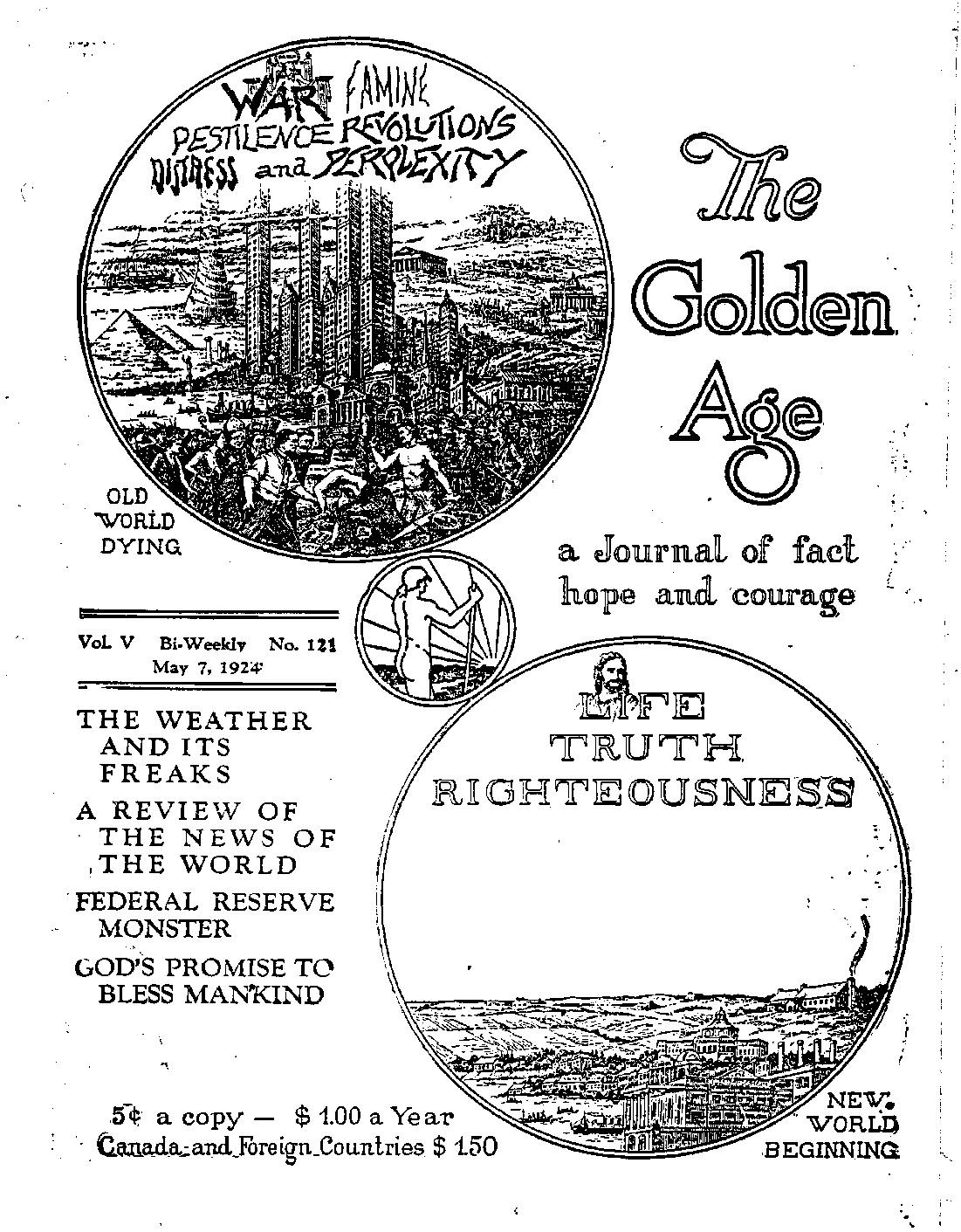
Contents of the Golden Age
Finance—Commerce—Transportation
Review op the News or the World.........
Charges of Fraud and Graft...........
Russian Banker Imprisoned...........
..The Federal Reserve Monster..........
Federal Reserve Seamstress Hard at Wouk (Cartoon) .
Coin Harvey’s Obelisk..............
Political—Domestic and Foreign
Great Britain, France, Belgium.........
Germany, Hungary, Rouinania. Bulgaria, Italy . . .
Religion in the East, Palestine. Persia......
India, China, Japan, Mexico, Honduras, Haiti . . .
Reports from Foreign Correspondents......
From Canada...............
From Great Britain.............
I Agriculture and Husbandry
i Danish Farming Notes..........
Travel and Miscellany
The Weather and Its Freaks.......
Physical Changes Are Noted........
Giant Icebergs Breaking Loose.......
Rain-Making Experiments.........
Insuwnce for Damage by Storms......
Forecasting and Its Uncertainties......
In the Storm (Poem)...........
Religion and Philosophy
A Literary Masterpiece..........
Above the Storm (Cartoon)........
God's Promise to*Bless Mankind.......
Why the Promise Was Made........
Channel of Blessing...........
Time and Effect of Blessing........•
The Old Must Pass (Poem)........
Studies is “The Harp of God’’.......
Cabtoon from “Yale Record’’........
. 493
. 494
. 495
. 406
. 49T
. 49T
. 498
483 489
506 -
Published every other Wednesday nt 18 Concord Street, Brooklyn, N. Y., U. S. A., by WOODWORTH. HUDGINGS A MARTIN
Copartner* and Proprietor* Address: 1* Concord Street. Brooklyn, X. I*., U. S* A.
CLAXTON J. WOODWORTH . . . Editor * ROBERT J. MARTIN . Burducss Manager WM. F. HUDGINGS . . Sec’y and Trens.
Fivh Cknts a Copt—$1.00 a Year Make Remittances to TT1C G0LDEX AGB
Forsxom Omcts: British.....34 Craven Terence, Lancaster Gate, London W. 2
Canadian..........?s-40 Irwin Avenue. Toronto. Ontario
4nst/alosinn.......493 Collins Street, Melbourne, Australia
South African......G Lelie Street, Cape Town. South Africa
Entered <• lecoudclaM matter at Brooklyn, N, X., under the Act of March 3, 1870
Volume V
ofte Golden Age
-5SM2
Brooklyn, N.Y., Wednesday, May 7, 1924
-- Number 12T^
The Weather and its Freaks
WEATHER is perhaps the most talk-producing subject in the world. It serves as a universal and continual silence breaker. , It comes to the rescue of the embarrassed, and relieves the monotony of many trying situations. Millions of tons of breath are wasted annually on the subject of weather. When minds grow sluggish and conversations lag, how natural it is for most of us to play ping-pong with the weather!
He said: “I think the weather is awful.0
She said: ■ “You shouldn’t grumble at the weather. If it were not for that, you’d have nothing to talk about.0
We may differentiate between climate and weather. Climate is the normal characteristic of the weather for any locality. The most potent causes regulating climate are latitude and altitude. Perpetual snow and ice in the polar regions and on mountain peaks are the climatic conditions normal to such places, while in the torrid zone grasses, fruits and flowers thrive, and beasts, insects and birds multiply and sing and play because the environments are conducive to such activity. Also, sea and air currents have much to do with determining climatic characteristics for any country.
The Himalaya mountains cause the Indian monsoon rains. The monsoon is a trade-wind of great influence on the climate of the world. From May to September a steady air current sets in from the southwest, laden with moisture from the Indian Ocean. A second monsoon from the northeast prevails from November to April. The monsoon region extends to the Pacific as far as Japan. Thus the Himlayas may be called the father of the weather.
Weather'may be said to be any meteorological phenomena, or oddities of climate. Any excessive hotness or coldness, dryness or wetness, storminess, fogginess or cloudiness, sudden changes of temperature, or prolonged spells of
any of these, and even abnormal presence or.^
absence of sunshine, are all properly weather^ conditions. .
The earth has its sunshine and cloud centers. " ■ At Tucson, Arizona, and Gunnison, Colorado, it ^ is safe for the hotels to advertise “meals free -on cloudy days0; for in the latter place there have been but six cloudy days in the last ten years. Yuma, Arizona, is the center of the chief' of the sunshine zones in the United States, with spots of secondary prominence located in southern California, southeastern New Mexico, west-* era Texas, and in Florida. These sunshine cen- . ters receive from eighty percent to eighty-five percent of the sunbeams aimed at them annual- < ly. The rainfalls in these .areas are negligible. The cloud centers are located in western Washington, near the southern portion of Puget Sound, on the southeastern shore of Lake Ontario, and in the upper peninsula of Michigan. From seventy-five percent to eighty percent of the days in these places are either cloudy or partly cloudy.
Best Climate in the World
LTHOUGH only eighty miles from the equator, the city of Para, Brazil, boasts
of the .best climate in the world. It enjoys a perennial climate of what might be called mild summer. A gentle shower of rain falls almost i every afternoon in the year, which, together with the welcome trade-winds blowing in from the Atlantic, tempers the intense heat of the sun and gives Para a climate that for evenness and agreeableness probably cannot be surpassed. ?
But we must not think that all around the world near the equator there is excessive heat, or even mild summer weather. Let us remember that on the 21st of September the sun is over the equator on his trip southward, and that at that time the sun’s rays are projected straight at the earth, so that at the equator the
' < '484'
sunbeams would be dancing straight up and
■3
BBOOKX.YV* W. X ■
dition and is shallow, and the trees were not
down, delivering their full energy of heat. An officer on one of the All-American Cable Company's ships writes that on October 15th while ’ crossing the equator at noon, southbound on the western coast of South America, he was com. pelled to don a heavy blue uniform instead of ■. the white duck suit which he had worn for three months around Panama. Before arriving at Santa Elena, Ecuador, 150 miles south of the equator, under more direct rays of the sun, he was wearing a sweater additionally under his coat. This was at sea, probably 100 miles out; but overcoats were being worn on his arrival at - Lima,.Peru, which is something less than 800 miles south of the equator.
Perhaps, after all, the best climate in the . world ia right at home, wherever we live. “The search for a better climate,” says the Journal of American Medical Association, “frequently means, as every clinician well realizes, a change in something more than meteorologic environment It is not the air for the lungs, the temperature for the skin, the altitude for circulation, or such incidents that alone are sought. Social, mental and physical changes occasion their own beneficial or baneful transformations.”
What the poor world is most in need of, then, is a peace of mind, a quietness of heart, and the elimination of the causes of worry, envy, jealousy and selfishness. These and many other good things are promised as the heritage of humanity during the reign of Messiah, the kingdom for which we still pray.
Physical Changes Are Noted
CLIMATIC changes have been noted in these columns from time to time, occasioned by shifting of ocean streams, receding of the ice ■■ zones, and changing of air currents. Mr. Charles ■ Lathrop Pack, President of the American Forestry Association, in explaining the reason why ’ many of the trees in Central Park, New York 5 city, died a few years ago, attributed it to chang-,'ing atmospheric conditions, which have been < going on for over twenty years.
\ There was a decided decrease in rainfall, much of which fell during the summer months, when/most needed; an increase of wind move-pmeats; and a general decrease in humidity extending: nvftr r five-year period. These were Vcontributing causes; for the soil is in poor conable to stand the increased lack of moisture.
Much rain falls on the ocean near its points of absorption. Tropical regions tend either to rainy seasons with a high annual precipitation, like the valley of the Amazon, with from eighty to one hundred and twenty inches, or to a low average, like the Peninsula of Yucatan in Mexico, with about fourteen inches, or to none at all, as in the desert of Sahara.
In the United States the rainfall figures run from ten inches in southern California to ten< to thirty inches in the high Western plains, increasing to twenty to thirty inches in the Missouri valley, rising to thirty-five through the Ohio valley to the Atlantic coast, and increasing to sixty on the Gulf coast.
There are many reports that the Arctic regions are wanning up. Explorers and fishermen find the climate moderating about Spitsbergen, and causing rapid changes in flora and fauna. Old glaciers have disappeared. For five years these changes have been noticeable. It is estimated that the United States as a whole, winter and summer, has warmed up one and three-tenths degrees since 1897. One degree in temperature is equal to about 100 miles in a north and south direction. So warm was it two years ago in the Swiss mountains that many of the ice bridges, used for years, gave way.
Seals have been leaving their old feeding places in the Polar region and seeking cooler water farther north. Land is appearing where formerly there were vast areas of ice. Fossils of a tropical fern have been dug up in Greenland, showing that in the antediluvian period there Was a warm climate with tropical vegetation where the glaciers are now melting away.
Scientists generally are at sea as to the cause of the earth’s wanning up. To them, the earth, millions of years ago (1), was a molten mass, red hot, and for ages it has been cooling. The ( sun also, say they, is gradually cooling. So,' scientifically, as the earth is cooling and the sun radiating less and less heat, the earth geta j warmer and warmer I It is estimated that the heat in the center of the earth ranges from 3,000° to 180,000° Fahrenheit. Some think that the increase of heat on the surface of the earth is due to the disintegration of radium in the rocks; others attribute it to radioactivity; and still others think that the earth is radiating heat which was stored up* during condensation
Hat T, 1921 from the original nebula, or that a chemical reaction of some kind is taking place.
Two summers ago the Laplanders enjoyed their first retL summer weather witliin the memory of the oldest inhabitants. The thermometer rose to 86°, and the Eskimos had to lay aside their furs.
There are warm spots in the far north. Little heed was given to the reports of trojfical regions north of Porcupine River, latitude 65®, longitude, 144°, Alaska, until 1912, when a party of explorers noticed that the thermometer began suddenly to rise from 40° below zero to where the snow was melting; and they had to remove their warm clothing, within a space of two hours' traveling. They encountered hot springs, and came upon dense growths of vegetation. They found large rivers of warm water teeming with fish: the country was said to be alive with game.
Great volumes of warm water from the Mexican Gulf* Stream, pouring through from the Atlantic into the far north, and from the Japan Stream, swinging farther into the north Pacific at every earthquake shock, tend to moderate the waters of the Arctic region, and will, we believe, in time wear away all the ice and snow and relieve the frigidity of the entire north. The San Francisco earthquake is said to have changed the Japan Stream to a course 1,000 miles farther north, and the recent Japan earthquake changed its course another 150 miles farther north.
Other Changes Not Unlikely
WHILE the Japan Stream and the Gulf
Stream are pouring great volumes of warm water into northern latitudes, the Arctic Ocean is doing its best to disgorge its surplus-into the south. In the Strait of Belle Isle, a narrow channel separating Newfoundland from Labrador rushes the water from the Arctic in what is called the Labrador current. This stream " makes eastern Canada and the New England states cool in summer and quite cold in the winter. Some engineers maintain that this stream could be diverted by building a dam, which would cost $10,000,000 or more.
Such a dam would force the cold waters out into the Atlantic, perhaps intercepting the Gulf Stream and causing it to hug the American side of the ocean rather than the British Isles. This would give eastern Canada and Newfoundland
GOLDEN AGE . -
much wanner weather, and England/tnight^B^^
come as cold as Labrador. As England dependent on the Gulf Stream for her warm^ weather, what a calamity would befall it if Gulf Stream should be diverted from its pres-/5 ent course! . <45
Man’s ability, however, to protect himself : against cold is much greater than his capability to defend himself against excessive heat and ’ humidity. Changes are bound to take place, • but perhaps they will come slowly enough to i permit man to adjust himself without any special inconvenience. ■ :
The Arctic Ocean is warming up; icebergs are growing scarcer; and in some places the seals are finding the waters too hot and are moving northward, according to a report from . Norway. But the United States Weather Bu-’ reau says that this is not so. It is said to be able to produce records that will disprove any claim of permanent shifting. The fact that the last two or three years have been unusually mild, with the quite unseasonably warm weather last fall until the new year, means nothing to the weather bureau. Periods of noticeably warmer or colder weather will come, but there will be no change in the general average, is its view.
An Unusually Mild Winter
AN UNUSUALLY mild winter, at least dur-■ ing the early part, was prevalent this past season over Russia and North America As late as the first of December the thermometer registered seventy degrees in the central part of Russia; lilacs bloomed in Kieff; violets were sold in Odessa; the cherry trees were in bloom over a large area; strawberries in every stage of development were found at Stratford, Ontario, December 20th; and the winter grain, which begins to sprout under the snow in the spring, sprouted and came up.
Generally in the' Gulf of St. Lawrence the weather at the first of December is severe. But this season it was so mild that the inhabitants of the district were deprived of their usual winter employment and their ordinary catch of fish, and were longing for real winter to come. They cared nothing for ripe strawberries and butterflies on the wing.
Farther south, in the United States, houses which ordinarily require plenty of artificial heat after October first, were comfortable up until
?j nearly Christmas with little or no heat except that generated in the kitchen range.
On the other hand, the winter weather in the British Isles was unusually severe. Fogs were unusually heavy. South of London a passenger train on the London and Southwestern Railway, Sf: headed for Portsmouth, lost its way and ran ?>" several miles on the road to Southampton, beY fore the fact that it was on the wrong track was discovered.
\ The evidence accumulates that the climate of ? the northern hemisphere is. gradually changing.
The north polar ice-fields are melting; Ameri-; can springs and falls are much longer than heretofore, the summers are shorter and not so hot, and the winters are often shorter and not so cold.
Without a doubt, in our judgment, the Lord . is making climatic conditions such that the vast arable plains of northern Russia, Siberia, ’ Alaska, and Canada can be opened up to settle* ment. These areas will be needed, at first; for the population of the globe is destined to be ■ tremendously increased soon by the resurrection (gradually, every man in his own order) of all that are now asleep in death.
Winnipeg, Canada, which usually has its 5-below and 20-below weather in November and December, last fall had semi-tropical weather. * Three times during that period Jack Frost . threatened a visit, but as many times some . giant got him by the whiskers and forced his . retreat. The Yukon river at Dawson was open as late as November 22—something unheard of ; ? and Alaska was extraordinarily temperate until - after December 1st. Santa Claus rode deerback 4 last Christmas. Some of the leading meteorolo-? gists of Canada are inclined to credit the warm - weather to the shifting of the Japan current. , -But Old Boreas got behind Jack in good shape '■'early in January, and pushed him without 1 mercy dnto the far south.
’>■••• The temperature soon warmed up again. One . j city reported 32°-below weather one day; and ; the very next afternoon (January 6th) the thermometer rose to 38° above, a change of 70° in C thirty-on^ hours. But the cold came again, and s .the rest ol January and February were nearer '-- the normal winter weather.
cold snap on the 28th of January evidently ;-tried to make up for lost time; for in northern - Ontario temperatures ranged from 40° to 60° f?bfelow zero; this with a high wind followed a heavy, snow storm, greatly hampering train movements. At the same time in the northern part of New York state the mercury dropped to 39° below, and at Syracuse it got as low as ' 12° below. This sudden breath of frigid air was quite severe on the dandelions, pear blossoms, and roses in southern New Jersey.
Giant Icebergs Breaking Loose
FOR several years it has been necessary in the spring to watch for icebergs in the north Atlantic waters; for they are becoming more numerous and larger than formerly. In 1912 the Titanic (the unsinkable ship) collided with one of these, and went down. An iceberg last spring was so large that it was estimated’ that it could furnish ice for nearly all the homes in the country for the season. It was one-third of a mile in length, and was seventy-five feet out of water. Three hundred large icebergs were located south of Newfoundland last spring by the ice patrol; and 195 steamships appealed to the patrol for information, and instructions to fit their particular cases were broadcast twice daily. Additionally, forty-six ships which were bearing down unawares into the icebergs, also received warnings.
The destruction of two large icebergs that drifted down into the steamship lanes was accomplished by the use of wrecking mines. This was the first use of explosives for the destruction of icebergs ever made. One iceberg of quite large dimensions was seen over 100 miles farther south than they usually drift
Cold and Hot, Wet and Dry
LAST May was reported to be the coldest in fifty-two years at Chicago. Nearly the whole of June was wintry in France, and on the 19th that country was shivering amid snow. It was also frosty and disagreeable during the' June nights in England. At Natal, Cape Colony, and the Transvaal of South Africa, last September, a blizzard swept over the country, so terrifying the natives of that region that explanations of the whites could scarcely reconcile them to the seeming miracle of snow.
Following the coldest June hi the history of England came in July last the hottest weather they ever experienced—129° in *the sun. The heat extended several thousand feet into the air; and an air pilot going 100 miles an hour between Manchester and London was compelled
to discard his coat. It was theorized that the heat was caused by the explosion of a dump of German shells at the Camp of Domeger. Windows within a radius of one and one-half miles were broken, fragments of the shells fell two-thirds of a mile away, but no one was injured. There were many deaths from the heat, however.
At Bazra, in Asiatic Turkey, in August, 1921, the thermometer stood at 128°, and the toll of life was heavy. This heat wave rested over nearly the whole of Europe. A severe drouth ^in July and August, 1921, extended over a large part of Europe while they were having their heat wave. Glaciers in Switzerland receded. Normally, from January to June England gets eleven inches of rainfall, but in 1921 she got about half the amount. Belgium was also hit hard. Ireland suffered at this time; and in October, 1921, there was an excess of heat and rain shortage that was world-wide, the worst for the preceding fifty years. For the five months preceding July the rainfall in London was only a trifle over four inches, the water shortage being the worst for sixty-four years.
.Water rationing was common, and in some places water was selling at two cents a bucket. The river Shannon in Ireland, the largest on the British Isles, had dried up to such an extent that it could be waded across in many places. During this terrible drouth a foolish prayer was offered for the postponement of rain because the first Monday in August is a Bank Holiday, which depends upon fair weather; and many thoughtlessly said: "Amen.”
The year 1921 was New York's hottest and driest on record. The temperature was an aggregate of l,04G° above normal; the rainfall was 1014 inches less. New York's coldest year was 1875, when the average temperature was 48.6°. The average temperature for fifty years has been slightly under 52°.
Following the drouth in 1921, some one in describing it said:
"The old spheroid known as the earth is emerging from what some human diagnosticians might call a severe attack of meteorological mumps. It has been accompanied by an intermittent fever, manifested in a world-wide heat wave of unusual length and intensity, in spite of crista and relapses—earthquakes, tidal waves, cloudbursts, typhoons, waterspouts, hailstorms, etc.”
As late as October water burst through the Gruben glacier in the Bernese Oberland, Switzerland, as a result of the long hot spell which^ caused the ice to melt and form small lakes and the surrounding district was flooded. /
It is said that June, 1922, was the wettest^ June the United States has known since the <; inauguration of the Weather Bureau, 187L But June, the following year, was very dry in New < York; and shrubs, bushes, and many grasses // were killed. ./
’Sometimes rain is a hindrance, as in the case of Napoleon, when he was hindered from making an earlier attack on Wellington at Waterloo. But sometimes it is an advantage; for Lincoln J. Carter attributed his millions to the success of his first melodrama, which was very well attended as a result of a heavy rainfall on the Sth of June, 1889. It is, of course, according to viewpoint. A farmer wants dry weather and sunshine so that he can put up his hay; his neighbor wants rain so that his cows may have more grass—to give more milk, to get more money, to get more land, to raise more grass, to feed more cows, to get more milkl
Fog and Frost
OGS are produced by the condensation of moisture in the air near the surface of the earth, or it may be that a cloud has descended and enveloped the surroundings. Cold air passing over warm water will produce a fog. Warm, moist air passing over cold land will produce the same result. The meeting of cold currents from the Arctic ocean with the warm waters of the Gulf Stream southeast of Newfoundland produces a perpetual fog. Puget Sound has considerable fog. The fogs in London are proverbially dense, and a person not only sees the fog but feels it and smells it In November, 1921, the fog was the densest in twenty years: trains, cab drivers, pedestrians, everybody, had to stop right where they were and wait for the fog to lift. At times this fog would roll like a huge blanket with varying degrees of theckness.
A reporter said:
“The Londoner pays $6 a year in cash for his beloved fog, besides breathing 22,400,000,000 sooty particles of the fog every day during the season. Scientists by means of special apparatus are able to weigh the fog. The latest estimate of the weight of a heavy fog covering the 443,424 acres of Metropolitan London is stated at the South Kensington meteorological office to be 900,000 tons.” , . .
| 488
GOLDEN AGE
Bsooklxx, N. X
- The London Herald says:
;' “There are many things to be said against a fog as a form of human lung-fodder. But there are just one or two things to be said in its defence. Fog is a democrat, a leveler, a practitioner of fraternity. It puts us all in S- the peasoup together. No amount of money can dispel J . a fog. ... A real fog is a salutary warning to the ' people who are always chattering about the triumph of ' civilization and the marvels of mechanical science.”
' But in October, 19.22, it was demonstrated at Pittsburgh, Pa., that a fog could be diminished; for a successful experiment was conducted on the Monogahela river. An attempt was made to lay a complete blanket of oil on the river, but the surface to be covered was so extensive that the mixture, which spread quickly, became too attenuated wholly to choke off the vapor. This is too expensive a method to meet with great enthusiasm, unless there could be a tax placed upon the people of that locality.
. “When the frost is on the pumpkin” it is on everything else. It is a beautifier. Those who have not seen frost on trees, shrubbery, tele
. phone wires, and window panes, do not know the sublimity of that kind of scenery. When frost is in season no one objects to it, but frost out of season is damaging; in the spring, to the blooming and fruiting of the trees and garden plants; and in the fall, to the proper maturing of late crops. A heavy late spring frost may destroy all the prospective fruit in large areas; such as apples, peaches, oranges, etc.
Along the 45° latitude, beginning in Wisconsin and extending west for over 300 miles, frost rarely nips anything in the bud. The cold of winter hangs on so tenaciously that when it ■ does let go, and the sap begins to liven up the , trees and shrubbery, the spring is so far along that Jack Frost seeks his hibernating quarters in the far north. For some reason cherries do , . not dq well in Minnesota, while plum trees will ’ bear"in abundance. However, killing frosts visited the northwestern states last fall as .V early as September 14th, but after that it was ‘ unseasonably warm until after New Year’s.
/ Rain-Making Experiments
MANY methods have been employed to ex. periment in rain-making. Spraying the clouds with liquid air has been tried; likewise -'-^explosives, conjuring, prayers, and electric \ 'sand have been used. But none of these meets with pronounced success. Elijah, the prophet „ of the Lord, prayed that there might be no •. rain; and none fell for three and one-half years. Then he prayed for rain, and a drenching rain was the response.
The Weather Man looks down upon the bringing of rain by any artificial means. He claims that it will dry up what wetness there is without producing more. Airplanes have been employed to throw electrified sand into clouds to make them shed their tear drops, and with some degree of success; but it seems to be too much of 4 an undertaking to be practical. Scientists, of * course, are behind the rain-making experiments. It is claimed that the droplets of water in the air are formed about dust particles; for even ' the infinitesimal electron has served as a nucleus of condensation in laboratory tests.
Sand particles, charged with positive electricity (the electrons are negative), serve to bring about the coalescence of vapor particles which, when accumulated to a certain size, gravitate to earth as rain. On the theory that a fog is simply a cloud on the ground, the chemists supporting the rain-making idea say that electrical sand will cause it to be precipitated and disappear. An experiment with electrified sand last year at Dayton, Ohio, is said to have brought minor success.
A very unscientific and irreverent method of producing rain is the Baal method—by prayer and supplication either to an unknown deity or to a deity unknown by those who pray. The natives of India have a unique way of appealing to their rain-god. The rain-maker hangs his assistant, head downward, and pulls him back and forth until the rain comes. In Africa, if the > rain-maker fails to produce rain when the attempt is made, he is put to death.
Ever since the days of childhood we have heard that explosives produce rain. This tra- i dition oddly enough goes back to the centuries 4 before gunpowder was used; but then the. rain was caused by the clash of the weapons againsj shields and armor. It is said that the Weather Bureau vouches for the fact that great fires sometimes cause rain. The heated air rises in volumes, condensing the moisture of the air,. forming clouds; and rain results.
Mr. C. M. Hatfield, of California, is said to be a rain-making artist. He used a huge tank in which the mystic chemical mixture was con-; _i fined. This tank was transported to the place ; where the rain was wanted. By adding a chemical the mixture started to brew; and as the brew breWed the man in the clouds from either joy or sorrow began to cry. It is claimed that in July, 1921, Hatfield caused weepings in Washington state to the extent of 4.24 inches. Then some farmers in Oregon offered him $3,000 an inch to produce rain forlhem. The next year Hatfield appeared at the Vatican, being anxious to explain his secret to the Pope? We have not heard of him since.
"St. Swithiifs Day, if thou dost rain, For forty days it will remain.
St. Swithin's Day, if thou be fair, For forty days 'twill rain nae mair.”
Marconi predicts control of rainfall by radio. All the work, he says, will be done by the sun; man will merely press the button. The developers of water power and of radio transmission of electrical energy produced by water power will become exporters of electrical energy to less fortunately situated countries.
Insurance for Damage by Storms
SOMETIMES much damage is done by hail.
Hailstones as large as hen's eggs have fallen in such quantities in the heart of the summer season that massive fields of growing corn were reduced to poor fodder for the cattle, trees were stripped of every vestige of foliage, shingle roofs were so shattered that complete re-roofing was necessary, every window pane on three sides of the houses was broken in, and chickens were killed by the thousands.
Sometimes snow will pile up on the roof of a building until it caves in. Ice-floes will occasionally jam a bridge until it gives way. Hurricanes leave in their train wreckage, demolished buildings, the maimed and the killed; ships are damaged; crops are ruined, and whole orchards uprooted.
But the dangers from hurricanes and typhoons are limited to the areas which they frequent. Tornadoes are more numerous, and are liable to spread their destruction in their narrow 'paths over much more of the earth's surface.''Strictly speaking, a cyclone is a circular air current covering a wide area and is not dangerous. .
The taking out of insurance for damage accruing from rain was considered a novelty until five years ago, but it is becoming quite'aTmai^ ter of business. Following the example of Grea^ Britain, Americans insure against every variety*? of loss which may be occasioned by rain^ lK 1921, it was reported that over $1,500,000 were] underwritten in rain insurance for the Fourth] of July, and it was thought that Labor Day] exceeded that figure. There was a policy writ-) ten covering the Dempsey-Carpentier fight, the premium of which is said to have been $75,000.<
Colleges insure against rain when there is to;
be a football game. State and county fairs* also try to cover the loss from rainy weather; by covering with rain insurance. It is said that! summer hotels likewise carry rain insurance fori the week ends, and so do also department stores I on days when special bargains are advertised, ,-j The consumer, of course, in the end pays they "freight", together with the taxes, the insurance, I the overhead, the excess profit demanded with* the spirit of the times, the interest on the invest- i ment, etc. Satan’s kingdom, like Pharaoh’s, has> been a hard taskmaster; and what a load will be lifted from the shoulders of humanity when Canaan, the Lord’s kingdom rule of righteousness and truth, is reached I
Periodic Weather Changes and Signs
THERE are periodic changes of weather which we shall not attempt to explain in this article. We have the seasonal changes attending the earth’s relation to the sun in its swing in its orbit The moon has its seasonal; influence. There are also storm cycles of about | seven days, and the reactionary storm periods’ in between. All the planets exert their influence,! diminished or intensified, upon our atmospheric; conditions, according to their relative position, i
The “Bruckner period” is a system by which I weather prognostication may be guessed at. The larger cycle is thirty-five years, in which are cycles extending from five to ten years. There will be thirty-five years of dryness, and then thirty-five years of wetness. The London Daily Herald informs us that we entered the Bruckner dry period in 1921. i
There is a “sunspot period” of 55.6 years, J also. These are cycles of cold periods. The * years 1813,1814 and 1815 led up to 1816, which i is known as the “year without a summer.” We I are now in the years leading up to 1927, when' the cold spell is again due to culminate. Pe>
■ haps the cold spring of 1923 was the beginning of that period.
r But another theory is advanced that not all \ . of the cold should be attributed to the sunspot maxima of that year, but partially to the terrific explosion of the volcano Tomboro in the island of Sumbawa, Dutch East Indies, the year before (1815) which filled the upper atmosphere
■ with hundreds of cubic miles of fine dust. In a few months this fine dust covered the earth and lasted for over two years, interfering with the proper radiation of heat from the sun.
The prophecies seem to show that there will * / be due in the late fall of 1925 another explosion
' of something which will fill the earth with small particles of something—we know not what. This time it may be a symbolic explosion, antityping the blowing off of the lid of the Teapot Dome, which has filled the upper atmosphere with great hunks of reputations and left the stains of oil everywhere.
Signs indicating weather conditions are numerous; some are foolish and superstitious, and some are based upon fact. Some go by the goose bone; some by bullfrogs. Some can tell
■ (T) from the coat of fur the skunk takes on
Whether a winter will be severe or mild; and from the way the squirrels gather the walnuts Whether the winter will be early or late.
For outlying settlements to be surrounded by great packs of wolves indicates cold weather. The itching of frosted feet is a sure harbinger of warmer weather within forty-eight hours.
. Nearly every one has his sign; and it is according to where one lives as to how it works. A native of Africa grieved the rain goddess, thus causing a drouth; and the native paid the penalty with his life.
The following by E. B. (Fanner) Dunn, formerly of the U. S. Weather Bureau, taken from Science .and' Invention, is interesting:
"Clouds are not always an indication of rain or snow. Certain clouds are really heralds of fair weather. A mottled sky, with light drifting clouds, foretells fair weather. If wind comes before the rain, the squall will be of short duration. If rain comes before the wind it may last ah'hour or two. The heavier the rain the quicker the squall passes. . . . When fog sets in before midnight, the following day is likely to be rainy; but if . fog appears in the morning after sunrise, the day will be fair. . • .A general increase of cloudiness at sunset ; means rain or snow. Tufts of cloud forming a dappled or mottled sky • indicate fair weather. . t . Small inky / . •
clouds indicate rain. In cold weather, a bank of dark clouds forming in the north or west with a southerly or easterly wind indicates rain or snow. An excessive clearness of the atmosphere is an indication of rain or snow to follow within twenty-four hours. A low, overcast sky, with light northerly wind in winter, foretells snow. Ragged clouds moving rapidly indicate wind and rain. Dew indicates a fair day. Wind or a cloudy night prevents frost or dew. A yellow sunset foretells rain; a bright straw yellow, wind and rain; and yellow blending into orange, fair weather. A red sunset, a fair day. A red sunrise, a wet day. A gray sunset, a wet day. A gray sunrise, a fair day. Dark Indian gray sunrise or sunset, rain. Pale green at sunset, rain. Combined green and red sunset or sunrise, probably rain. A red disc at sunset means fair and warmer. Cool wind over a warm surface of water, or a warm wind over a cool surface or water, creates fog. Sudden fall in temperature causes showers. Sudden rise in temperature, fair weather. High temperature and high humidity, thunder-storms.” >
“Not till clouds have hung above us, Slaking dark the bright blue sky, Do we see the real beauty
God has made for every eye.”
Freaks and Pranks of Nature
VERY now and then there is a surprising variation of weather from what is normally expected. This may be experienced in any time of the year, and almost anywhere. That the earth is under a terrific strain in keeping her orbital equilibrium amid the attractions from the other planets of our solar system, some astronomers have often noted. Sometimes when it is dry, it is dry; and when it rains it pours. A hot Hay may be followed by a cold June; a cold September may be followed by a warm October.
When the long drouth of 1921 was broken in Switzerland, rains fell in such torrents that railroad bridges on high elevations were washed away. There are some localities situated between hills where there is no attempt to build bridges. The stream beds are dry most of the time, Ijut after a hard rain the streams will swell with such rapidity that an automobile overtaken in the midst of one would have to be abandoned to its fate. The streams will be impassable for a day or two, and within a week will be dry again. Congressman Rainey and his wife had such an experience in Pike County, Illinois, a few years ago.
Last May there was a blizzard which extended
as far as Texas. A few years ago in the latter part of May there was such a heavy snow storm in Central Illinois that trains were tied up for twenty to forty-eight hours. Not even snowplows could get through in some places. But the snow melted quickly and soon was gone.
In South Africa, in February, 1923, (their summer) the crops were suffering from a long and terrifying drouth in the inland ai*eas of Cape Colony; and less than a thousand miles north in Mashonaland the natives were resort-J ing to human sacrifice in order to save the crops. Yet in the Transvaal, which lies between the two parched regions, there was wetness above normal. This was a very unusual thing.
A wireless expert laid the freakish weather to the radio. But a scientist furnishes an alibi for the radio, saying that there is not enough electricity used in broadcasting to affect the atmospheric conditions.
The abnormal results of the convulsions of nature began to be noticed about August, 1920. Since then drouths have caused the starvation of over 2,000,000 people; millions of fish have died in Europe alone. Floods have caused damages to the amount of $15,000,000; and hundreds have been drowned. There have been two damaging waterspouts; hailstones in Cuba destroyed three hundred houses, and many were killed; heavy hailstorms were reported in Rome and Greece; cyclones have been numerous; lightning struck many oil wells in Texas and Mexico; glaciers melted and flooded great areas. There have been no less than twenty-five volcanic eruptions; and no less than seventy earthquakes, of which the most destructive was the one in Japan; and two great ocean currents have been shifted.
Some of the really odd things are as follows: In January, 1923, in northern New York state, | the snow was sixteen feet deep on a level; in October, 1922, at Alexandria. Va., the rain fell in a spot ten feet square: millions of frogs disturbed the slumber of Junction City, Kansas, after twenty-four hours of hard rain; in November, 1920, there was a rain of blood upon Monte Caylo which lasted one and one-half hours, covering the roofs, roads, gardens and shrubbery Vith the sticky crimson.
In November, 1921, near Parkersburg, W. Va., rain fell for more than two weeks upon a patch of ground about twenty feet square. Bay and night, clouds or no clouds, the rain.''continued!^ This last phenomenon was explained byzfhe^ owner of the premises, that there were el^venS feet of sand covering a clay foundation) that§-the sand was always moist, and that on account^ of the warm weather moisture would rise in tBsM air, condense, and return to the earth. So many £ people got to visiting the place that finally twenty-five cents was charged for admittance.^
It was reported in August, 1921, that a cyclonic sandstorm disturbance carried more than 13,000,000 tons of dust* and dirt from New Mex-~ ico to Michigan, Ohio, Vermont and New Hampshire during a previous winter. Official records/ show that the storm traveled at an average. velocity of forty-eight miles an hour and blew-the dust, which it snatched from the plains of the southwestern states, to the fertile stretches’ of the corn belt and northeastern states. No one doubts that the wind may transport thousands of tons of rock material a thousand miles or more, but by what process the 13,000,000 tons in this instance were estimated we have no guess.
Forecasting and Its, Uncertainties
FORECASTING the amount of rainfall by the ocean temperature is what Dr. G. F.
McEwen has undertaken to do. His observations over the Southern California coastal region lead to the belief that when ocean temperatures are cooler than usual the rainfall will be heavier, and when the summer seas are warmer the rainfall will be less than the average. A fall of one degree in temperature corresponds on the average to an increase of about two inches of rainfall.
But there is a saying that all signs fail in dry weather. A man, in noting the severity of March weather, observed that when he lived through that month he always lived during the remainder of, the year.
One writer says that hundreds of thousands of New Yorkers arrange-their pleasures and business affairs, often months in advance, on special advice of the Weather Man. Another writer says that meteorological conditions are all askew, that the atmosphere is behaving in such a fashion that it baffles all observation. It often happens that when the Weather Man says “rain" it is fair; and when he says “fair* it rains. But we ninst not blame him too severely; for admittedly he knows nothing of causes behind low and high pressures. His barometer tells him the pressure where he is located. If it were not for the telegraph and radio, he would not know any more than anybody else. If a “northwester” hits the western coast at the rate , of sixty miles an hour, he can by keeping track of it, forecast the probable weather conditions in areas 500 miles in advance of the storm.
The daily forecasting and weather reports in the press are of enormous importance to all classes of business, especially to the agriculturists and stock raisers; and until a better method is discovered by the people and popularized, the present measurably unsatisfactory method will have to suffice. But everyone dependent on weather conditions should own a trusty barometer and follow its warnings,
Munich boasts of having the first tower barometer clock. It has a huge dial, nearly twenty feet . in diameter, and is situated on the upper outside wall of the Museum tower; the giant indicator shows people for miles around whether the weather will be good, bad, or indifferent.
Some claim that everyone is more irritable in hot weather than in cold. Divorce proceedings usually start in the summer, for the reason that there is, apparently, a general let down for all the family. Perhaps this theory is advanced because heat expands and cold contracts the physical organism. ,
When all nature is aglow with life, when verdure is springing forth, and when birds are mating and happily bringing to maturity their birdlets, maybe there is an expanding of the heart-strings in a yearning for reciprocal love which is not forthcoming.
Weather unquestionably, the high and the low pressure, has something to do with the moods. But whether it be one of quickened activity or languor should it not tend to affect all alike, and if e$ch be rightly exercised should there not be maintained an equipoise of heart and mind that would be conducive to the conjugal and home relations? ■
Did God intend the weather to make one peevish and fretful and another peaceful and contented, or did He intend that one should be cross as a bear and the other as meek as a lamb' Charging divorces up to seasonal changes of the weather is nothing short of subterfuge. Knowing how weak we are we should not be too exacting of others and nag at them, but
bend our efforts toward righteousness and truth and virtue and sobriety. ..
Arthur Brisbane, referring to our earth-home ; and the atmosphere we live in, said:
"We live ixi a rapidly revolving, marvelously balanced hothouse arrangement. The atmosphere protects us from inconceivable cold outside. The earth’s crust is a shield between us and liquid fire inside the earth. Thus between intense heat and intense cold we live nicely warmed, on a ball turning around a thousand miles an hour, going around the sun at a speed much greater £ than a million miles a day. If our atmosphere were . swept away, we should freeze to death in a second. If the solid ground vanished, we should melt like snowflakes landing on a red-hot stove. We should be grateful for such a finely adjusted hothouse residence, instead of taking it all for granted."
“How beautiful is the rain!
After the dust and heat,
In the broad and fiery street, In the narrow lane—
How beautiful is the rain.”—Longfellow.
In the Storm
Irene Woodstock in Our Punib AnunaU
I was hastening one day, through the snow and the sleet. When I saw an old horse standing near, on the street He looked at me sadly, with gentle, brown eye. And It seemed that he whispered, as I passed him by:
“Kind friend, I am cold, in your great overcoat And your muffler thne’s fastened so snug ’round your throat, You never could guess, since you are so warm, How chilly I am, standing here in the storm.
“The grocer’s boy drove me; and how I did dash Down the street, tip the hill, at the sfhig of his lash I While he shouted, and urged me the faster to gu On my poor, weary legs, through the Ice and the snow.
“Kind friend. If you watch, I am sure you will see
A great many other old horses like me. Who, for somebody’s pleasure, are urged to a run;
Then left, unprotected, in storm or in sun.
“I am Just an old horse, and I can’t speak my mind. But If I could talk. I would say Please be kind. For though I am only a horse, it is true, In feelings I'm almost aa human os you.’n
I found an old blanket I surely could spare.
I threw it across him, and fastened It there.
And I’m sure I felt better, that day of the storm.
Because I had helped an old horse to keep warm. ..
< ?
A Review of the News of the World
(Broadcast from WATCHTOWER WBDB, on a wave len^h of 214 meters, by the Editor)
NEARLY seven years ago Smith, Hauser & McIsaac, of New York, were given a contract for the construction of Camp Meade, erecting temporary buildings and sheds, and installing a ’ water and sewer system. The profit was to be * a percentage of the cost of the work, but the fee was not to exceed $250,000. The United States has paid for this camp $18,000,000.
The slipshod way in which the government, does its business may be seen in the fact that i only now has the Department of Justice taken ' action to recover $7,000,000, claiming that this is in excess of what it should have been. Who can tell why this matter was not investigated before payment was made? The complaint charges fraud, graft, and misuse of government funds on the following items: (1) Large quantities of material wasted; (2) excess employes used in unnecessary work; (3) persons employed without regard to qualifications; (4) persons encouracrftd to loaf rather than to work; (5) unskilled labor paid at the rate of skilled labor; (6) the same men paid on more than one payroll; (7) failure to use proper organization; (8) delays in the construction, thereby increasing the cost to the United States.
Great Britain
THE new Labor Government, having witnessed with joy the transformation of a coal miner and an ex-railroad porter into barons, has added the further achievement of cutting down the cost of the court dress from $750 to $75— another drift toward the good old American way of doing things. In America, when a grocer or a lawyer or a blacksmith feels that he can afford to go to Congress, he is generally pretty well satisfied if he can afford the $75 necessary for the coat, trousers, and vest which go to make up his court suit. But after he has been in Washington for awhile, and has gotten into what one of Mr. Harriman's admirers referred to as "the inner circle into which the rest of us may not enter," he is all too liable to change the $75 outfit for a $750 one; that is,he is until Senator Walsh or somebody else comes along and blows the cover'off the teapot. In these days of unrest and^ upheaval ‘a politician's life is not a happy one?
There are twenty-three members of the present British Parliament who served prison sen-fences during the days of the madness, due to their stand against the. World War.
Winston Churchill, who, during the World War, fitted out, or financed out of the British treasury, several of the expeditions which attempted the overthrow of the Soviet Government of Russia, has just been defeated for reelection to Parliament
France ; . 1 :
HE outlook for peace in Europe continues none too bright. On this subject the London Observer says that by comparison with her neighbors, France is now the strongest armed power known since the days of Csesar. She has three-quarters of a million troops, on : a peace-footing, with swarms of machine guns,. flotillas of tanks, and a preponderance of airplanes in the proportion of ten to one. Moreover, although Germany, Austria, Hungary, and. Bulgaria are disarmed, Europe has now a million more soldiers on a peace-footing than she had before the outbreak of the World War.
Belgium
HE king business is getting worse and worse/
During these times of the high cost of '
living, practically everybody else has been able . to get an increase in his wages. But it seems . that the king of Belgium is on the payroll for the same old amount that he was on before the World War broke out; and not only that but ■ recently some ungrateful Socialist actually ' wanted to cut his pay still more. If this king business gets any worse, the few monarchs that are left in Europe may find it necessary to take up some other trade. Meantime, the cardinal business continues very good; but how long it . will last nobody can say.
Denmark
ENMARK supplies forty percent of all the world’s exported butter. It is claimed for
the Denmark butter that although it is of a rich golden color it does not contain a particle of ’ coloring matter; and that a group of six Danes, once a week, names the price of butter for the world.
The Danish method of feeding cattle is to tether the cows in a line across the field so that the grass is cropped as systematically as though
mowed with a mowing machine. By the time the cows have crossed the field once, the grass on the far side is long enough to start over again. In cold weather the cattle are blanketed as they feed in the open fields.
Germany
COUNT Von Bernstorff, former German ambassador to the United States, is out with the statement that America alone won the .World War, and that no settlement of the quarrel between France and Germany will ever be made until America intervenes. But just at this moment America has . so many Teapot Dome statesmen on its hands, and is so deeply interested in the outcome of current investigations that she has little heart to interfere in European squabbles.
Conditions in Germany continue to improve. A recent report shows a decrease of 30,000 in the number of unemployed. At the same time it is said that‘at least one-fourth of all the school children are in desperate need of food; and that 'diseases rare before 1914 are now common, due to lack of milk and green vegetables. This want of food is seen in the fact that twenty-five percent of the patients in children’s hospitals are suffering from tuberculosis.
Hungary . ,
IT NOW appears that the persons who are responsible for smuggling the money and valuables out of Hungary, and thus bringing about the depreciation of the Hungarian crown, were the very detectives employed by the Government and entrusted by the Government with the task of stopping this very smuggling. This is our own modern American way of doing things. The Teapot Dome has shown us that the surest way for a man to make a great sum of money in the United States is to get into some place of honor and trust in government > service,^ particularly, it would seem, in the Department of the Interior, which is and has
• always been, a Mecca for grafters. After this-revelation of up-to-dateness, those who are cn-gaged in the Americanization of the Hungarians . in our midst will no doubt breathe easier, feeling thatthey have less to do.
Rxmta'
Ar.lrrA-NnyTt Krasnotchekoff, former Chicago lawyer, more recently manager and director ? of the Industrial Bank of Russia, has been sen
tenced to six years' solitary confinement for lending money to a brother at a less rate of interest than the going rate charged to other concerns. If the same rule was to be applied to American bankers, the jails would be full in a week. \
Roumania "* “ '
UNDER the general guidance and direction of France, Roumania has been engaged in subjugating what was once the Russian state of Bessarabia. The Bessarabians are not enthusiastic about being absorbed, however. As a consequence martial law Inas been declared, and -the prisons are full to bursting. These moves have greatly disturbed the Russians, and have added to the possibility of an explosion in the Balkans in the near future. ‘
Bulgaria
A PECULIAR, yet seemingly desirable condition prevails amongst the people of . ■ Bulgaria. The people in general have the laugh on the leaders. The Treaty of Neuilly has made it impossible for Bulgaria to maintain a standing army of over 20,000, made up of voluntary recruits, enlisting for not longer than twelve months. ’
The Bulgarians are a peasant people; and now that the rigors of military service cannot be imposed upon them, they smile at the recruiting officers and go about their business of tilling the soil and herding their flocks. The Government has tried to have the treaty annulled, or to have it changed so that conscription might be pennis- ' sible; but their efforts have proven of no avail.
Italy
SOMEBODY, somewhere, sometime, made a statement to the effect that the best possible form of government is a benevolent despotism. There seems to be a measure of truth in this. However much we may deplore the loss of the liberties of the Italian people in the seizure of the government by Mussolini and his followers, " there is no denying the fact that, in two years, unemployment in Italy has been reduced to one-third of what it was, and the number of days' work lost annually through strikes has been reduced to one-thirtieth. Industries and the general prosperity of the country have increased by leaps and bounds. ’
The League of Nations is once more proved to be an international joke in the annexation'
; and instead of looking with disappr6yS\at?ffi^ j Zionistic activities they become ardent strpjir^ , ers of the movement. .
l Doctor Joseph Silverman, Rabbi Emeritira ^K I Temple Emanu-El, was until his recent tripVto^ s Palestine an opposer of the Zionistio movement^ ( In his advocacy of Zionism in a.recent speedy L delivered in New York city he severely critic cized those who opposed the movement. He< . said in part: , . ..
"Any Jew who wilfully hinders the movement
1 rebuild the Jewish homeland is injuring his people and-i his faith. Any Jew who remains aloof lays himself* ' open to the charge of indifference to the faith of s large part of Israel.” . .
i Professor Elwood Mead, of the University of ■
, California, has made an exhaustive survey of. the various enterprises and conditions in Pales- ; tine. In speaking before 300 Jews recently he
: gave a glowing description of the possibilities ; of this once barren land, which holds such a : sacred place in the hearts of Christians, which is ; now being reclaimed, and which will eventually again flow with milk and honey. He stated
. that Palestine is destined to become the Califor-. nia of Asia which should result from the ; cooperation of American Jews. Science, drill, - and industry can make the plains of Esdraelon ■ and the valleys of Jezreel and of the Jordan a . ■ picture of rural charm and agricultural opulence.
Dr. Chaim Weizmann, head of the Zionist
. World Organization, has said that Palestine is capable of absorbing 3,000 immigrants a month. z About 1,000 Jewish immigrants per month are wending their way toward Palestine at present. In the past three years these immigrant* have built 2,000 houses, have planted 2,500,000 trees, constructed many roads, drained swamps, and ' r planted many olive and orange groves. Accord- ? *
L ing to the Bible, the Jew will be restored to the ’ -1 promised land, the land itself will become like ’ the Garden of Eden, and the Jew will be restored to covenant relationship with Jehovah.
: A wonderful future, therefore, is opening up for this much misunderstood and persecuted people. ,
Persia '
THE East continues to seethe with the in* fluence of the West. Persia is feverishly agitating the formation of a republic. Members of the national assembly, who advocated this, have been attacked with fists in the House of Parliament; but this .probably only hastens th* .
of Fiume by Italy. It will be remembered that Mr. Wilson was exceedingly anxious that Fiume should not go to Italy. But Mr. Wilson is dead, and Fiume is even now more certainly Italian territory than it was the moment it was seized by the poet D’Annunzio. From the moment the town was seized, no one who has had experience with the way things go in this worid believed that Jugo-Slavia would ever get the city back.
Religion in the East
THE business of religion in the East seems to be badly tangled. In Russia, a Roman Catholic Archbishop, Zepliak, has been banished because the Soviet Government believed that he interfered with their administration of Russian affairs. In Turkey, the ruler of the Turks, Mustapha Kemal Pasha, has not only chased out the Caliph, head of the Mohammedan religion, but now proposes to do the same thing for the Grand Rabbi of the Jews. Probably it is a good thing for the Pope that he has his desk in Rome instead of Constantinople, or he might lose his job, too.
There is a great awakening among the Turks. It seems that a real Turkish Republic is in process of development The leaders of the movement seem definitely determined to westernize the country. The schools of learning are crowded, with more schools in process of construction. However, one American school was recently closed on the charge that the principal taught the Bible. In a note to the French Government the Turkish Government has declared definitely against the teaching of religion of any kind in the schools of the country. This idea was probably taken from Russia.
Palestine
EVER since the advent of Zionism the Jewish people have been divided regarding its feasibility. Interest in the movement will blaze up with enthusiasm for a time, and then will die down. Sometimes the glow of devotion will seem to be almost extinguished; but the hope of the Jew of being rehabilitated in the land of his fathers is so great that the movement takes on ever 'increasing life. As opposing Jews become acquainted with the wonderful strides in the increasing activities in agriculture, vineyards, orchards, the building of highways, and construction of buildings, they have their faith in the promises of God to their fathers revived;
…