Golden Age, March 12, 1924
Download: PDF — Golden Age, March 12, 1924
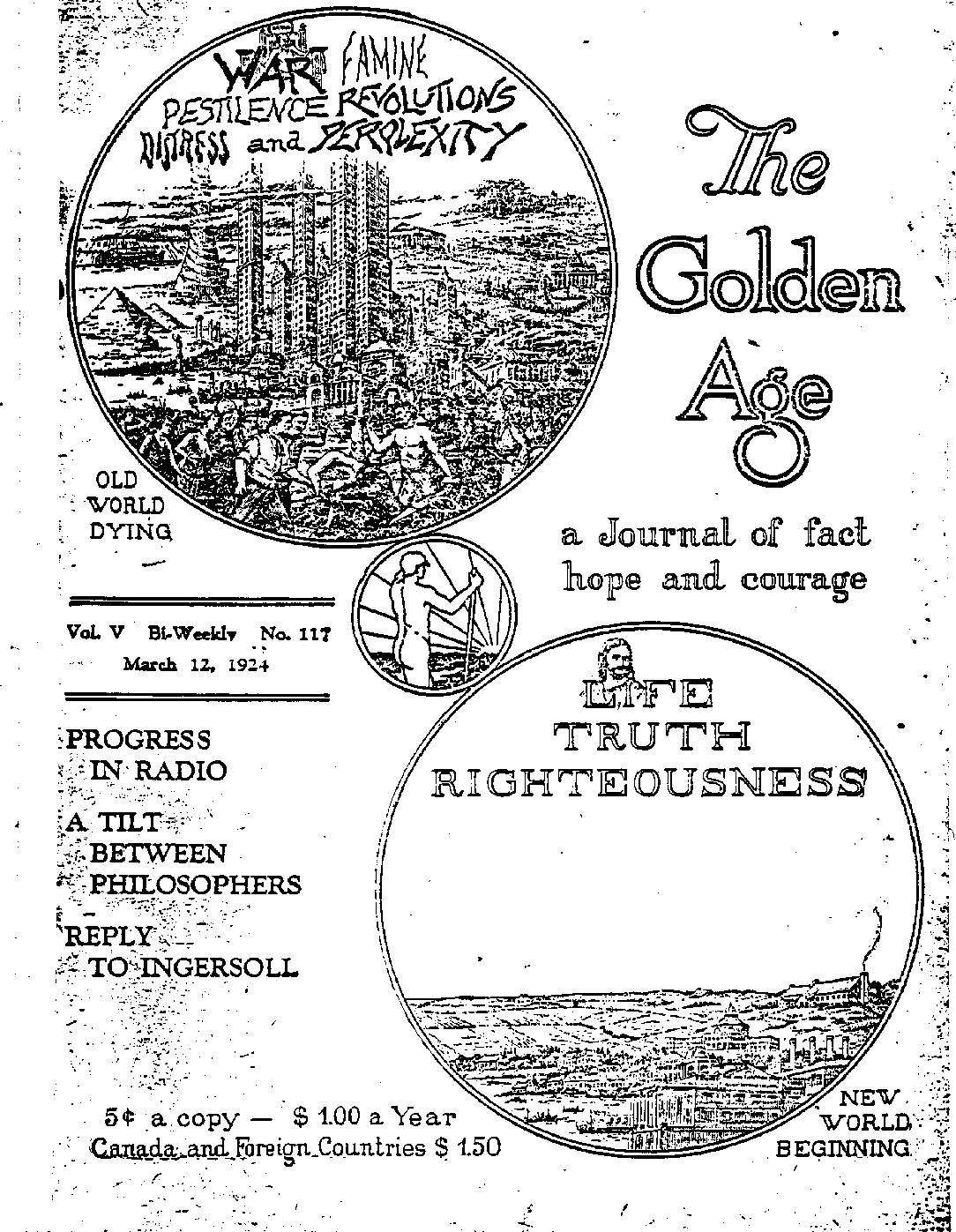
Contents of the Golden Age
Labor and Economics Child Slavery Increasing.............. .
■ Political—Domestic and Foreign
From Spain
High-Handed Rulership in Spain
From Canada
Exodus from Canada Significant
From England
The Problems of Labor
■ Science and Invention
A New Radio Station
Progress in Radio
. Broadcasting Items ..........*
Trans-Oceanic Efficiency.............. . . 338
Radio Ship Service......... ... ....... . 338
Trans-Oceanic Telephony
Freak Transmission Items.............. . 360
Radio and Land Vehicles ......
TraiJcmiMion of Pictures .....
Power Transmission
Static, Fading, and Other Troubles ....
Improvements in Secrecy
Radio In Governmental Use
‘ Education and the Press
Radio and Religion.............. 364
A Remarkable Forecast
B ' Religion and Philosophy
Shadows and Sunshine (Poem)
A Tilt between Philosophers
Professor James Warren Johnson's Letter.........,
Excerpt from Mark Twain's Writing!
Judge Rutherford’s Lecter
Reply to Ingersoll (Port 1) .... .
Studies in “The Harp or God”
The Golden Age (Poem) .....
Published every other Wednesday at 18 Concord Street, Brooklyn, N. U. 3. A., by WOODWORTH, HUDGING3 A MARTIN
Copartners and Proprietor* Addre**.- jg Concord Street, Brooklyn, N. F.» U. 8. A. CLAYTON J. WOODWORTH . . . Editor ROBERT J. MARTIN . Businm Manager
C. E. STEWART .... Assistant Editor WM. F. HUDGING3 . . Sec’y and Trees.
Fits Certs a Copt—*1.00 a Ybar Mars Remittances to THE GOLDEN AGA Fouiox OniCM: Britleh.....34 Craven Terrace, Lancaster Gate, London W. 3
Canadian.........3^-40 Irpvin Avenue. Toronto. Ontario
Aueiralatian ....... 405 Collins Street, Melbourne, Australia South African......6 Leila Street, Cape Town, South ATrlea
Bnterwd as seeond-claes matter at Brooklyn, N. Y., under the Act of March 3, 1870
x. ? ■ • .• .->■
czAe Golden AgeBi
■ Vdtuit V
Brooklyn* N. Y.f Wednesday, March IX 1924
NamWUT
A NeW Radio Station
THE International Bible Students Association (L B. S. A.), with main office at 124 ^Columbia Heights, Brooklyn, New York, for ■' some time has had in course of construction a radio broadcasting station. It is installing two sets of broadcasting equipment, the smaller radiating 500 watts, and now licensed as Class A equipment to operate on 244-meter wave length, using the call letters WBBR. The larger set is expected to be ready for operation in the near future. It is believed from experiments that there will be less interference on this wave length than a higher one. The apparatus has been tested for several nights; and reports indicate that listeners have heard very distinctly.
The masts for the antenna are constructed of wood, which will eliminate much difficulty that would result from a steel tower's absorbing of electricity. The masts of this station are 200 feet high, and set 300 feet apart. Mr. Ralph H. Leffler, radio engineer, will be in charge of the station. Mr. L. T. Cohen will be manager of broadcasting.
The purpose of this station is entirely educational. It will broadcast scientific news, news of inventions, matters of political interest, musical programs, both instrumental and vocal, readings on diet, health, hygiene, etc., general reports of world news, Bible instruction, Bible questions and answers, and featuring especially Bible lectures by Judge Rutherford, the Presi-^dent of the Association, and a number of his "associates, who for some time have been lectur-* ers of the International Bible Students Association.
< It is expected that the station will open offi* cially Sunday evening, February 24. The program will be put on between 8:30 and 10:. 30* p. m.; and thereafter the broadcasting, will-be-each evening between those hours and on Smu day afternoon between 3 and 5 p. m. The opening program will consist of vocal solos by-Miss Dorothy Cooke, by Professor John T. Read of Chicago and by Mrs. Cora C. Wellman ofJ Boston, selections by the L B. S. A. male: quartet, duet by Messrs. Franz and Twaroschk; baritone solo by Mr. W. P. Mockridge, instrumental music, piano selections by Professor* Jackson, and a lecture by Judge Rutherford. This will be followed by a series of lectures Judge Rutherford. The Golden Age once each week will give a review of world news...
This station will be devoted entirely to educational instruction for the benefit of the public on matters of importance along the line above. mentioned; and the Association will invite any educational institution that desires to broadcast matters of importance for the people to use its station from time to time. Those having receiving sets, and desiring to listen in, will please _ take note that the wave length is 244 meters.
Information can be had by addressing Mr.
A. R. Goux, Secretary, 124 Columbia Heights, < Brooklyn, N. Y, . \ -j
All of our readers are respectfully requested after listening in to address a card or letter to Radio Broadcasting Station WBBR, 124 Colum- J bia Heights, Brooklyn, N. Y., reporting on the ,.<1 efficiency of this station and on how they receive* the message. .^3
j?r.
Radio Receiving Sets
THE International Bible Students Association, or the Watch Tower Bible & Tract Society, do not furnish radio receiving sets, as neither is engaged in commercial business. We refer our readers to those who are manufacturing these sets that you may correspond with
them directly. We give below the names of two ■ firms who are doing this work: ‘
Bedwin & Cosby, 8118 95th Ave., Woodhaven, j
C. R. Wkkbek, 518 N. 12th St., Reading, Pa.
33A ' ...
Progress in Radio
IN THE. year 1866 Mahlon Lewis, a Washington dentist, sent up kites from two mountain peaks in Virginia twenty miles apart, and sent messages from aerials on the l<ites. During the next four years ho had a little financial , assistance from friends; but Congress laughed * at the proposal to give him $50,000 with which * to develop his invention. He died in 1886, unrewarded and unknown except by a few, but ? confident that his discovery would one day be of great value to the race.
" The father of wireless, Signor Guglielmo Marconi, is even now less than fifty years of age. In 1896, on his father's farm in Italy, he sent his first signal for 100 yards. In July,
1898, he signalled twenty miles. In 1901 his signals crossed the Atlantic. •
The first broadcasting of music occurred in the spring of 1909, from the top of the Metropolitan Opera House, at which time the great tenor Caruso sang a portion of the opera "Cavalleria Rusticana.” This was heard by several ships in the harbor. From 1910 to 1916 the only broadcasting done in the United States was done in California.
The Bell system transmitted speech by wireless from Arlington, Va., to Paris and to Honolulu in the autumn of 1915; but the Bell people have had so much to db to care for their great and growing wire systems, and have such confidence in them, and such a good knowledge of the difficulties of wireless work, that they have not pushed into the wireless field.
; Broadcasting in a commercial way was begun by the Westinghouse Company at Newark, N. J., in the fall of 1920. In The Golden Age No. 69,
May 10, 1922, the leading article is a comprehensive review of the progress made in radio up to that time. The progress since then has been so rapid that we are constrained to present .another summary.
It i> believed that at this time there are in the United States from 3,000,000 to 5,000,000 > homes which ore equipped to receive radio messages; it is believed that there are at least 100,000 such homes in New York city alone. ;Antennse cover the roofs. In other instances the ,antenn® consist of insulated wires dropped out tof windows, or are arranged within the apnrt-'ments in a great variety of ways. •
Many of the new apartments which are being zbtrilt'in New York are being fitted with radio uk.*‘<** • •
outfits, and a radio operator is in charge in each.' building. This operator does alf the tuning in for the entire house. All the residents have to do is to press a button to turn the music on or to shut it off. These apartments are sold or rented before completed. '/
In the suburbs it is now difficult to sell prop-; erty if there is anything around that tends to[ interfere with the radio connections. A gas tank in the vicinity is very disturbing to a radio set. In full many an American home, perhaps* several times in a week, the neighbors come in^ the rugs are rolled up, and the guests dance to. music originating hundreds of miles away. .
Broadcasting Items
S LATE as a year ago there were 607 licensed broadcasting stations in the United States, of which forty-four are west of the Rocky Mountains. One of these, the WJZ broadcasting station at Newark, N. J., operated jointly by the Radio Corporation of America and the Westinghouse Company, is the pioneer. From the time it was first opened, at an installation expense of $50,000, it has been giving free nightly concerts, from 7:00 p. m. to midnight, at an annual expense of $50,000, receiving its compensation in profits on sales of radio apparatus.
With the pouring forth of 607 broadcasting stations into the one medium, the ether, which must be used by all, to say nothing of the 21,000 other sending-stations in the country, the Government was forced in May, 1923, to make allotments of wave lengths to many of the large stations which have heretofore operated on 360 or 400 meter wave lengths. The allotments thus given were respectively 244, 263, 273, 278, 380, 405, 411, 429, 435, 447, 455, 476, 484, 492, and 546 meter wave lengths for certain of these large stations.
There has been a general complaint of the use of the radio for broadcasting baseball
scores, cheap humor, and phonograph records. A grocer, in Des Moines has been using it for talking to his customers by radiophone, giving them prices on staple goods and advertising special sales. Such usages for radio will probably be interdicted soon, in the general intereete of the public. -
Many interesting problems have arisen. Some owners of copyrighted songs have protested
306 . ■
$ .
GOLDEN AGE*
1 ‘M&tCX 12» 1924
X.v-
■^against their being broadcasted—a very foolish ’ protest, we think. It seems to us that the broadcasters were right in their answer that by broadcasting the songs they were giving them /an advertisement not otherwise possible to be obtained, and thus creating a demand for them.
'■ . The possibility that a single broadcasting program may be duplicated at the same time over : all the country was shown in June, 1923, when songs and addresses in Carnegie Hall, New . York city, were broadcasted at the same mo-Lment from stations in New York city, Schenectady, Pittsburgh, and Chicago, all of these stations being connected by direct telephone wires with the stage. The address which. President Harding was to have given at San Francisco, .but which was prevented by his death, was to have been thus broadcasted at the same instant V , in all parts of the United States.
•." Of the 885 Government broadcasting stations . the important ones include Arlington, Va., “ .Washington, D. C., Great Lakes, Ill., Omaha, ’. Neb., North Platte, Neb., Rock Springs, Wyo., Elko, Nev., Reno, Nev., and New Orleans, La.
- These send out time signals, weather forecasts, market reports, and general news.
Newspapers, stores and other commercial concerns maintain important stations at Boston, Medford Hillside, South Dartmouth, Springfield, Bellows Falls, Providence, Montreal, New York city, Troy, Rochester, Lockport, Buffalo, Newark, Philadelphia, Pittsburgh, Cleveland, Cincinnati, Charlotte, Atlanta, Louisville, Indianapolis, Detroit, Dearborn, Madison, Minneapolis, Davenport, Iowa City, Ames, Des * Moines, St Louis, Jefferson City, Kansas City, Dallas, Fort Worth, Los Angeles, Portland, and hundreds of other places.
In the countries bordering on the Pacific Ocean are 168 broadcasting stations, adjacent ® to or directly on its shores, twenty-one of which k^are able to send messages across the Pacific.
In some places mountain tops are used as broadcasting locations. The Brazilians have a powerful station fitted up on a mountain overlooking Rio Janeiro. The Germans have stretched their antonure between the tops of two mountains in the Bavarian Alps. These mountain peaks are G,000 feet high, with almost perpendicular sides where they face each other. The power will be obtained from the river beneath.
- * * j
British Radio Items < \
IN BRITAIN the British Broadcasting Company has a monopoly of broadcasting, and every person having a receiving set is supposed to be taxed for the ma tenance of the broadcasting program. There are features- ' about this plan that are desirable. The ether is . ■ kept freer from a bedlam of conflicting waves. ■
But reports indicate much difficulty in carrying out the plans. In April, 1923, there had, been 122,946 licenses issued; but it was esti- > mated that fully 200,000 persons had sets of their own design or assembly,, and could listen / in if they desired. It is claimed that licenses .. cannot be obtained for these pirate sets; also ; that the government broadcasting news service ' • contains too many society items and too little -real news. .
Southport, England, has a wireless theatre, where the audience may listen in on concerts, ■ the news of the day, and other features which are being broadcasted. A London organ-grinder gives a similar service in the open; the receiving equipment has a loud speaker attachment, ■ making it possible to hear everything received when the device is standing 200 yards away. ' .
Six great radio stations reach all parts of the British Empire; one each in England, Canada, Jamaica, West Africa, India, and Australia.
When wireless instruments were first installed in Darkest Africa they brought terror to the natives, who supposed that the new instru- i ments, fitted as they were with searchlights, / were a new kind of witchcraft by which the allwise white men could see and hear everything ' that went on in the huts of the natives. They . were calmed and made patriotic when they were ; assured that the English used these magic • • powers only to learn about their enemies.
Radio Elsewhere Abroad
RANCE, Germany,' Scandinavia, Holland, and Italy are all engaged in broadcasting.
The French Government requires a license fee „ ' from each receiving set, demands that all inter-ceptcd messages be kept secret, and that operation of the set shall cease whenever the Government so orders.
Holland has a station at Kootwyk, which is one of the most powerful sending and receiving stations in the world. It covers 750 acres, has five masts 700 feet high, and was designed to send and receive messages from Java, 7,500
miles away. It operates after sundown on a wave length of 8,400 meters or about live miles.
There is direct radio communication both ways between the United States and Groat Britain, Germany, France, Norway, Hawaii, Poland, Holland, Italy, Sweden, Argentine, and Brazil To reach Japan it is usually necessary to have the message relayed. The United States maintains six radio stations in Alaska; and there are important stations in the capitals of Mexico, Honduras, -Nicaragua, Colombia, and also in the Canal Zone.
The most powerful station in the world is at Monte Gradern, near Buenos Ayres, Argentine. It is of German design and manufacture. The installation covers 1,400 acres. Each of the ten towers is 800 feet high. The combined length of the antemue is seven and one-half miles. The plant has a 10,000-mile radius, with a wave length of 23,000 meters, or about fifteen miles.
Trans-Oceanic Efficiency
TN THE course of an address before the New -1*; York Electrical Society, Mr. David Sarnoff, Vice President of the Radio Corporation of America, in order to demonstrate the efficiency of radio service, sent from the speaker's platform four messages to Europe asking the question, "How is the weather V3 In forty-five seconds England reported rainy; in fifty-five seconds Norway reported mild, overcast; in one minute and fifteen seconds France reported lovely; and in two minutes and forty seconds Germany reported gloomy and cold.
In regular practice messages filed in New York at a stated time are delivered in Europe within about two minutes, and vice versa. The American troops at Coblenz on the Rhine were summoned by radio, and in twelve minutes the reply came from the commander that they were on their way.
Within two years' time the Radio Corporation of/Amcrica, from its six transmitting stations at Marion, Mass., Rocky Point, L. I., New Brunswick, N. J., and Tuckerton, N. J., was handling twenty-five to thirty percent of the entire volume of telegraphic messages between America dnd Europe. Week-end radio letter service to Europe is only six cents a word.
The effort to get as much as possible out of the expensive radio installations has resulted in on improved telegraphic alphabet, the invention of General George O. Squier, chief signal officer
BltOOKlTV, X. Y. ’
of the army. The new invention follows the. fundamental principles of speech and music/ It is claimed that this new alphabet caiT be soot 2.65 times faster than the Morse code, invented eighty years ago.
It lias been found possible to send 100 words4 per minute and to operate duplex, which means sending and receiving at the same time. It is expected that the time will come when the radio' apparatus will be able to send and receive at the rate of a thousand words per minute. ;
The method by which messages are sent by radio is as follows: They are first written on a machine that looks like an ordinary typewriter-This punctures a tape, and the tape controls the radio sending apparatus much as a punctured reel controls a player piano. The same, device has been used in sending radio messages from airplanes. These messages are sent at such high speeds that eavesdropping is well nigh impossible; they can he received only on high-speed receiving apparatus. .
Radio Ship Service
ROM the San Francisco wireless office steamers toward China and Australia have been held for a distance of nearly 6,000 miles, communicating direct regularly each night. Imagine the satisfaction to the passengers of being able to communicate at any time with their loved ones thousands of miles away across their trackless deep!
The ships have great satisfaction in communicating with each other. Instances are on record where concerts have been sent by wireless from one ship to another, 125 miles apart at' sea; also of a radio chess game between contending teams on the steamers Western World and American Legion, until the steamers, one going north and the othei’ south, were twelve hundred miles apart.
More than a yeai* ago the president of the? American Telephone and Telegraph Company, from his home in Connecticut, conversed with the captain of the steamer America, 370 miles out from New York. The sending was done from Deal Beach, N. J.; the receiving was done at Elberon, N. J. The switchboard was in the Walker-Lispenard Building in New York city. The sending was done over a wave length of 420 meters, and the receiving was over u wave length of 380 meters.
There arc now stations in New Jersey where
a different two-way conversation can be maintained with each of three ships at sea at the same timS; telephones are being put into the staterooms of steamers in both Atlantic and Pacific Oceans; and shortly it will be possible lor any one in the United States to pick up his .telephone anywhere in the country and con-tVerse with any passenger on any lin4r between America and Europe or America and the Orient ;as easily as if speaking to a person in the same • room. .. •
-. Messages can also be sent to and from submarines when submerged and between two submerged submarines.
A Striking Example
RADIO received a great impetus when the Republic was rammed by the Florida off the coast of Nantucket in 1910 and went down, but not until the wireless operator had sent out the S. 0. S. signals which made Jack Binns a hero in every American home. Binns is still a young man. Indeed, that is one of the most interesting things about radio; it seems to be almost wholly in the hands of young men.
. Another wonderful illustration of the value .of wireless was demonstrated at the time the steamer City of Honolulu was burned and abandoned 700 miles off the California coast on Thursday, October 12, 1922. As soon as the ship was found to be in dames, the operator on board broadcasted the ship's position. Within five minutes acknowledgment of the message was received from one station on shore and three steamers.
After the lapse of two hours the ship's condition was recognized as hopeloss, and the S. 0. S. call was sent out. This was also immediately acknowledged by one land station and by one ship coming ahead full speed to the rescue. Thirty minutes later the information was broadcasted that all were off the boat except the capfedn, chief engineer, first officer, fourth officer, and first radio operator. Forty minutes later a final message was received from shore, an answer was sent with difficulty, and the ship was abandoned. All of the 263 persons on board were saved^and landed at Los Angeles four days later.
There are some other interesting items regarding this disaster. The news story of the rescue of the passengers of the doomed ship was wirelessed from the rescue ship within 300
yards of where the City of Honolulu'waabein® burned. On the day previous, as.sooi^as-thif vessel was known to be doomed, the Associated] Press obtained from Honolulu in forty-four; minutes the complete passenger list of the ready for publication in San Frandsco.-/:^^
As already intimated, radio service to and from airplanes is as effective as to or from a. ship. By means of the teletype, messages can*; be sent or received in typewritten form- The* striking of the letter A on the teletype izLtht' air causes the letter A to be printed on-the tele-, type on the ground, and vice versa. This does1 away with the necessity of sending messages incode and eliminates chances of error.
The commercial passenger airplanes between Geneva and Paris are equipped with wireless*; so that the passengers may be entertained while enroute. ’ ..
An illustration of the value of radio in air service occurred a year ago on a mail flight between Cleveland and Chicago. On account of head winds and squalls the aviator found that he would not be able to land before dark. He sent out distress calls, asking that the landing-place be illuminated with flares and search-lights. Six stations heard the call, the lights were provided, and the crew and mail were landed in safety/ whereas death would have been the almost certain result otherwise.
Trans-Oceanic Telephony
OR several years the Bell system has been -L maintaining a wireless telephone service between Catalina Island and Los Angeles, by ‘ which any subscriber in Catalina can at any time call any subscriber in Los Angeles. This line has been maintained by wireless largely because it provided an ideal place to test ’out-wireless service. From Catalina, in 1921, speech was transmitted to the S. S. Gloucester in the; Atlantic ocean. In order' to accomplish this feat use was made of land wire systems on Catalina-and across the mainland of the continent, and. wireless across portions of the Pacific and the* Atlantic, making four sections in all. .
In January, 1923, wireless telephone conversation was carried on from New York to Southgate Station, London. The conversation could be carried in but one direction, owing to the development of British radio enterprise as a government monopoly; but the British heard
MO ' ; ‘ " ;_.
perfectly, remarking that the only difficulty was the American accent
Wireless telephony between America and Europe is possible right now, but it would require such high electric power as to make it very expensive. The American Telephone and Telegraph Company state that they hope to produce •apparatus which will enable conversations both ways throughout the twenty-four hours, and -which will reach around the world.
7 It is freely predicted that within two years business men in New York or Chicago can converse freely with business men in London or Paris, using wires part of the way and wireless across the ocean. Nikola Tesla, the electrical wizard, adds to this his expectation that with television apparatus each will be able to see the other as the conversation is carried on. Subsequent paragraphs show how this extraordinary thing may come true.
Freak Transmission Items
WIRELESS transmission is freaky, as yet It has bad freaks, but it has good ones also; and under certain conditions of weather extraordinary results are obtained, of which we list a number of illustrations that have come to our attention.
A dance was held at’Santa Clara, Cuba, to music sent out from Schenectady, N. Y-, 1,450 miles distant. Reversing the order, a fifteenyear-old boy in Medford, Oregon, picked up an address that was being broadcasted from Havana. An amateur message sent from Hartford, Connecticut, received an answer from Hawaii in four minutes' time. Radio concerts in Philadelphia have been heard in Paris so clearly that the conversations of the operators in Philadelphia were overheard. Wireless stations in Germany picked up the voice of a young woman singing in a department store in Newark, N. J. ‘Both the vocal and the instrumental tones were perfectly audible.
The broadcasting station of the General Elec-* trie Company, at Schenectady, N. Y., has re- ceived acknowledgments from every state in the Union, frdm Alberta, Newfoundland, Panama, ; and. from ships two thousand miles at sea.
C .French, British and American amateurs have . repeatedly bridged the Atlantic on 200 meters.
Tnany as 125 American amateurs have been ► in< Europe in oue week, and in one in-
SlOOVLYK, N. X
A ship operator 11,000 miles away in the Indian ocean picked up an amateur wireless station operating at Galveston, Texas.
In January, 1923, the New York Times received a complete message from the great Japanese sending station at Tokio, 9,000 miles away. In March, 1923, during four successive days, music broadcasted from the Rensselaer Polytechnic Institute, Troy, N. Y., was heard at Invercargill, New Zealand, slightly .less than 10,000 miles away in an air line.
Messages are now sent from London to Australia by radio, twelve thousand miles; but whether they are relayed at India, as we think likely, is not ascertainable from the data in hand. A station working on 8,400 meters at Hillside, Oregon, is being heard regularly at Shanghai. The company operating plans a series of stations in China.
Radio and Land Vehicles
SEVERAL American Pullman trains have been fitted with radio apparatus for the entertainment of passengers enroute. Among these are the Lackawanna; Lehigh Valley; Pennsylvania; Chicago, Milwaukee and SU Paul; Chicago and Alton; and Frisco systems. These radio receiving sets have been applied to only a few of the trains on these roads and not continuously.
The Lehigh Valley found upon trial that they could receive perfectly while passing through tunnels, could receive well while passing any body of water, either still or running, but had difficulty in receiving when passing between an avenue of trees on a level stretch of country.
The Interborough Rapid Transit Company, of New York city, permitted the use of a rear platform of one of their trains for the temporary installation of a receiving apparatus; and it was found that the messages could be received clearly underground, even when the train was rushing through the iron tubes far beneath the waters of the East River. There was found to be considerable interference by induction from passing trains.
In May, 1923, experiments conducted on a New York city trolley car showed that by radio it was quite possible for the car to keep in constant telephonic communication with the power ... house. It may therefore be expected soon to1.
cax will be fitted with such means of communication, so that in ease of trouble instant word can be sent to headquarters. Such an arrangement would obviate the long delays which sometimes occur when a car is confronted with a breakdown or other emergency.
Reports from Washington are that a fleet of army tanks can now be connected by radio in
Manipulation of Vehicles' ' ■■■
such a way that the master tank can direct the which the ship was steered. • _ v movement of the entire fleet while in action, . At Pittsburgh a freight train, with steam upf;
making any changes in manoeuvres which the tide of battle may require.
Transmission of Pictures
THERE are two general methods of transmitting pictures, the first of which is a modification of a method which has been used more or less for a generation. The picture to be photographed is graduated into seventeen shades of light These gradations, expressed in letters of the Morse code, are automatically transferred from the photograph to the telegraph key. On arrival on the other side of the world, a typewriter is operated, fitted with seventeen kinds of dots, corresponding to a keyboard bearing the letters A to P, with the result that all the essentials of the picture emerge, ready for the finishing touches of the artist. Fingerprints can be sent by this same method.
A more startling and almost unbelievable invention is that of C. Francis Jenkins, of Washington. For more than a year he has been able to send still pictures a distance of 140 miles, and now has perfected the device so as to allow of the sending of motion pictures a like distance. In this case the picture is broken up into thousands of flashes by the revolving of a polished mirror of graduated thickness, and is reproduced by the reverse operation of a similar instrument, called a radio eye. The picture may be sent or received either by wire or by radio.
More wonderful still, if such a thing be possible, is the palliophotophone, by means of which the human voice can be so perfectly photographed that when reproduced from the film upon which itjs represented by a waving streak of light, it cannot be distinguished from the original voice of the person making the record. By means of this instrument it is possible by radio to make, at any reasonable distance, a permanent record of audible speech uttered anywhere. •
IT IS now two years since the battleship.Taws^ with its fires lighted, but without a.man'onl board, was propelled hither and thither byriis radio operator on the battleship Ohio five milesk away. The guns of the Iowa were not fired, but; the naval engineers stated at the time that they, could have been fired by the same methods bjj was started and stopped entirely by radio. The* same has been done with an automobile,! the’ latter feat having been performed at an elec-;1 trical exhibit in New York city. In these feats1 the radio did not supply the haulage power, but; merely the starting and stopping and guiding’ impulses.
In the latter part of July, 1923, a despatch;; from France reported an airplane as traveling.-away from and being guided back to a radio station, steered only by wireless. But the des-, patch indicated that the plane had an aviator aboard, and the sense in which the radio steering was done is not sufficiently shown to btf clear to the reader. . , .
The series of 200 inventions by John' Hays Hammond, Jr., have for their object the complete guidance of airplanes, submarines, torpedoes, free balloons, motor cars, land torpedoes, and battleships, all by wireless, without any pilots or operators aboard. The speed can be regulated, the altitude, and the discharge of cargo, all by wireless. These inventions have J been sufficiently tested out to insure that in case , of a war a wireless operator perhaps hundreds ; of miles away could destroy an enemy .city or J army so. that not a vestige of life would- be left 3 in it, and all without the risk of a single life to the attacking party. How very evident that • unless those days should be shortened there should no flesh be saved! " J
Power Transmission
IT IS a long step from the manipulation of '! vehicles to furnishing the power that runs ; them; but engineers are agreed that even that J is possible, or at least will be possible some time. The General Electric Company, at Lynn, Massachusetts, has sent power several hundred feet without wires and in sufficient volume to operate massive machinery. Its engineers are said to be agreed that when the right kind of motor is devised it will be found that there ia -V
■ enough electricity in the air at all times to operate every piece of machinery in the world.
Nikola Tesla is said to believe that in the future it will be possible to cause rain to fall by radio, to drive vehicles of all lands by its ■ power, and to light houses, no matter how far £they are from an electric wire.
During the World War the Government, ' which has by now issued over a thousand wireless patents and has three thousand more pending, got the big electrical concerns of the coun' try together, so that their patents could be used together in radio work. The Radio Corporation of America thus gained a virtual monopoly of radio work in America, not only because of • the patents, but by exclusive traffic agreements,
direct governmental grants and provisions con- ing $50 to $75, may receive up to one hundred
ferring exclusive rights to valuable wave band . lengths. The inventions of Mr. John Hays Hammond, Jr., some two hundred in number, upon which he has been at work for fourteen years, constituted an important part of this arrangement.
•• Discoveries multiply. Methods of transmission have so changed that a single bottle, a vacuum tube, does the work that but a little time ago was done by $50,000 worth of heavy electrical machinery. This invention, the work of Lee DeForest, consisting of a single tube of glass and copper three feet in length by five inches in diameter, does the work of a high frequency alternator weighing several tons.
Radio signals have been transmitted over an electric wire, without the slightest interference to the lighting circuit, and have been made to turn ,on and off street lights at a distance of four miles, near Lynn, Mass., merely by the pressing of a button. The invention of B. F. Mieffner makes it possible to use electric light wires as antenna for a receiving station, and to use the electric light current instead of storage battery for lighting the filaments of the electron tubes. In this operation the current is stepped down from 110 volts to six volts.
Marconi has discovered a method of shooting * radio waves out in a given direction, somewhat ■ after the manner of a search-light. Ue has also discovered a new wave, not previously used for long-distance wireless, which transmits a message 2,600 miles with much less power and energy and much faster and cheaper than has hitherto been possible. Mr. Marconi makes the J cheerful prediction that inside of ten years the very best radio apparatus now in use will be -J completely obsolete.
In the summer of 1922 there were 202 con- -cerns in America engaged in the manufacture ’■ of radio apparatus. It is safe to say that some ' of their apparatus was obsolete before it left ‘ : the factory.
Receiving Sets
ROUGHLY speaking, the cost of a receiving set is about $1 per mile for every mile of distance from the broadcasting station. There are four general types. A simple crystal set, ■ costing $15 to $40, can receive from broadcasting stations up to twenty-five miles distance. A single vacuum tube detector and receiver, cost- ’ ’ miles. A vacuum tube detector and amplifying receiver, costing $100 to $250, will receive well up to a hundred miles, and under favorable conditions up to a thousand miles. The most elaborate instruments for home use combine radio and audio frequency amplification and loop reception, and cost $300 to $500.
The department stores alone are selling about a million sets annually. No radio set is fit to purchase unless all the connections have been soldered; otherwise the wires become loose, and reception is impossible. Further, if paste or acid is spread over the wiring, or if there is dirt in the receiving box, there will be trouble.
Many unique ways have been contrived to receive by wireless. In the Western states, in not -a few places, a barbed wire fence functions as an aerial; while at Hammond, Oregon, the lumberjacks have their antennae swinging from the tops of trees three hundred feet in height.
At a convention of electrical men in Chicago Mr. F. W. Dunmore, of the United States Bureau of Standards, walked around the lobby of the hotel, carrying in his hands a small suitcase out of which came a stream of market reports, interspersed with music, much to the mystification of some of the guests. ;
On the beaches at New York in the Summer of 1923 there were boys with wireless sets rigged up in their straw hats. Others have made re- 1 ceiving sets out of bill folders, cigar boxes, reading lamps, dinner pails, pocket-books, safety-razor boxes, and match boxes. A lad in Knoxville, Tennessee, made an instrument slightly less than an inch square which worked perfectly over a distance of fifteen miles.
> •‘••-I * ‘
J^MilCXT 12. 1924 tx. Golden Age .. ? ■-v^3^
^ Brainard Foote fitted a receiving apparatus into an ordinary watch case; and William H.
,vr Ruf, Manasquan, N. J., made a workable re-eeiving set no larger than a thumb-nail. Some . of his contrivances were exhibited at the radio show of the National Radio Chamber of Com, meree, held at the 71st regiment armory in • ’ New York, *
Static, Fading, and Other Troubles
THE Winter atmosphere is relatively free _ from the charges of electricity which set up electromagnetic waves competing with those of the transmitting radio stations.. In the Summer the static charges wandering around in the atmosphere become so bothersome, and are so bothersome at all times in the tropics, that the operation of a receiving set is difficult. Also, there are more interfering noises in the Summer than in the Winter. Sunlight has a dampening effect on radio signals, so that the night is the best time for operation.
There are pockets in the atmosphere where signals fade and become entirely unreadable. These are offset by regions where the signals are specially clear. A ship may enter a fading pocket, and be out of touch for as many as twelve hours. It may then emerge from the pocket and, although going away from the sending station, may hear even better than before the pocket was entered. There are such pockets in the Pacific ocean; there is also a pocket between New York and Boston, supposedly caused in the latter case by a large body of low-grade iron ore lying between the two cities.
These and other troubles are receiving constant attention at the hands of experts, and considerable has been accomplished in reducing them. Radio is not to be condemned because of them. It is of greatest possible benefit as a supplement to wire and cable service, doing many •things that they cannot do; but it is entirely ' unlikely that it will ever displace them. If radio had been discovered first, and the use of wires next, the radio people would now be worrying, and have reason to worry, lest the wires, giving direct and secret service from point to point, would eliminate them from the field.
A very efficient radio receiver will now bring in all sorts of hums and buzzes from electric light and power lines, trolley car motors, automobile magnetos, violet ray apparatus, and thunder storms; and all these must be tuned
out. If they are not tuned out, a- situation* liable to develop like that humorously described^ in the Williamsport, Pa., Grit: . .•-•^4
“This new idea of being married by radio has led to i so much confusion that several states have been con^i strained to deciare it illegal We coni mend such action;-for it is difficult to imagine a more unsatisfactory per*J formance. Just listen in on the next radio marriage yon ‘ learn of, and you will probably be regaled by a ceremony;
1 something like this: >
“Minister: Do you, William, wee-zow-bing-whistle-* rum-ta-ta-ta-wehe-e-e—take this maid, Miss Eloise— butter closed firm at 42 with Texas oil—to be your lawfully wedded—fair and warmer tomorrow in north-', era part—and to keep and cherish her until—the dul- « dren's s^roy this evening will be the fable of the wood-' , chuck played by the Shoanville Symphony orchestra. ■
“Answer: I shake a little shimmy on the shorea of / Kankakee. . (
“Ministor- And do you, Eloise Stritt—castor oil and orange juice in equal parts is one of the bestremedies for children's snapsnap-buzz-buzz-bang-who e o e ■take this bedtime story this evening by Clarence siloa should always be open at the top—to be your lawfully wedded, —xylophone solo by Sousa's, band in a novel march' program. .
“Answer: Jazzbo Sam in Alabama. - •
“Minister: I therefore pronounce you man and Clover • College Glee club in a program of cheese quoted at 28 • cents a pound in prevent forest fires an your fishing» trip by the Swiss yodlers.
Improvements in Secrecy ' ■ ■ ‘
THERE are forty-nine known channels for-radio use between the 200 meter and 1,600 meter wave lengths. Thus, theoretically, it ia possible for forty-nine broadcasting stations to operate in the same community at the same time without producing confusion; but in prac-. tice! Well! Practice is different The big ones drown out the little ones. ’
One of the inventions of John Hays Hammond, Jr., whose inventions have several times *' been mentioned in this article, has had in view the promotion of secrecy. It enables the scram- ‘ bling of radio-telephonic messages which can be * unscrambled only by the person at the other end ' with certain special apparatus designed with ' that end in view. Such messages cannot be understood by others, even though they may hear the sounds. The new scrambling and unscrambling device is in use between Catalina t Island and Los Angeles. Wireless telephony between the two points; thirty miles apart, has: ~
been in use about five years; but there has "been no privacy in the messages until now. .
Radio sending has been greatly improved by the invention of a perfect microphone, not made of any tangible materials, but of what can be r compared' to a sheet of electricity. The thinnest ^and most flexible of metals is not sufficiently ■^ sensitive to reflect properly the tones of music, ? although it does very well for the human voice in speaking.
, Radio In Governmental Use
PIS more than a year since Senator Harry S. New, of Indiana, addressed thousands of his constituents through the powerful station at Arlington. Since then the Government has decided not to let government stations be used for broadcasting appeals for votes, even though the service is paid for.
The Congressional halls have been fitted with microphone apparatus which enables every whisper to be heard; and it would be a very easy matter now for everything that is said in ■ those halls to be broadcasted, if there was any reason for doing so. It would be possible to broadcast similarly the deliberations of diplomats, courts, and conferences. It was planned that the address which President Harding was to have delivered iff San Francisco, should be actually heard by about five million persons. If their awakening should occur, the new statesmen, Joseph, Moses, David, Daniel, and others, could , even now, by the relay method, literally speed their messages through the air to all the nations of the earth, without visiting them at alh Inter? esting things in this line are just ahead. These inventions are all part of the Lord’s plans for ; bringing in-the kingdom.
Police authorities are now broadcasting descriptions ox criminals. News of a crime is . -flashed in every direction, and the criminal has no way .to flee. The eight high-powered bandit ■ cars of the Chicago police force are equipped ‘/-with both sending and receiving outfits; it’is even planned to equip every policeman with a ■ receiving set, thus to keep every patrolman in / the city constantly in touch with the crime situ-Ration, no flatter where he may be.
It is also anticipated that shortly, through a ■-../combination of radio apparatus and phono-// •'graph,' the recording of court proceedings will /;<be conducted mechanically, and the court re-/'/porter will be a thing of the past.
Education and the Press
TUFTS COLLEGE and several of the uni- . / versities, namely, those of Wisconsin, lowtu . and Nebraska, arc engaged in broadcasting lec- ’ tures on economics, engineering, atliletics, the drama, and other subjects of a popular nature, ' not beyond the understanding of boys fifteen to ; twenty-five years of age. It is thus apparent ' how the farmers'’ boys can all be given liberalf । educations without leaving home. <
Radio can be the transformation of school life. One skilled lecturer in history or gcog- W raphy or hygiene can -now deliver his lecture to the children in a thousand schools. In New York city a number of high schools were recently given a joint examination in accountancy. A -single instructor broadcasted the problems, which were answered simultaneously by the pupils at their desks. Courses in radio have been inaugurated in English schools.
The Government is not only broadcasting news of the markets, weather, and general news, but is also giving talks on education twice a week. In Lewiston, Ohio, a radio set installed in the high school is equipped -with a magnavox, . with the result that farmers and other persons within a radius of a mile and a quarter can hear market reports and news items and listen to music while going about their daily tasks. One can but wonder what is to become of the local purveyors of advertisements and propaganda when the cream of the news has been skimmed off hours before their papers could be printed and distributed. At present the newspapers themselves are receiving seventy percent of their news by wireless. Uninterrupted communication everywhere is evidently to be the order of things in the new age. Under such circumstances fraud and oppression become increasingly difficult.
Radio and Religion
WE HAVE reason to believe that the cause of true religion will be helped by radio, and our reason for thinking so appears in this issue, *on page 355. But we foresee that it will be the death of many an institution which calls itself a church but which' is merely -a commer* cial institution or a club.
The London Daily Herald says of radio: “This will tend to divert attention more and more from matters of which there can be no exact knowledge and to bestow it upon enlarg-
.4. > : MaICH 12, 1924
ing our acquaintance with nature/'’ This is , ■ another way of saying that with this new and interesting field of human interest opening before them many people will pay less and less .7 attention to religion; and we think that this is ’ true. From this aspect alone the denominational churches would have reason to fear jadio.
But they have more reason. The country church has been hit hard both by the automobile, which takes the attendants to the more ’ elaborate buildings and services in the cities or takes them away from service altogether, and by the radio, which takes the place of either. It is true that a few churches have installed receiving sets, so as to get sermons and music ____, from outside, and other churches have broadcasted sermons and tried to secure membership and money by interest thus created; but any one can see that the plan is impractical.
The truth can be broadcasted; but error can be broadcasted, too. A hypnotist in Ridgewood, N. by a prearranged plan broadcasted instructions to a young man in New York to fix his mind upon the hypnotist. In a few seconds he became rigid, his eyes wide open and staring. While hypnotized his body was pierced with a needle and otherwise maltreated, as usual He came to himself when a lighted match was held within a half inch of his eyes, causing them to blink and relax, but with apparent difficulty.
The demons are doing what they can to abuse the use of radio. Edward Berthold, Jr., of Newark, N. J., besides receiving the usual messages by radio which others could hear, was troubled with demons, who shot into his mind messages which none but himself could hear.
. These messages were not carried by radio, or all would have been able to hear them. He became crazed, and killed himself and two others.
For a long time it was supposed that the planet Mars was trying to get in touch with our earth. . Marconi had detected wave lengths of 150,000 iheters, and did not know any way by which such wave lengths could be produced on earth. He subsequently laughed heartily when he was shown in the laboratories of the General Electric Company, at Schenectady, the source from which these mysterious waves proceeded.
Radio and Health
IT IS believed by Henry S Williams, M. D., LL. D., that the electromagnetic waves constantly passing through the bodies of all human
beings as a result of broadcasting operationa,^ have a beneficial effect upon human life, beingO the same in character as those employed in the^ latest treatment for high blood pressure. Radio W has been directly employed in the treatment of cases of rheumatism, neuritis, pneumonia, and deafness. ■
Men that have not heard a sound in thirty^ years have been able to hear when the radioAM headpieces were attached. Leo Kuehn* of Do-troit, a deaf-mute twenty-eight years of age, an intelligent, educated man, learned to speak after a few lessons by radio. His first uttered words were: "Holy, holy, holy.” It was a well-chosen tribute to the Author of his blessings.
A German invention, a radio microphone, makes it possible for a physician in his office to examine the hearts of patients who remain in their homes. New York State is giving lectures on health by radio; medical advice is broadcasted free to anybody broadcasting a request4*/:, for it In England a mother was summoned to'?/ the bedside of her son by a message sent broad- 7? cast . J • .
Surgeons have found that when a patient is to be operated upon by the spinal anasthesia method, whereby the body is benumbed from * -the shoulders down, the patient is helped from ;' becoming nervous if allowed to have a radio- / phone service attached to his ears. . .f
Radio concerts have been given at the hos- </ pital for the insane at Central Islip, at Bellevue Hospital, and at Sing Sing prison, and have been greatly appreciated. Radio has been installed in Beth Israel and St Luke's Hospitals, / with radio service for all patients able and will- \ ing to use the same. Heretofore* in blind asylums it has been necessary to have readers; / now these are unnecessary, the radio having taken their place. A radio has'been installed on ; Cabras Island, Porto Rico's dreary, shadeless leper colony. Here these poor unfortunates ? may hear the news and the concerts of the A-world which they have left.
A hotel just completed in Minneapolis has V each of its several hundred rooms connected with radio plug? Any guest for a small fee can rent head phones from the clerk's office, and can thus listen to music until he falls asleep. He cannot steal the phones; for they remain con- ■ nected until released by an employ^. “
An enterprising bootblack in Oakland has installed a radio set for the entertainment of his <•;
customers; dentists and barbers have done the same. New 'York City has permitted their installation in the fire houses. When installed in a postoffice it has been found that the clerks unconsciously speed up their work. There seems no reason why the radio cannot be installed in myriads of factories, to relieve the monotony of certain kinds of toil. It is surely a godsend to the blind, the shut-ins, the snowbound, and to those who, for other reasons, have no other source of entertainment.
Radio and Safety '
ADIO has for some time been used for guiding ships into port during the densest
fogs. The steamer Oropsea, two hours off the Ambrose lightship, was given her position during a dense fog so accurately that when she passed the lightship she came within sixty yards of it.
~ By Marcdni's radio reflector apparatus, ships can now sail through the darkest channels and most dangerous fogs by constantly sending out shafts of radio waves and receiving their radio echo. Ships lost in a storm can accurately determine their positions and can locate other ships and lighthouses.
The old laborious method of heaving the lead is now unnecessary. A navigator passing through the water at full speed can tell at all times the depth of the water through which he is passing. The contour of the ocean bottom is being charted anew, and accurately. It is believed that by this means a way may be found to ascertain the depth of Sigsbee's Deep, off the coast of Yucatan, a place never yet fathomed. ' In measuring the length of time from the sending forth of the sound waves to the bottom of the ocean, and their return to the surface, the time is measured to less than the thousandth part of a second. By the same method by which the depth, of the ocean bed is measured, the - location of masses of ice is determined, enabling, the ice patrol to notify steamers in the vicinity.
;■ The'dangers of underground and undersea ’ work have been greatly reduced by the radio? phone. By means of this apparatus entombed miners oi laBorers entrapped in fallen caissons, or men engaged in building tubes under water, £ or men in disabled submarines, can direct the ; work of their rescuers.
’ / It is proposed to fit life-saving stations with ; radio receiving sets and amplifiers, so that word may be sent out over the waters to canoeists and bathers in case of the sudden approach of storms.
A Remarkable Forecast
ebbert D. Stenson in the Boston Post gives the following remarkable forecast of the future as it will be affected by radio:
“The average man of today, even the unimaginative 1 will agree with me when I say that the 'age' of our children will be the 'age of radio/ or the age of 'impoa-sibility made possible.' .. £
“And what is the age of radio? What are its possi- ' bilities? I claim without reservation that it will be man's supreme age, the last. It will be the Utopia which dreamers and scientists have seen through the curtain ’ of disbelief and ignorance. Radio will tear aside that curtain, and we shall enter and live a life far beyond the wildest dreams of a century ago. "
“How? To answer in a practical way, we will compare with the past All motor vehicles will ran noise- . lessly, deriving their power from radio energy stations situated at our greatest water-power sources. Streets and homes will be lighted by heatless, everburning lamps, drawing their energy from the air. Heat of the greatest intensity will warm not only our dwellings, but . our great outdoors as well. Climate will be controlled.
“Telephones and telegraphy will become obsolete. We will talk across the continent on waves of radio. Liners and passenger airplanes will not only be driven by radio, but will be in constant communication with the shores. 1 The news of the world, its dramas and finest musicales will be enjoyed in the most humble of homes.
“And not merely the voice, or sound, but the living, breathing picture will speed on wings of radio, and unfold miles away in all Its brilliancy. You will talk by radio to some distant loved one, and constantly before you that faco will smile and answer as if you sat side by side.
“Hydrogen, which heretofore has been obtainable only in limited quantities, will be released by radio vibration, . and drench the starving lands of our civilised world. Fruit and flowers will run riot.
“Receivers of wonderful delicacy will record every I® human emotion, love, hate, etc. Crime will become impossible. Divorce and scandals will cease. Disease will ' wither and die. Plagues will be swept from the earth. How? by*radio vibrations streaming across the earth of such infinite strength that they will kill and shatter . germ life. The air we breathe will be teeming with health. We all know how clear and invigorating the air is after an electric storm. Radio will cause it always to be so. ,
“If one increases the health, intelligence, and happiness of a community, he increases civilization and democracy. He causes Christianity to flourish, where ain
<
and vice ran rampant. Kadio activity will do all that and mere. Radio will become the sword arm of Christianity, of democracy, of life itself.
“All religions are united in saying that we are in the latter days. Its prophecies are fuliilled. Sorrow, pain and sin shall be swept from the earth. The wings of radio are, materially speaking, the wings of the Recording Angel. We are on the threshold. The Radio age will be life's fulfilment, earth's supreme result, and the heaven we are all blindly groping for.** *
Reports From Foreign Correspondents
FROM SPAIN <
FN The Golden Age for November 7, 1923, -L is a reference to the recent uprising in Spain; but if any may have drawn from that article the conclusion that the uprising was an aet ou the part of the common soldiers of Spain, this is to correct any such inference. As a . matter of fact, the common soldiers knew nothing of the matter until the new order of things had been established by certain high officers, who had revolted and enthroned themselves over all the people, as did Mussolini in Italy.
The sources of news from Spain are almost entirely under the control of the financiers and the clergy, who cooperate in their efforts to make it seem that things are going well for the people, and that they are satisfied; but this is far from the truth.
As an evidence that the recent uprising in Spain is a purely Mussolini movement, let me draw attention to the fact that when our “Ex-celentissimo senor Marques de Estella primo de Rivera" first came put of Barcelona to take possession of the government at Madrid, the Bishop of Barcelona blessed him as he departed.
I do not mean to say that Primo de Rivera might not have taken possession of the ship of stale with first-class intentions, and with finest desires to do the b<ist he could for the people. But it makes little difference what are the intentions of a good captain when the sea is full of pirates, sea-wolves: and the Spanish capital is full ofMergy and church-goers who are just that, who “devour widows' houses, and for a pretence make long prayer."—Matthew 23:14.
. Evidently the Lord must have had these in mind when Ue spoke of some who ‘’are within full of dead iqcn’s bones, and of all uncleanness" (Matthew 23:27); for they arc still engaged in the work of taking dead men out of an imaginary purgatory into a heaven over which they have no control, and into which they themselves will never enter. They arc asleep as to the times in which we are living, and know not that the thief is entering their house; but thanks be to the Lord, they shall soon see and know and understand.
High-handed Rulership in Spain 1 ■
OVER a month-ago the Speaker of the House* of Congress, Senior Melquiades Alvarez (elected by the people), and the Speaker of .the Senate, Conde de Romanones (not. elected hys the people), sent a note to the king, reminding him of his violation of the constitution.in not opening Congress, a thing that he.promised toi do, under oath, with his hands on the Gospels^
But what are the Gospels to a worldly king?' So it transpired that on the following day our Spanish Mussolini, Primo.de Rivera, had a de-: cree signed by the king which eliminated thesej gentlemen from the speakerships, and at the same time notified them that Spain needs nei-. ther congress nor senate to rule. Therefore no one knows when they will open again.
As for me, I think that these Houses will never again be open. If they never were of any real benefit to the common people, and if we now have an autocratic government which is shortly,to be followed by the ‘Tron Rule" of Christ, which will be still more autocratic, T fail to see where there is more need of “Houses" which are largely given over to foolish talking. These legislators, who have hitherto done so ' little for the common people, may as well keep quiet. '
Things are going from bad to worse for the-i common people. They can hardly get enough to ; eat, but they must not protest. If they do pro-'J test they get free lodgings, behind bars, and7-without any notice of when they may go out again. Under those conditions some might think this to be a good time to he a well-fed priest; ; but there arc plenty of indications that the time is near when the priests, too, will be in for their share of gnashing of,teeth and will realize that J
…