Golden Age, January 16, 1924
Download: PDF — Golden Age, January 16, 1924
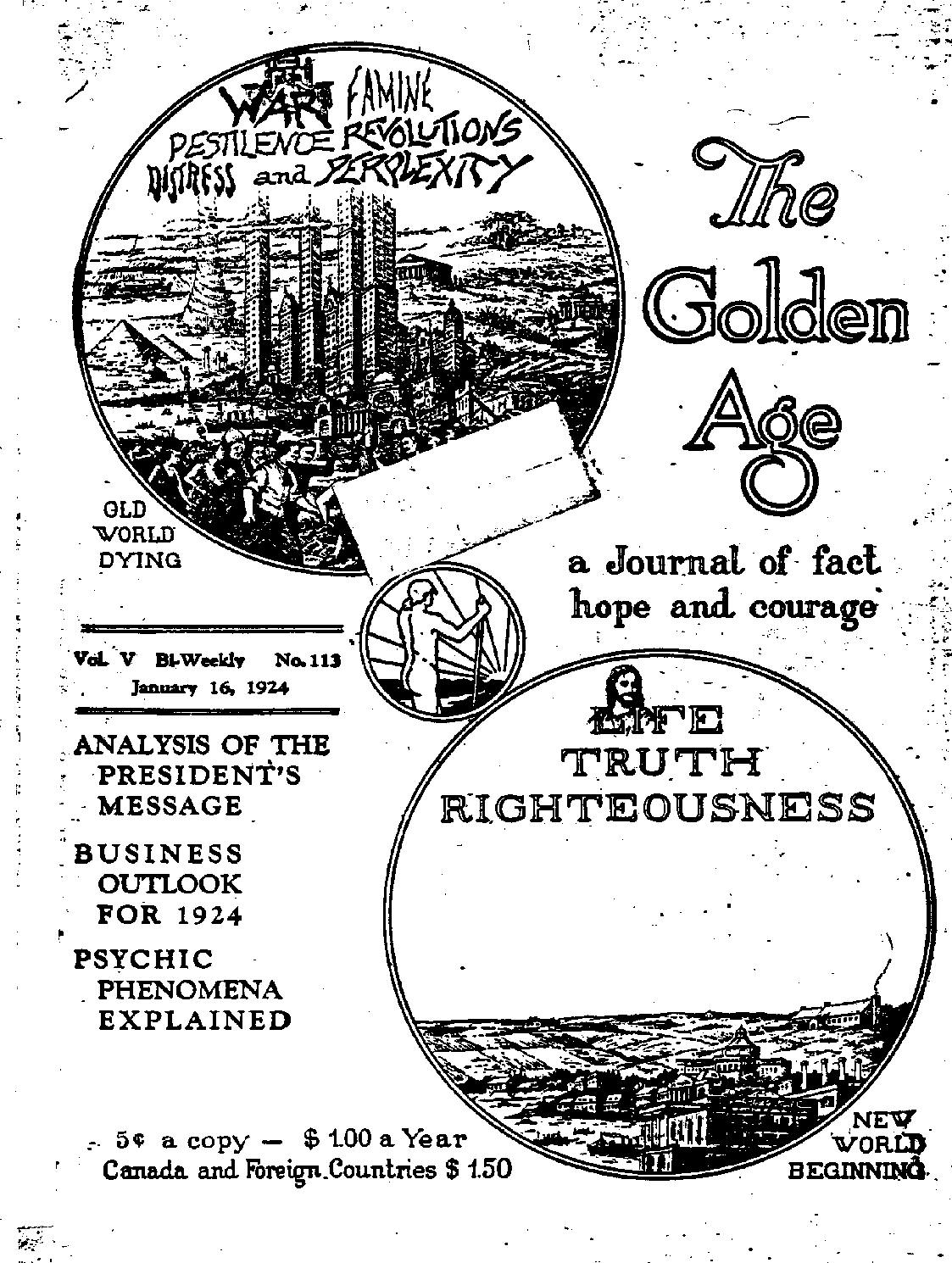
Contents of the Golden Age
/ . Labor and Economics
Hess and These Throughout the Woild
Unemployment In England
Dotes to Babylonians
Social and Educational Starring in a Palace ....
Items Respecting Russia
Clever Detective Wort
Barr Cun Found yua ns Blubs
- FENANCI—COMMKRCB—TBANSrORTATION
Bankers and Packers..... .
Maintaining the Monarchy......
TVs Business Outlook sub W24 . . .......... . 241
Political—Domestic amv'Toubw An Analtsh or tkb President's Mesbage . . . * * . . • . . 227 Repoets noif Foreign Cobbespon dents
From Canada...... 1..... .
From England
£ebe and The« Thboughout thm Would
Entertaining the Premiers
Ireland, Australia, Jamaica
, Egypt, South America, Cuba, Asia
Tire Tears of Peace .
j Efforts to Force America In
' Poincard the Impossible
Doctor Hillis in the Ruhr . . . .
: Germany Is in Chaos
Austria, dscho-SIorakta, Holland
Italian Statesmanship
Homs and Health Td Rights on No»TonAccoNwrs
Bnlioion and Philosophy A Study 09 the Theoet or Evolution (Part 2)
Psychic Phenomena Explained
Studies in “The Hasp op God* .
FaMished every etbar Wednesday at Ifl Concord Street. Brooklyn, N. Y„ U. 3. A* Sy WOODWORTH, HUDGINGS A MARTIN
(tepartncra. and Proprietor* Addrete.* 19 CtmcorO Straw. greeHyi*, F. F., U. 8. A. CLAYTON J. WOODWORTH . . . Editor ROBERT J. MARTIN . Bualneeo Manatee C. & STEWART .... Amtatant Editor WM. F. HUDGING3 . . S«*y and Trwa. rm cam a Copy—41.00 a Yaaa Man REMmaMCBa tv tbb GOLD** 9G9 9099900 Orness: BHMab.....84 Craven Terrace, Lancaster Gate, London w. 3
CanodlM ..••••••. 88-K) Inrtn Avenue. Toronto, Ontario AeWralmten ....... 40S CoUlna Street. Melbourne. Australia Soetk A/ween ...... 4 Laila Str ret. Cape Town, South Alrteu
Mtsted as aarond^laee matter at Brooklyn, N. under tDe Act of March A 14TD
afe Golden Age
Nubor 113
Brooklyn* N.Y.t Werin—dty, January 16, 1924
An Analysis of the President’s Message
Pbestdekt Cooudgb ostensibly is against America’s joining the League of Nations;
so is Wall Street. This is because the American people are definitely set against it Sour grapes.
He is for the World Court, the back-door entrance into the League; so is Wall Street
He is against the recognition of the government of Soviet Russia; so is Wall Street
He wants Europe to pay back the money it has borrowed here; so does Wall Street
He wants a reduction in the income taxes paid by the wealthy, so that a larger proportion of taxes may fall on those whose earnings are smaller; so does Wall Street
He is opposed to the levying of excess profits ? taxes; so is Wall Street
He is opposed to the issuance of any more tax free securities; so is Wall Street, now, after all these securities are safely lodged in their bank vaults to the tune of billions of dollars. This is locking the stable door when the stolen horse is twenty miles away.
He wants the tariff let alone; so does Wall Street, and everybody else with any dollars or sense. '
He wants America’s four billion dollar merchant marine surrendered to private interests; so does Wall Street
He wants the Supreme Court virtually to * have the power to fix railroad profits; so does Wall Street
He sees the necessity of a revision of freight rates, but he wants the railroads let alone; so does Wall Street.
He wants the procedure in Federal courts to be regulated by the courts rather than by statutes made by the people; so does Wall Street.
He wants prohibition enforced; so does Wall Street It has wet goods laid up for many years and it does not wish the people at large to have such goods. Wet goods make them dangerous.
He wants Northern industrial centers made more hospitable places for Negroes; so does Wall Street, because it has found Negroes much easier to handle than whites.
He wants the Federal Government, when it employs women, to see to it that there is a minimum wage below which the Government shall not fall; so does Wall Street, which, now that it has been freed of this burden by decree of the Supreme Court, can pay the women as it pleases in every other part of the Union.
He wants the immediate registration of all aliens; so does Wall Street. It hopes thus to be able to keep out Bolshevism. x
He is opposed to granting the soldiers a bonus; so is Wall Street.
He is opposed to government ownership or operation of coal mines; so is Wall Street.
He is opposed to regulating profits in coal at the mines; so is Wall Street. •
He wants "greater unity of ownership* of the,, soft coal fields and "common selling agents* for the product; so does Wall Street.'
He is opposed to any plan for aiding the farmer that would be in any way akin to the plan that has been used for aiding the railroads to make their huge profits; so is Wall Street.
He wants Congress to hamper him by wholly needless restrictions as to how he may dispose of Muscle Shoals to Henry Ford; so does Wall Street
He wants good roads for the automobiles; so does Wall Street '
It seems to us that President Coolidge is the Republican party's logical candidate for President, and that he probably stands well with the papacy; we shall be surprised if he is not nominated this coming June. But whether he would be elected may depend on how much the people as a whole see in his message and his close alliance with the superinvisible government
. str
Reports from Foreign Correspondents
Report from Canada ~
CANADA has received one good financial “earthquake” in the past few months, and the money satraps fear another one. That it will com# seems to be a foregone conclusion. The devastating failure of the Home Bank of Canada has caused the small depositors first to quake, then to get mad; and now they are combining into quite a formidable union for purposes of compelling investigation.
Simultaneously three investigations are going on: The authorities are taking criminal proceedings against the Directors; the Government is investigating the internal affairs of the-Bank, and discovering a condition so putrid that it almost calls for the use of gas masks; and the depositors are demanding that the Government make up any deficit, because the Finance Minister was warned by officers of the Bank years ago that its investments were.unsound and that it should be checked up.
Nothing was done at the time, seemingly; and upon the bare assurance of the management that everything was in good shape the matter was dropped. Now the depositors are invoking the Bank Act, and declaring that as the Government controls a large staff of bank examiners, this implies a direct responsibility with regard to the soundness of the Canadian Banks, and therefore the Government must make good its protege’s losses.
What the outcome will be remains to be seen. In the meantime the aroused state of public opinion bodes ill for the directorate if evidence of crooked dealing is exhumed, as seems highly probable. The fact that the Home Bank is practically a Boman Catholic institution, having been founded by a Bishop (Fallon) and supported by the Catholic institutions generally, does not increase the public confidence.
Church union affecting the Methodist, Presbyterian, an<^ Congregational Churches continues prominent in the press. Much bitterness is being stirred up and factional vituperation is much in evidence. The old adage that "when thieves fall out honest men get their due” may be true in this case; and no doubt as the fight waxes more fierce, many interesting truths will come to light.
Paralleling the already published statement that immense sums of money have been wasted annually by the three denominations in duplication of efforts in the communities where three full-time ministers are needed to do the work that one able-bodied man could do in his spare time, is the growing conviction in the minds of the people that the salaried minister is an anachronism.
Already the Southern Saskatchewan Conference of the Mennonite Church has cut off its salaried ministry because “a certain sect is widely advertising ‘Free Minister Service' [Seats Free and No Collection]*’; and they cannot compete. Some able-bodied ministers are now more closely emulating St Paul and working for a living whilst they preach.
Farming conditions are as one would expect, and as was predicted in the columns of The Golden Aon some months ago. When the tremendous wheat harvest of the “golden” West commenced to flow eastward to the markets, all' the newspapers joined in a chorus of praise of the “productivity of our wonderful Prairie Provinces.”
Today they are silent. The crop was big enough, but in many parts of the West the farmers cannot get enough money for the wheat to pay haulage to the railroad. There is again a despondency, a sullen hatred of conditions that make a year's labor of no avail.
Your correspondent hopes in his next report to give with some detail a report of the government action against the Alberta district farmers under the Tax Act It should be interesting reading whilst Canada is so “prosperous.”
One flourishing business, however, which seems to gain momentum with every passing month is the bootleg traffic to the U. S. A. The Belleville (Ontario) rum fleet still busily ships its spiritous cargoes to Cuba and Mexico in twenty-ton launches, returning in twenty-four hours for another load. There is much activity just now in fear of a freeze-up of Lake Ontario. An examination of the Mexico shipping records should be interesting, with all the names of Canadian lake craft that must appear thereon I
Labor conditions are deplorable. The Toronto Telegram reports that twenty-five thousand Canadians are crossing the American boundary line each week because of the slackness of business in Canada. Many of them are discouraged farmers. Many are unemployed artisans.
Many are immigrants who see a brighter prospect for steady employment south of the line, and thus hold up to ridicule both the Canadian Immigration activities in their attempt to get settlers, and the American law which tries to restrict their entry.
. During the “prosperous” years that followed the war which made Canada safe for democracy, the Government statistics of immigration and emigration are as follows:
■' To Canada From Canada
1919 57,703 57,783
1990 _________________117,336 90,025
1921 _________________148,477 72,317
1922 _____________:____ 89.999 46,810
1923 72,887 117,011
Total 486,401 383,945
This gives the total immigration from all countries for these years, and the emigration to the United States only. There was also a large loss to England, South Africa, Australia, and * other countries. Seemingly there is something radically wrong with Canada’s immigration . policy.
f
Report from England
BRITAIN at the present time is in the midst of the excitement which always aceompan-ies a general election. The Prime Minister, Mr. Stanley Baldwin, known to Americans because he was Britain's financial emissary, dissolved Parliament in order that he could go to the country for authority to introduce measures for protection; this because Mr. Bonar Law, whose place he took, had promised that the present government would make no attempt to introduce such legislation.
, Mr. Baldwin and his supporters say that this was a most honorable proceeding on his part, whereas the Liberal leaders say that he has prostituted the privileges of his office and thrown the country into confusion in order to get a party advantage. For, say they, the country has already many times expressed itself on this question; and the late government was expected to proceed with the legislation for the amendment of the country's affairs, without touching the principles upon which it lives, and to try to bring about such relationships with the country's European neighbors as would help to settle the distracted nations and thus bring peace in Europe.
When elected, the Conservatives got a much greater proportion of seats in Parliament than votes in the country; for they polled only about seventy-five percent of votes- in the constituencies. Their opponents are divided; and the only hope the Conservatives have at this time is that, the same conditions prevailing, they expect to do as well or better than before and to have freedom to go their own way. “
In the meantime the government of Britain has little weight in the counsels of the European politicians—which may be all the better for everybody; but Europe is going from bad to worse. At home unemployment is the giant stalking through the land, and it is this that has precipitated the Prime Minister’s action. The politicians are divided; at the best they do not know what to do to amend the weakness of the country's industrial situation. '
Some apparently genuinely believe that duties levied on all imports will serve to keep goods out of the country and so provide work at home by safeguarding the home manufacturer from foreign competition, thought it is also expected that the duties which will be levied (on the goods which are to be kept out!) will help to pay the taxation of the country and so relieve its burdens; also the shipping countries hope to continue to fill their ships with the goods and to satisfy their shareholders with the carrying profits on the goods which the protectionist hopes to keep out of the country. Whichever party is in the ascendancy the opposition can always point to failures; and in any case the public are the sufferers at the hands of those who hold the reins, power and money.
The profiteer is still abroad in the land, not only the one who openly takes advantage of a fellow citizen in his need, but the ordinary commercial profiteer. A short time ago it was pointed out that two Yorkshire firms, in the wool trade, revealed by their figures that each had made an average of £140 ($700) profit per year per employA Perhaps there is no more shameful fleecing of the public than in some departments of the wool trade. One buys some underclothing which is said to be good or best value in woolen wear, only to find that when the storekeeper sold the goods the customer was also “sold."
The general condition of the country shows up as usual. The people are very patient under the heavy burdens which they must bear. The richer people are feeling the pinch of things; but things do not pinch so hard when a person has only some thousands of pounds less in income. Lord Derby of Knowsley, near Liverpool, the present representative of the well-established family of the Stanleys, said the other day that he was approaching the point where he might have to consider the giving up of his ancestral home. But worry with scores of thousands of .pounds a year income can hardly be the same as when there is worry as to how many loaves can be bought with the wage of the home provider.
The late Lord Chancellor has been shocking the country by his outspoken paganism. He will not tolerate the idea that there can be a time when war will be no more, and he laughs to scorn those who carry such an idea. He will have nothing to do with any notion of such a league of nations as at present exists, and expects to see things go on as always. If he lives a little longer he will see something which will shake his paganism. In any case Isaiah is to be believed rather than the Earl of Birkenhead.
There is little doing amongst the churches. A great meeting is called for the Royal Albert hall by some earnest Christians, when they are going to declare their faith in the Bible as the Word of God. There are many who deplore the falling away from the faith of their fathers. To our regret we have to say that these apparently sincere persons refuse to be released from the bondage which their creeds have bound around them, and decline to have the plan of God set before them. We have no doubt that soon they will see that faith in the Bible as the Word of God is not enough; and that none can continue to hold faith who does not understand the Bible, which, admittedly, they do not.-
Here and There Throughout the World
UNEMPLOYMENT in England is increasing, and is already in the dreadful condition that seven million workers and their dependents are forced to apply for public relief. In some of the cities there are skilled workers who have not done a stroke of work in three years.
These men are quiet, but are broken in spirit; and their value as workers is diminishing. They are showing plainly the signs of hunger in their faces, They are clamoring for work, preferring to work at anything rather than to be idle, even though they may be paid something for it
The British Government is putting out two million pounds sterling per week for the maintenance of the unemployed, and an equal amount is being contributed by the local Poor Law authorities. The Labor Party sees no solution of the problem which Britain faces except the immediate cancellation of all war debts, including Britain's debt to the United States.
heretofore Britain has done an enormous business with all other European countries; but Europe can no longer buy, and the British dominions cannot take care of the surplus goods which British mills can produce. The British outlook is dark indeed.
A joint meeting of representatives of all the principal churches of England has just beefl held in London, at which resolutions were passed . * calling upon the Government to “institute a searching inquiry into the fundamental causes of the persistent unemployment which has sapped the life of the people for so many years,^with a view to large and radical measures being speedily taken to deal with the evil”
One of the bishops of the Church of England present said that the clergy were at this conference "to give voice to a profoundly uneasy conscience.” We can see why, as a result of their always championing the cause of war whenever the opportunity arises, they should have just that kind of conscience.
Where unemployment is so widespread, there is a natural tendency for wages to go down. The condition of cinema workers in London has just come to light, showing that one of these men, working from nine in the morning until ten-thirty at night every day in the week, receives as compensation only two pounds sterling per week, barely enough for a single man to exist upon. Another operator, showing pictures for seven and one-half hours daily, received only one pound three shillings per week.
Dole* to Babylonian*
BRITISH labor men, confronted with their own miseries, are giving some attention to the doles that are passed out to others. Millions of dollars are paid out every year to persons whose only claim to the money is that for some vague reason or other they are “distinguished.'* This is on the same general level with the payment of $20,000 a year to Chauncey M. Depew out of the funds of one of the great life . inanranna companies. On the witness stand Chauncey seemed unable to find any reason why he should get those $20,000 except for his “genoral standing^ in the community.
The labor people just now are pointing out that while he lived, Lord Nelson received his pay as a naval officer, plus $15,000 prize money for the Battle of the Nile alone, plus $15,000 a year from the King of Naples, plus a gift of ' = $50,000 from the East India Company, and received a pension during the latter part of his life of $20,000 per year from the British Government; and*that since his death, up to 1913, his relatives, moststf them entirely unknown to the public, have ceileeted an additional $2,500,. . \ 000, all because they happened to be Nelsons.
~' This same miserable policy of sustaining distinguished men and families long after the work ' for which they were duly paid at the time has been finished, continues to be a British policy. The judiciary are paid amply while in office, >. *- and paid after they are out of office. The same is true of the peers and of royalty in general
In the face of such conditions, an account of a royal wedding, such as that of the Crown Prince of Sweden to one of the British royalty, recently celebrated in London is nonsense.
The newspaper stories give us our fill of , information about “magnificent gold plate," ' .“scarlet and blue uniforms adorned with decorations and gold lace,” “gorgeous copes’* of the Bishop of London and the Archbishop of Canterbury, the “crimson and lace costumes” of the choir, etc.; and we. may add that it does not take long to give us our fill, either. A little of it goes a long way. Britain is paying well for a lot of tomfoolery it could do without
Entertaining the Premier*
FOR the entertainment of the Premiers et Canada, South Africa, India, Australia, and New Zealand the British Navy has just had a parade of its fleet off Spithead, England. ' Of the eighty-two vessels in the armada not a single ship was commissioned in 1914. The number of battleships is now but eighteen, whereas in 1914 there were fifty-five.
The battleship has had its day, and it was an expensive day. The Hood, England's greatest battleship, carries eight fifteen-inch guns at a speed of thirty-one knot an hour. The Angus, airship carrier, has no funnels, but ejects its smoke from behind, like an automobile.
Reports from India are that for the first time in years it is expected that the 1923 budget will be balanced. The Indian Premier says, in explanation of the means by which this fiscal result was accomplished:
“Taxation [of the poor Hindus] has been increased to an extent which a few yean ago would not have been thought possible. Nevertheless for five yean in cneeea ■ion we wen unable to balance our budgets. The aggregate deficits indeed in these five yean amounted to moce than sixty million pounds sterling, a gigantic sum for so poor a country."
Both the premiers of India and South Africa want a “tariff preference to goods from within the Empire." In other words, they want pro- . tection instead of free trade; and it seems likely to us that economic necessity will virtually^ force consent to their wishes. However, there is a great body of public opinion in England that will always be for free trade and against protection in any form.
Ireland, Australia, Jamaica
1~RF/LAND maintains its reputation for being always in trouble. The Irish Republic is now mostly in jail, prisoners of the Irish Free State, and is engaged in a hunger strike to bring about either liberty or death. At last account five hundred of the fifteen thousand prisoners were still on strike, with several of them in a dangerous condition.
Melbourne has been having a police strike with results somewhat like those which accompanied Boston's similar strike some years ago. Rowdies took advantage of the situation to overturn cars, smash windows, and rob stores. Part of the force stayed on the job, and the places of the strikers were temporarily filled by special constables who aided in restoring order. The strike was due to the refusal of the police commissioners to dismiss a patrolman for what
GOLDEN AQE
the commissioners regarded as inadequate reasons.
The Jamaican Government has been investigating the question of how to best develop the island’s transportation facilities. The expert appointed to the job, in his report to the Duke of Devonshire, advised against State ownership or control.
It is a safe bet that the Duke has a good personal financial reason why the railways should be left in his hands, if they are there now. We have no knowledge on the subject, but can guess. Generally, in America, when we find experts telling financiers that a certain enterprise ought not to be undertaken by the public, we know in advance why the report was framed that way.
Think what a crime against the financiers it would be if some of the really good and profitable things of this world should actually get into the hands of the common people. In a little while they would want something more; and after a while the people would want to run all their own businesses; and what a terrible thing that would be, wouldn’t itf ■
Excitement in Egypt
TT’GYPT has had the excitement of anelec-•I-i tion. Adley Bey, British candidate for the premiership, according to the London Daily Herald, received three votes. The Herald says that he was so sure of election that he neglected to go to the polls himself; otherwise he might have had four votes. Some of the ministers received no votes at all, not a single one. This would seem io indicate that if the Egyptians do not know what they want they at least know what they do not want
Ninety percent of the inhabitants of Egypt are engaged in agriculture; but the same conditions are developing there as elsewhere over the earth. The land is getting into the hands of the few, with a consequence of strikes and other labor troubles, which before the World War were never heard of. There has also been a rapid rise in the cost of living.
The Valley of Kings, within which lie the now famous remains of King Tut-ankh-Amen, has been connected with the outside world by long distance telephone. The use of the telephone is spreading greatly. England notices a rapid increase in the number of instruments in use since the war.
Baooxrnr, M. I <
' I South America, Cuba, and Asia
SOUTH America is a world all by itself, with
its own problems. The South American con-
tinent sets a pretty good example of sanity as compared with the rest of the world, but of late | is growing somewhat restless. The three great- i est countries of South America, Argentine, ; Brazil and Chile (co me times called the ABC j countries), determine South American destinies. ;
None of the other South American countries j would be able to contend seriously with any one of these, but it becomes a different matter when i they face each other. Argentine has been expanding its military administration, most un- ' wisely, we think. This has made Chile anxious; and now, although Chile is peaceably disposed, the probabilities are that it will follow Argantine’s bad example.
The present Chilean government is enlightened and progressive. It is organizing cooper- • ative workingmen’s banks in the industrial centers, with a view to the social betterment and ' uplift of the workers. That is the kind of work in which a government shftul'd be engaged, rather than in the evil work oFmultiplying arms with which to force its will upon others. -
Cuba would like to be progressive, but is handicapped. In the interests of economy and efficiency the Cuban legislature passed a bill consolidating the railroads of the country, an eminently sensible thing to do; but they did not reckon with the fact that some of the Cuban * railroads belong to American financiers. At present the financiers have blocked the way of . the Cubans by throwing their great power into an effort to have our State Department take a hand in the matter.
In the midst of the general Asiatic melefi China has developed a real statesman in the person of General Yen Hsi-shan, governor of " the province of Shansi. In the eleven years during which he has been administering the province he has reduced the soldiers from 50,000 to 20,000, has put a complete end to banditry and the opium traffic, has built modern roads, has begun reforestation on a large scale, and has introduced sheep suitable to the climate.
Early in November, Japan was the scene of one of the greatest ovations ever given any person on the other side of the world. It was a spontaneous expression on the part of all Japan in honor of the American Ambassador, as he
left for a visit home, following the relief work in which Ampri^a played the principal part. The ship on which he sailed was converted into a huge conservatory of flowers which came from all parts of Japan. This expression of gratitude is encouraging from every point of view. It shows fhat, whatever may have been the case in the past, the Japanese people at this time are genuinely friendly to the American people. Newspaper reports show that in Japan, when ' conditions were at the worst, people committed suicide in preference to facing starvation.
Fivo Years of Peace ’
FROM a symposium in the New York World we cull some items under this head. The president of Yale University says that the present situation is most disheartening. He sees in European affairs increased evidences of jealousy, fear, hatred, suspicion, greed, and the disposition of the strong to bully the weak.
The president of Princeton University does not see that the nations are any closer together than five years ago, or that there is any sign of their coming closer together. He thinka tEe best ' f thing for the United States to do is to join the League of Nations. In our opinion President Hibben is barking up the wrong tree. President Hibben is a D. D^ and engaged in the work of making other D. Ds. .
Robert E. Speer, president of the Federal Council of Churches, says that there is a deepening conviction that all the people want peace, that the whole trouble is in bad leaders, that the mass of the people are convinced that they have been misused to their own destruction, and that they are not in the mood to be thus misused much longer.
Dr. William T. Ellis, the magazine writer, ‘says that "most of the penetrating Old World observers with whom I have talked (in an eight months’ trip to the Near East) have reached the conclusion that unless there is a general return to an observance of the principles of Christianity there is no hope for civilization.”
During the lifetime of Pastor Russell, William T. Ellis devoted his talents to ridiculing the efforts of that godly man to establish true Christianity in the earth. The Presbyterian Church, of which Dr. Ellis is a spokesman, served faithfully as a slave at the beck and call . of the war god in 1917 and 1913.
Having done what he could to destroy true Christianity in the earth, and to uphold false Christianity, it strikes us as interesting at this juncture to have him say that unless mankind comes to an observance of true Christianity there is no hope for civilization. If civilization perishes, William T. Ellis will be as largely responsible for it as any man we know.
Oscar S. Straus, former ambassador to Turkey, says that the world conditions since the armistice have been ruinous alike to both the victor and the vanquished, and that the reason for the unparalleled disastrous result is because the peace terms were forged in revenge and not in justice.
Senator Borah of Idaho thinks that up to the time of the armistice the Allies were carrying on war against governments; and that since that time they have been carrying on war against men, women and children who were not responsible for the war, and who are being punished in peace as no human beings were ever punished before. The situation in Germany con- . firms this. Every effort is being made to destroy the German population.
Opinions of the Europeans '
Israkt. Zangwill, the novelist, says of Europe that it has no statesman, but a succession of. . gamblers; and that the people of Europe are like passengers in a train driven by a mad engineer. He is of the opinion that the men in • power all over Europe have forgotten much and learned nothing; and that if the press had not aided the politicians it would not have been possible to engulf the whole world in a whirlpool of hatred and falsehood.
Dr. Fridtjof Nansen, the scientist and explorer, declares that in his opinion Europe, five years after the armistice, is in a worse condition than it was in 1918 at the end of the war; and that the present crisis is greater than any that arose during the war itself.
Cardinal Mercier says that the rulers of Europe are filled with distrust, and that there is anxiety everywhere. The cardinal is right; and the reason for this distressing situation is that Europe has drunk too long and too deeply of Roman Catholic doctrines. It is Babylon’s mixed wine that has made Europe a madhouse. The Cardinal should chuck up his job.
Lloyd George, at the conclusion of his recent tour of America, made the statement that unless America joins with England to settle the present European unrest, "civilization is doomed within this generation to a catastrophe such as the world has never seen." He wants a policeman with a long pocketbook.
The President of Czecho-Slovakia says that the first requirement of Europe is authority. This is our opinion exactly; and in our judgment this authority can come from but one place. It can certainly never come from any earthly source; all such sources have been discredited long ago.
Francesco Nitti, ex-Premier of Italy, says that Europe is now in a far worse condition than at the close of the war, that all solemn pledges made during the war have been violated, that conquered nations have been disarmed, that France and her dependent states have doubled their armaments, and that every effort is being made to suffocate Germany and to destroy her economically. He anticipates that Germany will be broken up, and that her dissolution will bring irreparable disaster to France.
America Hat Already Paid
Gkefusl Smuts, Premier of South Africa, says of the Treaty of Versailles, which brought about present conditions in Europe:
"The responsibility for what wm done at Paris for the settlement contained in the peace treaty, weighs heavily on my conscience in spite of the fact that I signed it only under protest, and under a sense of foreboding of future calamities which have come only too true.”
He sees the economic and industrial structure of Europe cracking in all directions, unable to bear the weight of the vast hordes of black troops that have been poured into’ Europe by France in her effort to maintain her supremacy by force rather than by reason.
General Smuts, like most European statesmen, sees hope only if Amerind reenters European affairs. But Uncle Sam is chary of acting as Britain’s paymaster and sheriff; and most Americans see little else to be gained by America’s undertaking greater participation in the troubles overseas.
But Europeans have no right to feel that America has shown no interest in their troubles. The following is a statement, in millions of dollars, of the amounts that the United States Government has advanced to various European countries. The Liberty Bonds to provide these funds were sold to the citizens of America to their full capacity to buy:
Hungary
Latvia ■-------- - ---
Lithuania ----------
Finland .. .... .. __________
Armenia -----
Greece-----------■'■■■ -...........
Esthonia ——
Boumania_________
Austria —--------------
Jugoslavia---- ---------
Czecho-Slovakia
Poland ..
Russia -
Belgium - -
Italy —v--------------------
France - -- - -
Britain ....... .....
3,000,000 6,000.000 6,000.000 9,000,000
14,000.000 16,000,000 16,000,000 41,000,000 46,000,000 58,000,000
104,000,000 153,000,000 328,000,000 429,000,000 1,892,000,000 3,771,000,000 4,747,000,000
811,537,000,000
This is $100 for every ma", woman and child in the United States; it is almost $4,000,000 for every county in the United States. Think of the good roads and schools that could be built with such a vast sum. It would build homes for oneseventh of the people of the country.
Effbrfs to Farce America
EUROPE can never pay this sum in money;
if she sent us all the gold she has it would pay only the interest on the debt for two years; she cannot pay in goods, because America cannot afford to let the goods come in and thus destroy her own market
At present Europe cannot make enough to live on, and is borrowing heavily to pay living >-expenses. She has cut down imports until the American farmer has lost his markets and is in despair. Experience shows that it is not long after the farmer is in despair .before the manufacturer is in despair, too; for the fanner is his best customer.
The Federal Council of Churches, that everlasting messer in things that are none of its concern, is putting the screws on President Coolidge, endeavoring to force him, if not into the front door of the League of Nations, at least into ths back door, the World Court
The Council is becoming more and more political in its aims and methods. Through its efforts thirteen million persons hounded President Harding, by letters and petitions, preceding the Washington Arms Conference. Do we all remember how Jesus and the apostles got after the Boman emperors, telling them how to run their business of making1 the world safe for democracy! We do not; for they did not.
The League of Nations has completed its five • hundredth treaty, an agreement between Denmark and Latvia on the subject of trade marks. It has reestablished peace between Italy and Greece over the Corfu affair; it does accomplish some good in the world, in spite of all the evils it condones.
It does not dare concern itself, however, about the one great question that the whole world is talking about; namely, the French occupation of the Ruhr. A league that is courageous enough to intervene where a lesser government is the transgressor, but dares say nothing where the greatest military power of all time is the aggressor, is not the kind of supergovernment that the world needs. Christ's kingdom alone ^rill be able to deal with France.
Poincare the Impossible
BY THIS time all readers of The Golden
Aos are aware that the United States' proposals to France and other countries that an unbiased inquiry be made into Germany's ability to pay the reparations indemnities have fallen to the ground.
The French Premier, although understanding distinctly that these experts would be acting wholly in an advisory capacity, made such restrictions respecting the inquiry that it was not found feasible to go on with them.
, Senator McCormick voices the general opinion of Premier Poincar£ in America in the following statement:
“The contemptuous condescension with which JI. PoincarS conditions his acceptance of the proposed conference shove that he has not learned anything,, or, if he has, that he will not confess it. He originally proposed and promised the impossible to his own people, and so overthrew and succeeded in office a man of great ability, who had won from England a guarantee of French security which Af. Poincartf promptly repudiated. M. Poincare's policy has reduced the total of German reparations recoverable by France, has added enormously to the French national debt, has prolonged and increased unemployment in England, has added to the number of children in central Europe dead or dying of slow starvation, has multiplied the number of those whom Mr. Coolidge believes must be fed by the charity of the Amptican taxpayer, has made more remote the payment of the Allied debt to us, and has hurt immeasurably the American farmer and manufacturer."
But conference or no conference France is inevitably nearing the end of her course of force and selfishness. There has been no unemployment there yet, but there soon will be^ for the wbrk of reconstruction, now about two-thirds completed, will be stopped by lack of funds.
France has advanced eighty billion francs to the people in the war-devastated areas, and has set this huge sum aside in a special budget charged to Germany. If she drives Germany to dissolution and destruction, as she seems determined to do, Germany will never pay any of this; and the result will be what all leading economists see ahead for France—sure bankruptcy.
France, however, is largely an agricultural nation, and with eighty-five percent of the farina owned by the people living upon them, can manage to get along after, a fashion, even if the franc does go the way of the mark But she will have to stop* all industrial progress, and even military expense, if the franc continues to depreciate.
France Outkaisering the Kaiser
AT PRESENT the French military machine
> is worse than the German machine ever was, even in the palmiest days of the Kaiser. France has a million men under arms, and five airplanes to England's one. True democracy shudders at this new form of ruthless force.
For permitting, in the town of Leveque, an inscription stating that the World War was a war to end war, the French Government has ordered the mayor to stand trial for non-observance of a ministerial order. This shows that the present French ministry never had any such Wilsonian idea. The farther we go in chasing Mr. Wilson's rainbow phrases the more fatigued we get.
There is a pronounced antagonism in Franco against America. In September a young, man who stole $30,000 from the American Express Company, and who admitted that he had spent it in furnishing an apartment for an unmarried
Parisienne, was acquitted by a jury after only five minutes deliberation. The ground of the acquittal was that the American concern was American, that it was rich, and that it had made millions through exchange speculations in the franc. On any such basis a crime becomes a joke.
Doctor Uillu in the Ruhr *
THE Reverend Dr. Newell Dwight Hillis, of
Brooklyn, who won undying fame during the World* War by his "sermons” of hate for the Germans, is back from a visit to the Ruhr valley, where for eight months, he says, the German Government paid the workers to remain idle, so as to try to force better terms from the French. He describes the German civilization entertainingly, and contrasts it with Britain and America. In trying to prove that the Germans can well afford to pay reparations in full he said:
"Tenement houses are not permitted in the Ruhr valley. Ton can find tens of thousands of rotting old rookeries in the cotton cities of central England, and miserable shacks in the coal, iron and steel towns of the United States. But you shall not find one single such structure in the entire Ruhr valley—not one I One day, passing through the outskirts of Essen, I noticed at a distance what looked like a splendid villa, singularly like one of the finest houses on a certain estate in Greenwich, Conn. Driving up a little later to the front of this home, to my amazement I found it was an apartment building. The central portion was three stories high, the two wings at either end were two stories. The building contained fourteen apartments. In the rear were many little gardens. Knowing that the turnover, through discontent on the part of the workingmen, was about six months in certain factories in Detroit and Pittsburgh, inquiry showed that the workers in this particular plant remained for life, and that practically there was no turnover. The German employers have been very wise. The apartment for the family was full of air and sunshine, had all the conveniences of sanitation, opened out upon a little garden, in which the workingman's wife and children had their vegetables, their flowers, a few currant bushes and gooseberry, raspberry and blackberry vines, a few cherry trees, and a grape vine.”
During the war to end war, and to make the world safe for democracy, Dr. Hillis was one of the chief rooters for war; and as we understood his program at that time one of the principal things for which he was contending was the release of the German people from the above conditions. If what he says is true it is scant wonder that these "barbarous Huns,” as the Germans were called during the war, did not want to exchange their civilization for ours. I Maybe the "Huns" wanted to show us how to live!
Stoning in a Palaeo
BUT it is possible to starve in a palace, and that is what is happening in Germany.
Newspaper despatches show that a census of school children in Berlin, taken without warning by social welfare workers, revealed the fact that thousands of school children come to school in the morning without breakfast, and that many of them collapse in the class rooms because they have had no food.
Moreover, these same children are without adequate clothing, and some of them have neither shoes nor stockings. In some places in Germany the old folks have committed suicide, with the avowed object of saving the food supplies for the younger and more vigorous, so that something might be saved out of the wreck.
Dr. Nansen, the Norwegian explorer and diplomat, states that in one German town which he visited the people of the town had invaded the surrounding farms and dug up the potato crops at night The police arrested three hundred of these marauders in a single night, but the numbers finally became so great that they were forced to abandon the attempt to preserve order.
In terms of American money a mail carrier gets $5 a month, a railway engineer $7, and a railway superintendent $2T. These men must pay $1 a pound for meat and twenty cents a loaf for bread, with everything else- in proper-tion.
One hundred thousand Czecho-Slovakians living" in Germany have begged their own government to take them home because they have found the conditions under which they must live in Germany are intolerable. The United States contemplates a gift of 50,000,000 bushels of wheat to Germany.
Many families are unable to buy even two loaves of bread as their supply for an entire week. In one instance five hundred desperate men rushed the bread wagons in a factory dia» trict Sleeping cars are attached to freight trains, to save fueL
Germany Is in Chaos
THE fuel situation is so desperate that college trained men and highly educated and intelligent women are going out of Berlin in the fourth class railway carriages and returning with tightly packed loads of wood that represent the uttermost limits of their strength to carry to and from the cars.
They carry as much as possible on each trip because they cannot afford to make more than the fewest possible number of trips. In Berlin itself children crawl around the city parks with sacks, gathering every fallen twig or leaf or bit of bark that can be used for fueL
Politically Germany is in chaos, as it is financially. The people have lost confidence in the Reichstag and are unable to agree on any plan; indeed, the demands of France are such that is is impossible to have a plan. One cabinet after another goes down, and one uprising after another occurs. The central government continues to function, after a fashion, hoping against hope to find a way out of the impassA
There has been some mild excitement because the Crown Prince wished to return from his ' } exile in Holland, to rejoin his family in Silesia. Holland has no law which could prevent his return to Germany; and Germany is willing that he should return, as a private citizen. It is doubtful whether any Hohenzollern could ' regain the throne of Germany, and there would be little to fear from any activities of the Crown Prince.
In Bavaria, which has been under the rule of * a dictator, there has been an outbreak of antiSemitism. Dr. von Kahr, the dictator, ordered the expulsion of three hundred Jews who had not established the right of domicile. They were deported to Vienna, and all their property was ■ "confiscated. Their houses were turned over to German refugees driven penniless from the Ruhr by the French military machine. Bavaria is the Roman Catholic stronghold of what was once the German empire.
Austria, Czechoslovakia, Holland
THE recovery of Austria, as a result of the loan arranged a year ago, is said to be remarkable. Unemployment is now only half what it was at the beginning of last year, and deposits in savings banks have grown to three times what they were. '
Vienna claims to have regained control of all her old markets and to have regained her position as the financial center of the neighboring states. For many of these she now does the whole money exchange business. A few years ago Vienna's condition seemed hopeless.
The "Christian Socialists" are in control of the Austrian Government. This is a Roman Catholic movement, and has the great power of the Church back of it. No doubt the Papacy has made it its special business to show that where it is given a free hand it can bring order out of chaos. It might be able to do it in a strictly Boman Catholic country like Austria, but to do it in a Protestant country like Germany is quite another matter.
Between Germany and Austria lies the new country of Czecho-Slovakia, of which Prague is the capital. This is the ancient Bohemia, made illustrious by the reformer John Huss. Czechoslovakia has been trying woman suffrage for three years and is well pleased with the result.
The women have elected about five percent of the members of both the House and the Senate, and have definitely influenced the making of new laws which are working out well for the interests of the country as a whole.
These laws have to do with the organization of women's technical, industrial and domestic schools, and the establishment of child welfare centers in each city. The women have also rendered valuable assistance regarding food shortage problems.
In the midst of European confusion it is refreshing to find the' government of Holland showing a cool head under circumstances where an opposite course would have been excusable. Britain's great new $55,000,000 naval base at Singapore lies just in the northern center of Holland's choicest possessions—the East Indies, Java. Sumatra, Celebes, etc., from which are imported rice, coffee, sugar, indigo, pepper, dyestuffs, pearls, and other valuable articles.
Some Hollanders began to feel alarm, and urged that Holland should also build a great naval base somewhere in the vicinity. Wiser counsels prevailed: and out of G,700,000 persons in Holland 2,000,000 signed a petition urging the Government not to undertake such a work of folly; and the scare passed. For this act of sanity Holland deserves the thanks of all good men and women everywhere.
Items Respecting Russia
IN RUSSIA the farmers are reported as taking a great interest in the best of modern farm machinery. For generations they have been accustomed to common pastures and a common herdsman; and now they are planning, each village by itself, to have a common wheat field; worked by the latest and best methods. They are handicapped by lack of money and credit, but advantaged by the fact that the tax amounts to not more than one-tenth of the crop. The Government is the only landlord, and buys all the produce. *
The cooperative societies of Russia have just celebrated the twenty-fifth anniversary of the formation of their central organization. Americans can hardly comprehend the magnitude of Russian cooperation, but can form some idea of it when told that America has seventy-seven thousand post-offices and Russia’has one hundred thousand cooperative centres. According to their own statement:
*The cooperatives are purely economic bodies and have no interest in politics. They made considerable progress during the regime of the Czar, despite many difficulties; survived the World War, withstood the severe hardships caused by the revolution, with its consequent iron blockade, and through it all emerged more firmly entrenched than ever before.9
The railroads of Russia at this time are carrying about one-third the goods and passengers carried before the war. The rolling stock is in bad shape, but is slowly improving. The railroads have asked of the Soviet Government the privilege of charging one-half the prewar rates. In America the railroads took advantage of the war situation to charge about twice the prewar rates. Russian mines are now producing thirty-four percent of the coal produced before the war, and the oil fields are producing fifty percent of prewar. The Russian army is now 600,000 in size.
In marked contrast to the attitude of the American Government, Edgar Blake of Chicago, appointed by the Baltimore conference as bishop of the American Methodist Episcopal Church of southern Europe, in addressing the all-Russian church conclave at Moscow is reported to have said:
"Revolutions and upheavals are not born of death. They just show new life, and our hearts should be filled with gladness. The church is always much affected by these upheavals. The church should not, then, pro-
Beooccrx, X X.
nounce anathema against such movements. The church cannot stop new movements, but must join them. What we pray for in America is that the Lord will give us a ministry that will accept and join new movements. Russia is passing through a great social and economic experiment. For the first time in human history a great nation is dedicating itself to do good for the masses of humanity, and is striving to attain everything God-given for man. It is a gigantic task, and such a gigantic task is unattainable-without the help of God. I cannot see how the church can stand aside."
It may be all right for Methodists to talk that way when they are in Russia; perhaps Methodists might even dare to talk that way in America, for they stand very close to the Governs meat; but we would not feel so secure about other religionists that would try it, especially if of foreign birth.
Italian Statesmanship .
CONTRASTING the spirit which animates Europe now with the spirit which prevailed throughout the world only ten or twenty years ago, Francesco Nitti, Premier of Italy, at the time of the signing of the Treaty of Versailles and one of the world’s greatest statesmen, says in the Los Angeles Examiner:
“The United State* of America defeated Spain. With the exception of severing Cuba and the Philippine Islands from Spain, she imposed no humiliatian an the vanquished foe. Japan defeated Russia. Her peace terms were very reasonable and honest. Great Britain defeated the Boers. She indulged in no acts of revenge and granted them a liberal constitution. But tike treaties concluded after the European war are founded on rapine and fraud, a disgrace to humanity. The victor* kept none of the promises they had made in the hour of danger; they forgot all principles of liberty and of selfdetermination which they had solemnly proclaimed.9
Mr. Nitti admits that all the Allies, including Italy, lied about German cruelties. He traces the causes of the World War, showing that France, Russia, and Italy were each partly to blame for the difficulty which sprang up between Russia and Austria over the Sarajevo affair.
He cites the prewar treaty between Russia and France, found and published by the Soviets, wherein it was agreed that when the anticipated war should he over Russia was to see to it that France should get the 100% German Saar valley, and says:
"History records no bargain more cynical or more shameful. Hnd that horrible treaty of rapine been published during the war it would have destroyed all sympathy with Franca."
As to Mr. Wilson Mr. Nitti says that the eloquence, force, and simplicity with which he expressed his idealisms that the "last great war” was fought for civilization, for democracy, for the triumph of all principles of nationality and self-decision made him believed by everybody, including Germany.
"But, unfortunately, President Wilson, who convinced everybody else of the truth of what he said, was not himself convinced. He did not act as he spoke. He did k not live up to his words.”
Bishop William Burt, of the Methodist Church, in a lecture at Gowanda, New York, referring to his ten years’ residence as a Methodist Bishop in Borne, says of the papal power: "It is still true that all roads lead to Rome. Rome, the capital of capitals, still continues and will continue to be a place of destiny for Europe and the world. The present pope, Pius XI, is regarded by some as the ablest and cleverest pope that has ruled the Vatican for centuries. It is reported that twenty-five nations are rep- resented at his court What is he doing to eave the continent from the ruin for which the Vatican is largely responsible? He is simply applying his old salve of opportunism and pitting one nation against another. I regard the nest of intriguers at the Vatican as the One danger center in the actual crisis. Peace and pros-/ parity can never be established on the continent of Europe by forces that are merely political, financial or material.”
Go to it, William! You are hitting the nail on the head, not only in what you have to say > about the Papacy but in your general observation that “if professedly Christian people had really been Christian before 1914 there would have been no war.”
Italians are reported as eager for Germany to be given a chance. They see nothing to be gained by Italy in a Germany that is broken up into small states, each of which is bankrupt and unable to pay anything in the way of reparations. Italy wants her share of the reparations, and sees no comfort in France’s determination to ruin the German people so that nobody will receive anything.
Bankers and Packers
HE farther we get into this government "of the bankers, by the bankers, and for the
bankers” the less rosy it looks. Take for instance the way the b^nkera have handled this crooked packing business. The Government knew, and everybody knew, that the packers were squeezing the life out of the stock growers by artificially depressing prices for livestock and inflating prices levied upon the consumer. So the Federal Trade Commission set about making an investigation. It made an honest one; and this was something that apparently was not expected by either -the Government, the packers, or the bankers.
When the packers found that a real honest-to-goodness investigation was likely to come, the representatives of Armour, Swift, and Morris got together and signed a memorandum to the effect that "we believe the situation to be serious and recommend that due consideration be immediately given to it and that everything • be done to head off the present movement and to relieve the tension. We believe that as it stands today, nothing could stop criminal prosecutions.” We must at least give the packers credit for having enough sense to want to keep out of jaiL The investigation itself showed their absolute moral rottenness.
As the investigation proceeded with its labors it had a good chance to see what are the real standards of the big business men of America, the bankers and the packers. The report says that we "had to meet deliberate falsification of returns properly required under legal authority; we had to meet schools for witnesses where employes were coached in anticipation of their being called to testify in an investigation ordered by you [the President] and by the Congress of the United States; we had to meet a situation created by the destruction of letters and documents vital to this investigation; we had to meet a conspiracy in the preparation of answers to the lawful inquiries of the Commission.” ’
When the report of the investigation readied Congress a bill was passed, embodying amendments written in the handwriting of the lobbyists for the packers, ignoring the recommendations of the Trade Commission and putting it out of business. A few months later J. Ogden Armour, of Armour and Company, called at the White House and notified President Harding that an illegal merger of the packing monopolies of Armour and Morris was about to occur; and it has since been put across by the bankers, Guaranty Trust Company of New York, Kuhn, Loeb & Company, and the J. P. Morgan Company, all of them shining examples of modern finance. All of these concerns are
“up to their ears” in the packing industry, and are running it on the same principle or lack of principle as the railroad, sugar, lumber and other basic industries are run.
Maintaining the Monarchy
A NEWS despatch states that the United
States Steel Corporation has made a voluntary and unsolicited gift of $100,000 to the Eight Reverend J. M, Gannon, for the use of the Catholic diocese of Erie, Pennsylvania. Just what we would expect. We have previously exposed in these columns the red-handed anarchy which existed in Western Pennsylvania some two or three years ago, when the workers for the Steel Trust were seeking better conditions. Instance after instance was cited showing just where and when the so-called officials in certain communities set aside all laws and rights of the people in the interest of the gigantic organization which controls Western Pennsylvania and, with its allies, claims to control and does control the United States.
Here is a good sample of how the partnership works. Is the Steel Trust specially interested in Catholic works of charity 1 Perhaps, perhaps! But the Steel Trust is looking ahead; and when, at any future time, it needs in Western Pennsylvania a few more clerical "gents" to put the screws on public officials by threatening them with the loss of the Catholic vote unless they do certain things, and when it needs to get word to Catholics not to do certain things, it knows how to get the results desired. We consider this $100,000 well spent, for the purely commercial end in view; and no doubt the directors of the Steel Trust feel the same way, or they would not have appropriated the stockholders' money for that purpose.
…