Golden Age, September 12, 1923
Download: PDF — Golden Age, September 12, 1923
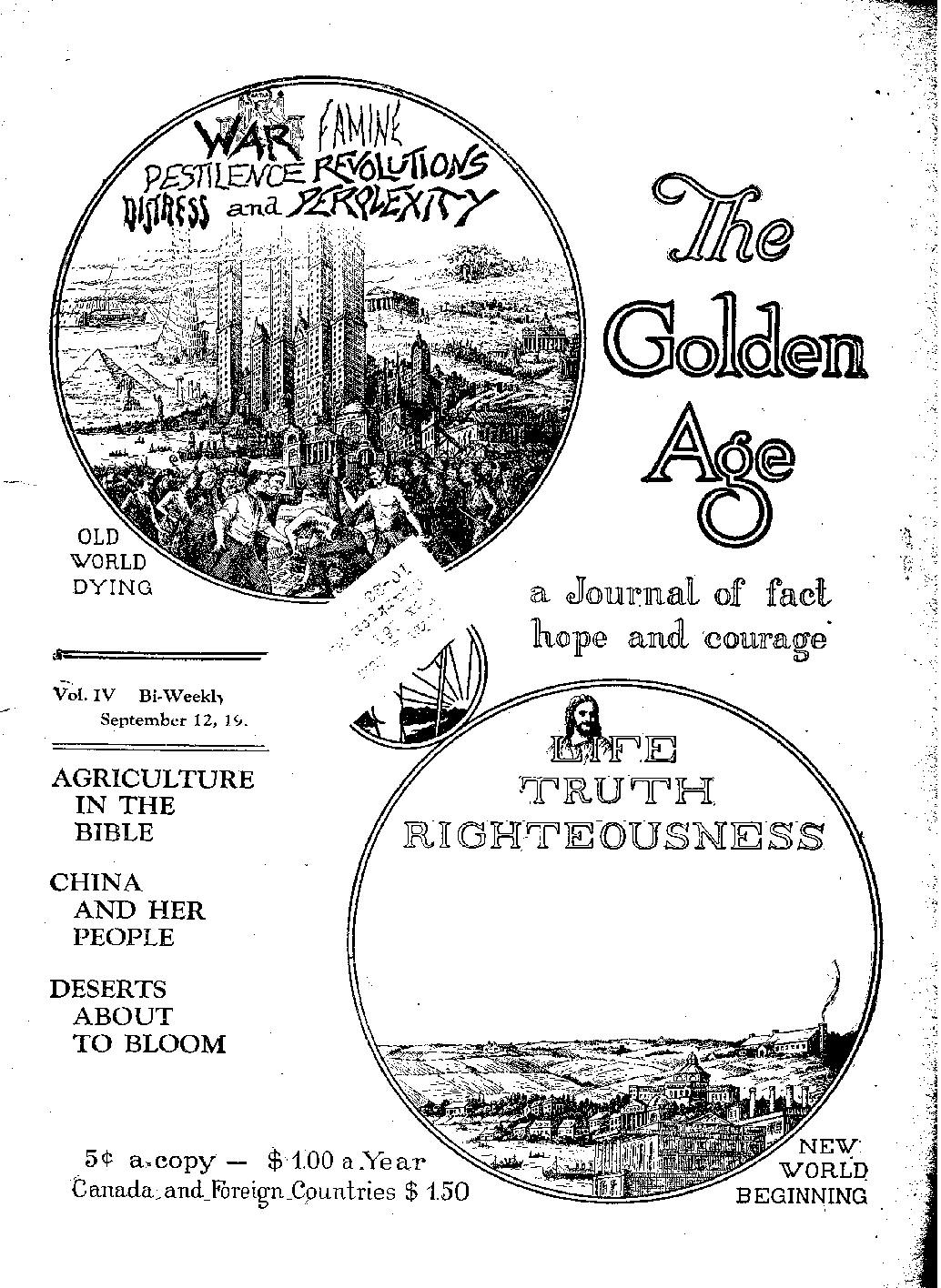
DESERTS ABOUT
TO BLOOM
AGRICULTURE
IN THE
BIBLE
CHINA AND HER PEOPLE
5$ a. copy — $1.00 a.Ye ar
Canada,and Foreign Countries $ 150
OLD VORLD DYING
Vol. IV Bi-Weekl>
September 12, 19.
a Journal of fact
NEV "VORLD BEGINNING
Contents of the Golden Age
Finance—Commerce—Transbortatton
The Eighty Percent Co-Insurance Clause
The Insurance Five Percent
Political—Domestic and Foreign
The Un-American Department of Justice
China and Her People (Part 41
Confucianism Docs Not Med Demands
Buddhism a Grafting Religion ......
Chinese Religion in Comparison
Disregard of Christianily
China Really Awakening
Christian Nations versus Christ
Missionary Efforts Abortive
Chinese Awakening to “Christendom's” Misconduct
Outlook for China’s Welfare
Reports from Foreign Correstom'i- xtn
Krom India .....
Krom Britain
The Anglo-Catholic Coiign-^
From Spain
From Greece
Agriculture and Husbandry
Agriculture in the Bible
Preparing the Fields
Wheat the Staple Crop
The Gardens of Antiquity
Harvesting the Crops
Faying Rent to the Ixird
Religion and Philosophy
A Logical Analysis
Deserts About to Bloom
Why the Deserts Exist
Deserts Already Producing
Why Go to Church ?
The Troubled World (Poem)
.Studies in "The Harp of God”
Published every other Wednesday at 18 Concord Street. Brooklyn, N. Y., U. S. A., by WQODWOBTIL HUDGINGS & MARTIN
Copartners and Proprietors Address: 18 Concord Street, Brooklyn, A’. U.S.A. CLAYTON J. WOODWORTH . . . Editor ROBERT .1- MARTIN . Business Manager <?. E. STEWART .... Assistant Editor WM. F. HUDGINGS . . Sec’y and Treas. Five Cents a Copy—$1.00 a Year Make Remittances to THE GOLDEN AGE Foreign Offices : British.....34 Craven Terrace, Lancaster Gate, London W. 2
Canadian........ 270 Dundas Street W., Toronto, Ontario
AustrataMan....... 495 Collins Street, Melbourne, Australia
South African ...... 6 Lolie Street, Cape Town, South Africa
Entered as second-class matter at Brooklyn, N. Y., under the Act of March 3, 1879
afa Golden Age
Volume IV Brooklyn, N. Y.t Wednesday, September 12, 1923 Number 104
- ■ , . .. — . - - , ,, --- ^^===38
Agriculture in. the Bible
WITH the exception of sea food, everything that we eat comes from the farm. Whether we are clothed in cotton, wool, linen or silk, the fibers of which the garments are made come from the farm. Man was made to participate in and to enjoy agriculture. It was his first occupation. When the Lord had created the first man, He “took the man, and put him into the garden of Eden to dress it and to keep it?’ —Genesis 2:15.
After the expulsion from the Edenic home, agriculture in some form became a matter of life or death. The outcasts were familiar with fire. They know how to roast a lamb, and probably how to ,cook vegetables. We read of the first two boys that were born into the world that “'Abel was a keeper of sheep, but Cain was a tiller of the ground.”—Genesis 4: 2.
After Cain had slain his brother, he was warned that a measure of the blessing which had hitherto attended his efforts would be withdrawn. The Lord said to him: “What hast thou done? The voice of thy brother’s blood crieth unto me from the ground. And now art thou cursed from the earth, which hath opened her mouth to receive thy brother’s blood from thy hand: when thou tillest the ground, it shall not henceforth yield unto thee her strength.” —Genesis 4:10-12.
When Noah and his family emerged from the ark they resumed their former occupations, as a matter of course; and because it was the occupation of his youth, and because there would not be need for any more arks, we read that “Noah began to be an husbandman.” (Genesis 9: 20) He began to cultivate the earth for the benefit of his family, and to husband its crops so that his loved ones would have food in the unproductive months of winter.
The Earth is the Lord’s
HERE is a general impression that the earth belongs to the human family, and that some of them have a more definite title to certain parcels of it than have others; but the Scriptural proposition is that “the earth is the Lord’s.” (Exodus 9: 29) Pharaoh had to learn this fact by a severe experience. Moses expressly told him that the plague of the hail, with the consequent damage to the early crops of flax and barley, was to teach him just that lesson.
The Jews were an agricultural people. They were allowed the use of-the Lord’s land during good behavior and during the Lord’s pleasure; but they were made to know that they could not dispose of it in perpetuity. Thus' their law read: “The land shall not be sold for ever: for the land is mine.”—Leviticus 25: 23.
The Lord declares that the absorption of His land into large estates is contrary to His wishes, and will receive due punishment. The principal offenders in this regard have been the nobility in all ages and the Catholic Church which, in some sections of the world, has at times owned as much as a third of such great countries as France, Poland, and Mexico. The scripture reads: “Woe unto them that join house to house, that lay field to field, till 'there be no place [for others] that they may be placed alone in the midst of the earth!”— Isaiah 5:8.
The thought that the Lord is the owner and the Jews were His people, his tenants, is kept to the fore in the tithing system, in the law requiring the land to rest one year in seven, and in the Jubilee arrangements, concerning which more hereafter. If His people were obedient the Lord gave them bounteous crops. If they were disobedient He undertook to bring them back to Him by disciplinary measures described by the prophet Amos:
Til
“I also have given you cleanness of teeth in all yoin* cities, and want of bread in all your places: yet have ye not returned unto me, saith the Lord. And also I have withholden the rain from you, when there were yet three months to the harvest: and I caused it to rain upon one city, and caused it not to rain upon another city: one piece was rained upon, and the piece .whereupon it rained not withered. So two or three cities wandered unto one city, to drink water; but they were not satisfied: yet have ye not returned unto me, saith the Lord. I have smitten you with blasting and mildew: when your gardens and your vineyards, and your fig trees, and your olive trees increased, the pahnerworm devoured them: yet have ye not returned unto me, saith the Lord?’—Amos 4: 6-9.
In the second verse of the preceding chapter the Lord, by the mouth of the same prophet, informed the Jews that this favorable arrangement was made with no other people, saying, “You only have I known of all the families of the earth: therefore will I punish you for all your iniquities.”
But while the Lord recognizes Himself as the owner and the people as His tenants, yet one tenant must not trespass upon the rights of another. The commandment was: “Thou shalt not remove thy neighbor’s landmark, which they of old time have set in thine inheritance” (Deuteronomy 19:14), and a curse was pronounced upon the one that did so. Yet the prophet Job tells us that there were some in his day who violated this command.
Preparing the Fields
HE fields of ancient times were fertilized by the method in general use to this day.
We know this from the prophecy concerning the wicked queen Jezebel that “the carcase of Jezebel shall be as dung upon the face of the field” (2 Kings 9:37), as well as from Jeremiah’s prophecy that "the carcases of men shall fall as dung upon the open field?’—Jer. 9: 22.
Modern scientific farming has proven that the dunghill is the farmer’s wastebasket, the place where he throws away his profits. The right way, the way that pays, is to transport the manure to a fresh place on the farm each day as it is made, yet the dunghill is a feature of most farms today as it was in days of old. The Lord said of salt that has become tasteless that “it is neither fit for the land nor yet for the dunghill.” (Luke 14: 35) The prophet Isaiah alludes to a practice still in vogue among fanners of our time when he prophesied that “Moab shall be trodden down under him, even as straw is trodden down for the dunghill.”—Isa. 25:10.
The prophets Jeremiah and Hosea each came to the Jews with the message, “Break up your fallow ground.” (Jeremiah 4:3; Hosea 10:12) 'Hosea adds: “For it is time to seek the Lord?’ Fallow ground is that which has lain idle for a year or more and has become hardened, difficult to plow.
The plows of ancient times were not greatly dissimilar from those of today. They had one handle, instead of two, and only two metal parts, the plow point or share and the coulter or sod-cutter. There is a very interesting passage regarding agricultural implements in 1 Samuel 13:19-21:
"Now there was no smith found throughout &U the land of Israel: for the Philistines said, Lest the Hebrews make them, swords or spears: but all the Israelites went down to the Philistines, to sharpen every man his share, and his coulter, and his axe, and his mattock. Yet they had a file for the mattocks, and for the coulters, and for the forks, and for the axes, and to sharpen the [ox] goads.”
The favorite method of plowing in Bible times was with oxen. When the calamities came upon Job, “the oxen were plowing, and the asses feeding beside them.” (Job 1:14) Oxen and asses could not be yoked together to the same plow because so unequal in strength and tread. (Deuteronomy 22:10) Some of the farms were large and had many oxen and many plowmen, or else it was customary for several neighbors to join together in plowing operations; for we read of Elisha that at the time when Elijah cast his mantle upon him he “was plowing with twelve yoke of oxen before him, and he with the twelfth?7—1 Kings 19:19.
The thought that several neighbors joined together in plowing operations is borne out by the query of the Prophet, “Doth the plowman plow all day to sow?” (Isaiah 28:24) It has been found in dry countries that it is best to sow the seed as quickly as possible after plowing, so that the seed may quickly benefit by the moisture which is turned up. Apparently, when working alone, a farmer would need to plow for a time and then sow for a time; otherwise the soil would become too dry to be profitably sown. But by several farmers working together the seed could be sown as the plowing progressed.
Before the seed was sown the soil was pulverized by some method, as we gather from the prophecy that “Judah shall plow, and Jacob shall break his clods?’—Hosea 10:11.
The Jews were forbidden to sow their fields with mingled seed. (Leviticus 19:19) Apparently they could not even plant different varieties of grapes next to one another in the same vineyard. The reason is given. “Thou shalt not sow thy vineyard with divers seeds: lest the fruit of thy seed which thou hast sown, and the fruit of thy vineyard, be defiled.” (Deuteronomy 22: 9) Oxen and asses were used to tread the seed into the ground after it had been sown. —Isaiah 32: 20.
Hay, Straw and Provender
THERE are no hay barns in the East at this frnie. In hot countries the grass withers quickly, and its preservation in the form of hay is not so common as with us. Nevertheless, there are indications that hay was a more or less staple crop. The prophet Amos speaks of “the latter growth after the king's mowings” (Amos 7:1); the Psalmist says of the wicked that “they shall soon be cut down like the grass” (Psalm 37:2), and of the coming of earth’s King that He shall come, not as we once thought, bearing destruction and devastation, but “'shall come down like rain upon the mown grass.” (Psalm 72: 6) One use of hay common in our Lord’s time was the heating of ovens; this was necessary on account of the lack of wood throughout Palestine. This is one of the thoughts back of our Lord’s question and its implied answer: “If God so clothe the grass of the field, which today is, and tomorrow is cast into the' oven, shall he not much more clothe you, 0 ye of little faith?”—Matthew 6:30.
We know that there were straw and provender for the beasts. This provision for their needs is three times referred to. When Eliezer came to Mesopotamia seeking a bride for Isaac, and when Rebecca met him at the well, she invited him to stay at her home, saying, “We have both straw and provender enough, and room to lodge in.” (Genesis 24:25) We have the account also of a Levite traveling from Bethlehemjudah to Mount Ephraim and taking with him straw and provender for his beasts of burden.—-Judges 19:19.
Although the Jews seemed not to have hay barns, yet they had other barns, or storehouses. The prophet Joel, urging Israel to repentance, reminds them that “the garners are laid desolate, the barns are broken down” (Joel 1:17), thus seeming to distinguish between granaries and other farm buildings. The Lord referred to barns several times. He reminded His followers that the fowls of the air “sow not, neither do they reap, nor gather into barns; yet your heavenly Father feedeth them.”—Matthew i 6:26. 1
In the parable of the wheat and the tares, the conclusion of the matter was, “Let both grow together until the harvest: and in the time of harvest I will say to the reapers, Gather ye together first the tares, and bind them in bundles to burn them: but gather the wheat into my barn.”—Matthew 13: 30.
In another of our Lord’s parables He spoke of a certain rich man who thought within himself, “What shall [ do, because I have no room where to bestow my fruits? And he said, This will 1 do: L will pull down my barns, and build greater; and there will I bestow all my fruits and my goods. And I will say to my soul, Soul, z thou hast much goods laid up for many years; take thine ease, eat, drink, and be merry. But God said unto him, Thou fool, this night thy soul shall be required of thee: then whose shall those things be, which thou hast provided? So is he that layeth up treasure for himself, and is not rich toward God.”—Luke 12:17-21.
Wo find the stall of the ox and the ass referred to by the Lord (Luke 13:15), and it was in just such a stall that the Lord himself was born. The inns of Eastern countries have stalls for camels and other livestock in the central courtyard. In these the poorer travelers may unpack their animals and take up their lodging, when either by want of room or want of means they are excluded from the inn itself.
Wheat the Staple Crop
TT1IIE British people use the word “corn” to -L describe all kinds of grains similar to wheat, including wheat itself; and thus the American reader of the Authorized Version of the Bible occasionally gets a wrong thought. Wheat, not corn in the American sense of the term, has been in all ages the staple food of man. Man is composed of seventeen elements. All of these are found in wheat as the Lord makes it, but nine of these elements are missing from white flour, and this explains much of the sickness in the world. The best part of the wheat is generally fed to the livestock.
The seven-eared corn which Pharaoh saw in his dream was a seven-eared wheat which is still raised in Egypt; and even before the Israelites moved out of Mesopotamia we have a reference to the "days of wheat harvest” (Genesis 30:14), showing that from earliest times Mesopotamia was, as it is now, a prolific producer of this standard cereal.
When Moses was describing the good land toward which God was leading Israel he described it in part as “a land of wheat.” (Deuteronomy 8: 8) Not only was wheat raised in large quantities to enable the Israelites at one time to export twenty thousand measures of wheat to Tyre, as occurred in the days of Solomon (2 Chronicles 2:10), but their neighbors raised large quantities of it also, as is shown by the annual payment of tribute by the Ammonites to Israel some four hundred years later, one of the Items of which was ten thousand measures of wheat. (2 Chronicles 27:5) Wheat is still an important product of the country once inhabited by the Ammonites. Job speaks of thistles growing instead of wheat and cockle instead of barley. (Job 31:40) The farmers have always had their troubles.
Barley was raised in about the same quantity as wheat, if we may judge from the scriptures above cited, where, in each instance, there was the same quantity of barley as of wheat. Barley ripened a month earlier than wheat, and as oats are not raised in hot countries barley was the staple food for horses and camels, as we find from the provisions made for Solomon’s stables. (1 Kings 4:28) Barley was a food of the’poor; the five loaves with which the Lord fed the five thousand people were barley loaves. (John 6:9) The bread of the poor was sometimes a mixture of various grains, like the war bread of 1918.
There were six ingredients in Ezekiel’s bread. (Ezekiel 4:9) There were wheat and barley; millet, which is much the same as our sorghum or broom com; fitches, the same as tares, and somewhat similar to our beans or peas; len
tils, another food somewhat similar to peas or beans; and then there were beans themselves, Fitches are black in color, aromatic in flavor,, and are used in the East as a medicine and condiment. '
The Gardens of Antiquity
EBY evidently there were garden plots in Palestine as early as the days of Jacob;
for we find him sending down into Egypt a present for the Egyptian ruler containing balm, honey, spices, myrrh, nuts and almonds, all choice and useful garden products that would keep through the winter.—-Genesis 43:11. . Most certainly there were gardens in Egypt; for when wandering through the wilderness, Israel bemoaned the loss of the cucumbers, melons, leeks, onions and garlic,’ which they had had there in such abundance, and which still grow there, large in size and excellent in ' quality.—Numbers 11: 5.
One of the tragedies of the bloody history of the ten-tribe nation of Israel was King Ahab’s i desire for a garden of herbs. He desired Naboth's vineyard, not for vineyard purposes but < because it was near by the royal palace and would make an ideal vegetable garden. Bead the whole interesting story in 1 Kings 21:1-24 ’■ and the sequel in. 1 Kings 22:30-38; 2 Kings I 9:30-37; 10:1-11. N
Isaiah’s mention of “a lodge in a garden of “ cucumbers” (Isaiah 1:8) is a reference to an > ancient custom of protecting growing crops -from night marauders by the gardener’s sleeping upon the premises. Cummin, mentioned by J the same prophet (Isaiah 28:27), is somewhat I similar to peas or beans. • ;
While Israel were in captivity during the J seventy years desolation of the land they were to “plant gardens and eat the fruit of them” (Jeremiah 29: 5): and after the long period of captivity should bo over, their children were ? promised that in the old homeland they should again “make gardens and eat the fruit of them.” —Amos 9:14. -
Vineyards in the Hills
HE earliest vineyard of history is that planted by Noah. (Genesis 9:20) There were doubtless vineyards in Egypt; for Pharaoh had his butler who “took the grapes and . : pressed them into Pharaoh’s cup.” (Genesis 40:11) There are grapes in California the bunches of which are not less than two feet in length, but even these bunches were surpassed in size by the grapes brought back from Eschol by the twelve spies. In the latter instance it required two men to comfortably carry one cluster. (Numbers 13:23) Travelers report vines in Palestine eighteen inches in diameter at the base.
Much of the tillable land of Palestine which could not be used for other purposes was used for vineyards. Hence we read of the mountains dropping sweet wine (Amos .9:13), and of the planting of vines on the mountains of Samaria. (Jeremiah 31:5) In a parable the prophet Isaiah sets forth the routine regarding the planting and care of a vineyard:
“My well beloved hath a vineyard in a very fruitful hill: and he made a wall about it, and gathered out the stones thereof, and planted it with tho choicest vine, and built a tower in the midst of it, and also made a winepress therein.”—Tsaiah 5:1, 2.
Probably with this parable in mind Jesus uttered another parable quite similar in language :
‘"‘There was a certain householder, which planted a vineyard, and hedged it round about, and digged a winepress in it, and built a tower, and let it out to husbandmen.”—Matthew 21: 33.
The hedges or walls were to keep out the wild boars and foxes, as we see from the remarks in Psalm 80:13 and Canticles 2:15. If vineyards were adjacent to each other there was evidently a separate wall or hedge entirely about each, with a space between for a path. It was in such a place, so narrow between the two walls that there was no way to turn either to the right hand or to the left, that the angel of the Lord met Balaam when he was on his way to curse Israel at the request of Balak, king of Moab. (Numbers 22: 24-27) The towers enabled the keepers to watch over the vines at night. Vineyards not looked after soon grew up to thorns and nettles. (Proverbs 24: 30, 31) It was not unusual for a vineyard to be let out to keepers who worked it for the owner on shares.—Canticles 8:11; 1 Kings 21:2; Matthew 21:34.
Palestine has always been famous for its olives, from the time of Moses even until now. Pomegranates and figs were also raised on a large scale. (Deuteronomy 8:8) The Jews of St. PauFs day understood grafting, as is plain from his parable of the wild olive branches grafted into the good olive tree. (Romans 11: 17) The method of tree culture adopted in our Lord's time, and still in use in Palestine, is ta dig about the tree and bury humus in the holes. (Luke 13:8) Solomon exported 20,000 baths of oil to Tyre with a like quantity of wine.— 2 Chronicles 2:10.
Harvesting the Crops
THH Mosaic law regarding ripened crops plainly shows the divine authorship. These laws would be considered a marvel of benevolence if in force today. They have been superseded by a system of caring for the poor through taxation; but there is a serious question whether the Mosaic method was not better after all, as it brought the benefactor into more intimate personal touch with the needy. We quote several of the laws:
“When thou comest into thy neighbor’s vineyard, then thou mayest eat grapes thy fill at thine own pleasure; but thou shalt not put any in thy vessel. When thou comest into the standing com [wheat] of thy neighbor, then thou mayest pluck the ears with thy hand: but thou shalt not move a sickle unto thy neighbor's standing corn.”—Deuteronomy 23: 24, 25.
“And when ye reap the harvest of your land, thou shalt not wholly reap the corners of thy field, Neither shalt thou gather the gleanings of thy harvest. -And thou shalt not glean thy vineyard, neither shalt thou gather every grape of thy vineyard; thou shalt leave them for the poor and stranger.”—Leviticus 19:9,10.
“When thou cuttest down thine harvest in thy field, and hast forgot a sheaf in the field, thou shalt not go again to fetch it: it shall be for the stranger, for the fatherless, and for the widow; that the Lord thy God may bless thee in all the work of thine hands. When thou boatest thine olive tree, thou shalt not go over the boughs again: it shall be for the stranger, for the fatherless, and for the widow. When thou gatherest the grapes of thy vineyard, thou shalt not glean it afterward : it shall be for the stranger, for the fatherless and for the widow'.”—Deuteronomy 24:19-21. |
How these laws worked out in practice we can see from the experiences of Ruth, the widow of Mahlon. When she came into the field of Boaz to* glean behind the reapers, “Boaz commanded his young men, saying, Let her glean even among the sheaves, and reproach her not: and let fall also some of the handfuls of purpose for her, and leave them, that she may glean them, and rebuke her not/'—Ruth 2:15,16.
Job makes his complaint of the wicked man who disregarded these benevolent laws and who instead of assisting such a needy one would * “take away the sheaf from the hungry” (Job 24:10); i. e.} would not allow him to retain the sheaf which he might have gleaned from the harvested field.
That the letting fall of handfuls of grain for the benefit of the poor was a custom widely observed in Israel we may judge from Jeremiah's reference to it where he says: “The carcases of men shall fall as dung upon the open field, and as the handful after the harvestman, and none shall gather them.”—-Jer. 9:22.
We know from the foregoing that the instrument of harvest was the sickle, and that the harvested grain was bound in sheaves. In Joseph’s dream he saw himself and his brothers binding sheaves in the field; his own sheaf arose and stood upright and the eleven sheaves of his brothers made obeisance to his sheaf. (Genesis 37:7) The sheaves were carried to the threshing floor in a cart; for the prophet Amos speaks of the way in which “a cart is pressed that is full of sheaves.” (Amos 2:13) Apparently the stalks were cut but a short distance below the head; for the prophet Job speaks of the wicked as being “cut off as the tops of the ears of corn [wheat].”—Job 24:24.
Our Lord makes several references to the fact that in Mis days it was customary for the husbandman to employ reapers and to pay them wages. When Boaz came into his field his greeting to his reapers was: “The Lord be with you”; and their reply to him was: “The Lord bless thee.” ("Ruth 2:4) We can but ’wonder in how many harvest fields in this “Christian” land such greetings are common between farm owners and farm laborers.
Threshing, Winnowing and Sifting
THE threshingplace of Araunah the Jcbus-ite,” referred to in 2 Samuel 24:16 and described as a “threshingfloor” in the eighteenth verse of the same chapter, was a level place which had become quite, hard through constant use for threshing purposes. Sometimes this word is translated “barn” in our common version, but it was not a covered place nor a structure in any sense. Various means were used on the threshing-floor for loosening the grain from the stalk. There was the ox that was not to be muzzled when engaged in this task (Deuteronomy 25:4); there was the “heifer that is taught, and loveth to tread out the corn [wheat]” (Hosea 10:11); and Isaiah mentioned three threshing devices in one verse. ” The verse reads: “The fitches are not threshed with a threshing instrument, neither is a cart . wheel turned about upon the cummin; but the fitches are beaten out with a staff, and the cummin with a rod.”—Isaiah 28: 27.
On the threshing-floor of Araunah (Ornan) there were threshing instruments of wood. (1 Chronicles 21:23) Isaiah speaks of a new sharp threshing instrument having teeth (Isaiah 41: 15), and Amos speaks of threshing instruments of iron. (Amos 1:3) We have no knowledge of how these were made. >
Today the modern thresher does all the work of threshing, winnowing, sifting and bagging the wheat, as well as stacking the straw; but there are men now living who can remember when the threshing was done with a wooden flail, still found in some barns. The winnowing was done with a fanning mill turned by hand, and the sifting was done by hand.
The farmer of Bible times did his winnowing only when there was a wind strong enough to blow away the chaff as he tossed his grain into the air; or else he created the air current with a fan. Job speaks of the “stubble before the wind” and the “chaff that the storm carrieth away.” (Job 21:18) The Psalmist speaks of the “chaff before the wind” (Psalm 35:5) Jeremiah speaks of a dry wind from the wilderness that would be “not to fan, nor to cleanse” (Jeremiah 4:11) because not sufficiently strong for the purpose. The wind sufficient for winnowing ' purposes came up generally in the evening; hence the statement respecting Boaz that “he winnowoth barley tonight in the threshing-floor.”—Ruth 3:2.
Isaiah speaks of “clean provender, which' hath been winnowed with the shovel and with the fan” (Isaiah 30: 24); and John the Baptist speaking of our Lord as the harvester of the Jewish age, said of him that his “fan is in his hand, and he will thoroughly purge his floor, and gather his wheat into the garner; but he will bum up the chaff with unquenchable fire.” (Matthew 3:12) We have the picture here of the use of a fan instead of a natural wind, -■> Probably one worker tossed the grain lightly in his shovel while another wielded the fan. The last operation was the sifting through a sieve mentioned by the Prophet.—-Amos 9: 9.
The farmers of olden time did not take any chances with their crops. Although it is stated of Boaz that he was a wealthy man, yet while his winnowing of barley was under way he took the precaution, to sleep on the threshing-floor at the end of the heap of barley that had been winnowed.—Ruth 3: 7.
Paying Rent to the Lord
NOT because it would be of any benefit to Him but because it would be of incalculable benefit to them the Lord impressed upon the Jews that He was the real owner of the land and that they were His people, His tenants, working with Him and for Him, despite the fact that most of the produce went to the people themselves.
The first sheaf of the harvest, the firstfruits as it was called, was to be presented to the Lord before the people themselves could participate in the new harvest at all. This “sheaf of the firstfruits” (Leviticus 23:10) represented the Lord Jesus at the time of His resurrection, when He became the firstfruits of them that slept.
After the ingathering of the firstfruits the Jews were to wait fifty days, when two wave loaves of fine flour baked with leaven were to be offered as additional firstfruits to the Lord.
These two loaves, the prospective “little flock” and “great company,” were set apart to the Lord fifty days after His resurrection, on the Day of Pentecost. 'There they became a kind of firstfruits, the leavened kind, leaven representing imperfection.
Once every three years the Jews were to give a tenth of all their crops to the Lord. (Deuteronomy 14:28) This giving of one-thirtieth of their incomes to the Lord was a small burden for them to bear, and made but reasonable provision for the Levites who, nominally onetwelfth of the people, had no inheritance in the land.
The Lord was the most benevolent of employers. Three times in the year, at times that would not interfere with the planting or harvesting of crops, every male was compelled to take a vacation of one week and participate in a feast; many of the women attended these feasts also, which were held at Jerusalem. After six years of work there was a vacation of an entire year, the Lord covenanting that in the sixth year the land should bring forth double crops. And once in fifty years there was a vacation of two successive years, one of them styled the Jubilee year, when every man returned to his fathers original possessions. When this period came around the Lord covenanted that in this particular “sixth year” the land should bring forth crops for three years. ■—Leviticus 2a : 21.
The Un-American Department of Justice
THE Department of Justice comes in for some well-deserved criticisms in a speech delivered in the House of Representatives by Hon. George Huddleston of Alabama. We give extracts from it because Air. Huddleston is one of the few lingering survivors of true Americanism, the kind that believes in freedom of speech and resents bitterly the domination of this government by the Wall Street anarchists who are trying to destroy every vestige of liberty in this land.
“It seems to me that those who believe it is right for men to be put into jail for expressing their opinions need to go back and read the first amendment to the Constitution, before they begin to pose as super-Americans and patriots. This is a time of peace. Men ought not now be in jail merely because they did not agree with the majority during the war.
“Some of the superpatriots of this country, some of the ‘unco guidd were themselves guilty of excesses during the war. There were many of them who took occasion to rob our Government and profiteer on our people during that time of distress. Let us prosecute them and put them into the penitentiary, and not confina ourselves me rely to prosecuting men who did not happen to think we had sufficient cause to go to war or that we ought not to have passed certain harsh and oppressive laws in connection with carrying on the war.
“No, Mr. Speaker, the very ones who are most bitter and vituperative against those who expressed their opinions of dissent from the majority are the chiefest defenders of the Attorney General who has failed to prosecute the grafting war contractors.
“Here are about sixty cases of men who are still in prison, not for spying, not for disloyalty, not fox- aiding the enemy, but for expressing opinions against war or conscription or otherwise dissenting from the majority. ... As a citizen who loves the fair name of his country I demand that their prison doors be opened. It cannot be said that they took any active part against our Gov-
eminent, that they did anything more than simply to say something which tended to obstruct conscription or to question the motives or conduct of some of those in authority.
“I like to think of America as a land of free men— of liberty of conscience and opinion. I would rescue her from the stigma of holding men in prison four long years after the war merely for the utterance of a few ill-considered words.
“It is also a fact that of all the nations of the world the United States is the only nation which yet holds in prison offenders convicted under the war laws. I know
of no better name for these persons than ‘political prisoners/ because that is exactly what they are. Their offenses were not against persons but directly against the Government by opposing measures relating to carry
ing on the war.
“I am impelled to discuss this subject because of the feeling that the situation is a disgrace to our country. I feel that it is a situation which demands the attention of Congress. I am disturbed by the thought that wc have too long been silent and that perhaps I myself have failed in my duty in not before demanding here upon this floor that these prisoners be released. . . . Whenever pardon for them is mentioned the department [of Justice] emits a smoke screen and attempts to divert attention from the true issue by reckless statements that the prisoners are ‘anarchists/ ‘communists/ or even murderers. It has tried to excuse itself with contemptible evasion and by blackening the names of these men by making unproven charges, by the use of epithets, and I would almost say making lying statements in regard to them. Once you mention the case of one of these men, back comes the propaganda that he is an 'anarchist/ an T. W. W./ a ‘communist/ or some other kind of political or economic heretic. Never will they deal with the facts of the particular offense for which he was convicted or with the proof as appears from the record of the trial of the case.
“The sinister effort to prejudice the public against these prisoners by making charges against them which have no connection with the offenses for which they were convicted is inspired by the consciousness of the slender basis for their conviction. In no case were they tried for disloyal or violent deeds. Always it was for the use of ‘words/ and in some cases the construction placed upon their words was so strained as to pass into 5S the realm of the ridiculous. Men were convicted of" conspiring with each other who were rank strangers,, had never met, and had never communicated; and when J the proven overt act consummating the conspiracy con- Jg sisted merely of spoken or written words.
“Necessarily, as in the case of all laws aimed at free speech, the espionage act convicted men for the intent ' $
or purpose with which they spoke, and in actuality they were tried before the bar of public opinion represented by juries. In such cases jurors, of course, * carry into the box the prejudices of the outside world . | and are left free to vent the feelings of the majority upon the dissenter. When public feeling is intense and practically unanimous, as in time of war, there is a demand that examples be made of any who may have been conspicuous in dissenting. Conviction is demanded whether there be actual guilt or not, and men are convicted upon their reputations and what others may £ believe about them. In such cases a trial is more or y,
less a farce. It is a sort of legalized mob action. The' y rich, influential, and ably defended, of course, go The weak, the undefended, and the friendless are convicted, of course. To be an alien radical or labor
agitator is to go to jail.
“The fact should be frankly and boldly recognized \ that certain influential groups in this country do not sincerely believe in free speech or other constitutional guaranties. As the beneficiaries of abuses of our system, these groups hold to valuable privileges, monopolies and the control of great aggregated wealth. They fear the exposure of their practices and the correction of the evils by which they have profited. Dominating to a large extent the channels of public information, twisting and coloring the news which the people receive, their security lies in the suppression of criticism. They identify themselves as the Government, because they are often permitted to control its activities. Then there are the militarists and imperialists, with their thoughts of unpopular future wars for which conscription will be necessary.
“Without any particular regard for the guilt of our political prisoners, these dominating groups would hold them in prison for its effect upon all who might desire to expose their practices, to thwart their aims, or to * question their right to dominate. It is out of deference * to these groups that the Department of Justice holds these men in prison. The department bows to the will of the masters of the present administration. Of all the vices which officials may have, hypocrisy is the^most --3 contemptible—the exercise of discretion for one feet of reasons while pretending to do so for other reasonsL This charge I lay at the door of the department.” J
“Less pleasure take brave minds in battle won Than in restoring such as are undone;
Tigers have courage and the rugged bear, , • - '■
But man alone can, whom he conquers, spare.**
China and Her People—In Four Parts (Part Four)
THE religion of the Chinese is quite complex and variegated. To them their religion is as good as any, and yet not altogether satisfactory. We presume that the different brands cause perplexity among them, as the multitudinous brands of ‘'Christianity' cause anxiety among denominational adherents.
Their religion consists principally of moral ethics handed down from Confucius, who lived in the sixth century B. C.; also of ancestral worship. The religions of China are tainted with Buddhism. The Chinese in religion are divided as follows:
Confucianism, an ethical system founded by Confucius (Kong-Fu-Tse) about 550 B. C. uFu-Tse” means ‘‘reverend doctor.'' This may be termed a “state’5 religion. It is a plain ethical code of morals of practical character and entirely human, not spiritual.
Taoism, another ethical religion, founded by Lao-tsze about the same time. Originally it was a pure philosophy, but later copied the Buddha ceremonial. Here the deities are worshiped, and the high priest is “Master of heaven/’ It holds tliat there is a life in some form after death.
Buddhism, a demon religion of superstition including the warding off and appeasing of evil spirits. It does not recognize any supreme being; anyone may be a priest. Buddha means “teacher.” It holds the doctrine of transmigration of souls, which means that a soul may be born over and over again through the process of birth, sin, suffering, and death until the evolutionary process is completed, when it is believed that the state of perfection is reached. It forbids to kill, to lie, to steal, to commit adultery, and to fall into drunkenness. The virtues striven for are charity, purity, patience, courage, and knowledge. It is a mild code of morals, abhorrent of cruelty. It is preposterous to imagine the images of Confucius and Buddha to be in the same shrine for worship.
Mohammedanism, a belief in one God only; that Mohammed is His prophet, superior to Christ; that the Koran is superior to all Bibles; that angels are ministering spirits; that there is to be a resurrection and judgment day; and that there is a form of predestination. As the Arabs are related to the Israelites, so their religion has many points in common with that of the Hebrews. As the Hebrews are looking for the coming of their Messiah, so the Mohammedans are looking for the coming of a greater prophet than Mohammed, whom they call Mahdi. There are about 10,000,000 Mohammedan Chinese, the greater part of whom live in the inland provinces of the West; and these are clearly marked off from other Chinese because they view their brethren of the Confucian faith with more or less disdain, for they have perverted the original form. In some localities where they are the strongest they are clamoring for a Mohammedan governor. The believers in Islam are becoming strong in North China. Sometimes there are serious uprisings among the Mohammedans of China, but these are not because of religious conflicts. About 300,000 Mohammedans met death in the province of Kansu in 1921, when a great earthquake shook all China.
Christianity was introduced by theNestorians. The Nestorians were a schism in the early church, and held to many things in common with true Christianity, and in many respects were purer in their doctrines than denominH.-tionalism of today. The Jesuits invaded China and, by subterfuge and loud swelling words aided by the devil, overcame the Nestorian Christianity and finally smothered it out. The Roman Catholics claim to have about 1,000,000 adherents among the Chinese, while the numerous Protestant sects claim for their following about 60,000. There is a “Chinese Mission So--ciety” in St. Colmnbans, Nebraska, which offers free scholarships to those who wish to become “Missionary Priests in China.” When later you read with astonishment that the Chinese are revolting against missionary efforts turn back to this paragraph and read it again.
The Mongolians are at a very much lower level than the Chinese, being largely nomads and sunk in superstition. The Tibetans are more fanatical than the Mongolians; hence their worship of Buddha is more grotesque and gloomy than that of Confucius. Buddhism is really foreign to the Chinese civilization.
Confucianism Does Not Meet Demands
LL religions are negative except the true Christian religion. The Confucian version of the Golden Rule is, “Do not,to others what you would not have them do to you.” Confucius was far ahead of the great Pagan philosophers in wisdom. For instance, Socrates said: “Do not call me wise. I am not a wise man; I am only a searcher after wisdom." But Confucius many years before had said: “Be not selfdeceived in wisdom; look further." Confucius was a practical man, a teacher of ethics which were concise and pointed; and he thought that by self-conscious direction one could arrive at proper action. Confucian ethics were exclusively social, the primary purpose of which was to establish order and harmony at home and elsewhere.
The education of the Chinese begins with the study of the “Four Classical Books" which contain the moral teaching of Confucius. These precepts embalm the essential principles of the Chinese civilization as it existed more than twenty centuries ago; and it has established ethical standards so perfectly meeting the wants of the Chinese people that they have until recently been considered final. The manuals of Confucius were the only books that escaped the universal destruction of literature ordered by the Emperor Hwang-ti about 221 B. C. Consequently, his writings have become practically the sole repository of China’s ancient wisdom, an oracle handed down from the venerable past.
Confucius said to his sovereign: ‘Tou are the head of a nation; you have a mission to fulfil; if you are not faithful to that mission, ‘resign, for you must be replaced by one better qualified.” He also said: “A sovereign should not reign except for the welfare of his j^eople. On the other hand, the people should obey their sovereign and regard him as their father and mother. Why should there be wars? ... A wise government will draw these nations willingly within the boundaries of your empire. Govern well and you will see the whole world eager to place itself under the protection of your just and beneficent rule. Burdensome taxes and bad laws are more cruel than tigers.”
He bade the members of each family to love one another: “Your parents have given you life. They have toiled and sacrificed to bring you up. You must aid them in their old age.”
Confucianism no longer meets the demands of the Chinese. When about ten years ago the empire crumbled and collapsed, the seriousness of China’s problem of political equilibrium
_____ LS
revealed itself by the chronic anarchy which since has ensued. With each province a feudal principality, and many of these seeking the mastery, the people naturally do not look to $ Confucianism as their salvation.
Buddhism a Grafting Religion
UDDIIA was born in India five or six hun- < dred years before Christ, but his fame did ;
not reach China until after Gethsemane; for it ■■■■ was about sixty-five years after Christ that a Chinese emperor had a dream which caused
him to send to India for priests of the new
religion he had heard of. A few years later,
Buddhist priests appeared on the scene palm-
ing themselves off as the priests of the most
high God, and started their propaganda. Some
insist that the emperor had heard the story of Christ, and that it was really His doctrines which he -wanted brought into China.
If St. Paul had gone east, as he intended , doing, and had preached the truth in China, China might have been the “civilizer” of the world. Had an apostasy started in that early Chinese church and had its Christianity become ;
corrupted and divided into warring factions J
dominated by Satan, as is the case in the West today, this same Satanic military spirit would have possessed China; and today Britain, France, Germany and America having re- 3 mained heathen, we might even now be arous- A ing from our age-long slumber “Christianized” with the same brand which is now being forced -upon China. But the Lord spared China the “holy” wars and bloodshed of the “dark ages” by giving St. Paul a dream in which he heard the call, “'Come over into Macedonia and help < us”; and the Gospel went west instead of east.
In the apostles’ day the Gospel was pure and wholesome; but the devil got the leaven of error into the food in an early day and had it ■. pretty well corrupted by 325 A. D., when Constantine, the devil’s agent, gave the perverted ? “gospel” a boost. We are glad that we are liv- . ing now in a time when true light is shining forth and when error, superstition and priest- S craft are giving way to saner reasoning. The > distress and uncertainty in the world is the strongest evidence that the old order is passing. A
In one respect at least the Buddhist priests : resemble the pious beggars of America: They beg, ask alms, seek for bounty, and hornswog-gle those who put their trust in them.
In a number of places in China are palaces, temples, and other architecture quite ancient; in Sianfu there are tablets dating back to the Han dynasty—B. C. 206-A. D. 220.
The oldest record of the Christian church in China is said to be the Nestorian Stone, which describes the earliest mission, 635 A. D. It is said to be about thirty inches wide by one hundred twenty inches in length. It was discovered under an old wall in Sian by a Jesuit priest in 1625, and a temple was built over it. The Mohammedans destroyed the temple in 1862, but spared the tablet because of the cross at the top of the Syriac inscriptions. It is now preserved in a Confucian temple. Perhaps we give more reverence to some of these old tablets than we should. The Lord is about to uncover the hidden treasures of the brilliant minds of the past by bringing them back from the dead; and instead of their writings we shall have their voices, their hearty handshakes, and their throbbing hearts among the children of men. Many men will be ashamed of fheir tombstones in the resurrection, because of the false impressions left of their goodness. But the worst of men have been loved; they have had mothers and wives and sweethearts and confidants. What a happy day that wall be when all the dead shall have been raised from the grave and given a heart and mind to know God, with the privilege of coming into harmony with Him! This will be not only for the White race, but for the Yellow, the Black, the Brown, the Red.
Chinese Religion in Comparison
HE Chinese are proud of their religions and of their moral ethics. To be sure, they recognize that something is wrong, just as pseudoChristians wonder what is the matter with their religion; but they contend that any attempt to “Christianize” China is in vain so long as Christianity is not presented to them in a form which will bear the closest scrutiny.
The West cannot fool the East in this respect; for the East knows that the West is not living up to its Book. For thirty years they have known this! The Chinese fail to see where a religion having a hypocritical profession is better than their own, and -wonder what the reward will be if they allow their millions to be tossed about in the turmoil of hundreds of conflicting creeds. They think that it wTould be -■wise for “Christians” to refashion their attitude, purify their convictions, and get back to the Bible. ‘
Christianity is not wholly a White man’s re- 4 ligion. When this is understood, the labels will come off, and Christianity wTill come under the . pure food laws of the kingdom of the Lord ' Jesus Christ. Jesus Christ by the grace of God tasted death for every man, a ransom for all; but it was never His purpose to save any except the few self-sacrificing saints until the time of His second presence. When Christ sets up His Messianic kingdom in the world, the Chinese will bo well taken care of without the aid of ■ missionaries. The Chinese are wise enough to see that the so-called Christian does not believe J his own Book. -
Chinese opposition to churchianity is to be expected; for the “church” cannot meet the de- ‘ niands of the Chinese. The false creeds have i rendered denominationalism unchangeable, in- * flexible. St. Paul said that he was all things to all men to win them to Christ. True Christian- 1 ity can enter into the Chinese life; the only <
thing necessary is the right seed falling into the soil of the heart; it will sprout and grow .in any ' heart, but it must be the virile seed of the love ■ of God. Churchianity, pompously posing as Christian, is looked upon by the Chinese as a '
foreign institution; and the people of the -
United States and elsewhere would do well to ■ copy the heathen Chinese in this respect.
The Chinese say that the foreign business men (called Christians) -whose gain comes from > the sale of liquor, tobacco, and opium, feel very kindly toward most “Christian” work in China; for it is the means used to keep her people in -ignorance and poverty. However, those whose - -profit comes from the exploitation of cheap . labor in China see little benefit to the Chinese in the educational and uplifting work the missionaries are supposed to do; for the more : ignorant and debased man is, the more easy it is to exploit him. '
Of course, there are a few noble-souled missionaries whose work results in a higher stand- T-ard of living. These are conscientious; and though misguided doctrinally they are doing their best to bring happiness and purity to the • J people who have not embraced Christianity.
We believe that there are true Christians in China as in other countries. Some believe in the virgin birth of Jesus, the atonement of Christ, the inspiration of the Scriptures, and that Jehovah is over all. These have fought the attacks of the evolutionist; for believing the Bible their hearts have been changed by the message of “Jesus Christ and him crucified.'’ These Chinese Christians can themselves claim the honors in this battle for truth and righteousness. Their opponents, the introducers of higher criticism and evolution into China, have been the modernists amongst the missionary forces. Shame on the hypocrites who profess to love God and who teach Christianity and seek soft snaps in the missionary field when they know that their hearts have never been touched with the grace of the goodness of God 1
China’s Insane and Their Care
THERE are three important items emphasized in Christianizing the Chinese, according to the opinions of some: They should give up their idols, unbind their feet, and quit working on Sundays. When Americans quit worshiping their idols of gold and silver and stop desecrating Sunday in thousands of ways, we may expect the Chinese to take kindly to our civilization; for they are good imitators.
But civilization has its drawbacks. Insanity is constantly on the increase; tens of thousands of insane are in our state institutions; all hospitals are full and some even crowded. New York State has 40,000 confined in asylums, which is 6,000 more than they were built to accommodate. In all China’s 400,000,000 population there is but one hospital for the insane. Only the more violently insane are confined; the harmlessly insane are allowed freedom. Sometimes a family will chain their violently insane to a post. One woman is said to have been so chained for twelve years. The one hospital has but 600 inmates. One reason why the few insane of China are not better taken care of is that the Chinese believe that an insane person is obsessed of the devil and therefore incurable. Practically none are insane from alcoholic liquors; some women are insane from jealousy; and some from ill-treatment in the home.
Quietness and peace seem to be conducive to sanity. What a wonderful world this would be if all friction and unnecessary noises could be dispensed with and peace and happiness fill the. hearts of all! Tins is the very condition which 2 shall obtain under the beneficent reign of the Prince of Peace in the kingdom of God on earth.
Disregard of Christianity ,
LET no church-enshrouded enthusiast of the
Christian community beguile himself into ■> the belief that the heathen or the Mohammedan r is consciously thirsting for the Gospel. How could he when he sees the drinking, gambling, profanity, vulgarity, and immorality of the <. White races ? When these things are witnessed , the only logical conclusion he could have is that it represents the average of Christianity; so he draws his odious comparisons, and lives t on in the belief that his own religion is as good and probably better than that of others. "What an evil influence has been cast over the nations " by labeling any nation “Christian” and claiming . -that every individual of that nation is a Chris- * tian. The idea that one to be saved must neces- . sarily be a “church” member has done the damage. The bars of decency have been let down * to save the world; and look at us! What a great revelation there will be when the Lord ? separates the sheep from the goats!
That “Christianity” has gained some foot- <
hold is not denied; but not being reasoned out ;
and accepted intelligently its hold is attributed /s to the operation, of forces from without. Missionaries go prepared to teach the sciences, ~ political economy, mechanics, hygiene, medi- ; cine, etc.; but before they allow any to escape ; they compel the pupil to imbibe their concep- * tions of the Christian faith, and count them 1 converts.
One holiday season a traveler saw a vast J; crowd going around shouting with laughter, with comic spirit. In the largest, gayest, and most crowded temple, in the inmost court, he found the Salvation Army singing hymns to a . brass band and preaching through an interpreter, assuring the holiday crowd that its amusements were idolatrous and must infalli- -bly bring them eternal damnation! The crowd * enjoyed this immensely, laughed vociferously, ’ and applauded with good humor. The traveler did not think that the Chinese thought the Sal- . vationists were in earnest; for if they had, the ,.' good manners which are never deficient in any class of China would have demanded a different program. When the Salvation Army awaken to the truth of God’s Word, and see that they were blaspheming the God of love and doing their best to spoil the merriment of those innocent people in their own building, how ashamed they will surely be! The traveler adds: “I alone was left somewhat pensive, reflecting upon the benefits of the civilization we are bringing to the poor, benighted heathen.”
Better by far let them alone.
China’s peril is churchianity. A very sharp distinction should be made between Christianity and that which passes for'it. Christianity is a name which should apply only to the moral and spiritual ethics, principles and doctrines of Jesus Christ. A person who goes to church in order to have his neighbors think well of him is not a Christian; he is a churchman, he belongs to “churchianity.” A person who has heard of Christ, and who believes that such a man existed and that he was the best man who ever lived upon the earth, is not a Christian; for an infidel could and should do as much. Then, when prominent Chinese point out that Christianity menaces them, it is not the true to which they refer, but that which passes for it—a rank and blasphemous counterfeit.
Lowe Chuan-hwa, writing in The Nation of February 7, 1923, brings a terrible indictment against what he calls Christianity, and against the practices of the missionaries. He starts his arraignment by calling attention to the fact that millions in money and armies of missionaries are employed to proselytize the Orientals while in the “Christian” nations of America "and Europe unbelief is rapidly spreading, and those who pass for Christians are descending into Mammon-serving, pleasure-loving, immoral people. Such a “Christianity” that is morally ineffective, and philosophically unsound, cannot hope to find a permanent home in China.
China Really Awakening
HERE is no question but that the multiplicity of labor-saving machinery is playing its part in the awakening of drowsy China. Another factor is the friendliness of the United States government, which has made China wonder as she has beheld the marvelous things that have found their way from here. 2\merica, outwardly at least, has befriended China at peace conferences, and otherwise has undertaken to have China treated fairly. If some portions of the world have shown aip inclination to eat China blood raw, it has been impressed upon her that one section of the White race will not desert her. Young China has been educated principally in America; and under the influence of our civilization they have carried these ideals and customs to their homeland, and with it the desire for a better means of written communication. They are using a written language which can be translated more easily so that some of the educational books here can be printed for the benefit of the Chinese, and these . books are being printed in the simpler alphabet which the younger generation is helping to spread. As a result the little old red schoolhouse will have an inning in China. ’
With numbers of English-speaking peoples going to China to help gather in the golden grain of exploitation it becomes necessary to “educate” the Chinese to speak the language of the foreigner, and it has become the fashion for the Chinese to have a missionary training before he is considered able to deal with the Westerner. Those who can speak English are in demand at the post offices, stores, railroads, hospitals, churches, custom-houses, etc., all of which are under foreign supervision; and th© missionaries teach just exactly what the foreign business man wants them to teach. Th© business end of the training is looked after first; then if there is any time to spare, a little false Christianity is injected into the heathen, The majority of converts have become nominal Christians as a means to secure foreign money and support. In times of famine it is an easy matter to make Chinese converts with the rice bowl. The feeling of their own superiority entertained by many missionaries has always been a barrier against friendly understanding.
…