Golden Age, August 29, 1923
Download: PDF — Golden Age, August 29, 1923
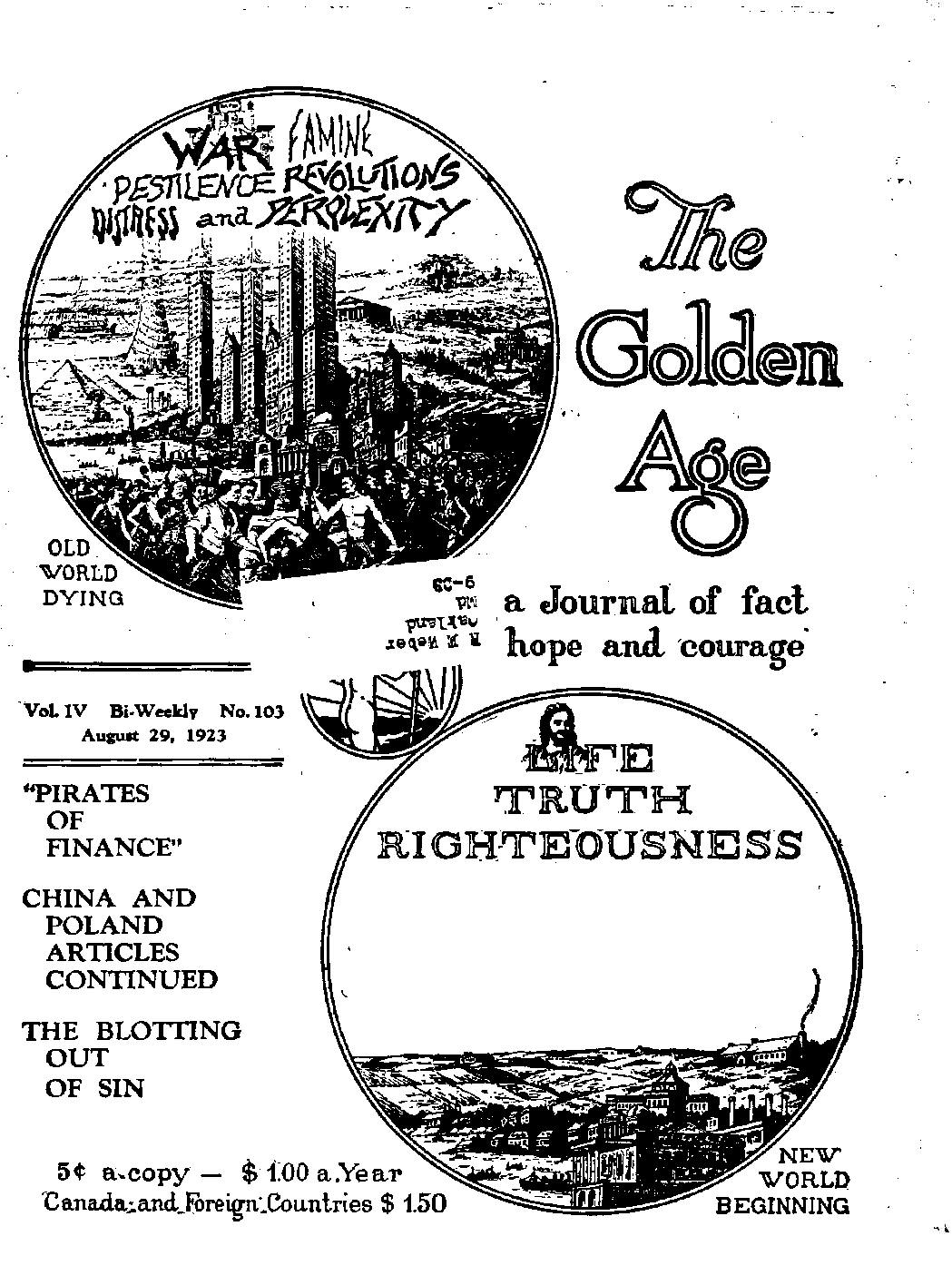
Contents of the Golden Age
Finance—Commerce—Transportation •Fixates or Finance”
la Government Treasury Being Drained?
Political—Domestic and Foreign
Vain Imaginatio?.'9
Why This Raging?
What Next?
China and Him People (Part 3)
China’s Trouble* Multiply
Will Boxer Experiences Be Repented?
Reconstruction from Within Need* J
Turkuns, or Military Governors
Popularity of l>r. Sun
Popularity of Gen. Wu Pei-fu............ .
Honor in Chinese Banditry
China’s Wealth Coveted
Whence Came the Munitions?
China's Open Door
Strength of Notions in Militarism
Tong Wars in America
Polam), Child of the Battleheu)
French Ix»ve for Poland
American Love for Poland
, Vatican Love for Poland . . . '
Social and Educational Items . . —
Industrial Notes
Religion and Philosophy
•Advertise the King”
The Blotting Out of Sin
Children of Believers Favored
Fear as a Converting Influence
Repentance Precedes Conversion
The Standard of Conversion
Deceive Ourselves, Claiming No Sin
Studies in “The Harp of God’’
Published every other Wednesday at 18 Concord Street, Brooklyn, N T., C S. A., by WOODWORTH, HVDGINGS A MARTIN
Copartners and Proprietors Address - id Concord Street, Brooklyn, V. F., P. A A. CLAYTON J. WOODWORTH . . . Editor ROBERT J. MARTIN . Bu-inees Manager C. E. STEWART .... Afudatant Editor WM. F. HIDGING8 . . Sec y and Trona. Five Cents a Copt—11.00 a Year Make Remittances to TUB GOLDEN AGE Foreign Ovricsa : .....34 Craven Terrace, Lancaster Gate, London W. 2
Canadian........ 270 Dundas Street W.. Toronto, Ontario
AtMfroJariM.......40S CoIHna Street. Melbourne, Australia
Bonth Africa*......6 Lade Street, Cape Town. South Africa
Bailed aa aoroBd'ClMe matter at Brooklyn, N. Y., under the Act of March 3, 1879 tfie Golden Age
- - - —— .. _■ ■ , , —e—HT
Velame IV Brooklyn, N. Y., Wedncvday, Aufust 29, 1923 NamlMr It*
—=»— ..... —--------—--—--r---
“Pirates of Finance”
HO AV the Wall Street Soviet contrived to take away legally all the real money belonging to the people of the United States and to place it absolutely under their own control, so that they may have panics or prosperity when and as they will, is interestingly told in a little 72-page book bearing the title, “Pirates of Finance,’’ and sold by the author, Theodore Cocheu, 505 Bedford Avenue, Brooklyn, N. Y.
Mr. Cocheu writes that although he was advised that the issuance of the book would land him in jail, yet it has been liberally circulated among congressmen, financiers and publishers, and that thus far there are no dire results following the exposure of what he believes to be and what evidently is a monumental sin against the whole people of the United States. As a matter of fact we opine that the men who were back of the Federal Reserve scheme of looting the United States Treasury are afraid to prosecute Mr. Cocheu. It would be an exceedingly disastrous thing for them to have these matters brought out in court and aired in a large way. We quote here and there from Mr. Cocheu’s book:
“Wlm the Federal Reserve Bank law was being discussed in Congress, Mr. Lindberg, as a minority of the committee, said:
“ ‘This bill positively abolishes the United Statea Treasury. It proposes to move all the people’s money from the United States Treasury and place it in the vaults of the banks, to be used by them for private gain. It violates every principle of popular democratic representative government, and every declaration of the Democratic party and platform pledges, from Thomas Jefferson down to the beginning of this Congress?
“Mr. Lindberg’s words were prophetic, and have certainly been fulfilled by the practical operations of the bank.
“Discussing the subject of bank control of money, Hon. Samuel Untermeyer is reported to have said:
“ ‘The concentration within a few years of the •Money Tower” in the hands of less than twelve men who control seventy-five percent of all the money in the United States, which control extends over a series of banks in all the greater cities, is absolute and despotic; but no relief can be expected, as these men are not acting contrary to existing law. Two billion dollars are held in control by the money combination centered in New York banks?
“It is this situation which he considers 'a menace to the country/ and ‘which threatens to lead to a money oligarchy more despotic and more dangerous to industrial freedom than anything civilization has ever known?
“ ‘I believe/ says Mr. Untermeyer, ‘that the trend of this concentration and control of the money of the United States, if continued on the lines which exist today, will do more toward leading men to Socialism in their frenzied efforts to seek some sort of relief, than any other underlying cause of complaint in our social system?
“Mr. Untermeyer says he is not attacking men, but a system which he ‘believes to be vicious and dangerous?
Mr. Alfred 0. Crozier, of Wilmington, DeL, a celebrated author and one of the best versed students of finance in this country, during a discussion of the proposed formation of a central bank, is reported to have said:
“ ‘The plan for a Central Bank originated in Wall Street and not with the National Monetary Commission. Wall Street will control this bank, or there will be no such institution. It is really humorous to note the coy manner in which the Wall Street interests are allowing the plans for their establishment to leak out gradually. As a matter of fact, this deal, the prize bunco game of American history, calculated to place the entire control of the Nation’s currency in the hands of a Wall Street coterie, has been completed for months. Fearing the uproar that would have been certain to result had the scheme been sprung on the public at once, the men organizing the deal have been shrewd enough to spring their plans by easy stages? ”
Is Government Treasury Being Drained ?
Tn Mr. Cocheu’s book he proceeds to prove from the official reports of the United States Treasurer that between April 7, 1917, and August 1, 1919, there passed out of its hands 2,868 tons of the 4,201 tons of gold which it had in its possession at the beginning of that period and 9,000 tons of the 14,000 tons of silver which it had on hand at the beginning of the same period.
He calls attention to the fact that all the gold left in the Treasury “is the property of the Fede rat Reserve Banks, only held in trust by the Government” and then in a single paragraph pointedly shows that the Treasury has been stripped of all the people’s money:
“Only two years ago, anyone receiving a pay envelop or other settlement for service found gold or silver certificates payable on demand. Today a few stray silver bills may be found, but who among our hundred million people can produce a gold certificate? These certificates are no longer in the hands of the people, and the metal is no longer possessed by the Government”
Mr. Cocheu proceeds with his story; and after pointing out how by a nice piece of financial juggling the people are robbed every year of the enormous sum of $240,000,000, which they pay for the use of their own money to the pirates that have robbed them of it, he comes down to the root of the matter, tellinghow the trick was done. Of course it was all done by lair. All thievery and chicanery worth while in these days is done not with a gun, but with every formality of law and every pretense of piety and patriotism:
“Congress could notrhave been induced to pass a law giving the people's gold direct to the banks, but the following are the magical words which enabled the high financiers to perform the trick:
“ 'The Federal Reserve Board shall have power: To issue Federal Reserve Notes at its discretion; to exchange Federal Reserve Notes for gold, gold coin, or gold certificates/
“Suppose the reader to be a man with a small bank account, finding himself with one hundred dollars in gold certificates, for which he could obtain gold on deihand, but it being more convenient to deposit the certificates in the bank, and pay the butcher, the baker and the candlestick maker with checks. This was done, and the bank cashed the checks with Federal Reserve Notes, and appropriated your gold certificates to its own use, though you were not consulted. This action is called Exchange. The bank presented your certificates at the United States Treasury, and received gold for them, which then became the property of the bank, and the 'Exchange' was complete.
“Thus it is plain how one hundred dollars gold was transferred from your ownership to that of the bank. ■And the same simple process operates whether the amount be one hundred dollan or one hundred million dollars.
“It should be borne in mind that the gold certificates represented real service which had been rendered by their owners, as depicted in the various sketches in the beginning of these pages; and though transferable, the gold and certificates could be properly owned only by those giving service in return for them. But what have the banks given for the nearly three thousand tons of gold transferred from governmental to bank ownership? Why, gold certificates, of course.
“What did they give for the gold certificates? Why, Reserve Bank Notes.
“The only mystery about the whole transaction is the answer to this last question:
"What did they give for the use of the Federal Re-serve Notes that were exchanged for gold certificates that took the gold that lay in the house that the people built?'"
The obvious answer is that the people of the United States have turned all their real money over to a gang that have given their notes in exchange for it, backed by an ever-changing collateral of goods in warehouses or in transit, and if the gang wishes to do so there is nothing in law to prevent their taking that gold and skipping with it to any comer of the earth to which they may wish to go. And, as they find it convenient, they will skip and take the gold with them; make no doubt of that. Mr. Cocheu sees the situation and sums it up as follows:
“Thus, by their own machinations, a handful of high financiers in two years have possessed themselves, without any return or service, of property which had required one hundred million people more than fifty years to gather together through the natural and orderly processes of honest industry and economy.”
The chapter headings in the book are: What Happened to Our Gold; The Arabian Nights; How the Looting Was Done; Currency Inflation and High Cost of Living; How the Great Gold Fund had been Gathered into the Treasury; Gold; 1907; A Sample of High Finance; The Federal Reserve Bank and Currency Law; What Have They Done with it; 'The Treasury is Bustin’ with Money9; Verily, This is a Rich and Easy Nation; Stabilizing the American Dollar; The American Dollar is Standardized; Conclusion; Lest We Forget.
By request Mr. Cocheu has furnished us with a brief sketch of his life, from which we select some items that we think will be of interest to our readers. His father was born in Brittany, France, in 1794, and was a soldier under Napoleon in the year 1312. A trained and successful morocco manufacturer at Watertown, N. Y., he was stripped of his business by the operation of high finance in 1844, and became a helpless paralytic for the remaining nineteen years of his life. During all those years Mr, Cocheu’s mother cared for her invalid husband, and their daughter and six sons. Theodore was born in 1838.
Theodore and his brothers were all soldiers in the Civil War, and in 1863 Theodore married. He says of his family life:
“I have said that my wife had brains. Before our marriage, while she was yet a mere slip of a girl, she won a prize for committing to memory and correctly reciting the whole book of Matthew within four weeks time; and though this was hot work she never forgot, but could correctly recite it to the last of her fifty-eight years of married life. When we married, we agreed to ‘keep house’ on my small salary, though the price of flour was $12 per barrel, coal $14 per ton, kerosene oil for lamps, twenty-five cents per quart, etc. But as $12 ahoe< and satin skirts were not then necessary for housework, and as we could get along in the summer without furs, we managed to live, having enough to eat and wear, and without incurring a financial debt of any kind. We also agreed to set up what was then known as a ‘family altar/ with reading a portion of Scripture and family prayer every night. I am thus specific in describing our family organization because we became parents to seven sous who all grew up to manhood’s estate in the borough of Brooklyn. We were frequently warned that it was impossible to bring up a boy in the city and keep him right; but when, in 1913, we celebrated our fiftieth or Golden Wedding within a quarter of a mile of the place of the original wedding in 1863, among many warm friends assembled were our seven sons, all occupying useful, honorable positions in the world, who had come with their wives from Panama and other distant parts of the world to attend the event. It is only just to say that the life work of a good, wise, Christian mother’s wonderful care, wise precepts and constant example to and before her boys has made every one of them a standing proof of the fallacy of the saying, ‘You cannot properly bring up a boy in the city? M
In the year 1872 Mr. Cocheu was appointed United States Customs officer by the Honorable Chester Alan Arthur, who subsequently became President of the United States. It was Mr. Cocheu’s fortune to be the officer in charge when the immigration sendee was transferred from the jurisdiction of the State of New York to the United States Government. On April 18th of a given year the State of New York received the immigrants at Castle Garden, New York City. On the very next day, at Ellis Island, the United States Government, with a different organization, under Mr. Cocheu’s management, landed 8,000 immigrants and sent them to then-destinations by railroad, or fed and lodged them in the barge office, and in barges which he)had provided for the purpose, all without hitch or mishap. He retired from the position in 1921 after a service of forty-nine years.*
Vain Imaginations
CONCERNING the world conditions Judge Rutherford says:
“To believe that one can accomplish that which is an impossibility is a vain imagination. That is exactly the condition of the world today. Many imagine that the present systems can be patched up and made desirable.
“A few years ago the cry was resounding through the earth: ‘The great war will make the world safe for democracy.’ How vain was that imagination is now apparent to all who think. Democracy is in a worse state of disintegration than at any other time during the past hundred years, and is daily growing worse.
“Democracy means government by the people in the interest of the majority. Particularly since the great war government is by the profiteers and their allies in the interest of the minority. The condition goes from bad to worse. The nations are hopelessly in debt, and the financial systems of many are already collapsed.
Because of fear that has laid hold upon the ruling factors of the nations, they are madly preparing for another great war. Says Sir James Foster: ‘It is enough to make the angels weep, that after the greatest tragedy the world has ever known the nations should be showing their teeth more in 1923 than they did in 1913. International affairs are in a worse condition today than ten years ago.* t
“ *A new chapter opens in the history of Europe and the world, with a climax of horror such as mankind has never yet witnessed.’—Lloyd George.
“ ‘There is no settlement in Europe. There is no peace in Europe. 1923 is worse than 1914.’—Ramsay MacDonald.
“‘Airplanes, poison gas and hatred mixed together are spelling the doomed civilization. America is preparing for war on a scale so colossal that it has no parallel in the history of the world.'—Frederick J. Libby.
“Religiously speaking, the denominational church systems are raging upon each other. The modernists have repudiated God’s Word and have denied the great ransom-sacrifice of our Lord. They deny His kingdom, and in turn teach evolution and other God-dishonoring doctrines. The fundamentalists cling to the Bible, and earnestly contend for it. Both sides, however, are allied with the commercial and political powers of the present evil order.
Why this Raging?
IN JEHOVAH are all the riches of knowledge and wisdom. His Word, the Bible, furnishes a sure and perfect guide. Many centuries ago, foreknowing the condition of our day, He caused His prophet to write propounding this question: 'Why do the nations rage and the people imagine a vain thing?’—Psalm 2: 1.
“The raging of the nations is apparent to all. What vain thing do the people now imagine? Big business, big politicians and apostate clergy' join together in announcing that they possess the wisdom and power to adjust the ills of humankind; that by means of compacts or leagues of nations or worldly conferences they can establish peace and prosperity and bring the desire of the people. Millions of good, honest people imagine that this can be done, and that imperfect man can establish peace and righteousness. This is a rain imagination, because Jehovah, referring to this time, through His prophet said: 'Associate yourselves, 0 ye people, and ye shall be broken in pieces; and give ear, all ye of far countries: gird yourselves, and ye shall be broken in pieces; gird yourselves, and ye shall be broken in pieces. Take counsel together, and it shall come to nought.’—Isaiah 8:9,10.
‘‘The reason why the great crisis has come now ia this: The Gentile world or order of things began in 606 B. C., was to continue 2,520 years, and according to the Bible legally ended in 1914, at which time the Lord foretold that the nations would become angry and God’s wrath would come. From then until now the nations have been raging, and the raging continues, and the people continue to imagine a vain means of settlement.
‘*FfOr nineteen hundred years real Christians have been praying earnestly the prayer that Jesus taught his followers to pray: *Thy kingdom come; thy will be done on earth as it is done in heaven? This prayer was taught that those who earnestly pray it might be in an attitude to receive the kingdom at its coming. The King is now present. The kingdom of God is at hand. Jehovah's Anointed is His beloved, the Christ AU who are not for Him are against Him. Concerning those who are against Him the Lord through His prophet says: 'The kings of the earth set themselves, and the rulers take counsel together, against the Lord, and against his anointed, saying, Let us break their hands asunder, and cast away their cords from us? (Psalm 2:2,3) In 1919 the political and financial rulers of the world said: 'We must have the League of Nations? And the Federal Council of Churches said: 'The time has come to organize the world for truth, right and justice and humanity. To this end as Christians we urge the establishment of the League of Free Nations. ... It is the political expression of God’s kingdom on earth? Here was a statement of these three dements equivalent to saying: ‘We will not have the King of kings, the Lord’s anointed, to rule over us. We will maintain our old arrangement? To this Jehovah's prophet answers: ‘He that sitteth in the heavens shall laugh; the Lord shall have them in derision. Then shall he speak to them in his wrath, and vex them in his sore displeasure?—Psalm 2:4,5.
What Next?
WHAT, then, may we expect to follow this condition of fear, perplexity and distress of nations? What shall be the result of the arrogant speech and efforts of the ruling factors to carry out their selfish desires? The answer is found in the Scriptures: 'And he gathered them together into a place called in the Hebrew tongue Armageddon, ... to gather them to the battle of that great day of God Almighty? (Revelation 16:14,16) This is to be followed by the complete establishment of Messiah’s kingdom of righteousness, which will cure the present ills of humankind and bring peace and prosperity to the people, the desire of all honest hearts. The whole creation groans and travails in pain, waiting, for the Messianic kingdom, for the time of complete deliverance. It is at hand. Millions now living will never die. It behooves every one to inform himself about this important subject?*
“Advertise The King”
Rejoicing ! Rejoicing!
We advertise the King I
Rejoicing! Rejoicing ’
Glad tidings now we bring.
For unto those who watch and wait, The King doth eome in glorious state; This message due with joy relate^
And advertise the King!
By Mrs. T. C. Alford
Rejoicing! Rejoicing!
We advertise the King!
Rejoicing! Rejoicing!
His praises all shall sing;
For millions now will never die, On promise sure the meek rely, In earth restored He’ll grace supply.
So advertise the King!
China and Her People—In Four Parts
OF ALL the tangled skeins of yarn in the world the political situation of China may be said to be the great one, the “Chinese Puzzle ." Like the minds of some men, it was one thing yesterday, another thing today, and will be something else tomorrow. The Chinese monarchy became a republic in February, 1912, after the revolution of the year before. The boy emperor, Pu-yi, still retains his title; but as a ruler he is not even a figurehead, though he is paid for it and evidently will continue to draw his pay until there is another revolution or a repudiation of the old order.
The country is in constant turmoil, and no faction has been successful in establishing any kind of stability. The military governors, the Tnchuns, hold the whiplash and have been in the habit of dictating to the Peking government.
It seems inconceivable how so vast a country buried in tradition, undeveloped in industry, and living by such low standards could in so short a time expect to emerge from slumber, throw off the shackles of monarchy, endeavor to establish a republic, unify her interests, and make herself felt as one of the powerful nations of the world. Two things may contribute: (1) Before the mighty influx of machinery and labor-saving devices came into the world China was put to sleep with opium. With the advent of opium, rum, and other “Christian” accouterments came her excessive drowsiness, her public debt, her discord and lax morals. With the banishment of opium and rum China is coming to herself; but like a drunken man after a spree she hardly knows how to stand. (2) The aggressiveness of exploiting Powers, which she sees will swallow her up unless she strives to / save herself, is prodding her on as a mattei^ of self-preservation.
As China arouses from her stupor great minds are sure to be enlightened, and ambitious, selfish men will seek for advantage. Instead of peace strife will ensue, and civil warfare be prevalent. There are two main divisions: Gen. Wu Pei-fu is supreme from the Great Wall to the Yangtse river, and exerts power over Central China in the neighborhood of Peking; Dr. Sun Yat-sen is supreme from the Yangtse Kiang southward, and is at the head of the Southern faction which centers at Canton. Another smaller division obtains in
(Part Three)
Northern China, or Manchuria, with Gen. Chang Tso-lin, a former outlaw and bandit, at the head.
Gen. Li Yuan-hung was vice president, then president, resigned, went into obscurity, was president again, abdicated June 14th because members of his own party and constitutional politicians demanded it, holding him captive four days in his own mansion before he took his flight. He was captured and held by his own troops. The immediate, cause of his flight was that Gen. Feng Yu-hsiang told the President that if his soldiers were not paid his troops would enter the capital.
The President of China necessarily rode in a stormy ship of state. He had around him a scheming bunch of politicians, a gang of robber financiers, and a gawking set of soothsayers known as priests. He was pestered from within and from without in strictly Oriental fashion.
China’s Troubles Multiply
HE rupture was precipitated because the soldiers had not been paid; and there was a division between the military leaders. It is now thought that a military leader will ascend to the presidency. China therefore faces 'another crisis. Li Yuan-hung had been undergoing a state of siege for many days, and was trying to form another cabinet to help extricate himself from the entanglement. Trouble'was brewing in practically every province; the bandits were harassing the peace of Shantung and all China; complications were arising with Japan; and the Consortium was putting China’s feet into the stocks. Besides this, outrages were being committed with remarkable frequency upon foreigners, so that all nations were getting ready to spring at China’s throat. The President’s hasty flight stopped the rioting around Peking; and in a few days there was a lull in all China, as far as newspaper reports were concerned.
The White race has fallen as a result of the World War, and the Chinese no longer regard them as superiors. White representatives are looked upon as merely agents of a profiteering country, bent on exploiting the resources and peoples of other countries. Even American trading ships on the Yangtse have been fired upon by bandits and soldiers. The State Department at Washington has received word
that American lives and liberty throughout China are endangered, and demands were made for foreign guards; but the trouble seems to be that there are too many people carrying loaded guns already. Kao Ling-jei was chosen premier.
It has been said of Li Yuan-hung:
“There is no other man in China who seems as likely to he able to guide the country safely through its period of reorganization. His task is most difficult; but, if he can retain the support of Wu Pei-fu and secure the cooperation of Chen Chiung-ining, he will successfully accomplish it”
Chen Chiung-ming was Sun Yat-sen’s leading general. Sometimes Chen is in possession of the South, and sometimes Sun holds sway. Just now Dr. Sun is shining brightly in the South. The Tuchuns harass Wu Pei-fu, and peace is as far away as ever. Some think that Li Yuan-hung with Generals Wu and Chen could unify China, but that is not what the foreign Powers want, as is evidenced by the support and goodwill they have for Dr. Sun.
Genuine national unification depends upon the sincerity of all parties in working for noble ends. If the peace of the country and her own welfare were considered, instead of the interests of financialdom, and the people themselves allowed to work out their destiny, much greater progress would be made toward making the government truly representative and democratic. A suggestion comes along this line from Dr. Sun in a manifesto addressed to the Powers, in which he advises them not to recognize the Peking government, that thereby the military powers will be weakened and China become pacified. A government can then be established which will be representative of the country and command the respect and support of the provinces.
An effort was made through a coalition of leaders composed of Li Yuan-hung, Chang Tso-lin^ Sun Yat-sen, and Lu Yung-hsiang to move the capital from Peking to Hangchow, Province of Chekiang, in order to get away from the unfavorable influences of the Chihli party, headed by Generals Wu and Feng. Perhaps the convulsions in China were aimed at the removal of the capital nearer to American and British civilization; for Hangchow is about 700 miles south of Peking and only about 550 miles from Canton and Hongkong. Some say that conditions in China are practically the same as when the Boxer uprising terrorized the whole world with Chinese atrocities.
Will Boxer Experiences be Repeated ?
SPEAKING of the likelihood of a Boxer uprising reminds us of the Boxer insurrection of 1900 and the causes lying back of it. It is said that the politico-ecclesiastical element of China is interwoven with Confucianism and centers in the seclusive atmosphere of Peking. Through the fall of dynasty after dynasty this church-state Confucianism has persisted; and the Chinese are fearful that the encroachments of the Whites with what they recognize as a perverted Christianity will bring them into subjection and take away their honored traditions which have cemented them together into a solid nationality. They have always regarded the missionary as prying into their liberties and have resented it, often with persecution.
According to the statement of Mr. Hain Joh Kai, son of the Chinese Minister of Finance during the Boxer uprising, the real cause of the uprising was the fact that many patriotic Chinese saw that the European Powers were scheming to get control of China in order to divide that country among themselves; and they felt that the only way to preserve the freedom of China was to drive out the Whites. Through the assistance of English and French forces the uprising was suppressed; and the Minister of Finance committed suicide in the presence of his sixteen-year-old son, knowing that if he were apprehended he would be put to death in some way designed to be a warning to all who were in favor of maintaining the integrity of their native country.
Years later Mr. Hain was one of the committee of nine young Chinese who were sent by the President of the Chinese Republic to visit the capitals of the leading European countries with a view of enlisting Occidental sympathy in behalf of the young republic. It is needless to say that the mission was a failure. None of the Powers would want to help China get on its feet for China’s sake; but if they can sack China and keep her for their own they will use any ruse, any cunning, any subterfuge, any “diplomacy” that the expediency might warrant In almost every instance the young Chinese were met with the inquiry: “What shall we get out of it if we assist the Chinese Republic!*
The young men had expected the European Powers to take a lively interest in their efforts to better the conditions of four hundred million Chinese who so badly needed assistance. When they met with repeated disappointment in their efforts to interest the European diplomats they lost confidence not only in Western civilization but in what wTas passing for Christianity as well; for they concluded that much of the interest which sent missionaries to China was really commercial, and not religious.
Reconstruction from Within Needed
THE question has been asked: ‘‘Can China hold her own against the political, economic, and cultural encroachments of the West long enough to enable her to make her own blend of the elements of her culture, which are of paramount significance, with certain values, mainly scientific, in Western civilization which she now lacks 1” It is a question of how there may be vital reconstruction from within, and how to induce the greedy West, including Japan, to keep hands off. The opening up of China is, to the Powers interested in the Consortium, better than opening up a new continent; for China holds in her arms about one-fourth of the earth's teeming millions, who are so peaceful and so innocent of the White man's greed that it is an easy matter to exploit her. The “Christian” White nations have succeeded in making an ally of Japan, taking away the possibility that the Yellow races may combine for mutual protection against the encroachments of the Whites. The only human salvation for China is for Socialism to sweep away the Western group of nations, overturning Capitalism, allowing China thenceforth to reconstruct, cultivate, and advance in modern civilization in her own sweet way, receiving the aid and helpfulness which might be given through some noble souls who are not animated by selfish motives. Intellectual leadership is present; and the young men and women of China are the equals of any nationality, surpassing many others in honesty and virtue. But the finding of a leader in whom all will repose confidence is the problem—unlikely of solution.
It is not to be wondered at that China does not put her house in order. The big Powers keep her in a state of poverty and weakness, so that she may be the more fully despoiled.
Her tariffs are fixed by the Powers, compelling China to accept just such a tax on her exports and imports as will be favorable to themselves and unfavorable to her. Chinese finances are regulated by the foreign Powers through the Consortium.
Minority rule has had its day; special privilege is waning; predatory wealth must cease to be. Politically, we must consider the most basic prerequisite to lasting peace—that the nations should become internationally minded, which means to think in terms larger than special interests. The League of Nations idea is not thinking in large terms. The thought of “league” presupposes that some are in, and some are out; any idea which excludes is narrow. When the ideas broaden to include humanity, the thought of league or clique or clan will not come into mind. This is a Christian principle about which few seemingly know anything.
Tuchuns, or Military Governors
CHINA is menaced by a system of Tuchuns.
These are military governors of the provinces, each of whom has armies under his command with more or less capital at his disposal. These war among themselves and rob the people to support the armies. This causes dissension and discontent Each governor is jealous of the other; so there is scheming on all sides. China’s predicament in raising money to pay off her debts is that she does not have the support of the provinces. Each province seems to be a kind of independent state having very little respect for the Central government; at least, there is little cooperation.
Perhaps one of the reasons why China is so arbitrarily governed by its Tuchuns is that in the eleventh century there existed a sort of State-Socialism arrangement, not unlike that championed by some today. Her civilization was highly developed. It is said that arts, architecture, literature and philosophy, and both the theory and the practice of government were highly advanced as far back as the Chow dynasty (1122-256 B. C.), intensified and further developed by the Han dynasty (206 B. C.-219 A. D.), and also by the Tang dynasty (618906 A. D.); and when the Sung dynasty came into existence in the tenth century civilization was even more flourishing. In the changes from one dynasty to another the people were not concerned at all; and even now when China is trying to give birth to a unified republic the people at large are not much concerned, as they have no voice in its formation. It is a fight between military and political forces.
One grand testimony to China’s history is that while the White races were waging their "holy” wars and carrying on warfare for "Christian” principles the Chinese were in blissful ignorance of it all. No dynasty has ever neglected the people of China; every dynasty remaining in power for any length of time did so with the silent approval of the people, and each dynasty tried to improve upon its predecessor. Some of these rulers were wise and kind, and greatly improved the condition of their countrymen. Of course, as is natural among the upper crust, jealousies would arise, fights ensue, and the weaker were overcome.
The farmers have always been recognized as the backbone of the country, and have been assisted when necessary. The taaes have been equitably and uniformly low, and the national debt has been negligible.
Popularity of Dr Sun
SUN YAT-SEN, the “father” of the Republic and its first president, has twice been ejected from Canton by military combinations armed against him. He made one dramatic reentry into the city; and the only pretense toward progress and liberalism that China has seen in five years, in the view of some. He has one hundred of his supporters in the present Parliament. He is the most popular man in Central and South China, according to a referendum conducted by the leading American newspaper in China, The Weekly Review. Whether this "popularity” is propaganda we cannot judge. Dr. Sun is given the credit of materially assisting Canton to rapidly modernize itself with sewer and water system, wide streets, fine buildings, electric lights, etc.
It was in February that Canton was captured from Gen. Chen Chiung-ming, the enemy of Dr. Sun Yat-sen, by troops from Yunan and Kwangsi provinces; but instead of turning the city over to Sun Yat-sen, as was expected, the troops revolted and held the city for their own prize. The provincial troops numbered about 28,000, mostly young men without discipline. Sun’s army of 40,000 started for Canton to reclaim the Southern capital, and 10,000 of Chen Chiung-ming’s soldiers were waiting to join them. Even the British authorities at Hongkong, who have never been among his admirers, welcomed him back. Sun is said to be friendly to Japan.
Dr. Sun desires to modernize Canton after the British pattern at Hongkong; invite foreign capital to finance the government enterprises, preferring American and British; construct railroads with foreign money; open the doors wide to foreign financiers so that they may loan money for the purposes of expansion, presumably the government going security for the money furnished; and, move of moves, he proposes to clear the market of all old provincial bank-notes; and, taking the advice of expert financiers, he will issue currency. This comes on the heels of the cancellation of the Lansing-Ishii pact of 1917 which granted Japan “special interests” in China. And by this it is said that the “diplomatic affairs of the United States in the Far East are placed in a more favorable situation than ever before.” This means that the Consortium has a firmer grip than ever upon China.
Dr. Sun has proposed a way by which these destroying military elements may be^defeated, resulting in the unification of the Chinese people. His scheme is a passive resistance and refusal to cooperate with any faction. It is advocated that this may be done most effectually by strikes and refusal to pay taxes. This sounds very much as if China were becoming "civilized”! The people may be ready for some such suggestion; for they are getting tired of seeing superfluous soldiers, and being required to bear the ever-increasing expenses involved. The Chinese are a peace-loving people, never having been imbued with the war spirit of murder; and if they can be convinced that their happiness and solidarity as a people rests on breaking up the military cliques, they in their weakness will become exceedingly powerful through non-responsiveness to the clamor of selfish men.
Popularity of Gen. Wu Pei-fu
OTHERS claim that the probable leader to carry China out of her chaotic condition is Gem Wu Pei-fu. He has had a sudden rise, and ]ias demonstrated that he is a great general. Since the empire was abolished, the control of the government has passed from individuals to groups, back to individuals, and to groups again, each in turn trying to secure itself permanently in power by usurping authority. Like all leaders these contending forces are ambitious and selfish, but Wu Pei-fu's appeal to the people made its influence felt; for they judge that he is unselfish and has nothing at heart but the unification of China. The time is fast approaching when the people generally will have confidence in no one except those who are really actuated by unselfish motives and who have no axe of their own to grind.
Wu Pei-fu himself claims he wants nothing but the unification of the Chinese, the political harmony of the North and the South, and to abolish militarism, to revive industry, and to win the respect of foreign Powers. He thinks that China should prosper, and says that railroads are her greatest need toward economic reconstruction.
The Japanese view is that the meteoric rise of Gen. Wu has something back of it besides the love of the people for him; that it can hardly be a profound faith in him; and that having had somewhat of a variegated career, in wlii ch he has been all things by turns and nothing long, he is not to be trusted overmuch. They incline to the belief that the foreign Powers are interested in him as a bulwark against Japanese aggression.
Young Emperor Marries
THE imperial soothsayers set November 14th last for the day of the marriage of the Emperor. The boy had been emperor since babyhood, when the revolution took away his throne; and even though a kindly government set aside an allowance it is said that the civil strife has made it hard to collect. So his majesty gets deeper and deeper into financial difficulty as moons wax and wane. This is the experience of most kings now. The bride was a Manchu woman of high birth and, of course, is accomplished and charming, as all brides are. But she comes from a comparatively poverty-stricken family and does many things which other women do (which is creditable): She drives her own limousine, and does her own sewing, when occasion-demands. With the Em, perors outgoing goes the last of the Manchu dynasty. So the Emperor, the Kaiser, the King, and the Czar business is losing all its former glitter; and the common people are coming into their own. Abraham Lincoln said: "The Lord must love the common people; for He made so many of them.”
In many places the village elders still believe that the Emperor, the father of his people, is on his throne. They have not heard, and they do not care to hear, about the establishment of a republic. They do not bother themselves with the problems of government; their business is farming. Perhaps they have the right idea that the government business is not in looking out for the interests of the people, as is supposed, but is a business in itself, run for the benefit of those in that business.
So in spite of the fact that the Republic is functioning after a fashion, the last of the Manchu dynasty sits on the Dragon throne. Some hope that the "Lord of ten thousand years,” as he is called, will again come into his own and regain supreme rulership; but China will never return to a monarchy. The Dragon flag lies folded away forever. The Emperor has a fine education and a pleasant disposition, and is keenly interested in the affairs of the world. Yet he is housed in, under guard, being polished and groomed for the eyent which shall never take place; and the wicked, gaping world is denied the privilege of seeing him enjoy himself like other boys. He cannot even ride in his wife’s limousine. Such are some of the drawbacks of royalty.
Honor in Chinese Banditry
SHANTUNG, of which we read so much during the early days of the Versailles Treaty, has been returned to the bosom of China. It has been overrun with bandits, who thought that they owned the country, and who asked the Japanese to turn it over to them instead of to the Chinese government. The government at Peking made peace with them by giving them $100,000 on their promise to refrain from violence; and bver a thousand bandits incorporated themselves into the Tsing-tao police force. Sometimes when a ruffian is put on his honor or made a guardian of public safety, he will behave himself. Whether these are the bandits who wrecked a train May 6th and carried off many of the passengers we know not. One paper says: “If a Chinaman gets his government into trouble in order to get a'job, he is a bandit. Over here they call them politicians.”
At any rate, bandits looted a train and carried off passengers who were supposed to have "heep” money. This further embarrassed China, further checkered her career, and made her political situation even worse than it was. The press despatches had much to say about one of the captives, Miss Lucy Aldrich, sister-in-law to John D. Rockefeller, Jr. The bandits demanded a million dollars and exemption from punishment to liberate their victims. Miss Aldrich was soon released. Other women taken were also soon released. One jewel among them refused liberty, preferring to stay with her husband. Miss Aldrich told a thrilling story, and a Mr. Powell’s was exceedingly fascinating. They described the wreck, the shooting up of the train and the looting of the cars of all valuables, in some cases the carrying off the bedding from the sleeping cars. Then there was the march of the passengers, thinly clad, and in some cases barefooted, through the dark, over rocks and brush into the fastnesses of the mountains miles away from the railroad. There was much suffering from the long, enforced marches, exposure, lack of clothes and food. The attack came at two o’clock in the morning, and there may have been a thousand bandits in the kidnaping raid. It was estimated that there were over 10,000 bandits within a radius of fifty miles, well intrenched in a very advantageous place for resisting an army; and they were well armed. About thirty prisoners were taken, mostly American and British citizens; and these two governments immediately got busy with demands on the Chinese government for the release of all captured. Five nations joined in a note last November, demanding immediate release of the missionaries kidnaped.
Some of the bandits, at least in this last offense, were discharged soldiers; and it is said that this was the method adopted to get their back pay. But others claim that the motive of the attack lay in an internal political plot; still others claim that Gen. Chang Tso-lin, war lord of Manchuria, was behind the attack trying to discredit Gen. Wu Pei-fu. However we may view the matter, the bandits were “some pumpkins”; for they established a line of conununication with the officials, and sent and received envoys, and dickered in thorough diplomatic fashion. Gradually, as officialdom came across with the ‘ long green” and promises of immunity from punishment, the captives were released, but not according to original demands.
China’s Wealth is Coveted
N EDITORIAL heading,“CleanUp China” appeared in one of the daily newspapers, which strings the fiddle to the true tune. It says:
“Rich beyond all comprehension, her fabulous wealth coveted by more than one powerful nation, this last great, virtually unprotected garden spot of the world stands forth as tempting as ripe fruit over a wayside wall. Some hungry nation or other, one of these days, will take advantage of an incident like that of the Shantung bandits and go after China.”
Reports from the bandits’ stronghold for five weeks were conflicting. There were anticipation and hopelessness, encouragement and discouragement, fears and forebodings, wills written and preparations for burial. Some forty Chinese were also prisoners, and a few of them had been for over a year. Some of these were slowly dying of starvation and filth. At Peking the release of the prisoners became more and more a political issue, as to what faction was to have the honor of liberating the captives; and of course there was competition among the bandits as to who should get the money.
The papers stated that “foreign intervention was unquestionably necessary to prevent the utter collapse of China; but whatever form the reconstruction should take would be fraught with extreme danger.” They must and they must not. It may be necessary in assuming a moral leadership, for some “Christian” nation to take charge of the provinces where the good oil wells and iron ore are located. The country needed, so some said, Chang Tso-lin (the bandit-ruler of the North) as a dictator to bring order out of chaos. But any effort on his part to seize the government would be fought vigorously by the other factions. Meantime Wu Pei-fu had his army marching against Sun Yat-sen. This army failed to receive their pay, and started looting. In some instances small bands of independent brigands tried to get through the troops’ lines to join forces with the bandits. Tien Chung-yu, Tuchun of Shantung, had three brigades of his troops, machine guns and two airplanes ready to plunge into the hills to rescue the prisoners; but this move would'relieve the Peking government of the responsibility, and was not looked upon favorably by the foreign diplomatic corps.
In such a crisis the armies of Wu Pei-fu and Sun Yat-sen should have been consolidated for the common good. But no! These two armies were ready to fight each other, and their commanders were oblivious to the dangers of the captives. J. B. Powell, the American newspaper man, proved his gameness. Two or three times he was released on his promise to return, being allowed to carry messages and to negotiate for the release of the prisoners. He returned each time; and once he wrote from his mountain prison: “We will stand whatever mistreatment is necessary to make all foreign lives safe in China. ”
Whence Came the Munitions ?
S NEGOTIATIONS progressed between the bandits and the government, a com
mission was appointed to ascertain who was responsible for the political scheme to embarrass the government, if there were one. They wanted to know whether the train crew knew in advance of the plan of the bandits, and to find out why the guards on the train did not try to protect the passengers. And as the troops of Gen. Wu and Dr. Sun came closer together, the government at Peking found itself embarrassed by Presidential encroachments of its rights, and the Chinese cabinet resigned. At the same time the Canton governmental affairs of the Sun regime had gotten off the rails onto the ties. Simultaneous with all this, the Consortium was busy trying to devise a plan whereby the financial interests could be stabilized in a reorganization of the central government at Peking. It was within a week after the above chop suey was served, that the President sought to flee the responsibilities of his office. x
Where did the bandits get their munitions supplies, their new automatic pistols, and the latest types of other arms? Could it be that “Christian” nations, or their representatives had supplied them* Chinese Minister to Washington, Mr. Alfred Sze, answers the question. According to a correspondent Mr. Sze charged that the big Powers, horrified by the kidnaping of Americans and other foreigners by the Shantung bandits and talking intervention in China, had supplied them.
Many of the arms are of American manufacture. Whence did they come! What are the subjects of Great Britain and Italy and Japan trying to do in arming faction against faction and stirring up animosities against different sections! And could it be possible that the Powers are well pleased with the situation as it is!
In the civil strife of China, first one side seems to be triumphant, then the other. A leader is needed in whom the people may repose confidence, but such is not to be found. China is not a fighting nation, though there has been more or less banditry for many years, some of the people being goaded into it by poverty and small means of subsistence. Perhaps if there were not so much of the White man’s money working in China these “heathen” people might settle all their difficulties among themselves and live in comparative peace. The corrupt, dishonest, and inefficient officialdom in China is denounced as thoroughly by the Chinese people as by other people.
So the Chinese problem is practically unfathomable. When you think you have it solved you may blink the eyes, and on reopening them find the political chessboard upset. "There are intrigue, deceit, camouflage, murder, and the betrayal of one’s friends for advantage. Foreigners in China—diplomats, business men and political agents—have taken a more active part in China’s affairs than would be tolerated in any other country. As China has minded its own business, we wonder at the temerity of the meddlers. All her leaders are perplexed; and they themselves know not how soon they may be dislodged from their present shaky positions and others take their places.
China*s Open Door
WE HAVE heard for twenty years of the “open door” and wondered what it really is, the size of it, whether it is swung on hinges, whether it is a close-fitting door, whether it has holes in it, and who is its guardian angel. The Open Door was a question which the Western nations thought was their prerogative to discuss. China, as a little girl, was dressed in an oilcloth apron, put into a highchair, given a stick of candy, and was supposed to keep quiet; for was she not a heathen, not well drilled in the .arts of war, and not advantaged with a formidable banking system? The Door of China is some door; it bounds China on the north, south, east, and west on the border thereof, and reaches to the sky. It is the Tariff Wall. The Western nations wanted an Open Door in Asia for their exports, and a Closed Door at home against the imports of the Yellow man’s cheap labor.
Thus the Door of Japan closed and opened at the will of the Whites, until—until Japan possessed a strong army and navy and had imbibed enough of the Western culture to shoot to kill. And when Japan had developed strength to control her own Door, the Powers found it expedient to “invite” Japan to the conference of the limitation of armaments; for she was able to assert her supposed rights and equality in determining the future of Asia. After demanding equal rights with the Whites she sought special rights for herself in Asiatic matters, which meant the exploitation of China on her own account; and the question soon resolved itself into what were Japan’s economic intentions in Asia.
The “civilized” Powers had special rights in Japan, even to the making of her tariffs, until they were expelled. Do not these same “Christian” nations want to make China’s tariffs, abridge her rights, and exploit her? Has not Great Britain done so in India, and the United States in the Philippines! If Japan wanted special privileges in the Orient, was she not following the Occidental pattern?
But who are interested in the Open Door of China ? Why, all those nations who are seeking an outlet for their wares. The “Christian” nations want no tariff wall in “heathen” China, so that that vast country of over 400,000,000 people may be flooded with manufactured goods from abroad. The captains of industry, taking advantage of the situation, build factories in China and manufacture everything there which is made here, but wnth much less cost of material and labor. They raise the tariff wall or close the door at home in order to protect themselves from foreign-made, cheap-labor commodities. They import surplus goods, which they have made through cheap labor abroad, and sell it at home at enormous profits. The manipulation is such that they “get you going and coming.” There is no other idea in the Open Door. It is considered “good politics” and ia the scheme of the profiteer to fatten his wallet. It has ceased to be profitable for Great Britain* France, Germany and the United States to sell each other; hence their hunger for the pound of flesh extracted from China; for she has not a large standing army and mammoth navy, and is, therefore, helpless before the rapacity, greed, and gall of so-called Christian nations, which in reality compose Satan’s empire, which has been weighed in the balance and found wanting, and is tottering to its fall.
Strength of Nations in Militarism
WRITER sarcastically says: “The Bible Society has sent nearly 200,000 Bibles to
Peking to ‘convert’ the Chinese. China hasn’t been fighting anybody but herself since the days of the great Mogul. The Bible ought to go to France, Italy, England, and Germany; and the United States ought to study it most of all.”
We are teaching the Chinese that might makes right, that force is a prerequisite to an advanced civilization, and that the commercialized dollar is the only redeemer. This is essentially the “Christianity” that is preached today; and we are asking the Chinese to accept it or be damned. A Chinese significantly declared: “Do you think that we are fools? For however you may cloak your policies of imperialism with benevolent pretensions of altruism, your hypocrisy is glaringly manifest to the intelligent people of Han.”
The Chinese are bright enough to see that America’s greatness does not lie in the fact that we have the Christian religion and practise it, but in spite of it. They see that our greatness is due to militarism and industrialism, to our reputation as a fighting nation, and not to our humbly following in the footsteps of Jesus. They can see that our greatness conies largely from the blessings of invention, good transportation facilities, better education, modern conveniences, push, and aggressive selfishness, and not to our reverence for and practice of the Golden Rule. The question is asked: “Was it Christianity that saved Japan from the hell of Western imperialism?” The answer comes: “No; it was her quick grasp of modern science and the arts of war?' Bright Chinese also see that when a country produces men of letters, *of arts, of skill in tilling the soil, they are treated as barbarians; but, when clothed in military style with helmets, spears and spurs, they are civilized, they are “Christian”! And this is the “Christianity” the heathen Chinese are supposed to accept in order to be saved.
Immigration and Deportation
VERY now and then there is an effort made to raise the ban on the immigration of the
Chinese. Labor interests possibly prefer to keep them out of this country, while the financial interests would be pleased to raise the ban in order to break the backbone of labor, to make labor eat out of their hand. The fact that Chinese are often captured while being smuggled into this country, some of them paying as high as $500 of their own money to be landed here, shows that should the immigration wall be torn down great numbers of Chinese would immediately come to this country, possibly to get work and make a better living and also to get away from the strife and turmoil in their own country’. The smuggling of Chinese into this country seems to be a business of some agencies, and there seems to be enough money in it to make it profitable. They come by ship through different ports, on the Pacific and Atlantic coasts and from Cuba, and also by land, through Canada and Mexico.
Last summer 250 Chinese were deported from Sonora, Mexico, not being able to get into the United States. In June of this year, twenty Chinese were being smuggled into this country from Cuba. The captain, who had received $5,000, and was to receive $5,000 more on landing them, brought them nearly to New York city, when he abandoned them and his small mailing vessel and lot them drift. The Chinese, not being able to speak a word of English, understood their plight—that they were doing something forbidden, and were fearful of landing; and after running out of food at sea, put up a distress signal and were picked up and their vessel towed in. It is estimated that between 25,000 and 50,000 Chinese are waiting now to be smuggled into this country, and that at least 20.000 succeed in getting in annually.
Very many of the ocean-going liners have Chinese in the crews, in the engine room, as cargo handlers, etc., wiy^in occasional Chinese officer. Many are smuggled in this way, return trips being manned with new crews. In August, 1921, a British freighter docked in New York; and, supposing that it was carrying contraband human freight, the immigration officers made a search of the ship, and found twenty-six stowaway Chinese. They were so concealed that their hiding places were wellnigh undiscover-able. Another search was made the next day, and fourteen more were brought out into the light of day. The twenty-six were taken from an empty water tank in the engine room, and the fourteen were taken from a hold in the ship. Some of the Chinese crew had been bribed, and gave the stowaways the meager food supply which kept them from starving. $15,000 was involved in the plot.
America’s solicitude for the Chinese is everlasting, if he stays on his own soil. If he comes to America to be educated and, having been graduated, wants a position, he is handicapped; for the immigration law dubs him a laborer. This excludes him from citizenship, and if he works he must be deported.
…