Golden Age, August 1, 1923
Download: PDF — Golden Age, August 1, 1923
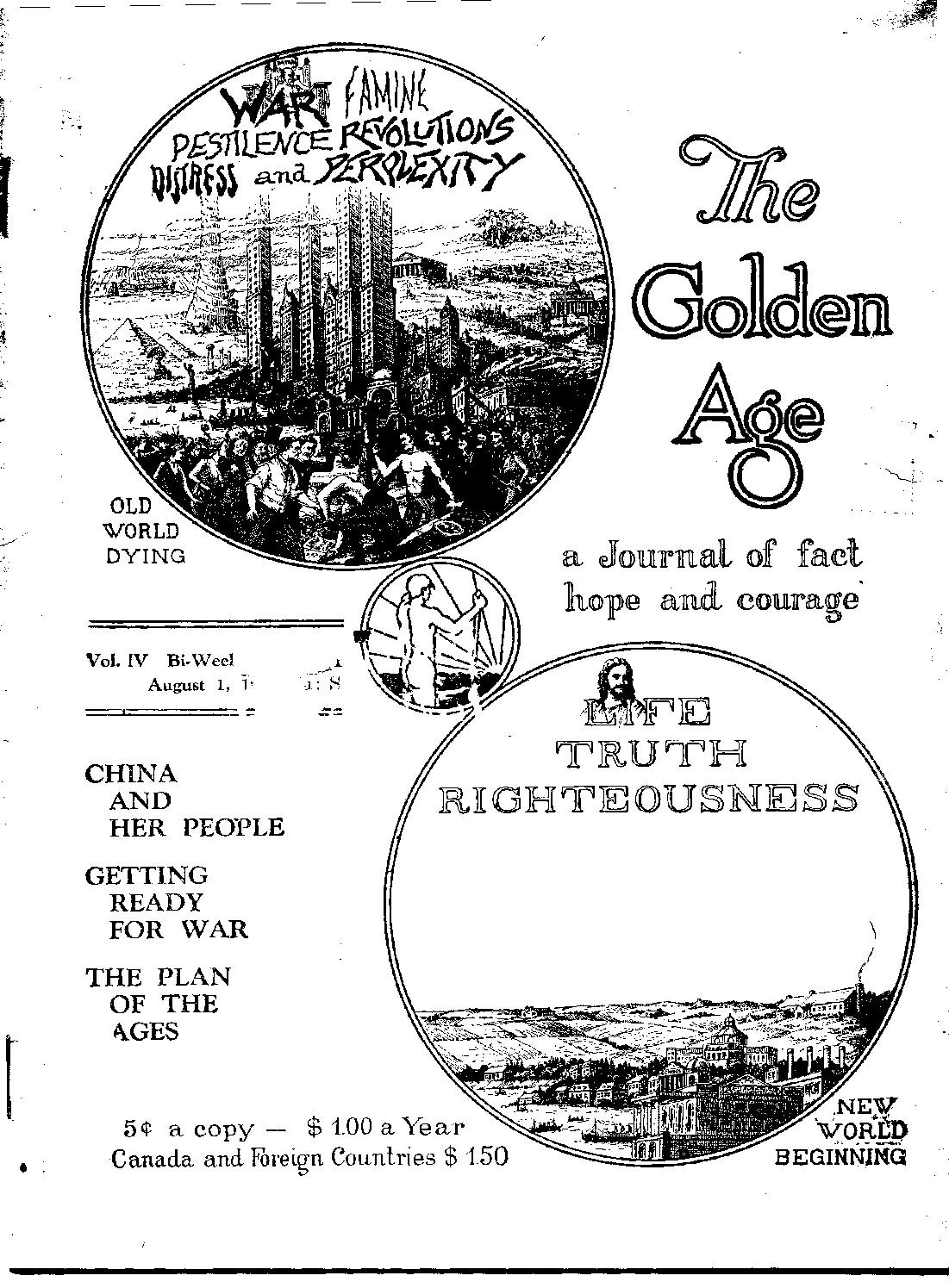
Contents of the Golden Age
Political—Domestic and Foreign
China and Her People (Part 1)
Devastation of the Streams
China Highly Civilized
Business Interests of China - .
Trade-Unions Springing Up
Transportation Facilities Inadequate
The Chinese Labor Problems
Work Done by Little (Jiris
Finances and the Public Debt
China’s Capital Corralled
The Siippns'al Capital of China
Cokhknt Events
Other Transportal ion Items
The AV heeds of Finance
Bonus Men and Bankers
Betting Beady for War
France, Germany, TP-msia. Briiain. F;<-.
The Prohibition Question
Notes on the .Indicia ry
The Progressive South
American Politics
Science and Invention
Caring for the Sick
Earthquakes and Volcanoes
Rome to Rulo the World?........... .
Going Up! Going Down ’
CUAZYLAND ON THE LOONEY I’lKE I I'ncni )
Reports from Foreign Correspondents...........
From England
JiELlGlON AM.) .Plltl.osor.il Y
REPORT/NTr Jl'DGE RlCJ n EumxD'.s La< ji I::-;
The Plan of the Apes
The Light of the Woki.ij
Heard tn the Office (No. 9i
Studies in “The Harp of God”
Published every other Wednesday at IS Concord Street, Brooklyn, N. Y., C. S. A., by woodworth. iiiFiiMis a martin
Copartners and rropri-lors A'hl>-<'ss: ns foncorr! Eir>ct, Brooklyn, N. A'., r.'. N, A. CLAYTON J. WOODWORTH . . . Editor ROBERT J. MARTIN . Business Manager c. E. STEWART .... Assistant Editor WM. F. lit DG1NGS . , Secy a nd Trcas. Five Cents a Copy—$1-00 a Year Mark Remittasces to THE GOLDEN AGE FOREIGN Offices : British.....34 Craven Terraco, Lancaster Gate, London AV. 2
Canadian........ 270 Dundas Street YV., Toronto. Ontario
Australasian ....... 495 Collins Street. Melbourne, Australia South African ...... 6 Lelie Street, Cape Town, South Africa
Bntered as second-class matter at Brooklyn, N. Y., under the Act of March 3, 1879
China and Her People—In Four Parts (Part One)
CHINA may be said to be the land of exploitation. “She has grown for centuries from a vigorous youth to an overlarge, sluggish nation with untold wealth lying at her feet, lacking ambition and energy to grasp what is within reach. And with stoical perseverance she stands idly by and watches the daring and avaricious White man come in and bag her resources, enslave her people, and make way with tin; spoils. But it is time for China to wake up; and wake she must.
In tracing the peoples of earth it is not necessary to go farther back than the Flood, which was almost 4,400 years ago. The race thereafter sprang from three heads: Japheth, the progenitor of the Whites, who went west and north, and settled throughout Europe; Ham, the forefather of the Blacks, who went south and west, settling in Africa; Shorn, the ancestor of the Hebrews, who was undoubtedly the head of the eastern and northern races of Asia. It is not likely that racial distinctions were as great then as now; that in the beginning there was much intermarrying is also probable.
There is a tradition among the Chinese that the first man was Shum, who can easily be identified with the Bible Shorn. It is believed that the peaceful king who subdued Egypt and built the Great Pyramid about 4,100 years ago was Melchizedek, who was none other than Shorn. Leaving Egypt as peacefully as lie entered it, he moved his band north and east through Babylonia and Assyria, settling in Asia. Now and then families or bands would ’drop out and form roving settlements, generally pushing eastward. From Shorn sprang tlio Tartars, Mongolians, Chinese, Japanese, Filipinos, Eskimos, American Indians, and the aztecs of Mexico.
China was called the “Celestial Empire” because her first emperors were “heavenly” deities, or descended from some deified personage, as is the traditional origin of rulers with most heathen nations. Also, China has been known as the “'Flowery Kingdom,” not because she has so many varieties of wild and tame flowers, but because she is “the flower of kingdoms.” Having been shorn of so much glory, she is now struggling to learn to walk as a republic. With a great future before the Chinese people, the next few years are sure to be filled with more or less perplexity and agitation; and it would not surprise us if, in the remaking and remodeling of the nations in the ushering in of the Golden Age, China would take a most important position.
Distribution of Population
CHINA is a vast territory; counting Manchuria, Mongolia, Turkestan, Tibet and China proper, it covers an area of 4,300,000 square miles, an area considerably larger than either Europe or the United States. In latitude, Harbin corresponds with Minneapolis, Peking with Philadelphia, Shanghai with Mobile, and Canton with Havana, Cuba. The population is estimated at 350,000,000 to 425,000,000. The most conservative estimate of the distribution is as follows: Manchuria 18,000,000; Mongolia 3,000,000; Turkestan 3,000,000; Tibet 3,000,000; China 323,000,000. Six-sevenths of her population live in one-third of her area, the southeasterly section, and are fairly well served with waterways. China has a coast line of some 2,000 miles; the mainland is made up of a series of parallel river plains running into the Pacific ocean. At the head waters of these rivers there are hills and mountains and vast wastes of unexplored country; the lower valleys are broad, fertile, and thickly populated. Into these the White man has pushed his way. China’s great cities are built along the rivers and harbors. The greatest canal in the world is built 100 miles inland, connecting the sHoang-Ho and
•7&
GOLDEN AGE
Yangtse rivers, and is 1,000 miles in length. No nation in the world is better watered.
Like the United States, China has a great Northwest. This Northwest is beckoning for a man; eventually it will find its J. J. Hill. The ^railroads will pierce this vast territory, and give the young men there a chance to go west and grow up with the country. Our “wild and woolly West” is therefore not the only one. Wild animals, wild birds, wolves, antelope, etc., are numerous. Mongolia is a dark and gruesome place; an explorer some time ago brought from there over 2,500 zoological specimens. As the Mongols never bury their dead, it is not uncommon to see thousands of bands of semiwild dogs devouring the human dead. Tt is unsafe to go anywhere unarmed, and to venture out at night is suicidal; for unlike the cat, you’ll never come back! The toughness and gaineness of the wild ass in Mongolia is described in the fact that a handsome specimen was run down, going over thirty-five miles and at times at a burst of speed of forty-five miles an hour. After being caught, he was rubbed down, washed, photographed, and turned loose.
Devastation of Streams
AVOC is sometimes played by the streams of China. Defective transportation facilities and floods destroy millions of Chinese. Every few years other millions perish in their river floods. This is one of the reasons that China’s population does not increase. For the past fifty years her population has been estimated at near 400,000,000. But, notwithstanding, the great plain'of China continues to be the richest farming land in the world. It is interesting to know that the loess, or fine silt, which makes the fertile plain, and incidentally causes the floods by forcing the river to build itself above the land-level, comes by the airroute from the great desert of Gobi. It is this wind-blown desert that is at once China’s joy and China’s sorrow—the source of her food supply and the destruction of her population. This plain is a little larger than the semicircle of the Gulf States; yet it supports about one-half of China’s great population.
China has her “Isle of Patmos,” her place of exile. About 500 years ago three small families were driven into exile in a barren mountain pass, supposedly for being traitorous to China. They were supposed to have died, being unable
VtOOKLYK, V. Xa
to find food. But they found food and lived on, increasing in numbers, until they now have thirty medium-sized villages. The quaintness of the Chinese dress, the manners and habits of 500 years ago are still preserved by these people of the “Hidden Valley.”
Differences in the Yellow Race
S THERE are wide differences in the White peoples of earth, so we find in the Yellow.
While Manchuria is not a part of China proper, it is much more intimately related to China than Mongolia. There is as much difference between the Manchus and Chinese as between the Chinese and Japanese/ But Manchuria and Mongolia are no longer looked upon by the Chinese as dependencies, but as integral parts of the Chinese Republic; and there is a sensitive ambition to exercise national control over these two important regions. Japan dominates the economic development of Manchuria, due to the control of the South Manchurian Railway. "When Americans sell machinery and other merchandise to Chinese in Manchuria there are delays, holdups, and mistakes made so that buying from others than Japanese becomes very embarrassing. China is learning what it means for outsiders to control her transportation. The-twenty-five-year lease on this railway expired last March, and China demanded that the road, 1,000 miles in length with its feeders, be returned. But Japan flatly refused to heed the demand; for in 1915 the treaty, which has become famous for its twenty-one points, extended the control of the railway ninety-nine years longer. This treaty was forced upon China, and no doubt Japan will try to hold her unfair advantage.
That China is awaking and trying to avoid being imposed upon longer is evidenced by the fact that early in the year the Chinese Parliament passed a resolution through both houses declaring that the treaties of 1915 were abrogated. Before this, Wang Fu, a member of the Washington delegation, resigned when he saw how China was being trampled upon with apparently no means of redress. Alfred Sze, minister to the United States, who seemingly sees matters from the financier’s viewpoint, reported that China was having a fair deal. Both of these gentlemen were candidates for Minister of Foreign Affairs in the Chinese Cabinet. Wang Fu was promptly chosen. Thus China
‘a
snaps her fingers defiantly at the Hughes brand of international justice.
[. Relations between China and Japan are intri-
cate and complex; and the way the tangled skein is unraveled may depend upon the brand f and quality of gunpowder the Powers deliver on order, or upon the cunning of the politicians * in inciting banditry to harass and embarrass the government. The astute, oily character of diplomacy of the Powers, especially in view of the understanding which the Powers have had with Japan, will have much to do with the outcome. Some well-posted men say that Japan - has a spirit of conciliation toward China; that there is not liable to be grievous trouble; that Japan is even now retrenching in Manchuria and gradually relinquishing her hold, but seeks to retain her trade relations and keep out Western competition. But this statement may be and probably is the adroitness of diplomacy concealing the truth.
Isolated for Centuries
RATHER than be in the limelight and pander to pride China has of her own choice been isolated, a hermit nation. Her geographical setting has contributed to this end. The Mongolian deserts formed a natural barrier on the north; the impassable Himalayas have been silent sentinels on the west; the sea and the oceans swept her southern and eastern boundaries. Thus hemmed in, she has developed a unique civilization which has seemed to the Chinese superior to that of other nations.
When nations came knocking at her doors China was annoyed, but not alarmed. The Portuguese came first in 1517; next came the Spaniards in 1575; the Dutch in 1622. But these touched only the fringe of the hermit giant. It remained for aggressive England to assume the right of breaking the shell of China, and in 1793 a party of Englishmen ventured in boats to Peking. English diplomacy failed then to establish an embassy, as was also the case in an effort made in 1816. What suavity could not do, gunpowder accomplished. The seizure of opium belonging to a British subject was the excuse England had for declaring war on a helpless, overgrown, dull youth; and of course the Lion was victorious. By the treaty of Nanking in 1842 Hongkong was ceded in perpetuity to Great Britain; and the ports of Canton, Amoy, Foochow, Ningpo and Shanghai were opened to foreign trade.
China was greatly concerned at the brazenness of the “barbarians/7 Causes of friction multiplied, and a second war in 1858 conipelled China to open up the Yangtse to foreign trade. England kept plowing up the fallow grouftd and succeeded in her objective—the establishing of diplomatic relations with the Imperial Court, having the treaties so worded as to cause no ■ offense—in England. China from then on has been plundered, exploited, deceived, and robbed by the so-called “Christian77 nations of the < world. To her credit the United States has ; refrained from the frantic grasping of spoils. Several times the Washington officials have endeavored to get treaties through which would preserve the integrity of China and save her from complete dissolution. i
China Highly Civilized y
LAO-TZE, who lived in the sixth century before Christ, was China's first philosopher.
From the days of Lao-Tze China has been a ~ highly civilized country in all that concerns art and literature, manners and government; in fact, China is too civilized to fight in dishonest warfare. As long as scheming politicians and militarists attack China from overhead and bigoted missionaries and avaricious merchants „J| from beneath, what show has she to recover her equipoise and become independent? Is there nothing to be preserved to her peoples because she is stupid in the art of war and careless in S. the use of soap? Potentially she has been the most powerful nation of earth; her history antedates that of all other Gentile nations: and in point of numbers she could carry on a continuous civil warfare and still have enough sol-diers to make the world respect her. All she y needs is sanitary conditions to conserve the yj
health of the nation; for all the arts of modern warfare could soon be learned. « x
In the remote past the Chinese must have « 3
been an inventive race; for many things are credited to their skill, such as gunpowder, the * mariner's compass, printing, etc. But today they arc awaking from a long slumber; they must bestir themselves if only as a means of self-preservation. The encyclopedias say that opium has been the great curse of China. What a crime indeed it has been to compel her, a -3 nation unschooled in the ways of gunpowder ”
ehurchianity7, to accept at the point of bayonets all the opium that the cargoes of the world's “civilizer” nation could dump on her shores! Perhaps it was opium that put her to sleep. Since about 1906, when importation of this drug into China began to be stringently curtailed, the people have been arousing from their lethargy.
China’s Great Resources
VERY country has that in which it excels.
China has inexhaustible beds of porcelain earth, the basis of her industry in chinaware. Gold, silver, and copper are found there in limited quantities; coal in abundance, also mercury and iron. Sho abounds in seven hundred or more kinds of birds; two hundred species of mammals, including the tiger, leopard, bear, badger, elephant, and rhinoceros. The rivers teem with wild ducks, geese, swans, and pelicans. Fish are exceedingly plentiful, and the cormorant has been trained to catch fish. This is sometimes shown in movies: A ring is placed around the neck of the cormorant so that it cannot swallow the fish; it dives from the prow of the boat, catches the fish with great skill, and brings them up in the pouch under its lower mandible.
Our goldfish are from China. The varieties of trees and shrubs are said to be wonderful; some are of great value, notably the tea plant and the .mulberry tree. The silkworms feed upon the latter. We are indebted to China for many varieties of flowers and vegetables. Some of our chickens are known as Asiatics- Chinese silk outlasts that from any other country7, through either a better way of feeding the worms or a greater dexterity in handling the silk in the weaving—possibly both.
The farms average one acre, and eighty-five percent of the people are agriculturists. In the north the principal crops are wheat, sorghum, millet, corn, cotton, sweet potatoes, and vegetables; in the south are rice, sweet potatoes, sugar, cotton, mulberries, and vegetables. The Chinese are not strictly a rice-eating people; for there are over 50,000,000 who eat no rice.
Vast areas, rich in natural resources, await railroads and settlement for development. The Chinese are industrious; but not having an inordinate love of money they do not take to building railroads and other commercial enterprises whereby their money may work while they sleep. They practise intensive farming. When the hillsides are too steep to cultivate -they convert these into huge stairsteps, making suitable for gardening all the land possible. Hence they get the largest yield per acre of any fanners in the world. The principal indus^ trial centers are Tientsin, north; Shanghai, center; Canton, south.
Business Interests of China
ILK production originated in China many centuries ago, and for a long time remained a secret with that country. Nevertheless the failure to readily adopt modern methods in production and manufacture has caused the Chinese silk industry7 to be surpassed by that of other countries employing more efficient methods. Hongkong ranks first in the knitting industry, the machinery of her mills having been imported from America. Owing to the increased demand for cement in construction work, a company capitalized at $3,000,000 has been formed to erect a cement plant at Shanghai. Another factory lias been established at Nantungchow to make lime from the shells of oysters and clams.
In 3918, the General Edison Company, finding freight rates extremely high to the Pacific coast and the breakage something terrible, decided that they would try making their electric lamps, globes and bulbs in China, and do their shipping over the peaceful waters of the Pacific rather than over the railroads, with their rough : handling, in America. The bulbs made in China . last fifty percent longer than those made here, and the cost of labor is $4.50 in America against sixteen cents in China.
The openings in China for American trade j are illustrated in the Foochow district, where small-type machinery has been sold for manu-factoring hosiery and cloth, and for hulling and polishing rice, pumping, etc. Electrical machinery, electrical goods, small electric light plants^ dyes, paints and chemicals are in de- . maud; and there is a good market for cotton piece goods. One authority says that the results of the World War have been to make Europe and America undesirable fields for the captains of industry; for returns are insecure, and sub- J ject to ever-increasing taxation. Thus China -looms as a veritable El Dorado. >
Some expect that sooner or later American ;;
industries will be moved to China, and the procU acts therefrom shipped back here to be sold in competition with American labor. In fact, this was the threat in 1921. This is the extent to which big business is prepared to go to reduce the workingman here to conditions bordering on peonage. The blame will be fastened on labor. Should this come to pass, we must not look upon it as a sordid scheme for profits, but as the highest form oE altruism known to man •—a sacrifice for the larger good, that ultimately the trade between the United States and China might be increased!
Trade-Unions Springing Up
NORMALLY, business in China is almost a social institution, and the important affairs are transacted at the dinner tabic rather than elsewhere. The merchant is a heavy buyer, respects his obligations, is guided by dictates of conscience rather than by law, is not accustomed to provide letter of credit with order, 'does his business over the teacup rather than the telephone and, ordinarily, is friendly to American people and things.
There is at the presemt time over a million and a half spindles, utilizing about 225,000 tons ■ of cotton yearly. If the rate of increase keeps up, and internal strife ceases, China could make enough cotton to supply the demands of the world. But American labor has nothing to fear on this score; for trade-unions are springing up, especially in the South, with remarkable suddenness and vigor, and also it is said that Bolshevism is making rapid headway among the more intellectual clashes. Keen competition to exploit the resources and wealth of China is manifested in the rivalry of some of the “Christian” nations. This has come about by the "Open Door” policy, which throws the door open to the West, but not to the East.
Some reports indicate the rising of an industrial system in China, the worst in the history of the world; unbearable conditions are reported in the factories. Children, nine years of age and up, are employed by the tens of thousands, because their parents cannot afford their keep. Miners work ten hours a day, seven days in the week, and sometimes are flogged by overseers; and the pay is about eight cents a day. These low-paid workers are forming unions. Employes in iron foundries work from thirteen to eighteen hours a day, and the skilled among
them get about twelve cents a day. It is hardly to be wondered at that they strike, and demand ' shorter hours and increased pay. 1 J
The railroads often employ girls and ^oung married women as ticket clerks and bookkeepers. Even the richer among the women, wno do ■ not necessarily have to work, are now taking ; up manual labor, such as light work in factories, making towels and socks, etc. They realize that employment brings health, more happiness and a measure of independence which they could not enjoy otherwise.
Transportation Facilities Inadequate
EARLY in her history China made use of her abundant waterways, and these have served * well. The Chinese are building ships. At Shanghai is a large shipyard operated by the s £ Government, but its engineering problems are superintended by Englishmen. The workman-ship is high grade, and a number of these ships are used by the American Government in Philippine waters. The waterways and rivers are ~ delightful, and houseboats are numerous; thesa 3 a? e well provisioned, and a cook is always taken along. The oarsmen stand to propel and guide < the houseboat. Life on the river is filled with peace, quietness and repose; and Mother Eartk supplies a scenic beauty of landscape that if charming. Much freighting is done by water.
The Chinese coolie comes in for his share, -In some places in the interior it is not uncom« mon to see much traffic on the roads; two- and' three-mule carts, carrier coolies, mule litters, " i ox trains, camel caravans, sedan-chairs and, 3 most of all, wheelbarrows. Sometimes there may be two men at a barrow, and ofttimes the load weighs over 500 pounds—one man at the handles hanging the load from his shoulders and the other hitched in front pulling with a rope; and the roads for hundreds of miles may ~ * be rough enough to make travel for a horse t difficult. Imagine the sweating and fatigue ofl body, the unhappiness of mind, and the aching void after feasting on a bowl of rice or maea- '3
roni after a hard day's work, then dreamily \
and wearily falling to sleep in the inn court- , yard with the pigs, chickens and mules, without a bath to cleanse away the dry sweat and dust; all this for about eighteen cents, Ameri-can value. But this is merely one phase of the . * Chinese life; America has its correspondencies.
'-<•3
Enormous Engine in China
AILROAD building is constantly going on in China, and roadways for automobiles. American coaches, engines and cars arc in demand. Not long ago the largest locomotive ever built was sent to China; it weighed over 300,000 pounds, and the engineer’s seat was ninety feet from the cowcatcher. The “good roads1' movement has opened up the market for autos with renewed vigor. About 4,000 cars are in Shanghai alone.
One of the largest orders placed by the Chinese Government for American locomotives was in 1921., when forty-two engines were contracted for at a cost of $2,000,000. Three hundred freight cars were ordered about the same time. Recently the Tientsin-Pukaw railway, the most important north and south trunk line, bought five complete American railway passenger trains of eleven cars each, including dining, parlor, and sleeping cars. Evidently investment in commercial and shipping activities for American capital is unlimited; for the Western ideas are that the development of the railroads there should reach the enormous sum of $5,000,000,-000—about three times what it now is.
It may be that China will find it to her best interests not to encourage railroad building too much. If she should acquaint herself with the controlling powers operating our transportation systems and find what an uncontrollable and intricate piece of machinery it really is, perhaps she would see the advantage of going slowly and building her roads with her own capital, thereby enabling her to run the railways for the benefit of the people instead of for the enrichment of the investors. But maybe the automobiles and the flying machines will, from now on, check the growth of the railroad business. The Chinese are learning aviation. They have a school in Victoria, B. C., and ten made initial flights in February and did exceptionally well. When they have passed their examinations, they go to China and engage in commercial aviation there. This school is said to be the only one of its kind in North America.
The Chinese Labor Problems
URING the World War the increase of industries along the Yangtse river in
factories, power houses, spinning, agriculture, commercial and fishing enterprises totaled 167; and the aggregate increase in capital reached over $80,000,000. To keep these and other industries going many young people were pressed into the labor ranks. Like other countries the lower classes of physical laborers, whose living is from hand to mouth, have been exploited for a long time by the landowners and capitalists* The uneducated and propertyless classes multiply and overproduce their kind as compared with their richer brethren. The average family in the north consists of from eight to nine chiL dren; in the south, from five to six children. The servant work is done almost entirely by the maid servant employed by rich families* Servant employment agencies work their nefarious game of extracting a fee from both servant and employer, sometimes as much as twenty percent from the employed.
There is a coolie class among the women. Some are really slaves, and do not know it* They work in the fields; they help coal the ships, and do other hard manual labor. They carry huge loads. They have raucous voices and shout epithets at each other as they pass, and occasionally show their relationship to the same class of women elsewhere in the world by being ready to scratch one another and pull each other’s hair.
There are men, women and children, the toilers, who are nearly forgotten when the upper crust fight for “privileged” rights which these never had. These toilers carry the burden ofi sustaining day by day the machines and mills which marlf'the transition of China’s society into the realm of modern snobbery. But sometimes they are forgotten too long, then thud— conies a strike. This group has raised its voice time after time the past year, and forced itself to the front,' compelling attention to its real rights and needs; and in some places its power commands deference. Most of these strikes centered around Shanghai, the most prosperous city in China. The high cost of living, one of the unavoidable chronic diseases necessarily rooted in the capitalistic system of production, jjitilessly gnaws at the proletariat, the poor wage-earning class. Prices go up, and the life of the laborer is sapped until he cries for mercy. He is appeased. The machinery starts its grind anew; and when the upper and nether millstones again come together, there is another cry for mercy. So the merciless conflict goes on and on and on.
Work Done by Little Girls
A CLOSE-UP on the profiteer may be interesting. In the silk thread mills of China are employed 90,000 women and girls; one-third of the latter are children. They work thirteen hours a day, with one hour off at noon, seven days in the week; and during the rush season they are compelled to work fourteen hours. The hardest work is done by little girls eight to nine years of age, who stand all day at basins of boiling water putting in cocoons and baling them out with dippers. Often they cannot get the cocoons in that way, and so the ' hands must be used to fish them out. Labor-saving devices in Italy are so constructed that it is not necessary to touch the boiling water; but not so in China.
In the past the apprentice at iron and steel workshops worked sixteen hours a day, and got nothing for it; he was poorly taught so that he would last longer—as an apprentice. Farm hands have been getting about live dollars and their keep a year. But labor conditions are rapidly changing for the better; the Chinese laborer is learning to strike. The monumental gall and rapacity of the employer will stand out in glaring and frightful colors shortly, after the reign of righteousness under Christ begins, when He shall bring the laborer into the proper light. Let the employer get the view now, by exchanging places for the moment, and ask himself how he would like to be treated if the tables were turned.
Finances and the Public Debt
WHERE in all the world are the finances of a country in such a muddled condition as in China ? Her case is hopeless; for her leading men are not financiers, and it is not to be hoped that they could cope with the astute White man. The total indebtedness of China is over $2,000,-000,000 of which about $500,000,000 are without security; and at present she is in no condition to make payment. This worries not only the Chinese but the financiers and economic experts in foreign countries. These outsiders are watching the civil strife and trying to protect their interests. According to some, this debt is negligible when the resources are taken into consideration. This latter statement is designed to encourage the Chinese to go still further into 'debt by a billion or so, that the coffers of the lenders may burst with the usury to follow.
The Chinese Consortium (an organization of foreign banks) was formed to assist the Chinese and to liberate them from poverty by loaning money for various purposes. Like the Federal Reserve, it is a pieans by which finan-cialdom may tighten the fetters which bind, and wield the power which money always secures. The Consortium is a legalized international looting machine by which the Powers may jointly exploit China and drain away her resources. Last year the Consortium declared that China must put her house in order, establish a responsible government, stop civil warfare, demonstrate her power over the provinces, and prove that she can conduct herself in an orderly, businesslike manner, before she could borrow more money. When China has internal strife she may obtain no money; but when she is good and obedient to her masters, the banking groups of America, England, France, and Japan are prepared to let her have the money to construct her enterprises, build her railroads, etc.—at so much per centum.
American Banks in China
rpiIIS Consortium, whose main business is to keep China docile, was endorsed by the Harding administration. It involves an international bankers’ pooling of funds and power to supply China with needed public utilities; as she lacks the money to absorb the overproduction of her friends—the people of the countries of the money lenders! A writer on this subject says: “If the American bankers who occupy the dominant position in this pool shall apply to China the spirit and methods by which they have exploited transportation in this country, we may be sure that the friendliness of China will Qiot continue/'
There are three American and one Chinese-American bank organizations in China. And these banking institutions, together with the big Consortium, as we might expect, are not there doing business for their health.
The Consortium's American representatives meet in the office of the J. P. Morgan Company whenever there is any discussion of China’s financial problems. Always there is the scheme of the money lenders to bring about something which shall involve the victim nation in embarrassment, to draw her into debt; and nothing has succeeded so well as war.
China's Capital Corralled
IN ALLOWING the grabbing of her finances
China shows imbecility were it not for the fact that she would rather be abused than take to arms. Iler people cannot help seeing that they are being imposed upon, but they are submissive and suffer it. This is really a commendable trait, and in the end will work out for the good and glory of China. Some sweet day, not so very far off, justice will dominate the affairs of earth.
; The principal revenue-producing agencies of ; the Chinese government arc the maritime customs and the "salt gabclle,” as the salt revenue administration is popularly designated. These are largely supervised by foreign officers employed by the government, and the yield is about $100,000,000 a year. The direct import and export trade is almost entirely in the hands of non-Chinese 'merchants; ships trading in China ports are largely of foreign registry. How would you like to have your business supervised by men of a different race I
Upon the formation of the first international Consortium in 1913 a loan of $125,000,000 was forced upon the Peking authorities to reorganize the finances of the newly-established republican government. As security, the annual receipts from the tax on salt ($80,000,000) was accepted. The contract between the Chinese government and the loaning group, consisting of British, French, German, Russian, and Japanese banks, provided that the system of collecting the tax on salt should be modernized (something the Chinese can hardly understand) with the assistance of foreign advisers. Production, transportation and sale of salt in China are strictly limited by treaty with the foreign Powers to natives of China.
Robbing Done “Legally”
THE salt belongs to China; it is sold to her own people; a tax is put upon it to appease the wrath of the foreign Powers; the revenues are handled by agents of the foreign banking interests to insure payment; and no human being knows how big a steal the salt business of China really is. And as foreign officers handle the revenue derived from maritime customs it is hardly to be wondered at that China is financially embarrassed. China is systematically being driven to the poorhouse.
The international bankers who have taken an
interest in the affairs of China express grave V concern about the. financial future of that country. A crisis is near at hand; and the Chinese ' bankers being hard pressed for funds are try-" ing to borrow from their friends in America and England; but banks which advanced credits on Chinese collateral are becoming restive and in many cases business relations have been broken off. The trouble is, the financiers are a beginning to see that there is no real govern- j ment in China, that rival factions continue to wage war for personal enrichment; and they < are afraid there will be a division of the spoils.. ■ with themselves left in the lurch. A recent J London advice says in effect: That for years | all the foreign capital loaned to China has been j utilized for munitions or corruption, and that such bonds as are secured on the Chinese Cus- * toms receipts can no longer be regarded as safe/ J for even the British Navy cannot compel people j to import goods they cannot pay for; therefore g all holding Chinese securities of all kinds should ] sell them for what they will bring. <
Sometimes we hear that China's greatest peril is Japan. The greatest peril of China is : the professional Chinese politician who, having learned the Western tricks, plays into the hands of the Japanese and is willing to sell : China’s independence, resources, labor, and : everything to Japan or anybody else, if he can . ; thereby line his own pockets with gold.
Interesting Items of Cities
NEARLY all Chinese cities are electrically
lighted; the better class have their elec- ; trie irons and washing machines. There is " rivalry between some of the towns in the mat- ' ter of electric light plants. Each tries to outdo J the other; and if a town in an obscure district gets an electric plant the neighboring towns im- J mediately put up a better one. Nantungchow prides itself on being the “model city of China”; :
besides electric lights it has over a hundred ’ miles of hard-surfaced roads, 300 primary j schools and over 20,000 students. The city proper has 150,000 population and the district S over 1,500,000. It is a great cotton center.
Many of the cities are built within high and -> strong walls, which apparently go through and "1 over every obstacle. Tn the construction ofl these walls great stones are often used which > lie along the paths of farm gardens, being geo* :< metrically laid out, and presenting in many in* * .j|
-■
683 J
■ S:-.;
stances really scenic and architectural beauty. In nearly every city, fine old Chinese homes and slums seem to be mixed promiscuously. A strange custom is to have one’s home in one part of the city, and his tea house and labyrinthine gardens quite remote from his residence.
Shanghai, strictly speaking, is not a Chinese city; it is the melting pot of the Orient. It is not much unlike a large city in the United States; for all the modern conveniences are to be found there. It has about 700,000 population. English is taught in the schools, and some of the brands of "Christianity” are said to flourish there. The East and the West, barbarian and sinner, rub elbows in Shanghai. Along the water front it is not unlike other ports; there are Japanese, Chinese, American, British, French, and Filipino business sections. Over the city fly the flags of many nations. Six- and seven-story buildings mark the prosperity, and * are indicative of the possibilities of the future. Nanking Road, the Mecca of the tourist, has its American, European, and Chinese shops in rows; and the climax is reached when the traveler comes to the two department stores where the goods of the East and the West mingle indiscriminately, as do their customers. Through the streets the British tram-car clangs along, rickshas scurry, motorcars wend their way, and horses with human freight dodge here and there.
Shanghai has its games, gardens and sports, movies and playhouses, gambling and other dens. It is said that because the streets are crooked we are not to conclude that they follow the proverbial cowpaths as in America; but because the evil spirits of China travel in straight lines, the streets are constructed in such a way as to avoid them. Likewise the entrances of some of the houses are zigzag—to fool the spirits and cause them to strike their heads on some obstruction. Native guides throng the entrances of the city and insist on directing the visitors, expecting to have their "mitts” greased liberally. The streets are so narrow in places that it is impossible for the sun to peep in; but the populace jostles its merry and gruesome way. A juggler entertains in the courtyard; a hawker sells whirligigs; the jovial beggar gets his handout; a Buddhist . priest chants and burns incense; and paintedfaced damsels sing in the restaurants. "Shanghaied” in China means the same as "Buffaloed.”
The Supposed Capital of China
PEKING is not a rice-eating city; it is
famous for its wheat bread and noodles,
its duck, and many succulent green vegetables unknown to us. Peking is supposed to be the capital of China; its district has a population
of about 1,000,000; of these but 1,000 are Americans. Foreigners are not permitted there with--out passports; for this reason it is called the "Forbidden City.” The streets are a continuous carnival. The house fronts are gay with lac- ■
quer and a medley of signs and banners. The
cries of peddlers fill the air. Barbers do a thriving business, equipped with stool and char- ‘ coal burner. Street sprinklers do their work
with a bucket and long-handled wicker scoop.
Food venders balance a complete restaurant on
each end of a long pole and swing along, look-
ing for customers. Pedestrians are lost to sight under their bundles, which they carry on their
heads; and all giggle and chat on meeting an
acquaintance. To a Westerner everything seen is curious and amusing. The funerals resemble
gorgeous circus parades. There is no social code on the streets—-simple manners, courteous recognition, and suave hospitality everywhere.
Childhood personality is respected, and unac- fl coinpanied children in the parks are in no danger.
The walls of the “Tartar City,” North Peking, with its palaces, temples, pagodas, and
bridges are most beautiful. They can hardly be said to be a protection in time of war, but
sometimes they protect life in civil strife. There is room for promenade on the south wall. The gate towers, crowned with their gorgeous tiles,
which glisten in the blaze of the unclouded sun-
shine which Peking enjoys for the greater part
of the year, lift themselves at regular intervals
above the walls, and span, not mere holes, but
splendid archways.
Some wealthy people, born in New York, now
living in Peking, prefer the Chinese city. In New York servants are hard to get, they are hard to manage when you have them, their -wants are never satisfied, and their afternoons -
off come always at inopportune times. In China
the lady has ten servants; they are obedient,
careful, solicitous, always on duty, and provide their own food. And the markets in China pro- .
vide all the staples demanded in America with
many foreign additions.
Current Events
BY THE time this, is published we shall probably know whether or not Captain Roald Amundsen has started on his projected airplane flight from Point Barrow, Alaska, via the North Pole to Spitzbergen, 2,800 miles. If successful, we may even know of his success. The flight will be over seas and ice-fields without any prominent points by which the route may be fixed. [After making his test flight, his expedition was abandoned.] Unless the sun is visible all the way the flight must be by compass, in a region in which the compass changes very heavily. In case of contrary winds there are great dangers of missing the North Pole and Spitzbergen. Constant sunshine, no fogs or clouds, no winds and perfect machinery may grant success; the chances are against it.
Flying 1,400 miles between Houston, Texas, and Mt. Clemens, Michigan, in eleven and one-half hours, Lieutenant H. G. Crocker in the latter part of May made his way through twenty-nine separate and distinct rainstorms. For an hour of this time he was above dense clouds, flying by compass, until finally he found a rift through which he could pass to the under side.
Professor Raimond Nimfuhr of Austria is said to have perfected a stabilizer for airplanes, likened to the antennae of insects, which automatically corrects errors of pilots, #so that the machine remains in steady flight regardless of the disturbances encountered. The device is said to make an airplane practically fool-proof.
In every quarter of the world the big nations and the little ones are buying airplanes and training airmen. Siam has 300 trained pilots. All the South American countries are prepared to do battle in the air if they should go to war tomorrow. Russia has bought large numbers of Italian and German airplanes and is known to have many German pilots and instructors. The Allies have done everything in their power to throw Germany and Russia into each other’s arms and seem to have succeeded fairly well. Airplane service has been established between Berlin and London. The trip takes six and one-half hours and the rate of fare is about the same as first-class railroad and steamship fare. The Germans, who were admitted to have been the masters of the air along the western front during the World War, are not permitted to have airplanes suitable for military purposes, but have made great improvements in lightweight and commercial planes. Perhaps they are intending to do their military aviation with machines ostensibly owned in Russia.
AM
The Duke of Sutherland, under-secretary of the British air ministry, commenting on the achievement of M. Georges Barbot in gliding across the English Channel in* one hour, says 3 that in a short time light airplanes will be in ; as general use'as motorcycles; that the ma- ] chines will be small enough, when the wings J are folded, to push through an ordinary field gate; that the price of the machines will be ] about $500, the fuel consumption will be about | 100 miles to the gallon and the instruction 1 period will cover not more than ten hours, q The day of the airplane flivver seems to be here. 1 1
Other Transportation Items
HE United States Department of Agriculture is engaged in building roads through < timber properties owned by the Government. The roads average about ten miles each in length, and are doubtless much appreciated by d farmers, lumbermen, and others who have occasion to use them. One hundred and seventy-five such projects have been completed, and at this : writing eighty-nine more are in hand.
Your uncle Henry Ford is said to be the wealthiest man in the world. -His latest auto- | mobile enterprise is the projection or establishment of an immense cotton mill in the South, j in which to make all the cotton fabrics used in the curtains and upholstery of his machines. 1 Henry will probably be the next president ofi j the United States. Go to it, Henry! ■
But although Henry is admittedly a great man he is not the greatest one in the transpor- $ tation business. Not by a long shot! Henry I would have to try several times before he could ’ I make a globe 8,000 miles in diameter, with four- j fifths of its surface covered with water two | miles deep, and set it spinning at the rate of over a thousand miles an hour, yet withal so q carefully as not to spill a drop of the water.
And when it comes to making a sun so great j that the flames shoot from its surface to the | extent of 330,000 miles in one hour, and the heat so nicely regulated that it. furnishes the . aforesaid globe with just the amount needed .3 for its comfort, Henry would have to quit, j Surely no Ford sun could perform such a task. J
August 1,1923
The Gulf Stream continues its merry task of melting the frozen North. It is cutting deep into the ice-fields of the Arctic, Avith the result that the North Atlantic has had more dangerous ice-floes and huge icebergs than in any other season for many years. Vessels are being warned to keep far to the south of the routes ordinarily followed at this season. One huge iceberg, extending over 120 feet out of water, was found one hundred miles further south than icebergs are usually found.
The Panama Canal is a huge success. Within the past year the number of vessels passing through the canal has increased from about 220 per month to about 400 per month, and the canal tolls are considerably over a million dollars per month. The transcontinental railway lines are feeling the competition, but their own net revenue is the greatest ever known.
The Wheels of Finance
NCLE SAM is wasting some of his money.
That is to say, he is importing more goods than he is exporting, to the tune of, say, $50,000,000 per month; and the bill will eventually have to be paid by the American people who are also spending large sums in foreign travel. But don’t let it worry you. Uncle Sam is just now very prosperous, and can stand these little items, although there is no doubt about his extravagance.
The mail-order houses have grown to immense proportions, but they have largely pursued a policy that will Avork for their downfall. In the effort to increase profits qualities have been sacrificed, goods have been made light weight and of skimped dimensions. Three or four inches off the length of a blanket, two inches off the width, two inches off the length of women’s stockings, excess of juice in canned goods, etc., make cheaper goods seem cheap until they are compared with standard quality goods, when discontent is sure to arise. No better way to kill an enterprise could be devised.
Sugar prices continue to rise, and the people are feeling the pinch. The housewives have been advised to boycott the sugar; but it is the canning season, and neither the housewives nor their husbands feel like seeing the fruits go to waste which otherwise might be saved and which will be needed during the winter. If some of the sugar profiteers could be canned for a few months, however, there are some
housewives who would be willing to postpone
their own canning operations.
New ways are being discovered all the time
for making fortunes dishonestly in Wall Street.
A gang of sharpers from out of town mailed
large checks to every important stock broker .
in the city, ordering purchases of stock. At
first the stocks went up; then when it was found
that the checks were all worthless, the stocks went far below what they had been. Here were opportunities for fortune-making by those who
knew what would happen. Forged letters
indicating that sound concerns were unsound, V bogus telegrams respecting receiverships, mys* > terious telephone calls supposedly from leading banks but actually from parties unknown—all ;
these and many other schemes as dishonest as highway robbery are being used constantly in V New York to sway the stock market this way or that to the schemer’s profit. If by these means y he may Sway the market ever so little, he and f his friends may make in a moment so much f money that they need not work for a lifetime.
Thomas W. Lawson, the financier, who wrote an expose of the crooked doings of many of . New York’s leading financial lights, in a book ? entitled “Frenzied Finance,” in 1904, and who / was ruined by these men as soon as they could V find the opportunity, has repaid all his debts and is about to return to New York to reenter V the Street. .
Almost all of the South American countries -f have recently been large borrowers of Ameri- ] can money, ranging from $250,000,000 to Argentina down to $7,500,000 to Haiti. In the list are Cuba, Guatemala, Colombia, Peru, Bo- ■ livia, Chili, Brazil, and Uruguay. Most of these ’ countries have pledged their taxes and tariff receipts to big business for the loans; and financial and U. S. government commissions have arranged the details of tax collection and distribution and police and military power in ; these countries in such a way that big business • cannot lose. In case of a war to collect these bills, the American people as a whole would fight the Avar, and pay for it in the people’s blood and treasure.
Bonus Men and Bankers
TN MANY of the large cities there are "bonus men” operating in connection with the banks.
A small contractor gets into a tight place and : needs money. He goes to his bank and hears a
.mm
hard-luck story about how difficult it is to get money just now. The bank tells him where he may find a man that might help him. He gets the help, at twenty percent interest, by the time all the charges are paid; and the bank gets a rakeoff. This is one of the ways of getting rich and staying rich at the expense of workers.
There are many bankers whose fortunes have been built up by this crooked bonus system, by foreclosures of mortgages on the thinnest of excuses and by stock gifts for favoring this or that concern. In other words, there are many bankers who have used the money of the people in fighting the people and fighting for themselves. Occasionally one hears of an exception, a banker who is really honest and who tries to help his fellow men; but the banking business does not promote honesty. The reason for this is that the basis upon which it rests, interest, is in itself inherently wrong.
In the effort to put Central Europe on its feet, a loan of $25,000,000 is being made by some of the largest New York banks, the Steel Trust, the Standard Oil Company, and the General Electric Company. It is not believed that Austria can possibly pay the eight percent which these bonds carry. Very evidently this is the beginning of a scheme to compel the American people to finance Europe whether they wish to do so or not. The big business interests get in first; then the politicians drag the Government in; then the press advertises the arrangement; then the preachers sanctify it; and then the people pay the bill, all of it, including the original loan.
The International Bankers have made all necessary arrangements to give Mexico a thorough cleaning. Among the things that the Mexicans must part with are the entire proceeds of the oil export tax, ten percent of the gross revenue of the railways of the country, and the entire net revenue of the railways; and they must turn the railways over to a group of the bankers. The Mexicans will be allowed to retain their eye-teeth and the hair on their heads. Meantime the recognition of the Mexican Government by our Government is delayed until the final papers are signed.
Getting Ready for War
WHEN the common people see all the greatest departments of the Government talking about- war, and when they all talk about it at the same time, it is a pretty fair indication J that something is about to happen. At least it • has that appearance.
May 25th, at Atlantic City, former United States Supreme Court Justice John H. Clarke . made the statement that a recurrence of the 'ri World War is expected in the comparatively " near future, as a result of a German-Russian alliance. He said that this is the opinion of ■ many well-informed persons. ri
May 25th, at San Francisco, Secretary of ; War Weeks said that the standing army of the ri United States is too small, and urged that it should be brought back at the earliest possible ~ date to a minimum of 150,000 enlisted men and 13,000 officers. ’
May 26th, at Newport, Secretary of the Navy Denby said that we know now that wars
between great Powers or groups of Powers
always involve many other nations, and that
“we cannot say with certainty that such a war
may not come at any time.”
May 27th, the New York Times contained an article by W. F. Full am, Rear-Admiral United y; States Navy, urging that the Panama Canal ri be supplied at once with an overwhelming air ri force and a strong submarine force composed of long-range and mine-laying boats, as well . : as with smaller boats of the quick-firing type .. ‘used with such powerful offensive effect by riri the Germans.'’ ' .y
Europe now has under aims 600,000 more ; men than she had before the beginning of the World War, despite the fact that the armies of •' the Central Empires arc 700,000 less. If one ; looks closely into this he finds that this great . increase is in the countries that border upon .ri Russia; namely, Finland, Poland, Ukrainia, Czechoslovakia, Rouniauia, Jugoslavia. 4
France is the greatest military country in 5
the world, and the most militaristic in its plans ■
and methods; and it has concentrated all its strength upon Poland. Marshal Foch, the Mar- ri shal of the Allied armies in France, is now ..-ri Marshal of Poland. He has under him the pick 5 ? of the officers of the Allies, and many officers from Germany and Austria as well. Ifoch is -said to believe and to teach that unless Poland ■ is protected from both Russia and Germany there will be inevitable world collapse. In view of the importance attaching to Poland in the ■ -day’s news we expect shortly to make a study of it and to present the results to our readers. >
1,1933
trance, Germany, Russia
HAT the next World War, when it comes, will find France on one side of the problem and Gemfany and Russia on the other is a foregone conclusion. France is depending upon officers, airplanes, and cannon. It cannot depend upon men; it has been bled white. Germany has officers, it knows how to make airplanes and cannon; and Russia has plenty of men. But millions of men can be destroyed in a short time by the new methods of warfare that will be used—airplanes and poison gas.
Every newspaper one picks up has something more to say of the efforts that France is making to force the German people to desperation. Some months ago the French seized the Krupp works, which for the past three years have been engaged in the manufacture of agricultural machinery, locomotives, automobiles, bridges, turbine engines, watches, clocks, instruments, and a thousand and one other things that men need a million times, more than they need the guns formerly made there.
When the French seized the plant, they undertook to steal all the automobiles about the place; and the workmen struck. The soldiers who had seized the plant turned a machine gun upon the workers, killing fifteen of them, and sent the directors of the works to prison for fifteen years for causing the strike. The natural effect of this throughout Germany is to make the Germans hate the French and to hasten the day of reprisals. The French seem bent on trying to force the Germans into Bolshevism, possibly so that they may have an excuse for sowing the country with poison gas and wiping out the whole German race.
The German government has tried in every possible way to make the Allies understand that she is unable to pay the amounts of reparation demanded, and has asked again and again that the question as to whether or not she can pay what is asked be referred to an arbitration court of disinterested parties. The Allies always refuse this; and Communism gradually spreads among a people that find themselves confronted by conditions which they believe they cannot meet.
Seventy percent of the artificial flowers used in America are made in Germany. The poppy is the symbol used by the American Legion to commemorate the share played by American
boys in the World War. Some of the posts in various parts of the country have been shocked to find that the poppies which they used this year on Decoration Day were made in Germany.
Britain and Other Countries
HE appointment of Stanley Baldwin as Premier of Great Britain, in place of
Bonar Law, who is too ill to continue to fill that post, is said to be due largely to his ability to produce whenever the occasion arises facts and figures, especially figures, which are convincing even to opponents. His popularity as a leader in the House of Commons was enhanced by the prompt way in which he arranged for the payment of the British debt to America, as well as by his general efficiency as Chancellor of the Exchequer. Taxes have been reduced, and a surplus is available justifying further reductions. The new government is less severe toward Russia than the retiring one.
Workers in New Zealand are voicing objections to further immigration at this time, claiming that most industries are oversupplied with labor in some of the cities, that only rarely is the supply inadequate, and that the housing situation is such that overcrowding is unavoidable. They call attention to the fact that last year public aid was necessary for many immigrants.
Peace has been finally arranged between Turkey and Greece, after negotiations which have taken all winter. When the situation seemed almost hopeless the American minister at Switzerland, Mr. Joseph C. Grew, by staying up all night and working alternately first with the Turkish ambassador Ismet Pasha and then with the Greek ambassador Eliptherios Venizelos, succeeded in convincing both of these gentlemen how very much each had to lose by renewing war and how very much they had to gain by coming to the agreement which was finally reached. Greece claims that she was egged into the war by Powers which subsequently made treaties with Turkey and left Greece unprotected. Evidently Great Britain is the one she has in mind.
…