Golden Age, July 4, 1923
Download: PDF — Golden Age, July 4, 1923
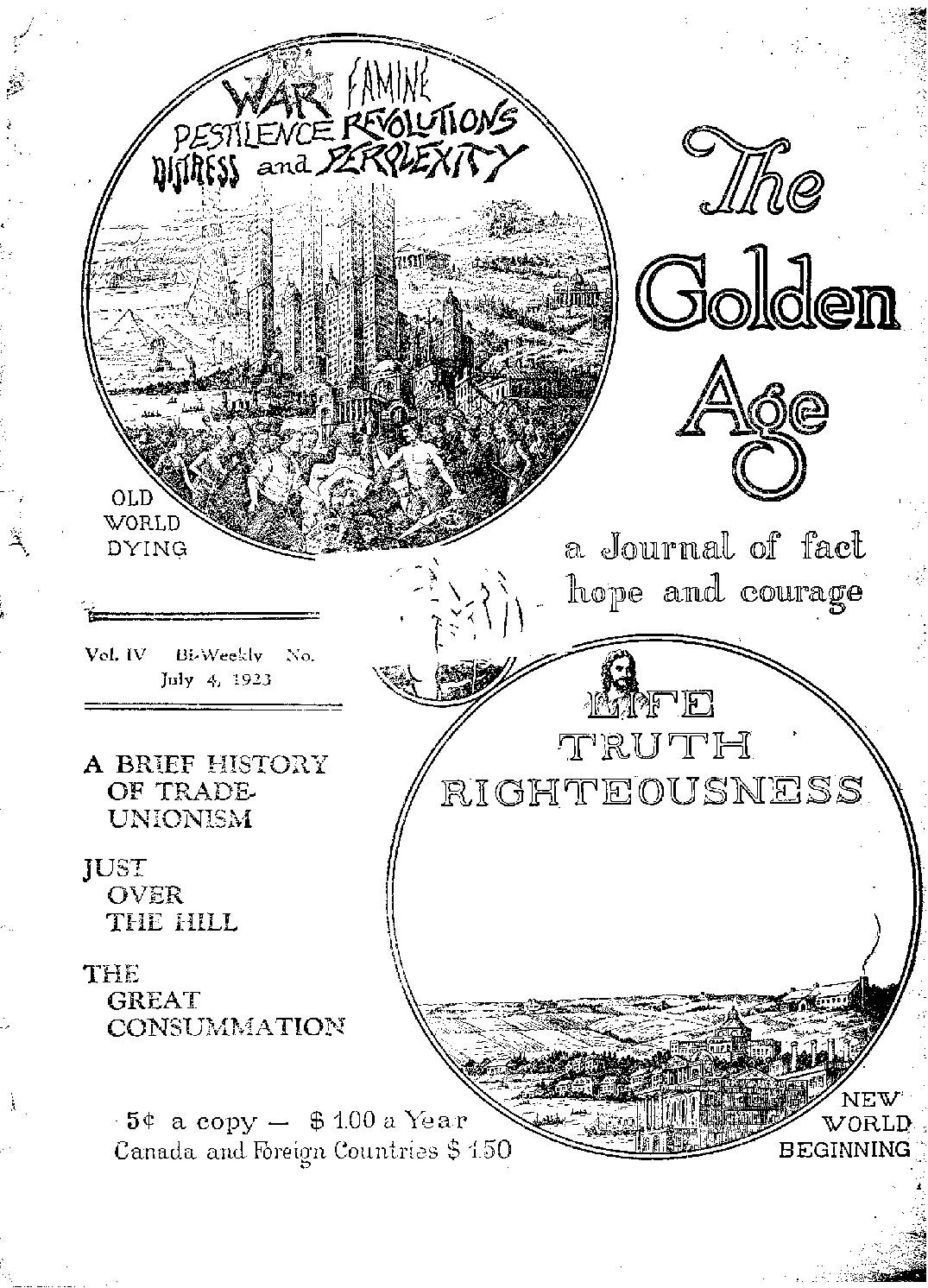
Labor and Economics
A Brief History of Trade-Cnioni.su .... Obstacles Toilers Have Met.......
Social and Educational
A Glimpse at the Current News......
Prosperity and the Nigro.........
Mining Items.............
Sugar Thieves and Other Thieves ......
Sensible Legislation and Procedure.....
Anarchistic Government Employes.....
Aviation and the Next War.......
Peace on Earth and Reparations......
Pope, League, anil Jew........ .
Britain, Russia, America . ........
Stimulants, Vivisection, Religion......
Sait, tub High Schools from Bardaribm . . .
Tin. Worship of Precedent........
Idol Worshipers Everywhere.......
Advertising in The Golden Age.......
The Negro Exodus............
611 611
613 614
622 624' G25
Finance—Commerce—Transportation
Land-Values Money Again............
Political—Domestic and Foreign
Lawyers Back Bia Business..........
Just Over the Hill.............
Moonshihino and Lawlessness .........
Home and Health
Items on Birth Control.........
Travel and Miscellany
Che Triumph of Liirt...........
Religion and Philosophy
Copy of a Letter of Withdrawal from a Masonic Lodge
The Great Consummation............
Heard tn the Office (No. 7)...........
Studies in “The Harp of God"..........
Published every other Wednesday at 18 Concord Street, Brooklyn, N. Y., U. S. A., by WOODWORTH, HUDCrINGS ft MARTIN
Popart ner$ and Proprietors Address: 18 Concord Street, JirooTcl}fnt N. U. S.A. CLAYTON J. WOODWORTH . . . Editor ROBERT J. MARTIN . Business Manager C. E. STEWART .... Assistant Editor WJJ. F, HUDGINGS . . Sec’y and Trcas.
Five Cents a Copt—*1.00 a Year
Foreign Omers: British . . Canadian
Make Remittances to TUI? GOLDEN AGE
. . 34 Craven Terrace, Lancaster Gate, London W. 2
Auvtralosfan . .
South A/rican .
270 Dundas Street IV., Toronto, Ontario . 495 Collins Street, Melbourne, Australia . G l.elio Street, Cape Town, South Africa
Sintered as second-claas matter at Brooklyn, N. T., tinder the Act of March 3, 1870
KW
<#><? Golden Age
Voltime IV Brooklyn, N. Y., Wednesday, July 4, 1923 Number TO
A Glimpse at the Current News
T) EADERS of The Golden Age are aware that we do not follow the practice, common with many periodicals, of glancing superficially at the news of the day, but prefer to take up a subject at a time and give it more thorough study. However, in this issue we depart from our usual custom and notice briefly the items wThich pass through our hands in one day.
Samuel Gompers, president of the American Federation of Labor, has an article in the United Mine Workers Journal reporting that Charles Garland of Boston, a young millionaire, has set aside $800,000, which is being used to acquaint the mine workers of America with the policies and principles of Soviet Russia. Mr. Gompers is believed by many to be in the employ of big business or, at any rate, working in their interest. If this be true, his alarm at the spread of Soviet doctrines among the mine workers is easy to understand.
, From Cleveland, Ohio, comes the news that a reward of $5,000 will be paid by the sixteen standard railway labor organizations for information respecting the lynching of a railway shopman at Harrison, Arkansas, last January. The statement shows that there is no government in Harrison. Men are assaulted, flogged, and driven from home for expressing sympathy for organized labor. Two former employes of the same railway system, innocent of any crime, were imprisoned at the command of the mob. The murdered man, E. C. Gregor, was accused of burning a trestle which union labor men believe was burned as the result of a defective engine’s dropping live coals upon it. Gregor was not in the city at the time the bridge burned.
Prosperity and the Negro
HE United States is having a season of great prosperity. Wages are rising; there is a labor shortage. Wisconsin is proposing an unemployment insurance, all employers to be affected by the Bill except the government and those employing fewer than six persons. On. the fourth day of his forced unemployment the worker begins to receive from the insurance fund one dollar a day. The worker must have worked six months in the state, and must show that he is unable to obtain employment. This is a good time to plan what to do for the workers in times of unemployment. The prospects are there will be plenty of unemployment six months hence.
The Negroes are again on the march. The shortage of labor is again pulling them from the South towards the North. It is claimed that 32,000 Negro farm-hands in Georgia moved north during the past twelve months. It is known that 5,000 Negro laborers in North Carolina went north recently in one week, resulting in the shutting down of some fifty highway construction projects.
Thirty-four Negroes have beenfburned alive in the United States since the armistice- The American Committee for the Art School at Fontainebleau, France, refused a scholarship to a talented Negro girl,Augusta Savage, solely ’ because of her color. One of the members of the Committee is a Spanish Jew.
As the wages of the workers rise, the cost of living rises. The average weekly earnings of New York factory workers were in February seven percent above a year ago, while wholesale prices are eleven percent above.
Judge Gary, the head of the Steel Trust that = but a little while ago was inciting riots and producing anarchy in western Pennsylvania because workmen of the Steel Trust wanted better living conditions, continues to clamor loudly that there is a shortage of common labor ' in the United States. Let the Steel Trust provide suitable wages and proper working hours and working conditions to its employes, and it will have all the employes that it will be to the good of the country for the Trust to have.
Mining Items
TEN thousand earloads of powder a year!
(Not face powder, but explosives.) That is what we use in the United States. This would allow 43,177 pounds to each car, which is all the powder that any car ought to carry. It would make a train eighty miles long. Pennsylvania is in the lead, consuming over ten percent of all the explosives used in the United States. The other mining states follow in the order of their importance, West Virginia, Alabama, Illinois, etc.
American users of soft coal were charged from one hundred to two hundred percent more for their coal in April, 1923, than was charged them for the same kind of coal in April, 1922, although in the meantime there was no increase in the wages of the coal miners, no increase in freight rates, and no valid excuse for the increased charges.
The anthracite coal production jogs along at about 250,000 tons for each working day. This is 5,000 cars, with 100,000 pounds on each car, and makes a trainload thirty miles long every day that the mines work. In a hundred days this would make a solid trainload of coal all the way from New York to San Francisco. All this coal comes out of one little section of Pennsylvania, and it is no wonder that the people in that section are greatly interested in seeing that their homes are protected from mine caves.
The United Mine Workers of America claim that it was their five months’ strike in the bituminous region, and longer in the anthracite region, that put a stop to the wage-cutting spasm of a year ago. Their 600,000 men refused to work until they had a new contract at the old wage scale.
In the manufacture of cement the rock is ground until it is so fine that seventy-eight percent of it will pass through a sieve made of bronze wire which contains 40,000 holes to the square inch, and will hold water. It is calculated that the ordinary cement particles are so small that 6,000,000 of them are required to cover one square inch.
Sugar Thieves and Other Thieves
THE sugar thieves have made another haul.
The only remedy which the Harding administration seems able to suggest is the illegal, inconvenient boycotting of sugar by those who need to use it for canning purposes. Does it not seem strange that the government can be all-powerful when it comes to dealing with labor unions, and utterly helpless when it comes to dealing with the piratical New York bankers who engineered this latest stealT
People are chafing under the high cost of> transportation. They would like to have restored to them the sleeping-car fares which were in use before the war and which in all conscience were then, and would be now, high enough. Indeed, the Pullman Company receives no advantage, the surcharge of fifty percent going to the railroads. The railroads, seeking to retain their ill-gotten advantage, are whining about the extra weight of the Pullman cars, which they claim carry only twenty-eight passengers as against sixty in an ordinary day coach. The other night we counted sixteen upper and sixteen lower berths in a car. The Pullman Company advertises that two persons can sleep comfortably in each of these thirty-twTo berths. Will not some statistician figure out for us how thirty-two berths, with two in a berth, makes a total capacity of twenty-eight?
Also, of late years the railroad companies have hit on a great scheme for increasing their revenue. They not only have raised the passenger fares from two cents a mile to the present high level, but have extra-fare trains between certain points. One road between Chicago and New York has so many “extra-fare” trains that it is difficult to find passage at regular fare. The extra fares are over and above the Pullman charges.
Secretary of Commerce Hoover has just made a speech carrying a cheerful tone regarding the business outlook, although he urges caution and warns against inflation. It was the last previous speech of Mr. Hoover’s that brought on the five hundred million dollar sugar squeeze, and we were in hopes that he would hereafter keep still; but perhaps that is expecting too much.
Sensible Legislation and Procedure
Senator Atwood of Columbus, Ohio, has presented to the Legislature a bill providing a jail term and heavy fines for second > offense violators of the Weights and Measures law. To back up his bill he cited several passages of Scripture, as follows: “Ye shall do no unrighteousness in judgment, ... in weight or in measure.’’ (Leviticus 19: 35) “Thou shalt not have in thy bag divers weights, a great and a small.” (Deuteronomy 25:13) “A false balance is abomination to the Lord; but a just weight is his delight.” (Proverbs 11:1) “A just weight and balance are the Lord’s.” (Proverbs 16:11) “Are there yet the treasures of wickedness in the house of the wicked, and the scant measure that is abominable?” (Micah 6:10) Mr. Atwood’s bill was a sensible piece of legislation and he went at it in a sensible way. Not a vote was registered against his bill.
There are signs of returning sanity in the Legislature of New York State, where some of the vicious laws passed during the period of war mania have been repealed. One law was repealed, however, which ought not to have been repealed. New York State has now no law for enforcing the Constitutional provisions against the sale of intoxicating liquors. To have the highest law-making body of a country pass a law and then to make no provision for carrying out that law is anarchy.
In Houston, Texas, a grand jury has had the courage and the honesty to return twenty-six indictments against men engaged in terrorizing a community for two years by floggings and other acts of cruelty.
For the first time in more than three hundred years the Indians of Maryland, Delaware, and Virginia have come together in an inter-tribal conference. Although there are only about two thousand Indians affected by this move, yet the plans contemplate an inter-tribal alliance of all the Indians of the North American continent. Such an alliance would have influence with the powers-that-be, and would be able to make itself heard in matters affecting the interests of the native American.
Anarchistic Government Employes
WOMAN in Oklahoma has presented to the Governor of that state forty-six signed statements showing that in the State Reformatory at Paul’s Valley boys have been whipped by drunken guards until the flesh looked as if it were burned or blistered with a hot iron, that one lad of sixteen committed suicide because of the terrible condition existing in the institution, that one boy suffered a broken ear-drum following a blow over the head, that as many as from a hundred to a hundred and fifty lashes were administered to one boy, yet none were excused from work the next day. One boy‘who had been at the Reformatory eighteen months stated that he had seen eggs but once.
The Nation contains an interesting story of a laundry solicitor of Scotch-Irish descent arrested in Washington, D. C., for attending a meeting of “Radicals” and for being a “Red.” He said:
“Let me tell you about some of the ‘red’ literature which was ‘seized’: Two copies of the Nation (O’Dea ran around with them crying, ‘See the kind of stuff these damned reds are handing out!’), a copy of Soviet Russia, a ticket for ‘Russia Through the Shadows’ (an animated picture passed by the National Board of Motion Picture Review), and a book on the Bahai revelation. I asked O’Dea why he had not brought my Bible along also. On the third morning of my imprisonment I was brought before an audience of men, and placed upon a platform in the District Building. One of them told me to explain how I became radical. I told them: ‘Through studying the life of Jesus, the Harvard classics, and the orations and writings of the founders of this republic.’ I was questioned night and day by policemen whose questions I answered because I thought I had to. These answers were exaggerated, twisted, and distorted day by day in the newspapers.”
We call attention to this matter because it strikes us that Mr. O’Dea is probably a Roman Catholic owning first allegiance to a foreign monarch, the Pope, and obviously, for other reasons, not a good American citizen. We call attention to this also because the United States Constitution guarantees freedom of public assembly and freedom of speech.
From these acts of anarchy on the part of a Government official it is a pleasure to turn to evidence that the Department of Justice is at last actually doing something for the people. The Government has won a suit against the Sanitary Potters’ Association and sent eight of the ringleaders to jail. These men had combined so as to control eighty-two percent of all bathroom fixtures except tubs, and were (it is estimated) two-hundred-percent-profit Americans. Thus they were adding to the difficulties of the housing question. They well deserve what they got, and the Department of Justice should give its attention increasingly to these and similar real enemies of this country. ■
The courts seem bent on breaking the workers of the country. Case after case piles uj
Showing injustices toward the workers. It is a bad thing to have the working people of the country convinced by decision after decision that they cannot expect a square deal from the courts. How it comes that the courts are blind to the fact that they are ruining the country by not giving a square deal to the workers in their decisions is beyond us.
Aviation and the Next War
HE next war will be fought in the air with gas and microbe bombs as the weapons;
and the claim is made that Germany, in spite of all restrictions, has now an air reserve second only to that of France, with America third. Nearly every country in the world is building up air fleets. The next war will aim to kill all classes, men, women, children, and at any distance from the front. When an airplane can fly from New York to San Diego in one continuous flight of twenty-seven hours and bombers can hit a mark one time out of five, it may be settled that the day of the battleship is past. The United States Government is now planning a flight around the world as one of the next achievements of the army air-service.
An American military aviator has flown 243 miles an hour. Today many airplanes can average 200 miles an hour. The French air strength at present consists of 5,000 machines—eight times that of Great Britain. The output of French machines is at a rate of eleven times the output of American airplane industries.
Germany is building up its airplane service, and therefore the number of airplanes available for military purposes, by carrying passengers and freight for less than two cents per mile. The American rate is seventy-cents per mile.
Among the horrors of the new war when it comes will be the cannon now perfected by tho French, that will enable them to bombard London from cannons located on the shores of France.
Senator Borah is pressing for a declaration outlawing war, and has as one of his supporters as great and wise a man as Elihu Foot. If a law like this could be passed it would put the true patriots of the country into the saddle, where they belong, instead of putting the power into the hands of those who are working against the interests of everybody, themselves included.
That Great Britain still believes in warships seems apparent from the fact that she is just about building a $55,000,000 naval base at Singapore. The explanation offered for this is that Great Britain may continue to have command of all the seas. This, it will be remembered, was supposed to be done away with as a result of the Washington Conference.
It is well understood throughout Europe that the Standard Oil Company is back of the grant made by the Turkish Government to Admiral Chester, giving him the right to reconstruct. Turkish ports, build railways, and develop mineral and oil lands. It is well known that it is this oil question which has caused the conference at Lausanne to be prolonged all Winter and Spring. Meantime, the delay in settling the questions at issue between Turkey and Greece caused an infinite amount of suffering to the Greek fugitives from Smyrna, and generally speaking, to the Greek inhabitants of Turkey and to the Turkish inhabitants of Greece.
Peace on Earth and Reparations
THE Los Angeles Examiner tells us (and we believe it tells the truth) that the single great State of Toxas, if it were properly drained, irrigated, plowed, fertilized, and intensively cultivated, could feed the entire population of the earth as it is today. Another paper draws attention to the fact that there is sufficient room on Staten Island (one of the five boroughs of the City of New York) to provide standing room for all the people in the world.
An impression has been widely spread that the Germans have paid practically nothing in reparations. The facts are that in the years 1918-1922 the Germans paid 42,780,000,000 gold marks. A gold mark is worth $.2375. The total amount in our money is $10,269,000,000. This is a German statement, and includes all payments to December 31,1922, as well as all property seized by the Allies or turned over to them. It is obvious that the more there is seized of Germany’s working capital in the way of property, the less Germany can pay hereafter.
deferring to the French refusal to accept Germany’s offer of $7,500,000,000 cash or any sum above that amount which an international commission might agree that she could and ought to pay, The Nation says:
“What the French are after today is an economic and militaristic despotism in Europe, and they propose to be the despots. They do not care a whit for the sufferings they are indicting by this policy upon Switzerland and Holland and Sweden and Norway and other innocent bystanders. They care not at all that their keeping all Europe in turmoil is endangering the safety and stability and the prosperity of every other nation in Europe. As Sir Philip Gibbs says, they ‘intend to smash Germany, and if we smash Europe in the process so much the worse’ for Europe. They are perfectly willing to continue to starve women, and children and to earn if need be the title of baby-killers, which a few years ago they bestowed with horror on the Germans. They are going right ahead, conscious that with their enormous army and unmatched air fleet they can impose their will upon England or anybody else. Talk about the German threat of world domination I If it ever existed ..utside of Allied propaganda, it was small compared to the menace of domination of Europe by Trance today. For Americans the humiliating thing about it all is not only that innocent American boys gave their lives to the number of 100,000 to produce this state of affairs, but that in the White House and State Department there is no leadership, moral or political, no one to call a conference to put an end to a situation which everybody must admit, whether he supports the French, the English, or the German position, menaces the foundations of civilization in Europe.”
Pope, League, and Jew
T^HE Pope has refused to make a statement of what lie and King George of England talked about when the latter monarch waited upon him on May 9. The Popo is planning to call a church council in 1925, and the Catholic press is claiming that the world-wide kingdom of Christ with the Pope as His earthly representative will be established in that year. This is a retreat from their former position, wherein they claimed for centuries that the Pope already ruled thus.
The League of Nations is still a vital question in England. The president of the Board of Education, speaking recently at Leicester, England, made the statement that “the policy of the League is the policy of the British Empire.” Throughout Britain the word is going forth in leaflets distributed far and wide that “the failure of the League means the uprooting of civilization, and the utter destruction of humanity. The next war will be inconceivably more hideous and terrible that the last. Alan-kind, unable to endure the agony of horror, will turn to anarchy. The world will be devastated from end to end.”
The Jews continue to make progress in Palestine. A local rabbi has referred to the recent visit of Dr. Chaim Weizmann in these words;
“The romance of twenty centuries, the rehabilitation of Palestine as a homeland for the oppressed, seems now to approach realization. Millions of dollars have already been spent and many more millions will be devoted to reanimating the old home of the Jew and making it again a center whence shall go forth inspiration to the Jews of all the world, help and guidance in the solution of the world’s problems.”
Britain, Russia, America
THE British Government seems to have more trouble in bluffing the Russian Government than any other government on which this frequent recourse of British statesmanship has been tried. Just as Britain is about to determine what it will do to Russia for failure to obey its orders, one of the Russian officials dashes two thousand miles by airplane from Moscow to London and sits in the gallery of the House of Commons so that he can hear the debate. On the same day Trotzky, the military leader of the Russians, who has defeated all the armies which Air. Churchill and other British statesmen have wholly or partly financed and sent against him, announces that he is ready for war; and the Russian people, angered by the murder of one of their statesmen at the Lausanne Conference, are eager to enter the fray.
England has other worries. The Labor members in the House of Commons have horrified the old-timers by singing a revolutionary song called “The Red Flag” on the floor of the House.
Despite the unprecedented prosperity of the United States in the past few months and its tremendous accumulation of wealth, London has regained its position as principal clearing house for international financial transactions. Its interest rates are more stable and lower than in New York. It is the great investment center of the world, as New York is the great speculative center.
The Pan-American Conference in Santiago, Chile, is pronounced a complete failure. The conference was unable to bring about any agreement for the reduction of armaments and was unable to convince Uncle Sam of the folly of pursuing an imperialistic policy in the Caribbean Sea and Central America. It seems quite clear that there will be no official Western Hemisphere League of Nations.
Stimulants, Vivisection, Religion
TEA, coffee, and tobacco are used in enormous quantities; and some one of these is used by almost everybody. Tea contains tannin, which dries up the tissues and shrivels the face. It produces wakefulness, irritability, and neuralgia. Coffee retards digestion, causes sclerosis of the liver and degeneracy of the kidneys, having an effect similar to that produced by Small doses of opium.
Inasmuch, however, as people persist in using coffee, many may wish to know how to take out coffee stains, especially from delicate materials. This can be done by brushing the spot with pure glycerine, rinsing in lukewarm water, and pressing on the wrong side.
Tobacco was abandoned as a drug because so many deaths resulted from its use, even when applied externally. Nicotine dulls the nerve centers and injuriously a (Teets every tissue, fluid, and organ of the body. It causes the loss of the delicate, bluish-white translucency of the tissue of the eyes, and sometimes causes blindness. A small part of the stain of tobacco smoke placed on the tongue of a cat causes the death of the cat in a few moments.
The curse of vivisection still goes on. Doctor Doyen of Rheims, still living, after removing from a patient a cancer of the breast, grafted a portion of the cancer upon the other breast, at that time perfectly healthy. In a few months the operation was a success; cancer developed in the second breast. In experimenting upon the infants under his care, Dr. A. H. Wentworth, Senior Assistant Physician to the Infants’ Hospital, Boston, Massachusetts, punctured the spinal canals of twenty-nine children, five years and less of age. Some of them were punctured four times. Of these twenty-nine children fourteen died on the day of the puncture, and all but two within a very few days. After forty-five punctures, he admitted that the experiments had no value. At the Good Samaritan Hospital in Cincinnati, Dr. Roberts Bartho-low drove red-hot needles an inch and a half into the brain of a feeble-minded girl, Mary Rafferty. The experiment was not a success, as the poor girl died shortly in the greatest agony.
The Bible is to be rewritten. So it has been decided by the Reverend Stuart L. Tyson, Honorary Vicar of the Cathedral of St. John the Divine. With several other "eminent” Episcopalians, the first steps were taken at the home of J. P. Morgan. It strikes us that this was a very appropriate place for such a meeting to be held.
Lawyers Back Big Business
ONCE in a while there is an honest lawyer, but not twice. The business of pleading the cause of the oppressed is one of the noblest in the world, but it requires courage, it requires honesty, it requires self-sacrifice; for the inducements of the profession are all in the opposite direction. Abraham Lincoln would never take a case unless he had first assured himself of the justice of his position; and then no matter how poor the client, he put all his great ability and his great heart into the case.
At a real risk to itself The Golden Age on ' September 13, 1922, published the thrilling story of Isaac Herman Schwartz respecting the virtual homicide of Ned Thompson in the p leased-convict lumber camp of the $800,000 Putnam Lumber Company of Eau Claire, Wis-
k
consin, and Jacksonville, Florida. The story -gave the details of the flogging of Schwartz i almost to death, when he was so ill that he was unable to stand. Funds to pay for his release 3 from the terrible penalty imposed for stealing J a ride on a freight train came just in time to -save his life.
A pretty howdy-do was created by the publication of that article. It helped to bring to light the murder by flogging of young Martin Tabert of North Dakota in the same camp, with all the nice details of how the flogging boss, Captain Higginbotham, put his foot on the young man’s neck to keep him from writhing, while the boss finished the job of beating him with an eight- jJ pound strap because Tabert was too sick to a wTork at top speed ten hours a day standing in |
&
water over his shoe-tops. It was a fine example of modern business efficiency—an $800,000 example.
The officers of the Putnam Lumber Company, and the stockholders, are probably nice people, church members, anxious to uphold our civilization, and to keep it from getting into the terrible condition of things in some of the European countries. The flogging boss is one of the means by which they hope, indirectly, to keep the “kingdom of God” intact. Boys should not steal rides on freight trains; if they do, inasmuch as a perfectly good "hell” awaits them hereafter for not being officers or stockholders in some one of the great corporations which furnish stability to our civilization, it is the duty of such corporation, through its lawyers, to arrange that such boys shall have a taste of hell in advance, and incidentally keep some of the officers and stockholders comfortably seated in their soft seats. So the convict-leasing system was worked out by lawyers in the.long ago and would be going in good shape yet, were it not for such offensive publications as The Got,den Age.
The publication of the Schwartz article got us into hot water. Oh, yes! But when you have had your feet in hot water for a sufficient length of time, you can put in a little more hot water and rather enjoy it. One of our subscribers, a most estimable gentleman, who was so offended that he really wanted to get us into trouble for publishing it, sent a marked copy to the governor of Florida, and only regretted that he did not have other copies which, so he intimated, he would have enjoyed placing where they might have done us the most harm.
But the trouble was that the Schwartz article told the truth; and by the time it got into the governor's hands he was in hot water himself with the governor of North Dakota and a delegation of North Dakota lawyers (honest ones) and judges who visited the state and began an agitation against the $800,000 efficiency system that had hitherto worked so well. Now the flogging boss has been indicted for murder, and the lawyer of the Putnam Lumber Company has the dirty job of trying to save his neck and to make things look as well as possible for the officers and stockholders of the Putnam Lumber .Company.
Already suggestions are beginning to appear in the papers that, after all, the Lumber Camp was a pretty good home, that Captain Higginbotham was only joking when he whipped these boys to death; that he lightly hit them only a few taps anyway (though some of the witnesses said not less than 125); and that the murdered boys, instead of being buried in the water, were given “Christian” burial in a real nice private cemetery which the Putnam Lumber Company keeps on its premises for all patients who die by accident or otherwise while at their sanitarium.
The despatches indicate that some of these wholesome suggestions emanate from the lawyer of the Putnam Lumber Company. Probably he is a college graduate. Very likely he has had a post-graduate course in law. Undoubtedly he is a church member. Without question he is anxious to uphold our Twentieth Century Sniv-elization, and without the least shadow of a doubt he does already have a poor opinion of The Golden Age and will have a worse one when he reads this little skit. Woe unto you lawyers!—Luke 11:46.
On April 20th, with but one dissenting vote, the Florida Legislature put an end to the leasing of convicts to the lumber companies of that state, which means that no more men are to be flogged to death in the prison camps of that commonwealth. The State Senate also took another matter in hand: It ousted J. R. Jones from the office of sheriff of Leon county. Jones was charged with securing “$20 a head” from the Putnam Lumber Company for every convicted prisoner he turned over to their lumber camp.
In the trial of Sheriff Jones the camp physician, Dr. T. C. Jones, testified before the special legislative committee that Tabert, the North Dakota boy, died from other causes and that he was unaware of any condition prevailing in the camp that would justify prisoners: complaining. The Legislative committee recommended in its report that the State Board of Medical Examiners investigate Dr. Jones “to the end that the medical profession be purged of a seemingly unworthy member.” Representative Kennerly of the committee said that the lumber company and its officials made a display of armed force to frighten a Negro ex-convict who offered to show the investigators the spot in the pine swamp where Tabert died and where other eonvicts had buried the body.
A Brief History of Trade-Unionism By George. lJ. Dunn (Canada)
ONE of the most characteristic features of modern industrialism has been the growth of various organizations for the promotion and protection of wage earners. No one can gainsay the fact of the rise of trade-unionism; for it is written on the pages of history over a period of 140 years. While in its earliest stages the movement was hardly discernible except to those most nearly interested, yet it was not long before its influence was felt.
The great opponent of labor has always been capital. These two giant forces, which are so dependent on each other, have never in history formed an alliance. Many efforts have been made to find a solution and bring about a peaceful state, but they can no more mingle than oil and water. Both sides are working for one selfish end, and that:
“The good old rule, The simple plan, That they shall get Who have the power And they shall keep Who can.”
Capital naturally has always had the best of it, for “money is the sinew of war”; and as capital is “that part of wealth which is devoted to obtaining further wealth,” and as it does not matter how wealth is piled up or who suffers in the struggle providing the capitalist gets the profit, it is no wonder that the worker always had the worse end of the fight. But against all obstacles he has made progress. Concessions have been made grudgingly by the powers in control; the worker has had to battle against many influences—ecclesiastical, financial, and political. The ones to whom he has naturally looked for help, the preachers and teachers of the church systems, have always sidestepped the issue, and at the bidding of the financial and political rulers have used their influence against the common people.
One would naturally concede the exceptions that prove the rule; for during these years of struggle for better conditions men and women of all classes and vocations have stepped out boldly on the side of the worker. During the time when things looked darkest for the worker, when the common people began to realize their needs, and when the great struggle for freedom was starting, from 1781 onwards, at the time when legislators ■were passing laws in England to imprison those pioneers oi' the inalienable rights of all to live and have their share in the good things which they have helped to produce, Ebenezer Elliott wrote these lines:
“When wilt Thou save the people? 0 God of Mercy, when?
Not kings and lords, but nations;
Not thrones and crowns, but men.
“Flowers of Thy heart, O God, are they: Let them not pass, like weeds, away-— Their heritage a sunless day.
God save the people I”
History does not state whether he was imprisoned on a charge of sedition; but as we find his poem in church hymnals, maybe he had some pull with the ecclesiastical powers of his time. Had the poet been living but a few years later, when the time had come for the light to shine and for men to get an understanding of God’s wonderful plan of salvation, his heart would have been gladdened by such promises as that of Zechariah 8:8, in which through the Prophet Jehovah declares: “They shall be my people, and I -will be their God”; for in the Golden Age no man will need to say to his neighbor: “Know thou the Lord.”
Obstacles Toilers Have Met
CONDITIONS of labor at the beginning of the nineteenth century were indeed bad. In the year 1780 we have record that the bookbinders of London, England, were working fourteen hours daily, and were evidently the first to form themselves into a society or guild with the endeavor to better their working conditions. In 1786 we find that their hours were reduced to thirteen daily, the first concession to a trade-union.
In 1790 the hours of labor in England were practically unlimited, children working as many as fifteen hours a day. By 1794 the London bookbinders, who were evidently the union with the “pep” in those days, had reduced their hours to twelve daily. This success evidently scared the masters; for by 1799 a bill was put through Parliament making every form of trade combinations unlawful.
In 1800 another bill was introduced, and passed in 1801, which made it unlawful for workers to combine for the purpose of discussing an increase in wages, and which also provided punishment for those who refused to work for the amount of wages that the master considered it right to give. When we read that earlier economists such as Adam Smith taught that the price of labor should afford the worker neither more nor less than a mere subsistence, one can imagine what the toiler of that day was up against.
In 1820 the London Society of Compositors, who were then a Friendly society, requested that the masters of the printing trades receive a deputation to consider the wage question. The masters expressed their willingness to meet the delegates, and five compositors were sent as the deputation from the union. These five men were afterward arrested and sentenced to two years imprisonment on the charge of conspiracy; and one year later five bookbinders were imprisoned for the same reason. So the struggle continued until 1824, when a bill was passed through the English Parliament repealing the combination laws and giving tradeunions the right to organize.
By 1830 we find the Labor movement getting into its stride; organizations began to be prominent in the United States, and were becoming powerful in England. Persecution, however, was still in order; for in that year Richard Oastler began an agitation for a ten-hour day for factory workers, and suffered imprisonment. His work bore fruit; for many prominent men began interesting themselves in labor problems — Sir John Ilobhouse and Lord Shaftesbury in England putting through laws for the reducing of hours of labor for girls, children, and young boys under eighteen. In the United States, in 1840, President Martin Van Buren declared a ten-hour day for the [Navy Yard and other public works; and many other industries fell into line. In 1847 the ten-hour day became law in England, and the following year France followed suit.
By this time the trades-unions had become popular among the workers, and their membership was being numbered by tens of thousands. Financially also they were becoming very strong, and the result was that they became dictatorial in their attitude toward the employers. The latter formed masters’ associations for their own protection, and strikes and lockouts became numerous. The nine-hour day now became the bone of contention; but by 1872 the skilled workmen of England had won their point; for the majority were working a nine-hour day. The Trades-Union Act of 1871 had given a legal status to the unions; and both sides, capital and labor, being fully organized, the fight became more intense.
Free education had become a great factor in the lives of the workers, and with greater light and knowledge they saw more clearly the oppression under which they and their forefathers had been suffering. Dissatisfaction with their conditions increased, and many measures were brought before the House of Commons to advance the cause of labor. The lobbies were crowded with representatives of various labor organizations seeking interviews with their local members endeavoring to further their cause.
Employers sitting on both sides of the house fought these issues bitterly, and started a movement of their own to revive the ten-hour day. The result was more strikes; and it is interesting here to note that a strike generally affects more than the workers involved and, in most cases, that at least thirty percent more of other trades are affected and can be numbered among the unemployed.
Throughout the history of the trades-union movement right up to 1919-20 the fight was of a seesaw nature. But the representatives of labor were not to be denied; and factory laws for the betterment of working conditions and for the preserving of life and limbs of employes were passed, also laws for safeguarding the wages of the worker, making it illegal to stop any part of a person’s earnings without the consent of the one involved or through a garnishee order. To tabulate the successes and defeats of labor during this time would require a volume; for the workers in every part of the civilized world were agitating for better working conditions.
One outstanding event was the address of the deposed Kaiser of Germany to the parading troops, warning them that, if necessary, at his command they would have to fire on their own countrymen. The Labor-Socialist movement was getting so powerful in Germany that it had even gotten under the skin of the "all powerful.”
Labor, and in fact the workers as a whole, has always been an unknown quantity to the economist. Labor has a power the extent of which it has never been possible to fathom; and.it has upset many carefully laid plans of capitalistic corporations. Its chief and practically only weapon of offense and defense is the strike and boycott; and the endeavors of the leaders of capital have ever been to find ways and means to break or offset this powerful weapon.
During the years of the World War the worker came into his own. He was called upon to do the fighting, to supply munitions, food, and clothing; and nothing was too good for him. Those who were left to run the factories could have practically any wages they liked to ask for. The common people found that they were a very necessary part of the world of mankind, and began to appreciate themselves at their worth or, one should say, at the value the employer put on their services, owing to abnormal conditions. Then came the slump, and with such suddenness that the people were unprepared for the bad times. Some had used common sense and salted away some of their excess earnings; but the great majority had spent" as it came, expecting the good times to last indefinitely.
It was soon evident that 1920 was to be a bad year; and with the stoppage of factories unemployment became prevalent, wage reductions were put into force and many strikes were caused thereby. The power of trade-unionism had reached its peak by the Fall of 1919. Although represented strongly in Parliament and Congress, and with large surplus of funds, yet the trades-unions were not powerful enough to hold up wages at the time of the decline in 1920; nor have they been able to force increases since then.
The evidence of the decline of trade-unionism is strong. The working people are as strong as ever, if not stronger; and their strength will 'doubtless be shown in the near future; but the organized element is weakening. If these organizations have been so strong and have achieved so many reforms, securing better conditions and wages for the worker, why is it, at this time when politically and financially their position seemed so secure, that a decline has set in?
Henry Ford in an interview aboard his yaeht ' at Clayton, N. Y., on August 9, 1922, gave his view of this question when he asserted that the financial kings are responsible for big strikes. ■ He further stated that they are behind these walkouts, as they are behind every disturbance in the ranks of labor or capital; that all unions were engineered by capitalists, who knew that men could be more easily handled as units than as individuals. Mr. Ford’s statement is practically right, as events during the past three i years have shown.
The Power of Money
HE writer well remembers the visit of an j international official to the local of his
union in 1920. In the course of his speech to -the membership he made the statement that the i? Manufacturers’ Association of New York had a -special fund of five million dollars for the pur- t pose of breaking the unions; and he warned us i that this money would be used for bribing those A, officials of unions who were willing to use their influence against their fellow workers. The dis- 1 astrons strikes of the past three years seem to 1
show that this fund and many others like it ‘
have had the expected effect; for no success > has come to the worker. i
From the end of 1919 wages have been cut from twelve to fifty percent with an average of j twenty-five percent. Mr. Clynes, Labor member 1 in the British House of Commons, in a recent 1 speech stated that wages of the worker have been forced down below the prewar purchasing value. Working hours in many cases have been | lengthened; and in smaller factory towns that | are not organized, conditions are very bad, as | bad as fifty years ago and with the strenuous S work of keeping pace with modern machinery ;a to make them harder.
In one Canadian factory town today, men are ’ a working sixty to sixty-six hours per week at a ?g wage of twenty-five cents per hour; and girls ’ the same length of time for one dollar per day.
Yet the same company which employs this labor . has an American factory in which the forty- ;
four-hour week is in force and the wages paid j
are on the generous side. The employes in the .■ 1 latter ease, however, are working in a district ; where labor has always been able to organize.
The labor-unions still have some prestige; j but with each defeat it lessens, and the unions in most cases can hut bear the blame. One remembers the walkout of the New York printers and pressmen in 1920—a quite legitimate act op their part under the then existing circumstances. But these men were outlawed by their Internationals, and their headquarter executives used their funds and authority to defeat their own members. This can be recognized as the beginning of the decline. It showed capital the weak spot in labor’s ranks, and we know now to what advantage they have used that knowledge.
We have seen the disastrous strikes of the miners, railroad men, machinists, and engineers in England, bringing defeat for the unions and depleting the funds not only of the strikers but also of most other labor organizations which went to their assistance. The result is that the unions, having no funds to fight with, have had to make the best terms possible for themselves when new contracts have been under discussion. So wage cuts have been universal.
Are the workers satisfied with the situationT Whoever knows the average English worker can give the answer to that question. Maybe one would not be able to decide from casual meetings and ordinary conversation. But get inside the shops; and if one gets the chance to listen in at the noon hour or odd times when a few get together, one would say that he had heard sounds like the rumblings of a coming storm.
In the United States and Canada we have seen many strong organizations in the labor world go down in defeat. The ill-advised strike of the printing trades for the forty-four-liour week is a case in point. This conflict which started in both countries in June, 1921, is still being fought out, with the unions on the losing side. The bookbinders and pressmen have practically owned defeat, but the Typos, though still in the fight, have failed in their object to weaken production and so force the employers to come to terms; for of the twenty-four leading cities of the United States we find only four producing over ninety percent on. the forty-four-hour basis, and two producing eighty percent. Of the other eighteen cities there are nine producing over ninety percent on the open-shop fortyeight-hour basis, and the others arc averaging seventy-five percent. Tn Canada the printing centers are overwhelmingly open shop on the
forty-eight-hour basis, and production is found <5 to be equal to the amount of work offered. The • International Typographical Union has a treas- j ury fund of $3,500,000, but it does not seem to get the members anywhere. Their striking adherents get good strike pay; but every week -finds them losing in other ways—in self-respect .
and prestige, for instance.
There is a great difference in the way strikes are handled today compared with those of the past. We read daily in the press of acts of ’ violence on the part of striking railroad work- -ers, miners, and other organizations that are < fighting for the right to live. They received their lesson and example from the treatment of the steel workers, the brutality of which moved _ even some of the leaders of ecclesiasticism to ' action; and one can foresee this phase of labor . trouble getting worse as time goes on. $
The worker is being irritated by the constant ' cutting into his rights. Many of the extra conveniences that were installed in large factories ’ during war-time have been removed — rest 7 rooms, hospitals, bath, dining rooms, etc. Th® employer feels that there is now no need to > make special provision to induce workers to stay with him and is looking forward to the time when, as shown in a cartoon of recent date, • * he will have the worker eating out of his hand; -for, as another of these one-time advocates of -the “big brother” system puts it, ’ “a hungry i worker is a willing worker.” The student of ~ economics can see the decline of trade-union- ; ism. A writer in the Sunday Chronicle (Eng- ~ land) used the expression in his article: “When J; Trade-Unions Were in Power,” implying something in the past. ,
What, then, has the worker to look forward to? Some writers are giving the assurance that i the elections will achieve all that organized la- ' bor has failed to do. Doubtless the, worker will " use his last weapon, the ballot, and will fill the t Commons in London and the Congress in Wash- * ington with those who promise to further his 5 demands. But one can also read and realize that capital is well aware of this plan of cam- ' "J paign on the part of labor and is making its . plans to defeat it.
If labor would close up its ranks and present ’2 a solid fighting front to the forces of capitalism, J* a sweeping victory would speedily be assured -to them; but the leaders, especially of the Inter- -3
. -Si national bodies, have always rejected any suggestion of the amalgamation of all sections of labor into one solid organization. The leaders of capital knov»T that they could not hope to win against the solid mass of labor, and have centered all their forces on individual organizations, using their power to force strikes at the most convenient time to insure an issue successful for the capitalistic side.
If this state of things were to continue, it would be a dreary future of hopelessness the toiler would have in view. But God has prom- ‘ ised through His Holy Word that this shall not always be; for by His prophet He says that He will loose the bands of wickedness, and undo the heavy burden, and let the oppressed go free, and that every yoke of bondage shall be broken.—Isaiah 58: 6.
Save the High Schools from Barbarism By Irene Davis
A PASTOR in the southern part of the country writes in a recent Christian -weekly of the dangers that threaten the young people of this and coming generations, through the dance problem in our public schools.
The pastor tells that some time ago he spent an evening in the home of a distinguished professor emeritus of an American University, and in the course of the conversation this experienced educator stated that he was one of a committee selected to pass upon the merits of a number of competitive essays from writers scattered over the United States, the purpose of the essays being to suggest methods of dealing with immoralities existing in the public schools of the country. So shocking had these immoralities become that a prize had been offered for the best essay telling how to deal with them. Since that time conditions do not seem to have improved, but rather grown worse. “So serious and alarming, indeed, have these conditions become, at least in some communities,” said he, “that I am convinced that the high schools of our cities are threatening to paganize America.”
He rightly deplores the dance craze which has struck our city high schools amidship, and which is producing results that might be expected. “As ye sow, so shall ye reap.” The published news growing out of this condition is often unfit to read.
He said that in one city three hundred mothers had opened war on immorality among high school students, “booze parties and dances.” He stated that in another city the police authorities have taken steps to regulate the highschool club dances. Dancing is the order of the day in some high schools, being a part of the regular school program. “Mixers” are had from time to time. A high-school dance party was held one night, and two mothers were talking of it the next morning. “My daughter did not come home until three o’clock in the morning,” said one mother, “but I slept well because I -knew that one of the boys would chaperone her home.” “Ah!” replied the other, “I could not sleep for that very reason, but waited up until my little girl came home; and I think it high time that all mothers were awake on this allimportant theme of their daughter’s salvation for body, mind and soul.”
The principal in one high school charges that some of the girls openly practise things in matters of dress that border on the indecent, if indeed they are not positively so. From one ’ city comes the report that certain high-school boys and girls had indulged in an “outrageous bacchanalian orgy.” “Cheek to cheek” dancing had been openly practised. Doubtless these instances could be multiplied, but these are sufficient to show the drift of things. Another deplores the atheistic; teachings in certain high . schools.
Someone has said that the general craze for the dance in its extreme and indecent forms seems to be a part of the nation’s inheritance from the late war; and that the tendency toward • the wickedness of Sodom and its immorality is the natural outcome; that this was why God permitted so many in decadent Europe to be destroyed. “The nation that forgets God shall perish."
A French Senator recently gave the solemn warning that “France will fall as Rome fell unless there is a regeneration of morals.” He pointed out that the latest revue in the biggest music hall in Paris had ten naked women in one scene. The Senator declared:
“This city is plastered with immoral theatrical port-
ere. The dancing clubs are filled with half-dressed women. Even the street costumes of women are immoral. Women who come from the best families walk in the streets in indecent gowns, flaunting their physical charms. Unless all this is stopped, France will fall just as Some fell and for the same reason.”
The pastor points out that the time to call a halt is when there is a fighting chance to remedy the situation, and not after the texture of our civilization has been corrupted and weakened by rampant worldliness and unblushing shamelessness. If the tendencies in our high schools, pointed out above, continue unchecked, they will increase in strength until they become dominant; and then indeed the stream of our national life will become hopelessly corrupted near its source. There will be no desire for pure reading or spiritual literature. Even now, in order to hold their own, the denominational organs are paying all they can afford to writers of stories that will entertain, amuse, and please the pleasure-loving side of the reader.
Here are some of the remedies that are suggested :
1. “Make a clear and. definite and insistent call for tome of our finest young people to choose teaching in the public schools as a life profession. It is high tim# for us to look upon this form of service, not as a Bid# issue, nor as a stepping-stone to something else, bul rather as a high and holy task worthy of the best talent and the best energies of our choice young men and women. We need Christian colleges for the training of Christian teachers for our public schools just as imperatively as we need them for the training of minister# and missionaries.
2. “Dare to utter insistent and repeated warning# against the dangers that are threatening the students of our high schools. As we plan, great things in other directions, let us not carelessly allow the stream of our national life to be hopelessly poisoned.
3. “Demand of local boards of education that dancing be eliminated from the public schools. If parents wish their children to dance in spite of all the warnings that are given, they can send them to private dancing masters. But there are thousands of parents who do not want their children to learn to dance. -Under the prevailing arrangements their children are virtually forced to dance or suffer social ostracism in school life. Public school authorities are under no obligation to foster a practice in the schools that is, or was until recently, condemned by nearly all of the churches in the land. Therefore let vigorous protest be made. And if this protest is unheeded, carry it into court as has already been done in one case with success.”
Just Over the Hill By John W. Baker
LISTEN, my friends 1 Just over the hill is another holocaust of death, destruction, bloodshed and misery, many times worse than was the slaughter from 1914 to 1918 to which your loved ones were driven.
Just over the hill your houses of worship will again be turned into recruiting stations.
Just over the hill will your ministers, professedly of God, again volunteer as recruiting officers.
Just over the hill will murder and hate again be taught.
Just over the hill will your lips of protest again be sealed and your last spark of liberty vanish.
Just over the hill will you again hear the blasts of war trumpets, and the thud, thud of military hosts tramping behind the drums that are leading on to death!
Just over the hill will you again hear the hypocritical cry: “Save Liberty, Democracy, Freedom, Civilization, Christianity”—or something else.
Just over the hill will you again be ridden, tortured, insulted, jabbed, and forced to buy bonds, bonds, and bonds.
Just over the hill will you again hear the epithet, “Slacker,” when you will have done more than you are able.
Just over the hill will you again witness, as never before, rivers of blood.
Just over the hill will you again, dear fathei and mother, kiss, caress, and bid farewell to your fair sons, never again to see, speak to, kiss, ot caress them, but to pine your lives away in horrified memory of the demon who took them from you. War again is at the door. And who is war!
War is the associate of death, destruction, misery, sadness and sorrow; war is the demon who refuses all food save human flesh; war greedily gazes into the faces of infants and impatient to wait for them to mature to battle age; war rips the heart from mothers, fathers, sisters and sweethearts and wrings the last ounce of hope therefrom; war with beak and cldw tears the last and only son from parents, their last support, their last hope; war robs the land of its manhood, and then advises our sisters to speed up *\nd become mothers; war urges lax marital laws and encourages harlotry and whoredom that his ravenous appetite shall never run short of human bodies; war is a product of imperialism and run-down systems 'of government.
: Upon the ruins of this dying civilization, will grow and flourish, to the honor of man and the glory of God, the Lord’s earthly kingdom wherein freedom, love, happiness, the brotherhood of man and the Fatherhood of God will reign supreme.
Over there, in the valley of peace, beyond the next “hill” there will be no more hills to climb, no more graft, no more fraud, bribery, and greed, no more war to maintain wealth and power of the few over the many, no more Slavery and bondage, no more need of a Moses to lead the people from bondage, no more Pharaohs to detain them, no more rending of hearts and withering of souls.
…