Golden Age, June 20, 1923
Download: PDF — Golden Age, June 20, 1923
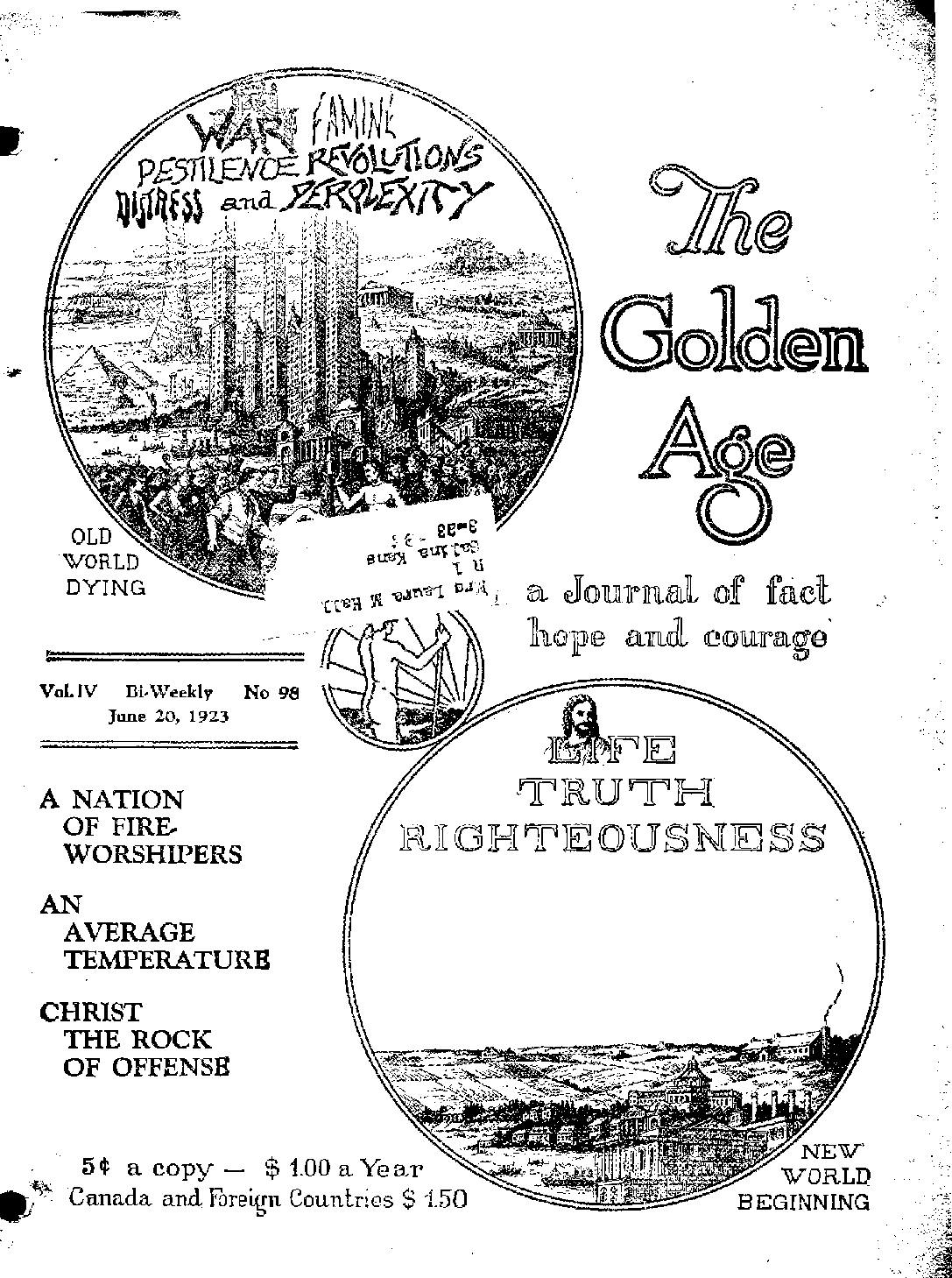
Contents of the Golden Age
Labob and Economics
A Nation of Ftbe-Wobshlpkes......... E5T9
Conflagrations of History
Fires In Fire-proof Buildings ............. . 582
Fires In Public Buildings . . .
Arson for Excitement
Arson by Radicals
Arson by Tobacco Companies
Arson for Profit . , .
Fire-Insurance Items
The Fire-Laddies ,
Deeds of Heroism
Social and Educational
Makino Saints to Obdeb
A Pbibst Kiels a Pbiest
Travel and Miscellany
An Average Tempbbatujus
The Bible on Temperature............., . 593
Two Crops to Harvest
Edcnic Conditions to be Restored .............
The MockiNG-Bird
Religion and Philosophy
Tee Gulden Aob Coming into Finland
Christ the Rock of Offense
Various Beliefs concerning Christ .
Self-righteous Hypocrisy ...
( Worldly Wisdom Self-deceived ...
A Stone of Stumbling
' A Rock of Offense
The Day of Trial
Babylon Is Falling ..........., . 604
! Many False Teachers ............ , 605
Evolutionists not Christians
Death the Penalty
Studies in "The Hasp op God”
Published every other Wednesday at 18 Concord Street, Brooklyn, N. Y., U. S. A., by WOODWORTH, HUDGINGS * MARTIN
Copartners and Proprietors Address: 18 Concord Street, Brooklyn, N. Y,t u. jff. A. CLAYTON J. WOODWORTH . . , Editor ROBERT J. MARTIN . Business Manage C. E. STEWART .... Assistant Editor WM. F. HUDGINGS . . Sec’y and Treas. Fivu Cents a Copt—51.00 a Ybab Makb Remittances ioTHE COBDEN AG® Fosejgw Offices ; British.....34 Craven Terrace, Lancaster Gate, London W. 2
Canadian ........ 270 Dundas Street W.. Toronto, Ontario Australasian.......495 Collins Street, Melbourne, Australia
South African......6 Lelle Street, Cape Town, South Africa
Entered as second-class matter at Brooklyn, N. Y., under the Act of March S, 1879
of™ Golden Age
V«Imne IV Brooklyn, N. Y., Wednesday, June 20, 1923 Nunribw 93
A Nation, of Fire-Worshipers
TV/T ORE than any other people, the inhabitants of the United States and Canada can lay claim to being fire-worshipers; for their losses by preventable fires are much greater in proportion to population than those of other countries. Canada is even a little worse than the United States, or at any rate is worse in some years; but the losses in the United States are bo huge, and the data on the subject so explicit, that we give most attention to the United States in considering the subject.
There is a fire in America on the average of one a minute, day and night, the year around. These fires are destroying property at the rate of about $700 per minute, day and night, from one year’s end to the next, or at the rate of about one million dollars per day. Three-fourths of all the fires are a total loss, and ninety-two percent of them are due to carelessness.
In no other country is there such a general disregard of the common safety, yet in no other country do the people need to be so careful. In the first place the United States uses more wood in building than do other peoples (with the exception of Canada), builds less substantially and builds higher; and in the second place it is the largest per-capita user of liquids of high volatility, and this increases the fire hazard tremendously.
Since the year 1910 the average annual fireloss in the United States has been $242,201,600, while the average annual value of new buildings has been $914,376,500, showing that about one-fourth of all the great sum annually expended for new buildings is sacrificed to the fire god, the god of carelessness as respects electricity, matches, smoking materials, and defective chimneys and flues. This is a matter to which the people of the United States ought to give attention; for whatever is destroyed by t fire increases the cost of living for us all.
The way this distribution of loss takes place is through the insurance companies. The higher the insurance rates the higher the prices that must be charged for everything covered by them; and as practically everything in America is of necessity covered by insurance, up and up go the prices.
As an illustration of the greater carelessness in America: Boston, which is smaller in population than Glasgow, has an annual fire-loss six times as large; while Chicago, of the same size as Berlin, has an annual fire-loss seventeen times as large. This is not wholly due to carelessness, however, as building conditions and extremely hot, dry weather have something to do with the matter. America has its good spots, at certain seasons. In May, 1922, during one consecutive period of ten hours there was not a fire-alarm in the entire city of Philadelphia. This is a good record for a city with one and one-half million people.
Fires in Homes
IN THE United States the average family runs one chance in sixty of being burned out each year; hence each adult is liable to have this experience once in his lifetime, and it is not a pleasant experience. Sixty-five percent of all the fires are in dwellings; there are 889 homes burned each working day. The saddest part of it is that during the year 1921 there were 15,219 persons burned to death, eighty-two percent of them being mothers and children under school age. In the property loss in homes fully twenty-five percent consists of heirlooms, works of art, rare books, antiques, rugs and tapestries, the value of which cannot be estimated in dollars and cents.
One of the most prolific sources of fires in homes is the overheated electric flat-iron. It is so easy to respond to a call at the door or to the needs of a child, and to forget to turn off the current before the iron has set fire to the ironing board, and the ironing board has set
C80
QOLDEN'AQE
fire to the house. In New York City in 1921 there were fifty-two fires due to overheated electric irons coming in contact with inflammable material. The average loss on these fires was over $4,000.
Many fires are caused by rubber hose connections on gas stoves; many also by swinging gas jets coming in contact with curtains. Metal guards should be placed under and around gas and coal stoves; stopcocks should be placed at gas fixture and not merely at gas iron; rubber hose gas-connections should be replaced with metal connections; swinging gas-brackets should be replaced with stationary ones and provided with wire guards or glass globes.
Kerosene causes many fires. In Detroit, a little over a year ago, a woman who was trying to start a fire with kerosene seriously burned herself, reduced her home to ashes and burned to death her husband, her four children, a friend who was visiting her at the time, and the three children of her friend. Kerosene should not be used to start fires; kerosene lamps should not be filled while lighted; and kerosene should not be kept in a warm room.
Matches cause many fires. A little nine-year-old lad at 'Jamesburg, N. J., at Christmas time disobeyed instructions and peeped into a closet where his forthcoming gifts were stored. He lighted a match to assist his investigations, arid then hastened down stairs so that his absence would not be detected. In a few minutes everything in the closet—his Christmas presents, his parents’ clothing, and a roll of bills containing $485 belonging to his father—had gone up in smoke. When rats get into a home they frequently start fires by gnawing at match-boxes to get the paste on the box labels. Matches should be kept in metal boxes, away from heat and out of reach of children. Lighted matches should not be used when one is entering dark rooms.
Candles cause many fires. In New York, at the beginning of the rental season an intelligent woman, well connected socially, was rejoiced at finding a new and satisfactory apartment. In placing things to rights she overworked, fell asleep in a chair, her candle overturned, and burned herself and her two small children to death. The building was a new one, not yet ready for tenancy, neither gas nor electric lights having been installed. Candles should
Bmooxltm,K. & t .
? ' -x
not be used on Christmas trees, and lighted candles should not be used when entering bedrooms, cellars, attics, or dark closets. s
Hot ashes cause many fires. They should not be put into wooden boxes or wooden barrel*. A fire-screen should always be used for an open fire, as both coal and wood crackle and may at any moment send out sparks. Chimneys built without flue-lining are unsafe and should be taken down. Chimney holes should be kept • closed, and chimneys and stovepipes should be frequently cleaned so that the soot which they contain will not take fire. Chimneys are sometimes built of only one thickness of brick, and those bricks are placed on edge. Such building is criminal. The rusting through of smoke pipes is responsible for the annual loss of millions of dollars worth of property and thou- j sands of lives. Furnace-flues should be taken . Sown every summer, so that they will not rust ! out. - j
Rags saturated with oil and put into a hot, j Bry, confined place will burst into flames in a | short time. They should be destroyed, or ’’ spread out where the air can get at them all r? over, or confined in covered metal receptacles. J Inflammable fluids used for cleaning should not be used near an open flame. Gasoline used for : cleaning gloves causes many fires. ;
Other causes for fires are numerous. Cook- ’ stoves should be kept dean; for if they are >
allowed to get covered with grease it may take j
fire when least expected. Fat boiling over on the stove is another common cause of fires. j Looking for gas-leaks with a torch, thawing out ; pipes, allowing do thing or other inflammable 5 material too near to hot stoves, defective fire- ; less cookers, incubators, fireworks, and accumulations of rubbish in basements—all these ; are food for the fire-fiend. ‘
Most fires are the same size at the start. U : attacked by a determined person With a wet k broom or with a pail of water and a dipper or with a fire-extinguisher, they can often be put . out with little or no fire, water, or smoke dam- J age. Every housekeeper should know the looa- ’ tion of the nearest fire-alarm station and how -to send in an alarm.
In the effort to cut down the ninety-two percent of fires caused by carelessness, in 1922 th* boys and girls of New York city were award|^| 202 medals for the beat essays on fire proven- -d
tion. It was a good investment, and a good way y to give publicity to a highly important subject.
It is believed that the appalling loss of life from tenement fires in New York city could almost all be stopped if the Trinity Church corporation, and other great and selfish landlords worth millions of dollars, would install a one and one-half-inch supply pipe to a sprinkler head on each floor in hallways and dumb waiters and a fifty-foot hose on each floor, so that occupants of the building could use it in extinguishing fires.
Conflagrations of Bistory
THE fire set by Nero in Rome in A. D. 64 burned for eight days before it burned itself out. The great fire of London raged four days, consumed 13,200 houses, rendered 100,000 persons homeless, and obliterated the London of Shakespeare’s plays. But this was not a bad thing, in a way,* for the old London, like other old cities of the time, had no raised sidewalks, and an open sluice ran down the center of the street in which the householders threw kitchen water, refuse and garbage, where it accumulated until carried away by showers or scavengers. In order to reach their homes many citizens had to pass through filth ankle-deep. The old London was like the modern New York, so crowded that numbers of people had to live in cellar rooms. One house of ten rooms is known to have sheltered ten families, and some of the families kept lodgers besides.
Nearly every great city has been visited by disastrous fires. But some of the most noteworthy are the burning of Moscow, set by the citizens themselves, September 14, 1812, as a rebuke to Napoleon, in which 30,000 homes were burned; the New York fire, December 16, 1835, which burned down 693 buildings; the Chicago fire, October 7,1871, which burned down 16,950 buildings; the Boston fire, November 9, 1872, which burned down 776 buildings; the Baltimore fire, February 7,1904, which burned down 2,500 buildings; the Chelsea fire, April 12, 1908, which burned down 700 buildings, and the great San Francisco disaster, 1906, which devastated the business district, inflicting a $350,000,000 loss.
In its recent fire-records Japan bids fair to emulate the United States. In the month begin-,ning March 27, 1921, in three different sections of the empire, there were fires destroying 1^000, 1,700 and 4,000 houses, respectively. At tha greatest of these fires, the one at Tokio, it looked for a time as if the whole city waa doomed; and it probably would have been had not the wind, which was driving the flames toward the heart of the city, suddenly died down; as it was, the police had to tear down a ring of houses around the burning area in order to arrest the flames. Japanese houses are flimsy structures in the construction of which paper plays a great part.
The World’s Sunday School Convention had a narrow escape. The building in Tokio in which the convention was to be held was burned just before the formal opening of the convention. The building was crowded with delegates at the time, but all escaped.
The most recent largo conflagration in America was that at Worcester, Massachusetts, in January 1921, during which fifty or more buildings were destroyed on a day when the mercury was down to zero. The fire spread so rapidly that some of the fire-fighting apparatus itself was caught and had to be abandoned.
New York is always having fires, 8,700 a year on the average; but it claims the best fire department in the world and the fires seldom get out of hand. One of the most serious of recent fires was the burning of the beach resort at Arverne, Rockaway; another was the obliteration of a five-acre asphalt plant, when thirty-four tanks of gasoline exploded and a thirty-six-hour conflagration resulted. Philadelphia had a similar fire in August, 1921, when ten great oil tanks exploded, killing four men and destroying property worth $1,000,000.
Prevention of Conflagrations
ABOUT forty percent of all conflagrations have resulted from sparks and flaming embers carried by high winds to the roofs of nearby buildings. In the year 1922, in Indianapolis, out of 1,199 fires 850 were chargeable to inflammable roofing; and the city has passed an ordinance requiring all shingle roofs to be replaced within the next eight years. Out of thirty fires in Wabash, Indiana, twenty-five were traced to this same cause.
Many years ago the butts of shingles were about an inch thick; modern shingles are sawn so thin that under a hot sun they become like
tinder, requiring only a spark to ignite. Slate, metal, and tile roofs are good as fire preventers; but they are mostly heavy and expensive.
One of the best roof-coverings, aside from actual fire-proof materials, is the asphalt shingle, which is about the same weight as ordinary shirfgles, and much less inflammable. The asphalt shingles are made of felt saturated with asphalt and are surfaced with a heavier coat of asphalt into which is rolled crushed mineral matter. These shingles are to be had in at least four different colors and are very attractive in appearance.
The "American Contractor" has made a study of the things that can be done in the building of an ordinary wooden house which, without greatly adding to its cost, will assist materially in its safety from point of view of a possible fire. We give the list, with its accompanying illustration:
(1) Fire stopping of all intersections of walls and partitions with floors, ceilings and roof.
(2) Herring bone fire stopping in partitions midway between floor levels.
(3) Partition and wall corners framed solid.
(4) Wall between porch attic, and house sheathed ■olid.
(5) Header beams 20 inches from the fireplace breast. Incombustible hearth.
,(6) Wood members 2 inches from chimney, space between filled with loose incombustible material.
(7) Plaster applied directly to chimney breast.
(8) Flue lining in chimney.
(9) Top of chimney 2 feet above peak of roof.
(10) Protection over heating plant
(11) Hoof framing 2 inches from chimney, flashed,
permitting free movement of chimney. .
(12) Top of heating plant 15 inches from ceiling. ■ ■ 2
(13) Furnace 8 feet from warm air riser. i
(14) Smoke pipe ll'a times its diameter below th* .eg ceiling. is
(15) Heat pipes fl inches below ceiling.
(16) Doubled tin pipes, %-inch air space between | in partitions, kept 1 inch from all woodwork. Steam | and hot water pipes 1 inch from woodwork.
(17) Heat pipes running through floors, fire stopped fl with loose incombustible material. 1
In New York city there has been considerable | discussion of a plan requiring each building 3 larger than a fifteen-room twb-family house to ' j have an automatic valve for shutting off gas, | so designed that it can be shut off from inside 1 or outside of the building, or by contact with | fire. But this device has been objected to on | the ground that thieves might shut off the gas f from a house not wired for electricity, and might plunder the house at will. What a pity |
that the world is in such condition that meaa- 3
ures which it takes for its safety in one direo I tion become a danger in some other! I
Wood carefully painted with a solution of | silicate of soda will stand a long exposure to a f fierce flame without even charring, and it would | be well to apply a coat of this to surfaces of |
wood which are relatively near to furnaces or j
stoves. '1
- -a
-J
Fires in Fire-proof Buildings
AT A fire in Chicago, in March, 1S22, ai % which 250 business firms were wiped out, j the heat was so intense that the windows of a . fifteen-story fire-proof building across the street melted and the entire contents of the building were destroyed, although the building itself ; stood.
Fire goes through a brick building with unprotected window-openings as easily as through : a wooden one. In all conflagrations in which flames go up against brick, stone, or concrete « buildings, the window frames ignite, the glass .. falls out and the story becomes a horizontal -flue through which the flames lick up all combustible material. Metal window frames arid wired glass are as necessary as fire-proof walla and floors.
*« *>>*•» Tb QOLDEN aqe aa*
** In any fire-proof building, when the heat J becomes sufficiently intense, the iron pillars which support it melt or become incapable of carrying their loads. In such circumstances a cast-iron column, unprotected and unfilled, which will stand safe for twenty minutes, will stand ten minutes longer if the interior is filled with concrete. A structural steel column, protected by concrete, will stand for eight hours. Hollow tile protection for steel columns will enable the columns to stand fo- only three hours. In order to acquire this information a special building was constructed in Chicago in which heat of specified intensity could be applied to samples at the same time that they were subjected to pneumatic pressure equivalent to the weights they would be expected to carry in a building.
All high buildings now constructed in New York must have standpipes which extend from basement to roof and are capable of delivering water to the highest point at high pressure. Some buildings are so constructed that a water curtain can be thrown completely around the building from open nozzles extending from a pipe encircling the outer edge of the roof.
The conflagrations at Baltimore and San Francisco have shown that in a great fire the contents of fire-proof buildings go irresistibly. In San Francisco it was found that the contents of such buildings burned out at the rate of a story an hour. In the burning of any high building there is a funnel-shaped heat-wave which automatically burns all combustible material in surrounding high buildings, even though they may be several hundred feet away.
Fires in Factories
FIRES in factories are frequently accompanied with terrible loss of life; there should be fire escapes on all sides of factory buildings, with access to adjoining buildings. There should also be frequent fire-drills, and employes should be taught not to stop to get hats or coats.
Because of fires, production is hampered, contracts are cancelled, selling forces are laid off, and thousands of workers are compelled to move from one place to another. In some cases where factories have been destroyed by fire the owners have never been able to resume, although their business was in a flourishing condition when fire overtook it and wiped it out. At Wilmington, in December, 1920, a plant which had been idle for some time, and which normally employs 800 men, burned the day before it was to be reopened.
The causes of factory fires are numerous: Cigarettes, wood in close contact with steam pipes at seventy pounds or upwards pressure* spontaneous combustion from piles of greasy rags, pulleys and idlers permitted to run dry and hot, and spontaneous combustion from piles of soft coal, also explosions of dust particles in flour mills, sugar refineries, starch factories, and aluminum plants.
Many factories neglect fire protection almost completely, and pay little heed to the subject of fire-fighting. There is a lack of fire-extinguishers and fire hose, there are no plans for fighting a fire, there are no disaster signals, there is no fire inspection. In one instance a large concern bought an expensive forty-gallon chemical engine and kept it carefully housed in a heated building through an entire winter without knowing that the engine had never been filled with the charging solution and would therefore have been useless in case of a fire.
One of the best forms of inexpensive fire protection for factories is the keeping on hand of plenty of fire-buckets always filled with Water. There should be one bucket for each five hundred square feet of floor area; and the buckets should hold not less than ten quarts each. For oil or grease fires the buckets should be filled with sand instead of water.
The proper way to form large piles of soft ooal is to drop the loads all at once upon the large pile, each time in a different place. The object of this is to avoid getting the large lumps all together with air-spaces between. It is these air-spaces that set the coal afire, when spontaneous combustion ignites the pile.
The courts formerly held that the obligation rested upon the tenant, not the landlord, to see that the laws regarding fire protection were complied with. Now this obligation is held to rest with the owner. He cannot put it off upon his tenant or tenants or upon the fire chief or the factory inspector. Moreover, his liability in case of fire extends not only to tenants and employes but to strangers who chance to be within the building at the time. The owner of the building is even responsible for the partial
Br complete blocking of means of exit by a tenant; and if in any way the owner has failed to provide the fire escapes required by law, he taay be sued by any person whose rights have thereby been infringed, and is responsible for Injury to them.
Fires in Public Buildings
ACH week in the United States one hundred and forty flats, twenty-six hotels, twelve churches, ten schools, six apartment houses, three department stores, three public halls, three theaters, two prisons, two hospitals, two asylums and two colleges are destroyed by fire. Only five percent of the schools of the country are constructed entirely of fire-resisting materials, including walls, windows, doors and finish; forty-four percent of the school buildings are constructed of wood above the foundations and are veritable firetraps. Many times they are firetraps when not supposed to be such. At Collinwood, Ohio, several years ago, fire started from an unprotected steam main passing through the first floor, and one hundred and seventy-three school children were burned to Heath. The doors through which they were supposed to reach the street were made to swing inward instead of outward; and the little folks in their mad rush were piled in a great heap against them.
In Chicago, on December 30, 1903, a fire started in the wings of the Iroquois Theatre. Thinking that the blaze would be out in an instant, the attendants, instead of opening the exit doors, which also opened inward instead of outward, placed their backs against them and refused to permit egress until too late. When the rush for safety took place, the doors could not be opened at all; and 531 women and children were burned to death. One frail woman, who lost her reason momentarily while passing through the main exit, found herself in the street, and in her hand the complete sleeve of a man’s coat which in her frenzy, she had seized with such strength as to tear it completely from the body of the coat, not knowing what she did.
In New York harbor, in 1904, the picnic steamer General Slocum burned. The life-preservers were found filled with sawdust instead of cork, and one thousand women and children were burned to death or were drowned. In dry seasons fires occur almost daily on large bridges. Many steel bridges have been totally; destroyed, and have dropped into ruins as a result of their wooden floors burning. Of every, ?5 sixteen public institutions in the country one suffers a serious fire each year. Dried veneer -and panels constitute a tempting fire-trap in hotels and other similar structures.
In a business college in Butte City, Montana, there is still in daily use a building with six hundred boys and girls on the top floor. The only fire-escape is a straight ladder that no woman and few men could descend in a time of excitement; in the center of the building is an elevator shaft, which would make an ideal flue for a fire. Running around and around the elevator shaft is the main stairway, and their is no secondary stairway. This is a holocaust that has not yet occurred, but may at any time.
The Government is a loser by fire, the same ; as individuals. Not long ago fire and water1 destroyed almost all of the census department ; records. Another fire licked up an aviation property, including thirteen seaplanes, two ; hangars and other property of the value of a 1 million dollars. The roof of the Treasury wna ’ afire not long ago, and a $5,000 appropriation was made to turn the attic of the White House i from a fire-trap into a fairly safe place. In January, 1921, the capitol of West Virginia, at , Charleston, was destroyed, entailing a loss ofi two lives and $6,000,000 in property. i
Bonfires and Forest Fires
IN A single small midwestern community, '
■within a period of sixteen days, twenty-one < children were burned to death in bonfires which i they had started among the leaves. The start- -ing of a bonfire in Alabama caused the destruo -tion of 191 buildings. In October, 1922, in . Haileybury, Ontario, a town of several thou- J sand inhabitants, a man built a bonfire of some j potato-tops and started a fire which burned the i entire village, causing the death of sixty per- 4 sons. In burning rubbish choose a calm1 day and a safe location for the fire. It is safer to 7 use an incinerator. ■’
If children will be allowed to play about bon-' . fires their garments can be inexpensively fire-' / proofed by immersion in a solution of ammonium sulphate. As soon as the cloth is dry it is fireproof; and the fireproofing solution doe* '
JVkb 20. 3023
, absolutely no harm to the fabric, being easily removed by washing. Ammonium sulphate is a soluble powder which may be purchased at small expense from any druggist.
Until recently, bonfires were frequent upon the streets of New York. The vendors in the markets were accustomed to destroy their rubbish by starting fires on the pavements. Upon a scrutiny of the matter, however, it was found that fires built in this way had damaged the city pavements to the extent of a hundred thousand dollars.
Bonfires built by campers are the principal cause of forest fires, aside from sparks from locomotives. The ashes of a camp fire should always be scattered with a stick, after the fire itself has been put out.
In the year 1811, in the Swiss Tyrol, forest fires caused the destruction of sixty-four villages. In the year 1871, fires in the pine forests of Wisconsin and Michigan caused the loss of a thousand lives and rendered fifteen thousand persons homeless. In September, 1894, there was a great forest fire in northern Minnesota, causing the loss of many lives. When fires start in a dry pine forest, they travel with the speed of an express train; and the only safety for any living thing in their path lies in immersion in water or in freshly-ploughed earth.
In April, 1922, New Jersey had one forest fire which destroyed three thousand acres of timber, and another covering an area of 125,000 acres. In the one case, government stores of hundreds of tons of T. N. T., the most powerful explosive known, were in immediate danger. In the other instance, the patients in a large tuberculosis sanitarium were barely saved.
Forest fires annually burn over 11,000,000 acres of land in the United States, and destroy enough timber to build a five-room frame house every one hundred feet on both sides of a road extending from New York to Chicago. Such a low of dwellings would house the entire population of Cincinnati, New Orleans, Minneapolis, Beattie, or Kansas City, Mo.
In very dry weather in the state of Washington automobiles fitted with flanged wheels, instead of rubber tires, follow the passage of every train through the timber district, putting put three to eight fires daily, started by sparks from the locomotives which have preceded them.
Arson for Excitement
PHYSICIAN of Montreal is authority for the just-published statement that, at the present rate of increase, the whole world will be hopelessly insane in twenty-five years. One of the forms which this increased insanity takes is arson for excitement, pyromania.
In July, a year ago, a girl in Millis, Massachusetts, organized a band of boys and girls, and led them forth to burn her own town and the adjoining village of Medfield, her only reason being that the towns were too dull to suit her and she wanted to wake them up.
Two months previously a man who had recently returned from Sing Sing, where he had been serving an eight-year sentence for arson, set fire to a four-story tenement house in which a woman and a child were fatally burned, eighteen persons injured and forty families forced to flee.
The year 1921 was the banner year for this kind of arson, due to the newspaper notoriety given to the doings of a firebug in western Pennsylvania, of which more mention will be made shortly. In the effort to emulate him, in January of that year, high-school students in Omaha, who were about to be installed in temporary quarters until a new school building could be erected, burned the $150,000 temporary frame structure to the ground the day before it was to have been occupied.
The next month a young man in Long Island City set fire three times to a two-family house, giving as his excuse that he wanted some excitement. He was twenty-one years old when he got his excitement, and will be sixty years old when he emerges from Sing Sing if he serves his full time. In the same month five youths in the Bronx started fires in nine tenement houses in one and one-half hour time, just before midnight.
In May the town of Darien, Connecticut, purchased a new red fire-engine; and in the ensuing-six weeks there were more fires within the town than had occurred in the previous six years. The pyromaniac who set the fires wanted to see the new engine racing through the streets and at work upon the fire.
At Princeton in June some college men out for a good time, started fires in six separate places, using excelsior and rags soaked in gasoline and kerosene, and even spraying doors and windows with inflammables to insure success. Some of these children of our best profiteers are so playfull But it is to be expected that parents who have kept out of prison themselves only by purchasing seats in the legislative assemblies of the nation should have trouble keeping their scions from walking in their steps.
In July, a fourteen-year-old newsboy in Hoboken started fires on the second and third floors of a twelve-family apartment house in that city, with no other object in view than to try to create some excitement. The same month a young man in Newton, Massachusetts, was arrested and confessed to having started twenty fires in that vicinity.
In Brooklyn, in September, a girl eighteen years old set fire to her own home twice in order to see the fire engines arrive. In October a lumber handler six feet two inches tall, weighing 245 pounds, confessed to starting four fires in the yards of his employer at Astoria, a suburb of New York, so that he could have the excitement and fun of helping to put the fires out. One of the fires got away and did $400,000 damage. A month later a fourteen-year-old boy twice set fire to a crowded theater in New York in order to produce some excitement. The fires were built in the theater loft.
Arson by Radicals
IN NOVEMBER and December, 1920, and in
January, 1921, a great number of churches, school buildings, barns and houses were destroyed in Fayette, Westmoreland, and Washington counties, Pa., in accordance with what seemed to be a carefully prearranged plan. Property to the value of $5,000,000 was destroyed.
Immediately those faithful and well-paid servants of our leading profiteers and grafters, the newspapers owned by and managed in the interests of those who have taken for themselves about everything that is worth taking, and who are trying to take what is left, began to shout that this was the work of radicals. Government detectives were put on the job; and as soon as they could find time to empty their pockets where the stuff could be conveniently found, the readers of the New York Times and and other leading New York papers were treated to the rare news that "radical literature was found near a majority of the places fired yesterday." The word “radical” comes from the Latin “radix,” meaning “root,” and imports a person who seeks to go to the root of a matter. For example, any man who would suspect another of being a burglar and would undertake an inquiry as to where the burglar got his load would be a radical, a red, and very offensive to the burglar.
At length the man who had set the fires was found, Frank Koma, or Frank Smith, the son of a preacher. He confessed to firing some thirty buildings; and when asked why he had done so replied that he was prompted to do so by voices which he heard in his sleep. This was generally taken to mean that the man was insane, and so he was; but the cause of his insanity was demon suggestion.
Smith went on to explain: “I get pains in the back of my head, and I don’t just know why I did it. I remember that I set fire to the school building, the church, and the garage at Brownsville. I just got those pains, and then I did the < firing. There were times when this strange feeling in my head sort of told me I was to set fire to my own home. I never did, but the pains in my head told me I should.” Those who have read “The Finished Mystery,” page 127, will at once identify this as the work of evil spirits, .. demons, working upon and through the mind of this unfortunate man.
These fires, therefore, were not set by working men who are trying to better their ! working conditions and the civilization of which ; they are a part, nor even by those innocent persons who wonder how the sugar gang and the coal gang, the credit gang and all the other gangs get away with their plunder year after year, all on the promise of an expensive investigation of their own framing up. In other . words, the title of this section ought properly to be “Arson by Demons.” Pyromania is merely one of the methods by which they are ruining -civilization.
Inspired by the publicity given Koma's or < Smith’s adventures a wave of arson spread over Am Arica that has not even yet died out. ' As an illustration: While the Smith excitement was at its height a highly educated young woman, a nurse for three dentists in Brooklyn, , set fire to the building in which she worked, imperiling the lives of one hundred persons;
Thirty families were driven from their hornet ' as a result of this fire. When asked as to her reason for setting the fire the nurse said that “something flashed through her mind” that made her want excitement. Without doubt that something was a demon suggestion. In Canada last year a number of prominent Roman Catholic edifices were burned; and it is likely that their destruction was suggested in the same way, probably in the hope of getting innocent people into trouble—demon-like.
Arson for Love
WHILE the Koma or Smith affair was at its height, in March, 1921, eight young men connected with the city fire department of Columbia, Pa., set ten fires, with damages ranging all the way from $100 to $50,000. As soon as the fires were set, they turned in alarms and then rushed to put out the fires. Cornered, they acknowledged that they wished the admiration of some of the fair young ladies of their city for their bravery as fire-fighters.
A more pronounced case of arson for love was that of an Elmira lad of seventeen, who was away at boarding school, at Manlius, near Syracuse. He was infatuated with a girl in his home town, and conceived the bright idea that he might get a vacation if all three of the buildings where he was at school were destroyed. He got the vacation all right; for he was expelled from school. Subsequently he got a long one, behind bars. Love is cruel.
The opposite of love, anger, led a young shepherd boy of Aires, France, in November 1921, to set a fire which destroyed fifty-five houses. He set the fire because he did not wish to be reprimanded. Quite likely this was the work of demons, too, if the facts were ascertainable.
Arson by Tobacco Companies
THE tobacco companies ought to be compelled to pay the full cost of all losses sustained as a result of the business which they so persistently flaunt in the faces of people who do not admire smoking, A hotel man who had been burned out eight times stated to the editor that every one of the eight fires had been caused by smokers, chiefly cigarette smokers.
A man engaged in shingling the roof of a hotel porch at Arverne, N. Y., in June, 1922, dropped some hot cigarette ashes on the roof, . resulting in a fire which burned nine hotels and one hundred and fifteen houses. We have “smoked out the facts,” and “they satisfy.” But do they?
While the delegates to the annual convention of the National Safety Council in Boston were discussing means of preventing fires, one of the delegates threw a lighted cigarette among a pile of paj^ers. Considerable damage was done to the apartment before the fire could be put out. This man’s own children were upstairs asleep at the time.
A Harvard University student came out of a theater in Boston, lighted his pipe, and threw the burning match into the lace dress of a woman, setting it on fire. Watch the careless smokers, the converts of the widespread advertising of the tobacco companies; and see where they throw their matches.
We have a Biblical reason for wanting the tobacco companies to bear the losses for which their business is responsible. It reads this way: “If a fire break out, and catch in thorns, so that the stacks of corn, or the standing corn, or the field, be consumed therewith, he that kindleth the fire shall surely make restitution.”-—Exodus 22:6.
Arson for Profit
INSURANCE companies find that fire losses decrease as business improves in other lines, and that when there is a general slump in the business of the country there is a great increase in fire losses. This is partly explainable by the better care that a manufacturer takes of his premises when business is good. Yet it is a noteworthy fact that when a large stock han been piled up and the stocks cannot be moved at the cost price, there is liable to be a fire.
The year 1919 was a banner year in the clothing business. The next year was a hard year, and in New York city there was an increase of 400% in fires in embroideries and laces businesses, 385% in shirts, 360% in woolens and worsted goods and 229% in women’s clothing.
There are 2,500 arson convicts in the United States, with about five hundred convictions each year. Not long ago a concern was discovered at Chester, Pa., engaged in the training of cats, whose business it was to overturn lighted lamps on sight. Such cats sold at $250 each, which is a pretty high price for a cat.
The National Association of Credit Men who unearthed the Chester concern found another scheme in use by the arson-for-revenue-only fraternity, consisting in placing a lighted candle in an empty lard bucket. Inside the bucket were suspended several small bags of gasoline. In due time the flames reached the strings, the bags dropped, there was an explosion, and all evidences of the crime were removed.
In New York city at one time in December, 1922, forty laundry proprietors appeared at the District Attorney's office and complained that efforts had been made to compel them to join an association, and that failure to join meant that their places were set on fire, or their clothes ruined by acids or dyes.
During the fall of 1920, in the cotton districts of Alabama and Texas, persons who persisted in trading in cotton at less than forty cents a pound had their cotton gins, warehouses, and mercantile establishments destroyed by fire, due notice having been sent them that such would be done.
A young man at Somerville, N. J., the junior member of a machinery concern became dissatisfied with the old buildings in which the plant was housed, placed cans of gasoline here and there about the place, connected them by wires with his home, and there exploded all the cans at once by throwing a switch. He hoped to get new buildings out of the insurance carried on the old. When apprehended he said that he wanted to get married and did not want his intended to think that the business he was in was not prosperous.
At Spokane, Washington, in May, 1921, the widow of a wealthy railroad president, unable to maintain her $50,000 home on the allowance of $4,000 per year left for its maintenance, arranged with her chauffeur to set it on fire in her absence; she expected to get the insurance, but got a term in prison instead. It is strange that a person of respectability could so lose control of self, unless mentally unsound.
A cobbler in the Bronx, in the fall of 1921, took out $1,700 insurance on his furniture and then deliberately set a fire in his apartment, endangering the lives of seventy-five families. The fire was put out; and the cobbler got twenty to forty years in Sing Sing, with a statement by the judge that he was sorry he could not send the miscreant to the electric chair.
Fire-Insurance Items
NOTHING could be softer for the financiers back of the fire-insurance companies than the arrangement by which they have guaranteed themselves a net profit of five cents on every dollar they take in, with an additional three cents to cover possible conflagrations involving losses of more than $1,000,000 in a single fire. The National Board of Fire Underwriters has entered into an agreement with the National Convention of Insurance Commissioners that the profit of the Fire Underwriters shall be this amount; probably the same crowd under different names.
We said that nothing could be softer; but we might make an exception of the clever, almost diabolically ingenious scheme by which the same crowd compels everybody to carry all the insurance possible or else suffer deprivation in case of a fire. We refer to the so-called 80% coinsurance feature, which is now a standard part of all fire-insurance policies. Here is the way the thing works out:
Suppose a man has a house worth $5,000. Unless he carries on that house at least 80% of insurance, i. e., policies to the amount of $4,000, he will not receive from the insurance companies the full amount of the policies which he does carry unless there should happen to be a total loss. Thus: if the house is damaged to the extent of $1,000 and it is insured for $1,000, instead of receiving $1,000 the policy holder will receive 25% of the loss, or $250. Or if the house is damaged to the extent of $1,000, and it is insured for $2,000, then instead of receiving $1,000 the policy holder will receive 50% of the loss, or $500. Or if the house is damaged to the extent of $1,000, and it is insured for $3,000, then instead of receiving $1,000 the policy holder will receive 75% of the loss, or $750. To get $1,000 for a $1,000 loss he must carry $4,000 insurance.
If the house is damaged to the extent of $2,500 the same rule prevails. On a $1,000 insurance he would receive $625, on a $2,000 insurance $1,250, and on a $3,000 insurance $1,875. To get $2,500 for his $2,500 loss he must carry $4,000 insurance. Many people do not know these facts until the unhappy hour when they try to collect something from a bunch of fire-insurance adjusters. Then they realize that ths soft words of an agent to whom they pay their money are of little worth.
Fire-insurance policies become void if the insured moves from one location to another, or places a chattel mortgage on property, or operates a factory after ten o’clock at night, or ceases to operate for ten days, or if repairs or alterations to property take more than fifteen consecutive days, or if the building becomes vacant for ten days, or if illuminating gas is generated in the building, or if explosives or any product of greater inflammability than kerosene are kept on the premises.
In December, 1920, one hundred and thirtyeight insurance companies doing business in the state of Mississippi withdrew from business in the state as a result of a suit brought against them for being in collusion in the matter of rates.
The insurance business is so well developed that the companies can tell with a fair degree of accuracy what are the prospects of a given district’s being visited by a devastating fire. They have charts showing the amount of area covered by streets, the amount covered by buildings, how many are of fire-proof construction, how many windows are protected, how many buildings are sprinklered, the exposure to lumber yards, whether the water supply and engine supply are adequate and whether the district is subject to high winds. At present Parkersburg, W. Va., is considered a bad risk.
Unusual Fires
IN JULY, a year ago, in New York city, a trolley car burst into flames; and the motorman raced with it to the nearest fire-house and summoned the firemen with his gong. They put out the fire with sand. This is believed to be one of the first times that a fire was ever brought to a fire station to be extinguished.
At Benwood, W. Va., a year previous, the sun’s rays focused through a flaw in a window pane set fire to a baby’s bed, and burned the child to death. At Ferndale, New York, about the same time, a woman dressed in a paper costume at a masked ball was severely burned when her costume took fire from a candle carried in her hand.
A rag fire is one of the worst, on account of the thick smoke. In fighting a fire of this land jn Brooklyn the firemen were compelled to lie prostrate in the street so that they could breathe the purer air near the pavement; and 1,000 families in the neighborhood were compelled to flee the fumes.
In May, 1921, the century-old New York naval militia training-ship was destroyed by fire from the outside. The ship became surrounded with a pool of oil from a leaking pipe line. The pool was ignited by the backfire of a motorboat, and the flames licked up the sides of the doomed vessel.
Frictional electricity is sufficient to ignite the vapor of gasoline. Combing the hair, walking swiftly in a fur coat flapping against rubber boots, removing a silk dress from a basket, pumping gasoline through a hose, and even touching woolen fabrics that have been washed in gasoline have been sufficient to cause gasoline explosions, with fatal results. Tanks in which dogs and cats are asphyxiated in gasoline fumes have frequently exploded as a result of the friction generated by throwing cats into them. Dogs do not produce the same effect.
Fires Abroad
THE early history of fire-fighting in the British Isles makes quite amusing reading. In Liverpool a light extension ladder was stationed in each of the public squares, with a policeman to guard it. In the event of a fire he could commandeer anybody to aid him in reaching the fire with his ladder.
In Glasgow it was the custom, when a fire was reported at a police station, for a man to step to the door and beat a drum. The volunteer firemen would come running from nearby shops, passing horses would be unhitched from their vehicles and hitched to the fire apparatus, and the crew would be off. On arrival at the fire bystanders were hired to work the pumps.
In Germany, in case of a fire in an apartment house, the first arrivals at the fire lay tarpaulins in the halls and up the stairs to minimize the loss by fire and water; and in case of any fire it is the custom for the police to lock the man up on whose premises the fire is found, and he has to prove his innocence to secure his release.
In France if one has a fire and it goes outside his premises he has to pay his neighbor's loss. A law in New York city tending in the same general direction of holding persons responsible for negligence compels a man who disobeys an order of the fire department, and then has a fire, to pay the city for the cost of extinguishing it.
Before the war the annual average fire loss for each man, woman and child in Holland was eleven cents; Switzerland, fifteen cents; Italy, twenty-five cents; Austria, twenty-five cents; Germany, twenty-eight cents; England, thirty-three cents; France, forty-nine cents; United States, $2.10 (a greater burden than all of the foregoing put together); and in 1920 in the United States the loss was $4.80. This tells its own story.
The city of Sydney, New South Wales, 'Australia, builds its own fire-engines, having found that it can do so at a profit.
The Fire-Laddies
THE one who sets fires for excitement has his complement in the one who turns in a false alarm for the same reason. Even New York has one offender who has the curious mania of calling out ambulances, just to hear the gong and to see the vehicle running. At Montclair, N. J., in June, 1921, two young men driving through the city turned in five false alarms of fire. They were fined $100 each.
A year ago, in New York, for a while there seemed to be a mania of false alarms; but it transpired that a new style of fire-alarm box, much easier of operation than the old style, had just been installed, and children accustomed to playing with the handles of the old-style boxes could not play with the new without bringing out the fire apparatus.
A false alarm may be a very serious matter for the firemen. As everything depends upon how soon they get to a fire, the fire-laddies always go at top speed; and the streets are very hard to navigate nowadays. In New York, in April, 1922, nine firemen were hurt, seven of them being hurled to the street when a trolley car rammed the rear wheels of a fire truck on the way to a false alarm. At a fire in Salt Lake City the automobiles packed the streets so tightly that when the chief sent in a second alarm it took the apparatus fifteen minutes to get to the fire.
As a sample of what New York firemen have to contend with: On the way to a fire one man had his jaw fractured and both wrists sprained, one had his left kneecap broken, and one had his thigh broken. Those who did arrive at the fire were driven from their work of fighting the flames by a drum of sulphuric acid four feet long and a foot in diameter, which became superheated by flames from broken gas-pipes. The tank was loosened from its fastenings and carried down the fire escape, after which the fire itself was stopped in short order.
In the case of inflammable liquids and certain chemicals the use of water multiplies the danger to the firemen. In July, 1922, a large warehouse in New York, housing at the moment a great quantity of magnesium powder for the Government, took fire; and when water was applied to the flames there was a series of tremendous explosions and the entire contents of the great warehouse were destroyed. The fire burned for sixty-five hours. During the first half of that time it was calculated that 216,000 tons of water were poured into the building. It was one of the city's hottest fires. While the fire was in progress a victim of delirium tremens ran into the building and up to the third floor, from which he was rescued with difficulty.
The fire patrols or salvage corps do important work at fires, doing what they can to save goods and machinery from water by covering them with tarpaulins or removing them to safer quarters. At most fires the water damage is equal to the fire damage. In many instances the fire patrols can do nothing until the fire is out.
■¥
Deeds of Heroism
NO CIVILIZED community should expect its firemen to risk their lives in fighting fires which, as in the United States, are in most instances so easily preventable; yet their lives are frequently sacrificed. It is a common thing for firemen working on upper floors to get trapped by bursts of flame below them, and then only the courage and faithfulness of their comrades on the lower floors or on the ground can save them. They have been known to jump through a sheet of flame, and catch a swaying ladder which constituted their only means of escape.
Grateful citizens of New York have provided a number of medals annually awarded to members of the New York Fire Department for acts of heroism during the year. Some of the feats J for which these medals have been granted are rescuing comrades from burning cellars, strad-
Bling from the fire-escape of one building to the window ledge of a burning building and swinging the persons in the burning building to safety, shinning up lintels for a full story above the top of their highest ladders and rescuing persons about to jump, and laying ladders across a courtyard.
In Brooklyn, in January, 1922, a fireman was swung by the heels by his comrades from the roof of a building; and into his arms, one after another, a mother and four children were thrown, pendulum fashion, to safety. Subsequently, a fireman who had been trapped in the blazing apartment while seeking to rescue the same persons, was also rescued.
A girl was rescued from injury and possible death at a fire in Newark. She was about to jump; and as no ladder was at the moment available, three firemen got together, back to back, and bending low, hands on knees, formed a human basket. The girl knocked them all flat; and all were bruised, but none seriously.
Firemen frequently have odd jobs. A somnambulist in Trenton dreamed that the police were after him. He ran to the roof, and jumped down the chimney. Part way he stuck fast, and could go neither up nor down. The firemen had to come and open the side of the chimney to get him out. Moral, never jump down a chimney when you are asleep.
Others besides firemen perform deeds of heroism at fires. In May, 1921, a Negro elevator man, Oswald Pickering, employed in a twelvestory building at 589 Broadway, New York city, found smoke on the ninth floor of the building in which he worked. He turned in an alarm, went back to the ninth floor, found a man on the floor overcome by smoke, took him to the street, and then ran his car repeatedly to the tenth, eleventh and twelfth floors until the scores of workers on those floors, cut off from the stairways by the dense smoke, were all carried to safety.
At a Jewish orphanage near Montreal, in August, 1922, fifty-five boy orphans were trapped on the top floor of a building not provided with fire escapes. Two of the boys, Samuel and Joseph Kaufman, fourteen and fifteen years of age respectively, marshalled the boys to the safest part of the building, made rope ladders of sheets, and all but four of the boys descended them in safety.
At a fire in Minneapolis, in June, 1922, at which a fashionable club burned to the ground, Miss Lucy Gilbert, head of the art department of the public library of that city, was burned to death because she refused to leave the side of an old and crippled friend. At the last moment she could have been saved, but refused the proffered aid because it was impossible to extend it to her crippled friend. A splendid example of true nobility.
Golden Age Coming into Finland By Kaarto Harteva
THE year 1923 began in Finland in a very peculiar way, both in external and internal affairs. The first month in the year, January, is called in the Finnish language “Tammi-kuu,” which signifies "Oak-month.” The explanation in our literature is that the cold this month has been so severe that it has been compared with an oak. Regularly there has been much snow, and so much cold that the mercury has frozen in some places. But during the greater part of January last it was exceptionally warm. The thermometer was about at freezing, and many days it rained. Recently a newspaper published an interesting article about the possibility of growing grapes in Finland without using hothouses, merely protecting them; and the prediction was made that Finland will soon be a grape-producing land. Some years ago only the Bible students dreamed about such times.
Still more interesting and striking was the great change in the internal affairs of Finland with the opening of the year 1923. January 1st the so-called religious-liberty law was put into force. In order to understand the great significance of the law it must be noticed that Finland has been, and still is, a church-state community. Only some ten years ago it was, according to the law, a compulsory matter to partake of the Lord’s Supper for all those who desired to marry. How stupid! The theory of the clergy assumed that every one who unworthily partook of the Lord’s Supper was condemned to a hell of eternal torment. In other words, according to their theory, people who desired to marry and were not in a worthy condition were forced into hell or were forced to remain single. The stupid law was overthrown in 1909.
The power of the state-church has been great in Finland, but now it is being broken down. Heretofore it was necessary to belong to some church approved by the state, if any one desired to leave the Evangelical-Lutheran church, which is the state-church. But from the beginning of this year, every one has liberty to belong to a church or not. In the church offices people now form queues and stay in them hours waiting their turn in order to state their will regarding leaving the church; for according to the law every one who has reached the age of eighteen years must do it personally. The law also permits the clergy to ask the reason of those who intend to go out of the church, and at first they used that right. But as this gave the truthloving people an excellent opportunity to 'witness for the truth, they have now stopped their inquiries, and simply write the names of those leaving!
As it was formerly necessary to belong to a church, so it was also necessary to pay to the
church a special tax, but now those who do not accept the church are liberated from that tax. Before this law was passed the conservative clergy tried to oppose the law with all their might. But the liberal-minded in Parliament gained the victory, and religious matters are now fully free in Finland. What a great step toward the light! The Bible students have ■ ;
rejoicingly left the great, mysterious Babylon not only in spirit but also literally.
It is true that the clergy have tried to frighten some of those who have gone and explained their reason for leaving the church. Among other things they have said that they will not give them a burial-ground (in Finland almost all the cemeteries belong to the Evangelical-Lutheran state-church), but if the clergy will hinder the dead being buried then other officials . in the community will find a place for the dead ones; and many will get their eyes opened to see the right character of the clergy. Certainly all struggle in vain against the new King of "
…