Golden Age, June 6, 1923
Download: PDF — Golden Age, June 6, 1923
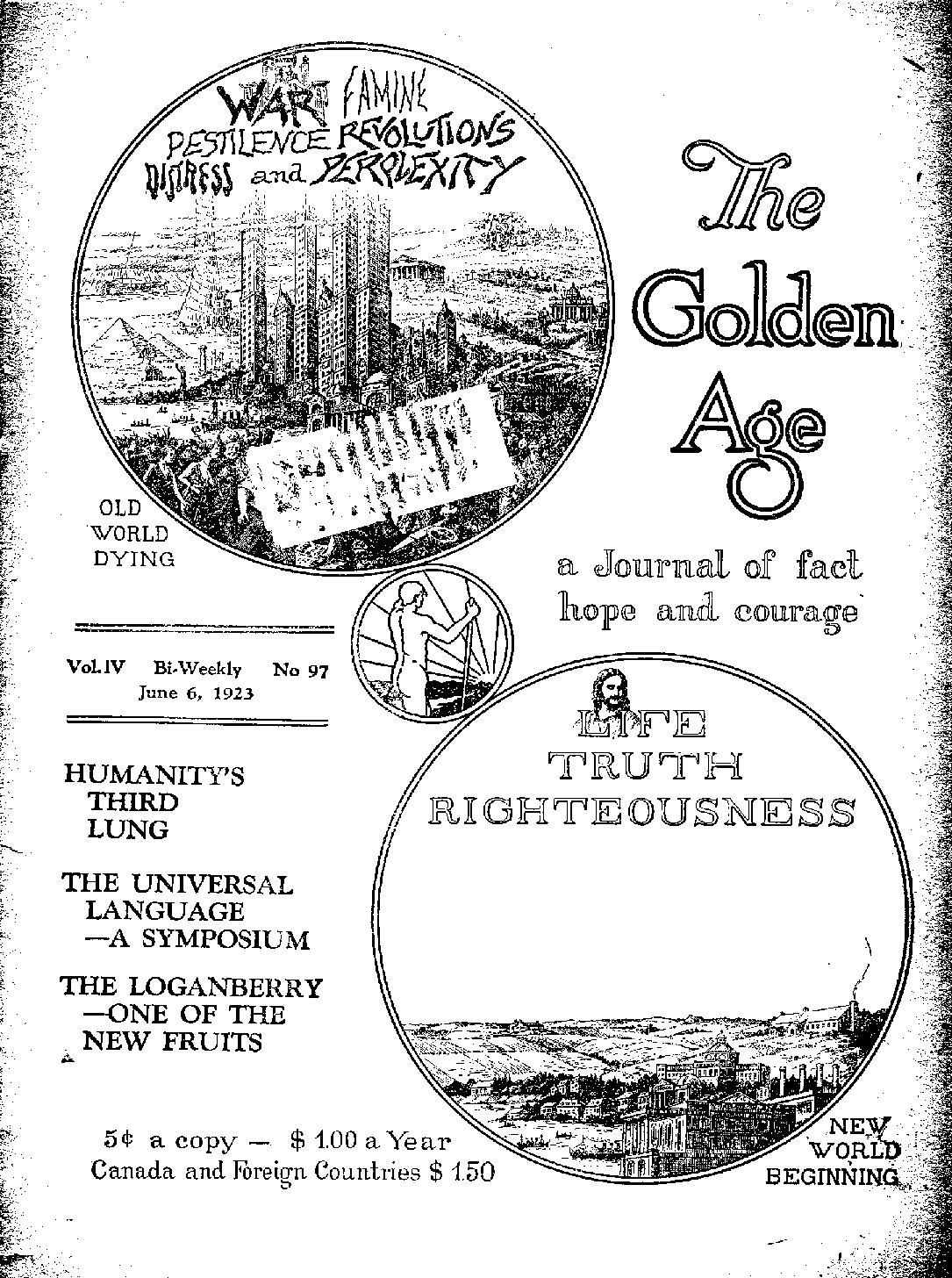
- Tr,f
a Journal of fact
,-s
I
JS
is
OLD WORLD DYING
as i?
THE LOGANBERRY
—ONE OF THE NEW FRUITS
THE UNIVERSAL LANGUAGE
—A SYMPOSIUM
HUMANITY’S THIRD LUNG
-j
.5"
5<t a copy — $ 100 a Year Canada and. Foreign Countries $ 150
&
t*. -
j#6"1
& _
r
&
VoLIV Bi-Weekly No 97
June 6, 1923
3 t
GoHem
NEV WORLD BEGINNING,
Contents of the Golden Age
Social and Educational
Universal Language of the Golden Age
The Argument for Hebrew
The Argument for Esperanto
The End of a Noble Life.............. . . 557
Political—Domea ;c zxd Foreign
Shall It Be Again?
Reports mon Foreign Correspondents
From Ceylon
Let ths Truth Be Known
Youthful Soi.dieby not Good
Agriculture and li i ,-iumai
One or the New Fruits—The Looanbtoiby .......... 561
The Bat or the Bee, Which?
Home Health
Humanity’s Third Lung
Preliminary to the Bath
The Cool Bath In Tub or Sea . .
Tepid, Warm and Hot Baths
Turkish and Russian Baths
Medicated Baths and 'Specialties
Wrongful Practice of Vivisection
Rust on the Teeth
i i Religion and T'i; • ;.o’-ot-it y
The World and Ur.n Affairs
Millennium Seen in Tboublks
Missionaries Spreading Infidelity
The Right Spirit......
Is the Chubch Abdicating?
Effohts to Unite Demagnetized Chi -
Russia Fighting the Churches . . -
Begging fob Mercy
Heard in the Office (No. 5) . . . .
Great Men and Women of the Oli, ..n.s,
Studies in “The Habp of God”
Fabiislied every other Wednesday at 18 Concord Slrc-el, Brooklyn, 1'., U.S.A., by WOODWORTH, HEDGINGS 4 MARTIN
Ocpnrtncrs and Proprietors Address; is Concord Street, BrooHvn, N.T., U.S.A.. CLAYTON J. WOODWORTH . . . Editor ROBERT J. MARTIN . Business Manager
C. E. STEWART .... Assistant Editor WAI. F. HUDGINGS . . See'y and Treas.
Five Cents a Copy—$1.00 A Ybab Maki Remittances to THE GOLDEN AOB Foreign Offices ; British ..... 34 Craven Terrace, Lancaster Gate, London W. 2 Canadian ........ 270 Dundas Street W., Toronto, Ontario
Australasian.......-105 Collins Street, Melbourne, Australia
South African ...... 0 Leila Street, Cape Town, South Africa
Eolorad as lacond-elaa matter at Brooklyn, N. under the Act of March 8, 1870
of™ Golden Age
▼•Iwtne IV
Brooklyn, N. ¥., Wednesday, June 6, 1923
Humanity’s Third Lung
NOT only is the skin nature’s garment for protecting the delicate organs of the body from, injury and for shielding them from sudden heat or cold; it is more. It is a third lung, through which we breathe; and as such it fills a most important office. There is a story of a little girl who, to fill a part in a papal procession, was covered with gold leaf. She died in a short time, not because of exposure, but because all the pores of her body were stopped and nature was not able to carry on its usual operations through those tiny apertures.
There are seven millions of those little waste pipes in the human body. They carry off one and a half to two pounds of waste material daily. Most of this material is water, but in this perspiration there is a considerable amount of worn-out tissue from the interior of the body as well as from the exterior. When these pores are unobstructed, the inhaling of oxygen goes on through them to such an extent, and the blood is cleansed by this means to such an extent, that the skin is sometimes referred to as nature’s third lung. (Hence the title to the study of this subject, which we have been requested by one of our readers to publish in The Golden Age.) The pores, if open, exude great amounts of poisonous carbonic acid gas.
Experiments have been made of putting the body into an air-tight vessel, with the head outside, and then reversing the process; and it is claimed that the results are nearly the same. The distress is about as great in the one case as in the other. It is well known in the mining regions that a bum which covers one-third of the body of a miner (and many of the serious injuries to miners are in the nature of burns) always results in death. The body cannot go on doing its work when one-third of the pores have become closed.
Now it happens that we live in a world where, if we are going to accomplish anything, we shall be brought more or less into contact with grimy or at least dusty articles; and the perspiration from the inside of our bodies, already holding considerable waste matter, picks up still more. Hence there comes a time when, with apologies to Hamlet, we say:
To bathe, or not to bathe—that is ths question: Whether ’tie nobler in the man to continue To accumulate fatty secretions, dead skin, And dirt from inside and outside until He has scales like a poor fish, Or, by opposing, end them?
To wash, or not to wash—ay, there’s the rub.
Whether to wait until Saturday night
Or the Fourth of July,
Or leave it all for the undertaker— ;
This puzzles the will, and makes some rather Bear the waste they have
Than risk some troubles that they know not of.
To keep in healthy condition the skin needs air, water, and friction; and it should have the sun, too, if this can be obtained. Moreover, to remove the dirt effectively, some of the water applied to the skin must be warm, and soap must be used. But the effect of cold water on the skin and on the complexion is better than that of warm water. It improves the color and the tone, as well as prevents wrinkles and chapping.
The principal reason why there is more sickness in the winter than in the summer is that in the winter there are very many people that never get into a perspiration, and hence never get the dirt out of their pores. As a consequence they throw more and more work upon the lungs, kidneys, and excretory apparatus generally, and more than those organs can bear. Disease is the result. An inactive skin is specially subject to a chill.
This does not mean, however, that bathing !■ a cure-all; for there is no cure-all in this world. But it does mean that bathing is something to
*“
B48 The qoLDEN’AQE
which every person must give attention if he would keep well. Besides, he owes it to others; for an unclean person is very offensive. In very . cold weather one of the best ways to keep warm is to take frequent baths.
Some skin diseases are aggravated by bathing; and if a person thus affected finds persistent redness, pimples, or watery heads making their appearance the bathi ng should be reduced in frequency and length until the symptoms disappear. To a person thus afflicted, a simple tub-bath once a week in tepid water is about the best treatment.
Bathing has a powerful effect upon the nervous system, for the reason that there are millions of tiny nerve-endings in the skin, and nervous people need to pay more attention to the subject than those fortunate, or unfortunate, individuals who have no such things as nerves and who mistakenly think that others have none. It is hard for a bulldog or a dachshund rightly to appreciate an Airedale or a greyhound. The effect of water upon the nerve-endings can be judged from the fact that when water is suddenly thrown in a person’s face it causes him to gasp for breath.
Ancient History of Bathing
ROM the Scriptures wo know that Pharaoh’s daughter was accustomed to take a daily plunge in the Nile (Exodus 2:5); that the Aaronie priesthood was washed on induction into office (Exodus 29:4); that frequent subsequent washings were required of them, and a special laver or font was provided for the purpose (Exodus 30:18-20); that the sacrifices must be washed before presentation to the Lord (Leviticus 1: 9,13); that there were elaborate provisions f-or the washing of the flesh and the clothes of the people (Leviticus Ch. 11; 13-17; 22); that Naaman was instructed to dip seven times in the Jordan (2 Kings 5); that David’s sin was partly traceable to the fact that, from the roof of the king’s house, he saw a woman bathing (2 Samuel 11:2); that Christ washed the feet of his disciples (John 13:5-14); and that the pools of Bethesda and Siloam, in the city of Jerusalem, were much used for public bathing and recommended by the Lord for that purpose. (John 9:7; 5:2-7) In the case of the pool of Bethesda it was fed by mineral springs impregnated with gas, discharged at intervals. Altogether, the subject of bathing and washing is mentioned in the Scriptures something over 150 times.
Among the Greeks the care of the body, reached a high state of development. Homer mentions that when Ulysses entered the palaos of Circe a bath was prepared for him. Hip* pocrates regarded water as of special value in the treatment of acute diseases. There were ’ hot sulphur-spring baths at Thermopylae, and in the Isles of Lesbos and Euboea, which became famous for the cure of disease. The Greeks believed that a clean body was necessary to the possession of a sound mind; Diogenes made his home in his tub. Some of the Egyptian temples were provided with bathing places; and it is known that in the long ago bath houses were built in Assyria, Persia, and India. The Greeks were accustomed to provide warm tub-baths for their guests upon their arrival at their homes.
In the year 305 B. C. a large public bathhouse was erected outside the city of Rome; and from that date onward the baths multiplied rapidly until the daily consumption of water had become two hundred millions of gallons. In some of these bath-houses two thousand to three thousand persons could bathe at one time. Water for these bath-houses was brought from the Appenines through aqueducts constructed by various Roman emperors. The baths of the Emperor Caracalla covered an area of a fourth of a mile or more on each side. The Emperor Constantine erected large bath-houses at Byzantium.
As time went on, the bath-houses became more and more elaborate. At first they were provided with separate arrangements for the ( men and women. Then they were provided with' gymnasia, theatres, etc. Later, the practice of! men and women bathing together was adopted* h and the public baths gradually became centers j of debauchery and degeneration. With the ad- ; vent of Christianity such orgies came under the ban. Finally the conquering Goths and Huns cut the aqueducts, and the baths were closed.
Wherever the Roman legions went they car- < ried their bathing customs; and extensive baths were built by them in the East, throughout " northern Africa, the continent of Europe and•-< in England. The best-known Boman baths in England are those at the eity of Bath, erected j by the Emperor Claudius A. D. 60. The beat* known watering places of Europe were first made famous by the baths erected during Boman occupancy.
Store Recent History
TRE A TENG the subject geographically, L e., starting in the East, we may say that the South Sea islanders are fond of bathing in the surf, their children taking to the water naturally. The Japanese are in the same class, and claim to be the cleanest people in the world. Tokio alone has 800 public baths, in which three hundred thousand people bathe each day at a cost of about one cent each. The baths are warm, the Japanese being particularly fond of them in this fashion and sometimes taking several in a day. In one village famed for its hot springs every person in the village bathes five times daily in the idle season, winter, and twice daily in summer, the children getting into the bath whenever they feel cold. Japan is a land of hot springs, so that almost every district has its natural hot baths. Public swimming baths and private baths are numerous. The sexes bathe together naked, but without violation of recognized proprieties. Instead of soap the Japanese ladies use bran bags, which make the ekin soft and smooth. The Japanese do not favor soap; for there is a superstition that it causes the hair to turn red, the traditional color of the Japanese devil.
Of all the countries in the Far East the Chinese seem to take the least interest in the subject of bathing. Apparently there are no public bath-houses anywhere in China; and yet the Chinese in this country have an excellent reputation for cleanliness, the Chinese restaurants in New York occupying the very highest place in this respect. In India bathing in the Ganges is an act of worship. The Mohammedan religion prescribes the use of the bath, and public baths are common in Turkey and Egypt. The Turkish bath will be discussed later.
In Russia, Finland, Scandinavia, and Denmark hot baths and steam baths have always been popular; even the poorest Russian peasant tries to obtain a steam bath at least once a week. Where there is but little room in the house, the large household hake-oven is utilized. But in Russia there are districts where there is scarcely enough water in the villages for drinking purposes, where the residents get but three baths during their lives—at birth, before mar- . riage, and before buriaL Scarcity of water elsewhere is the cause of infrequency of bathing among other peoples.
Hundreds of years ago the Germans used to practise cold water bathing, the men and women bathing together, and often cutting holes in th* ice so that they might have their plunges even in midwinter. During the middle ages it was practised but little; and during the seventeenth ■' and eighteenth centuries the practice of public bathing became extinct.
Hydrotherapy was revived in 1829 by Vincent Priessnitz, a Silesian peasant, who established at Grafenberg a range of baths which attracted f visitors from all over Europe. The innovation was fought by the medical fraternity, but was encouraged by the Austrian government and ’ became the parent hydropathic society of,the world. At present there are great numbers of such institutions.
But although the middle of Europe has now many bathing resorts, yet there are even now < few bathtubs except along the beaten lines of ? American travel. In Europe one may own a ®magnificent palace, filled with luxurious furnish- 5 ings of every sort; and yet when he would $ bathe, he must ring for hot water and take his - bath standing up.
In England and America
IN ENGLAND and America there is a bathtub in nearly every home; but it was not always so. The first bathtub in the United States was installed at Cincinnati, Ohio, on December 20, 1842, by Adam Thompson, who exhibited it and explained its workings to a Christmas party. Several of the guests later enjoyed the novelty of a plunge. The newspapers the next day denounced the installation as undemocratic and tending toward effeminacy.
The next year the Legislature of Virginia laid a tax of $30 a year on each bathtub installed in that state; and in the same year the Common Council of Philadelphia failed by two votes to pass an ordinance prohibiting all bathing in that city between November first and March fifteenth. Two years later the cities of Charleston, Wilmington, Hartford, and Providence instituted charges of heavy water-rates against owners of bathtubs; and Boston, refined, fastidious, cultivated, intellectual hub of the universe,
5a
made bathing unlawful except on medical advice. Today the luxuries of the bathroom run to such proportions that in Chicago one maker of fixtures has shown a $10,000 equipment for what he styles a model bathroom. This is even more ridiculous than it is to forbid bathing except on medical advice. Women are reported as taking a more general interest in the subject of bathing, the world over, than do their more savage (if they are more savage) companions.
Preliminary to the Bath
BATH is like a meal; it is enjoyed most when there is the most need of it. Hence the time really to profit by a bath is when one has done sufficient work or taken sufficient exercise to get the pores of the body in action, pouring out their poisons upon the surface of the skin. One should never bathe for at least two hours after eating; for the blood is needed in the digestive tract, and if taken away sooner may impair the digestive apparatus. One should never bathe when greatly fatigued, as it may make too great strain upon the heart. One of the best times in the day to take a bath is when the system is at its best, say about eleven o’clock in the morning; but this is impractical for most people.
The bathroom should be warm enough so that a person could remain in it naked for several minutes without taking cold; and inasmuch as respiration is quickened by the act of bathing the bathroom should be cleaned before the bath, and aired well, too. If there is a watercloset in the same apartment, as is common in American homes, it should be thoroughly cleansed before the room is aired, so that the bather will encounter no foul atmosphere.
The cheaper toilet soaps have an excess of alkali, which unites harshly with the delicate fatty substances secreted for the protection of the skin, leaving the skin dry and harsh. Even the purest soap is irritating if allowed to remain on the skin; hence care should be exercised to rinse it off. Delicate skins require less soap than do others, and less in winter than in summer.
Many famous beauties follow the Japanese customs and avoid soap altogether, using instead almond meal, oatmeal, bran and other bland, non-irritating substances, which have a soothing and softening effect upon the skin. In New York some of the beauties look as if they never washed at all in anything, but applied a ■ new coat of kalsomine or varnish when the old-coat begins to peel off or to show signs of cracking. They also indicate a greater fondness for the flour barrel before marriage than it is to be feared some of them do afterwards. At least, their faces look that way.
Scrubbing brushes, bath-mits and sponges are unsanitary for bathing purposes, as they, become filled with decomposing animal matter : and cannot be easily cleansed. It is better to use a coarse wash-cloth which can he washed and boiled.
The last and most important item before the bath is the thermometer. There is a great did- J fcrence in people; and baths which are suited to strong, powerful constitutions are extremely injurious to others. For one class of people there is need of exercise, cold treatment, cold baths, sea baths, and sea air; for their opposites there are indulgence, warmth, warm climate warm baths, and mountain air. In a general way, strong, muscular people are in the one ; class, and thin, ansemic people are in the other; and the rest of us are between.
Each person, knowing his own temperament^ ; should experiment until he finds the kind ol bath temperature that agrees best with him, and then stick to that temperature. The chief value of the bath lies in the exhilaration that follows, but it should be an exhilaration that is not too hard on the heart action. Four standard temperatures for baths are recognized: Cool 70°, tepid 90°, warm 98°, hot 105°. At any ratty a thermometer should always be used in deter- ; mining the temperature of a bath for invalids-
If the water for the bath is what is called "hard water,” a wineglass full of common vinegar added to the tubful will neutralize or soften ;
it. Hard water carries an excess of lime or '
other minerals, and is not so good a dirt solvent x as soft water.
The Cool Bath in Tub and Sea
R. DUDLEY A. SARGENT, for forty year* * director of physical training at Harvar9 :
University, and the dean of physical director* in America, has the opinion that few persons . have such a constitution that they can stand a -plunge into cold water without injury to their 4 systems; and we think that the Doctor is right, । ■ He calle attention to the fact that many people seem proud of their morning cold plunge, and admits that the first reaction is often one of great stimulation, but found what most of us who have tried it have found—that the stimulation in the early part of the day is offset by excessive depression in the latter part. The fceart will do about so much work during the day; and if it is violently stimulated in the morning, it will take toll in the afternoon by going slower. Getting into a tub of cold water causes a rush of blood to the heart, the extent of which may be realized when it is known that, for persons who have fainted, a dash of cold water on the chest is more effective in restoring consciousness than any other remedy known. Thin persons, old persons, persons with defective circulation, and persons with heart trouble should never take a cold bath; nor should anybody take such a bath when the body is cold. Some exercise should be taken first. Cold baths are helpful to fat people who can stand the strain on their hearts, as such baths absorb the bodily heat, thus allowing less to go to the making of adipose tissue. Huxley said of those who are proud of their morning plunge in cold water that they are “conceited all the forenoon and stupid all the afternoon.” But there is apparently here and there a person that suffers no ill effects from it.
In the general class with the cool bath must be classed sea bathing, although the Bea sometimes reaches nearly to the tepid point, in certain favored localities. Those who are not safe in a tub of cold water at home are no safer in water of the same temperature in the ocean, no matter how many others may be. It is doubtless true that many of the deaths from "cramps,” so-called, are really due to sudden stoppage of the action of a weak heart. Besides the effect of the cold, already explained, the exercise of swimming is in itself one of the most strenuous kinds of exercise known. This puts additional strain on the heart.
Sea bathing has great advantages. The effect of the sea air is stimulating, as is also the slap from the waves; and there is an advantage in the Balt, as is found in the fact that sea bathers do not take cold so quickly as bathers in rivers and fresh-water lakes. Going about on the seashore in a semi-nude condition is an excellent thing for the general health. Swimming or vig
orous exercise should always accompany a bath ; in salt water. ;
The first effect of a plunge into the ocean is a feeling of chilliness, followed by a feeling of warmth, if the water is not too cold, and ill the strength of the bather is equal to sea bathing. Then comes, later, a second chill; and this is the signal for leaving the water. It is dangerous to wait until the teeth begin to chatter. The colder the water the less time should be spent . in it. Young children should never be forced into it. It is better to let the salt water dry on the skin than to use a fresh-water shower afterward. After a sea bath a thorough rubbing should be given with a rough towel.
The Cool Sponge Bath
FT1HE sponge bath is not so severe as the plunge, because the whole surface of the body is not exposed to the chilliness of the water at one time; and some can enjoy sponge baths, and be benefited by them, who would not dare to take a cold plunge. The general effect of a sponge bath is chilling, even though the water be warm; but the chilliness is quickly replaced by warmth as soon as the wet surface has been dried.
There are various ways of taking sponge baths. Inasmuch as some find a tendency in the body to lean in whichever direction it is bent, they practise one morning taking a sponge over ? the entire body, the second morning over one- ■ half of the body, the third morning over the other half. Others sponge the entire body daily; others every other day; still others every day for a week, and then omit it the next week. One of the best of all ways is to sponge a small portion of the body at a time, and then dry it thoroughly before proceeding to the next. This prevents too great strain on the heart and has been found an excellent way to get the advan- < tages of a cold bath without its disadvantages. : Some have found it an advantage in taking such i a bath to rub the surface about to be bathed with a rough towel before sponging.
Once a week a warm bath, with soap, should . be taken by those who take sponge baths, so as 'i to remove the dirt which sponging in cold * water, without soap, will not remove. For those not strong enough to stand a sponge bath in $ cold water the water may be tempered as de- ~j| sired, or even omitted, the dry rub accomplish- .’1 ing for the system a good portion of what the bath itself would accomplish. Sea salt in the water used for a sponge bath is beneficial, and may be had at drug stores. A final rub with the hands is excellent after any bath. Soap, except on hands and face, need not be used with the daily sponge.
Other varieties of cool baths not so generally available are the shower bath, the rain bath, which is an overhead shower so inclined as to prevent the water from striking the head; and the needle bath, which consists of a combination of head showers, side sprays and upward jets, applied in minute streams to the whole body by a series of vertical and horizontal tubes. Then there is the douche, by which water is directed at will to any particular part of the body through a half-inch or inch hose. Most people who use baths of this kind start with warm water and finish with colder water, sometimes alternating the hot and cold streams, thus producing a most powerfully stimulating action.
The Natural Bath
THE Natural Bath, so-called, takes its name from the fact that it imitates or attempts to imitate the habits of the brute creation. These never plunge at once into the water unless excited to such action by human beings, but usually back in, wetting the back parts first. Animals pursued by hunters frequently pause in the midst of flight to rub their hind quarters in a puddle or splash water upon the centers of their nervous organisms, heated by the chase.
The Natural Bath, discovered by Adolph Just, is claimed by its devotees to suit almost every type of person. It is taken in the bathtub, into which three or four inches of cool, but not ice-cold, water have first been placed. The bather first sits in the water, immersing only the seat and the feet. Immediately he begins splashing the abdomen, paying special attention to the lower part of the body, and thereafter one part of the body after another until all have been laved, the arms and legs last.
The whole bath is limited to from three to five minutes. The bather stands in the tub while letting the water out, and rubs and massages his body with his bare hands. The rubbing and slapping is kept up until the body is dry. Soap and towels are considered violations of the established rule for these baths, but are used by those persons who especially prefer towels.
Tepid and Warm Baths 1
AN ORDINARY tub bath, in which the water
is tepid or warm, is better for many people j than any other kind. There is no shock to the : system, the pressure on all sides is equalized, -there is neither depression nor excitement, and -the effect in the treatment of persons with chronic skin or nervous diseases is excellent The warm bath is one of the most effective .. sedatives known, having entirely replaced the use of drugs for that purpose in asylums and sanitariums. Several hours in such a bath will ' induce restful sleep, but the stomach should be 4 practically empty before indulging in a bath of -'= that length. If taken in the day time or before going out into the open air a warm bath should always be followed by changing the water in the tub, letting out some of the warm water and letting in some of the cold until the water has _ become cool, but not ice-cold. It should be followed by a vigorous rubbing.
A warm bath relaxes the muscles, takes the blood from the head, equalizes the circulation, and is particularly serviceable in removing feelings of fatigue. The feeling of relaxation engendered has a tendency to relax physical mor- ~ ality, however; and the bathing resorts of the world to this day are lax morally.
Some of the famous natural warm baths of the world are those at Hot Springs, Arkansas; Las Vegas, New Mexico; French Lick, Indiana; Banff, Canada; Bath and Buxton, England; Bourboule, Plombieres and Vichy, France; Wiesbaden and Baden-Baden, Germany; Carlsbad and Teplitz, Czechoslovakia; Wildbad- ; Gastein, Austria; Ragatz, Switzerland; Acqui, Bormio and Viterbo, Italy. :
Hot Baths
THE hot bath is very valuable in preventing ;i colds after exposure, and will often break 4 up a cold if continued for fifteen minutes, fol- j-lowed by immediately going to bed. The strain 5 put upon the heart and blood vessels and brain would be hurtful to many, and has even been 3 known to cause death; but the danger to the 3 head can be allayed by wrapping a cold doth 3 around the head while in the tub. Before retir- S ing, or the first thing upon arising, the pores 4 should be closed by a quick sponge with cool ' water, followed by a good rub. The hot bath should be used only before going to bed. The artificial heat is valuable in some cases of rheumatism, especially if sea salt be added. If one does not remain in a hot bath longer than two minutes, he gets almost as much reaction as from a cold bath. A hot foot-bath will often relieve headache, toothache, or acute pains in any part of the body; but a full hot bath will aggravate a headache, as it stimulates the general circulation, including that of the head.
Turkish and Russian Baths
Thh; modern Turkish bath is not modern at all and is not Turkish. It is merely one of the famous Greek baths of long ago, adopted by the Romans and subsequently discontinued by the Romans themselves, but perpetuated by the Mohammedans, and hence called Turkish. Most of our readers know the principle of these baths—a succession of rooms, heated to increasing temperatures with dry air, the hottest room perhaps running as high as 220° Fahrenheit. The bather goes from one room to the other, under the direction of an attendant. He is encouraged to drink quantities of cold water, with the result that shortly he is in a copious perspiration. A shampoo, a shower bath, a plunge, if desired, a thorough drying and a period of rest, with variations of the program, complete the bath. These baths are permissible only to those with strong lungs and strong hearts; and even then should be taken at rare intervals, as they are exhausting. It is much better for a person to produce a perspiration by exercise than by such means. Very fat persons should keep out of Turkish baths; and no one should take them with the idea that they are beautifying, for such is not the case.
The Russian bath, so-called, did not originate with the Russians. It is a modern name for the old “hadstu” of the Vikings. The “badstugas” of long ago were single-room huts, heated by a bath stove constructed of masonry. Large round stones were placed upon bars over the fire; and after the fire had gone out hot water was poured upon these superheated stones, until the room was filled with vapor. Benches for the bathers were arranged in terraces, those 'desiring the higher temperatures and freer perspiration selecting the higher ones. The “badstu,” with modifications, has been used by the Scandinavians, Slavs, Teutons, Eskimo^ ? and North American Indians. Modifications of the Russian bath are the Turko-Russian, a combination of the Turkish and Russian baths, which is very popular, and the individual vapor bath, obtained by wrapping oneself in a blanket ' and sitting on a cane chair over a bucket of ■■ boiling water, the temperature of which, if desired, may be maintained by the addition of -hot bricks to the water.
Medicated, Bathe and Specialties
TDIIYSICIANS are now generally agreed that there is little or nothing of merit in what IS were once a great fad; namely, medicated baths. There seems to be a complete lack of evidence . that the salt in sea water is absorbed through s the skin; and w’hat is true of the salt in sea -water is true of all other salts and chemicals, ■ or supposedly so. It is now claimed that the 1 principal curative effect of mineral baths, mud baths, pine-leaf baths, olive-pulp baths, dung baths, grape-skin baths, alkaline baths, acid ■' baths, iodine baths, bromine baths, mercurial baths, sulphur baths, and seaweed baths is the stimulating effect upon the skin. Mud baths h; take little heat from the body and exert a | soothing influence on the nervous system. It is -
noteworthy that at some places where it is ?
claimed that miracles are wrought by the effect ?• of certain waters, the waters themselves are remarkable for their freedom from all mineral \-ingredients. Some have ascribed the. virtues of ‘y mud baths to f ormie acid, a volatile body formed ■ by ants, having a very pungent odor and con- ? siderable stimulating power. Others, and more recently, have claimed that the benefit derived from baths of this nature is wholly due to the 1 fact that the materials are slightly radioactive.
Blood, milk, whey, broth, wine, strawberry p juice, elder flower juice, chickweed and other '■ delectable combinations and concoctions have at h various times been used by the ladies with a S view to heightening their charms; but their ? value for the purpose is to be doubted. The h Empress Poppaea took daily milk baths, the milk being obtained from 500 asses kept for the j purpose. We have nothing against Poppsea, not I a thing; but it seems to us that she was what might be called '''light in her upper story.” The case is a little different with the actress, Anna • Held. Her press-agent had a wagon load of -milk delivered at her hotel every day, and the newspapers had a lot to say about Anna Held’s milk baths, but it leaked out afterwards that Anna never got into the milk. She got into the papers instead, and that was what the milk was for. The milk itself was poured out, wasted.
Sand baths have always been and will continue to be popular. The patient is buried in hot sand, and exposed to the full rays of the sun or to artificial heat. In Dresden and other European cities there are establishments for the methodical application of this form of treatment. The combined effect of the heat and of surface irritation is to produce copious perspiration.
A bath in the air, and if possible in the sun, is beneficial to every one. If the nude surface of every human being could be exposed daily to the rays of the sun for thirty minutes, the result would be in a few years to increase the vigor and power of the race greatly. When nudity is not possible, very light clothing may be worn and great benefits still be gained. The head should be protected from the direct action ofi the sun’s rays.
In the mechanical wave bath, common in some parts of Europe, the water is kept constantly in motion, resulting in an increasing stimulation to the bather. There are baths in which galvanic currents and electro-magnetic currents are passed through the water, besides foot, sitz and hip baths, used principally for remedial purposes.
The best time to wash the head is at bedtime, as it induces sleep. The head bath should begin with warm water and soap and finish off with cold water and friction. After a head bath the < hair should he thoroughly dried before retiring. It is a good idea after a bath of any kind to slap the flesh gently after the body is dry.
Universal Language of the Golden Age
[We present below two articles, the one advocating Hebrew as the prospective language of mankind throughout the future, the other advocating Esperanto. Our own position in the matter is neutral. We are not ■ure that either of these languages will be the one that the Lord will adopt, although we see many good points tn the arguments presented, pro and con. We are sure of one thing, for ourselves, and that is that we have not the time at our disposal to devote to the learning of a new language. The business of a Christian is to proclaim the King and His kingdom, and it takes all of his time and energy. But let others do as seems to them to be right. Each must determine for him self the value of what appears in these columns on any subject. We have nothing against Hebrew and nothing against Esperanto; we have much in favor of both; but it is for those who are devoted to'the Lord, and for those who are not, to do as they will with their spare time and energy. Our business is to provide facts, not programs.—Ed. note]
The Argument for Hebrew By Elw k. Johnson
IN VIEW of the fact that the Scriptures teach an age in which righteousness will prevail, under the leadership of the Prince of Peace, an age in which there is to be a “restitution of all things which God hath spoken by the mouth of all his holy prophets since the world began,” it becomes a matter of wonderment as to what shall be the spoken language of that epoch, seeing that the human family shall become one family, with mental, moral, and physical perfection restored to them. We sometimes wonder whether there shall be a continuance of the hundreds of dialects and languages, or whether in the restoring process the race shall gradually grow into the use of one language, and, if so, what it will be.
Perhaps in each nationality there are those who at least wish it might be their own tongue. Shall it be English or French or German or Chinese or Greek or Hebrew? There is an effort being made to establish a universal language in Esperanto, and schools of instruction are springing up in many countries; and the claim is made that if the pupil knows a little about grammar and applies himself he may speak Esperanto fluently in three months’ time. It is interesting to view this subject from the Scriptural point of view.
Therefore I will submit the following facts, proven by the Scriptures and substantiated by present events, showing which language has the favor of Jehovah at the present time and also that it will he the language of the future.
Acts 3:21 tells us of the times of restitution
of all things, "which God hath spoken by the mouth of all His holy prophets since the world began; and I fail to find any mention of Esperanto in the Scriptures anywhere; but the prophet Moses speaks of a language spoken in the garden of Eden by the first man Adam when he named all the animals as they were brought before him. Unquestionably that language will be restored shortly and become universal, the language which the great Creator gave to man st the beginning; for not one jot or tittle of the law or prophets shall pass away, till all be fulfilled.—Matthew 5:17,18.
The Language Spoken in Eden
ERMIT me to submit the following as proof that the original Hebrew is the language
which was used in the beginning, and that it is now in process of restoration, and that it has the blessing of the great Creator upon it at this time, and that it will be the language of the future.
All the world was of one language until a long time after the Flood; and that language of course was the language spoken by the first man, Adam, received by him from his Creator.
Let us show how this language became the language of Israel. Adam died at the age of 930 years. Lamech, Noah’s father, born A. M. 874, and 56 years old when Adam died, without doubt heard the wonderful story of Paradise, of the fall and the curse, from Adam, in the original language; for there was none other.
Lamech died at the age of 777 years, in the year A. M. 1651.
Shem, his grandson, was born A. M. 1558. He was therefore 93 years old when Lamech died and had heard the story of Paradise from Iris grandfather, to whom it had been told by Adam.
Now Shem lived 600 years and died A. M. 2158. This Shem spoke the language of Adam and was the progenitor of Abraham and all Jewry. See Genesis 11:11-32.
Abraham lived from 1948 to 2123, and Shem lived 35 years after Abraham’s death.
Isaac was born A. M. 2048.
Jacob was born A. M. 2108; and as Shem died A. M. 2158, we see that Jacob lived for fifty years contemporaneously with Shem, whose grandfather had spoken with Adam and had told Shem all about it.
This is conclusive proof that these ancient worthies, Abraham, Isaac and Jacob, spoke the V-original language of Paradise, and that that language is the original Hebrew language. S (Abraham, the Hebrew; Semitic, Shemitic.)
Exodus 6 shows us that Amram married :-Levi’s daughter Jochebed, and that these were the parents of Moses. Thus we see how the wonderful story of Paradise was brought down by word of mouth in the original language from Adam to Lamech, Lamech to Shem, Shem to Jacob, Jacob to Jochebed, the mother of Moses, who was able to give the whole story of creation to her son Moses in the original language, which enabled Moses to write it down in what is the original Hebrew of the Old Testament. That / the Hebrew language has been out of favor : even as the Israelites have been out of favor writh Jehovah as a punishment for disloyalty, there is no doubt. But now we see the restoration of Palestine and the anxiety of the Jew r for the restoration of his language, the ancient Hebrew; and as we see the favor of God coining = to the Jew again and note the great revival ofi v the language of Adam we must confess that that language which was spoken by the mouth of all God’s holy prophets will be the universal language in the ages to come. However much ? the Jew-haters will dislike it, they must learn 1 that language; for such men as Abraham, Isaac and Jacob will brook no opposition when they -stand up and begin to talk it shortly; for they are to come forth from the graves as soon as $ the Messianic kingdom starts; and under God’s Anointed they shall be the “princes in all the earth.”—Psalm 45:16; Hebrews 11:8,9,39,40. - *
Our Lord Jesus said: “Every plant which my ' heavenly Father hath not planted, shall be root-ed up” (Matthew 15:13); and He planted the original Hebrew language in the hearts and ■ 1 minds of His friends, the ancient worthies, and it will not be rooted up.
I would love to speak more of the ancient Hebrew language—of its beauty, its pictur-esqueness and its power of expression and ’ J-description. How wonderful it is I But the fear of taking too much space prevents it. Y
In studying languages why not turn to ancient
Hebrew (not Yiddish or any other gibberish), S and see the wonders and delights of the lan-guage of Jehovah, which He gave to His crea-
tore and which shall be restored and be the
universal language of the world?
The Argument for Esperanto By James Denson Sayen
WHEN one deals with well-established facts concerning any subject of more or less public interest, it is quite easy to find a solid premise and build the discussion thereon. Bub if the pro or the con in any debatable question is based upon a mere theory, unsupported by any direct or even indirect information, the argument becomes somewhat uncertain. And in such a position we find ourselves in attempting to discuss the suggestion that the Hebrew language is to be restored and become the universal language of the restitutional age.
Within recent years one of the fulfilments of Biblical prophecy has been the great increase in knowledge. God long ago declared by the mouths of His prophets that in the last days, on the eve of the establishment of His Idngdom on earth, knowledge would be very greatly increased. We know that the immense strides made by the human race in all manner of learning and inventions during the last half century have been possible only because God so willed it. Proud and haughty infidels arrogate unto their own petty selves the honor of all great accomplishments, even threatening to make a better job of creation than God has made. But we know that there is a divine plan, and that the plan is unfolding according to its great Architect’s designs.
God has inspired great archeologists to delve into the ruins of ancient cities of the Near East, where He has preserved under the dry desert dust rich remains and testimonials to corroborate much of His Word and to give very valuable historical information to the faithful diggers after knowledge. By such painstaking labors, within the past seventy-five years, we have come into very much knowledge that bears Upon ancient Biblical records, never at great variance with the latter as we have long known. We have learned quite definitely enough that the Hebrew language, in which the Old Testament was recorded from the Pentateuch down to the last records made before the Babylonian captivity, was a far richer language of derivation than the simple monosyllabic language spoken by the first emigrants from Ur of the Chaldees who reached Palestinian valleys.
This fact is clear from a few definite remains of samples of that simple herdsman language of Abraham and his contemporaries. The Hebrew language of the first portion of the Bible, the language of Moses, David and Solomon, Was a language already grown rich by literary expression practised contemporaneously with a great development of language among the surrounding Egyptian, Babylonian, Syrian, and other peoples. The linguistic art of first building new forms of thought by joining two monosyllables and then developing prefixes and suffixes for further extending the nuances of word meanings was most certainly a development which came long after Abraham drove his docks into the Jordan valley. No doubt similar forms of many of the original words prevailed and form the roots of a very large portion of the richer literary language, but when one speaks of the beauty, picturesqueness and power of description and expression of ancient Hebrew, one cannot be referring to the simple language of Abram of Ur, but only to a well-developed language enriched by contact with the culture of civilizations six hundred to a thousand years after Abraham’s time.
It is only theory, unsupported by any statement in the Scriptures, to say that even a close approximation of the language spoken by father Adam was the language spoken by Abraham, much less by Moses and King David. Granting that Shem spoke the exact language of Adam, his descendants lived nomadic herdsman lives, very probably being more or less in contact with other tribes, descendants of other sons of Noah, speaking many different developments of the languages which God, for His own high purposes, caused to develop soon after the Flood.
Let us assume, for the sake of argument, that Adam spoke and handed down unspoiled to his Hebrew descendants the language in which the first part of the Old Testament is recorded. Can we find in that language names for a polar bear, a seal, an American buffalo, an automobile, a telegraph or telephone, for radium, for that most wonderful single force that God has unfolded to His creatures in these latter times, electricity? If father Adam should awaken tomorrow from his long sleep in death and see an aeroplane dashing thunderously over his head, he would very likely give it a new name. One may say that Adam was given a perfect language, that it was lost by the fall into sin, and that it will be revived. This would be getting almost over to the belief that God will miraculously give to humanity a perfect universal language. Any one has a right to such belief.
Ml
Ancient Biblical Hebrew was a very rich improvement over the monosyllabic language of the Chaldean herdsmen of early postdiluvian times. It had learned the great value of affixes for increasing the richness of its form variations without straining the memory with extra arbitrary words. Dr. Zamenhof, a devout Jew and expert Hebrew scholar, developed by far the most perfect language yet recorded among men. In so far as he found advantages in the language of his forefathers which were useful in the construction of a language easy of acquirement and flexible in usage for all the diverse elements of humanity, he adopted them. In so far as he found ancient Hebrew just a polyglot growth, illogical and extremely difficult of mastery, he left it out of Esperanto. By his years of scholarly and painstaking search, he grafted into Esperanto the cream of the beauty and logic of all the present-day highly developed languages, which in turn have drawn on the more or less rich storehouses of the ancient languages, including ancient Hebrew. As a result, the devout, God-fearing Jew, Zamenhof, great idealist and lover of his fellow men of all races and creeds, developed a language so simple of mastery by all nationalities, even for the Orientals, so flexible and fitting for every manner of usage, that one who studies the question broadly and has an open heart toward God must recognize the believable probability that it is part of God’s work brought along in due season.
Having studied ancient Hebrew somewhat, I am sure it would take me five thousand hours of severe study to gain indifferent mastery of it. In one hundred hours of study I was able to speak Esperanto almost as easily as I speak mother English. Some members of my Espe- , ranto class in New York speak and understand | Esperanto surprisingly well after five lessons. I shudder to think of how far we would be, after an equal amount of study, from an under- ’ standing of the complicated ancient Hebrew vowel signs, much less the proper verbal infleo-tions and sentence construction.
The sudden flaring up of interest in Espe- $ ranto in nearly every part of the earth during | the past two years, and more especially during | this past winter, is significant. Some few have felt that the Lord wished to use them through this new medium. They have already begun to do good work in sending the message to hungering persons in far lands where but few 5
crumbs of the rich food from the Lord’s table § have fallen through other channels. Others js ■were uncertain about taking up this form of work. In every such case they were advised that if they felt they were already in their present field of endeavor doing as effective ? work for the Master as they could in the new, e by all means not to give the Lord’s time up to -the time required to learn this language. This -• advice is here repeated to all.
A publication to carry the message of the coming kingdom to the understanding of many 'J by this added appeal is needed and the Lord S has moved a wealthy man to finance and pub- - ,3 lish it. It will be partly in Esperanto; but the i-major portion will be in English, carrying the "s kingdom message to the multitudes who, because of the new and wide-spread recent interest . 1 in the world-language question, will have open minds and reading eyes for it as they have not . "5 had before. 2
Those having an interest in this question may obtain information by sending a self-addressed envelope to James Denson Sayers, 20 Vesey Street, New York City.
The End of a Noble Life
ONE of the noblest men in London, Sir Arthur Pierson, founder of St. Dunstan’s Institution for the Blind, slipped in his bathtub, struck his head against a faucet, and while unconscious was drowned. He was one of the most cheerful, self-reliant, helpful blind men in the world. In his institution he taught 1,300 blind men shorthand writing, telephone operating, massage, poultry farming, joinery, mat making, boot repairing, basketry and piano tuning. Additionally, he taught the blind soldier boys to kick footballs, throw cricket balls, put the shot, row, sprint, and run wheelbarrow ■ races. In other similar institutions girls have -been taught cooking, sewing, knitting, crochet* ing, weaving, basketry, and stenotypy.
Shall It Be Again? ( Contributed)
THE above title is the name of a new book about the great war written by John Kenneth Turner, and published by B. W. Huebsch, Inc., of New York, during the past year. So carefully has the information been collected, with the facts so thoroughly proven, that the honest reader cannot but agree with the volume of truth divulged; and this book should grace the shelves of every American home. In his introduction the author proves that the American people were absolutely opposed to the war, this being shown by the fact that the 1916 presidential election was won by the 'Democrats” on the slogan that "President Wilson kept us out of the war.” The reader's attention is also called to the fact that other anti-war candidates were elected to various offices throughout the country, citing as examples the election of Mr. Hylan to the mayoralty of New York City, and of La Follette to the senatorship for Wisconsin.
In the circumstances of the draft it is pointed out that over fifty percent put in formal claims of exemption and that over eight percent failed to appear, succeeding in escaping arrest, to say nothing of the many who registered unwillingly, the number of evaders left unknown, and the many desertions (over 1,400 in ten months), from the army.
The illegality of the conscription is shown in its violation of Amendment Thirteen of our Constitution, which provides that “neither slavery nor involuntary servitude, except as punishment for crime wherein the party shall have been duly convicted, shall exist within the United States or any state subject to their jurisdiction." An excuse for the draft was used in the example of its being enforced during the Civil War; but the Thirteenth Amendment was adopted after the close of that war.
In the first half of his book Mr. Turner exposes in detail the campaign of secret intrigue with its carefully devised propaganda that was foisted on the people to bring about belligerency—how the press, pulpit, and college each competed diligently to spread this propaganda, and how our Constitution was again violated by the President’s usurpation of the powers that this document grants only to the legislative bodies of our government (“The Congress shall have power to declare war”), in his ordering the arming of merchant ships and providing them with navy gunners.
Another violation is shown in the Espionage Act, in its conflict with the First Amendment, “Congress shall make no law respecting an establishment of religion, or prohibiting the free exercise thereof; or abridging the freedom of speech or the press; or the right of the people peaceably to assemble,” etc. Are we not today experiencing the results of these violations of our Constitution in the great difficulty, if not inability, of enforcing the Prohibition Amendment! For how can an individual be expected to adhere to a law that he deems an obstruction to his liberties after witnessing violation and complete overthrowal of lawn incorporated for the protection of his liberties, by the chief executive of his government!
The second portion of the book deals with our objectives, and shows in what manner the financial interests cooperated to bring about belligerency. Here is an overwhelming exposure of “big business” in its many depredations to influence and coerce the people. The starting point was the loan of $500,000,000 to England by the J. P. Morgan Company, agents for a number ofl American bankers and financiers, without security other than the willingness and honesty of the British government. A “peace without victory” on the part of England would have placed this loan in jeopardy, as political upheavals and possible revolutions would have made repayment difficult.
Then follows the story of the campaign of corruption and graft indulged in by the war “patrioteers," including the American Federation of Labor, under Samuel Gompers, who sat with the financiers and obeyed their dictates, expecting to share the plunder.
To illustrate the extent that our government was under the control of the corporations, Mr. Turner cites the long list of corporation heads who were given positions of active control ol various governmental departments during ths period of the war.
The long list of treaty violations indulged in by the various belligerent countries, including the United States, is given complete publicity. Some of those mentioned are: The Clayton-Bulwer Treaty, between America and England, guaranteeing the integrity of Nicaragua, Costa Rica, and the Mosquito Coast—violated by both America and England; the Berlin Act of 1885, between England, France, Germany, Belgium, and other countries, guaranteeing the integrity of the Congo Free State—violated by Belgium’s annexation of the Congo, without consent and without protest from other powers; the treaty between England, France, Russia, and Japan, guaranteeing the integrity of Korea—violated by Japan’s invasion of Korea, against the protests of the sovereign of that country; the Act of Algeciras, 1906, between England, France, Germany, and other countries — violated by France sending in an army with the support of England and no protest to the agreement from the other parties except Germany; the Entente of 1907 between England and Russia, guaranteeing the integrity of Persia—and broken by Russia’s sending an army into Persia, which was still there when England declared war on Germany for violating Belgian neutrality. These are only a few of the treaty violations disclosed by Mr. Turner. Is there any wonder that God is angry with the nations!
ua
Another interesting item concerns the Bol-sheviki who, upon coming into possession of the government buildings in Petrograd, opened the Czar’s archives and found therein the secret documents of agreements that were entered into between England, France, Belgium, and Russia to bring about and conduct the war against the Central Empires.
A splendid indictment is lodged against our foreign policy, which the author terms American Imperialism. Here is exposed the foreign intrigue practised by the United States against Denmark (in acquiring the Virgin Islands), Mexico, Haiti, Nicaragua, Santo Domingo, Panama, Colombia, Costa Rica, Salvador, and Honduras. Using the Monroe Doctrine as a blind, Haiti, Santo Domingo, and Nicaragua were invaded by American troops at different periods and their governments brought under American influence, so that certain financiers could get control of the wealth and public utilities of these countries and exploit their natural resources.
In finishing his chapter, “The Enemy at Home,” Mr. Turner says:
“The real enemy of America is not autocracy abroad. It is not kings or kaisers or czars. The Teal enemy of America is our rich fellow citizen who is willing to plunge our country into war for his own selfish purposes ■—his political servant, without whose voluntary cooperation public war for private profit would be impossible— his intellectual henchmen of the press, the pulpit, and
the college, whose function Is to identify the national honor with the business ambitions of a small but powerful minority.” 5
In a concluding chapter, “The Proof of the ' Pudding,” the author says:
“Disillusionment must be final when one faces the results. One hundred thousand young Americans died _ on European battlefields and in army camps. Nearly as many more are permanently insane from the shocks and horrors of war. Half a million are mutilated for , life. The direct money cost, disbursed by the government 1 ’ alone, was in excess of thirty billion dollars—and this was only a beginning. What have we to show for ths ' price we pay except our soaring living costs, our 21,000 new millionaires, our mutilated constitution, our European entanglements, our permanently enlarged military . . and naval establishment, and a complete set of war lawa ready to dap down upon the country, the moment it if ; decided that the thing shall be done again?" '
The final chapter, “Reconstruction,” begin* with the following:
“The program that would preserve the peace of Amer* ica, promote its prosperity, and preserve democracy at • home and abroad, would have to indude an honest
application of the principles by which President Wilson
professed to be guided in sending armies to European battlefields,
“For international application the cardinal printi- -pies are self-determination and equality of sovereignty. ■ Before there could be any question of fighting to compel
the observance of these fundamentals by others, we
would first have to observe them ourselves, as well as to < heal, as far as may be, the scars that we have cut in 1 trampling upon them in the past. In other words we .• : would have to purge ourselves with a course of repudi*-tion, withdrawal, and reparation.” - ■
In conclusion Mr. Turner states: .
“Democracy is not a reality in America. America is j a financial oligarchy, in which the president is the ;-willing, though pretendedly reluctant, servant of the great financial powers. :■
“The events of the past half-dozen years have demon- _ strated not only the moral bankruptcy of the political and intellectual leaders that capitalism has given the world, but the inability of capitalism to save the world from periodic (or total I) disaster. Imperialism is aim- 1 ply a phase of capitalism. Big business government ’* must go; but big business government will not go until big business goes. Only the institution of a new social ' order, based on economic equality, will save the world ?' from more and more wars for business.” - J
…