Golden Age, April 25, 1923
Download: PDF — Golden Age, April 25, 1923
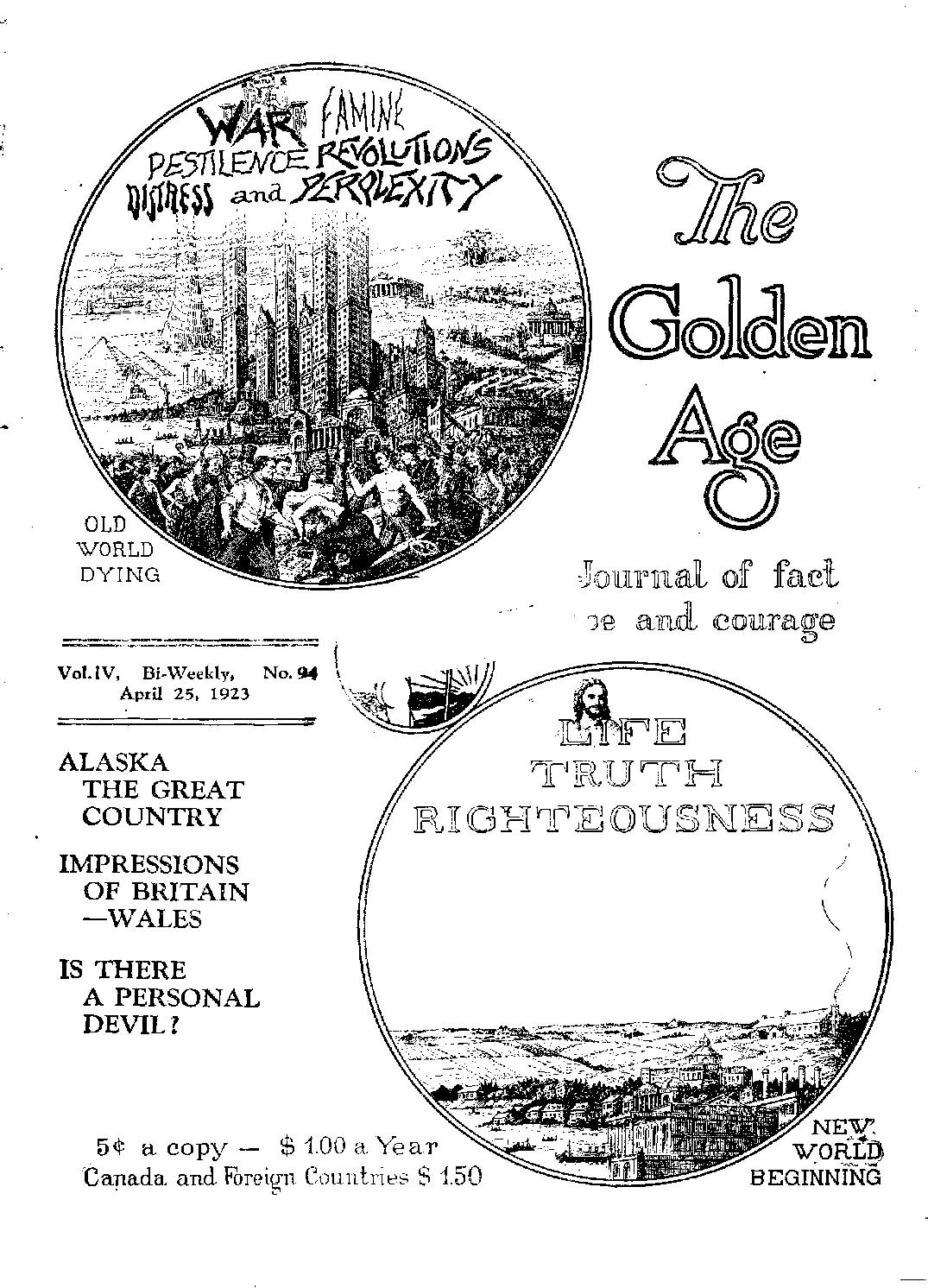
Contents of the Golden Age
Social and Educational CONCENTRATING NKWBrAREa POWER
A Conttscatob Confiscated
Finance—Commerce—lRAN6i-ubrATioN Taxation is Getti.no Tof-Heavy
Political—Domestic and Foreion Does the World Need a Despot?
The SrrRiT or Coney's Army
ItEFor.Ts from I-’oKtiGN COMEsroNbuxtx
Ileport from Enghiml
Keporf from Germany
iteport from Cinailii
Report from Greece
SciHMT. and In \ i'.:. i'ION Abe Other Planets Inhabited?
Travel and Miscei.lani' At.-Ak-Shak, the Great Country
Scenery anil Climate
What about Plant Life?
What of Aninwl Life?
The Salmon PisLeries
Proiluction of Minerals
Hallway am! Mail Servin'
The Native Alaskan . w
Impressions or Bbitain (Pari VIII)
Alone' the English Channel
The Path to Wales
The Plight of Monmouthshire
Helicion and PiiioEociiLi.' Is There a Personal Devil?
Devil, Satan, Beelzebub .
Satan Can Hear anti Speak
Satan Steals Truth and Sous lir.'H
Satan tr Powerful Monarch..............,
Studies in "The Habe of God" . .
Published every ether Wednesday at IB Concord Street, Brooklyn, N. T., U. S. A., by WOODWORTH, HEDGINGS A MARTIN
Copordnert end Proprietors Address: IS Concord Street, BrooJttyn. A’. F., C. S.A. CI.A'S'WX J. WOODWORTH . . . Editor ROBERT J. MARTIN . Business Manaeer C. E. STEWART .... Assistant Editor WM. F. HEDGINGS . . . Sec’y and Treaa. Five Cents a Copy—*1.00 A Ykab Maki Rimittanckb to THE COLD Lie AOa Eobkiuh Offices ; British .... 34 Craven Terraco. Lancaster Oats, London W. 3
Canadian ........ 270 Dundas Street W., Toronto, Ontario Australasian ....... *03 Colllna Straot, Milbourn*, Australia South African......a Lalle Street, Cape Town. South Africa
Hnterad u sacond-cIaM matter at Brooklyn, N. S, nndor th* Act of March 3, 1BT»
?-
ahe Golden Age
Brooklyn, N. Y.t Wednesday, Apr. 25, 1923
Number 94
Al-ak'shak, the
WHEN the Danish navigator, Vitus Bering, discovered the sea and the strait which bear his name, he discovered at the same time the great peninsula which the Inuit Indians called Al-ak-shak, meaning The Great Country, and which we today call Alaska. The name which the Indians gave it was a most appropriate one; Alaska is a great country.
The area of Alaska is 590,804 square miles; this is as large as all that portion of the United States east and south of the Mississippi and Ohio rivers and east of the boundary line between Ohio and Pennsylvania. It is as large aa England, Ireland, Scotland, Wales, Holland, Belgium, France, Spain, and Portugal, combined.
If Alaska were superimposed upon the United States, the southeastern extremity would be in the neighborhood of Savannah, Georgia, and the western edge of the Aleutian Islands would be in the neighborhood of Los Angeles. Not over half of the territory has been mapped; much of it is still unexplored.
The Aleutian Islands, stretching away from the mainland of the peninsula in a southwesterly direction for a thousand miles, are of volcanic origin, ten of the volcanoes upon them being still active. The vegetation on these islands is limited to berry bushes and dwarf willows; but there are many varieties of flowers, birds, and animals not found elsewhere; and for this reason the islands are very interesting to naturalists.
It is believed that a coaling station in these islands would be a profitable investment for the ships engaged in traffic between Japan and the Pacific northwest, enabling the carriage of a larger freight cargo than would otherwise be possible, on account of the large amount of coal needed for the voyage.
. . The trans-Pacific lines come quite near the (Aleutian Islands. This is because the flattening of the earth near the poles makes a great
Great Country
northern arc shorter than a straight line from east to west. For the same reason Seattle is a thousand miles closer to Japan than is San Francisco.
In the summer of 1920 the American Secretaries of the Navy and the Interior visited Alaska to make a selection of one of the islands for the proposed coaling stations; and at that time it was figured that under the new plan of -coaling at this half-way point between the Occident and the Orient the annual saving per 8,000-ton vessel would be $200,000, or one-tenth of the cost of the vessel itself.
Scenery and Climatt
AS SOON as adequate transportation facilities are provided, Alaska must become a favorite resort for those who are fond of magnificent scenery. The mountains (McKinley, 20,460 feet; Logan, 19,550 feet; St. Elias, 18,024 feet) are the highest in America and nearly a mile higher than the highest mountains in Europe, while the beauty and grandeur of the fjords cannot be surpassed on the globe. The face of the Muir glacier is a perpendicular wall of ice 200 feet high and three miles wide, and yet it is small compared with others. Beside this glacier the glaciers of Switzerland are rivulets.
In a country as large as Alaska, and situated as it is partly within the arctic zone, no general statement of climatic conditions can be made that will apply to the country as a whole. At 1 Point Barrow in the dead of winter the temperature is 70 degrees below zero, the ground is frozen to a depth of forty feet, and the annual mean temperature is 25 degrees above zero. Point Barrorv is on the Arctic ocean, as far north of the southernmost points in Alaska as Winnipeg, Manitoba, is north of Jaurez, Mexico. And the southernmost point of Alaska is in the same latitude as Winnipeg.
The Yukon river flows through Alaska from east to west in the same latitude as the middle portions of Norway and Sweden and Finland. In this valley a winter temperature of 50 degrees below zero may be expected for weeks at a time, and the ice freezes to a depth of from six to nine feet at one point where the river just touches the arctic circle. But the ice goes out in May, and from then to October the river is open, and vegetation flourishes on the banks. There are times in midsummer when the temperature at points in Alaska within the arctic circle ranges as high as 86 degrees.
The lower part of the Yukon valley, for a distance of five hundred miles, dips off sharply to the south, where its temperature is greatly modified not merely by the lower latitude but especially by the fact that it comes within the influence of the warm Japanese current, which does for Alaska, British Columbia, Washington, Oregon, and California what the Gulf Stream does for the British Isles, Scandinavia, and Northern Europe generally. In the lower part of the Yukon, and in the parallel valley to the south, the Kuskokwim, the climatic conditions are even now favorable to the development of plant life. As the summer days are long, the growing season while short in months is relatively long in hours.
The Coast Region
BETWEEN the great interior and the coast region there is a chain of mountains which accomplishes two marked climatic effects: They shield the coast from the arctic winds, and act as a condenser for the moisture-laden winds which sweep across the warm Japan current. As a consequence, the coast region is relatively warm and, additionally, it is one of the rainiest places in the world outside of the tropics.
The entire coast south of the Yukon is in the same latitude as the British Isles; the southernmost part of the Aleutian Islands is in the same latitude as Dover, England; and the commercial metropolis, Sitka, is on the parallel of Aberdeen, Copenhagen, and Moscow. Stockholm, the capital of Sweden, and Christiania, the capital of Norway, are each farther north than Juneau, the capital of Alaska. Trond-hjem, an important Norwegian city, is in the same latitude as Nome and Dawson.
Of the dozen or more ports of Alaska there is only one of any importance that is cut off by ice in the winter; the remainder are open the .3 year around. Some of these coast points are cold the year around, on account of the cold rains and cold winds that come down from the icy mountains, which are adjacent; but where £ the mountains are farther back, the summer 1 temperatures are so mild that it is claimed that j in the territory in which the Alaskan railway -S operates the mean temperature is higher than j at Washington, D. C.
Of the Alaskan winters it may be said in general that there are no storms, that horses and cattle may be worked in the coldest weather without danger of being frozen, and that children attend school the year around, with no interruptions because of inclement weather. The weather conditions for the children are more favorable in winter in Alaska than they are in North Dakota.
What about Plant Life?
A WHITER thus describes the great valley of the Yukon, a place imagined by many to be a desolate waste:
“From end to end of the Yukon, one of the mighty rivers of the world, the traveler may wander during four months of the year and never see snow. Instead, there will be a tangle of rich vegetation, of great forests, of grass that grows as high as a man’s shoulder, and of endless fields of beautiful plant life. Wild berries in great variety, raspberries, huckleberries, blackberries, cranberries, gooseberries, currants; beautiful ferns wav- Y ing in the soft breezes, great beds of the purple lupins1 ~ and the red columbine, wild celery and wild parsnip t growing many feet high, ponds on which float greet >3 yellow lilies, with the purple iris bordering their banked ——all are everywhere.” 4
At first that seems pretty strong; and w* would be inclined to take it as a perfervid utterance of some ultra patriot who has in his mind a vision of the future instead of the pretk ent. But government officials are not so apt ta-3i be rhetorical, because it is inconvenient to b» chocked up. Yet the governor of Alaska moBt than twenty years ago wrote: 'J
“Oats, wheat, rye, varieties of barley, buckwheat, cabbage, cauliflower, potatoes, turnips, rutabagtl^-^ thyme, sage, horseradish, carrots, beets, parsnips, Mk’jS tuce, radishes, peas, horse-beans, onions, celery, clovw^;’|l flax, rhubarb, were planted, and nearly every one
. APML 25, 1923
. ; brought to perfection. The cereals were planted the last of April, and. came to maturity with full plump grain the last of September; they grow with rank straw. Good garden truck was successfully grown as far north as Eagle City, upon the Yukon.”
Professor Georgeson, another government official, who has been in Alaska for twenty-one years, and who has charge of four agricultural stations there, says that the time will come when the Alaskan wheat fields will play an important part in the economy of the nation. And still another government official, Mr. Lane, Secretary of the Interior, is said to have made the ’ statement that when the fishing industry of
' Alaska has run out, as it already bids fair to
do, its place can well be taken by the vegetable canning industry, particularly the canning of . peas.
•; The only farming areas thus far developed
are along the line of the Alaskan Central Railway, which extends in a north and south direc> tion from the coast to the center of the Yukon , ’ valley. The men farming here went to Alaska ’’ originally to dig gold. They are mostly un, married and need wives. Here is a chance for
the girls. Take the boat from Seattle to Anchorage, and behave yourselves well, and you will be married in a week.
A In this district the soil is rich. Wheat, oats, barley, buckwheat, and vegetables thrive; potatoes mature; and the ordinary red-top grass, which in the United States grows to a height p’ of but eighteen inches, attains a growth of over six feet. Throughout this area are grown the finest of turnips and the crispest of celery.
Apples do not do well in Alaska, but some of y the trees that were planted in the old Russian . missions along the coast are still yielding sour fruit. At Rampart, in the Yukon valley, near the arctic circle, winter rye seeded in August '■ lived through the winter and matured grain the : following season. Barley seeded in May was
ripe by the middle of August.
A.. But while Alaska has even now 100,000 ; square miles fit for cultivation (an area larger k than Illinois and Indiana combined), yet until ■ the polar ice-cap has melted its principal future - is as a dairy country, or at least a country for
A the raising of domestic animals suited to its
peculiar vegetation. Alaska is striking in the y profusion of its wild flowers and. mosses.
What of Animal Life?
THERE was a time when elephants and mastodons roamed over Alaska, and the ivory from the tusks of these monsters of long ago is still an article of commerce. There are furbearing animals, the sea-otter, marten, ermine> sable, mink, muskrat, beaver, white fox, blue fox, red fox, black fox, polar bear, grizzly bear, black bear, glacier bear, and the Kadiak bear, which is the largest and most powerful flesheating animal known. There are wolves, lynxes, seals, walruses, and whales.
In the line of food animals are the moose, arctic hare, porcupine, marmot, squirrel, sheep, goat, and, most important of all, the caribou or reindeer. In its present condition Alaska is a natural home for the reindeer, which is merely a domesticated caribou. The country is covered with thick reindeer moss, which it is estimated would easily maintain four million reindeer, probably it would maintain many times that number.
There was originally a large herd of native caribou in Alaska; but the coming of the whites killed these off, although there are yet some herds on the north coast and in the mountainous hinterland, where the hunters have not been so thick as on the west coast. It was the destruction of these native herds that led to the introduction of the domesticated animal.
About ten years ago Uncle Sam bought 1,200 reindeer in Siberia and placed them in charge of the school authorities of Alaska. They have proven a great civilizing influence, turning the natives from a hunting and fishing people into pastoral owners of property, with community interests and an increasing appetite for education. The original herd of 1,200 has increased to 180,000, most of them in the hands of the natives. Shipments of reindeer meat have been made to the United States.
Another northern animal which. would do well in Alaska and be a great benefit to; the country is the Canadian musk-ox which feeds on the herbage which grows between the clumps of reindeer moss. This animal is valuable for its hide, its superb wool, and the meat, which ia much like beef. The musk-ox gets along well with the reindeer, and they would live side by side without quarreling.
If the empty places of Alaska could be filled with reindeer and musk-oxen, the two specie*
would provide a great meat supply and be useful in ridding Alaska of the billions of mosquitoes which infest the whole country.
These mosquitoes develop and mature in the tundra or moss, rising in throngs to the shores of the Arctic Ocean. They sting even bears and moose around the eyes until these animals are maddened into miring themselves in the swamps, and they force the native hunters to wrap their heads in furs. How to get rid of these mosquitoes over so great an area is a great problem.
The Salmon Fisheries
THE salmon fisheries of Alaska are the most extensive in the world, employing 20,000 people and yielding products of an average annual value of about $40,000,000. From the standpoint of the number of persons employed this is the most important industry in Alaska. It now bids fair to die out because of being overdone. The salmon catch for 1919 was only half that for 1918.
The highway of Alaska is the Yukon. For ages its tributaries have been the breeding places of salmon innumerable. These great fish have been food for the native and for his dogs, winter and summer. Hunters, trappers, prospectors, miners, and travelers alike have depended upon them. Now the canning companies have taken so many that their destruction impends. Not content with taking from the river itself the 30,000 cases which Government regulations permit, the fishing concerns have stationed themselves just off the Yukon’s mouth, catching the fish before they can get into the river at all, thus preventing them from spawning. Tn this way the canning companies are killing the goose that lays the golden eggs, so to speak.
A4 the present time more than half of all the salihon product of the United States comes from Alaska. The herring and cod fisheries are also large. The halibut fisheries need further Governmental protection to prevent them from being exhausted.
Timber Supplies
THE most valuable of all Alaska’s timber woods is the yellow cedar, a straight-jrained And highly durable wood from which the Indians make their dugout canoes, some* times seventy-five feet long by eight to ten feat wide and carrying 100 people. There is also a valuable wood for tanning in the balsam fir. There is no timber north of the arctic circle. .
The local wood of all work is the Alaska spruce, too knotty for fine work but yet the only wood generally available for all purposes. It is estimated that there are twenty million acres . of virgin spruce and hemlock in Alaska, all ... owned by the Government; and that the yearly . : growth would provide a news-print product equal to one-third the annual consumption. Under the reign of earth's new King, however, it "will not be necessary to tell so many lies as now, and the demand for news-print will not be nearly so large. =
Early History
IT WILL be a surprise to some to learn that the first steamships built on the Pacific coast , slid into the waters from the Russian shipyards at Sitka. The supplies for the first California t miners, their woolen clothing, picks, shovels, lumber, dried fish, and woodenware, were purchased from the Russian-American Fur Company, with headquarters at Sitka. This company aimed to make Sitka a great city on th* j
route from America to Asia, but found too ||
many difficulties in the way at that early date.
Indeed, many of these difficulties still exist.
By the time the Civil War came along, th* Jg Russian Government had tired of its Alaska® 41 undertaking. It had more land than it could w develop or manage: it had become friendly to the United States ’Government; it wanted ft '3 buffer state between the British possessions ol 3 North America and its own possessions in the J’S Far East. Accordingly William H. Seward, l| Secretary of State, who had an enthusiastic 1 belief in Alaska’s future, took the territory off her hands in March, 1867, for $7,200,000. 3
The Russians and the trappers knew of gold sands and placers, but it was not until th* ‘j* United States Government had taken over th* , territory and discovered gold in large quantities on Douglas Island that anything in th* J|l nature of mining was undertaken. From that one mine at Treadwell there has been produced jg over fifty million dollars in gold. - a|
The second great discovery of gold was o* the Canadian side of the line, in the Klondik* region, near Dawson, where the Yukon leaves the British possessions and enters American territory. This was in 1899, and resulted in one of the greatest gold stampedes in history.
There was a rush of tens of thousands of men into a vast country which was almost unknown. They went up every river and over every mountain pass. The struggle was so terrific that in one of these passes, the one through which the White Pass and Yukon railway makes its way from the headwaters of navigation on the coast to the headwaters of the Yukon river, the builders of the railway were obliged to remove the frozen bodies of two thousand pack-horses before they could grade the line.
One morning in June, 1899, while this railway line was in process of construction and two thousand men were busily engaged in the work, word reached the workers of a gold strike at a lake district something like a hundred miles away. By night there were only six hundred men left on the job; the other men had plunged into the wilderness, carrying their picks and shovels, but leaving virtually everything else behind them. There were thousands of cases of want during the next long winter, and no doubt many cases of actual starvation. In the end the American Government was obliged to rescue large numbers of the unfortunates and take them out of the country.
But Dawson is today a city of electric lights, waterworks, churches, theaters, club houses, banks, hotels, public schools, and elegant homes, with an assessed valuation of eleven million dollars. The subduing of the earth is a man’s job, but it pays in the end.
The same thing which happened at Douglas Island, in the southern extremity of Alaska, and which subsequently happened in the Yukon valley near Dawson, happened again at Nome two years after the Dawson discoveries; and .Nome is in the far northwest, nearly two thousand miles away. A United States soldier was 'digging a well. Standing by was an old prospector who was ill and unable to follow the crowd that had rushed into the adjacent gulches. He recognized the "pay streak,” and in twenty days took out $3,000 in gold. Then another rush as great as the Dawson rush occurred. People of every occupation took to burrowing in the sand, and the price of labor went up at once to $15 per day.
Production of Minerals
ALTHOUGH there is not much gold produced in Alaska at present, on account of the high cost of labor and materials, yet it is claimed by experienced miners that at least $500,000,000 worth is in sight. There have been years in which the production of gold has gone as high as $29,000,000. In the one year of 1920 the products of all kinds shipped from Alaska to the United States were ten times in value the amount paid for the country.
The value of the total mineral product of Alaska increased from $18,620,913 in 1919 to $23,307,757 in 1920, but the gain was entirely due to the increase in the output of copper. Alaska has the greatest copper mine in the world; but there is only one copper mine in the country that is not owned by the Guggenheims, and that one is controlled by them because they control the steamship line by which the ore must be brought out.
The mine production of Alaska embraces gold, copper, silver, coal, tin, lead, platinum, petroleum, marble and gypsum. The silver production thus far has been small, although it is claimed that great deposits have been discovered in the southern part of the country. The iron thus far discovered is of a poor quality. Asbestos, uranium, zinc, and graphite have been discovered in large quantities. Alaska has the only tin mines on the continent; one of them, owned by a woman, produced tin to the amount of $40,000 in a short time.
In the Seattle Chamber of Commerce there is a lump of coal, weighing 1,500 pounds, which came from Cape Sabine in the Arctic ocean. Coal has been found at widely scattered points here and there all over the peninsula. Most of the coal which has thus far been mined is a sulphurous lignite useful for domestic fuel, but so poor for steam purposes that it has been found profitable in some places to import coaL The Geological Survey estimates that there) are 150,000,000,000 tons of coal in Alaska. ,
Any country which has soft coal in large quantities has oil; and prospecting and development work in the search for oil is in progress. The Secretary of the Interior claims that the coal and oil of Alaska, if developed on a large scale, would pay the bonus for the soldiers which the big business interests of ths country are so anxious (1) to see them get
Transportation Facilities
A LASKA’S pressing need is better transportation facilities. Any country develops in proportion as its transportation facilities improve. The time will come when a trunk-line railway will run down the Mackenzie valley from Edmonton, up the Peace river, and thence down the Yukon valley to Bering Strait. The strait will be tunneled and, by that means, there will be completed a railway around the world, so that those who prefer to travel by rail may go virtually anywhere.
But at present the only way of getting to Alaska is by the Canadian steamship line or by one of the two American lines. The travel is light because the population is small and scattered, and the rates are high. The two American steamship lines, the Alaskan Steamship Company, owned by the Morgan-Guggeulieim interests, and the Pacific Steamship Company, charge the same rates and are probably both under Guggenheim (American Smelting and Refining Company) control.
The shore-line of Alaska is 26,000 miles, greater than the circumference of the earth at the equator. It is claimed that on account of the magnificent scenery these bays, coves, inlets, and winding waterways offer a pleasure ground for summer cruising that is unmatched in the world. A year ago a white man, John Muir, traversed 800 miles of the coast alone in a small canoe.
The Yukon is the great commercial artery of interior Alaska. This river, with a total length of 2,044 miles, is navigable for a distance of 1 ,S66 miles by light-draft ships. In the summer of 1921 there were forty boats engaged in commerce upon its waters. Six hundred miles above its mouth it is a mile in width.
The Yukon is peculiarly fitted for navigation by the singailar circumstance, that it is without snags, and a boat may tie up at almost any spot desired. The reason for this is that its headwaters are in a southerly direction from the one place in its route to the sea where the Yukon touches the arctic circle. As a consequence the Yukon begins to thaw out in May at its very source; and the flood waters, cracking the great ice-sheet six to nine feet in depth, send it crashing, grinding and cutting its way to the sea in one of the most awe-inspiring scenes to be found anywhere. The winter trade begins as soon as the ice is of sufficient thick* 1 ness to sustain teams of dogs and loaded -sleighs, and continues until the next spring. - :
Railway and Mail Service *
WITHOUT waiting for the Canadian line
from Edmonton to Dawson and thence j; into Alaska, which will some time be built, the United States Government has built its own < line from Seward on the south coast straight north to Fairbanks in the Yukon valley, a distance of 467 miles. This railway, begun in 1915, has been completed, having cost about $100,060 per mile to build. It is now operating twa trains a week each way. Another railway is " projected from Fairbanks to Nome, far on the ; road to Bering Strait. Having been built with Government money, the Guggenheim interests seem to be planning, by excessive steamer -t rates, by monopoly and closure of coal mines, and by propaganda to that end, to get the Government’s railway into their own hands. j
The mail service might be better, and. it might be worse. There are about 100 post- 5
offices scattered over the vast territory, and the Government makes an effort to provide nearly all of these post-offices with two mails a month the year around. Where ordinary means 01
-'S
transportation fail, the Russian reindeer, d<>* mesticated in Alaska, carry the sacks over the * frozen lakes and snow-covered hills, traversing y a great distance in a short time. The carrier who takes the mails to Fort Yukon, on th< $ arctic circle, twice a month the year around, i supplies his own dogs and sleds, and receive*-;* $25,000 a year for his work. He is the highest salaried postal official in the world. When boai^ connections at Seattle are closely made, it takes-|l but eight days for mail to go from the national JS capital at Washington, D. C., to the Alaskan capital at Juneau. li?
There are fourteen incorporated towns ilk 3“ Alaska, in each of which there is a high school^ and there are about sixty-five other schools ijl-^ various parts of the country. All parts of th*' ^ country are in daily touch with the outside..^ world by telegraph, wireless or cable; and al-^ though there are but 32,000 whites and 23,OODJ3 natives in the whole great country, yet thee* Jr are a few newspapers, two of which are befoi<f us as we write. These are copies of the Dai
A Telegraph Bulletin of Nome, issued in connec-: tion with the Nome Weekly Nugget.
The Bulletin consists of a single sheet of paper eight inches wide by fifteen inches long. On one side of each of the two numbers which we have is an advertisement of some social affair, in the one case of a barn dance, admis-*- sion for gentlemen $1.50, ladies free, and on the other an advertisement of a Pioneer Potlatch (whatever that is), admission for gentlemen $1.00, ladies free. On the other side are three columns of condensed telegraphic news. The price of the Bulletin is ten cents per copy, or the combined Bulletin and Nugget for $2 per month.
Conservation, of Development
THE Government is in a predicament regarding Alaska, wishing to develop the country h (which it can do at once if only it will surrender ' body and soul to the Guggenheim crowd and let them operate it as a crown colony for the group which has already gobbled up many of the best mining properties in the world), and wishing to find some way to give the plain people a ;;; chance to get some of the riches with which the r country abounds. In the effort to save something for the people a policy of conservation has been adopted which means well, but which is really S causing the country to go backward instead of
k forward.
' The Guggenheims came near getting full con: trol of Alaska some twenty years ago; but
President Roosevelt, in the effort to prevent it, issued an executive order reserving all the coal ? lands, the oil lands, the timber lands, and water
; powers, Fire Island as a moose reserve, and a
- number of the Aleutian Islands as a fish and ' ' bird -reservation. The effect of these Teserva-; tions has been to drive people out of the coun-
F try, so that, it is claimed, sixty percent of the
white population have given up the fight and gone back to the United States.
It would seem as though the Government should be able to find some happy mean be. tween an ignoble surrender to one corporation A and the discouraging of all initiative by malting so many restrictions; yet its efforts to keep the g . corporations, a few big ones, from gobbling up ' about everything worth gobbling in the United " States, have not met with any reassuring success.
The moment the restrictions are removed, that moment the giant corporation is in position to act, powerfully and effectively, while individuals or smaller concerns are handicapped by lack of capital. If a few honest officials could be found, it would seem as if the Government could carry much further the development so well begun by the construction of the Alaskan Railway. This is the aim of many of its statesmen.
Alaska’s development should not be entrusted to one or many bureaus in Washington, but to the Alaskans themselves in a legislature of their own. There are now in Washington thirty-eight bureaus claiming and exercising jurisdictions in respect to Alaska’s affairs. They administer after some sort more than 300 reserves; and on account of the distance from Washington, conflicting claims, and the desire to exercise control, these bureaus have strangled the country, and for the time being have ruined it.
But this is all of God’s permission, and without doubt it is His pleasure that the natural wealth of the country should for a time lie largely unused; for shortly, under Messiah’s control, millions will be coming back from the tomb. And when that time comes, there will be room for myriads of them in this land of possibilities, if not of present opportunities, Al-ak-shak, the Great Country.
The Native Alaskan
WE DO not wish to leave the subject without saying something of the smiling, optimistic, hopeful, purloining Eskimo, the blackhaired, black-eyed, hardy, home-loving and family-loving people that have followed the shores of the Arctic ocean all the way from northern Siberia to the eastern coast of Greenland, and that make up most of the native inhabitants of Alaska.
Among the Eskimos the family is the unit, independent of all other families. Marriages are arranged by parents while children are young, and are consummated by the bridegroom riding off with his bride to their future home. Women are the property of men. Polygamy is not uncommon, the second wife being taken about ten years after the first, and with the consent of the first, to assist in caring for the children. Among newly born children the death rate is high. Eskimo snow houses are sometimes lined with sealskins; the beds also are of snow, covered over with skins, and are not uncomfortable. The windows are blocks of ice, the air supply coming in through a hole in the roof.
In parts of Alaska the natives have their own cooperative stores, their canneries and sawmills, their power launches and electric-lighted homes. They even publish a magazine devoted to the interests of their race. They keep up with the whites in the public schools. Of 2,204 pupils in forty-seven schools, 1,255 or 56.9 percent are native born. Alaska is so well mixed that out of 408 students attending night schools for adults there were thirty-four nationalities represented, not counting the natives.
The influenza wrought terrible havoc among the natives in the winter of 1918-1919, resulting in 1,500 deaths. Governor Biggs, of Alaska, said of the situation at that time:
“Whole villages of Eskimos lost their entire adult -.js population. Many infants were frozen in their dead mothers’ arms. To make matters more gruesome, ths half-starved dogs mangled and mutilated the dead and -,** dying. Reports are arriving of several villages having ’ been entirely wiped out and the bodies eaten by dogs. One little half-breed girl, picked up in an igloo and -hurried to the hospital, suffered amputation of botil 3 legs. I doubt if similar conditions existed anywhere in J the world, the intense cold of the arctic days, the long ”3 distances to be traveled by dog teams, the living chil-dren huddled against their dead parents already being gnawed by wolfish dogs. No assistance at that time 3 could he procured from any helpful agency. They were *3 ah too much engrossed with the woes of Europe to be 1 able to note our wards, dying by swarms in the dark i of the northern nights.”
To this we can only add, "Thy kingdom i come 1” . i
The “Star” of Bethlehem
NOT many are aware of the fact that the “star” of Bethlehem was a fake star—a supernatural light given by the power of Satan —and the purpose was to destroy Jesus, who was declared to be a king and a savior. By reading the story this thought will more and more impress the mind. The point to be noticed is; God does not work through nor give any information through star-gazers, astrologers, or Magi. The “wise men from the east” were magicians. They saw the star and went to Herod, the wicked ruler of Israel. Herod had no intention of paying homage to the child Jesus, but sought His life. The wise men were warned of God in a dream not to return to Herod. When he saw that he was foiled he demanded the death of all the children in Bethlehem, two years old and under. But Joseph, being warned in a dream also, took the child and His mother into Egypt.
As we might know, there was a sorrowful wail that went up from those Jewish mothers. “Rachel” represented the common mother of all those children. God foresaw it all and inspired the Prophet to write: “Refrain thy voice from weeping, and thine eyes from tears: for thy work shall be rewarded, saith the Lord; and they shall come again from the land of the enemy.” (Jeremiah 31:15-17) Thus is shown the resurrection of those babies; for they shall come to their own border.
Rev. W. A. Fite, of Kansas City, throws a little light on the subject. In part he says:
“In the minds of most people the Bethlehem shep--herds saw the star which appeared on the night Jesus was born and the Magi made their visit to him. on the same evening. . . . According to the New Testament the shepherds did not see the star and neither did the wise men reach the Christ and offer their gifts on tbs night of the nativity. . . . The land of the East seems reasonably to have been Babylonia. According to th* book of Daniel the wise men of Babylon were known U 'J Magi. . . . They started from the land of the East tn Jerusalem soon after they saw the star. But it required several months to make this long journey of several 13 hundred tn ilea, almost a thousand. And when they ar* . fa rive Jesus is no longer in a stable and manger, but inw^ house. He is no longer called a babe but a child.
was probably only a little less than two years old at the time of the visit of the wise men. Herod had asked them .Ji exactly what time the star appeared, and being mocked J? by the failure of the wise men to return to him, ha-sought to kill Jesus by killing all the male children ia Bethlehem, from two years old and under, according to jg the time which he had exactly learned of the wise men. Herod wanted to make sure of the death of Jeans, bait a| he did not want to kill any more children than was neo-essarv. He sought, therefore, only a safe margin between "d the age of Jesus and the age limit for other children tp be killed.” Wj
^•7
Impressions of Britain—In Ten Parts
f "PORTSMOUTH, the Portiig Magnus of the J- Romans, seventy-five miles south of Oxford, was the American's next stop. It is the z center of British navrd activities. Here Alfred '■ the Great fitted out his fleet that overcame the i Danes, and here Admiral Nelson went forth fc* with the fleet which destroyed the combined French and Spanish fleet off Cape Trafalgar, in 1805, and put an end to Napoleon’s well-laid plans for the invasion of England.
The British people hold Nelson’s memory in great esteem (despite the blemishes of his private life), because he had the indomitable grit t and courage which have made the British Empire. In 1801 he was with the fleet which destroyed the Danish fleet in the harbor of Denmark’s capital, Copenhagen; and when his attention was called to the fact that his superior officer had signalled to cease firing he put the telescope to his blind eye and said that he could not see the signal. This gave him great popularity in England. Three years previous, in the battle of Alexandria, he had destroyed all but two ships of Napoleon’s Egyptian fleet.
At Portsmouth one is shown several tablets E" marking incidents in the admiral’s life, the hotel in which he stayed the last night on shore, the entrance on the dock through which he passed to his flagship, and the old flagship itself, the “Victory,” upon which he died in the ■ hour of victory in 1805, and which is now being ” repaired by public subscription. The yachts of Sir Thomas Lipton, by which he has on numerous. occasions for a generation endeavored to y regain the American Cup, arc made at Portsmouth. The dockyards here cover 500 acres, r Southsea Common, which extends to the beach, is a parade ground for troops; and the beach it-7J self is one of England’s popular seaside resorts, p
Along the English Channel
THE journey from Portsmouth to Brighton was by rail, but it was near enough to the I; English Channel to enable one to catch here jp . and there glimpses of that restless body of water. The tides here are double tides, lapping y ‘ back upon themselves every six hours, due to the backwash from the North Sea coming ^7 through the narrow neck of the Dover straits " at ebb tide.
From Bosham, fourteen miles from Ports-
(Part VIII)
month, sailed Harold on that voyage which ended in his being wrecked on the coasts of Normandy, where he was made to swear by the Duke of Normandy, afterward William the Conqueror, that he ’would forego the crown of England in the duke's favor. On being set at liberty Harold returned to England, was chosen king, and tried to forget the promise which he had made under duress. But William did not forget. On October 14, 1066, he landed with a large force and at Hastings, about fifty miles farther east, Harold, the last of the Saxons, and most of his nobles, were slain; and William reigned in his stead. Chichester, in the vicinity of Bosham, wag the Roman Regnum, founded by the Romans. It hag a church built in 1123, the spire of which is 270 feet high. Part of the ancient walls of Chichester still stand.
Brighton, forty-five miles from Portsmouth, is England’s chief bathing resort. It was an unimportant fishing village until 1750, wheh one Dr. Russell recommended to his patients the hitherto unheard-of practice of sea-bathing. During the war it received such a great influx of Jewish visitors from London, anxious to escape the air raids, that it came to be jokingly called Palestine-by-the-sea.
In the rear of Brighton ig a mountain commanding a view of the country and of the sea for many miles in every direction. On the top of this mountain the American patroled for some, distance earthworks thrown up by the Roman soldiers when they invaded Britain before Jesus was born in Bethlehem of Judea. It is a most peaceful scene now, part of one of the golf links for which rural England is famous.
The American wag entertained in a home fax up on the mountainside; he was to lecture that evening two miles away; there was a half-hour to spare, and he proposed to his host that they cover the distance on foot. The host’s two daughters agreed to go ahead and set the pace; and yon had better believe now that they did. The American is a good walker; he can do a mile every fifteen minutes easily; he had heard of the ability of English girls to walk, and he had a good chance to see it demonstrated. At least he did for the first mile; after that the girls were so far ahead that they could not be easily seen. Where they get all their steam from is a mystery.
<69
The beach at Brighton is a beautiful place, as is also the one at Southend-by-the-sea, one hundred miles northwest, which was the American’s next stop. Southend is distinguished by the fact that it has the longest pier in the world. This resort, located at the northern edge of the mouth of the Thames river, has Buch a gradually shelving beach that it requires a pier one and one-half miles long to reach deep water, and for the convenience of the hundreds of thousands of tourists that come here during the season, there is an electric railway running between its termini.
Westward Bound
SOUTHEND-BY-THE-SEA was the American’s “farthest east,” and from here the course was almost straight west as far as England and Wales combi ned will permit. The first point of interest is Slough, eighteen miles from London; for in going west from Southend one must go through London. Here Thomas Gray, the writer of the “Elegy Written in a Country Churchyard,” lies in the churchyard in which the acknowledged masterpiece of English literature was written. Although begun in the churchyard it required seven years to polish it into its final form. How sweet the words:
“The curfew tolls the knell of parting day, The lowing herd winds slowly o’er the lea;
The plowman homeward plods his weary way And leaves the world to darkness and to me.”
So remarkably is this poem constructed that the third line of the foregoing stanza is capable of being arranged in a great variety of ways and still is musical and intelligible:
The plowman plods his weary way homeward. The plowman plods homeward his weary way. The plowman plods his way homeward, weary. The plowman plods his homeward way, weary.
* The plowman homeward his weary way plods. The plowman homeward, weary, his way plods. The plowman his weary way plods homeward. The plowman his way plods homeward, weary. The plowman his way homeward, weary, plods. Homeward the plowman plods his weary way. Homeward the plowman his weary way plods. Homeward the plowman, weary, his way plods. Homeward the plowman his way plods, weary. Homeward the plowman his way, weary, plods.
Homeward plods the plowman his weary way. i .t.
Homeward plods the plowman his way, weary. ’ -
Homeward plods his weary way the plowman. . Homeward plods the plowman, weary, his way. -
Enough has been given to show that this remarkable sentence can be arranged in 120 different ways, and still make a readable and pleasing expression of a thought not elsewhere so well stated. It would be well if all literature could be as carefully prepared, including The ; Golden Age. Doubtless in the Millennium the world’s literature will be prepared with infinitely more care than the literature of the past ■; and present has been, and it will be under divine supervision. There is no form of poisoning so insidious as the poisoning of the mind by : untrue or evil literature. And today, outside ofl the Bible and Pastor Bussell’s "Studies in the i j Scriptures,” there is little literature which can be read with confidence that it will not contain here and there elements of injury to the mind ’’ of the reader. ~
Burnham Beeches, three miles farther on, is , a fragment of the ancient forests of Bucking- J hamshire. It contains 374 acres of enormous 4 beech trees, many of them of great age. Since 2 1883 it has been opened to the public as a park * by the Corporation of London. 2
At Maidenhead, twenty-four miles from London, the Thames is crossed by an elliptical arch brick bridge, a unique and graceful structure. I At Maidenhead lived and died Simon Allyn, the 2 Vicar of Bray, who, like many another theologian, was in the religious business for revenue only. He managed to hold his job as a Roman Catholic vicar under Henry VIII, then as B-.i Protestant vicar under Henry VIII and Edward VI, then as a Roman Catholic vicar under Bloody Mary, and then as a Protestant vicar under Queen Elizabeth. His chief principle haU.J been summed up in the lines: - -i
"And this is law, I will maintain
Until my dying day, sir, That whatsoever king may reign, I’ll still be Vicar of Bray, sir.” ■
An Avenue of Kingdoms --4
READING, not far from Maidenhead, the capital of England in 1017-1041 XlXgM when the Danes were in power. '
At Vantage, sixty miles from London, Alfred the Great was born in 849 A. D., and is fully entitled to the appellation usually attached to his name. It was he who gathered the Saxon people together into one nation, and who laid the foundation for the British navy. In his own times he went by the name "The Truth Teller/’ a sufficient mark of nobility for any man. He codified the customs of the people into written laws. He overcame the Danes, then overrunning the country, by making Christians of them and teaching them to live by other means than depredations upon the peace-loving Saxons. His justice and modesty left a great impress upon history.
While Alfred was rising to power, but while he was still a fugitive from the Danes, he took refuge on an island, in the home of a peasant to whom he was unknown. The good wife set him the task of watching the cakes; he allowed them to burn and was severely scolded, but took the scolding in the meekest manner, and without revealing his identity as the king. He was a wise and just ruler, a friend of the common people, a scholar, and a far-seeing general.
At Vantage there is a curious stone called the blowing stone. It is a huge block of red sandstone pierced by may holes. The sound produced by blowing into one of these holes is like the bellowing of a calf and can be heard for six miles.
Uffington (Offa’s town), six miles farther west, is named after Offa “The Terrible,” king of Mercia, one of the six Saxon kingdoms which, in the latter part of the eighth century, covered the territory now embraced in England. Offa was the antithesis of Alfred the Great. He was as little and mean and brutal as Alfred was great and noble and magnanimous. But he was a good Catholic. He had his neighbor Ethelbert, king of East Anglia, secretly murdered, and then seized his kingdom. For this neighborly act he atoned by a work of great piety, the building of the Abbey of St. Albans.
Offa also started, or developed widely, the scheme of sending to Rome money, which is now called “Peter's Pence.” He compelled each family in his realm that had property worth thirty pence to send one penny each year to Rome. This put this brutal murderer in solid with the king of heaven, earth, and hell; and no doubt we shall sometime be favored with a revised history in which Offa will be reverently referred to as Saint Offa.
At Uffington, cut through the turf into the chalk underneath, one may still trace’ on “Whitehorse Hill” the gigantic white horse, 353 feet from nose to tail, which commemorates King Alfred’s victory over the Danes here in 871 A. D. At Wootton Bassett, seventeen miles farther on, are still preserved the old stocks in which prisoners were once confined. At Chippenham, ninety-four miles from London, was born in 1800 W. H. Fox Talbot, one of the inventors of photography, and one of the first to decipher the inscriptions on the tablets recovered from Nineveh.
Bath, 107 miles from London, famous for its healing waters since 863 B. C., still preserves the baths erected by the Romans prior to the beginning of the Christian era. They are five in number, heated by flues beneath the floor, one of them lined with lead. The largest is 68 by 110 feet. The principal springs, four, in number, pour out 7,000 gallons an hour, at temperatures ranging from 108 to 117 degrees Fahrenheit. The angels on the Bath Abbey church are badly battered. Cromwell and his crowd were not strong in their admiration for anything designed or built by the Roman Catholic system, and took a delight in making the angels look as though they had been in a prize fight and got the worst of it.
The Path to Wales
HE American’s first stop was Bristol, 118*4 miles from London; and the trip from London was made in just 120 minutes, schedule time, a record hard to beat. Bristol has a church with a spire 292 feet high, which leans “at an alarming angle.” But you need not fear that it will fall right away; for it has been leaning that way since as long ago as 1578, when mention was made of the fact.
Bristol has a suspension bridge 245 feet above the level of the Avon, and a tower erected in honor of John Cabot, theliardy Italian navigator who, sailing out of Bristol with a single vessel, in 1497, landed on the continent of North America, and followed the coast all the way from Labrador to Florida. The parliament of the time gave him in one lump a sum the equivalent of fifty dollars for discovering the new isle; and here is hoping that he did not waste any of it, as it constitutes England’s sole claim to possessions on this side of the Atlantic.
Between Bristol and what once was Wales, but which now is Monmouthshire, the railway passes through a four and one-half mile tunnel under the River Severn. The tunnel, built after many difficulties from flooding, was completed in 1886 at a cost of £2,000,000. The Severn, 220 miles long, has a tidal rise and fall of sixty feet, making it one of the most dangerous of rivers for the unwary. The tide comes in so rapidly as often to cut off the retreat of those who venture •ut upon the flats revealed at low tide.
Cardiff, derived from a Welsh word which means City on the Taff, was the American’s next stop. Cardiff has the largest coal exports of any city in the world. The old Cardiff Castle, built in 1080, is still in use as a residence by the fabulously wealthy Marquis of Bute. The docks cons: -cted by the Marquis for his coal exports cover 200 acres and cost $20,000,000.
The Marquis, although living in a Protestant country and obtaining his wealth therefrom, is a Roman Catholic. One can see the reason why a wealthy business man might prefer to be a Roman Catholic; for it is a religion within which one may by contributions and donations of money to the right man at the right time make himself solid with the Almighty, “as it were,” without having to give the matter any further personal attention.
The Marquis is reputed as willing to sell his old castle when somebody with sufficiently much money, and sufficiently little common sense, comes along and makes him the right offer. It is a gloomy-looking old place that no sensible man would take as a gift. Robert, Duke of Normandy, suffered as a prisoner within its walls for the long period of twenty-six years.
At Llandaff, a Welsh name which means Church on the Taff, is a church alleged to have been originally built by King Lucius in A. D. 180. The River Taff is famous because at ebb tide it is plainly but a small stream, while at flood tide it looks like a great river. It is this appearance of being what it is not that has given rise to the expression that one is giving “taffy” when he flatters another. The good people of England rather seem to give the Welsh people as a whole credit for just this sort of thing; but perhaps the Welsh would feel more like dividing the honors with their critics in this respect.
Welsh Foreigners
THE name Wales comes from an old English word Waelisc, which means foreign. The
ancient inhabitants of the British Isles, driven back into the mountain fastnesses of the west J by the Romans and the Saxons, were termed -J foreigners by those who came in and possessed their lands. There are numerous imperialists in Britain to this day who still have this idea, ’?
that upon whatsoever land they set their foot 4
it is their own and that the real natives have only such rights as may be measured out to them; they are “foreigners.” |
The Welsh hang on to their old language and | customs with great tenacity. It is estimated J that at the beginning of the twentieth century there were in Wales about twenty percent of the population who knew no other language than AVelsh. The national singing festival, the Eisteddfodd, is believed to date from several a centuries before the Christian era. Welsh sing-. ing is of note the world over; Adelina Patti made it so; it is a treat to hear it in Wales M itself. The rhythm, the time, the swing, the accentuation, seem not duplicated elsewhere.
The Welsh names are a subject for despair: Ynyshir, Cribbrfawr, Glyncorrwg, Llwynhendy,
Llanerchymyedd, Llanddewiaderarth, Lian-rhairdrmochnant, Llanfairpwyllgwnguillgpge- ' rydrobblandiailiogogoch. Good night; this is * as far as w’e go. A motto stands at the head of ’• the bed. It reads: “lesu Grist ddoe a heddyw __ yr un, ac yn dragywyddo.’’ It is the Welsh for Hebrews 13:8. Look it up; it may do you good. -It is one of the most precious texts of the Bible,
The world is so closely bound together that a strike in one part of the planet is immediately offset by activity in another. During the Brit-" i ish coal strike, fuel oil and coal were brought ;; into Britain in larger quantities than ever before, thus cutting down the Cardiff market for its main product; but when the coal strike was 5 on in America it became extremely active. In- J dustries cannot go on now without fuel; but . J they will manage to do it some day—the day when the method of turning light into heat is V discovered. That day will end coal mining few 3 all time. .'-g
At Bridgend, 138 miles from London, ia a picturesque ruin; at Neath, eighteen miles farther, the abbey mins are of the thirteenth century; at Swansea, another eight miles, the ruins of a castle built in 1330 are in the midst of the town, and a lively town, too. Swansea is the chief center of the copper, tinplate, and spelter industry of the United Kingdom, and has the largest tube works in the country. Llanelly, nine miles still further on, and the end of the American's journey in Wales, is distinguished as the site of a smelting works which has a chimney 320 feet high. The singing in Llanelly is a thing to be remembered with joy forever.
The Plight of Monmouthshire
IT WAS not until the year 1284 that the Germanic races which overran England finally succeeded in bringing Wales into submission. One of the terms of capitulation required the surrender of one county to England in each century’, but the arrangement was discontinued. The last of the counties alleged by the English to have been transferred to England, and by the Welsh alleged still to be a part of Wales, is Monmouthshire; and in order to perpetuate the doubt still in their minds as to whether they are in either England or Wales, the residents of Monmouthshire, if they live in Newport, prefer to have their mail addressed neither Newport, Wales, nor Newport, Eng., but Newport. Mon. So, unless you want to appear foolish, do not ask a resident of Newport -whether that city is in Wales or whether it is in England; for you are likely to get the mystifying answer that another man did, "It is not in either; it is in Monmouth.” And it may take you some time to get the facts upon which the answer is based.
Chepstow is one of the stops on the way out of Wales. Here Henry Marten, one of those who signed the death -warrant of Charles I, ■was imprisoned in one of the towers of the fortress for many years. The view of the river Wye here is charming. Chepstow was the southern end of Offa’s dyke or wall, built by Saint Off a "The Terrible” to keep the Welsh away from those English fields which had belonged to Wales from time immemorial, and to keep them back in the Welsh mountains. To this day Welsh is spoken on one side of this dyke, and English on the other. The village of Newnham, sixteen miles farther on, cherishes a sword presented to it by King John over seven hundred years ago.
Gloucester, well over the border from Wales, in the west of England, is an ancient Roman city containing a church begun by Abbot Serio in 1089. Here is still the old Parliament House, wherein sessions of Parliament were held when Parliament was a perambulating body. Here also is the oldest inhabited house in England, formerly the prior's lodging of the abbey. It is now a deanery. A dean is a man that has a job in a cathedral. A cathedral is a church-building which may or may not house a church. A church is a company of God's saints.
Gloucester contains a house the upper story of which consists of a disused railway coach.
Twenty years ago there were on the sand lots of San Francisco, looking out over the Pacific (the best location for homes in the whole city), perhaps fifty old street-cars which had been improvised into dwellings. They made a picturesque sight, but one not to be envied. Probably, they have long since been replaced with the beautiful bungalows for which California is justly famed. San Francisco readers might advise on this point. It was probably better to use these cars for temporary dwellings than to consign them to the flames as Syracuse did when inaugurating a new trolley system.
The West of England
LOUCESTEIi was the birthplace of Robert
Raikes, founder of the modern Sunday school; and it was in Gloucester in 1781 that the first Sunday school was formed. Noticing that there were large numbers of children who had nowhere to go and nothing to do on Sunday, many of them factory employes, he engaged several regular day teachers to teach these children reading, sewing, and the catechism of the Church of England. The idea took, and in five years it is estimated there were 250,000 children in England receiving instruction in Sunday schools. Twenty years ago the Protestant Sunday schools of the United States claimed 13,092,703 pupils.
George Whitefield, founder of the Calvinist Methodists, a remarkably gifted orator, was also born in Gloucester. After his first sermon at Gloucester, at the age of twenty-one, complaint was made to the bishop that he had driven several people mad. He no doubt sin-
eerely believed the doctrine of hell-fire torment, or tried to believe it, and succeeded in making others do so. He preached at Exeter, N. H., and Newburyport, Mass., the day before his death, and no doubt was devoted to the doing of God’s will as he saw it.
At Stratford-on-Avon, fourteen miles from Gloucester, the American saw Shakespeare’s birthplace in Henley Street, where they let you inside the door for a shilling (25c) but not otherwise. He walked over the same path which Shakespeare used in courting his beloved Ann Hathaway; and at Shottery, a mile away, a beautiful old English country village, the same size as it was four hundred years ago, he saw the pretty thatched cottage where Ann Hathaway once lived. They also let you into the Hathaway homestead if you have another shilling with you, not otherwise. The wide fireplace and ancient furniture are all as they used to be when Will was courting Ann. In America all places of general public interest are purchased and maintained at public expense. The handsomest thing in Stratford is the monument to Shakespeare erected by George W. Childs, of Philadelphia, Pa., U. S. A. It occupies the center of the public square. It is free.
…