Golden Age, April 11, 1923
Download: PDF — Golden Age, April 11, 1923
i
$ 100 a Year
5$ a copy —
Canada and Foreign Countries $ 150
\
IMPRESSIONS OF BRITAIN —OXFORD
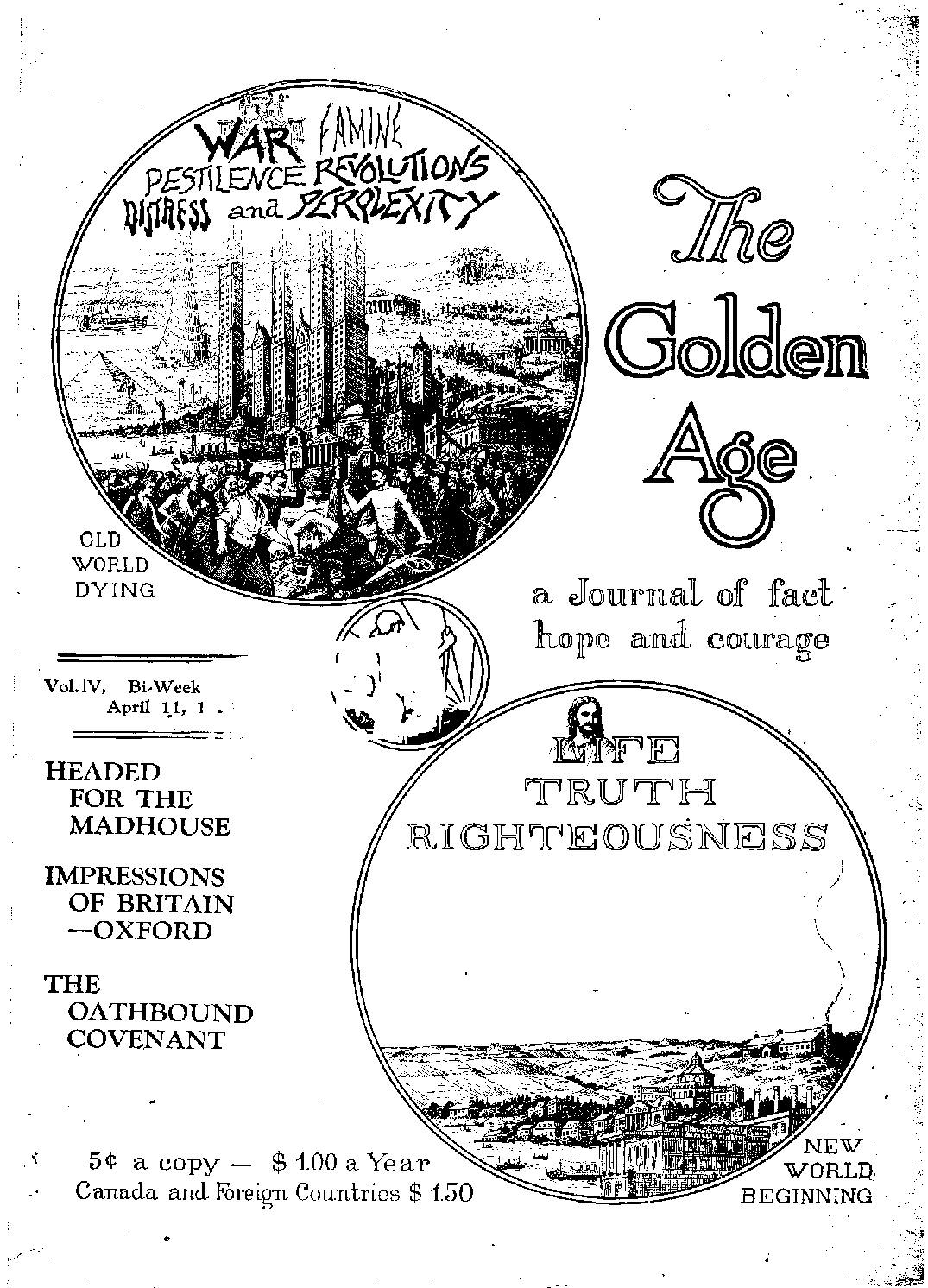
OLD WORLD DYING
HEADED FOR THE MADHOUSE
THE
OATHBOUND COVENANT
Vol. IV, Bi-Week April 11, 1
u i 4'1 I'k
a Journal of fact' Kope and courage
NEV WORLD. BEGINNING
il
Contents of the Golden Age
Social and Km: cation al
Header r<m the Ma mi oust: Causes of Insanity . . The Effect of Diet . .
The Ductless Glands
Sane Care of the Insane Insane Care of the Insane Conditions in England .
Travel and Miscellany
Impressions of Britain (Part VII).....
Scotch Industry and Thrift........
Along Cromwell's Trail ..........
An Anarchist Religious Organization.....
Eboracum anil Leeds..........
Modem Spi riitin I Food..........
Oxford’s Glory and Shame........
Feet and Inches.............
Political—Domestic and Foreign
Tttb Rofe is Breaking (Cartoon)........
Beitcion and Philosophy
Tni: OAthbovxd CmiA’.i.'i’ . Assurances of the Almiglit.i's Coil Foresaw the Present
_ Gospel Church not I'oinplele Promise to the Jews . . . Sublimity of God’s Work . Future of Heuthen People .
Studies tn the Habp of God
Published every other Wodncsil.iy .nt 1S Concord Street. Brooklyn, N. Y.. U.S.A., by WOODWORTH. IltliillXllS A- MAIITIN
Copartners and Proprietor# Jis■ f’oi"'-nrd Street. N. y_, H. ft. 4t
CLAYTON ,T. WOODWORTH . . . Ildiror It K. STEWART .... Assistant Editor
ROBERT J. MARTIN . Business Manager W.ll. F. Ill’I M11\<rS . . . Sec’y and Treas.
Fomign OrrlCEs: Britix/i. .... 34 Craven Terrace, lanriister Gale. London W. 2
Canadian . . .
AuBtralarian .
South African
270 Dund.
Toronto, Ontario
4115 Collins Street, Melbourne, Australia G Lelie Street, Cape Town. South Africa
Entered as second-class matter at Brooklyn, N. T[„ under the Act of March 3, 1878
c-hs
ake Golden Age
Volume IV
Brooklyn, N. Y., Wednesday, Apr. 11, 1923
Number 93
Headed for the Madhouse
DR. A. A. LOEWENTHAL, former professor of mental and nervous diseases at the University of Chicago, has made the statement that “at the present rate of increase the world ~ will be ruled by madness within fifty years.” In this article we give some of the data upon of which such ap opinion rests.
i. We do not have to go far away from home to ■' find plenty of data. New York State heads the ; Jist of states with the highest number of per-£ sons with mental disorders per hundred thousand of the population, and in New York State more persons were sent to the insane asylum ^during the last year than in any previous year. * At the end of 1921 the patients in the thirteen j^siate hospitals for the insane numbered 39,736, span increase of 1,445 over 1920. This is 6,642 more than the hospitals were built to accommo-s date.
» Of the total number of patients in New York fe State one-half were born in Europe, and nearly r one-third of all the patients were out and out A aliens. From this number two hundred and 7 ninety persons were sent back, during the year ending June 30, 1920, to the foreign countries frpm which they came. Under the law, any peri sons showing insanity within five years after i admission to America may be returned to their former homes.
Massachusetts comes next to New York in its number of insane per hundred thousand of the population. Dr. Briggs, former chairman of the Board of Insanity, says that in Massachusetts-one person in every ten at some time or other enters an insane or feeble-minded hospital, and ■ that five percent of all the deaths in the state are in state institutions of one kind or another. y These figures are so large that we hesitate to ■_ publish them; but these are the data before us, and we hhve no reason to question them. Mas’ aachusetts spends six million dollars annually > for the care of delinquents. Connecticut, Ver-ttiont, Montana, and Oregon — all northern
states —have heavy percentages of insanity; the lowest percentages are in the South.
Taking the country as a whole, insanity and
mental disorders are increasing four times .
faster than the population; and as long ago as" .
1910 there were more patients in the institu- ' tions for the insane than there were students , ’ in all the colleges.
Already Ruled by Madness
EVERTING to Dr. Loewenthal’s statement that in fifty years the world-would be ruled
by madness, we find that both the Bible and ' 1
secular history showT that it has been ruled by madmen for more than 2,520 years. Nebuchadnezzar, the first w’orld-ruler, represented Gentile rule in the earth. He was insane for seven . years; those seven years represent the seven < “Gentile Times”.the period from the overthrow f
of King Zedekiah, 606 B. C., down to the out-
break of the World War, which legally ended
Gentile rule and almost ended it actually.
The condition of affairs during those 2,520 years, proves that the rulers have been mad-
men. What sane persons believe that the com-
mon people of any land desire to murder their
fellows or to be murdered by them! And yet ■ they have given their support to a set of rulers that have brought on one terrible era of blood- V > . ' shod after another. '
Tako the inordinately vain Kaiser Wilhelm II. His father and his grandfather were sane, but his earlier ancestors showed all the evidence of minds that were out of balance. -Frederick I was a spendthrift and tyrant; : Frederick William I was bloodthirsty, tyran- '
nical, and hated his own son; Frederick the
Great was a human butcher; the next two gen-
erations were weak-minded fanatics, and Wil- ' Z: i liam IV died insane. Before the Kaiser’s birth
his mother, then but eighteen years of age, was ~ ‘ : undor doctor’s care for nervous troubles and ■
in a pitiable condition. The child was at first
thought to have been born dead; it is almost a < pity that he had not been.
But what can we boast about on this side of the Atlantic? There was every reason that sanity could urge why America should have stayed put of the war. America was in no more possible danger of an invasion from the Germans than it was from the Patagonians. But America had a ruler of the same general type as the Kaiser — vain, egotistical, heady; and as he thought that the lives, fortunes, .and influence for good of the American -people were all at stake they were herded into a Avar against those interests and to their own ruin.
When the crazy rulers arc not planning the. ruin of the people by driving them into some Avar, they are planning their ruin economically. The avoAved purpose of politicians is to sustain a system which hands over most of the wealth to those Avho do no useful work, and to keep that class in luxury, while the workers receive, a bare subsistence. What could be crazier?
Causes of Insanity
AT THE top of the list of the causes of insanity we put the influence' of the demons, evil spirits. It is our firm belief that a large proportion of the insane are in their present condition because in some way they have fallen under the influence of these beings that infest the earth’s atmosphere. The Scriptures name them as the cause of the World War, ‘going forth ... to gather the kings of the whole earth together to the battle of the great day of God Almighty.’ (Re\ elation 16: 14) 'The Czar of Russia Avas controlled by demons through Rasputin, a spirit medium.
The ways in which the demons get into contact with humans are many. One of the principal of these is through the clergy Avho are directly under their influence. “Babylon the great is fallen, is fallen, and is become the habitation of devils, and the hold of every foul spirit.” (Revelation 18:2) From this we conclude that wherever else the demons are to be found, their general headquarters is in the nominal church. And wdiat is the general influence of the nominal church? In a time of war is it for peace ? In a time of economic ■strife is it for the under-dog? E -. crybody knows the answers.
Another way in AA'hich the demons get into contact Avith humans is through mediums, who d constantly advertise in the papers as clairvoy- ,■< ants, healers, consulters and revealers of hid- ■ den things. Many brainy people, many talented < personages, are among spiritism’s devotees, not? knowing the true explanation of its phenomena. "
Too much attention to the operations of the mind is a cause of insanity. When one spends -A too much time pondering upon the operations W of his own mind he is in a fair way to lose con- As trol of it. Manual dexterity does not come from ) gazing at one’s hands or poring over one’s anatomy, but from paying close attention to "--A the things in hand. It is the same way with the -mind.
Genius and Temperament
TAR. E. S. SOUTHARD, an eminent alienist
? from Boston, president of the Americai^ Mental and Psychical Association, in an address at Philadelphia asserted that every form of neurosis may be classified as a form of insanity, that every “temperamental” person is , really insane, and that from this point of view all mankind are unbalanced. . — • .
Musicians, painters, and poets all bear testi- A mony to the fact that talent, genius, and insan- J ity are closely allied. The craze for paintings by cubists and futurists, which has but lately died aAvay, was insane; many of the modern I dances and the music which accompanies them I are the work of disordered minds. aJ
When it comes to authors, we see the eccen-tricities of Francis Bret Harte finding heredi- | tary expression in his daughter, Jessamy Harte Steel, until her career is ended by confinement in the St. Lawrence Hospital for the Insane. -
There was mental unsoundness on both sides 3 of the poet Cowper’s ancestry; and he himself j| suffered from hallucinations, melancholia and 5 suicidal mania, spending over a year in an j asylum. Shelley had an insane ancestry, was i subject to vivid hallucinations, and at school .4 rvas known as “Mad Shelley.” ,
Charles Lamb, at the age of twenty, was com-mitted to an asylum; and his sister Mary while insane murdered her mother. There was iiisan-ity in Wordsworth’s family. His sister Doro- -"*1 thy, of his own poetical temperament', became 3 hopelessly insane. - Southey came of insane stock on his mother’s side.
Coleridge’s family had strongly marked in- • -3
-r** *
&•■.-• sane tendencies; his father was eccentric and ' Ms mother simple-minded. Sir Walter Scott's ■ ■ family was permeated with nerve disorders and / dementia on both sides. Byron’s mother was » unbalanced, and his maternal grandfather suf, ~ -fered from melancholia and finally committed ’ suicide. His father also committed suicide . while insane.
. Noise and Worry
£ ■ ’ TAR. NANCE, trustee of the Sanitary DisU trict of Chicago, puts down the unnecessary noises of city life as one of the direct causes of insanity. He says:
‘TJnnecessary noises are the bane of metropolitan existence. ■ They murder sleep, assassinate mental rest, shatter our nerves, and indirectly shorten our lives: Factory whistles screeching three times a day, in addition to steamboat, tug-boat and locomotive whistles, the grinding, crunching, munching of flat-wheeled j street-cars and elevated trains, the shrill sirens of auto ... trucks, the cannonade of exploding motors, venders of ■ vegetables crying their song of sale, boys screaming ' . extra papers, barking dogs, howling cats, rattling milkwagons, the untimely sounding of guns, church bells, ■ hand organs and barrel organs, the discordant piano and whining phonograph, the amateur trombone, the Baxaphone in practice. Noise! It.increases the death ' rate by murdering sleep. It destroys the vital and recu-. perative powers of the sick. It increases deafness. It > helps indirectly to fill our insane asylums. There is
■ ' little doubt but that many nervous wrecks are created
i । every year by the incessant din and clamor to which the : average city resident is continually subjected.”
i Unemployment is a cause of insanity, so the doctors say who have thousands of the insane under their care. They notice that cases multiply more rapidly as the waves of unemployment come. Thus worry over the needs of one’s loved ones, due to lack of work on the part of ..; the family bread-winner, may so fill the mind as to break down the mental balance.
■ . The war was a direct cause of insanity. There
■ ■ are 400,000 mentally deranged in Paris, mostly from that cause; and from the American forces ■ alone 72,000 are reported by the American
. , Legion as mentally deranged. Consequently the total number on all fronts and in all sides . ' of the conflict must be nearly or quite half a million.
Then the war was an indirect cause of insani ity to great numbers who found no way of reconciling the conflicting voices of conscience, loyalty, duty, self-preservation, patriotism, etc., presented to them. Moral courage makes for sanity. The man who takes a stand, one way or the other, and abides by what he believes to be right, will endure the reverses of life with a courage and success that will seem almost supernatural. Children should be trained to-face unpleasant situations and to make the best of them, but not to worry about them.
Too Much Excitement
THE movie theaters have been blamed for some of the increase in insanity, and probably not without reason. Every form of mental strain is depicted by the actors, and this cannot fail to have some effect upon those who are suffering mentally or are predisposed to insanity.
Much insanity is caused by bacteria and poisons of various kinds undermining the brain structure through the blood stream. The germs of syphilis are deadly to the brain structure; and there is scarcely a person who does not’ have it in his blood, cither bovine syphilis, derived from vaccination, or the real thing obtained from our tainted (not sainted) ancestors. .
Dr. J. M. Lee, of Rochester, N. Y., speaking before a conference of medical men, pointed out that farmers are more susceptible to insanity than any other class because they work hard, worry much and have little recreation.
.He added: “Our methods of living, our methods of eating, and the general hustle and ten-dcncy to worry throw the mental machinerj out of gear.”
The people who become insane lose the grip on the realities of life. Rage is insanity while it lasts; and some pretty well-balanced people sometimes allow themselves to fall into fits of rage, even to the extent of committing murder and suicide.
The evading of responsibilities tends toward insanity. The more hopelessly insane a person ■ is the more he acts like an infant, assuming that whatever he wishes should be provided for him by others because he desires it. The possession of a disposition to wish to get.along without work is therefore an evidence of insanity. It indicates the neurotic mind. The desire to work, to produce, so that one may have for himself and have to give to others, is an evi-
’dence of sanity. The idle rich, are all on the road to insanity, and many of them are actually insane.
. Liquor and Insanity
SPHERE are conflicting opinions as to the - share of responsibility to be attributed to liquor as a cause for increased insanity. Doctor Hall, Chairman of the Insanity Commission of Cook County, Illinois, says: “Either prohibition does not prohibit, or the brand of liquor ’ . that drinkers are getting is more violent in its A t effect.” His report shows an increase of thirty-|hree percent in the number of alcoholic cases . before the commission in December of 1921 over fx-. thoge of pre-prohibition days. He said further: ■ y'-. "There are two classes of alcoholic cases wc are get. ’ ting. There is. a class of elderly persons who were ' fi accustomed to use a certain amount of liquor regularly.
They were able to coordinate and to combat social, domestic and business worries. Then prohibition came, and they were unable to obtain liquor regularly. When they did get it, it would be by the bottle. Not knowing when they would get more, they would drink it all at once. As a result they broke down mentally. rthe other class comprises the young, who get the unlabeled or .moonshine whiskey. They drink all they can get. when they can get it. It contains a large percentage of poison and works havoc with their minds. Wc had several eases of young doctors who wrote their own prescriptions, and a got bad whiskey, which they drank to excess, resulting in their breakdown. It has been necessary to commit • : several to an asylum for the insane.”
Dr. Lichtenstein, resident physician at the • ■' Tombs Prison, New York City, thinks alcohol ‘ is doing its share toward the increase of insanity. He says that many steady drinkers are . ' unable to give up intoxicating liquor and will drink poisonous substitutes which are offered for sale; that this alcohol is absorbed through the lymphatic system and causes a toxic condition which deadens the nervous system and produces what is known to alienists as alcoholic
• , psychosis. Whether a person becomes incurably insane is dependent upon how much dam: ■ age is done to the nervous system before treatment begins.
Hut Dr. R. H. Hutchins, Sr., superintendent of the Utica, N. Y., State Hospital, says that moonshine whiskey has caused! only a slight increase in insanity. His belief is that the . stories of widespread insanity caused by impure whiskey were propaganda of wet advocates; and that for years, with, the exception of the first four or five months after prohibition went into effect, hospital cases resulting from whiskey had steadily decreased in number. Homer Folks, secretary of the State Charities Aid Association, said that he believed the' number of persons who had gone insane from the use of alcohol during 1921 was fewer than normal.
An indirect cause of increased insanity due to prohibition is that many -persons who had become used to taking intoxicating liquors were deprived of them and resorted to drugs to satisfy their appetites. We have treated the subject of drug addiction at length in our issue of. June 21, 1922. . '
.AS
1g
The Effect of Diet •
TAR. H. P. SKILES of Chicago‘treats very ■ L-J interestingly the subject of the effect of ; ■ diet upon the mind. He says:
“There are 20,000 new cases of dementia prccox every year and all declare 1 hat it is on the increase. The mem tai phenomena vary with different cases. The physical ; phenomena prow* llial in a very large percent, the , patients have faulty digestion and faulty circulation as well as faulty elimination, and wc will find in almost all of (hem a faulty respiration, very little if any abdominal breathing.
“Wlwii ire remember that we can retard or completely stop the respiration by pressing on any one of thfy. ■ bra. lies of the sympathetic nerves that may be. abnor-null, either in the upper or lower orifices of the body, . . . then it is plain to us that if any one or more of lliese branches become involved so that the respiration " is impeded and the sympathetic normal efficiency ia reduced it is reasonable to sav filial the elimination and digestion as well as assimilation will be reduced. .
“Therefore in order to relieve one. of these cases we must see to it that every branch must be inspected and ■ cared for, so that we can have as nearly as possible S normal functions. Why? Because normal functions must obtain if wc are to have normal use of the cerebrospinal in all of its varied duties, and the highest of these is normal thought. ' ,
“We must first eliminate the fact that there is' no central lesion; when that is done it is admitted that the primary cause is not in the brain. Then we pro- . । ceed to examine the functions. We find that we have , । in these cases as a rule either a low or a high blood pressure, the greatest majority being a low blood prea-sure. By persistent correcting of the different orificai,,;^ the low blood pressure ia gradually relieved, but sonwr times very slowly.
«?
“We find also that these cases are suffering from , varied degrees of auto toxemia, so that auto-intoxication obtains a part or all the time. It is phi in that as long as the. patient’s auto-into.xication persists he will not be responsible, but when his toxemia is reduced below the state of intoxication ho then will be responsible and his mental condition will be clear. But he will not be well until the toxemia is reduced to such an ' extent that the functions of the body will be normal each day, accompanied by normal blood and normal blood pressure. And more, all of the functions of the - - body must obtain until the strength of the entire body ■ has been" restored; and then will he have normal poise
; jnd norma] thought.
“The sympathetic system being first corrected, the ■ ■ diet carefully chosen, baths prescribed, we must, if pos-n sible change the blood pressure. In these eases we have a venous status whether in high or low blood pressure
- cases. I|Fthc low blood pressure cases the venous status is due mainly to a dilation of the veins, making it im-
■ possible for them to deliver the blood to the heart in sufficient quantities to be normal,and so we have a delayed circulation. . . . Additional excitement increases < the high blood pressure of the high pressure cases and correspondingly decreases the blood pressure of the low blood pressure cases.
“We will all admit that the poisons from the different tissues are being thrown into the veins and that if "we ' can reduce the poisons by any means we will shorten — the recovery of the patient.
“Every now and again we find that the pressure goes up and down from some fault in somebody or the * patient, and we find that anything that will cause loose movements of the bowels will upset our blood pressure. Fmki this we learn lessons of great value which we • must teach the patient, namely, that if he wishes to remain well he must forever abstain from all kinds of , drugs that will cause loose discharges from his bowels;
- that if he has arrived at the happy medium where his , ... thoughts are lucid and his poise is perfect under all ■ occasions it is up to him to thus remain; that evidently his assimilation and elimination which take place in - the" millions of capillaries in all parts of his body which make it possible for him to live and carry on both '. physically and mentally are performing their functions
normally, and if he obeys the laws of his body he will remain well; that the sickness he has suffered causing him to experience many abnormal thoughts and experience many abnormal perceptions have been physical.
“We are now of the belief that dementia precox, sori called, is produced by a faulty metabolism (changing food into protoplasm and carrying off waste) in che ' capillaries of the body, and is curable.
“We must educate not only those immediately inter-k ested, but the great masses, to show them how they must ; live. A nation-wide education must be made against the habit of giving and prescribing all kinds of physic; for it is an impossibility to cure one of these cases if, only one dose of cathartics of any kind is given. . . . Only by preventing insanity will we be doing our whole duty.”
The Ductless Glands
B. SCHLAPP, Professor of neuropathology at the Post-Graduate Medical School and Hospital, New York City (who is authority for the statement that twenty-five percent of the murders in this country were committed by insane persons who could have been cured by proper treatment in early stages), writes of the discoveries that have been .made iij recent years in endocrinopathy, or diseases due to improper working of the ductless glands of internal secretion. He says:
"Twenty years ago the very term was unknown and the science of the ductless glands had no standing. Today our knowledge of the endocrines and their influence upon every function of the nervous system in man promises to revolutionize our whole understanding of human behavior. We know now that many men commit crimes because their thyroid glands or other glands are out of order. We understand now that many unfortunate human beings are unable to control themselves under temptation or in the face of other arousing stimuli because there is some derangement in the glands. It is now certain that these endocrine organs control the activities of our nerves altogether, including the workings of the brain.
“This means of course that science has brought human conduct or misconduct down to a physiological, ’ or rather a chemical, basis. Men do not err because they are evil but because of chemical disturbances in that marvelous and intricate machine, the human body. Just how far we want to go or can go with this state-' ment at present is doubtful, but to some extent it must ’ already be accepted and acted upon; for we are able to treat many criminals, to correct this chemical disturbance or abnormality and thereby to restore these sufferers to health and normality.
"At least the well-informed among us know that many of the men who commit crimes are not responsible for their acts but are the victims of disease or pathological or chemical conditions. We know, also, that many men in our prisons should be in hospitals and sanitariums. And we know that a very large proper- ’ tion of all the men sent to prison for felonious breaches of the law are sick men who can be cured of their illness. But we continue to treat these men as pariahs and monsters. Wc continue to torture them and cage them and judge them according to stupid and obsolete standards.”
■ Bbookbth, - 'IS
Sane Care of the Insane
NOT straight-jackets and cruelty, but eom-. forts and love, tend to aid those who are ■ insane to regain their mental balance. The ' work at the State Hospital for the Insane, at Trenton, N. J., under Doctor Henry A. Cotton, has proved this conclusively.
Here one finds clean, carpeted halls, furnished with rockers and other chairs. The walls are adorned with pictures; there are ferns and plants about. The rooms for patients confined to their beds are perfectly ventilated, and the rooms themselves are large and cheerful.
The dining-room tables are covered with white linen, ihid adorned with ferns and flowers; and the patients are. served with care and attention to the wholesomencss of the food. There are no handcuffs, no chains and no straitjackets; and as a consequence maniacal outbursts are seldom heard. The nurses and attendants are of high class, instructed well in the physical care of their patients.
Upon the arrival of a patient at the hospital an X-ray of the mouth is taken and infected teeth tare removed. A stomach test is next-made. Then the tonsils are examined; if infected, they are removed. Intestinal examina-tiohs are then made. An abdominal X-ray is : next taken; and then a specimen of the blood and spinal fluid is taken and examined. It is a common thing at the Trenton hospital to dis. ■ cover infection of the teeth, tonsils and eOion, -"also in the appendix and gaJl bladder. The rectum is likewise often found to bo ulcerated or otherwise infected, and requiring, surgical attention.
’ As a consequence of these thorough examina-■ tions, and corresponding close medical attention, the record shows that out of 400 patients admitted during 1918-1919 and classified as manic depression, hypermanic, dementia precox, etc., after a period of nine months only " sixty of the patients remained in the hospital.
Previous to removing infection from patients the rate of recovery was forty percent; which would mean that 160 of these 400 cases would have been discharged instead of 340.
It is almost enough to drive a sane person ' insane to lock him up and give him nothing to do; hence the saner administrations of hospi— - tals for the insane are now paying attention to employment of their charges. In Illinois, whore occupation for the insane, and education for those occupations, has become a practice, ) the class of insane called “maniacs” has almost ' entirely disappeared. Progress in the same • direction has been made in two large hospitals* , at Patton and Norwalk, California. The Indus* -trial work includes the manufacture of rag" ear- jc
pets, shoes, brooms, brushes, baskets, and. toys.
" ' -J
Consideration is being given to the proposition to sterilize the mentally defective. A case is cited of a woman committed ten times to an. institution at Kalamazoo, Michigan, who has given birth to ten insane children. The woman's family has a history of insanity for many generations. Surely no good reason exists why this woman should be allowed to become the mother of ten more insane children, apd thus to pile burdens upon the citizens of the state of Michigan for which no return of any kind can ever be made. »
ml
a
Insane Care of The Insane ‘
TF CONFINEMENT in a prison often results'
in making sane people insane, what is the’ “3 natural effect of confining insane. people in -prisons'? The answer is so evident that it is a I wonder that only recently are the medical fra-> ^$8 ternity beginning to give the subject attention.
A modern physician, Dt. Broder, formerly physician to the Insane Asylum of the City‘Of'
Now York and of the Manhattan State Hospital for the Insane at Kandah's Island, New, YdSk,.* also neurologist of the Hat Moriah Hospital} is planning, with others, to erect and operate a modern institution for the scientific treatment of the insane, with a view to their cure. Hrs plan is explained in his statement of-the reasons that led to the plan being formed: -
“I found that, there was no organization that would treat insanity, for either its cure or prevention., and, that there was no hospital in the United States dedi-' eated to the eradication of diseases of the brain. There ■■ are. hospitals for everything else and for every Epeeififl. disease under the sun, but none for the prevention and,-cure ol insanity. -
“Mentally afflicted respectable citizens, in my opin* • ion, should be treated more like rational beings and._ less like criminals. We are clinging too much to tha‘ old idea that a •madman' should be shunned. Instead,,'
he should be looked upon as a sick man. We. accept too much the obsolete theory of 'once insane, alwaya-y; » insane.’ No effort is made to help the sufferer. If -
s.
w
i
nch. he is sent to a'sanitarium; if poor, he is committed.
“Under present conditions little, or nothing is done because the physicians who would do so are handicapped by lack of facilities and lack of opportunity. The sick man with hallucinations is sent away. His condition becomes chronic. Any other result is largely mere chance. ■■
“The theory we advocate is that the patient should be put to bed like any other sick person and treated
I*.; accordingly. Specialists of all kinds should examine him. People do not become mentally deranged unless
**- there "is a cause. To effect a cure, the cause must be ; 'found and removed.
j/- “Most of the so-called insane people have their
rational moments. To such a person the shock of
being sent away is enough to dethrone reason pcr-
F liiaiieiitly.
Even in the State hospitals it is difficult to got attendants who are patient and intelligent enough to I, keep from beating their charges. All the stories of
beating and ill-treatment of the insane are not mere
& figments of the imagination. Fractured ribs and fractured jaws are nothing new. The excuse usually is that another patient did it. Nine times out of ten
it was the attendant.
“Nervous- and mentally distressed people apply to fe- nerve and brain specialists and' are -often advised f ‘change of scene and ocean trips. But no effort is made to-remove the poisonous toxin that is the cause of the
trouble.”
One cannot read of the insane receiving /“beatings” and “fractured ribs and fractured jaws” without a sinking at the heart for one •never knows when one's own loved ones or
bven oneself might fall into the power of these B'k'insanc people who are “caring for the insane” gi-by methods that, are just about as sensible as
those by which the Roman Catholic church un-
14 n.
fete'
dertook to keep the world in good spiritual health during the days of the Inquisition. ,
AVill Leeger, real estate dealer and Republi-ean leader of Weehawken, on May 9th asked that the Stg.te Hospital for the Insane at Morris Plains, N. J., be investigated. He said । that while a patient there he was* kicked and ”, beaten, and that in addition to the brutality P. tbaches and other vermin were tlrick in the '’C-dining room; and that physicians and orderlies sfVere negligent in their duties, He said that he . ay attended the hospital as a paid patient, hut was fc-begten and kicked by orderlies, and that they pBWbre constantly at their patients. He said rf',that bathing was omitted; and that on one occasion he had been placed in solitary confinw'it'-ttf in a strong room, 5x6 feet, and given no opportunity to cxcrci.se or have fresh air. Attendants kicked him until he was insensible and Hien dragged him along the floor. Speaking of medical attention, he said: “The doctors would pass through the ward, glance around, and go out. That was a medical examination! All that I ever had done to me was the taking of a blood test.” lie further complained that letters addressed to his relatives had never been mailed, and that when he once complained to a doctor he was laughed at.
Similar Care in Britain
tTIHE Daily Herald, London, on August 26, 1921, published the following account of the
murder of one of the insane in the West Riding Asylum at Wakefield:
“Stripped naked in an open yard, left to the mercies of his lei low-patients who flung a bucketful of boil- ’ ing water over him, thereby causing his death—these are some of the revelations made at an inquest on Arthur Crosthwaite, an inmate of the West Riding Asylum at Wakefield.” ,
Dr. Montague Lomax, for two years an assistant medical officer in one of the largest ' English asylums, in his book entitled. “The '
Experiences of an Asylum Doctor” giv^s details of the horrible conditions which prevailed in the asylum with which he was connected. ' We quote extracts:
“Behind the tabic a dozen of the worst cases sit all day with their backs to the wall. In front of them is an attendant always on duty. They have no amusement, no exercise, no employment. Even for meals they do not change their places or surroundings. The speech of these patients is often obscene and blasphe- . mous. their habits quarrelsome and filthy, their persons dirty and malodorous; bestialized, apathetic, mutinous, greedy, malevolent—often quarreling fiercely, at
plates—they sit all day in their miserable corner, "at once the most damning indictment and the most degrading example of our ‘humane and scientific’ treatment of the pauper lunatic. All the inmates wear fustian coats and waistcoats,’ white drill trousers and ill-fitting asylum-made boots. They never wear overcoats; and although it may be raining heavily, they are kept out in the airing courts during the time allotted for exer-cisc. What usually happens, is that in winter there is a great increase of entirely preventable bronchial and rheumatic affections, permanent ill-health often result- ' ing, and occasional deaths from pneumonia, etc. Tuberculosis, in particular, is a dread scourge in most asy-
. luma. .In 1915 the asylum death-rate from this disease was 16,1 per 1,000, while the mortality for the same year among the general population was only 1.6 , per 1,000. All classes of pauper lunatics are herded together in barrack-like structures which are unhygienic and totally unsuitable. The unhappy inmates are confined for weeks together in pitch-black, ill-smelling, mostly unheated, locked-up cells. They are fed on ill- selected, innutritious, dirtily served and badly cooked food. They suffer and die from various physical diseases, contributed to, if not actually caused by, the con. , ditions of their asylum life, inadaquately treated, and ; often—as in surgical cases—not treated at all.” „
Putting Away Relatives
IT OCCASIONALLY happens that a successful business man gets tired of the more or . less careworp, decrepit, and possibly crotchety
' wife of his youth and gets his eye on some
younger, more attractive dame that he thinks . would please him better; and it is one of the easiest things imaginable for a wealthy man to put away a peculiar woman, if he has no prin-• ciple—and many wealthy men have none. Again,
an asylum is often sought for some balky rela-. five about to fall heir to a fortune.
Bird S. Coler, New York Commissioner of Public Welfare, is authority for the statement: "It is quite true that, a person suffering from some . mental disorder, quite possible of cure,-can be sent away for life merely upon the word of two inexperienced country doctors and a judge.”
Mrs. Laura Price Meader, 67 Riverside Drive, New York City, testified before Judge Walsh in the Court of Common Pleas, Bridgeport, a few years ago, that she had been kept, against her will, in Dr. Wiley’s, sanitarium, and was strapped down in ice packs, served with ■ milk containing roaches, and obliged to eat from dirty plates. She stated that she was inveigled into the sanitarium by her husband on a pretense of visiting friends. She also charged that her money was taken from her, and she was not allowed to receive any mail or communicate with any one. Jewell Hanson, the nurse who attended Mrs. Meader, testified that Mrs. Meader was sane, and in good physical condition, aside from a broken arm.'
Mrs. JeanR. Melville, wjjo was declared sane by a jury before Supreme Court Justice Martin, took steps to secure vindication for the action of her husband in endeavoring to have - her declared incompetent. Through her attor-
neys sho filed three actions for $100,000 each, ~ naming her husband and Drs. S. Philip Good- 4 * hard and Clarence J. Slocum as defendants. '
Idaho has taken a step toward clearing the ' asylums of those who do not properly belong -
there. David Burrell, Commissioner of Public ;
Welfare fox that state, has asked the cobpera- -tion of the judges in this work, alleging to the judges that in his examination of commitment ‘ papers he has found that the grounds mpon * which some have been put away could just as , well have been applied to any citizen of the state. ’
Another unfortunate thing about this aspect . -of public institutions is that soldiers suffering from shell-shock have been committed to Ibese A'l institutions, and that once they have been - 1
locked up are never visited by the federal officials to see whether they are properly cared for, but are left to find their cure in the com- ' pany of criminal insane, drug addicts, and vicious degenerates. The proprietors of some.- d private institutions arc alleged to pocket as much as sixty percent profit of the amount al- A* lowed for the care of such ex-service men. -A
Conditions in England
TN ENGLAND the lunacy laws are such that -L an alleged lunatic, once in an asylum, is wholly dependent on the doctors'for any chance of getting out again. Everything is in their hands. The patient may be deprived of all communication with friends, either personally or by letter; and though he may see or write to a commissioner, it will avail him nothing if the' medical superintendent either mistakenly believes him to be insane or has private reasons, for keeping him in the asylum. _
’ Dr. Forbes Winslow of England, writing on. the same subject, says:
"I have no hesitation in stating that at the present day there are among those incarcerate^ in asylums quite half the number who could be well managed: outside. I have proved this on many occasions. I have in. many instances been the means of obtaining the freedom from asylum supervision of those who, apparently, had there been no intervention, would have been thefa for their natural lives. I do not recollect one single case ? where the steps taken were not followed by anything-, but good results. I have not the least hesitation in say* ing that the very atmosphere of a lunatic asylum, and the contaminated air breathed, are sufficient to pievent recovery. Many a case, curable in its naturt, has-
ri become chronic by having been placed among lunatics.” I&, -Dr. Alfred Russell Wallace in his book, “The 7?', .Wonderful Century,” speaking of- abuse of the
• insane, says that the great evil lies in the cxist-HE? wee of private asylums kept for profit by their Skf*owners; and in the system by which, on the PP Certificate Of two doctors, employed by any Tel-ative or friend, persons may be forcibly kid-
1 -napped and carried to one of these private asylums without any public inquiry, and sometimes even, without the knowledge or consent of their
A" ..other nearest relatives or of those friends who know most about them. He say’s further:
kt- “The fact of insanity should be decided, not by the SA..patient’s opinions but by his acts; and these acts should’ be proved before condemnation to an asylum. Asylums fe.. for the insane should all belong public authorities, so g-"„ that the proprietors and managers should have no pecuniary interest in the continued incarceration of their patients.”
jg* Concluding Thoughts
TT IS only proper for the scientists to seek for 1^ -L the causes of mental delinquency, theorize on ra- the improper functioning of the organism, and experiment on possible aids to correction of gj- the malady. They leave God out of the question B' . and-do not take into consideration that the race is fallen because of disobedience and alienation from the Creator. We suppose that Dr.
|ET Schlapp’s argument, from the neuropathic . standpoint, is good. He says: “Men do not err
K ■ because they are evil, but because of chemical Kiri disturbances in . . . the human body.”
Sr Let us see: Did father Adam err because of jp a chemical disturbance^ in his perfect “body? Or did the disturbance commence after he had sin-
Ks-ned and -was driven from Eden? The disobegg? dience of our federal head wrought havoc for K.-the whole race, plunged all onto the down grade K. of mental, moral and physical weakness and de-K? cay. The breakdown in mentality is heaped ■fe upon bur age because our day is one of tension, |fc-push and hustle, and the poor, fagged out brains are not equal to the task. The chemical
Rconditions unay contribute to some extent to “the obliquities of humanity, but we should not stress it too much.
• Humanity is in a sorry plight, and largely through choice. Man is a free moral agent, but Ke is beguiled, deceived and ensnared by the devil, Efe' who manders to the pride and self-love of his gfe~snbiccts. and who has led the world into dark-
ness, superstition and the pride of self-govern* f ment. Satan has baited and enslaved mankind <
These scientists are getting away from thq : thought that many are obsessed, by demons. We ■ ; ? believe that many in our asylums, and some . outside, are actuated by the evil spirit which has such a terrible influence in the world, . backed by Satan and his hosts—visible and invisible.
It is commendable that plenty of light, exercise, fresh air, wholesome food, harmless entertainment, and light forms of labor are given in -some places. These people should be given all ' the freedom they can stand without -harming anyone; and above all, their attendants should : be persons of kindness and self-control. VVheth-er the cause is “chemical” or obsession the need of kindness is all the more imperative. The few brutes incarcerated in asylums'should like- . wise have kind but firm treatment.
What a gracious provision the Lord haa • made for humanity in her extremity I The race is even now plunging deeper into the mire of perplexity and dismay, according to correct Biblical chronology, as all will see within the next three years. Then Messiah’s kingdom shall break with blessings of uplift from every mental, moral and physical weakness and imperfection of mankind. Jesus has bought the .
. race, and the kingdom to be inaugurated at the second,advent will cure every ailment of the "disease-cursed earth. Having then bound Satan for a thousand years, the Great Physician will put into power the laws of truth and righteousness, take away all the tension, and establish -peace world-wide. Then happiness, liberty and life will be proffered all the families of the earth as they shall seek to cooperate with the . new arrangement, until all mental disorders, moral suyineness and organic ailments are everlastingly healed; so that, eventually, every • knee shall bow and every tongue confess that Jesus is Lord, to the glory of God. : '
NOT SELLING OIL STOCKS
THE Golden Age is not connected, directly or indirectly or in anyway, with any concerna ' using a similar name and engaged in the sale of oil stocks or other stocks. All sach concerns arc using the name “The Golden Age” entirely : on their own responsibility. ■
Impressions of Britain—In Ten Parts (Part vii)
VTOU know how green the grass gets in the X northern part of the United States along . in the month of May, when there has been alter-
<.<■ pate sunshine and shower for a month past.
y Well, the British Isles are like that all the v , time. Ireland has been called the Emerald Isle, and properly so and green is its emblem ' and with all- propriety. But the title is just as t . appropriate to England, Wales, and Scotland.
One of the first things the traveler notices is ' the extraordinary greenness of the grass.
■. The areas of the British Isles are small, a ‘ ■ total of only 121,284 square miles, as against 3,026,789 square miles in the United States; but * to show how heavily they are cropped we pick - out a group of industrial and agricultural states v in the United States, all of which seem to us to ' . be in a high‘state of cultivation, and then com-■ pate them with the British Isles. The areas are as follows:
- GROUP OF SIX AMERICAN
BRITISH ISLES GROUT
STATES
Massachusetts
8,266
•. . ' England
• 50,874
Connecticut
4,965
Wales
7,446
New Jersey
8,224
Ireland
32,559
Delaware
1,965
Scotland
30,405
Ohio
Illinois
41,040
56,665
Square Miles
121,284
Square Miles
'121,125
These groups are as nearly equal in area as We can arrange; and now we will give certain comparative data which will be of interest. Besides giving the data for the six groups of equal area to the British Isles we will also give
• data for the United States as a whole:
BRITISH SIX AMERICAN UNITED * ISLES STATES STATES
or over 200,000 424,023 4,148,098
• ’ 428
• Improved lands '
- (acres)
53,000,000
49,655,449
506,982,301
Woodland
'/ Other unimproved
3,000,000
8,693,039
168,615,122
? lards
20,639,125
19,171,512
280,079,122
. ■ Horses.
2,000,000
2,292,039
19,785,933
, " Cattle
12,000,000
5,346,043
66,810,836
■ - ;• Sheep ...
30,000,000
2,783,648
35,033,516
■ 1 Swine'
• Total live
3,000,000
8,067,399
59,368,167
stock
A Farms under 50
47,000,000
18,489,129
200,998,452
1- acres in area
■' Farms 50 acres
700,000
162,351
. 2,300,268
A thoughtful examination of the foregoing * data will show what is very apparent to the s traveler; namely, that Britain is a garden spot, { a paradise on earth, and though a very small country in area is a very large country in ; respect to its live stock and other agricultural ij. interests. The fields seem to average about one ■ -a acre in extent, instead of about ten acres as in 4 the United States; and many a family makes a ■ -living from one small field. This is possible' in^-some districts because of the richness of the t soil, the alternate favoring mists' and sunshine, and the mild winter weather. ■ .
Scotch Industry und Thrift . *
THE industry of the Scotch is proverbial, -and evidences'of this abound in the arabte ' parts of Scotland. After a pleasant automo bile trip through the farming country about Edinburgh (to and from the great Forth Bridge, which is some miles up the stream from Edinburgh) a careful estimate revealed that ■ about each collection of farm buildings there were approximately fifty stacks of straw, perhaps sixteen feet in diameter. When we asked -what were these stacks, the answer came "corn”; for in Britain wheat is corn, barley is corn, oats are corn. American maize, the only kind of corn called “corn” in America, does not
mature in Britain. >
The Scotch are thrifty, too. When the Scotch farmer builds a house he builds it in partnership with about four of his neighbors. This method requires less building material, and the interior walls are kept warm at less expense And then each of the four farmers rents out hit attic to one of the farm hands. This makes a warm floor for the farm hand, and brings in a little income to the proprietor. j
There seem to be sheep and cattle everywhere in Britain. Even in the highlands of Scotland, where ordinary cattle would starve, there are the Scotch cattle, with their quaint shaggy hides, that manage to make out a living. The soil of .Britain proper is lacking in lime; and so a custom prevails of sending young, cattle to Ireland for a few months while their-bony structure is building up, when, they ar® brought back’to,be fattened.
This lack of lime in the soil 'is probably the
ArK"n’1023 GOLDEN AGE , . 439 *
underlying reason for the regrettable fact that clapboard fashion, except that they are put on
even beautiful young girls in Britain, hardly Out of their, teens, have been compelled to lose their teeth, and to resort to artificial substitutes. In America the teeth are generally sound at forty-five, and frequently much later in life. This difference may be due to increased pyorrhoea in England, or may possibly be due to .excessive tea-drinking or to too many meals during the twenty-four hours. The American custom of three meals a day is more healthful than the British custom of four meals a day, and the American would be still better off with but two meals per day, and so would the Britain. .
It is a shame for a grown man to laugh at arf innocent sheep, but there are some sheep in the northern part of England and the southeastern part of Scotland that are irresistibly funny to behold. They look as if they had become badly sunburned. The wool above the hips is as red as the reddest of Irish red hair, no doubt a climatic variation.
The orchards along the line of travel pursued by the American were few in number and small in size, Britain imports most of her fruits, although she raises some apples and in the' far South, some peaches and even figs. Strawberries ripen about August 1st. The summer-days are so long in the upper latitudes of Scotland that from the latter part of May until the early part of July it is possible to read fine print with ease at any time of night; but the sun’s rays are too much deflected to give any really hot weather at any time anywhere in the Isles. Sunny days in October are about like October days in New York. ..
Old Landmarks
THE old bridges, gates, and public houses of the England of long ago are the markers of the present; the fields are all marked off from each other by stone Avails built high and with care; or where the stones are not so abundant they may be separated from one another by hedges. In a few places there arc fences, and in some, instances the fence-posts appear to fee. but three feet apart. Not infrequently the fence-posts are vineclad, producing a pleasing appearance to the eye. Occasionally a fence, instead of a wall, surrounds a suburban home. The fence palings are laid partly on one another
vertically. These fence palings show Britain’s poverty in forests. Except for the vines trained upon them they would be hideous, and look non© too well anyway. ' •
Cleanliness and neatness are everywhere. In plowing, the foreman on the farm first goes . over the field, and by furrows plowed each way ■ expertly marks it off into squares* about ten feet apart. These squares are as straight as. can be imagined. Those who do the remainder of the plowing could hardly fail to plow straight furrows. There seems to be no other object in marking the fields off into squares; if there is, will British readers please advise so that a further statement may be made? . :
Having entered Scotland via the Midland . Railway, which, in its upper reaches, is well over to the West Coast, the American made the return trip via the North Eastern Railway, which follows the Firth of Forth thirty miles down to the sea and then turns off sharply to the right, hugging for a long distance the rough body of water which Americans know as the North Sea, but which Britains.somewhat euri- ’ ously designate the German Ocean.
At the mouth of the Forth is Dunbar, distin- ' guished for its red rocky headland and its cas-tie ruins. In the old Dunbar caStle the local. Scottish nobility once successfully withstood a siege of nineteen weeks duration by an English army; and Mary Queen of Scots stopped here on her flight to England. Dunbar was the scene in 1650 of one of Cromwells successful battles.
Along CromwelTs Trail
IX miles below* Dunbar, at a distance of throe or four miles from the edge of the ’ .
German Ocean, the railway goes through a nar- , row pass in the hills, Cockburnspath. Through ’ : this, pass, still conmiauded by a ruiped watch* ' tower, Cromwell’s army, descending in force upon Charles II, won his “crowning mercy,”- th© ’ battle of Dunbar. j
Cromwell, a Protestant of the Protestants, was noted for his unbending honesty and for his determination that the lower classes of the pec* ’ plc should be treated with fair play. He is one of the few generals who never lost a battle, due to the fact that his soldiers believed in him . absolutely and did not hesitate to face death on
-1 „ his behalf He found the king, Charles I, to be - dishonest and unreliable, and was largely re-■ sponsible for Charles’ being beheaded. Cromwell himself became president of the Commonwealth ad interem. After his death Charles II caused his body to be exhumed and the head ’ cut off and fixed on a pole at Westminster.
' The pass of Cockburnspath is so narrow that for a considerable distance the stream which . ; traverses it is enclosed and the railway is built ■ over it, a nice piece of engineering, duplicated f at Pittston, Pennsylvania, by the Laurel Line, t- the third-rail electric system between the anthracite metropoli of Wilkesbarre and Scranton.
Below Cockburnspath. the railway- runs for miles almost on the-very edge of cliffs that rise . - at this point perhaps 200 feet abovQ the waters of the German Ocean. Between the railway and ... the-cliff edge every particle of soil is closely cul-■ tivated. The sedne from the car window is i inspiring—a vision of peaceful fields broken
: now and then by glimpses of the angry sea toss-r iiig itself against the base of the cliffs far below, i Berwick, fifty-seven miles southeast of Edinburgh, and lying between Scotland and Eng. land, was anciently neutral ground, and was • commonly said to be “sib to the devil” (related to the evil one) on account of the fact that it was the scene'of so many fierce border enmities. But if the town is now related to the evil one, C the appearance from the train belies it. The ; back yards of scores of houses jutting against the railway embankment are beautifully kept. In «. late October they were filled with vegetables and flowers in profusion, with an entire absence f . of the ash cans, stagnant pools, rubbish, and tin cans that decorate many an American landscape in such localities. The railway bridge across • the Tweed here is 2,000 feet long and 184 feet high, built in twenty-eight great semicircular t arches—a fine structure.
■' In 1216 feerwick was taken from the Scotch by "King John, and it was here that the British ’ king and Parliament met when they tried to ' decide whether Baliol or Brace should be the rightful king of Scotland. The decision wTas in
- ■ favor of Baliol, with the understanding that he was to swear allegiance to the British monarch.
. ■ Baliol.was unpopular with the Scots, and after Bruce became king he took the town from the ;. 'British in 1318 and it was not for 164, years after that date that it finally became a per-
manent English possession. The ancient walls of Berwick, or Berwick-on-Tweed as it is properly called, are still well preserved and constitute a fine promenade. '
Newcastle-upon-Tyne, 124 miles southeast of Edinburgh and 273 miles northwest of London, was the American's first stop after leaving Edinburgh. The expression “Carrying coals to Newcastle” arose satirically from the fact that Newcastle is, or was until recently, the greatest coal-exporting city in the world. Cardiff, Wales, contests the honor now. It is a dr,oil enough fact that during the World War conditions arose for a brief time in Newcastle which did actually make it necessary to do the supposedly unnecessary task of bringing in coal to maintain the great industries there centered. Newcastle is one of England’s Philadelphia and Pittsburghs, a place devoted to the making of largo and heavy machinery. .
One of the bridges still in use across the Tyne .at Newcastle is the famous high-level bridge designed by Robert Stephenson for carrying rail and wagon traffic across the river. It was opened in. 1850. Although it looks curiously heavy for its work it is not actually so; the immense beams and girders are hollow-cast. The bridge has been recently reconditioned for modern use by putting in such steel beams and rods as are necessary to make it fit. "
,,Let There Be Light”
BUT though Newcastle makes heavy articles ' it also makes some of the finest instillmeats used by scientists. A gentleman engaged in this line of work narrated a most interest- , ing incident of the optophone, the device by which the blind are now enabled to read ordinary printing. The contrivance is such that bymeans of the selenium crystal each printed . letter when presented to the eye-piece of the instrument gives forth a different sound, due to its peculiar shape. After a while the delicately trained ear of the blind is able to identify these sounds, and then the step from that stage , to reading is a short one.
A party of scientists had gathered in London to give the instrument a test. A clerk was sent out to get a number of publications which . should be alike, so that all might see that ho error was made. He came back with an armful .. of Bibles, obtained from an adjoining store. The '
B-Bibles were passed around, and the young |k woman who had been taught to read through O’the instrument was given the open book, and Ke‘-the . instrument was placed in hey hand. The K. first words which she read out to her auditors Sjwere,/‘Let there be light.” It is stated that there fcTWns no connivance in this; and we are of the opinion that if this be true the matter was prob-|: ’'ably' arranged by the Lord. Possibly one of g/the holy angels was present and directed the details of the interesting experiment.
5g. The same gentleman was familiar with the Weeing of another new Instrument, the truth *’ detector. - It is claimed for this instrument that the suppressed emotions consequent upon the telling of a falsehood are so startling in their telltale story upon the dial that it is ■well nigh impossible for a person who is being examined •- - to carry out a deception. A criminal denies that r lie has ever heard of a certain person; the per... son’s name is unexpectedly incorporated in a f question, and the telltale hand in the next room .betrays that for some reason that name is of uncommon interest. Of course the person being . examined is connected electrically -with the \ instrument and with the dial.
It Was at Newcastle that the Scottish people, disagreeing with Charles I in his views of taxa- tion without representation, and being in general dissatisfied with his religious views, turned him over to the parliamentary committee com-~ posed of Cromwell and others, who shortly afterward removed his head from his shoulders. ‘ It was; during his feign, especially in the years t 1630^1640, that many of the most progressive t people -of England emigrated to America, i Croinwell at- one time had planned, to join these r' emigrants, though he did not need to do so, */ since he had ample means and was well con-nested socially and educationally.
'' An Anarchist Religious Organization
DURHAM («the ancient Dunholme) fourteen „ '-miles from Newcastle, was founded in 997
Z as a combined fort and religious retreat. The site is one of great scenic’beauty. The River Wear, returning sharply upon itself in a rocky , gorge, leaves a-lofty plateau which is almost an k island. The cathedral here was built in 1476, ’’ and for’ fifty years after it Was constructed any . , fugitive from justice reaching the cathedral and holding on to the knocker could claim and
…