Golden Age, March 14, 1923
Download: PDF — Golden Age, March 14, 1923
roL. 4 WEDNESDAY, MARCH 24, 2923 NO. 91
CONTENTS of the GOLDEN AGE
LABOR AND ECONOMICS
Distress of Nations——.355 The Old World Dying...—....358
The Old World____—..... 355 New world Beginning
FINANCE—COMMERCE—TRANSPORTATION Am I my Brother's Keeper? ..............—, ____
POLITICAL—DOMESTIC AND FOREIGN
Why a Soldier Bonus?_____
The City of Cleveland---------------------------------------_
Reports from Foreign Correspondents.__ 3gg
SCIENCE AND INVENTION
Disintegrating the Atom....373 a Glance at the Heavens....373 Is There Life on the Moon? 375 Lunar Influences and
Variations
The Planets in Order...—.—37”
Dur Own Planet, the Earth 877
Our Neighbors the Mar
tians
The Planets Farther Out
The Heavenly Itinerants....380
Firozoue Lubrication
TRAVEL AND MISCELLANT
Impressions of Britain (5) 359
Zone S.v»tem of Fares
Excellent Highways
First Impression—Honesty 360
Desire for Service___
Second Impression—Cour* tesy
Dignity and Klndnesa—__.862
Differences of Pronunciation — —..-303
Difference# in Use of Worts 363
Differences In Foods.
Names for the Houses
Interior Arrangement
Evidences of Economy—366
RELIGION AND PHILOSOPHY
Sending the Idea Home (Cartoon t ?■.
An Unholy Alliance (Cartoon)— ...—372
Christian Unity Needed.......
Heard in the Office (No. 2)___---
Studies in the “Harp of God”..—.------------
MiUibed mry other Wmarnftf st 1* Coueort Binet, Brooklyn. N. Y......0. 3. A
by WOODWORTH, EVDGDKB Ud MASTIN CLAYTdS J. IVGQDWQKTS ....... Editor C. E. STEWART........A»lttaat Edit®
BOBEHT J. MARTIN .... Busiaen Manaytf WM. F. HUDGINGS......Bec'y and Treaa.
Copartneri tod proprMtan. AdOnaa: 18 Concur* Street. Brooklyn, N. Y......U. S. A
Five Cents a Copy — 31.00 a Team foreign omens '. British : 34 Craven Terrace, Lancaster Gate. London W, 2; Canadian: 270 Dundas St. W.. Toronto, Ontario : Australasian : 495 Collins St., Melbourne, Australia* Make remittances to The Golden Aga ■swwd a* aawt-dwa matter at Brooklyn. N. X Mr tto Act af Mertt I. lift.
Golden Age
V«iam« FV Brooklyn, N. Y., Wednesday, Mar. 14,1923 . . ______
Distress of Nations
THE . OATTBB— PROPOSED REMEDY — THE BEAL AM ADEQUATE REMEDY
”0n the earth anguish of nations, in embarrassment, sea and surge surrounding, men fainting from fear and expectation of the things overtaking the inhabited earth”—Luke 21:25, 26, Rotherham.
YOU will be interested in the above words because they so completely describe the conditions now existing, although written nearly nineteen hundred years ago. They are words of prophecy spoken by Jesus and are now being fulfilled.
Suddenly in 1914 the World War began, $ either directly or indirectly affecting all the nations of the earth. National leaders stated that the World War would result in a more complete democratic government of the people. The League of Nations treaty, it was claimed, would enable the nations to establish peace and * prosperity. Bat disappointment has been the experience. The great war was followed by a terrible famine in many countries of earth, also by a devastating pestilence. Disease always accompanies famine. There also came revolution after revolution in various parts of the earth. ■ The finances of Europe are either wrecked or in course of rapid disintegration. Business is paralyzed. Labor is pitted against capital, and capital against labor; and the breaking point is almost momentarily expected.
All the nations of earth are embarrassed *- more or less; and the common people grow more restless. Like the waves of the sea, they surge to and fro. Men, seeing their life’s sav-t ings disappear in a day, and feeling that the
future bodes no good, everywhere are growing weary and faint. Bolshevism, like a hideous monster, has appeared on the horizon, destroying some nations and knocking at the door of many others. These calamities are rapidly overtaking the inhabitants of the earth.
The above facts are admitted by every one who thinks. The real cause and an adequate ■ remedy are diligently sought. The thinking man asks hhnself: Why do these distressing con-r ditions continue! Is there no real remedy!
The Old World
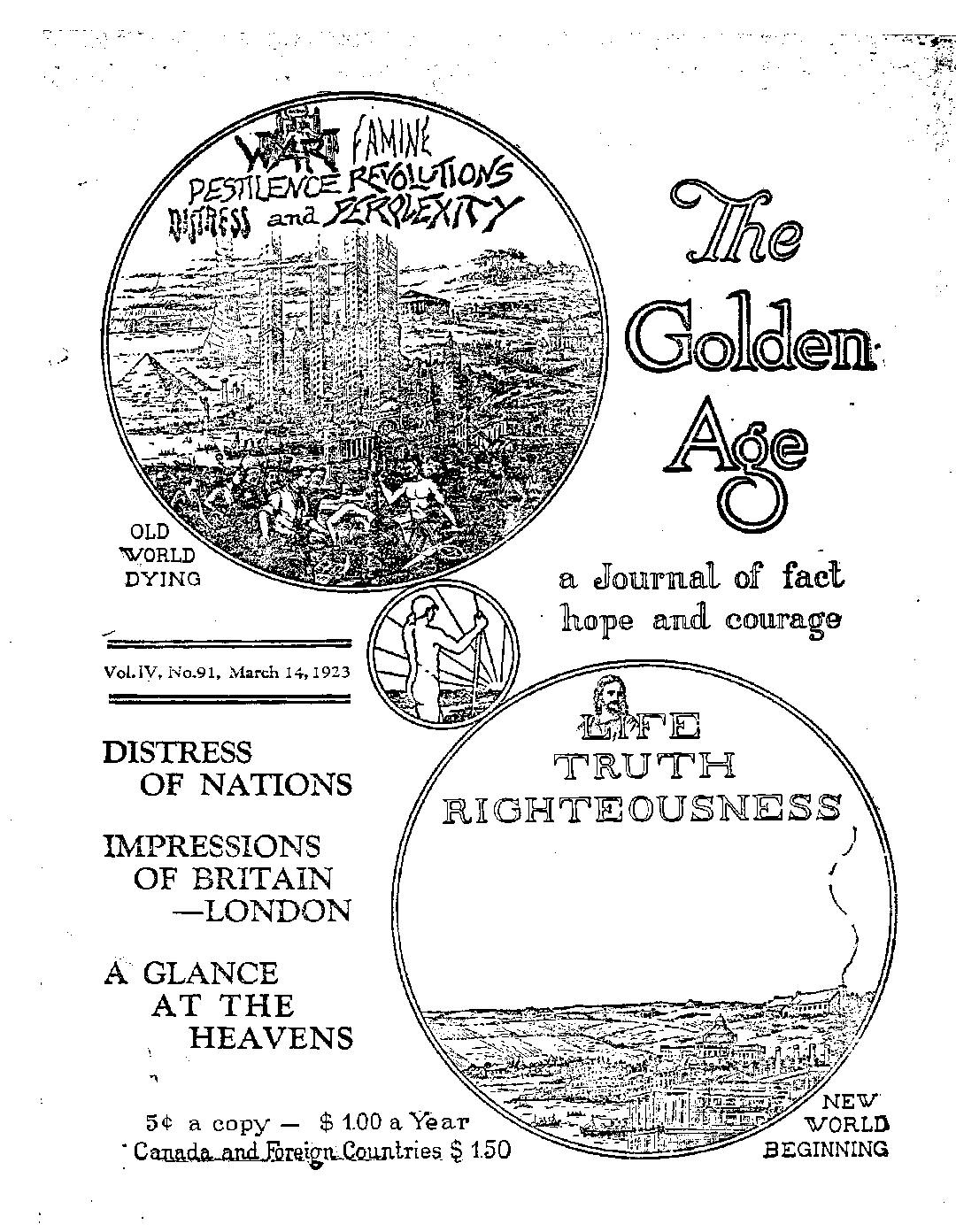
OUR purpose here is to answer these question^, giving the real cause for the distress and the only adequate remedy. As you read, study the illustration on the cover page. It contains a great amount of history briefly stated, and bearing directly on the questions at issue. Some knowledge of the history of the world is essential to an understanding of the present distress and to how it can be remedied.
The illustration pictures Eden, the place of the beginning of man’s history. There he was perfect. The serpent, representing Satan the devil, caused man to sin, for which he was sentenced to death and expelled from Eden, his perfect home. Thereafter his children were born, imperfect; hence under condemnation. Later, God caused holy men to write the history of these things, inspiring their minds to write it correctly, which history we have in the Bible.
Man resorted to his own devices to govern himself. Angels, leaving their heavenly estate, materialized as men and mingled with humankind. The whole world turned to wickedness; and so great was this wickedness that God declared that He would destroy and did destroy the world in the deluge. Noah and his family were the only ones carried over from that old world into another or new world, being saved in the ark which he builded at God’s command.
After the flood a new world began, which has now grown old. Mankind again multiplied. All then spoke one language. Some one proposed that a tower be builded by which they could go up to heaven. It was builded and named Babel, because there the Lord confused the speech ol all the people. Such is the reason for the many languages and tongues spoken from then until now.
There were some men who loved righteous-
B56 THE GOLDEN AGE BMon.yw.N.1.
Dess, among whom were Job, Abraham; and others. With these men God dealt, making history for the benefit of those now on earth. In the light of this history and prophecy men can see the meaning of the present-day events.
In the course of time Jehovah caused the great Pyramid of Egypt to be builded, which by its geometrical measurements and construction pictures in stone the great divine plan.
To Abraham God made a promise to the effect that some day in the future He would bless all the families of the earth, by offering to all a full, fair, and complete opportunity for life, liberty and happiness. For the purpose of picturing this coming blessing God formed the descendants of Abraham into a nation and called that nation Israel. He gave them His law, by which He foreshadowed a better thing to come: namely, the blessing of mankind. With that nation He established the true religion: namely, the worship of Jehovah God. Satan, continuing his method of fraud and deception, established a false religion amongst the nations round about, misled and overreached them, causing them to erect great temples wherein they worshiped images and demon gods.
The nation of Israel, unfaithful to its covenant with God, was overthrown, Jehovah permitting the gentiles to establish a universal empire. This occurred in the year 606 B. C.; and God's prophet foretold that this gentile dominion would continue for a period of 2520 years. It is seen, then, that the legal end of the gentile times must be in 1914 A. D.
God promised to provide redemption of man from death, and in due time to destroy death and the grave. He sent His beloved Son Jesus into earth for that purpose. Jesus was put to death on the cross. He arose from the dead, the divine Christ Jesus. Thereby was provided the redemption for all mankind; and in due time this redemption and deliverance must and trill be granted to all men.
During the past nineteen hundred years honest men have been striving to establish ideal forms of government; but selfish men have, under the influence of Satan, controlled the affairs of the nations of earth.
During the past hundred years there has been a tremendous advancement in knowledge and invention. Such was foretold by Jehovah through His prophet Daniel.—Daniel 12:4.
During that brief period of time men have formed great banks and other financial insti- ? tutions, erected towering buildings, brought from the earth great quantities of iron and steel, builded mighty ships to ply the seas, and great railway systems and other means of rapid transit; they have controlled the land and the sea, and later the air. Giant corporation* have grown until they have come to control th* affairs of earth, forming the ruling factors of the nations. Working together with these have been and are professional politicians find an apostate clergy. This combination has made the laws and influenced improperly the enforcement thereof. They have builded great universities and other institutions of learning, controlled the curriculum thereof and shaped the course of the rising generation. Eager for more power, they have formed great armies and builded mighty battleships; and withal hav* grown proud and arrogant, dominating the peoples of earth. They have heaped up great treasure in the way of money and property for the** last days, where we now are, and as the Lord foretold they would.
For their own protection labor organization* have been formed. These have had unwise counsel and have often practised injustice. Strike*, accompanied by violence, have become a common thing. Between the upper and nether millstones the common people have suffered and yet suffer.
The Old World Dying
THE order of society existing from the dd-uge until now is designated the old world, legally ending in 1914. God had promised that at its end there should be a transition, gradually, from the old to the new order. His inspired writers wrote that the old world must pass away with a great, fiery time of trouble, even as the first world passed away with a flood; and that this should be followed by a new order of things, wherein dwelleth righteousness.—2 Peter 3:2-13.
The question was propounded to Jesus by His disciples: How may we know when we have come to the end of the world! He answered that the first evidence which would mark th* beginning of the end of the old order would be a world war, followed by famine, pestilence, revolution, and distress of nations, with perplexity, men's hearts failing them for fear and expectation of the things overtaking the peo-pies of earth. The conditions that we see today prove beyond question of a doubt that they are in fulfilment of the words of the Lord, showing that we are now in the transition period. The old world is dying.
All the efforts put forth by the premiers, the financiers, the clergy, or like conferences, to establish peace and order, will fail, because God foretold through His prophet that they must fail. (Isaiah 8: 8-10) The present condition argues more trouble; and this is corroborated by the words of Jesus, who states that following the present distress and perplexity of nations there shall be a time of trouble such as the world has never known; and that so great will it be that all the human race would perish except for the fact that the Lord will intervene and stop the trouble, because it is time to establish a new order, a new world.
Satan is the god (invisible ruler) of the old world that is now dying; and soon Satan will be restrained of his power, and his reign of unrighteousness cease.
New World Beginning
THE new world or order of things will permanently establish righteousness on earth. Christ Jesus will be the invisible ruler of this world; and through His visible representatives He will establish lasting peace, prosperity and happiness and life amongst mankind. The evidence above stated concerning the passing away of the old world is likewise proof of the presence of the Lord. In fulfilment of His own words, He has taken unto Himself Eis power and is dashing to pieces the old order, that the new may take its place. His death and resurrection are a guarantee that all men shall have an opportunity for life. He gave His life a ransom for all, to be testified in due time to all; and the time for the people to know these things is now here.
God's prophet plainly states that when His judgments are in the earth the people will learn righteousness. In the language of His prophet, "the kingdom of the Lord shall be established over the other kingdoms, and shall be exalted above them; and all the nations shall flow unto it. . . .’He'shall judge among the nations, and shall rebuke many people; and they shall beat their swords into plowshares, and their spears into pruninghooks: [and in the new world] nation shall not lift up sword against nation, neither shall they learn war any mare” That will be a time of universal peace. Then, as God's prophet says, the people will build houses and live in them — not that a few will build houses and others live in them provided they can pay the rent. Then will the people, young and old, be taught the truth and righteousness, and be no longer deceived by error. Then every man shall have his own home and dwell under his own vine and fig tree, and shall not fear any one, because no wicked or evil thing shall be permitted. Then the commerce of the earth will be for the benefit of all and not selfishly for the gratification of the avaricious few. Then the earth shall yield its increase and become a fit habitation for man. Then the desert shall blossom as the rose and the waste lands become tillable, and the arid places habitable, because God formed the earth for man's habitation and has promised to bring it up to a fit condition for man.—Isaiah 2:2-4; 65:17-25.
■ That will be the time spoken of by the Apostle : "Times of refreshing shall come, . . . and God shall send Jesus Christ, who before was preached unto you, whom the heavens must retain until the time of restoration of all things, which God hath spoken by the mouth of all his holy prophets since the world began." (Acts 3: 19-21) The twenty-four prophets who wrote the old Bible foretold these coming days of restoration. Jesus, referring to the same time, said: "If a man keep my saying, he shall never see death"; and again: "Whosoever liveth and be-lieveth in me shall never die." (John 8:52; 11: 26) That is the time referred to by the Prophet when, if the wicked shall turn away from their wickedness and do that which is lawful and right, they shall live and not die. Then will the prayer be answered which Jesus taught His disciples to pray: "Thy kingdom come; thy will be done on earth as it is done in heaven.”
For this time of righteousness on the earth orthodox Jews hoped long centuries ago. Catholics and Protestants, all Christians, regardless of denomination, have prayed for it for the past nineteen hundred years. That good time is just at'hand. The Lord is now present. The kingdom of heaven is at hand. The old order is passing out; the new is coming in. The day of deliverance is at the door.
The jubilee system that God gave to the Jews enables the student of prophecy to measure the time when the restoration of the world of
B58
■ kind will begin. The Jews were required by the law to keep seventy jubilees; fifty years between each jubilee making a total of 3,500 - years. They were to begin to count this time
। when they entered the land of Palestine, which
, they did in the spring of the year 1575 B. C.
j It was to mark time until the days of restora-
i tion. That 3,500-year period ends with the con-1 elusion of 1925. Therefore it may confidently be expected that war, famine, pestilence, and revolution will reach a climax and quickly pass away about that time; and peace, prosperity, . and happiness will be quickly ushered in. The , new order being fully established, those who . are obedient to its arrangement will live and not die. For this reason it can be confidently stated now that millions living at this time on the earth will never die. We are in the transi-; tion period.
t Instead of becoming discouraged, the student - of prophecy should look by faith beyond this dark night to the new day, the Golden Age that ; is just dawning. The whole plan of God relative to man, which covers a period of 7,000 years, reaches a climax in the restoration of man and his perfect home on earth.
The Golden Age cannot afford the space to set forth these matters in full, because of the multitudinous Scriptural citations and proofs. We are pleased to call attention to the fact that the International Bible Students Association publishes a series of books in which all these matters are clearly proven from the Scriptures. The small book, “Millions Now Living Will Never Die,” contains more than four hundred Scriptural proofs to establish the truth of that assertion; “The Harp of God,” in eleven chapters, discusses the fundamental points; while the seven volumes of “Studies in the Scriptures” examine the whole question in detail. The International Bible Students Association is printing and sending out these books by the million, disposing of them at cost and often less than cost; the object being to get the message to the people.
The most stupendous question before mankind today is the restoration of man and his perfect home. With the passing away of the old world and the coming in of the new, the desire of all nations will come. The Messianic kingdom is the only remedy for the ills of humankind. It is a certain and specific remedy, [t is God's remedy and it will result not only
• - & M. *
in establishing peace and prosperity, but right- ■ eousness and everlasting life upon earth to all of those who desire to do right and who will try to do right. ■
The Golden Age is trying to do its part in enlightening the people. If you are. interested in your own welfare and that of your family and your neighbors, pass the message of good tidings on to others. Nineteen hundred years ago the angel from heaven brought to the shepherds in the field at Bethlehem the message: , "Behold, I bring you good tidings of great joy r which shall be unto all people.” We have come to the day when that message of glad tidings must now go to all people. Let every one who loves righteousness delight in passing the glad message on to others. .
•'SENDING THE IDEA HOME’,
Millions no'v livmg,..will never die!
In the world is a class of individuals who have what a bishop has aptly named the "ecclesiastical mind.” Its chief characteristic is that it has become ossified, which means that the skull is practically impregnable to a new thought. As the creeds are inflexible and not permitted to advance with civilization, those who are creedbound are in the dark and exceedingly loath to depart from traditions. But the light will break through— eventually.
Impressions of Britain—In Ten Parts (Part 7)
LONDON, in its 700 square miles of area, has 7,000 miles of streets. The American did not, of course, try to go all over the city, but he did get around considerably. London has, without doubt, the best facilities for getting around of any city in the world. There are no elevated railways to mar the beauty of the city and to disturb it with their roar; and there are no tram-cars, except upon the outskirts, and therefore no rails to mar the streets or trolley poles to obstruct the sidewalks.
How, then, do the Londoners get about 1 In ' the first place, they have the finest system of t underground railways in the world. One can go anywhere in London without going out of the tubes; and instead of the roar and screech which prevents conversation in New York subways, the tubes are so designed that uninterrupted conversation can be carried on in an > ordinary tone or even a low tone of voice. To carry on a conversation in the New York subway one would have to have a voice like a steam calliope. The speed seems to be about the same in either city, however. The British ears are more comfortable than the American cars; there > are arm-rests marking off the exact space allotted to each passenger, and if one gets a seat he also gets a comfortable arm-rest along with it The subways in London are so numerous that there seem to be always seats enough for everybody. And the fares are extremely rea-f sonable. They are from one penny (2c) up, depending upon where you wish to go.
In the second place, London has the finest surface transportation in the world. The London General Omnibus Company has 142 bus lines traversing all parts of the city. It is re> grettable that they are disfigured by signs of Dunlap's “Tyres’’ and other posters until their appearance is ruined, but they render most ex-■ cellent service. They are double-decked, the . same as the tram-cars used all over Britain, except that the top decks of the omnibuses are ? open to the weather. These buses are the same as the Fifth Avenue buses in New York.
The Zone System of Fares
HE zone system of car-fares applies to all omnibuses, tram-cars and underground rail-
F ways, instead of, as in America, a single fare which Entitles one to go anywhere he pleases.
• > • The conductor of the omnibus has in his hand a bank of tickets of six different colors. When a passenger boards the car he states whether he want a ride for a penny, three half-pennies, two pence, three pence, four pence or five pence; and in accordance with his request he is issued a white, buff, blue, red, green or salmon-colored ticket. The route over which the bus travels is divided into twelve to fifteen zones, printed in order upon the ticket As the ticket is issued to the passenger the conductor punches it so as to show the zone at which the passenger boarded the car; and as the passenger glances at his ticket he can see immediately opposite the punch mark not only the place where he boarded the car, but also the place at which he must alight or pay another fare. The tickets must be shown to the conductor at any time upon request. This system works well in practice and is just. .
While we are on the subject of transportation and communications we notice a few related items. All the telegraph and telephone service of the British Isles is administered by the Post Office Department, a system which makes for economy and efficiency; but telephones are not nearly so popular as in the United States. In America almost everybody in what might be called the middle classes has a telephone; in Britain telephones are a rarity. The number of telephones per 100 of the population in various countries is as follows:
United States_________.____________
Sweden............... ...
Norway .......,
Germany---------------
Great Britain
France
Italy.3
Excellent Highways
THE United Kingdom has 240,000 miles of highway, mostly macadam, very little hard concrete, which it keeps in most excellent condition at a cost of about £100 per mile per year. There is general complaint that the char-a-bancs, heavy vehicles for carrying sightseers or other travelers from one village or city to another, are making it harder and harder to keep the roads in condition; but the problem seerps to be well handled thus far and the roads all that could be expected. There are not so many fifteen-ton. trucks and other road-wreckers at
•w
in the United States; but there are numerous road locomotives, a type of vehicle never seen here. These are really locomotives, with smokestacks in front, looking much like the locomotives on the railroads; and they usually have one trailer. Trailers are seen, but are not numerous in America. Years ago we did have in the United States a traction engine of which the British street locomotive seems to be a modern development.
On account of the fact that Britain is an island. and has great numbers of excellent ports and deep rivers reaching far into the heart of the island, and in view of the fact also that Britannia is the world's great sea power, much greater attention is paid to waterborne commerce than in the United States. All the rivers are connected by canals and in all there are 4,673 miles of canals and canalized rivers in the United Kingdom.
Much attention is paid in England to the raising of homing pigeons, not for any mercenary reason but because Englishmen love animals and love sport. This is not saying that other people do not love animals and love sport, too; but there is friendly rivalry among raisers of these pigeons, and the custom exists of neighbors shipping rival pigeons to the far ends of the Isles and then malting wagers as to which bird will get home first after its release. There are immense numbers of birds of all kinds in England. And crows 1 Crows and seagulls 1
Carrier pigeons have done some wonderful things in the world's history. Probably the most wonderful of all was the pigeon released by Sir John Franklin when he was frozen in while on one of his Arctic expeditions. Unable to move, and seeing no way of escape, Franklin released one of his carrier pigeons; and the little creature arose in the wilderness of snow and ice far to the north and west of Labrador, wheeled about two or three times in the upper air, and headed straight for its home in far-off England, three thousand miles across the trackless ocean, where it arrived exhausted three days later. Who put it into the head of that liftle creature to know exactly which way to go i^ order to reach its far-off home?
The pigeon trips in England are so short as to be only a pleasure for a bird. The utmost extremity of flight in Britain proper would be from John O’Groat's hexagonal house (so built in order that his six boys might each have a > share of his estate without quarreling over it) ; in the extreme northeast corner of Scotland, to Land's End, in the extreme southwestern corner of England, a distance of only 876 miles, or . less than the distance from New York to Chiea- _ go, by rail.
First Impression—Honesty I
PERHAPS you wonder what were the Amer* ican’s first impressions of the British people when seen in their native land. The Britishers ; wonder, too, forgetting that we have in Amer. < ica several millions of ex-Britishers whom we know and love and appreciate. But it is a little ’ different when one goes to England and finds himself in a land where practically everybody U a Protestant and where everybody speaks the American's own native tongue. In America there is the grandest chowchow of religions and nationalities on the face of the earth, and in a street-car one is likely to get every kind of language and every odor of garlic from every quarter of Europe. But he gets the ideas, too; and these ideas have made America the moat progressive nation under the sun.
The first impression that the American geta of the English is that they are the most honest people in the world, and this is in spite of the cabby incident in Liverpool. No matter where one goes or what one sees or handles there is every evidence that the article or articles have been made to render the utmost service, and the price shows that only a reasonable profit is asked or expected. This is not true in America, where the stores are filled with the cheapest qualities of flimsy materials and poorly made goods; and the one object in view seems to be profit, regardless of service. The very finest and best of goods can be obtained in America, too, but at outrageous prices, which people of moderate earning power cannot afford to pay.
The mail boxes in use in Britain look as if they had been made to withstand the fire of heavy artillery. They are apparently made of cast iron, are tubular in form, red in color of paint and about eighteen inches in diameter and five feet in height. In America the mail boxes are built-up metal boxes, rectangular in form. For letters only, the boxes are about 8 x 18 x 18 inches mounted upon iron posts. For newspapers and packages the boxes are much larger, perhaps 18 x 24 inches and four feet high, resting upon the ground, as do the boxes in Britain. The postmen in England wear helmets, flat on top, looking something like an inverted coal scuttle. The rubbish cans in London are as well made as the mail boxes.
' Nowhere in England did there seem to be in evidence any kind .of towels except what we know in Amprim as heavy crash towels; and this is a good thing. The so-called hand towel much used in America has so little absorptive power that when one has dried his face and hands on it the towel is done for until it has had time to dry out. The grades of toilet paper which are in common use in America could not be sold in England at all; the people would not have them, and they are a disgrace to the manufacturers and the dealers here.
The Desire for Service
HE American watched a force of men engaged in street repairing in London. First there was a bed of three or four feet of solid concrete, smoothed off on top as smooth as it could be made. Then wooden blocks, such as are in use in some places in America, were painstakingly fitted together; and when the workman was satisfied with his joint, he passed his hand over the surface to see if the top was perfectly smooth. It was not, and he took a plane and carefully pared off enough to insure the block being exactly level with its mate. Imagine such a thing being done in America!
The American before his departure for England saw men paving Hicks Street, in Brooklyn. Up through the center of the street a great steam-shovel ripped off the surface to a depth of about two feet, motor trucks carrying away the debris as fast as removed. Only a little way behind were the traveling concrete mixers, pouring their loads into the newly made excavations; and behind these was the asphalt paving apparatus. In one day two whole blocks were ripped out and replaced with what looks like a perfect pavement; but two years from now the British pavement, shaved off by hand planes, will be as good as when it was laid, and the people on Hicks Street will be complaining of the great holes which the heavy trucks have hammered into their newlaid road surface.
The English people do not have vegetable gardens adjoining their premises. The vegetable gardens are all in one place on the outside of the city. Here each family may rent a small area in which to raise the cauliflower, celery, Brussells sprouts, cabbages, turnips, etc., which are specially suited to the climate, and all of which are so good for the human system. There are no watchmen on these premises; the gardens of the whole city are there, all ranged side by side, and with nothing but narrow paths to separate one garden from the other. But do you suppose the Briton is afraid that anybody will take any of his garden stuff! Not a bit of it. He is honest himself, and expects every other Briton to be honest. And he usually is. The allotments, as these family gardens are called, commonly have little tool-houses on each allotment, presenting an odd appearance, though not displeasing to the eye.
On account of the climate it is necessary to wear woolen clothing all the year around in Britain, and there is no use trying to dispose of poorly made woolen clothing or mixed clothing in England. It is the world's center for fabrics, and the people know enough about them to. insist on such makes as will render real service. American tailors complain that they cannot get in America, at any price, such cloths as are commonly made and used in England. Another instance of the Briton’s desire for service rather than speed is the sign seen over a bakery, "Country bread, stone ground, retaining all the nutriment.”
Second Impression-Courtesy
HE second impression that the American gets of the Britisher on his home soil is that the British are the most polite, the most courteous, people in the world. This will be a surprise to many Americans who have formed the idea that the British are abnormally pigheaded, conceited and rude. This impression has come about through a mutual misunderstanding. The Britisher does not understand the American, and the American does not understand the Britisher.
The courtesy of clerks, waiters, and policemen is most surprising and most refreshing. The policemen do not carry clubs; there is no reason for them to do so anywhere. The American approaches a policeman in London and asks :"Can you direct me to Cavendish Square f* Back comes the answer: "Up this street to the right, then the second street to the left, and the seventh door up is the American consulate.”
862 n, qOLDEN AQE b^™. N. x, .
The American asks quizzically: "How do you know I am an American 1” And the London “bobby”gives the friendliest of smiles and says: "Oh, that is easy.”
And just here let it be said that no American in Britain need expect to hide his identity. He is betrayed by the length of his face, by his complexion, by his clothing, by the rims on his glasses, by his quickness of speech and movement, and by what seems to the Briton his peculiar intonation. Another Briton when asked, “How do you know I am an American?” answered: "Oh, by the twang; I met a number of them while I was in France and got quite used to it.”
The Americans are accused of "talking through the nose.” What really happens is that an American talks as if he had a cold and as if his nose were partly stopped; for when a person has a cold and his nose is in that condition, that is just the expression used here. Probably this difference is purely a climatic one, the salt and moisture in the British air making the nasal membranes more pliable than is possible in America.^ dry climate.
Dignity and Kindliness
VTDENCES of the Britisher's innate courtesy and dignity are on every hand. The following are some signs copied for the benefit of American readers. Compare them with the short, sharp and often discourteous signs found in America: “Off the bus first, please”; “Please abstain from the obnoxious habit of spitting on the floor”; “Visitors are respectfully requested not to walk on the grass”; “Passengers are earnestly desired to flush the pan before leaving”; “Passengers are prohibited from joining trains without first obtaining tickets”; “Gentlemen using the lavatory basins are particularly requested to leave them in the condition they would-like to find them”; “It is respectfully requested that passengers refrain from throwing into the pan any substance likely to choke the pipes or prevent a proper flow of water; otherwise serious discomfort to the passengers themselves may result and the closet rendered both disagreeable and useless.” An exception to this general courtesy is that Africans are always called “niggers" without any seeming effort to find a more agreeable name for those who have had the fate to be born into the world with black skins. ’
The only profanity which the American heard in ‘five weeks in England was on an occasion when he stepped to a ticket office at 9.27| a. m. and asked for a ticket to Bradford. Quick “ as a flash came the ticket and the change through the window, accompanied by the startling warning, “Yullhoftobodom quick abaht it; the train goes at 9. 28.” Americans pronounce “about” as if it were spelled “abowt," most Britishers as if it were spelled “abaht.” Yes I He caught the train, thanks to the Britisher’s warning, intended in all courtesy and kindness. .
A Briton will ride for two hours or four hours in the same compartment with another solitary individual of any nationality, and never utter a word to break the silence. His real reason for not saying anything is that he does not wish to give possible offense. He thinks the stranger may have reasons for wishing silence and does not wish to intrude. But let the stranger ask a question and he is all attention, eager to render any service in his power. In America two strangers would not be together five minutes before they would be engaged in animated conversation on some subject, and it might be any subject under the sun.
At the Briton's table the stranger is seldom or never asked to return thanks for the food; the host does that himself, fearing to embarrass his guest. This is directly contrary to the American custom, where as a mark of recognition or honor the stranger in invited to return thanks for the meat But the Britisher will polish his guest's shoes; and if he fails to warm the guest's bed with a hot-water bottle, he will apologize for it the next morning!
But while the Britisher is the soul of courtesy, he is not “soft” Thus, when Bunnymede, which is generally regarded as the birthplace of English liberties, was recently put up for sale, nobody would bid on it. Had this been in American hands the best parts of it would have £ been sold at great profits by a real estate firm, and the balance of it shoved off on the public at twenty times it real value as a result of some political deal.
Differences of Pronunciation
WE HAVE already called attention to the fact that in Britain ticket offices are always called booking halls, and the word “booking^' is not pronounced “buhking” as it would be pronounced in America but the double vowel “oo” is drawn out so as to give its full sound, as though it were “bookeing ” There are other differences of pronunciation. The American pronounces the name of a popular newspaper as though it were spelled “Dayley Mayle’’; the Briton seems to the American to pronounce it as though it were spelled “Diley Mile,” but to his own ear it probably does not sound that way. The Briton probably pronounces the words “Mail” and “Male” differently, giving separate values to the “ai” and the "a”; the American pronounces them exactly alike. The American “raylewaye” sounds like “rilewye” in England. The American’s r’s vary with the climate, as they do in Britain. In Boston when they say “raw” it sounds like "rorr”; in New York when they say “New York” it sounds like “Nuyawk” and “Work” sounds like “Wuick”; in Scotland if a man is “drunk” he is terribly “drrrrrunk,” and no mistake about it; in England there is a softness to the r’s which is extremely musical. Nothing could be sweeter than to hear the English people sing and to note the softness of their pronunciation of such words as “Father,” “dear,” “here,” etc. They are accused of saying “Fathaw,” “deah” and “heah.” It is not true. They place a value upon the r, but it is too slight and too musical to be pronounced by those who have grown to maturity in America’s drier climate. Climate is the real explanation of many of these national differences.
Another item about English pronunciations is that they differ in different sections; and in some places, as in Northumberland county, it is claimed that in a distance so short as six miles there are deeply rooted dialects that continue as they have continued from time immemorial. Thus, in places that are near to one another, one village will pronounce America’s national beverage by a word that sounds like “waughter,” while another village calls it “wot-ter/’ It was in Northumberland County that a woman-who first saw a swing bridge is alleged to have made the surprising remark that “the warks o’ God are wonderfu; but the warks o' man are mair sae.” We do not guarantee the story, but it is current in the county itself.
Differences in Use of Words
THERE are certain words which the Britons use in a different way than they are used in America. An Amarim shoe is a British boot. An American Oxford or low shoe is a British half-boot. An American boot is a British topboot. The American blackberry is the British barberry. The American store is the British shop. The American toilet is the British lavatory. The American pie (but—and treason— not so good) is the British tart, and the American deep pie is the British pie. It is served with a tablespoon, and it is good. The American’s undershirt is the Briton’s vest, and the American’s drawers are the Briton’s pants. The American merchant tailor is the British bespoke tailor. The American barber shop is the British shaving saloon. The American boarding house is the British board residence. The American laundry is the British shirt-and-col-lar dresser. The American truckman is the British highway transport contractor. The American signs “Men” and “Women” in Britain are always “Gentlemen” and “Ladies.” A steam fitter has a steam joinery works. A street-cleaning department is a cleansing department. The delicatessen of America is unknown in Britain, and the fish-and-chip saloon and the tripe dresser of Britain are unknown in America- An American lunch for farm workers is a bagging in England. The ushers of America are stewards in England, the deacons are stewards, the porters are stewards, and the waiters are stewards. When a Briton cracks a good joke on you he is “pulling your leg.” But when an Amer-iean “pulls your leg” it is no joke; for it means he has carried through some plan to get money out of you to which perhaps he was not entitled and which you could ill afford to give bim. The British housewife uses the expression, “I did not have my fruit bottled,” and a drunken man is spoken of as “bottled up.” Some Britons use the expression “Aye” considerably, and the way in which they say it sounds very musical and, to an American, rather novel.
The most unusual use of words in a different sense- from what they are used in America and in other parts of England was in the West of England, where the dusty traveler was twice greeted by his host with the kindly inquiry, “Won’t you go upstairs and have a little swill right way before dinner t” For the convenience of the incredulous we give one of the Standard Dictionary's definitions of the word swill: “To drench oneself, as with water in washing, from the Anglo-Saxon Sicilian, to bathe." It will thus be seen that the word as used in the West of
n* GOLDEN AGE
England is the purest English, and is not to be confused with the Equid food for hogs more generally known in England and altogether in America as the only meaning of the word.
Differences in Foods
THERE are differences in foods between
England and America, but they are unimportant. British oysters are very small; American blue points are as large as the palm of the hand. The skin of a British peach is so soft, due to the climate, that it goes to market packed in cotton and must be marketed at once. The flesh of the American peach is soEd, and the skin is tough. Tomatoes in England are the size of eggs and are raised only in hothouses. British hothouse grapes are a dollar or more a bunch. The grapes are an inch in diameter and delicious.
The British have a very fine vegetable called marrow, which is something in taste and te$£ tore like the American summer squash. Pumpkins do not grow in Britain. Alack and alas; to think of going through life without the delectable joys of ever eating a piece of pumpkin pie! That one discovery ought to enable an American to forgive his British cousin anything.
In Yorkshire the British have a famous dish, Yorkshire Pudding, in texture something like an American flapjack fresh from the griddle; and Eke that same toothsome wheat-cake it must be eaten while hot and fresh, if it is to be as crisp and as tender as its reputation compels it to be and as it generally is.
The British always have on their tables quantities of stuffed or fat cookies called scones (and very good they are too), cocoanut baEs, tarts, and little cakes. They do, not go in for layer cakes or apple, mince, custard or lemon pies as much as we do in the United States; and ice-cream is a rarity. But they do have more, elaborate desserts than are generally seen on American tables. These desserts frequently consist of fruit, over which is poured custard, and on top of that whipped cream; and you had better believe the American when he teds you thatdt is. good. And then English puddings of all soijts are as famous in America as they are in England itself. In one place in London there was a sign, “New York ice-creams, American ices and sundaes, 1 shiUing, 1 shilling three pence, and 1 shilling sixpence/' or 22jc, 28c,
33 je. No British table is complete without a “tea cosy” to keep the tea warm. 1
British table manners are different from I American. In America the knife is never used except when strictly necessary, and frequently ; lies quietly beside the plate throughout the en- 1 tire meaL In Britain it is considered as poor ’ etiquette to lay the knife down as it is in Amer, ica to reverse the process. The American eats with the fork in his right hand, and uses it all too frequently as a scoopshovel instead of as a spear, as he is supposed to do. The Britisher J eats with the fork in his left hand and upside down, using his knife to help him load well the back of the fork; and without any desire to cause any international complications, candor forces the American to admit that it is astonishing how much can be loaded upon such an unhandy vehicle when wielded by a hungry and determined descendant of William the Conqueror.
The system of milk delivery in England is antiquated, unsanitary, and deplorable. In America all deliveries are in bottles; in England the deliveries are from large cans pushed around the streets in hand pushcarts. The British milk cans are large at the bottom and small at the top, instead of-cylindrical as in A-merira-
Pushcarts and Scaffolding
ONE sees more pushcarts of all sorts in five weeks in Britain than he would see in a lifetime in America. One of the most interesting vehicles of this sort was a kind of glorified baby carriage, or perambulator used for wheeling invalids or sightseers across the parks and even down the main streets. Sensible things they are, too. Nothing of this sort is to be seen in America, except on the boardwalk at Atlantic City.
One of the things that makes for the beauty _ of London and other Anglican cities is the great number of curved streets, curved corners, and curved buildings. It takes off the stiffness and rigidity characteristic of the central portions of so many American cities. There are narrow streets here and there, but the streets as a whole are wider than they are generally supposed to be. In some places the sidewalks are too narrow for the throngs of people who would use them, and as a consequence it is a very common thing to see people walking in the street near the curb. The curbs are of less height than j in America, showing that there are fewer heavy .storms.
There are the most astonishing ladders in use in London, six stories high and as straight as an arrow. Where the wood for such ladders could be found is a mystery; probably in Norway. And how it would be possible to put such a ladder in position is also a mystery. The rails seem of one piece and about four inches in diameter all the way up.
Scaffoldings in England are not erected as in America- Instead of being made of 2 x 4 inch or 1x8 inch timber nailed together and surmounted by planks loosely laid on, the whole sometimes falling and killing the workmen. British scaffoldings consist of poles similar to those of which the ladders are made. These poles are lashed together in regular seaman style, and nothing could be more secure.
Names for the Houses
HE suburbs of English cities are not nearly so attractive as those of Ampri can cities, for the reason that in American suburbs there are no walls or fences to separate one place from another or from the street. The effect is as of one beautiful park full of the most elegant residences. The Britisher likes his suburb all to himself, and builds a wall around his place so high that no one can see over it; and the consequence is that a drive through the suburbs is a drive between high stone wails with practically nothing to see until the open country is reached.
No one in America thinks of giving his house a name, and no one in Britain thinks of letting his home go without a name. The following is a list of names taken from a succession of houses in the order in which they appear in the city of Leicester:
Brookfield, Edina, Oakland, Greenhayes, Thorncroft, Ehnsthorpe, Heathfield, Rock-Dene, Mayfield, Houghton House, Carisbrooke, Thorpe Underwood, The Rowans, Eyreville, The Shrubbery, Lynhurst, The Lawn, Newlyn, Hampton Lodge, Tythorne, Woodbank, Thorn-leigh, Coonamble, Linden, Treveva, Glenfinnan, Charle-cote, Gordon Lodge.
Taking Britain as a whole, one may say that 'detached1* houses are rare and that semi-detached hopses are common. There are usually ornamental arches over the doorways; and if the houses are of stone or red brick, they have buff brick trimmings around the doors and windows, setting off the houses nicely and relieving the sameness noticeable in those parts of American cities which are solidly built up. Many of the houses are vineclad, and all of them are of brick or stone.
There are no wooden houses in England; and when the British hear that many Americans live in wooden houses, they think it most singular. One wonders what they would say at houses, perhaps a million of them in the United States, that are built on props and have no cellars at all under them. These are all in the South or the West, where climatic conditions are such that heating plants are unnecessary.
Most artistic of all the houses in England are those that were built in the sixteenth century. These are of timbers perhaps eight inches square, with the interstices between the timbers filled with brick or stone and plastered over with mortar, giving them much the effect of modern stucco houses. The regular old sixteenth-century houses, of which there are still a few samples in London and elsewhere, have every upward story projecting a little further into the street than the floor below, presenting a pleasing sight from the street
Interior Arrangement
PRACTICALLY every home in the northern part of the United States has some kind of interior heating plant — steam, hot water or hot air — designed to heat the whole house and every room in the house. There is usually a fireplace in the living-room, but it is not often used. Americans traveling in Britain suffer with the cold, not being used to the climate, and their blood having become thinned by living in warm rooms the year around. The Britisher has a fireplace in every room, and that is the means of heating the home.
American homes are usually fitted with clothes closets off from every room and two off .from the room occupied by paterfamilias and materf ami lias; there is a linen closet upstairs and there are dish closets, a broom closet, and usually a coat closet downstairs. Most British homes are built without closets. The closets are purchased separately, and are elaborate and expensive.
American dining-rooms and living-rooms are usually separate and distinct entities. In Britain it is not so. The dining-room is the place of entertainment in the complete sense of the
term. Or rather, it would perhaps be better said that when guests are present meals are served in the living-room on the great table which is kept there for that purpose.
All the nianos observed in five weeks had candle racks upon them, not a bad idea, as they doubtless come in good for helping to hold the music in place, but would hardly be used for candles in 1922. All houses or nearly all are-fitted with electricity, as in the United States. But the electrical switches are different. In America the switches are operated by pressing a light or a dark button, depending upon whether one wishes to make the room illuminated or otherwise. In England there is a little brass knob. Pushed up, it puts the light on; pushed down, it puts the light out; or vice versa.
Linoleum is much more used in England than in America, it constituting a covering for nearly every floor in the house. This is because narrow width matched flooring or hardwood floors are impracticable in England on account of the dampness. Under the linoleum-the floor boards are generally about eight inches wide. The American did not peep to see; he saw it without peeping. American window-shades are hung on spring rollers; in England the window-shades are operated by cords over pulleys.
Evidences of Economy
HERE are evidences of economy in England which are not to be found in the United
States. There are tailors who make a business of reversing clothing. In America the tailors take it for granted that the cloth which they put into the clothing is not worth the reversing
BBOOXLT9, N. %
after it has been worn for a few months; and they are generally right. At any rate an American tailor who has the appearance of looking anything but prosperous says with disdain when the proposition is put to him of reversing an overcoat which was made of extra good cloth: “I would not bother with it.”
One of the many remarkable markets of London is the wholesale second-hand clothing market at Phil’s Buildings. At this place secondhand clothing, the total value of which runs into hundreds of thousands of pounds, is handled every year.
The "sandwich men” of London and of Britain in general work twice as hard for their employers as they do in the United States. Instead of carrying merely two signs, one on the breast and one on the back, they carry also a frame attached to the shoulders supporting two signs above their heads. This device would not do in the United States. We have too many high winds here. A sandwich man thus rigged out might suddenly find himself turned into a miniature airplane and, like other airplanes, might find it difficult to choose just the right time and place and ma-nner in which to alight.
Some other evidences of economy: In some of the public comfort stations there are signs, "One penny for toilet facilities,” and in some of the restaurants napkins ("serviettes” as they are called) are furnished only upon request, , and for their use a slight charge is made. The British are not ashamed of these little economies ; and why should they be in a world which is in the present plight of old mother earth!
Why a Soldier Bonus ? By E. Haviland Boyle
I WOULD not expect to use space in The Golden Age to discuss the merits of a Soldier Bonus; but the article, ,rWhy a Painless Soldier Bonus,” by H. Willis Libsach, page 777, exposes the writer to criticism.
Regardless of the apparent success with which our statesmen juggle the bonus egg, their responsibilities in the World War and those of the ex-service men will remain the same; for “all they Jhat take the sword shall perish with the sword* (Matthew 26:52), and a few reluctantly given dollars will do little to thwart the word of Christ.
I do not agree with the writer that sane tax- . payers, who had no direct participation in the war, would be glad to lavish a gift upon the men who fought for them; neither can I see that the fighting was “for them.” We asked for no war, for none of the spoils of war; so for what reason were we in need of a champion! As for the ex-soldier, any Christian has a feeling of pity for him and will do all possible to alleviate the horrors of post-war reactions. However, this does not sanction the setting up of a privileged military class in America.
We Americans should look with understand*
ing to Imperial Germany as the weird specter which such a class produced over there, heeding the words of Christ, "Ye shall hear of wars, and rumors of wars: see that ye be not troubled” (Matthew 24: 6); and the words of James 4:1-3, which would seem to indicate that Christians are not expected to train and otherwise prepare for war. Governed by the spirit of a sound mind, they are to learn gradually that since order is one of heaven’s first laws, it , should be one of the first elements and characteristics of society in this age. An eye for an eye and a tooth for a tooth, is not the law of the true Christian church, and therefore / should not be the law in America, since the United States Supreme Court has concluded that this is a Christian nation. So why inflict a painful soldier bonus?
It seems surprising that the writer would ask the extraordinary question, “Why should not taxpayers experience some of the horrors of war?” But, if someone must, why not have it confined to those who want war, who propagate war, who build engines of war, and who finance war? Why not allow them to go and do the fighting for themselves? Why should a Yankee boy leave home and loved ones, journey across the ocean under great danger, and murder some German boy just because a banking crowd gets into difficulties ? It must be remembered that the great responsibility for the crimes of war lie not at the door of the soldier or cunning statesmen (?), but at the door of those ofttimes called'Wall Street”—our “malefactors of wealth,” by whom our statesmen as well as our people allow themselves to be ruled. _ The apostle James has a word for this class.— James 5:1-6.
I cannot imagine by what theory of economics the writer arrived at the conclusion that “all t reaped financial rewards heretofore undreamed ' . of.” As a result of the manipulations of our wheat crop I would not say that our farmers did; neither do I forget the accounts in The Golden Age of the crimes against the sugar producers, when some of our profiteers were robbing the producers on the one hand and, with high prices, were robbing us on the other. I feel, too, that if the writer had mingled to any extent with the conscripted men or those rendering industrial war service, he would have heard considerable "murmuring” in protest against war. He seems to overlook the severe trials of Judge Rutherford and his associates for daring to preach the truth. He must have been in another world when Mr. Debs was disgracefully imprisoned for exercising his constitutional right of free speech, by a so-called Christian nation, that the world might be made “safe” for democracy. There were some fine men in the country who not only dared to murmur, but spoke right out in the open and spoke the truth, and they received their persecution exactly as Christ foretold in Luke 21:12.
Revising the writer’s seventh paragraph, I would say that it is high time for ex-service men (as well as others) to turn to God and repent. Every man should divulge the truth. He should speak now as he would like to have been spoken to during the war, if he feels inclined to please God. The nation demanded a supreme sacrifice of these men; now they may, knowing the sin and folly of war, be better experienced to forbear and thus not demand of others that which would profit them little and perhaps be harmful to many. It might be said that no monetary reward can atone for the sacrifices of our men. The conflict was a national crime against them; a capitalistic crime against the masses; a clerical crime against God—the unholy alliance at its work.
But these things must come to pass, until men, seeing the folly of their sins, stop to listen to the words of the Redeemer. Then, seeing the “Son of man coming in a cloud [of trouble] with power and great glory,” their redemption will be near.
"Come, all ye saints, to Pisgah’s mountain, Come, view our home beyond the tide:
Millennial Canaan is before us, S<fon we’ll sing on the other side.
Oh, there see the ‘white throne’ of glory, And crowns which the saints then shall gain;
And all who shall love Christ’s appearing, Shall be blessed by His glorious reign.
"Faith now beholds salvation’s river,
Gliding from underneath the throne,
Bearing its life to whosoever
Will return to his Father’s home.
They will walk ’mid the trees by the rivers
With the friends they have loved by their side;
They will sing the glad songs of salvation,
And be ready to follow their Guide.”
The City of Cleveland .
THAT some cities are mismanaged there is no doubt. Graft, corruption and aggrandizement are practised and covertly cultivated. There seems to be the thought among the city "fathers” that no one should have aught to say except those who have a “pull”; and when they grab everything in sight, and many things not in sight, it is considered a legitimate part of their business. The people in each community should come to realize that the men with the greatest "pull" are the most dangerous to their common interests. Voters today have more sense than a few years ago; and may we hope that intelligence shall increase among the masses f Some realize the expediency of having men ‘■'rule over them" who are business men, men of honesty and ability. These may not necessarily be church-goers nor over-pious, but should be conscientious, and have strength of character sufficient to carry out their convictions.
…