Golden Age, November 22, 1922
Download: PDF — Golden Age, November 22, 1922
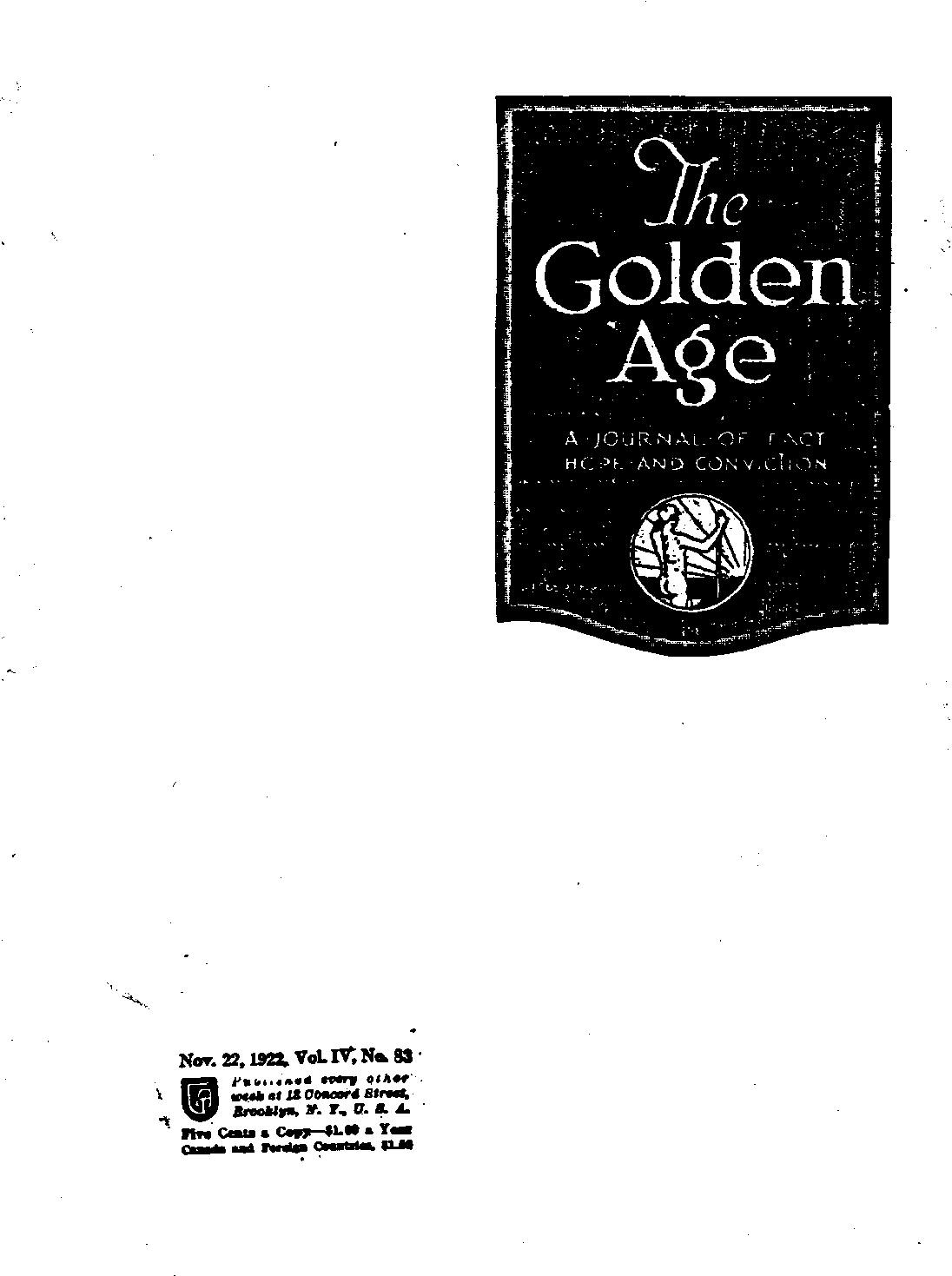
Not. 22,1922, VoL IT, No. 83
fBB ?»(..<«•«* ovary «<Aar . ‘ IkH «*«* at U COaoord Strut, VJJF Broottya, ». F, ff. & 4.
ftv* Ccua * Cayy ILO * Y««
Cwita aad Arata* Caaalilaa «LM
WEDNESDAY, NOVEMBER 22. 1922 Ne. 83
CONTENTS of the GOU)EN AGE
LABOR AND ECONOMICS ..
Coal Dioma and Claro—. . SOCIAL AND EDUCATIONAL . .
- There is a Spirit ta Man 103 Why. the Cburchee Failed- 107 Makers of History ' God or Mammon...............10?
'' Egotists ' --—i----104' Fhoto-Pray Writing ,.400
. Feudalism a Failure-------104 “litr- joiw" iPoeni)............109
’ Real. Cadet of ail Wars 105 “Inflnenes, of the Press" '■
Kay tn the Situation—...IOS- (Paesa) ■ - ___118 ."
. •' FINANCE—COMMERCE—TRANSPORTATION ~ Why-' Condone Usury——----------u,--!..._........too."
Value-of th* Employing Bookbinders of America', to the ' ,- Industry---—:---:—--------— --:—X. 10R.'
V - . .. POUTICAL-rDOMESTlC ANfr FOREIGN
Frttu Versailles to Genoa.-------,---------;
Golden Age add. Government—. ...J
, ’■ ' AGRICULTURE AND HUSBANDRY .
9 Here about "Parmen-----—.—-—u---1—
-. . SCIENCE AND INVENTION
. Inmendtar Geological Changes.-- -i-L- ____— —
- Radio DeveiofHMnt^—_— ---.—-——»---
■ ' « HOME AND HEALTH *■
. Reeiia tlng Internal Baths..——__.-—, - .---—
' ’ • . • RELIGION AND PHILOSOPHY
.112 414
■lid
.110 ‘ . .118
ITT
. ’He Great Elusion———: . Heaven aa the Future
' i Home of Mankind' • -cl Final Dtapoeltion of the
. - - Earth——--~:
.119 Tactics "of Mrfdsrn Pharisees_______-— ____1123
.120
Earth aa an Eternal Home 120
Writing a N«*'Blbte.........123
Saving SotUa and Real
Estate.___:____.____:___.123
—.120 of •
—12T.
rntibbsd eery otlnr Wsdamdsy it IB eddeard
Slrwt. Brooklyn. N. T.,
c. h. a.
br WOODWORTH. HVD0IN0B ud MARTIN CLAYTON J. WUODWOBTB ....... r-UUr BGRtaT. 1. Mtmn . ; - . matin ■ wacjsm wm. r. Hunoiwoa......sot ud nvsa
Covsnnsrs ud praeristas, dddna: IB Conard - . Burnt BmkJya. AT......D. 1 A.
Ftvb Cents a Corr —11.00 a Ykab . roiaiow omens : BrttM: 34 Craven Terrace, Lancaster Gats. London W. 2; Canadian: 270 Dundas St W-Toronto, Ontario:. Asatraleriae: 400 Collins St., Melbourne, Australia.' Make remittances to The Golden doe tsmd si aaeaod-daaa natter at Brosttrs. R> A
Films * IV
ahe Golden Age
.. Brooklyn. N. Y., Wadnaaday, Not. 22, 1923 .
. Nuib«» -
Why Condone Usury ? Byw. t. Beds.
THERE is only one great problem before - To do so, society must prevent any persoif or . the world’ today} and. that- is, to stop man group, of persons from exploiting any other
.exploiting man. It matters not whether the person or group of persons ; that is, it must ^exploitation i» done through banker, lawyer, i ' '" ’ ' ......
introduce a social and economic system that
doctorj preacher, merchant, farmer, or laborer, will compel each person to do his just portion “ . . . . . . . of the productive work of the world
if one person takes more than he gives he is
Profit-taking* or exploitation, of the many by
doing hisfellow man an injustice; and any sys- Profit-taking* or exploitation, of the many by tern-of profit (taking more than "one gives) is the few* was the direct chuse of the great unjust. Man should be rewarded for service World War.. Unless the nations-which were inrendered* not. for any power he may have to volved make the abolition of profit their prin-' levy tribute on his fellow-man through rent, ci pal purpose, ft is impossible to see where interest, profits, or. professional power. ’ • mankind as a whole will be in. any way bene-
The reason why the many toil much and get fited by .the struggle. - . .
litj.lp, ■ and the. few-toil little and get much, is -Although usually, fought iff the-name of re-
interest, profits, or. professional power.
liftle, and the. few -toil little and get much, is
because of our business system ? Instead of . bgion or freedom,, practically all; wars have-furnishing capital at cost we have permitted terminated with the. same results; that is, to
furnishing capital at cost we have permitted
. s. system of usury-taking to develop that causes : the producers and the consumers of our na’ tion needlessly to pay billions of dollars yearly - to a small number of our people. We have thus created a system 6f bondage which is the most thorough, merciless and deceitful form of Slavery under which a nation and people have ever been forced to struggle and suffer. This condition of injustice, cruelty and inhumanity has been developed in a country noted as the most free, enlightened, liberty-loving, and democratic in the world, and has come about through a system of propaganda by' the bond-holding class. Through the power of their money they
have been able to keep the common people in ignorance, to poison their minds against truth and their true friends, to control the schools, .. „ .
the press, the courts, and the legislative bodies, duetion!. No!
fasten some exploiting system’not only upon the workers of the conquered people, but also upon the conquerors. Probably not more than one-in every three of our population is an actual producer of wealth, the remainder in some form or other riding on the backs of the producers. . '
It is this continual effort of two-thirds of our population to ride on the backs of the wealthproducers of the nation, and for that matter all civilized nations, that causes not only international wars but labor wars as well.
With our improved machinery, the producers of wealth can now create several times as much wealth per 'capita as they could thirty or forty years ago. But do you.think the producers get any proportionate part of that pro-
—an€ to educate our own children into the belief that the sacred rights of money and property transcend the rights of man and humanity.
One can. read the papers of the United States . and find nothing that deals with the real cause of wars’ or that suggests a remedy to. abolish wars and place civilization on a higher plane.
. Mr. Lawson, the copper magnate, is reported as saying that the trusts watered their stocks
to the tune of $40,000,000,000 to take up this surplus, ■
■ Through our system of capitalization and profit-taking the producers are, at a conservative estimate, mulcted out of two-thirds of all they produce^ •
We are informed that the incorporated businesses of this country have a corporate stock of $65,000,000,000 and a bonded indebtedness of $35,000,000,000, making $100,000,000,000 of secunties on^which the people, are compelled
way of working. You capitalize your $20,000, getting five percent yearly in either interest, / dividends or profits, which brings you $1,000 yearly without touching your accumulated sav
______ ... . ings. You are thus permitted—without touch-i to pay dividends? That represents only ihcor- ing your accumulated savings-r-to live, orf the.; porated concerns.- Add to the above the school backs of the wealth-producers, forever: and. ' district,, road district, town, city, cotmty, state . anon, you and your offspring — idlers, non-J : and national indebtedness, then the short-time .producers, and usually classed as. the elite-of-;
■ Idans of our business men and private individ- ' * " ... .....
oals, and the mortgages given by the farmers : and tenants, and count all as a capitalized
interest or dividend-drawing proposition; and we have permitted a burden on the backs of the ■■ wealth-producers of this nation that they are scarcely able to stagger under and that will sooner or later, if not relieved,, cause an upheaval. ' '
It is estirnated that the total wealth of this
It is estimated that the total wealth of this- jge sure to* get the above proposition clear, -. country is $230,000,000,000- The working peo- . the greatest iniquity of interest-taking is, *
pie own less than five percent of it, and from that it permits a condition whereby millions of, seventy-five to eighty percent of the people ' ' . ... • . .
who die leave no property. It is claimed that
some thirteen millionaires practically own or control all of the railroads, banks, and other great industries of this nation. How long do you suppose such conditions, can. continue! ■.
There is.' a limit, to human endurance, and often it is the last straw that breaks the camel’s back. Therefore it is wise and proper that not only the workers of this country, but also the . lawmakers, should study our financial system, the most outrageous and enslaving system that has- ever been fastened upon a people, and see whether we-cannot devise some way out of our dilemma. ' ‘ .
If one is not a wealth-producer he is a parasite to the extent that he is being clothed, housed and fed by wealth-producers. However, the labor of non-producers is exerted to a more . or less degree in the interest of parasites higher up in the financial strata^ and therefore practically all workers are working to pile up riches for a few already fabulously rich.
To gbt this system clear let us use this illustration: Say that a man is entitled to live off his accumulated savings, which is granted. He saves $20,000. He then starts living therefrom, and ,it takes $1,000 a year. After one year he has $19,000 left, and in twenty years would have’Mevoiired his accumulated savings. But he actually lived therefrom.
However, our modern system has a different society, often despising the wealth-producers who are feeding, clothing, and housing you.
Thus every time a $20,000 bond or other
form of capitalization, either real or watered, . is placed, it means that one average family can live in idleness—-often despising those who pro- 1 vide for them — bringing up their children to ' take the same view of labor«thirt*they" themselves entertain^ ' ’ ’ , ■ • people can live in idleness and luxury, never •' rendering‘a service therefor and usually not ’ even appreciating whence their bounty' is derived. . ■■..\. , . • ■.
How long are the wealth-producers of this . nation going to be- deceived -by this scheme which permits so many of our population to . live in idleness and luxury while every year the wealth-producers are- compelled to work harder and harder and skimp to a greater ex- . tent to carry, a burden that is ever being piled higher and higher! . ’ ’
Do you wonder that our government officials are compelled to make a special study of conservation and efficiency and continually admonish the wealth-producers of the nation to practise conservation and greater efficiency! How can it be otherwise when financial autocrats are continually saddling more bonds,' real and watered, onto the backs of the wealth-producers!
If you want to see peace and plenty in this nation, make capital work for the benefit of mankind, not for the benefit of a-favored few. Toi do this we must take from-capital the power to levy, tributethat is, compel capital to work without interest (usury) or profit.
When a man borrows a bushel of wheat, require him to return a bushel of wheat, not a bushel and a tenth. If he borrows a sack of potatoes, require him to return a sack of pota- • toes, hot an additional amount as tribute. If a man borrows a dollar, require him to return
Ifcv'-
33, 1933
full measure, which is one dollar (plus the cost radical; but when so-called civilized peoples can '
and will let their selfish desires to exploit their
of conveyance), not one dollar* and ten cents. _
If the nation needs mfiney and it is necessary fellow men cause them to precipitate nations-to borrow, in payment require only the return into so gigantic and destructive a war. as that of the sum borrowed- That is justice' Stopthis; from which, the world has recently emerged, it system that permits idlers to liyein idleness seems necessary that the people make some . and .luxury while- those who dig and delve live radical changes in their political and industrial in- poverty. Make that the law of the nation, systems. . ■ “
and wfe--will abolish nine-tenths of. all the con- One of the greatest steps forward which they fUdf and turinoil .that now beset, not only onr could take would: be’ to: adopt’ a principle to nation, but- all nations which practise profit'/ which Thomas Jefferson unsuccessfully devot-. Jriting; ?. -. .. . ed. a.considerable-portion-ofJus life; that is^
/ The World War, sifted down.to final cafise^ to make our government our bankers. Then was-for profits,, and nothing else. Abolish our nation could furnish its people capital at-_ profit-taking, and you will abolish war. . cost and thus . stop, this eternal scramble to ex’ khnliftb- p-rnfit-taking, and you will abolish’ ploit one another, which has enthroned a money the labor troubles, that are continually crop- autocracy that is rapidly taking from the peo-ping but throughout the land. . ' . . pie of this nation freedom of-speech, freedom
Can you notsee to the bottom of .this, profit-.-, of press, "and freedom ^of assemblage, besides talcing • systerh that has effectually enslaved all freedom to- acquire an. adequate'livelihood. ...... - - - • ' ’ ‘ " Did. you ever stop to think that a $20,000 bond is far better than -the best chattel slave ’ that’ever lived! ..That a whole family'can live . on the interest derived therefrom! And they
divilized nations 1 Then why not work for its abolition! • . .
It is hardly- right to criticize a system withr out. in some way offering suggestions toward its remedy : - ■’: '
First: We would suggest a system of pay-as-we-go.- Eliminate all-profits—rents, interest
do not even have to be American citizens. How
many hundreds and thousands of European no-_ _ .. . bility do you-imagine ate liyigg from revenue
T and dividends. Provide a non-intefest-bearing. derived from that source! * ’
<. sinking or reserve fund to ■ finance all under- ■ Did you .know, that interest-taking (then . -- takings.. (That system would necessarily do known as usury).became so obnoxious in Eng. ; away with private ownership of anything other > laud four or five centuries ago -that it was ■ a
; • than what one or one’s family could personally - ■ - -
■ ■ than what one or one’s family could personally crime punishable by death to be convicted of
use.• The oqly reason why people desire to own charging interest! ’ Just think what the result
- an excess of what they cannot use themselves of such a law would-be at- the present time.
•’, is that it’ gives them power to levy'tribute on . Do you know that most counties-and school their less fortunate brethren.) - . . . districts in this state. (Washington) pay their
Second: Make all schools manufacturing- help in county warrants .drawing eight percent ' educational plants. Work all pupils over ten interest, permitting thousands of people to live
.. years of age two hours daily at some wealth- therefrom without working, and compelling the
•- ■ - producing occupation, at the same time.receiv- taxpayers to pay yearly $8 extra on each $100 ing instruction in mechanics ; two hours phys- thus paid, simply because we have been taught. ical culture^ receiving instruction in hygiene, that we have to transact our business on a
’ physiology and health;.four hours at general’ ------ - - - •
, book learning. (Imagine the great saving—real conservation-!-of labor that would result there-
■ is that it gives them power to levy tribute on
from if we had 20,000,000 school children work-■ ing two hours daily at wealth production. There would be no reason then why every child in the nation could notfc receive. a thorough education . ■. and continue in school until, receiving every . advantage that can be derived by going to . • school.) •
. Some people may think the above suggestions
credit basis instead of using a pay-as-we-go system! • . . ■
If we ever, expect to change present conditions we must stop electing money-lenders and their representatives to make our'laws, and instead elect true and tried workers. . .
. We should also own and manage our own press; for it is asking too much to expect papers owned or controlled by exploiters to work in the interest of the people. •
Just suppose that about one hundred years
ago Thomas Jefferson’s idea of the government- One more illustration to show that the pro1 '. being our banker had prevailed, jnstcad of the ducers—the farmers and wage workers—are
• Hamiltonian idea' of individuals doing our abject slaves to stock and bondholders is the '• banking,'which was adopted through the eun- statement • taken from the recent book on ... ’mng and astute foresight of the banker and big . "Wealth Accumulation,” by Mr, Klein, New./ v land-holder and commercial element of thatday. .York city’s great statistician. Mr, Klein states i
. . Imagine what a blessing a government bank- that-the yearly interest on bonds in the United ;;
’ ing-system furnishing capital at cost would States is $6,000,000,000, while the total yearly . have been to the early pioneers who . started production of the.fanners is $5^40,000,000;v .? in New York and Pennsylvania and came west- that other yearly dividend and .interest-bear-.
’ ward, stage by stage, conquering the wilderness ing securities, ptQduee : their holders .^i0,00ft^'./^ n-nt.il they at last reached our beautiful Pacific 000,000. Can you- not see;that a system like’ .<• Northwest - . . • that makes the workers, of this nation absolute .
Think of the hundreds of thousands of blight'-. slaves to the bondholders) Wake upand help edhomes that are strewn along-the entire route break the chains enslaving you; .■ We may be./’, —failures simply because they were literally able to do it today; tomorrow maybe too date* ■. eaten up by that monumental curse, the mort- . The producers’ of this nation, have within . gage, with its interest-devouring claws, which their power the means of emancipation from could have been avoided if our government had the above curse. That is. through cooperation done its duty as the people’s banker* and a judicious-use of the ballot, electing offiL- .
Think of the thousands of. noble and Self- cers. from their own walk of. life, adopting . sacrificing men-and women, the flower of our proper laws and putting into operation a sys- • land, who grew prematurely old and died with- tern of government-owned banks, railroads, out seeing one ray of /he peace and happiness public utilities, manufacturing plants, and- nat-they so richly deserved—all because they inno- oral resources, to be operated for use. instead cently placed their faith in the ever-grasping. of' profit—for. the benefit of all-the people in- ' and unscrupulous money-lender,' instead of stead', of a favored few. Shall we avail our-banding together and. working cooperatively ■ selves, of this opportunity or shall, we feebly for the benefit of all, and placing service, well- submit to the crushing power of the.most mondoing and brotherly love above profits. - . strous'curse of all hgesr . ":
Coal Diggers and Clergy By a. l, Geyer ■
their families have been evicted from their homes; which have since been occupied by strike-breakers. ’• ' ‘
A few .days prior to the strike a group of Polish Bible Students was forbidden to hold a Bible study or lecture bn company property unless they would agree, to urge the men to ’return to work. The priests and the preachers generally are accepting these propositions,
The wages of a miner average $725 per year. While on strike they cannot buy a pound of coat from the company, at any price, and of course their living conditions are deplorable. One of their quarters is a barn which measures 18 ft. s 18 ft., and which contains a small hayloft. The barn contains seven beds and twp cradles in which, besides adults, twenty-six . children sleep. Some sleep in the hay in the
HEREWITH are a few pictures taken at Herminie, Pennsylvania, It was my privilege, to be sent there by the Detroit- Polish Bible class to distribute: a collection of $213.55. among the Polish Bible Students at that place. The miners there are on strike because their employers-broke a contract. The Prophet has said that this breaking of contracts would be a feature of our day. ‘/They have spoken words, swearing falsely in making a covenant.”— Hosea 10*:4. . . '
The Roman Catholic priest at Herminie, is urging the men daily to return.to work, trying to-make them believe that they are Bolsheviki . because they are on. strike. He is at liberty to go anywhere he pleases on company property. The homes of the miners were situated on this property, but since the strike all the miners and
top. of the barn. I send a photograph of the barn exterior and. of a section of the interior; .also a photograph of a, tent in which, some are Eving;and one of a little shack, built of all r|i?es.pf hoards picked up at random, and used., .tar cooking and sleeping quarters. This little difiaek;ha3s the-bare ground for' a floor. Where j^re. the clergy, with their message of comfort 3otheee people? .'Instead. of comfort they have -shaken hands with those that "oppress the hjxe-^Hhgin his wages.”—Malachi 3:5..
/\At Mt Pleasant-, Pennsylvania, the - priest ' blasted from his'■ pulpit that he was' a stock-' holder in. the coal company* and-that the men
-would, have to work. This fulfills prophecy; ,-feritjs written: “The priests thereof teach for ’hire” [stock in coal companies, etc.], “teaching /things which .they ought- not,’ far filthy lucre’s Jiake.”—-Micah 3:11; Titus 1 <liL .
A: As* reported in the Penn Central News.of i April 18, 1922, John Luske, a miner of Clar-
ence, Pennsylvania, who was o® strike, was arrested for a murder'of which he knew nothing, was put through the third degree; and when no confession was forthcoming, they sent for a eriest, a local pournciAjr/and a coal op-bbator (the unholy trinity); and- also Luske’s . wife; to force a confession of a murder which
he did not commit.; ’.•..*. ' _
- The Pittsburgh Press of: June 23,' 1922, re-. ports the bitter denunciation of labor unions by Reverend W. L. C-Sampson^otthe Fourth. U. P. Church, at* the regular quarterly meeting of the Monongahela Presbytery, U. P. Church.
The Pittsburgh Gazette Times of July 31, 1922, says that Reverend D’r.E. Edward Young, of Brooklyn, N. Y., discoursing on the subject of ‘‘Who Will Be First?*’ scored the strike as - a- weapon which - should be. crushed, - and after the’discourse, left to take up his. duties as chaplain of the-14th Infantry Regimentof the New York National Guard. ’? . ;;
i•. “There is a Spirit in
; pLIHV, the son of-Barachel, many thousands /- ■£4-of years* ago, was right. There i® a spirit . in. man. In Elihu’s case it was an intense de- j '. sire for self-expression; he desired an oppori ".tunityto speak concerning the argument that "absorbed his three companions. He had long -endured in Silence out of respect for the ad- .
vaiiced years of those with him, hoping, thereby to learn wisdom and- acquire knowledge .’ which only; age possesses—that- wisdom which '• comes a$ a result of experience, and which acts ■ as a protective armor against the hasty utter-
anees and rash acts of youth.' - * •’
J ■ But ; Elihu had been vastly disappointed ' and disgusted with the sounding phrases and meaningless-platitudes of those with him who claimed to be comforters of their mutual friend, Job.. 'Arguing from-a wrong premise most of the time, these hoary frauds had ceaselessly attempted to convince Job, against his better
J- sense, that the evils and miseries which had ' come upon him w;ere, of necessity, the result of sin. . . . ‘ .
' Elihu "Anally rebelled, as he says: “I will answer also my part, I also will show my opinion, for I am full of matter, the spirit within me-
Man” By D. IL Copeland.
‘ constraineth me; Behold, my belly is as wine that hath no vent? it is.ready to burst like new . bottles. I will speak that I may be refreshed:
I will open my lips and answer.” • .
If Elihu had lived today, he perhaps might . not have waited so long for the old boys to say their long-winded pieces and get through, but in aD probability he would have put his oar into- the conversation right from the beginning, speaking, as does our modern youth,-with that fine and inimitable contempt for established custom which is the outstanding feature of modern progressive thinking; fot this truly is the day of Youth-, in every department of public and private life. -
• And it really is doubtful whether pur modern man; with all his ideas of the importance of the modern young man in general, and himself in particular, could get together .and logically present. as good and sound ah. argument as did Elihu on that occasion, as stated in the .32nd chapter of Job. .*
However, this is merely a preface to the- discussion of a point which is of some slight in. terest to the writer, and may be to the.reader, which is, that there is a spirit in man which is
showing itself more prominently today than ever before in the world’s history; a spirit which has a multitude of expressions and which, in one or other of its three main manifestations, is showing itself today in the actions of every ' man and. woman of the age of accountability.
. It is again the same spirit of self-expression, and in the. effort to express oneself, all the good, bad' and indifferent qualities that go to make up a human being show so plainly that
-- he who runs may read. ’ . • ,
Makers of History Egotists .
THE world’s history has been made by people who demanded the right to express themselves in word or in act. Sometimes it was the silver-tongued orator who s<S worked on the minds, of others that he succeeded'in convincing ‘ them that his particular road to some summum bonum was-the one and only road which could succeed; and. thus he achieved his own ends through the instrumentality of others.
Again, history records the exploits of many swashbuckling adventurers: who, being in their day opportunists, achieved, some measure of self-expression, usually, at the expense of the common good. Other self-expressionists bear names that, struck dread into the hearts of an entire world in their little day—such great ones as Genghis Khan, Tamerlane; Alexander, Mo-hammet, and Napoleon, who wrote in letters of blood the record of' their mighty egotism- '
Some few years ago another ego became swollen and bloated with his demands for selfexpression; and finally, through a series of circumstances which were so opportune as to be almost miraculous, if they were not skillfully engineered by this same ego, the long-looked-for chance came, and again in an effort to carve ' a name long to be remembered in history, Europe was bathed in blood and tears, and the fingers of sorrow stretched into every corner of the so-called civilized world. '
What the result of that effort at self-expression was,‘"we all too sadly know today; but the lessons of the “old men” of history fall on deaf ears, and in the thousands of years, which have passed since Abraham went forth to the slaughter of the tep ki$gs, and Lot’s herdsmen strove with, the herdsmen of his uncle in the .land of Canaan, the Vorld has found no new or better way to settle its difficulties than with battleaxe and sword.
Of course, civilization- is a wonderful thing. . The writer of this article would be . last to . deny that;indeed, he candidly admits that it ia. . a fearful and wonderful thing—so fearful and' wonderful that to face the prospect of seeing- \ it forced upon the rest of the world bf mankind,. '
; those at present outside the paleof its-infiUence, ' ’ is too painful to be- looked at-with equanimity;
... A very cursory .glance through the pages of ; H history, which led ‘up to: what we are today V J
• pleased’ to - call. civilization, convinces one that ■ no really good thing could be the product of" -such blood and agony and- tears as -f aceus from the past, the progenitors of our present-day -... conditions. “Man’s inhumanity to man makes countless thousands mourn,” was an expression " coined to fit a situatioii of a' generation ago,-. bfif how more than true it is of today! . - ■ . ;
Dickens, Thackeray,, and'other writers of a -.* • bygone era exposed many glaring injustices and intolerable conditions in their land; and • "• remedial-measures were taken just in time to. ward off and divert the great industrial revo- . lution which was brewing. . . ; ■
The United’ States'was- not so fortunate;, but
• the voice of the Negro slave, made coherent through such men as - Wilberforce and Lin- -coin, at last was heard ; and a nation-went^ to _ war- with- bitterness and- hate,- destroying al
, most two millions of its finest manhood and setting' back. its- industrial development many years. ' •
. Feudalism A Failure '
CENTURIES ago, long before America was discovered or thought of,, there- was.a condition. existent - which we term “the . feudal ■ system.” This consisted of a social order clearly divided into two distinct; parts, with a third superimposed on both. The.landowner or “baron” owned everything in sight, and Spent his . days in devising ways and means of acquiring everything else that was not nailed down. ’
Beneath his beneficent rule the “serf”-eked out a perilous existence, tilling the lord’s land and raising his cattle and horses and incidentally rearing his children to perpetuate the slave system. •
Then there waS the “army” Which was composed largely of the native-born serfs who found it easier to live on the baron’s bounty and make what they could on the side from the frequent raids on other land-owners; and often
an admixture of paid soldiery,“mercenaries,” as they were termed and “soldiers, of fortune,’* yrho Were quite useful to the baron in. enforcing • hasdemands upon his own serfs, and seeing that-they were-kept poor enough to be humble. Thisarmy was the secret of the lord’s power; fq^ without- it he was helpless and his. com-' B^n^k'were ofno avail, so-that it was the con-jstaht endeavor of each baron either.to annihi-jlate or. fo steal his neighboring baron's army, knowing: that with it went his power, and in-hidentally his lands and his serfs. ...
*-;This. was- a.splendid period.of history called, and rightly, so, the “dark ages,” daring which Ehglandadvanced not at all except to perfect ■herself in-the noble art of land-grabbing, which • art has stood her in good stead in the years .that have; Since passed. ’
Beal ffauee of all IFars ' '
- A LL Europe went through this.routine at some ’**• time-or other; and in the “Renaissance” which followed, each nation vied with nation to see how much of the surface of the earth could be grabbed and held; for it'was discovered that to seize a. thing, did not necessarily mean that •it copld be kept, as. the example of Spain, in the New World later showed. And also the severe rap oh the knuckles that England got ‘over the colonization of the land wliieh now we call the United States enforced the lesson .that she also could bite off more than she could chew, on occasion. •
. This last-mentioned event , serves as a. good illustration of the meaning of our title. America stood for just"so much from England; then . she also “swelled up like new wine” and demanded, speech. Of course such insolence merited punishment; so the good old sword and axe were called upon, and the quarrel was settled as usual, after—it is always after—a number of decent citizens had been killed and the country’s industries exhausted for many years.. Wherever there is a war, you will find the old-gag about protecting “sacred institutions,” and the “inalienable rights of man,” and usually too, something about defending the “sacred faith of dur: forebears” and so on, ad infinitum
’ —all the1 shopworn political flummery which is-trotted out whenever the “barons” want to go ‘on another land-grabbing expedition and desire the help of the “serfs,” brought prominently to
• the'fore; the “hatchet” buried again when peace
is declared, until the next expedition calls, for it to be refurbished. • ■
In modern times we have the events in Ireland. At this present .writing the .Irish situation is about as .clear as mud—and getting, no better fast Right after the European war , seemingly Ireland thought it a good time really to start something.. For many years she had been “swelling, up” like new wine, and a number . of minor explosions had served to keep her constantly at boiling point. Finally the smash came; and again after a number of people had -been killed and maimed, and business ruined, England made, one of her famous compromises, ' wherein she gave Ireland two-thirds of what she wanted, and withheld one-third. The result was that a rough and noisy minority of the Irish figured- that .if old T^trly England could be forced to give up two-thirds, she could als'o be made to hand, over the other third, and the' war went on more merrily , than ever, because now, instead of tWo factions fighting, there are.
. three; and presumably if some arrangement can be made about these, conditions, the good .: old axe and sword will he.shined uprfor a footer five-sided scrap. Apparently the multiplication of grievances in Ireland is in direct ratio to the amount any side gives in.. . - i
Key to the Situation. .. ■ . '
Pl- THIS fair land, of ours, we have Mr.
and Mrs. Trouble in. the shape of railroad and coal strikes. There is a possibility of their both being settled in the immediate future; but, in the meantime coal is not being, mined and we are within a few weeks of cold weather, and railroad equipment is running down to such an extent that when there is some coal to haul, the chances are that there will be plenty of trouble getting it to where it will do. the most good. Incidentally the harvest is bn in many sections, and crops cannot be moved in anything like the quantity that is necessary for the well-being of the country. Truly, there is a spirit in man— and a devil of a spirit it is these days. ’
Now, I suppose that some who read this will say: "Aha, here speaketh the Bolshevist!” But not so, my friend. The writer of this article is by no means a Bolshevist'nor in sympathy with them, nor even a Socialist, as such is generally understood. Just look at the situation calmly for a moment, and fry to figure out a solution. I realize that there are as many so-
»■
lutions as there are people guessing; but when you come right down to brass tacks, where does the trouble really lief. Take for example the two main elements, Capital and Labor. Labor . , waves a heavy fist and curses Capital luridly, blaming.all the sins and follies of earth on the ’/ Capitalist system.- Capital, on the contrary, ; lays all the blame on Labor. jSo there you are.
Which is right! You will answer, this, question- , _ .
just according to where your sympathies lie-^-’ labor with the hands so that a few can bask in/"-and in that very fact you have, the hey to. the the luxuries.that wealth makes possible/ Ncrw,-,
. situation. You, Mr. Ordinary Citizen, are the Mr. Private Citizen, where do you stand in this answer to the whole problem; but you don't see problem! ' •'■. ; . ;. /.;. . ;
it, or won’t see it. ._•• - . I have seen you by the hufidred thousand ini
- This new war between Capital and Labor, the subways and*the elevated trains^ ip the.Siir- / " new in the sense that it has now become the /ace cars, in your Henry Fords,in the cross- / chief issue of the-day, is fought between/two. /roads grocery and the small town ho tel,and on' minority groups, just as the power behind all the?street in swarmihg masses, hungrily readwars has been in the minority. Actually history ing ydiir newspaper to see what the* end of the”
' proves .that the voice of the majority is seldom strike will be.' There is no very deffnitely-forin-heard,, except as it can be .used to express some ' ed opinion of the rights of the.matter ih ydur desire or aspiration of an active and violent' mind. There cannot be, seeing that the press .
; minority. These two groups are forcing before ' - - . ... .. ... . - .
the people an issue which does not actually af-feet the mass of the'people, except in one sense.
// That is, as individual sympathies' are excited' ■ by the plight of either groups we.lend our par... . tizan spirit to. the acquiring of whatever that ; ’ ‘ group may desire. '• -
- Indifference io Others* Woes *
SO TODAY, the issue is not one of hours and . wages on the one hand, and dividends and . vested interests on the other,, but rather it is ’ again the demand of the individual' for selfexpression. The man who has money thinks that.he has a perfect right to use it as he wishes, and accordingly proceeds to do so, much to the chagrin of the man who has none. - :
The rich man buys a coal mine, and offers ■ to employ the poor man to mine coal The poor .. man accepts the offer and mines coat The rich man suddenly changes his mind about the price he will pay to have his coal mined; and the
poor man forgets himself, and starts .to burn
up the"mine property and dynamite the. rich old feudal days had refused as a mass to suffer man’s home and do sundry other nasty, things ' further at the hands of the few barons, how
to show his independence of spirit
The rich man has recourse to the old and well-tried remedy, .the arm of the law, as- exemplified in the standing army, which is. composed of ex-coal ihiners in all probability, who forget ‘ that they are common people like their brethren, and willingly lend their aid. to put doWn . all exuberant manifestations of independence : of spirit with the. old, civilizing axe and sword. ’ • ’Twere ever thus; and so the tale would be told,// over and over again,, as. it has Been in the past, /. except for one thing, whicK one-thing we shall/
shortly point out briefly. . / '
The same principle applies te the .railroad ;: workers, and to/the rest of their comrades’whq '/ is under the control of the capitalist;. and fur-
thermore I doubt whether you would take the ‘ trouble to find out really just what is the mat-ter—fundamentally, I mean. : .- /.' ’
Rather, you will be glad when it’s over; and you'are sure that you can get enough coal this- ;
winter to get by on p and if you- are a-small • shopkeeper, you probably give- a ' fleeting ,* thought to the possibility of the price being higher on account of the shortage, and men- .. tally decide to boost the price on a few cbm-modi ties to cover the difference, thus passing ' the buck along a little further. ’
But as to your personally expressing,a decided opinion one way Or the other, np, sir! . It’s none of your business, you say, and let it . go at that. You have not yet realized that it has been the apathy of the private citizen all . down through the ages which has let the abuses from which the world has suffered so much and ' so often take- such a toll of the lives and happi-
ness of the people; ‘ .
Suppose for a moment that the "serfs”, in long could the baronial system have endtired! Such a day did finally arrive, and the power of-the baron was broken'; but it was" not until the power of the standing army and the forces of • law and order were divorced from the rule of money, and placed on the side of the majority.
? Suppose for a moment that the entire armies Of the world had chosen the more honorable
<t»urse of being conscientious objectors to going out and slaying thousands- of honest working then of other nations with whom they had no' personal quarrel, could there then have been
are owned body and soul by big business, used by that institution as part of the club to keep you in subjection. . ■
Churches were splendid. recruiting stations during the war, adding that air of sanctity to
_..... , . . thefilthy-business of war, the trading in corpses
■ fha’unhappiness and destitution which the last and graft andcorruptionof war contracts,which ... great-war brought to Christendom! ’ ' 1 -.-. was needed to make it acceptable to the more
Suppose for one moment that the minisford. sensitive of the .people. And now they are good ■bl'dur churches .had really preached Christ and s0^-a^ centres where the doctrines of big -husi-the-.love of- God,, could the capitalist have so ■ ness introduced into the minds of the. ... engineered them that they would have. willingly yottQ8’ n*’ uu. easy and apparently innocent- , flepred the devil .as they did, and jjreaehed mil- manner. . And-YQU, Mr. Citizen, are content to lipna-of hoys into' an awful and useless death! have, it so. ■ ...
• * ' ’ ’ ’ You do not dare, or* are too lazy, to think
‘ Suppose for a moment that you today were to take an intelligent interest in everything .that intimately affected the lives of your broth-ers,‘ whether. they were in your particular
for. yourself; and if you do, you let it go at * thinking.. You Maye hot the-moral courage to stand onyoUr hind legs and talk right out in .
, ■ • V - .u i ■ , j meeting about-these .things^ No;. you. would
church congregationror your particular lodge, rather dodge the responsibility .by avoiding o^ your particular , trade-union or spoke your goi
d° religious matters at'all, than you would to get
-would be before much of the crying abuses that busv and demand a rrfoijn.' now afflict the world, would be cleaned up! But '
no!' Because you are not the one that is being God or Mammon?
^.directly hurt, it is easier, to let the whole rotten • _______ . ' . ~ . ..business continue, rather than that'you should V k it w the Spurt
be disturbed and put about a little to rectify it. ‘ of Selfishness, The Golden Rule is a thing of - ' - u. . ,..x, , .',, • the past in the business and: social life of our
■ .Rather you would^see your little children fConsideration for the rights and privi-again; in. the grip, of the profiteer, forced to j g pf othera is contained in the terms of the ‘ ;Wprk again m dhe factory by a court-ruling eonstitrition bat that’s the only place it can
T^S t02VeT 1”telhSent ™ter be found—there, or in the dictionary. We have
the United States, than that you would make - .... . . - .
lost the art of being’magnanimous as a nation;
■ yes, as a world. • ’
■ “The survival of the fittest/’ is our cry today,' and the weak can go to the wall; and so we drag along, in a dog-eat-dog existence, al-
.active and determined efforts properly to take care of the situation. . . . •
, . OH! you say, what’s the use! Every leader we get we find out is a grafter, and a tool of the-big interests; or if he isn't at'first,' he ___
ways' with an eye on the. main chance, hoping
_• . •- ' »» w ’* * *** **** -w J v** vaaw. ******** **v*kzi**M
speedily becomes corrupted. Granted that in- by gome fluke to be able to get on top of the the majority of cases this is true, yet that- is- heap and join the ruling classes, and willing to nd-excuse for apathetically accepting it. use. anything as a stepping-stone toward our
• ‘ vaulting ambitions. •• . .- ’
Why the Churches Failed - gpakespeare make his character of. Wolsey,
rpH^ case of your.church is a shining ex- in “Henry VIII,” use these words: “Cromwell, A ample. Anyone with a grain of sense can I charge thee, fling away ambition; by that sin ' ’ ’ fell the angels; ho,w can man, then, hope to win
see that the church today is rotten to the core. Why!. Simply-because you have been content to have it so. "Give us teachers that will pander to oug pet sins, and make things easy,” you have cried; and the weak-rkneed ministers have given you just what you asked for. When you have ceased to support them properly, they have sold out to the opposition until today they
by it i” And again: “Had I but served my God with half the'zeal I served>my king. He would hot in mine age have left me naked to mine enemies.” . . . ■ ; .r
This heartbroken cry of a dishonored man, dishonored for one of the few decent acts of his life, is terribly true today of most of us.
Did we but put the things that are eternal into their proper place in relationship to the rest of our daily lives, how much happier could we
- I* I
. But God is far from us today; our lives are lived in the cellars of our minds, groping for the material satisfactions in the muddy dregs of existence. But those who have an . ear to -
hear, have heard the solemn notes of the bell : of time, tolling the death knell of this present.. rotten order of things, and giving glad prom- ■ ise of a better day at hand, when men will have -*••_ a fair chance to love one another as brothers';-, and neighbors, and the spirit in man will ba ‘ that.of service one to another. Thank God.for\< the’promise of His incoming kingdom! * •
Photo-Play Writing By H. E. Coffey
PHOTO-PLAY writing is now one of the have seen a story begun on'the-screen, can you established artsi Since certain individuals depict events leading plausibly to a elnnuxf',' have achieved distinction and acquired wealth Are you able to picture ^raya for people to. ex-by writing scenarios, many ambitious persons tricate themselves when you see Or. read 'of ', have sought to master the profession. But not . them in. dangerous or perplexing' situations f ■■ all who make the effort succeed. Before any one . Have you sufficient sense of lyimbr to imagine. can write a photo-play he must understand the ......”* - - - •
■ primary laws and rules governing their con-
struction, And, above all, possess some talent— some individuality coupled with imaginative and creative ability. .
I will explain how one. may know with cer- . _ _ _ . .
tainty whether or not he has talent* for this in .mind. On the screen is truly a place where
> art and, if so, how it. may be developed. Mail-: "i " ’ ’ ’ ’’
order sharks have extracted as much as one hundred dollars.from unwary victims for similar information no better than my own.
- '"First before, they could accomplish this feat, scenes. This at once creates interest in your however, it was necessary-that they entangle story and Stimulates the imagination. * ■>.
their victim’s mind in an hallucination. This ■
result was achieved by stimulating the irnagi- .... .
nation of their prospect to a point where .the . serted in the upper left-hand comer. After you
achievements of others seemed easy of accomplishment in their case. Hence on this account all should realize that there is no “royal road” to learning or to success in any other worthy, line of endeavor. Reward conics only after patient effort. . ■
I. would not encourage anyone to attempt to . realise the impossible. Yet all valuable infor-matiou should be dispensed, free for the profit and benefit of all. The following should be of much value to those who have no latent talent - as. well as to those who have. He who must-answer these questions in the negative should-not.attempt to write scenarios; for his talent is- not sufficient to merit development.
. Can you read a story halfway through arid then imagine a logical outcome! After you tridate themselves when you see or. read 'of an originakjoke! If you have honestly answer- ’ ed-the. foregoing, queries affirmatively, you are. now. ready as a prospective play-writer to consider the laws which must govern your writing. ■
You must from the first remember that ydur ' story is to- be told by action and ever keep this _• "actions speak louder than words.” - Build'yo.ur narrative around an original thought This may'' be called the germ of your story and should be ' exposed—made known—in one of the opening
Your story should be written. on letter-head* ; size paper, with your -name and address in-have. written the title of your play, then give .
underneath a .brief synopsis of the whole, followed by the cast of characters. Your play proper will consist of any number of- reels according to the length of your story. Each reel or part is made up of scenes. .
The’number of scenes which can be used in a reel depends upon the* length of time required to show each scene ; but the average number is about thirty. It is important that -you .have.. these scenes blend intelligently without. confusion or break. Written explanations called ’ leaders may occasionally be used to precede , scenes. But these should be inserted only where necessary to carry the thought. • '
The foregoing only outlines.some of the prin- . ciples which are found to govern all successful
writers of photo-plays. Hence the. prospective writer who would achieve success should give careful attention- to the plays screened at his local theater; and, above all, he should study pver the- -printed scenario of some successful --play.' This will help one to understand more. of the- technique of photo-play writing than all 'cither'. explanations, oral or written. - '
£.-jQiap of the most successful printed spenarips qnd' one which is obtainable at lower-cost and ’Jes^ difficulty".than, any other is- the- PhotoDrama of- Creation. This well-known scenario iis the product of onC of the most successful 'jrriters of our age—Pastor C. T. Bussell, now 'deceaseds It has been screened in practically, evOrypartof the civilized world ; and so eri-’thusiasticaily have the people received it that-iit many of the larger cities it has been repeated time and again. The fact that it treats on a Biblical subject does not decrease, but rather ^enhances its value and interest . • ' .
. ’•*, The geitn around which and out of which all .other action in this play comes and revolves is. the thought of creation. The Supreme Being .began His activity by the creation of the Logos, through whom all else was created, including -bur earth. The Photo-Drama focuses attention upon the. creation- of our original parents and events that resulted therefrom. It depicts their 'fall into sin, and.shows how through them the trhole race was involved in degradation. It further depicts their deliverance from sin through, the Great Emancipator, Christ Thus is shown how the whole earth is to be brought .to the designed Edenic condition. .
Consciously or unconsciously all-other photoplays revolve around this central Drama of Creation. The Creation made possible the existence of all activities terrestrial or celestial, human or divine- God’s laws define their scope
and determine the length of their continuance. ■ Hence all budding photo-play writers and . other aspirants to the motion picture industry. y-ould do well to align themselves with the ’ ; future march of progress. Human sentiment ia . fickle, and to obtain its favor now does not • mean anything in regard to one’s future. In the near future the motion picture industry . may be expected to be- revolutionized. r .
The ancient worthies, including Abraham, ■ Isaac and Jacob, will’ soon be- the directors of.. this industry and will’accomplish things hither- ‘ .
to unthought of. The sky is a most natural " . background, and in, the future will serve as a screen on which the most, perfect and' interest- ' ing plays-ever presented to the world may be expected to be-shown/ These noble worthies will have multifarious duties, and will need a corps of assistants to carry put, the. details. Hence it is well to aspire for some of these worth-while positions of the future. These are days which hold'forth great possibilities.
The god of this world, Satan, realizes that his usurped rule has ended. To ensnare as many as possible he is holding forth many dazzling allurements; By this means he seeks to absorb , the time and-.talent of righteously inclined peo-pie’ in . the’direction of acquiring present fame and wealth. Those looking forward to a more sure reward should not allow themselves to be -thus entangled.--' , ..... . -
A word to the wise is sufficient; but a word from the Book of Wisdom is doubly faith strengthening: “Lay not: up for yourselves treasures on earth: . . . But lay up for yourselves treasures in heaven.”(Matthew 6:19, 20) As far as lieth within you, bend your dramatical and photo-play writing talents into alignment with the future -r into alignment with God’s will concerning, you. .
BIG JOBS bv Charles Horace Sfeiers
' ’. When you- have a big job waiting,
■ ; Standing grimly in your way,
•' And you spend in hesitating, .
' Say a minute or a day, • .
You have just set back the gladness .
• • Which’ accomplishment bestows,
' And are entertaining sadness,
While the big job bigger grows.
When’you have a big job standing
On your pathway to success, ■ t Valiant toil of yon demanding.
If you bravely onward press
You will find that you can do it • - Somewhat easier today
Than, if burden you lend to it By indulging in delay.
Value of the Employing Bookbinders of America to the Industry
. ' By W. B. Conkey . ’ ;
(Mltariwl Hotel The W. B. Cdnkay Compkay of Hammond, UkL, 1» probably thalavgw* publishing and bookbinding Inatttutios tB-the world. The company aanploya many man. Its President.; Mr, W. B. Conkey. han been the head of the Institution since Its . organisation. For many yean this company published thw “Studtea tn the Scripturea"- and otb*-publication* of the; Watch Tower-. . BIMo A Tract Society. Recently at a convention of the. bookbinders of America. Mr. Conkey delivered an addreaa. We bavm* pleaaura la reproducing this apeerh It la (ratifying to note that a man who has. ao well succeeded In baalneas end a large ■„ . anpfoyer of labor takes aneh a high and noble stand in behalf of labor and tnalats on righteousness being the aula by which . .
matters between labor and capital shall bo settled. Wo heartily agree with Mr. Conkegr that brotherly .love must -be practised' bo-1;' - tween both parties add that this must be founded upon justice for alT before these dMRulties can. bo settled. This condition at.. peace and unity amongst men will be brought about by the great Messiah's kingdom now being established. Other employers, bow-
ever, will read Mr. Conker's address with profit.) . • • -* • ■ :
— 11 Th. President and Gentlemen :’. When I its workings have assumed such a wide: sebpe^
’ XVJL was asked to address -you I requested ■ -covering all branches.of our industry,-.that-th<<
that the subject be one of wide latitude, so -■— ■J-- :xt-’ -
- that I would not be confined closely to a sub-
ject, and the one selected for me to speak on fully covers that point; for I am sure that the . value of an organization of this kind to the ■}: bookbinding industry of America is most- im. . portant .
-, ' Organization of employers among the various industries of our land has grown’ to gigantic proportions, and the benefits derived • have been far reaching. I am sure that this < same condition will exist in-the Association
. _________ ._T _____ . _____ ________ binder to collect these sheets and form them'
/- of the Employing'Bookbinders of America into a compact and. beautiful volume that would, after its work and results become more defi- ... - - - ■
. _____ ___ ____ _____ ________ _____ . ____ ultimately grace-the shelves of_the.famous li-. ■
, nitely -understood by its members, and it.will -braries of-the world. ■ , •
V.' be a great power for good to the craft There is nq. inore honored or respected yoca- •
-.... There is no trade that has a better, license ~tion in which men are engaged than the manu- . -:,’ to organize than the bookbinders of -America, factiirg of books; and it should take its place
They have not assumed the position that right- among the leading industries of the land and .fully belongs to them, because they have, in a - assume the dignified and exalted position which- ; measure, relied upon other organizations in the rightfully belongs to it in being the foremost-
' allied trades of the printing industry to lead . them. But the time has come, as has been shown by the results of this organization dur' ing the past three years, that the bookbinders of America should assert themselves through the form of ah organization sv.h as we now have; and by the right of its necessity to the allied printing trades and the dignity which belongs to the era it by its being first in the art preservative, it should be a leader among time is ripe for.'this organization to give-’to members detailed information and active Help/ ,J that pertains- directly to the trade in which we-" are all. interested;.. ’ • •
trade organizations. ‘ . pression, in that it has shown that our business
The printers’ organization, The Typothet®,. ' ' ’ ' - - - - -
which ^has gained great prominence by its splendid" work during its existence in the last several decades, is foremost in its educational
development; and it has been a lasting and powerful good to the printing fraternity throughout our land. Its activities have been
. 'a source of great benefit, because of the infbr- ;
. mation ana reliable data which it has collected, and which information has been spread broad- । cast throughout the printing fraternity. But '
From the earliest days of printing,, the bind- -; ■ ear’s art has been ‘a necessity; and while there. '.t should be ho attempt to dim the lustre of the- s' -glory of Gutenbergs the-discoverer, and Ben-'.fy jamin Franklin, the patron saiht of the. printer, their work and their printed sheets would' be ■, ' almost worthless without the skilful hand of the ~
leader in preserving the art and literature of the world. - • . -
Without the aid of the binder, the schools, .. colleges and universities of our land could not . exist; and in almost every function of the ' , world’s work the art of the binder is a most . important factor. • . ■
. The experience of many of the leading eon-cerns in our line during the last few years has been a lesson that should make a lasting im-could be made profitable, and that as a business it is entitled to a legitimate profit.
This organization can do more to educate the master bookbinders to conduct their busi-nc-ss in-order to get ar proper price for their work and to create a. spirit of friendliness toward each other than can be accomplished- in ' any other way. Meeting each other and knowing each other will hep to eliminate the fierce competition between each other, which means loss of profit, loss of temper, a hatred of our-
■ selves, the business an eternal,grind, and life, hardly worth living. .
• Truly the-workman is worthy of his hire; fully watched the-labor situation. I have paid 'and there is no business that requires more attention not only to the printing craft through painstaking detail than ours. We are entitled the Typothet®, but to the building and other to a 'legitimate profit on our investment and- trades as well, and there is no-question but that labor; and if we will all use the information the labor unions have been a.very potent factor-that tean be obtained by cooperating with each for good in the advancement of civilization, ’other through this organization, and.’all pull Unprincipled employers have ground the ^together, the bookbinding business can be made h6el of despotism upon the heads of their em-.0 attractive-for investment and pleasurable ploy4s, making the-burden of life almost un- • operation as any industry in the land. •" beatable. Long hours, unfair wages, sweat _
The question of handling the labor situation shops, and child labor have forced the vindica-as 'probably the most difficult problem that con- tivfe spirit of the working" men to acts of vio-f ronts the'master binder of today; and, as I lence, until they finally realized that by might stated before this assembly three years ago, I and force, through the element of the strike
am unalterably opposed to “Legislation with- and the club; they could accomplish the pur-out Representation” either by the enployer or pose which they were .after. '
jthe .employe, and in my humble opinion-, the The employer paid comparatively no atten- -■ employing -bookbinders should form a -Trade- tion to the conditions- which were arising un--Tnndn, which should be composed of repre- til, in-its mighty force, this condition became
seniatives .of both the workmen and the ,em- ..... ..... . ..
ployers, who should agree on all regulations,
and there- is no business that requires more rules; and wage scales, and the rulings of this body be final and binding on both parties.
? While the ’ Open Shop is strongly recommended by many employers, it is not by any 'ideane a lasting settlement'of this problem, for -the reason that there is the same opportunity \forthe unfair employer to take wrongful advantage of his employes, as there is for the unfair workman or so-called labor leader to act
, and deal unfairly with the employer. .
cedure must come from the Trade-Union, the purpose of the meeting is to arrange an - - - - - ... . amicable settlement of matters of vital inter-
the contract. _
.’ : This, gentlemen, is simply an outline of the the loser, by the endeavor to force an exorbi-planfand its details could be worked.out carefully by a1 committee of this organization in
…