Golden Age, September 28, 1921
Download: PDF — Golden Age, September 28, 1921
$■-
A ' • . • /
Golden Age
▼•1mm n
Brooklyn, N. Y., Wednesday, September 28, 1921
“Why Stand Ye Idle?”
WHY stand ye idle!” was the Biblical question. '
“Because no man hath hired us.”
This is the answer today of six million people in the United States, four million in England, and on the Continent half a million more than in England.
There is a general disinclination by those that have the information and access to the prehs to discuss this matter in an unbiased fashion. The wish and learned cater to the powers that be and have been, and open their mouths warily. Economists deal with facts, but with unpleasant facts in a pleasant manner only. The public remains ignorant of the truth.
Widely Prevalent - ~
THE idle are counted by the million. The tide rises. The menace shows no sign of abating.
Month by month the percentage increases two or three percent, showing the drift toward harder times. •
The situation in New York State is typical of the industrial sections. Compared with a year or so ago the percentage of decreases of employment has been:
i -
Metal industries 44%
Steel industry 66%
All occupations__28%
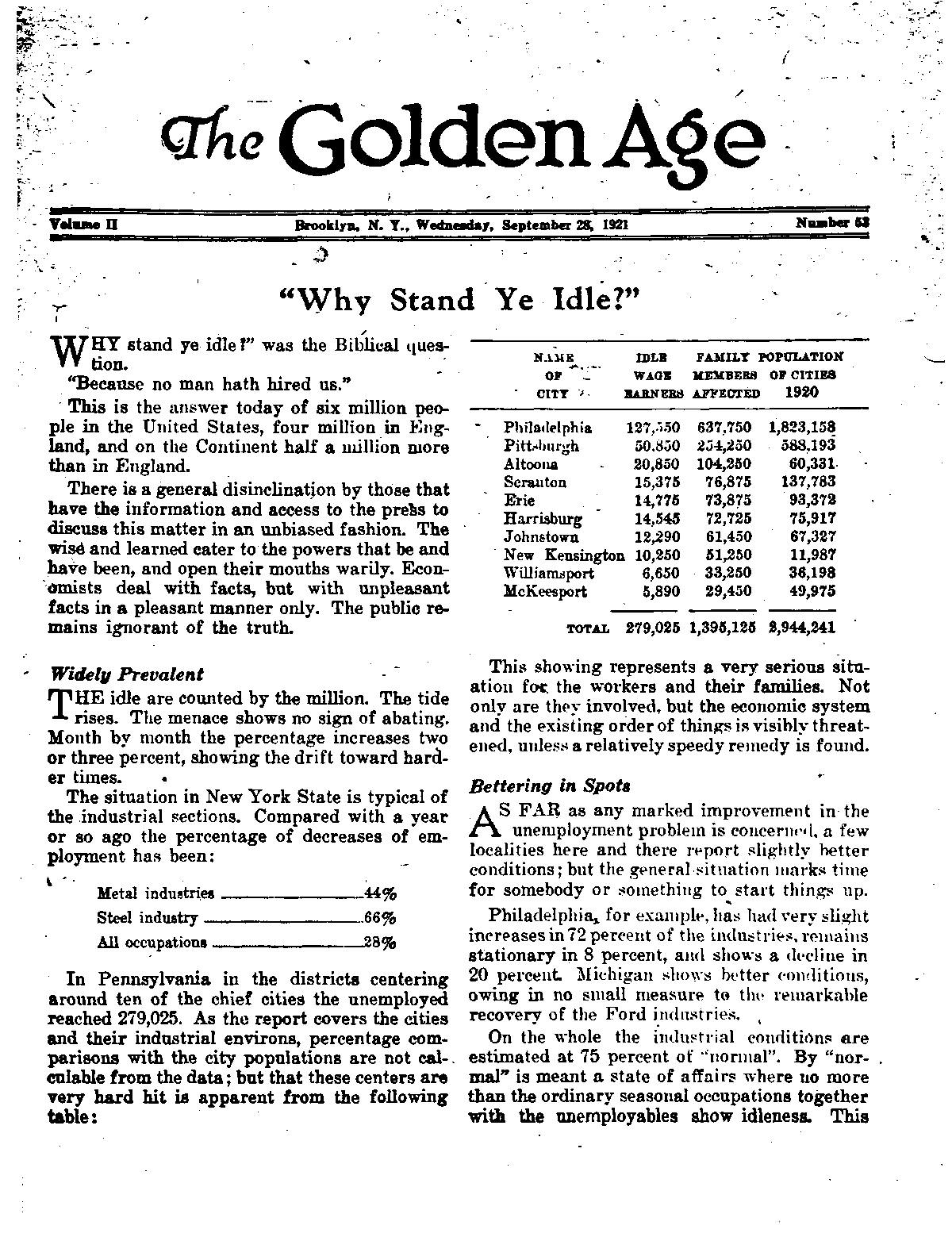
In Pennsylvania in the districts centering around ten of the chief cities the unemployed reached 279,025. As the report covers the cities and their industrial environs, percentage comparisons with the city populations are not cal-, culable from the data; but that these centers are very hard hit is apparent from the following table:
NAMK
OF _ ‘ CITT ''
IDLE
WAGE KARN EBB
FAMILY POPULATION
MEMBERS AFFECTED
OF CITIES 1920
* Philadelphia
127,550
637,750
1,823,158
Pittsburgh
50.850
254,250
588.193 .
Altoona -
20,850
104,250
60,331
Scrauton
15,375
76,875
137,783
Brie .
14,775
73,875
93,372
Harrisburg
14,545
72,725
75,917
Johnstown
12,290
61,450
67,327
New Kensington 10,250
51,250
11,987
Williamsport
6,650
33,250
36,198
McKeesport
5,890
29,450
49,975
TOTAL
279,025
1,395,125
2,944,241
This showing represents a very serious situation foe the workers and their families. Not only are they involved, but the economic system and the existing order of things is visibly threatened, unless a relatively speedy remedy is found.
Bettering in Spots
AS FAR as any marked improvement in the . unemployment problem is concerned, a few localities here and there report slightly better conditions; but the general situation marks time for somebody or something to start things up.
Philadelphia* for example, has had very slight increases in 72 percent of the industries, remains stationary in 8 percent, and shows a decline in 20 percent Michigan shows better conditions, owing in no small measure to the remarkable recovery of the Ford industries. (
On the whole the industrial conditions are estimated at 75 percent of “normal”. By “normal” is meant a state of affairs where no more than the ordinary seasonal occupations together with the unemployables show idleness. This
signifies between one and two million chronically out of work, according to the season. For example, house plasterers are idle "normally” most of the cold weather. .
A genuine “normalcy” for humanity would be a condition where a hundred percent of the people able to work were at work. Such a state prevails only during war, when measures are taken to keep production up which would be considered'improper in the piping times of peace.
Like a silver lining to the doud comes the news that in some whole nations idleness is distinctly on the decrease. In Great Britain the winding up of the coal strike put many back at work, whose idleness marked the peak of unemployment. In France there are less than a quarter of the unemployed of the early part of the year. Germany sees the people getting back to work. In one German city the number of idle fell off 40,000 in one month. Possneck, in Thuringia, enjoys the distinction of not having a single idle person in the big boom of the textile and building industries. Europe as a whole has had as many as 15,000,000 out of work, but the figure has fallen to some 4,300,000.
, The forcing of the wage decline upon the workers produces abnormalities in the seasonal occupations. The lathers in Detroit—artisans who nail laths in new buildings—should be busy doing some of the 160 days a year that they ordinarily are able to work, but have been tocked out by their employers, to enforce a twenty percent wage cut. Lathers “normally” see a great deal of enforced idleness without being kept from work by employers — in the first three months of the year they average 28 days work, 40 days the second, and 60 the third and 33 the fourth quarter. All workers have to eat and pay rent the year round, and it would seem that an unusually high day or hour rate is only fair to seasonal workers. The wage for the 'working period of the year ought to be enough to give a living for the entire year.
Idlers of Distinction
THE army of the idle is not like that of the prosperous season. It has been a surprise to retail merchants how well the monthly bills have been paid even by those out of work. The out-of works are not bums or hoboes, but people who during the good times of recent years saved money for the rainy day, which is now upon
them. The common people did not squander their earnings, as charged by irresponsible writers. '
Not' merely artisans and laborers make up the army 6,000,000 strong that looks vainly for work. All clashes, to the highest paid, suffer from the shortage of work. A hard time is experienced by the white-collar brigade. High salaried specialists, executives and office assistants are walking the streets, sitting in the parks, staying at home, or taking their “vacation” in other ways. One college professor took a job without remuneration to stay all summer on an island for a wealthy friend of birds, who wanted some one around to look after his feathered friends. Over 1,600 applied for this work. Hard times are not respecters of persons.
In the common eye everyone who is walking •about the country is a “tramp”. At River Rouge, Michigan, a scared "tramp" saved the big Ford blast furnaces from the harm that might have come from fifteen or more pounds of dynamite. The wanderer was trying to get to sleep in a railroad yard near the plant, was disturbed by a band of men discussing the proposed outrage, and fled for his life to the police station. The ordinary type of vagrant would have taken wings to get away from the officers of the law.
Distress Among Women ' -
ISTRESS has been evident among college girls and other young women, such as teachers, whose vocation is seasonal, and puts them in the idle column during the warm months. Thousands of this clas§ have applied for temporary work in vain; and many, from lack of the usual summer earnings, are obliged to give up the coveted next year at college or school and its privileges. of self-sacrifice and privation for the sake of better education: More than ever efficiency is the rule in business houses; and budgets are cut to the bone, to the elimination of the substitute workers, and incidentally to the dashing of the hopes of the best class of students in the country.
On the other hand it is asserted by President H. B. Smith of the National Employment Board, that women are holding their jobs, while men are being forced out to walk the streets. “In the labor market,” says Mr. Smith, “the most efficient workers are keeping their positions and others are going out. Women are holding on
■ and men are going. There are jobs for $25 a -* week in offices for women, but scarcely any demand for m^n in the same positions. Probably * sixty percent of office workers now are women, and the percentage is increasing.”
. As a rule the state of the Unemployed woman xis more serious than tMat of the man. This is ' especially true in countries where there'is a ■' small allowance paid by the government to the ' unemployed as unemployment/ insurance. In ,■ ^England this is called the "dole”. ' .
'>■ The British dole was recently reduced. The women unemployed 'were greatly concerned when their dole was reduced. A resolution by the Women's Section ot’ the National Union of General Workers made this protest:
“Many single women with 110 home are without any means ox existence whatever, and a large number willing to take domestic service cannot be found work in this direction; therefore, it is the duty of the State to maintain them until work is found. Also the present rate for men with a family is slow starvation, and demands a substantial increase.”
The obtaining of the powers connected with the franchise has caused a definite policy to -• crystallize among the women in matters affecting their home and personal affairs., The British women bitterly condemn the policies of the men in control of the government, who had not scrupled to plunge the country into the horrors - of war. At the Congress of the Women’s Cooperative Guild in Manchester the assembled women bitt: 1 ly sb s iar.-d that “it was cheek on the part of the government to spend millions on war, and then declare that it had not the money to^et people doing profitable work. The government's international policy of wholesale murder was denying the necessities of life to innocent women and children.”
The sentiment of the British women in some instances takes a markedly radicaT aspect. At the convention mentioned Mrs. Bell of Carlisle “appealed to the workers to band themselves together and sweep aside all those who made war in their own interests”.
Some of the women are being driven or led into a distinctly revolutionary attitude. Said Mrs. James, an example of this class:
“I come from South Wales, which is considered to be red hot revolutionary. We are all revolutionists, because we revolt against the conditions that this government £in America the term “administration” would be used] ja putting upon us as workers.” _
Utterances like these are significant, not because they represent the actual sentiments of any large percentage of the people, but because any higher wave of hard times might increase the number of the aggrieved, and suddenly start something. It was the starving women, not realizing what they did, that inaugurated the French Revolution. When women feel as Mrs. James does, it would be a wise thing for the men of wealth and' power, as speedily as they can, to try to make times better, to ameliorate the condition of those in distress, and to make the common people-feel that they are friends. Such a course would undoubtedly save the civilized world, not merely much distress of mind, but much of the actual trouble in which it finds itself now, with worse things threatening.
American Women Suffering -
IN AMERICA, too, the women are suffering.
. Bridgeport, Connecticut, beheld the tragic sight of women with babies in their arms, joining in a parade of thousands of unemployed and hungry men.
New York has tens of thousands of women— a voiceless class in the social body—who are silently enduring the pangs of hunger, while vainly seeking work or sitting in lonely rooms.
Pretty Eleia Nico came to America to make her fortune, and tried hard to find the work that might start the fortune; finally she gave up, and jumped into the river.
The theatre business in New York is in such a state that over 3,000 chorus girls are in a desperate plight. They cannot get work either on the stage or in the occupations open to most working girls.
“Serves them right,” says the rural purist or preacher. "They oughtn’t to be chorus girls.”
But if a good heart counts, many- of these young women are better than some 'of the "good” sisters that swell church memberships.
The chorus girls that have work are helping their less fortunate companions. They have organized the Chorus Girl’s Relief League, with a kind and generous attitude toward the poorer ones. This is expressed in declarations of principles which are worthy of imitation by certain charity organizations which in. their effort to make sure a beneficiary of their funds is "good” or “worthy” rob the poor of self-respect, before they open the purse strings.
"There’s going to be no red tape, and no humiliation far any girl who has to apply to the organisation for relief,” says the leader of the chorus girls. "All she will have to do will be to give her last engagement and show her need. Her statements will be quickly verified, and enough money will be provided to get her on her feet again. There is nothing in any existing organization which will do this for needy chorus girls. We are not affiliated with any organization. We are just chorus girls who sympathize with our jobless sisters of the chorus; and we will help them, with the generous as* ■istance of the New York managers.”
Words like these are not like those of the professional eharity worker. They have the right ring. Many a girl of the chorus is nearer to the spirit of the Master than some in the churches that make great professions of Christianity.
- X
Palliatives in America .
TT TAKES a few months for a worker out of * employment to exhaust savings, store credit, and loans from friends. Until this process has been gone through by a great number, the unemployment situation could not become acute or reach a dangerous stage.
In Philadelphia, however, the charity and welfare organisations are far behind on the funds requisite to cope with the needs of the people that have been many months without work. Additional money cannot be raised by private arrangements. The statesmen of the City of Brotherly Love are audibly talking about some scientific solution of the problem of unemployment. But they are face to face with a vast economic condition. The problem seems insoluble under the existing economic system. Action is likely to be long delayed that will answer the riddle of how to give men work when there is a diminishing market for products and little immediate prospects of profits for the capital involved. The fear appears on all sides that-action may first be attempted by the hosts of the idle—action which it is hard to see could be beneficial, in the delicately adjusted social and economic structure of the day.
In New York the Timely Service Society proposes to purchase tracts of land near the metropolis for the establishment of industrial colonies. To these tracts the idle are to be invited, and find friends, real homes and a job that will make them self-supporting and self-respecting members of the social system. No explanation is offered as to how the Society proposes to evade the action of economic law, and provide a market for its products when others cannot sell theirs, nor how the funds are to be secured for the plants-and equipments of the industries.
Samuel Gompers advances the ancient suggestion that a general’ policy be adopted of pushing public works to completion whenever there are hard times, and in seasons when there . are always many out of work who are engaged in the seasonal occupations. "This plan sounds, good: but it depends on raising the money for' the public works by the sale of bonds or by added taxation, in either instance by payments made by the people at work now or hereafter. The taxpayers would surely have something to say about this proposal if it ever came up for serious consideration. .
Labor circles have their suggestions for putting unemployed men to work. In New York City, where there are 550,000 idle, the Central Trades and-Labor Council seeks to cooperate with the Merchants’ Association and the social service agencies. The business men are alarmed at the diminishing amount of money in circulation; for the workers are getting less wages and have less to spend at the stores. The latter are much Concerned at their vanishing business.
The old proposal is revived to' organize a program for the forwarding of public works, which ordinarilywould have to wait till the politicians got things all fixed for a worth-while melon cutting, a process taking time and patient preparation. Schools are urged, to cost $52,-•XX),000, which would make up a little for the hitherto obstructions placed in the way of an efficient public school syste’m.
One delegate of the Electrical Workers gave way to expressions which perhaps he would not make on second thought—that he would advise his men this winter, if acute distress should develop, to enter the stores and help themselves to what they wanted. He did not explain how sueh a manifestation of the spirit of violence would help in the restoration of the confidence required to bring back business and employment for the out-of-works, nor how it would encourage the grocers, who in 1920 made 8.2 percent profit on their net sales, to stand the losses from mobs and keep their stores open for further losses.
Continental Unemployment Insurance
OVERNMENT systems of state insurance for unemployment are in existence in Great ■ Britaih and Ireland, Austria, Italy and Czechoslovakia.
Belgium, Holland, and Denmark give subsidies to trades unions.
Switzerland levies upon employers, as do the Swiss cantons, to provide something collectively for the idle.
Germany gives the unemployed donations determined in different localities according to the cost of living, and adds an allowance for a wife and for each child under sixteen.
The amount of the public aid per week is usually small. In England it averages $2.30; in Germany it is from 12.4 to 4.96" cents; in Austria from 90 kronen up—the Austrian crown has an almost non-existent value; in Switzerland from thirty francs—$4.92—down; Belgium pays not over $2.20 a week; in Holland the unfortunate victim of hard times got before the war not over $7.38 a week; now there is no uniformity about the amount, except that it is • very small. Viewing all the countries having state unemployment systems, it is obvious that everywhere the idle get only about enough to starve on comfortably—not so much as to make idleness at tractive.nor so little as to make them dangerous. It is reported, however, that in all these countries the profiteers are getting along very well, and not giving up any more for the good of the poor than the law requires.
Sweden has much unemployment; and the - lower house of the Storthing has taken the bull by the horns, and placed the cost of unemployment benefits and of.the war itself squarely where it belongs — upon the shoulders of the profiteers who propaganded the world into war, and who everywhere, including the United States, are now seeking, not bnly to keep their war stealings, but to shove the war costs upon the poor by such devices as sales taxes.
The Swedish House passed a bill providing-for taxation of fortunes on the following basis: Fortunes exceeding 500,000 kroner ($102,000) to pay 1,800 kroner ($574); fortunes of 10,000,-000 kroner ($2,050,000) to pay 140,000 kroner ($28,700); fortunes of 20,000,000 kroner (4,100,-000) to pay 350,000 kroner($41,750). Sweden was not in the war, but had both heavy costs from the mobilized army and enormous profits from
trade with Germany. The proposed-tax is a progressive tax on capital of respectively 0.36 percent, 1.4 percent, and 1.75 percent—a very light tax indeed, but estimated as adequate to liquidate the Swedish war debt, and provide for the needs of the unemployed. Such a tax might set an undesired precedent fpr other nations, and Big Business the world over will rally to help their Swedish brethren to defeat this pro- -position. - .
The British “Dole**
THE British Unemployment Insurance law, as recently revised, prorides that weekly doles shall be paid the unemployed, as follows:
15 shillings—$2.70—to men.
12 shillings—$2.16—to women.
71 shillings—$1.35—to boys.
6 shillings—$1.08—to girls.
How would you, Mr. Head-of-a-Family, like to keep your family on $2.70 a week! How can a girl honorably keep herself alive on $1.08 a week! This is the practical problem the British out-of-works are facing by the million.
Those that are at work have been required for many years to pay weekly for part of the cost of the doles for the idle, the employers also paying a share, and the government making up the remainder by taxes or “rates”, as follows:
KIND OF PAID BY PAID BY
WORKER WORKER EMPLOYER
Men 7 d (li».)c)8 d (12
Women___6 d ( 9 c)7 d (10
Bov 31d ( 5 c)4 d ( 6
Girl 3 d ( 4fc)3|d ( 5
Up to a few months ago, somewhat larger sums had been paid both by workers and employers to provide the doles; and workers who had paid such larger sums as unemployment insurance, now that the dole has been reduced, feel that they have been dealt with treacherously by the Lloyd George administration, when it reduced the dole to less than what they had paid for.
The British dole reduction of 25 percent took place because the British profiteers who paid the taxes began to find themselves pinched to pay several million dollars a week. Pressure was brought by others who had not profited by the war but who have to pay the rate — the landed gentry and small fry; and the Lloyd George administration took the opportunist line of least immediate resistance, and cut down the allowance for the poor.
" The dole was not merely f-educed, but made more difficult to obtain. Formerly, if the worker was unemployed for three consecutive days he was qualified to apply for his dole. Now he must be idle for six consecutive days, which cuts out a very large proportion from the dole. This, the worker complains, works badly for him. It often happens that there is work for a day or half day. If he works, he loses the dole; if he’ refrains from working, he permanently loses his standing with his employer and his chance of getting future work. “I think the administration," says Chief Insurance Secretary Fred Potter, "has been guilty of a gross breach of faith.” “There is a very bitter feeling among the dockers,” comments District Secretary Thompson, of one of the great unions.
Women are hard hit by the dole revision. The regulations now exclude from the doles any married woman residing with her husband, unless she has been engaged in a “staple” industry. As there are thousands of women of this class, and as they have to live the same as others, protest has been made by official representatives of the Women’s Workers’ Section of the National Union of General Workers, and the government agreed so to revise the interpretation of the rules as to provide doles for all women single or married suffering from unemployment. The administration gave in to this request, because in England the control of government and of industry is less exclusively in the hands of the wealthy, and British administra-. tion has to have an open ear for protests and requests from representatives of labor, for fear of being turned out of office.
Open Protests by Labor
RITISH labor has not taken kindly to the dole reduction. Newspaper headlines run:
New Robbery of the Unemployed. Sinister Proposals.
Advisory Committees Insulted. Fifteen Bob to Starve on. Workers on the Scrap Heap. The Worker Always Pays. A Vile Proposal.
Plan for Hitting a Man When Down. Bill to Starve the Poor.
Unjust Working of Nev Insurance Act.
And so on. It is with such suggestions that the mind of British labor is being filled, and the suggestions of unjust and cruel treatment fall into ready soil. •
Little wonder that the Coalition Government — about the only national administration still holding over from war days — holds oh like grim death, to stave off defeat in some measure in Parliament, and a fresh election of Parliament. British labor, even now preparing for the inevitable election, says that it is coming in the immediate future, and that when it comes the Labor Party will sweep the country, and that England will then see st Labor Prime Minister, a Labor Cabinet, and a Lalx>r Parliament —and, with this, the downfall from power of the factors that brought on war and trouble, comprising that unholy accord of British financiers, politicians, and apostate clergy. Labor believes that the inauguration of an administration of, by, and for the common people will advance Britisl^freedom to a higher plane than ever before. “Magna Charts will conquer again,” is the theme of the British worker, as he grooms the candidates for their offices.
Attitude of Labor Press
RITISH labor journals are outspoken in condemnation of the' diminution of the dole, as a further act of aggression against the workers, in the campaign of the employers to reduce the wage and the spirit of lal>or. Voicing, as it understands it, the feeling of the people the London Dally Herald says editorially:
"Violent unrest in any community almost always springs from one thing — hunger.
“The real promoters of violence are not the propagandists prosecuted by Sir Basil Thompson, but the men who, in the secret, sinister places of politics and finance, plot to make men, women and children go hungry.
“We deplore and condoinn violence. We hope it may never break out in this country. But if it ever does, let there be no mistake about whose is the fault.
“For many months the Coalition Government, at the bidding of, and in collusion with, the representatives of aggressive financiers, has planned starvation for the workers. Today it proposes to carry the plan a step further.
“The out-of-work dole is miserably inadequate. It is «»mi-starvation for those who, through no fault of their own, have to depend upon it, So th* administration proposes to reduce it. ------
"Why? Because the fund from which it u paid is exhausted. Why? Because the number of the employed goes down and down, and the number of the unemployed up and up. And why that? First and last and all the time because of the policy of the Coalition Government.
• • •
“The coal lockout, which has inflicted incalculable loss ■ on the nation goes on. [This was during the strike] Why? Because our financiers think it economical to try to make the miners work for less than a living wage.. And, largely in consequence of this, the great textile ^industries are following the same fatal lockout policy. In 1 wool, for instance, orders are conitnsr in; and the coal stoppage, we are told, makes it impossible to meet them. And so the vicious circle of unemployment spins ever faster.
“The central truth of the matter is this: That the worst extravagance of all is lettiug people starve. That is what the nation cannot afford. Aa long as there is a rich class of the community, it is an insult to God and man for anyone to talk of its being 'necessary* for some to sink into semi-starvation.
"The financiers, aiming at false economy, are the worst extravagance, and waste all our substance. And the people suffer.” Pathos of Poverty
MANY are the stories that might be related of the pathetic and tragic occurrences of this greatest known period of unemployment, but we will confine ourselves to one, from the Daily Herald. Reader, put yourself for the moment in the place of these men:
“ Death from natural causes,’ was the coroner’s verdict on one of the idle who fell dead when told that there was no money for him.
“The story of William Beadle is typical of thousands.
-“When he was told there was no money for him, he fell dead. This was the simple and tragic tale of William Beadle. Ho was a warehouseman, 56 years of age. ‘Such a good hubby.’ his wife said, ‘and willing to work, if he could have found it.’
“For weeks he had been out of work; and on Friday, with hundreds of others, he took his place in the'long queue outside the Labor Exchange, and commenced the weary wait for the miserable sum that stood between him and actual starvation.
“An hoqr and a half he stood in the street, and saw four of his wretched fellow-sufferers collapse.
“Then when he reached the desk, the clerk said to him, ‘There is no money for you. We will write to you.’
“ ‘Oh 1* exclaimed Beadle, and fell back dead.
“ Tfs a long time, sir, to stand in a queue, as so many have to do,’ a man who was next to Beadle told the court.
“ ‘Only this morning I myself saw four men collapse in the queue, and I was informed by those who had been there longer than myself that in all some ten men fell to the ground in an exhausted end fainting oon-drtion throu0h the long wait.’
“ ‘The circumstances connected with the man’s death,’ said the Coroner, ‘give a very sad and tragic touch to the case. It is the outcome of the prevailing distress, and we can only hope that things , will very soon improve.’
"And thus closes the life of • willing worker, a good hubby, and an Englishman.”
Threadneedle Street—the British Wall Street —plans the profits, and muddles through the peace; but the man that pays is the starving worker. British financiers grumble at the dole and reduce it all they dare. “Woe to.you! for ye lade men. with burdens grievous to be borne, and ye yourselves touch not the burdens with one of your fingers!”—Luke 11:46.
Demonstrations by the Idle
TVf ANY demonstrations of the unemployed have been made. Three thousand hungry people marched upon the British Ministry of Transportation, and their spokesman, A. Scott, told how the idle felt about the abandonment of the road projects upon which they had been working:
“The temper of the people locally on the question can be gauged by the fact that three thousand have come with us. Many of the men who have marehed here have served their country and are prepared to work. They feel very keenly on the point. More people would have been with us, but it was impossible, because of their boots. You people do not realize the position of the poor. Men are not going to let everybody tread on them whilq animals are well fed.”
' “Sir Henry Maybury”—so reads the report— “promised to bring the matter before the Minister’s notice.” Nothing resulted. What can a Minister of Transportation do in the face of a world-wide economic crisis!
Brighton is a famous English seaside resort. There the wealthy congregate to enjoy the cool breezes from the sea. Several hundred workless men inarched from London to Brighton with an appropriate banner, and selling their own journal on the way. Only men wore picked who would have the endurance to walk the round trip.
Welch miners appeared in busy Fleet Street, London, and sang the harmonious songs of Wales, while collectors raised money for the local distress fund of the Bhondda Valley. Said the leader, W. D. Cadogan:
“We are not here for our personal benefit. A picture of miser}- has brought us from our valley—a picture of starving women and children fining up in queues for food, while their men are fighting for their rights.” [This was during the coal strike]
“In our valley,” continued Mr. Cadogan, “the little children are rushing to school, not because they want to be taught, but because of the meals that are provided in the schoolhouse. ,
“So we have come from the valley at our own expense. Our singers are working on reduced rations, so that we can send ample funds home. If the miners and their families are not assisted in their resistance to the attempt to enforce a lower standard of life, every industrial worker will have to submit to starvation wages.”
The Amsterdam, Holland, unemployed carried banners proclaiming that the state and city must support them. They consider that, as the controlling power of the modern industrial state is the money power, and this power operating in various countries, brought on the great war and its attendant miseries, and now having forced the hard times upon the common people, it is but reasonable that those who are responsible, and who have profited, should support the unfortunate victims of their fatuous policies. They consider that in some respects the owned slave was better off than the industrial worker is now—the “wage slave”, they call him—for the employer but lets him die of starvation, while the slave had to be fed. Ideas of this kind are spreading like wildfire.
On the Halifax, Nova Scotia, Common the unemployed numbering hundreds gathered, and passed resolutions demanding that the city give them either work or the necessities of existence. Speakers of their own number counseled the importance of themselves maintaining law and order, in order to avoid rousing the mob violence of plug-hat anarchists, or hostile action by the authorities. They said that it seemed a reasonable proposition, since all persons in a social organism are dependent on one another, literally members one of another, that when some of the Ihembers are in a serious plight, the others . should assist them,* and that a liberal policy by the municipality was right, if only for expediency.
In America the demonstrations of the unemployed are largely kept out of the press, but are occasionally heard of or pass from person to person. Here the workless are less fortunate than their British brethren in opportunity to present their cases visibly to the public. Thousands are starving in Bridgeport, Connecticut; but after a permit had been granted for a great - parade, it was revoked by the authorities, on the pretense of “the crowded condition of Alain Street”—which, however, is not too crowded to permit a circus parade.
According to the press, many hunger-pinched veterans of the World War had hoped to participate in the demonstration. Said one: “You’re a hero when you go away, and a bum when you get back”. Said a friend of the people: “There are men here who helped whip the Germans; and now they are practically starving, because the town takes no interest in them and employers refuse to hire them”. An official of the Manufacturers’ Association said they were planning to distribute $300,000 among the workless. Not the manufacturers, but the people were to pay the money; for it was to take the form’ of a bond issue for public works, on which the bankers would receive a commission, the investors interest, all to be paid in due time by the people. According to the New York Times hundreds of the idle, including many ex-soldiers fairly stormed the Bridgeport Welfare Building, demanding the city jobs, not knowing that the bonds were not out yet nor the money raised. Thousands are expected to apply for the work, the wage on which will be the low wage of 25 or 30 cents an hour for common labor.
So many ex-soldiers are among the workless that it has provoked comparison with hard times in ancient days. Two thousand years ago not a few of the unemployed of the day were men who had cut their way to victory the world over for the eagles of Rome, and for the Roman profiteers. To these ex-service men there was made an address by Tiberius Gracchus^ couched in strangely modern terms:
‘The wild beasts of Italy have their caves to retire to, but the brave men who spill their blood in her cause h»ve nothing left but air and light. Without houses, without any settled habitations, they wander from place to place with their wives and children; and the generals do but mock them; while at the head of their armies they exhort their men to fight for their sepulchres and domestic gods. The private soldiers fight and die, to advance the wealth and luxury of the great; and they are called masters of the world, while they have not a foot of ground in their possession.”
There being nothing actionable about Grac-
Chas’ words, he was not sent to the Federal Penitentiary. Shortly the Roman profiteers had him assassinated. These were the conditions that brought an end to the Roman Empire. The striking thing is that today the same conditions exist as two thousand years ago, and the words of a Roman orator sound as if spoken today.
World- Wide Condition
THE serious social condition due to unemployment is world-wide. In Germany thousands of idle workers raided the Labor Unions Assembly, demanding that everyone who had work should give his job to the unemployed. Those at work, however, were unable to see it that way; and a riot ensued. Hundreds of police “pacified” the fighters, who had wrecked the interior of the building. Evidently it is not a practicable way of settling the unemployment problem to ask those that have — even if what they have is only a job—to give up to the have-nots.
Ireland has. over 100,000 out-of-works, and there is much distress among the poor, due in . no small measure to the disturbed military conditions.
Cuba adds her quota to the plight of the desperate idle:
“The situation throughout the island,” says a prominent sugar importer, “unquestionably is desperate. The country people are in dire need of employment. All work has been stopped on sugar estates because of lack of funds. In many places the former workers on these estates are wandering about the country in swarms, begging for food. Spanish laborers are leaving for Spain. Large numb- rs of Jamaican and Haitian negroes, who were brought to the island, now are destitute. The Haitians in particular are in a most deplorable condition. Conditions are such in Cuba that the clement of time becomes a most important factor. A starving man peeds food now, not the promise of it three months later. Anti-American demonstrations are of frequent occurrence. There is a strong feeling against the gov-. ernment.”
There was plenty of work in Cuba during the war and afterwards during the riot of sugar profiteering, but the collapse of the sugar prices ruined many New York sugar speculators and Cuban planters, and high prices took fully half the per capita money away from the native population and landed it in the New York banks. There is a dislocation of the delicately adjusted economic mechanism in Cuba which is the despair of the authorities. -____
Pressure upon Governments
THE unholy accord of ambitious financiers, -*■ politicians, and ecclesiastics is not • a little disturbed over the manifest fundamental weakness of their, machine, as displayed in the mounting mass of unemployment.
British politicians feel the pressure and'with characteristic caution and opportunism yield to it. A well-known London social worker, Geoffrey Drage, puts it:
‘‘Parliament is under popular terror and cannot vota against any of these doles, while the various departments have shown themselves equally easy”.
There is fear in England on account of the 28,000,000 receiving state aid. In Parliament J. R. Clynes warns the administration against presuming too far on the patience of the poor:
“The Ministers have concluded that those who have endured so much ran endure more and longer. Let any honorable gentleman put himself in the place of the head of a working-class family, when all the savings are exhausted, all the borrowings spent, the furniture is* in the pawnshop, only one pound ($3.60) a week te keep the family, and that reduced to 15 shillings ($2.70).”
There is a popular opinion that the attitude of British politicians is not for the people. This was expressed in Parliament by J. Cairns:
“This House is not the place to come to for good thinking. It is no place to get good feeling. I would get better conditions from the coal owners. There is a prejudice against the workers in this House.”
If Mr. Cairn’s statement is true, it is both unfortunate and serious that, at a time when the utmost good feeling and the general application of the golden rule are necessary to solve world problems irresistibly forcing themselves forward for solution, the common people, of whom he is one, should so lack confidence in the men in charge of the state.
In England when a bill in Parliament which is backed by the Prime Minister is defeated the Ministry resigns and an election of members of Parliament is held, to secure a new administration representing the view of the people. The expectation of the early replacement of the present Lloyd-George administration—or “Government” as the British term it—was reflected in a report by the Parliamentary correspondent of a London newspaper in a description of a speech against too liberal doles for the out-of-works :
“Dr. Macnamara’i rosy head rolling on his shoulder^ and his right hand jiggling in the air. are the central objects of last week's Parliamentary, debates. He gesticulated better than he knew. He spoke for a shaking and rolling Government, Mid his every utterance made it ■hake more and roll a little nearer the electoral abyss."
In the opinion of many of the well-posted, an election of Parliament any time in the near future signifies the end of control by the unholy accord and the taking up of the reins by the British Labor Party — for good or for ill.
Not even the sacred person of the British ■ King is immune in the strife of words over the idleness of millions. The recent visit of the King and the Queen to an important labor celebration at Glasgow “was repeatedly interrupted by men in the audience who heckled the royal pair,, shouting questions as to what was being done to solve the problem of unemployment. . . . After a first attempt to suppress the news, the newspapers came out with an account trying to minimize the event. Some say that the 'more conservative members of the union’ drowned the hecklers out by singing, ‘For He’s a Jolly Good Fellow’. Others state that the hecklers were actually ejected.” Imagine the brutal acts of the police in America under like circumstances! Heckling a speaker is more the regular thing in England than in America—but to heckle the King! In days of falling czars and kaisers, “uneasy lies the head that wears a crown".
In Newfoundland, according to reports received, there exists the same pressure on the government which has appeared in England. According to press reports which did not find very wide circulation in the United States:
“Twice within a few weeks unemployed workers, clamoring for bread, have' forced the adjournment of the legislative assembly of Newfoundland, and twice they have appeared at the bar of the house demanding consideration of their claims for relief. A more desperate condition never existed in the province which two years ago was rolling in wealth.
"Several days ago a crowd of unemployed threatened forcibly to close both the legislative chambers and the city hall and to help themselves to food from stores in the business section, but the authorities hope to be able to avert this extreme step. - ' •
“The situation, however, seriously disturbs the government, and business men. Demands are coming from all parts of the country that relief be provided in some way for needy fishermen in hundreds of coast villages. The government says ita difficulties are increased by reason of its inability to secure loans.”
In the United States it is said that the ominous growth of unemployment was one of the subjects prominently discussed in the conference between President Harding, J. P. Morgan, E. M. Sabi : and other' representatives of Big Business, who got together quietly at the White. House one summer night. Anxiety is manifest . in many quarters where but a few months back the comfortable profits of war and peace had imparted a sense of solid complacency. Big Business begins to read something like a handwriting on the wall, and to see that their fight» to “liquidate” labor and make the workers “eat out of their hand’’-has precipitated what may prove,to become a life-and-death political conflict for the control of the affairs of the country. It is much easier to act in a high-handed, inconsiderate and unjust manner toward the common people, than to settle at will the storm of ill feeling engendered.
Workers Seem Determined
O JUDGE by the organs of the organized workers some of the men, or at least some of their leaders, are determined to bring about social and economic changes as soon as possible, as the only way for the workers to emerge from the morass. A considerable- spread of radicalism is in evidence. Intimations of-radicalism, however, when searched into, have usually been found to be baseless, the workers being chiefly interested in getting a living for themselves and their families, and only the small proportion of five percent or so are out-and-out radicals.
Sometimes a situation of but slight importance changes on a sudden provocation to one of great imminent portent. Perhaps the dole question in England may have some influence in that direction. .
In the British Parliament J. R. Clynes outlined the seriousness of the situation, as he saw-it, in these terms: -
“The threat to reduce the dole from one pound to fifteen sliillinirs is a threat that counts too much unon submission on the part of those who will suffer from it. This is a dangerous step. The greatest resignation haa been shown, but you can make too great a demand upon the patience of the poor.” .
According to press reports Mr. Clynes repelled spiritedly the suggestion of the employers that unemployment was caused by the dole insurance. '
“ ‘Who would say,’ he said, ‘that fire insurance caused fires? Let those people [Big Business, etc.] have the
courage of their convictions, and s#eep away the whole scheme of unemployment insurance.’What would be the outcome? Riot, robbery and plunder. People would break the law, because the need of subsistence would compel them/ He closed with a pathetic appeal: If you have the choice between running somewhat into debt and letting people die of starvation, our appeal fa: Do not let people die! Many thousands are near starvation!**’
If Mr. Clynes is right, all that stands between the present British administration and national 'T~ disaster is the thin line of the meager dole.
Big Business in England received a severe jolt when Farrow’s Bank failed, causing anxiety and possible loss to thousands of the people. The fall of this bank and that of the Lloyd George administration were linked together in Parliament by Colonel Wedgewood, who said that "Farrow’s Bank and the Government are going down together".
The unfavorable effect on the minds of the workers, employed and unemployed, who under British law have had to contribute out of their earnings toward the unemployment insurance, was suggested by G. A. Spencer, M. P.:
"During the war large contributions were paid into the Exchequer from excess profits. If industry- thus contributed to the State in its prosperous day, it had the right to claim help in its day of adversity, and to ask for a little of the revenue it had provided.”
"You are making Bolshevists by the thousands through these actions,” declared M?mber-af-Parliament Jack Jones. “How would you like to take out an insurance policy, pay your contributions, and then after a few years, find out that it was not worth what you had understood it was? The workers are finding out [by the dole reduction from what had been agreed on] that they were not getting what they’ve paid for and some are questioning if they will ever get anything at all.”
Vote Themselves into Power
THE terrible experiences of many of the common people of England during the present hard times has bred in not a few of them the determination to vote the administration of the British Government into their own hands, immediately on some failure of the Lloyd George Government to receive Parliamentary support Commenting on this editorially, the Daily Herald, the leading mouthpiece of the working people, says:
"We are all for production, but not for more production for the benefit of the financiers. At this moment there are masses of work people, whose labor could be
utilized for the building of houses for the growing of food, for the making of clothes, and the manufacture of furniture—indeed for the supply of all our needs. They are not allowed to work, because were they to do so, the markets would be flooded, and because their labor is organized under commercialism only for the service of the financiers and landlords. .
“There is but one remedy for all this, and that is clear thinking an the part of the workers. They must organize for the overthrow of the present social order. They must be united, industrially and politically, but they must be united on a class basis, an a basis which will make them understand that they aa a working class, are diametrically opposed to the possessing claaaes, who hold not only the reins of Government, but also the lives of the workers in their hands. We must not only change our masters. We must get rid of the whole mastership [the unholy accord of Big Business, politicians, and ecclesiastics] as it exists today. We must get control of our lives in such a way as will enable our labor to be used for the service of the nation aa a whole.”
Evidently the feeling is being rapidly spread in the existing emergency among the British workers, that the only way to mend things is to vote themselves into power. Their intentions are plainly of the best, but once in power they would find a situation of unparalleled difficulty and of economic, social, and international danger, from the reactionary group (their propaganda rendered aD the more determined by failure), from the differences within their own ranks on the proper methods, and from the* violent economic and perhaps military hostility of other governments, as well as from their own inexperience in steering a ship of state on the uncharted sea of human progress and failure. At present the appearances are that Lloyd George’s failure under existing conditions might deliver the administration into the hands of the Labor Party for them to try to do the best they are able to do with it
Possible Dangers
UNGRY men are obedient men,” is reported as the dictum of a prominent American financier. With this a British editorial writer differs sharply and indicates the danger of forcing men toward the hunger line:
“Hungry men are dangerous man, and if neither the administration nor local authorities will supply ths means of life to those in need, if is certain that the needy ones will take what they want and chance the consequences. Revolution and bloodshed are always pre-
ceded by hunger, and the reason England has escaped the horrors of bloody revolution <up to the present is simply because means have been found at least to keep the population alive.
“The administration is playing with fire in its proposal to reduce the unemployed below subsistence' and it will be the local authorities who will be expected to save the nation from the effects of this criminal action . of the administration [reduction of the dole].
“Thu* means, in effect, that once again the administration is compelling the ^oor to. keep the poor. . . . Careful students of affairs view with some amount of alarm the attention that is being paid to what is called national finance, and the total indifference with which Parliament allows the administration to go on piling up burdens [army, navy, etc.} upon those totally unable to bear them.”
Huge appropriations for war, past and future, are made, many of the people are beginning to think, because the financiers of Paris, Tokio, and New York fear that they may be outdone in trade plans by the financiers of London and Berlin, and vice versa. The journals which represent the people are advancing the idea that these rich men are causing their governments to pile up navies, air fleets, poison gases, submarines and cannon, in order to be in a position to destroy their commercial rivals. In the minds of more and ever more people, there is forming the concept that it is time that the unholy accord of financiers, politicians, and ambitious ecclesiastics be voted out of the control they havC; long exercised over the minds, muscles, and pocketbooks of the people, to their own profit and the people's undoing.
Revolutionary Talk
THERE is not wanting, of course, a scattering of utterances of quite extreme character. Occasional pamphlets appear by~night, advocating violence and destruction, ostensibly issued by Communists or other revolutionaries, but sometimes b aring the earmarks of the private detective agencies—“agents provocateurs” as the French term them—employed by large corporations to elicit radical utterances from mark'd men with the design of snaring them into expressions or acts contrary to law. Sometimes the pamphlets are genuine and evidently proceed from overwrought minds. Such men should give consideration to the question of what actual tangible good it does the workless to have buildings destroyed or men wounded or slain. Every building gone makes the housing situation that much worse; for it has to be replaced to make things equal to what they were before, and injured and dead men by that much reduce the productive possibilities of a people.
Violence profits no one. Far better would it be _ for all to perceive that-in mutual good will and in the practice of the’golden rule by capital and labor lies'the highway to complete recovery from the world’s ruin.
Especially those that havemuehjof education, ' power or means should take the first steps to- ’ ward reconciliation of the conflicting interests. Self-Interest alone would dictate this, for all too clearly the workers are coming to understand certain basic causes back of their wage cuts and the miserable unemployment of millions. In their journals, in their unions, and in their homes they are talking the matter over. They feel that someway they do not have a fair show. They are told that it is because business an<i industry are run not for service but for profits; that prolonged periods of depression are inevitable; that profits are impossible when prices and wages get too high; that depressions enable prices and wages to fall to a point from which another period of satisfactory profits can be made on the rising market of prosperity and general employment.
Quite strong language is employed by some leaders against what they term the “profit system”. For example. James P. Warbusse, President of the Cooperative League of America, puts the mat ter _ thus, as reported in the New York Call-.
“These- children of men must suffer and perish in want because the purpose of industry is to produce profits. an<l because out of this purpose grows privilege, which makes it possible for some to live by the toil of others.
“<>t all the hellish inventions these stand supreme. No fiend in the wildest imagination of superstition ever contrived more diabolic traps for mankind. Behind unemployment, slums, ignorance, filth and poverty, behind the war which hurled twenty millions of men at one another’s throat and divided mankind into hostile camps, ■ behind hell itself, stands leering at humanity the specter of profits and privileged And of all the travesties on earth none is greater than the fact that, behind profits and privileges, holding them up as though they were a sacred icon, stands the whole glorious phalanx of respectable society — the educated, the cultured, and the wealthy.
“The demand that the world be made a better place to live in, that poverty be abolishe'd, and that justice reign—behind this demand are neither the educated, the cultured, the wealthy, nor the state, nor the school, nor the press, nor the pulpit—but the htmble, the'reviled, and the lowly. And it is these, to whom the world must look for redemption, advised and guided rare exceptions from the ranks of the educated, cultured and wealthy, who must suffer the contumely of their class for their allegiance to the poor.”
However, it is well known that a threatened -revolutionary movement amounts to little or ' nothing, until a certain factor manifests itself.
In the attempted Russian revolution of 1905 the movement was quickly quenched, and it was commented by the press that it could not succeed until it had the army on its side. In 1917 the Russian revolutionists accomplished their purpose with almost no difficulty and almost without shedding of blood, because the Russian soldiers took their weapons over to the revolution.
During the British coal strike:
“The failure of the government to distribute promised maintenance allowances for the families of military reservists, who have served now four weeks on strike duty, has spread acute dissatisfaction. Already there have been outbreaks on the part of reservists which required strong measures to quelL Six thousand military reservists have been recalled from Aidershot as the result of riots.”
Items of this kind suggest that some of the soldiers have none too much sympathy for the officials they act for, and that it might require a comparatively insignificant incident to turn them against the established interests. In America the precaution is being pursued of thoroughly searching into the loyalty and Americanism of persons likely to act for the powers that lie.
No person of sense or good will desires things to make progress any further toward such trou-. ble as prevails in some countries, but rather that measures be taken without delay calculated to prove permanently remedial. To bring about a settlement in a manner really for the good of themselves and other members of the social body, the members of the unholy accord now in control — aggressive financiers, unscrupulous politicians, and ambitious clergy—should make a genuinely whole-hearted application of justice, kindness, and brotherliness, as more effective than the rifles, machine guns, riot guns and gas bombs that are ready in every armory and police station. The well-to-do and the workless are brothers; and as the relationship must be recognized sooner or later, the sooner it is done the better for all in every way.
"What about the bread lines t” is a question asked recently by a well-known writer on financial topics. He says that he asked this question of a Chicago banker: “What are you going to • do about the bread lines that will gather in
-every city in this country next winter?”—and, to use the publicist's expression, the banker “turned white at the gills”. With whatever mixture of good and harmful intent, the Federal Reserve Banks certainly precipitated the hard times, and the lesser bankers and employers helped to make the times much harder than was necessary. They brought about existing conditions by overdoing things. What are they, who have power, going to do with the millions of starving men, women and children, who have been made the victims of an unrighteous industrial system? Not that the men at the head have done differently from what almost anyone would, under circumstances where they are as much the tools of an economic system as the men at the bottom are its victims — but they have the most power and have been great beneficiaries, and now should with earnest good will apply the medicine of brotherly love to all the people, in order that affairs may be healed and good rather than ill come to alh
It was good advice, and timely today, that was given long ago: "Be wise now, therefore, O ye [financial and political] kings; be instructed, ye judges [rulers] of the earth. Serve Jehovah [not self]with fearfof consequences otherwise], and rejoice [in better acts] with trembling [lest you be punished for past misdeeds]. Kissfmake up with] the Son [Christ] lest he be angry [as He might well be unless you change your course], and ye perish from the way [in the wrath of the workers], when his wrath is kindled but a little [as might happen at any time for further willfulness]. Blessed [happy] are all they [including earth’s great ones now, if they will but change] that put their trust in him.”—Psalm 2:10-12.
The prophet Zechariah (8:10), speaking of the days just preceding the Golden Age, says: "Before those days there was work for neither man nor beast”. Today we see a larger fulfillment of this prophecy than ever before known. It is another evidence that "the kingdom, of heaven is at hand”.
Curtailment and Hard Times By John Buckley
OFFICIAL returns show that 5,735,000 peo-pie, with ov^r 20,000,000 dependents, are out of work in the United States, practically one-fifth of the entire population. And this in the Summer, usually the busy season of the year. Winter will soon be here, with its increased demands for coal, shoes, and clothing; and with it usually, comes a falling-off of 'work. There is but little building in the country today, and no prospects of an early activity in that direction. After the ground freezes, there can be no work of that nature done in the Northern States, until Spring. ‘
Most of the farmer’s work stops with the cold weather, and he lives upon his past. But what about the mechanic and the laborer! Friends will help, where they can; the city, town, county or state, where it must. The Government in times of calamity has helped, and will no doubt help again, yet it has never been up against quite, the same situation before.
…