Bible Students Monthly, December 1916
Download: PDF — Bible Students Monthly, December 1916
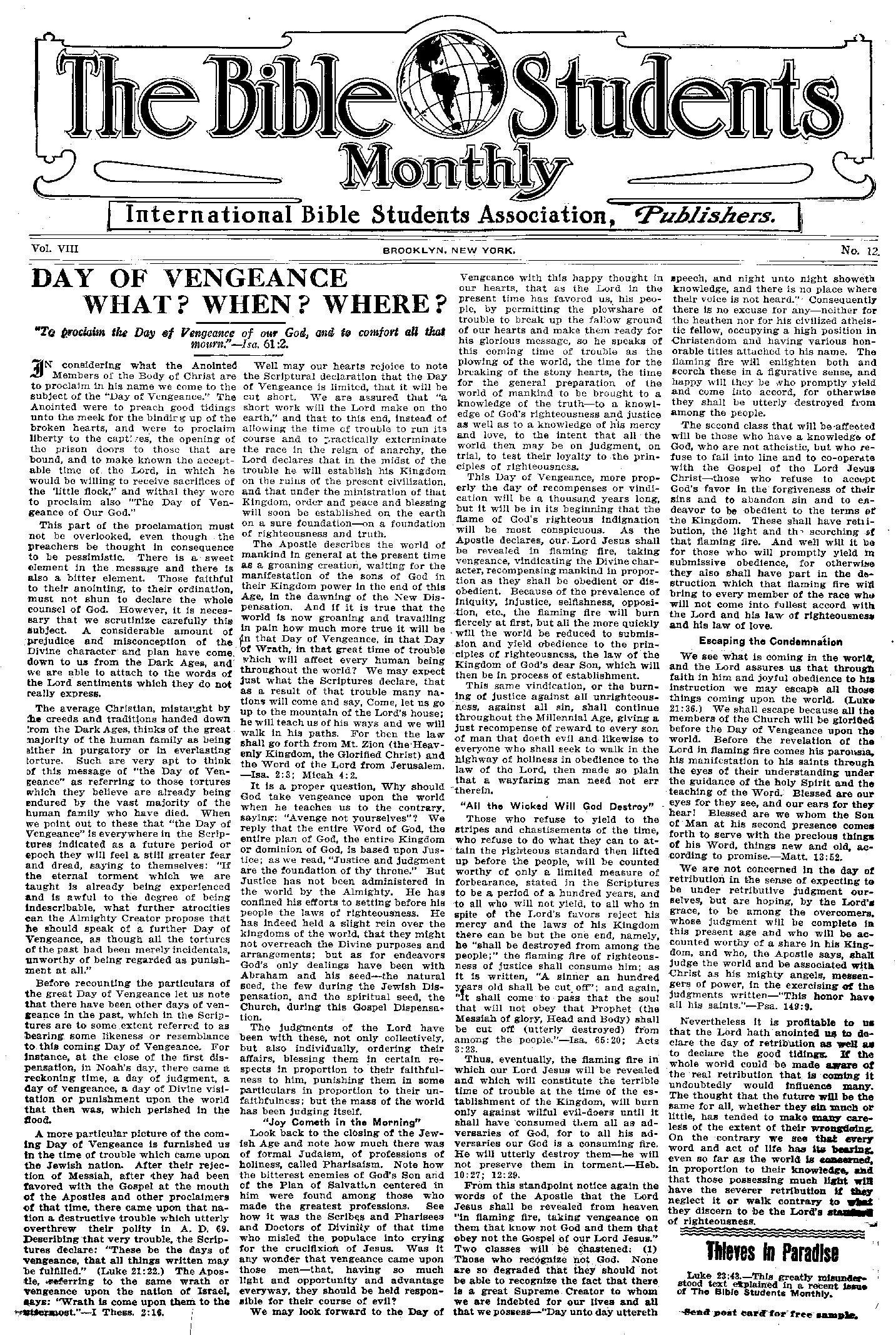
International Bible Students Association, Publishers. [
Vol. VIII BROOKLYN. NEW YORK. No. 12.
DAY OF VENGEANCE WHAT ? WHEN ? WHERE ?
“2c proclaim the Day of Vengeance of our God, and to comfort all that mourn."—Isa. 61:2.
^jjN considering what the Anointed
Members of the Body of Christ are to proclaim in his name we come to the subject of the “Day of Vengeance.” The Anointed were to preach good tidings unto the meek for the bindir g up of the broken hearts, and were to proclaim liberty to the capt.zes, the opening of the prison doors to those that are bound, and to make known the acceptable time of the Lord, in which he would be willing to receive sacrifices of the ‘little flock,” and withal they were to proclaim also “The Day of Vengeance of Our God.”
This part of the proclamation must not be overlooked, even though the preachers be thought in consequence to be pessimistic. There is a sweet element in the message and there is also a bitter element. Those faithful to their anointing, to their ordination, must not shun to declare the whole counsel of God. However, it is necessary that we scrutinize carefully this subject. A considerable amount of prejudice and misconception of the Divine character and plan have come, down to us from the Dark Ages, and we are able to attach to the words of the Lord sentiments which they do not really express.
The average Christian, mistavght by ihe creeds and traditions handed down from the Dark Ages, thinks of the great majority of the human family as being either in purgatory or in everlasting torture. Such are very apt to think of this message of “the Day of Vengeance” as referring to those tortures which they believe are already being endured by the vast majority of the human family who have died. When we point out to these that “the Day of Vengeance” is everywhere in the Scriptures indicated as a future period or epoch they will feel a still greater fear and dread, saying to themselves: “If the eternal torment which we are taught is already being experienced and is awful to the degree of being Indescribable, what further atrocities can the Almighty Creator propose that he should speak of a further Day of Vengeance, as though all the tortures of the past had been merely incidentals, unworthy of being regarded as punishment at all.”
Before recounting the particulars of the great Day of Vengeance let us note that there have been other days of vengeance in the past, which in the Scriptures are to some extent referred to as bearing some likeness or resemblance to this coming Day of Vengeance. For Instance, at the close of the first dispensation, in Noah’s day, there came a reckoning time, a day of judgment, a day of vengeance, a day of Divine visitation or punishment upon the world that then was, which perished in the flood.
A more particular picture of the coming Day of Vengeance is furnished us In the time of trouble which came upon the Jewish nation. After their rejection of Messiah, after they had been favored with the Gospel at the mouth of the Apostles and other proclaimers of that time, there came upon that nation a destructive trouble which utterly overthrew their polity in A. D. 69. Describing that very trouble, the Scriptures declare: “These be the days of vengeance, that all things written may be fulfilled.” (Luke 21:22.) The Apostle, -referring to the same wrath or vengeance upon the nation of Israel, gays: "Wrath is come upon them to the rWttermost.”—I Thess. 2:16. /
Well may our hearts rejoice to note the Scriptural declaration that the Day of Vengeance is limited, that it will be cut short. We are assured that “a short work will the Lord make on the earth,” and that to this end, instead of allowing the time of trouble to run its course and to practically exterminate the race in the reign of anarchy, the Lord declares that in the midst of the trouble he will establish his Kingdom on the ruins of the present civilization, and that under the ministration of that Kingdom, order and peace and blessing will soon be established on the earth on a sure foundation—on a foundation of righteousness and truth.
The Apostle describes the world of mankind in general at the present time as a groaning creation, waiting for the manifestation of the sons of God in their Kingdom power in the end of this Age, in the dawning of the New Dispensation. And if it is true that the world is now groaning and travailing in pain how much more true it will be dn that Day of Vengeance, in that Day of Wrath, in that great time of trouble vhich will affect every human being throughout the world? We may expect just what the Scriptures declare, that as a result of that trouble many nations will come and say, Come, let us go up to the mountain of the Lord’s house; he will teach us of his ways and we will walk in his paths. For then the law shall go forth from Mt. Zion (the'Heav-enly Kingdom, the Glorified Christ) and the Word of the Lord from Jerusalem. —Isa. 2:3; Micah 4:2.
It is a proper question, Why should God take vengeance upon the world when he teaches us to the contrary, saying: “Avenge not yourselves”? We reply that the entire Word of God, the entire plan of God, the entire Kingdom or dominion of God, is based upon Justice; as we read, “Justice and judgment are the foundation of thy throne.” But Justice has not been administered in the world by the Almighty. He has confined his efforts to setting before his people the laws of righteousness. He has indeed held a slight rein over the kingdoms of the world, that they might not overreach the Divine purposes and arrangements; but as for endeavors God’s only dealings have been with Abraham and his seed—the natural seed, the few during the Jewish Dispensation, and the spiritual seed, the Church, during this Gospel Dispensa-tion.
The judgments of the Lord have been with these, not only collectively, but also individually, ordering their affairs, blessing them in certain respects in proportion to their faithfulness to him, punishing them in some particulars in proportion to their unfaithfulness; but the mass of the world has been judging itself.
“Joy Cometh in the Morning”
Look back to the closing of the Jewish Age and note how much there was of formal Judaism, of professions of holiness, called Pharisaism. Note how the bitterest enemies of God’s Son arid of the Plan of Salvation centered in him were found among those who made the greatest professions. See how it was the Scribqs and Pharisees and Doctors of Divinity of that time who misled the populace into crying for the crucifixion of Jesus. Was it any wonder that vengeance came upon those men—that, having so much light and opportunity and advantage everyway, they should be held responsible for their course of evil?
We may look forward to the Day of
Vengeance with this happy thought in our hearts, that as the Lord in the present time has favored us, his people, by permitting the plowshare of trouble to break up the fallow ground of our hearts and make them ready for his glorious message, so he speaks of this coming time of trouble as the plowing of the world, the time for the breaking of the stony hearts, the time for the general preparation of the world of mankind to be brought to a knowledge of the truth—to a knowledge of God’s righteousness and justice as well as to a knowledge of his mercy and love, to the intent that all the world then may be on judgment, on trial, to test their loyalty to the principles of righteousness.
This Day of Vengeance, more properly the day of recompenses or vindication will be a thousand years long, but it will be in its beginning that the flame of God’s righteous Indignation will be most conspicuous. As the Apostle declares, our. Lord Jesus shall be revealed in flaming fire, taking vengeance, vindicating the Divine character, recompensing mankind in proportion as they shall be obedient or disobedient. Because of the prevalence of Iniquity, injustice, selfishness, opposition, etc., the flaming fire will burn fiercely at first, but all the more quickly will the world be reduced to submission and yield obedience to the principles of righteousness, the law of the Kingdom of God’s dear Son, which will then be in process of establishment.
This same vindication, or the burning of justice against all unrighteousness, against all sin, shall continue throughout the Millennial Age, giving a just recompense of reward to every son of man that doeth evil and likewise to everyone who shall seek to walk in the highway of holiness in obedience to the law of the Lord, then made so plain that a wayfaring man need not erf 'therein.
“All the Wicked Will God Destroy”
Those who refuse to yield to the stripes and chastisements of the time, who refuse to do what they can to attain the righteous standard then lifted up before the people, will be counted worthy of only a limited measure of forbearance, stated in the Scriptures to be a period of a hundred years, and to all who will not yield, to all who in spite of the Lord’s favors reject his mercy and the laws of his Kingdom there can be but the one end, namely, he “shall be destroyed from among the people;” the flaming fire of righteousness of justice shall consume him; as It is written, “A sinner an hundred years old shall be cut off”; and again, “It shall come to pass that the soul that will not obey that Prophet (the Messiah of glory, Head and Body) shall be cut off (utterly destroyed) from among the people.”—Isa. 65:20; Acts 3:23.
Thus, eventually, the flaming fire in which our Lord Jesus will be revealed and which will constitute the terrible time of trouble at the time of the establishment of the Kingdom, will burn only against wilful evil-doers until it shall have consumed them all as adversaries of God, for to all his adversaries our God is a consuming fire. He will utterly destroy them—he will not preserve them in torment.—Heb. 10:27; 12:29.
From this standpoint notice again the words of the Apostle that the Lord Jesus shall be revealed from heaven “in flaming fire, taking vengeance on them that know not God and them that obey not the Gospel of our Lord Jesus.” Two classes will be chastened: (1) Those who recognize not God. None are so degraded that they should not be able to recognize the fact that there is a great Supreme Creator to whom we are indebted for our lives and all that we possess—“Day unto day uttereth speech, and night unto night showeth knowledge, and there is no place where their voice is not heard.” Consequently there is no excuse for any—neither for the heathen nor for his civilized atheistic fellow, occupying a high position in Christendom and having various honorable titles attached to his name. The flaming fire will enlighten both and scorch these in a figurative sense, and happy will they be vho promptly yield and come into accord, for otherwise they shall be utterly destroyed from among the people.
The second class that will be-affected will be those who have a knowledge of God, who are not atheistic, but who refuse to fall into line and to co-operate with the Gospel of the Lord Jesus Christ—those who refuse to accept God’s favor in the forgiveness of their sins and to abandon sin and to endeavor to be obedient to the terms of the Kingdom. These shall have retii-bution, the light and th-1 scorching af that flaming fire. And well will it be for those who will promptly yield in submissive obedience, for otherwise they also shall have part in the destruction which that flaming fire wifi bring to every member of the race who will not come into fullest accord with the Lord and his law of righteousness and his law of love.
Escaping the Condemnation
We see what is coming in the world, and the Lord assures us that through faith in him and joyful obedience to his instruction we may escape all those things coming upon the world. (Luke 21:36.) We shall escape because all the members of the Church will be glorified before the Day of Vengeance upon the world. Before the revelation of the Lord in flaming fire comes his paronsia, his manifestation to his saints through the eyes of their understanding under the guidance of the holy Spirit and the teaching of the Word. Blessed are our eyes for they see, and our ears for they hear! Blessed are we whom the Son of Man at his second presence comes forth to serve with the precious things of his Word, things new and old, according to promise.—Matt. 13:52.
We are not concerned in the day of retribution in the sense of expecting to be under retributive judgment ourselves, but are hoping, by the Lord’s grace, to be among the overcomers, whose judgment will be complete in this present age and who will be accounted worthy of a share in his Kingdom, and who, the Apostle says, shall judge the world and be associated with Christ as his mighty angels, messengers of power, in the exercising of the judgments written—“This honor have all his saints.”.—Psa. 149:9.
Nevertheless it is profitable to us that the Lord hath anointed us to declare the day of retribution as well as to declare the good tidings; If the whole world could be made aware ot the real retribution that is coming it undoubtedly would influence many. The thought that the future will be the same for all, whether they sin much or little, has tended to make many careless of the extent of their wrongdoing. On the contrary we see that every word and act of life has its bearing; even so far as the world is ecneerned, in proportion to their knowledge^ ahd that those possessing much light wiH have the severer retribution if they neglect it or walk contrary to what they discern to be the Lord’s standard of righteousness.
Wes In Paradise
Luke 23:43.—This greatly misunder* stood text explained in a recent issue of The Bible Students Monthly.
/
'Send post car J for freo
THE BIBLE STUDENTS MONTHLY
W. F. HUDGINGS, Editor.
13, IS, 17 HICKS ST., BROOKLYN, N.Y,
S’ * ithly—12 cts. a yaar. Single cop es„ lo.
An Independent, Unseetarian Religions Newspaper, Specially Devoted to tlie Forwarding ofi the Laymen’s Home Missionary Movement for the Glory of God and Good of Hnmaniiy
The Lord’s House in Top of the Mountains
truthfulness of all this. If some of us have hoped, that the general education of the masses and the general enlight-
“It shall come to pass in the last days, that the mountain of the Lord’s house shall be established in the top of the mountains, and shall be exalted above the hills; and
all nations shall flow unto it.”—Isaiah 2:2.
enment of the race would abolish sin and selfishness , and demonstrate the truthfulness of the Proverb, “Honesty is the best policy,’’ we are willing to
/it^UR text has not ’21/ but we believe its fulfillment to be
yet been fulfilled, the beginning of near. It pictures
Messiah’s Kingdom, for which GnrisU. n
Ministers of the I. B. S. A. render their services a -jeople have long been waiting and funerals free of charge. They also invite correspond “rphir kinp-rlnm rnmp- thv will
encofrom those desiring Christian counsel. graying, J-liy r^ingCLOIXl COuie, buy Will
-------------- ....... ........ ---be done on earth as it is in heaven”— TO SJS THE SCRIPTURES CLEARLY game Kingdom for which the Jews TEACH long waited and are still waiting.
That the Church is “the Temple of tn&£)Ur text relates, not to the spiritual Living GoT’-peculiariy “His workman. h Kingdom, which the Gospel
ship; its construction has beea in prog- .___ , . .
ress throughout the Gospel Age—ever Ghurch is called to share, but to the since Christ became the world’s Re- earthly part of the Kingdom, which be-deemer and Chief Corner Stone of His ’-ongs to the natural seed of Abraham. Temple, through which, when finished, A. great mistake has been made by God’s blessing shall come “to all peoi rog,ny of us in the past, in that we have pie,” and they find access to Him.—discerned and acknowledged the 1 Corinthians 3:16, 17, Ephesians . »^w0 israeis spiritual and natural, and Genesis 28:14; Galatians 3:29. J , . . ,
That meantime the chiseling, shaping and*he separate rewards and blessings ,ap-polishing of consecrated believers ini portioned to these by the Divine prom-Christ’s Atonement for sin progresses; Ises of the Scriptures. Both are. to be and when the last of these “living used of God in fulfilling the promise stones,” “Elect and precious,” shall made to Abraham—in blessing all the have been made ready, the great Master famiiies of the earth.
Yvorkman will bring all together in the j^fter the completion of Messiah, First Resurrection; and the Tempi© ■ . . _ ~
shall be filled with His glory, and be the riead a»d Members, on the plane _ of meeting place between God and men, glory, the New Covenant will be in-throughout the Millennium.—Revelation augurated with Israel, as the Scrip-
15:5-8; 21:3.
tures distinctly teach. (Jer. 31:21-34.)
That the Basis of Hope, for the Church Our text, therefore, waits for its ac-and the World, lies in the fact that complishment until the last member of “Jesus Christ, by the grace of God,- the eiect church of Christ shall have tasted death for every man,’’ "a Ran- d beyond the vail.
som for all, ’ and will be “the true Light * .
which lighteth every man that cometh Israel the Earthly Representative of the into the world,” “in due time.”—Hei Kingdom
brews 2:9; John 1:9; 1 Timothy 2:5, 6. In the symbolic language of the That the Hope of the Church is that shescriptures a mountain is always sym-
may be like her Lord, “see.Him as ,of a Kingdom. Hence the moun-
is,’’ be “Partaker-of the Divine nature, Lord's house means the
and share His glory as His joint-heir.—• . . ,, . . ,
1 John 3:2; John 17:24; Romans 8:17; Kingdom of God and that royal house
2 Peter 1:4. or family recognized by him. For in-
That the present mission of the ChurcH stance, we read that David sat upon
is the perfecting of the saints for the the throne of the Kingdom of the Lord future work of service; to develop in and that God made a Covenant with herself every grace; to be God’s witness him> “even the sure mercies of David” to the world; and to prepare to be kings _vi that none but his Seed> his _ and priests m the next Age.—Ephesians. ., ■__
4:12; Matthew 24:14; Revelation 1:6; 20:6. tenty, would ever be recognized as Jm That the hope for the World lies in the Divinely appointed representatives . o.t
blessings of knowledge and opportunity God in kingly authority and power. Tn . ,;O brought to all by Christ's Mil-other words, Messiah was to be •
lennial Kingdom—the Restitution of all offspring of David, the great antitypi-that was lost in Adam, to all the -willing caj David (Beloved), who must “reign and obedient, at the hands of their from sea to sea and from the river to Redeemer and His Glorified Church— .. „
when'all the wilfully wicked will b©the ends of the earth. °
destroyed.—Acts 3:19-23; Isaiah 35. The Messiah-King on the spirit We affirm the pre-existence of Jesus as plane, the Son of God (and like God in-the mighty Word (Logos—spokesman) visible to men, as are also the angels), “the beginning of the creation of God,” fs the antitypical David and the anti-“the First-Born of every creature,’ the, typical Solomon, the wise, the great, active agent of the Heavenly Father, $be ricb< jn tbe days of his flesh our Jehovah, m all the work of creation.~ „
“Without Him was not anything made ^°^d ^as t]^® Soa of David according that was made.”—Revelation 3:14; Co- to the flesh, though begotten of a divine lossians 1:15; John 1:3. We not tainted by any human imper-
We affirm that the Word (Logos) wasfection. He was, therefore, holy, harm-
made flesh—became the Babe of Beth- less, undefiled and separate from sin-lehem—thus becoming the Man Jesus, ners. His faithfulness to the will of “holy, harmless, undefiled, separate from pather made him subject to all of sinners. . s we a nn VflHnitv the experiences of suffering and death, of Jesus, we equally affirm the Divinity ®
of Christ—“Cod also hath highly exalted as expressed in his own words, “The Him, and given Him a name which is cup which my Father hath poured for above every name.”—Hebrews 7:26; Fhi-. me, shall I refuse to drink it?” His lippians 2:9. . obedience unto death, even the death
We acknowledge that the personality of of the cross, demonstrated his loyalty the Holy Spirit is the Father and Son; t0 ^be jas^. degree and j^e received the that the Holy Spirit Proceeds fromt both appropriate. “Him hath
and is manifested m all who receive tne , . ,,■, ,
begetting of the Holy Spirit and thereby God also highly exalted and given a become sons of God.—John 1:12; 1 Peteil name that is above every name, that
1:3.
at the name of Jesus every knee should
We affirm the resurrection of Christ—tha'fcow, both of things in heaven and He was put to death in flesh but quick things in earth.”
ened in Spirit. W© deny that He wr Exalted to the right hand of Divine raised m the flesh, and challenge ai.^ favor hP waits onlv for the Father’s statement to that effect as being un- favorwaits only tor tne b atfier s scriptural—1 Peter 3:18; 2 Corinthians time to take to himself his great power 3:17; 1 Corinthians 15:8; Acts 26:13-15.j and reign (Revelation 11:17). Mean--------—---- a time, in harmony with the Divine will,
7 WONDERS Or MODERN WORLD, purposed before the foundation of the A scientific magazine made a requestworldj be acts as Advocate for such as to the Physical Department at Cornell t< ^ave the hearing ear and the obedient name seven wonders of the modern work _ ...
selected from a list of fifty-seven out-.^t and will now respond to the standing inventions and structures sub-3 special invitation of the Gospel Age. mitted. That call is to leave the world, its sins,
The faculty, graduates, and seniors ar Ms pleasures and its hopes, and to walk the physics seminary balloted, the aware
gt;y faith in the exceeding great and of the voting going to wireless telegraphy, precious promjses of God—the things synthetic chemistry ”d‘^nSS>hicli eye, hath not seen nor ear heard, aviation, the Panama Canal, and tne tele-. J .phone.—New York Times. neither hath entered into the heart of
_______._______. man. These are the heavenly things SAN FRANCISCO TO NEW YORK Ji promised them as the Bride and joint-
THREE DAYS AND A HALF. heir with their Redeemer in his glo-
The acceleration of transcontinental rjous Kingdom to come and its blessed railway travel during the past two years ^york of uplifting Israel and the world, has been made so quietly that not many people are aware that the time from In the Top of the Mountains ocean to ocean has been reduced to less -^e have before our minds the anti-than three and a half days. The fact was ... hnn„_ navid Messiah’s recently brought into prominence by daily/plda\ °L H?vld’ Messiahs
press notices of a trip made by an Aus- kmgly household, the Royal Priesthood tralian passenger who left San Francisco Divinely prepared. As a Kingdom it at 10.40 P.M., March 2, and reached New: will be at the top, above all the king-York March 6, in time to catch the steam- doms of earth. Not only will this be chip sailing at noon the same day fo- true of the spiritual Kingdom (invisible Europe, the total time from San Fran men as the ang-eis are invisible), but cisco to New York being three days ar. .. .. . . , . earthlv Kingdom
eleven hours.—Scientific American. WU1 mciuQe als° an earthly Kingdom
composed of “Israelites indeed.” At their head as princes in all the earth will stand the resurrected Ancient Worthies, perfected as men and samples of what all mankind, by obedience to the laws of the Kingdom, may attain to, with eternal life. These Ancient Worthies are enumerated in the Scriptures—-Abraham, Isaac, Jacob, the prophets, etc., and described by St. Paul in Hebrews 11:38-40. To these belong the earthly promises of the Old Testament. They never heard of the heavenly or spiritual promises. Their loyalty will find its reward in the fact that they will come forth from the .tomb no longer blemished and imperfect, but fully, completely restored to the perfection originally enjoyed by father Adam. Additionally these will have the special guidance and instruction of Messiah (Head and members) in all the affairs of mankind. Thus as the Master said, speaking of that time, “Ye shall see Abraham, Isaac, Jacob and the prophets in the Kingdom.”—• Luke 13:28.
God’s Kingdom will be represented in the earth by Israel—especially by these saintly men of Israel, resurrected perfect, who will be :he special appointees and representatives of the glorified Messiah’s rule. As it is written, instead of thy fatners (the ancient saintly ones were styled “the fathers,” as Jesus was styled the Son of Abraham and David) shall be thy children, whom thou mayest make princes in all the earth. (Psalm 45:13.) These princes acting under and continually in ‘contact with the spiritual Kingdom and rulers styled in the Scriptures “the royal priesthood,” will, of course, be so superior in their wisdom and power as to command the obedience of the whole earth. The nation of Israel, with whom they are related, would naturally respond more quickly than others to the New Order of things, which will be just that for which they have been waiting and praying for more than thirty centuries.
All Nations Shall Flow Unto It.
In these words the Lord through the prophet assures us of the wonderful success which will attend the establishment of the New Empire of earth, the dominion of the Prince of light, which will supersede the dominion of the Prince of darkness, when Satan shall be bound for a thousand years, that he may deceive the peoples no more. Messiah’s Kingdom will be high above all other Kingdoms, not only in its grandeur, majesty and authority, but also in the lofty principles which it will represent.
Thus it is written, “He shall lay righteousness to the line and jus-: tice to the plummet and the hail [Truth] shall sweep away the refuge of lies” (Isaiah 28:17). Nevertheless, as the world shall come to appreciate the new order of things all nations shall flow unto it, flow up to it—contrary to the downwardness of fallen human nature. It will make manifest such wonderful rewards for righteousness and obedience to God and it will so make manifest the stripes that must attend all willful disobedience to the Divine arrangement that the Scripture will be fulfilled which declares that ■when the judgments of the Lord are abroad in the earth, the inhabitants of the world will learn righteousness.—■ Isaiah 26:9.
Humanity for six thousand years has been learning “the exceeding sinfulness of sin,” its downward tendency in every sense -of the word. Every form of government has been tried in an endeavor to secure the greatest amount of blessing. But the uniform results have been that those exalted to place and influence and power have proved themselves unequal to the opportunities and temptations of the positions and have abused them selfishly. Whoever is acquainted with history realizes the
confess that this has been a mistake. We perceive that the greater the wisdom and intelligence granted to a selfish mind and heart the greater will be its opportunities for evil and incitement thereto.
“Every Man's Hand Shall Be Against His Neighbor”
As a consequence the world is losing confidence in itself. All, whether politicians or judges or governors, great or small, of one party or another, of one nationality or another—all are accused of being tarred with the same stick of selfishness. The Bible clearly indicates that this distrust is not without reason and that the great time of trouble soon to come upon every nation (Daniel 12:1) will be the direct result of this loss of confidence. The Bible’s description of the matter briefly summed up is, Every man’s hand shall be against his neighbor (Zechariah 8:10; 14:13). It,will be after that great, time of trouble shall have thoroughly sickened humanity as respects itself and any hopes it might have had of bringing about a Millennium by its own efforts—4hat God will manifest his Kingdom in the top of the mountains—■ higher than all other kingdoms every way, and all people shall flow toward it. As it is written, “The desire of all peoples shall come.”—Haggai 2:7.
This is described in the verses following our text which read, “And many people shall go and say, Come ye, let us go up to the mountain (kingdom) of the Lord, to the house (temple) of the God of Jacob; and he will teach us of his ways and we will walk in his paths, for out of Zion [the spiritual unseen Kingdom of Messiah] shall go forth the Law and the Word of the Lord from Jerusalem [the seat of earth’s empire to be]. And he shall judge among the nations [rewarding and punishing justly], and shall rebuke many people; and they shall beat their swords into plowshares and their spears into pruning hooks. Nation shall not lift up sword against nation, neither shall they learn war any more.” All Christians agree that these words apply to the Messiah’s Kingdom. They tell us clearly and distinctly of how the judgments of the Lord will be abroad in the earth, causing wars to cease and the knowledge of the Lord to fill the whole earth as the waters cover the great deep.—Isaiah 11:9.
O House of Jacob, Come!
We have already noted that this prophecy belongs to natural Israel and not to spiritual Israel. As the first verse declares, it concerns Judah and Jerusalem. By the time this prophecy shall have begun to be fulfilled, spiritual Israel will be beyond the vail. It is In full harmony with this that we read in the fifth verse, “O house of Jacob, Come ye and let us walk in the light of the Lord.”
This is particularly the time when this wonderful message to natural Israel should go forth. We understand the Scriptures to teach that during the next few years the Lord will have special dealings with Israel in connection with this call. He will point out to them the way of righteousness and the great privileges that are theirs as a people, because of Divine promises to their fathers, Abraham, Isaac and Jacob, etc. But only those who respond by turning to the light of God’s Word to walk in it will be in the proper condition of heart and obedience to promptly get the blessing at the beginning of Messiah's reign. Those most prompt to respond will get the greater blessing.
Verses 6-10 portray some of the reasons why God’s favor has been withdrawn for a time from natural Israel— aside from the fact that his special favor was for the time to be given to Spiritual Israel. Then follows a description of the time of trouble, in which present institutions will succumb, to be followed by Messiah's Empire. _
“WHERE ARE THE DEAD?”
This article was published in this paper in Volume one, Number 3. The interest aroused, and the great demand for copies of it have been remarkable. A sample copy will be mailed to any one free. Address, Bible Soc. :y, 17 Hicks Street, Brooklyn.
Vessels of Gold and of Silver
’In a great house there are not only vessels of gold and of silver, but also of wood and of earth, and some to honor, and some to dishonor. If a man, therefore, purge himself from these, he shall be a vessel unto honor, sanctified and meet for the Master’s
use, and prepared unto every good work.”—2 Tim. 2:20, 21.
itself.
.Apostle fidelity this he Church
This does not signify that the now or hereafter. The degree of honor
the faith He here many to moment,
71T HIS text shows that the Apostle v' was solicitous for the Church because of a sectarian spirit of contention which prevailed where the spirit of fellowship should have manifested ignored the importance of to the Truth, for concerning had already written that the should “contend earnestly for once delivered to the saints.” objects to the disposition of contend about matters of no which he terms “words to no profit, but to the subverting of the hearers,” and again “profane and vain babblings, which would increase unto more ungodliness and eat as doth a canker.”
In a word, man-made differences ehould be ignored and only those doctrines which the Scriptures clearly and distinctly set forth are to be insisted upon and contended for. In all other things tlie Lord’s people are to have fervent charity and liberty among themselves. After exhorting Timothy, “Study to show thyself approved unto God, a workman that need-<eth not to be ashamed, rightly dividing the word of truth,” he declares, that notwithstanding these various babblings and twistings of the Scriptures, the “foundation of God standeth sure.” God’s great plan will stand and will finally triumph no matter who may babble against it and no matter how much the Adversary may seek to draw-attention away from the fundamental facts to the theories and fancies of the egotistical and hypocritical. The Apostle’s thought seems to be that some of the Lord’s people, by following the course he has outlined, and becoming thoroughly furnished in the word of truth and able to rightly divide it to others, will be vessels of honor in the service of the Lord in the present time. On the contrary, some—truly God’s people, truly consecrated to him, yet neglecting these important princi-pies—will be vessels of less honor and used of the Lord to accomplish less glorious results.
To Honor and Less Honor
How manifestly true is this inspired declaration only the more advanced of the Lord’s people may know. The world judges by outward appearance, and perceives the prosperity of many who have the form of godliness without the power thereof; it perceives the prosperity of many sects , and parties, divided chiefly by mere quibbles, and Jt perceives the lesser prosperity of those who ignore sectarian lines and Stand only for the word of truth, and contend only “for the faith once delivered to the saints.” Only the spiritually minded can see the situation from the Lord’s standpoint—only these can realize which, from the Lord’s standpoint, are the gold and silver vessels and which are those of wood and of earth. Only this class can discern which vessels the Lord uses to the greater honor-—through which he sends the greater riches of his grace and truth, and which he uses in an inferior sense.
The “great house” of the Apostle’s parable is the household of faith—the house of God—the Church of the living God. This Church is now in an embryo condition; unfinished, imperfect; it bears a similar relationship to the Church in glory that Israel’s tabernacle in the wilderness bore to the temple at Jerusalem. We are not to understand that only the most proficient of the Lord’s people are recognized by him and others entirely ignored, but, as the Apostle says, our «sure foundation lies in the fact that ■“the Lord knoweth them that are his,” and also in the fact that those who name the name of Christ should depart from iniquity. Every servant of God, every vessel in his house, must come under these conditions to be vessels at all: (1) The Lord must know them as his; they must be of the class mentioned by the prophet who have made a covenant with the Lord by sacrifice—self-sacrifice, consecration to •death; (2) they must also be of the class that depart from iniquity—that recognize righteousness,.truth, holiness, and strive toward perfect attainment.
full consecration and who strive for called,' chosen, being schooled, is that
in the Lord’s service will depend upon their degree of honesty and zeal. While, therefore, we may well rejoice to be vessels in the Lord's house, to be used of him either in more honorable or less honorable capacity in his service, nevertheless he is pleased to have us aspire to such faithfulness in .
But not all of those who make a righteousness shall occupy the same station in the Divine service, either thought, in "word, in deed, as would have his approval and win for us the higher stations in his esteem and service here and hereafter.
“If a Man Purge Himself”
The Apostle tells us how as Christians we may attain to the highest positions in Divine favor. He says, “If a man purge himself from these he shall be a vessel unto honor.” He does not mean, however, if any man do so, for here and elsewhere he shows, in harmony with the other Scriptures, that the world has nothing whatever to do with this matter—that the first step of approach to God must be through the door, through Christ, and that only those who come unto the Father through him have any standing whatever at the present time. Hence the Apostle’s thought is that if any man in the Church will purge himself, will purify himself, will seek to put away these elements of dross and unrighteousness, will seek to avoid profane and vain babblings, will cease to strive about words to no profit, and will seek more and more by the Lord’s assistance to “rightly divide the word of truth”'—such a man in Christ, whether his talents and opportunities be great or small, will be blessed of the Lord and reckoned of him as one of the more honorable vessels for his service here and hereafter.
Continuing further he declares that the man who thus purges himself and seeks to bring himself closely into alignment with the will of God, will not only be reckoned a vessel unto honor, but ’will be sanctified and set apart by the Lord for his service. He will give him opportunities, special opportunities, to do and to be assisted, which he would not have provided for him otherwise. Christian people too often seem to overlook this matter—to forget how much God has to do with his Church, with those who have made consecration of themselves to him.
"More and more should we all remember, as is urged by the Apostle, that “God hath set in the Body the various members as it hath pleased him.” It is for us not to be ambitious for a high station, but to humbly desire to be and to do those things acceptable to the Lord, leaving it for him to give us whatever experiences in life will be best for us—either larger opportunities for service or lesser opportunities, for the testing and proving of our loyalty. Selfish ambition in any of the Lord’s people would be the surest road to Divine disapproval. It might succeed in securing place and power in nominal systems of human origin, but such a course—so far from bringing these into greater prominence with the Lord or into greater opportunities of service in connection with his truth— would work in an opposite direction; as it is written, “The Lord disdaineth the proud, but showeth favor to the humble.” The Apostle, therefore, urges, “Humble yourselves, therefore, under the mighty hand of God, that he may exalt you in due time”—in the present life or in the future life or both. It is for the Lord to choose our places and our work for us; it is for us to
The Rich Man in Hell;
Lazarus in Abraham’s Bosom
This greatly misunderstood parable made plain in a recent issue of BIBLE STUDENTS MONTHLY. Send for free sample copy. seek to be instruments willing and ready, “for the Master’s use made meet.”
“House
of Many Mansions”
now
Looking beyond our present opportunities and privileges of usefulness in the Lord’s service, and the degree of opportunities secured by us through faithfulness, we perceive that the great work for which we are of the future, of which the Apostle says, “That in the ages to come God will show forth the riches of his grace, in his loving kindness toward us in Christ Jesus.” (Eph. 2:7). Our Lord referred to that glorious future condition when he declared co his Apostles, “In my Father’s house are many mansions. I go to prepare a place for you.” The many mansions, the many stations, the many planes of celestial being and blessing are here pictured, and the suggestion is further given that one special place in the Divine family •would be made for the special followers of the Lord—those known throughout the Scriptures as “the Bride, the Lamb’s Wife,” and again as “the Royal Priesthood” under Christ, their great Chief Priest. The chief mansion will be for these who, called to the highest honor, are represented by the golden vessels.
And again they are called the “Lord’s jewels,” and he says of them, “They shall be mine, saith the- Lord, in that
day when • I come to make up jewels.” (Mal. 3:17.) As jewels scarce, so these are described to only a little flock to whom it is Father’s good pleasure to give
my are
be the the
declared that he was glad to suffer ’through the portals of the Divine Word
Kingdom. (Luke 12:32.) To be of this company, styled in the Scriptures as “more than conquerors through him that loved them and bought them with his precious blood,” the Apostle Paul any loss—to count all things but as loss and- dross that he might win Christ and be found in him—as a member of his Body, a member of the royal priesthood, a member of the little flock, a partaker of the divine nature.
and in the temple a symbol of this highest of all rathe angelic. Our immortal condition
In the tabernacle gold was used as divine nature, the tures, superior to Lord described this as signifying the possession of life in himself—life not derived from other sources. “As the Father hath life in himself (immortality), so hath he given unto the Son to have life in himself” (immortality). (John 5:26.) And he has been given the privilege of giving this to whomsoever he will —to the worthy ones constituting his elect Bride, otherwise styled “members of the Body of Christ,” vitally connected with him, their living Head. It is to this glorious quality of the divine nature, symbolized by the gold, and again in our text styled the vessels of gold, that Peter refers, saying “God hath given unto us exceeding great and precious promises, that by these we might become partakers of the divine nature.”—2 Peter 1:4.
“Vessels of Silver”
All recognize silver as less precious than gold, but much more abundant. As one of the precious metals it is used in the Scriptures to represent a spiritual class, but a- different class from that represented in the vessels of gold—a unore numerous class. While all of the Lord’s people of this Gospel Age were called, as the Apostle says, “In one hope of their calling,” with at least the prospect or opportunity of becoming golden, vessels, nevertheless the Lord foreknew that not all of his true followers would prove in the end to be “more than conquerors;” not all of those who love righteousness and hate iniquity would be so zealous for the service as to be esteemed worthy to be of that little flock, the Bride, because all would not run in the race with zeal, following in the Master’s footsteps; hence we find in the Scriptures another class, another division of the Church, clearly pointed out.
In the types of the Old Testament they were represented by the Levites, who had an important work to do in. conjunction with the priests and as their assistants. In the New Testament this class is referred to in our text as “vessels of silver,” or less honorable than the vessels of gold, and they are particularly brought to our attention in our Lord’s last message to his Church, in which he pictures them as a “great company” in contrast with the “little flock.”
serve him He points sage that the Bride
This great company he designates as in the end honored and honorable victors, with palm branches—the crowns being reserved for the little flock, the vessels of gold. In the same picture he shows us that while the little flock of more than conquerors are to sit upon the throne with him, these others, worthy but less worthy, are to be before the throne. He points out that, while the “little flock” will share his glory and honor as his Bride, this greater company, represented by the more numerous vessels of silver, will in his temple. (Rev. 7:9-15.) out further in the same mes-while the little flock will be class, the “great company” will be honored with an invitation to be present at the marriage supper of the Lamb in glory. (Rev. 19:9.) And through the Prophet David he pictured the distinction between these classes, the little flock, the vessels of gold unto greatest honor, and the greater multitude, the vessels of silver unto less honor, picturing them as the Bride and her companions—bridesmaids. The picture shows the Bride all glorious in raiment of fine needle work, of embroidery and gold, brought in before ■the King, and then it shows us the “virgins, her companions, who follow her.”—'Psalm 45.
“Vessels of Wood and of Earth”
To be in any part of God’s great house—to be in his service in any capacity, either now or hereafter, is an honor, is no dishonor. Hence we prefer that translation of our text—vessels unto more honor and vessels unto less honor. The vessels of earth and of wood are specified as indicating those unto less honor, and to our understanding represent in the future those who will be servants of God on the earthly or human plane. "Whoever catches a glimpse of the coming glory of the earth during the Millennial Age •—a glimpse of the “times of restitution of all things which God hath spoken by the mouth of all the holy prophets”—can rejoice with any who will be found worthy to be a vessel of less honor in the Master’s cause in the future on the earthly plane. To our understanding the majority of Christian peop’e have never appreciated the glorious grandeur that is to come to earth during and as a result of the reign of Messiah—his Bride included. Surely, as Saint Peter declares (Acts 3:19-21), these will be times of restitution which God has declared through all his holy prophets.
EVERY THINKING
CHRISTIAN
SHOULD READ
PASTOR
RUSSELL’S
BOOKS
in the
Scriphires”
“Bill Arp” the Southern journalist said editorially:
“It is impossible to read this book without loving the writer and. pondering his wonderful solution of the great mysteries _ that have troubled us all our lives. There is hardly a. family to be found that has not lost some loved one who died outside the church—outside the plan of salvation, and if Calvinism be true, outside of all hope and inside of eternal torment and despair.
“This wonderful book makes no assertions that are not well sustained by the Scriptures. It is built up stone by stone, and upon every stone is the text, and it becomes a pyramid of God’s love and mercy and wisdom. There is nothing in the Bible that the author denies or doubts, but there are many texts that he throws a flood _ of light upon that seem to uncover its meaning.”
The set of six volumes, cloth, 3,000 pages, is supplied by the BIBLE AND TRACT SOCIETY, No. 17 HICKS ST., BROOKLYN, N. Y., for the usual price ©f one such volume, viz., $3.30 prepaid.
Workmen That Need Not To Be Ashamed
"Study to Show Thyself approved unto God, a workman that needeth not to be ashamed, rightly dividing the Word of Truth.”—2 Tim. 2:15.
Although the world is full of denominations, each claiming to be the Church of Christ, we all admit that there is but the one “Church of the firstborns.whose names are written in heaven” (Hebrews xii, 23). This conviction is being borne in upon us more and more as the days go by, and as the eyes of our understanding open more widely to the teachings of God’s Word. We realize increasingly that our division means our shame in the eyes of the world, and that our Creedal contradictions imply that we are not all led in all things by the holy Spirit, the teachings of which cannot be Yea and Nay upon the same subject. It is this sentiment which is taking hold of the ministry of all denominations and making them anxious for an outward show of Unity in Church Federation, which will shortly be effected. The Christian public, however, and especially Bible Students, are not deeply sympathetic with the Federation idea. They realize that at most it would be a gloss of deception so far as doctrinal oneness is concerned; and that otherwise it is but a business or worldly combination.
Bible students are more and more coming to prefer the Lord’s way—the Scriptural way. They are coming to realize that what God’s people need is not more organization but less organization, not more explicit creeds but the one standard of fellowship which the Bible sets up. They are learning that this simple creed is:—a turning from sin and acceptance of the Lord Jesus as the Redeemer from sin and death and the full consecration of the believer, mind and body, to know and to do the Lord’s will to the best of his ability, under the Lord’s Providential guidance. We all see that this simple bond of fellowship is the only one laid down in God’s Word, and that whatsoever is more than this is injurious—■ bondage to men and to systems. We all see that “the Church of the Living God whose names are written in heaven” is composed exclusively of such as conform to the terms of this simple creed—that these alone will constitute “the Church, which is his Body”—< “the Bride, the Lamb’s Wife,” whom he will accept and unite to himself in the end of this age. 'We all see that this class alone is referred to in the Scriptures as “the elect,” who are to be associated with the Savior in his glorious Spiritual Kingdom, which, invisible to men, is shortly to be established in power and great glory for the blessing of natural Israel and through her for the blessing of all the families of the earth—living and dead.
“Workmen Not Ashamed.”
Let us consider the latter part of our text first: The Apostle’s suggestion is that Timothy and all the ministers of the Gospel of Christ are pro-1 fessedly workmen, laboring under the guidance of God’s Word. In the larger sense every Christian is a minister of the Gospel, or, as St. Peter declares of all the consecrated, “Ye are a Royal Priesthood, a Holy People, a Peculiar Treasure.” In the end of the age will come a reckoning time, a showing of results, “Every man’s work that he hath wrought shall be made manifest” (I Corinthians iii, 13).
Our text urges that Timothy, and every faithful servant of God, should be so loyal to God and his message that in the great time of examination in the end of this age preparatory to the introduction of the Kingdom the showing shall be one of which we need not be ashamed. Let us, then, as Christian Bible Students of all denominations anxious for Truth, ask ourselves respecting our own work in the world, and how it must appear to God, to ourselves and to our fellowmen—yea, how it must shortly be made manifest to all!
Let us call the roll. Baptist brethren, What have you to show as workmen who need not to be ashamed, rightly dividing the Word of Truth? Methodist brethren, what say you? Presbyterians, next. Congregationalists, Lutherans, Catholics—all!
The answer of one is practically the answer of all: “We have—so many hundred Churches. They cost—so many millions of dollars. Their steeples are—so high. Their cost of maintenance is—-so much. The number of ministers is—so many. The Church collections amount to—so much. The amount collected for foreign missions is—so much. The amount expended on fine choirs and elegant organs is—■ so much. The aggregated debts of all our churches is—so much. The unpaid interest on many of these debts is—■ so much. The time and energy expended in fairs, bazaars, etc., to help pay the expenditures is—so much. The number of Church membership is—so many. The number in Sunday Schools is—so many.”
Many of our dear Christian friends say, What lack we yet? Have we not really attained the goal of our Church ambition? Should we build finer edifices or pay larger salaries ? Are we not straining ourselves with collections at every turn? What more could God ask of us? “We are rich and increased in goods and have need of nothing” (Revelation iii, 16-19).
In reply we may suppose the Lord to ask, Where did I give you instruction respecting these things? Where in my Word did you find the suggestion that what I desired you to do in the world was to erect great church edifices, piles of stone and iron and mortar, polished woods and stained glass? You are not rightly reading my Word. However good in intention, you have failed to “rightly divide the Word of Truth!” The Temple respecting which I gave instruction is the spiritual one, the Temple of the holy Spirit—-the Body of Christ which is the Church. I fear that you have forgotten the true temple of God while rearing so many temples of earthly materials. Concerning the true Temple I instructed you that “the temple of God is holy, W'hich temple ye are”—“living stones,” being shaped and polished “for the habitation of God through the Spirit.” Show me what you have accomplished in this way. Show me to what extent you have rightly divided my Word, and properly instructed mankind respecting my glorious character and my great Divine Plan of the Ages! Show me fruitage of the glorious message!
Who Authorized the Creedal Fences?
How many in all the millions that you report are “New Creatures in Christ Jesus,” who “walk not after the flesh, but after the Spirit”? Let me hear the message of my love and grace in Christ as you are proclaiming it! What mean these sectarian divisions amongst you? Why are there so many Church edifices and so .few saintly worshipers? Who authorized you to put these creedal fences between my people to divide the flock? Know ye not that I said, there is one flock and one Shepherd? Why have you so neglected the spiritual interests of my flock and their instruction in righteousness? Why are you so unable to rightly divide my Word?
Instead of coming together as one Church of the Living God whose names are written in heaven you have divided into hundreds of sects and parties! Instead of taking my Word as a whole and rightly dividing its teachings as between the different ages and dispensations of my work, you have divided my Word in a sectarian manner. One sect has made one selection from my Word and another sect has made another selection. Thus ye array one part of my Word against another part of it, and hence get into confusion and conflict. What have you to answer for these things?
With shame of face we must all acknowledge that “We have done those things which we ought not to have done and have left undone those things which we ought to have done, and there is no help in us.” The proper thing for us to do, dear Christian friends, is to get down upon bur knees before the Lord and in contrition of heart acknowledge that we have wrought no deliverance in the earth (Isaiah xxvi, 18); that our sectarian differences are our shame; that the ignorance that we have all been in respecting the Word of God is humiliating. Now that our eyes are open so that we can comprehend as never before the harmony of God’s message from Genesis to Revelation, it means a rich feast and blessing to our souls. The Word of God becomes more precious to us daily as we become able to comprehend it. Our duty is to fly to the assistance of our dear brethren and sisters in Christ, of all denominations, and to call upon them to join with us in a determined stand for righteousness, for Truth, for God and for his Word.
We must show them that ignorantly we and they have dishonored our God by misrepresentation of his character and misrepresentations of the real teachings of the Bible. We must point them to the fact that the Bible does not teach that all mankind except the “Elect” saints will be consigned to an eternity of torture at the hands of fireproof demons. We must show them that the election of the Church during this age—a saintly . little flock—does not mean injury to the non-elect. That, on the contrary, it is the Divine purpose that the elect saints with their great Redeemer in glory shall constitute God’s Kingdom; that his Kingdom when established -will bind Satan, put down sin, banish ignorance, error and superstition and uplift mankind by “restitution,” by resurrection processes, up, up, up, to all that was lost in Eden by disobedience and to all secured for Adam and his race through the great transaction at Calvary (Acts iii, 19-21).
“Rightly Dividing the Word of Truth.”
Alas, how many intelligent people have turned aside from following Christ and from hearing the voice of God through the Bible! Alas, how many are looking to Theosophy,. to Spiritism, to Christian Science, to Higher Criticism, to Evolution—wandering farther and farther daily from the “faith once delivered to the saints” (Jude iii). We .fault them no more than we fault ourselves. As a whole we have been workmen who need to be ashamed. We have dishonored God through misunderstanding and misrepresenting his Word and his Character. We have driven away from God and the Bible some of the most intelligent of our fellows, by reason of the contradictory nonsense of our creeds.
The Apostle urges, “Study to show thyself approved unto God.” We are not to suppose, therefore, that the highest of all science, that which pertains to the Divine purpose and the Divine plan, can be acquired without study. We are not in this claiming that study alone would bring the desired results of proper knowledge. We heartily agree in the Scriptural proposition that “the world by wisdom knows not God.” We are not therefore to study along the lines of worldly wisdom, but along the lines of “that wisdom that cometh from above”—along the lines of the inspired Scriptures. We must study! Whoever will not study will not know. “The secret of the Lord is with them that reverence Him.” And reverencing him means the giving of our best thoughts and talents to the study of his Word, that we may “know the things freely given to us of God” (I Corinthians ii, 12).
We should note further as Bible Stu™ dents that we must not study to be approved of men, but to have the Divine approval. This will bring to us, as it did to the Master and his apostles, the disapprobation of the worldly-wise and nominally religious. It was the Chief Priests and Scribes and Pharisees, and not the common, people of the Jews, nor the Roman sol-: diers who instigated the cruel-fixion of our Lord. And we must ex-' pect similar conditions, because, as the Apostle says, “As he was so are we in this world.” The class who called the Master Beelzebub is the same class which will oppose his footstep followers.
It is those few, that “little flock” zealous for God, for his Word, for righteousness, that he is now marking out as the prospective joint-heirs with Jesus in his glorious Kingdom, which is to bless the world with full opportunities for earthly salvation—“restitution.” The trials of the faith, the patience, the love, the devotion of this “little flock” are all designed and not accidental. Satan and his hosts may think to thwart the Divine Plan and may mislead and use humanity as their tools, but it shall yet be seen that all of the Divine purposes shall be ac* complished.
St. Paul declared of earthly Israel, that they enjoyed “much advantage every way, because to them were committed the oracles of God.” So now, dear friends, it seems to me that you and I and all sincere Christians the world around enjoy much advantage every way. Looking to the past we find great excuse for our dear forefathers who, with sincerity of heart, so misunderstood the Divine Word and so misinterpreted the spirit of the Master that they burned one another at the stake. We should not think so harshly of them for this—as though they lived today under the greater advantages which we possess. We should sympathize with them. We should consider them as blinded by the great Adversary, as was Saul of Tarsus, when he, as a member of the Sanhedrin, authorized the stoning of St. Stephen. We should think of them sympathetically—as St. Peter spoke of the Jews who crucified the Lord. He said, “I wot, brethren, that in ignorance ye did it, as did also your rulers.” So also we should kindly, lovingly cast a mantle of benevolence over similar conduct on the part of John Calvin and others of our forefathers. But as we would not go to the Jewish rulers, nor to 'Saul of Tarsus for religious instruction, neither should we go to Brother Calvin or others of our forefathers who were blinded, as he was, respecting the true character of God and the true Spirit of his Word.
Only within the past century have the masses of God’s people been able even to read the Bible, if they had possessed it. And only within the same time have they had the Bible to read. Our great hindrance has been that with Bibles in our hands and with ability to use them, we looked for instruction to our well-meaning fathers, instead of going to God’s Word itself. Now by God’s grace the eyes of our understanding are opened. The wonderful Bibles of our day with their marginal references, their concordances, etc., and other assistances in Bible study, are bringing us in touch with the whole message of God’s Word. Now, one passage of Scripture throws light upon another and thus with increasing brightness the .Word of the Lord as a lamp gives light upon the pathway of his Church.
…