Bible Students Monthly, September 1911
Download: PDF — Bible Students Monthly, September 1911
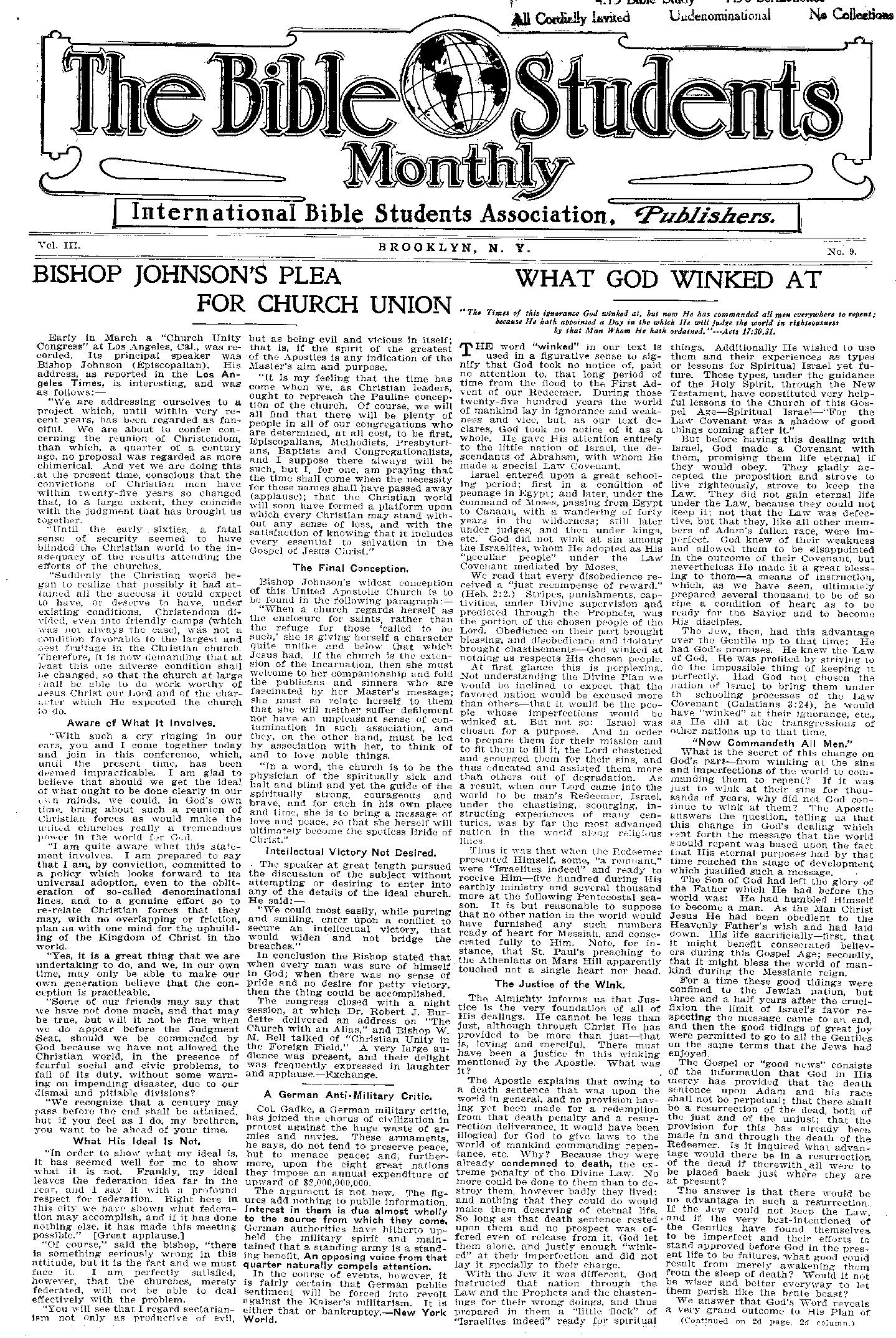
Vol. III.
No. 9.
BROOKLYN, N. Y.
BISHOP JOHNSON’S PLEA
WHAT GOD WINKED AT
Early in March a “Church Unity Congress” at Los Angeles, Cal., was recorded. Its principal speaker was Bishop Johnson (Episcopalian). His address, as reported in the Los Angeles Times, is interesting, and was as follows: —
“We are addressing ourselves to a project which, until within very recent years, has been regarded as fanciful. We are about to confer concerning the reunion of Christendom, than which, a quarter of a century ago, no proposal was regarded as more chimerical. And yet we are doing this at the present time, conscious that the convictions of Christian men have within twenty-five years so changed that, to a large extent, they coincide with the judgment that has brought us together.
“Until the early sixties, a fatal sense of security seemed to have blinded the Christian world to the inadequacy of the results attending the efforts of the churches.
“Suddenly the Christian world began to realize that possibly it had attained all the success it could expect io have, or deserve to have, under existing conditions. Christendom divided, even into friendly camps (which was not always the case), was not a condition favorable to the largest and best fruitage in the Christian church. Therefore, it is now demanding that at least this one adverse condition shall be changed, so that the church at large : hall be able to do work worthy of Jesus Christ our Lord and of the character which He expected the church to do.
Aware cf What It Involves.
“With such a cry ringing in our ears, you and I come together today and join in this conference, which, until the present time, has been deemed impracticable. I am glad to believe that should we get the ideal of what ought to be done clearly in our own minds, we could, in God’s own time, bring about such a reunion of Christian forces as would make 'the united churches really a tremendous power in the world for Ged.
“I am quite aware what this statement involves. I am prepared to say that I am, by conviction, committed to a policy which looks forward to its universal adoption, even to the obliteration of so-called denominational lines, and to a genuine effort so to re-relate Christian forces that they may, with no overlapping or friction, plan as with one mind for the upbuilding of the Kingdom of Christ in the world.
“Yes, it is a great thing that we are undertaking to do, and we, in our own time, may only be able to make our own generation believe that the conception is practicable.
“Some of our friends may say that we have not done much, and that may be true, but will it not be fine when we do appear before the Judgment Seat, should we be commended by God because we have not allowed the Christian world, in the presence of fearful social and civic problems, to fail of its duty, without some warning on impending disaster, due to our dismal and pitiable divisions?
“We recognize that a century may pass before the end shall be attained, but if you feel as I do, my brethren, you want to be ahead of your time.
What His Ideal Is Not.
“In order to showT what my ideal is, it has seemed well for me to show what it is not. Frankly, my ideal leaves the federation idea far in the rear, and I say it with a profound respect for federation. Right here in this city we have shown what federation may accomplish, and if it has done nothing else, it has made this meeting possible.” [Great applause.]
“Of course,” said the bishop, “there is something seriously wrong in this attitude, but it is the fact and we must face it. I am perfectly satisfied, however, that the churches, merely federated, will not be able to deal effectively with the problem.
“You will see that I regard sectarianism not only as productive of evil,
FOR CHURCH
UNION
but as being evil and vicious in itself; that is, if the spirit of the greatest of the Apostles is any indication of the Master’s aim and purpose.
“It is my feeling that the time has come when we, as Christian leaders, ought to repreach the Pauline conception of the church. Of course, we will all find that there will be plenty of people in all of our congregations who are determined, at all cost, to be first, Episcopalians, Methodists, Presbyterians, Baptists and Congregationalists, and I suppose there always will be such, but I, for one, am praying that the time shall come when the necessity for these names shall have passed away (applause); that the Christian world will soon have formed a platform upon which every Christian may stand without any sense of loss, and with the satisfaction of knowing that it includes every essential to salvation in the Gospel of Jesus Christ.”
The Final Conception.
Bishop Johnson’s widest conception of this United Apostolic Church is to be found in the following paragraph: —
“When a church regards herself as the enclosure for saints, rather than the refuge for those ‘called to be such,’ she is giving herself a character quite unlike and below that which Jesus had. If the church is the extension of the Incarnation, then she must welcome to her companionship and fold the publicans and sinners who are fascinated by her Master’s message; she must so relate herself to them that she will neither suffer defilement nor have an unpleasant sense of contamination in such association, and they, on the other hand, must be led by association with her, to think of and to love noble things.
“In a word, the church is to be the physician of the spiritually sick and halt and blind and yet the guide of the spiritually strong. courageous and brave, and for each in his own place and time, she is to bring a message of love and peace, so that she herself will ultimately become the spotless Bride of Christ.”
Intellectual Victory Not Desired.
• The speaker at great length pursued the discussion of the subject without attempting or desiring to enter into any of the details of the ideal church. He said: —
“We could most easily, while purring and smiling, enter upon a conflict to secure an intellectual victory, that would widen and not bridge the breaches.”
In conclusion the Bishop stated that when every man was sure of himself in. God; when there was no sense of pride and no desire for petty victory, then the thing could be accomplished.
The congress closed with a night session, at which Dr. Robert J. Burdette delivered an address on “The Church with an Alias,” and Bishop W. M. Bell talked of “Christian Unity in the Foreign Field.” A very large audience was present, and their delight was frequently expressed in laughter and applause.—Exchange.
A German Anti-Military Critic.
Col. Gadke, a German military critic, has joined the chorus of civilization in protest against the huge waste of armies and navies. These armaments, he says, do not tend to preserve peace, but to menace peace; and, furthermore, upon the eight great nations they impose an annual expenditure of upward of $2,000,000,000.
The argument is not new. The figures add .nothing to public information. Interest in them is due almost wholly to the source from which they come. German authorities have hitherto upheld the military spirit and maintained that a standing army is a standing benefit. An opposing voice from that quarter naturally compels attention.
In the course of events, however, it is fairly certain that German public sentiment will be forced into revolt against the Kaiser’s militarism. It is either that or bankruptcy.—New York World.
“The Times of this ignorance God winked at, but now He has commanded all men everywhere to recent; because He hath appointed a Day in the which He will judge the world in righteousness by that Man Whom He hath ordained. "•—Acts 17:30,31.
THE word “winked” in our text is used in a figurative sense to signify that God took no notice of, paid no attention to, that long period of time from the flood to the First Advent of our Redeemer. During those twenty-five hundred years the world of mankind lay in ignorance and weakness and vice, but, as our text declares, God took no notice of it as a whole. He gave His attention entirely to the little nation of Israel, the descendants of Abraham, with whom He made a special Law Covenant.
Israel entered upon a great schooling period; first in a condition of peonage in Egypt; and later, under the command of Moses, passing from Egypt to Canaan, with a wandering of forty years in the wilderness; still later under judges, and then under kings, etc. God did not wink at sin among the Israelites, whom He adopted as His “p.eculiar people” under the Law Covenant mediated by Moses.
We read that every disobedience received a “just recompense of reward.” (Heb. 2:2.) Stripes, punishments, captivities, under Divine supervision qnd predicted through the Prophets, was the portion of the chosen people of the Lord. Obedience on their part brought blessing, and disobedience and idolatry brought chastisements—God winked at nothing as respects His chosen people.
At first glance this is perplexing. Not understanding the Divine Plan we would be inclined to expect that the favored nation would be excused more than others—that it would be the people whose imperfections would be winked at. But not so: Israel was chosen for a purpose. And in order to prepare them for their mission and to fit them to fill it, the Lord chastened and scourged them for their sins, and thus educated and assisted them more than others out of degradation. As a result, when our Lord came into the world to be man’s Redeemer, Israel, under the chastising, scourging, instructing experiences of many centuries, was by far the most advanced nation in the world along religious lines.
Thus it was that when the Redeemer presented Himself, some, “a remnant,” were “Israelites indeed” and ready to receive Him—five hundred during His earthly ministry and several thousand more at the following Pentecostal season. It is but reasonable to suppose that no other nation in the world would have furnished any such numbers ready of heart for Messiah, and consecrated fully to Him. Note, for instance, that St. Paul’s preaching to the Athenians on Mars Hill apparently touched not a single heart nor head.
The Justice of the Wink.
The Almighty informs us that Justice is the very foundation of all of His dealings. He cannot be less than just, although through Christ He has provided to be more than just—that is, loving and merciful. There must have been a justice in this winking mentioned by the Apostle. What was it?
The Apostle explains that owing to a death sentence that was upon the world in general, and no provision having yet been made for a redemption from that death penalty and a resurrection deliverance, it would have been illogical for God to give laws to the world of mankind commanding repentance, etc. Why? Because they were already condemned to death, the extreme penalty of the Divine Law. No more could be done to them than to destroy them, however badly they lived; and nothing that they could do would make them deserving of eternal life. So long as that death sentence rested • upon them and no prospect was offered even of release from it, God let them alone, and justly enough “winked” at their imperfection and did not lay it specially to their charge.
With the Jew it was different. God instructed that nation through the Law and the Prophets and the chasten-ings for their wrong doings, and thus prepared in them a “little flock” of “Israelites indeed” ready for spiritual things. Additionally He wished to use them and their experiences as types or lessons for Spiritual Israel yet future. These types, under the guidance of the Holy Spirit, through the New Testament, have constituted very helpful lessons to the Church of this Gospel Age—Spiritual Israel—“For the Law Covenant was a shadow of good things coming after it.”
But before having this dealing with Israel, God made a Covenant with them, promising them life eternal if they would obey. They gladly accepted the proposition and strove to live righteously, strove to keep the Law. They did not gain eternal life under the Law, because they could not keep it; not that the Law was defective, but that they, like all other members of Adam’s fallen race, were imperfect. God knew of their weakness and allowed them to be disappointed in the outcome of their Covenant, but nevertheless Ho made it a great blessing to them—a means of instruction, which, as we have seen, ultimately prepared several thousand to be of so ripe a condition of heart as to be ready for the Savior and to become His disciples.
The Jew, then, had this advantage over the Gentile up to that time: He had God’s promises. He knew the Law of God. He was profited by striving to do the impossible thing of keeping it perfectly. Had God not chosen the nation of Israel to bring them under th schooling processes of the Law Covenant (Galatians 3:24), he would have “winked” at their ignorance, etc., as He did at the transgressions of other nations up to that time.
“Now Commandeth All Men.”
What is the secret of this change on God’s part—from winking at the sins and imperfections of the world to commanding them to repent? If it was just to wink at their sins for thousands of years, why did not God continue to wink at them? The Apostle answers the question, telling us that this change in God’s dealing wThich ‘ent forth the message that the world should repent was based upon the fact that His eternal purposes had by that time reached the stage of development which justified such a message.
The Son of God had left the glory of the Father which He had before the world was: He had humbled Himself to become a man. As the Man Christ Jesus He had been obedient to the Heavenly Father’s wish and had laid down. His life sacrificially—first, that it might benefit consecrated believers during this Gospel Age; secondly, that it might bless the world of mankind during the Messianic reign.
For a time these good tidings were confined to the Jewish nation, but three and a half years after the crucifixion the limit of Israel’s favor respecting the message came to an end, and then the gpod tidings of great joy were permitted to go to all the Gentiles on the same terms that the Jews had enjoyed.
The Gospel or “good news” consists of the information that God in His mercy has provided that the death sentence upon Adam and his race shall not be perpetual; that there shall be a. resurrection of the dead, both of the just and of the unjust; that the provision for this has already been made in and through the death of the Redeemer. Is it inquired What advantage would there be in a resurrection of the dead if therewith all were to be placed back just where they are at present?
The answer is that there would be no advantage in such a resurrection. If the Jew could not keep the Law, and if the very best-intentioned of the Gentiles have found themselves to be imperfect and their efforts to stand approved before God in the present life to be failures, what good could result from merely awakening them from the sleep of death? Would it not be wiser and better everyway to let them perish like the brute beast?
We answer that God’s Word reveals a very grand outcome to His Plan of
(Continued on 2d page, 2d column, i
THE BIBLE STUDENTS MONTHLY
W. F. HUDGINGS, Editor.
13, 15, 17 HICKS ST., BROOKLYN, N.Y.
Monthly—12 cts. a year. Single cop es, 1c.
An Independent, Unsectarian Religions Newspaper, Specially Devoted to the Forwarding of the Laymen's Home Missionary Movement for the Glory of God and Good of Humanity.
Ministers of the I. B. S. A. render their services at funerals free of charge. They also invite correspond-encefrom those desiring Christian counsel.
MONEY TO BE DICTATOR.
fpHE trust system seems to be laying J- hold of everything — railroads, steamships, steel production, smelting, bridge works, oil refining and selling, meat, products, groceries. Above all it has made a money combination or banking system, the most gigantic the world has ever known. Billions of dollars of the people are in the banks, and the banks are controlled by wealthy syndicates. This money trust has a power of control which is marvelous. As in Great Britain the titled aristocracy hold the land and collect immense revenues and bring great pressure to bear .socially and financially, so now it is in this country, with evidently more to follow.
An Illustration of This Power.
As an illustration of this power we note the facts recently set forth in the New York Press respecting the Magazine Trust. This Trust has recently bought up several magazines and put them under one management. And directly and indirectly it is able to dictate the policies of nearly all the ■others. The Editor of Hampton's Magazine sets forth that, having refused to enter the combine, his magazine is suffering boycott. Thus the capitalist syndicate, which is said to be headed by J. P. Morgan, the banker and trustifier, says: “Hampton’s Magazine is warned to cease ‘muckraking,’ to cease attacks upon Wall Street methods, to cease attacks upon the trusts in general.” Mr. Hampton .says:—
‘‘Constantly increasing pressure has been brought to bear on us to change our policy since Wall Street started its attempt to corner the magazine market and organize the biggest of all trusts. First this took the form of withdrawal of advertising. That failing to be effective we have been threatened in various ways. A few months ago we were notified that if we printed an article relative to a certain great corporation, the president of that corporation would make trouble for us with our stockholders. We printed the article. Within a month various magazines and newspapers and ‘news bureaus’ began to attack the stock of Hampton's .Magazine.
Money Wields Club.
‘‘About this time we were advised that ‘no bank with Wall Street connections’ would have anything to do with this corporation as long as it remained under its present management. .Also stockholders advised us that they had been approached, apparently by agents of Wall Street brokerage houses, who endeavored to secure their proxies to vote at the meeting.
‘‘The American people are in the grasp of the ‘money trust.’ In the past the banker’s only question has been the character of the business man, his experience and skill, the nature of his business, its conditions and the probable chances of success. Conditions have changed. ‘Thou shalt not run counter to Wall Street’ is not the eleventh commandment—it is the first in the American business world.”
This matter of coercion along financial lines is one of the most powerful methods of warfare ever known. Yet it keeps within the law. The effect will be to keep the surface of things quite smooth, whatever may be the turbulence beneath. The cry of “Peace, peace,” where there is much discontent, will apparently be borne out by the facts, so far as the great newspapers and magazines represent them. The excuse will be that the public will get as much information as is good for them. What will happen to personal liberty under such conditions no one can foretell. God’s people are to be peacemakers, to “seek peace and pursue it.” Nevertheless the Scriptures forewarn us that as all of these attempts to control the pressure and growing discontent of our time will prove unavailing, so, ultimately, there will be a great explosion, which will reach to the uttermost corner of the earth—the time when newspapers and banks politicians and everybody will be lost, and when every man’s hand will be against his neighbor. We see it coming!
While we see the storm coming, let us remember the words of the Prophet, “We will not fear though the earth (society) be removed, and though the mountains (kingdoms) be carried into the midst of the sea (anarchy).”—Psa. 46:2
(Continued from first page.)
Salvation. The word resurrection, as Scripturally used, signifies much more than to be merely resuscitated. It signifies awakening and more, uplifting out of all sin and death conditions, up. up, up to perfection—to all that was lost by Father Adam and to be redeemed through the Calvary sacrifice.
“God Hath Appointed a Day.”
This, then, is the meaning of the Apostle’s argument. By providing the Lord Jesus Christ as the Redeemer of the Church and the world, God has made possible a fresh trial or judgment for Adam and his race. Adam’s first judgment or trial day was in Eden. There he lost everything by his disobedience and brought upon himself and all of his race the Divine sentence to death. Christ has appeared that He might redeem Adam and his race, for the very purpose of giving them individually another full, fair trial or judgment for life everlasting or death everlasting.
That general Judgment Day mentioned by St. Paul in our text is neither a damnation day nor a twenty-four hour day. It is the thousand-year day of Christ—the period of His Mediatorial reign, in the which Satan will be bound, all evil influences be removed and the light of the knowledge of the glory of God be made to fill the whole earth. St. Peter reminds us, “Beloved, be not ignorant of this one thing, that one day with the Lord is as a thousand years.” (2 Peter 3:8.) This is the key to the expressions, “The Day of Christ,” “The Day of Judgment,” etc.
The Mediatorial reign will be the Day of Judgment, or trial, in the sense that all mankind, the living and the dead, will then be brought to a full knowledge of God and to full opportunity to regain by resurrection processes a complete uplift from all weaknesses, imperfections, etc., which have resulted from our share in Adam’s sin and our own weakness and ignorance. Sins to the extent that they were wilful will to the same extent be punishable and receive a “just recompense of reward.” (Heb. 2:2.) Every good endeavor will be rewarded and every transgression will be punished.
From this standpoint we see the force of the Apostle’s argument, that it is the Divine intention to grant to every member of Adam’s race another trial, another judgment, to determine afresh and individually the worthiness or unworthiness of each to have eternal life. But why should this fact make any difference to the world in the present life? Why did not God wait until the Messianic Age and give them all a surprise? Why did He send them the message of His love and a revelation of this knowledge of His future dealings? Did He not know what the past eighteen centuries have proven, namely, that few of mankind would have the “hearing ear,” and that fewer still, after hearing, would so love righteousness and so hate iniquity as to sacrifice the interests of the present life by espousing the Gospel message, repenting of sin, and seeking to live a saintly life, in opposition to all unrighteousness?
Yes, we answer, it is written, “Known unto God are all His works from the beginning of the world.” (Acts 15:18.) God surely knew that the message of His grace would generally fall upon ears that were dull of hearing. That we might know this He caused it to be written in the prophecies in advance, that few would have the hearing ear for His message of love and mercy. Why, then, did He send the message? We answer that there were two reasons for His so doing:
(1) He intended that a witness should be given so that those comprehending would have an incentive to a reformation of life. He wished all to know that their responsibility in life would be proportionate to their knowledge of this fact of redemption. This principle is stated in the Scriptures by our Lord. He declares that he who knew not and was disobedient would be punished with comparatively few stripes, while those who knew better and sinned with deliberation would be punished with many stripes—in that New Dispensation.
(2) Another reason for the promulgation of this good tidings of the Day of the Lord’s Judgment is that God wishes to use this message as a primary lesson to do a primary work of instruction for a special class of “elect” characters, whom He is seeking in the present time before the inauguration of the Mediatorial Kingdom. He calls these His “jewels,” the “Bride of Christ,” His “members.”
This class is specially called out of the world now, in advance of the Mes-‘sianic Kingdom, that they may eventually be God’s Royal Priesthood, or priestly kings, in association with the Redeemer. 'These, according to the Scriptures, are to be associate judges of the world with Christ. St. Paul asks, “Know ye not that the saints shall judge the world?” (1 Cor. 6:2.) We do know it, thank God! And we know that they will be thoroughly
competent for that work. Their experiences in the present life, in battling against the world and the flesh and the Devil and coming off conquerors through the assistance of the great High Priest, will make them competent judges of the world; competent, priests to assist and to bless the world; competent under-priests to govern the world from the spirit plane.
“Building Up Yourselves.”
We are glad to warn all men everywhere to repent, and glad also to give them the good reason why they should repent—to tell them of God’s appointed time, the Messianic Epoch, in which all shall have a full opportunity of gaining eternal life through Christ. We are glad to assure them that every endeavor for righteousness put forth now will bring large returns of character development and better position then. We warn them that every wilful transgression, all wilful ignorance, will react upon them to their disadvantage and make for their shame and lasting contempt, under the glorious
Christ’s Ascension from Hades
"He led forth a multitude of captives and gave gifts unto men. ’’—Eph. 4:8.
AS CHRISTENDOM celebrates the resurrection of the Lord Jesus Christ, it is appropriate that our hearts and minds should intelligently grasp the significance of the event commemorated. St. Paul laid great stress upon the resurrection of the dead, declaring that if there be no resurrection of the dead all those whom we count as asleep will never have an awakening, and consequently would be as dead as are brute beasts. Note his emphatic statement to this effect. (1 Cor. 15:12-18.) For here as elsewhere his words contradict the thought that the saintly dead pass immediately to glory and the unsaintly to Purgatory or to eternal torture.
According to the Gospel of Christ, of which St. Paul declares that he was not ashamed, the dead are to be esteemed as though they were asleep— at rest from all the commotion and turmoil and strife, ignorance and superstition and sin and trouble incident to the present reign of sin and death. They have truly entered into rest, whether they were saints or sinners.
The Resurrection by Judgment.
When the time for their awakening shall have come, in the morning of Christ’s reign of righteousness, surrounding conditions will be very different from what they are today-, thank God! Then Satan will be bound, the Bible assures us (Rey. 20:1-3), and the ignorance and superstition, selfishness and crime, which have for centuries marked his reign will gradually draw to a close, for the glorious Messiah-King will not permit them. His reign, on the contrary, will be marked with the true enlightenment of all mankind; and the result will be, as foretold; namely, “Every knee shall bow and every tongue confess to the glory of God.”—Isa. 45:23.
Gradually the world will be brought to an Edenic condition, in harmony with the Divine promise. Indeed, this work may be said to be already beginning. Already, by artesian wells and irrigation processes and highways of travel and good roads and intelligent cultivation of fields, the earth begins to bloom and the wilderness and solitary place to be glad, as foretold by Isaiah the Prophet.—Isa. 35:1.
In speaking of the world’s resurrection our Redeemer designates it a resurrection by judgment. (Rev. Ver., John 5:28, 29.) Messiah’s righteous judgments will then be abroad in the world. The light of knowledge will be as clear as the noon-day sun. Every good deed and endeavor will receive its reward and every wilfully evil deed will receive chastisements, corrections, to the intent that they may learn the advantages of the way of holiness and go up thereon to life eternal, which the willing and obedient may reach by the close of the Messianic Age.
Through the Prophet Daniel, the Lord declares that many of the worldly who now sleep in the dust of the earth shall come forth unto shame and lasting contempt. We can readily realize the shame that will be theirs when the light of full knowledge shall prevail and all of their past shall stand revealed to themselves and to others in its true colors. We can well understand that this will bring contempt to many now highly esteemed among men.
But we can rejoice in the thought that Messiah’s Kingdom then to be in power will deal graciously with all. The stripes of punishment will be tempered with mercy; and gradually by their change of character the contemptible ones will cease to be contemptible. The transforming power of grace and Truth now operating in the Church will be equally forceful then, operating upon the world oi; mankind.
As perfection i§ gradually attained the shame of imperfection will gradusunlight of that New Day. It will search out and expose to all humanity their weaknesses, their sins, to the extent that these have been recognized or approved or have not been resisted.
There are some who are of the saintly class, “called, chosen and faithful”— some of this jewel class, whose judgment or trial is in progress now. We trust that these are striving with might and main to make their calling and election sure through faith in the Redeemer’s sacrifice and obedience to His Law of the Spirit of life—the Law of Love.
Now is our Judgment Day, our day of testing or trial. We will not stand or fall as congregations and denominations or lodges or societies. Our testing is an individual one and nothing short of loyalty of heart to the Lord, to His Truth and to the brethren, will make us, as the Lord’s jewels, “heirs of God,” and joint-heirs with Christ our Lord, if so be that we suffer with Him that we may be also glorified together.”—Rom. 8:17.
ally abate, while all of the shameless will be destroyed in the Second Death. Thus we see the Divine Purpose of the resurrection of the dead and our glorious hope, far different from all the fears that were taught us by the musty traditions of men, from the “dark ages.” And thus we see the force of the Apostle’s words that if there be no resurrection of the dead our hope is vain, our faith is vain.—1 Cor. 15: 14-19.
“But Now Is Christ Risen.”
The Apostle argues, “If the dead rise not,” if that is an impossibility so far as the world in general is concerned, then it is an impossibility so far as Christ is concerned. And “if Christ be not risen,” then all hope, all faith, is vain. And all preaching is not only foolish, but worse. (See 1 Cor. 15:14.) “But now is Christ risen from the dead and become the First-Fruits of them that slept.”
The mere awakening from sleep, as in the case of Lazarus, Dorcas and others, is here left out of the question. Nothing is counted as Resurrection except the full, complete raising up out of death. Our Lord was the “first that should rise from the dead” (Acts 26:23), in this full sense. And He was a First-Fruits, or proof, that others still sleeping will come forth by Divine Power to be exercised by Him in the resurrection morning. The Church will be the next in order—she is to be the Bride-Consort of the Great King and to participate with Him in His glorious work of uplifting the race which fell from the Divine image into sin and death through Father Adam. The redemption-price has been provided in the death of Jesus; and the time for beginning the great work of “restitution of all things” merely waits until the completion of the election of the saintly Church.—Acts 3:19-21.
Christ Arose from Hades.
Preaching on the Day of Pentecost, St. Peter declares that God raised Christ from the dead. Then, in proof that this was the Divine intention from the beginning, he quotes from the prophetic Psalm of David, “Thou wilt not leave My soul in hell.” The Apostle’s quotation (Acts 2:27), is in Greek, in which the word hell is hades. His quotation is from the Hebrew, in which the word hell is sheol—the only word rendered hell throughout the entire Old Testament.
In the morning of our Lord’s resurrection, He said to Mary, “Touch Me not, for I am not yet ascended to My Father and your Father; to My God, and your God.” (John 20:17.) The language of the so-called Ajpostles’ Creed, which is coming more and more into vogue with all denominations, declares, “He descended into hell and rose again the third day.” In a version of this creed published by the Presbyterian Board of Publication of Philadelphia, a foot-note very properly explains that the word hell here used is, in the Greek, hades, which signifies the state or condition of death.
This is a very important matter, which should be made widely known, because of the false conception of hell handed down to us through our creeds formulated in the “dark ages,” and since a misinterpretation of sheol and hades has been given to the public mind—the impression that these words signify a place of torture. All this is wholly false, as every Greek and Hebrew scholar knows, and, if crossquestioned, will admit.
It is an important question to the public because this misconception of the meaning of the word hell is driving hundreds, yea, thousands, away from God and away from the Bible. They correctly reason that the teaching that our Creator foreknew and intended a hell of torture for His creatures is beyond conception, beyond be-
lier', and manifestly untrue, as no holy being could be so unjust, unkind, unloving. It is time that all such should see that the fault lies with the creeds and not with the Bible—that the Bible teaches a hell, sheol, hades, into which all go, both good and bad, and from which all will be called forth in the resurrection morning by the great Redeemer.
“Leading Captivity Captive.”
A better translation reads, “Our Lord ascended on high leading a multitude of captives.” These words are a pen picture representing a great King as a Conqueror returning from a victory over an opponent. The victor rides in a chariot at the head of the procession, surrounded by trumpets and acclaimers, and behind him follow the evidences, the proofs of his victory—either those whom he has captured and enslaved, or, as in this case, those who have been captured and enslaved and whom the Conqueror has set free.
The picture is graphic and wonderful, notwithstanding the fact that a considerable time has intervened between our Lord’s triumphant resurrection and ascension and the evidences of His victory, which are following after Him. Of the great King of Glory Himself, let us remember that after He had suffered by the will of God, “the Just for the unjust,” that He might set mankind free from sin and death, He was “highly exalted and given, a Name above every name.” He was made “partaker cf the divine nature.” He was no longer a man, for “Flesh and blood cannot inherit the Kingdom of God.”—1 Cor. 15:50.
True, He still has as one of His many titles, The Son of Man, which identifies Him with our race and the work which He is in process of accomplishing for it and which He will finish during His Mediatorial reign. We are reminded by the Apostle that He was put to death in the flesh and made alive in the spirit—a Spirit Being. He died as a. man this side the veil. He arose a New Creature the other side the veil—a Spirit Being. He was “sown in dishonor, raised in glory; sown a natural body, raised a spirit body.” As the Church’s Head and Forerunner He passed beyond the veil; and now shortly, as participants with Him in the glorious triumphal procession, will follow “the Church which is His Body,” sharers with Him in the First Resurrection—His Bride.
Next in processional order, following the Bride class, the “very elect,” will come the “great company” from every nation, people, kindred and tongue, the honored servants of the heavenly Bridegroom and Bride. “The virgins, her companions” (Psalm 45:14), will follow after the Bride into the presence of the great King, Jehovah. Next in processional order will come the Ancient Worthies, frdm faithful Abel down to John the Baptist, the last of the Prophets.—Matt. 11:11.
But these will come forth from the tomb in human perfection and not in the spirit perfection of those preceding (Heb. 11:38-40.) In their human perfection, similar to that of Adam before his transgression, plus their development in faith and obedience, these will constitute a first-fruits of Israel and of the world of mankind. Under their ministration, supervised by the glorified ones beyond the veil, the work of restitution and uplifting the captives of sin and death will progress until, at the close of that thousand years of the reign of righteousness, every human being of loyal character will be completely freed from the bondage of. sin and death and imperfection and, with the Ancient Worthies, will come under the direct control of Jehovah Himself.— 1 Cor. 15:24-28.
Thus the great Redeemer and Deliverer will not only present the saintly Church, blameless and irreproachable before the Father in love, but likewise will liberate all who will of Adam’s race, now asleep and degraded. No wonder the Scriptures declare of the end of His triumphal procession, “He shall see of the travail of His soul and be satisfied.”—Isaiah 53:11.
“And Gave Gifts Unto Men.”
All the blessings which, in God’s providence are now coming to the Church during this Gospel Age, and all the blessings that in the Messianic Age will flow to natural Israel, “the rebellious also,” and all the blessings that will flow through Israel and its New Covenant to all the families of the earth, proceed directly or indirectly from the great victory which our Lord Jesus gained over sin and death.
Our text and context, as well as the Psalm from which the quotation is made, bear out this thought. It is because our Lord descended and because, in harmony with the Father’s will, He loft the courts of heavenly glory and humbled Himself to become a man, and then “humbled Himself to death, and even to the death of the cross,” that His exaltation came as a reward of His loyalty to the Father’s will.
And in the Divine Plan it is because His resurrection Body and glory were a reward, a blessing—His earthly body and nature and rights had not been, forfeited through disobedience—that He had the latter with all its privileges to bestow upon Adam’s dead and dying race. He gave the merit of that sacrifice, first imputedly, on behalf of all desirous of walking in His steps of self-sacrifice even unto death, that these might be, in the Father’s good pleasure, counted as His members and companions on the heavenly plane.
To this end the first gifts were bestowed at Pentecost; and all of similar class throughout this Age have had opportunity for participation therein. Additionally gifts of helpfulness and instruction and assistance were provided through the Apostles, orators, pastors and teachers of the Church— for the qualification of these saintly footstep followers for the work of service in building up the Body of Christ,
MAm I My Brother's Keeper?”
HOW long Cain brooded over his sacrifice being rejected by the Lord, how long it took for his wrong desire, his envy, to conceive and bring forth the sin of murder we are not told— merely the fact is stated that this was the bitter fruit. The Lord did not hinder the murder, and even dealt most generously with the murderer to whose attention the matter is called by the inquiry, “Where is Abel, thy brother?”
As the question implied ignorance on the Lord’s part, Cain may have wondered to what extent the Almighty was omniscient, all-seeing and his answer was in line with this. “I know not: am I my brother’s keeper?” This question continually recurs, not only among the members of Adam’s natural family but also among the brethren of the Lord’s family, the New Creation. To what extent is one his brother’s keeper? How far does our responsibility go?
Let us look first at the spiritual family. Its members are declared to be bounden or holden one to another by the cords of love, by membership in the Body of Christ, so that if one member suffer all the members suffer with it, and if one member be honored all the members are honored.
Every Member Is Necessary.
The Apostle, expatiating on the importance of the various members of the body, declares that even the humblest is necessary—that the hand may not say to the foot, I have no need of thee; and that as in our natural bodies we take the greatest care of those members which are least pleasing, so in the spiritual family those which are least attractive of themselves need our attention and sympathy and covering with the garment of charity more than do others. The new commandment which the Lord gave to His disciples was, “That ye love one another as I have loved you.” We cannot love the world with that deep, intensive love—it is not incumbent upon us to sacrifice our own interests for the world; but it is made obligatory that we have the Lord’s Spirit toward all the household of faith, so that, as He did, so shall we rejoice to lay down our lives for the brethren, serving them with our moments and our hours at the cost of our own ease and comfort.
Terms of Membership in the Body.
According to this, the law of our Head, the terms and conditions of membership in His Body, we are our brothers’ keepers; each one has a responsibility for his fellow—not to intrude upon him as a busybody, but to look out for his interests, his welfare, and to do all for that brother that he would have that brother do for him— yea, more than this: that he would la5r down his life for his brother, as Christ loved the church and gave Himself for her.
If all the Lord’s brethren could realize this to be the Divine rule governing the New Creation and realize that only those who live up to this rule are making their calling and election sure, what an awakening of zeal among the brethren for the service one of another would result, and what a blessing would come to all of the Lord’s dear flock! Let us take heed that no man take our crown—that we be found possessors of the Master’s Spirit toward the fellow members, and thus be accounted ■worthy of a share in the Kingdom class.
As for the world: We are to remember that while there is a wide gulf between the natural man and the New Creature in Christ, nevertheless according to the flesh there is a brotheruntil the elect Body shall be complete.—Eph. 4:11-13.
“WHERE ARE THE DEAD?”
This article was published in this paper in Volume one, Number 3. The interest aroused, and the great demand for copies of it have been remarkable. A sample copy will be mailed to any one free. Address, Bible Society, .17 Hicks Street, Brooklyn.
Soon these gifts and blessings and privileges now granted and imputed to the Church will be no longer needed by the class being prepared for the heavenly Joint-heirship. Then the gift of the Messianic Kingdom, and through Israel the gift of the New Covenant (Jer. 31:31), will be bestowed upon the blood-bought world, granting to them individually the opportunity of recovering from all their defilement and imperfection.
Let us then hail this great Redeemer and Deliverer Lord of all! Let us bow our hearts to Him now and voluntarily put on the yoke of His service and suffer with Him “outside the camp,” that we may be accounted worthy of sharing with Him in the glorious work of His Mediatorial Kingdom as His Bride and Joint-heir.—Heb. 13:11-13..
hood which we are not to disdain nor overlook. The entire groaning creation are our brethren according to the flesh, and have claims upon us that the Lord would have us recognize.
Loving the Neighbor as Thyself.
They are our “neighbors,” and according even to the Jewish letter of the law the neighbor must be loved as one’s self—his interests are to be safeguarded as we would guard our own interests. Hence, in the whole world of mankind, this question, “Am I my brother’s keeper?” would properly be answered, Yes, each one should be on the lookout for the interests, the welfare of others as well as his own, and so doing would not be disposed to override or cheat his neighbor, but, according to the Golden Rule, to do unto others as he would have them do to him.
We cannot hope that the world, blinded by selfishness and devoting all the energies of life along selfish lines and ambitious channels—we are not to expect the world to appreciate this high standard of the Divine Law. But surely all who are New Creatures in Christ should appreciate it, and in their dealings with the world, therefore, should not only be just, but more—loving and generous and kind, unwilling to injure, willing to bless.
Thus the Lord’s people are to be peculiar people in that they unselfishly will seek to be their brothers’ keepers, looking out for the interests of others as well as for their own interests; not necessarily laying down their lives for their neighbors, but ready to do good unto all men as they have opportunity, especially to the household of faith.
The Voice of Abel’s Blood.
PutCng the matter in figurative language, the Lord declared to Cain that Abel’s blood cried from the ground for vengeance. It was another way of telling Cain that the Lord was omniscient, knew everything that transpired, knew that his brother had died at his hand. In this figurative sense all sin cries for the punishment of the wrong-doer—it is the voice of Justice.
The Apostle Paul, referring to the death of our Lord, who similarly was murdered by His brethren, and whose blood might be expected to cry out against’ them, against the whole world pf mankind, tells us that, instead of crying for vengeance, our Lord’s blood—shed as a sacrifice on our behalf, as an atonement for our sins— cries out not for justice but for mercy! O, how gracious, that our dear Redeemer laid not the sin to the charge of those who crucified Him and de-spitefully used Him, but that in His generosity He is willing to make an appropriation of His precious blood on behalf of the sinners, to effect their reconciliation to God by the blood of the cross—by His death on the cross!
The Apostle’s words are that the blood of Jesus speaketh better things for us than the blood of Abel. (Heb. 12:24.) Let us not forget that blood stands for or represents something higher than itself—that when we speak of the blood of Christ we are not referring merely to that which coursed His veins and arteries and which flowed from His wounded side, but we are speaking of that which the blood represents, namely, the life: as the Lord said. “The Life is the blood.”
Redemption By the Precious Blood.
Hence, whenever the shedding of Blood is referred to, the giving up of life, the death, is the main thought— thus the passage, “We are not redeemed with corruptible things such as silver and gold, but with the precious blood of Christ,” signifies that we are redeemed with the incorruptible life of Christ—the life which was not under penalty, not forfeited, not condemned, but approved, and which was yielded up as a sacrifice, a corresponding price, a ransom, for the forfeited life of Adam and his race.
The curse of God was upon Cain, the murderer—Divine condemnation rested upon him; he was cut off from communion with God, previously enjoyed, and according to his own language felt his condemnation and outcast condition severely. The Lord declares through the Apostle that no murderer hath eternal life. This signifies that anyone having the spirit of murder in his heart is unfit for eternal life, could not, according to Divine arrangement, be granted that great boon or blessing—he himself must die, because unfit for life.
Hope for Cain.
This does not mean that there will be no hope for Cain in the future: we know not to what extent he may have repented of his crime before he died. But we are sure that he, as well as all mankind, not only will receive a just recompense or punishment for their sins, but also secure a measure of the blessing which God has provided for every member of the race through the dear Redeemer, who bought us with His precious blood.
On the other hand, for one of the Lord’s consecrated ones, begotten of the spirit, to commit murder intentionally, willingly, in the first degree, would undoubtedly mean his Second Death; because it would signify that the spirit of love, the Spirit of God, must have entirely perished in his heart ere such a deed could be deliberately and intentionally committed. We would have no hope for such an one. More than this, for wilful and deliberate hatred toward a brother to be engendered in the heart would seem to mean the perishing of the spirit of love there, and if so would, mean the Second Death.
However, because of the weakness of the flesh it would he very unsafe for any of us to attempt to judge closely upon this point. But it would be well indeed that we should be fearful along these lines, as the Apostle suggests, “Let us fear, lest a promise being left us of entering into His rest any of us should seem to come short of it.” (Heb. 4:1.) Let us fear, therefore, any approximation of a feeling of hatred, anger or malice against a brother in the Lord or against anybody. Let us strive more and more that the new mind shall control positively in our thoughts and intentions, and so far as possible in our outward deportment.
TRUST IN THE LORD.
O trust thyself to Jesus, When conscious of thy sin—
Of its heavy weight upon thee, Of its mighty power within.
Then is the hour of pleading His finished work for thee;
Then is the time for singing, His blood was shed for me.
O trust theyself to Jesus,
When faith is dim and weak, And the very One thou needest
Thou canst not rise to seek, Then is the hour for seeing
That he hath come to thee; , Then is the time for singing,
His touch hath healed me.
O trust thyself to Jesus, When tempted to transgress
By hasty word, or angry look, Or thought of bitterness.
Then is the hour for claiming Thy Lord to fight for thee;
Then is the time for singing, He doth deliver me.
O trust thyself to Jesus,
When daily cares perplex,
And trifles seem to gain a power Thy inner soul to vex.
Then is the hour for grasping
His hand who walked the sea;
Then is the time for singing, He makes it calm for me.
O trust thyself to Jesus,
When some truth thou canst not see For the mists of strife, and error,
That, veil its form from thee.
Then is the hour for looking To him to guide thee right;
Then is the time for singing, The Lord shall be my Light.
—Selected.
PASTOR RUSSELL’S SCRIPTURE STUDIES.
These volumes deserve a careful study by all who are not thoroughly satisfied with the Bible interpretations of the “dark ages.” They can be bought for a trifle or borrowed free. Address us.
“Bill Arp” the Southern journalist said editorially:
“This wonderful book makes no assertions that are not well sustained by the Scriptures. It is built up stone by stone, and upon every stone is the text, and it becomes a pyramid of God’s love and mercy and wisdom. There is nothing in the Bible that the author denies or doubts, but there are many texts that he throws a flood of light upon that seem to uncover its meaning.”
* ♦ ♦
The set of six volumes, cloth, 3,000 pages, is supplied by the BIBLE AND TRACT SOCIETY, No. 17 HICKS ST., BROOKLYN, N. Y., for the usual price of one such volume, viz., $3,30 prepaid,
Human Immortality, Divine Immortality
"He brought life and immortality to light through
the Gospel.”—2 Tim.
10.
ALL AROUND U‘j we see what the Scriptures designate as a reign of sin and death. The various forms of life in nature—the grass, the flowers, the lower animals and man—exist for a brief summer time of life, then wither and die. This does not strike us as strange, except in conjunction with humanity, and that because of man’s greater intelligence — his appreciation of the value of life, his growth in
knowledge and his opportunities with dom.
The disposition
ability to use life’s his increased wis-
to shun death
not peculiar to man; it is the law nature. The smallest creature, instinct, flees from death. The law self-preservation is properly said to
is of by of be
Thy salvation! Like sheep we are laid in the grave; like the brute beast we seem to perish; we have only a promise of a salvation from death through the Redeemer, and a resurrection from the condition of death.
But God will not be hastened. He has a wise as well as gracious purpose. He has a definite time for every feature of His great work. He had allowed four thousand years to pass before He even sent His Son to begin the work of redeeming mankind, by the payment of a ransom-price. He has allowed nearly two thousand years
the first law of nature. The lower animals, like man, have sensation, an appreciation of pain; but all these things are much more pronounced in humanity than in the lower animals; and the lower the form of life the more slight are these sensations. We are not defending vivisection, but we quite agree with scientists that the pain, the suffering of the lower animals, is as nothing in comparison with that of humanity. We even note the fact that the more refined a human being, the more intense his suffering. Correspondingly, refinement and intelligence bring fear of death and desire for life everlasting.
All mankind seem, instinctively, to hope for a future life, even though with the majority the hope i-s accompanied with dread respecting its
since to mankind tions. It it is but
elapse without recovering from sin and death condi-is for faith to trust; and yet natural that we should in-
conditions.
However, only the Bible
reveals a rational basis for faith respecting a future life—a survival of
the general death where prevalent.
conditions every-
The
for a future life, but furnish a logical basis
pectations.
heathen hope none of them for such ex-
quire, why this delay? For what does God wait so long? The reply is twofold:—
(1) God leaves time for the birth of a sufficient number of Adam’s children to people or fill the earth, purposing that the powers of procreation and the begetting of children shall not continue in the future as in the present. He declares to us that those who attain to that world to come “will neither marry nor be given in marriage,” but in this respect will “be like unto the angels," who have no children, who do not propagate their kind.
(2) Incidentally, in connection with man’s fall and recovery, God purposes a most wonderful manifestation of His Wisdom, Love and Power in the bringing into existence of a new race of beings, not only higher than human nature, but higher also than angelic natures. God purposes a New Creation, whose members will be limited in number and all be made partakers of the divine nature—“far above angels, principalities and powers.” This
those also who love His appearing.” This Includes all who are hungering and thirsting and striving for that righteousness which Messiah’s Kingdom is to bring to the Church through the First Resurrection. Righteousness will eventually be brought to the world through the establishment of the Messianic Kingdom, which will put down all things contrary to the Divine will, and uplift every person and principle loyal to God.
The immortality for which the Apostle declares the Church is to seek is of a different kind entirely from that which the world may expect. It is a different kind even from that which the angels possess. It is the immortality which is a feature or quality of the divine nature. This immortality, the Scriptures assure us, was originally possessed by the Heavenly Father alone. We read, “Who alone hath immortality, dwelling in the light which no man can approach, whom no man hath seen nor can see.” The only be-
The redemption to be accomplished by the Redeemer during His reign as Messiah is to reinstate all the willing and obedient in human perfection and Divine favor, as these were enjoyed by Adam before his transgression All the wilfully wicked, all not desirous of returning to fellowship with God through the Redeemer, will be destroyed in the Second Death. The test will, be so thorough, so crucial, that God declares that there shall be no more crying, no more dying; which implies that there will be no more sin—that the lessons connected with human and angelic transgression will be so thoroughly learned that those found worthy-of eternal life will have their characters eternally fixed in respect to righteousness and sin, as God’s character-is fixed and unchangeable.
gotten of the Father, the Logos, when made flesh, revealed ' — -
mankind (John 1:18). ness of the Logos as
the Father to
The faithful-the Man Christ
New Creation, the most wonderful ex-Only in the Bible can this amplification of Divine power ever
The heathen hope is represented by their great philosophers, Socrates and Plato. Their hope is, in brief, that, in view of man’s great superiority over the beast, it must be he will have u future, even though to all appearance's death means the same to the human as
manifested or ever to be manifested. He has arranged shall be developed during this Gospel Age and in conjunction with the reign of sin and death. It is to be developed from amongst sinners, and is, in rank and time of development, to take pre-
..cedence over the salvation of humanity to the brute. The Bible explains that from sin, sickness, sorrow and death, man was indeed created in his Maker’s ‘ ~ ~
image and likeness and granted the privilege of eternal life on condition of obedience, but that he disobeyed and therefore became subject to death; and that death, the penalty, effects him exactly as it does the brute creation. But the Bible does not leave the subject here. It fells of God’s pity and love, and of His provision to rescue mankind from sin and from death.
fifeK. God Meets Man’s Emergency.
Since the Divine purpose is that only the perfect may live, Adam and his race, as imperfect sinners, could not have eternal life after a violation of the Divine Law; but to meet this emergency, Divine Love provided a Redeemer, who died, “the Just fop |he unjust”—“As by man came death, by” a also comes the resurrection of dead; fqr as ail in Adam die, even sq ip Christ shall be made alive; pvery man in his own order” (1 Corin-.thianS 15:21-23).
F Tlitls God has manifested His char-aetef In a way and to a degree which could never have been known to angels or to men had He not permitted sin to enter the world. His Justice has been manifested in the infliction of the death penalty upon our race for six thousand years. Divine Love has been manifested in the arrangement made by which the Only Begotten Son of God, on the heavenly plane, counted it joy to leave His glory and honor
* and be made flesh and die for our sins. Before the Divine Plan shall be fully consummated, God’s 'Wisdom ahd Power will aiSS eland fully revealed through His dealing with sin and sinners.
► Through ihtl ifiirh ©I Qh'rht’S death, Adam’s transgression Will be fully offset', and the fcenblty of Adam’s sin will be fully to Justice; and Adam himself and all of his posterity, who have fehared his penalty, will be set trfeO from the sighing and crying, the pain and trouble, mental, moral and physical, incidental to the execution of the death sentence against sinners. Thus, through the death of Jesus, Divine provision has been made for a future eternal life for mankind — for so many as will appreciate the privilege and conform themselves to the Divine laws and avail themselves of the privileges which will be granted.
The World’s Salvation Waits.
How natural it is for us to be impatient! The few years of our lives, measuring our knowledge and experience, leave us little appreciation of the span of Eternity, from the Divine standpoint. We are inclined to say, If God designs to do anything for man’s aid, why does He not do it immediately? We cry out, O Lord, haste! haste! Behold Adam’s children, mentally, morally, physically, in a deplorable condition, unable to help themselves, dependent upon Thy mercy,
…