The School of the Prophets (1922)
Download: PDF — The School of the Prophets (1922)
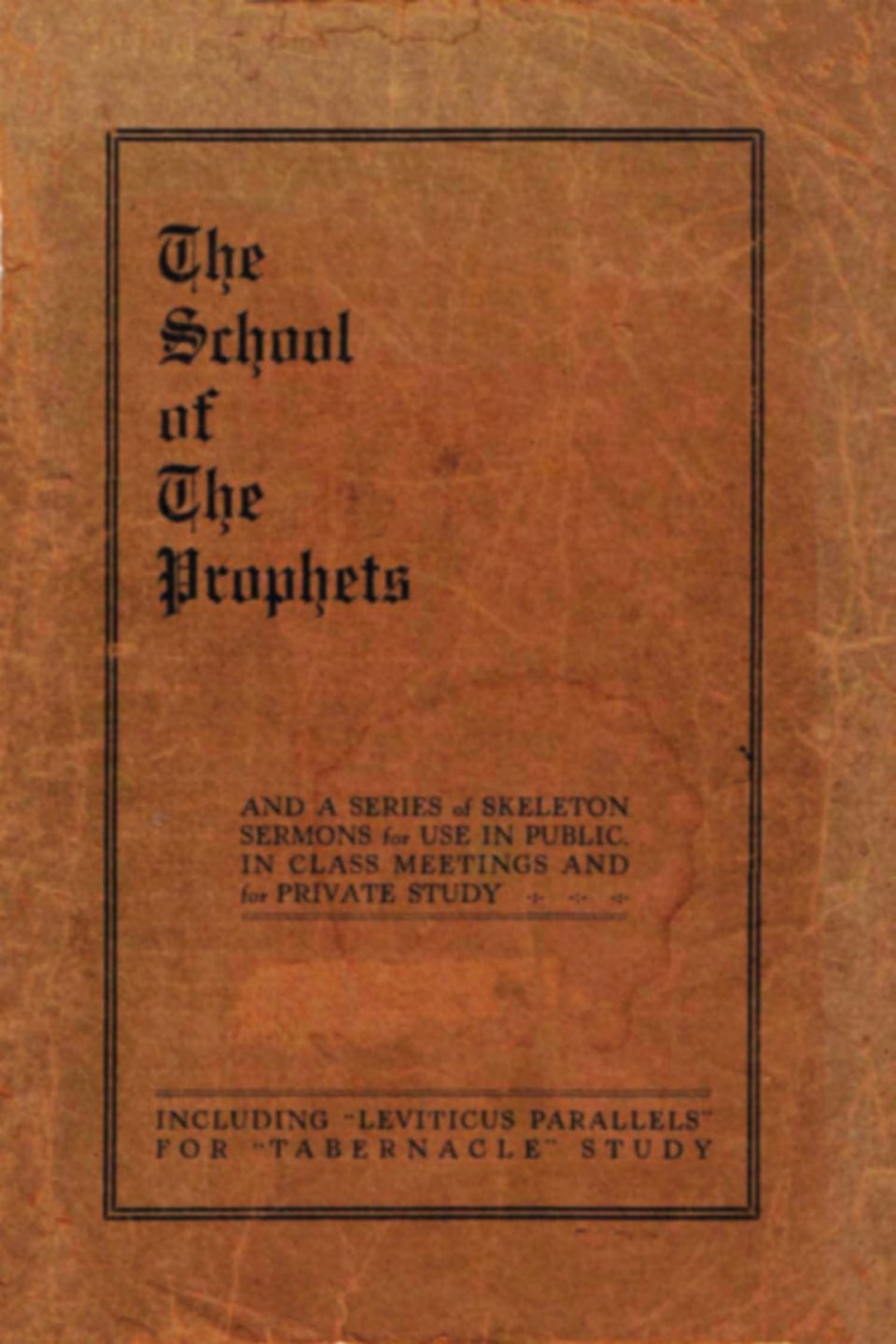
The School of The Prophets
AND A SERIES of SKELETON SERMONS for USE IN PUBLIC. IN CLASS MEETINGS AND for PRIVATE STUDY
INCLUDING "LEVITICUS PARALLELS" FOR "TABERNACLE" STUDY TABLE OF CONTENTS
Foreward 3
Outline of First Chart Discourse 6
Lesson One 11
Lesson Two 14
Lesson Three 16
Lesson Four 18
Lesson Five 19
Lesson Six 20
Lesson Seven 22
Deportment and Gestures 25
Use of Charts 28
Outline of Second Chart Discourse 30
Outline of Third Chart Discourse 31
New Arrangement of Chapters and Questions in
“Tabernacle Shadows” 32
Skeleton Sermons 33
( 1) Why Was Man Created? 33
( 2) Where Are the Dead? 33
( 3) The Oath-Bound Covenant 35
( 4) Why Jesus Came to Earth 36
( 5) Man Redeemed 37
( 6) Resurrection of the Dead 38
( 7) What Is the True Church? 39
( 8) The Second Coming of Christ 40
( 9) What Is a Christian? 41
(10) The World’s Judgment Day at Hand 41
(11) Eden Restored 42
(12) Man’s Everlasting Home 43
Millions Now Living Will Never Die 44
How to Study the Bible 45
Funerals 47
At the Grave 48
Leviticus Parallels (Chapters 8, 9 and 16)
INSERT Back Cover Page 49 The School of the Prophets
Correct Use of the Organs of Speech, with Reading, Breathing and Physical Exercises
BY J. C. LARDENT, LONDON
AND
A Series of Skeleton Sermons For Use in Public, in Class Meetings and for Private Study
BY C. E. STEWART, ST. PAUL
INCLUDING "LEVITICUS PARALLELS" FOR "TABERNACLE" STUDY
THIS WORK IS DEDICATED
to the Lord
of the
NEW CREATION in the interest of the
of His Glorious Message of Salvation; for the Upbuilding of His Saints in Grace and Truth, and for the edifying of those who are seeking GOD if haply they might find Him.
"Study to show thyself approved unto God, a workman that needeth not to be ashamed, rightly dividing the Word of Truth, * a vessel unto honor, sanctified, and meet for the Master's use, and prepared unto every good work." 2 Timothy 2:15, 21.
Copyright, 1922 THE NEW ERA ENTERPRISE St. Paul, Minnesota, U. S. A.
Price, Twenty-five Cents.
FOREWORD
IN old times our gracious Heavenly Father used certain loyal members of the House of Servants as His mouthpieces. As St. Paul declares (Heb. 1:1), "God spoke . . by the Prophets." These representatives of Jehovah spoke in the power and majesty of His name.
Their messages were either begun or ended with the formula—"Thus saith the LORD."
It appears that the prophets were the great orators of natural Israel. Standing apart alike from government and the established priesthood, they were used by God to tell forth His messages—especially in all the great crises of their national affairs, with wonderful energy, boldness and success, depending for their influence mainly upon the effect of their words. Up to the time of Samuel we hear but little of them; the reason probably being that down to his day none but the priests of the noblest class could read or write. However, this grand servant of God, in the fields around his own house at Ramah, gathered a few young men of promise, whom he trained as prophets. Soon similar schools sprung up in several of the larger towns, at Bethel, Jericho and Gilgal. As these institutions were presided over by elder and advanced servants of God, prophets of standing, we find their pupils also bearing the same title of "prophet". As time advanced they grew into quite a numerous class, whose learning stood in such high esteem, that as early as David's time they had become the historians and chroniclers of the Court.—1 Sam. 19:20-24.
Unlike the priesthood, the prophetic office was open to all, it depended neither upon the birth or station of the candidate. They belonged to no special caste, but were recruited from
all ranks alike. Out of this class from time to time, there stood forth men inspired with divine fervor—men who spoke for God, and who felt the burden—yet who fearlessly declared His message; at times, threatening Israel with punishment—if persisting in a wrong course.
Again they would earnestly entreat their countrymen to turn from their evil ways, assuring them of Jehovah's mercy and rich blessing as a reward.
The Schools appear to have consisted of students differing in number; sometimes they were very numerous. (1 Kings 18:4) One elder or leading prophet presided over them, called "father" (1 Sam. 10:12); or "master" (2 Kings 2:3); who was apparently admitted to his office by the ceremony of anointing, (1 Kings 19:15); these students were called his "Sons".
Their chief subject of study was the Law, and its interpretation. Subsidiary subjects of instruction were music and sacred poetry. The prophets that met Saul, came down from the high place with a psaltery and a tabret, a pipe and a harp before them. 1 Sam. 10:5.
Having been themselves taught and trained, they had the function of teaching others, both explaining and interpreting the Scriptures.
This, in brief, is the history and office of God's typical prophets of the past. Coming down on the stream of time to the first advent of our dear Master, we find the prophetic function has a deeper manifestation in explaining the hidden or secret meaning of the types and prophecies of the past—further by showing their applications and fulfilment in the events and conditions of Spiritual Israel.—Luke 24:19; Eph. 3:5.
The Function of Prophecy.
This function of prophecy—more in its aspect of exposition, has continued with the "House of Sons" down to the present day when a great revival in Bible study has been in operation amongst God's consecrated people. All who have received of the anointing of the Holy Spirit have divine authority as prophets, and their function is to tell forth—to preach according to ability and opportunity. Their theme is the "Good tidings of great joy which shall be unto all people"; they are to comfort the mourners and to proclaim the intervening Day of Vengeance of our Lord.—Isa. 61:1-3.
In the matter, however, of public exposition of Jehovah's message, there are certain qualities which must be possessed. The following are the essential attributes for successful ministry: (1) Consecration to God and devotion to His Truth; (2) High Ideals; (3) Sterling Character; (4) Sincerity; (5) Good Appearance; (6) A well-furnished Mind; (7) Graceful Action; (8) Fluency of Language; (9) A Cultivated Voice; (10) A Refined Pronunciation; (11) Unfailing Tact; (12) Singleness of Purpose; (13) Sympathy; (14) Sanctified Common Sense.
There are but a few who are "born orators"—i. e., who possess these attributes naturally. However, the majority of these qualities enumerated are capable of development, and many have these in a latent form, while others can be had by cultivation. Hence quite a few of God's people can develop their powers sufficiently to present quite an acceptable and effective public discourse.
We all realize the great responsibility and trial that is laid upon those who possess this talent and who desire to use it in God's service. How careful it should make us, in telling forth His message—to speak as the oracles of the Lord.—1 Peter 4:11; Jer. 23:28.
When we thus reflect on the vast importance and privilege of being used as divine mouthpieces surely it
is our heart's desire to present our gracious Father's Word as effectively, as attractively, and as powerfully as lies in us. Particularly does the need of preparation appear important, in view of the great crisis now approaching in the affairs of the nations.
Our beloved Pastor's last words, were to the effect that shortly the antitype of Elijah smiting the waters would take place, (2 Kings 2:8; Rev. 17:15). Then the Elisha work is to be done—by a bold, brave class of God's dear children—and a special measure of God's Spirit will be upon them and working through them till the hour comes when no further witnessing can be done this side of the veil. Still, again, the antitype of Gideon and his band is shortly to take place. In view of these sublime prospects, dear fellow prophets, let us be up and doing—let us seek to prepare ourselves more efficiently for the Divine Ministry—asking at the same time for heavenly wisdom and grace which is pledged to assist us. James 1:15.
Mental and Mechanical Aspects.
There are two aspects of the prophetic function,—first, the Mental Aspect, which refers to the art of composition, gathering materials, its arrangement in logical sequence; then its grammatical and sympathetic expression. The second is—the Mechanical Aspect which refers to the graceful carriage of the body, the correct standing and sitting positions, proper management of the breath, accurate enunciation and pronunciation of words, and the essential qualities of a good speaking voice. All these details need attention if really efficient service is to be rendered. As an aid to attain unto this proficiency it is our intention (D. V.) to arrange a course of graduated lessons which can commence at any time. This training will entail but little time regularly day by day, much of which can be carried out in the fleeting spare moments.
History supports the truth that proficiency can only be attained by diligent practice.
No brother should discourage himself with the thought that it is hopeless to become a public speaker because he is not a born orator, or because of failure in the past.
The case of Demosthenes — the world's great master orator—is a good illustration of what determination and application accomplished over natural inability. He was laughed at again and again by the populace—at the first attempt he made of public speaking. One time, we are told, that when his speeches had been ill-received and he was going home with his head covered and in great distress, Satyrus the Player, who was an acquaintance of his, followed and went in with him.
Demosthenes lamented to him that though he was the most laborious of all the orators and had almost sacrificed his health to that application, yet he could gain no favor with the people; but drunken seamen and other unlettered persons were heard and kept the rostrum, while he was entirely disregarded. "You say true," answered Satyrus, "but I will soon provide a remedy, if you will repeat to me some speech in Euripides or Sophocles." When Demosthenes had done so, Satyrus pronounced the same speech, and he did it with such propriety of action and so much in character that it appeared to the orator quite a different passage. He now understood so well how much grace and dignity of action lend to the best oration.
He saw that it was a small matter to premeditate and compose—if the pronunciation and propriety of gesture were not attended to. Demosthenes renewed his flagging determination and built a subterranean room, went there daily to train his voice and gesture, committing to memory the substance of all the conversations and speeches he heard, disciplining and developing himself for the high place he was destined ultimately to fill. He completely overcame his natural defect of stammering and of indistinctness by practicing his speeches with pebbles in his mouth, also strengthened his weak voice by reciting aloud poems and orations while running or walking uphill.
Thus we perceive that the secret of success in public speaking does not so much lie in natural gifts as in the qualities of attention, courage, and perseverance.
Developing Into Bible Lecturers.
With these remarks we close the historical aspect of our subject and come now to consider the various points needing attention in our course of training as Bible Lecturers. First and foremost is the Discourse itself; hence we will give our next consideration to the principles underlying well balanced, comprehensive, and interesting addresses. Having decided on your topic, the immediate need arises of Gathering Material. Meditate upon it; fix your mind upon the subject, and you will find that this theme will become the point of attraction; and material gathers around it with surprising rapidity.
These spontaneous thoughts that radiate around our subject should be committed immediately to paper because our thoughts are fleeting things. Revolve your subject again and again in your mind. This will give birth to ideas. Ideas will fertilize the mind and make it productive of original thought. Ideas will beget ideas; thought will yield thought with astonishing fertility when we concentrate all the intellectual powers upon a subject. The mind is the soil, so to speak, in which thoughts germinate and grow. Only after one has exhausted the natural resources of his own mind should recourse be made to other channels.
In the subjects which we, as Bible Lecturers, use, an abundant supply of material will be found in back numbers of the 'Watch Towers', the seven volumes of Scripture Studies, the Pastor's Sermons in the newspapers, etc., in Convention Reports, etc.
The subjects dealt with are arranged topically in the end of our Berean Bibles, and reach down to 1907.
[And now we have the splendid arrangement of subjects and texts in the Seventh Volume of 'Reprint Towers'.]
A further excellent means of gathering material is through private conversation with others on your subject; ask them questions; get them to do likewise, and your avenues of thought will be opened and thus assist you to take a comprehensive grasp of your subject.
Having committed your materials to paper, collected from your own mental storehouse, from books and conversations, as well as observation, you have now before you a mass of general notes thrown promiscuously together. In this collection lies the materials of your discourse. The
next step is to make a plan and arrange the ideas, in an organized form. A little exercise in composition is therefore necessary to make an outline of your theme.
This outline should be written, not in sentences but like a "Table of Contents". It should be clearly understood that this plan, or brief, is merely a "Skeleton" and not the discourse itself.
It is comprised of single statements arranged as headings and subheadings, each indicated by a separate letter or numeral, and the whole divided into three parts, known as "The Introduction", "The Discussion", and "The Conclusion".
This will be made clear by the following specimen:—
OUTLINE OF FIRST CHART DISCOURSE.
"THE THREE WORLDS."
— Introduction.
—Day of Unbelief; Foundations of Religion being Questioned.
—Brief Review of Foundations a—Evidence of Creator.—Acts 14:16-17. b—Reliability of the Scriptures.
—Need of Child-like Faith and Trust.—Matt 11:25; Heb. 11:1.
—Purpose of the Bible.—Rom. 15:4.
— Orderly Study Necessary.—2 Tim. 2:15.
—Discussion.
—Has God a Plan?—Heb. 3:4; Acts 15:18.
—Bible—God's Plan Book.—Heb. 2:2; Isa. 14:24.
—Use of Chart. (Illustration—Captain and Charts.)
Outline—Dispensations and Worlds. (Cite Passages.)
—Significance of term "World",—Not Earth, but Social Order.—2 Peter 3:6; Ecc. 1:4.
—The First Dispensation.
(a) Its beginning. (b) Creation of Adam. (c) The Creator's blessing. (d) Adam's trial. (e) The sentence. (f) Its Rulers—Angelic control. (g) The disloyalty of some—its nature. (h) Its End—the terrible results. Gen. 6:2-6. (i) Faithful Noah and family. (j) Ark and Deluge. (k) Not an experiment. (l) God's foreknowledge. Rev.18:4; Acts 15:18. (m) The Lesson.
—The Second Dispensation. Its beginning.
(a) Rainbow Pledge. (b) Racial division-3 heads. (c) Tower of Babel,dispersion of Ham. (d) Its ruler,Satan, Prince of this world-not of any other; rightly dividing the Word. (e) Rulership acknowledged.John 14:30; Eph.2:2. (f) History of Lucifer.Ezek.28. (g) His Satanic purpose.-2 Cor.4:4. All men deceived except Christians. (b) Steps necessary to become a ChristianRepentence, Consecration, Justification, Spirit-begetting.
(i) Invitation given to become a disciple. (j) Its End—by Fire—not literal, but symbolic.—2 Peter 3:7-10; Zeph. 3:8-9; Isa. 45:18. (k) Signs of the Times; symbolical fire.
—The Third Dispensation. Its beginning.
(a) 2 Pet. 3:13. Overthrow of Satan's Empire.—Rev. 20:2-3. (b) New Heavens and Earth,—their significance. (c) Its Rulers, Prince of Peace, Christ and the Church,—invisible, but all powerful. (d) Righteousness to dwell.—Psa. 72:6-8. (e) Its End,—without end.—Psa. 145:13. (f) Clean Universe.—Rev. 5:13.
— Conclusion.
—Hoping the discourse aroused a desire to study on the part of the hearers. Subject for the next Lecture, date and time. Invitation. Benediction.
THE time devoted to the careful preparation of the outline will be well spent. It will save much rewriting and confusion in the address itself. This outline should be subject to the severest analysis before the first draft of the discourse proper is made. The various statements in the outline should be arranged in the strongest and most logical order and the whole held together in an unbroken chain. The subject should grow out of itself, as it were. The opening thought should provide the bud for the development of the second idea; this in turn prepares for the third point, and so on. When this is finally done, the brother is ready to write out his discourse with this outline before him as his guide.
It should be clearly understood that the outline given is merely a suggestion. No prophet should imitate slavishly another's form of presentation; but rather allow his own individuality to have fullest play. In the exposition of Divine Truth we have an inexhaustible field of research, and certain facts and association of ideas appeal to some minds more than to others. For instance, brothers with a scientific bent of mind will present it most effectively from this standpoint and the talk will be replete with appropriate scientific illustrations and forcible points. Others, however, who take a general view of the subject
would give a popular form of lecture; and so on, with other casts of mind, there would be different modes of expression.
On the other hand while not having a stereotyped style of address, there are some salient points which should be emphasized in every First Chart discourse: (1) Show very clearly the stream of time and how the history of the world is divided. (2) Point out plainly the difference between the 'erms "Dispensations" and "Worlds". (3) Emphasize that the earth—this planet—is the stage or foundation of the three worlds. (4) The experiment of men and angels doomed to absolute failure; Divine foreknowledge and permission of evil. (5) God's remedy productive of everlasting happiness. (6) Reference should be made to the need of reverence, also of consecration, in order to understand these wonderful truths. (7) A brief personal testimony as to the value of Dispensational Bible Study.
Regarding the writing out of one's discourse, this may appear a tedious procedure to some; but it is a rule admitting of no exception, that one will speak well, in proportion as he has written much. Writing is a whetstone or a flattening engine which wonderfully stretches ideas and brings out all their malleableness and ductility. If you have time for preparation, never undertake to speak without having put on paper the sketch of what you have to say, the links of your ideas.
You thus possess your subject better, and consequently speak more closely and with less risk of digression. When you write down a thought you analyze it. The division of the subject becomes clear, becomes determinate, and a crowd of things not before perceived present themselves under the pen. Speaking is thinking aloud, but it is more: it is thinking with method and more distinctness, so that in embodying your ideas you do not only make others understand it, but you understand it better yourself while spreading it before your own eyes and unfolding it by means of words. Writing adds still more to speech, giving it more precision, more fixity, more strictness, and by being forced more closely to examine what you wish to write down, you extract hidden relations, you reach greater depths, wherein may be disclosed rich veins of truth and abundant lodes of thought.
Writing Out the Outline.
Experience teaches us that we are never fully conscious of all that is in our own thoughts, except after having written them out. So long as they remain shut up in the mind they preserve a certain haziness. We do not see them completely unfolded and we can not consider them in all their aspects and bearings.
Having gathered your material as before mentioned make your plan or outline at the first impulse and follow your inspiration to the end; after which let things alone for a short time. Then re-read attentively what you have written and give a new form to your outline; that is, rewrite it from one end to the other, leaving only what is essential. Strike out whatever is superfluous, only take pains to have the principal features well marked, vividly brought out and strongly connected in order that the division of your discourse may be clear and the links firmly welded.
It is advisable when you have mapped out your outline satisfactorily to fix it indelibly in your mind, then
there will be no danger of missing the connections during the delivery of your talk.
With the written outline in front of your eyes, go mentally through your entire subject again and again until it assumes in the mind a complete and tangible form. Above all things, see your ideas by thinking out your thoughts in unspoken words.
By so doing, when you come to speak you will have it vividly in your mind's eye; when the very words and letters of your outline will rise before you. Our dear Pastor at the first meeting of the "School of the Prophets", held some years ago at the London Tabernacle, emphasized the need of making such an outline of one's discourse. He also advised having enough matter to cover one and a half hours, although the actual address should not generally exceed one hour.
THE INTRODUCTION.
Always speak your first sentences slowly and with deliberateness because the audience is not yet fully receptive of your ideas or used to your voice. A further advantage of this style of delivery is that the brother appears to weigh his thoughts before giving utterance, thus investing them with a sense of importance, which leads his audience to do likewise. When the prophet stands to address a company of strangers he is estimated often before he has uttered a single syllable. Face, figure, and personality convey a silent, but none the less irresistible, impression. If each brother allows the joy of the truth to fill his heart it will more or less irradiate his face and make it very attractive. Then the quality of the brother's voice, too, plays an important part in these initial moments of adjustment between speaker and hearers. If it be a well trained instrument marked by clearness, flexibility and melody, this will act as a recommendation. Gradually you will realize that you have gained their attention, and that sympathy has sprung up between you.
Intuitively you will feel that you are carrying them with you. Especially is this calm, deliberate expression necessary, if you are at all apprehensive of stumbling or losing control of your ideas through nervousness. Self-consciousness is the bane of the public speaker. We remember how Bro. Russell mentioned that he was troubled with this at his first public effort; so much so that he uttered a few words, then lost his ideas for the time being, and he almost wished that the ground would open and swallow him out of sight. However, by an effort of the will and firmly concentrating on the outline which should have been well fixed, by the method as before suggested, this self-consciousness departs and you become "subject-conscious". Again this applies also, if you should have momentarily lost the thread of your address, caused by some distraction, such as a baby crying out loudly or a person fainting, etc. The only way to recover is to pause, then speak with the utmost deliberation. The probability is that no one will suspect your loss of memory but merely suppose it to be the prelude to a greater exertion of power, and you will not only be able to recover yourself, but even the effort to do so may be a stimulus to the mind, enabling you to proceed with renewed energy and strength.
THE DISCUSSION.
The Speaker having begun his address should utter the first few words slowly, distinctively, and with due regard to his whole audience, not addressing merely the first half dozen rows, but directing his eyes and voice to the persons farthermost from him. The first feeling of timidity, if any, soon disappears and he enters more particularly into the heart of his subject. Here and there a word or a phrase or a passage of scripture is given special emphasis; a subordinate passage hurried over; an effective pause made, with possibly an occasional gesture introduced. Gradually the address gains in power and momentum and variety. The face and figure of the speaker becomes more and more animated, the gesture and action grow in size and significance, the voice assumes a new variety and intensity and at length the feelings of the brother, now unharnessed, bear him and his audience upon a moving tide of eloquence inspired by the Truth.
There are brief moments for pause and relaxation but soon the dear brother's voice is heard again in all its power and intensity. Pointed phrase, word picture, telling arguments, and vivid illustrations are used in turn to convince and persuade his audience. Finally the Prophet reaches the culminating point of his address, drives home his message by the full force of his personality.
THE CONCLUSION.
No part of an address requires such skillful handling and careful study as the ending. It should never be left to the haphazard ideas of the moment, for nothing is so fatal to the success of an address than to prolong it unreasonably beyond its due limit.
We have frequently heard a speaker end his talk twice or more times. Having said all he intends to say, having exhausted all his ideas upon his subject, he flounders until he finds himself irretrievably lost amid a maze of words and phrases. He then becomes painfully aware that he is addressing a listless and wearied audience. Some are taking out their watches, others are whispering to their next companion. This only adds to his discomfiture. Still on he goes, not knowing—along the tortuous windings of empty words and phrases till in recklessness of despair he abruptly terminates—he knows not how nor where.
The proper conclusion of the address should be given in such a way as to give your audience the impression that you are going to do so. The simplest, the most rational and effective conclusion consists merely of winding up, by a rapid recapitulation of the whole discourse, presenting in sum what has been developed in the various parts.
This procedure, accompanied by considerable spirit and animation, of giving a summary, makes the remembrance of your theme easy, and the application quite pointed. An earnest and cordial welcome to the strangers and their friends should be given to hear the following address, or to attend the Berean Class is timely also.
While on this aspect of our Study, of the conditions of actual prophesying, a brief consideration of the matter of clothing will be in order.
HOW TO DRESS.
Prophets of old generally wore the loose garments of the East, consisting of a white linen or cotton shirt— "The Kamise"and over this a black goat's hair sackcloth cloak, also a head dress formed of a white or colored flowing scarf of silk or linen called a "Kefea-Yah" bound round by an "Akal", a twisted rope of dark brown goat's or camel's hair, about an inch and a half thick. Artists say that this is the most picturesque dress worn by man. Their footwear was the sandal leather shoes, and, if riding, the turned up and pointed toed red leather top boots. "The Fellaheen" or village folk wore either an "Aba", a sackcloth of hair or a coarse worsted cloth cloak over the Kamise and on their heads a Turban. Coming down the stream of time to New Testament days, we find that Greek and Roman civilization modified the dress of the learned and well-to-do; hence the dress of some of the Apostles would consist of the "Toga", that loose graceful clothing which adorns the human form so well.
This leads us to have a seasonable word together on the covering of our outward man. Respect for the Lord, for the Truth, and in conformity with our high office as Ambassadors of the King of kings, impresses upon us the thought that some attention should be paid to our clothing. We are living in a day when the general sentiment of thinking and pious people is turning from the rough and ready preaching, once so approved, to something more refined and reverential. There are still good people who consider it a sin or fleshly pride to wear a collar or necktie or a good suit of clothes, even at Divine service; but they are becoming fewer. Even the Master himself was not careless regarding His clothing, for He wore what in the East is considered very valuable dress—a Seamless Coat.—John 19:23.
However, in the matter of adornment, one should avoid wearing conspicuous or showy jewelry. Then, again, the wearing of an ordinary every day business suit of gray or blue is quite unsuitable for pulpit or platform presentation of the truth, unless emergency might make it necessary. Further, the use of a fancy vest, colored tie, or gaudy apparel is surely irreverent at a preaching service. Rather, we would recommend that every Prophet should have a preference for a frock-coat suit or morning coat dress whenever possible and convenient; or, at least, to use black and white apparel, whatever the design. Attention should be given to the footwear, to one's toilet, etc.; and the end to be attained in all these details is neatness, inconspicuousness and refinement.
"Majestic sweetness sits enthroned upon the Savior's brow; His head with radiant glories crown'd, His lips with grace o'erflow. None other could with Him compare among the sons of men; He's fairer, too, than all the fair who fill the heavenly train."
SEVEN STUDIES ON SPEAKING
FIRST LESSON.
(Repeat Daily for One Week.)
PHYSICAL EXERCISES.
The Physical Exercises are designed to give the body a graceful poise, flexibility and facility of expression. A regular time spent, but a few minutes each day, will remove stiffness, awkwardness, and tend to give a ready control over all one's members, as well as a sense of fitness. These exercises should be taken in rotation, one set daily for a week, as they will be found to be of increasing power. This same remark also applies to all the other exercises hereafter given.
Stand easily erect, toes at an angle of 45 degrees, knees straight, arms loosely at sides, chin slightly drawn in, chest high and eyes straight to the front—this is the correct standing position. Now clench the fists, palms upward, bend right arm at elbow, keeping elbow of left arm close to the side; while returning to position, bend left elbow in like manner; and continue to alternate twenty times. Bring the arm up vigorously each time. Breathe deeply and regularly and increase the number of movements each day by three.
THE BREATHING EXERCISES.
These are necessary in order to increase lung capacity, as well as control of the breath. For public speaking the quantity of air required is much more than that needed for vital wants. The air in the lungs should never be all exhausted, otherwise your delivery will be marked by gasps and inconvenient pauses in the middle of a sentence, owing to the giving out of available breath. Again, the improper control of the breathing is the cause of much stammering; this can be corrected by keeping a full supply
of air constantly in the chest and speaking deliberately. While on this important matter, emphasis cannot be laid too much on the need of NOSE Breathing. In the nostrils is a wonderful arrangement of hairs and a mucous membrane which filters dust and impurities, preventing such from entering the delicate cells of the lungs. Not only so but the air in passing through the nose is warmed, thus preventing chill and contraction of the lungs. Deep abdominal breathing should be cultivated, as this will greatly supplement available air supply. There is not the slightest risk of displacing any of your internal organs, as one good brother feared would result from deep breathing. These exercises should be taken on every possible occasion; when walking along the street; before an open window, etc. If you do this consciously at first, gradually the habit of deep natural breathing will become fixed and unconsciously practiced.
Speech consists of variously modified emissions of breath. All utterances must therefore be preceded by inhalation. The inspiration should be noiseless. The outward impulse which the air receives in speech should be given, not so much by the descent of the thorax or walls of the chest, as by the ascent of the diaphragm or base of the chest.
BREATHING EXERCISE.
Inhale a deep breath slowly through the nostrils, expanding the abdomen and chest in the order named. Exhale gently and evenly through the nostrils, keeping the chest expanded with easy firmness. Stand in the open air or before an open window and practice this exercise for five minutes and increasing by one minute each day successively during the first week, as well as on other occasions through the day.
THE VOICE EXERCISES.
These are arranged to develop the timbre or musical quality which makes it pleasant to listen to, in fact to give it that mellow tone of a well-trained instrument. Voice is produced in the Glottis, (the back of the throat), by mechanical vibration caused by the passage of the air. It is modified by the condition of the Glottis, by resonance within the Pharynx, the windpipe and the cavities of the head and by the organs of speech. The organ of voice, the Larynx, is situated at the upper part of the Trachea or windpipe, intervening between it and the back opening of the mouth. It is formed of various cartilages connected together by a membrane. Much of this mechanism is seen as a projection, in the middle line of the throat and is known as Adam's Apple, or "PomunAdami."
Upon the sonorous condition of the Glottis, the expansion of the gutturalarch (seen at the back of the throat when the mouth is wide open) and the external aperture of the mouth, depends the purity of tone. A husky tone results from relaxation of the Glottis; a guttural tone from contraction of the fauces due to enlarged tonsils; a dental tone from too close a position of the teeth; a labial tone from pouting or overhanging lips; and a nasal tone from partial emission of the voice through the nostrils.
An excellent practice for developing the range and quality of the voice is to sing as often as possible, also to practice inflection. The tones of the voice in singing are level, that is, of the same pitch throughout each note. In speaking, however, all the notes of the voice are inflected, that is, each vocal impulse, however short, carries the voice higher or lower than the commencing pitch. The following exercise will elaborate these points more fully.
VOICE EXERCISE.
Inhale deeply through the nostrils and then count, deliberately, distinctly, and in a pure-toned voice—1-2-3 4-5-6-7-8-9-10. Take a breath
between each numeral. Repeat this voice exercise on various keys, with both rising and falling inflections. Increase the number by two each day in succession through the week.
THE ARTICULATION EXERCISES.
These are designed to develop flexibility of expression and freedom of speech. Articulate speech is much more than voice, in that it implies the action of the brain and mind in moulding mere sounds to form words. The various sounds used in speech are usually of two great classes, vowels and consonants. Of these, the vowels are, for the most part, the easier to be sounded; for their production, it is only necessary that the exit of air from the mouth should be as free as is possible, and that the parts, when once put in the proper position, should retain that position till the sound is concluded. They are continuous sounds, modified by the form of the aperture of the mouth. Thus, in sounding AH, the mouth is open to its fullest extent, the tongue is depressed, and the hanging curtain of the palate is drawn up, so that the air escapes from the mouth without any check. In making the sound expressed in English by OO, the same arrangement is carried out, but the aperture of the mouth is narrowed in a natural way; if other vowels are tried, it will be found that they are varied by the form of the aperture of the mouth, so that the parts remain fixed.
To produce the consonants (so-called because most of them cannot be formed without the aid of a vowel), a certain degree of movement of the parts concerned in their production is necessary, and the breath in consequence, suffers a more or less complete interruption in its passage through the mouth. These have been divided into two main classes: the first are called "explosives" or "mutes," which necessitate that the breath should be completely stopped at the moment of their production; the second "continuous" in which the breath only receives a partial check, and the sound like the vowel is continuous. In pronouncing the consonants contained in the first class, of which b, p, d, h, k, may be taken as examples, the posterior orifices of the nose are completely closed, and all the air is driven through the mouth; in pronouncing b and p, the air is stopped by the shutting together of the lips; in pronouncing d and t, by contact of the tongue with the front part of the roof of the mouth; this latter arrangement is also used in pronouncing of the hard g and k, the difference consisting in the degree and extent to, which the tongue is brought in contact with the roof.
In the other class, the nose is open, and the air is allowed to pass more or less freely through it, as in m and n, etc., but in others, as v, the air is not allowed to enter the nose; still in all the consonants included in this class, the sound is capable of being prolonged to an almost indefinite extent.
The organs of articulation include the Pharynx, situated behind the soft palate and all the anterior parts of the mouth, the palate, the tongue, the teeth and the lips. Errors in articulation arise from a want of contact or lack of sharpness and precision in the points of approximation or from an effort of pushing outwards, of conjunctive pressure instead of a light disjunctive action. A light and pointed action of the articulating organs is assisted by the lower jaw; a free, downward motion of which should precede consonant formation and accompany vowel utterance. During pauses in speech, the teeth should remain slightly apart. In this position, the breath may imperceptibly be taken through the nostrils, by applying the tip of the tongue to the palate and so closing the oral aperture.
As a hammer is raised before its downward stroke, and afterwards rebounds from the object struck, so the active organs of speech should, before an articulative stroke, be freely separated from the parts of the mouth against which they are to act, and afterwards gently fall asunder. The opening of the mouth puts all the organs in a state of readiness for any action that may follow; and at the
same time, allows of an easy influx of air. This graceful preparation, the opening of the mouth, is the natural commencement of all utterance.
During acts of speech, the lips should lie evenly in line with the teeth, so that the edges of the dental ranges may be visible; and in the mechanism of speech, the lips should not be protruded. The lower lip only should move upwards and downwards, not outwards; and the upper lip remain almost quiescent. The labial organs are thus left free for their higher functions of expressiveness.
The tongue should never be depressed within the lower jaw, or protruded between the teeth. It should be held back and slightly elevated, so that its motions may be perfectly independent of those of the jaw. The tongue has no action against the lower teeth. It should never touch them in articulation.
The jaw should not hang behind the upper teeth, or be protruded beyond them; but the two lines of teeth should be parallel. The downward motion of the jaw should be smooth without jerking, as if it fell merely by its own weight. Its upward action should be light and free from biting. The edges of the teeth should never quite come into contact. Each speaker should make a mental note of the correct actions of these articulative organs and stand before a mirror so that he may remedy any defects should there be any. A visit to the dentist is advisable if any of the teeth are missing, particularly front ones, as their lack oft-times causes a hissing and lisping in the articulation.
ARTICULATION EXERCISE.
Practice the following exercise for flexibility of lips; repeat the sounds horizontally, slowly at first, gradually increasing the rate as facility is acquired. (Long sound of vowel.)
ba
be
bi.
bo
bu
be
bu
bo
bi
ba
bi
ba
be
bu
bo
bo
bi
bu
ba
be
bu
bo
ba
be
bi
READING EXERCISES.
These are one of the most valuable means of developing a good musical speaking voice. By a "musical" voice, we do not mean an intoned voice, such as ecclesiastics of the nominal churches often use, which is quite "throaty" in character; rather, one of natural quality and expression. The feeling of the moment controls the pitch of the voice; if of elation, a higher tone is used; when desiring to counsel or persuade, a middle pitch is best, and in solemn exhortation, a lower tone is suitable. In the reading exercises, one should express sympathetically the ideas of the writer, and varying the tone to suit the sentiment imparts the musical quality.
The ultimate object of the reading exercises is to enable you to express yourself with ease and naturalness. It should not be supposed, however, that what is habitual or familiar with each brother is necessarily natural. To speak naturally is to speak in tones suggested by nature; hence, little children speak naturally because they have not acquired bad habits of speech. Each brother is recommended to listen attentively to the conversation of little children, in order to distinguish this natural quality from that of mere habit and artificiality. Note how the emotions of the child mould the tone and inflection of its voice.
Each Speaker should bear in mind that a good reader does not attract attention to himself. His main purpose is correctly to interpret the meaning of an author and to convey that meaning to the hearer. When you read the extract prescribed in this lesson, do not think merely of the sounds you are uttering, but more particularly of the sense back of the words. It will be helpful frequently to ask yourself such questions as—"Do I clearly understand the author's meaning?", "Am I expressing precisely the thought intended by him?", "Am I conveying this meaning clearly and adequately to my hearers?" Each brother should learn to read readily at sight and to this end the eyes should run ahead of the actual reading in order
to get the sense in advance. It will be seen that learning to read, in the best sense, is simply learning to think.
READING EXERCISE.
(1) "The low winds of summer blow over the waterfalls and the brooks, and bring their voices to your ear, as if their sweetness were linked by an accurate finger; yet the wind is but a fitful player, and you may go out when the tempest is up and hear the strong trees moaning as they lean before it, and the long grass hissing as it sweeps through, and its own solemn monotony over all, and the dripple of that same brook, and the waterfalls unaltered bass shall still reach you, in the intervals of its power, as much in harmony as before, and as much a part of its perfect and perpetual hymn."
(2) Vol. One.—"The Divine Plan." Page 191-bottom paragraph.
(See top of page 44.)
(3) "Poems of Dawn,"—Page 6,— "The Word of Truth."
(4) The Twenty-third Psalm.
SECOND LESSON.
(Repeat Daily for One Week.)
PHYSICAL EXERCISE.
Clench the fists, the palms downward, bring right arm straight up in front on a level with the shoulder; while returning to position, bring left arm up in like manner and continue to alternate twenty times. Keep the arms straight throughout this exercise. Breathe naturally. Increase number of movements two per day during week.
BREATHING EXERCISE.
Inhale a deep breath rapidly and silently through the nostrils expanding both the abdomen and chest. Exhale rapidly and silently through the nostrils.
VOICE EXERCISE.
Inhale deeply, through the nostrils; then count, deliberately and distinctly in a gradual ascending scale,—1-2— 3-4-5-6-7-8-9-10.
Commence at a low key and be careful not to increase the force of the voice on the higher pitches. Then repeat in a gradual descending scale. Take a breath between each numeral.
ARTICULATION EXERCISE.
Pronounce each of the following sounds very slowly and distinctly. After considerable practice they should be repeated rapidly, in order to acquire facility of enunciation.
(Long sound on all vowels.)
(1) "The quality of mercy is not strained, it droppeth as the gentle rain from heaven upon the place beneath. It is twice blessed. It blesseth him that gives and him that takes. 'Tis mightiest of the mightiest; it becomes the throned monarch better than his crown. (His sceptre shows the force of temporal power, the attribute to awe and majesty wherein doth set the fear and dread of kings.) But mercy is above the sceptred-sway. It is enthroned in the heart of true kings. It is an attribute of God Himself; and
ab
eb
ib
ob
ub
ba
be
bi
bo
bu
boi
bou
ad
ed
id
od
ud
da
de
di
do
du
doi
dou
af
ef
if
of
uf
fa
fe
fi
fo
fu
foi
fou
ag
eg
ig
og
ug
ga
ge
gi
go
gu
goi
gou
ak
ek
ik
ok
uk
ka
ke
ki
ko
ku
koi
kou
al
el
il
ol
ul
la
le
li
lo
lu
loi
lou
am
em
im
om
um
ma
me
mi
mo
mu
moi
mou
an
en
in
on
un
na
ne
ni
no
nu
noi
nou
ap
ep
ip
op
up
pa
pe
pi
po
pu
poi
pou
ar
er
ir
or
ur
ra
re
ri
ro
ru
roi
rou
as
es
is
os
us
sa
se
si
so
su
soi
sou
at
et
it
ot
ut
ta
te
ti
to
tu
toi
tou
av
ev
iv
ov
uv
va
ve
vi
vo
vu
voi
vou
az
ez
iz
oz
uz
za
ze
zi
zo
zu
zoi
zon
READING EXERCISE—DISTINCTNESS.
It is of primary importance that the prophet in reading or speaking should be easily heard. Loudness of voice is not so agreeable, not so well understood as one of moderate tone if it be clear and the articulation distinct. It is a good practice to dissect words and examine them syllable by syllable. When you read or speak, do not slur a single sound that should be enunciated. Bring your voice into full play, but do not mouth your words. It may be well to state here that daily care of the teeth plays an important part in correct articulation. The various extracts in this exercise should be read with particular regard to enunciating the elements in each word with special attention to terminations. This preliminary practice is desirable, in order that you may eventually read and speak without conscious thought of your enunciation.
earthly power doth then show likest God's when mercy seasons justice. Therefore though justice be thy plea, consider this, that in the course of justice none of us shall see salvation. We do pray for mercy and that same prayer doth teach us all to render the deeds of mercy."
(2) "Do not keep the Alabaster boxes of your love and tenderness sealed up, until your friends are dead; fill their lives with sweetness. Speak approving, cheering words while their ears can hear them and while their hearts can be thrilled and made happier by them. The kind things you mean to say, when they are gone, say before they go. The flowers you mean to send for their coffins, send to brighten and sweeten their homes before they leave them. If my friends have Alabaster boxes laid away, full of fragrant perfumes of sympathy and affection which they intend to break over my dead body, I would rather they would bring them out in my weary troubled hours and open them, that I may be refreshed and cheered by them, while I need them.
I would rather have a plain coffin, without a flower; a funeral without a eulogy, than a life without the sweetness of love and sympathy. Let us learn to anoint beforehand our friends for their burial. Post-mortem kindness does not cheer the burdened spirit. Flowers on the coffin cast no fragrance over the weary road."
(3) "Eye hath not seen, nor ear heard, neither have entered into the heart of man, the things which God hath prepared for them that love Him." Imagination sinks under the weight of this subject and the object is too bright for eyes like ours; but the nature of things doth not depend on our faculty for seeing them. As God calls us to combat more than human, so He sees fit to support us by a prospect of more than human rewards: Yes, it is the Supreme Being, it is He who will shortly distribute the praises which are due to such as have triumphed over themselves. What a spectacle! What a prospect! Yes, Christian champion, after thou hast resisted flesh and blood, after thou hast made thy life one perpetual martyrdom, thou shalt be called forth in the presence of men and angels; the Master of the world will separate thee from the crowd; there He will address to thee the language: "Well done, good and faithful servant." There He will accomplish the promise, which He makes to all who fight under His Standard. "He that overcometh shall sit with me in my throne." Ah! Glory of worldly heroes is profane encomiums, fastidious inscriptions, proud trophies, brilliant but corruptible diadems! What are you in comparison with the acclamations which await the Christian heroes and the crown which God the rewarder prepares for them!
(4) Lose this day loitering, 'twill be the same story tomorrow, and the next more dilatory, then indecision brings its own delays and days are lost, lamenting over lost days. Are you in earnest? Seize this very minute.
What you can do, or dream you can do, begin it. Courage has gained power and magic in it. Only engage and then the mind grows heated. Begin it, and the task will be completed.
THIRD LESSON.
(Repeat Daily for One Week.)
PHYSICAL EXERCISE.
Extend both arms straight out at sides, the fists clenched, then swing the arms vigorously in circles from front to rear, keeping the rest of the body still as possible and the chest well expanded. Breathe deeply and regularly.
BREATHING EXERCISE.
Bend forward slightly from the waist. Inhale a deep breath through the nostrils, direct the will to the muscles of the back and expand it as much as possible. Exhale deeply and fully through the nostrils.
VOICE EXERCISE.
Repeat the sounds—A E I O U, directing each tone clearly and precisely toward a distant point. This projecting of the voice should be practiced in both soft and loud tones. The aim, throughout, should be to acquire freedom, depth and elasticity of voice. Speak to someone in the distance without elevating the pitch of your voice.
ARTICULATION EXERCISE.
Repeat the following consonants slowly and distinctly, carefully noting the organs of speech involved in producing each sound, viz., T, by the tongue and back of teeth; L, by tip of tongue and roof of mouth; K, by tongue and palate; R, by the throat and tongue; P and B, by lips; F and G, by teeth and lips.
(See top of page 17.)
READING EXERCISE IN THE ART OF PICTURING.
When you analyze a passage for reading try to make a mental picture of the various thoughts. The imagemaking faculty can be surprisingly developed after a little practice. You
<tr><th colspan="4">1.
2.
3.
T
L
K
R
L
T
K
R
K
Y
L
L
T
L
R
K
L
T
R
K
K
R
L
K
L
K
T
R
R
L
T
K
R
T
K
L
L
K
R
T
R
L
K
T
R
T
K
L
K
L
T
R
T
R
L
K
R
K
T
L
K
L
R
T
T
R
K
L
R
K
L
T
T
K
L
R
K
T
L
R
L
R
T
K
T
L
K
R
K
T
R
L
L
R
K
T
<tr><th colspan="4">4.
5.
6.
P
F
B
G
B
G
P
F
K
T
B
P
P
F
G
B
G
P
F
B
K
T
P
B
F
B
P
G
G
P
B
F
K
B
P
T
F
B
G
P
G
F
B
P
K
B
T
P
B
F
P
G
G
B
P
F
K
P
T
B
P
B
F
G
G
B
F
P
K
P
B
T
P
B
G
F
F
G
P
B
B
T
P
K
F
P
B
G
F
G
B
P
B
T
K
P
are not likely to make others see vividly what you do not yourself see with your mind's eye. Do not forget that besides this preliminary practice in picturing, you must again see the picture at the moment of utterance. The use of suitable illustrations will be found of great use in emphasizing various points of doctrine. Hence to give effect to such pictures each brother will find it helpful to put questions to himself in order to bring out clearly in his mind the details of the incident. For example, after reading the first extract hereunder, ask yourself such questions as,— Did you see the battle in actual progress? About how many men were there? What were they like? Can you describe any other details of the engagement? What time of the day was it? From what direction did the relieving army come? Were they on time? What was the result of the battle? Can you see the face of the defeated commander? Can you describe him?
EXERCISE ONE.
"A great battle was going on. Column after column had been precipitated for eight mortal hours on the enemy posted along the ridge of a hill. The summer sun was shining in the west; and reinforcements for the obstinate defenders were already in sight; it was necessary to carry the
position with one final charge or everything would be lost. A powerful corps had been summoned from across the country and if it came up in season all would yet be well. The great conqueror, confident in its arrival, formed his reserve into an attacking column and ordered them to charge the enemy. The whole world knows the result. Brouchy failed to appear; the Imperial guards were beaten back; Waterloo was lost; Napoleon died a prisoner at St. Helena; because one of his marshals was behind time."
EXERCISE TWO.
"A railroad train was rushing along at almost lightning speed. A curve was just ahead, beyond which was a station at which trains usually passed each other. The conductor was late, so late that the period during which the down train was to wait had nearly elapsed, but he hoped yet to pass the curve safely. Suddenly a locomotive dashed into sight right ahead. In an instant there was a collision. A shriek, a shock, and fifty souls were destroyed; and all because an engineer had been behind time."
EXERCISE THREE.
"There is a charm connected with mountains so powerful that the merest mention of them, the merest sketch of their magnificent features, kindles the imagination, and carries the mind at once into the bosom of their enchanted regions.
How the mind is filled with their vast solitude. How the inward eye is fixed on their silent, their sublime, their everlasting peaks! How our hearts bound to the music of their solitary cries, to the tinkle of their gushing rills, to the sound of their cataracts! How inspiriting are the odors that breathe from the upland turf, from the rock hung flower, from the hoary and solemn pine. How beautiful are those lights and shadows thrown abroad, and that fine, transparent haze which is diffused over the valleys and lower slopes, as over a vast inimitable picture."
EXERCISE FOUR.
"I have seen the flower withering on the stalk, and its bright leaves spread on the ground. I looked again, it sprang forth afresh; its stem was crowned with new buds and its sweetness filled the air. I have seen the sun set in the west, and the shades of night shut in the wide horizon. There was no color, nor shape, nor beauty or music; gloom and darkness brooded around. I looked; the sun broke forth again in the east and gilded the mountain tops; the lark rose to meet him from her low nest, and the shades of darkness fled away. I have seen the insect being come to its full size, languish and refuse to eat, it spun itself a tomb and was shrouded in the silken cone; it lay without feet, or shape, or power to move. I looked again; it had burst its tomb; it was full of life, and sailed on colored wings through the soft air; it rejoiceth in its new being. Thus shall it be with thee, O man! and so shall thy life be renewed. Beauty shall spring up out of ashes and life out of dust. A little shalt thou sleep in the dust of the ground, as the seed lies in the bosom of the earth, but in the morning He who has the Keys of Hades and Death will call thee forth into Paradise restored."
Read each passage silently, then close your eyes and endeavor to see a mental picture of what you have just read. If it seems obscure, read the extract again, and again close your eyes and repeat the exercise of picturing the thoughts as vividly as you can. Dwell on the details of your mental picture and persevere until you can describe from your "mind's eye" what you have read from these pages. When at last you read the passage aloud, try to see a clear-cut mental picture of what you are reading. This practice will not only develop your imagination but will help you to rid yourself of self-consciousness and unnaturalness.
FOURTH LESSON.
(Repeat Daily for One Week.)
PHYSICAL EXERCISE.
Raise both hands above the head, the thumbs locked. Swing the arms straight down, without bending the knees, endeavoring to touch the toes with the finger tips. Breathe deeply.
BREATHING EXERCISE.
Inhale deeply through the nostrils. Hold the breath a few moments with an effort as if lifting a heavy weight. The muscles of the waist and abdomen should be firm and elastic. Exhale slowly through the nostrils.
VOICE EXERCISE.
Sing — te — ta—taw—lah—loh— loo—with the throat easily expanded, keeping the back of the tongue down. First sing on one element; then combine all elements in a sustained tone, changing very gradually from one to the other.
ARTICULATION EXERCISE.
The following elements are to be repeated distinctly and rapidly as a tongue exercise:
(Vowels, long.)
da—te—di—to—du,
de—du—to—di—ta,
di—te—de—tu—do,
du—to—da—te—di.
READING EXERCISE ON DELIBERATENESS.
We have previously emphasized the importance of this in public discourses and a few exercises are here given to develop this method of speaking. It is a common fault to read rapidly and skim passages. Remember that deliberateness invariably makes a good impression because it is associated with depth of
ments, giving them meaning and language."
(4) "It has been the lot of all men, in all ages, who have aspired at the honor of serving, guiding, instructing or mending mankind, to have their paths beset by every persecution from adversaries, by every misconstruction from friends; no quarter from the one, no charitable construction from the other. To be misunderstood,
thought and reeling. Deliberateness does not mean dwelling unduly upon words, but arises from judicious pausing. The time spent upon a single word, called quantity, may be lengthened if the thought requires it; but deliberateness applies to the style in which you read an entire passage. In your reading you should understand the relation of one thought to another. Unless you make what you read your intellectual possession you read in vain. To memorize without assimilation, parrot like, is one of the ways to produce mental weakness. Deliberate, meditate on what you
misconstrued, misrepresented, borne down, till it was in vain to bear down any longer, has been their fate. But truth will survive, and calumny has its day. A reformer must proceed steadily in his career; not misled on the one hand by panegyric, nor discouraged by slander on the other. He wants no praise. I would rather say of him, 'Woe to him when all men speak well of him'. I shall go on in the course which has been marked out for me by divine providence, pursuing in the footsteps of our great forerunner, even Jesus the Messiah, who has left us his instruc-
read, and you will read slowly.
(1) Psalm 103:11-16.
(2) Proverbs 4:1-7.
(3) "It is not mere poetry to talk of the 'Voices of summer'. It is the daytime of the year, and its myriad influences are audibly at work. Even by night you may lay your ear to the ground and hear that faintest of murmur, the sound of growing things. I used to think when I was a child, that it was fairy music. If you have been used to early rising you have not forgotten how the stillness of the night seems increased by the timid note of the
tions and success: His instructions to guide our walk and His crowning success to cheer our spirits, for He did overcome the world and finally all things shall be subdued unto him."
FIFTH LESSON.
(Repeat Daily for One Week.)
PHYSICAL EXERCISE.
Raise both hands above the head, clasp them, hold the breath and sway the arms from side to side three or four times, while keeping feet flat upon the floor. Drop the arms to
increased by the timid note of the first bird. It is the only time when I would lay a finger on the lip of nature, the deep hush is so very solemn. Bye and bye, however, the birds are all up, and the peculiar holiness of the hour declines, the lowing of the cattle blending in with the suspicious warble of a thousand of God's happy creatures, and the stir of industry coming on the air like the undertone of a choir, and the voice of man heard in the distance over all, like a singer among instru-
…