Souvenir Notes — Bible Students Convention, Asbury Park and St. Paul (1906)
Download: PDF — Souvenir Notes — Bible Students Convention, Asbury Park and St. Paul (1906)
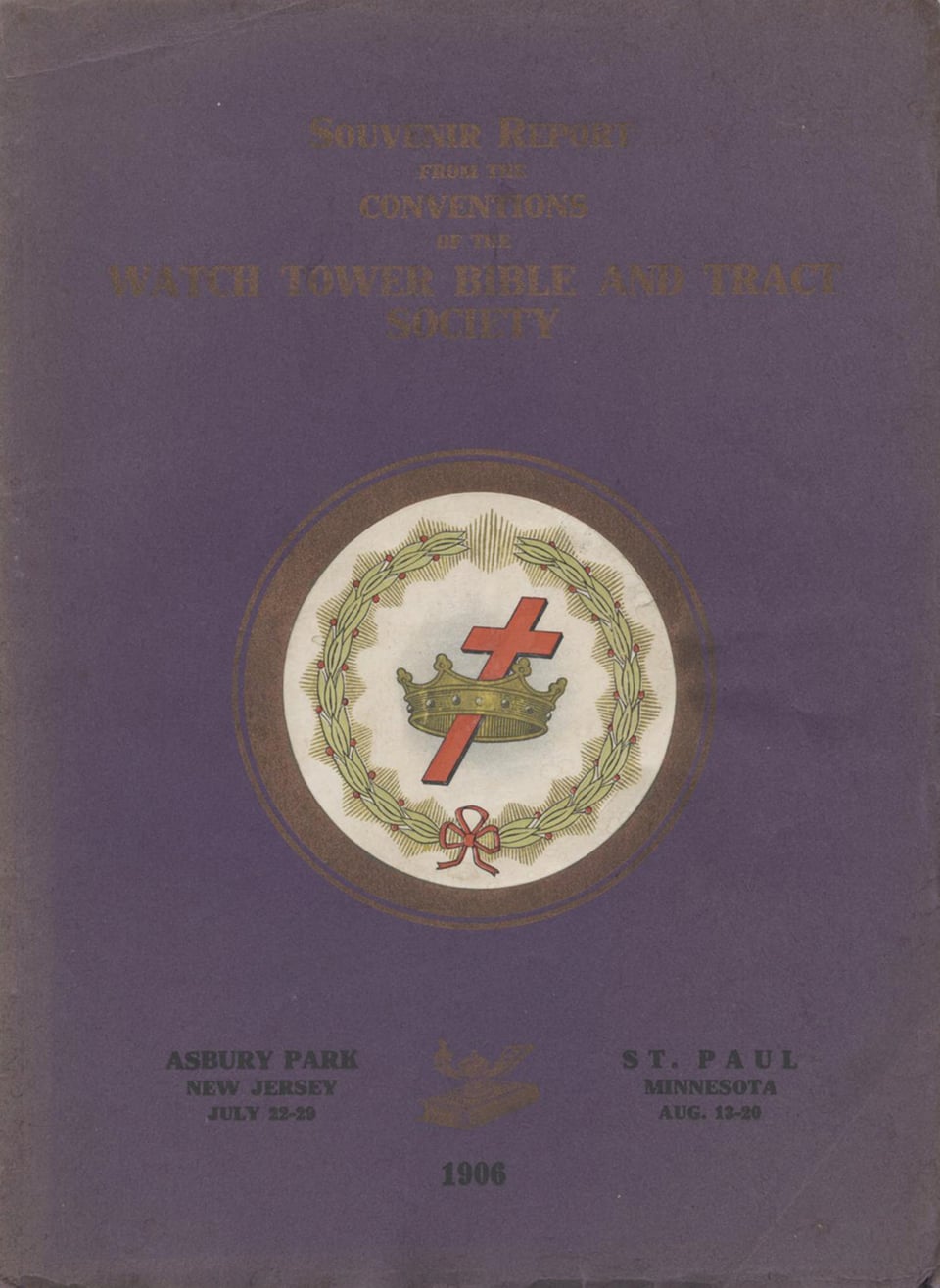
ASBURY PARK
NEW JERSEY
JULY 22-29
ST. PAUL MINNESOTA AUG. 13-20
SOUVENIR REPORT
FROM THE
CONVENTIONS
OF THE
WATCH TOWER BIBLE AND TRACT
SOCIETY
ASBURY PARK
NEW JERSEY
JULY 22-29
ST. PAUL
MINNESOTA
AUG. 13-20
(Motes from)
Watch Bible and Tract Tower Society's Conventions
To the King of Kings and Lord of Lords
IN THE INTEREST OF
HIS CONSECRATED SAINTS,
WAITING FOR THE ADOPTION,
THIS WORK IS DEDICATED
"To make all see what is the fellowship of the mystery which from the beginning of the world hath been his in God." "Wherein He hath abounded toward us in all wisdom and prudence, having made known unto us the mystery of His will, according to His good pleasure which He hath purposed in Himself; that in the dispensation of the fulness of the times He might gather together in one all things, under Christ."
Eph. 3:4, 5, 9; 1:8-10.
Asbury Park, N. J.
St. Paul, Minn.
"A Peculiar People."
A. PECULIAR PEOPLE, with banner unfurled, Attracts the attention all over the world. Come, let us this wonderful people review, It may be refreshing to me and to you.
Their NAME is peculiar: Not named after Paul, Nor Luther, nor Calvin, nor Wesley—et al. Belonging to Christ they will bear but his name, And "brothers" and "sisters" all titles they claim.
Their TALK is peculiar for others to hear, To them but one subject is precious and dear: "The Plan of the Ages," "A Ransom for ALL," "Times of Restitution" for all from the fall.
Their FOOD is peculiar: The good Word of God, Which "rightly divided" becomes understood: What "meat in due season" it then does contain! The "deep things of God" become easy and plain.
Their DRESS is peculiar: It is not their own, But one which they have as a generous loan; The white, spotless robe of Christ's righteousness Which covers all their unwilling blemishes.
Their WORK is peculiar: They're reaping the field, The harvest is here and the sickle they wield; They gather the wheat, while the enemy's snares Are binding together the bundles of tares.
Their CREED is peculiar: The shortest you've heard It is all comprehended in one single word. Not man-made, indeed, but received from above And that comprehensive and grand word is LOVE.
Their REST is peculiar: They've entered God's rest, Like Mary of old they have chosen the best; No longer they worry about the success Of Christ's future work all earth's families to bless.
Their FAITK is peculiar: They really believe God's Word to be true, while man's theories deceive. Infallible guidance they find in that Word, And all things they prove by a "Thus saith the Lord."
Their HOPE is peculiar: They hope to attain Joint-heirship with Jesus, and to share in his reign; To be "the elect," and make known God's "free grace." Abundant provisions of life for the race.
Their LOVE is peculiar: They love God supreme, His will is their will, nor their life they esteem, But lay it down joyfully, spending and spent, And every power to sacrifice bent.
Their JOY is peculiar: A deep constant joy, Whatever the troubles or things that annoy; Rejoicing to suffer for Christ and his name, To bear his reproach, ignominy and shame.
Their HOME is peculiar: A heavenly home, And heavenly citizens have they become. Forsaking earth's blessings, homes, houses and land, To dwell with the Lord in His mansions so grand.
—Selectcd.
T seems to be the Lord's will that a combined report of these Conventions should be prepared, therefore in conjunction with our dear Brother Geo. M. Huntsinger, this report has been prepared.
While this is not an official report of the Conventions of 1906, held under the auspices of the Watch Tower Bible and
Tract Society, at Asbury Park, N. J., and St. Paul, Minn., but merely notes on the sermons and incidents connected therewith, we trust, however, that it may be a fitting memento of the "best conventions" ever held.
The two Conventions covered a period of over two weeks, and there being usually two discourses each day, it is found impossible to put each discourse in the report verbatim, because of lack of space, time, cost to print, etc. It is therefore necessary to give only a synopsis of part of the discourses. We regret we cannot print them all in full. They were all good, and each one, no doubt, specially appealed to certain ones present; but it is our endeavor to select those subjects that would possibly be most interesting to the greatest number of the friends—in our judgment.
There are also many features of Conventions of this magnitude that it is impossible to reproduce in any report; they cannot be described, but only appreciated by those present.
We trust that those who were privileged to attend the Conventions will, in the possession of this report, have a tangible reminder of the precious seasons of fellowship there enjoyed, and of the many helpful suggestions and special assistances which were there presented, which otherwise might possibly have been lost in the abundance of blessings provided in that "feast of fat things," but which will thus be permanently preserved.
We also trust that those who were not privileged to personally attend the Conventions may, by means of this report, receive a large share of the blessings which were the portion of those who more fortunately were able to be in attendance, and that the report may cause such to feel that they had a personal part in the Conventions, which they could not have had in any other way.
Special credit is due a number of the friends whose assistance has helped to make this "souvenir" what it is. They consider their service as a service of love unto the Lord,—He knows who they are.
We pray the Lord's richest blessing upon the report as it goes on its mission to His household, giving out His truth, which is "meat in due season to the household of faith," and that His spirit and His strength may refresh one and all, and be especially manifest in the trials necessary in endeavoring to "press down upon the mark of the prize of our high calling of God in Christ Jesus."
May grace and peace be multiplied unto you through the knowledge of our Lord and Savior Jesus Christ.
Yours in the fellowship and the royal service of the King of Kings and Lord of Lords.
Asbury Park, New Jersey
The Ever Restless Ocean, Asbury Park
THIS year only two General conventions were held, the first one being at Asbury Park, which is a beautiful little city of 10,000 inhabitants, situated on the Ocean front, about 40 miles south of New York City, and is widely known and patronized as a Summer resort of the higher class. The daily average of visitors during the Summer season is 100,000. There is a beautiful sandy beach the entire length of the city, well adapted to bathing. The bathing facilities are excellent. There are numerous bath houses where suits and rooms are furnished for 25 cents. One of the interesting features of this place is a wide board walk along the entire distance, which serves as a promenade and gives a beautiful view of the ocean; this is usually crowded with people.
Part of our meetings were held in the Casino, which has a seating capacity of about 2,500, and is located directly on the beach, the waves rolling underneath the outer end, and part were held in the Auditorium, which is located only a half block from the beach, and has a seating capacity of about 1,500.
BY the time of the first meeting on Sunday morning, most of the friends had already arrived; so probably about 700 attended the first meeting. The average attendance was about 1,000, some coming and going all the while.
The Yorkshire hotel was the headquarters of the convention, and accommodated about 50 of the friends. including Bro.Russell. It is located one block west of the Auditorium.
Some Features of the Convention
A change in program was made from that announced in the Tower, and there were held morning sessions, usually from 9 o'clock to 12; and, with exception of Sundays and Thursday, when the baptism service was held, no regular meetings were held in the afternoon, so as to enable the friends to rest, bathe,
and be sociable. However, two informal meetings of colporteurs took place during the week, as well as two song services conducted by Bro. McPhail.
Quite a large number of the friends, both brothers and sisters, availed themselves of the fine surf bathing each afternoon save Sundays.
The friends were not slow, from the very beginning, in drawing spiritual lessons from the beautiful natural surroundings. References to the ocean in symbol were frequently made; such as, for instance (in testimony meetings principally), it was pointed out that some of the most beautiful lessons taught by our Savior were on the sea shore. Again, the ocean was compared to the restless masses of humanity, etc. Again, the mighty stretch of ocean to the boundlessness of God's love. Again, that some are carried about by every wind of doctrine, as the friends were in the surf, they having to hold on to the ropes provided for that purpose, or they would have been carried clear out to sea, etc.
It is hard to give the key-note or the key-notes to this convention; there evidently is more than one. Prominent among the thoughts were these, however: That as Bro. Williamson said in the first discourse, we are a joyful people; we do not go around with a "sour visage" even tho we do groan. Special stress was laid on this point all thro the convention. Bro. Russell called attention to the fact that although we do groan, as well as the world, there is this difference: we groan within ourselves, as the Apostle says, and not outwardly as the world does.
Bro. Herr's discourse "Transformed," made a deep impression. Again, this impressive thought was brought out prominently, how that we are dead to earthly things, etc.
Next, and probably the most impressive, the Time features of the plan, so powerfully and beautifully brought out in Dr. Edgar's discourses on Time Features, and the Great Pyramid. His discourses were listened to with enrapt attention, and created a profound interest, even reaching out to the newspapers of
Bible Students' Convention, Asbury Park
the city, and they gave a garbled account, which was published in the New York papers, saying that Dr. Edgar predicted an American revolution in 1912, etc.
It is the general sentiment that the week conventions are better than the three day conventions, as it gives the friends a chance to rest from their travels, and the confinement of attending the meetings, and offer opportunities for getting acquainted, and promotes sociability; so that the friends go home rested physically as well as refreshed spiritually.
It was also frequently mentioned that each convention gets better—and will doubtless continue so until we all meet in the one grand General Convention beyond the vail.
Pilgrims of the Morning
vention.
"I wish to assure you that every part of Asbury Park is yours—if you pay for it. However, we are not going to charge you a very high price, and we hope to give you a real good, enjoyable time, and you will have that if you do nothing else than attend the meetings.
"Asbury Park is different from any other seaside resort in the world; it is the best governed city; we have the finest police force—although I am sure the friends will not need the services of the police force very much, unless you get lost and cannot find your lodging place.
"I am sure we will have the best convention we have ever had, and I pray that we will all receive something from this meeting that will make us better and stronger in the Truth."
Pilgrims of the Morning, blessed pilgrims of the Light. Go ye forth to banish the "gross darkness" of the night; Every heart enkindled with "a flame of sacred love." Every face illumined with "a radiance from above."
Blow "the silver trumpets" over land and over the sea, Publish on the mountains the great "Year of Jubilee;" Sing it through the Valleys, shout aloud upon the plains. Tell the whole creation that the Lord Jehovah reigns:
Angel hosts surround you, strength is promised from on high.
Lift your heads rejoicing, "your redemption draweth nigh;"
Courage yet a little while, and then the battle won.
Sweet will be the sure reward in your dear Lord's "Well done."
First Day, Sunday, July 22, 1906
Response by Bro. A. E. Williamson, Temporary Chairman:
"The Lord bless thee, and keep thee;
The Lord make his face to shine upon thee, And be gracious unto thee;
The Lord lift up his countenance upon thee, And give thee peace."
In using those words of the High Priestly blessing, dear friends, you will recall that I am repeating those delightful words which it was our privilege to share together at the closing session of the Niagara Falls convention one year ago this month. I trust that as we have been separated for the past twelve months we have felt the High Priestly blessing refreshing our hearts—not merely that typical blessing which was suggested by the words given to the Mosaic priesthood, but the blessing which has come to all of the Lord's people who are members of the priestly house, of which Jesus Christ is the head. I trust that by the experiences we have had during the year we rec-
10 A. M., Casino
MEETING opened by Bro. Whyte, by use of hymn No.1 on Slip "All Hail," etc. Prayer by Bro. Frank Draper.
Opening address of welcome by Bro. Whyte, who lives at Asbury Park, in substance as follows:
ognize there is a greater appreciation in our hearts today of the favor of God, of the loving-kindness of Jesus Christ, of the fellowship of the brethren, of the comfort there is in the possession of the holy spirit, and of the blessed privilege of sharing in the sufferings of the body of Christ, in order that we may likewise share in the glory that shall be fulfilled to those who are faithful to their covenant to the end of the journey of life.
There are some who were at the Niagara Falls convention who are not with us to-day in their bodies of flesh, because they have gone to be with the Lord; and there are probably some amongst us to-day who will have the privilege of going home to the Lord, if they are faithful to their covenant of consecration, before the next Convention, and the experiences of this convention will have something to do with the development of each one of us in preparation for that glorious condition. The experiences of this convention will add to the responsibility of each one of us, as to whether we shall be faithful and counted worthy to share with the Lord in the glories of His Kingdom,
"Dear Brethren and Sisters in the Lord: I feel this morning that God has placed upon the speaker great honor in permitting him to open the convention in Asbury Park; but it is felt in an humble spirit, and in the spirit of one who wishes to serve you. In the name of the friends in the truth in Asbury Park, and those who are seeking the truth, and in the name of this beautiful city by the sea, I extend to you a most hearty and sincere welcome. The mayor and city council are interested in this meeting—not as friends, but as officials of Asbury Park they are glad to have you meet here, and our aim is to make you feel so much at home that this may be the place of each annual general conor whether in some cases we shall not be found unto praise and honor and glory at the appearing of our Lord and Saviour. Let us all resolve in our hearts that as the Lord, the High Priest, has promised to be gracious unto us, and to bless us, that we will use all these wonderful privileges so that we may grow in grace and spiritual knowledge and put on those precious fruits of the Holy Spirit which shall make us perfect New Creatures in Christ Jesus.
Now, dear friends, on behalf of the Watch Tower Bible & Tract Society, I welcome you all to this convention, and trust that all your arrangements will be satisfactory—temporal as well as spiritual, but particularly spiritual—and may the Lord continue to grant his favor and blessing upon us all.
It is intended that the meeting this morning shall be what the program calls it, a "general rally, praise and testimony" meeting. The word "rally" suggests in connection with various experiences of the world a gathering together in force for the purpose of en-
Bro. Ira E. Whyte
couraging one another.
You doubtless remember the expression is frequently used in connection with warfare. When the battle seems to be almost gone, and the enemy seems to nearly overwhelm those who are fighting and striving to gain an advantage, there are some who are still strong and vigorous that sound the rally cry, and gather around the banner of the regiment, which is almost being cut in pieces; and their renewed vigor, energy and activity, inspired by the rallying, turns the battle to the gates, and those who were almost overwhelmed are privileged to overcome the enemy and to experience a glorious victory. Now that is our position, dear friends: we are not on the other side of the veil, but we are in the thick of the fight, and every one of us should realize that there is arrayed against us all the force the adversary can gather together to keep us from gaining the victory. Are we rallying together? Are we holding each other up before the throne of grace? Are we inspiring one another by the Truth as we have it? Do we rejoice in the privilege of fellowship together in order to encourage one another to go forward and fight the battle with all the vigor and earnestness we possess? Or are we leaning upon our arms? Are we hanging back from the battle, allowing others to take places of faithfulness, earnestness and energy? It is our privilege this morning to encourage one another, to build one another up, and to stimulate each other for the battle every one of us is sure to have."
(After singing 1 and 3 stanzas of hymn No.15, the meeting was thrown open for testimonies, which were interesting and told of the pleasure the friends had in being permitted to attend the convention).
One brother said that he had attended several conventions, and each time his joy was so greatly increased that he did not know whether in the future he would have the capacity to receive the joy or not. Bro. Williamson, who was leader, assured him that his capacity would grow along with his joyful experiences.
Sunday Afternoon, 3 P.M., Casino
Discourse of Bro. A. E. Williamson, "The Saints Shall Judge the World."
Bro. A. E. Williamson
MEETING opened by use of hymn No. 3 (on slip) "His Loving Kindness."
Bro. Williamson spoke as follows:
"Our text is found in the 6th chapter of the first Epistle to the Corinthians, 2nd verse. 'Do ye not know that the saints shall judge the world? and if the world shall be judged by you, are ye unworthy to judge the smallest matters?'
"The Apostle is addressing the Lord's people; he is calling attention to the obligation which is upon the Lord's people in a judgment work. Those who belong to the Lord must recognize that to-day there is a certain kind of judgment which they are to exercise,
and they are to realize that if they perform that judgment inaccurately, if they fail to recognize the responsibility that pertains to such a judgment, the time is going to come when they will be unable to fulfill the obligations which are upon them and which it will be necessary for some persons fulfilling the duties of a certain class to carry out in connection with the administration of the Kingdom of God.
"We want to look at this matter from a practical standpoint. What is it that devolves upon us as the Lord's people for the fulfillment of judgment work from these two standpoints, judging to-day and judging in the future? First we want to clearly discern what it is to be a saint, because Paul here describes the class of judges as being particularly saintly. In olden times, you remember, the usual idea was that a saint was an individual who had been remembered as in former ages, perhaps three or four hundred years previously, having done some extraordinarily good works according to the standard that was then understood to be correct. Several hundred years after that individual had died, finished his course, and carried out whatever he thought was the right thing to do, some people remembered that he had done those good things, and having remembered they investigated and secured what they wanted as evidence, then took it before a council, or a holy father, and asked him to pass on those good works and state whether they were sufficiently good or not and if he said they were, as he always did, then that individual was passed into what they called canonization, and he became a saint, and ever afterwards all those who were supposed to be Christians had the privilege of folding their hands and closing their eyes before the figure of such an individual and praying to him as one who would be supposed to give them relief from various troubles and afflictions. Now that is the idea of saintship among a large class of persons who called themselves Christians. You will recognize that I am speaking about the institution of the Roman Catholic Church. If that was what the Lord ordained to be considered as saintship, then very few of us would have any particular interest in the matter; we would not be especially looking for sometime in the future when persons with weaknesses and depravities would be looking at our images and remembering that in some hundreds of years in the past we had done good, and therefore, we had in some manner reached a condition where we could give them blessing and service.
"The point which the Lord's people are to have particularly in their minds is that there is a possibility of saintship to-day, and if it is not fulfilled to-day it never will be; that we will never be counted as saints three or four hundred years after we are dead, if the Lord cannot count us saints in the experience of our present lives. Then the question arises what is a saint? And the answer is very clear according to the tenor of the scriptures, that a saint is a sanctified one; one who has been sanctified by the Lord. We know what a great many people think about sanctification. We know how the general picture is represented of a person going around with a long face and a very sour visage and the determination that he would never smile or present to others a condition of cheerfulness, satisfaction or pleasure, but rather the tendency to show to others how much he could make of misery and dissatisfaction. Now that is not sanctification. That is not the spirit the Lord's Word inculcates. The Lord prays on behalf of his people. 'Sanctify them through thy truth; thy word is truth.' And, thank God, the Word of Truth never makes a sour visage; it never makes a person miserable; it never distresses his mind and disappoints his heart; but the Christian rejoices in the realization that God is love, and God's loving him is drawing out from his heart that same demonstration of love towards God, and more and more as he strives to recognize the character of God he is becoming a joyful Christian and is fulfilling the exhortations of the Holy Word, 'Make a joyful noise to the Lord, the God of our Salvation.'
Bro. A. E. Williamson
That is something along the line of saintship.
"The word sanctification has in it the special element of separation, a setting apart. The Lord wished it to be particularly typified or pictured before our minds in the institution of the Aaronic priesthood. You remember Moses was instructed that he should anoint Aaron as priest of that particular arrangement by the pouring upon him of a certain anointing oil, an oil which God declared was so precious in his eyes that if any one else but those who were authorized should have any in their possession, or if any of an unauthorized kind should be found to be manufactured, those persons should immediately be put to death. God wished that particular anointment to be considered so sacred in the minds of the people that they would recognize that it represented something extremely important in the sight of God.
"In this present time, from the time that the Jewish institution ceased to be, God has been selecting a holy priesthood, of which that former institution under Aaron was merely a picture, a type. This holy priesthood, or special class, that the Lord is selecting as the antitypes of the original typical priesthood, receives its separating mark, its distinguishing features, by a peculiar, sacred anointing antitypical of that which was poured on the original typical priests—similar in certain characteristics, and so precious, and so particular in its arrangement, that God would declare that any individuals who were unlawfully claiming its possession, or who were unlawfully administering it, or supposing that they were administering it, would be worthy of the condemnation of God.
"Now that particular anointing that the Lord has thus set apart so as to distinguish, to separate, to sanctify his holy priesthood, in the present time, is the anointing of the holy spirit of God. It is not an anointing, it is not a spirit, which can be communicated to unbelievers, and it is not therefore for any one in any position, whether claiming to be a servant of God in the pulpit, or administering the Lord's truth under any other circumstances, to say to unbelievers, 'You can come to the Lord and as soon as you believe and confess your sins, the Lord will give you the holy spirit of his sanctifying power and separation.' The individual must have been a believer, he must have been separated from the world first before he can be separated into this special priestly service, because God does not separate and does not accept as priests any who have not first come under that condition of cleansing, which is the essential quality to begin the Christian course.
"So we have two steps presented to us in the Lord's Word, both of which must be taken by the individual before he can be called a priest of God, before he can be spoken of as having the possession of the holy spirit which constitutes him a son in God's sight; the first step being that of justification, belief on the Lord Jesus Christ, receiving thereby of the cleansing power of the blood of our dear Redeemer, who gave his life on our behalf to save us from the wicked conditions of the world. That belief on the Redeemer makes us, under the Lord's favor, children of God. The Apostle says, in writing to the Galatians, 'Ye are all children of God by faith in Jesus Christ.' Faith in Jesus Christ constitutes one justified, clean, just, counted as righteous in the sight of God because of his faith. But such a one is not an anointed son; that is not the individual who can be recognized of God as entitled to the denomination, 'sanctified in Christ Jesus.' He must be more than that, he must not only be a believer but he must be an anointed believer. And the Apostle tells us in the 8th chapter of Romans that that anointing comes to us in this way: 'For ye have not received the spirit of bondage again to fear; but ye have received the spirit of adoption, whereby we cry, Abba, Father.'
"We recognize God in a special and particular sense as related to us as our Father; not in that first sense whereby we become justified, and the Apostle's words were proper to us 'Ye are all children of God by faith
in Christ Jesus.' That merely puts the individual in the condition reckonedly in which Adam was actually before he committed sin. Adam was an actual human son of God. By faith in the Lord Jesus Christ we who were sinners are reckoned as the sons of God on the same plane that Adam was as a human son. By virtue of the sacrifice of Jesus Christ, whose sacrifice took our place, and made up for our deficiencies and imperfections, God was at liberty from the standpoint of justice to consider that we were right and acceptable in the Father's sight, covered with the robe of the righteousness of Christ, thereby sustaining a general family relationship. But Paul is talking about another relation of sonship—not human sonship but spiritual sonship—a sonship to which the individual is begotten by the possession of the holy spirit of God in his heart, and the possession of that holy spirit of God really represents the anointing of the Lord, which makes the individual not only a special kind of son, but a priest according to the Lord's order, after Jesus Christ his head. This special kind of sonship is spiritual sonship, represented by the possession of the holy spirit in the heart, which holy spirit is operating upon the individual, directing his mind, forming his thoughts, arranging his purposes and aspirations, so that while that holy spirit is working upon the individual and taking full possession of his heart and his life, it is carrying out what the Apostle suggests to us in the 8th chapter of Romans as the ultimate conclusion of the experience of the Christian, 'Whom God did foreknow, he also did predestinate to be conformed to the image of his Son.' That is the work of the holy spirit of God in the individual's heart. That is what the Lord proposes when he gives us the spirit, to so change the mind of the individual, to so develop and transform that mind that after the full experience the Christian has had under the possession of this holy spirit of God, his mind will eventually become conformed to the mind of Jesus Christ, just as the pattern set before his spiritual vision continuously will draw out in him these peculiar characteristics which the scriptures call the fruits of the holy spirit; the development in him from day to day of conditions that will make him not merely a duplicate in mind and in character of Jesus Christ, but will also make him worthy of a share in the glorious kingdom of the Lord, which has been set apart as the peculiar privilege and the holy inheritance of the saints in light. Those who have this spirit, this disposition, this will, this power of God operating upon them, in them, and through them, are being transformed day by day to be ready for a share in the heavenly kingdom.
"We are not suggesting something that is mystical, something that is so supernatural that one would expect to have peculiar emotions strike him when he received the holy spirit of God. We are referring to the possession of the mind of Christ, the mind of God, which is first presented to us in the holy Word; the mind of truth and righteousness which is here depicted as the standard of character, and which God himself possesses. We also refer to the spirit of righteousness and truth which is found in every consecrated Christian, every individual who has fulfilled the exhortation of the scriptures, and carried out what the Apostle says, 'I beseech you therefore, brethren, by the mercies of God, that you present your bodies a living sacrifice, holy, acceptable unto God, which is your reasonable service.'
"When the individual has taken that position, he has received in himself the spirit of righteousness, (1) from the holy Word, (2) from the divine providential leading in connection with his various experiences, and (3) from his contact with others of the Lord's people. When the individual has made such a covenant with the Lord, has laid down all he possesses as a living sacrifice to our dear Redeemer's service, then he has declared before God that he is willing to fulfill God's will in his daily life to the extent of his ability, and from that moment he has the guarantee of God that he will have the strength, grace, encouragement and blessing which God is able to provide so as to uphold and sustain him, to keep him, in all the interests of his life to the very end of his experience, until he has finished his course with joy and the Lord counts him worthy to share in the glories that belong to the kingdom of heaven.
"In a general way this is the way the Lord makes saints; and he can make saints of you and me. Every one of us has the precious privilege of being in this saintly class if this holy spirit of God has been communicated to our hearts. We quoted awhile ago part of what the Apostle said in the 8th chapter of Romans about the spirit that is given to us, the spirit of adoption as sons, whereby we cry Abba, Father. Then the Apostle goes on a little further and says, 'The spirit itself beareth witness with our spirit that we are the children of God. And if children, then heirs; heirs of God and joint-heirs with Christ; if so be that we suffer with him, that we may be also glorified together.' Let it sink deeply into our minds what a wonderful proposition those words express to us, to be heirs of God and joint-heirs with Jesus Christ. It is not a little flimsy matter that we can pick up to-day and examine for the temporary, transient attraction it may have, then cast it away on another day. That which is represented in those holy words is the most wonderful, the most stupendous blessing that is within the power of our Lord to bring within our reach. And if we realize the full extent of being joint-heirs with Jesus Christ, and associated with him in the work of his kingdom, we will realize also the need of the exhortation of the Apostle, 'Seeing that we are encompassed about with so great a cloud of witnesses, let us lay aside every weight and the sin which doth so easily beset us, and let us run with patience the race that is set before us, looking unto Jesus the author and finisher of our faith,' recognizing him as the one who went before us to point out the way in which we ought to go, the one who endured great trials and afflictions, so that he might indicate the fact that he is able to sympathize with us in our difficulties and trials, and who has such an abundant store of grace and comfort that every one who is trusting in him, every one who is leaning upon him for comfort and guidance, need never be without the sustenance of the Lord's favor, and may always realize that he is kept by God's power to the very end.
"Now, dear friends, let us look at some of the practical applications of this matter to our daily lives. The Apostle asks us here, 'Know ye not that the saints shall judge the world?' If we are going to learn to judge the world, going to learn how to administer the judgment that the Lord proposes to carry out in connection with the world's interests, then it behooves every one of us to-day to know how to judge ourselves. How foolish it would be if we were to imagine that God proposes to set apart, sanctify a class, and that he is going to make them judges of the world, going to set them on high in the kingdom of heaven, and when he has gotten them there, they do not know the first principle about judgment, because they never learned to judge themselves! The Apostle Paul emphasizes particularly the necessity of learning how to judge ourselves when he calls our attention in another place to the application we are to make of our present experiences. 'For if we would judge ourselves, we should not be judged. But when we are judged, we are chastened of the Lord, that we should not be condemned with the world.' Now think of that, dear friends, and if we have been forgetful of the obligation that is upon us in connection with the application of truth to ourselves, let us consider for a moment how the Lord expects us to deal with ourselves. If we would judge ourselves in this present time, we would not be judged. Judged by whom? By the Lord. When? Now. What does that mean? The Apostle is bringing to our attention the fact that if we have made a consecration of ourselves to the Lord, if we come before the Lord and say voluntarily, of our own free will, 'O Lord I give myself away, it is all I can do,' if we have thus committed all
our cares and interests into the Lord's hands, the Lord undertakes to see that we are taken care of in all the affairs and interests of life, and that particular development of character, which saints must manifest before they are ready for the kingdom, shall be produced.
Suppose that we are somewhat negligent, that while we intend to do the best we know, various interests of different kinds swerve our minds and thoughts—you remember how the scriptures suggest to us that sometimes some of the Lord's people have been interfered with by the cares of this life and the deceitfulness of riches of various kinds—if we have been swerved from devotion to the Lord and faithfulness to the consecration we have made, the Lord does not propose to leave us in that swerved condition if we really want to do the best we know how, if we want to fulfill his will to the complete extent of our ability; so the Lord proposes that he will judge us. What does he mean by that? Condemn us, overwhelm us with his manifestations of reproof and lack of appreciation of the attitude we have taken? Oh no, indeed. If the Lord were to take that attitude toward us how very hard it would be for those who are trying to do his will; how very difficult it would be for us to overcome the frown of the one whom we love and desire to cherish more than any other being in the universe. How discouraged we would be from time to time as we would find ourselves striving in certain ways to do his will and at the same time getting our garments spotted with various fleshly interests because we had been neglectful on different occasions. No, the Lord does not condemn. The Lord does not cast us down. The Lord does not reprove us in such a manner as to hinder us absolutely from going on in the way; but the Lord criticises, the Lord discerns, the Lord examines into the characteristics we have been manifesting, the degree of character we have developed, and he sees to it that we are chastened. When we are judged by the Lord we are chastened of the Lord; we are experiencing that criticism from the Lord which will be beneficial to us if it is received in the proper manner, if it produces in us such a humility, such a willingness to fulfill the Lord's will that we will get out from that experience and go forward with greater determination to do His will day by day.
"So if we have trials in our lives, dear friends, it is not because the Lord is angry with us and wants to show us how little he appreciates our efforts to do him service, but it is because he wants us to make the very most of the experiences that come to us; he wants to develop in us that condition of quickness of appreciation as to what is right as would be a fulfillment of those lines in the hymn which we sometimes sing concerning our conscience.
"Quick as the apple of an eye,
O God, my conscience make."
"The experience which the Lord's people are expected to develop from time to time is quickness to discern the fact that they are in a difficult position, that they are likely to be swerved aside from the doing of the Lord's will faithfully, and quickly bring themselves back into harmony with the divine arrangement, if they can recognize the wrong course quickly enough to save themselves from the judgments, the criticism, the chastening, which the Lord frequently finds it necessary to administer. There is not one of the Lord's people who during the course of his life would be able to judge himself with such accuracy, such particularity, that he would not need at any time the careful consideration and criticism of the divine mind over his actions and course; and so it is a blessed privilege that the Apostle is explaining when he tells us that when we are not quick enough, when we are not accurate enough, the Lord takes it into his own hand and sees that we get such experiences as will save us from condemnation with the world. If we are outside of the Lord's favor, if we are not receiving this discriminative judgment which the Lord administers, then we will be with the world and condemned under the general conditions of death which is the experience of the world.
There is not one of us who would not rather choose all the administration of the divine judgment than to be cast in with the world's lot and realize that we would then be without God and without hope in the world. Whatever there might be in the future for the world, under the Lord's arrangement, our present experiences would represent the fact that we had no claim upon the divine favor.
"If we are thus being careful as far as possible, and if we are under the Lord's care and direction in every sense, and if we are thus striving to take hold of the things we have heard, lest at any time we should let them slip, we are on the way to a full and glorious realization in due time of what the saints shall accomplish when they shall judge others. Let us see to it that we are learning the lessons with such zeal, such humility, such earnestness of mind, that it will be our portion in God's due time to be accounted worthy, not to selfishly sit down on others and rejoice in the fact that we are saved, even though millions of others have been eternally lost, but to rejoice in the wonderful privilege of helping humanity. It is declared that it shall be the portion of those who are faithful to be kings and priests unto God and to reign upon the earth—kings to govern the interests of humanity, to exercise care over them from a legislative and administrative standpoint, and priests to teach the people, to give them the instructions which will be necessary to lead them into the ways of righteousness and peace, that they might do the will of God from time to time as they are able to appreciate it, and as it is brought to their attention by the instructions of that period.
But now to get to that condition, to reach to that full glorious administration of divine favors how shall we do in our daily lives, what course shall be adopted by us that we may be recognized most fully in harmony with our covenant of consecration? In looking into the Word of God we can find four different lines along which the Lord instructs his people to develop in connection with certain experiences so that they might fulfill the Apostolic exhortation and grow in grace and in knowledge of our Lord and Savior Jesus Christ. The first of these lines of instruction is in connection with our thoughts; the second is in connection with our words; the third is in connection with our general demeanor, our appearance before others as we come in contact with them; and the fourth in connection with our actions, how we deal directly with those we may be associated with, both of the world and the Lord's people.
"Naturally, the thoughts are to be the very first consideration with those who are striving to be saints. You remember that the Apostle emphasized the matter in his letter to the Philippians where he calls their special attention to the necessity for thinking along such lines as will develop that accurate line of thought that will show forth more and more how we are determined, as far as the Lord will give us wisdom, to put in practice in our daily lives the things that are righteous and true: 'Finally, brethren, whatsoever things are true, whatsoever things are honest, whatsoever things are just, whatsoever things are pure, whatsoever things are lovely, whatsoever things are of good report; if there be any virtue, and if there be any praise, think on these things.' You remember how the Lord puts it: 'Out of the abundance of the heart the mouth speaketh.' If there is anything of good, pure, noble, honest, lovely thought and purpose in the heart, there will not be any speaking of good, pure, noble, honest, lovely things. We must get at the very root and foundation of the matter; we must recognize the fulfillment in ourselves of the exhortation, "Keep thy heart with all diligence, for out of it are the issues of life."
"Now I want you to notice the peculiarity of the construction of this exhortation—that the Apostle presents it from a positive standpoint. He does not say, 'If there be anything untrue, if there be anything dishonest, if there be anything impure, if there be anything unjust, if there be anything unlovely or of bad report, if there be anything that is not virtuous, and if there be anything that is not praiseworthy, do not think on these things.' Dear friends, that is only half the proposition that the Christian is to consider. He might have in his mind all the time that he will not think of those things that are bad, that are unlovely, that are dishonest, but if his mind is not positively made up, if he has not got the positive determination that he will think upon some things that are opposite to those wrong things, he is not going to make much progress; the things must be positively true, positively honest, positively just, and positively of good report, and positively praiseworthy in the sight of God.
You remember that the Lord Jesus gave us an illustration of a negative attitude of a man's heart. He told us of a man who was possessed of a devil, and having been dispossessed of this devil his heart was swept, cleansed and garnished, but he did not fill that heart with anything of the opposite quality, he did not receive the spirit of righteousness in his heart, he did not henceforth make up his mind that he would do the will of God; it was merely a negative position; and the devil from going up and down the face of the earth, and being unable to find any rest came back to the man's heart and found that it was empty, swept and garnished, ready for his occupancy—a negative heart; and the devil took seven other spirits worse than himself and entered into that man's heart. The last state of that man was worse than the first. Now, that is the position in which it is possible for us to get into unless we have positive convictions, unless we have determinations that are along positive lines of truth and righteousness. I do not mean merely the intellectual appreciation of truth. I do not mean merely to consider the glorious effects of the wisdom of God in Jesus Christ, not merely to see how grandly Christ's government would be established in the earth and how that in due time the world shall bow to his glorious reign. I mean the practical application of truth in the heart which will develop the kind of character that makes saints; and that character development that makes saints begins with the thoughts, with the positively righteous thoughts which the Apostle here presents to us so forcibly and clearly. If we by the Lord's grace are thinking of the things that are just and honest, and true, and pure, and lovely, and holy, and of good report, and that are praiseworthy in the sight of God, then we will be thinking about the fruitful as well as the doctrinal features of the divine plan, and the Lord's great blessing will be with us day by day.
"But it is not merely essential that we shall keep our hearts right; not merely necessary that our thoughts should be constantly fixed upon the principles that are true and in harmony with the Lord's requirements. Our thoughts having been decided and become positive before the Lord, we must see to it that our words are in harmony therewith; in our daily speech it is important for us to make our communication with those who are without as well as those who are the Lord's people fulfill the exhortation of the Apostle, "Let your speech be with grace seasoned with salt." The speech of the Lord's people must necessarily be of such character that their words will carry home to the hearts of the individuals with whom they converse conviction of the fact that we are thinking about the things that are righteous, that the words we utter are not deformed in manifesting those imperfections of expression which would suggest that our thoughts have been wandering and straying from the things that are righteous and true; but speaking the word of truth in love, speaking the things which would show our appreciation for righteousness above everything else; that there would be a preservative influence by reason of the words that we shall say.
"By using the figure of salt, as the Apostle does here, he evidently intends that our words of grace, the gracious truths which it is posisble for us to speak, must be that kind which will be tempered with wisdom.
with judgment, with the spirit of a sound mind. Now it is very possible to speak words of grace in a very untempered fashion. It is very possible to try to serve the truth in such a manner that we really drive people away. I had an illustration of that very point since coming to this convention. Arriving here two days before the other friends, and calling upon one of the parties with whom we had made arrangements for accommodations, I got into conversation concerning what this convention meant, what it was all about and what these people believed. The lady was interested and curious to know something more than she had been able to ascertain. In my conversation with her it developed that she had a conversation with some other lady along the same line, and that lady had made certain remarks to the lady with whom I was conversing, telling her about some truths which the scriptures represented, and yet stating the matter in such form that it immediately produced a bad impression upon that lady's mind. It was a doctrinal truth which is clearly taught in the scriptures and yet such a strong portion of meat that it would be improper to discuss it except with one who having developed along certain lines, and having received the sincere milk of the Word, would be able to enjoy strong meat. Now this dear lady doubtless in the earnestness of her heart to help the one with whom she was talking, out of a wrong understanding of the teaching of the scriptures stated point blank that the thing which the other lady had cherished in her mind for all the years of her life as a truth, was a falsehood, and the dear lady said to me, "As soon as I heard that lady make that remark, I came to the conclusion that the good impression I had of her before was wrong, because I could not feel that she would entertain such a view if she were a Christian." She had a certain idea in her mind and it was necessary to be diplomatic, to be careful, not to interfere with such an amount of truth as the lady might receive by telling her more truth than she was then in a position to receive. She did not season the word of grace with the preserving salt of discretion and the manifestation of the spirit of a sound mind.
"Now that is what we want to do; we want to control our expressions and endeavor as far as possible to see that what we say shall be to the edification of those who are about us, and if they are babes in Christ, or if they are merely on the outside, striving to learn how to be babes in Christ, we should not give them all the strong meat which the Word of the Lord says would be more than they could endure. You remember the Apostle gives us an exhortation along that line again where he tells us to be instant in season and out of season in proclaiming the truth; yet there are many of the Lord's people who so fail to appreciate the meaning of the Apostle's words that they suppose they must on every occasion, no matter where they may be or what the circumstances are, tell the word of truth, and must interfere with other people's comfort in order to fulfill what they mistakenly believe an obligation on them as the Lord's people. The Apostle is not talking along any such line at all. He is emphasizing the necessity for the Christian to recognize that his time does not belong to himself. He is not talking about other people's time and he is not giving license to any one to steal another person's time. If we find some one engaged in connection with a matter which he considers extremely important, it would be most impolite, even from the standpoint of the world, and would be a thing most unpleasing to the Lord, to interrupt in order that he might preach the truth. We must preach the truth in love, preach the truth with grace, seasoned with salt. We must preach it with discrimination as to times and seasons, using only such times as are seasonable to the persons with whom we are talking, no matter how unseasonable it may be to us. If we are thus doing we are helping along as far as our words are concerned the message which the Lord expects us to declare to those who have an ear to hear.
Then what about our actions? What about our general demeanor? How should we appear before other people in the conduct of our lives? How are we appearing to those with whom we come in contact, those who may be entirely disinterested persons as far as we know, but who may be observing the actions we are performing, and the endeavors we are supposed to be making to show forth the love of the Lord in our lives, and our carefulness to be worthy ambassadors of Christ? It is impossible for us to so walk and to so act from the absolute standpoint of complete perfection that no person could take any exception to the course of conduct we are manifesting, or could see that there was the slightest deflection from the thing that was good; and yet we can recognize that in the course of the Lord's people there are degrees of the demonstration of the best things, there are degrees of showing forth the things that are right and good; and sometimes we are aware of the fact that we have neglected the exhortation of the Lord's Word, and are not showing forth the best demonstration in our demeanor of what would be acceptable in the Lord's sight.
Now we were speaking awhile ago of what a saint should be, and suggesting that a saint is not an individual who goes around with a sour visage, an individual who manifests sullenness or moroseness, or anything which would suggest that he was unhappy, low-spirited, and discouraged in connection with his experience. One of the things which every one of the Lord's people must have particularly in mind is that we are to love the Lord with such earnestness and faithfulness and zeal that we will be dignified and careful of the sobriety of our conduct, that we will try as far as lieth in us not to bring reproach upon the truth by such a demonstration of frivolity as would show to others that we are out of harmony with things which are considered properly decent. It is not proper for the Christian, after he has been in the way a sufficient length of time to learn these lessons, to be sour and disagreeable and to show forth something else than that spirit of kindness, gentleness, courtesy and dignity which all the Lord's people ought to manifest in their general conduct and contact with others. The scripture seemingly presents a paradox in the course the Lord's people should take. On the one hand we find the scriptures very carefully laying down the line of conduct from the standpoint of solemnity and sobriety. The Apostle Peter specially speaks about soberness, "Be sober, and hope to the end for the grace that is to be brought unto you at the revelation of Jesus Christ." And the Apostle Paul specially brought this matter to our attention in a very peculiar and solemn way. In writing his letter to the Hebrews he tells us that it is our privilege to share in the reproaches of Christ and "go to him without the camp bearing his reproach with him." One who is bearing reproaches does not naturally feel very jolly; he does not feel light-hearted, as though there was a spontaneousness of joy in his heart, that lifts him up above the course of trial. He feels there is an obligation of responsibility that rests on him which is essential for him to consider all the time, and to so consider that it will regulate and modify the various actions he may adopt. The Apostle, you remember, is drawing to our attention the picture that is arranged in the typical tabernacle service, where on the day of atonement, the priest, having slain the bullock, certain parts of it which were not proper for the sacrifice within the tabernacle were to be taken outside of the court and burned "without the camp." The things which were disagreeable there represented the disagreeable experiences, the trials, the difficulties and the disappointments which all the Lord's people must necessarily have in their various interests in daily life. We recognize the afflictions of Christ which we bear in our bodies as being borne on behalf of the body of Christ, as the Apostle suggests in his letter to the Colossians, and if we thought that was the only obligation of the Christian, if we thought that represented the only attitude of the consecrated saints, then we would only be recognizing half of the presentation of the scriptures and would be allowing ourselves to be guided into one narrow groove to such an extent that we would lose some of the pleasures of the Lord's service, which are intended to modify the Christian's experiences and to help him appreciate that while the trials are many, the joys, rejoicings, comforts and stimulations are just as complete by the Lord's grace.
So the Lord gives us another picture, one that seems to be so entirely different that if we did not have the Lord's Word for it we would imagine it was intended to apply to another class.
The scriptures tell us God proposes that his anointed, if they are faithful, if they are true to the administration of the holy spirit, living up to the obligations that belong to this covenant they have made, shall become in due time members of the body of Christ, the bride of Christ. You remember how Paul puts it, "I am jealous over you with godly jealousy: for I have espoused you to one husband, that I may present you as a chaste virgin to Christ." Now just imagine a bride espoused to a husband, one who was to be so beautiful and so glorious, so courageous and so faithful to that bride's interests that she knew when she would be joined with her Lord and husband, all the cares and trials and difficulties which might have been her portion while she was waiting for the marriage day would be dissipated like the mist before the morning sun, and in that glorious culmination every blessing she had hoped to receive would be far more than fulfilled to her—imagine that bride entertaining such thoughts as would lead her to feelings of discouragement or a demonstration of sourness of spirit, or moroseness of conduct and of general demeanor which would reflect on the character of her future Lord and husband, as she would come in contact with her neighbors and friends during her betrothal. It would be impossible to associate the idea of a real and proper bride with any such conception as that; impossible for us to imagine a bride who had a proper understanding of what her future experience would be, and realizing that it would be a good, happy and blessed one, to demonstrate before her friends that she was not appreciative of the full glory of the blessings that would be hers, and that she would thus allow certain conditions to enter in which would interfere with her happiness and joy.
The scriptures represent that the Christian is the only one who is entitled to joy, the only one who is really in a position where he can show forth a joy which belongs not merely to the outward, trivial circumstances of daily life, but a joy which belongs to the very depths of the heart, in such full and complete degree that when he has entered into an acknowledgement of his covenant relationship with the Lord the joys are supposed to begin from that very moment, and to increase more and more as the individual enlarges his capacity and reaches out to the full perfection of character which the Lord requires shall be manifested by the saints before they are accounted worthy for the kingdom. The joys will increase, they will not diminish, by our recognizing the responsibility, and the experiences that are coming to us as consecrated Christians; and although we have to bear the reproaches of the world, let us see to it while we do it with dignity and sobriety, that we also do it with a joyful manifestation of the fact that the truth in our hearts upholds us in our lives and keeps us through all the dark hours of trial, trouble and distress, and will do so until we have reached the door of the kingdom, where we will lay aside every experience that pertains to imperfection, and nothing shall be left but the pure, complete comfort and satisfaction of awakening in the likeness of Jesus Christ our Lord.
…