The Cause of World Unrest (1920)
Download: PDF — The Cause of World Unrest (1920)
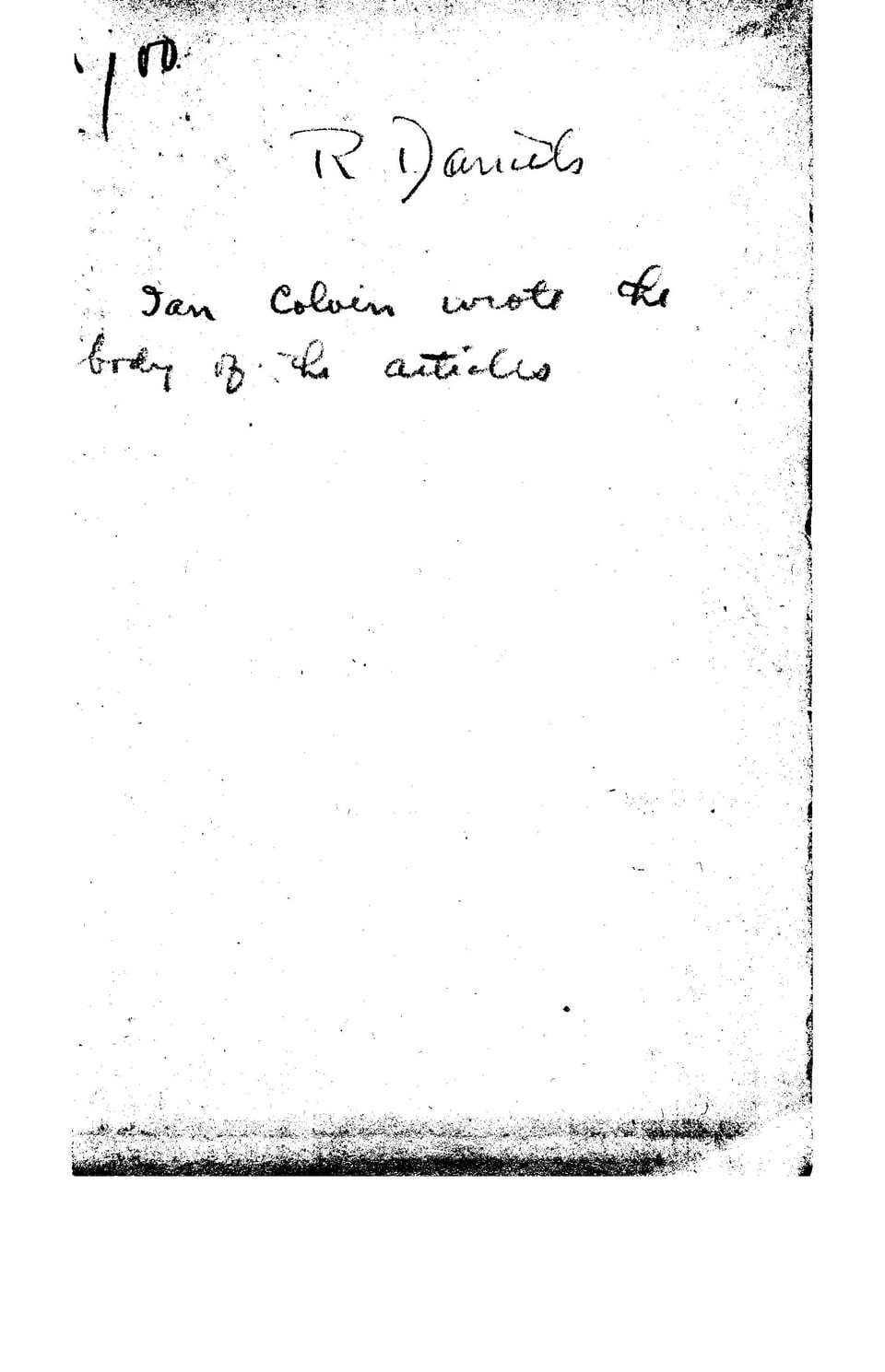
R Daunds
Jan Colvin wrote the body of the articles
THE CAUSE OF WORLD UNREST PUBLISHED BY GRANT RICHARDS LIMITED
THE EVOLUTION OF REVOLUTION
By H. M. HYNDMAN Demy 8vo. 21s. net. [In Preparation
CLEMENCEAU
THE MAN AND HIS TIME
By H. M. HYNDMAN
Demy 8vo. 12s. 6d. net.
"A comprehensive survey of the great man's life work, and an illuminating picture of his personality."—Clarion.
THE BOLSHEVIK THEORY
"Mr. Postgate's exposition of Bolshevic principles is so frank and clear that it should be read by every working man."—Morning Post.
"This is a book which I strongly recommend."—Daily Herald.
IRELAND A NATION
Crown 8vo. 7s. 6d. net.
"Stands above and apart from the vast majority of books on the subject. . . brilliant handling of a complicated theme . . . he lifts the issue to a newer and higher plane."—Nation.
THE TAINT IN POLITICS
Crown 8vo. 7s. 6d. net.
"Deserves attention as a searching and forcible exposure of many undoubted abuses. Lack of principle, lightly disguised corruption, privileged incompetence, a pampered and leisured Civil Service . . . are often convincingly attacked."—Times.
THE RAGGED TROUSERED PHILANTHROPISTS By ROBERT TRESSALL
Crown 8vo. 3s. 6d. net.
"This striking novel on the terrible conditions among sections of the unorganised building trades . . . the life of the hopeless wage-slaves of unrestricted capitalism." Justice.
ST MARTIN'S STREET LONDON W.C.2 THE CAUSE OF WORLD UNREST
With an Introduction by the Editor of "THE MORNING POST"
LONDON GRANT RICHARDS LTD. ST. MARTIN'S STREET MDCCCCXX
CONTENTS
PREFACE . . . . .
PREFACE
THOSE who have studied their history must at times have been astonished at the ease with which popular movements, honest and sincere in themselves, have been manipulated by clever and unscrupulous men to their own personal advantage or to further their own political aspirations. The people have throughout the ages presented a pathetic spectacle. Time and again they have been used with most barefaced effrontery as a means of producing results which they themselves never desired. Indeed, in many cases, they have suffered terribly from their own achievements. Nothing is more pitiful than the persistent betrayal of the people by their leaders and nothing more splendid than the people's refusal to believe it. In earlier history popular movements were difficult to create and direct unless they were purely local. Kings, princes, governors stood between the masses and their exploiters. Distances, too, were great in the days before railways, and communication was difficult. But, roughly speaking, the people were prevented by established authority from being victimised. To-day all that is changed, and we now live in an age which will be known, perhaps, in history as the age of the exploitation of the people.
PREFACE
This exploitation of the people has in later years become something of a fine art. The party machine, which was at first merely the instrument by which a party tried to impress its views on the electors, has in many cases taken charge of the party, so that the machine and not its leaders decides what shall or what shall not form part of the programme. Battle cries, "slogans," phrases and catchwords, deliberately framed so that they should conceal the truth or create a false impression, have now become part of every political campaign. Do our politicians ever ponder over this surprising fact, that the greatest response to a semi-political appeal that this country has ever seen took place in 1914-15, when the call was to go out to death? And they have so little knowledge of the people they govern that they are surprised when the most tempting of battle cries, telling the people how much they can have for the mere asking, remain without result. The explanation of this is simple enough and yet it is far too high for the understanding of the mere politician. It consists in this truth, that the people of this country can only be really roused by an appeal to their better nature. That is the strength of England.
We are seeing to-day how the exploitation of the people can be achieved with comparative ease because the people throughout the civilised world is enfranchised and there is no one to stand between the exploiters and PREFACE
the exploited. If we look back in history we shall find that the disappearance of this intermediate influence has not been altogether fortuitous. There have been kings who exploited their people just as Lenin is to-day exploiting the Russian people, but they have mostly paid forfeit with their thrones, as Lenin one day will pay forfeit with his life. But the temptation to get at the people and to use them for ends to which they are indifferent and of which they are ignorant has been great. The pages of this book will trace the threads of a conspiracy engineered by people whose main object has been to destroy utterly anything—kings, governments or institutions—which might stand between them and the people they would exploit.
Anybody who reads the story of this subterranean scheming as it is unfolded in this book may perhaps be disinclined to admit the correctness of the authors' statements because of the startling conclusions to which they lead up. But I would urge the reader to cast aside all prejudices and judge the facts brought out on their merits as facts and provide, if he can, other conclusions. The main outline of the contents of this book is, in brief, that there has been for centuries a hidden conspiracy, chiefly Jewish, whose objects have been and are to produce revolution, communism and anarchy, by means of which they hope to arrive at the hegemony of the world by establishing some sort of despotic rule.
The "Protocols of the Elders of Zion," which have been published in England, have aroused tremendous interest and a storm of protest. It will be noticed by the reader that the authors of the book have taken particular care not to assume their authenticity. They may or may not be genuine. Their chief interest lies in the fact that, while the book which contains them was published in 1905, the Jewish Bolsheviks are to-day carrying out almost to the letter the programme outlined in the Protocols.
I have said that this secret revolutionary movement seems to have been engineered chiefly by Jews. It is about time that somebody spoke out frankly on this subject. I myself have several Jew friends. One of them I shall always remember with gratitude, for he would give me no peace in the years before the war until he had convinced me of the German danger. At his own expense he despatched a man to visit the various dockyards of Germany and the information thus obtained was found extremely useful. Now this man is as good a patriot as I am, but when I say that there are many bad Jews who have conspired and are conspiring against stable government; when I say that over 95 per cent. of the present Bolshevik Government are Jews, that the Bolshevik movement outside Russia is chiefly directed by Jews; when I cast doubt upon the political integrity of any Jew, or even when I disagree with his policy—when I do these things I am dubbed an anti-Semite.
In this way is anti-Semitism created and fostered by the Jews themselves, as I will proceed to show.
The Jews are justly proud of their race, which, in spite of every sort of difficulty, has not only persisted throughout the ages, but has achieved a position of great power and influence in nearly every civilised country. Persecution and outside pressure have taught them to stand together, and the tradition of unity is as strong, if not stronger, to-day. They may quarrel among themselves, but they unite instantly and almost unconsciously against any criticism from outside. The result is that a critic of a prominent individual Jew or of a particular Jewish policy, who begins with no sort of prejudice against Jewry, finds arrayed against him the serried and united ranks of Jewry. It is no use his declaring that his objections are not to Jewry, but to a particular Jew or a particular Jewish policy. He is dubbed an anti-Semite, with a consequence that he has to accept the epithet and, in some cases, on the principle of the dog with the bad name, promptly proceeds to justify it.
I will give a concrete instance of this. A few months ago, as a result of the Peace Conference, Great Britain accepted a mandate for Palestine, and, true to her word, proceeded to carry out her promise to provide a home for Jews in that country.
At the present moment the population of Palestine consists of 80 per cent. Arabs and 20 per cent. Christians, Jews and other religions. The Arabs are in a highly excited state of mind, because they know of the intention of the British Government to afford Jews a home in Palestine. Naturally they are asking each other what is to become of them if the Jews come into their country in great numbers. They are not ignorant of the fact that there has been started a great Jewish fund of £25,000,000 to aid the immigration of Jews into their country. The situation is a highly delicate one. On the one hand is the declared British policy, on the other the Arab inhabitants, fearful about their fate. To deal with such a critical state of things tact and, above all, impartiality was required. The British Government for some extraordinary reason appointed Sir Herbert Samuel, a Jew, to be High Commissioner for Palestine. In the opinion of the Morning Post it was a dangerous and an improper appointment. Were Sir Herbert Samuel the greatest of men and a very Solomon for wisdom, the appointment would still be a gross mistake, for even the loftiest motives and the most impartial application of justice were bound to be misunderstood. I have never yet met in private conversation a Jew or a Christian who defended the appointment.
Yet when the Morning Post protested against it, the Jewish papers came out with bitter attacks, and with the usual accusations of anti-Semitism. Cannot the good Jews see that this is a mistaken policy? It creates, as I said before, anti-Semitism. The objection to Sir Herbert Samuel's appointment was justified on every count. If the British Government had proposed Sir Edward Carson as Viceroy of Ireland, that step would be exactly on all fours with the choice of a Jew as High Commissioner of Palestine. Surely criticism of such an obviously unwise decision might have passed without arousing the stupid cry of anti-Semitism.
The question which every reader of this book will want to have answered is whether there is a Jewish Peril and, if so, what are its ramifications. That there is a Jewish Peril I have no sort of doubt, but we must guard ourselves against generalisations. It is easy to prove that a certain section of the Jews in the world are engaged in a mighty attempt to destroy the established rule in many countries and to bring this world into communistic brotherhood. The thing is taking place before our eyes. But it would be downright wicked to ascribe to Jewry as a whole this mad and dangerous policy. In that direction lies the danger, the hideous danger of a violent and indiscriminate antiSemitism.
It must be averted by the Jews themselves. The honest, patriotic Jews must come forward and denounce and no longer defend the revolutionaries of their race. They should refuse to approve of any policy which tends to undermine the pillars of civilised society, for the time has come when there can be no sitting on the fence; those who are not with us are against us.
The pages of this book will tell the tale of this conspiracy against civilisation—for that is really what it amounts to. Perhaps I may be excused if I give a brief summary of the circumstances and the deductions irresistibly proceeding from them which brought me to the conclusion that the causes of the present world's unrest were not fortuitous but the result of a definite plan. When the war broke out, it seemed, and I believe it was, a simple, plain, straight-forward struggle between a people whose pride in their warlike achievements had forced them along the direction of a world hegemony and the countries who refused to accept it. During the war it was impossible to shut one's eyes to the fact that a certain section of the Jews did not desire to see Germany vanquished. The "peace without victory" suggestion had many supporters in international circles where Jews had influence. Again, I must warn the reader that he must not accept this statement as a suggestion that Jewry PREFACE
throughout the war was pro-German. But it is true that there was observable in certain Jewish circles a tenderness for Germany which we could not understand. Then came the Peace Conference in Paris, where this tenderness for Germany became more and more marked. The theory which prevailed at the Armistice that Germany had offended against humanity and therefore had to be punished, just as a man is hanged for murder, was displaced gradually by suggestions that leniency was the best policy. All that the ordinary man could make of it all was that Germany was to get off remarkably lightly.
Later on at the Conference we come to a phase in the proceeding where it is possible to say that Jewish influence did materially affect the policy of the Allies. I refer to Poland, and I do not make this assertion at random, but I base it on the speeches and statements of Jews themselves or Jewish newspapers.
The policy of the Allied and Associated Powers was avowedly the creation of a strong Poland. No country can be strong in these days of commerce and industry unless it has an outlet on the sea. Therefore, it was obvious from the first that Dantzig must be part of the newly constituted Poland. Again, no country can hope to remain strong unless it has full powers of government over all its inhabitants within its boundaries.
From the very outset it was obvious that there was going to be a desperate struggle in Paris to defeat all attempts to create a strong Poland. The Jews openly threw their influence on the anti-Polish side. The Jewish Delegation sat throughout the Conference and strained every nerve to deny Dantzig to the Poles and to create special privileges for the Jews in Poland. In this matter Jewish policy was in opposition to British policy. Our Foreign Office, which has been subjected to a most deliberate and subtle campaign of calumny, declared in Paris that Dantzig was the test of our policy, and that a free and strong Polish Government was essential in British interests. Here our interests and Jewish interests were at variance. We are entitled to ask what was the attitude of British Jews at this crisis. Were they British first and Jews afterwards, or Jews first and British afterwards? Is it a mere accident that at the moment I write the whole force of Bolshevism in this country is being organised to force our Government to allow Russia to occupy Warsaw?
All this time the Jewish Junta in Russia was working with feverish activity to extend its loathsome propaganda in other countries. With the Armistice came two Bolshevist attempts in our country. Glasgow and Belfast tried to put into practice here the theories of Bolshevism. These attempts were dead failures, and it was obvious that Sovietism would not be carried by a coup de main in this country.
So our enemies and the enemies of civilisation, the Jew-Bolsheviks, determined upon another plan. There was nothing secret in this. The substitution of a slower system of undermining civilisation in this country was announced from the housetops, so to speak. Here are the Jew-Bolsheviks' orders to their sympathisers in this country :
"If such elements (Bolsheviks and Spartacists) increase in numbers and strength, everything may get changed. At first it is necessary: (1) The centre of gravity of the struggle must be outside of Parliaments (strikes, revolts, insurrections, etc.); (2) the struggle inside the Parliaments must be closely connected with the struggle outside; (3) the representatives must take part in general organisation work; (4) the representatives must act by directions of the Central Committee and be responsible to it; (5) they must not conform to the Parliamentary manners and customs.
"We have to state again that the most vital part of the struggle must be outside of Parliament-on the street. It is clear that the most effective weapons of the workers against Capitalism are: The strike, the revolt, armed insurrection. Comrades PREFACE
have to keep in mind the following : Organisation of the Party, instalment of the Party groups in the Trade Unions, leadership of the masses, etc. Parliamentary activities and participation in elections must be used only as a secondary measure—no more." (Call, April 22nd, 1920.)
It required no very intelligent reading of events to guess at such a plot even without this clear and precise declaration of policy. The disastrous results were quite plain and obvious, and a definite plan was revealed to the most careless of observers. From the day of the Armistice until to-day not a single week has passed without a strike. Industry is thoroughly unsettled and the future is dark indeed. The aim of these wreckers is to produce by the next winter such general unemployment as to ensure a discontented population on which to work. It is a diabolical plan, but, from their point of view, it is by no means a difficult one to achieve. The exploitation of the people has been brought to a fine art. Every one of these men is an advocate of despotic government, but they work under the flags of extreme democracy, anarchy or communism. Posing as the friends of the working classes, they impose upon them with an ease which is disturbing. The British working man is one of the most loyal creatures alive, and perhaps the most credulous. He will give PREFACE
generous support to those who can persuade him that they are concerned only for his welfare. He gets daily and weekly evidence of the success of their endeavours. Wages are increased, and with each increase the working man rubs his hands with satisfaction, and blesses the people who have wrung it out of the hated capitalist. He does not see that, without increased production, increased wages will kill the industry from which he draws his wages. The Jew-Bolshevik policy is to kill that industry, so that unemployment, want and discontent will ensue. Read the old revolutionary maxim, on which they act to-day:
"Want and opinion are the two agents which make all men act. Cause the want, govern opinions, and you will overturn all the existing systems, however well constituted they may appear."
Let us see to it that here in this country they shall not have success. Yet we shall do well to bear in mind Karl Marx's declaration of policy in regard to this country, as quoted by Mrs. Webster. In 1870 he sent the following message to the Internationale at Geneva :
England is the only country in which a real Socialistic revolution can be made.
The English people cannot make this revolution.
Foreigners must make it for them.
The foreign members, therefore, must retain their seats at the London board.
The point to strike at first is Ireland, and in Ireland they are ready to begin their work.
Ten years ago this would have been regarded as midsummer madness. To-day the case of Ireland gives to this message the aspect of a prophecy almost fulfilled. We should do well, however, to keep our eyes on conditions in England, Scotland and Wales. The destruction of our industries is going on apace. Our industrial existence is dependent upon having a large field of exportation. We least of all nations can continue to exist by "taking in each other's washing." At the present moment we are filling up the huge void in our home market caused by the war. These needs will soon be met, and we shall then have to seek markets for our goods in South America, some parts of Europe, the Far East and in our own Dominions. In these markets, which are neutral, we shall find rivals and shall have to expect severe competition. Mr. Smillie and his miners' executive have increased the price of everything into which coal enters as a part of its manufacture, so that our prices are enhanced and foreign merchants will be driven to cheaper markets at our expense. As it is, our manufacturers cannot give firm quotations. They find themselves forced by the PREFACE
disturbed industrial position in this country to insert saving clauses in their contracts. Just at the present moment, with such leeway to make good, foreign and neutral buyers are willing to put up with the inconveniences of varying prices, but this cannot last long. Those of our manufacturers who have a long view are most pessimistic, and there are signs of increasing unemployment in the near future.
This unemployment—the constant dread of the working man—is, in my opinion, deliberately created by the hotheads of Labour. When the war ended, even with the high prices of labour, a prolonged period of industrial progress and prosperity was in sight. Labour could have, and no doubt would have, secured its fair share, but Labour is losing the opportunity, and distress, poverty and unemployment threaten us. The moderate Labour leader knows the danger, and has fought stoutly for their men. But a wave of mad communism—the work of the Jew-Bolsheviks—has caught up a powerful section of Labour, and there is not even any pretence now of safeguarding the interests of the working man. It is all a political game—nationalisation, direct action and open revolution. What do they want, these people? A new heaven and a new earth, fashioned after their ideals? They seek the "proletarian dictatorship"—whatever that may mean. Governments and theories of government must always be judged by their result.
If the Jew-Bolsheviks had produced a system by which the governed were happier, freer and more prosperous than the peoples under other systems, there would be every excuse for any attempt to imitate them. But in Russia trades unionism has been stamped out, religion mocked, liberty denied, and the will of the autocracy of the Soviets impressed on everybody. It is a system of rule by terror. Whoever holds a contrary opinion to the Soviet Government is executed or imprisoned. Disease is rampant, and, from all accounts which we get from Russia, never was any country in such a desperately unhappy state. And this is what our extremists want for us?
But is it? Communism, anarchy and the "dictatorship of the people" are words and convey nothing to the student of history and politics. They are mere terms used to describe phrases of political or popular movements. When they are achieved, there still remains a permanent system of government to devise. We must credit the leaders of Bolshevism with the power of seeing farther than their noses, as the common phrase goes. Indeed, some of them are gifted with a very high intelligence, though they seem to possess a low moral standard. They have worked it out to the nth degree. Communism cannot in the nature of things be the final end of their hopes and dreams. They know better PREFACE
perhaps than the highest of high old Tories that it is not, and can never be, a permanent system of government. Indeed, in Russia, they have by their acts acknowledged that this is so. As for anarchy, it used to be a favourite subject among the old Russian Nihilists, but it has disappeared from all political programmes of the Reds, and does not exist now, even as a political dream. There remains the "dictatorship of the people." Luckily for us, it is not necessary to ponder deeply over the meaning of this. Being in actual and active existence in Moscow, we can see exactly what it means, how it works, and the main results. This system of government, so alluring to the working man, and so utterly inimical to his interests, is run by a few men who have usurped authority, relegated the working classes to a position of serfdom, and are now working with all seriousness for the hegemony of the world. And 95 per cent. of them are Jews!
It would be unfair and un-English to argue from this that all Jews are Bolsheviks. But we may fairly say that the time has come when every country in the world is entitled to ask its Jews what policy they intend to pursue towards this new and alarming danger. Here is a huge country, of enormous resources and illimitable wealth, being run by a company of Jews on a system which, whatever else it may be, is the denial of democracy. It aims at spreading this abominable theory throughout the world.
This is the boast of their own men, not our mere statement. In every country are to be found to-day representatives of Sovietism, Jew and Gentile, working feverishly and with excellent organisation. In England we are seeing daily the results of the propaganda. Bolshevists here openly declare their intentions to have Soviet government, and they possess a paper, the Daily Herald, which is frankly and utterly Bolshevist. The political Jew, who is working for his nation and not for his religion, is active. He is everywhere working with extraordinary activity towards the furtherance of Bolshevist plans. Is it not time to ask those of our Jewish fellow citizens who do not share the views of their fellows to speak out openly and fearlessly?
The attitude of many English Jews on these questions of international is one of surprise that their religion should subject them to suspicion or differential treatment of any kind. They say in effect, "Why are we treated differently from Roman Catholics, Wesleyans, Methodists, Church of England, or any other religious community?" Recently in the Jewish Guardian (March 26th, 1920) the attitude of English Jewry was thus described:
"Judaism is a religion, not a nation. It was to Jews as members of a religious body that national rights have been vindicated at the Peace Conference; and it PREFACE
is by Jews as members of a religious body that Judaism will be guarded."
These are admirable sentiments, most of which every tolerant and generous Englishman will endorse. But perhaps he might ask the meaning of the phrase: "It was to Jews as members of a religious body that national rights have been vindicated at the Peace Conference." We presume that the writer intended to convey the idea that the Peace Conference insisted on the Jews of Roumania and Poland having special rights, because they were a religious community and not because they were a separate national entity. But later on in the same article we have a remarkable passage which tends to prove that there are a large number of Jews who desire a distinct nationality for themselves, apart altogether from their religion:
"Now, is this the policy of the Zionists, not to deprive Western Jews of nationality, but to acquire for such Eastern Jews as want it the opportunity of developing a civic sentiment, repressed and held in check where they dwell? If so, we would ask them four questions: (1) How far is this policy modified by the Minority Treaties enacted and to be enacted, and by the just desire to give them a fair trial? (2) How do the Zionist leaders propose to inform their followers and others that Jewish 'Nationalism' outside Palestine is a mistaken term, without foothold in the present, or justification in the past, or security in the future?
(3) Are they willing that Palestinians of other races and other creeds should share with Jews the civic sense of Palestine? And (4) how do they propose to conciliate the help and co-operation of the many Jews, in whose behalf we are writing, who, untouched, as they are, by political Zionism, are willing, even anxious, to assist in the restoration of Palestine?"
It is obvious, then, that there is a large and powerful section of Jews who cling to their nationality as much as they do to their religion. Indeed, the whole controversy in this matter boils down to the answer to the question, Are Jews working as a distinct race or merely as members of a distinct religion?
Let us try to seek the answer to this question from the Jews themselves. The Jewish Guardian is out and away the ablest Jewish paper published in England. We must bear testimony to its fairness, broad-mindedness and general excellence. It must be remembered that it was founded only last year as a protest against the curious attitude of the other Jewish papers. In effect it is anti-Zionist and anti-revolutionary. It stands in rare contrast to the narrowness and bitterness of its Jewish rivals. Also the Guardian commands the services of some of the best pens in British Jewry.
In a leading article published August 6th of this year it refers to the question of nationality.
"We have never disguised our conviction, unpopular in places though it has been, that Zionism (or, more precisely, Zionist 'hotheads,' as Lord Curzon recently described them) brought grist to the mill of those anti-Semites who pretend that Jews are duo-national. The confusion between the philosophic 'nationalism,' which Mr. Leon Simon has expounded in a recent book, and the common nationality of the subjects of one ruler such as King George, has been as unfortunate as it is illogical. We still hold that wiser counsels might have avoided it, and that Jewish leaders, jealous for the good name of other adherents to Judaism than the Zionists, should always have been careful to distinguish between the two uses of one word."
Here we see the recognition of the accusation that the Jews are a nation and the attempt to meet it by Mr. Leon Simon. The Jewish Guardian is certainly "up against" the same accusation, and very gallantly, and we believe sincerely, tries to prove that Judaism is a religion pure and simple. But facts are against it, and alas! facts from its own pages.
Some time in June the Maccabeans honoured Mr. Lucien Wolf at the Holborn Restaurant by inviting him to a banquet. The event is described in the Jewish Guardian of June 11th. Here is the first sentence :
" Honour to whom honour is due, and all honour to Mr. Lucien Wolf, the man who fought for Jewish rights at Versailles last year."
Now what precisely do the words " Jewish rights" mean? If Judaism is a religion was there any need to fight for its rights, since no country in the world offers any obstacle to the exercise of his religion by any one of its nationals? So we conclude that the "rights" were political and we see the Jewish nation at work. If Mr. Lucien Wolf receives the thanks of Jewry for fighting for Jewish rights at Versailles, then Sir Herbert Samuel will, no doubt, do his best to deserve the same thanks for his fight for Jewish rights in Palestine.
Later on in the same account we come across another significant passage. Here it is:
"The second (message) was a letter from Mr. Israel Zangwill, pungent and self-reminiscent, but with truth at the bottom of it as usual. 'The Minority Treaties were the touchstone of the League of Nations, that essentially Jewish aspiraPREFACE
tion. And the man behind the Minority Treaties was Lucien Wolf.'"
I have italicised the description of the League of Nations as being "that essentially Jewish aspiration." Was the establishment of the League of Nations a religious or a political question? Surely, by no stretch of imagination or sophistry, can the League of Nations be regarded as a religious matter. It was political, and again we see the Jewish nation at work.
In returning thanks for the many kind things said of him at the banquet, Mr. Lucien Wolf's reply is thus described :
"Then came the sharing of the praise, first to the Alliance Israelite, then to the Americans, then to the statesmanship and goodwill of the Conference itself. The Anglo-Jewish members of the Delegation might claim that the first detailed plan of the Minority Treaties was their own. They discussed it with members of the Commission on New States, but the governing principle had first been accepted from them (my italics) by the Allied and Associated Powers and by the League of Nations. Though in the excitement of hearing the Main Treaties all else might be well lost for the moment, he would remind them that the principle laid down in the preamble to the Labour Convention, which secured the rights of the working classes and guaranteed them the protection of the League of Nations, recognised that the rights of minority populations were on exactly the same plane."
Here is the political Jew at work for the Jewish nation. There is nothing deserving of blame in this. If political and intensely national Jews care to combine to secure privileges and rights for their co-nationals throughout Europe they deserve well of Jewry, but the Jewish Guardian must not talk nonsense about Judaism being only a religion. It may be that, but in addition it is a strong, active political force, pulling strings in every country for the good of Jewry.
It is here we join issue with those Jews who do not concern themselves with the political and national aims and aspirations of their co-religionists. We want to know how we are to distinguish between the good citizen Jew and the politically minded Jew who works for Jewry, right or wrong. In this country there are many Jews holding important political offices. We want to know for certain that if at any time British interests and Jewish interests clash he will be British first and Jewish afterwards. How are we to know this? I have shown and this book will show much more amply the great political activity of the Jews. Cannot the good Jews see that it is difficult for us to tolerate this uncertainty, especially with the world in its present state of unrest?
We are gradually being forced to deny to Jews political office, unless we can be quite sure that it will be exercised on behalf of our country and Empire and not on behalf of the Jewish race throughout the world. We have seen at the Peace Conference the extraordinary and most successful workings of the Jews among the delegates, and this book will prove that their efforts were almost entirely directed towards safeguarding purely Jewish interests. It is impossible not to be amused at the assertion of Mr. Lucien Wolf that the principle laid down in the preamble to the Labour Convention, which secured the rights of the working classes and guaranteed them the protection of the League of Nations, recognised that the rights of minority populations were on exactly the same plane. Taken to pieces this means that in order to secure privilege for the minorities (i.e., the Jews) it was found best to camouflage this step under the guise of "securing the rights of the working classes" and guaranteeing them "the protection of the League of Nations"—"that essentially Jewish aspiration." Fancy our working men needing the protection of the League of Nations, or the working classes in any other country!
This is the Jewish Peril, that a great number of Jews, owning various nationalities and in some cases rising to great political power, are working for the rights of the Jewish nation.
If there should come occasions to such a Jew when the safety, honour and welfare of the country of which he is a national are opposed to the safety, honour and welfare of the Jewish nation, on which side will he throw the weight of his influence and power? That uncertainty is not lessened by the spectacle of a Jew Bolshevik Government or by the remembrance of Jewish national activity in Paris and elsewhere. If for giving expression to this policy of alarm and suspicion that is felt by many of my fellow citizens I am to be dubbed "anti-Semite" by the Jewish Press, then I suppose I must put up with the epithet. But as long as I see a possibility of the interests of this country and Empire being risked by uncertain allegiance, so long will I continue to denounce it.
H. A. GWYNNE.
Morning Post Office August, 1920.
CHAPTER I
THE MOST FORMIDABLE SECT IN THE WORLD
Lenin and Germany—Barruel and the French Revolution Spartacists of 1801 and 1918—Mrs. Webster and the Orleanist Conspiracy-Revolutionary Freemasonry.
In the House of Commons, on November 5th, 1919, Mr. Winston Churchill gave a very remarkable account of the Russian Revolution. He began by quoting a passage from Ludendorff's book on the war. It occurs in Volume II., page 509 :
"By sending Lenin to Russia " (says Ludendorff) " our Government did moreover assume a great responsibility, but from the military point of view his journey was justified. Russia had to be laid low. But our Government should have seen to it that we were not also involved in her fall."
So far Ludendorff. Let us now see what Mr. Churchill has to say upon the implications of this passage :
"Lenin was sent into Russia by the Germans in the same way that you might send a phial containing a culture of typhoid or of cholera to be poured into the water supply of a great city, and it worked with amazing accuracy. No sooner did Lenin arrive than he began beckoning a finger here and a finger there to obscure persons in sheltered retreats in New York, in Glasgow, 34 THE CAUSE OF WORLD UNREST
in Berne, and other countries, and he gathered together the leading spirits of a formidable sect, the most formidable sect in the world, of which he was the high priest and chief. With these spirits around him he set to work with demoniacal ability to tear to pieces every institution on which the Russian State depended. Russia was laid low. Russia had to be laid low. She was laid low in the dust.
"Colonel Ward—But she is not dead yet.
"Mr. J. Jones—Why did you not declare war on him?
"Mr. Churchill—Her national life was completely ruined, the fruits of her sacrifices were thrown away. She was condemned to long internal terrors, and menaced by famine. . . Her sufferings are more fearful than modern records hold, and she has been robbed of her place among the great nations of the world."
Now let us carefully consider this gloomy, impressive, and almost terrifying passage. What does it mean? It means, first of all, that the German Imperial Government used an organisation—"the most formidable sect in the world"—for the destruction of Russia. Secondly-as we also gather from Ludendorff—the German Government ran a great risk-"assumed a great responsibility"—in letting loose this mysterious power. Thirdly, Ludendorff seems to suggest that the German Government handled this power clumsily, so THE MOST FORMIDABLE SECT
that they were also brought down by it. Fourthly—and here we come to Mr. Churchill the sect was not German only or Russian : its leading spirits were drawn from New York, Glasgow, Berne, and other countries.
It was a power outside Germany, a power outside Russia: it was a world-wide power. And it was a power strong enough to bring Russia down, and also, if we are right in our interpretation of Ludendorff's words, to bring down the Imperial German Government and the House of Hohenzollern.
What was it?
Before attempting to answer this question, let us make another quotation, this time from an author long dead. The Abbé Barruel wrote his Memoirs of Jacobinism towards the end of the eighteenth century. The English translation was published in 1797-1798. The Abbé traced the origin of the French Revolution through a bewildering maze of secret societies, French and German, chiefly Masonic or pseudo-Masonic in form, and all inspired by a common plan. He suggested that the parent sect of the Revolution was the Illuminati founded by the famous "Spartacus" Weishaupt in Bavaria in 1776, and after describing the sinister activities of this and other organisations of a similar kind, he warned his readers in these remarkable words:
"You thought the Revolution ended in France, and the Revolution in France was 36 THE CAUSE OF WORLD UNREST
only the first attempt of the Jacobins. In the desires of a terrible and formidable sect, you have only reached the first stage of the plans it has formed for that general Revolution which is to overthrow all thrones, all altars, annihilate all property, efface all law, and end by dissolving all society."
Now, the Abbé Barruel's book caused a great sensation at the time, and became the centre of a great controversy—both in Europe and America—now almost, if not quite forgotten. Among those who attempted to answer Barruel was Jean Joseph Mounier, famous in the early stages of the Revolution as President of the National Assembly. Mounier was one of those Liberal-Constitutionalists who seem doomed to be the dupes of the Revolutions over whose early stages they preside.
Mounier, then, wrote a reply* to Barruel. In this reply Mounier pointed out that the Illuminati had been dissolved in 1787.
"How, therefore" (he asked), "could it have produced the Revolution of France which began in 1789? True, we have been assured that it was continued in more secret forms; but this assertion is out of all probability. . . . They who say the order still exists ought to give up the attempt to persuade the Germans of it, who are witnesses of the conduct of those who established it.
If we are to believe the writings of Dr. Robison and M. Barruel, the systems of M. Weishaupt were diffused with the rapidity of the electric fluid."
Here surely is a passage upon which Time sheds a strong and dramatic light.
In 1801 no German believes that the followers of "Spartacus" still exist as a secret society. In 1918 they come out of their shadows and attempt a Revolution in Berlin!
In 1801 it is absurd to suppose that a secret society, a "formidable sect," could spread from Germany to France "with the rapidity of the electric fluid." In 1919 Mr. Churchill asserts that Revolution was carried from Germany to Russia "in the same way that you might send a phial containing a culture of typhoid."
Barruel then is justified by time. As we shall presently show, he finds support in the researches of modern history. The French Revolution—like the Russian Revolution—was actuated by a formidable sect "the most formidable sect in the world."
The proofs of this statement we must reserve for the moment. In the meantime let us merely state the question which this book will attempt to answer.
What is this "formidable sect" of which Barruel speaks in the eighteenth century, of which Mr. Churchill speaks in the twentieth? Is it the same then as now? That is a disturbing question.
Upon the answer may rest the safety of England-of Christianity-and of the civilisation based on Christianity.
"The appalling thing," says Lord Acton in his Essays on the French Revolution, "is not the tumult but the design. Through all the fire and smoke we perceive the evidence of calculating organisation. The managers remain studiously concealed and masked, but there is no doubt about their presence from the first."
What was this calculating organisation? Lord Acton does not answer. He was too absorbed in his pre-occupation of Constitutionalism—that will-o'-the-wisp which all our Whig historians are eternally chasing through the quaking bogs and the lurid shadows of those terrible times. Was it by any chance the same "formidable sect" which the German Emperor let loose upon Russia?
Mrs. Webster, in her admirable book on the French Revolution,* suggests several answers to this question. She recalls the "formidable sect" of the Illuminati of Bavaria, founded by "Spartacus" Weishaupt in 1776, and asks if it can be "mere coincidence" that the Spartacists of modern Germany adopted the pseudonym of their fellow-countryman and predecessor of the eighteenth century.
The French Revolution. By Nesta H. Webster (1919).
THE MOST FORMIDABLE SECT
We shall examine that theory later on.
Then Mrs. Webster goes on to point out that the Internationale, by the admission of Prince Kropotkin, had "a direct filiation" with the "Enrages" of 1793 and the secret societies of 1795.
That also is a question we shall have to consider.
They are mentioned by Mrs. Webster as an afterthought, suggested no doubt by the terrible events which were taking place when she was completing her book. The main body of her work is occupied with tracing the Orleanist conspiracy, which beyond doubt had its share in those events.
Now the Duke of Orleans was a voluptuary and a coward. Sober historians, after examining his character, laugh at the idea that he could have organised such a conspiracy. Why then was his name—the name Philip Egalité—a rallying cry of those formidable sects which organised the Revolution? That is a question which we must also hold in suspense for a moment.
Then Mrs. Webster allots its due share to the Prussian conspiracy organised by Frederick the Great, and continued by his successor, for the destruction of France. That Prussia had its share in the French Revolution is no longer in doubt. "Anacharsis" Clootz, that horrible Prussian; Ephraim, that horrible German Jew, were probably agents of the House of Hohenzollern.
Had they also a "filiation" with the "formidable sect"? We shall see.
Again, there was the obscure conspiracy to place the Duke of Brunswick on the Throne of France.
There were also English influences at work in the "formidable sect." English gold helped to finance the French Revolution. That is certain. But it is also certain, as Mrs. Webster shows, that it was not the gold of Pitt. The Government of George III. had no hand in the foul conspiracy. The aid was given by certain "revolutionary clubs" in England.
What interest had they in the destruction of the House of Bourbon? Were they also members of the "formidable sect"? If they were—if Bavarians, Prussians, Frenchmen, and Englishmen were all working in the same conspiracy, in the same organisation—then the "formidable sect" could not have been French merely. It must have been International.
Are we to believe that even in the eighteenth century there was an "International" devoted to the destruction of Church and State? The French Clerical, the French Royalist, will reply at once: Certainly, there was Freemasonry.
That is an answer at which Englishmen will be inclined to laugh, for no one who knew anything of them could suspect our English Freemasons of any revolutionary THE MOST FORMIDABLE SECT
design. But there is Freemasonry and Freemasonry. The danger of the Masonic organisation is this—that every secret society which aims at revolution finds in Freemasonry a disguise which it is almost impossible to penetrate. Freemasons themselves admit, as we shall see later on, that the trowel has been used as a dagger, and that the square has covered a bomb. Let us quote from a witness who upon this point is not likely to lie. Louis Blanc was himself a revolutionary, and his History of the French Revolution is written to glorify that event. Let us see, then, what he says on this subject.
After reminding his readers that Liberty, Equality, and Fraternity are words dedicated to Freemasonry he continues :
"As the three grades of ordinary Masonry included a great number of men opposed, by position and by principle, to every project of social subversion, the innovators multiplied the degrees of the mystic ladder to be climbed. They created occult lodges reserved for ardent souls . . . shadowy sanctuaries whose doors were only open to the adept after a long series of proofs calculated to test the progress of his revolutionary education. . . . It was to these subterranean schools that Condorcet alluded when, in his Histoire des Progrès de l'esprit Humain, interrupted by his death, he promised to tell what blows monarchical idolatry and superstition had received from the secret societies, 42 THE CAUSE OF WORLD UNREST
daughters of the Order of the Templars." This testimony, as we shall see, does not stand alone. And it has the merit also of explaining a good deal that is otherwise inexplicable. For it is certain that in France the Duke of Orleans was Grand Master both of the Central Masonic Lodge, the Grand Orient, and also of the Templars; that Frederick the Great was Grand Master of a world-wide system of Freemasonry, and that the Duke of Brunswick was Grand Master of the German Freemasons.
Whether these principals were the directors or were the tools of the "formidable sect" is a question that must also be answered.
But in the meantime we must examine a little more closely the words of Louis Blanc's testimony.
We gather from this closer view that the ordinary lodges and the general run of Freemasons—even in France—were not entrusted with the designs of the conspirators. These conspirators created special lodges—"arrière-loges," as they are called behind (and above) the ordinary lodges. The "innovators" were thus protected by a screen or several screens, one behind the other, of unsuspected and unsuspecting Masons. These were the "shadowy sanctuaries," open only to the adept, where blow upon blow of the revolution could be directed in safety—as from a bomb-proof dug-out or the armoured top of a battleship.
CHAPTER II
THE ILLUMINATI IN GERMANY
Adam Weishaupt—His Revolutionary Philosophy—Secret Organisation—Capture of Freemasonry—Weishaupt's Downfall—The Grand Orient—The Making of the French Revolution—Economic Causes—The Arriereloges and Jacobin Clubs.
We have seen that the Illuminati are mentioned both by the Abbé Barruel and by Mrs. Webster as one of the Prime Movers of the French Revolution. Indeed, Mrs. Webster goes further, and calls "Spartacus" Weishaupt the "inventor of world-revolution." A careful study of Barruel, however, suggests that the Illuminati were only one of many sects which worked with the same means for the same object. They are important chiefly because we know a good deal about them. Their archives were captured and published by the Elector of Bavaria. That makes them interesting, for we can study them, as we study the working of bees in a glass hive. But it is also a danger, for we may be led by our knowledge of them to give them too high a place in the revolutionary hierarchy. We know that this "formidable sect" had a hand in the French Revolution; but it was not the only sect, and it is doubtful if it was the chief sect. Indeed, we shall see 44 THE CAUSE OF WORLD UNREST
when we examine it more closely that it leads us into a blind alley. It entices us along in the most promising and alluring way; but it ends in a dead wall.
We know a good deal about Adam Weishaupt. He was born in 1748, and at the age of twenty-eight was Professor of Law at the University of Ingolstadt, in Bavaria. We know that even before this early age he had worked out the general lines of his system and of his philosophy. But there is one thing we do not know—Did he work out the system for himself or was he inspired thereto by some unknown and unsuspected teacher?
We do know, by the way, that he was a thorough-paced scoundrel, for among his intercepted correspondence was a series of letters, written by him to various initiates, imploring them to help him to find the means to destroy the unborn child of his sister-in-law, before its birth should overwhelm him with disgrace. After such a confession we are entitled to doubt if the philosophy he professed was the real motive of his activities.
His philosophy need not detain us very long. It is the old familiar set of fallacies and unproved assumptions formulated some little time before by Jean Jacques Rousseau, and long since exploded by historians on the one side and by men of science on the other.
Liberty and equality are the essential rights that man in his original and primitive perfection received from Nature. Property destroyed Equality; Governments and Religions destroyed Liberty; therefore to reinstate man in his original rights it was necessary to destroy all Religions, all Civil Societies, and all Property.
This was to be done by secret organisation—
"Yes," he prophesied, " princes and nations shall disappear from off the face of the Earth. Yes, a time shall come when man shall acknowledge no other Law than the great book of Nature. This Revolution shall be the work of our Secret Societies, and that is one of our Grand Mysteries."
It may be noted in passing that he uses the plural—as if he were aware that there were others working along tunnels similar to those which he and his confederates were digging so busily.
He began with his pupils of Ingolstadt, the general idea being that "each class of my order must be the preparatory school for the next." He educated a class of "Insinuators," whose business was to secure initiates, and these initiates were only let into the secrets of the organisations when they were proved to be faithful and had gone too far to draw back.
The scope of these designs is revealed in the following passage, which might almost THE CAUSE OF WORLD UNREST
persuade us that we are in the presence of the "formidable sect":
"When the object is a universal Revolution, all the members of these Societies, aiming at the same point, and aiding one another, must find means of governing invisibly, and without any appearance of violent measures, not only the higher and more distinguished class of any particular State, but even of all stations, of all nations, of every religion, insinuate the same spirit everywhere; in silence, but with the greatest possible activity, direct the scattered inhabitants of the Earth towards the same point."
With marvellous patience and cunning Weishaupt elaborated a secret organisation closely resembling Masonry, of four classes, subdivided into six degrees. Young men were tempted into it upon various false pretences, and before very long the organisation had great power in Bavaria and other parts of Germany.
Then came a great chance. Weishaupt was fortunate in two disciples, "Cato" Zwack and the Hanoverian Baron, "Philo" Knigge, who had dabbled in Freemasonry, and with these two he conceived the project of capturing or illuminising the Masonic Lodges.
Weishaupt's instructions on the gentle art of capturing Freemasonry are interesting:
"In every town of any note situated THE ILLUMINATI IN GERMANY
within their district the secret chapters shall establish lodges for the three ordinary degrees, and shall cause men of sound morals, of good repute, and of easy circumstances, to be received in these lodges. Such men are much to be sought after, and are to be made Masons, even though they should not be of any service to Illuminism in its ulterior projects."
These methods succeeded beyond expectation. Weishaupt and his initiates were soon in secret control of a multitude of lodges throughout Germany.
But the great chance came with the universal Masonic Congress at Wilhelmsbaden in 1782. At that Congress "Philo" Knigge was busy, and he gleefully reports his progress to his Master: "All of them," writes Knigge, "were enchanted with our degrees of Epopt and of Regent." Into these degrees the Freemasons were enlisted in shoals.
The centre of the conspiracy was now in Frankfort, and was spreading in all directions. The South German States, Prussia, Austria, Holland, were all infected. A trusted agent was sent to London "slily to illuminise the English." Several of the German Courts were almost completely in the hands of the Illuminati. Their prestige was becoming enormous.
But in the height of his success Weishaupt received a staggering blow. The Elector of Bavaria swooped down upon him, obtained evidence, both written and oral, which filled Germany with horror and covered the sect with confusion.
Weishaupt fled to another part of Germany; but his organisation continued, and, as we shall presently see, its agents or fugitives helped to precipitate that Revolution in France which they had failed to effect in Germany.
We have said that our study of the Illuminati only leads us into a cul-de-sac, a blind alley. We come to Adam Weishaupt, and we get no farther back. But at its other end this blind alley joins the main roads, or rather tunnels, of "occult" Freemasonry and Revolution.
We find this "filiation" quite clearly in Mirabeau's visits to Berlin. Mirabeau returned from Berlin with two enthusiasms, the one for the Jews, the other for the Illuminati. Of the former enthusiasm we shall have something to say later: the latter enthusiasm bore immediate fruit. Mirabeau induced "Amelius" Bode, the disciple and successor of "Spartacus" Weishaupt, to "illuminise" the French Masonic Lodges.
There is no doubt that at that time French Freemasonry was assuming certain very dangerous and subversive forms. France was, in fact, covered with a web of secret organisations of the Masonic type, and of these Lodges practically all the Jacobins were members.
THE ILLUMINATI IN GERMANY
The Grand Orient itself had become a vast revolutionary organisation. Under the nominal rule of the Grand Master, Philip Egalité, Duke of Orleans, were the Lodges of no less than 282 French towns; there were besides 81 Lodges in Paris and 16 at Lyons. Every Lodge sent its Deputy to the Grand Orient, and every Lodge had its President, whose duty consisted in forwarding the orders of the Grand Orient, or in preparing the Brethren for the orders which they were to receive.
As early as 1776 the Central Committee of the Grand Orient instructed its subordinates to prepare the Brethren for insurrection. They were to visit the Lodges throughout France, to conjure them by the Masonic Oath, and to announce that the time had at last come to accomplish their ends in the death of tyrants.
Barruel (English edition, Vol. II., p. 438) gives an account of how these orders were executed at Lille in that year. The officers of the Regiment of La Sarre, stationed at that town, were, many of them, Freemasons, and these were invited to meet the Agent of the Grand Orient, an officer of the Artillery called Sinetty. In a grandiloquent speech he told them that the Universe was about to be freed from its fetters, that the tyrants called Kings were to be vanquished, and that Religion and Kings were to give way to Light, Liberty, and Equality. The 50 THE CAUSE OF WORLD UNREST
officers were good Masons, and they were also loyal subjects of their King. They treated the message half as a disagreeable joke, half as an incomprehensible incident to be dismissed from their minds. But, being bound by their Masonic oath, they did not report the incident to headquarters.
While the Grand Orient thus organised Revolution throughout France, various occult Lodges had their parts in the movement. Thus the Paris Lodge of the Coq Héron was the seat of the propaganda. Its chiefs were the Duc de la Rochefoucauld, Condorcet, and Sieyès, and in 1790 they controlled funds of twenty million livres, or £900,000, at that time an enormous sum.
Barruel quotes the main principle on which they founded their hopes of a Revolution :
"Want and opinion are the two agents which make all men act. Cause the want, govern opinions, and you will overturn all the existing systems, however well consolidated they may appear."
Now Barruel quotes this revolutionary maxim on the authority of one Dr. Girtanner, who, he says, had been able to penetrate the secrets of revolutionary Masonry in Paris. Was it acted upon? Everybody knows that one main cause of the Revolution in Paris was the scarcity of bread. That scarcity is usually said to be due to a bad harvest. Mrs. Webster, however, quotes many authorities to show that the scarcity was aggravated by the deliberate action of certain people who bought and held up the grain.
These people, in her view, were agents of the Duke of Orleans and of what is called the Orleanist conspiracy.
"Montjoie" (says Mrs. Webster) "asserts that agents employed by the Duc d'Orléans deliberately bought up the grain, and either sent it out of the country or concealed it in order to drive the people to revolt, and in this accusation he is supported by innumerable contemporaries, including the democrat, Fantin des Odoards, Mounier, whose integrity is not to be doubted, the Liberal Malouet, Ferrières, and Madame de la Tour du Pin. Beaulieu, however, one of the most reliable of contemporaries, considers that the Orleanists would have been unable to create a famine by these means, but that they accomplished their purpose by stirring up public feeling on the subject of monopolisers, thereby inducing the people to pillage the grain. The farmers and corn merchants, therefore, fearing that their supplies would be destroyed in transit, were afraid to release them. By this means a fictitious famine was created."
…