Watchtower Annual Report (2002)
Download: PDF — Watchtower Annual Report (2002)
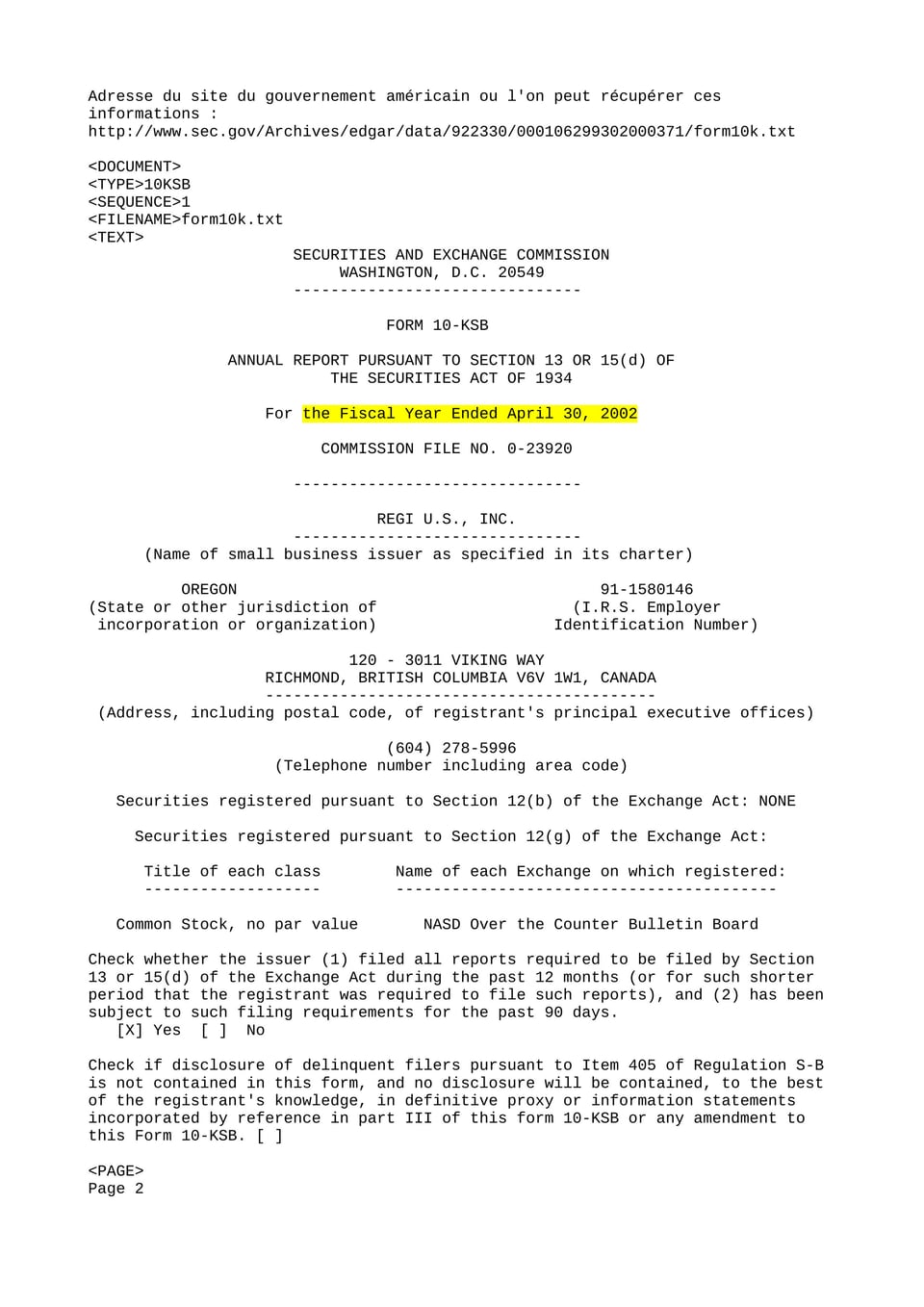
Adresse du site du gouvernement américain ou l'on peut récupérer ces informations :
http://www.sec.gov/Archives/edgar/data/922330/000106299302000371/form10k.txt
10KSB
form10k.txt
SECURITIES AND EXCHANGE COMMISSION WASHINGTON, D.C. 20549
FORM 10-KSB
ANNUAL REPORT PURSUANT TO SECTION 13 OR 15(d) OF THE SECURITIES ACT OF 1934
For the Fiscal Year Ended April 30,2002
COMMISSION FILE NO. 0-23920
REGI U.S., INC.
(Name of small business issuer as specified in its charter)
OREGON (State or other jurisdiction of incorporation or organization)
91-1580146 (I.R.S. Employer Identification Number)
120-3011 VIKING WAY RICHMOND,BRITISH COLUMBIA V6V 1W1,CANADA
(Address, including postal code, of registrant's principal executive offices)
(604) 278-5996 (Telephone number including area code)
Securities registered pursuant to Section 12(b) of the Exchange Act: NONE
Securities registered pursuant to Section 12(g) of the Exchange Act:
Title of each class
Name of each Exchange on which registered:
Common Stock, no par value
NASD Over the Counter Bulletin Board
Check whether the issuer (1) filed all reports required to be filed by Section 13 or 15(d) of the Exchange Act during the past 12 months (or for such shorter period that the registrant was required to file such reports), and (2) has been subject to such filing requirements for the past 90 days.
[X] Yes [ ] No
Check if disclosure of delinquent filers pursuant to Item 405 of Regulation S-B is not contained in this form, and no disclosure will be contained, to the best of the registrant's knowledge, in definitive proxy or information statements incorporated by reference in part III of this form 10-KSB or any amendment to this Form 10-KSB. [ ] State the issuer's revenues for its most recent fiscal year: nil.
The aggregate market value of the voting stock held by non-affiliates of the registrant on July 31,2002, computed by reference to the price at which the stock was sold on that date: $1,240,544.
The number of shares outstanding of the registrant's Common Stock, no par value, as of July 31,2002 was 11,287,935.
Documents incorporated by reference: See Exhibits.
Transitional Small Business Disclosure Format (Check one): Yes ( ) No (X).
Page 3
REGI U.S., INC.
FORM 10-KSB
TABLE OF CONTENTS
PART I
PART I
ITEM 1. DESCRIPTION OF BUSINESS 5
GENERAL 5
BUSINESS OF THE COMPANY AND PRODUCTS 6
Overview and History 6
PRODUCTS AND PROJECTS 8
Rand Cam Technology 8
Rand Cam Cold Turbine Engine 8
Gasoline and Diesel Engine 8
Motor Scooter Project 9
Compressor 9
Air Pump 10
Hydraulic Pump 10
Hydrogen Separator 10
Ceramic Rand Cam TM Engine 10
MARKETING 12
COMPETITION 13
RAW MATERIALS AND PRINCIPAL SUPPLIERS 13
PATENTS, TRADEMARKS, LICENCES, FRANCHISES, CONCESSIONS, ROYALTY
AGREEMENTS, LABOR CONTRACTS, INCLUDING DURATION 13
Patents 13
Royalty Payments 14
RISK FACTORS 14
GOVERNMENT REGULATIONS 17
DEPENDENCE ON CERTAIN CUSTOMERS 17
RESEARCH AND DEVELOPMENT 17
COSTS AND EFFECTS OF COMPLIANCE WITH ENVIRONMENTAL LAWS 18
NUMBER OF TOTAL EMPLOYEES AND NUMBER OF FULL-TIME EMPLOYEES 18
ITEM 2. DESCRIPTION OF PROPERTY 18
ITEM 3. LEGAL PROCEEDINGS 18
ITEM 4. SUBMISSION OF MATTERS TO A VOTE OF SECURITY HOLDERS 18
PART II
ITEM 5. MARKET FOR COMMON EQUITY AND RELATED STOCKHOLDER MATTERS 19
DIVIDEND POLICY 19
RECENT SALES OF UNREGISTERED SECURITIES 19
ITEM 6: MANAGEMENT'S DISCUSSION AND ANALYSIS OR PLAN OF OPERATIONS 19
LIQUIDITY AND CAPITAL RESOURCES 20
ITEM 7. FINANCIAL STATEMENTS 21
ITEM 8. CHANGES IN AND DISAGREEEMENTS WITH ACCOUNTANTS ON ACCOUNTING
AND FINANCIAL DISCLOSURE 21 Page 4
PART III 21
ITEM 9. DIRECTORS, EXECUTIVE OFFICERS, PROMOTERS AND CONTROL PERSONS;
COMPLIANCE WITH SECTION 16 (a) OF THE EXCHANGE ACT. 21
BUSINESS EXPERIENCE AND PRINCIPAL OCCUPATION OF DIRECTORS,
EXECUTIVE OFFICERS AND SIGNIFICANT EMPLOYEES 22
ITEM 10. EXECUTIVE COMPENSATION 24
ITEM 11. SECURITY OWNERSHIP OF CERTAIN BENEFICIAL OWNERS AND MANAGEMENT 25
ITEM 12. CERTAIN RELATIONSHIPS AND RELATED TRANSACTIONS 27
ITEM 13(a). EXHIBITS. 28
ITEM 13(b). REPORTS ON FORM 8-K. 29
SIGNATURES 30
THIS ANNUAL REPORT ON FORM 10-KSB, INCLUDING EXHIBITS THERETO, CONTAINS FORWARD-LOOKING STATEMENTS WITHIN THE MEANING OF SECTION 27A OF THE SECURITIES ACT OF 1933, AS AMENDED, AND SECTION 21E OF THE SECURITIES EXCHANGE ACT OF 1934,
AS AMENDED. THESE FORWARD-LOOKING STATEMENTS ARE TYPICALLY IDENTIFIED BY THE WORDS "ANTICIPATES", "BELIEVES", "EXPECTS", "INTENDS", "FORECASTS", "PLANS", "FUTURE", "STRATEGY", OR WORDS OF SIMILAR MEANING. VARIOUS FACTORS COULD CAUSE ACTUAL RESULTS TO DIFFER MATERIALLY FROM THOSE EXPRESSED IN THE FORWARD-LOOKING STATEMENTS, INCLUDING THOSE DESCRIBED IN "RISK FACTORS" IN THIS FORM 10-KSB. WE ASSUME NO OBLIGATION TO UPDATE THESE FORWARD-LOOKING STATEMENTS TO REFLECT ACTUAL RESULTS, CHANGES IN ASSUMPTIONS, OR CHANGES IN OTHER FACTORS, EXCEPT AS REGULATED BY LAW.
PART I
ITEM 1. DESCRIPTION OF BUSINESS
GENERAL
We were organized under the laws of the State of Oregon on July 27,1992 as Sky Technologies, Inc. On August 1,1994, our name was officially changed by a vote of a majority of our shareholders to REGI U.S., Inc. We are controlled by Rand Energy Group Inc., a privately held British Columbia corporation ("RAND"), which, in turn, is controlled 51% by Reg Technologies Inc., a publicly held British Columbia corporation ("Reg Tech").
We are engaged in the business of developing and building an improved axial vane-type rotary engine known as the Rand Cam/Direct Charge Engine ("RC/DC Engine"), which is a variation of the Rand Cam Rotary Engine, an axial vane rotary engine ("Original Engine"). The worldwide, exclusive of the United States, intellectual and marketing rights to the RC/DC Engine are held by RAND. We hold the rights to develop, build and market the RC/DC Engine design in the U.S. pursuant to an agreement with RAND. Under a project cost sharing agreement entered into with RAND effective May 1, 1993, each company funds 50% of the continuing development cost of the RC/DC Engine.
Our principal offices are located at 3011 Viking Way, Suite 120, Richmond British Columbia V6V 1X1, Canada. Our telephone number is (604) 278-5996 and our telefacsimile number is (604) 278-3409. Our website is www.regtech.com.
We will likely need to raise additional capital in the future beyond any amount currently on hand and which may become available as a result of the exercise of warrants and options which are currently outstanding, in order to fully implement our intended plan of operations.
BUSINESS OF THE COMPANY AND PRODUCTS
Overview and History
We are engaged in the business of developing and building an improved axial vane-type rotary engine known as the Rand Cam TM Direct Charge ("RC/DC") Engine, which is a variation of the Original Engine. The Original Engine is an axial vane rotary engine, the worldwide marketing rights to which are held by RAND. A United States patent was issued for the RC/DC Engine on July 4,1995,and assigned to us. Since no marketable product has yet been developed, we have not received any revenues from operations.
The RC/DC Engine is based upon the Original Engine patented in 1983. Brian Cherry, a former officer and director of the Company, has done additional development work on the Original Engine which resulted in significant changes and improvements for which the U.S. patent has been issued and assigned to us. We believe the RC/DC Engine offers important simplification from the basic Original Engine, which will make it easier to manufacture and will also allow it to operate more efficiently.
Pursuant to an agreement dated October 20,1986 between Reg Tech, Rand Cam Corp. and James McCann, Reg Tech agreed to acquire a 40% voting interest in a new corporation to be incorporated to acquire the rights to the Original Engine.The new corporation was RAND. Reg Tech acquired the 40% voting interest in RAND in consideration of the payment of $250,000.
Pursuant to an agreement made as of April 27,1993 among Reg Tech,Rand Cam Corp., RAND and James McCann,Reg Tech acquired an additional 330,000 shares (11%) of RAND from Rand Cam Corp. to increase its investment to 51%.
On August 20,1992, we entered in an agreement with RAND and Brian Cherry (the "August 1992 Agreement") under which we issued 5,700,000 shares of our Common Stock at a deemed value of $0.01 per share to RAND in exchange for certain valuable rights, technology, information, and other tangible and intangible assets, including improvements, relating to the United States rights to the Original Engine. RAND's president is also our president and its Vice President and Secretary is also one of our directors. The terms of the agreement were negotiated between the parties and were deemed to be mutually advantageous based upon conditions and circumstances existing at the time.
We entered into an agreement dated April 13, 1993 with RAND, Reg Tech and Brian Cherry (the "April 1993 Agreement") and made as an amendment to a previous Amendment Agreement dated November 23, 1992 between RAND, Reg Tech and Brian Cherry and an original agreement dated July 30, 1992 between RAND, Reg Tech and Brian Cherry, Cherry agreed to: (a) sell, transfer and assign to RAND worldwide rights, except for the United States, to all of his right, title and interest in and to the technology related to the RC/DC Engine (the "Technology"), including all pending and future patent applications in respect of the Technology, together with any improvements, changes or other variations to the Technology; (b) sell, transfer and assign to the Company United States of America rights to all of his right, title and interest in and to the Technology, including all pending and future patent applications in respect of the Technology, together with any improvements, changes or other variations to the Technology. On November 9, 1993, in consideration for this transfer of the Technology, Brian Cherry was issued 100,000 shares of Reg Tech with a deemed value of $200,000.
Page 7
A final provision of the April 1993 Agreement assigned and transferred ownership of any patents, inventions, copyrights, know-how, technical data, and related types of intellectual property conceived, developed or created by RAND or its associated companies either to us which results or derives from the direct or indirect use of the Original Engine and/or RC/DC Engine technologies by RAND.
We entered into a letter of understanding dated December 13,1993,with RAND and Reg Tech, as grantors, and West Virginia University Research Corporation ("WVURC"), the grantors agreed that WVURC shall own 5% of all patented technology relating to the Original Engine and the RC/DC Engine. WVURC performed extensive analysis and testing on the RC/DC engine. WVURC provided support and development of the RC/DC Engine including research, development, testing evaluation and creation of intellectual property.In addition, WVURC introduced us to potential customers and licensees. We are entitled to all intellectual property developed by WVURC relating to the RC/DC Engine.
Based upon testing work performed by independent organizations on prototype models, we believe that the RC/DC Engine holds significant potential in a number of other applications ranging from small stationary equipment to automobiles and aircraft. In additional to its potential use as an internal combustion engine, the RC/DC Engine design is being employed in the development of several types of compressors, pumps, expanders and other applications.
To date, several prototypes of the RC/DC Engine have been tested and additional development and testing work is continuing. We believe that such development and testing will continue until a commercially feasible design is perfected. There is no assurance at this time, however, that such a commercially feasible design will ever be perfected, or if it is, that it will become profitable. If a commercially feasible design is perfected, we do, however, expect to derive revenues from licensing the Technology relating to the RC/DC Engine regardless of whether actual commercial production is ever achieved. There is no assurance at this time, however, that revenues will ever be received from licensing the Technology even if it does prove to be commercially feasible.
We believe that a large market would exist for a practical rotary engine which could be produced at a competitive price and which could provide a good combination of fuel efficiency, power density and exhaust emissions.
Based on the market potential, we believe the RC\DC Engine is well suited for application to internal combustion engines, pumps, compressors and expansion engines. The mechanism can be scaled to match virtually any size requirement. This flexibility opens the door to large markets being developed.
We are currently testing prototypes for several products. Our strategy is to develop engines and compressors for low to medium horsepower applications, then apply the Technology to larger applications. We have licensed the Technology for several projects. The licensee's have agreed to fund their projects for research and development of the specific applications. To date, we have completed three license agreements with Advanced Ceramics for 10 H.P. or less for remote piloted vehicles, a license agreement with Radian MILPARTS for greater than 10 H.P. for military applications and to Rotary Power International for Generator applications.
Page 8
PRODUCTS AND PROJECTS
Rand Cam Technology
Rand Cam Cold Turbine Engine
On March 13,2001, we announced that analysis has been completed on a RAND CAM COLD TURBINE ENGINE to generate 1000 horsepower at 1800 rpm for the electrical power generation market. Preliminary drawings of this engine have been completed.
A presentation has been prepared to visually demonstrate the technology so that we can generate interest and obtain funding to build and test this new engine. A dry run of the presentation was presented to a representative of one of the largest engine manufacturers in North America and the representative is assisting in setting up a presentation for its top management. Two additional presentations have been made to the management of this engine manufacturing company and the product is being reviewed by its engineering department. This presentation will be "taken on the road" and shown to additional major engine manufacturers and end users such as utility companies to solicit interest. Summarizing the presentation, the RAND CAM COLD TURBINE ENGINE compared to the best available MICROTURBINE ENGINE, has 32 percent better efficiency and generates 91 percent more power from the same airflow while retaining all of the emissions advantages of the MICROTURBINE ENGINE.
An analysis has been completed to show the potential of the RAND CAM COLD TURBINE ENGINE in aircraft application at the 400 horsepower output level so that we can work with several groups that have expressed interest in the Rand Cam Engine at this rating for aircraft and marine markets.
On July 12, 2001 we announced that our Engineer, Patrick Badgley, has completed a proposal to build a residential Cold Turbine Rand Cam generator. The self-contained residential power plant will be capable of providing 100% of the power needs of a modern luxury residence and would run on natural gas, propane or diesel fuel. The 25kW Rand Cam power plant would run at 3600 rpm, be extremely quiet, only 18 inches in overall diameter and would weigh 110 lbs. Designs have been completed for three different applications of this new engine concept. The Cold Turbine is the use of a positive displacement RAND CAM(TM) compressor and a positive displacement RAND CAM(TM) expander in a Brayton cycle (gas turbine) machine. Much interest is being shown in this technology following both our press release and a recent article in Ward's Engine Update.
Rotary Power International has been granted a license agreement for the power generator applications.
Gasoline and Diesel Engine
Two prototype engines were built in 1993 and 1994 by the WVURC to run on gasoline. Testing on these prototypes suggested that the concept is fundamentally sound and that with a program of engine review, design, testing and development, a technically successful range of engines can be developed. The current prototype design for the diesel engine was designed by a consortium made up of Alliant Techsystems (formerly Hercules Aerospace Company) ("Alliant"), WVURC and us. Alliant was involved in the design and development including drawings for the RC/DC diesel engine. In addition Alliant performed extensive
Page 9
analysis on the diesel engine including bearings, cooling, leakage, rotor, vanes, housing, vane tip heating, geometry and combustion. This engine was designed as a general purpose power plant for military and commercial applications. A prototype of the diesel engine has been assembled and tested.
Motor Scooter Project
The motor scooter project was successfully tested by Paul LaMarche, our engineer in Detroit, Michigan. Additional testing is proposed to prove the concept to potential interested customers.
The RC\DC Scooter Engine was successfully test fired on the new ignition system which was designed by our engineering team. The system fired in all chambers on both sides. The positive aspect of this test is that the ignition system is capable of operating at the demanding rate of the sixteen combustions per revolution versus the eight combustions for two revolutions on the existing piston engine used today.
The RC\DC Scooter engine will be a light weight, smooth and quiet running motor and very inexpensive to maintain and manufacture. Also, the RC\DC Scooter Engine prototype required equipment has been fabricated and acquired. The RC\DC Scooter Engine will weigh approximately 15-20 pounds and generate 20 HP. We have received inquiries from manufacturers regarding the possibility of including the Motor Scooter Engine in lightweight and inexpensive vehicles. There is no assurance, however, that we will enter into an agreement with anyone to manufacture the Motor Scooter engine.
Compressor
We contracted Coltec, Inc., a Columbus, Indiana engineering firm, to fabricate the Rand Cam (TM) air conditioning compressor for buses. The testing is to be conducted by Trans/Air Manufacturing Corporation, one of the largest manufacturers of air conditioning units for buses, which has agreed to jointly develop and manufacture the working model compressor. The prototype compressor was delivered to Trans/Air in January 2001 and is presently awaiting testing in a bus.
A special 3.2 SCFM air compressor has been designed for a large fuel cell customer. The customer has reviewed the design and his comments including type of drive motor, inlet and outlet piping arrangements and mounting considerations were incorporated and final drawings were prepared. This compressor is of virtually all plastic construction.
On June 28,2001 we announced that the air pump for the fuel cell had been assembled and testing had commenced. The air pump was designed for the 1 KW fuel cell and is to be further tested by a potential customer at its facilities. Reg Technologies, Inc. also has agreed to build a Rand Cam compressor for several applications in the air, hydrogen and natural gas compressor requirements for fuel cell applications.
On August 21, 2001 we announced that the prototype air compressor requested by a major fuel cell manufacturer has been fabricated and is currently undergoing additional testing at REGI U.S.'s facility in Detroit. At the completion of this effort the compressor will be delivered to a compressor manufacturer for evaluation and testing as a first step towards this manufacturer becoming a licensee to manufacture compressors for our applications.
Page 10
Air Pump
On September 21, 2000 we announced that Paul LaMarche, a director and Vice President of Engineering, completed a series of feasibility tests on the Rand Cam air pump for the Lumbar seat application in automobiles. The Rand Cam air pump was tested without lubrication and filled the lumbar chamber in less than four (4) seconds, which is less than required by the specifications, at only 6,600 rpm. To date, production costs and manufacturing techniques have not been completed.
Hydraulic Pump
A special 2.5 GPM pump has been designed and fabricated for use in a hydrostatic transmission for the lawn and garden market.The pump includes an integrated 12 Volt drive motor. This pump incorporates the same new technologies used in the air conditioning compressor including the winged rotor and multi-piece vanes The pump is designed for very low cost and is of all plastic construction. Production pricing has been obtained and we are very competitive according to our customer. This specific application for which this pump was designed has been temporarily put on hold.
Hydrogen Separator
We purchased the rights to the H2O Hydrogen Separator Technology consisting of a hydrogen separator based, which is a unique system for extracting hydrogen from water. We own a 50% interest in the U.S. rights and Reg Technologies, Inc. owns 50% of the worldwide rights excluding the U.S. to the Hydrogen Separator Technology.
In consideration for a 50% interest for the rights to the Hydrogen Separator Technology Reg Technologies, Inc. ("Reg") agrees that we shall apply for a patent in the U.S.for the Hydrogen Separator Technology at Reg's expense; and Reg agrees to build a prototype of the Hydrogen Separator Technology as designed by GHM, Inc. We declined the option to purchase an additional 50% interest.To date, patent confirmation has not been received by Reg.
Ceramic Rand Cam TM Engine
On December 6,2001 we announced that a U.S. Navy contract (SBIR No1-144) has been awarded to Advanced Ceramics Research (prime contractor) and REGI U.S., Inc. to build and test a Naval 0.5 horsepower ceramic engine. The proposed engine is a four stroke Rand Cam engine utilizing continuous injection and combustion in a single combustion chamber. The engine will be of all ceramic construction to permit high temperature operation, without cooling, to effectively burn heavy oil. This new motor will be developed for powering the U.S. Navy's new Smart War-fighter Array of Re-configurable Modules (SWARM) low cost unmanned aerial vehicle.
On April 4,2002 we announced that we signed an agreement to grant a license to Advanced Ceramics Research, Inc. ("ACR") for the Rand Cam based motors for 10 H.P. or less for the SBIR No 1-144 Navy Contract for the remote piloted applications. We agreed that a 5 year contract will also be granted to ACR for the Rand Cam concept motors for the commercial and military rights for the applications developed under the Navy contract for 10 H.P or less.
We will receive a royalty fee of 5% of the purchase price for the commercial and Navy applications. We also receive 30% of the Navy phase I contract and 50% of
Page 11
the phase II contract which is typically 50,000 to 100,000 for Phase I and 500,000 to 750,000 for Phase II. Phase I has been completed by Advanced Ceramics.
Progress Report from May 1,2001 to April 30,2002
On June 28,2001 we reported that the air pump for the fuel cell has been assembled and testing has commenced. The air pump was designed for the 1KW fuel cell and is to be further tested by a potential customer at their facilities. Reg Technologies, Inc. also has agreed to build a Rand Cam compressor for several applications in the air, hydrogen and natural gas compressor requirements for fuel cell applications
On August 21,2001, we reported progress on the Rand Cam Air Conditioning Compressor. We previously reported the air conditioning compressor for heavy-duty bus applications was completed and delivered to the Trans Air Manufacturing Company for testing in January of this year. Unfortunately,the testing has not been started. Pat Badgley previously visited this company and
was assured that Trans Air is still very interested in the compressor and will start the testing now that the busy season for their industry is coming to a close.
On October 22, 2001 we announced that Robert D. Stoddart B.S. Chemical Engineering, was appointed as Corporate Marketing Director for the Rand Cam(TM) technology applications for REGI U.S., Inc. Robert Stoddart brings with him 30 years experience in the aerospace and aircraft industry, as Corporate Marketing Director and Federal Government Affairs Director. Mr. Stoddart has been involved as a contractor and/or consultant for the Department of Defense, Naval Sea Systems Command; Naval Air Systems Command and Defense Advanced Research Projects Agency (DARPA).
We also announced that Stodd International, Mr. Stoddart's company, was appointed as agent for REGI U.S., Inc. to raise up to $6 million (U.S.) on a non-exclusive basis. A 5% agents fee of the total funds received from contacts introduced by Stodd International will be paid for funds raised, license fees, royalty payments and contract fees. We believe that Mr. Stoddart's extensive expertise in government relations and advanced technologies marketing will be a valuable asset to marketing the Rand Cam(TM) projects and raising substantial funds for REGI U.S., Inc.
Our Rand Cam(TM) technology was exhibited at the GSE Expo (Ground Support Equipment Expo http://www.gseexpo.com) in Las Vegas at the Rio Hotel and Convention Center on October 23-25, 2001. Our booth was well attended.
On December 6,2001, we announced that a U.S. Navy contract (SBIR No1-144) has been awarded to Advanced Ceramics Research (prime contractor) and REGI U.S., Inc. to build and test a Naval 0.5 horsepower ceramic engine. The proposed engine is a four stroke Rand Cam(TM) engine utilizing continuous injection and combustion in a single combustion chamber. The engine will be of all ceramic construction to permit high temperature operation, without cooling, to effectively burn heavy oil. This new motor will be developed for powering the U.S. Navy's new Smart War-fighter Array of Re-configurable Modules (SWARM) low cost unmanned aerial vehicle.
Page 12
On April 4,2002 we announced that we signed an agreement to grant a license to Advanced Ceramics Research, Inc. ("ACR") for the Rand Cam based motors for 10 H.P. or less for the SBIR No 1-144 Navy Contract for the remote piloted applications.
A 5 year contract will also be granted to ACR for the Rand Cam concept motors for the commercial and military rights for the applications developed under the Navy contract for 10 H.P or less. We will receive a royalty fee of 5% of the purchase price for the commercial and Navy applications. REGI U.S., Inc. also receives 30% of the Navy phase I contract and 50% of the phase II contract which is typically 50,000 to 100,000 for Phase I and 500,000 to 750,000 for Phase II.
MARKETING
We intend to pursue the development of the RC/DC Engine and the air pump, compressor and other products by entering into licensing and/or joint venture arrangements with other larger companies, which have the financial resources to maximize the potential of the technology. At the present time no such licensing or joint venture arrangements have been concluded and there is no assurance that any will be in the foreseeable future. We have no current plans to become actively involved in either manufacturing or marketing any engine or other product which it may ultimately develop to the point of becoming a commercial product.
Our current objective is to complete and test the various compressor, pump and diesel engine prototypes.
Based on the successful testing, the prototypes will be used for presentation purposes to potential license and joint venture partners. We are currently making presentations to the U.S.military which could result in additional government funding if the diesel engine prototype meets with its approval.
We expect revenue from license agreements with the potential end users based on the success of the design of from the compressor, pump, Cold Turbine Engine and diesel engine prototypes. Based on of successful testing of the Rand Cam prototypes, we expect to have joint venture or license agreements finalized which would result in royalties to us. However, there is no assurance that the tests will be successful or that we will ever receive any such royalties.
The following marketing activities are all currently underway:
AIR CONDITIONING COMPRESSOR - An agreement with Trans Air Manufacturers has been completed to use the Rand Cam(TM) compressor in air conditioning units in bus applications. We have delivered a compressor prototype for testing. We are awaiting test results from Trans Air.
AIR PUMP - A prototype air pump for a Fuel Cell Application has been completed and will be delivered to the Fuel Cell manufacturer for testing soon.
DIESEL ENGINE - Efforts are underway to obtain funding for modifications of the existing Diesel engine to incorporate the latest winged rotor technology and incorporate extensive thermal barrier coatings. Also several new aircraft engine designs have been completed for aircraft applications ranging from 1 to over 400 horsepower for interested potential customers. We have signed a license agreement with Advanced Ceramics and Radian MILPARTS to further develop our Rand Cam Technology for diesel engine applications.
Page 13
COMPETITION
We currently face and will continue to face competition in the future from established companies engaged in the business of developing, manufacturing and marketing engines and other products. While not a highly competitive business in terms of numbers of competitors, the business of developing engines of a new design and attempting to either license or produce them is nonetheless difficult because most existing engine producers are large, well financed companies which are very concerned about maintaining their market position. Such competitors are already well established in the market and have substantially greater resources than us. Internal combustion engines are produced by automobile manufacturers, marine engine manufacturers, heavy equipment manufacturers and specialty aircraft and industrial engine manufacturers. We expect that our engine would be used mainly in industrial and marine applications.
Except for the Wankel rotary engine built by Mazda of Japan, no competitor, that we are aware of, presently produces in a commercial quantity any rotary engine similar to the engines we are developing. The Wankel rotary engine is similar only in that it is a rotary engine rather than a reciprocating piston engine. Without substantially greater financial resources than is currently available to us, however, it is very possible that it may not be able to adequately compete in the engine business. One competitor, Rotary Power International, is presently producing the first production SCORE rotary (Wankel type) engines. Our RC\DC Engine is more fuel efficient, smaller, quieter, costs less to produce and will have fewer exhaust emissions.
We believe that if and when our engine is completely developed, in order to be successful in meeting or overcoming competition which currently exists or may develop in the future, our engine will need to offer superior performance and/or cost advantages over existing engines used in various applications.
RAW MATERIALS AND PRINCIPAL SUPPLIERS
Since we are not in production and there are no plans at this time for us to enter the actual engine manufacturing business, raw materials are not of present concern. At this time, however, there does not appear to be any foreseeable problem with obtaining any materials or components, which may be required in the manufacture of its potential products.
PATENTS, TRADEMARKS, LICENCES, FRANCHISES, CONCESSIONS, ROYALTY AGREEMENTS LABOR CONTRACTS, INCLUDING DURATION
Patents
U. S. patent No. 5,429,084 was granted on July 4,1995, to the inventor, Brian Cherry, Patrick Badgley and four other individuals for various improvements incorporated in the RC/DC Engine. The patent has been assigned to us. U.S. Patent 4,401,070 for the Original Engine was issued on August 30,1983, to James McCann and RAND holds the marketing rights.
The RC/DC Engine is composed basically of a disk shaped rotor with drive shaft, which turns, and the housing or stator, which remains stationary. The rotor has two or more vanes that are mounted perpendicular to the direction of rotation and slide back and forth through it. As the rotor turns, the ends of the vanes ride along the insides of the stator housing which have wave-like depressions,
Page 14
causing the vanes to slide back and forth. In the process of turning and sliding, combustion chambers are formed between the rotor, stator walls and vanes where the fuel/air mixture is injected, compressed, burned and exhausted.
Two additional patents have been issued for improvements to the engine including: U.S. Patents 5,509,793 "Rotary Device with Slidable Vane Supports) issued April 24,1996 and 5,551,853 "Axial Vane Rotary Device and Sealing System Therefor) issued September 3,1996. Additional patent applications are presently in process for the Winged Rotor, Multi-Piece Vanes and Cold Turbine.
Royalty Payments
The August 1992 Agreement calls for us to pay RAND semi-annually a royalty of 5% of any net profits to be derived by us from revenues received as a result of its license of the Original Engine. The August 1992 Agreement also calls for us to pay Brian Cherry a royalty of 1% semi-annually any net profits derived by us from revenue received as a result of our licensing the Original Engine.
Other provisions of the April 1993 Agreement call for is (a) to pay to RAND a continuing royalty of 5% of the net profits derived from the Technology by us and (b) to pay to Brian Cherry a continuing royalty of 1% of the net profits derived by us from the Technology.
Pursuant to the letter of understanding dated December 13,1993, among us,RAND, Reg Tech and WVURC,WVURC will receive 5% of all net profits from sales, licenses, royalties or income derived from the patented technology relating to the Original Engine and the RC/DC Engine.
No royalties are to be paid to Alliant or Adiabatics, Inc.
Pursuant to our agreement with Weston, we agreed to pay to Weston 8.5% of net sales derived from the AVFS together with a minimum annual royalty of $24,000 per year beginning October 1, 1997, payable quarterly. This agreement was terminated February 4, 2002.
RISK FACTORS
You should carefully consider the following risks and the other information in this Report and our other filings with the SEC before you decide to invest in us or to maintain or increase your investment.
The risks and uncertainties described below are not the only ones facing us. Additional risks and uncertainties may also adversely impact and impair our business. If any of the following risks actually occur, our business, results of operations, or financial condition would likely suffer.In such case,the trading price of our common stock could decline,and you may lose all or part of your investment.
Developmental Stage Company. We were incorporated on July 27,1992. We are a development stage company.In a development stage company, management devotes most of its activities to establishing a new business. Planned principal activities have not yet produced significant revenues and we have suffered recurring operating losses as is normal in development stage companies. We also have a working capital deficit of $559,000. These factors raise substantial doubt about our ability to continue as a going concern. Our ability to emerge
from the development stage with respect to our planned principal business activity is dependent upon our successful efforts to raise additional equity financing, receive funding from affiliates and controlling shareholders, and develop a market for our products.
Ability to develop product. We have no assurance at this time that a commercially feasible design will ever be perfected, or if it is, that it will become profitable. Our profitability and survival will depend upon our ability to develop a technically and commercially feasible product which will be accepted by end users. The RC/DC Engine which we are developing must be technologically superior or at least equal to other engines that competitors offer and must have a competitive price/performance ratio to adequately penetrate its potential markets. If we are not able to achieve this condition or if we do not remain technologically competitive, we may be unprofitable and our investors could lose their entire investment. There can be no assurance that we or potential licensees will be able to achieve and maintain end user acceptance of our engine.
Negative Shareholders' Equity. We have a negative shareholders equity as of the date of this 10-KSB. Our ability to continue as a going business will be dependent upon our ability to raise additional capital and/or generate revenues from operations.
Need for Additional Capital. We rely on our ability to raise capital through the sale of our securities. Our the ultimate success will depend upon our ability to raise additional capital or to have other parties bear a portion of the required costs to further develop or exploit the potential market for our products. REG Tech and REGI have agreed to provide the necessary funds for the development of the RC/DC Diesel Engine prototypes and our other operations until joint venture or license agreements can be completed.
Dependence on Consultants and Outside Manufacturing Facilities. Since our present plans do not provide for a significant technical staff or the establishment of manufacturing facilities, we will be primarily dependent on others to perform these functions and to provide the requisite expertise and quality control. There is no assurance that such persons or institutions will be available when needed at affordable prices. It will likely cost more to have independent companies do research and manufacturing than for us to handle these resources.
Product/Market Acceptance. Our profitability and survival will depend upon our ability to develop a technically and commercially feasible product which will be accepted by end users. The RC/DC Engine and the AVFCS which we are developing must be technologically superior or at least equal to other engines which our competitors offer and must have a competitive price/performance ratio to adequately penetrate our potential markets. A number of rotary engines have been designed over the past 70 years but only one, the Wankel, has been able to achieve mechanical practicality and any significant market acceptance. If we
are not able to achieve this condition or if we do not remain technologically competitive, we may be unprofitable and our investors could lose their entire investment. There can be no assurance that we or our potential licensees will be able to achieve and maintain end user acceptance of our engine or the AFVCS.
No Formal Market Survey. We have not conducted a formal market survey but statistics available on the aircraft, marine and industrial markets alone indicate an annual market potential of more than one hundred million dollars.
Competition. While not a highly competitive business in terms of numbers of competitors, the business of developing engines of a new design and attempting to either license or produce them is nonetheless difficult because most
existing engine producers are large, well financed companies which are very concerned about maintaining their market position. There is no assurance that we will be successful in meeting or overcoming our current or future competition.
Protection of Intellectual Property. Our business depends on the protection of our intellectual property and may suffer if we are unable to adequately protect our intellectual property.The success of our business depends on our ability to patent our engine.Currently,we have been granted several U.S.Patents. We cannot provide assurance that our patents will not be invalidated, circumvented or challenged,that the rights granted under the patents will give us competitive advantages or that our patent applications will be granted.
History of Losses. We have a history of operating losses, and an accumulated deficit, as of April 30,2002,of $5,308,000. Our ability to generate revenues and profits is subject to the risks and uncertainties encountered by development stage companies.
Our future revenues and profitability are unpredictable. We are currently have no signed contracts that will produce revenue and we do not have an estimate as to when we will be entering into such contracts.Furthermore,we cannot provide assurance that management will be successful in negotiating such contracts.
Rapid Technological Changes could Adversely Affect Our Business. The market for our engines is characterized by rapidly changing technology, evolving industry standards and changing customer demands.Accordingly, if we are unable to adapt to rapidly changing technologies and to adapt our product to evolving industry standards, our business will be adversely affected.
Management and Conflicts of Interest. Our present officers and directors have other unrelated full-time positions or part-time employment. Some officers and directors will be available to participate in management decisions on a part-time or as-needed basis only. Our management may devote time to other companies or projects which may compete directly or indirectly with us.
Control by Current Insiders. 6,017,850 common shares, not including currently exercisable options or warrants, are owned by current insiders representing control of approximately 53.31% of the total voting power.Accordingly,the present insiders will continue to elect all of our directors and generally control our affairs.
Need for Additional Key Personnel. At the present, we employ no full time employees. Our success will depend, in part, upon the ability to attract and retain qualified employees. We believe that we will be able to attract competent employees, but no assurance can be given that we will be successful in this regard. If we are unable to engage and retain the necessary personnel, our business would be materially and adversely affected.
Indemnification of Officers and Directors for Securities Liabilities. Our Bylaws provide that we may indemnify any Director, Officer, agent and/or employee as to those liabilities and on those terms and conditions as are specified in the Oregon Business Corporation Act. Further, we may purchase and maintain insurance on behalf of any such persons whether or not we would have the power to indemnify such person against the liability insured against. This could result in substantial expenditures by us and prevent any recovery from such Officers, Directors, agents and employees for losses incurred by us as a result of their actions. Further, we have been advised that in the opinion of
Page 17
the Securities and Exchange Commission, indemnification is against public policy as expressed in the 1933 Act and is therefore, unenforceable.
General Factors. Our areas of business may be affected from time to time by such matters as changes in general economic conditions, changes in laws and regulations, taxes, tax laws, prices and costs, and other factors of a general nature which may have an adverse effect on our business.
Limited Public Market for the Common Stock. At present, only a limited public market exists for the Common Stock on the over-the-counter bulletin board maintained by the National Association of Securities Dealers and there is no assurance that a more active trading market will develop, or, if developed, that it will be sustained.
Estimates and Financial Statements. The information in this Form 10-KSB consists of and relies upon evaluation and estimates made by management. Even though management believes in good faith that such estimates are reasonable, based upon market studies and data provided by sources knowledgeable in the field, there can be no assurance that such estimates will ultimately be found to be accurate or even based upon ac-curate evaluations.
No Foreseeable Dividends. We have not paid dividends on our Common Stock and do not anticipate paying dividends on our Common Stock in the foreseeable future.
Possible Volatility of Securities Prices. The market price for our Common Stock traded on the over-the-counter bulletin board has been highly volatile since it began trading and will likely to continue to behave in this manner in the future. Factors such as our operating results and other announcements regarding our development work and business operations may have a significant impact on the market price of our securities. Additionally, market prices for securities of many smaller companies have experienced wide fluctuations not necessarily related to the operating performance of the companies themselves.
GOVERNMENT REGULATIONS
Our engine products including the spark ignited engine, Diesel engine and Cold Turbine engine will be subject to various exhaust emissions standards depending upon the application and the country in which it is produced and/or sold. As each product becomes ready for sale, it will be necessary to have the engine certified according to the standards in effort at that time.
DEPENDENCE ON CERTAIN CUSTOMERS
Although we have no key customers at the present time,we expect that if our development work is successful,we will likely become dependent,at least initially,upon one or very few key customers. Such dependence could prove to be risky in the event that one or more such potential customers were to be lost and not replaced.
RESEARCH AND DEVELOPMENT
The basic research and development work on the RC/DC Engine and other products is being coordinated and funded by Reg Tech and funded as to 50%.
Page 18
We plan to contract with outside individuals, institutions and companies to perform most of the additional research and development work which we may require to benefit from our rights to the RC/DC Engine and other products.
Development work on the air conditioning compressors is being completed by Coltec Industries an engineering firm in Columbus, Indiana under contract with us.
During the last two fiscal years, we spent $627,000 on research and development.
COSTS AND EFFECTS OF COMPLIANCE WITH ENVIRONMENTAL LAWS
At the present time there is no direct financial or competitive effect upon our business as a result of any need to comply with any federal, state or local provisions which have been enacted or adopted regulating the discharge of materials into the environment, or otherwise relating to the protection of the environment.
NUMBER OF TOTAL EMPLOYEES AND NUMBER OF FULL-TIME EMPLOYEES
We currently have two full-time contractors directly involved in technical development work on the RC/DC Engine. We expect to hire additional employees for those positions which we deem necessary to fill, as needs arise. Most additional employees are expected to be in technical and licensing/marketing positions.
ITEM 2. DESCRIPTION OF PROPERTY
We own no properties. We currently utilizes office space leased by Reg Tech in a commercial business park building located in Richmond, British Columbia, Canada, a suburb of Vancouver. The monthly rent for our portion of this office space is $500.00. The present facilities are believed to be adequate for meeting our needs for the immediate future. However we expect that we will likely acquire separate space when the level of business activity requires us to do so. We do not anticipate that we will have any difficulty in obtaining such additional space at favorable rates. There are no current plans to purchase or lease any properties in the near future. Mr. Badgley, a director and Vice President, works out of an office in his home in Columbus, Indiana. From this office, Mr. Badgley oversees and controls development and testing of the engine and other prototypes. Mr. Badgley has also used the facilities of Coltec Industries which was under contract to design and build the compressor prototype.
ITEM 3. LEGAL PROCEEDINGS
We are not a party to any legal proceedings or litigation, nor are we aware that any litigation is presently being threatened or contemplated against us or any officer, director or affiliate.
ITEM 4. SUBMISSION OF MATTERS TO A VOTE OF SECURITY HOLDERS
There was no matter submitted to a vote by our security holders during the fourth quarter of our fiscal year ended April 30,2002, through the solicitation of proxies or otherwise.
Page 19
PART II
ITEM 5. MARKET FOR COMMON EQUITY AND RELATED STOCKHOLDER MATTERS
There is a limited public market for our Common Stock which currently trades on the OTC Bulletin Board under the symbol "RGUS" where it has been traded since September 21,1994. The Common Stock has traded between 0.09 and 6.75 per share since that date.
The following table sets forth the high and low prices for our Common Stock as reported on the Bulletin Board for the quarters presented. These quotations reflect inter-dealer prices, without retail mark-up, mark-down or commissions, and may not reflect actual transactions.
Bid Price
Asked Price
High $
Low $
High $
Low $
Quarter Ended July 31,2000
.78125
.375
.96875
.5
Quarter Ended October 31,2000
.53125
.25
.5625
.3125
Quarter Ended January 31,2001
1.25
.375
1.28125
.5
Quarter Ended April 30,2001
.53125
.3
.65625
.375
Quarter Ended July 31,2001
.36
.25
.4
.26
Quarter Ended October 31,2001
.46
.16
.47
.21
Quarter Ended January 31,2002
.28
.15
.29
.20
Quarter Ended April 30,2002
.22
.17
.30
.19
Quarter Ended July 31,2002
.21
.07
.22
.11
(Information provided by The Over The Counter Bulletin Board. The quotations reflect inter-dealer prices, without retail mark-up, markdown, or commission and may not represent actual transactions.)
As of July 31,2002, there were 11,287,935 shares of Common Stock outstanding held by 238 shareholders of record.
DIVIDEND POLICY
To date we have not paid any dividends on our Common Stock and do not expect to declare or pay any dividends on our Common Stock in the foreseeable future. Payment of any dividends will be dependent upon future earnings, if any, our financial condition, and other factors as deemed relevant by our Board of Directors.
RECENT SALES OF UNREGISTERED SECURITIES
Set forth below is information regarding the issuance and sales of our securities without registration during the last fiscal year. No such sales involved the use of an underwriter. See Note 5(d) to our audited financial statements for the fiscal year ended April 30,2002 for more information on recent sales of unregistered securities.
ITEM 6: MANAGEMENT'S DISCUSSION AND ANALYSIS OR PLAN OF OPERATIONS
We are a development stage company engaged in the business of developing and commercially exploiting an improved axial vane type rotary engine known as the Rand Cam/Direct Charge Engine (the "RC/DC Engine").
As a development stage company, we devote most of our activities to establishing our business. Planned principal activities have not yet produced significant revenues and we have a working capital deficit. We have undergone mounting losses to date totaling 5,308,000 and further losses are expected until we complete a licensing agreement with a manufacturer and reseller. Our working capital deficit is 559,000. Our only assets are our intangible assets, being patents and intellectual property rights,totaling $67,000 which represents 83% of total assets. These factors raise doubt about our ability to continue as a going concern. Our ability to emerge from the development stage with respect to our planned principal business activity is dependent upon our successful efforts to raise additional equity financing, receive funding from affiliates and controlling shareholders, and develop a market for our products.
During the year, we raised a further 194,550 in addition to the 72,000 raised in 2001, pursuant to a private placement of 1,066,000 units issued at 0.25 per unit. Each unit will contain one share and one warrant to acquire one additional share at 0.30 per share if exercised in year one after receipt of funds. These funds raised do not provide enough working capital to fund ongoing operations for the next twelve months. We may also raise additional funds through the exercise of warrants and stock options, if exercised. Warrants with respect to 830,767 shares and 1,066,200 shares priced at 0.50 per share and 0.30 per share respectively may be exercised to net 735,244. Options with respect to 1,485,000 shares at prices between 0.40 and 1.50 per share may be exercised to net 915,000.
Results of operations for the year ended April 30,2002 ("2002") compared to the year ended April 30,2001 ("2001")
There were no revenues from product licensing during 2002 and 2001.
The net loss in 2002 decreased by 653,000 to 156,000 compared to 809,000 in 2001. The decrease was due to a 579,000 decrease in research and development expenses and decrease of 74,000 in administrative expenses. The decrease in administrative expenses was mainly due to a decrease of the investors relations budget and accounts payable written off. All other administrative expenses were kept to a minimum amount of 35,000 from 30,000 in 2001. Professional fees made up 20,000 of the administrative expenses in 2002 as compared to 21,000 in 2001 which includes accounting, auditing and legal; we continue to use a consultant to perform the majority of legal work. The decrease of 579,000 in research and development was mainly attributed to a decrease in the write-off of our AVFS rights to 12,000 from 309,000, prototype design and construction contracts for outside contractors was decreased to 5,000 from 100,000, accounts payable write-off of 94,000 from nil, and consulting as described below. The majority of prototype construction and testing costs continues to be borne by potential licensees and manufacturers. We paid two in house consultants for technical prototype design consulting amounting to 37,000 compared to $97,000 in 2001, which was mainly conducted by Paul LaMarche and Patrick Badgley, Vice President of Research and Development. See above progress reports for research and development activity conducted during the year.
LIQUIDITY AND CAPITAL RESOURCES
During 2002, we financed our operations mainly through subscription proceeds of 194,550 towards a private placement of units at 0.25 per unit.
Page 21
We received funding in 2002 from our affiliated companies (common directors) and our 44.94% shareholder, Rand Energy Group, Inc. and our 51% shareholder Reg Technologies Inc. These companies advanced, or paid expenses on behalf of, $101,000 during 2002.
These amounts owing are now$ 473,000 or 83% of total current liabilities, are unsecured and repayable on demand. Our affiliated companies have indicated that they will not be demanding repayment of these funds during the next fiscal year and will advance, or pay expenses on behalf of, further funds if needed.
The loss for the year of 156,000 included ( 75,000) of non-cash items being 7,000 for amortization of capital and intangible assets, 3,000 for stock based compensation, 12,000 for the write-off of intangible assets, and ( 97,000) for accounts payable written off.
As at April 30,2002, we had a cash deficiency of 2,000 and other current liabilities of 97,000. We receive interim support from our ultimate parent company and plan to raise additional funds from equity financing which is yet to be negotiated. We also plan to raise funds through loans from a controlling shareholder (REGI). REGI owns 5,073,200 shares and plans to sell shares as needed to meet our ongoing funding requirements if traditional equity sources of financing prove to be insufficient.
ITEM 7. FINANCIAL STATEMENTS
Our consolidated financial statements are included and begin immediately following the signature page to this report. See Item 13 for a list of the financial statements and financial statement schedules included.
ITEM 8. CHANGES IN AND DISAGREEEMENTS WITH ACCOUNTANTS ON ACCOUNTING AND FINANCIAL DISCLOSURE
None.
PART III
ITEM 9. DIRECTORS, EXECUTIVE OFFICERS, PROMOTERS AND CONTROL PERSONS; COMPLIANCE WITH SECTION 16 (a) OF THE EXCHANGE ACT.
The following table sets forth the name, age and position of each of our Executive Officers and Directors:
Name
Age
Position
John G. Robertson
Director, Chairman of the Board of Directors,President and Chief Executive Officer
Jennifer Lorette
Director,Vice-President and Chief Financial Officer
James Vandeberg
Director and Chief Operating Officer
Patrick Badgley
Vice-President,Research and Development
Page 22
BUSINESS EXPERIENCE AND PRINCIPAL OCCUPATION OF DIRECTORS, EXECUTIVE OFFICERS AND SIGNIFICANT EMPLOYEES
Mr. Robertson has held his position since our formation in July, 1992. All officers currently devote part-time services to our operation.
There are no family relationships between any director or executive officer and any other director or executive officer.
The present and principal occupations of our directors and executive officers during the last five years are set forth below: John G.
Robertson - Chairman of the Board of Directors, President, Chief Executive Officer
Mr. Robertson has been our Chairman, President and Chief Executive Officer since our formation. Since October 1984 Mr. Robertson has been President and a Director of Reg Technologies Inc., a British Columbia corporation listed on the Canadian Venture Exchange that has financed the research on the Rand Cam Engine since 1986. REGI U.S. is controlled by Rand Energy Group, Inc., a British Columbia corporation of which Reg Technologies Inc. is the majority shareholder. REGI U.S. owns the U.S. rights to the Rand Cam (TM) technology and Rand Energy Group, Inc. owns the worldwide rights exclusive of the U.S. Mr. Robertson is President, Principal Executive Officer and a member of the Board of Directors of IAS Communications, Inc., an Oregon corporation traded on the OTC bulletin board, which is developing a new type of antenna system. Since June 1997 Mr. Robertson has been President, Principal Executive Officer and a Director of Information-Highway.com, Inc., a Florida corporation traded on the OTC bulletin board, and its predecessor. He is also the President and Founder of Teryl Resources Corp., a public company trading on the Canadian Venture Exchange involved in gold, diamond, and oil and gas exploration. He is also President of LinuxWizardry Systems, Inc., a public company trading on the OTC Bulletin Board. Linux Wizardry's Apprentice Router allows small businesses to establish and manage network connections without the need of a Network specialist. Since May 1977 Mr. Robertson has been President and a member of the Board of Directors of SMR Investments Ltd., a British Columbia corporation engaged in the business of management and investment consulting.
Jennifer Lorette - Vice President and Chief Financial Officer
Ms. Lorette became a member of the board of directors in January 2001. She has been our Vice President since June 1994, and was also previously Chief Financial Officer. Since April 1994 she has also been Vice President of Administration and Secretary for Reg Technologies, Inc., a British Columbia corporation listed on the Canadian Venture Exchange that has financed the research on the Rand Cam Engine since 1986. REGI U.S. is controlled by Rand Energy Group, Inc., a British Columbia corporation of which Reg Technologies Inc. is the majority shareholder. Since February 1995 Ms. Lorette has been Secretary/Treasurer and a director of IAS Communications Inc., an Oregon corporation traded on the OTC bulletin board. Since June 1997 Ms. Lorette has been Executive Vice President and a Director of Information-Highway.com, Inc., a Florida corporation traded on the OTC bulletin board, and its predecessor. Since June 1994 Ms. Lorette has also been Vice President and Secretary of LinuxWixardry Stystems, Inc. Since November 1997 Ms. Lorette has been Vice President of Teryl Resources Corp., a public company trading on the Canadian Venture Exchange involved in gold, diamond, and oil and gas exploration. She also became a director in February 2001.
Page 23
James L. Vandeberg - Chief Operating Officer and a Member of the Board of Directors
…