Watchtower Annual Report (2000)
Download: PDF — Watchtower Annual Report (2000)
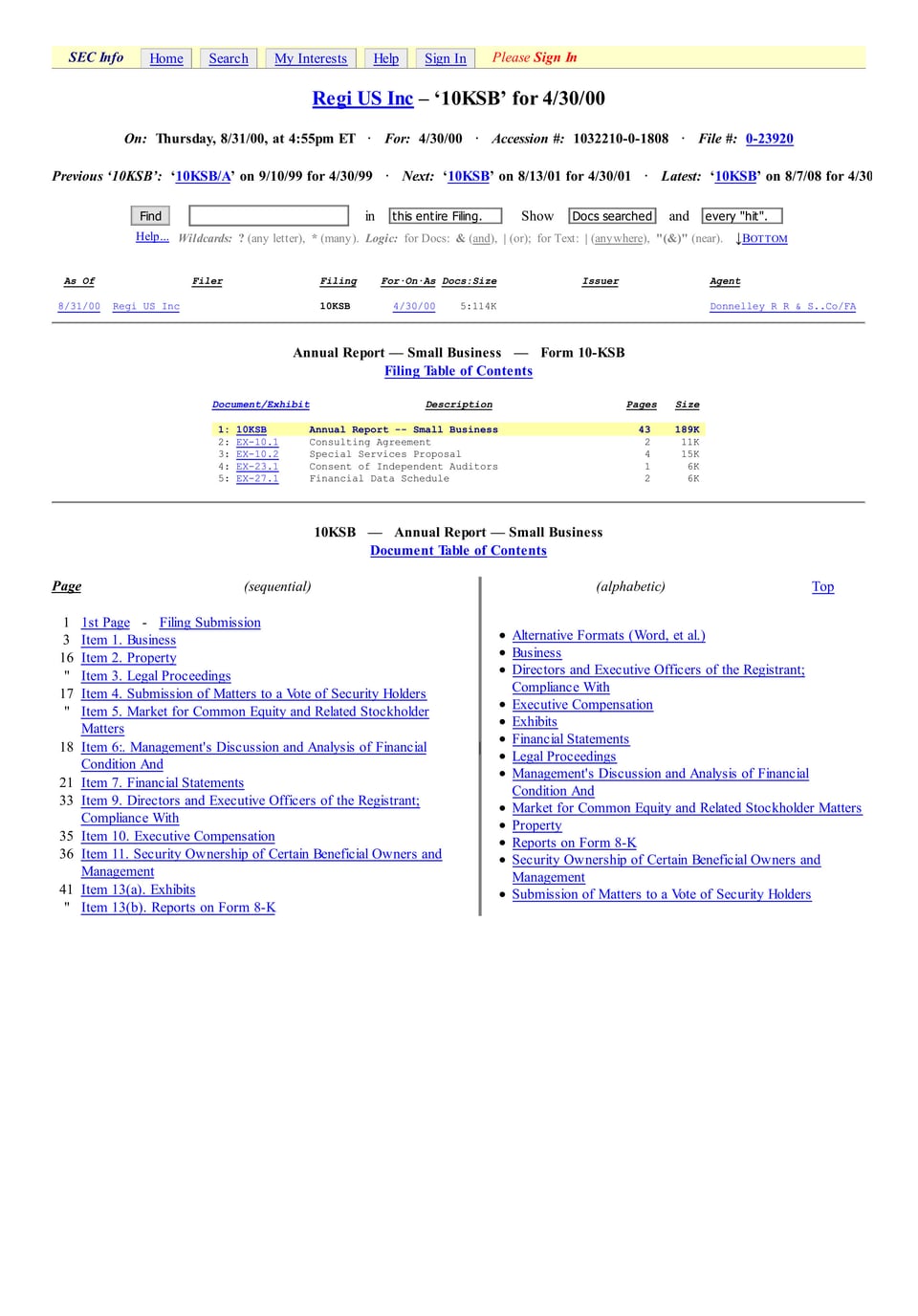
SEC Info
Home
Search
My Interests
Help
Sign In
Please Sign In
Regi US Inc - '10KSB' for 4/30/00
On: Thursday, 8/31/00, at 4:55pm ET · For: 4/30/00 · Accession #: 1032210-0-1808 · File #: 0-23920
Previous '10KSB': ' 10KSB/A' on 9/10/99 for 4/30/99 · Next: ' 10KSB' on 8/13/01 for 4/30/01 · Latest: ' 10KSB' on 8/7/08 for 4/30
Annual Report — Small Business — Form 10-KSB Filing Table of Contents
Document/Exhibit
Description
Pages
Size
1:10KSB
Annual Report--Small Business
189K
2:EX-10.1
Consulting Agreement
11K
3:EX-10.2
Special Services Proposal
15K
4:EX-23.1
Consent of Independent Auditors
6K
5:EX-27.1
Financial Data Schedule
6K
Page
(sequential)
1 1st Page - Filing Submission
3 Item 1. Business
16 Item 2. Property
" Item 3. Legal Proceedings
17 Item 4. Submission of Matters to a Vote of Security Holders
" Item 5. Market for Common Equity and Related Stockholder Matters
18 Item 6.: Management's Discussion and Analysis of Financial Condition And
Top
33 Item 9. Directors and Executive Officers of the Registrant; Compliance With
21 Item 7. Financial Statements
(alphabetic)
36 Item 11. Security Ownership of Certain Beneficial Owners and Management
35 Item 10. Executive Compensation
41 Item 13(a). Exhibits
" Item 13(b). Reports on Form 8-K
Alternative Formats (Word, et al.)
Business
Directors and Executive Officers of the Registrant; Compliance With
Executive Compensation
Exhibits
Financial Statements
Legal Proceedings
Management's Discussion and Analysis of Financial Condition And
Market for Common Equity and Related Stockholder Matters
Property
Reports on Form 8-K
Security Ownership of Certain Beneficial Owners and Management
Submission of Matters to a Vote of Security Holders
SECURITIES AND EXCHANGE COMMISSION WASHINGTON, D.C.
20549
FORM 10-KSB
ANNUAL REPORT PURSUANT TO SECTION 13 OR 15(d) OF THE SECURITIES ACT OF 1934
For the Fiscal Year Ended April 30,2000 COMMISSION FILE NO. 0-23920
REGI U.S., INC. (Name of small business issuer as specified in its charter)
OREGON (State or other jurisdiction of incorporation or organization)
91-1580146 (I.R.S. Employer Identification Number)
185 - 10751 SHELLBRIDGE WAY RICHMOND, BRITISH COLUMBIA V6X 2W8, CANADA (Address, including postal code, of registrant's principal executive offices)
(604) 278-5996 (Telephone number including area code)
Securities registered pursuant to Section 12(b) of the Exchange Act: NONE
Securities registered pursuant to Section 12(g) of the Exchange Act:
Title of each class
Name of each Exchange on which registered:
Common Stock, no par value
None
Indicate by check mark whether the issuer (1) filed all reports required to be filed by Section 13 or 15(d) of the Exchange Act during the past 12 months, and (2) has been subject to such filing requirements for the past 90 days. Yes X
Indicate by check mark if disclosure of delinquent filers pursuant to Item 405 of Regulation S-B is not contained herein and will not be contained, to the best of registrant's knowledge in definitive proxy or information statements incorporated by reference in Part III of this form 10-KSB or any amendment to this Form 10-KSB.
The registrants revenues for its most recent fiscal year were: nil.
The Aggregate market value of the voting stock held by non-affiliates of the registrant on July 31,2000, computed by reference to the price at which the stock was sold on that date: $1,959,905.13.
The number of shares outstanding of the registrant's Common Stock, no par value, as of July 31,2000 was 10,217,735.
Documents incorporated by reference: None
Transitional Small Business Disclosure Format (Check one): Yes ( ) No (X).
REGI U.S., INC.
FORM 10-KSB
TABLE OF CONTENTS
[Download Table]
PART I
Page
Item 1. Description of Business... 1
Item 2. Property... 14
Item 3. Legal Proceedings... 14
Item 4. Submission of Matters to a Vote of Security Holders ... 15
PART II
Item 5. Market for Common Equity and Related Stockholder Matters... 15
Item 6. Management's Discussion and Analysis of Financial Condition and Results of Operations... 16
Item 7. Financial Statements... F-1
PART III
Item 9. Directors, Executive Officers, Promoters and Control Persons; Compliance with Section 16(a) of the Exchange Act... 19
Item 10. Executive Compensation... 21
Item 11. Security Ownership of Certain Beneficial Owners and Management... 22
Item 12. Certain Relationships and Related Transaction... 25
Item 13. Exhibits and Reports on Form 8-K... 27 ITEM 1.
BUSINESS
GENERAL
The Company was organized under the laws of the State of Oregon on July 27, 1992 as Sky Technologies, Inc. On August 1, 1994, the Company's name was officially changed by majority shareholder vote to REGI U.S., Inc. The Company is controlled by Rand Energy Group Inc., a privately held British Columbia corporation ("RAND"), which, in turn, is controlled 51% by Reg Technologies Inc., a publicly held British Columbia corporation ("Reg Tech"). The Company is engaged in the business of developing and building an improved axial vane-type rotary engine known as the Rand Cam/Direct Charge Engine ("RC/DC Engine"), which is a variation of the Rand Cam Rotary Engine, an axial vane rotary engine ("Original Engine"). The worldwide, exclusive of the United States, intellectual and marketing rights to the RC/DC Engine are held by RAND. The Company holds the rights to develop, build and market the RC/DC Engine design in the U.S. pursuant to an agreement with RAND. Under a project cost sharing agreement entered into with RAND effective May 1, 1993, each company will fund 50% of the continuing development cost of the RC/DC Engine.
The Company's principal offices are located at 10751 Shellbridge Way, Suite 185, Richmond, British Columbia V6X 2W8, Canada. Its telephone number is (604) 278-5996 and its telefacsimile number is (604)278-3409.
In order to fully effect its intended plan of operations, the Company will likely need to raise additional capital in the future beyond any amount currently on hand and which may become available as a result of the exercise of warrants and options which are currently outstanding. Reg Technologies, Inc., the parent company, is currently completing a private placement to raise $250,000 Cnd, which will be sufficient funds to complete the Rand Cam(TM) compressor and oil pump projects.
PRODUCTS
History
The Company is engaged in the business of developing and building an improved axial vane-type rotary engine known as the RC/DC Engine, which is a variation of the Original Engine. The Original Engine is an axial vane rotary engine, the worldwide marketing rights to which are held by RAND. A United States patent was issued for the RC/DC Engine on July 4,1995,and assigned to the Company. Since no marketable product has yet been developed,the Company has received no revenues from operations.
The RC/DC Engine is based upon the Original Engine patented in 1983. Brian Cherry, an officer and director of the Company, has done additional development work on the Original Engine which resulted in significant changes and improvements for which the U.S. patent has been issued and assigned to the Company.
It is believed that the RC/DC Engine offers important simplification from the basic Original Engine, which will make it easier to manufacture and will also allow it to operate more efficiently.
Pursuant to an agreement dated October 20,1986 among Reg Tech,Rand Cam Corp. and James McCann,Reg Tech agreed to acquire a 40% voting interest in a new corporation to be incorporated to acquire the rights to the Original Engine. The new corporation was RAND. Reg Tech acquired the 40% voting interest in RAND in consideration of the payment of $250,000.
Pursuant to an agreement made as of April, 27, 1993 among Reg Tech, Rand Cam Corp., RAND and James McCann, Reg Tech acquired an additional 330,000 shares (11%) of RAND from Rand Cam Corp. to increase its investment to 51%.
On August 20,1992,the Company entered in an agreement with RAND and Brian Cherry (the "August 1992 Agreement") under which the Company issued 5,700,000 shares of its Common Stock at a deemed value of $0.01 per share to RAND in exchange for certain valuable rights, technology, information, and other tangible and intangible assets, including improvements, relating to the United States rights to the Original Engine. RAND's president is also the president of the Company and its Vice President and Secretary is also a director of the Company. The terms of the agreement were negotiated between the parties and were deemed to be mutually advantageous based upon conditions and circumstances existing at the time.
Also in August 1992, the Company sold 300,000 shares of its Common Stock at $0.01 per share to Brian Cherry.
In an agreement dated April 13,1993 among the Company,RAND,Reg Tech and Brian Cherry (the "April 1993 Agreement") and made as an amendment to a previous Amendment Agreement dated November 23,1992 between RAND, Reg Tech and Brian Cherry and an original agreement dated July 30,1992 between RAND, Reg Tech and Brian Cherry,Cherry agreed to: (a) sell, transfer and assign to RAND worldwide rights, except for the United States,to all of his right,title and interest in and to the technology related to the RC/DC Engine (the "Technology"),including all pending and future patent applications in respect of the Technology together with any improvements, changes or other variations to the Technology; (b)sell, transfer and assign to the Company United States of America rights to all of his right, title and interest in and to the Technology, including all pending and future patent applications in respect of the Technology, together with any improvements, changes or other variations to the Technology. On November 9,1993,in consideration for this transfer of the Technology,Brian Cherry was issued 100,000 shares of Reg Tech with a deemed value of $200,000.
A final provision of the April 1993 Agreement assigns and transfers ownership to the Company of any patents, inventions, copyrights, know-how, technical data, and related types of intellectual property conceived, developed or created by RAND or its associated companies either prior to or subsequent to the date of the agreement, which results or derives from the direct or indirect use of the Original Engine and/or RC/DC Engine technologies by RAND.
Pursuant to a letter of understanding dated December 13,1993, among the Company, RAND and Reg Tech, as grantors, and West Virginia University Research Corporation ("WVURC"), the grantors agreed that WVURC shall own 5% of all patented technology relating to the Original Engine and the RC/DC Engine. WVURC performed extensive analysis and testing on the RC/DC engine. WVURC will provide continued support and development of the RC/DC Engine including research, development, testing evaluation and creation of intellectual property. In addition, WVURC will introduce the Company to potential customers and licensees. The Company also will be entitled to all additional intellectual property developed by WVURC relating to the RC/DC Engine.
Based upon testing work performed by independent organizations on prototype models, the Company believes that the RC/DC Engine holds significant potential in a number of applications ranging from small stationary equipment to automobiles and aircraft. In additional to its potential use as an internal combustion engine, the RC/DC Engine design is being employed in the development of a compressor unit which may find application in automobile air conditioners.
At the present time, several prototypes of the RC/DC Engine have been tested and additional development and testing work is continuing. The Company believes that such development and testing will continue for at least another year before a more or less "final" design is achieved, and it may take several years before a commercially feasible design is perfected. There is no assurance at this time, however, that such a commercially feasible design will ever be perfected, or if it is, that it will become profitable to the Company. If a commercially feasible design is perfected, the Company does, however, expect to derive revenues from licensing the Technology relating to the RC/DC Engine regardless of whether actual commercial production is ever achieved. There is no assurance at this time, however, that revenues will ever be received from licensing the Technology even if it does prove to be commercially feasible.
Diesel Engine
By News Release dated June 21, 1999, the company announced that the The Rand Cam (TM) rotary diesel aircraft project (1998 NASA SBIR Phase I contract) was completed and the final report was delivered to NASA on schedule. Patrick Badgley, senior engineer for the Rand Cam (TM) diesel aircraft project, reported that under his direction, the 125 horsepower diesel engine successfully completed a short test run on diesel fuel ignited by compression ignition. Mr. Badgley was directly involved with Global Aircraft in Starkville, Mississippi in training their personnel on the assembly and testing of the engine and he also assisted in the design of several important modifications.
Also on June 21, 1999, the Company announced that the 250 horsepower engine design for aircraft operation has been completed using our new "winged rotor" concept that greatly enhanced internal sealing and eliminates numerous separate components. The proposal for a Phase II program for $600,000 to design, fabricate and test a 250 horsepower Rand Cam (TM) engine was completed and submitted to NASA for their approval for funding.
The approval for funding was subsequently unsuccessful.
Two prototypes were built by the WVURC to run gasoline. Testing on these prototypes suggested that the concept is fundamentally sound and that with a program of engine review, design, testing and development, a technically successful range of engines can be developed. The current prototype design for the diesel engine was designed by a consortium consisting of Alliant Techsystems (formerly Hercules Aerospace Company) ("Alliant"), WVURC and the Company. Alliant was involved in the design and development including drawings for the RC/DC diesel engine. In addition Alliant performed extensive analysis on the diesel engine including bearings, cooling, leakage, rotor, vanes, housing, vane tip heating, geometry and combustion. This engine is being designed as a general purpose power plant for military and commercial applications. Prototypes of the diesel engine have been assembled and tested.
On October 1, 1996, the Company announced the results of tests performed at Adiabatics Inc. in Columbus, Indiana (an experienced engine research and testing company). In general, these results were favorable and led to modifications of the prototype. Subsequently, the Company reported a successful Diesel Engine Compression Test in May, 1997.
Motor Scooter Project
On January 6,1998,the Company announced that the RC\DC Scooter Engine was successfully test fired on the new ignition system which was designed by its engineering team.
The system fired in all chambers on both sides. The positive aspect of this test is that the ignition system is capable of operating at the demanding rate of the sixteen combustions per revolution versus the eight combustions for two revolutions on the existing piston engine used today.
The RC\DC Scooter engine will be a light weight, smooth and quiet running motor and very inexpensive to maintain and manufacture.
Also, the RC\DC Scooter Engine prototype required equipment has been fabricated and acquired. The RC\DC Scooter Engine will weigh approximately 15-20 pounds and generate 20 HP. The Company has received inquiries from manufacturers regarding the possibility of including the Motor Scooter Engine in lightweight and inexpensive vehicles. There is no assurance, however, that the Company will enter into an agreement with anyone to manufacture the Motor Scooter engine.
Compressor Prototype
The Company has contracted Coltec, Inc., a Columbus, Indiana engineering firm, to fabricate the Rand Cam (TM) air conditioning compressor for buses. The testing was to be conducted in the Spring by Trans Air Manufacturing Corporation, one of the largest manufacturers of air
7th Page of 43
TOC
1st
Previous
Next
Bottom
Just 7th
conditioning units for buses, which has agreed to jointly develop and manufacture the working model compressor.
Air\Vapor Flow System
In June 1997, the Company announced that it had reached an agreement with John Weston ("Weston") to acquire the US rights to his invention, the Air/Vapor Flow System (the "AVFS"). The objective of this invention is to reduce harmful carbon monoxide emissions by eliminating unburned liquid fuel in the exhaust. Weston was paid 50,000 plus 200,000 shares of the Company. In December 1997, the Company acquired the worldwide rights (exclusive of Canada) to the AVFS for a subsequent payment of36,500 plus an additional 200,000 shares. The Company agreed to pay to Weston 8.5% of net sales derived from the AVFS together with a minimum annual royalty of $24,000 per year beginning October 1, 1997, payable quarterly.
On September 2,1997, the Company announced that test results for the AVFS reduced hydrocarbon emissions by 75% and carbon monoxide by over 50% compared to a standard carburetor.
The AVFS is capable of reducing the hydrocarbon and carbon monoxide emissions produced by internal combustion engines by more than 50%. The AVFS provides the engine with vaporized fuel rather than liquid gasoline, causing it to run cleaner. The system runs without a carburetor, fuel injector or fuel pump.
The latest tests show that the AVFS permits gasoline engines to run much cleaner, reducing hydrocarbon and carbon monoxide pollution. In addition, the AVFS is relatively simple to manufacture.
First applications will be in the area of small internal combustion engines powering lawn mowers, weed eaters, and similar devices. Such engines are a major source of air pollution created by excess exhaust emissions. Future applications will be in the area of internal combustion engines powering automobiles, trucks and buses.
A series of tests on the AVFS was run by Adiabatics, Inc. on August 26, 1997. The AVFS provided vaporized fuel to a Kawasaki GA 1400A Portable Generator Set. Emissions were measured by a complete emissions cart containing Beckman test equipment.
In half of the tests, the Kawasaki engine was provided liquid gasoline by a conventional carburetor. In the other half, the AVFS replaced the carburetor. All other facts were kept equal. The generator was first run equipped with the standard carburetor at idle and at a fixed high load using light bulbs to load the generator and reading the voltage and current delivered by the generator. Fuel consumption was measured by using a calibrated pipette directly feeding the carburetor inlet. Exhaust emissions were collected using a heated sample line running to the Beckman emission cart. Tests were repeated using the AVFS.
10KSB
8th Page of 43
TOC
1st
Previous
Next
Bottom
Just 8th
Test results are shown in the following table:
HC(ppm)
CO(ppm)
CO\\2\\(%)
O\\2\\(%)
NO\\x\\(ppm)
CARBURETOR
No Load44.6
less than 40
greater than 6000
7.61
5.2
No Load48.2
less than 40
greater than 6000
7.82
5.1
1190 Watts127.8
greater than 6000
8.89
3.9
1190 Watts134.3
greater than 6000
8.97
3.8
FUEL CELL
No Load24.9
less than 40
9.18
8.8
No Load27.3
less than 40
8.96
9.1
1190 Watts942.5
12.58
2.7
1190 Watts932.5
12.47
4.4
1190 Watts855
12.3
3.1
1190 Watts610
11.5
5.1
On March 12,1998,the Company announced the following test results as reported by Patrick Badgley.
The latest round of AVFS testing on the 10 horsepower Tecumseh engine has been completed by Adiabatics, Inc. The following is a summary of the latest test data where the power output is the same for the AVFS and the standard carburetor fuel system:
Head Temp(deg F)
Exh. Temp(deg F)
CO2(%)
HC PPM
NOX(ppm)
O2(%)
Load Fuel(in-lbs)
Flow(lbs/hr)
BSFC(lbs/hp/hr)
Stock AVFS
10.62
34.2
0.55
5.00
0.636
9.14
27.6
0.72
4.92
0.625
% Change
4.3
-14
-49.6
-19.3
30.9
-1.6
-1.6
Hydrocarbons were cut in half with the AVFS
. Oxides of nitrogen were reduced by about 20 percent
. Fuel consumption was improved
Automotive manufacturers may also consider the AVFS technology because of the following:
. May be an answer to one of the worlds most serious pollution problems
. Is simple and inexpensive to manufacture, replace and maintain
. Is easily retrofitted on today's internal combustion engines
. Could result in manufacturing cost savings for internal combustion
. Could lengthen the life of an internal combustion engine
Oil Pump Project
On December 1, 1999, the Company announced that testing of the first Rand Cam (TM) oil pump was completed. A major American automobile manufacturer notified the Company that the approved evaluation of the production intent design will be run in the first or second month of the year 2000. The Company's components were expected to be ready for testing and evaluating by the automobile manufacturer's Production Transmission Group at that time. The Rand Cam (TM) pump assembly was to be ready by late January 2000. The Rand Cam (TM) oil pump tests completed to date by Paul LaMarche indicate that the oil pump in many areas exceed the spectrum and show to be more efficient in volumetric performance. These results promoted the oil pump to the next phase of the evaluation to be run. It is a requirement to calibrate all the benefits to improve fuel economy over current oil pumps used today in automobile transmissions. Currently the Company is still awaiting results from the automobile manufacturer regarding this project.
On June 1, 1998, the Company announced that the design of the special transmission oil pump for automobiles is now completed for prototype fabrication and testing has commenced.
On November 20,1997,the Company announced that Ford Motor Company has approved a budget for developing a program to test and build a Rand Cam oil pump prototype for their new automotive transmission.
The major advantages of the Rand Cam design are the small size, ability to have multiple pressures in one pump and being able to turn off one half of the pump when a predetermined RPM has been achieved to save on fuel consumption.
Other Products
Discussions with a large potential end user for fuel cell applications are underway for the air pump and compressor.
10th Page of 43
TOC
1st
Previous
Next
Bottom
Just 10th
Progress Report from May 1, 1999 to April 30, 2000
On May 18, 1999 the Company announced out of Detroit, MI that it is proceeding to build and test the Rand Cam(TM) pump in high volume transmission applications.
The design of the new pump application is currently underway by Paul LaMarche, REGI's engineer in Detroit, MI and will proceed with a production packaging evaluation in the rear wheel drive transmission.
The evaluation will include the following:
. Demonstrate packagability
. Demonstrate packagability
. Enable functional testing at the Automatic Transmission New Product Center in Livonia
. Enable in vehicle evaluation
. Check functionality given packaging constraints
. Ease cost comparison
. Ease manufacturing evaluation
The first Rand Cam(TM) pump is currently being tested in Detroit. The automotive testing facilities, which are dedicated to pre-production development programs, will complete the testing on the new pump. The testing will include in lab testing as well as vehicle on the road evaluation.
On June 11, 1999 the Company announced that the Rand Cam(TM) rotary diesel aircraft project (1998 NASA SBIR Phase I contract) has been completed and the final report has been delivered to NASA on schedule.
The NASA SBIR Phase I contract provided funds for modification and testing of the existing 125 horsepower Rand Cam(TM) diesel engine which was developed by Reg Technologies/REGI U.S., Inc. engineering team Patrick Badgley and assisted by Paul LaMarche.
Patrick Badgley, our senior engineer for the Rand Cam(TM) diesel aircraft project, has reported that under Mr. Badgley's direction the 125 horsepower diesel engine has successfully completed a short test run on diesel fuel ignited by compression ignition. Mr. Badgley was directly involved with the Global Aircraft corporation in Starkville, Mississippi in training their personnel on the assembly and testing of the engine, he also assisted in the design of several important modifications. Additional testing is currently being conducted by the Global/Reg team.
Patrick Badgley also reports that the 250 horsepower engine design especially for aircraft operation has been completed using the Reg Technologies, Inc. new "winged rotor" concept that greatly enhanced internal sealing and eliminates numerous separate components.
The proposal for a Phase II program for $600,000 to design, fabricate and test a 250 horsepower Rand Cam(TM) engine is currently being completed and submitted to NASA.
On October 4,1999 the Company announced it has received notification from Global Aircraft Corporation on Friday October 1,1999 that Global/Reg/REGI was not successful in obtaining the Phase II award for the 250 H.P. Rand Cam(TM) aircraft engine. The debriefer from NASA stated that the Phase II proposal was excellent with regard to technical content applicability to the NASA mission, the major weakness of the proposal regarding the lack of sufficient engine test data and concern that the Reg engineers have solved the sealing problems.
Based on the information from NASA the Company has commenced work on design modifications to the existing 125 horsepower diesel Rand Cam(TM) engine to incorporate the latest "winged rotor" concept.
Following the completion of the drawings the new hardware will be fabricated and the existing engine parts modified. The engine will then be assembled and tested to demonstrate that the objectives have been met.
According to Chief Engineer Patrick Badgley this project will dramatically improve the gas sealing,will eliminate several rubbing surfaces and will omit over 50 parts.
On January 14,2000 the Company announced it contracted with Coltec, Inc., a Columbus, Indiana engineering firm, to fabricate the Rand Cam(TM) airconditioning compressor for buses.
The testing will be conducted by TransAir Manufacturing Corporation this spring. TransAir is one of the largest manufacturers of air-conditioning units for buses and has agreed to jointly develop and manufacture the working model compressor.
DISCUSSION ON THE YEAR 2000 ISSUE
In recognition of the Year 2000 risk for information systems, computers, equipment and products using date sensitive software, the Company retained a consultant to assess the risk to the Company, both internally and externally. The Year 2000 risk for information systems, computers, equipment and products using date sensitive software has passed without any problems whatsoever. The Company will continue to monitor the Year 2000 issue, but does not anticipate any problems. It is not expected that any additional material costs will be incurred in addressing the Year 2000 compliance for the Company.
RISK FACTORS
A number of rotary engines have been designed over the past 70 years but only one, the Wankel, has been able to achieve mechanical practicality and any significant market acceptance. It is believed that a large market would exist for a practical rotary engine which could be produced at a competitive price and which could provide a good combination of fuel efficiency, power and decreased emissions.
The profitability and survival of the Company will depend upon its ability to develop a technically and commercially feasible product which will be accepted by end users. The RC/DC Engine which the Company is developing must be technologically superior or at least equal to other engines that competitors offer and must have a competitive price/performance ratio to adequately penetrate its potential markets. If it is not able to achieve this condition or
if it does not remain technologically competitive, the Company may be unprofitable and investors could lose their entire investment. There can be no assurance that the Company or potential licensees will be able to achieve and maintain end user acceptance of its engine.
While market acceptance of a new type of engine could be difficult to achieve, once accepted, such an engine could have a potential market of hundreds of thousands of units per year.
The Company has not conducted a formal market survey but statistics available on the aircraft, marine and industrial markets alone indicate an annual market potential of more than one hundred million dollars. The two prototypes are being used as demonstrators to prove that the Technology works and can be used in other engines. For example, Alliant looked at all engine applications for the RC/DC Engine. Based on the market potential, the RC\DC Engine is well suited for application to internal combustion engines, pumps and compressors and expansion engines, such as turbines and other piston engine applications. The mechanism can be scaled to match virtually any size requirement. This flexibility opens the door to large markets being developed. The Company is currently testing prototypes for these products. The Company's strategy is to develop engines and compressors for low to medium horsepower applications, then apply the Technology to larger applications. The Company plans to then license the Technology or enter into joint venture arrangements for other specific applications. The licensee or joint venture partners will then provide funding for research and development of the specific applications.
A "Technology Evaluation" report was prepared on the RC/DC Engine dated May 19, 1993, by Patrick R. Badgley formerly of Adiabatics, Inc. This evaluation concludes that the engine concept is sound and has numerous advantages over current engines. At the time of the report, Mr. Badgley was director of research and development at Adiabatics, Inc. Mr. Badgley is now a Vice President of the Company. The Company believes the conclusions contained in the report are still valid.
ROYALTY PAYMENTS
The August 1992 Agreement calls for the Company to pay semi-annually to RAND a royalty of 5% of any net profits to be derived by the Company from revenues received as a result of its license of the Original Engine. The August 1992 Agreement also calls for the Company to pay semi-annually to Brian Cherry a royalty of 1% of any net profits to be derived by the Company from revenue received as a result of its licensing of the Original Engine.
Other provisions of the April 1993 Agreement call for the Company (a) to pay to RAND a continuing royalty of 5% of the net profits derived from the Technology by the Company and (b) to pay to Brian Cherry a continuing royalty of 1% of the net profits derived from the Technology by the Company.
Pursuant to the letter of understanding dated December 13,1993, among the Company, RAND, Reg Tech and WVURC, WVURC will receive 5% of all net profits from sales, licenses, royalties or income derived from the patented technology relating to the Original Engine and the RC/DC Engine.
No royalties are to be paid to Alliant or Adiabatics, Inc.
Pursuant to its agreement with Weston, the Company agreed to pay to Weston 8.5% of net sales derived from the AVFS together with a minimum annual royalty of $24,000 per year beginning October 1, 1997, payable quarterly.
MARKETING
The Company intends to pursue the commercial development of the RC/DC Engine by entering into licensing and/or joint venture arrangements with other larger companies which would have the financial resources to maximize the potential of the engine. At the present time no such licensing or joint venture arrangements have been concluded and there is no assurance that any will be in the foreseeable future. There are no plans at present for the Company to become actively involved in either manufacturing or marketing any engine which it may ultimately develop to the point of becoming a commercial product.
The Company's current objective is to complete and test the compressor and diesel engine prototypes. Based on the successful testing, the prototypes will be used for presentation purposes to potential license and joint venture partners. The Company will be making presentations to the military which could result in additional government funding if the diesel engine prototype meets with its approval.
The Company expects revenue from license agreements with the potential end users based on the success of the early test results from the compressor and diesel engine prototypes. Within six months of successful testing of the prototypes, the Company expects to have joint venture or license agreements finalized. These would result in royalties to the Company. However, there is no assurance that the tests will be successful or that the Company will ever receive any such royalties.
The following marketing activities are all currently underway:
. AIR CONDITIONING COMPRESSOR - An agreement with Trans Air Manufacturers has been completed to use the Rand Cam(TM) compressor in air conditioning units in bus applications. The Company is in the final stages of delivering a compressor prototype for testing.
. PUMP - The design of the special transmission oil pump for a large automobile manufacturer will proceed shortly after receiving the pump specifications from their engineers.
RESEARCH AND DEVELOPMENT
The basic research and development work on the RC/DC Engine is being coordinated and funded by Reg Tech and funded as to 50%.
The Company plans to contract with outside individuals, institutions and companies to perform most of the additional research and development work which it may require to benefit from its rights to the RC/DC Engine.
Development work on the air conditioning compressors is being completed by Coltec Industries an engineering firm in Columbus, Indiana under contract with the Company.
During the last two fiscal years, the company has spent $475,324 on research and development.
ENVIRONMENTAL CONTROL FACTORS
14th Page of 43
TOC
1st
Previous
Next
↓Bottom
Just 14th
At the present time there is no direct financial or competitive effect upon the Company's business as a result of any need to comply with any federal, state or local provisions which have been enacted or adopted regulating the discharge of materials into the environment, or otherwise relating to the protection of the environment.
KEY CUSTOMERS
Although the Company has no key customers at the present time, it is expected that if its development work is successful, it will likely become dependent, at least initially, upon one or very few key customers. Such dependence could prove to be risky in the event that one or more such potential customers were to be lost and not replaced.
RAW MATERIALS
Since the Company is not in production and there are no plans at this time for the Company to enter the actual engine manufacturing business, raw materials are not of present concern. At this time, however, there does not appear to be any foreseeable problem with obtaining any materials or components which may be required in the manufacture of its potential products.
PATENT INFORMATION
U. S. patent No. 5,429,084 was granted on July 4,1995, to the inventor, Brian Cherry, Patrick Badgley and four other individuals for various improvements incorporated in the RC/DC Engine. The patent has been assigned to the Company. U.S. Patent 4,401,070 for the Original Engine was issued on August 30,1983, to James McCann and the marketing rights are held by RAND.
The RC/DC Engine is composed basically of a disk shaped rotor with drive shaft, which turns, and the housing or stator, which remains stationary. The rotor has two or more vanes which are mounted perpendicular to the direction of rotation and slide back and forth through it. As the rotor turns, the ends of the vanes ride along the insides of the stator housing which have wave-like depressions, causing the vanes to slide back and forth. In the process of turning and sliding, combustion chambers are formed between the rotor, stator walls and vanes where the fuel/air mixture is injected, compressed, burned and exhausted.
SEASONALITY AND BACKLOG OF BUSINESS
Since the Company is not yet in production, the seasonality of its potential business is not of present concern. However, at this time it does not appear that there will be a significant seasonal factor to its potential business.
The Company has no current backlog of business.
WORKING CAPITAL REQUIREMENTS Because the Company is not yet producing and selling any products, working capital requirements relative to production, inventory and accounts receivable are not relevant.
Working capital requirements for day-to-day operations and the continuation of research and development activities have been provided from equity capital and advances from related parties including Reg Tech and RAND.
Until such time as the Company is able to obtain revenues from licensing production rights to the RC\DC Engine or from some related activities it will most likely need to rely on additional equity capital or debt capital, if available. RAND and Reg Tech will jointly provide the necessary funds for the development of the RC/DC Diesel Engine prototype and the other operations of the Company until joint venture or license agreements can be completed.
The Company expects that it may receive additional capital as the result of the sale of shares of Common Stock either through private placements or public offerings and through the exercise of outstanding options and warrants. RAND has agreed to sell sufficient shares of Common Stock, under Rule 144, as necessary to fund the operations of the Company.
BUSINESS SUBJECT TO RENEGOTIATION
The Company currently has no business or contract subject to renegotiation with any agency of the U.S. Government and does not expect to have any during the fiscal year ending April 30,2000.
COMPETITION
The Company currently faces and will continue to face competition in the future from established companies engaged in the business of developing manufacturing and marketing engines. While not a highly competitive business in terms of numbers of competitors, the business of developing engines of a new design and attempting to either license or produce them is nonetheless difficult because most existing engine producers are large, well financed companies which are very concerned about maintaining their market position. Such competitors are already well established in the market and have substantially greater resources than the Company. Internal combustion engines are produced by automobile manufacturers, marine engine manufacturers, heavy equipment manufacturers and specialty aircraft and industrial engine manufacturers. The Company expects that its engine would be used mainly in industrial and marine applications.
Except for the Wankel rotary engine built by Mazda of Japan, no competitor, of which the Company is aware, presently produces in a commercial quantity any rotary engine similar to that which the Company is developing. The Wankel rotary engine is similar only in that it is a rotary engine rather than a reciprocating piston engine. Without substantially greater financial resources than are currently available to the Company, however, it is very possible that it may not be able to adequately compete in the engine business. One competitor, Infinite Engines Corporation, is developing a competitive rotary engine. However, the Company believes that its engine is different. The Infinite Engine is similar to the old Wankel engine which had pollution problems and was not
16th Page of 43
TOC
1st
Previous
Next
Bottom
Just 16th
fuel efficient. The Company's RC\DC Engine is more fuel efficient and will have fewer emissions.
The Company believes that if and when its engine is completely developed, in order to be successful in meeting or overcoming competition which currently exists or may develop in the future, its engine will need to offer superior performance and/or cost advantages over existing engines used in various applications.
EMPLOYEES
The Company currently has two full-time contractors directly involved in technical development work on the RC/DC Engine. The Company expects to hire additional employees for those positions which it deems necessary to fill, as needs arise. Most additional employees are expected to be in technical and licensing/marketing positions.
SEGMENT DATA
The Company currently operates only in one industry and therefore, the financial statements contained herein describe its operations in this one industry. All dollar amounts are stated in U.S. funds, unless otherwise noted. The Company has no foreign operations and has recorded no sales since its inception.
ITEM 2. PROPERTY
The Company owns no properties. It currently utilizes office space leased by Reg Tech in a commercial business park building located in Richmond, British Columbia, Canada, a suburb of Vancouver. The monthly rent for its portion of this office space is 500.00. The present facilities are believed to be adequate for meeting the Company's needs for the immediate future. However, management expects that the Company will likely acquire separate space when the level of business activity requires it to do so. The Company does not anticipate that it will have any difficulty in obtaining such additional space at favorable rates. There are no current plans to purchase or lease any properties in the near future. Mr. Badgley works out of an office in his home in Columbus, Indiana. From this office, Mr. Badgley oversees and controls development and testing of the engine prototypes. Mr. Badgley is also using the facilities of Coltec Industries which is under contract to design and build the compressor prototype. Mr. Badgley has also designed several important improvements to the RC/DC Engine for which patent applications are pending. Mr. LaMarche works out of the office at Five Star Industries, a machine shop located in Detroit, MI. The monthly rent for his portion of office and work space is 2,175.
ITEM 3. LEGAL PROCEEDINGS
The Company is not a party to any legal proceedings or litigation, nor is it aware that any litigation is presently being threatened or contemplated
TB
17th Page of 43
TOC
1st
Previous
Next
Bottom
Just 17th
against either itself or any officer, director or affiliate.
ITEM 4. SUBMISSION OF MATTERS TO A VOTE OF SECURITY HOLDERS
No matters were submitted to a vote by the Company's security holders during the fourth quarter of its fiscal year ended April 30,2000.
PART II
ITEM 5. MARKET FOR COMMON EQUITY AND RELATED STOCKHOLDER MATTERS
There is a limited public market for the Common Stock of the Company which currently trades on the OTC Bulletin Board under the symbol "RGUS" where it has been traded since September 21, 1994. The Common Stock has traded between 0.5625 and 6.75 per share since that date.
The following table sets forth the high and low prices for the Company's Common Stock as reported on the Bulletin Board for the quarters presented. These quotations reflect inter-dealer prices, without retail mark-up, mark-down or commissions, and may not reflect actual transactions.
Bid Price
Asked Price
High
Low
High
Low
Quarter ended July 31,1998
$0.843
$0.843
$0.937
$0.937
Quarter ended October 31,1998
$0.593
$0.593
$0.760
$0.760
Quarter ended January 31,1999
$0.75
$0.75
$0.937
$0.937
Quarter ended April 30,1999
$0.5625
$0.5625
$0.75
$0.75
Quarter ended July 31,1999
$0.6870
$0.6628
$0.84879
$0.8392
Quarter ended October 31,1999
$0.644
$0.6318
$0.7583
$0.74365
Quarter ended January 31,2000
$0.621845
$0.596685
$0.72569
$0.69246
Quarter ended April 30,2000
$0.99776
$0.91778
$1.1553
$1.06256
As of July 31,2000, there were 10,217,735 shares of Common Stock outstanding, held by 229 shareholders of record.
DIVIDEND POLICY
To date the Company has not paid any dividends on its Common Stock and does not expect to declare or pay any dividends on such Common Stock in the foreseeable future. Payment of any dividends will be dependent upon future earnings, if any, the financial condition of the Company, and other factors as deemed relevant by the Company's Board of Directors.
RECENT SALES OF UNREGISTERED SECURITIES
Set forth below is information regarding the issuance and sales of the Company's securities without registration during the last fiscal year. No such sales involved the use of an underwriter.
From October 1998 to September 1999, the Company sold, in a private placement, 852,101 units at a price of 0.75 per unit to 30 accredited investors and to 21 non-accredited investors. Of these investors, four of the accredited were not U.S. residents. Each unit contained one share and one warrant to acquire one additional share at 1.00 per share if exercised during year one after receipt of the subscription funds. An additional 17,334 shares were issued pursuant to exercises of warrants at 1.00 per share. A commission of 47,608 was paid in connection with the placement. This offering was exempt from registration under Rule 506 and Section 4(2) of the Securities Act of 1933, as amended (the "Act"). Each certificate representing securities issued to the investors in this private placement bears a legend restricting transfer. In addition, if the exemptions under Rule 506 under and Section 4(2) of the Act are not available, $ 61,750 of the sales to non-U.S. residents were exempt pursuant to Regulation S under the Act.
ITEM 6: MANAGEMENT'S DISCUSSION AND ANALYSIS OF FINANCIAL CONDITION AND RESULTS OF OPERATIONS MANAGEMENT'S DISCUSSION
REGI U.S., Inc. was incorporated in the State of Oregon, USA on July 27, 1992.
The Company is a development stage company engaged in the business of developing and commercially exploiting an improved axial vane type rotary engine known as the Rand Cam/Direct Charge Engine (the "RC/DC Engine"). The world-wide marketing and intellectual rights, other than the U.S., are held by Rand Energy Group Inc. ("REGI") which is the Company's controlling shareholder. The Company owns the U.S. marketing and intellectual rights and has a project cost sharing agreement, whereby the Company will fund 50% of the further development of the RC/DC Engine and REGI will fund 50%.
In fiscal 1998, the Company acquired the U.S. and world-wide rights (except Canada) to an Air/Vapour Flow System "AVFS". The Company will pay to the inventor 8.5% on net sales derived from the AVFS.The inventor will also receive a minimum annual royalty of $24,000 per year beginning October 1,1997, payable quarterly.
As a development stage company, the Company devotes most of its activities to establishing its business. Planned principal activities have not yet produced significant revenues and the Company has a working capital deficit. The Company has undergone mounting losses to date totalling 4,343,000 and further losses are expected until the Company completes a licensing agreement with a manufacturer and reseller. The Company's working capital deficit is 217,000. The Company's only assets are our intangible assets, being patents and intellectual property rights, totalling $395,000, which represents 99% of total assets or 216% of shareholders' equity. These factors raise doubt about the Company's ability to continue as a going concern. The Company's ability to emerge from the development stage with respect to its planned principal business activity is dependent upon its successful efforts to raise additional equity financing, receive funding from affiliates and controlling shareholders, and develop a market for its products.
During the year, the Company raised a further 531,575 gross, 483,968 net, pursuant to a private placement of 852,101 units at 0.75 per unit, 107,500 was received in fiscal 1999. These units were issued on December 20, 1999, and each unit contained one share and one warrant to acquire one additional share at 1.00 per share if exercised in year one after receipt of funds. These funds raised do not provide enough working capital to fund ongoing operations for the next twelve months. The Company may also raise additional funds through the exercise of warrants and stock options, if exercised. Warrants with respect to 834,767 shares at 1.00 per share may be exercised to net 834,767 and options with respect to 815,000 shares at prices between 0.75 and 1.00 per share may be exercised to net 655,000.
The Company receives interim support from its ultimate parent company (110,000 subsequent to April 30,2000). The parent company is raising additional funds from equity financing for a total of 250,000 Cnd.
Progress Report from May 1,1999 to April 30,2000
The Rand Cam (TM) rotary diesel aircraft project (1998 NASA SBIR Phase I contract) was completed and the final report was delivered to NASA on schedule. Patrick Badgley, senior engineer for the Rand Cam (TM) diesel aircraft project, reported that under his direction, the 125 horsepower diesel engine successfully completed a short test run on diesel fuel ignited by compression ignition. He was directly involved with Global Aircraft in Starkville, Mississippi in training their personnel on the assembly and testing of the engine. He also assisted in the design of several important modifications. The Global/REGI team is currently conducting additional testing.
The 250 horsepower engine designed for aircraft operation has been completed using our new "winged rotor" concept that greatly enhanced internal sealing and eliminates numerous separate components. The proposal for a Phase II program for $600,000 to design, fabricate and test a 250 horsepower Rand Cam (TM) engine was completed and submitted to NASA for their approval for funding. On December 1, 1999, the Company announced that testing of the first Rand Cam (TM) oil pump was completed. A major American automobile manufacturer notified the Company that the approved evaluation of the production intent design will be run in the first or second month of year 2000. The Company's components were expected to be ready for testing and evaluating by the automobile manufacturer's Production Transmission Group at that time. The Rand Cam (TM) pump assembly was to be ready by late January 2000. The Rand Cam (TM) oil pump tests completed to date by Paul LaMarche indicate that the oil pump in many areas exceed the spectrum and show to be more efficient in volumetric performance. These results promoted the oil pump to the next phase of the evaluation to be run. It is a requirement to calibrate all the benefits to improve fuel economy over current oil pumps used today in automobile transmissions.
By News Release dated January 14,2000,the Company announced that it had contracted with Coltec, Inc., a Columbus, Indiana engineering firm, to fabricate the Rand Cam(TM) air conditioning compressor for buses. The testing was to be conducted in the Spring by Trans Air Manufacturing Corporation, one of the largest manufacturers of air conditioning units for buses, which has agreed to jointly develop and manufacture the working model compressor.
Results of operations for the year ended April 30,2000 ("2000") compared to the There were no revenues from product licensing during 2000 and 1999.
The net loss in 2000 increased by 15,000 to413,000 compared to 398,000 in 1999. The increase was due to a30,000 increase in research and development expenses and a decrease of 15,000 in administrative expenses. The decrease in administrative expenses was due to the Company's continued reduction of the investor relations budget. The reductions in investor relations activities was done to preserve working capital. All other administrative expenses were kept to a minimum amount of84,000 from 72,000 in 1999. Professional fees made up25,000 of the administrative expenses in 2000 as compared to 20,000 in 1999 which includes accounting, auditing and legal; the Company continues to use an in house consultant to perform the majority of legal work. The increase of30,000 in research and development was attributed to increased travel costs to 12,000 from2,000; and prototype design and construction contracts for outside contractors was increased to 55,000 from40,000. The majority of prototype construction and testing costs continues to be borne by potential licensees and manufacturers. The Company pays two in house consultants for technical prototype design consulting amounting to $88,000 which was mainly conducted by Paul LaMarche and Patrick Badgley, Vice President of Research and Development. See above progress reports for research and development activity conducted during the year.
Liquidity
During 2000, the Company financed its operations mainly through subscription proceeds of 484,000, net of a48,000 cash commission, towards a private placement of units at 0.75 per unit. The Company also received17,000 from warrants exercised.
The Company paid funding received in 1999 from its affiliated companies (common directors) and its 57.3% shareholder, Rand Energy Group, Inc. and its 51% shareholder Reg Technologies Inc. These companies advanced, or paid expenses on behalf of, 237,000 during 1999 of which142,000 was repaid in 2000. These amounts owing are now $98,000, or 45% of total current liabilities, are unsecured and repayable on demand. The Company's affiliated companies have indicated that they will not be demanding repayment of these funds during the next fiscal year and will advance, or pay expenses on behalf of, further funds if needed.
The Company spent 12,000 on patent protection costs and5,000 on computer equipment during 2000. The loss for the year of 413,000 included40,000 of non-cash items being 24,000 for amortization of capital and intangible assets and16,000 for stock based compensation.
As at April 30,2000, the Company had a cash deficiency of 5,000 and other current liabilities of202,000. The Company receives interim support from its ultimate parent company ($110,000 subsequent to April 30,2000) and plans to raise additional funds from equity financing which is yet to be negotiated. The Company also plans to raise funds through loans from a controlling shareholder (REGI). REGI owns 5,362,700 shares and plans to sell shares as needed to meet the Company's ongoing funding requirements if traditional equity sources of financing prove to be insufficient.
ITEM 7. FINANCIAL STATEMENTS
Independent Auditor's Report... F-2
Balance Sheets... F-3
Statements of Operations... F-4
Statements of Cash Flows... F-5
Statement of Stockholders' Equity... F-6
Notes to the Financial Statements... F-8 Independent Auditor's Report
To the Board of Directors REGI U.S., Inc. (A Development Stage Company)
We have audited the accompanying balance sheets of REGI U.S., Inc. (A Development Stage Company) as of April 30,2000 and 1999 and the related statements of operations, shareholders' equity and cash flows for the period from July 27,1992 (Inception) to April 30,2000 and the years ended April 30, 2000 and 1999. These financial statements are the responsibility of the Company's management. Our responsibility is to express an opinion on these financial statements based on our audits.
We conducted our audits in accordance with generally accepted auditing standards in the United States. Those standards require that we plan and perform the audit to obtain reasonable assurance about whether the financial statements are free of material misstatement. An audit includes examining, on a test basis, evidence supporting the amounts and disclosures in the financial statements. An audit also includes assessing the accounting principles used and significant estimates made by management, as well as evaluating the overall financial statement presentation. We believe that our audit provides a reasonable basis for our opinion.
In our opinion, the aforementioned financial statements present fairly, in all material respects, the financial position of REGI U.S., Inc. (A Development Stage Company), as of April 30,2000 and 1999,and the results of its operations and its cash flows for the period from July 27,1992 (Inception) to April 30, 2000 and the years ended April 30,2000 and 1999,in conformity with generally accepted accounting principles in the United States.
The accompanying financial statements have been prepared assuming the Company will continue as a going concern. As discussed in Note 1 to the financial statements, the Company has not generated any revenues or profitable operations since inception. These factors raise substantial doubt about the Company's ability to continue as a going concern. Management's plans in regard to these matters are also discussed in Note 1. The financial statements do not include any adjustments that might result from the outcome of this uncertainty.
"Elliott, Tulk, Pryce, Anderson"
CHARTERED ACCOUNTANTS
Vancouver, Canada July 19,2000
10KSB
23rd Page of 43
TOC
1st
Previous
Next
Bottom
Just 23rd
REGI U.S., Inc.
(A Development Stage Company)
Balance Sheets
April 30, 2000 and 1999
2000$
1999$
Assets
Current Asset
Cash
82,120
Fixed Assets(Note 3)
4,295
Intangible Assets(Note 4)
394,973
405,335
399,268
487,455
Liabilities and Shareholders' Equity
Current Liabilities
Cheques issued in excess of funds on deposit
4,853
Accounts payable
51,924
107,274
Accrued liabilities
11,328
9,875
Due to affiliates(Note 7)
98,404
240,771
Convertible debentures(Note 5)
50,000
216,509
357,920
Convertible Debentures(Note 5)
50,000
Commitments and Contingent Liabilities(Note 8)
Shareholders' Equity
Common Stock(Note 6),20,000,000 shares authorized without par value;10,217,735 and9,348,300 shares issued and outstanding respectively
4,510,249
3,901,447
Common Stock Paid For But Unissued(Note 6(d))
107,500
Stock Based Compensation-Stock Option
15,417
Deficit Accumulated During the Development Stage
(4,342,907)
(3,929,412)
182,759
79,535
399,268
487,455
(The accompanying notes are an integral part of the financial statements) REGI U.S., Inc.
(A Development Stage Company)
Statements of Operations
Accumulated from July 27,1992 (Inception) to April 30,2000 and
Accumulated from July 27,1992(Inception) to April 30,
$
$
$
Revenues
Administrative Expenses
Bank charges
7,520
1,552
1,238
Foreign exchange
4,296
Interest on debentures
12,369
3,828
4,713
Investor relations - publications
304,837
35,994
6,478
Investor relations - consulting
500,306
40,095
96,870
Office, rent and telephone
143,621
28,714
28,719
Professional fees
302,850
24,586
20,135
Transfer agent and regulatory fees
88,582
21,013
16,921
Travel
11,674
5,327
Less: interest
(16,747)
(1,212)
(12)
1,359,308
160,551
175,544
Research and Development Expenses
Intellectual property (Note 4(a)(b))
257,000
Amortization
83,062
23,741
25,199
Market development
92,782
Professional fees
73,904
Project management
220,000
30,000
30,000
Project overhead
176,646
21,062
16,445
Prototype design and construction contracts
1,284,106
54,628
40,363
Royalties (Note 4(d))
63,000
24,000
24,000
Technical prototype design consulting
377,806
88,000
84,200
Technical reports
22,120
Technical salaries
169,467
Travel
163,706
11,513
2,173
2,983,599
252,944
222,380
Net Loss
4,342,907
413,495
397,924
Net Loss Per Share
(.04)
(.04)
Weighted Average Shares Outstanding
9,657,000
9,310,000
(The accompanying notes are an integral part of the financial statements) REGI U.S., Inc.
(A Development Stage Company) Statements of Cash Flows Accumulated from July 27,1992 (Inception) to April 30,2000 and the Years ended April 30,2000 and 1999
Accumulated from July 27,1992(Inception) to April 30,
$
$
$
Cash Flows to Operating Activities
Net loss
(4,342,907)
(413,495)
(397,924)
Adjustments to reconcile net loss to cash
Amortization
83,062
23,741
25,199
Intellectual property
257,000
Stock based compensation
256,713
15,417
71,046
Change in non-cash working capital items
Increase (decrease) in accounts payable and accrued liabilities
88,254
(53,897)
44,372
Net Cash Used in Operating Activities
(3,657,878)
(428,234)
(257,307)
Cash Flows from Financing Activities
Increase in capital stock - net of cash commission
3,898,702
501,302
107,500
Increase in convertible debenture
50,000
Increase (decrease) in due to affiliates
(101,596)
(142,367)
237,397
Net Cash Provided by Financing Activities
3,847,106
358,935
344,897
Cash Flows to Investing Activities
(Increase) in fixed assets
(24,947)
(5,452)
(Increase) in intangible assets
(169,134)
(12,222)
(6,639)
Net Cash Used in Investing Activities
(194,081)
(17,674)
(6,639)
Increase (decrease) in cash
(4,853)
(86,973)
80,951
Cash - beginning of period
82,120
1,169
…