Questions by Jehovah's Witnesses (1976)
Download: PDF — Questions by Jehovah's Witnesses (1976)
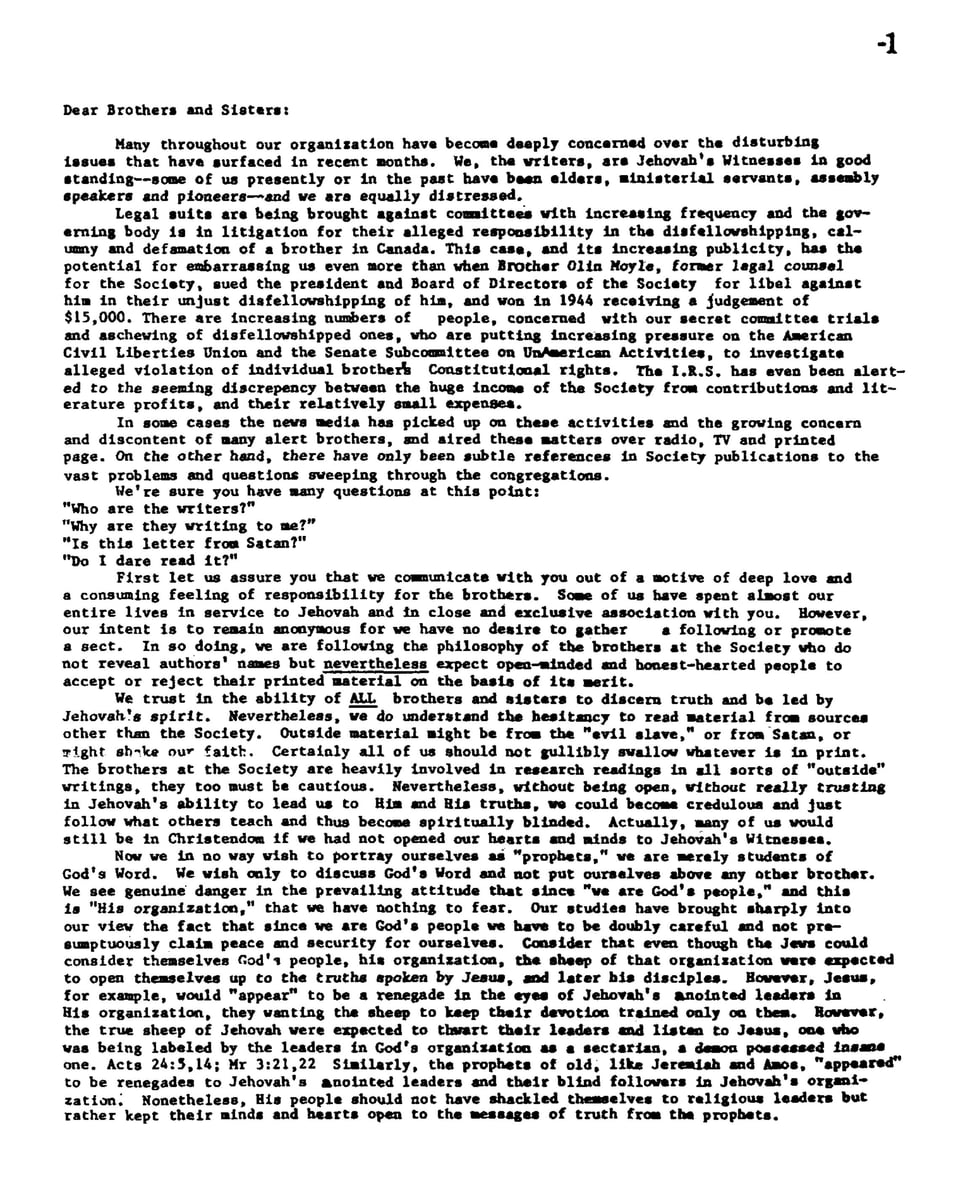
Many throughout our organization have become deeply concerned over the disturbing issues that have surfaced in recent months. We, the writers, are Jehovah's Witnesses in good standing--some of us presently or in the past have been elders, ministerial servants, assembly speakers and pioneers-and we are equally distressed.
Legal suits are being brought against committees with increasing frequency and the governing body is in litigation for their alleged responsibility in the disfellowshipping, calumny and defamation of a brother in Canada. This case, and its increasing publicity, has the potential for embarrassing us even more than when Brother Olin Moyle, former legal counsel for the Society, sued the president and Board of Directors of the Society for libel against him in their unjust disfellowshipping of him, and won in 1944 receiving a judgement of $15,000. There are increasing numbers of people, concerned with our secret committee trials and aschewing of disfellowshipped ones, who are putting increasing pressure on the American Civil Liberties Union and the Senate Subcommittee on UnAmerican Activities, to investigate alleged violation of individual brothers' Constitutional rights. The I.R.S. has even been alerted to the seeming discrepency between the huge income of the Society from contributions and literature profits, and their relatively small expenses.
In some cases the news media has picked up on these activities and the growing concern and discontent of many alert brothers, and aired these matters over radio, TV and printed page. On the other hand, there have only been subtle references in Society publications to the vast problems and questions sweeping through the congregations.
We're sure you have many questions at this point:
"Who are the writers?"
"Why are they writing to me?"
"Is this letter from Satan?"
"Do I dare read it?"
First let us assure you that we communicate with you out of a motive of deep love and a consuming feeling of responsibility for the brothers. Some of us have spent almost our entire lives in service to Jehovah and in close and exclusive association with you. However, our intent is to remain anonymous for we have no desire to gather a following or promote a sect. In so doing, we are following the philosophy of the brothers at the Society who do not reveal authors' names but nevertheless expect open-minded and honest-hearted people to accept or reject their printed material on the basis of its merit.
We trust in the ability of ALL brothers and sisters to discern truth and be led by Jehovah's spirit. Nevertheless, we do understand the hesitancy to read material from sources other than the Society. Outside material might be from the "evil slave," or from Satan, or right shake our faith. Certainly all of us should not gullibly swallow whatever is in print. The brothers at the Society are heavily involved in research readings in all sorts of "outside" writings, they too must be cautious. Nevertheless, without being open, without really trusting in Jehovah's ability to lead us to Him and His truths, we could become credulous and just follow what others teach and thus become spiritually blinded. Actually, many of us would still be in Christendom if we had not opened our hearts and minds to Jehovah's Witnesses.
Now we in no way wish to portray ourselves as "prophets," we are merely students of God's Word. We wish only to discuss God's Word and not put ourselves above any other brother. We see genuine danger in the prevailing attitude that since "we are God's people," and this is "His organization," that we have nothing to fear. Our studies have brought sharply into our view the fact that since we are God's people we have to be doubly careful and not presumptuously claim peace and security for ourselves. Consider that even though the Jews could consider themselves God's people, his organization, the sheep of that organization were expected to open themselves up to the truths spoken by Jesus, and later his disciples. However, Jesus, for example, would "appear" to be a renegade in the eyes of Jehovah's anointed leaders in His organization, they wanting the sheep to keep their devotion trained only on them. However, the true sheep of Jehovah were expected to thwart their leaders and listen to Jesus, one who was being labeled by the leaders in God's organization as a sectarian, a demon possessed insane one. Acts 24:5,14; Mr 3:21,22 Similarly, the prophets of old, like Jeremiah and Amos, "appeared" to be renegades to Jehovah's anointed leaders and their blind followers in Jehovah's organization. Nonetheless, His people should not have shackled themselves to religious leaders but rather kept their minds and hearts open to the messages of truth from the prophets.
Not wanting to fall into the same trap as the idolatrous Israelites, let's notice their claims: "And upon us no calamity will come, and no sword or famine shall we see...Do not put your trust in fallacious words, saying, 'the temple of Jehovah, the temple of Jehovah they are' ...We are wise and the law of Jehovah is with us...saying no sword or famine will occur in this land...They are saying...'Peace is what you people will have'...'No calamity will come upon you people'...Woe to those who are at ease in Zion...But at Bethel you(Amos) must no longer do any further prophesying, for it is the sanctuary of a king and it is the house of a kingdom... By the sword they will die--all the sinners of my people those who are saying: 'The calamity will not come near or reach as far as us'...'Is not Jerusalem in the midst of us? There will come upon us no calamity." Jer 5:12;7:4;8:8;14:15;23:17; Amos 6:1;7:13;9:10; Mic 3:11
Dozens of scriptures telling us clearly that we are not to follow any man or group of men, but to rely on Jehovah and His Word, take on particular meaning when we realize that the blindness and stiff-necked attitude spoken against in the Bible was on the part of God's people, those in His organization. God's people in the past have always been told by their leaders to listen only to them, and more often than not, the sheep have deferred and acquiesced to their own detriment. We as God's people are obviously not exempt from the blindness and errors of His people in the past. If we don't learn from Bible history, we may be condemned to repeat it. Why not take the same attitude that Peter and the apostles took when confronted by the leaders of the first century Jewish organization: "We must obey God as ruler rather than men"? Acts5:29
Notice the counsel expressed in various Watchtower publications: "We should learn to love and value the truth for its own sake; to respect and honor it by owning and acknowledging it wherever we find it and by whomsoever presented. A truth presented by Satan himself is just as true as a truth stated by God. Perhaps no class of people are more likely to overlook this fact than Christians...Accept truth wherever you find it, no matter what it contradicts..." (Watchtower, July, 1879, pp. 8,9) "To arrive at truth we must dismiss religious prejudices from heart and mind. We must let God speak for himself." (Let God be True, p. 8) "We need to examine not only what we personally believe but also what is taught by any religious organization with which we may be associated...If we are lovers of truth there is nothing to fear from such an examination..." (Truth Book, pp. 13,14) If we are free from hypocrisy we will apply this counsel to ourselves. Certainly the writers of these quotes would not object.
Yes, we have communicated this material to the Society but they have been unresponsive to our questions and pleas for scriptural answers. Consequently, we have decided to seek your help. In proceeding this way, let us say that we have no vendetta and even though some of what we say may seem quite strong, we do so not out of vindictiveness but out of love for the truth and the brothers. We have no desire to be dogmatic on the questions and issues we raise. Perhaps many of you will have information which will clarify matters for us. If there can be "iron sharpening iron" we would be most grateful to you. In essence, we hope to tap the huge pool of Bible knowledge existing in the world-wide association and perhaps resolve these important matters.
We sincerely feel that the questions we raise are not merely "foolish questionings," or fuel furnishing the fire to cause "fights over the law," or "questions for (senseless) research." Tit 3:9,10; 1Ti 1:4;6:4; 2Ti 2:23 We feel confident that you brothers can decide the importance of the material upon open-mindedly reading it. But let us say that related to these issues are divorces, loss of faith, spiritual dejection, family disruptions, persecutions, death and even suicides. Certainly it is much better to have an open forum now rather than be caught unprepared later in the field or when we come under attack by publicity. If we are wrong in our approach or in any of our statements or information, we invite, even plead, for your help brothers.
We encourage you to write to the Society about these issues. If you wish to communicate with us, you may write one of the addresses below nearest you-correspondence will be kept confidential. This is a private effort on our part. We have pooled what little resources we have for printing and mailing, but if you wish to give us addresses for mailing the "Questions," feel free to write and we will help to the degree we are able. Also, feel free to duplicate and distribute as you individually see fit.
Write "Questions," c/o one of the following: 4 Grindon Ct.; Grindon, Sunderland; County Durham; England--Box 864; Vancouver, Washington 98660--Box 581; Dandonong, 3175; Victoria, Australia-- Box 3; Davison, Michigan 48423--Marknadsvagen 289; S-18334; Taby, Sweden HOW TO COUNT TO SEVEN
The Bible states that the seven trumpet blasts of Rev Chpts. 8-11 occur in succession. The last three trumpets, 5,6,7, seem to be the same as the three woes which are also spoken of as successive. Rev 8:13;9:12;11:14 Why then do we teach that the first six trumpets were sounded in succession between 1922 and 1927, but that the seventh trumpet sounded at the approximate time of 1914-1918? Why does the Bible say the trumpets sound: 1,2,3,4,5,6,7, and the three woes occur: 1,2,3, but we teach trumpets sounding: 7,1,2,3,4,5,6, and woes: 3,1,2? To attempt to evade this difficulty,i.e., that our teaching says the seventh trumpet is sounded before the first trumpet, the "Finished Mystery" book, p. 292, says: "In the year 1928 C.E. the beginning was made not of the marvelous things announced, but of the worldwide announcement of such things...the seventh of a series of annual Bible student conventions." Are we therefore teaching that the seventh trumpet was sequential because it was "announced" following the blowing of the sixth, even though we argue the seventh acutally blew in the 1914-1918 era? What do the scriptures teach? Do the seven trumpets blow: 1,2,3,4,5,6,7; Do they blow: 7,1,2,3,4,5,6; Or, do they blow: 7,1,2,3,4,5,6,7(announced)?
CHRIST--HERE OR NEAR?
Why do we teach that the Kingdom of God is here, when Jesus said that the occurrence of the sign of Mtt 24 would mean that the Kingdom and Christ were "near?" "Now learn from the fig tree as an illustration this point: Just as soon as its young branch grows tender and it puts forth leaves, you know that summer is near. Likewise also you, when you SEE ALL THESE THINGS, know that he is NEAR at the door." Mtt 24:32,33 Why was the preaching commission given to Christians that of preaching that the Kingdom of God has drawn "near," not here? Mtt 10:7;Lk 10:9
LOOK! I HAVE FOREWARNED YOU
We are presently taught that the second presence of Jesus Christ began in 1914, and that this invisible, secret type return, was discerned only by the spiritually alert remnant of anointed ones. Why did Jesus warn, respecting his return, not to believe those who say: "Look! Here is the Christ, or there...For false Christs(Gr., khristos=anointed ones) and false prophets will arise and will give great signs...Therefore if people say to you, 'Look! He is in the wilderness,' do not go out; 'Look! He is in the inner chambers,' do not believe it. For just as the lightning comes out of eastern parts and shines over to western parts, so the presence of the Son of man will be"? Mtt 24:23-27; compare Rev 1:7,11; Mtt 24:30,39; 26:64; lThes 4:15-17; Heb 9:28; lJo 3:2 Why did Jesus interject, in speaking to his followers: "Look! I have forewarned you?" Mtt 24:25
COMING VS PRESENCE
Why does Jesus seem to make no distinction between coming and presence when referring to his return? compare Mtt 24:3,27,30,39,42,44,50;25:6,19,31 The disciples asked Jesus for the sign of his presence AND the conclusion of the system of things. Does it not seem as though Jesus speaks of both events as occurring essentially simultaneously? Does he not answer his disciples by drawing parallels to the sudden destruction of the world of Noah's day and the cities of Sodom and Gomorrah? Lk 17:26-30 Does Jesus not say of this event—his presence and the end—that we will not know the day or the hour? Mtt 24:42 Why do Greek scholars generally prefer to render parousia as "coming" rather than "presence?" If Christ came in 1914, why do we still celebrate the evening meal, since Paul said to do so only "until he arrives?" lCor 11:26 Also, if we are to "observe the commandment in a spotless and irreprehensible way until the manifestation of our Lord Jesus," and Jesus "manifested" himself in 1914, why do we continue to "observe the commandment?" lTim 6:14
THE ARK, PETER'S VIEW
Why do we teach that the antitypical ark that we must be on in order to be saved is the "spiritual paradise" of Jehovah's Witness—the congregational and organizational arrangements set up by our brothers in Brooklyn—when Peter, under inspiration, said that that which corresponds to the ark and is saving us is "baptism"—set up by Christ Jesus? lPe 3:20,21
AN INTERESTING QUOTE
"Jehovah, the God of true prophets, will put all false prophets to shame either by not fulfilling the false prediction of such self-assuming prophets or by having His own prophecies fulfilled in a way opposite to that predicted by the false prophets. False prophets will try to hide their reason for feeling shame by denying who they really are."-Paradise Restored, WHO WERE PHILETUS AND HYMENAEUS?
If the resurrection of the dead ones began in the early part of this century, why does Paul state: "...those who are dead in union with Christ will rise first. Afterward, we who are surviving will, TOGETHER WITH THEM, be caught away in the clouds to meet the Lord in the air?" lThes 4:16,17 If both the faithful living, and the resurrected dead ones in union with Christ meet the Lord in the clouds together, how could the dead meet the Lord several decades before the living? Does the"together" mean a unity not in time but in purpose, a harmony, a consonance, an accord and agreement much like the togetherness and unity of Christ with Jehovah and his disciples described in Jo 17:21-23, which verses we use in rebuttal to the trinitarian argument of Jo 10:30? If so, why does the "Kingdom Interlinear" display the Greek word in lThes 4:17, "hama," which translates to "at the same time?" Also, why does the large print edition of the "New World Translation," p. 1231, footnote the "together" of lThess 4:17 as follows: "Or, at the same time?"
If we compare the sequence of events in 1Thes 4:16,17 and 1Co 15:52, where Jesus is described as descending from the heavens with God's trumpet(the last trumpet—Rev 11:15) signaling the resurrection, with the events Jesus described in Mtt 24:29-31, an interesting question becomes apparent. In Mtt 24:30,31, Jesus is again described as coming with God's trumpet and gathering the chosen ones from the four corners of the heavens. If this account pictures the same events as 1Thes 4:16,17 and 1Co 15:52, wherein a resurrection and gathering of the chosen ones to Jesus is described, why does vs 29 say that this occurs AFTER the tribulation—apparently the"great tribulation" of Mtt 24:21? Since we do not know the day or the hour of "Jehovah's Day,"(1Thes 5:2; 2Thes 2:2) how can we know the "day and hour" of the resurrection? Why are Philetus and Hymenaeus spoken of as "deviating from the truth," having experienced "shipwreck of their faith...subverting the faith of some," by believing and spreading the "gangrenous" teaching that the resurrection has already occurred? 2T1 2:16-18
"GENTILE TIMES," FOR WHAT?
If the "appointed times of the nations"(Lk 21:24) is a period of time during which the gentile nations dominate God's Kingdom, and this period of time ended in 1914, why do the gentile nations still dominate? If the trampling ended in 1914 at the time of WWI, why does Jesus say the trampling continues on through the sign of Lk 21? In other words, why does Lk 21:24 about the trampling FOLLOW the sign? If Jesus says the trampling occurs following the war, famine, pestilence, etc., why do we say the trampling ended when these signs began? Lk 21:10-24
Does the "Jerusalem" Jesus speaks of in Lk 21:20 as being surrounded by encamped armies change four verses later in Lk 21:24 to a symbolic, spiritual, cryptic, representative Jerusalem in the heavens?
Is it proper to expand upon the inspired interpretation of the tree dream described in Da 4, when Daniel himself said the "word itself was FULFILLED upon Nebuchadnezzar?" Da 4:33; ICo 4:6 If Daniel said the vision of the tree was fulfilled upon Nebuchadnezzar, why do we take the seven times in Daniel, change them into seven years, change the seven years into 2,520 days, then take the 2,520 days and change them into 2,520 years to give the 1914 date? Furthermore, why do we then base almost our entire prophetic theology and hope on this date? Why, when almost every prophetic expectation about 1914 failed, did the Society cling to the date, interpreting in retrospect invisible surreptitious fulfillments? Mtc. 24:23-27
Is it possible that the "appointed times of the nations" could very simply be the time Jehovah has allowed for the nations, the gentiles, to contribute their number to the 144,000? Are perhaps these"times" the period to gather the "other sheep"(the original flock perhaps being the Jews, and the other sheep being the gentiles) of Jo 10:16? Please compare Ro 11:25; Acts 15:14; 17:26,27-31; Eph 1:9,10;3:5,6; Col 1L26,27; Rev 7:4;10:7; Lk 21:24, see what you conclude.
PEACE AND SECURITY! WHO MAKES THE CLAIM?
Who is the "they" of lThes 5:3, "Whenever it is that THEY are saying: 'Peace and Security' then sudden destruction is to be instantly upon them...?" Are "they" the nations? If so, where does Paul make such an identification? Why is it that Paul identifies the "they" as the religious leaders of God's apostate organization, the Jews? lThes 2:15,16 Who is it today that must be careful not to presumptuously claim peace and security? Mtt 24:13; 1Co 9:27; Php 2:12;3:12-14 Who fulfills the modern antitype of God's peace proclaiming organizational leaders of the time of Amos, Micah, Jeremiah or of Jesus? Read carefully: Amos 9:10;5:18;6:1; 7:13; Micah 3:11; Jer. 5:12;6:14;7:4;8:11;14:15.
WHERE DOES THE "MAN OF LAWLESSNESS" SIT?
If we are the temple of God, as Paul says we are(1Co 3:16), why are we told to look to the clergy of Christendom for the "man of lawlessness"? Paul states emphatically that the "man of lawlessness...sits down in the temple(or, "divine habitation" according to the Kingdom Interlinear) of The God." 2Thes 2:4 Is Christendom the temple of God? Notice that Paul does not say that the man of lawlessness "claims" to sit there, but that "he sits down in the temple of The God."
Similarly, the "holy place" of Da 11:31 and Mtt 24:15, is the temple. If we today are the antitypical temple, are we to look within our midst for the "disgusting thing...standing in a holy place," or are we to look out at "pagan" Christendom or the U.N.?
GET OUT OF HER MY PEOPLE
Why does Rev 18:4, in speaking of Babylon the Great, say: "Get out of her MY people," and not "Get out of her and BECOME my people"? Who did Babylon of old take captive? Did Babylon take God's people captive? Were they God's people while they were in Babylon? Was it not God's people who were released from Babylon of old?
Is Babylon the Great identified in scripture on the basis of her abuse of and dictatorship over God's people, or by a doctrinal lineage? Rev 17:1,6,15;18:24;19:2 Who is it that Jesus identifies as the abuser of God's people? Mtt 23:33-38 Who is it that Jeremiah identified as the abuser of God's people? Jer 2:34 Who is it that Isaiah identifies as being a dictator over God's people? Isa 1:10, compare with Jer 23:14 If Israel of old, and the Jerusalem of Jesus' day are identified with the trademarks of Babylon, who would fit the antitype today of God's chosen ancient organizations?
SIGNS OF APOSTASY
The Bible states that several features would be evident before the coming of the Day of Jehovah. Several of the signs would be apostate teachings and practices. Are these indicators present now? If so, where uniquely are they found?
Many will come on the basis of Jesus' name saying "I am the Christ"(Gr., khristos= anointed) and mislead many. Mtt 24:5,24
False anointed ones will teach an invisible secret presence of Jesus.Mtt 24:23-27
There would be the teaching that the Day of Jehovah and the presence of Christ were already here. 2Thes 2:2,3
There would be the teaching that the resurrection had already occurred. 2T1 2:16-18; 2Thes 2:1
Within God's people, those who tried to expose pharisaical hypocrisy, turn people to the truth, turn people to the Bible and Christ, rather than false Christs(Gr., " anointed) warn of impending judgement on his people, insist that there really was no spiritual paradisaic peace and security among his people, and expose,scripturally, errors foisted on the sheep, would be judicially disciplined, counseled not to speak, disfellowshipped, slandered, called insane, sectarians, dividers, seditionists, apostates, demonized, and experience all of the travail that has come upon those in the past who tried to serve Jehovah exclusively and maintain freeness of speech through faith in Jehovah God. Jo 16:1-4; Mtt 5:11;10:16-23;23:29-38; Mr 3:21,22:8:31,34;9:13;10:33; Acts 24:5,14;21:21; Jer 38:4; 6:28;12:1; Amos 2:12
WHERE ARE THE SHEEP AND THE GOATS?
If the sheep-goats parable pictures the separation of Jehovah's Witnesses from the people in the world, why do both the sheep and the goats call Jesus their Lord, and why does Jesus assume the role of shepherd over both of them? Mtt 25:32,37,44 Is Jesus the shepherd of the entire world or only his true Christian congregation? Does the world recognize Jesus as their Lord? If judgement is based upon the treatment of the "brothers," who alone knows who the brothers of Christ are? How are people even given a chance to treat the "brothers" one way or the other if they are usually only approached by "nonbrothers," the so-called great crowd that is just hanging on the skirts of the Jews? Is a householder condemned because he rejects the offer of an Awake! that is offered by a child who is featuring an article on the "Bears of Smokey Mountain National Park"? What if the householder never sees another Witness and Armegeddon comes? Is the householder a goat? Is he condemned to everlasting cutting off? John wrote that the"world does not have a knowledge of us(the brothers)" lJo 3:1 If this be true, then how can those in the world be called goats?
SHEEP AND GOATS(CONTD)
The judgement on the goats is everlasting cutting off. Mtt 25:46 Are people in the world going to be given the judgement of eternal cutting off because they did not treat the self-proclaimed anointed and faithful and discreet ones nicely? Does not this interpretation of the parable by the professed anointed guarantee themselves homage and reverence by others, for according to this teaching any who would not treat them with nicety and reverence would inherit everlasting cutting off?
Why did Jesus say that "whoever does the will of my father who is in the heavens, the same is my brother..." Mtt 12:50; Mr 3:35 Why do ALL Jehovah's Witnesses call each other brother? Is it not possible that Jesus' parable of the sheep and the goats was simply to emphasize his command to his followers, his brothers, to treat one another with love, and not to set up a clergy class to be separated off from the rest and be treated nicely by the rest of the world? If this be true, then would not the sheep and the goats be found within his followers—those who exhibited Christian love being the sheep, and those who abused fellow Christians being the goats? Compare Mtt 10:40-42;18:5;Mr 9:37;Jo 13:35
Is it not scriptural, indeed, the only way of justice, that those who get everlasting cutting off are only those who know the truth and turn from it—committing the unforgivable sin? Heb 10:26,27 Is this perhaps not why Peter said it was better not to know the truth than to know it and turn from it? 2Pe 2:21 Does it not follow that we, the only ones rightfully claiming to know the truth, are in fact the only ones capable of turning from it? Do we not claim to be alone in realizing the identity of God and his requirements for exclusive devotion? Hence, are we not the only ones who could become apostate, "goats," since an apostate must know the truth first before he turns from it? Therefore, might it be possible that the sheep-goat parable will see its fulfillment entirely within the context of the Christian congregation—within us?
WHO REALLY IS THE FAITHFUL AND DISCREET SLAVE?
The claim is made by those who profess to be of the anointed that they have been declared by Jesus as the "faithful and discreet slave" of Mtt 24:45-47. How does Jesus say we can identify the slave? Is it not on the basis of the food they are dispensing, i.e., that that food is from the master and should be identifiable as such? Mtt 24:45 Yet if the professed anointed have been declared faithful and discreet by Jesus in the early 1900's, why have they taught so much error? (There have been almost 30 beliefs that were understood one way in the early 1900's, changed to a different understanding, then changed back to the original understanding, e.g., the "superior authorities" of Ro 13) Are the erroneous teachings of the past—and the present—food from the master, food from Christ Jesus? Does Jesus teach error? Furthermore, if Jesus appointed the faithful and discreet slave already, then why don't they have the authority over ALL of Christ's belongings as Jesus said they would after the appointment? Mtt 24:47 Jesus' belongings include earthly and heavenly things. Mtt 28:18; lCo 6:3 Do the professed anointed now have control over heavenly things? Again, if Jesus has declared them faithful and discreet already, they should now also have this heavenly authority, shouldn't they? Mtt 24:47 In this regard, why does the Watchtower literature in its commentary on Mtt 24:47 add the expression: "here on earth" to Jesus' words in the scripture?
At Lk 12:37 Jesus states that the reward, the declaration of faithfulness and discreetness, is made at the time of the master's arrival--at an "hour you do not think." Lk 12:40 Is the arrival at an "hour you do not think," 1914? If not, how can we say that Jesus has already made the appointment?
At Mtt 24:45, did Jesus declare who the faithful and discreet slave was, or simply ask a question? Why, when Peter asked if Jesus was applying this to "us or also to all," did Jesus simply retort to Peter: "Who really is the faithful and discreet slave?" Lk 12:40,41 If Jesus would not identify Peter and the other disciples as a faithful and discreet slave, and yet Jesus specifically instructed Peter to "feed my little sheep,"(Jo 21:15-19) how does anyone today have the authority to declare themselves faithful and discreet and aver that the declaration actually came from Christ Jesus? What do the scriptures say about self proclamations of anointing, faithfulness, discreetness? Ro 12:16; 1Co 3:8,10; 2Co 10:18; Ga 6:3.4
If the approximately10,000 professed anointed remnant are the faithful and discreet ones, how do they all get together to dispense the food? If the faithful and discreet ones are feeding the domestics, and the "domestics" are fellow professed anointed, then the slave SLAVE(CONTD)
is feeding itself, isn't it? Mtt 24:45 Doesn't the "great crowd" get fed?
Where does the Bible say that any dedicated Christian does not have the responsibility to be faithful and discreet? Jesus said that "anyone" that heard and did his sayings would be discreet. Mtt 7:24 Don't all Christians have the responsibility of hearing and doing Jesus' sayings? Would it be unreasonable and unscriptural to believe that all of us have equal opportunity to be declared faithful and discreet when Christ comes—if we indeed are such and don't rely on others to be faithful and discreet for us? Is it by accident that this understanding fostered by the Society elevates a class of Christians above other Christians? Does the understanding create a clergy laity division within us? Do we feel the unqualified responsibility to teach truth, or do we simply feel obligated to parrot what the self-proclaimed anointed and faithful and discreet ones dictate? Our honest answer will tell us each individually whether we actually do have a clergy laity division.
HAVE WE REJECTED THE INVITATION?
Is it ones' responsibility to profess to others by act or word that he is " anointed"? Is there any way that we could prove to others that we are anointed? If not, why profess it publically? Does Ro 8:16 speak of a class of Christians: "The spirit itself bears witness with our spirit that we are God's children"? Are"God's children"A class of special anointed ones in contrast with the rest of Christians? Why does Ro 8:14 say that "all who are led by God's spirit, these are God's children"? Are some Christians led by God's spirit and others not? See 1Jo 3:2; Mtt 5:9; Ro 8:12-17 Doesn't the self-proclamation of being anointed create a clergy-laity distinction? Does our teaching about the " anointed" contribute to the oneness or the division of the body of Christ? 1Co 1:10-13; Eph 4:4,5 Does it contribute to the oneness of the body of Christ to teach that only those who self-proclaim anointing are the ones the Bible is written to or that Christ is only their mediator and not the mediator of fellow Christians? (Aid, p. 1130) Why are only those who declare themselves anointed given the higher responsibilities in the Society or asked to be on the governing body?
Why did Jesus never make an issue over which Christians should partake of the emblems? Why did he, on the other hand, say: "Unless you eat the flesh of the son of man and drink his blood, you have no life in yourselves"? Jo 6:53 Don't all Christians want life? Is not the only "unworthiness" in eating the evening meal related to gluttony and drunkenness? lCo 11:17-34 Is it not possible that all Christians have the same hope of one day being declared by Christ as part of his bride? Is not the choosing of the bride dependent upon an invitation from God? Does not God do the choosing? Ro 9:16 Is it for those who declare themselves anointed to dictate who can and cannot be invited, and how many, and when, and how? Should men "shut up the kingdom of the heavens before men"? Mtt 23:13
Are any of us as dedicated Christians correct in precluding that we may one day be invited to be part of Christ's bride just because we are naturally given to the temporal mundane desires of this physical existence and because others have said the kingdom of the heavens is closed to us? Should any of us not want to be part of the bride of Jesus Christ? Should we reject this most wondrous groom just because others tell us his invitation has ended with them?
Do the Greek or the Hebrew canons teach the class distinction among Christians that is ostensibly such a bulwark of our theology? Paul said: "You are all, in fact, sons of God through your faith in Christ Jesus...you are all one person in union with Christ Jesus...one hope to which you were called; one Lord, one faith, one baptism...if we go on enduring, we shall also rule together as kings...for there is reserved for me the crown of righteousness...yet not only for me, but also to all those who have loved his manifestation." Ga 3:26,28; Eph 4:4-6; 2Ti 2:12;4:8 Jesus' hope and prayer was for a oneness of the body. Jo 17:20,21-23
Is not the position the" anointed" have placed themselves in similar to that taken by priests? Is it not the priesthood of Catholicism that claims special prerogatives that put them in a position above the laity and in a position to rule and direct lives? If only the " anointed" can read the Bible—they being supposedly the only ones it is written to—and they have the higher calling of ruling with Christ in the heavens, some supposedly already being there, should the rest not naturally look upon the " anointed" with awe? Is that not what we do? Don't the anointed usually in one way or another make it known to the "great crowd" Christians that they are of the " anointed"?
INVITATION(CONTD)
Since the "anointed" will supposedly rule one day over the earth, but proven faithful men like Noah, Abraham, Isaac, Jacob, Moses, David, Jeremiah and Daniel will be resurrected to the earth to be ruled over by the "anointed," does this not elevate the self-proclaimed anointed above men whom Jehovah has definitely identified as faithful men of God? In other words, those of our brothers who proclaim themselves anointed and follow closely the directives of the Watchtower, are automatically given ascendency over Abraham. In other words, the theology promulgated by Knorr, Franz, Suiter, etc. guarantees them a more holy and revered position than Abraham or Moses. However, the scriptures say: "But I tell you that many from eastern parts and western parts will come and recline at the table with Abraham, Isaac and Jacob in the kingdom of the heavens." Mtt 8:11; Compare Lk 13:28,29
Some would say this self-elevation is a diabolical clergy distinction, divides the body of Christ and is the height of presumptuousness.
ORGANIZATION--JEHOVAH'S PLAN OR NEMESIS?
The command to associate together was given for our benefit, to upbuild one another in spontaneous Christian love. Heb 10:24,25 Is an "organization" necessary for this association? If so, why did Jesus say: "where two or three are gathered together in my name, there I am in their midst"? Mtt 18:20 If the leviathan superstructure of organization we have is Jehovah's will for man, why is it that "organizations"of the past seemed to always veer men away from God and suck them to the leaders? Was it Jehovah's will for the development of the organization of ancient postflood Babylon, or for the kings and the organization which the unfaithful Israelites demanded? lSam 8:6,7 Where are the Biblical directions for the development of an "organization" for Adam and his descendents? Where are the Biblical directions for an "organization" such as we have today, for a legal corporation, for a "president," for a "vice president," for a gigantean printing factory with hundreds of regimented "Bethel workers"? Where is the scriptural directive empowering a twentieth century central Christian agency to dictate essentially all aspects of Christian life, to pontificate the exact number of meetings, their exact length, their domination not by the Bible but by extrabiblical publications, their format of programmed questions and answers resulting in a form of congregational litany, and for extensive record keeping and reporting to a central body?
Where does the Bible say that there was or should be a "governing body"? True, Paul and others took the one issue of circumcision to the apostles and older men in Jerusalem, but was there a "governing body" there that dictated all aspects of Christian activity and disfellowshipped any who would not defer to them and conform? Acts 15 Where are the terms, "Jehovah's organization" and "governing body" found in the Bible? Did Paul take the circumcision issue to the city of Jerusalem because there was a "governing body" there, or because Jerusalem happened to contain the APOSTLES and men who were in the truth from its pentecostal infancy? But do we have apostles today? Do we have leaders and teachers? Should we? Mtt 23:8-10 If we need an authoritative decision today, do we go to the Bible and the inspired words of Jesus or Jehovah, or to a legal corporation and to fallible uninspired men who call themselves the "governing body"? Pr 2:1-6; Ja 1:5; Jer 29:13,14
Today can we approach, counsel, reprimand, question or investigate the brothers in Brooklyn? Paul was able to question the apostles in the first century for their erroneous views on circumcision. Ga 2:11-14 Would we even know who to approach or who to counsel if error emanated from Brooklyn? If the Society refused to answer letters, what could a brother out in the congregation do? Does the anonymity of the brothers of the Society serve to prevent creature worship—as they state—or does it really serve more to protect and hide any who practice and teach error and impose this on the congregations? Why, in attempting to communicate with the"governing body," do our letters get intercepted by unknowns who stamp their communications: "Watchtower Bible and Tract Society of New York, Incorporated"? Why is it the practice of the Society to refuse to answer any questions that are critical of them when brothers write, and refuse to allow brothers to apply the counsel of Mtt 18 to them if they sin against us, but are quick to demand identification of any in the congregations who challenge their teachings even empowering special tribunals and investigations and hearings for the purpose of ferreting out these dissenters and publically disciplining them with various "stones" such as disfellowshipping?
ORGANIZATION(CONTD)
Is the justification for the superstructure of organization we have today the need to implement a world-wide preaching work? Where did Jesus say the preaching of the good news was dependent upon a legal corporation, or a "governing body," or an organization? Is it possible for the God who can make the rocks cry out to be able to move his true followers to accomplish His work by activating them by His holy spirit,and not be dependent upon any human organization? Lk 19:40
Have any of us joined the organization for safety and to live up to a certain set of rules in hopes of thereby being right with God? Is it by accident that all of this "organization" we have serves very efficiently to make the flock almost totally dependent upon the brothers in Brooklyn to carry out their worship. Certainly our God is one "not of disorder, but of peace,"(1Co 14:33) but how much "organizational" mileage did Paul intend for us to get out of this one scripture? It is a natural human tendency to want to be led, to want someone else to tell us what is right and wrong and not depend upon our own consciences. But each of us must ask ourselves whether from our study of the Bible our God wants dictators and regimented conformist servants, or a oneness of the body and trust in the power of the holy spirit to move us all to spontaneous love for God and man?
PERSECUTION, BROUGHT ON BY WHOM?
Persecution has always been a part of serving God faithfully. However, is Christian persecution to be expected primarily from the political or the religious enemies of God? Who persecuted the prophets of old, the nations, or Jehovah's own people in His organization? Who persecuted Jesus, Stephen and Paul, the nations, or the apostate leaders and their blind followers in God's organization? On the other hand, hasn't Jehovah repeatedly used the nations to punish his wayward idolatrous people? Was not Nebuchadnezzar used to punish the rebel king Zedekiah who had rebelled against the "superior authority" of Babylon? Were not the Roman armies in their role in destroying the "holy place" called "his(Jesus') armies in 70 CE? Is this why Paul could say that the superior authorities are "God's minister, an avenger to express wrath upon the one practicing what is bad"? So, according to Bible types, do the nations usually serve as Christian persecutors, or as Jehovah's agents of judgement on His people? If the ancient types are a pattern for today(Ro 15:4), what might we suspicion if we are being persecuted by the nations? What should Jerusalem have suspicioned in 607 and in 70?
The scriptures are clear in their admonition for Christians to be in subjection to the superior authorities. Ro 13:1-4;Col 1:16;2:10;1Ti 2:1,2;Tit 3:1;1Pe 2:13,14;Pr 20:2 The Bible is not without its record of faithful men who served the superior authorities closely, some even becoming superior authorities. Examples are Moses, Joseph, Daniel and his three companions, Mordecai and the Christian "holy ones" of the household of Caesar. Php 4:22 Elisha even permitted Naaman to subject himself to the king of Assyria to the extent of aiding the king to bow to the false god Rimmon. 2Ki 15:18,19 If we take an unrighteous stand against the nations, not properly subjecting ourselves to them, and they persecute us, is this "righteous Christian persecution," or actually punishment from Jehovah and his ministers of wrath upon the ones practicing what is bad? Ro 13:1-4
Our brothers in Malawi are being persecuted because they will not purchase a party card. The superior authorities of Malawi attach no religious significance to the card but rather require the purchase of all who wish to be citizens. There is only one party in Malawi, and thus the party is Malawi.(Awake! 12-8-75:4, para 3) Has the superior authority of Malawi poked its finger in the eye of God by requiring this purchase in defiance of the directives of the Watchtower Bible and Tract Society? It is interesting that even Jesus' parents complied with Caesar in registering, even though the registration was used in part for conscription into the military. Lk 2:1-3; Aid, p. 1383 And Paul asserted his Roman citizenship. Acts 22:25
Brother Knorr and others at Bethel, readily sign passports which state: "I (e.g. N.H.Knorr) a citizen of the United States..." "Citizenship" in itself is political. Can countries force citizenship. Do the countries step on Jehovah's toes by so doing? Is it possible that we are stepping on His toes by not being in subjection? Might it be, looking at the Bible types, that the persecution in Malawi is because of an unrighteous stand against God's superior authorities? Is the stand of the brothers in Malawi, obedience to God or to the Watchtower Society? The brothers readily carry WTBTS member cards. Is it any wonder our stand is viewed as political? Are our brothers laying down their lives for Jehovah or for Brooklyn? Did those in Jerusalem lay down their lives in 607 and 70 for Jehovah or their religious leaders? If one feels it is the dictate of Brooklyn that is resulting in the persecution and death of brothers, should we direct our letters of appeal to Malawi or to Brooklyn?
WILL WE RECEIVE OUR JUDGEMENT WITHOUT MERCY?
There can be little question but that justice is extremely important to Jehovah. Jesus came to send forth justice, and religions are to be judged on the basis of their justice. Deut 32:4; Isa 28:22; Jer 2:5;22:3,5; Mic 3:1,9; Mtt 12:18-21; Lk 18:1-8; Ro 9:14 Would it not follow that the matter of justice should be preeminently important to us? Would we not want to make sure that we were just personally, and that we did not give support to a system that was unjust or unscriptural?
When Jesus said that the third step of Mtt 18 should be taken to the "congregation," why do we take it to a "committee?" Mtt 18:17 Where is the "judicial committee" found in scripture? We reject the trinity partly because the term is not found in the Bible, do we have a hypocritical double standard with regard to "judicial committee"?
If open hearings("taking it to the congregation" Mtt 18:17) help to insure justice, and this was the clear pattern Jehovah has set for handling hearings, as the "Aid" book clearly indicates(p.384, last paragraph; p.1053, paragraphs 3 and 4), why do we not follow it if we are keenly concerned with justice being met? Why did Paul write: "reprove before all onlookers...rebuke before the majority," if he had the idea of secret "judicial committee hearings"? 2Co 2:6; 1Ti 5:20 Why did Jesus condemn the things done in secret? Lk 22:53; Jo 3:20,21;18:20 Were not the injustices done to Jesus in large part due to stealth and secrecy? Mtt 26:4,5; Mr 3:6;12:13;14:1;26:65
If the committee commits injustice against "innocent blood,"(committees, made up of sinful fallible men, are certainly not above committing injustices) and the congregation follows suit by spiritually stoning the innocent one—they, of course, not knowing innocence or guilt due to the secret nature of the hearings--where does the congregation stand in Jehovah's eyes? Does not Jehovah "hate those shedding innocent blood"? Pr 6:7; See also Jer 19:4;22:3,16,17;26:15 Is the congregation removed from guilt because they were "only following orders"?
Does the system of adjudication we presently have allow for gross injustices? We know that there are vast throngs of disfellowshipped ones out in the world, and is it possible that in many of their cases "the way of the wicked ones is what has succeeded, that all those committing treachery are the unworried ones"? Jer 12:1 Is it possible of some of our disfellowshipped brothers: "Look! the tears of those being oppresses, but they have no comforter; and on the side of their oppressors there was power, so that they had no comforter"? Ec 4:1
Is it by accident that the secret system of disfellowshipping protects the brothers in Brooklyn and their teachings from the critical eyes of those "testing the inspired expression"? 1Jo 4:1 Is it not true that the Society and their representatives in the congregations are trained to ferret out any who do not conform, who question, who alert others to error? Does not the secret nature of hearings pretty much guarantee the Society protection, while the brothers at large remain blind to the issues, the criticisms, perhaps even the truth? Does not the system result in the casting out of any who challenge the position of those who like the first place among us? 3Jo 9,10
If only elders can restore sinners, why are the "incompetent sheep" allowed to study with, teach and guide sometimes grossly debauched sinners from the world into the organization? Are only the elders able to "save his soul from death and cover a multitude of sins," by "turning a sinner back from the error of his way"? Js 5:20 Why do the scriptures tell us ALL to admonish one another? Ro 15:14; Col 3:16; lThes 5:14
Where does the Bible say that disfellowshipped ones should be spiritually disfellowshipped in addition to being socially disfellowshipped? Does our knowledge of God allow us to ever stop from attempting to help ailing ones? Why did Paul tell us to admonish such ones as "brothers"? 2Thes 3:14,15 Why did Paul state that it was the OVERLY SEVERE TREATMENT OF AILING ONES, DISFELLOWSHIPPED ONES, that was a design of Satan? 2Co 2:11 Jesus ate with harlots and tax collectors and even said that these would go ahead of the self-righteous presumptuous hypocritical leaders of God's organization into the Kingdom? Mr 2:16,17; Mtt 21:31 If Jesus would associate with such ones, admittedly not for social reasons, but to spiritually instruct them, why do we treat wayward sick ones differently? It is true that those who have committed the unforgivable sin are beyond forgiveness, but are we in a position to read hearts and determine who has committed this sin and then cut brothers off assuming Jehovah's mercy has run out for them? Heb 10:26; 1Jo 5:16 Should Christian emphasis be on judging, cutting brothers off, "keeping the congregation clean"(a phrase not found in the Bible), or on mercy, humility and love? Mtt 9:12,13;12:7; Jo 13:35 If Jesus' sacrifice was for us while we were JUDGEMENT(CONTD)
yet sinners, and Jehovah continued to approach his wayward, idolatrous, "disfellowshipped" nation of Israel, who are we to eschew and condemn by our actions those related to us in the faith? Ga 6:10; Jer 3:12,13,22; Ez 18:23,30-32; WT 8-1-74:461
Is it our position to judge, or Jehovah's? See Lk 6:35-37; Ro 5:6;8-10; Heb 10:30; Js 4:11,12; 2Pe 3:9 Is it consistent with mercy, or even with logic, for us to treat those who are most ill--which hard-core sinners are--the harshest? Is it sound medicine to withdraw treatment when the patient becomes desperately ill? Who of us are without sin? Who of us could stand if Jehovah did not extend repeated mercy? Who are we to do less to fellow sinners? Mtt 7:1-5
If we must be at peace with our brother before our worship is acceptable, but we have condemned by our actions and even words those who are spiritually ailing--and for those in the congregation, judgment has been made without knowledge of whether justice has been accoplished--how do we stand with our God? How do we stand if we acquiesce to a system that may be unscriptual, unmerciful and tolerates injustice? Mtt 5:23,24; Lk 6:27,28,32,33; Ro 13:10
Why is there no system of discipline for "committees" or the "Society" if they have acted wrongly?
MARRIAGE
Is the commentary on "natural" and "disgraceful" in Ro 1:26 and 27 addressing itself to homosexuality or to married relationships?
The Bible states that marriage is for the purpose primarily of bearing children. Ge 1:28; 24:60;30:1 Does the Bible say the decision not to bear children lies with the parents-- perhaps even deciding before getting married? The Bible allows for the decision not to marry, but where does it advocate or even give latitude for a voluntary decision by a couple not to have children? 1Co 7:36-38 Is it possible that some of us might be guilty of using the "truth" as an excuse not to assume the responsibility of children and to give us freedom to pursue goals in the "Society" or selfish personal interests? Why have the brothers in the past, and even those taking the lead at Bethel, Gilead and in circuit, district and zone work been advised against having children, childlessness even being a condition of retaining certain Society positions? What is"natural" about the synthetic contraceptive paraphernalia the brothers must use, are even encouraged to use, to avoid bearing children so that they can more fully carry out the assignments and responsibilities the Society gives them?
MENTAL ILLNESS--WHY SO HIGH AMONG JEHOVAH'S WITNESSES?
A recent study in a reputable journal of psychiatry("British J. Psychiatry," (1975),126, 556-559) demonstrated statistically that Jehovah's Witnesses have mental illness up to four times greater than in the general population. This fact is common knowledge to psychiatrists who are Jehovah's Witnesses. Some Witness psychiatrists have related that the incidence of mental illness and even suicides is much greater than the above report reveals because there is a general hesitancy among Witness to turn to psychiatric help, or, to do so only as a last resort because of the prevailing myth among the brothers that psychiatry is closely tied to demonism. Some brothers have attempted suicide, were disfellowshipped for the attempt, then, in the depths of pathetic depression, committed suicide.
But why, when the Bible promises better mental and physical health, should our brothers be plagued with a high rate(some Witness psychiatrists estimate as much as 15-20 times higher than in the general population) of mental illness! There could be many reasons, there is probably no single one. But could one of them be that many brothers do not have the clean conscience that Christ promised, because of being enslaved by others and their dictums? Witness psychiatrists observe that it is the "gobd" Witnesses, the conscientious ones, who have the most difficulties. Are we attempting to work out our salvation? This is, of course, an effort in futility, an impossible task which can only lead to constant frustration and depression, the fertile bed of psychological maladies.
Are the following concerns that weigh heavily on the brothers' minds reflective of the freedom and cleanliness of conscience Christ promised:
"Should a 70 year old sister work in service alone with a 20 year old brother? Should we buy plywood if blood has been used in the manufacture of the glue? Can we say: "bulletin board, good luck or bless you"? Can we leave free literature in the ministry? Is it proper to start our time in the morning by a telephone call at home or by leaving literature in a MENTAL ILLNESS(CONTD)
laundermat or service station on our way to a territory? How far can we drive between calls and still count the time? What will the brothers think if I only have six hours in the ministry this month? Is it alright to add up minutes during the month? Is it proper to offer other than the special offer during the month, or literature other than the magazines on Saturday? If a sister has the territory card in a car group where a brother is also present, can she make assignments if he is not familiar with the territory? Can we count fractions of hours on time cards? What if we get more than 75 or 100 hours when pioneering, can we report the excess on the congregation report to boost their average? Since the literature costs us less than we sell it for, how is this "receiving free and giving free," and how can we tell the householder that we are only asking for the printing cost? Can we count a return visit if the spouse of the RV is the only one at home? Will the brothers think I am immature because I said rendezvous instead of book study, back-call instead of return visit, unit instead of congregation, and servant instead of overseer? If we have any extra money should we send it to the Society for the "advancement of Kingdom interests"? Can we buy clothes that are on sale if they have national colors on them? If the sisters are cold, can they wear pant suits? If so, how cold does it have to be? How long can sideburns and hair be? Can brothers grow a beard or a mustache? What will the brothers think if I do? Will I be able to be used as a servant and give talks? How about flared pants? May I wear colored shirts to meetings? How about patterned shirts? If we sisters can't teach, how can we say we are not teaching just because we face one another in presentations on the platform? Will the friends think we are worldly or not putting "kingdom interests first" if we have children? May we stand when the bride walks down the isle? Can we use first names, Mr. and Mrs.or must we entitle one another as brother and sister at meetings? Which vaccines and serums can be used? If the end is imminent, why not sell out, special pioneer, live off savings and pull children from school? What would the brothers think if we bought a two door instead of a four door car? If an elder moves, how do we rotate? Should everyone move up one, should we insert someone? Who? If we do insert someone, what happens at the time of regular rotation next year? etc., etc., etc.
If righteousness is through following the mandates of men, or even the law of God, then why did Christ die? Ga 2:21 Does faith follow works, or works follow faith?
If we are not experiencing the freedom that Christ promised(Lk 4:18; Jo 8:32), but are rather under the heavy yoke of a "Torah," what must we do, what can we do to help the thousands of brothers who find themselves beaten by the standards and requirements and duties imposed upon their consciences? 2Pe 2:19; Ga 2:4;4:10;5:1,4; Ro 3:24,27,28;4:14;9:32;10:4;11:6; 14:4,5,10,12,13; Col 2:16-23 When not only mental illness, but physical illness (thousands discovered themselves hypoglycemic after an article in an"Awake!") and rampant hypochondriacism ravages the brothers, what can we do to help? Is all of this the fault of the brothers, or is it the result of the system they find themselves religiously constrained under? Who should we turn to, who should we direct others to for help: "my yoke is kindly and my load is light"? Mtt 11:30
BLOOD
Given that blood transfusions are often medically dangerous and that there is genuine wisdom in not making a practice of their use, there remain some SCRIPTURAL questions regarding the propriety of our stand on blood. Since we are not under the "law," which proscribed the eating of fat as rigorously as the eating of blood, we, as Christians, can only appeal to the passages in Genesis and Acts. Lev 3:17; Col 2:14-17; Heb 10:1,11,12; Acts 10:10-15
If the prohibition given to Noah in Genesis 9:4 applies to all men, why does Jehovah allow the sale of dead(unbled) animals to foreigners"that they must eat it"? Deut 14:21 Why does the WT(11-15-64:683) state that a Witness doctor can transfuse a nonwitness? Animal sacrifice, the distinction between clean and unclean animals, and circumcision were also practiced before the law of Moses. If the statement to Moses about blood is binding on all men, why aren't these other practices likewise binding? Ge 8:20,21;7:2;17:10; Jo 7:22 Were not ALL of these practices later limited only to Israel under the law? Deut 14:21 Also, if the prohibition regarding improperly bled animals is still binding on us, why don't we take the special slaughtering and bleeding measures practiced by the Jews?
BLOOD(CONTD)
We have argued("Blood" booklet, pp. 7,8) that since the soul is in the blood(Deut 12:23), and we must worship Jehovah with our whole soul(Mtt 22:37), that to drain blood from ourselves would mean that we could no longer worship Jehovah with our whole soul. Then does this mean that when we have a nosebleed that we can no longer love God with our whole soul? Is our love for God really dependent upon blood volume? Is it measured in pints?
Are the prohibitions on blood in the book of Acts part of the covenant "that is GROWING old and NEAR to vanishing away"? Heb 8:13 Were the regulations imposed upon the people of the nations who were turning to God, for the purpose of not stumbling the Jews who were having so much difficulty even with the circumcision issue? Acts 15; Ga 2:11-14 Notice, Paul admonished: "...keep from becoming causes of stumbling to Jews..." lCo 10:32; Compare lCo 10:28, 29;8:4-13 Were the requirements laid upon the Gentiles in Acts 15:20,29 and 21:25, for doctrinal reasons or because indulgence by gentiles would cause offense to others? Paul said: "All things are lawful; but not all things are advantageous. All things are lawful; but not all things build up." lCo 10:23 The prohibitions in these verses in Acts were essentially the same as those imposed upon foreigners in the Jewish community. Lev 17&18 The early congregation of Christians was predominantly made up of Jews(Acts 15:5,21), therefore, if gentiles came into the congregations doing the things mentioned in Acts 20&29, the Jews would look upon them as "alien." Is perhaps the real reason for the decree stated by James in Acts 15:20, that which follows in verse 21: "For from ancient times Moses has had in city after city those who preach him, because he is read aloud in the synagogues on every sabbath"? The "for" in vs 21 is translated from the Greek conjunction "gar" which means: the reason, cause, motive and principle of what has been previously said.
Would those mature in the faith balk at consuming blood? Why did Paul say that "EVERYTHING that is sold in a meat market keep eating, making no inquiry on account of your conscience...If anyone of the unbelievers invites you and you wish to go, proceed to eat everything(unbled meat? cups of blood? meat sacrificed to idols? blood sausage? etc.) that is set before you..." 1Co 10:25,27 In context, however, Paul still admonishes Christians to abstain IF the conscience of OTHERS(Jews) is bothered by ones consuming "everything." 1Co 10:28,29;8:4-13 Ro 14:15 Are these words of Paul a modifying commentary on the statements in Acts 15&21? Was Paul saying we are free to eat anything unless we might offend someone with an immature realization of God's purposes? Was this not really the lesson for Peter when he fell into a trance and was told to eat the four-footed creatures and creeping things and birds? Did not Peter, in his immaturity, call unclean that which "God has cleansed"? Notice the vision of Peter said nothing about the necessity of bleeding the creatures he was to eat. Acts 10: 9-16
…