Judge for Four Days: Rutherford (1940)
Download: PDF — Judge for Four Days: Rutherford (1940)
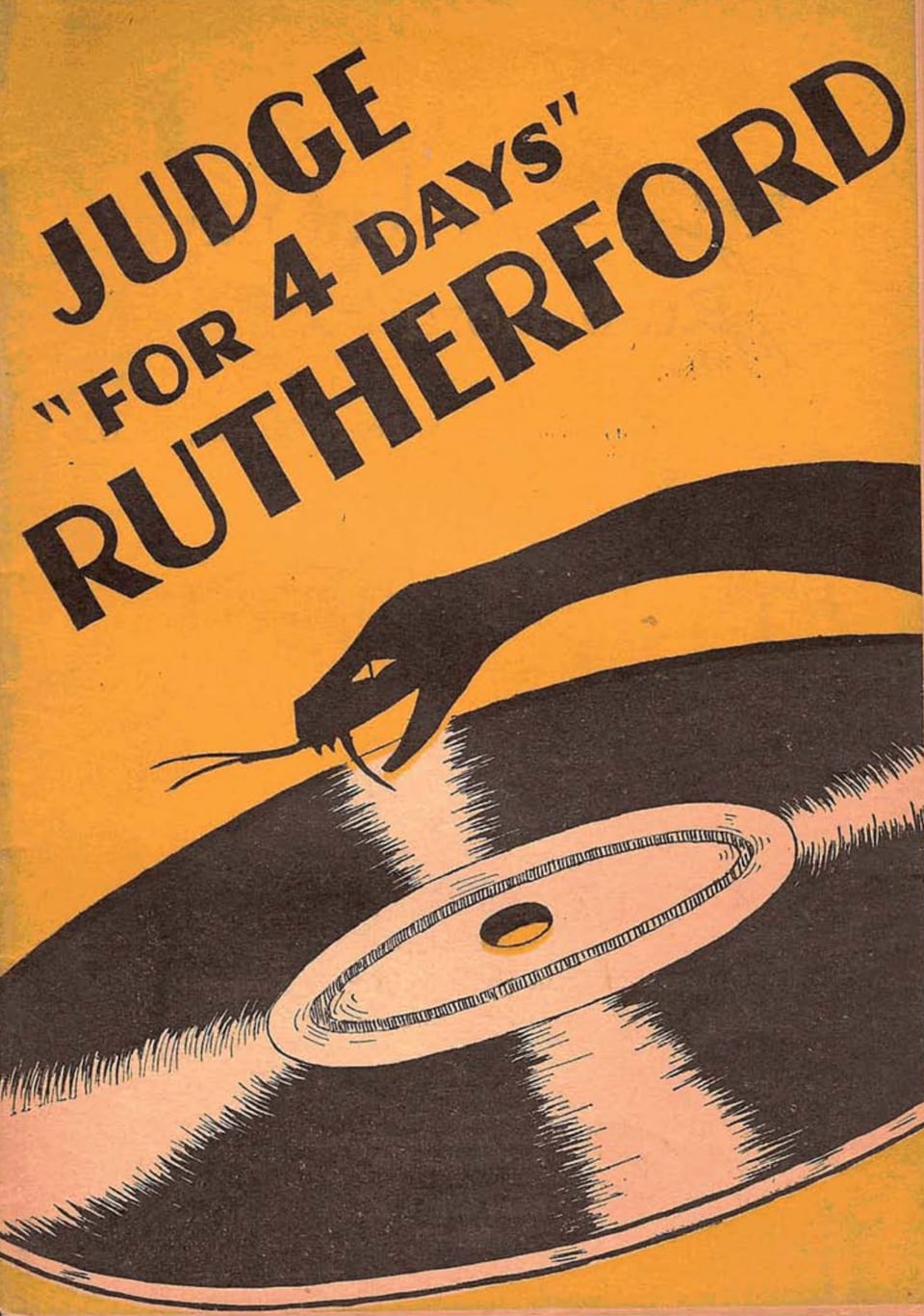
JUDGE "FOR 4 DAYS" RUTHERFORD Judge—"for four days"
—Rutherford
By Rev. Edward Lodge Curran, Ph.D.
Published by the INTERNATIONAL CATHOLIC TRUTH SOCIETY 407 Bergen Street, Brooklyn, N. Y.
Copyright, 1940 REV. EDWARD LODGE CURRAN, PH.D. Brooklyn, New York
Printed in U. S. A.
HIMSELF
SUPPOSE the ordinary, good, decent patriotic American citizen, who works hard, who tries to lead a moral life, who loves his family, who believes in God, who practices religion, who is loyal to his country, were to hear some of the following sentences over the radio or from the disc of some revolving phonograph record:
"No one knows the Scriptures but me . . . Read my books and then you'll know the Scriptures . . . If you understand the Scriptures different from me, you're wrong, you're lost, you belong to Satan, you will be destroyed, there's no hope for you . . . You must read my books and take my interpretation of the Scriptures . . . No one else's interpretation counts . . . For nineteen hundred years everybody has been wrong in interpreting the Scriptures . . . It is wrong to say that man has a body and a soul . . . He only has one . . . Body and soul are just two names for one and the same thing . . . If you belong to a Church, you belong to Satan . . . Satan is the head of every Church . . . If you salute the flag of your country, you commit a sin against God . . . Satan is the head of every country . . . No one connected with the government of the United States is on the side of God . . . The American government is the child of Satan just like every other government . . . Catholics and Protestants and Jews are all alike, the enemies of Jehovah and the children of Satan . . . There is no difference . . . Catholics are running the Protestant Church . . . All those who believe in religion are children of Satan . . . Do not support any Church . . . Instead, give all your support, financial and otherwise, to me . . . Buy my books and pamphlets . . . I'll tell you what the Scriptures mean . . . Christ was only a man . . . He failed to bring the people back to God . . . I'll bring the people back to God . . . Only 144,000 people, anyhow, are ever going to heaven . . . Most people are lost forever . . . Only a few millions of all who ever lived will be raised from the dead to inhabit the earth again . . . Christ will come again in 1914; no, in 1918; no, in 1925; no, in 1930; no, but what does a few years matter . . . When he comes you're all lost unless you have read my books and taken my interpretation of the Scriptures . . . God is not interested in anybody's salvation . . . Yes, He is . . . No, He isn't . . . Well, anyhow, think of Jonah and Jonadab and Rahab and the Sheep and the Goats and the Abomination of Desolation . . . The Catholic Church is the Abomination of Desolation . . . The Protestant Church is the Abomination of Desolation . . . The Jewish Church is the Abomination of Desolation .
. . The League of Nations is the Abomination of Desolation . . . Everything except me is the Abomination of Desolation . . . Commerce is the Abomination of Desolation . . . Business is the Abomination of Desolation, that is, all business except the business of selling my books and pamphlets . . . Catholics don't belong to the Catholic Church . . . Protestants do belong to the Catholic Church . . . Annoy people by playing phonograph records upon their doorsteps . . . God has inspired my books just like the Bible . . . Denounce every one who is not a Witness . . . Look out, here it comes, the Battle of Armageddon, the end of the world . . . Oh, no, that was just a scare . . . Well, anyhow, it isn't far off . . . Buy my books and get on the bandwagon . . . If you are a loyal Church member, if you are a good citizen, if you are trying to lead a decent life, that doesn't count . . . You're lost . . . Unless you buy my pamphlets and come over to me . . . Who said so . . . The Bible said so . . . Where . . . Well, I don't exactly know, but I said it and that's enough . . ."
BELIEVE IT OR NOT
What would be the reaction of the good ordinary American citizen, whose ears were assailed with such tommyrot. First of all, he would deny the possibility of ever hearing or reading such tommyrot. Secondly, he would say that the author of any such statements, either in books or over the radio, condemns himself and destroys his authority by making them.
Yet, believe it or not, such thoughts and hundreds of others just as unreliable, are actually presented in pamphlets and books and over the radio and on phonographs. These, and many others, are the malicious, ignorant and unfounded statements of the present head of a group called Jehovah's Witnesses, one who calls himself "Judge" Rutherford, but who, in all accuracy, should only be called Judge—"for four days"—Rutherford.
HIS TITLE
What claim has Joseph Rutherford to the title "Judge"? The following facts, which were drawn from the Circuit Court Records of Cooper and Morgan Counties, Missouri, by Father Felix, O.S.B., are the only evidence that can be gathered in the matter of Rutherford's "Judgeship."
LEGAL BACKGROUND
Rutherford was a lawyer in Missouri. He graduated from no law school. He received no law degree. He became a lawyer by first becoming a Court Stenographer. On the basis of
his experience as a Court Stenographer Rutherford applied to be admitted as a member of the Missouri Bar. He was examined by a committee of five members of the Bar at Boonville, Missouri, and admitted to the Bar of the State of Missouri, May 5, 1892. It is significant that he received no such formal and thorough and cultural training in the law and in legal history and practice as that which is furnished by modern law schools.
As a lawyer, Rutherford, like all other lawyers in the State of Missouri, was privileged by law to sit in place of the regular Presiding Judge of the Circuit Court whenever the latter was absent and until the latter returned. In other words, he was permitted to sit in place of the Judge. He did not preside over the Circuit Court in his own name or in his own right. The Statutes of the State of Missouri permitted the lawyers in a Circuit District to select one of their members to preside over the Circuit Court until the regular Circuit Court Judge returned.
JUDICIAL BACKGROUND
Rutherford performed the duties of an "Acting Judge" for four days. On two occasions there were no cases to be tried. On the other two occasions only minor cases arose. This is the only way in which Rutherford ever sat upon a Bench. At most, he was an Acting Judge for four days.
Moreover, since Rutherford denounces all civil government as the child of Satan and as the Abomination of Desolation, he should be consistent and forever renounce the title which he hugs to his heart and which is bait to capture the attention of his audiences. How can the "great Rutherford," who denounces all governments as the offspring of Satan and who declares that no one connected with the government of the United States is on the side of God, allow people to call him by a title which associates him with a judicial branch of government. If the government is the child of Satan, then the branches of government, according to Rutherford, must be likewise Satanical. Then also, if Rutherford is logical, any title indicating the holding of office in such Satanic governments must be Satanical. On the strength of Rutherford's own statements concerning the Satanic character of all civil governments, including the government of the United States of America, we cannot imagine how he can tolerate the title "Judge" for a single instant.
He should also warn his followers against using it. In using it they are subjecting Rutherford, according to his own statements, to a diabolical insult. Moreover, if they must use it, and Rutherford has done nothing to stop the use of it, they should at least be accurate and unite with us in referring to Rutherford as Judge—"for four days"—Rutherford.
This will be in accord with facts. This will stop anyone from presuming that Rutherford ever performed judicial duties for a long period of time. Henceforth, we shall refer to the subject of this analysis as Judge—"for four days"—Rutherford.
PATRIOTIC (?) BACKGROUND
In this analysis of the message which Judge—"for four days" Rutherford shouts at his Jehovah's Witnesses, we are not interested in the private life of the "Judge." In fact, up to the time when he joined the followers of the late Charles T. Russell, whom he succeeded, his private life holds no interest for anyone. He was born in Missouri on November 8, 1869. He became a lawyer in the manner already mentioned.
For four days he was selected by his fellow-lawyers to preside over a Circuit Court in the absence of the Circuit Court Judge. He became an attorney for Charles T. Russell, the founder of the Russellites or Millennial Dawn People. In 1876, Russell "discovered", although he never let anyone into the secret of his "discovery", that Christ had returned to the earth invisibly, in 1874. When Pastor Russell, whose wife had been granted a divorce in 1897 for infidelity and cruelty, died in 1916, Judge—"for four days"—Rutherford succeeded him. He became head of the International Bible Students' Association and of the Watch Tower Bible and Tract Society.
In 1918 he was arrested and tried and convicted of wilfully and illegally conspiring to produce insubordination and disloyalty on the part of the armed forces of the United States. He was sentenced to twenty years, but was released, after the war was over, on May 16, 1919. Since then, his tirade against organized government in general, and against the government of the United States in particular, has continued. Under the spell of his long, intricate and hopelessly unintelligible sentences the followers of Russell have become known as "Jehovah's Witnesses."
COMMERCIAL BACKGROUND
The headquarters of Jehovah's Witnesses is in Brooklyn, New York. According to recent articles in the New York Post, the property at 122-24 Columbia Heights is assessed on the city tax rolls at 425,000, while that at 117 Adams Street is assessed at 325,000. This is quite a sizable and valuable bit of real estate to be owned by a group whose "judicial" leader denounces all commerce as the operation of the devil.
According to the articles which appeared in the July 15th, 16th and 17th issues of the New York Post, some 42,000 "publishers" or "pioneers" of Judge—"for four days"—Rutherford are paid to sell his pamphlets and books and magazines throughout the country. The radio station of the "Witnesses" is owned by the Watchtower Bible and Tract Society. Seventeen books have been written by Judge-"for four days"-Rutherford. Twenty-five cents apiece is the price required for the privilege of wading through the chaotic thought processes and the garbled scriptural interpretations contained in these books. According to the New York Post, 1,008,127 copies of the volume entitled "Salvation" were printed and sold in three months. According to the "Yearbook of Jehovah's Witnesses", some 309,484,991 books and booklets have been distributed throughout the world since 1920.
PROFITABLE ADDITION
In addition to his books, Judge—"for four days"-Rutherford has written thirty-three sixty-four page pamphlets. Then there is the semi-monthly magazine called "The Watchtower" and the bi-weekly magazine called "Consolation". These works of Judge-"for four days"-Rutherford have appeared in eighteight languages.
Add to these the 109 discs, whose duplicates carry the "Judge's" chaotic thought processes and garbled scriptural interpretations to those not fortunate enough to live close to the society's headquarters.
Add to these the fact that over one hundred and thirty-eight radio stations carry the voice of Judge—"for four days" Rutherford every week in the United States alone.
Add to these the fact that his army of Brooklyn workers, who produce the paper,the covers,the ink,the paint,the paste,and who print his vast array of publicity,receive only $10 a month.
Add to these the fact that millions of copies of his books bring in 25 cents apiece; that millions of copies of his pamphlets bring in 5 cents apiece; that his own manufactured portable phonographs, together with three recordings by the "Judge", bring in 10 dollars apiece; that the discs, duplicating some "original" broadcast of the "Judge" sell for 70 cents apiece.
Add all these facts, which were gathered by the special feature writer of the New York Post, and you have a composite picture of a monumental business and commercial and profitable operation in the control of a man who rants against all commerce as the operation of the devil. The poor people who are persuaded to part with their hard-earned money for the books and pamphlets and magazines and phonograph records of Judge-"for four days"-Rutherford should know these facts.
When they give money for one of the "Judge's" magazines or books or pamphlets or records, they are, in the "Judge's" opinion, really playing into the hands of the devil, for, according to the "Judge's" own statements, commerce, like government, is the work of the devil.
The purpose of this pamphlet is to show that Judge—"for four days"Rutherford has no right to set himself up as a judge in religious or scriptural matters. The purpose of this pamphlet is to warn all real American citizens that the "Judge" is anti-Protestant, anti-Catholic, anti-Jewish, anti-American, the enemy of religion, the enemy of our country and the enemy of common sense.
II.
HIS WRITINGS
There is only one class of people with whom the rantings of the "Judge" have any influence. He depends for his success upon the fact that many people no longer read the Bible. He appeals, therefore, to those who love the Bible but who do not read it. No Catholic, no Protestant, no Jew, indeed, no American, to whatever religion he may belong, who reads the Bible can help but discover the ignorance, the delusion and the falsehood of the "Judge's" so-called Biblical interpretations.
We appeal to the Jehovah Witnesses themselves to read the Bible. We appeal to them to re-read the particular books of Rutherford which we shall use as evidence. If they do so, calmly and honestly and sincerely, they will soon renounce the fantastic, intellectual slavery in which Judge—"for four days" Rutherford holds them.
We have the greatest sympathy for those who accept the "Judge's" Biblical interpretations as infallible, simply because the "Judge" says so. We believe that they have accepted the "Judge's" interpretations without reading the Bible and without demanding any proof. By indulging in constant quotations from the Bible the "Judge" palms himself off as an educated and learned man. That impression will disappear by reading the Bible and by analyzing the "Judge's" use of the Bible.
It is significant that the vast majority of the "Judge's" Bible quotations are from the Old Testament and from the Book of the Apocalypse (otherwise known as the Book of Revelations) in the New Testament. The "Judge" practically ignores the four Gospels. He twists the Old Testament accounts and the
prophecies in the Book of Revelations in order to apply them to any event to which the "Judge" wishes them to apply.
RUTHERFORD VS. ISAIAH
Thus, the "Judge" states that the words of the prophet Isaiah, eighth chapter, verses 12 and 13, refer to the League of Nations that was founded at the end of the last World War. On page 253 of his book entitled "Salvation", the "Judge" states: "It was fear that induced the rulers to form the League of Nations; and hence they acted under the direction of Satan. God warned his people to have nothing to do with such a confederacy of nations, but that they should fear God; and his promise is that to them he will be a sanctuary (Isaiah 8:12, 13)."
In this particular case, the "Judge" is guilty of an absolute falsehood. It is false to declare, as the "Judge" does, that the words of the twelfth and thirteenth verses of the eighth chapter of the Book of Isaiah refer to the League of Nations established at the close of the last World War.
Here are the exact words of the prophet Isaiah:
"Say ye not: A conspiracy. For all that this people speaketh, is a conspiracy. Neither fear ye their fear, nor be afraid.
"Sanctify the Lord of Hosts himself: and let him be your fear; and let him be your dread.
"And he shall be a sanctification to you: but for a stone of stumbling and for a rock of offense to the two houses of Israel, for a snare and a ruin to the inhabitants of Jerusalem."
We ask the Witnesses themselves: where is there a mention of the League of Nations in these words? By what right did Judge—"for four days"—Rutherford try to deceive people into believing that in these verses of the Prophet Isaiah he had explicit condemnation of the particular League of Nations established at the close of the last World War?
The words of Isaiah refer to a "conspiracy". No mention is made of a League of Nations. The prophet clearly states that the conspiracy mentioned in these verses is one of words. "For all that this people speaketh," says the prophet, "is a conspiracy." The enemy of God, here mentioned by the prophet, is "the two houses of Israel" and "the inhabitants of Jerusalem." By what right does the "Judge" try to deceive people by quoting words from the Prophet Isaiah which do not prove his point. If the "Judge" wants to denounce the League of Nations, that is his affair. But to declare, as he did declare, that God denounced the modern League of Nations in the twelfth and thirteenth verses of the eighth chapter of the Book of Isaiah, is a lie. Does Judge—"for four days"—Rutherford know anything about the Scriptures?
Does he not know that in these verses the Prophet Isaiah is reproving the Jews for their sins and warning them of the evils which will come upon them for having sinned.
The question here is not whether God approves or disapproves of the modern League of Nations or of any league of nations. The question is not whether Judge—"for four days" Rutherford approves or disapproves of the modern League of Nations or of any league of nations. The question here is that the "Judge" tried to have his readers believe that the twelfth and thirteenth verses of the eighth chapter of the Book of Isaiah contained a warning by God that people should have nothing to do with the particular modern League of Nations established at the close of the World War. The verses contain no such thing. The "Judge" is guilty of a falsehood stating so. The "Judge" is also guilty of fraud and deceit for trying to make his readers accept his lie.
Judge—"for four days"—Rutherford is unfit to be accepted as a religious leader by anyone, including those who now accept his leadership and who are known as Jehovah's Witnesses. We desire the Witnesses to read this pamphlet and, then, to ask themselves whether the "Judge" possesses those qualities and virtues which should be expected from one who holds himself forth as a teacher or preacher or leader of spiritual realities. If they are honest and sincere and unprejudiced in their reactions, they will admit that the "Judge" does not possess them.
MERCENARY APPEALS
We have already indicated the mercenary and commercial factors in the "Judge's" conduct of big business. The "Judge" himself declares how interested he is in securing gold and silver from those to whom he preaches. The following appeal for money is made by the "Judge" in an advertisement which appears on page 380 of his book entitled "Riches."
Riches That Do Profit you in the near-by "day of wrath"
All the gold and silver you could heap up on earth would not avail you a thing in that day: "neither their silver nor their gold shall be able to deliver them in the day of the Lord's wrath." —Zephaniah 1:18.
— Zephaniah 1:18.
WHY, THEN, HOLD BACK NOW
from contributing some of such gold and silver to the work of preaching the Kingdom gospel and receiving in acknowledgment thereof
real riches, to wit, any or all of the books shown in true colors on opposite page?
Following these words is a list of books written by the "Judge." Again we state that it is amusing to find the "Judge" indulging in commercial operations, when he declares in his writings that commercial operations are of the devil.
WANTS EVERYTHING
It is important to remember that according to the "Judge's" private interpretation of the Bible only 144,000 people are ever going to heaven. According to him, most of the people born into the world, from the very beginning of creation, are lost forever. Only a few million, according to the "Judge", will be forever happy. These latter millions will not be admitted to heaven. They will live forever upon the earth. The "Judge" refers to them as "Jonadabs." In pursuance of the mercenary motive, the "Judge" has this to say about the duty of the "Jonadabs" towards Jehovah's Witnesses. On page 269 of his book "Salvation," the "Judge" states: "The Jonadabs or 'other sheep' have declared themselves for Jehovah and his kingdom. It is therefore their privilege and their obligation to give all their support to God's kingdom, and that means their time, their energy, their money, and everything, to advance the kingdom interest. . . After providing the necessary material things for oneself and one's dependent ones, then if he is in a covenant with the Lord it is his privilege and duty to use his substance to further the interest of the Lord's kingdom."
MERCENARY HYPOCRISY
The "Judge" condemns anyone who gives support to religion. He condemns the Catholic for supporting the Catholic Church. He condemns the Protestant for supporting his particular Protestant Church. He condemns the Jew for supporting the Jewish Church. But he is most anxious to secure support for his own group. In fact, as the foregoing quotation reveals, he wants everything, beyond what is actually needed by a Jonadab for the support of the Jonadab and his dependents.
According to the "Judge", it is wrong for a decent American citizen to worship God in his own church and to support that church. Simultaneously, according to the "Judge" those who wish to follow him must give him all their earthly goods, beyond what is absolutely needed for personal or family support. This is mercenary hypocrisy. It should condemn the "Judge's" appeal immediately in the mind of everyone visited by his "Witnesses." The Churches of America merely ask their members for support.
The "Judge" wants everything from those who follow him.
MANY BOOKS - SAME IDEAS
Like all self-appointed and self-styled intellectual tyrants Judge-"for four days"Rutherford will tolerate no interpretation of the Scriptures which differs from his own. All his books are a long and wordy presentation of his own interpretations of the Scriptures. Included in all his books are vicious and unfounded attacks upon all religions and upon all governments, including the government of the United States of America, under whose free constitution and laws he has been at liberty to build up a million dollar business.
In fact, to get acquainted with the ignorant and false and malicious rantings of the "Judge" it is only necessary to read one of his books. They all contain the same subject matter. They all contain the same attacks on religion and government. They all contain the same fantastic interpretations of Old Testament events which the "Judge" demands that his followers accept under pain of eternal destruction. It is a waste of money for anyone to spend quarter after quarter for the books produced by the "Judge." One quarter is enough to reveal the malice and the ignorance and the fantasy of his preachings.
SELF-EXALTATION
Strangely enough, the "Judge" condemns himself in his own writings. The "Judge" claims that he and his "Witnesses" are superior to Christ and the Apostles. Christ, the "Judge" states, is Jehovah's King. Christ died to conquer the devil and to initiate God's kingdom. Yet, the "Judge" also states, for nineteen hundred years after the death of Christ the Devil has remained supreme in the world. According to the "Judge" Christ came to vindicate Jehovah's name. Yet, Christ and the Apostles were failures. The world, according to the "Judge", had to wait for him and his Jehovah's Witnesses, in the twentieth century, to begin the work of vindicating Jehovah's name. By declaring Christ to have been a failure for nineteen hundred years the "Judge" insults Christ, just as he insults the religious and patriotic beliefs of every decent American throughout the land.
It is not to be wondered at that a man of such pride and arrogance and ignorance should condemn his own activities in his own works. The "Judge" rants over the radio and by means of phonographic records. The "Judge" uses tons of ink to write
SELF-CONDEMNATION
the same material in different books. The "Judge" sends out his "Witnesses" to bring his message to the homes of America. And yet, here is what the "Judge" himself says about his own activities.
On page 168 of his book entitled "Riches," the "Judge" says:
On page 168 of his book entitled "Riches," the "Judge" says: If you come in contact with men or organizations of men that are reaching out for gain, whether that gain be numbers in their organization, or property, money, power or influence, avoid such because they cannot be the servants of God."
The "Judge," as we have seen, is interested in getting everything from the people who follow him, except that which is absolutely necessary for their own personal and domestic maintenance. The "Judge," therefore, is a man "reaching out for gain." His organization, Jehovah's Witnesses, which is an organization of men, is likewise "reaching out for gain." Therefore, to follow the "Judge's" advice, he himself and his Witnesses, who force their presence upon American households, should be avoided, because, as the "Judge" says, "they cannot be the servants of God."
On page 138 of his book entitled "Riches," the "Judge" says:
On page 138 of his book entitled "Riches," the "Judge" says: "A man who harangues the people and states his conclusions or the conclusions or opinions of other men is not a 'preacher' within the meaning of the Scriptures. A more appropriate name for him would be 'windjammer.'"
This is delightful. Judge—"for four days"—Rutherford calls himself a "windjammer." For the "Judge" harangues the people and states his own conclusions. Only a minor portion of his books is devoted to actual quotations from the Scriptures. The "Judge" uses millions of words and thousands of lines and hundreds of chapters to state HIS OWN CONCLUSIONS about what he reads in the Bible. We have already seen how the "Judge" has lied about the twelfth and thirteenth verses of the eighth chapter of the Book of Isaiah. Since the "Judge" harangues the people and states HIS OWN CONCLUSIONS, he is a "windjammer." The citizens of the United States should be on guard against the windjamming Judge.
DENOUNCES HIS OWN WITNESSES
One of the best proofs, provided by the "Judge" himself, that no sane and reasonable American citizen should have anything to do with Judge—"for four days"—Rutherford or with the salesmanship talk of his "Witnesses," is to be found on page 92 of his book entitled "Riches." There the "Judge" states: "Let it be kept clearly in mind that Jehovah God is not trying to save men. He has not commissioned any company or people on the earth to try to save men."
If the "Judge" were honest and sincere when he wrote these lines, why, in the name of common sense, does he send forth the "company" or "people," known as Jehovah's Witnesses, to try to save men. This delightful exhibition of the "Judge's" chaotic mental processes shows how much the "Judge" thinks of Jehovah. Jehovah, he says, is not trying to save men. Jehovah, he adds, does not commission "any company or people on the earth to try to save men." But I, says the "Judge" by inference, I shall send forth a company or a people known as Jehovah's Witnesses in spite of Jehovah. What an interesting knot hole the "Judge" has got himself into by his own use of words and misuse of thoughts. According to the "Judge," Jehovah's Witnesses, who surely are a "company" or a "people," have no authority from Jehovah to do what they are doing throughout the world. The "Judge" here repudiates his own Witnesses.
Since it is the "Judge" who writes the books and the pamphlets and harangues and insults, this pamphlet is concerned with revealing how unfit the "Judge" is to pose as a spiritual leader or as an interpreter of Scriptural prophecies. The "Judge" should be repudiated by his own Witnesses and avoided by every sensible American citizen for the following reasons. The writings of the "Judge" reveal him to be (1) the enemy of Christ; (2) the enemy of the Scriptures; (3) the enemy of common sense; (4) the author of hatred and bigotry and treason.
III.
ENEMY OF CHRIST
Judge-"for four days"-Rutherford is the enemy of Christ. We have already shown how the "Judge" looks upon Christ as a failure. For nineteen hundred years Christ has failed to vindicate the Name of Jehovah, says the "Judge." He, the "Judge," will do in a little while what Christ failed to do in a big while.
In the thirty-third verse of the sixteenth chapter of St. John's Gospel, Christ urged His followers to have confidence because He overcame the world: "But have confidence. I have overcome the world." The "Judge," however, refuses to accept this. According to the "Judge," Christ was only a man. According to the "Judge," Christ did not become king until 1914. According to the "Judge," Christ did not begin to judge mankind until 1918. According to the "Judge," Christ has been a failure for nineteen hundred years. According to the "Judge," Christ did not overcome the world although Christ Himself declared: "But have confidence. I have overcome the world."
In other words, Judge—"for four days"—Rutherford attempts to oppose the teachings of Christ. The "Judge" ignores many of the statements which Christ uttered on earth. When the "Judge" does quote the words of Christ, he gives them his own interpretation and robs them of the meaning which Christ attached to them.
DENIES "SERMON ON THE MOUNT"
Christ demanded that all men should believe in Him. He also demanded that all men should keep the commandments. He further demanded that all men should become virtuous. The fifth, sixth and seventh chapters of the Gospel of Saint Matthew contain Christ's Sermon on the Mount. The "Judge" does not even mention the Sermon on the Mount in his book entitled "Salvation." And this is the book which the "Judge" states, on the title page, to be "A text book for the Jonadabs." Evidently the "Judge" is not interested in the moral teachings of Christ.
In His Sermon on the Mount Christ declared that we must love all our neighbors, including our enemies. "But I say to you: Love your enemies: do good to them that hate you: And pray for them that persecute and calumniate you." (Saint Matthew V:44). In all his books, the "Judge" preaches hatred towards those who practice religion and towards those who are loyal to their country. The "Judge's" books are a denial of the command which Christ uttered: "Thou shalt love thy neighbor as thyself." Christ preached love. The "Judge" preaches hatred.
NO MENTION OF PRAYER
Christ preached the necessity of prayer. The "Judge" never mentions the necessity of prayer in "Salvation," his "text book" for the Jonadabs. When the apostles asked Christ to teach them to pray, Christ gave them the "Our Father," the most beautiful prayer of all time. The "Judge" never mentions the "Our Father" in his "text book" for the Jonadabs. No man who fails to preach the necessity of prayer can rightly claim to be a follower of Christ. The "Judge" is not a Christian.
Christ declared that He was the Son of God. Referring to Himself, He stated:
"For God so loved the world as to give his only begotten Son: that whosover believeth in him may not perish, but may have life everlasting.
"For God sent not His Son into the world to judge the world: but that the world may be saved by him"
(Saint John's Gospel 111:16-17).
Again we read: "And if any man hear my words and keep them not, I do not judge him: for I came not to judge the world, but save the world." (St. John's Gospel XII:47.)
And again, in the third and fourth verses of the second chapter of Saint Paul's First Epistle to Timothy, we read:
"For this is good and acceptable in the sight of God our Saviour, Who will have all men to be saved and to come to the knowledge of the truth."
DENIES CHRIST DIED FOR ALL
We have quoted these various Scriptural texts to show that God wishes the salvation of all men and that Christ, the Son of God, came into the world in order to save all men. In other Scriptural places we read that Christ will judge the world and reward or punish men for their activities. In the texts, here quoted, Christ is emphasizing the doctrine of salvation for all. This does not mean that all will be saved. It does mean that salvation is offered to all and that Christ died for all men and not for a favored few. Men must accept salvation by belief in Christ and by doing the things which Christ commanded. But the salvation is there for all, and Christ shed His Precious Blood for all. This is why Saint John the Baptist cried out as Christ approached: "Behold the Lamb of God. Behold Him Who taketh away the sin of the world."
The "Judge," however, denies this teaching of Christ. He declares that salvation is not for all. He insists that Christ did not die for all. He declares that since some will be lost, in spite of Christ's sacrifice and death, then Christ did not suffer and die for all. Christ said that He did suffer and die for all. The fact that Christ foretold the eternal punishment of the wicked shows that there will be some who will not profit by Christ's death. Christ's teaching is that, although He came to save all, some would not be saved even though salvation is offered to them.
In spite of this clear teaching on the part of Christ, a teaching repeated by Saint Paul and the Apostles, the "Judge" who thinks he knows more than Christ denies it.
On page 42 of his book "Salvation," the "text book" for the Jonadabs, the "Judge" states: "Salvation is not provided for everyone." Christ says that salvation IS PROVIDED FOR EVERYONE, even though some will refuse to profit by it. The "Judge" says "Salvation is not provided for everyone."
Evidently the "Judge" does not know the meaning of words. The word "provide" means to offer. The "provision" or the offering" may be rejected or accepted. A father may provide
food for his children. Some of the children may refuse to eat, but the food is there for all to eat. To say that the father does not provide food for all his children, simply because some of them refuse to accept it, is to charge the father with neglect and cruelty. The correct statement is to say that the father provides food for all his children but, unfortunately, some of them will not eat it. Christ declares that He died for all and that salvation is for all. The "Judge" declares that Christ did not die for all and that salvation is not for all. All lovers of Christ will accept Christ in preference to the "Judge."
DENIES JEHOVAH WANTS ALL MEN SAVED
On page 30 of his book entitled "Riches," the "Judge" declares: "It is equally erroneous to say that God tries to save any one."
On page 92 of "Riches" the "Judge" similarly declares: "Let it be kept clearly in mind that Jehovah God is not trying to save men."
Saint Paul in his epistle to Timothy, as we have seen, states that God "will have all men to be saved." Christ said that He came into the world to save the world. Christ did not declare that He came only to save some. He said He came to save all, the entire world. The "Judge" denies the statement of Christ and the statement of Saint Paul. No sensible man or woman will follow the "Judge" in preference to Christ and Saint Paul.
DENIES CHRIST'S BODILY RESURRECTION
Christ rose from the dead, whole and entire, with a real body. After His Resurrection, Christ talked with His disciples. To prove the reality of His bodily resurrection He "showed them his hands and his side." To Thomas, the doubting Apostle, He said: "Put in thy finger hither and see my hands. And bring hither thy hand and put it into my side. And be not faithless, but believing."
All the accounts of the Resurrection prove that Christ's Resurrection was a bodily Resurrection. In the last chapter of Saint John's Gospel, verses 12 and 13, we read how the resurrected Christ even dined with His disciples, giving them bread and fish with His own hands. The following quotation from Saint Luke's Gospel reveals how anxious Christ was to prove to His disciples that His Resurrection from the dead was a bodily resurrection and not merely the resurrection of a spirit:
"Now, whilst they were speaking these things, Jesus stood in the midst of them and saith to them: Peace be to you. It is I: fear not.
"But they being troubled and frightened, supposed that they saw a spirit.
"And he said to them: Why are you troubled, and why do thoughts arise in your hearts?
"See my hands and feet, that it is I myself. Handle and see: for a spirit hath not flesh and bones, as you see me to have.
"And when he had said this, he showed them his hands and feet. But while they yet believed not and wondered for joy, he said: Have you here anything to eat?
"And they offered him a piece of a broiled fish and a honeycomb.
"And when he had eaten before them, taking the remains, he gave to them" (Saint Luke XXIV:36-43).
The Scripture clearly teaches, therefore, the bodily resurrection of Christ from the dead. The "Judge" boasts that he believes in the Scriptures and that all his teachings are scriptural teachings. And yet, wherever he refers to Christ's resurrection, the "Judge" denies that it was a bodily resurrection and asserts that Christ's resurrection was merely a resurrection of His spirit.
Typical of the "Judge's" denial of this clear teaching of Christ and this clear evidence of the Scriptures is the "Judge's" statement on page 172 of "Salvation," his self-styled "text book" for the Jonadabs: "God raised Jesus out of death and gave him life as a spirit." This statement of the "Judge's" is a denial of what Christ teaches and of what the Scriptures record. Christ said that His Resurrection was a bodily resurrection. The "Judge" says it was not.
DENIES GENERAL RESURRECTION OF THE DEAD
One of the important and striking teachings of Christ is the general resurrection of all the dead. In that resurrection, as Christ taught, He himself would be the judge. Two eternal judgments will be decreed: everlasting happiness for the good and everlasting punishment for the wicked. But, as Christ taught, both the good and the bad will be resurrected from the dead.
Thus, we read, in the 28th and 29th verses of the fifth chapter of Saint John's Gospel, the following words of Christ Himself:
"Wonder not at this: for the hour cometh, wherein all that are in the graves shall hear the voice of the Son of God.
"And they that have done good things shall come forth unto the resurrection of life: but they that have done evil, unto the resurrection of judgment."
It is important to note that Christ said: "all that are in the graves" shall come forth in the general resurrection.
In the twenty-fifth chapter of Saint Matthew's Gospel, we have Christ's own description of the last judgment. The entire chapter should be read, particularly verses 31-46. In these verses, Christ teaches that He will come in majesty to judge the world. All nations shall be gathered before Him: the good as well as the bad. Upon both he will pronounce judgment. The good will be eternally rewarded. The bad will be eternally punished. In other words, the last judgment will be preceded by a general resurrection of all: the wicked as well as the good.
For the sake of brevity we here quote verses 31-34, 41 and 46, of the twenty-fifth chapter of Saint Matthew's Gospel:
"And when the Son of man shall come in his majesty, and all the angels with him, then shall he sit upon the seat of his majesty.
"And all nations shall be gathered together before him: and he shall separate them one from another, as the shepherd separateth the sheep from the goats:
"And he shall set the sheep on his right hand, but the goats on his left.
"Then shall the king say to them that shall be on his right hand: Come ye blessed of my Father, possess the kingdom prepared for you from the foundation of the world. (Verses 31-34).
"Then he shall say to them also that shall be on his left hand: Depart from me, you cursed, into everlasting fire, which was prepared for the devil and his angels. (Verse 41).
"And these shall go into everlasting punishment: but the just, into life everlasting." (Verse 46).
In the 15th verse of the twenty-fourth chapter of the Acts of the Apostles, we find Saint Paul referring to the "resurrection of the just and unjust."
DENIES THE GOSPEL MESSAGE
What has Judge—"for four days"—Rutherford to say about this clear teaching of Christ and about this clear evidence from the Scriptures? Believe it or not, he denies it. Christ teaches the general resurrection of all the dead, both the good and the wicked. The "Judge" denies it.
On page 342 of his book entitled "Salvation," his "text book" for the Jonadabs, the "Judge" states: "There appears no reason or Scriptural proof that God would resurrect the willfully wicked." And believe it or not, the "Judge" quotes the 28th and 29th verses of the fifth chapter of Saint John's Gospel, which clearly state that all shall be resurrected: the good unto resurrection of life and the evil unto the resurrection of judgment. Before quoting these verses the "Judge" asks: "Will not all the dead be awakened to the resurrection? and is not that made sure by the words of Jesus" (John 5:28, 29).
Immediately upon quoting these verses, the "Judge" then states: "The Scriptures do not support that conclusion."
This is an insult to the intelligence of his readers as well as a sinful denial of the clear teaching of Jesus Christ, whose words the "Judge" casts aside as of no value and of no account and of no proof. In his efforts to deny what Christ has clearly taught about the general resurrection of all the dead the "Judge" also ignores the account of the general resurrection given by Christ Himself and recorded in the twenty-sixth chapter of Saint Matthew's Gospel, verses 31-46.
DISTORTS THE MEANING OF "GRAVES"
On pages 342 and 343 of his book entitled "Salvation" the "Judge" tries, in vain, to wiggle out of the clear statement made by Christ that all who are "in the graves" shall come forth. The subterfuge he uses is opposed to common sense as well as to the Scriptures. He says the word "grave" means a "monument in remembrance of the dead." He then twists the word "grave" to include only those "held in the memory of God." He then declares, without any proof, that God has no memory of the wicked. Therefore, the "Judge" naively declares, while insulting the power of God, the word "grave" in the quotation of Saint John means only those whom God remembers, namely, the just.
This is a diabolical effort to substitute the "Judge's" own private interpretation of Scripture for the clear words of Christ. The "Judge" ignores the teaching of Christ concerning the general resurrection of all the dead, the wicked as well as the good, in Saint Matthew's Gospel. The "Judge" quotes Christ's words concerning the general resurrection of all the dead in Saint John's Gospel but declares that Christ's words in Saint John's Gospel do not mean what they say. And to ruin further the meaning of Christ's words, he indulges in a fantastic definition of the word "grave," in order that his followers may accept his teachings instead of Christ's teachings. This process makes the "Judge" the clear and confirmed and ignorant enemy of Christ.
IV.
In addition to proving that the "Judge" is the enemy of Christ, the foregoing material also proves that the "Judge" is the enemy of the Scriptures. The "Judge" is not too anxious for his followers to read the Scriptures alone. The "Judge"
tolerates no interpretation of the Scriptures which differs from his own mis-interpretations. In fact the "Judge" puts his own books upon the same level with the Bible. You may read religious literature in any language, but you will go far to meet with the arrogance and pride used by the "Judge" when he speaks of his own publications. Here is a choice bit of pride and arrogance from his book entitled "Riches," pages 353-354:
"The Lord has graciously provided for the publication of His message in the form of books (the 'Judge' is not referring to the Bible), that the people may be informed of the truth (the 'Judge' is referring to his own 'interpretations' of the Bible). On the last page of this book you will find a list of such publications (the 'Judge's' own books), which will enable you to locate in the Bible the very texts about which you desire to know, and which answer your questions. Provide yourself with those publications (at twenty-five cents apiece), study the same, together with your Bible (the reader will notice that the 'Judge' places his books on the same footing with the inspired works of the Bible). Those books do not contain the opinion of any man (does the 'Judge' mean to infer that he is not a man?). They merely enable you to locate the words of the Lord and to find out the very things you desire to know; and doing this (buying and reading the 'Judge's' books), you are obeying God's commandments."
Little need be added to the remarks which we have enclosed in parentheses to prove to any thinking man that the "Judge" puts his own books on a par with the Bible and that his followers must not read the Bible alone or indulge in their own interpretations. We have already given several examples to prove how the "Judge" misuses and mis-interprets the Bible. The following additional examples are but a few of the many more that could be offered.
CHRIST DID NOT CONDEMN RELIGION
One of the insistent claims of the "Judge" is his statement that Christ condemned religion. He refers to those who worship God through religion as "religionists." Christ, he says, condemned all religionists. In order to prove this, the "Judge" quotes the following words from the twenty-third chapter, verses 3-4, of the Gospel of Saint Matthew:
"Do not ye after their works . . . For they bind heavy burdens, and grievous to be borne, and lay them on men's shoulders; but they themselves will not move them with one of their fingers."
It is not necessary to continue this quotation to the end. The "Judge's" misuse of the Scriptures is present in the words already quoted. The "Judge" would have his followers believe that, in these words, Christ condemned all religionists, religious members as well as religious leaders.
Nothing could be further from the truth. Christ Himself entered Jewish Synagogues. Christ Himself went up to the Temple. Christ Himself celebrated the various Jewish feasts. He had just celebrated the Jewish Feast of the Passover when He was arrested by His enemies.
Christ did not condemn every religion or all religionists. Christ condemned the Scribes and Pharisees, in the verses quoted by the "Judge," because they were hypocrites and not because they were religionists. It was because they did not live up to the spirit of the Jewish religion that Christ condemned the Scribes and Pharisees. In fact, in verses two and three of the Scriptural quotation used by the "Judge," Christ said: "The scribes and the Pharisees have sitten on the chair of Moses. All things therefore whatsoever they shall say to you, observe and do." Purposely and maliciously and unscripturally the "Judge" omits these words from his quotation. And, in verse three, the "Judge" also omits these words: "For they say, and do not." Instead of these words, which the "Judge" should have quoted, if he were not an enemy of the Scriptures, the "Judge" places dots (...) in the beginning of his quotation.
MALICIOUS OMISSION
These words, which the "Judge" has PURPOSELY omitted from his quotation, prove that Christ was condemning the Scribes and Pharisees not because of religion but because they had religion and did not practice it. "For they say, and do not." Moreover, Christ bade the Jews to be true to religion even when taught by the Pharisees and Scribes, and even though the Pharisees and Scribes themselves were negligent in the practice of the religion which they preached.
The quotation used by the "Judge" to prove that Christ denounced all religions and all religionists is no proof at all. It is a proof of the opposite. To conceal the fact that Christ praised religion and urged the people to practice religion, even though some of their leaders were guilty of not practicing what they preached, the "Judge" purposely omits the complete and exact words of Christ.
This wilful omission on the part of the "Judge" alone condemns him as the enemy of the Scriptures. No man who so
misuses the Scriptures is worthy of belief. The "Judge" shrewdly omits the words of Christ when they do not suit his own purpose. The "Judge" will twist the Scriptures in order to prove his own fantastic doctrines. No wonder the "Judge" does not want people to read the Bible for themselves. If his followers would only read the Bible, they would discover what a Scriptural sham their own leader is.
To list all the Scriptural mis-interpretations and omissions of which Judge—"for four days"—Rutherford has been guilty, and in which he indulges in order to support his own private fantastic doctrines and to keep the truth away from his followers, would require many volumes of many pages. Enough of them have been recorded in this pamphlet to prove that just as the "Judge" is the enemy of Christ, so he is, also, the enemy of the Scriptures.
V.
ENEMY OF COMMON SENSE
No individual who possesses common sense can sincerely accept the teachings of Judge-"for four days"-Rutherford. His writings are full of contradictions. In order to arouse hatred toward religion and government the "Judge" indulges in charges that have no foundation and in statements that are utterly ridiculous.
BODY AND SOUL
Thus, when the "Judge" talks about man's body and man's soul, he says one thing, one moment, and the opposite thing another moment. This is what we mean by a contradiction. On page 36 of his publication entitled "Salvation," the so-called "text book" for the Jonadabs, the "Judge" writes:
"Every man is a soul, that is to say, a living, breathing creature. He does not possess a soul separate and distinct from his body; but the body of flesh and the breath of living creatures, together, constitute the soul. When these are separated the soul is out of existence."
"ONE PLUS ONE EQUALS ONE"
We ask the "Judge's" Witnesses to notice the contradictions involved in this statement of their "judicial" leader. The "Judge" says that man has a body and that man is a soul. Then the "Judge" says that body and soul are one. Then, the "Judge" says that when body and soul, which, he says are one, are separated, the soul is out of existence. How can that which is one be separated?
If the body and soul, as the "Judge" claims, are one and the same thing, then it is stupid to use the word "they" and more stupid to say: "when they are separated." This is not a mere playing with words on our part. This is only a common sense analysis of the words used by the "Judge." He supplied the words we are analyzing. We are only supplying the analysis.
Moreover, if, as the "Judge" says, man has a soul and a body, surely, body and soul are not one and the same thing. They may be united together, as they actually are in every man, but body and soul remain distinct. The "Judge" himself states that body and soul are distinct because he talks about them separately. He even says "when they are separated." But the "Judge" immediately denies what he states, by saying that the body and soul, of which he speaks separately and which he says will be separated, are one and the same thing. The "Judge" should have said that every man has a soul which is not separated from his body on earth, but which is quite distinct from his body, so that body and soul, distinct though united, constitute a living creature.
CHRIST'S TEACHING
The "Judge" does not realize that two things can be distinct although not separated. The "Judge" does not realize that he is also contradicting his own false statement about the identity of soul and body, as one and the same thing, when, on page 266 of his book, "Salvation," he quotes the following words of Christ:
"And fear not them which kill the body, but are not able to kill the soul; but rather fear him which is able to destroy both soul and body in hell" (St. Matthew X:28).
Christ here plainly states that it is possible to kill the body but not the soul. Therefore, it is the teaching of Christ that body and soul are distinct and not the same. The "Judge" contradicts this teaching of Christ when he says that body and soul are one and the same thing. If, according to the "Judge," body and soul are one and the same thing, then to kill the body would mean to kill the soul. In other words the "Judge" contradicts Christ, as well as himself, in his false teachings about the body and the soul.
THE "JUDGE'S" YEARS
The "Judge" becomes hopelessly involved in contradicting himself, when he writes about the time when Christ is to gather
the elect, the 144,000 of which the "Judge" speaks, to Himself. Thus, on page 165 of his book, "Salvation," the "Judge" writes that Christ began to gather the 144,000 faithful and true followers to himself in 1918. On page 211 of "Salvation," the "Judge" writes that Christ applies His ransom merit for the elect after the year 1922. And yet on page 172 of his book entitled "Riches," the "Judge" states that God has been choosing His elect since the first Pentecost, in 33 A.D. We wish that the "Judge" would straighten himself out as regards his own numerology.
SALUTING THE FLAG
We ask the Witnesses to meditate upon the contradiction contained in the "Judge's" denunciation of the act of saluting the American Flag. On page 260 of "Salvation" the Judge writes as follows:
"But is the saluting of the American flag by a Christian or one in a covenant to do God's will a violation of God's law? Most emphatically yes . . . "
Then on page 266 of the same volume the same "Judge" writes:
"The act of saluting the flag is not an offense; but the one who has made a covenant to do God's will, and who then acts in disobedience to God's will, commits a wrong leading him into destruction. Those who desire to salute flags should do so, but those who have agreed to serve Jehovah God must obey him if they would live at all."
In one and the same breath the "Judge" states that it is not an offense to salute the American flag but that it is a violation of God's law. Now, if it is not an offense—and no loyal American has ever considered it to be an offense, except the "Judge"—then to salute the flag is not a violation of God's law. An offense is something that is against God's law. In one and the same breath the "Judge" says that to salute the flag IS AN OFFENSE and IS NOT AN OFFENSE.
We hope that the Witnesses will realize that there is something wrong with the mental process of a leader who indulges in such bold contradictions. We hope that the Witnesses will return to the ranks of true Americanism and salute the flag. We hope that the Witnesses will return to the ranks of clearthinking, reasoning men and repudiate the leadership of the "Judge," who reveals himself to be the enemy of Christ, the enemy of the Scriptures and the enemy of common sense.
VI.
AUTHOR OF HATRED, BIGOTRY, TREASON
When we come to an analysis of Judge—"for four days" Rutherford as the author of hatred and bigotry and treason, hundreds of pages could be used to record his vile and unfounded charges, made against Jews and Protestants and Catholics, as well as against the government of the United States of America. While the "Judge" is conducting a million dollar business, there are thousands of Catholic and Protestant and Jewish clergymen toiling night and day, with little revenue, in order to keep God's Holy Name before their fellow-men, in order to help their fellow-men live moral lives, and in order to assist their fellow-men to become good and upright and loyal citizens of the United States of America. No sincere member of any religion and no sincere American should have anything to do with the "Judge." George Washington praised religion as one of the mainstays of our country. The government of the United States has always honored and respected religion. By his tirades against religion and by his denunciation of the government of the United States as the child of Satan, the "Judge" is a greater enemy in our midst than Adolf Hitler. Judge—"for four days"—Rutherford is a Fifth Column all by himself.
Christ condemned hypocrisy on the part of certain religious leaders of His day. Christ never condemned all religions. As we have seen, Christ manifested the greatest respect for the Jewish religion. Christ founded a religion of His own. The "Judge" condemns all religions as the offspring of Satan. The "Judge" evidently does not realize that every religion is opposed to the power of Satan throughout the world and to the power of Satan over human souls. Only a master of ignorance and of contradictions could denounce religion as the child of Satan, when religion is definitely and eternally opposed to Satan. Moreover, in condemning all religion, the "Judge" once again reveals himself to be the enemy of Christ.
The language used by the "Judge" in his vitriolic condemnation of all religions, is characterized by stupidity as well as by malice. Thus, on page 79 of his book entitled "Riches," the "Judge" declares that members of the Catholic Church are not members of the Catholic Church. He denies the meaning of
CATHOLICS AND PROTESTANTS
the words "Catholic Population," as used in the Catholic Directory. He refuses to admit that "Catholic Population" means the number of those who are members of the Catholic Church. The "Judge" should realize that all who belong to the Catholic Church—Pope and Bishops and Laity—are members of the Catholic Church. The Catholic Church bars none of her members from heaven. But the "Judge" bars most of his followers from eternal happiness in heaven. The "Judge" states that there is an inner group of his Witnesses who will constitute the kingdom of God in heaven. All others, whose financial support he continually calls for, will be barred from heaven. These are the Jonadabs, according to his own terminology, who will be confined to the earth while the "elect," including of course the "Judge," will rejoice in heaven.
With greater ignorance and malice, the "Judge" even claims that Protestants are Catholics, although he denies that Catholics are Catholics. Thus, on page 228 of his book entitled "Riches," the "Judge" writes:
"What was at one time known as 'Protestantism' is now dead, and the so-called 'Protestants' are dominated and controlled by the Roman Catholic Hierarchy."
And again, on page 285 of his book entitled "Riches," the "Judge" identifies Protestants and Catholics in language which we do not expect from one who calls himself a "Judge."
"There was a period of time," writes the "Judge", "when in the world there was an organization known as 'Protestantism', and which opposed the Roman Catholic organization; but about the time of the World War the 'Protestant' (so called) organization ceased and went over, bag and baggage, to the Hierarchy, and now the entire lot constitutes 'the great whore.'"
Did any one at any time ever utter more insulting and stupid nonsense, in order to deceive one's followers, than these words of which Judge—"for four days"-Rutherford is the author?
FALSE CHARGES
In order to arouse hatred on the part of his followers for all religions, the "Judge" falsely accuses religious people of desiring to kill his Witnesses. Here are his words on page 221 of the book entitled "Riches":
…