In Search of Christian Freedom (1991)
Download: PDF — In Search of Christian Freedom (1991)
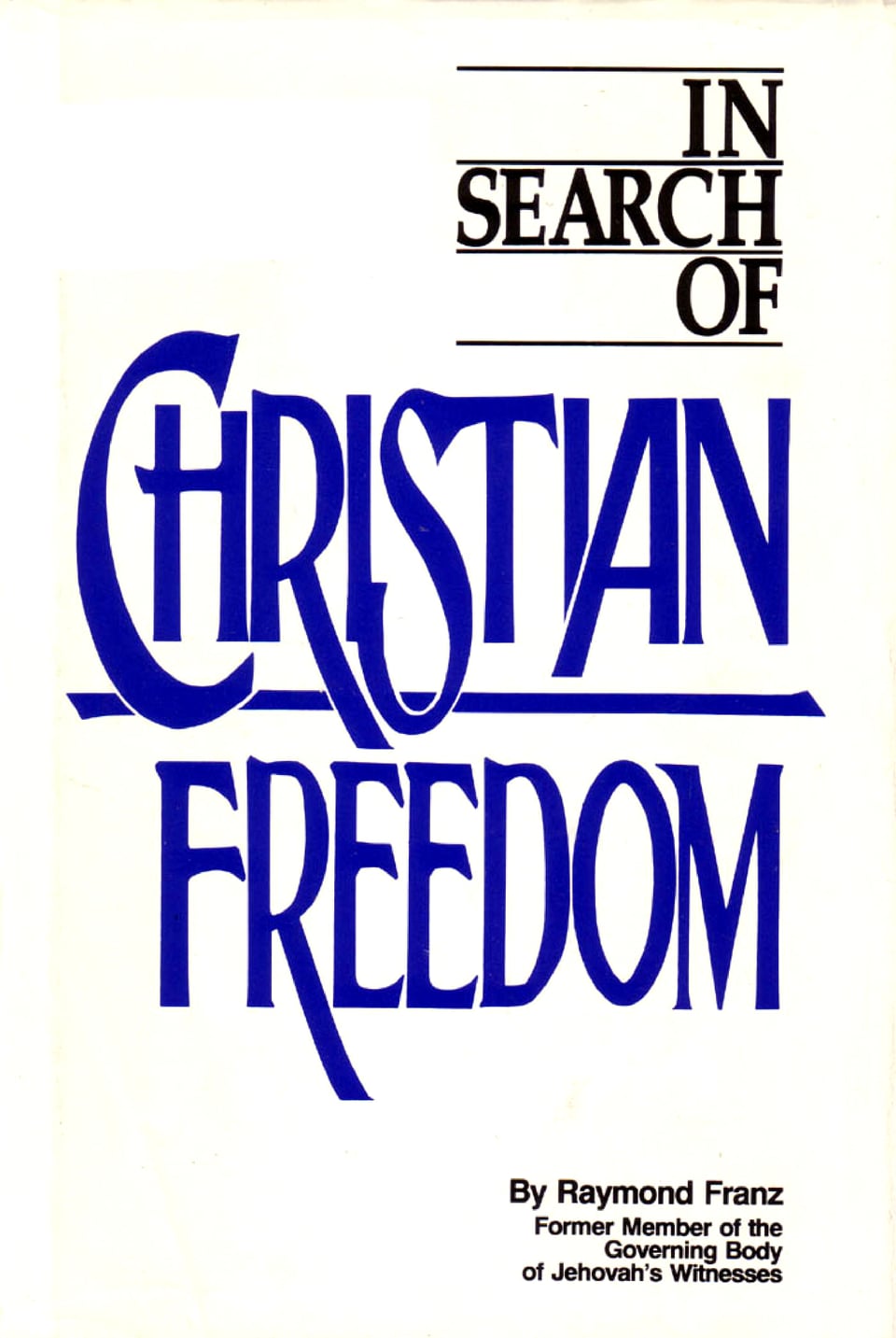
By Raymond Franz Former Member of the Governing Body of Jehovah's Witnesses IN SEARCH OF
CHRISTIAN FREEDOM
Second Edition
RAYMOND FRANZ Former member of the Governing Body of Jehovah's Witnesses
COMMENTARY PRESS ATLANTA 2007
Abbreviations of Bible translations referred to in this book:
ASV American Standard Version
AV Authorized (King James) Version
JB The Jerusalem Bible
LB The Living Bible
NAB New American Bible
NEB The New English Bible
NIV The New International Version
NRSV The New Revised Standard Version
NW The New World Translation
PME Phillips Modern English
RSV The Revised Standard Version
TEV Today's English Version
Wherever possible, and for the sake of authenticity, an effort has been made within this book to present quotations from other publications by direct photocopies. Since certain of these publications may go back as far as ninety years in the past, the quality of the type may not always be of the highest standard.
SECOND EDITION, First printing 2007
Copyright © 2007 by Raymond Franz
All rights reserved
First edition 1991
Second printing 1999
Third printing 2002
Published by Commentary Press
P. O. Box 43532, Atlanta, Georgia 30336
ISBN 0-914675-17-6 Contents
Foreword 1
1 The Search for Christian Freedom 8
2 The Channel of God 16
3 Centralized Authority 38
4 The Recurring Pattern 69
5 The Faithful and Discreet Slave 125
6 Salvation by Faith, Not Works 179
7 From House to House 207
8 Legalism—Opponent of Christian Freedom 237
9 Blood and Life, Law and Love 286
10 Shepherds of the Flock 312
11 The Misuse of Disfellowshiping 348
12 Indoctrination and Subordination 391
13 Argumentation and Manipulation 432
14 A People for His Name 489
15 The Greatness of the Good News 524
16 An Appealing Promise, Unfulfilled 555
17 The Challenge of Christian Freedom 614
18 A Congregation of Free People 655
Afterword 695
Appendix 715
Index 729
Foreword
SEVERAL YEARS have passed since my resignation from the Governing Body of Jehovah's Witnesses, the body which directs and controls internationally the worship and, to a remarkable degree, the thoughts, speech and very lives of the millions of members of that religious movement. The events leading up to that resignation and the subsequent events that produced my excommunication from the movement are already detailed in an earlier work, Crisis of Conscience. That book, in its original 1983 edition, ended with these words:
I am grateful to have been able to make available information that I feel others have a right to hear. There is much more that could be said, perhaps that needs to be said to give a complete picture. But whether time, life and circumstances allow for saying it or not, I am content to let the results of what has now been said rest in God's hands.
I was then 61 years of age. In the two decades that have passed, I have received thousands of letters and telephone calls from every part of the earth. Many of those communicating were former Witnesses, nearly as many were still associated with the organization. They represented virtually the entire range of organizational levels. The communications have come from persons who had held or, in some cases, were yet holding such positions as pioneer, special pioneer, missionary, ministerial servant, elder, city overseer, circuit overseer, district overseer, and branch coordinator. Several hundred of those writing or phoning had at one time been members of the Watch Tower headquarters staff in Brooklyn, or of the staffs of its branch offices in other countries, or had served as foreign missionaries.
In what follows, I will quote from a few of the letters received. The purpose is not for self-commendation, but to show the concerns expressed, what kind of approach appealed to those writing, and the heart qualities this revealed about the persons themselves.
The expressions as a whole made plain that the information supplied in Crisis of Conscience had filled a particular need. The discussions of the Governing Body, its doctrinal and decisionmaking processes, and the method of development of the written material on which all members feed are all shrouded in a cloak of secrecy. Many Witnesses, including elders and others in positions of responsibility, felt serious concerns, but found it difficult to "put all the pieces together." Crisis of Conscience supplied facts previously inaccessible to them. These evidently served as a "catalyst" bringing together the elements of the problems they had discerned within the organization and helping them understand why those problems existed. The information had the result of freeing them from a false sense of guilt created by the concept that their service to God must be through an organization, that is, specifically through the Watch Tower organization. It served to dispel the feeling of being cut off from God solely because of being cut off by, or having separated from, that organization.
Illustrating this is a letter from a man in Australia who, together with his wife, had spent forty very active years with the Watch Tower organization and because of being unable to accept certain of the organization's dogma and policies was pronounced "disassociated" in 1984. He wrote:
I have been requested by family members to write to express their deep gratitude for the tremendous help Crisis of Conscience has given us all in clarifying and broadening our understanding of issues which have caused us concern and distress over many years. For holding views which were tolerant of our position [as no longer associated with the organization], my son and his wife were disfellowshiped from the movement in 1986. . .
This book has made a major contribution in holding us together as a family during the worst crisis of our lives which began with our alienation from the movement, and has helped us to stand on our own feet in the spiritual sense and make moral decisions based on our own integrity instead of that of the movement's policies.
A young woman who had spent many years as a full-time "pioneer" and had later been a Watch Tower headquarters staff member, reveals the difficulty that transition from being a devoted "organization member" to living in a truly personal relationship with God can bring. Writing from Pennsylvania, she says:
Your account of what transpired organizationally as well as personally was not only an eye and heart opener for me, but also confirmed much of what I have felt throughout the years. . . .
Before reading your book I was not aware of the great influence the organization had in my own life, even during the time of my [subsequent] disassociation. Before, I felt so lost, so unworthy of anymore having a personal relationship with Jehovah and Christ Jesus because I no longer had the organization. Now for the first time in a very, very long time I feel free to worship Jehovah through Jesus apart from the organization. I can now approach Jehovah in prayer and be his Servant. The tears flowed from my eyes and the ache has finally been lifted from my heart.
Her following paragraph contains complimentary remarks about the way book was written. In harmony with what I stated earlier, I include it for only one reason and that is because it illustrates something that has been true of so many of those writing—that they are not in favor of vindictive literature against Jehovah's Witnesses and that, rather than animosity, they retain an affection toward those still in that organization. Her letter continues:
I was very much impressed with the manner in which you wrote your book. The love you had and still have for the brotherhood comes through. Your expressions were not bitter or vindictive, but merely presented the facts as kindly and lovingly as was possible. During my association with the organization I met some truly wonderful, extraordinary people and many of my experiences were memorable and happy. Much of what I have been taught through the organization is Bible-based and still imbedded deep in my mind and heart. For these things I have great appreciation. However, I too have seen and felt the effects in my own life and that of others when organizational laws dictate to people's conscience thereby superceding the Bible. This concept has played havoc with the lives of men, women and children alike.
A letter from another woman, writing from the midwestern part of the United States, illustrates some of the "havoc" experienced: I left the organization in 1980, although I just merely didn't go to meetings.
Wouldn't you know, it couldn't be just that. My mother wrote a letter to me in'81 stating that she could no longer associate or socialize with me because I did not attend meetings. Of course, my brothers followed suit.
Our daughter was killed in January 1983.Mother did not come to the funeral and sent no condolences.I am raising my daughter's four children and have learned the hard way who my true friends are. People that I did not even know expressed sympathy and helped me with the children. They gave money, time and anything they could to help.I felt so humbled to think I had turned my back for so many years on [non-Witness] neighbors and relatives who were so willing to help us. They never stopped loving me.I can't tell you the times I cried over the many years I wasted shunning them as "worldlings."
I was baptized in 1946 and about 1971 I started to realize things weren't appearing very Christian. I searched the Scriptures and could not find any basis for the things happening in the congregation. . . . About that time I read a book by Milton Kovitz, "Fundamental Liberties of a Free People." I began to wonder how the [Watch Tower] Society could fight so hard for freedoms under the constitution and deny those same freedoms to others—freedoms guaranteed under the same constitution, like the right to free speech, rights of privacy, etc. No allowance was made for individual conscience. With the exception of one or two, the men in the congregation were more interested in obtaining positions of authority than praying for and obtaining true discernment. Comments at meetings were just a mere "parroting" of the Watchtower's printed page. No concern for those with weaknesses, just an overwhelming compulsion to "Keep the organization clean..."
I have forgotten so many things, names, dates, so I can't write with real authority the way you have. That carries no regret. I'm glad it's fading.
One more thing, I have found it almost impossible to pray. I wish I could but I don't know how to develop a personal relationship with God and Christ. My old hurt feelings about the organization surface when I try to pray.After reading your book, I was standing at the sink feeling such sorrow for those that may be trying to have the courage they need and I asked God to help them.The first real prayer in a long time. Thank you.
Still others who wrote had had no association whatever with Jehovah's Witnesses, but they were experiencing a similar struggle of conscience with regard to their own religion.
Typical of several such letters is this one from a couple in California:
My wife and I recently picked up a copy of your Crisis of Conscience. We were so thrilled to "discover" it. Thank you for writing with grace and dignity in a field so often characterized by sensationalism and bitterness. Your experience had a particular poignancy for us—we recently left the church of our heritage, the Mormon church, in order to "worship the Father in spirit and truth," unencumbered by "human commands and teachings." We found much that was familiar in your story. . .
Again, we thank you for your courageous witness to the graciousness of God in your life. May He keep you in the shelter of his healing wings.
I do not feel that what I wrote represents any particular act of "courage." I wrote the book because I felt that people had a right to know things that were otherwise inaccessible to them. What brings the greatest satisfaction in all the many hundreds of communications, are those expressions that indicate the persons' having drawn closer to their heavenly Father and his Son, of having their faith and confidence renewed and strengthened. But I also find particularly rewarding the comments of many that they found a freedom from bitterness and malice in what was written. I hold no such feelings toward Jehovah's Witnesses and I am happy if what I wrote does not convey those sentiments. Letters received in which people lash out at the movement, its leaders or its members, or give vent to ridicule and sarcasm, bring me no pleasure whatsoever.
I believe that those who think it is the individual persons in the organization or its leaders who are the true danger, are missing the point. I lived among the people themselves for nearly sixty years and I have no hesitation in saying that they are as sincere in their beliefs as people of any other religion. I knew personally the members of the Governing Body and, while I cannot say it of all, I knew many to be basically kind, honest persons, who were simply doing what they believed was expected of them, what has been done traditionally in the past. They were the heirs of the legacy of that past. In their minds "the organization" was indistinguishable and inseparable from God and Christ.
Nonetheless, error has been and is being presented as truth actions have been and are being taken that constitute a grave misrepresentation and distortion of the teachings and life course of God's Son. While those involved cannot help but bear, each one, a measure of responsibility, nonetheless they themselves are not the fundamental source of the problem.
Rather than the people themselves, it is instead the beliefs and concepts that are the real problem, the true danger. They form the primary source from which the erroneous teachings, wrong attitudes and harsh acts proceed.
All kinds of persons have entered the organization of Jehovah's Witnesses for all kinds of reasons. And all kinds of persons (actually hundreds of thousands) have left for all kinds of reasons. Some have left, as one former Witness put it, 'for all the wrong reasons.' While the course they take thereafter may give at least some indication of the motivation that led to the departure, this is not necessarily a sure guide. Many go through a period of transition marked by uncertainty, even of doubting everything due to having suffered a severe disillusionment. They are temporarily adrift, and only when they have passed through this stage can their course give any clear indication of what their heart motivation has been.
One thing seems evident, however, and that is that mere departure from a religious system under the conviction that it contains serious falsehood does not of itself guarantee freedom. Simply to see error is, in many cases, not enough. Unless one can see why he or she once believed that error, and what was false in the method of argumentation that led one to believe, no great progress is attained, no solid basis for enduring Christian freedom is established. A person could easily abandon one system that proved erroneous and then quickly be taken in by another that likewise promulgates error, error which may be doctrinally quite different yet which is often supported by the very same kind of false argumentation and reasoning employed by the previous system.
Many of Jehovah's Witnesses have become disillusioned by teachings or predictions that proved false, others by the rigidity of certain policies, or by the pressure for engaging in a constant treadmill of organizationally programmed activity that brings little of genuine spiritual uplift. What is needed is to see the root cause of such fallacies, of the authoritarian nature of the policies, or of the futility of such programmed works. I believe that without an understanding of the Scriptural teachings involved one cannot see clearly that root cause and cannot see that there is something better and more genuine open to them. Unfortunately, the average Witness has never been aided to develop a good personal understanding of the Scriptures.
As an organization member there was little encouragement to use his or her thinking powers other than to accept and, in effect, to commit to memory whatever information was supplied by the organization, submitting almost automatically to its directives. Questions, one of the mind's most powerful tools, were negatively portrayed as evidence of lack of faith, a sign of disrespect for God's approved channel of communication.
There is yet another,very significant,side to the matter.Many persons seek only a negative freedom. They seek to be free from something,to be free from feeling compelled to profess belief in certain teachings,to perform certain activities or conform to certain policies,all imposed by ecclesiastical authority.
Of itself that kind of freedom may be a proper goal, desirable, bringing release from oppressive restraints and from domination of mind and heart by men in a way which is clearly unchristian. But even so, by itself this release does not bring Christian freedom. For Christian freedom primarily implies a positive freedom—not merely a freedom from something but a freedom to something. It is the freedom not simply of not doing but of doing, as well as of being—as to what we are in heart and mind as an individual person. Rather than by the mere step of leaving a religious system viewed as false, it is by what we do with our lives after separating from that system that we demonstrate whether true freedom has actually been gained.
What follows in this book will consider these issues and how they apply. I recognize that a considerable period of time has elapsed and that the documents and quotations set forth may be earlier than the time of Watch Tower affiliation of many of the readers. Nonetheless they show the basis for conditions and the pattern for policies and attitudes that prevail to this day. While obviously directed primarily to persons with a background among Jehovah's Witnesses, the underlying principles involved are applicable in any religious setting. It is hoped that the information will be of aid to those who, out of love for truth and out of concern to be pleasing to God, are weighing the rightness of giving unquestioning loyalty to a religious organization. Its aim is to contribute in some measure to confidence in God's power to sustain us through whatever crises our holding to personal integrity may bring and help open up wider spiritual horizons and a more rewarding and satisfying life in service to our Creator, to our Master, God's Son, and to our fellow humans.
The Search for Christian Freedom
When Christ freed us, he meant us to remain free . . . what matters is faith that makes its power felt through love. You began your race well; who made you less anxious to obey the truth? —Galatians 5:1,6,7, Jerusalem Bible
FREEDOM, like faith, love, and truth, is an essential part of true Christianity. Where freedom prevails, faith, love and truth prosper. When freedom is limited or lacking, they inevitably suffer. —2 Corinthians 3:17.
The freedom which God's Son gave us is for the very purpose that we may express our faith and love to the fullest degree, free from restraints which men, not God, would impose on us. Any willing forfeiture of that freedom inevitably means a sacrifice of truth. For those who would impose such restrictions do so, not by truth, but by error.
In the past several decades, hundreds of thousands of persons have separated from the religion that was the religion of my birth: Jehovah's Witnesses. During those same decades hundreds of thousands of other persons have entered that same religion, sufficiently so that the religion has continued to grow. I do not feel that either the departure or the entry of these persons of themselves proves anything.
The real question regarding those who leave is why they have left, what moved them to separate. Was it love of truth,the desire to express their faith and their love in Christian freedom? Could they not have achieved this by remaining where they were? Was their departure justified?
By the same token, questions may be asked about those entering. There is no question that a sizeable number of these were previously irreligious, unspiritual, essentially materialistic in their outlook. Since their entry, they have made a considerable change in these areas. At least a percentage of them were helped to free themselves from serious problems of sexual promiscuity, alcoholism, drug addiction, violent or dishonest, even criminal, behavior.
This has certainly marked an improvement in their lives.
Yet it is also true that this record of help is not unique. Most religions and church organizations can produce multiple case histories and testimonials of persons whose lives definitely turned around as a result of conversion. Similarly, the record and number of those helped by the Watch Tower organization in overcoming vicious habits or addictions can undoubtedly be equaled by even some social organizations, including Alcoholics Anonymous, drug addiction help centers, and similar entities. And certainly the majority of those becoming Witnesses were not persons previously plagued with such problems.
The question remains, then: Whatever the apparent benefits gained, at what cost have they been gained? Has their integration into the Witness organization eventually resulted in a forfeiture of freedom to express truth, faith and love in a way that is uncoerced and unrestrained by human domination? If this should be the case, then how genuine an improvement has been attained? How truly Christian are the apparent benefits?
These identical questions may be—and should be—applied to any religion professing to be Christian and it is hoped that what is here presented may prove of value to people of many religious backgrounds. For the issue here is actually far greater than the particular people involved. It reaches to the very heart of the good news about God's Son, Jesus Christ.
Where the Difference Lies
Several centuries ago, at the time of the Reformation, a time when many persons felt bound by conscience to reject ecclesiastical domination over their lives and their faith, one of them expressed the position of the Christian in this way:
A Christian man is a free lord over everything and subject to no one.
He then followed this up by saying:
A Christian man is an obedient servant in everything and subject to everyone. 1 That sounds contradictory, but it is not.
It basically paraphrases the apostle Paul's words in 1 Corinthians 9:19:
I am a free man and own no master; but I have made myself every man's servant, to win over as many as possible. 2
The difference here is between a submission that is extracted by men who claim a superior position and who insist on submission to their authority, as contrasted with a submission and service that springs freely and spontaneously from one's own heart. It is a submission and service that results, not from yielding to others' claims and their demands, but from seeing other persons' needs and the good that can result. Paul recognized only one God-appointed Head and Master, Christ, and owned no other, whether a single man or a group of men. Of some who tried to assume such authority, he said:
[They] have furtively crept in to spy on the liberty we enjoy in Christ Jesus, and want to reduce us all to slavery [attempted to tie us up with rules and regulations, Phillips Modern English]. I was so determined to safeguard for you the true meaning of the Good News that I refused even out of deference to yield to such people for one moment. 3
The apostle did not view lightly the loss of Christian liberty through religious domination. When he wrote the words quoted at the start of this chapter it was to people who were letting themselves be misled by a false gospel or good news.In his day it was the effort to reimpose the Law Covenant upon Christians as obligatory that notably threatened their freedom in Christ. Wherein lay the grave danger? The law being urged upon Christians was, after all, the very same law that Jehovah himself gave through Moses. Why then would Paul say that its reimposition would lead to being "burdened again by a yoke of slavery"?
Part of the danger lay in the fact that such submission to law would inevitably allow for and bring into play the role of men who act as interpreters of the law, their interpretations taking on the force of rules, with judicial bodies, religious courts applying those rules and imposing sanctions as enforcers of the law. That would mean the reinstitution of a human priesthood over Christian believers, who had but one superior Priest and Mediator, God's Son. 4 Why then, did some men in the first-century Christian congregation work to reintroduce law-keeping?
Evidently the reason was that, consciously or subconsciously, they wanted to exercise control and authority over others. They sought power over fellow Christians and one way to gain this was by interposing themselves between Christians and their rightful head, Christ. This was in fulfillment of the apostle's prophecy recorded at Acts 20:29, 30:
I know that after my going away oppressive wolves will enter in among you and will not treat the flock with tenderness, and from among you yourselves men will rise and speak twisted things to draw away the disciples after themselves. 5
Their arguments were plausible, had the sound of logic, and Paul shows that many of their hearers were being convinced, accepting this as gospel truth. The proponents of law-keeping could argue that God requires righteousness, holinesswhich is trueand that without the imposition of law people simply will not hold to righteousnesswhich may be true of most people, but which should not be true of Christians.As an opening wedge, they urged circumcision, something instituted by God himself nearly two thousand years earlier, in Abraham's time. Once this base was accepted, however, they built on it the addition of other features of the law, presented as necessary to be right with God, to maintain a clean congregation. 6
The gravest danger, then, lay in the way this emphasis on law-keeping would alter the Christian's relationship to God through Christ, the way in which it would misrepresent the basis for the Christian's hope and would dislocate the proper focus of Christian service. Paul recognized it as a serious denial of the good news he had been commissioned by God and Christ to preach. 7 Spelling out the gravity of the matter, he wrote:
You who are trying to be justified by law have been alienated from Christ; you have fallen away from grace. But by faith we eagerly await through the Spirit the righteousness for which we hope. For in Christ Jesus neither circumcision nor uncircumcision has any value.The only thing that counts is faith expressing itself through love. 8 In those few words, "faith expressing itself through love," the inspired writer sums up the essence of all Christian life.
Not concern over keeping of rules, and an accompanying concern over the approval of others in doing so, and certainly not fear of being hailed before a judicial body for infractions of certain policies and regulations—a purely negative force—but rather faith and love are what motivate the Christian man and woman. Faith and love are the positive forces that supply not only the best deterrents against wrongdoing but also the greatest stimuli of the fine deeds that are the fruitage of those who are truly disciples of God's Son.
Perhaps an example from home life will illustrate more clearly the difference between being under law and being under grace or undeserved kindness—what this really results in, in the final analysis.
Consider a home where the husband is both a father and the prime wage earner. If he decided to exercise headship through a list of laws, setting out specific rules for his wife to observe, laying down the law as to just how the house should be kept, the method and days and times when she should care for all the household and family responsibilities—the cleaning, shopping, preparing of meals, caring for clothes, disciplining of the children—such a husband might have a very orderly home, with things functioning according to schedule. But he would also likely have an unhappy wife. He might have whatever satisfaction it would bring him to see that things were being done according to his code of rules, enforced by his authority. But he would never know if they were motivated by love.
By contrast, a husband who believes in the power of love and kindness, whose thinking is not governed by a false sense of superiority but who respects and trusts his wife, recognizes her intelligence, her ability to care for things with personal initiative, who believes that her interest in the home and family is as keen as his own, and who acts toward her in accord with this knowledge, may likewise enjoy an orderly, well-kept home, though one with a far more relaxed and happy atmosphere than the other described. He may attain this by good communication and discussion, preferring and seeking shared conclusions and decisions, rather than some mere show of arbitrary authority. When he sees a home that is neat and clean, meals well prepared, clothes cared for, or finds that his children have inculcated in them a fine respect for him, he can know that all this is done as a result of something other than a compliance with rules.
He can have the genuine satisfaction and joy of knowing that it is done out of his wife's love for him and their marriage and family.
The external results in the two cases may appear to be the same in certain areas. But the inner results are enormously different. The key is in the difference in motivation and spirit. And that is the difference, as regards the effect on the way one lives as a Christian, between being under law and being under God's gracious kindness through Christ Jesus.
Surely God's wisdom is manifest in this. Love and faith, the true "rules" of the Christian, can reach innermost thoughts and depths of the heart. They can touch and affect every facet of life in a way that law and rules can never accomplish. Because of not being under law, the Christian is put in the position of showing what he or she really is at heart. And that alone counts with God.
The longer I was a member of the Governing Body of Jehovah's Witnesses, the more this issue pressed on my mind. I found that an inordinate amount of the time spent in our Governing Body sessions was occupied with the making of decisions that involved the regulating of people's personal lives. I saw that each ruling spawned questions that led to further rulings, by which the righteousness of others was judged. Only if they observed those rules were they to be viewed as having a right standing with God and Christ. Why should this be? Did we few men really have the authority from God to do this? Was it genuinely for the good of those we were supposed to be serving?
It was only when I came to the realization that the freedom the Scriptures taught was not simply freedom from Mosaic Law but freedom from the very concept of law-keeping—whatever the system of law involved—that I could see where the true problem lay. Instead of law-keeping, rule-keeping, as the means for attaining and maintaining righteousness within the Christian congregation, there was a superior way. It was this that made Christian freedom possible, workable and so genuinely desirable.
It is not that law is bad (it is, after all, the only thing that keeps many people of this world in check). 9 It is rather that love and faith are so superior, able to accomplish so much more than law, able to produce a righteous spirit that springs from the heart. For which person would we ourselves feel greater confidence, have greater respect and esteem: the person who says he refrains from a certain wrong act "because it is unlawful?"
or the person who says he refrains "because it is unloving and shows a lack of faith in God?" The first expression reveals only the person's attitude toward, or concern for, law, while the second gives us a view of the person's heart and intimate feelings.
When God chose the people of Israel as his covenant nation, he did not call them into that relationship individually as separate persons but took the whole mass, "lock, stock and barrel," good, bad and indifferent. Their national level of spirituality was certainly not notable, then or later. The Law given to them fulfilled a necessary role. It served as a disciplinarian, leading them to the Messiah, just as ancient "pedagogues" led children to their teacher. 10 It made obvious their sinfulness and their helplessness to free themselves from sin, their need of a redeemer. 11 It provided a panorama of "shadows" symbolically outlining the realities to be fulfilled through the Messiah. 12 Without it there is no reason to believe that at the close of some 1500 years of the nation's existence there would have existed any semblance of the arrangements God instituted among them, arrangements which were to provide the background against which the Messiah could be positively identified. By contrast, Christians are called to relationship with God as his sons through Christ, not as a mass, but as individuals, not on the basis of fleshly descent, but on the basis of their heart and its motivation. Their teacher has come and they do not need a disciplinarian to lead them to him. They are "not under law, but under grace," the gracious kindness of God. They have given their hearts to him and his Spirit motivates them. 13 That Spirit can do infinitely more to safeguard any of us from wrongdoing and move us to good deeds than any law code or set of rules ever could. To miss that is to miss the whole point of the good news. To fail to appreciate the grand freedom this brings is to show disdain for what Christ accomplished in making it possible for us to be "not under law but under undeserved kindness" of God.
As in any other area of life, it is true in religious matters that "the price of freedom is eternal vigilance." Christian freedom is lost not so much by violent conquest as by subtle erosion, so that little by little one relinquishes to others his God-given right to exercise his own conscience, to do his own thinking so as to arrive at conclusions and convictions that are truly his own, and so that his faith is the product of his own heart, based on a personal knowledge of God's Word.
Eventually he arrives at a secondhand faith based on the convictions and reasonings of others. To sacrifice those rights inherent to Christian freedom—to whatever degree and for whatever reason—is to limit and inhibit our expression of faith and love. For such expression of these qualities to be spontaneous, inwardly motivated, it must enjoy a climate of freedom. For "where the Spirit of the Lord is, there is freedom." 14
Does that climate of Christian freedom flourish within the organization of Jehovah's Witnesses, fostering expressions of love and faith that freely result from inner motivation and not from external pressure? I believe the evidence shows that it does not. My years on the Governing Body of that organization convince me that it does not. Not that all individual Witnesses are affected to the same extent. Some are able to cope more effectively with the organizational pressure. They are able to resist encroachment on their individuality, striving to avoid the narrowness of viewpoint and lock-step mentality that come from channeled thinking. Such ones often manifest a spontaneity of motivation that is noteworthy. Yet, the evidence is that this is not a result of the organization, but something maintained in spite of the organization. Nor do I think the situation is unique among Jehovah's Witnesses. But I believe they are all affected to some degree and that the effect is inevitably a hurtful one. The attitude inculcated is based, not on truth—the truth that makes one free—but on a distortion of truth. It distorts their understanding of what being a follower of God's Son actually embraces. It hinders them in making the fullest expression of his qualities. It restricts them in doing many acts of love and faith which their hearts would indicate and obliges them to perform other acts for which they see no convincing Scriptural reason. In one way or another, in greater or lesser measure, freedom is sacrificed. Obscured or forgotten is the truth that, "when Christ freed us, he meant us to remain free."
The roots of the problem are not one, but several. However, I believe that what next follows points to a very fundamental cause.
The Channel of God
Test everything. Hold on to the good.
—1 Thessalonians 5:21, New International Version
Dearly loved friends, don't always believe everything you hear just because someone says it is a message from God: test it first to see if it really is. 1 John 4:1, The Living Bible
A PROMINENT eighteenth-century British scholar, areligious leader known as a lover of civil and religious liberty, made this striking statement:
Authority is the greatest and most irreconcilable enemy to truth and argument that this world ever furnished. All the sophistry all the color of plausibility-the artifice and cunning of the subtlest disputer in the world may be laid open and turned to the advantage of that very truth which they are designed to hide; but against authority there is no defence. 1
If indeed authority has been an ancient enemy of truth, it has also been an ancient enemy of freedom, for truth is a prime liberating source, able 'to make one free.' 2 When compelled to confront truth in the field of combat, error finds its favorite weapon, and also its ultimate refuge in authority. All too often, the claimed authority has no more genuineness than does the error itself.
No matter how much evidence may be supplied, no matter how much Scriptural testimony may be presented, no matter how much logic may be brought to bear on the points discussed in this book, these may all be rejected and discarded by those who place a particular human religious authority as their guide, as the determiner of truth. In fact, with the vast majority of Jehovah's Witnesses all such evidence and Scriptural testimony will be rejected before it is even heard—because authority has decreed for them that they should reject it.
Those under the authority are thus robbed of the freedom to decide for themselves whether the information is factual or false, beneficial or detrimental.
And the same is true of all persons who submit to any human religious authority as their supreme arbiter of right and wrong. If they choose to allow that authority to decide for them, speak for them, think for them, then any alternative argument or evidence advanced has no hope of a fair hearing, for "against authority there is no defence." The authority has no need to respond, no need to refute, or even to consider the evidence presented; it simply condemns. This is, I believe, the basic issue, and unless it is first understood, little else can be understood. At least that has proved to be the case in my own experience.
Men can make no greater claim to authority than to claim to speak for God even more than that to claim to be his sole channel of communication to all mankind. To occupy such a position would be an awesome responsibility indeed, and one that should logically call for the greatest of humility on the part of imperfect humans if they were in fact assigned to fill it.
A fitting analogy might be that of a slave sent forth by a king to deliver a proclamation. If impressed with his own importance, lacking humility, the messenger might feel free to add to the message or make adjustments, while nonetheless insisting that all hearers should accept whatever he presented as a bona fide royal order. If people questioned him on certain points, he might become resentful, seek to awe them with his royal backing in order to override any doubts about the authenticity of his statements.
By contrast, a truly humble messenger would scrupulously avoid any alteration of what came from the royal source. He would not become resentful if asked for proof of full authenticity for what he said, nor would he criticize if some took steps to confirm that the message he presented was delivered just as given, free from embroidery or change. Rather than decry such investigation as an abusive lack of respect for himself (the mere slave), he would accept it, even welcome it, as evidence of the inquirer's concern and deep respect for the will of his master, the Sovereign.
The Watch Tower Society repeatedly states that its message has life and death importance. The organization claims its message has been sent by God, the supreme Sovereign, for all mankind, with ultimate destruction as the outcome for disobedience.
Some other religions take a similar position.
Surely, any claim of such magnitude should never go untested. In fact, the greatness of the claim calls for, not less, but more caution, more careful testing. Simple respect for God should move us, actually compel us, to make sure that the message is genuinely His, free from additions or alterations. The deeper our respect for God, the more conscientious our effort in testing.
I can vouch for the fact that the Watch Tower organization views with the utmost seriousness its claimed position of being God's sole channel of communication on earth. Perhaps some of the plainest statements made by organization officials as to what will be the result for any who reject their message came in a court trial held in Scotland, back in 1954. The case, known as the Walsh case, centered around the claim for ministerial status on the part of one of Jehovah's Witnesses who was the presiding overseer of a congregation in Scotland. I remember years ago hearing personally from my uncle (later the Watch Tower president) of his part in that trial, but it was not until seeing the actual court record in recent times that I realized all that the testimony covered.
With permission of the Keeper of the Records of Scotland, some portions of the official court record of the testimony are here reproduced. 3 As noted, Fred Franz, at that time the organization's vice president, was first on the witness stand, and the court record includes this information, portions of which I have underlined. ("Q" represents the question put, "A" the response given).
Q. In addition to these regular publications do you prepare and issue a number of theological pamphlets and books from time to time? A. Yes. Q. Can you tell me this; are those theological publications and the semi-monthly periodicals used for discussion of statements of doctrine? A. Yes. Q. Are these statements of doctrine held to be authoritative within the Society? A. Yes. Q. Is their acceptance a matter of choice, or is it obligatory on all those who wish to be and remain members of the Society? A. It is obligatory.
According to this testimony, anyone wishing to remain as one of Jehovah's Witnesses has no alternative, no option but to accept the published statements of the Watch Tower Society, for whom Fred Franz spoke as a representative. Acceptance is "obligatory." The consequences are indicated in his further testimony:
Q. So that there will be in effect a new human society existing on earth as the result of that? A. Yes. There will be a new world society in a new earth under new heavens, the former heavens and the former earth having passed away in the battle of Armageddon. Q. Then the population of this new earth, will that consist of Jehovah's Witnesses alone? A. Initially it will consist of Jehovah's Witnesses alone. The members of the remnant expect to survive that battle of Armageddon the same as a great crowd of these other sheep. The continuance of the remnant upon the earth after the battle of Armageddon will be temporary because they must finish their earthly course faithful in death, but the other sheep by continued obedience to the will of God may continue to live on earth for ever.
Acceptance therefore becomes a life or death matter, for those surviving Armageddon will consist of "Jehovah's Witnesses alone." What if a congregation member were to reject a certain organizational teaching because of conscientiously believing it lacked Scriptural backing and, as a result, the person was subsequently disfellowshiped? What is the official position regarding disfellowshiped persons who do not gain reinstatement? That position is spelled out as follows in the testimony:
Q. And are these disciplinary powers in fact exercised when the occasion arises? A. Yes, they are. Q. Well I will not ask you any more questions about that side of the matter but are there offences which are regarded as so grave as to warrant expulsion without hope of re-instatement? A. Yes. The fact is that ex-communication in itself can lead to the annihilation of the ex-communicated one, if that individual never repented and corrected his course of action, and be continued outside the organisation.
There would be no hope of life for him in the new world, but there is a course of action which would result in ex-communication from which the individual could be certain never to return, and this is called the sin against the Holy Spirit.
The British government counsellor later directed attention to certain teachings that the Watch Tower organization had in time rejected, including some involving certain specific dates. What if someone, at the time when such teaching was promulgated, had seen the error in it and had therefore not accepted it? What would the organization's attitude toward such one be? The testimony explains this
Q. Is it not the case that Pastor Russell put that date in 1874? A. No. Q. Is it not the case that he fixed the date prior to 1914? A. Yes. Q. What date did he fix? A. The end of the time of the Gentiles he fixed as 1914. Q. Did he not fix 1874 as some other crucial date? A. 1874 used to be understood as the date of Jesus' Second Coming spiritually.
Q. Do you say, used to be understood? A. That is right. Q. That was issued as a fact which was to be accepted by all who were Jehovah's Witnesses? A. Yes. Q. That is no longer now accepted, is it? A. No. Q. Pastor Russell in so concluding passed the view, did he not, on an interpretation of the Book of Daniel? A. Partly. Q. And in particular Daniel, Chapter 7 Verse 7, and Daniel, Chapter 12, Verse 12? A. Daniel, 7, 7, and 12, 12. What did you say, he based something on these Scriptures? Q. His date of 1874 as a crucial date and the date of Christ's Second Coming? A. No. Q. What did you say he fixed it as; I understood that is what you said, I must have misunderstood you? A. He did not base 1874 on these Scriptures. Q. He based it on these Scriptures coupled with the view that the Austro-Oothic Monarchy occurred in 539?
A. Yes. 539 was a date that he used in the calculation. But 1874 was not based on that. Q. But it was a calculation which is no longer accepted by the Board of Directors of the Society? A. That is correct. Q. So that am I correct, I am just anxious to canvas the position; it became the bounden duty of the Witnesses to accept this miscalculation? A. Yes.
Q. So that what is published as the truth today by the Society may have to be admitted to be wrong in a few years?
A. We have to wait and see. Q. And in the meantime the body of Johovah's Wutnesses have been following error? A.
They have been following misconstructions on the Scriptures
Q. Error? A. Well. error.
Again the question as to how great the authority attributed to the Watch Tower Society's publications is, came in for discussion. While at one point the vice president had said that "one does not compulsorily accept," his testimony thereafter reverts back to the earlier position, as can be seen:
an Ordained Minister of a congregation he must come to an understanding of the things contained in these books. Q.- But, then, is baptism not the ordaining of a person as a Minister? A.- Yes Q.- Therefore at baptism must he know those books? A.- He must understand the purposes of God which are set forth in those books. Q.- Set forth in those books, and set forth in those books as an interpretation of the Bible? A.- These books give an exposition on the whole Scriptures. Q.- But an authoritative exposition? A.- They submit the Bible or the statements that are therein made, and the individual examines the statement and then the Scripture to see that the statement is Scripturally supported. Q.- He what? A.- He examines the Scripture to see whether the statement is supported by the Scripture.
As the Apostle says; "Prove all things; hold fast that which is good."
Q.- I understood the position to be - do please correct me if I am wrong - that a member of the Jehovah's Witnesses must accept as a true Scripture and interpretation what is given in the books I referred you to? A.- But he does not compulsorily do so, he is given his Christian right of examining the Scriptures to confirm that this is Scripturally sustained. Q.- And if he finds that the Scripture is not sustained by the books, or vice versa, what does he do? A.- The Scripture is there in support of the statement, that is why it is put there.
Q.- What does a man do if he finds a disharmony between the Scripture and those books? A.- You will have to produce me a man who does find that, then I can answer, or he will answer. Q.- Did you imply that the individual member has the right of reading the books and the Bible and forming his own view as to the proper interpretation of Holy Writ? A.- He comes -- -- Q.- Would you say yes or no, and then qualify? A.- No. Do you want me to qualify now? Q.- Yes, if you wish? A.- The Scripture is there given in support of the statement, and therefore the individual when he looks up the Scripture and thereby verifies the statement, then he comes to the Scriptural view of the matter, Scriptural understanding as it is written in Acts, the seventeenth chapter and the eleventy verse, that the Bereans were more noble than those of Thessalonica in that they received the Word with all readiness, and they searched the Scripture to see whether those things were so, and we instruct to follow that noble course of the Bereans in searching the Scripture to see whether these things were so. Q.- A Witness has no alternative, has he, to accept as authoritative and to be obeyed instructions lived in the "watchtower" or the "informant" or "avoke"?
- Do must accept those.
q. If three
hope of salvation for a man who depends upon his Bible alone when he is in a situation in the world where he cannot get the treats and publications of your Incorporation A. B. Independent upon the Bible.
Q. Will be able to interpret it truly A. Ho.
Q. I do not want to bandy texts with you, but didn't Jesus say, "Whose ear bellowth in me, lireth and 'bellowth in me shall never die.'" J. Tud.
The testimony by the witness is, then, that the message that the Watch Tower Society, as God's channel, publishes is the only means whereby people on earth in this twentieth century can gain an understanding of Scripture. Failure to accept what these publications contain means incurring divine disfavor, death itself.
This, however, was the testimony of only one man, Fred Franz, the vice president. There were two other responsible officials of the headquarters organization who had come to Scotland to testify. Did their testimony confirm his on these matters? Next on the stand was the Society's legal counsel, Hayden C. Covington. Following are statements he made during the course of his testimony:
Q. - Is it not vital to speak the truth on religious matters? 1. - It certainly is. Q. - Is there in your view room in a religion for a change of interpretation of Holy Writ from time to time? 2. - There is every reason for a change in interpretation as we view it, of the Bible. Our view becomes more clear as we see the prophecy fulfilled by time. Q. - You have precluded forgive the word - false prophecy? 1. - We have I do not think we have promulgated false prophecy, there have been statements that were incorrect, that is the way I put it, and mistaken. 2. - It is most vital consideration in the present situation of the world to know if the prophecy can be interpreted into terms of fact, when Christ's Second Coming was?
4.- That is true, and we have always strived to see that we have the truth before we utter it. We go on the very best information we have but we cannot wait until we get perfect, because if we wait until we get perfect we would never be able to speak. 4.- Let us follow that up just a little. It was prosulgated as a matter which must be believed by all members of Johovah's Witnesses that the Lord's Second Coming took place in 1874? 4.- I am not familiar with that. You are speaking on a matter that I know nothing of. 4.- You heard Mr. Prentz's verdict? 4.- I board Mr. Prentz testify, but I am not familiar with what he said on that, I read the subject matter of what he was talking about, so I cannot answer any more than you can, hearing heard what he said. 4.- Have we out of it? 4.- That is the source of my information, what I have heard in court, 4.- You have studied the literature of your movement? 1.- Yes, but not all of it. I have not studied the seven volumes of "Studies in the Bariptures", and I have not studied this matter that you are studying now of 1874. I am not at all familiar with that. 4.- Arrow free on that it was proclaimed as authoritative by the Society that Christ's Second Coming was in 1874? 4.- Taking that assumption as a fact, it is a hypothetical statement. 4.- That was the publication of false prophecy? 4.- That was the publication of a false prophecy, it was a false statement or an erroneous statement in fulfillment of a prophecy that was false or arrogant. 4.- And that had to be believed by the whole of Johovah's Witnesses? 1.- Yes, because you must understand we must have unity, we cannot have disability with a lot of people going any way, so may it be supposed to march in step. 4.- You do not believe in the wordly armies, do you? 4.- We believe In the Christian way of God.
Q.- Do you believe in the wordly archest? I.- We have nothing to say about that, we do not preach against them, we merely say that the wordly archest, like the nations of the world today, and a part of Satab's organisation, and we do not take part in them, but we do not say these nations cannot have their archest, we do not preach against warfare, we are merely claiming our acceptance from it, that is all. Q.- Back to the point now. I falsely prophecy was proclaimed? I.- I agree that. Q.- It had to be accepted by Joborah's Witnesses. I.- That it correct. Q.- If a member of Joborah's Witnesses took the view himself that that prophecy was wrong and said so he would be disfollowed/pledged. A.- Yet, if he said so and kept persecuting in creating trouble because if the whole organization balloted one thing, area though it be arcealous, and somebody also starts on his own trying to put his ideas across than there is disunity and trouble, there cannot be harmony, there cannot be marching. When a change comes it should come from the proper source, the head of the organisation, the governing body, not from the bottom upwards, because anybody would have ideas, and the organisation would disintegrate and go in a thousand different directions. Our purpose is to have unity.
+ Only at all costs? 1.- Unity at all costs, because we believe and are sure that Jahovah God is acting our organisation, the governing body of our organisation to direct it, even though dictates are made from time to time. 9.- And unity based upon an informed acceptance of false prophecy? 1.- That is conceded to be true. 9.- And the person who expressed his view, as you say, that it was wrong, and thus disfellowhipped, would be in breach of the Coronment,
if he was baptized? 1.- That is correct. 9.- And
as you said yesterday expressly, would be worthy of
death! 1.- I think --- 9.- Would you say you
or so ? 1.- I will answer you, unhesitatingly. 9.-
Do you call that religious 1.- It certainly is. 9.-
Do you call it Christianity? 1.- I certainly do.
Q. In connection with mistakes, you were cross- examined at some length as to differences of view which might have taken place in the authoritative exposition of the Scriptures over the years since the foundation of the Society, and I think you agreed there had been difference? A. You. Q. You also quite frankly argued that purpose who at any time are not prepared to accept authoritative exposition are liable to erpulsion from the Society, with much spiritual consequence as that may entail i. You, I said that and I
Unity, according to the testimony of this Society representative, can require of a Christian that he accept as true what he believes God's Word shows to be false. No matter what he reads in the Bible, he is not to express that if it does not coincide with the organization's authoritative teachings. While it may be clear to him from God's own Word, this is not enough. He must wait until the change issues "from the proper source, the head of the organization, the governing body, not from the bottom upwards." No matter what he reads in the Bible, he must wait for the "proper source," the Governing Body, to tell him what is acceptable for belief and for discussion.
The justification for such a remarkable claim? There must be "unity at all costs," even if it must be based on "an enforced acceptance of false prophecy." To fail in this respect is to merit disfellowshiping and "be worthy of death." In effect, while one may read the Master's own words in writing, he cannot accept or act on them if the Master's professed "slave" tells him something different. This is, in plain language, the organizational concept advanced.
Yet a third witness took the stand. This final headquarters official testifying was the Secretary-Treasurer, Grant Suiter, and his testimony included these statements of official position:
position of a Company secret in that respect. 1. Be sure here not the qualifications that have been previously tested to, of security and understanding and spiritual understanding, and in ability to read the Congregation. Be sure here that dealing previously mentioned in the Theoretic Ministry School, to a leader in the field ministry itself, be apt to teach, and otherwise have quotations that the Scriptures laid down. Has cannot lay down qualifications that the Scriptures do not, reg. 4. That is in general terms. But to some degree in actual practice, be must attend the Theoretic Ministry School, must be nott. 1. Yes. 2. And there be finds the library. 1. Yes. 3. I can't be expected to familiarise himself with the publications of the Society. 1. In particular is. 4. Indeed may be in the view of Jaborah's Witnesses here an understanding of the Scriptures apart from the publications of Jaborah's Witnesses. 1. No. 4. Only by the publications can be have a right understanding of the Scriptures. 4. That is right. 4. In that not are general. 1. No. 4. You heard the evidence about 1874 having been found to be wrong to a material and crucial date, and about 1925 being a wrong date. On these two items, acceptance and absolute acceptance to Truth was imposed upon all Jaborah's Witnesses at the time. 4. That is right. 4. You agree that that was acceptance of the failure. 1. No, not entirely. The points that rate wrong were because they were in error, but the overall result in what is important. All through these years of the ministry of Jaborah's Mitten, since the formation of the Society, the Pennsylvania Corporation, there has been a constant turning of the heart and the mind of people to God's Word and its righteous precepts, and giving them spiritual strength to stand up for what they have to be right, to hold high Jaborah's name to denounce his Eligion.
That is no comparison between the insidious policy that here has been corrected compared with the importance of the cold thing, the vortex of Jaborah God. That has been implicated in the mind of Jaborah's Mitten and countless other persons all through these years.
…