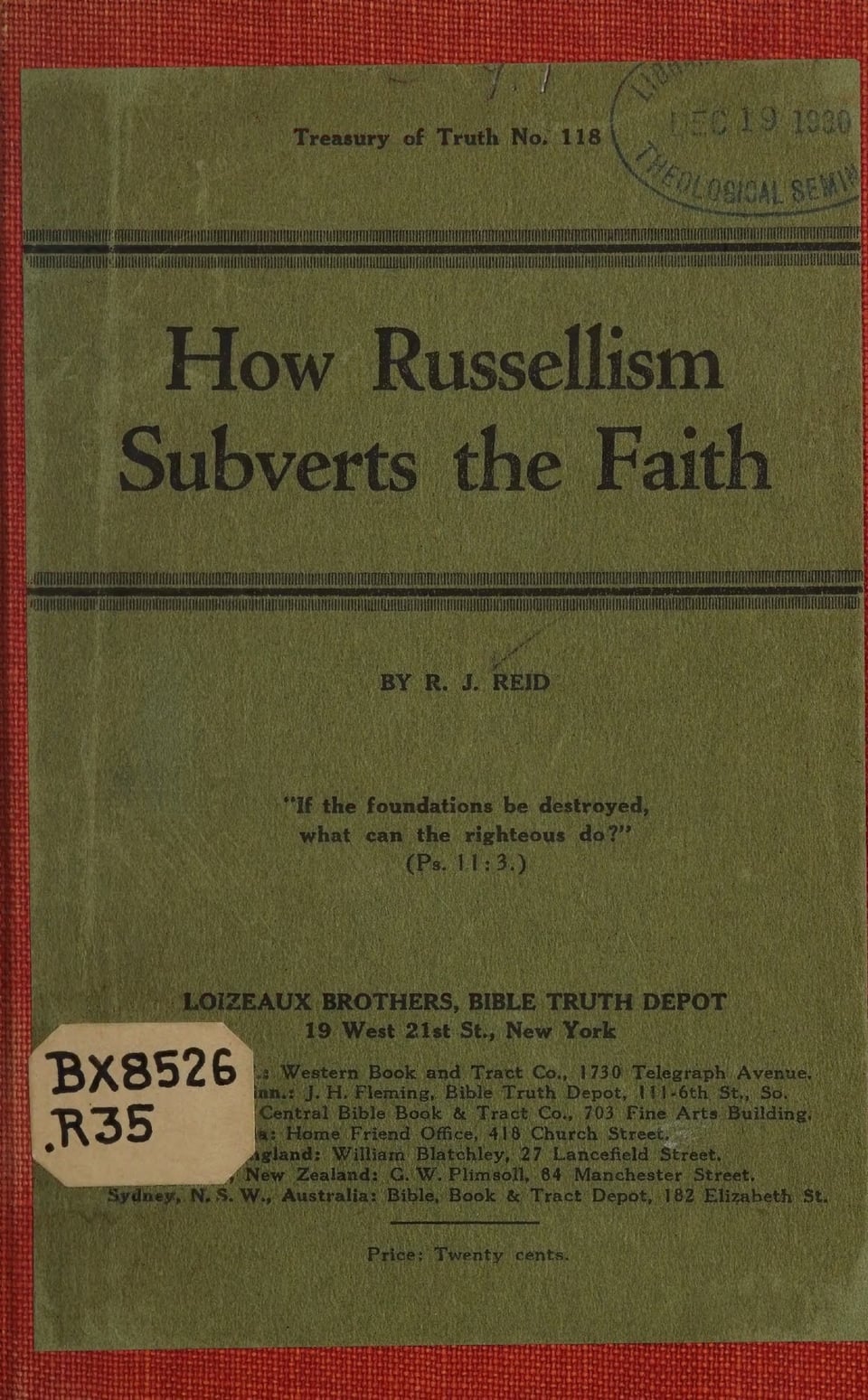
How Russellism Subverts the Faith (1915)
Download: PDF — How Russellism Subverts the Faith (1915)
DEC 19 1930
THEOLOGICAL SEMINARY
How Russellism Subverts the Faith
BY R. J. REID
"If the foundations be destroyed, what can the righteous do?" (Ps. 11:3.)
LOIZEAUX BROTHERS, BIBLE TRUTH DEPOT 19 West 21st St., New York
BX8526
R35
L: Western Book and Tract Co., 1730 Telegraph Avenue. Inn.: J. H. Fleming, Bible Truth Depot, 111-6th St., So. Central Bible Book & Tract Co., 703 Fine Arts Building. a: Home Friend Office, 418 Church Street. England: William Blatchley, 27 Lancefield Street. New Zealand: G. W. Plimsoll, 84 Manchester Street. W., Australia: Bible, Book & Tract Depot, 182 Elizabeth S LIBRARY OF PRINCETON
12.19.30
THE OLOGICAL SEMINARY
3X8526
.R35
LIBRARY OF PRINT
DEC 19 19
THEOLOGICAL SENIOR
HOW RUSSELLISM SUBVERTS THE FAITH
BY R. J. REID
LIST OF SUBJECTS
How Russellism Subverts the Faith 1
How Russellism Subverts the Truth of the Deity of Christ 9
How Russellism Subverts the Truth of Everlasting Punishment 32
How Russellism Subverts the Truth of the Authority and Profit of Scripture 50
How Russellism Subverts the Truth as to Conduct in the House of God 59 How Russellism SUBVERTS THE FAITH
WHEN the Lord asked His disciples, "Whom do men say that I the Son of Man am?" it implied that they knew what sayings were current among the people about Himself, and their importance as referring to His Person. The same principle applies to-day. We should know what men are saying about Him now. Nor is this all; He greatly appreciates our confession of His Name, coming from hearts that have been taught of God; so He asks His own disciples, "Whom say ye that I am?" (Matt. 16:13-15). And how important is this, when Christendom abounds with systems of error about the Lord on whom our salvation depends!
In a class by itself stands that system of error known as Russellism or Millennial Dawnism, as set forth in six volumes, entitled "Studies in the Scriptures," of which the author is C. T. Russell. This system has several agencies of propaganda, as for instance: "The People's Pulpit;" "Watch Tower Bible and Tract Society;" "International Bible Students' Association." etc. It would seem
as if these divers names (for substantially the same thing) are intended to confuse the public as to its identity.
Another has justly said, that when the title of the printed matter was changed from "Millennial Dawn" to "Studies in the Scriptures," the new title became an "alias," after the old had become identified.
To secure attention, this system employs a semi-Christian phraseology; it endeavors to speak the language of Canaan, although it cannot help doing so with a foreign accent. Nevertheless some are deceived by its "good words and fair speeches" (Rom. 16:18). Recently we met an old lady who had been attracted to it by its use of Christian hymns, such as—
"On Christ the solid Rock I stand,
All other ground is sinking sand!"
When asked how she would feel if it were proved to her that those with whom she consorted denied the eternal deity and present manhood of Christ, she said : "Oh, brother, do not say such things; I could have nothing to do with people who deny these truths; but those dear people do not hold the blasphemies you mention!" Alas! several have been turned from the "old paths" through lack of discernment, like this old lady. But remember that some who are not so easily deceived by appearances, may be partly to blame for defection of simple folk by permitting copies of "Studies in the Scriptures" to lie upon their tables or bookshelves, as thousands do.
What is this but a lack of sensitiveness as to the Christian's duty in regard to the truth?
Unlike those fairly sound creeds (which still show weakness on many points as to the truth) Russellism is anti-Christian. It is false on every crucial issue.
A few of its many errors may be briefly indicated before examining more fully those that give a special notoriety to the system.
Russellism denies that the Holy Spirit is a person. But God's word says: "The Spirit of God hath made me, and the breath of the Almighty hath given me light" (Job 33:4). Our Lord Jesus said, "When He, the Spirit of truth, is come, He will guide you into all truth; for He shall not speak of Himself, but whatsoever He shall hear, that shall He speak: and He will show you things to come. He shall glorify Me: for He shall receive of mine, and shall show it unto you" (Jno.16:13,14). He is everywhere present (Ps.139:7,8); He can be grieved (Eph. 4:30); Ananias and Sapphira lied to Him (Acts 5:3,4); He selected Barnabas and Saul to evangelize the nations (Acts 13:2).
Russellism limits the ransom Christ paid to mere physical death. It alleges that suffering was only incidental to the ransom. The judgment from God for our sins endured by our Saviour upon the cross has no place in it. The "curse" borne by our Lord, the place of distance and crying, "My God, my God, why hast Thou for saken Me?"
forms no part of Russellism's "ransom."
Russellism gives the ransom a merely human value. It argues that the life our blessed Lord laid down was only equal to ransoming one person, Adam; adding that as Adam was held accountable for the human race, when Jesus ransomed Adam, the race was included in the resulting benefits. It belies Paul's adoring words, "The Son of God, who loved me, and gave Himself for me" (Gal. 2:20). If its teaching were true, Paul should have said, The Son of God who gave Himself for Adam.
Russellism says the "little flock" becomes joint-sacrificers with Christ in atonement. It avers that "the price is not yet fully paid;" that "the atonement sacrifice will be finished" when every member of the little flock is made "a living sacrifice;" whilst Scripture declares that "without shedding of blood is no remission;" that "Christ was once offered to bear the sins of many," and that by that solitary sacrifice, offered once for all, atonement has been made.
Russellism denies that all the "justified" are saints. It says that only those who have attained to a high degree of devotedness are saints and compose the true church—the "little flock." But the apostle Paul calls the Corinthians "saints;" "sanctified;" "the Church of God;" "the temple of God;" "the body of Christ" (1 Cor. 1:2; 3:16;12:27), though he had much to reprove among them.
Russellism's "little flock" is a select class. Its "peculiar people" is an inner circle of believers themselves of course and not all believers taken from among Jews and Gentiles, set apart, sanctified, as God's own treasure, distinct from the world, as God's word throughout the Epistles teaches.
Russellism teaches that Adam had "eternal life" in his original state, and lost it when he fell, and that no one has it now. It says that that life is supported by material food; that in the millennium mankind will be tested as to their worthiness to receive it; that the majority will be approved as worthy, and a minority will be annihilated as unworthy. But our Lord Jesus Christ says: "He that believeth on Me hath everlasting life" (Jno. 6:47)—has it now. "This is the record that God hath given to us eternal life." Having received the Son of God, the believer has life eternal—not independently, but he has it as having the Son: "He that hath the Son hath life; and he that hath not the Son of God, hath not life" (1 John 5:11, 12). Christ is that Life; He is the source or fountain of eternal life, and apart from Him there is none. This life is characterized by the knowledge of the only true God and Jesus Christ whom He has sent (John 17:3). Moreover He is the Bread of life—the One by whom we are nourished from day to day (Jno. 6:35).
Russellism says the "little flock" raise themselves to a plane whereon they are begotten of God. Having degraded eternal life, it affirms that to be begotten of God is a blessing higher than eternal life, but that it stops short of "new birth," asserting that no one who is born again could die.
Russellism declares that in the resurrection, and not before, the approved will be "born again." This it avers is equivalent to receiving "immortality." It says that immortality implies selfexistence, the possession of life as an independent source, and the ability to communicate it. It owns that only God had it at the outset, but says that Christ obtained it as a reward for dying, and that the "little flock" will also receive it for yielding itself up as a "living sacrifice." Thus this system, which denies the truth of the divine Trinity, has no difficulty about deifying the "little flock." It offers the reward of deity to its votaries.
Russellism says that Christ is now exclusively a spirit. The scripture it cites for this is: "The last Adam was made a life-giving Spirit" (1 Cor. 15:45). But Scripture calls man (who has a "spirit, and soul, and body," 1 Thess. 5:23) a living soul. He is thus distinguished from angels, who are exclusively spirits. Yet Scripture also speaks of man as a "spirit" in these words: "We have had fathers of our flesh which corrected us, and we gave them reverence: shall we not much rather be in subjection unto the Father of spirits, and live?"
(Heb. 12:9). In this way is man distinguished from a lower creation, as by "soul" he is distinguished from a higher creation—man being of complex nature. Now, in resurrection, the Lord has taken the place of "last Adam"—the head of a new race, in which His unique glory is revealed as "a life-giving Spirit." This we can never be; for we shall ever be dependent creatures—ever dependent on Him, however blessed our portion. But never in Scripture is there a hint of manhood being given up—neither in our Lord nor in our case.
Russellism says that Christ in His pre-human state was a creature. It says He was the first and highest creature of God, and quotes: He is "the firstborn of every creature"—"the beginning of the creation of God" (Col. 1:15; Rev. 3:14), thus applying texts which refer to Christ since incarnation to the glorious uncreated Son of God our Creator! Nor do these texts refer to time, but to His dignity and headship. Thus as risen He is called firstborn "from among the dead" (Col. 1:18), as the Head of a race after His order. Similarly Jehovah says, "Israel is my son, even my firstborn" (Ex. 4:22); i.e., head of the peoples of the earth.
Russellism says that Christ came to earth in 1874, and is now present upon it, although invisible; also that we are in the millennium. In the millenium!—the bloody fields of Europe have cried out so loudly against this lie that comment is unnecessary in the year 1919.
We conclude these brief references to a few of the Russellite errors by saying that its scheme of prophecy is a mass of confusion, failing as it does to distinguish between the Church period and the prophetic times. For the Church, belonging to heaven and not to earth, forms a parenthesis in the course of prophecy. Prophecy relates to the earth, it has Israel as its centre; and the course of prophecy (interrupted by Messiah's rejection) will not be resumed till the Church has been translated to its heavenly home.
Let us now look more closely at the principal errors which the system in question strenuously labors to establish. Why it does so, we shall see.
The principal object of Russellism is the denial of the truth as to—
(1) Everlasting Punishment. And as the greatest barrier to this denial is—
(2) The glory of Christ's Person; it seeks to lower Him. This it seeks to support by—
(3) Nullifying those texts which expose its errors. Finally it contends for—
(4) Lawlessness without rebuke in the house of God.
We shall examine these four errors. But let us begin with Russellism's effort to lower the glory of the Person of Christ.
(9)
HOW RUSSELLISM SUBVERTS THE TRUTH OF THE DEITY OF CHRIST
It says :
"Our Redeemer existed as a spirit-being before He was made flesh and dwelt among men. At that time, as well as subsequently, he was properly known as 'a god'—a mighty one. As chief of the angels and next to the Father, he was known as the Archangel (highest angel or messenger), whose name, Michael, signifies, 'Who as God,' or God's representative. As he was the highest of all Jehovah's creation, so also he was the first, the direct creation of God, the 'Only Begotten,' and then he, as Jehovah's representative, and in the exercise of Jehovah's power, and in his name, created all things,—angels, principalities and powers, as well as the earthly creation."—Vol. 5, p. 84.
Here we are told that the Lord Jesus was the only ' direct " creation of God, after which He became the Creator Himself, and God ceased to be the Creator directly.
However, if Genesis says, "In the beginning GOD created," etc., John says of the WORD, "All things were made by Him; and without Him was not anything made that was made." Creatorship was not transferred from a first to a second Creator, but He who created at the outset, completed the work He began. He, the eternal Word, created "the anointed cherub," who became Satan (Ezek. 28:14); He created Michael the archangel, and all the angels; He created man; He created everything that was created.
And there is grace in this, for as the Word, He it is that expresses God's mind. As someone has remarked, There is in the creation a hint of revelation to follow far greater than that evidenced in the things made. It intimates the desire of God to reveal Himself and to communicate His purposes. What a pledge that in the fulness of time God would manifest His love!
The eternal Being, the eternal abode, and the eternal Deity of the Word are affirmed in John 1: 1, "In the beginning was the Word, and the Word was with God, and the Word was God."
(1) "In the beginning was the Word." Yes! He is the eternal, self-existent One—"Who is, and who was, and who is to come, the Almighty!" (Rev. 1:8). He is the great I AM (Isa. 9:6).
(2) "The Word was with GOD." The word Elohim denotes plurality of persons. Hence, "In the beginning God (Elohim) created," describes the act of those Divine Persons subsequently revealed as the Father, the Son, and the Holy Spirit. But "while the noun 'Elohim' is plural, the verb 'bara' is singular. The action is one" (S. Ridout). And to this agrees Prov. 8, revealing the second person in the Trinity—Wisdom—in the unclouded communion ever subsisting between the Divine Persons
(3) And John delights to show that "The Word was God;" and he declares that it was Christ's glory that Isaiah saw when seraphim exclaimed, "Holy, holy, holy, is Jehovah of hosts" (Isa.
6: 3; John 12: 38-41), and that He is "the true God and eternal life" (1 John 5: 20).
Russellism teaches that the Lord Jesus was "a god," subordinately so (as the printer's type suggests), in the sense, although in higher degree, in which Moses was "a god to Pharaoh" (Ex. 7:1). Again it says, He was the archangel Michael, chief of the angels—the highest angel or messenger. It was thus He was "a god." But see how Scripture destroys such evil teaching: "Yet Michael, the archangel, when contending with the devil he disputed about the body of Moses, durst not bring against him a railing accusation, but said, The Lord rebuke thee" (Jude 9). Not being set over the devil, the archangel did not presume to rebuke him, but committed this to the Lord who could both rebuke and command Satan, saying, "Get thee hence, Satan." Michael the archangel was therefore not the Lord. But to continue :
"We are told that our Lord, before he left his glory to become a man, was 'in a form of God'—a spiritual form, a spirit being; but since to be a ransom for mankind he had to be a man of the same nature as the sinner, whose substitute in death he was to become, it was necessary that his nature be changed. And Paul tells us that he took not the nature of angels, one step lower than his own, but that he came down two steps and took the nature of men—he became a man; he was made flesh—Heb. 2:16; Phil. 2:7,8; John 1:14 . . . Notice that this teaches not only that angelic nature is not the only order of spirit being, but that it is a lower nature than that of our Lord before he became man, and he was not then so high as he is now (Phil. 2:8,9)."—Vol.1, pp.177,178.
Having said that the Lord Jesus in His prehuman existence was the highest angel, Russellism now says that He had a higher, or superangelic, nature. But what Scripture says of Him is this: "Who, being in the form of God, thought it not robbery to be equal with God: but made himself of no reputation, and took upon Him the form of a servant, and was made in the likeness of men" (Phil. 2:6,7). Being "over all, God blessed for ever" (Rom. 9:5), He had the right to humble Himself thus. He considered not His divine place and glory a thing to be grasped or clutched at, but voluntarily humbled Himself. While His Person could not change, remaining ever "God over all," He could and did take a "servant's form," and "was made in the likeness of men." The Jews understood well His words when He said that "God was His Father." They said He made Himself "equal with God." What infinite grace such a humbling of Himself, and such a journey betokened! Ah, yes; He passed the angels by, came down and became a man to bear our guilt upon the cross. Blessed be His name!
The following passage of Isaiah 40:9-11, "O Zion, . . Behold your God! Behold, the Lord God will come with strong hand, and his arm shall rule for Him: behold, his reward is with Him, and his work before Him.
He shall feed his flock like a shepherd: He shall gather the lambs with his arm, and carry them in his bosom, and shall gently lead those that are with young," is likewise subverted by Russellism, as follows :
"We are told that here surely is one passage in which our Redeemer is called by the great name of Jehovah. But we answer, No; he is here called the 'arm' of Jehovah as in other places: the mighty arm of Jehovah 'shall rule for him,' until he shall have put down all authority and power opposed to Jehovah and his righteous law."—Vol. 5, pp. 46, 47.
This text, which speaks of Jehovah's "arm," speaks also of His "hand" and His "bosom." Will Russellism, which tells us that Jehovah's "arm" is a person, be consistent enough to say that His hand and bosom are persons also? By no means. Its interpretation therefore is but a subterfuge, and Isaiah 40 does teach that our Redeemer "is called by the great name of Jehovah." His coming "with strong hand" when "His arm shall rule for Him," teaches that He will then assert His rights by force, whereas today His power is used in blessing, as it is written: "Thou hast given Him power over all flesh, that He should give eternal life to as many as Thou hast given Him" (John 17:2).
But again:
"We are asked to consider Isaiah's statement (8:13, 14) as proof that the name Jehovah is properly applicable to our Lord.
It reads: 'Sanctify Jehovah of hosts himself; and let him be your fear, and let him be your dread.' The stress is laid upon the next verse, which without specifying who declares, "He shall be for a stone of stumbling and for a rock of offence to both the houses of Israel.' We cannot admit this as proof; for, quite to the contrary, the context shows a third party (besides Jehovah and the Prophet), even our Lord Jesus, who says, 'Bind up the testimony, seal the law among my disciples. And I will wait upon Jehovah; Behold I and the children which Jehovah hath given me' (Isa. 8:16-18; compare Heb. 2:13."—Vol. 5, p. 49.
The contention here is, that while we believe that Isa. 8 speaks of Jehovah as a stumbling stone to the Jews, and Luke 20:17,18 teaches that Jesus is that Stone (hence that He is Jehovah), Russellism asserts that the Stone in this passage is "a third party" who says, "I will wait upon" Jehovah, but not himself Jehovah. To consider this, let us take other examples.
In Dan. 7: 9-14 the prophet speaks thus: "I beheld, till the thrones were cast down [set], and the Ancient of Days did sit, whose garment was white as snow, and the hair of His head like the pure wool" (ver. 9). "I saw in the night visions, and, behold, one like the Son of Man came with the clouds of heaven, and came to the Ancient of Days" (ver. 14). Thus the Ancient of Days (the eternal God) is distinguished from the Son of Man, the Lord Jesus. According to Russellism's "third party" plea, this would prove that the Son of Man is not the Ancient of Days.
But the prophet continues: "I beheld, and the same horn made war with the saints, and prevailed against them; until the Ancient of Days came." In the former passage, "the Son of Man came" to do what this latter passage says "the Ancient of Days" came to do. Hence, although distinguished in their respective glories, as Man and as God, they are one. And Rev. 1:13, 14 confirms this. For when John sees "One like unto the Son of Man," who says, "I am He that liveth, and was dead; and, behold, I am alive for evermore," he at once identifies Him as the Ancient of Days, thus: "His head and His hairs were white like wool, as white as snow."
Take another example: "I give thee charge in the sight of God, who quickeneth all things, and before Christ Jesus, who before Pontius Pilate witnessed a good confession; that thou keep this commandment without spot, unrebukeable, until the appearing of our Lord Jesus Christ; which in His times He shall show who is the blessed and only Potentate, the King of kings, and Lord of lords; who only hath immortality, dwelling in the light which no man can approach unto; whom no man hath seen, nor can see: to whom be honor and power everlasting. Amen" (1 Tim. 6:13-16). Timothy is charged to keep the apostle's commandment until Christ's "appearing," when the King of kings "shall show" or manifest Him. Thus Christ Jesus is distinguished from the King of kings. Nevertheless when He who is "the Word of God" appears from heaven, He is identified as the King of kings (Rev. 19:11-16).
The blessed Man whom "every eye shall see" shall then be manifested as "the blessed and only Potentate, the King of kings, and Lord of lords; who only hath immortality, dwelling in the light which no man can approach unto; whom no man hath seen, nor can see."
It is therefore apparent that Russellism's plea that the Lord Jesus could not be Jehovah, because He would "wait upon" Jehovah, is as unfounded as would be the plea that the Son of Man could not be the Ancient of Days, because He "came to" the Ancient of Days; or that He could not be the King of kings, because the King of kings "shall show" Him at His appearing.
Scripture presents the Lord Jesus as the dependent Man waiting upon Jehovah, and also declares He is Jehovah. It presents Him as coming to the Ancient of Days, and also says He is the Ancient of Days. It speaks of the King of kings showing Him, and also declares He is King of kings Himself—so true is it that in the inscrutable glory of His person "no man knoweth the Son but the Father" (Matt. 11:27).
But, once more, see with what boldness Russellism perverts the Word of God :
‘'Bethlehem Ephratah, . . out of thee shall he come forth unto me that is to be ruler in Israel; whose goings forth have been of old, from everlasting' (Mic. 5:2).
These words we are asked to accept as proof that Jesus was Jehovah—from everlasting to everlasting—because Moses declared, 'Jehovah . . . from everlasting to everlasting, thou art God' (Psa. 90:1,2). . . What then is meant by the words of Mic. 5:2? We answer that they can well be understood thus: 'Whose goings forth have been [foretold] from of old, from everlasting.'"—Vol. 5, p.45.
There is no pretense here that a correct translation calls for the word "foretold;" this system boldly interpolates it on its own responsibility. Tampering with the holy records, it adds to the words of God, notwithstanding the warning, "Add thou not unto His words, lest He reprove thee, and thou be found a liar" (Prov. 30:6). In this text God declares of His Son: "His goings forth have been from of old, from everlasting." Russellism replies: They were foretold from of old, from everlasting. God asserts the eternal being and activity of the Son. Russellism inserts a word to nullify that assertion. God says the smitten Sufferer of Calvary is Jehovah manifest in flesh. Russellism replies to Him, saying, It is not so. What ungodly effrontery!—and that to degrade the person of the Son!
We have seen then that every text appealed to by this system repudiates it, and insists that Jesus is Jehovah. Nor is this merely the teaching of the texts cited, it is the sense of all Scripture. There is legitimately no room in the universe for the denial of this. For if "All things were created by Him, and for Him" (Col.1:16), He is not only the Cause of the universe, but its Object of worship.
Can it be conceived that the moral Centre of all things is merely a creature? Shall the Object of a redeemed creation's praise receive honors impossible to be rendered to God? Shall our hearts be conscious of a link with One who has personally won them to Himself as God has not? No, no! In rendering to the Lord Jesus the homage and praise due to our ever blessed and glorious Redeemer, it shall never be forgotten that that Redeemer is God Himself.
HOW RUSSELLISM SUBVERTS THE TRUTH OF THE MANHOOD OF CHRIST
We turn again to Mr. Russell's books, in which he says :
"We see that in Jesus there was no mixture of natures, but that twice he experienced a change of nature; first, from spiritual to human; afterward from human to the highest order of spiritual nature, the divine; and in each case the one was given up for the other."—Vol. 1, p. 180.
"It was absolutely necessary that he should be a man neither more nor less than a perfect man."—Vol. 5, p. 95.
"Our Lord avers that he existed before Abraham. Nor do the Scriptures in any place intimate that the existence of the Only Begotten ever ceased from the time it began, as 'the beginning of the creation of God,' until it ceased at Calvary for three days; after which he was raised from the dead to die no more, death having never more dominion over him (Rom. 6:9). The incident of his birth as a human being "a little lower than the angels," for the purpose of being man's sin-sacrifice, did not involve a death to the spirit-nature pending the birth as a human babe, but merely a transference of his life from a higher or spirit-nature to a lower or human nature. Hence, our Lord's words, 'Before Abraham was I am,' signify that there had been no cessation of his existence at any time in the interim, and positively identifies Jesus, the Son of God, in the flesh, with the Logos, the firstborn of all creation."—Vol. 5, p. 90.
"As the natural sleep, if sound, implies total unconsciousness, so with death, the figurative sleep; it is a period of absolute unconsciousness--more than that, it is a period of absolute non-existence.
. Our Lord's being or soul was non-existent during the period of death . . The man Christ Jesus suffered for us death in the most absolute sense of the word—everlasting destruction . . The man Jesus is dead, for ever dead." —Vol. 5, pp. 329, 362, 466, 454.
In a former chapter we have seen that Mr. Russell affirms that the Lord was "the Archangel" before He became flesh and "subsequently." This implies that He was a man and the archangel also; it betrays confusion in the mind of its author, for his saying that He was "a man neither more nor less" cancels it. But this cancellation, although another error, is the error that represents Russellism in a way the first error does not.
In the extracts given above, Mr. Russell says of our Lord :
(1) He became a man "neither more nor less."
(2) The life He had as an angel was transferred from a non-angelic nature to a human nature.
(3) This transfer did not involve a death to the nature abandoned, but signified that as there had been no cessation of His existence in the interim, His identity with the Logos had been preserved.
(4) At Calvary, the existence whereby the identity had been preserved, ceased for three days, Christ having become non-existent for three days.
(5) Although no more than a man, as such He was destroyed forever.
In examining this, many absurdities will have to be passed over; we will look at but two of their principal doctrines.
First, that when Jesus died the existence which identified Him with the Logos ceased "for three days;" the identity thus being lost "for three days."
Second, that "the man Jesus" came to an end for ever, became non-existent for ever.
Non-existence for three days is the same as for ever, of course, for it means annihilation; and there can be no annihilation for three days. Russellism says that Jesus was no more than a man, and then adds that as a man He has been annihilated for ever. It teaches therefore the eternal annihilation of Christ.
However, this is denied—but only in terms of evasion. For instance, when Dr. Haldeman's paper, "Millennial Dawnism, or the blasphemous religion which teaches the annihilation of Jesus Christ" appeared, although its author was accused of misrepresentation, the accusers were careful to ignore the evidences which Dr. Haldeman had adduced in support of his charges. Seeing no answer to them, the present writer wrote to headquarters at Brooklyn, inquiring for anything on hand dealing with the Haldeman assertions. The answer received speaks for itself.
Sept. 18, 1916.
"As we do not have anything directly refuting the absurd statements of Dr. Haldeman about the teachings of Pastor Russell we will send you a special edition of the Watch Tower and also some copies of the B.
S. Monthly, the reading of which will show you that he does not teach the annihilation of Christ.
"Dy. File K."
Thus does Russellism evade the evidence of its sin, and lodge its denial in general terms. The reason is evident. It does teach the annihilation of Christ. In fact it argues that death, whether inflicted upon Christ or upon any one, is always annihilation.
A pretense, however, is made that the force of this has been lessened so far as mankind is concerned (although never so far as Christ is concerned). Hence the sentence :
"The Adamic death has been turned, by reason of the divine plan and the ransom, from being a destruction to a suspension of existence, called sleep."—Vol. 5, p. 330.
But the hollowness of this pretense is shown in what follows with astonishing degree:
"Those who speak and write intelligently upon the subject (for instance the inspired Scripture writers), as if by common consent, speak of the unconscious interim between death and the resurrection morning, in which sensibility (sentient being) is suspended, as a 'sleep.' This death-'sleep' is so absolutely a period of unconsciousness that the awakened ones will have no knowledge of the lapse of time. Indeed 'sleep' is merely an accommodated term, for really the dead are dead, utterly destroyed, except as God's wisdom preserves their identity, and has decreed through Christ their awakening, their re-organization and resuscitation, and this indeed will be re-creation . . . With any power and wisdom less than that of our Creator guaranteeing the resurrection, we might justly fear some break or slip by which the identity would be lost, .
. . But . . . He who knows our very thoughts can reproduce them in the new brains . . . The identity of the individual will be preserved, by reason of his being awakened to exactly the same conditions which he lost in death."—Vol. 5, pp. 344, 346, 347, 343, 478.
Thus the death turned from destruction to sleep is returned from sleep to destruction; and we are coolly told that what "inspired Scripture writers" said about "sleep" must be taken as an accommodation, but that "really" the dead are "utterly destroyed." Even this is still worse confounded by the attached clause,—"except as God's wisdom preserves their identity." How it is preserved we shall see later, but for the present let this be clear;—Russellism says:
(1) At death man is utterly destroyed.
(2) By the divine plan and ransom this destruction has been turned to sleep.
(3) But this sleep is "really" utter destruction.
Surely this is the wandering of an abnormal mind!
But let us now consider Russellism's method of preserving identity. It assured us that the identity of Jesus with the Logos had been preserved by the continuity of His life from a prehuman existence. Now we are told it can be preserved by "re-creation," to former conditions. In the "new brains" of the re-created being, thoughts are reproduced which were in the old brains of the being who became absolutely nonexistent.
This is a second way of preserving identity.
There is, however, a third implied. For Russellism having shown that the second is by recreation to former conditions, teaches that Christ was not re-created to former conditions but to new conditions as a spirit-being, higher than He was before He became man. Manifestly this implies a third way of preserving identity, a way that is not explained—we are thankful to say.
Alas, at what a loss is this speculation! The precious, well-known Christ, followed and loved down the ages, disappears for ever. And, solemn though it be to say so, If this cult has a Christ, it is a false one.
With what comfort then we return to the Scripture record of Christ's identity through every part of His journey from heaven to earth and from earth back to heaven. It declares that when He died He went to paradise (Luke 23 : 43). Precious thought! Russellism answers that "Christ was buried;" and devout men "carried Stephen to his burial;" that if Christ and Stephen were laid in the grave, they were nowhere else. Russellism is wilfully ignorant that in speaking of the burial of Christ or His witness Stephen, Scripture speaks of their bodies. It limits its language to the subject in hand. If the subject is the Lord's burial, He is buried; if the subject is the unseen state, He is in paradise.
In the former connection He is viewed in relation to the body; in the latter in relation to the soul. And that is why Scripture records that when the penitent thief died he went to paradise whither his Saviour had preceded him, and where He welcomed him. With no excuse, for himself, but self-condemnation, this man was the only one in that dark hour who justified Christ and looked to Him in faith. His eyes anointed to perceive the glory of the Sufferer at his side; beyond every present obstacle he looked to His righteous rule in the millennial age. He foresaw the King in the day of His manifestation taking the kingdom,and thus appealed:“Lord, remember me when Thou comest in thy kingdom!” And his gracious Saviour exceeded his request. He virtually said: You have looked on to the day of my manifestation in kingdom-glory and craved my compassion then, but I say unto thee,“To-day shalt thou be with Me in paradise.” This was no reference to the time when the Lord uttered the words (as Russellism alleges), but to the time when the thief would be “remembered.” It was present grace for a needy suppliant.
And thus too was our precious Redeemer comforted in the hour of His unutterable sorrow; thus did He both sow and reap and rejoice in the work He loved so well to do; thus did He rescue from the very jaws of hell a sinner that seemed doomed beyond recall, bringing him to paradise as a trophy of the Cross.
How natural, how sweet and simple is the Bible evidence of the unbroken identity of the individual, whether it be that of our blessed Lord or of ordinary men and women. How different is its narrative of facts to the cold, far-fetched and contradictory speculations of Russellism.
But to proceed:
"God proposes the judgment of the church during this gospel age, for the prize of eternal spirit-being; and the judgment of the world during the Millennial age, for the prize of everlasting human perfection . . . God's plan of salvation for the general race of Adam is to extend to each member of it, during the Millennium, the offer of eternal life upon the terms of the New Covenant sealed for all with the precious blood of the Lamb . . . The offer will be "restitution" (Acts 3:19-21) to life and health and perfection of human nature—the same that Adam possessed as the earthly image of God before his fall from grace into sin and death."—Vol. 5, pp. 408, 402.
Now let the cost of this be pondered. The man Christ Jesus becomes non-existent for ever, that Adam might be re-instated and re-produced in a race after his order. The man Christ Jesus must have no generation as such, so that Adam might be displayed in future ages in a generation derived from him!
Indeed, this is false and very wicked. Scripture negatives it at every approach. Scripture says believers have died in the death of Christ: "Ye are dead, and your life [eternal life] is hid with Christ in God" (Col. 3:3). Again: "Knowing this, that our old man is crucified with Him, that the body of sin might be destroyed, that henceforth we should not serve sin.
For he that is dead is freed [justified] from sin" (Rom. 6: 6, 7). "For in that He [Christ] died, He died unto sin once: but in that He liveth, He liveth unto God. Likewise reckon ye also yourselves to be dead indeed unto sin, but alive unto God through Jesus Christ our Lord" (Rom. 6:10, 11). The believer is dead with Christ, and is called upon to reckon himself so. It is in Christ and not in Adam that he lives before God. Wherefore the Holy Spirit has been given to engage his heart with Christ, and form him in his ways according to that Pattern. To use typical language: the "oil" is put upon the blood and not upon the flesh (Exod. 29:21); the gift of the Spirit involves the setting aside of what we were in Adam, in order that Christ might be reproduced in us.
Russellism may reply that it contemplates blessing according to Christ's pattern for the "faithful" of the church period, and that its Adamic resuscitation is future and millennial. But Christians will not be deceived by this. Right well do they know that God has not two kinds of salvation for the children of men. They know that whatever the scope of testimony in any given dispensation, Christ alone was, Christ alone is, and Christ alone shall be the salvation of God. All the redeemed of every age, whatever the character or measure of blessing, they derive it from the one Mediator between God and men, the Man Christ Jesus.
God has not been working in a Church age according to the pattern of Christ on a small scale, while contemplating work in the Millennium according to the pattern of Adam on a large scale. Oh, how Russellism serves Satan's purpose to diminish the glory of the Man Christ Jesus! Its volumes pursue the subject to a nicety to leave no room in God's eternal purpose for the Man Christ Jesus.
But even this is not enough: it must be brutal as well. Hence, speaking of the Lord's body, it says:
"We know nothing about what became of it . . . Whether it was dissolved in gases . . . no one knows." --Vol. 2, p. 155.
In this way does the loveless system from Allegheny, Pa., express its innermost feelings, with no pretense of argument. Devoid of those safeguarding instincts which would insure a measure of reverent language, Russellism cannot restrain an underlying Satanic hatred of the true Christ—the Christ of God. Like the second Beast of Rev. 13 (which had an appearance of Christ, having "horns like a lamb," it betrays its diabolical character when delivering its message,—"he spake as a dragon"), so does this evil society betray its foreign accent while attempting to speak the language of Canaan. How estranged must they be who could thus speak of the body of Christ—that body which God had prepared for Him; the only human body in which the will of God was perfectly carried out; the temple of God—that holy shrine whence shone the light of God in a dark world.
But we turn to Scripture, in which every page, whether in Old or New Testaments, points to the Man Christ Jesus. Even Adam was "the figure of Him that was to come" (Rom. 5:14).
Christ is the Man of God's Purpose
The "Second Man," Christ, is revealed in contrast with the "first man," Adam. The first "is of the earth, earthy;" the second is "out of heaven" (1 Cor. 15:47, N. T.). And although Mr. Russell explains this latter to mean the future appearing of Christ from heaven, it is manifestly a contrast between Adam and Christ in their origin and nature.
The "Last Adam" is revealed as superseding the first forever; He is the last. There shall be none other. As such, He is a life-giving Spirit—the blessed Man of God's delight, who communicates spiritual life to a race derived from Him. And although the recipients of this life continue their pathway here in their natural decaying bodies, and die as do the unregenerate, the life they have in Christ Jesus is beyond the reach of death, and should give character to their life here on earth.
David returned from conflict and bearing the proof of victory. Man lay under the penalty of death, but now God has a Man in resurrection in the power of an endless life. This is the great triumph of God over the forces of evil. It provides a basis unreachable by death whereon He places those who submit to the gospel. "For since by man came death, by Man came also the resurrection of [from among] the dead" (1 Cor. 15:21).
The Agents active in the resurrection of Christ were the Father, the Son, and the Spirit (Rom. 6:4; John 2:19; 1 Pet. 3:18). Note how specific are the words of Christ: "Destroy this temple, and in three days I will raise IT up," that body of "flesh and bones" from which the precious blood had flowed, for "without shedding of blood is no remission." Therefore Christ's body in resurrection is the witness of accomplished redemption. Hence His words: "Handle Me, and see, for a spirit hath not flesh and bones, as ye see Me have" (Luke 24:39), dispelled forever the infidel assumption of the disciples that in resurrection He was merely a spirit impersonating a man.
This same testimony is rendered through the apostles by the Holy Spirit come from heaven. Listen : "This Man, after He had offered one sacrifice for sins for ever, sat down on the right hand of God" (Heb. 10:12). Consequently He is the Way of blessing—"Through this Man is preached unto you the forgiveness of sins" (Acts 13:38).
Moreover, by and by God "will judge the world in righteousness by that Man" (Acts 17:31).
He it is too who, after the millennial reign, shall deliver up the kingdom to God, even the Father, and take forever the place of subjection in the manhood He retains; "that God (the Father, the Son, and the Spirit) may be all in all." God will be "all" as the Object of universal worship; and "in all" as having His place in the affections of a redeemed creation. And the One who will bring matters to such an issue will be the Man who shall exemplify in Himself and in the race derived from Him, the place proper to man and the glory due to God (1 Cor. 15:24-28).
HOW RUSSELLISM SUBVERTS THE TRUTH OF EVERLASTING PUNISHMENT
Russellism says :
"The meaning of the Hebrew sheol (hades is its Greek equivalent) can scarcely be expressed by any one English word : it signifies hidden, or extinguished, or obscure—the condition or state of death : it is not a place but a condition, and perhaps the word oblivion would more nearly than any other in our language correspond with the word sheol of the Hebrew and hades of the Greek."—Vol. 5, p. 354.
In examining this appeal to Hebrew and Greek, made by Russell, preparatory to a denial of everlasting punishment, the present writer, only knowing as much of these languages as Mr. Russell—which is nothing—will have to furnish a point of contact by agreeing to the three meanings given sheol or hades. As to the conclusions based upon them, that is another matter.
What then has been concluded as to
Sheol or Hades?
Well, we are told that it signifies "hidden, or extinguished, or obscure—the condition or state of death."
And what is death?
Russellism always says that "Death is the condition of absolute non-existence."
How was this determined? Has some proof been furnished?
Not at all! We are merely told it is "the condition or state of death."
But to return. It says that sheol or hades signify "hidden, or extinguished, or obscure." Be it so. But what does "hidden" mean? Heretofore a thing hidden was considered out of view. Thus if a person was referred to as in hades, he was said to be where his former associates on earth saw him no longer. It was said: He is in the unseen state. But this is what Russellism denies. It says he is "non-existent."
As to extinguished,—it signified that that which gave light or heat had ceased to do so. Hence if a person was referred to, it would be said: How hath the candle of the wicked been put out! or, What a burning and shining light he was!
Obscure signified something dim or faintly perceived. And such a word aptly describes sheol or hades. Indeed there was but One who could draw aside the curtain and disclose to view the unseen state (Luke 16).
It appears, then, that the word "oblivion" deduced from "hidden, or extinguished, or obscure" cannot be made to mean non-existent, and the attempt to make it do so completely breaks down. The old meaning of sheol or hades therefore remains; namely, "the unseen state."
We may now consider Russellism's appeal to Scripture on the subject of Everlasting Destruction
"Fear not them which kill the body but are not able to kill the soul . . . but fear him that can destroy both body and soul in Gehenna' (Matt. 10:28). Here the power of God to destroy the soul is positively asserted, and that by an unquestionable authority. We are aware that a crooked theology has sought to wrest the Scriptures, and therefore asserts that this signifies that God is able to destroy the happiness of the soul in Gehenna, but that he is unable to destroy the soul itself. We reply . . . that the word 'gehenna' here used signifies 'the Second Death,' utter destruction—to all souls which will not hear God's great Prophet."—Vol. 5, pp. 332, 333.
But, reader, consider what the text says: If men kill the body, they cannot kill the soul. This would be untrue if the soul dies when men kill the body, as Russellism teaches; for in that case the slayer of the body is the slayer of the soul as well. But Scripture, rejecting the idea of the soul's death, changes the word from "kill" to "destroy," saying: God "can destroy both body and soul in Gehenna." The word for "destroy" is also rendered "perish," "lost," "marred." "No man putteth new wine into old bottles: else the new wine doth burst the bottles, and the wine is spilled, and the bottles will be marred" (Mark 2:22). As F. W. Grant has well said: "The bottles are destroyed for the purpose for which they were originally destined; and so is man, whether as the subject of the first death or of the second. In either case he is set aside from the place for which he was originally created; in the first death, temporarily; in the second, eternally.
But the bottles exist, though 'destroyed:' they do not cease to be; neither does man. This is the Biblical force of destruction." Wherefore we read: "If thou wilt not hearken unto the voice of the Lord . . . the Lord shall send upon thee cursing, .. until thou be destroyed" (Deut. 28: 15-20, 61, 62). "And it shall come to pass, when all these things are come upon thee, . . . and thou shalt call them to mind . . . and shalt return . . . and shalt obey . . . that then the Lord thy God will turn thy captivity" (Deut. 30: 1-3).
In all this how evident it is that destruction is ruin. A prosperous people are reduced to pitiable straits in captivity: they are destroyed. Yet upon repentance they are recovered.
To this it may be objected that whereas the destruction referred to in these texts is merely temporal, that under consideration is eternal. True; but in either case the thought in "destruction" is the same, be the duration for a limited period or for eternity. In the former, opportunity to repent is given; in the latter it is eternal ruin.
None realized better than the martyrs that when men killed the body, the soul still lived. Hear the testimony of George Wishart: "For the word's sake and true gospel, I suffer this day by men, not sorrowfully, but with a glad heart and mind. For this cause I was sent, that I should suffer this fire for Christ's sake . . . This grim fire I fear not.
And so I pray you . . . not to fear them that slay the body, and afterward have no power to slay the soul . . . I know surely, and my faith is such, that my soul shall sup with my Saviour this night." The apostle Paul, similarly, desires "to depart, and to be with Christ, which is far better" than remaining here (Phil. 1: 23). And although unselfishly he elects to remain for the sake of the Church, he avers that "to be with Christ" is a great increase in the blessedness which he already enjoyed upon earth. Did he delight in Christ here? He would delight in Him far more there. Was he refreshed by the love of Christ here? He would drink more deeply of that fountain "in Immanuel's land." Was communion with God his portion in this life? When he would "depart" he would enjoy it to the full. Altogether his portion would be "far better." But Russellism is a stranger to this and its blessedness. Instead, it consoles the ungodly with an assurance of extinction. No apostle, no early Christian, no suffering witness for Christ ever believed that those who killed the body could close their intercourse with God by ushering them into nonexistence. Russellism does!
But some may ask: Why is Russellism so anxious to prove that death is "a state of nonexistence," an "everlasting destruction"? The answer is: It is to prove its denial of everlasting punishment. So it annihilates all who die, even Christ.
If it could prove that death is a state of non-existence the doctrine of endless woe must be false. For what "fearful looking for of judgment and fiery indignation which shall devour the adversaries" can subsist alongside this theory? What tyrant, degenerate, or blasphemer will tremble at the prospect of non-existence?
A sort of saving clause is however introduced. Death, they say, when inflicted "the first time" is but until the "re-creation;" and only when inflicted "the second time" is it without promise of re-creation. Meanwhile we are expected to forget that (according to Russellism), whether inflicted the first or second time, the thing inflicted is the same, namely "everlasting destruction," said to be "absolute non-existence."
We quote from another as follows:
"But it is perfectly in place here that I should ask those of you who have logical minds to tell me how it is that those who die the first time all who die now—and are everlastingly destroyed how they can come to life again, and again be everlastingly destroyed?
"If they suffer everlasting destruction the second time, I am sure it must be plain even to a little child that they do not actually suffer everlasting destruction the first time; and if they do not suffer everlasting destruction the first time, when they were said to be everlastingly destroyed, how can we be sure that the everlasting destruction the second time is everlasting destruction at all?
Who can be sure that those who have been twice everlastingly destroyed may not come to life again to go through an everlasting destruction for the third time; and who can be assured that this possible third everlasting destruction may be able to keep them destroyed? If the first everlasting destruction does not destroy, as Russellism by its second everlasting destruction proves it does not, what guaranty is there that Russellism's everlasting destruction destroys at all—even the first time"—(I. M. Haldeman).
The Unseen State Unveiled by Christ
As to the narrative in Luke 16 concerning the rich man and Lazarus, Russellism says:
"To regard it as a literal statement involves several absurdities, for instance, that the rich man went to 'hell' because he had enjoyed many earthly blessings and gave nothing but crumbs to Lazarus. Not a word is said about his wickedness. Again, Lazarus was blessed, not because he was a sincere child of God, full of faith and trust, not because he was good, but simply because he was poor and sick."—"What say the Scriptures about hell?"—p. 37.
This is an error. No tale takes up every aspect of truth relating to its characters, but only those necessary to its moral, and the moral of Luke 16 is not the wickedness of the rich nor the goodness of the poor. But as the Pharisees who were present had derided the Lord's teaching because they "were covetous," the narrative deals with covetousness and its consequences: it being assumed that this consists in an unjust retention of one's possessions; not merely in the desire to possess.
The Lord had likened man to a steward entrusted with "goods" for which he will be held accountable. If he uses them (whatever they may be) in view of a day of reckoning, all will be well; but if he does not, disaster will overtake him. Thus it is apparent that the charge of absurdity in a literal interpretation of this part of the tale is based upon failure to read the context.
But the rich man had not only lived covetously, he had ignored the testimony of Scripture. Consequently when he asked Abraham to send Lazarus to warn his five brethren, he is reminded, "They have Moses and the prophets; let them hear them." In contrast with the rich man, however, Lazarus (already a national son) had become one of Abraham's spiritual children (Gal. 3:7). For Abraham is called "the father of all them that believe" (Rom. 4:11). Evidently then, Lazarus had heard Moses and the prophets. Therefore what more suitable place for him than his father's bosom, and what apter description of his spiritual relationship?
Nevertheless Russellism reminds us:
"Again, the coveted place of favor is 'Abraham's bosom,' and if the whole statement be literal, the bosom must also be literal, and it surely would not hold very many of earth's millions of sick and poor."—"What say the Scriptures about hell ?
"—pp. 37, 38.
But it is owned that Luke 16 contains figurative language. What is denied is that on this account the narrative cannot be literal. An illustration will show why.
"James Benson having read some fiction of the sea disappeared from home three weeks ago. But one voyage of sea-faring life was enough for James. It seems that Captain Strong's discipline so filled his cup of misery that he concluded, "There is no place like home!" It was therefore a penitent youth who appeared at the old home last evening, and who was welcomed back to the bosom of his family." Now, no one supposes that the "cup of misery" or the "bosom of his family" is a literal cup or bosom. But is the tale therefore not literal? Surely it is evident that the ship, the captain, the youth, etc. are literal. Similarly, the notion that Luke 16 cannot be literal, because it contains figurative language, falls to the ground.
But again:
"The thought would not be, that a spirit finger would take a drop of literal water to cool a literal tongue." The Bible Students' Monthly, Vol. 6: No.11.
Quite true. For Scripture precludes the idea of the body being in hades, and therefore shows that literal water and a literal tongue are not intended. But it does speak of a man suffering in hades.
When the Lord says: A certain man went to hades, and suffered there, we know that to hades he went and suffered. He did not go bodily, it is true, but he went nevertheless. He did not suffer bodily in hades, for his body lay in the grave, but he suffered there, none the less. The Lord says so.
In its extremity to rid itself of this passage, Russellism seeks to explain that the suffering described is merely figurative of the temporal suffering of the Jews since the fall of Jerusalem.
It says:
"The Lord wished to show that great sufferings or torments would be added to the Jews as a nation after their national dissolution and burial, and that they would plead in vain for release at the hand of the formerly despised Gentiles."—"What say the Scriptures about hell?"—p. 40.
But if so, why speak of such sufferings in hades? Has not Russellism declared there is no room for the idea of suffering of any sort in hades? Therefore its explanation of these sufferings (although false) is a complete surrender of the claim that hades is the "state of non-existence."
We return therefore to the Lord's presentation of conditions in the unseen state. From it we receive the impression that the impenitent are already tormented in hades. Some may not have been clear as to what was figurative and what was literal, but all did receive a wholesome impression from the Lord's words; coming down the ages the impression so imprinted itself upon the conscience and mind that Mr. Russell testifies that for nineteen centuries nothing appeared that could alter it.
His words are :
"We have never seen any lucid interpretation except that which we now present."—The Bible Students' Monthly, Vol. 6, No. 11.
That is to say, the impression which has solemnized myriads and turned their attention to divine realities, which has turned many from their wicked ways, has retained its hold upon the serious-minded, and has never been offset until Russellism came with a lucid explanation to show that the impression received had been wrong! In other words: Those who received a wrong impression from the figurative language of the Lord, will have that impression removed by the literal language of Mr. Russell! Wherefore he tells us that the rich man's appeal for a drop of water to cool his tongue was fulfilled in the following way:
"The fulfilment came when the Jews of this country in a general petition requested the President of the United States to co-operate with other 'Christian nations,' and intercede on behalf of their members in Russia that they might have more liberty and less persecution, that their torments might be cooled."—The Bible Students' Monthly, Vol. 6, No. 11.
But the Bible says it is the tormented man who intercedes for his non-tormented brethren.
Russellism interprets this as the political pressure of comfortable American Jews on behalf of tormented Russian Jews. Nor is this all. It puts the President of this country in Abraham's place, and in his mouth the most hopeless message that ever fell on human ears. Is there a record in Washington of this crushing refusal to the agonizing appeal of those unfortunate people? Yet this is the foolish explanation Russellism gives of Luke 16:23-31.
We think it must be apparent to all that Mr. Russell's interpretation is far from "lucid;" that in fact it is that of a trifler. And it is to be hoped that precious souls will turn resolutely from his fables to the words of Him who cannot lie.
The Eternal Issue
Seeing that the earth was made for man (Ps. 115:16), death demonstrates that he has forfeited the right to remain upon it. But if he cannot remain upon the earth, his unfitness for heaven is solemnly implied. Hence Scripture shows that death is not the whole penalty of sin, saying: "It is appointed unto men once to die, but after this the judgment" (Heb. 9:27). Judgment therefore, in this connection, is neither probation nor regular administration. It is God's "strange work" (Isa. 28:21), which, though a necessity, affords Him no pleasure.
But before considering the final judgment we will look at a sentence of Russell as to the sinpenalty. He says:
"The penalty is death, not dying; and death is the absence of life, destruction."—Vol. 5, p. 465.
Of course every Christian knows that the penalty for sin is death, not dying; but when Russellism adds its own idea as to death being "destruction" (which it always says means annihilation), the Christian replies: "The wages of sin is death," but death is not annihilation!
Let us ask however: Does anyone say that death means "dying?"—Yes.
Who? Mr. C. T. Russell.
What It may seem incredible, but read on :
"Death and hell (hades, oblivion) delivered up the dead which were in them: and they were judged, every man according to their works' (Rev. 20:13) . . . This scripture shows us that at the proper time not only will the dead (those under sentence of death, who have not yet gone into the tomb) be granted a full trial or judgment, to determine their worthiness or unworthiness of life everlasting, but also all of those who have gone into sheol (hades, oblivion), shall also come forth from unconsciousness, from the sleep of death to be judged. This scene of judgment is located in the millennial age, which is the 'day of judgment' for the world, as the Gospel age is the day of judgment for the church."—Vol. 5, p. 379.
…