The Emphatic Diaglott (1902)
Download: PDF — The Emphatic Diaglott (1902)
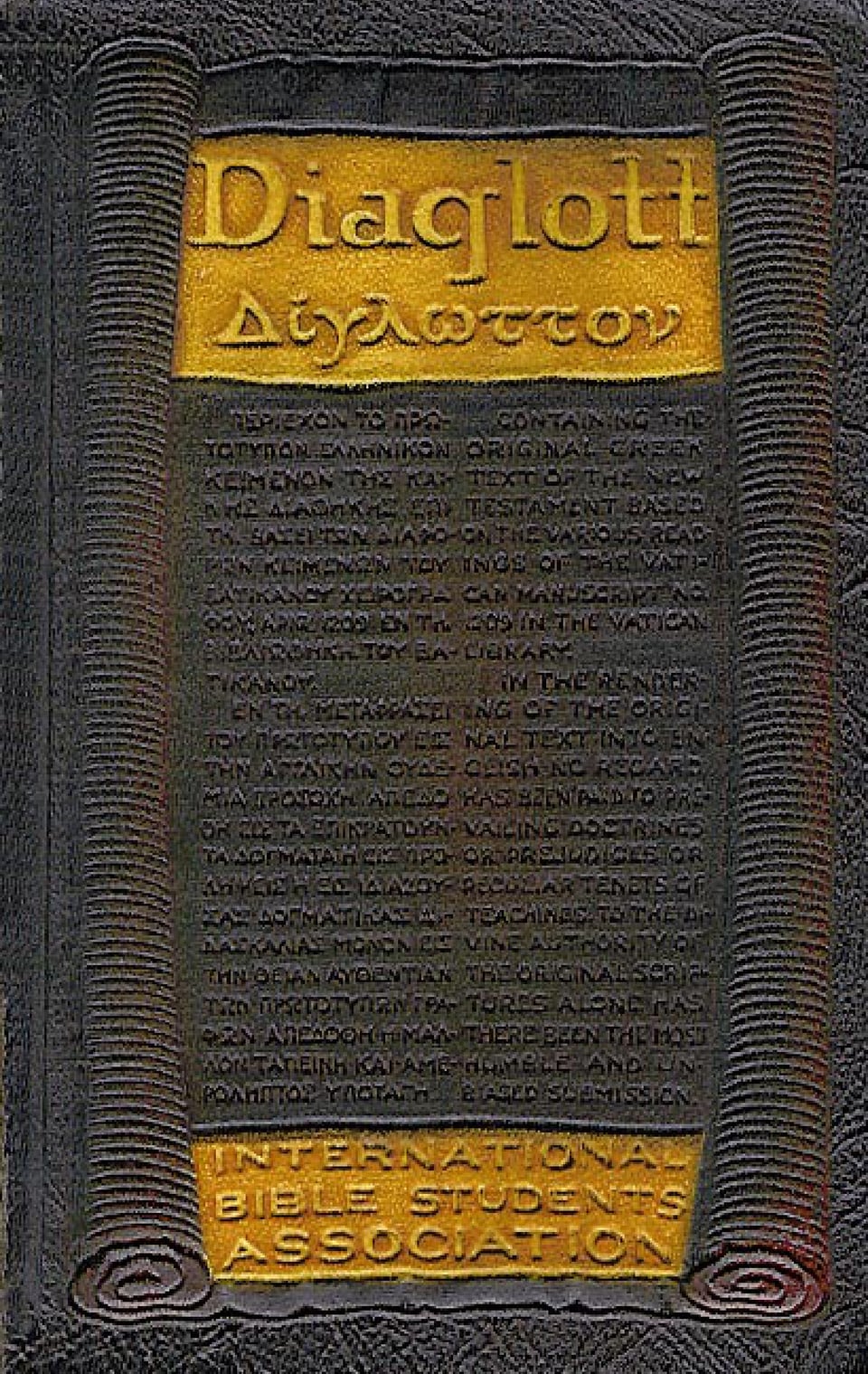
Diaqlott
Διγωττον
TERIEXON TO PRO-
TOTYTON DANNIKON ORIGINAL-GREEN
KEIMENON THE KAN TEXT OF THE NEW
IN H2 AIAOKKYE CRY TESTAMENT BASED
TH. BAZEINON LIANG ON THE VARIOUS READ
PEN KEIMENON TODY INGES OF THE VATIC
DATIKANDY YOADRA CAN MANUSCRIPT ABO
GON ANGLODON TH. GOD IN THE VATICAN
S. BAZEINON TODY BA-LIGNARY.
IN THE RENDER
EN TH METAPHAEI NG OF THE ORIG
TOM ΠΡΟΤΟΤYΤΟΝ DE NAL TEXT INTO EN
THN APTAITHN OYAS-GLISH NO RECARD
MIA TROTOXN. ALCAD HAS BEEN PAID TO PRO-
OR CLETA STINPATDYN-VAILING DOCTRINGS
TA DOPMATAITH CLE TPD-OR PREJUDICES OR
AN HICI H SE LAADY-RECOLLAR TENETS OF
ZAS DOPMATINAS AN-TEACHINGS TO THE AR-
DACHNAAS MONON DE VINE AUTHORITY OF
THN DEAN AYDENTIAN THE ORIGINAL SCRIPT
TZN ΠΡΟΤΟΤYTRN TPA-TORES ALONG HAS
INTERNATIONAL
BIBLE STUDENTS
ASSOCIATION
THE
EMPHATIC DIAGLOTT:
CONTAINING THE
Original Greek Text
OF WHAT IS COMMONLY STYLED THE
NEW. TESTAMENT, (According to the Recension of Dr. J. J. Griesbach.)
WITH AN INTERLINEARY WORD FOR WORD ENGLISH TRANSLATION;
A NEW EMPHATIC VERSION,
BASED ON THE INTERLINEARY TRANSLATION, ON THE RENDERINGS OF EMINENT CRITICS, AND ON THE VARIOUS READINGS OF
THE VATICAN MANUSCRIPT, No. 1209 in the Vatican Library.
TOGETHER WITH ILLUSTRATIVE AND EXPLANATORY FOOT NOTES. AND A COPIOUS SELECTION OF REFERENCES
TO THE WHOLE OF WHICH IS ADDED.
A VALUABLE ALPHABETICAL APPENDIX.
Br BENJAMIN WILSON.
NEW YORK:
FOWLER & WELLS CO., PUBLISHERS. 27 EAST 21ST STREET.
Entered, according to Act of Congress, in the year 1864. By BENJAMIN WILSON. In the Clerk's Office of the District Court of the United States for the Northern District of Illinois.
PREFACE.
To trouble the reader with any lengthy remarks on the important advantages to be derived from a new translation of the Sacred Writings, is deemed altogether unnecessary. Much information on this point has been given by others, who have published modern Versions of the New Testament, with the reasons which have induced them to do so. Those reasons will serve in a great measure also for this. It is generally admitted by all critics, that the Authorized or Common version of the Scriptures, absolutely needs revision. Obsolete words, uncouth phrases, bad grammar and punctuation, etc., all require alteration. But this is not all. There are errors of a more serious nature which need correction. The translators of the Common version were circumscribed and trammelled by royal mandate; they were required to retain certain old ecclesiastical words, which accordingly were left untranslated. Thus the minds of many who had no means of knowing the meaning of the original words have been misled and confused. Biblical criticism, however, during the last two hundred years, has done much to open up and elucidate the Word of God, by discovering many things which were unknown to the old translators, making great improvements in the text, detecting numerous interpolations and errors, and suggesting far better renderings of many passages. Many modern versions have availed themselves of this valuable assistance, and it is believed they have thereby been enabled to give the English reader a better understanding of what was originally written.
Without presuming to claim any superiority for this, as a translation of the New Testament, over any other modern version, it is thought that the present Work presents certain valuable features, not to be found elsewhere, and which will be of real practical utility to every one who wishes to read the books of the Evangelists and Apostles, as they were written under the guidance and inspiration of the Holy Spirit. These features are;—An approved Greek text, with the various Readings of the Vatican Manuscript, No. 1209; an Interlinear literal Word for Word English translation; a New Version, with the Signs of Emphasis; a copious selection of References; many appropriate, illustrative, and exegetical Foot-notes; and a valuable Alphabetical Appendix. This combination of important items cannot be found in any other book. The reader will find further remarks on this subject, on the page headed, "Plan of the Work;" and he is also invited to read the pages with the respective captions;—"To the Reader;" "History of the Greek Text;" and "History of English Versions." Also, on another page will be found the "Letters and Pronunciation of the Greek Alphabet," for the special benefit of those who may wish to obtain a rudimentary knowledge of that language.
The intelligent reader will at once perceive the utility and importance of this arrangement. Readers who are familiar with the original tongue, obtain in this Work one of the best Greek Testaments, with important ancient Readings, well worthy of their attention, and, it is presumed, that there are even few Greek scholars, who are so far advanced, but may derive some help from the translation given.
Those who have only a little or no knowledge of the Greek, may by careful reading, and a little attention to the Interlinear translation, soon become familiar with it. This Work, in fact, places in the hands of the intelligent English reader the means of knowing and appropriating for his own benefit, with but little labor on his part, what it has cost others years of study and severe toil to acquire.
Scrupulous fidelity has been maintained throughout this version in giving the true rendering of the original text into English; no regard whatever being paid to the prevailing doctrines or prejudices of sects, or the peculiar tenets of theologians. To the Divine authority of the original Scriptures alone has there been the most humble and unbiassed submission.
In the preparation of this Work for the press, all available help to be derived from the labors of great and learned men, has been obtained and appropriated. Lexicons, Grammars, ancient and modern Versions, Commentaries, critical and explanatory, Cyclopedias, Bible and other Dictionaries, etc., have been consulted and culled from. Also, the suggestions, opinions, and criticisms of friends, on words, phrases, and passages, have been duly considered, and sometimes adopted. It is not presumed that this Work is free from faults or errors. Infallibility is left for others to claim. Great care, however, has been exercised to make it as correct as possible.
The Work is now sent forth to the public, to stand or fall on its own merits. True, it cannot boast of being the production of a council of learned men, as King James' version, but let it be remembered that TYNDALE alone, under very disadvantageous circumstances, did far more for the English Bible than that learned body, for they only followed in the wake of his labors.
This Volume, principally designed for the instruction and advantage of others, is now reverently committed to the blessing of our Father in the heavens, with an earnest and sincere desire that many of those who peruse its pages may be led by the knowledge, faith, and obedience inculcated therein, to obtain an inheritance in the aionian kingdom of Jesus the Anointed one.
WILSON.
HISTORY OF THE GREEK TEXT.
HE following condensed account of the different editions of the Greek New Testament, will introduce the reader to the history of the Greek Text, and the various steps taken by learned men for the purpose of editing it with greater critical accuracy. The history will commence with the first printed editions.
The first printed edition of the whole of the Greek New Testament was that contained in the Complutensian Poly glot; published by Francis XIMENES de CISNEROS. The principal editor of the work was Lopez de Stunica. It was printed in Greek and Latin, and completed January 10th, 1514. In consequence of the delay as to the publication of this edition (from 1514 to 1520) that of ERASMUS was commenced and completed, and was published in 1516, being the first edition published of the Greek New Testament. Like the Complutensian edition, this was also in Greek and Latin. The latter part of the book of Revelation being wanting in his MS. he supplied the same by translating the Latin Vulgate into Greek.
The Greek Manuscripts used for these two editions were few in number, of little critical value, and therefore do not possess much real authority. In 1535, Erasmus published, his fifth edition, which is the basis of the common Text.*
In 1546, and again in 1549, ROBERT STEPHENS printed, at Paris, two beautiful small editions of the Greek New Testament; and in 1550 his folio edition with various readings from several Manuscripts—he collated some 15 MSS., but chiefly followed the Complutensian copy.
BEZA published five editions of the Greek Testament; the first in 1565, the last in 1598.
In 1624, the ELZEVIR, printers at Leyden, published a small and beautiful Greek Testament, the editor of which is wholly unknown. It differs little from Stephens' folio edition. The printers gave to this Text the name of "Textus Receptus."
In WALTON'S POLYGLOT of 1657, the Greek New Testament was given according to the Text of Stephens; and in the last volume there was a collection of various Readings from such MSS. as
were then known. These various Readings, with some additions, were given in the Greek Testament, published by Bishop Fell, at Oxford, in 1675.
In 1707, Dr. Mill's Greek Testament appeared. His Text is simply taken from Stephens' as given in Walton's Polyglot; his collection of various Readings was extensive, and these were made the ground for a critical amendment of the Text.
Dr. EDWARD WELLS published the first critical revision in parts at Oxford, between 1709 and 1719, with a translation and paraphrase.
BENGEL followed on in the same work and published his edition in 1734, and in his "Apparatus Criticus" he enlarged the stock of various Readings,
WETSTEIN published his Greek Testament in 1751-2, but only indicates in his inner margin, the few Readings which he preferred to those of the Elzevir edition. But in the collection of critical materials he did more than all his predecessors put together.
GRIESBACH. in critical labors, excels by far any who preceded him: He used the materials others had gathered. His first edition was commenced in 1775; his last completed in 1806. He combined the results of the collations of Birch, Matthaei and others, with those of Wetstein. In his Revision he often preferred the testimony of the older MSS. to the mass of modern copies.
Since the publication of Griesbach's Text, three or four other critical editions have been published, and have received the examination and approval of scholars. Of these, the edition of Scholz, has passed through numerous editions. His fundamental principle of criticism was, that the great majority of copies decide as to the correctness of the Text; hence, those who prefer the more ancient documents, will consider the Text of Griesbach preferable; while those whose judgment would favor the mass of testimonies, would prefer that of Scholz.
In addition to Scholz's collation, Lachmann, Tischendorf, Tregelles, &c., have given t. the world the result of their critical labors, and which are acknow ledged to be of the highest authority.
The number of MSS. now known, and which have been examined, is nearly 700; thus affording now a far better chance, to obtain a correct Greek Text, than when the authorized version was at first published.
HISTORY OF ENGLISH VERSIONS.
HE first English version of the New Testament was that made by JOHN WICLIF, or WICLIFFE, about the year 1367. It was translated from the Latin Bible, verba tim, without any regard to the idiom of the languages. Though this version was first in point of time, no part of it was printed before the year 1731.
TYNDALE's translation was published in 1526, either at Antwerp or Hamburg. It is commonly said that Tyndale translated from the Greek, but he never published it to be so on any title page of his Testament. One edition, not published by him, has this title—"The Newe Testament, dylygently corrected and compared with the Greke, by Willyam Tyndale, and fynesshed in the yere of oure Lorde God, A. M. D. and xxxiiij. in the moneth of Nouember." It is evident he only translated from the Vulgate Latin.
COVERDALE published the whole Bible in English, in the year 1535. He "followed his interpreters," and adopted Tyndale's version, with the exception of a few alterations.
MATTHEW'S BIBLE was only Tyndale and Coverdale's, published under the feigned name of Thomas Matthews.
HOLLYBUSHE'S NEW TESTAMENT was printed in 1538, "both in Latin and English, after the Vulgate text," to which Coverdale prefixed a dedication to Henry VIII.
THE GREAT BIBLE, published in 1539, purported to be "translated after the veryte of the Hebrue and Greke textes," but it is certain that it was only a revision of Matthew's, with a few small alterations. It was named "the Great Bible," because of its large size.
CRANMER'S BIBLE, published in 1540, was essentially the same as the Great Bible, but took his name on account of a few corrections which he made in it.
THE GENEVA BIBLE was published at Geneva in 1560. The New Testament in 1557. Coverdale was one of the Geneva brethren who issued it.
THE BISHOPS' BIBLE was a revisal of the English Bible, made by the bishops, and compared with the originals. It was published in 1568.
THE DOWAY BIBLE appeared in 1609, and was translated from the authentical Latin, or Vulgate.
KING JAMES' BIBLE, or the Authorized Version, was published in 1611. In the year 1604, forty-seven persons learned in the languages, were appointed to revise the translation then in use. They were ordered to use the Bishops' Bible as the basis of the new version, and to alter it as little as the original would allow; but if the prior translations of Tyndale, Coverdale, Matthew, Cranmer or Whitchurch, and the Geneva editors agreed better with the text, to adopt the same. This translation was perhaps the best that could be made at the time, and if it had not been published by kingly authority, it would not now be venerated by English and American protestants, as though it had come direct from God. It has been convicted of containing over 20,000 errors. Nearly 700 Greek MSS. are now known, and some of them very ancient; whereas the translators of the common version had only the advantage of some 8 MSS., none of which were earlier than the tenth century.
Since 1611, many translations of both Old and New Testaments, and portions of the same, have been published. The following are some of the most noted.
The Family Expositor: or a Paraphrase and Version of the New Testament, with Critical Notes. By Philip Doddridge. 1755.
The Four Gospels translated from the Greek. By George Campbell. 1790.
A New Literal Translation, from the Original Greek, of the Apostolical Epistles. By James Macknight. 1795.
A. Translation of the New Testament. By Gilbert Wakefield. 1795.
A Translation of the New Testament, from the original Greek. Humbly attempted by Nathaniel Scarlett, assisted by men of piety and literature. 1708.
The New Testament in an Improved Version, upon the basis of Archbishop Newcome's New Translation, with a corrected Text. 1808.
The New Testament, in Greek and English; the Greek according to Griesbach; the English upon the basis of the fourth London edition of the Improved Version, with an attempt to further improvement from the translations of Campbell, Wakefield, Scarlett, Macknight, and Thomson. By Abner Kneeland. 1822.
A New Family Bible, and improved Version, from corrected Texts of the Originals, with Notes Critical, &c. By B. Boothroyd. 1823.
The Sacred Writings of the Apostles and Evangelists, translated from the Original, by Campbell, Macknight, and Doddridge, with various Emendations by A. Campbell. 1883.
A New and Corrected Version of the New Testament. By R. Dickinson. 1833.
The Book of the New Covenant, a Critical Revision of the Text and Translation of Common Version, with the aid of most ancient MSS. By Granville Penn. 1836.
The Holy Bible, with 20,000 emendations. By J. T. Conquest. 1841.
The Good News of our Lord Jesus, the Anointed; from the Critical Greek of Tittman. By N.N.Whiting. 1849.
A Translation of the New Testament, from the Syriac. By James Murdock. 1852.
Translation of Paul's Epistles. By Joseph Turnbull. 1854.
The New Testament, translated from Grlosbach's Text. By Samuel Sharpe. 1856.
TO THE READER.
THAT "All Scripture, divinely inspired, is profitable for Teaching, for Conviction, for Correction, for THAT Instruction which is in Righteousness," is the truthful testimony of the Sacred Writings about themselves. We rejoice to express our conviction that the Word of God was perfect and infallible as it emanated from those holy men of old, the Prophets and Apostles, who "spoke, being moved by the Holy Spirit." As a revelation of Jehovah's will to the human race, it was requisite that it should be an unerring guide. Amid the ever conflicting strife of human opinions, and the endless diversity of thought, we needed such a standard, to lead us safely through the perplexing problems of life, to counsel us under all circumstances, to reveal the will of our Heavenly Parent, and to lift on high a celestial light, which streaming through the thick darkness that broods around, shall guide the feet of his erring and bewildered children to their loving Father's home. We needed therefore a testimony upon which to repose our faith and hope, free from all error, immutable, and harmonious in all its details—something to tell us how to escape from the evils of the present, and attain to a glorious future. With reverence and joy we acknowledge the Sacred Writings to be such, as they were originally dictated by the Holy Spirit. How important then that they should be correctly read and understood!
But can it be fairly said that such is the case with our present English Version? We opine not. Though freely acknowledging that it is sufficiently plain to teach men the social and religious duties of life, and the path to Immortality, yet it is a notable fact that King James' Translation is far from being a faithful reflection of the mind of the Spirit, as contained in the Original Greek in which the books of the New Testament were written. There are some thousands of words which are either mistranslated, or too obscurely rendered; besides others which are now obsolete, through improvement in the language. Besides this, it has been too highly colored in many places with the party ideas and opinions of those who made it, to be worthy of full and implicit confidence being placed in it as a genuine record. In the words of Dr. Macknight, "it was made a little too complaisant to the King, in favoring his notions of predestination, election, witchcraft, familiar spirits, and kingly rights, and these it
"is probable were also the translators opinions. That their translation is partial, speaking the language of, and giving authority to one sect." And according to Dr. Gell, it was wrested and partial, "and only adapted to one sect;" but he imputes this, not to the translators, but to those who employed them, for even some of the translators complained that they could not follow their own judgment in the matter, but were restrained by "reasons of state."
The Version in common use will appear more imperfect still, when the fact is known, that it was not a translation from the Original, but merely a revision of the Versions then in use. This is evident from the following directions given by King James to the translators, viz.: "The Bishops' Bible to be followed, and altered as little as the Original will permit. And these translations to be used when they agree better with the text than the Bishops' Bible—namely, Tyndal's, Matthew's, Coverdale's, Whitchurch's, Geneva." None of these were made from the Original Greek, but only compared with it—being all translated from the Vulgate Latin. Hence it follows, that the authorized version is simply a revision of the Vulgate. And the Greek Text, with which it was compared, was compiled from Eight MSS. only, all of which were written since the tenth century, and are now considered of comparatively slight authority. The "Textus Receptus," or Received Greek Text, was made from these MSS., and is now proved to be the very worst Greek Text extant, in a printed form. And there was only one MS. for the Book of Revelation, and part of that wanting, which was supplied by translating the Latin of the Vulgate into Greek! Since the publication of the "Textus Receptus," and the Common Version, some 660 MSS. have been discovered, some of which are very ancient, and very valuable. The best and oldest of these is one marked B., Cod. Vaticanus, No. 1209, of the fourth and fifth centuries. The second marked A., Cod. Alexandrinus, of the fifth century. The third marked C., Cod. Ephrem., about the fifth century, and the fourth, marked D., Cod. Cantabugiensis, of the seventh century.
Besides valuable assistance from ancient MSS., the DIAGLORR has obtained material aid from the labors of many eminent Biblical Critics and Translators. Among these may be mentioned,—Mill, Wetstein, Griesbach, Scholz, Lachmann, Tischendorf, Tittman, Tregelles, Doddridge. Macknight, Campbell, Horne, Middleton, Clark, Wakefield, Bloomfield, Thompson, Murdock. Kneeland. Boothroyd, Conquest, Sharpe, Gaussen, Turnbull, Trench, &c., &c.
Should any person doubt the propriety of the Translation, in any particular part, let him not hastily censure or condemn till he has compared it carefully with the various authorities on which it is based; and even should he see reason to differ in some respects, a correct Greek Text is given, so that the Original may be always appealed to in cases of doubt. However imperfect the Translation may be considered by the Critie, it cannot adulterate the Original.
PLAN OF THE WORK.
--and Phrases intimately connected with doctrinal subjects, alphabetically arranged. These will be critically examined, and the light of Biblical science thrown upon such as have given rise to sectarian disputes, and the cavils of infidels.
Greek Text and Interlinear Translation. The left hand column contains the GREEK TEXT according to Dr. J. J. Griesbach, and interlined with it a LITERAL WORD-FOR-WORD TRANSLATION, wherein the corresponding English is placed directly under each Greek word.
The Sectional Divisions are those of the Vatican and Alexandrian MSS. Greek Words enclosed in brackets [thus,] though authorized by Griesbach, are omitted by the Vat. MS.
The advantages to be derived from such an arrangement must be apparent to the Bible Student. The learned have a Greek Text acknowledged to be one of the best extant, while the unlearned have almost an equal chance with those acquainted with the Original, by having the meaning and grammatical construction given to each word. This part of the work will be a desideratum by many, but more adapted for criticism than reading. Although by adhering to the arrangement of the Original, the Translation may appear uncoath, yet the strength and beauty of many passages are thereby preserved.
The frequent recurrence of the Greek article of emphasis, and an occasional ellipsis, often interfere with the sense and elegance of a sentence, but this cannot well be avoided in a word-for-word Translation. The advantages, however, accruing to the diligent investigator of the Divine Word by persuing this plan are many, and will be duly appreciated.
New Version.—The column on the right hand side of the page is a NEW VERSION for general reading. This rendering is based upon that in the left hand Column, and the labors of many talented Critics and Translators of the Scriptures. The Readings of the oldest Manuscripts now known are sometimes incorporated, and always referred to. In this Column the EMPHATIC SIGNS are introduced, by which the Greek Words of Emphasis are designated. For the use and beauty of this arrangement, the reader is requested to examine the annexed remarks on Signs of Emphasis.
The Chapters and Verses of the Common Version have been retained, principally for convenience of reference. The reader however, by following the paragraphs in the opposite column, need not be governed by these arbitrary divisions. Chapters and Verses were not introduced till the middle of the 16th century.
Foot Notes and References. The various Readings of the Vatican MS., Notes for the elucidation of the text, and References, are introduced at the bottom of the page. The Notes are critical, illustrative, explanatory, and suggestive. Old Testament quotations are always referred to, and copious parallel passages in the New.
Appendix.—It is intended to add an Appendix to the Work, containing all the Geographical and Proper Names found in the New Testament, with Words
SIGNS OF EMPHASIS.
The Greek article often finds its equivalent in the English definite article the, but in the majority of cases it is evidently only a mark of emphasis. It frequently precedes a substantive, an adjective, a verb, an adverb, a participle or a particle, thus pointing out the emphatic words. The Greek article and Emphatic Pronouns exercise a most important influence on the meaning of words, and sometimes throw light on doctrines of the highest interest. The sacred penmen of the New Testament were, in the opinion of many eminent persons, guided by Divine inspiration in the choice of their words; and in the use of the Greek article there was clearly a remarkable discretion displayed. In fact, the Signs of Emphasis are incorporated with the words in such a manner, that the latter cannot be stated without conveying at the same time to the intelligent mind an idea of the very intonation with which the sentence was spoken when it was written down. This peculiarity of the Greek language cannot be properly expressed in English except by the use of typographical signs; such as, Initial Capital letters, italics, small capitals, and CAPITALS.
The Common Version of the New Testament fails to give the reader a full conception of the meaning designed to be conveyed by the Greek original, in regard—
1st. To those Words which are connected with the Greek Article;
2d. To those Pronouns Substantive which are intended to carry in themselves a peculiar emphasis; and,
3d. To those Adjectives and Pronouns which obtain a comparative importance, by reason of the position which they occupy in the Greek Text, with reference to some other words.
To remedy these deficiencies, the following System of Noattion is employed in the English column of the DIAGLOTT.
Those Words rendered positively emphatic by the presence of the Greek article. are printed in Small Capitals: as, "The LIFE was the LIGHT of MEN."
Those Pronouns Substantive which, in the Greek, are intended to be positively emphatic are printed in Black Letter: as, "He must increase, but He must decrease."
Those Adjectives and Pronouns which in the Greek are comparatively emphatic, as indicated by their position, are printed with an Initial Capital Letter: as, "One Body, and One Spirit, even as ye are called in One Hope of your CALLING."
All Greek Substantives, as being of more importance than other words, are also commenced with a Capital Letter.
By adopting these Signs of Emphasis, it is believed certainty and intensity are given to passages where they occur, as well as vivacity and earnestness to the discourses in which they are found; thus rendering the reader, a heaver, as it were, of the life-words of Him "who spoke as never man spoke." or which were enunciated by His inspired apostles.
<tr><th>FIGURE.
NAME.
SOUND, OR POWER.
REMARKS.
A α
Alpha
a
Accents are said to sometimes assist the reader to discriminate between words which are alike in form, but different in meaning; but as they are by no means necessary, either for the pronouncing or understanding of the Greek language, and as the earliest of all the manuscripts of the Greek Testament is without accents, it has been thought best to omit them in the DIAGLOTT, leaving the sense, in doubtful cases, to be determined by the context. If accents favor a particular sense, it may be an erroneous one, and then they are injurious; and if they do not favor any particular sense, then they are unnecessary.
B β
Beta
b
Γ γ
Gamma
g hard, as in begin
Δ δ
Delta
d
E ε
Epsilon
e short, as in met
Z ζ
Zeta
z
H η
Eta
e long, as in keen
Θ θ
Theta
th
I ι
Iota
i
K κ
Kappa
k
Λ λ
Lambda
l
M μ
Mu
m
N ν
Nu
n
Σ ξ
Xi
x
Ο ο
Omicron
o short, as in lot
Π π
Pi
p
Pronunciation.—Considerable discrepancy of opinion prevails among the learned concerning the proper sound of some of these letters, and as it is impossible at this distance of time to ascertain the mode of pronunciation among the ancient Greeks, the simplest plan is to consider each Greek letter as corresponding in sound to its correlative letter in our own alphabet, as shown in the Table.
P ρ
Rho
r
Σ σ, final s
Sigma
s
T τ
Tau
t
Υ v
Upsilon
u
Φ φ
Phi
ph
X χ
Chi
ch hard, as in chord
Ψψ
Psi
ps
Ωω
Omega
o long, as in throne.
The LETTERS are divided into seven vowels and seventeen consonants.
The Vowels are ε, o short; η, ω long; and α, i, v doubtful.
Diphthongs are formed of two vowels joined together, and are twelve in number; six proper, α{1},α{v},ε{i},ε{o{l}},ω{v} and six im proper, α,η,ψ,η v,ω,v_{i}. The little stroke under α,η,ψ, standing for Iota, called Iota subscript, is not sounded, but merely serves to show the derivation.
The LABIALS, (π ,β ,φ,) the PALATALS, (κ ,γ ,χ,) and the DENTALS, (τ ,δ ,θ,) are named according to the organs of articulation employed in pronouncing them. To each of these classes belongs a double letter, so called because combining the sound of s with that of another consonant; thus, the Labials, π s, β s, φ s, are equal to ψ , the Palatals, κ s, γ s, χ s, to ξ .and the Dentals, τ s, δ s, to ζ.
The letter ν can stand only before Dentals; before Labials it becomes μ before the liquids, (λ ,μ ,ν ,ρ_{,}) assimilation takes place, so that before λ it becomes λ , before ρ it becomes ρ &c. Before Palatals ν is converted into γ but observe, that whenever γ is found before another γ , or either of the other Palatals, it is always pronounced like n ; thus α γ γ ε λ o s (angel) is pronounced angelos, not aggelos.
Every word having a vowel or diphthong for the first letter is, in most printed books, marked at the beginning either with an aspirate, or rough breathing, ('), as ἡλιος, (sun,) pronounced as if written helios; or with a smooth one, ('), as ἐπι, (upon,) simply read epi. The former one of these breathings is only of necessary use, and may be considered as having the force of the English letter h. The aspirate is placed over ρ and v when they stand at the beginning of a word; thus βοδον, (a rose,) pronounced rhodon. In diphthongs the breathing is placed over the second vowel; thus νίος, (a son,) pronounced why-os. When ρ is doubled, the last one takes the aspirate, as ερβώσo, pronounced errhoso.
Words in Greek are of eight kinds, called Parts of Speech; viz., Article, Noun, Pronoun, Verb, Participle, Adverb, Preposition, and Conjunction.
The Article, Noun, Pronoun, and Participle, are declined with Gender, Number, and Case.
There are three Genders; the Masculine, Feminine and Neuter. There are two Numbers; the Singular, which speaks of one, as λογος, a word; and the Plural, which speaks of more than one, as λογοι, words.
To these the Greeks added a third number, called the Dual, which only sp of two, but this number was not much used, and is not found either in the Septuagint, or New Testament.
There are five Cases; the Nominative, Genitive, Dative, Accusative, and Vocative.
The Article δ, η, τ o , generally answers to the definite article the in English. When no article is expressed in Greek, the English indefinite article a is signified. Thus α vθρωτ o s means a man, or man in general; and δ α vθρωτ o s , the man. It is thus declined:
SINGULAR.
SINGULAR.
PLURAL.
Masc.
Fem.
Neut.
Masc.
Fem.
Neut.
Jom.
δ,
η,
το,
the.
Nom.
oï,
ai,
ta,
the.
Gen.
τov,
τηs,
του,
of the.
Gen.
των,
των,
των,
of the.
Dat.
φ,
η,
φ,
to the.
Dat.
ois,
ais,
ois,
to the.
Acc.
τον,
την,
το,
the.
Acc.
ovs,
as,
ta,
the.
The Article has no vocative; ω , which sometimes precedes a noun in the vocative, is an Interjection.
The Article takes the consonant τ in every Case, except in the nom. sin. masc. and fem. δ, η , and in the nom. pl. masc. and fem. oi, ai, where the τ is superseded by the aspirate (').
The gen. pl. in all genders and in every declension, enas in ω v.
The Personal or Primitive Pronouns are three; εγω, I, plural ημε s, we, of the first person ; σ v, thou, plural υμε s, you, of the second; Gen. υ v, he or she, plural σφε s, they, of the third.
The Relative Pronouns are δ s, η, δ , who, which, and av\tos, avτη, av\tro, he, she, it, &c., &c., &c. KEΦ.
α, 1.
1 Bißlos γεννεσως Πηgov Χριστου, νιον
A record of descent of Jesus Christ, son of
Δανιδ, νιον Αβρααμ. 2 Αβρααμ εγεννησε τον
David, son of Abraam. Abraam begot the
Iσακ· Iσακ δε εγεννησε τον Ιακωβ· Ιακωβ
Isaac; Isaac and begot the Jacob; Jacob
δε εγεννησε τον Iovδαν και τους αδέλφους
and begot the Judas and the brothers
avτον. 3 Iovdas δε εγεννησε τον Φαρες και τον
of him. Judas and begot the Phares and the
Zара εκ της Θαμαρ. Φαρές δε εγεννησε τον
Zara by the Thamar. Phares and begot the
Εσρωμ· Εσρωμ δε εγεννησε τον Αραμ· 4 Αραμ
Esrom; Esrom and begot the Aram; Aram
δε εγεννησε τον Αμιναδαβ· Αμιναδαβ δε
and begot the Aminadab; Aminadab and
εγεννησε τον Ναασσων· Ναασσων δε εγεννησε
begot the Naasson; Naasson and begot
τον Σαλμων· 5 Σαλμων δε εγεννησε τον Booζ
the Salmon: Salmon and begot the Booz
εκ της 'Ρахαβ. βooζ δε εγεννησε τον Ωβηδ εκ
by the Rachab. Boos and begot the Obed by
της 'Povθ. Ωβηδ δε εγεννησε τον Ιεσσαι·
the Ruth. Obed and begot 'the Jesse:
Jesse and begot the David the king.
Δαυδ δε *[δ βασιλεvs] εγεννησε τον Σολομωνα
David and [the king] begot the Solomon
εκ της τον Ουριον. 7 Σολομων δε εγεννησε
by the of the Urias. Solomon and begot
τον 'Ροβoaμ· 'Ροβoaμ δε εγεννησε τον Αβια·
the Roboam; Roboam and begot the Abia;
Αβια δε εγεννησε τον Ασα· 8 Ασα δε εγεννησε
Abia and begot the Asa; Asa and begot
τον Ιωσαφат· Ιωσαφat δε εγεννησε τον Ιωραμ·
the Josaphat; Josaphat and begot the Joram;
Ιωραμ δε εγεννησε τον Οζιαν· 9 Οζias δε εγεν-
Joram and begot the Ozias; Ozias and begot
νησε τον Ιwaθαι· Ιwaθαι δε εγεννησε τον Αχαζ·
the Jotham; Jotham and begot the Achaz;
Αχαζ δε εγεννησε τον Εξεκιαν· 10 Εξεκias δε
Achaz and begot the Ezekias; Ezekias and
εγεννησε τον Μνασση· Μνασσης δε εγεννησε
begot the Manasses; Manasses and begot
τον Αμων· Аμων δε εγεννησε τον Ιωσίαν· 11 Ιωcias
the Amon; Amon and begot the Josias; Josias
δε εγεννησε τον Ιεχονιαν και τους αδέλφους
and begot the Jechonias and the brothers
αντου, επι της μετοικεσις· Βαβυλωνos.
of him, near the removal Babylonian.
CHAPTER 1.
1 A Register of the Lineage of Jesus Christ, Son of David, Son of Abraham.
2 From ‡ Abraham proceeded Isaac; from ‡ Isaac, JACOB; from ‡ Jacob, JUDAH and his BROTHERS;
3 from Judah, PHAREZ and ZARAH, by TAMAR; from Pharez, HEZRON; from Hezron, RAM;
4 from Ram, AMMINADAB; from Amminadab, NAHSHON; from Nahshon, SALMON;
5 from Salmon, BoAz, by RAHAB; from Boaz, OBED, by RUTH; from Obed, Jesse;
7 Solomon had REHOBOAM; Rehoboam had ABIJAH; Abijah had ASA;
6 and from Jesse, DAVID the KING. David had Solomon by the [WIDOW] of URIAH;
8 Asa had JEHOSHA PHAT; Jehoshaphat had +JEHORAM; Jehoram had Uzziah;
9 Uzziah had JOTHAM; Jotham had AHAZ; Ahaz had HEZEKIAH;
10 Hezekiah had MANASSEH; Manesseh had AMON; Amon had JO SIAH;
11 and + Josiah had JECHONIAH and his BROTHERS, near the time of the CARRYING-AWAY to Babylon.
12 Μεταδέ τηνμετοικειαν Βαβυλωvos, Ιεχονias
After and the removal Babylonian, Jechonias
γεννησε τον Σαλαθιπλ. Σαλαθιπλ δε γεννησε
begot the Salathiel. Salathiel and begot
του Zoroβαβελ· 13 Zoroβαβελ δε γεννησε του
the Zorobabel; Zorobabel and begot the
Αβιονδ· Αβιονδ δε γεννησε του Ελιακειμ· Ελια-
Abiud; Abiud and begot the Eliakim; Elia-
κειμ δε γεννησε του Αζωρ· 14 Αζωρ δε γεννησε
kim and begot the Azor; Azor and begot
του Σαδωκ· Σαδωκ δε γεννησε του Αχειμ· Αχειμ
the Sadok; Sadok and begot the Achim; Achim
δε γεννησε του Ελιονδ· 15 Ελιονδ δε γεννησε
and begot the Eliud; Eliud and begot
του Ελεξαρ· Ελεξαρ δε γεννησε του Матθιν·
the Ileazar; Eleazar and begot the Matthan;
Matθav δε γεννησε του Ιαικwb· 16 Ιαικwb δε
Matthan and begot the Jacob; Jacob and
γεννησε του Ιωσηφ, τον ανδρα Марías, εκ ηs
begot the Joseph, tho husband of Mary, of whom
γεννηθη Ιησους, δ λεγομενος Χριστος.
17 Πασαι ovv ai γεννεai απο Αβρααμ ἐws Δανίδ,
All then the generations from Abraam till David,
γεννεai δεκατεσσαρες° και από Δανιδ ἐws της
generations fourteen; and from David till the
μετοικειας Βαβυλωνos, γεννεai δεκατεσσαρες°
removal Babylonian, generations fourteen;
και από της μετοικειias Βαβυλωνos ἐws τον
and from the removal Babylonian till the
Xριστου, γεννεai δεκατεσσαρες.
Christ, generations fourteen.
18 Tov de Iησον Χριστον η γενεσις οὐτως πν.
Of the now Jesus Christ the birth thus was.
Mνηστευθείσης γαρ της μητρος αυτου Μαριας τφ
Being espoused for the mother of him Mary to the
Iωσηφ, πριν η συνελθειν αυτους, εύρεθη εν
Joseph, before either came together them, she was found in
γαστρί εχουσα εκ πνευματος ἀγίου. 19 Iωσηφ δε
womb having by a spirit holy, Joseph and
δ ανηρ αυτης, δικαιοςων και μη θελων αυτην
the husband of her, a just man being and not willing her
παραδείγματισαι, εβουληθη λαθρα απολυσai
to publicly expose, was inclined secretly to release
αντην. 20 Ταντα δε αυτου ενθυμηθηκεντος, ιδον,
her. These but of him thinking on, lo,|
αγγελος κυρίου κατ' οναρ εφανη αυτψ, λεγων*
a messenger of a lord in a dream appeared to him, saying;
Iωσηφ, νιος Δανιδ, μη φοβηθης παραλαβειν Μα-
Joseph, son of David, not thou shouldst fear to take Ma-
ριαμ την γυναика σουν· το γар εν αυτη γεννηθεν,
ry the wife of thee; that for in her being formed,
εκ πνευματος σστην ἀγίου. 21 τεξεται δε νιον, και
by a spirit is holy; she shall bear and a son, and
καλεσεις το ονομα αυτου Ιησούν· αυtos γαρ σωσει
thou shalt call the name of him Jesus; he for shall save
12 And after the CARRYING-AWAY to Babylon, from Jeconiah descended SALATHIEL; from Salathiel, ZERUBBABEL;
13 from Zerubbabel, ABIUD ;from Abiud, ELIAKIM; from Eliakim, Azor;
14 from Azor, ZADOC; from Zadoc, ACHIM; from Achim, ELIUD;
15 from Eliud, ELEAZAR; from Eleazar, MATTHAN; from Matthan, JACOB;
16 and from Jacob, JOSEPH, the HUSBAND of Mary, of whom was born THAT Jesus, who is NAMED Christ.
17 [All the GENERATIONS, then, from Abraham to David, are fourteen Generations; from David till the CARRYINGAWAY to Babylon, fourteen Generations; and from the CARRYINGAWAY to Babylon till the MESSIAH, fourteen Generations.]
18 Now the NATIVITY of the *CHRIST Jesus was thus: Mary his MOTHER had been pledged to JOSEPH; but before they united, she was discovered to be pregnant by the holy Spirit.
19 Then Joseph, her afflianced HUSBAND, being a just man, and unwilling to expose her, purposed to divorce her privately.
20 But while he was reflecting on these things, behold! an Angel of the Lord appeared to him in a Dream, saying, "Joseph, Son of David, fear not to take Mary, thy affianced WIFE; for THAT BEING FORMED in her is by the holy Spirit:
21 she will bear a Son, and thou shalt call his NAME † Jesus; for he will τον λαον αὐτουν αποτων ἀμαρτιων αντων.22 (Τουτο the people of him from the sins of them; This δε δλov γεγονεν, ένα πληρωθη το ρήθεν υπο and all was done, so that might be fulfilled the word spoken by τον κυριον δια του προφητου, λεγοντος.231δov, the lord through the prophet, saying; "Lo, η παρθενος εν γαστρι έξει, και τεξεται νίον, και the virgin in womb shall have, and shall bear a son, and καλεσονσι το ονομα αυτου Εμμανονηλ."
δ εστι they shall call the name of him Emmanuel;" which is
save his PEOPLE from their SINS."
22 (All this occurred, that the WORD SPOKEN by the Lord through the PROPHET, might be verified, saying :
23 $ " Behold! the VIRGIN shall conceive, and bear a Son, and his
μεθερμηνευομενον, μεθ' ημων *[δ] θεος.)
being translated, with us [the] God.
24 Διεγερθείς δε δ'Iωσηφ απο τον ἡπνου, εποίησεν
Being aroused and the Joseph from the sleep, he did
ως προσεταξεν αυτψ οὐ αγγελος κυριον και παρε-
as commanded to him the messenger of a lord; and took
λαβε την γυναικα αὐτον, 25 και οvk εγινωσκεν
the wife of him, but not he knew
αντην έως οὐ ετεκε [τον] νιον [αυτης τον
her till she brought forth [the ] son [of her the
πρωτοτοκον] και εκαλεστε το ονομα αντον Ιησουν.
first-born; ] and called the name of him Jesus.
KEΦ. β'. 2.
1Tov δε Iησον γεννηθεντος εν Bηθλεεμ της
The and Jesus being born in Bethleem of the
Iovδαίας, εν ημερας 'Hρwδov τον βασιλεws, ιδov,
Judea, in days of Herod the king, lo,
μαγοι από ανατολων παρεγευνοντο εις 'Iερροσκλη-
wise-men from an east country came into Jerusalem,
μα, λεγονταιτε·2Πov εστιν δ τεχθείς βασιλεvs των
"NAME shall be called " † Imma-nu-el ; " which signifies, God with us.)
24 And Joseph, being raised from SLEEP did as the ANGEL of the Lord had commanded him, and took his WIFE;
25 but he knew her not, till she brought forth a Son, and called his NAME Jesus.
CHAPTER II.
1 And Jesus being born in Bethlehem of JUDAEA, in the Days of Herod, the KING, behold, Magians from the East, came into Jerusalem; saying:
2 "Where is the NEWBORN KING of the JEWS?
Iovδαίων; ειδομεν γαρ αυτον τον αστερα εν τη
Jews? we saw for of him the star in the
ανατολη, και ηλθομεν προκυνησαι αντφ. 3Ακον-
rising. and are come to do homage to him. Having
σας δε 'Hρωδης δ βασιλεvs εταραχθη, και πασα
heard and Herod the king was alarmed, and all
'Iερσολονμα μετ' αντον. 4Και συναγαγων παντας
Jerusalem with him; and having called together all
τους αρχιερεις και γραμματαις τον λαον, επυν-
the chief-priests and scribes of the people, he in-
θανето παρ' αντων, που δ Χριστος γενναται. 5Οί
quired of them, where the Anointed should be born. They
δε είπον αντφ· Εν Βηθλεεμ της Iovδαίας· οὐτω
and said to him; In Bethleem of the Judea; thus
γαρ γεγραπται δια τον προφητου. 6‘Kai σv Βηθ-
for it is written by the prophet “And thou Beth-
λεεμ, γη Iovδα, ονδαμws ελαχιστηει εν τοιs
leem, land of juda, by no means least art among the
ήγεμοσιν Iovδα· εκ σον γαρ εξελευσεται ήγουμε-
princes of Juda; out of thee for shall come forth a prince,
vos, δστις ποιανει τον λαον μου, τον Ισραπλ.”
for we saw his STAR at its RISING, and are come to do him homage." 3 Now *Herod, the KING, having heard, was alarmed, and All Jerusalem with him.
4 And having assembled All the CHIEF-PRIESTS and Scribes of the PEOPLE, he inquired of them where the MESSIAH should be born.
5 And THEY answered, "In Bethlehem, of JUDAEA;" for thus it is written by the PROPHET: 6 ‡ "And thou Bethlehem, Land of JUDAH, art by no means least as to the PRINCES of Judah; for out of thee shall come forth a Prince, who shall rule
who shall govern the people of me, the Israel." 7Τοτε 'Ηρψδης λαθρα καλεσας τους μαγους,
Then Herod privately having called the wise-men,
"my PEOPLE ISRAEL."
7 Then Herod, having secretly called the MAGIANS,
VATICAN MANUSCRIPT-23. a God. 25. a Son. 25. of her the first-born. om.; so Lachmann and Tischendorf. 3. the king Herod.
† 23. Heb. IMMA, with; NU, us; and EL, God—the future name of Jesus; showing that he will be "a God with us." It is not emphatically "God" who will be with his people under the name of Immanuel; but "God," in the same sense in which it is said "The word was God."—John i.1. (See Dr. Middleton on the Greek Article.) 1. A Sect of Philosophers.
‡ 21. Isa. lix. 20; Rom. xi. 26, 27. ‡ 23. Isa. vii. 14. ‡ 25. Luke ii. 7. ‡ 6. Micah v. 2.
nekriβωσε παρ' αυτων τον χρονον του φαινομενου learned exactly from them the time of the appearing αστερος, 8 και πεμψας αυτους εις Βηθλεεμ, a star, and sending them into Bethleem, ειπί Πореνθεντες, akριβως εξεταισατε περι τον he said; Passing on your way, exactly inquire about the παιδίου επαν δε εύρηте, απαγγειλάτε μοι, δπως infant; as soon as and you have found, bring word to me, that κάγω ελθων προσκυνησω αντφ. 9 Οιδε ακονσαντες I also going pay homage to him. They and having heard τον βασιλεws επореνθησαν. Kai ιδov, δ αστηр, of the king departed. And lo, the star, δν είδov εν τη ανατολη, προηγεν αυтов, έως which they saw in the rising, went before them, till ελθων εστη επανω οὐ την το παιδιον. 10 Ιδοντες going it stood over where was the infant. Seeing δετου αστερα, εχαρποσαν χараν μεγαλην σφοδρα and the star, they rejoiced a joy very great; 11 και ελθοντες εις τηνοικιαν, ειδOVTO παιδιο μετα and being come into the house, they saw the infant with Μαρias της μητρος αυτόν, καιπεοντες προσεkv- Mary the mother of it, and falling down did homage νησαν αυτόν, και avoiξαντες τους θησανρουsv αυτων, to it, and opening the treasuries of them, προσηγεκαν αυτόφ δώρα, χρυσον και λιβαvon και they offered to it gifts, gold and frankincense and συmvρνα. 12 Kai χρηματισθεντες κατ' οναρ, μη myrrh. And being warned in a dream not ανακαμψαι προς 'Hρωδην, δι' αλλάν δεν ανεχω-to return to Herod, by another way they οπασαν είναι την χωραν αυτόν.
13 'Αναχωρησαντων δε αυτων, ιδον, αγγελος
Having withdrawn but of them, lo, a messenger
κυριον φαινεται κατ' οναρ τῶι Ιωσπηφ, λεγων'
of a lord appears in a dream to the Joseph, saying;
Εγερθεις παραλαβε το παιδιον και την μπερα
Arising take the infant and the mother
αντον, και φενγε εις Αιγνπτου, και ισθι εκει,
of it, and flee into Egypt, and be thou there,
έως αν είπω σοι μελλει γαρ 'Hρωδης ζητειν το
till I speak to thee; is about for Herod to seek the
παίδιον, τον απολεσαι αυτό. 14 'O δε εγερθεις
infant, to kill it. He then arising
παρελαβετο παιδιον και την μπερα αντον νυκτος,
took the infant and the mother of it by night,
καὶ αναχωρησε εις Αιγνπτου. 15 Και ην εκει έως
and went into Egypt; and he was there till
της τελευτης 'Hρωδον ἐνα πληρωθη τορηεν
the death of Herod; that might be fulfilled the word spoken
ύπο που κυριον δια του προφητου, λεγοντος
by the lord through the prophet, saying:
"Eξ Αιγνπτου εκαλεσα τον νιον μου."
Out of Egypt I called the son of me."
16 Τοτε 'Hρωδης ιδων ότι ενεπαίχθη δπο των Then Herod seeing that he was mocked by the
ascertained exactly from them the TINE of the STAR'S APPEARING;
8 and sending them to Bethlehem, he said, "Go, search strictly for the CHILD; and as soon as you have found him, bring me Word, that also may go and pay him reverence."
9 And THEY, having heard the KING, departed; and behold! the STAR which they saw at its RISING, preceded them, till it came and stood over the place where the CHILD was.
10 And seeing the STAR, they rejoiced with very great Joy.
11 And coming into the HOUSE, they saw the CHILD with Mary his MOTHER; and prostrating, they honored him. Then opening their CASKETS, they offered, as Presents to him, Gold, Frankincense, and Myrrh.
12 And being warned in a Dream not to return to Herod, they went HOME by Another Way.
13 But they having retired into their own country, behold! an Angel of the Lord appeared to Joseph in a Dream, saying : "Arise, take the child and his mother, and fly to Egypt; and remain there, till I speak to thee; for Herod is about to seek the child to destroy him."
14 Then HE, arising, took the CHILD and his MOTHER, by night, and withdrew to Egypt;
15 and remained there till the DECEASE of Herod; so that the WORD SPOKEN by the *Lord through the PROPHET might be verified saying : + "From Egypt I have called back my son."
16 Then Herod, perceiving That he had been deμαγων, εθυμωθη λιαν και αποστείλας ανεILE wise-men, was enraged much; and sending forth he slew παντας τους ἡπαιδας τους εν Βηθλεεμ και εν all the boys the in Betbleem and in πασα τοις δριοις αυτης, από διετους και κατω-all the borders of her, from two years and under, τερω, κατα τον χρονον δεν ηκρίβωσε παρα των according to the time which he exactly learnt from the μαγων.
17Τοτε επληρωθηκε δηθεν έπο 'Ιερεμιον wise-men. Then was fulfilled the word spoken by Jeremiah του προφητου, λεγοντος, 18“ Φωνη εν ‘Ραμα the prophet, saying. “A voice in Rama ηκουσθη, *[θρηνος και] κλαυθμος και οδυρμοs was heard, [lamentation and] weeping and mourning πολυς‘ ίραχλλ κλαίουσα τα τεκνα αὐτης και great; Rachel bewailing the children of her; and ovk ηθελε παρακληθηναι, δτι οvk είσι.” not is willing to be comforted because not they are.”
19 Τελευτησαντος δε τον 'Hρωδον, ιδον, αγ-
Having died and of the Herod, lo, a
γελος κυριου κατ' οναρ φαινεται τψ Ιωσηφ εν
messenger of a lord in a dream appears to the Joseph in
Αιγυπτω, λεγων. 20 Εγερθείς παραλαβε το
Egypt, saying; Arising take the
παίδιον και την μητερα αντον, και πορενον εις
infant and the mother of it, and go thou into
γην Ισραηλ· τεθνηκασι γαρ οἱ ζητουντες την
land Israel; they are dead for the seeking the
ψυχην του παίδιον. 21 'O δε εγερθείς παραλαβε
life of the infant. He and arising took
το παίδιον και την μητερα αντον, και ηλθεν εις
the infant and the mother of it, and came into
γην Ισραηλ. 22 Ακονσας δε, δτι Αρχελαος
land Israel. Hearing and, that Archelaus
βασιλενει επι της Iovδαίας αντί 'Hρωδον τον
was reigning over the Judea instead of Herod the
πατρος αντον, εφοβηθη εκει απελθειν· χρημα-
father of him, he was afraid there to go; being
τισθείς δε κατ' οναρ, ανεχωρησεν εις τα
warned and in a dream, he withdrew into the
μερη της Γαλίιαas. 23 Kai ελθων κατακησεν
region of the Galilee. And coming he dwelt
εις πολιν λεγομενην Naζapετ· δπως πληρωθη
into a city named Nazareth; that might be fulfilled
το βηθεν δια των προφητων, δτι Ναζωραios
the word spoken through the prophets, that a Nazrite
κληθηκεται.
he will be called.
ceived by the MAGIANS, was greatly enraged; and despatching emissaries he slew all THE MALE CHILDREN in Bethlehem and in All its VICINITY, from the age of Two-years and under, according to the TIME which he accurately learnt from the MAGIANS.
17 Then was verified the WORD SPOKEN * through Jeremiah the PROPHET, saying.
18 $ "A Voice was heard tin Ramah, Weeping and great Mourning; Rachel bemoaning her CHILDREN, and unwilling to be comforted. Because they are no more."
19 When HEROD was dead, behold! an Angel of the Lord appears in a Dream to JOSEPH in Egypt, saying:
20 "Arise, take the CHILD and his MOTHER, and go into the Land of Israel; for THEY are dead who SOUGHT the CHILD's LIFE."
21 Then HE, arising took the CHILD and his MOTHER, and * entered into the Land of Israel;
22 but hearing That Archelaus was reigning over JUDAEA instead of his FATHER Herod, he was afraid to return there; and being warned in a Dream, retired into the DISTRICT of GALILEE;
23 and coming into a City named Nazareth, he abode; that the word SPOKEN through the PROPHETS might be verified. "That he will be called "a Nazarite."
KEΦ. γ. 3.
1 Εν δε ταις ήμεραais εκειναais παραγινεται
In now the days those comes
Iωαννηs δ βαπτιστηs, κρηνισσωv εν τη ερημφ
John the dipper, proclaiming in the desert
της Ιουδαίας, [και] λεγων. 2 Μετανοείτε
of the Judea, [and] saying; Reform yo;
ηγγικε γαρ η † βασιλεία των ουρανωv. 3 Ουτος
has come nigh for the majesty of the heavens This
γαρ εστίν δ ἔπθεis νπο 'Hσαιον τον προφητου,
for is he spoken of by Esaias the prophet,
λεγοντοσ· “Φωνη βοωντος εν τη ερημφ°
saying; "A voice crying out in the desert;
έτοιμασατε την δδον κυριον, ενθειας ποίειti
make ye ready the way of a lord, straight make ye
τας τρίβους αυτοv.”
4 Αντος δε δ Ιωαννης είχε το ἐνδυμα αὑτον
He and the John had the outer garment of him
απο τριχων καμηλου, και ζωνην δερματινη
from hairs of a camel, and a belt made of skin
περι την οσφυν αὑτου· η δε τροφη αὑτον πν
around the loins of him; the and food of him was
ακρίDES και μελι αγρίου. 5 Τότε εξεπορεύето
locusts and honey wild. Then went out
προς αυτον 'Ιερσολονμα, και πασα ή Iovδαία,
to him Jerusalem, and all the Judea,
και πασα ή περιχωROS τον Iорδcvον. 6 και
and all the country about of the Jordan; and
εβαπτίζονTO εν των Iорδavη υπ' αντον, εξομολο-
were dipped in to the Jordan by him, confessing
γονμενοι τας αμαρτias αὑτων.
7 Ιδων δε τολλους των Φαρισαιων καὶ Σαδδον-
Seeing and many of the Pharisees and Sadducees
καίων ερχομενους επι το βαπτισμα αὐτον, είπεν
coming to the dipping of him, he said
αντοις· Γεννηματα έχιδων, τις ἡπεδειξεν
to them; O broods of venomous serpents, who pointed out
ύμιν φυγειν από της μελλονσης οργης;
to you to flee from the coming wrath?
8 Ποιησατε ουν καρπον αξιον της μετανοίας,
Bring forth then fruit worthy of the reformation,
9 και μη δοξητε λεγειν εν έαντοις· Πατερα
and not think to say in yourselves; A father
εχομεν τον Αβρααμ· λεγω γαρ υμιν, στι δυναται
we have the Abraun; I say for to you, that is able
δ θεος εκ των λιθων τουττων εγείrai τεκνα τφ
the God out of the stones these to raise up children to the
CHAPTER III.
1 Now in those DAYS appeared John the IM MERSER, in the DESERT of JUDEA, publicly announcing.
2 †" Reform ! because the ROYAL MAJESTY of the HEAVENS has approached."
3 For this is HE of whom Isaiah the PROPHET SPOKE, saying: "A Voice proclaiming in the DESERT, 'Prepare the WAY for the Lord, make the HIGHWAYS straight for him.'"
Now John wore a MANTLE of Camel's Hair, with a leathern Girdle encircling his WAIST; and his FOOD was Locusts and wild Honey.
5 Then resorted to him Jerusalem, and All JUDAEA, and All the COUNTRY along the JORDAN;
6 and were immersed by him in the * River JORDAN, confessing their SINS.
7 But seeing many of the PHARISEES and Sadducees coming to *the IMMERSION, he said to them; †“O Progeny of Vipers! who has admonished you to fly from the APPROACHING VENGEANCE?
8 Produce, then, Fruit worthy of REFORMATION :
and presume not to say to yourselves, 'We have a Father,-ABRAHAM;' for I assure you, That God is able out of these stones to raise up Children to ABRAHAM.
Αβραμ. 10 Ηδη δε *[και] η αξινη προς τη
Abraam. Now and [even] the axe to the
ρίζαν των δενδρων κειται παν ονν δενδρον μη
root of the trees lies; every therefore tree not
ποιονν καρπον καλον, εκκοπτεται, και εις πυρ
bearing fruit good, is cut down, and into a fire
βαλλεται. 11 Εγω μεν βαπτιζω δμας εν ὑδατ·,
is cast. I indeed dip you in water,
είς μετανοιαν δ δε σπισω μου ερχομεvos,
into reformati n; he but after of me coming.
ισχυροτερος μου εστιν, ov οvk ειμι ικαvos τα
mightier of me is, of whom not I am worthy the
ὑποδηματα βαστασαι αυτος δμας βαπτισει εν
sandals to carry; he you will dip in
τυενματι άγιω και πυρι. 12Οv το πτυον εν
spirit holy and fire. Of whom the winnowing shovel in
τη χειρι αντον, και διακαθариει την άλλωva
the hand of him, and he will thoroughly cleanse the threshing floor
αὐτον και συναξει τον σιτου αὐτον είς την
of him; and he will gather the wheat of him into the
αποθηκενη, το δε αχυρον τακανσει πυρι
storehouse, the but chaff he will burn up in fire
ασβεστω.
13 Τότε παραγιεται δ Ιησους από της Γαλι-
Then comes the Jesus from the Galilee
λαιας επι τον Iορδανην προς τον Iωavνην, του
to the Jordan to the John, of the
βαπτισθηναί υπ' αυτον. 14 Ο δε Ιωavνης διεκωλυεν
to be dipped by him; The but John refused
αυτον, λεγων. Εγω χρειαν εχω υπο σον βαπτισ-
him saying; I need to have by thee to be
θηναι, και συ ερχη προς με; 15 Αποκρ.θεις δέ δ
dipped, and thou comest to me? Answering and the
Ιησους είτε προς αυτον. Αφες αρτι οὐτῷ γαρ
Jesus said to him; Permit now; thus for
περον εστιν ημιν, πληρωσαί πασανδικαιοσυνην.
encoming it is to us, to fulfil all righteousness.
Τότε αφιπσιν αυτον. 16 Και βαπτισθείς δ Ιησους
Then he suffered him. And having been dipped the Jesus
αγεβη ενθυσ από τον ιδατος· και ιδου, ανεψχ-
went up immediately from the water; and lo, were
θηκεν *[αυτω] οι ονρανοι, και είδε το πνευμα
opened [to him] the heavens, and was seen the spirit
του θεον καταβαίνουν δσει περιστεραν, [και]
of the God descending like a dove, [and]
ερχομενον επ' αυτον. 17 Και ιδου, φωνη εκ των
coming on him. And lo, a voice out of the
αυρανων, λεγονσα· Ούτος εστιν δ νιος μου δ
heavens, saying; This is the son of me the
αγαπητος, εν φ ενδοκησα.
beloved, in whom I delight.
10 Even now the AXB lies at the root of the TREES; Every Tree, therefore, not producing good Fruit, is cut down, and cast into a Fire.
11 I, indeed, immerse you in Water in order to Reformation; but HE who is COMING after me, is more powerful than I, Whose SANDALS I am not worthy to carry; he will immerse you in holy Spirit and in Fire.
12 Whose WINNOWING SHOVEL is in his HAND, and he will effectually cleanse his THRESHINGFLOOR; he will gather his WHEAT into *his GRANARY, but the CHAFF he will consume with Fire inextinguishable."
13 Then comes Jesus from GALILEE to the JORDAN, to be IMMERSED by JOHN.
14 But *HE refused him, saying; "I have Need to be immersed by thee, and thou comest to me!"
15 But Jesus answering, said to him; "Permit it now; for thus it is becoming us to establish Every Ordinance." Then John suffered him.
16 And Jesus being immersed, went up from the WATER; and, behold! instantly the HEAVENS were opened, and *the Spirit of God appeared, descending, like a Dove, and resting on him.
17 And, behold! a Voice from the HEAVENS, saying; † "This is my Son, the BELOVED, in whom I delight."
VATICAN MANUSCRIPT—10. even-omit. 12. his oranary. 14. he refused. 16. to him-omit. 16. the Spirit of God. 16. and-omit.
† 11. Acts i.5; ii.2—4 xi.16. ‡ 14. Isa. xi.2; lxi.1. ‡ 17. Isa xlii.1; Luke ix.85.
1 Then Jesus was conducted by the SPIRIT into the DESERT, to be tempted by the ENEMY.
2 And after fasting forty Days and forty Nights, he was hungry.
3 Then the TEMPTER approaching him said :
ελθων αυτφ δ πειραζων, ειπεν. Ει νιος ει τον
to him the tempter, said; If a son thou be of the
θεον, ειπε, ένα οί λιθοι οὑτοι αρτοι γενωται.
God, speak, that the stones these loaves may become.
4 'O δε αποκρίθείς ειπε· Γεγραπταί "Οvk επ'
He but answering said; It is written; "Not by
αρτω μονφ ζησεται ανθρωπος αλλά επι παντι
bread alone shall live a man; but by every
βηματι εκπορευουμεν φ δια στοματος θεον."
word proceeding from mouth of God."
5 Τότε παραλαμβάνει αυτου δ διαβολος είς την
Then takes him the accuser into the
ἀγιαν πολιν, και ιστησιν αυτου επί το περυγίου
holy city, and places him on the wing
τον ξερου· 6 καλ λεγει αυτφ· Ει νιος ει τον θεον,
of the temple; and says to him; If a son thou be of the God,
βαλε σεαντον κατω· γεγραπταί γαρ "‘Οτι τοις
cast thyself down; it is written for; "That to the
αγγελοις αυτόν εντελειται περι στον· και επι
messengers of him he will give charge of thee; and on
χείρων αρονσι σε, μηποτε προσκοψης προs
hands they shall raise thee, lest thou strike against
"If thou be a Son of God, command that these stones become Loaves."
4 But HE answering, said; "It is written, * 'MAN shall not live by Bread only, but by Every Word proceeding from the Mouth of God."
5 Then the ENEMY conducts him into the HOLY City, and places him on the BATTLEMENT of the TEMPLE.
6 and says to him, "If thou be a Son of God, cast thyself down; for it is written, ‡ 'He will give his ANGELS charge of thee; they shall uphold thee on their Hands, lest then strike thy foot
λιθον τον ποδα σου.”
7 Εφη αυτφ δ Ιπσους stone the foot of thee.” Said to him the Jesus:
Παλιν γεγραπται.
“Ονκ εκπείρασεις κυρίου Again it is written; “Not thou shalt put to the proof Lord τον θεον σου.”
the God of thee.”
8 Παλιν παραλαμβανει αυτον δ διαβολος εις Again takes him the accuser into opos βψηλον λιαν, και δεικυνσιν αυτωπαας mountain high exceedingly, and shows to him all tas βασιλεias τον κοσμον και τηνδοξαν αντων, the kingdoms of the world and the glory of them, και λεγει αυτφ· Ταυτα παντα στοι δωσω, εαν and says to him: These all to thee I will give, if πεσων προσκυνησης μοι. 10 Τοτε λεγει αυτφ falling down thou wilt do homage to me. Then says to him δ Ιπσους· “Τπαγε οπισω μον, στατανα γεγραπ-the Jesus: Go thou behind of me, adversary: it is written ται γαρ· “Κυριον τον θεον σου προσκυνησεis, for: “Lord the God of thee thou shalt worship, και αυτφ μουφ λατρενοειs.” 11 Τοτε αφιπον and to him only thou shalt render surrender.”
'against a Stone.'"
7 Jesus answered; "Again, it is written, \ddagger 'Thou shalt not try the Lord thy God.'"
8 Again, the ENEMY takes him to a very high Mountain, and shows him All the KINGDOMS of the WORLD, and the GLORY of them;
9 and says to him; "All these will I give thee, if prostrating thou wilt worship me."
10 Then Jesus says to him; "Get thee behind me, Adversary; for it is written, 'Thou shalt worship the Lord thy God, and him only shalt
αντον δ διαβολος καὶ ιδον, αγγελοι προσηλθου
him the accusers and lo, messengers came
καὶ διπκονονν αντφ.
and ministered to him.
11 Then the ENEMY leaves him; and behold Angels came and ministered to him.
VATICAN MANUSCRIPT-4. MAN.
WORLD. Kosmos, here translated world, may be restricted to the Land of Palestine as it is in Rom. iv. 13; though in Luke iv. 5, hee oikoumenee is found, which may possibly include the Roman empire, in which acceptation it is frequently used.
…