When Pastor Russell Died (1946)
Download: PDF — When Pastor Russell Died (1946)
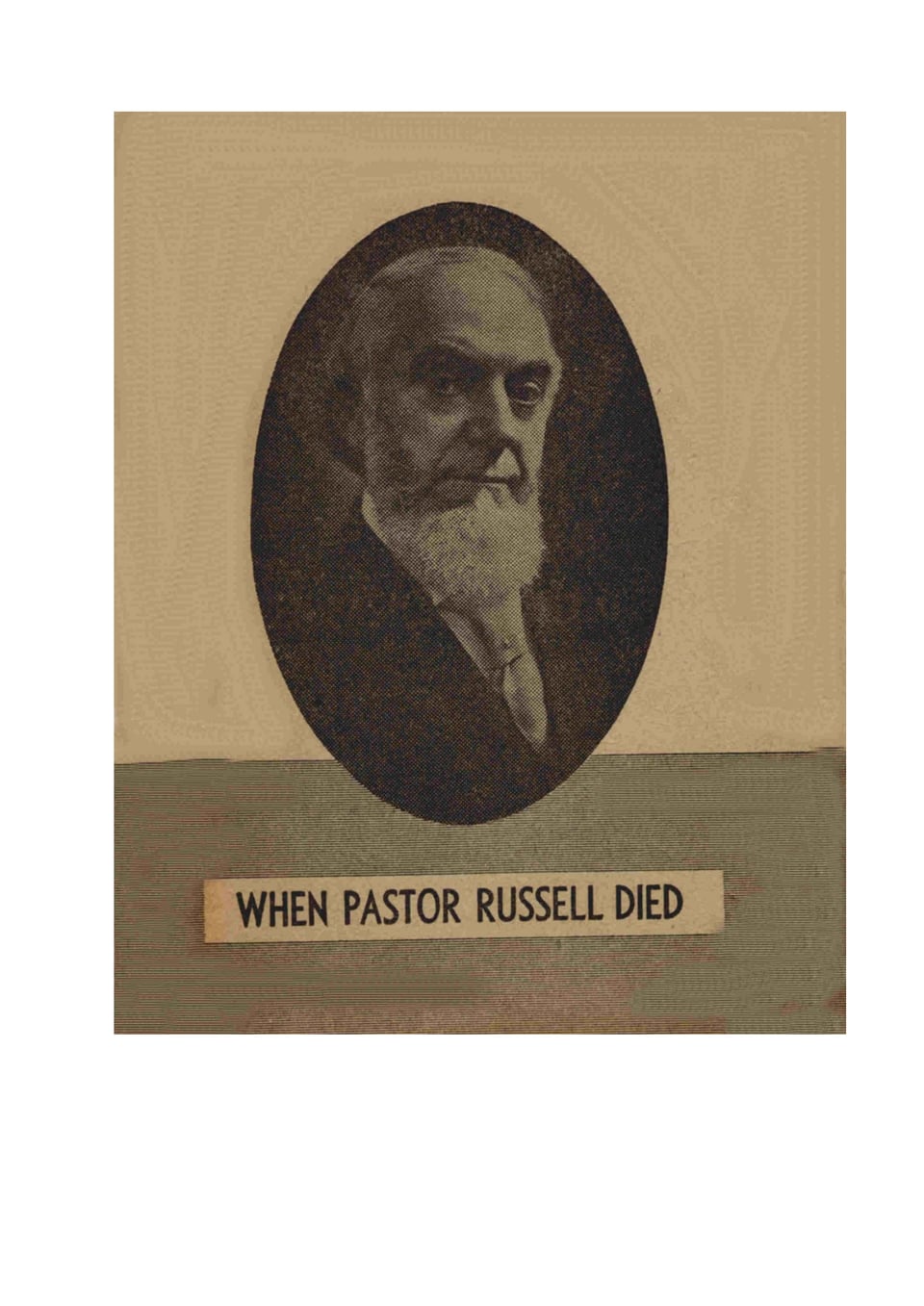
WHEN PASTOR RUSSELL DIED
Thy Word
truth..
FIRST EDITION 1946
ADDITIONAL COPIES OF THIS BOOKLET
MAY BE HAD FREE UPON REQUEST.
DAWN BIBLE STUDENTS ASSOCIATION
EAST RUTHERFORD
NEW JERSEY
WHEN PASTOR RUSSELL DIED
ON OCTOBER 31,1916, on a railroad train eastward bound through Texas, Pastor Charles Taze Russell, familiarly known to thousands of his brethren in Christ the world over as "Brother" Russell, passed away. The news of his death spread rapidly, and for a time those who knew and loved him for his work's sake could think and speak of little else as they met one another except that "Brother Russell is dead." Somehow many of us felt that Brother Russell would remain with the church in the flesh as long as there was work to do this side the veil, and it was difficult to grasp the hard fact that now he was gone.
Pastor Russell began his ministry as a very young man. Raised a Presbyterian, he took to heart the teachings of that denomination, particularly the doctrine of eternal torture for all who die unconverted. So thoroughly did he believe this superstition that at times he went up and down the streets of his home city with chalk in hand, writing on the sidewalks special warnings to all sinners. Later he began to reason matters out for himself and concluded that a God of love would not torment unbelievers; but, believing [or supposing] that the torment theory was taught in the Bible, he began to doubt that, it was inspired by God.
He then made a study of various heathen religions but without finding anything to satisfy his mind and heart. Later, in the Lord's providence, he learned that much of the misunderstanding concerning future punishment for sin was due to mistranslations of the Hebrew word sheol and the Greek words hades and Gehenna.
It was the improper translation of these words in certain scriptures which had made the Bible appear to teach that God would torment sinners forever. Now, Brother Russell learned that Paul's statement, "The wages of sin is death," is really true—that death, not torment, is the penalty for sin.
Then he began a study of the prophecies. Others joined him. They found that a mistranslation of the Greek word parousia had led to a misunderstanding of the subject of Christ's return; just as mistranslations of sheol, hades, and Gehenna had led to error regarding the penalty for sin. It was discovered that parousia means presence, and not "coming," and that when used in the prophecies of the second advent it refers to the time when Christ is present, not to when he will come. This proved to be the key which unlocked the prophecies of the second advent, and it was soon apparent from the light then enjoyed that the scriptural date 1874 marked the beginning of the second presence.
In the early seventies, Brother Russell and several others studied the Scriptures together for over two years. Telling of this experience later, he said the most outstanding truth of God's Word which came to light as a result of this long period of study was that the return of Christ is for the restoring of the human race to life, and not to destroy the earth, as commonly believed in nominal church circles. In relating this he cited that wonderful statement by Peter recorded in Acts 3:19-21concerning the "times of restitution of all things, which God hath spoken by the mouth of all his holy prophets since the world began."
The Spirit of the Movement
It was this grand and ennobling truth of "restitution" for a sin-cursed and dying race that proved largely to be the inspiration of the "truth" movement which was inaugurated and fostered by Brother Russell.
For the first time since the death of the apostles this real essence of the Gospel was lifted free from the traditional rubbish under which it had been buried and was trumpeted throughout the earth.
Nominal church leaders of all denominations were shocked that anyone would dare to preach what they considered to be a "second chance," forgetting that the vast majority of humanity had died without having had any chance. So long had they been accustomed to circumscribing the grace of God and magnifying his vengeance, that their narrowed vision of truth and their resultant shrunken hearts would not permit them to believe that God could possibly bestow his grace and blessing upon others besides themselves. As a result of putting the fires out of hell and portraying God as loving, and ready and anxious to bestow his blessings upon those who had died in ignorant unbelief, Brother Russell became a hated object of attack and persecution by nearly all Christendom.
But that which called forth the cry of "Heresy!" from his enemies, warmed the hearts of those who responded to the original, and now revived, Gospel of love—the true Gospel of Christ. The word "restitution" was almost a magic one, opening up a new vista of hope and inspiration. Men and women of all denominations responded. Atheists, whose largeness of heart belied the creedal god of torment, rejoiced to find the true God of the Bible. Regardless of former beliefs or disbeliefs, those who "came into the truth" were, by the sheer grandeur and beauty of the message, imbued with a determination to spread the good news far and wide.
"I love to tell the story, it did so much for me," is the way the "truth people" felt about it. And what a grand story it was! Truly did the poet say, "It satisfies my longings, as nothing else would do." Brother Russell himself once said, and very truthfully so, that if the Gospel of Christ as embodied in the divine plan does not satisfy one's longings, there must be something the matter with his longings.
The heavenly calling of the church became more understandable in the light of restitution blessings for the world. In fact, every phase of divine truth radiated a new and better meaning when viewed in the light of restitution. We might almost say that without restitution the study of any part of the Bible merely leads up a blind alley and leaves the student without an answer to his questions. Restitution proved to be the common denominator of all the problems of divine revelation. Without it there came endless controversies, contradictions, and chaos; with it there were found harmony and satisfaction, and an incentive which could not be denied, to tell the whole world these blessed tidings.
The hope of restitution for the world of mankind lifted the Gospel out of the realm of selfishness into the sphere of love. Those who "came into the truth" had no further use for that puny and selfish conception of Christianity embodied in the traditional prayer, "God bless me and my wife, my son John and his wife, us four and no more." They knew, now, and how they rejoiced in that knowledge, that God's plan calls for the blessing of "all the families of the earth."
For more than forty years this glorious Gospel of the grace of God was heralded forth by Brother Russell in every conceivable way. Increasing thousands laboured with him, and rejoiced with him. Together they scattered the message by printed page and from the platform, through the public press and the Photo Drama of Creation, and even over the garden fence. Those who rejoiced in the restored Gospel of Christ were often referred to as "Russellites," and sometimes "Millennial Dawnists," but it made little difference what the world called them, for they knew that "God had called them out of darkness into his marvelous light."
The Promptings of Love
The blessed light of truth, made radiant by the hope of restitution blessings for all the families of the earth, revealed the love of God as nothing else could do; and it inspired love in the hearts of those who believed. Divine love is an unselfish principle that thinks of others and reaches out to bless them. It was inevitable, therefore, that the truth movement should be characterized by a fervency of the missionary spirit.
Brother Russell couldn't keep the truth to himself. He devoted his personal fortune to spreading the message, and used up all his vitality of mind and body for the same purpose. He felt that he could never do enough. The creedal gods were so mean and contemptible that he could not be satisfied short of devoting his all in showing forth the praises of the good God of love whom he found revealed in the sacred Word. And all who came into the truth felt the same way about it.
It was not surprising, therefore, that forty years of missionary effort by a group who were thus inspired by the love of God resulted in thousands accepting the message and becoming "truth people." Nearly a hundred thousand subscribed to Brother Russell's semi-monthly magazine, The Watch Tower. Twelve hundred local groups of Bible Students elected him as their Pastor. Some of these groups numbered more than a thousand, many of them hundreds. The Brooklyn and London Tabernacle congregations were outstanding among these.
But now Brother Russell was dead! That he died while still active in the missionary field did not alter the fact that he no longer could be the pace-setter for the zealous workers who loved the truth they received through him and who wanted to lay down their lives to give it to others.
He was dead, and the brethren were stunned. What now?
Tests Begin
For a time after Brother Russell passed beyond the veil, most of the brethren held strictly to the truth as it came from his pen; although from the start it became apparent that matters of minor importance were engaging the attention of those who were taking a leading part in continuing the work. Early in his ministry, Brother Russell surveyed the general framework of the truth and concluded that in order to treat all of its phases in the detail needed to clarify the message and to separate the truth from the superstitions of the Dark Ages, a set of seven books would be needed. In the seventh he expected to deal primarily with the Book of Revelation.
He died without writing the seventh book which he had contemplated. This left the way open for speculative minds to go to work, and they did. In a remarkably short time a "Seventh Volume" was published, with the claim that it was the posthumous work of Brother Russell. It created a stir among the brethren, resulting in divisions in many places. It was not truly the posthumous work of Brother Russell, and in some ways it was contrary to both the letter and the spirit of his teachings.
It was made a test of fellowship in many ecclesias; it was one of the first major issues to arise which diverted attention from that glorious and all-important theme of the true Gospel. The "Seventh Volume" itself did not deny the doctrine of restitution, nor any of the other doctrines of the truth, but the attention which was focused upon its speculations tended to take the eyes and hearts of the brethren away from that main theme which had satisfied their longings as nothing else had done.
It marked the beginning of an era among the brethren in which the trend was to relegate first things to the background, and to focus the attention of the consecrated upon side issues of speculative and non-essential theories.
The story of the "Seventh Volume" would not be complete should we fail to mention that in a remarkably short time after it was published it was virtually rejected by the publishers. It is well nigh impossible to believe, yet true, that whereas when this book was first published those who did not accept it were condemned and disfellowshiped, within a few years those who did accept it were disfellowshiped.
The repudiation of the "Seventh Volume" by its publishers was quite in keeping with a general development which became manifest about 1924. At that time there began a departure from the truth, as the brethren had learned and proved it under the leadership of Brother Russell. As it was claimed that the "Seventh Volume" was written by Brother Russell, it was but natural that it should be discarded. Eventually, all Brother Russell's writings, including the six volumes of Studies in the Scriptures, passed out of print.
The departures from pure truth were slight at first. Many did not discern them; and many of those who did consoled themselves with the thought that this trend would not continue. However, as each item of truth was set aside by The Watch Tower Bible and Tract Society, and an erroneous substitute put in its place, some withdrew their support from the general effort. This went on year after year, with more and more of the "old-timers" leaving the original organization as its teachings departed further and further from what they were when Brother Russell died.
The claim was made that the brethren were progressing in the light, a light which was to shine more and more unto the perfect day!
But was this claim true? Let us see. As we have noted, the great theme which made the truth so marvelous, and so far in advance of anything taught by nominal churchianity, was that of restitution—the glorious Gospel which was spoken by the mouth of all God's holy prophets since the world began. The practical, everyday meaning of this was that those who believed and rejoiced in it could exercise hope for those who did not accept it in this life.
New Light — Old Darkness
When that terrible pall of darkness settled down over Christianity following the death of the apostles, one of its densest aspects was the humanly conceived limit which was placed upon the grace of God, a limit which said that salvation is restricted to those who believe before they gasp their last breath of this fitful and condemned life. And even worse than this was the sectarian construction which was put upon that word "believe." To the Catholics it meant to believe the teachings of the Catholic Church. To the various Protestant groups it meant the acceptance of their particular interpretation of truth and how to practice it. To all and sundry it meant, "Come with us, and do it before you die, or you will be forever lost"—or at least suffer for hundreds of years in a terrible purgatory of torment, as the Catholic Church teaches.
This concept of the Gospel replaced love with fear as an incentive to believe and obey, and for this there is no scriptural authorization. There isn't a hint anywhere in the Bible that the opportunity to obtain salvation through Christ is limited to this present life. How we rejoiced in the largeness of the truth: that it enabled us to look with sympathy upon those who could not see as we do, and to rejoice that when the time of their visitation come, they would have a more favorable opportunity to believe than is now possible when Satan is abroad to deceive and blind the minds of those who believe not.
Yes, we were proud of the truth! With Paul we could say, "I am not ashamed of the Gospel of Christ."—Rom. 1:16
But what happened? Well, to start with, for example, through the "channel" there came a new interpretation of the Parable of the Sheep and the Goats. And the new interpretation was wrong. There's no question about that. But more important than the erroneous interpretation itself, was the fact that it was a step into darkness because it began to take away that glorious hope of blessing for all the families of the earth. It hinted strongly that most of the ministers of denominational churches were going into the "second death."
As we first learned the truth, the "second death" was merely one of its doctrines, a necessary one, to be sure, but somehow we did not think too much about it. We knew that all incorrigible sinners would go into the second death, but it hadn't occurred to us that those who are unable to see the truth as a result of our stammering, bungling way of explaining it to them, and because there are a hundred other voices calling from other directions, were incorrigible sinners.
So this comparatively obscure doctrine of the second death suddenly came to the fore, and as the new flashes of alleged light increased (?) in brilliance the brethren were told of more and more who were going into the second death. Among the classes for which there was no hope at all was the one made up of those who did not accept the "new" light from what was claimed to be the Lord's exclusive channel of divine truth. To leave this "channel," therefore, was looked upon as the blackest of all sins which a mere mortal could commit. Those who did so were considered a part of the "man of sin," the "son of perdition," and certain to be punished with the second death.
Darkness for Light
As we have said, according to these teachings, ever increasing numbers seemed to be in line for the second death. This popular trend of so-called increasing light continued until it was discovered that so many were going into the second death that there wouldn't be enough people left of those who have lived and died to fill the earth. So, the next flash of "light" revealed that those who accept these teachings, and work, hard to promulgate them, will live through the "time of trouble," get married, and raise large families—very large, indeed—and thus through them will the earth be filled.
The Scriptures, of course, do not teach any such absurd notion as this, but because so many people had been consigned to the second death something had to be done about it, and the advancement of this fantastic theory of "filling the earth" seemed like a logical thing to do. Like every other false doctrine, it was "proved" by the use of remote Scripture texts improperly associated and woven into a pattern of belief which was naught else than a "cunningly devised fable."
This substitute for restitution was about the final step backward into the fundamental viewpoint of all nominal churchianity. That blessed theme of God's mercy and grace, that melody of love which had as its chorus the blessing of all the families of the earth, was scarcely heard in her any more at all. As in Babylon, fear took the place of love and became the driving power back of all their activities; and fear was implemented with the threat of the second death to all who dared question the new "light."
With this "advancement" accomplished, the teachings of the Watch Tower relative to hope beyond the grave were in principle no different from those of all Christendom except in one respect; that is, the use of the "second death" as a whip to keep the workers in line, instead of eternal torture.
Their teachings of course differed from those of the churches in a hundred ways so far as details were concerned. So do all the nominal churches differ from one another; but the final result of their teachings is the same; namely, Believe us now, or be lost. It is into this gross darkness that many who once rejoiced in the truth gradually were led. The theme song of restitution for the condemned race no longer stirred their hearts.
Many Wonderful Works
The "zeal of God's house" engendered by love, remained with thousands of the Bible Students following the death of Brother Russell. But the scene gradually changed and the inspiration of the movement was transformed. Instead of love and the sheer joy of telling the world about a God of love, "great works" of one kind or another kept the brethren whipped up to a frenzy of misguided zeal and self-sacrificing devotion to a false cause. An intermingling of fear and hate was the backdrop for these scenes of activity fear of the second death if not faithful, and hate for those who did not accept the message, particularly for Roman Catholics.
Yes, many "great works" were attempted: the "Elisha work"; "calling out the prisoners" from Babylon; "building the temple wall"; gathering the "Jonadabs"; casting up the "highway of holiness"; offering "the waters of the river of life" to the people; etc. It was truly remarkable how quickly each one of these gigantic tasks was undertaken and then forgotten, while the campaigners went on to the next item in hand.
The "new light" slogan found an effective place in the general furor of excitement. The "channel" advocates moved on unabashed from one viewpoint to another, totally disregarding, and at times it would seem, almost glorying in, their ability to contradict today what they had taught yesterday.
In 1923, an article was published by these brethren urging the friends to adhere to the teachings of Brother Russell, warning that those who sought to lead the brethren away from these teachings were wolves in sheep's clothing. Not long after, they taught that those who did not depart from Brother Russell's teachings, but insisted upon adhering to them, were of the "evil servant" class, and certain of going into the second death if they did not repent.
When the "Elisha" work was at its height, it was announced that those engaging in it were blessed with a "double portion of the Spirit"; but in 1927 it was announced that the church no longer possessed the Holy Spirit at all.
In 1921 restitution blessings were said to be for all men; in 1934 this was denied; and in 1939 "elective elders" were derided for continuing to believe in restitution for the world.
Even the fundamental doctrine of the ransom was tampered with. For a time after Brother Russell's death it was still taught that Jesus died for all, including Adam; that as "all in Adam die," so all in Christ shall be made alive." In 1939 it was "discovered" that Adam was not redeemed by Christ, hence will not be raised from the dead. And there was some cleverly false reasoning in connection with this change. It was said that the reason Adam was not redeemed by Christ was that he was a wilful sinner. Those who accepted this "new light" seemed to overlook the fact that if he had not been a wilful sinner he would not have needed to be redeemed.
Samples of other and less important changes might be briefly noted: In 1930, Nebuchadnezzar represented Satan; in 1936, he represented God. In 1923, character development was a work of God; in 1927, a delusion of the devil. In 1924, true religion was of God; in 1937, all religion was a snare of the devil, and a racket.
In 1918,the church was not under the new covenant; in 1934,the church was under the new covenant.
We might go on almost endlessly citing these contradictions, but no particular purpose would be accomplished by wearying the reader with more. To err is human, and no student and teacher of the Scriptures should be held up to ridicule simply because he discovers that he has made a mistake and wishes to correct it. But in this case no mistakes were acknowledged nor from their standpoint, could they have been made. It was claimed that God was their teacher, and God couldn't make a mistake. One can't help wondering, though, what god it was; for, to say the least, he was a very changeable one; whereas of the true God it is written, "I am the Lord, I change not."—Mal. 3:6
But we should not lose sight of the main issue involved. The important consideration is not so much that this and that item of truth was changed, or that various types of work were attempted. The main thing is that in all this maze of interpretation and misinterpretation, of fanciful speculations and weird theories, of unauthorized and abortive campaigns of great works, and of fear engendered by threats of the second death, the melodious theme song of God's love, as it formerly resounded from his plan to bless all the families of the earth, was lost.
With this loss, thousands of the brethren the world over were left in much the same position as the Hebrews in Babylon, of whom it is written that they "wept when they remembered Zion." (Psalm 137:1) The truth was lost! The Watch Tower had taken the position of all other groups who hold out no hope to men unless they "flee to the organization" for safety and protection. These friends are still earnest, sincere, and zealous. Would that all of us had the same degree of zeal; but the pure truth is no longer with them. They have some details of truth. They can define the soul; they believe in one God instead of three; they have a general knowledge that we are in the end of the age; but their central theme is not of God.
They are laying down their lives bearing witness to a message which, according to their own viewpoint, is doing nothing for the masses who do not receive it except to make them liable to the second death. Thus has the sacred flame of truth—that inspiring truth of God's love revealed by ransom and restitution—been extinguished in the minds of many.
Standing Fast
Having traced this main detour from that great teaching which was the very core and lifeblood of the truth movement under the leadership of Brother Russell, let us now go back again to the time of his death, and note other developments. Not all Bible Students remained in one group. Far from it. Some ceased their co-operation almost immediately upon Brother Russell's death. Others "left" in connection with the "Seventh Volume" incident; and through the years, for one reason or another, other brethren withdrew their support from the "Society."
Among these many who did not choose to remain in the "channel," various "movements" developed, each with a different viewpoint of the needs of the times. One had its inception in the northwestern part of the United States and Canada and, while it found adherents here and there, it never became organized outside of that limited area. Those who became associates of this movement were noble, earnest, and self-sacrificing Christians.
And they were good students of the Bible, too. They had learned the truth, and could give a reason for their hope. They refused to compromise the truth and its application to their Christian lives. Their stand-embodied also the refusal to buy war bonds and in other ways to cooperate with the war effort during the first World War.
The "Seventh Volume" also was involved in their conception of loyalty to principle and truth. These dear brethren accepted "The Finished Mystery" as the very book which Pastor Russell intended to write, but didn't. They believed that it was the posthumous work of Brother Russell. So, when those who published the Seventh Volume repudiated it, they stood fast in its support; and some of these brethren still do.
This movement, as a co-ordinated effort, was short-lived. The brethren tried to work together without having any work to do, and the inevitable result was disintegration. And why did they have no work to do? It was because they decided that the harvest work of the Gospel age had ended with the death of Brother Russell, hence that a public proclamation of the truth would no longer be pleasing to God.
This was an unfortunate viewpoint because it robbed the truth of much of its joy-inspiring power. With the missionary incentive banished by speculative interpretations, the brethren found outlet for their energies in picking doctrinal and other flaws with one another, with the result that divisions and subdivisions became the order of the day. They stood fast in the truth, all right; but, by holding it exclusively for themselves, they lost much of its spirit. The theme song of love, the voice of God, ceased to be a power inspiring them to lay down their lives that others might have an opportunity to learn that God intends to bless all the families of the earth. They loved the truth, but forgot that God had called them into his marvelous light in order that they might shew forth his praises by telling it to others. They forgot that their worthiness to share in the blessing of all the families of the earth during the next age depended upon their interest in all the families of the earth now.
With many of these, however, the zeal of God's house continued as a flame that could not be quenched. The fact that leaders said the work was done could not and did not quench that flame.
It burned on, and today is again finding expression in the joyful work of telling the whole world these blessed tidings.
Watching and Waiting
There was still another general effort among the brethren, independent of the main group. A paper was published, and pilgrims were sent from class to class to comfort and encourage the brethren. Inasmuch as the date 1914 had come and gone, Brother Russell had died and there seemed to be no facilities for publishing the truth, there was a general feeling among the brethren that there wasn't much in particular they could do except to strengthen that which remained.
True, The Divine Plan of the Ages was re-published; small quantities of tracts were printed; but the missionary spirit among these dear brethren seemed at a low ebb. Certainly the brethren as a whole were not especially urged to be active in the promulgation of the truth. A general pastoral, or shepherding work was deemed proper and essential; but it soon developed that a mere handful of brethren were doing this work for the friends generally, who were largely in the position of laity waiting to be served.
One of the great features of the truth as taught by Brother Russell was that every consecrated child of God is a servant, anointed to preach the glad tidings. In one master stroke this precious doctrine did away with the separation of the church into clergy and laity. "One is your Master, even Christ, and all ye are brethren," was emphasized and re-emphasized by Brother Russell. (Matt. 23:8) And to make this viewpoint effective, Brother Russell was continually planning work for the brethren to do, urging that they all feel a responsibility toward the truth and its proclamation. The concluding chapter of The Divine Plan of the Ages is an example of this.
A large proportion of the Daily Heavenly Manna comments furnish us with another good example. Brother Russell was our Pastor, and a faithful one, not alone because he ministered to us, but also because he made it possible for all to participate in the ministry of the truth, and urged all to do so as ability and opportunity afforded.
We doubt if any of the brethren, immediately following his death, actually held a different view from this. But the peculiar combination of circumstances created an attitude of mind which caused it to be partially overlooked. Two or three years of comparative inactivity in this respect on the part of a group of brethren might not result in any serious spiritual decline. But time went on, and 1914 as a date in prophecy was farther and farther in the past. The church was still this side of the veil. These facts were dwelt upon, and reasons for them sought. A new chronology was found, setting 1933 as the full end of the Gentile Times. The importance of Brother Russell's ministry was minimized. Nominal church writers were appealed to for help. The modernistic viewpoint of the relative unimportance of doctrines began to get a foothold, and without realizing just what was wrong, the comparatively small number of little classes throughout the country which formed the background of this movement, began to disintegrate.
A high standard of righteousness for the saints was held up by these brethren. Indeed, they specialized along the lines of faith, prayer, and personal holiness. There was a slight tendency, as a matter of fact, to feel that Brother Russell had been somewhat negligent along this line. Thought and language of godly men of the past were introduced. But this specializing of the ministry did not hold the brethren together; nor did it provide them with the incentive to lay down their lives in the service of the truth.
It was only a part of the truth, and not that part of the truth, either, which was the very life of the truth movement. Character development and devotionalism are fundamental in the Christian life, but these were not the truths which called the Lord's people out of Babylon in this harvest time at the end of the age. All the churches enjoy the blessings of formalistic devotionalism and an assumed character development, but only those enlightened with present truth enjoy that understanding of the plan of God which sets them on fire with zeal to proclaim the glad tidings.
Now, when the simple doctrines of the divine plan are spoken of as the mere milk of the Word, and the brethren are taught to believe that they should have progressed beyond the discussion of them in their meetings, and that proclaiming them to the world is of very incidental importance, it is not difficult to understand what happened, and why. With the true doctrines rarely discussed, false doctrines began to creep in among the brethren. Nominal church conceptions concerning the second coming of Christ were taken up by some, and by these the second presence of Christ was denied. The church's share in the better sacrifices of this age—the second phase of the sin-offering—began to be questioned. Eventually it became difficult to find an ecclesia which was not more or less divided in sentiment concerning many of the really vital and important features of the truth.
This condition of things did not develop overnight, nor were all the brethren involved in it. The development was gradual and subtle. The circumstances arising out of the disappointment of 1914, and the death of Brother Russell, created just the attitude of mind that made it possible. In recounting the facts here, it is not with the thought of placing the blame, nor to ridicule, nor to discourage, but to diagnose an unhealthy condition with the hope of discovering what is needed as a remedy to restore spiritual health.
And as we view this particular situation the thing which speaks the loudest to us is something which is not in the picture at all. It is conspicuous by its absence. Whether holding to the truth or trifling with error; whether possessing a faith which can remove mountains, or beginning to doubt; whether coming oft to the throne of grace, or depending upon our own strength to overcome; if we have lost sight of the fundamental fact that as Christians we are called to be the "light of the world," the "ambassadors for Christ" to hold forth the Word of life in the midst of a crooked and perverse generation, we have missed the point of it all.—Matt. 5:14; 2 Cor. 5:20; Phil. 2:15
Satan is the prince of darkness, and one of his chief interests is to prevent the light of truth from reaching the people. He is not limited to one method of doing this. As we have seen, some of the brethren were zealous to work for the Lord. Come what may, they were determined to continue active in the service of God, even though Brother Russell had died. Not being able to quench their zeal, Satan found it possible to pollute the stream of truth as it went forth. Having accomplished this, he is not concerned how active they may now be.
With other brethren another method was necessary. With them it was impossible to substitute error for truth. Discovering this, Satan's next move and it succeeded for a time—was to convince these dear ones that God would not be pleased for them to continue publishing the truth. Their great sense of loyalty to truth made them adhere to this alleged truth with such tenacity that they ceased all witness work over a period of years. Again Satan scored!
Special Servants
Once more we go back to the time of Brother Russell's death to pick up another thread of Bible Students' history.
The death of such a faithful and widely used servant of God—"that faithful and wise servant"as Brother Russell, was bound to leave an empty place in the hearts of the brethren. With many, the blessedness of the truth itself filled this void, and they were able to sing from the heart:
Send out thy light and truth, O Lord;
Let THEM our leaders be.
But not all were able thus to differentiate between a leader and the truth which he brought to them, so when the leader was gone they sought another. And we are not surprised to find that there was no dearth of those who of the Scriptures is that when God really chooses a servant for a special work he inspires him with a vision or understanding of the work to be done, and he is more concerned with that work than with proving that God has especially chosen him.
It was so with Brother Russell. It was difficult to get the Pastor to admit that he thought the Lord had specially chosen him. He knew that God had revealed the truth to stop short of devoting all that he had toward its proclamation. And God, by his providences, provided Brother Russell with the ability, the opportunity, and all the other circumstances which made it possible for him to be "that servant" in this end of the age. The best that the remainder of us can do is to continue heralding forth the truth which God gave to us through him.
But when Brother Russell died there were those who thought God had appointed them to be special servants in the church, and that they were therefore the successors to Brother Russell. Have any of the individuals who have claimed the status of special servant in the church to succeed Brother Russell, carried on with the work of Brother Russell? NO. not one!
One and all of these have promptly set forth some new set of teachings.
Not all have denied what Brother Russell taught. Some, indeed, have ridden into the confidence of the brethren on the platform of loyalty to Brother Russell, even going so far as to claim that they are the only ones who are loyal to the teachings of Brother Russell
But again there is a conspicuous absence of that spirit and viewpoint of Brother Russell pertaining to our use of the truth, our privilege of being the light of the world. To an extent, some of these have encouraged a public ministry, but have circumscribed it with vain philosophy concerning the place to be occupied in God's plan by those who become interested. Almost without exception these special leaders arbitrarily taught that the door to the high calling was closed about the time they claimed to have been appointed of the Lord to their exclusive position in the church
So amidst the uncertainties of speculation; weird interpretations; self-assertive claims; and the attempt to divide the Lords people into groups of the spiritual and less spiritual, the heavenly class and the earthly class, the "great company" and the "little flock"; God's theme song of love the restitution blessing of all the families of the earth—was again relegated to the background, and that feature of the real work of God, as Brother Russell conceived it and prompted it and for which he died, was neglected.
We have been speaking particularly in this connection of tempts at exclusive leadership among the brethren which resulted in some measure of co-operation in the sense that each secured a few followers. While on this phase of the narrative, it might not be amiss to mention other manifestations of this same complex which have accomplished next to nothing. We mention this in order to clarify a very erroneous viewpoint held by many of the brethren, and promoted by a few, namely, the alleged tremendous number of "divisions" there are among the Bible Students.
This viewpoint of what some refer to as the "fifty-seven varieties" of brethren has come about by the fact that individual brethren here and there throughout the world develop a pet theory of doctrine or of the interpretation of prophecy; go to a local printer and have it printed, and then send it out over their names to all the brethren whose addresses they possess or can acquire. Sometimes these messages are mailed under the name of "Associated Bible Students," sometimes as representing an ecclesia, but usually merely from an individual.
Many brethren when receiving literature of this kind erroneously conclude that each new circular letter and each new pamphlet or book represents another division among the brethren. This is not so! We know of one instance where the name "Associated Bible Students" is used on literature, yet it is but a lone individual who sends out the mimeographed sheets which carry his speculations on prophecy.
This is an important fact to remember. One of Satan's tactics is to frighten and discourage us. He would like to have us believe that all the Bible Students are divided; that no two of them believe alike; that there are indeed "fifty-seven varieties," that most of them are going out of the truth; and that we alone are remaining faithful to the Lord. If he can induce us to believe this it will be easy for us to conclude that there is nothing more that can be done in the service of God; and concluding this, we won't do any more.
What about these who publish their new theories of truth? Shall we condemn them to the second death? No! Shall we say they have no right to do it? No! Shall we spend time reading everything that is sent to us? That is for each individual Christian to decide for himself. The thing we should all discern is the relative importance of these unproved and highly speculative theories as compared with the great fundamental truths of the divine plan.
Do they help us to understand our God better, to love him more, and to show forth his praises more faithfully? If the glorious truth of the divine plan continues to satisfy our longings as nothing else can do, well, nothing else can do it, that's all, so we won't be wasting time filling our minds with that which dissatisfies rather than satisfies.
Divisions
How many divisions are there among the Bible Students? That is a difficult question to answer, for not all interpret the term division as meaning exactly the same thing. Let us think of it from the standpoint of ecclesias and the viewpoints of ecclesias. When we do this, we do not find so many divisions as some might expect. In city after city throughout America, as well as other parts of the world, there are but the two groups—those who are with the original organization and those who are not.
In a few places there are small ecclesias who follow their favorite leader; but only a very small minority of the brethren are involved. At a national convention of one such group there were but thirty-five in attendance. In a very few localities we find a small group of brethren who meet by themselves because of differing views on the covenants and related subjects. But here again the number involved is very small. Here and there today, even as was the case in the time of Brother Russell, we find two classes in a city, both groups believing essentially the same things, but divided because of conflicting personalities.
These conditions, of course, are lamentable; but God's harvest work in the earth has not failed, as some would have us believe. It is a tribute to the power of the truth, and to the depth of consecration on the part of God's people, that after so many years of severe trial, through confusion and disappointment, thousands of Bible Students are still aglow with zeal for the Lord and for that blessed meat in due season the truth which was served to the household of faith by "that servant."
Revival
One could suppose when noting what occurred among Bible Students when Pastor Russell died, that despite the vast scope of the harvest conducted under his supervision, made possible by the marvelous spirit of zeal and selfsacrifice which consumed him and the brethren generally during that period, it had failed of lasting results. But this would be an incorrect viewpoint. Time is an important element in God's arrangements. What we see today may not be true of tomorrow. God changes not, but in developing and testing his people he permits them to pass through varying experiences in order that their faith might be tested and their determination to serve him faithfully, crystallized.
The years following Brother Russell's death have been a period of special testing. It has been a fiery furnace for all the Lord's people, and we should be careful not to misjudge any of the brethren upon the basis of their temporary reactions to the flames. The great test upon all has been their loyalty to God and to the truth and its spirit, apart from human leadership. Brother Russell was not only "that servant" of God, but he was a noble, good man, whom we all loved, and upon whom we leaned. God wants us to lean upon him, and to be faithful individually in doing his work. Through the truth he called us out of nominal churchianity—Babylon—and through these years he has been putting us through the fiery furnace of trial in order that all the cords of bondage might be burned away to set us free entirely from human leadership, that we may be bound only to our Lord and one another by the cords of love and devotion to the doing of his will.
With the exception of those who have departed from the truth to the extent of denying its great fundamentals, all the brethren during these years of trial have remained "in the truth."
They have been proud to be called "truth people." But in the hearts of most of them has been a realization that something was lacking in their Christian experience, that something else died with Brother Russell. No substitute program could take the place of this loss, and they would not be satisfied until the real thing was restored.
Yes, they knew what it was! They had learned the lesson well that being a Christian was more than merely the acceptance of God's grace for our personal salvation and satisfaction. The same lesson was learned by the disciples at the very beginning of the age. Even before Jesus died he "sent out" the twelve into the ministry, and later he sent out the seventy. When the women found the empty tomb, the symbol that he was no longer dead, they were bidden to "go tell" the news to others. When Jesus met with his disciples shortly before he returned to heaven he told them to tarry at Jerusalem until they were endued with power from on high, and then they were to go into all the world and preach the Gospel.
If we could imagine those who went early to the tomb simply being told that Jesus had been raised from the dead and then instructed to go home and say or do nothing about it; or if we could think of Peter and the other disciples receiving similar instructions; or if Jesus had told his disciples to continue tarrying at Jerusalem until they had lived out their natural span of life and died in inactivity, then we could at the same time imagine somewhat the feelings of many of the Lord's people during these years of trial since Brother Russell died. With the exception of the effort which led brethren into activity to preach other than truth in its purity, the friends generally had been left to suppose that the height of Christian experience, the end of all that the truth should mean to them, is to "tarry" until they were called "home" to be with Jesus in the kingdom.
But the Holy Spirit was given at Pentecost. It reached the Lord's people at this end of the age through the medium of present truth. The death of a great leader might, and did, result in consternation among the brethren, but it did not drive the Holy Spirit from their hearts—at least, not from the hearts of all. It remained! The spirit of truth and of love continued to burn, and to thousands of the brethren the world over it continued to say throughout all the uncertain years, "Go and tell," "Go ye into all the world." They became "weary with forebearing," they perhaps were inclined to "tarry" for a while, but realized that continued inactivity was vitiating their spiritual lives.
This was the individual experience of brethren in all groups. While there was intense activity in some quarters, the truth was being changed and many who loved the truth found themselves sitting on the sidelines, unable to cooperate. Individuals in other groups were being prompted by the Holy Spirit in their hearts to realize that something should be done that wasn't being done. It was not a concerted, organized demand, but the spontaneous revival in the hearts of individuals of that spirit of love toward others which characterized the truth movement during the lifetime of Brother Russell.
About this time brethren began to leave the original organization in larger numbers than previously. , In Pittsburgh, Pennsylvania, a sufficient number left at one time to form an ecclesia. Soon thereafter (in October 1929), this ecclesia arranged to hold a convention; and, interestingly, this convention was held in the old Bible House Chapel where Brother Russell had carried on the ministry of the truth for so long a time.
The following October another convention was held in the same place. The desire of the brethren concerning the ministry of the truth began to make itself felt at this second convention.
A business meeting was called, much against the wishes of a minority, who, sad to report, wanted the brethren to continue "tarrying," forgetting that the Spirit had been given nineteen centuries ago! At this meeting a committee was appointed to investigate the possibilities of what could be done to assist the brethren in giving a wider witness for the truth and to build one another up in the most holy faith.
The following winter, brethren in the New York district expressed their desire to "go and tell" the truth to others. This was done through the Brooklyn Ecclesia, a class that had been formed in 1918 and which had remained loyal to the truth throughout all the years which followed. Realizing that the radio, a new means of disseminating knowledge which had come into being since Brother Russell died, was available for use, a radio committee was formed comprised of the thirteen elders of the ecclesia, and programs were prepared and broadcast over one of New York's most powerful stations.
The effect upon the friends was electrifying. Brethren sitting on the sidelines heard the programs and rejoiced.Many of these began to co-operate. By reason of opposition to the effort on the part of some, and in the Lord's providence, we believe,the matter was brought to the attention of brethren throughout the entire country, and even in Great Britain and Australia.
Those still holding to the truth rejoiced. The radio work as of that time (1932) proved to be too expensive to be continued; although, in addition to the New York broadcasts a few transcribed programs were made and these were used on a limited number of stations elsewhere in the country. Evidently, in the Lord's providence, its principal purpose was to serve as a signal to the brethren that the time had come to cease tarrying, that there was something for willing hands to do.
This radio effort called for the publication of suitable literature to follow up the interest, and while the radio work itself did not at that time continue, there could be no question about the desire of brethren the country over that the publication of literature be maintained. This was done. The weekly "Radio Echo," designed to follow up the programs, was enlarged and made a monthly magazine. It was called The Dawn in keeping with the original Millennial Dawn literature, and because of a deep conviction that we are living in the dawn of the Millennium. The Dawn did not assume leadership of the friends, but sought merely to render assistance where and when invited by individual brethren and ecclesias. The Dawn insists that God's voice in the church is heard through the local ecclesias.
As the years went on, and as the Lord pointed the way, Tabernacle Shadows, the Daily Heavenly Manna, Hymns of Millennial Dawn, and Studies in the Scriptures, were re-published. Booklets and tracts were published and widely distributed. New interest in the truth developed, and there was a general awakening among the Lord's people as their hearts responded to the theme which had lain nearly dormant so long. Once more they rejoiced in that concept of the truth embodied in the Master's command, "Go and tell."
Love for the brethren increased, and they desired more and more to be together. Local and general conventions began to be the order of the day. On occasions The Dawn was used to announce as many as twenty-five such conventions in a single issue. This gathering together of the friends has further stirred them up in the old-time enthusiasm for the truth and its service. "This is just as it was in Brother Russell's time," is the remark that was made over and over again by thousands of the brethren as they met one another at these various conventions.
And they were right!
In 1940, through the urging of a number of the brethren, it was decided to try the radio work again. Those who had the matter in hand were frankly skeptical of the ability of the friends to carry on such an effort. But a start was made, and to the surprise and joy of all the brethren, within a few months practically all of the United States and Canada were being reached weekly with the kingdom message of truth. That has continued unabated until now. Meanwhile, brethren in Australia have also taken up the radio work, Newfoundland, too, is now being served in this way.
Results
It is not to be expected that all, even of the Lord's people, could be pleased with the same thing. Some are still critical, and ask what is being accomplished by such a wide witness of the truth. Even those of us who are rejoicing in the general revival of activity in proclaiming the message are also interested to know the results of our efforts. Results, of course, should not enter into the matter of doing what the Lord has asked us to do. It would not have been in keeping with the spirit of the occasion for the women at the tomb to have replied to Jesus that even if they did tell the disciples of his resurrection, Thomas would not believe. The instructions were, "Go ... and tell."
And so it is with us today. Nevertheless, it is encouraging to know that there are results. Probably one of the greatest results is among the brethren themselves. The radio and other witness work is reaching many of the consecrated who have long been separated from their brethren. They hear or read the message, and recognize it as the old-time truth which they loved so long, and almost lost: and their hearts rejoice. Through handling the great fundamentals of the divine plan for the benefit of those who are not in the truth, the brethren are re-learning the real value and beauty of the truth.
This is helping to promote the spirit of unity among them—not a unity on non-essentials, nor around human leadership, but a unity of the Spirit—the Spirit of the truth.
And there is also new interest! There are not thousands coming into the truth, but some are; and larger numbers are rejoicing in a partial knowledge of it, while millions are receiving a witness. In the very thought of this the brethren as a whole rejoice. They feel that the truth is again much more to them than merely a better religion than that possessed by their neighbors. They feel that they are having a part in a work which the Lord approves, because it is the same kind of work which he outlines in his Word and was carried on so faithfully by Pastor Russell.
The Incentive
It is well that, at this point, we inquire concerning the incentive which, within a period of a few years, has brought about the co-operative activities which we have just described. Did The Dawn come into being as a medium for the dissemination of new light? Were the friends stirred to action because something had been found and was being proclaimed through The Dawn? No! The Lord's consecrated people throughout the world are, as a whole, well satisfied with the truth as it was brought to them through the ministry of Brother Russell. The brethren directly responsible for what appears in The Dawn are well satisfied with that truth. They have no new doctrines to proclaim, and no new formula for Christian living. They see no need for instructions along doctrinal or devotional lines which are contrary to those which we have in The Studies in the Scriptures.
No, the revival of activity has not been due to the proclamation of a new divine plan.
Certainly it has not been induced through fear of the second death; nor has it been, even in the remotest sense, a rallying around a new-found leader, or leaders. Rather, it has come about as a result of the operation of the Spirit of God in the hearts of his people as a whole, just as it was the Spirit of God in Brother Russell's heart that impelled him to sell his business and devote himself to the publishing of the glorious jubilee message of truth. And it is the same Spirit which actuated the "truth people" generally throughout the happy years when Brother Russell was with us.
The Work—What Is It?
What phase of God's work is it that is now being done? Those who are critical of the present efforts of the brethren insist on having this question answered as a condition to their co-operation; and even then the answer must be to their liking, or else they will continue to "tarry." Probably the reason this question looms large in importance to many brethren is because the "harvest work" was supposed to end in 1914, or 1918. Logically, if the harvest work did end in either of those years, the dissemination of the truth now must represent another kind of work.
As far as the definite teachings of the Scriptures are concerned, there are just three main lines of work which are accomplished during the Gospel age through the proclamation of the truth. These are the sowing of seed, the harvest, and a general witness to the world. In the general witness work there is involved the call to repentance. Of this Paul says, "God ... now commandeth all men every where to repent." (Acts 17:30) This call has gone out through the church, and continues to do so. In connection with the sowing as well as the reaping there is the building up and nourishing of those who come to the Lord. The entire commission of the church is outlined in Isaiah 61:1-3, where it is shown to include a ministry designed to reach and nourish Christians, as well as to give a message to the mourning ones of the world; and finally to "proclaim ...
the day of vengeance of our God."
Proclaiming the day of vengeance comes under the head of general witness work, being merely an up-to-date application of the truth message to present world conditions, an explanation of the meaning of the "time of trouble." God's people are not commissioned to pronounce vengeance upon the world. We are not to smite the people. They are being smitten by the great time of trouble, and are mourning because of it. Our privilege is to explain the cause of their mourning, and thus to comfort them.
No New Work
There seems to be no need for supposing that now God must be doing a different kind of work. Certainly the general witness work is still appropriate—"This Gospel of the kingdom shall be preached in all the world for a witness unto all nations; and then shall the end come." (Matt. 24:14) The end has not yet fully come, so why shouldn't we continue to preach? What the result of this witness may be is in the Lord's hands. Our responsibility is to keep the message pure, and to send it forth far and wide as opportunity and ability permit.
As long as some are still embracing the truth and making a consecration to the Lord, it means that the harvest work is not yet complete. We may call it a gleaning if we wish, but it is harvest work, nevertheless. It is to be expected that the number actually and actively embracing the truth and entering the narrow way will decrease with the passing years. At the same time, it is logical to suppose that some new consecrations will be made and that these will be accepted by the Lord during the closing years of the age. Why?
As all know, the Lord's people have been going through an era of severe trial occasioned by the death of Brother Russell. Trials and testings imply the failure of some. This means that those who have fallen by the wayside and have lost their crowns are to be replaced by others. After so many years of such testing, is it surprising that some are coming into the truth to take the places of the unfaithful? We think it would be surprising if such were not the case. If no one was coming into the truth today, it would be a very good reason to question whether our understanding of events at the close of the age might not be wrong. What we see actually occurring in this respect is, therefore, corroborative testimony of the truth concerning the harvest.
…