Memoirs of Dr. John Edgar (1924)
Download: PDF — Memoirs of Dr. John Edgar (1924)
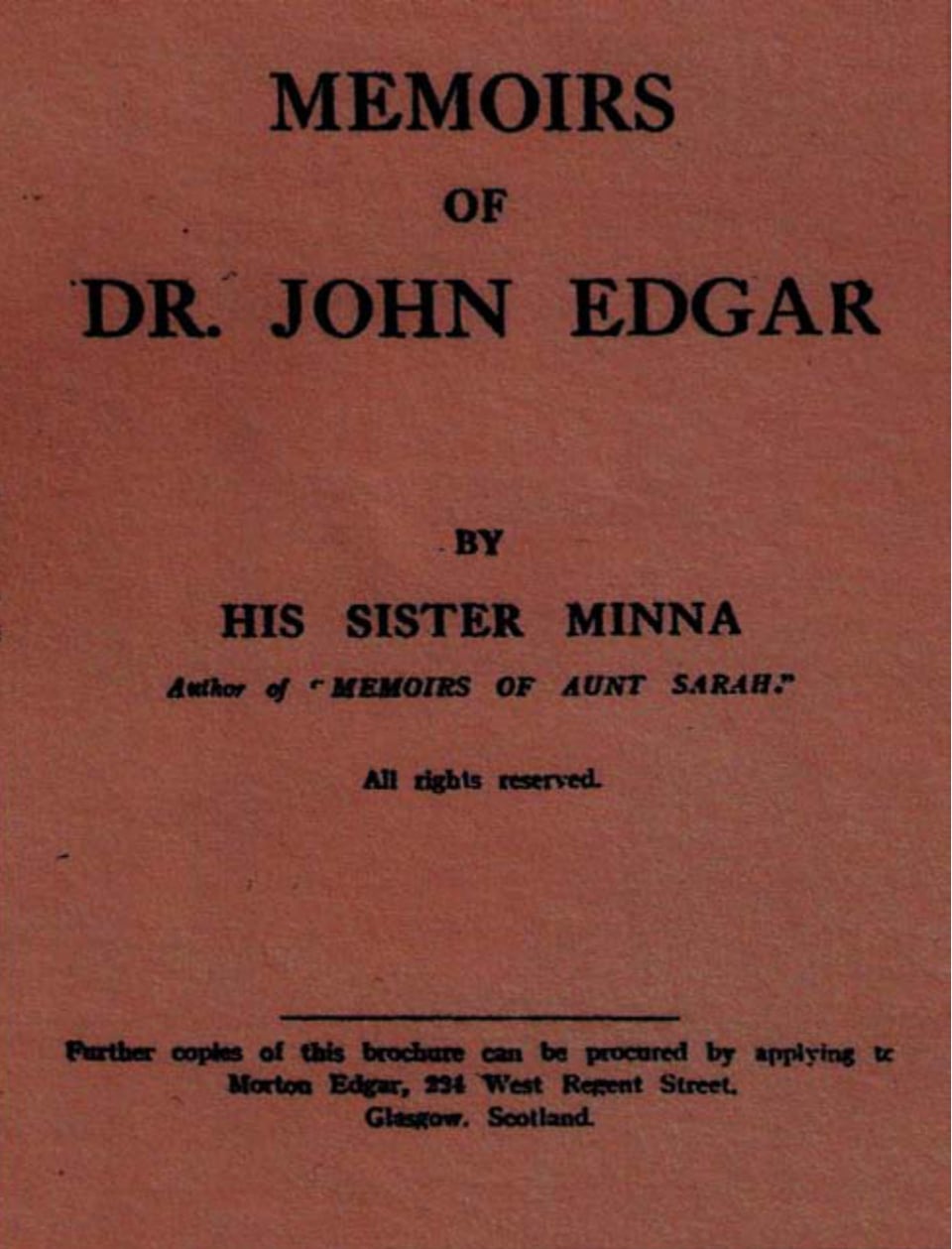
MEMOIRS
OF
DR. JOHN EDGAR
BY
HIS SISTER MINNA
Author of " MEMOIRS OF AUNT SARAH."
All rights reserved.
Further copies of this brochure can be procured by applying to Morton Edgar, 234 West Regent Street. Glasgow. Scotland.
MEMOIRS OF DR. JOHN EDGAR
BY HIS SISTER MINNA Author of "MEMOIRS OF AUNT SARAH."
All rights reserved.
CHERISHED PROMISES
(Isa. 58 : 11 ; 51 : 3 ; 27 : 3. Hosea 14 : 5)
Though sterile as a desert My heritage hath lain,
A silent desolation Of marshland, hill, and plain;
Now mine, through faith surrendered,
Submitted to my care.
Transformed, shall bloom an Eden,
With flowers and fruitage rare.
Lest any hurt my vineyard, I'll keep it night and day. Lest summer heat and sunshine Should wither and decay. I'll water it and tend it Each moment of each hour. By evening mist and dew-cloud And rain's refreshing shower.
These promises, dear Father,
Lie cherished in my heart,
I, panting, crave the wat'ring
Thou only canst impart.
Come, make my soul Thy garden,
Spread flowers of grace around,
Let lily of the valley
And Sharon's rose abound.
Convert my barren waste-land To pleasant fruitful field. And cause my rocky upland Its verdant praise to yield. Change dreary swamp to fountains All rippling with delight. Proclaiming loud Thy mercy, Exulting in Thy might.
Rank weeds of self uprooted Abhorred and flung aside. Each sprout of pride detected Though secretly it hide. Vain Nature's thorns and briers To ashes burn away. Let naught retard the increase Of love's productive sway.
All Thine the Garden's flowers,
All Thine the Vineyard's fruit,
Beloved, Thou hast planted
And watered seed and root.
Possess and keep me, Father,
Extend Thy quick'ning power—
Till all my being praise Thee
Each moment of each hour.
MINNA EDGAR.
PRECIOUS in the sight of the Lord is the death of His saints."
This beautiful text was greatly impressed upon my mind when my beloved brother, John, entered into his rest. His had been a busy and useful life, wholly devoted in late years to the service of God. For the Lord's sake he had counted not his life dear unto him; and now he had triumphantly finished his course.
I felt assured that the heavenly Father would use His faithful servant's dying testimony; and the thought was suggested that a brief Memoir might prove, in the Lord's hands, a means to this end. I besought the Lord in earnest prayer that I might know His will in this matter; and "watching unto prayer" He in various ways graciously indicated His approval.
At that time I contemplated issuing duplicated typewritten notes; but it soon became evident from the numerous interested enquiries I constantly received, that only by the printed page could I hope to supply the demand for these Memoirs.
Many dear friends had written expressing deep sympathy in our loss, and, in a general letter of acknowledgment, I hastened to convey to them our brother's parting exhortation. Pastor Russell kindly published this letter in the "Watch Tower" of 15th July, 1910, and the Lord thus enabled many thousands of like precious faith to receive the benefit of John's last testimony. Communications from far and near soon came, telling of great blessings received through the message.
A little later Dr. Jones, of Chicago, requested my brother Morton to send "something more concerning the doctor.
on the lines of the 'family letter,'" that it might be inserted in the forthcoming U.S.A. Convention Report. He responded by forwarding some brief notes which I had compiled, and these duly appeared in the Report.
I have since heard of many who, through reading my brother's dying testimony, have been quickened to greater earnestness in service, and to more fervent love and zeal. It gives me special joy and cause for thanksgiving to learn that the faith of some fellow-pilgrims, while on their death-beds, was fanned to a "pure and steady ray" through the knowledge of John's experience, and that the dark valley of death was illuminated with the joyful assurance that the blessed Saviour, who "helped dear Brother Edgar" to rejoice even amidst his sufferings, would also strengthen them to witness a good confession to the mighty power of God to keep His own.
In sending forth these Memoirs I am, therefore, encouraged to hope that they will be used and blessed of the Lord. They have been written in much weakness and with many tears; yet the labour of love, undertaken and completed in entire dependence upon God, has been very sweet.
MINNA EDGAR NOTICE OF THE DEATH OF DR. JOHN EDGAR.
From "Glasgow Herald," Friday, 10th June, 1910.
We regret to announce the death of Dr. John Edgar, of Clairmont Gardens, Glasgow, which took place yesterday evening in a nursing home. Dr. Edgar became suddenly ill toward the end of last week, and on Monday it was found necessary to perform an operation which unfortunately proved unavailing. Dr. Edgar, who was a son of the late Mr. John Edgar of Mansewood, Pollokshaws, was well known in professional circles as an outstanding specialist in the departments of obstetrics and gynecology. He was born in Glasgow 48 years ago, and was educated in the University of Glasgow in arts, science, and medicine, taking degrees in all three faculties. After qualifying in medicine, he took special post-graduate courses abroad, and on his return to Glasgow at once commenced special studies in the hospitals in the departments in which he has since distinguished himself. In 1896 he was appointed one of the surgeons to the Royal Samaritan Hospital for Women, a position which, till the time of his death, he occupied with much acceptance. He was also, on the retirement of Dr. W. L. Reid from Anderson's College Medical School, appointed to succeed him as a teacher of midwifery and gynecology, where his teaching was highly appreciated by the students.
Dr. Edgar took much interest in the work of the Glasgow medical societies, at which he was a frequent attender, and in two of which he reached the position of vice-president. He was author of many important contributions to the proceedings of these societies and to the medical periodicals. For many years he has had a large consulting practice in Glasgow and neighbourhood. He was a great favourite with his professional brethren, who regarded him as a man of considerable talent, and his untimely death, at an early age, is a matter for very deep regret.
In recent years Dr. Edgar had gained considerable popularity as a speaker on religious subjects, having travelled in connection with this work over nearly all the populous centres in Great Britain and many parts of the Continent. His lecture, "Where are the Dead?" has reached a circulation of 40,000. Last year, accompanied by his brother Morton, he visited Palestine, delivering lectures in Jerusalem. They also visited the Great Pyramid in Egypt, spending some time in exploring and measuring its internal passages. A volume is at present in the press detailing their scientific symbolism, and pointing out many significant parallels in Scripture chronology and time prophecy.
MEMOIRS OF DR. JOHN EDGAR.
I.
How he came into the Light.
MY dear brother John came gradually into the light now due to the household of faith, for there were many obstacles in the way. It was difficult for him to find the necessary leisure sufficient to duly consider spiritual things; his professional work and studies fully occupied his time, and were very dear to his heart. Past successes quickened his hopes for still greater achievements, and there was every prospect that his ambitions would be attained. He was highly esteemed, both for his personal qualities and his skill as a surgeon. Enjoying vigorous health, a happy home, and many loving friends, this life held much to satisfy his bright, affectionate disposition.
Although such earthly acquisitions tended to hinder his spiritual advancement, my brother had nevertheless certain Christian advantages. Our parents had trained him to reverence God and the Bible, and also to regard Christ as his personal Saviour. Possessed of a humble spirit, his mind was open to accept of truth, even though unpopular. His standard of authority was the Word of God. Any teaching that appeared reasonable and in harmony therewith, he carefully searched till satisfied of its soundness or otherwise; and whenever a truth became a matter of conviction, his life and conduct were brought into conformity with it regardless of all consequences, immediate or remote, even should these prove to be the loss of every cherished friend and the frustration of his dearest earthly hopes. Thus humbly walking in the light, he continued to be taught of the Lord; for "the meek will He guide in judgment, and the meek will He teach His way"—Psa. xxv. 9.
Brought as he was in the course of his professional work into close touch with much pain and sorrow, and being of a very sympathetic nature, John keenly felt the need for the world's deliverance.
He had himself experienced deep grief in our losing by death, after protracted suffering, four members of our family, in the short space of two and a half years. The ploughshare of sorrow had thus done its part in helping to prepare his heart to receive gladly the seed of the Word—the "good tidings of great joy which shall be to all people"—Luke ii. 10.
Our father, whom we all dearly loved, and our sister Eva, in addition to myself, were the first to read and appreciate "The Divine Plan of the Ages," by Charles T. Russell.
This book was drawn to our attention at the right time by a friend, Miss Ferrie. We were greatly depressed by the sufferings and death of our dear ones, though assured that they had died trusting in Jesus. Despite the teaching of the Church, as expressed in the Shorter Catechism, that "the souls of believers are at their death made perfect in holiness and do immediately pass into glory," much mystery beclouded our minds and augmented our sorrow.
These bereavements were used by God to impress upon us how terrible an enemy is death, and led us to see that the question "Where are the Dead?" is not satisfactorily answered by the creeds of Christendom. Brought up in the Presbyterian faith, we held as truth the commonly accepted doctrines of eternal torment, the immortality of the soul, free grace, and the Calvinistic view of election, etc. Greatly did these doctrines trouble me, especially during the last nine months of our brother James's most distressing illness.
James never professed being a Christian, and generally avoided conversation on religious subjects. He would not permit me to pray with him, and would wearily turn away as he noted my sadness at his refusal. He had been what the world calls "a good fellow," an honest, moral-living man; but God alone knows what bitter tears I shed as I agonised in prayer that he might be saved from the horrible fate which my creed taught awaits all who do not confess Christ.
How fervently I urged my simple faith to "claim" my brother's salvation on the strength of the promise in John xvi. 23—"Whatsoever ye shall ask the Father in My name, He will give it you!" I clung to that word "whatsoever," and implored the Almighty to grant me my brother's salvation.
On the day James died, when I realised that he was so soon to pass away, my prayers grew more passionate in my fast-ebbing hope. Had my faith proved too weak to win my brother's soul? Was he to be forever lost because a child of God in her weakness proved unavailing in prayer? I was bewildered and distressed, but still sought to lay hold of the promise of God's own Word, and resolved that once again I would speak to my brother. I did so, asking him most tenderly if he would like me "to say a wee prayer with him"; but, with closed eyes, he murmured, "Oh, no." Overwhelmed with grief, I sought the quiet of my room to pour out in prayer my deep anguish before the Lord.
Later, when in the library, dear father questioned me as to the cause of my bitter weeping. I told him, between my sobs, of the dreadful fears which filled my mind. I think father must surely have been finding consolation in thoughts of the mercy of the Lord, which, as the Scriptures say, "endureth for ever," for he did not appear to be much perturbed on James's account, though he showed concern at my grief. He went to the sick room, and before long returned, saying in his kindly tones, "Well, my dear lassie, you need never distress yourself any more about James. I asked him just now if he was trusting in Jesus, and he answered, 'Oh yes, father.'" Words cannot express my unbounded gratitude to God who had thus so graciously comforted me. Indeed, was it not just like His loving tenderness so to soothe the grief of His ignorant child!
I thought this dying expression of trust was all that was required to deliver my brother from an eternity of woe.
Before long, however, perplexing questions presented themselves to my mind. Had I the right to hope that James was now in Heaven with all those faithful followers of the Lord, who had devoted their lives to His service and suffered, maybe, even martyrdom for His sake? Was my brother's spirit undergoing a purifying process which would ultimately make him a copy of Christ? What of those who have no one to pray for them—would they perish on that account? For these and similar difficulties, Presbyterianism has no solution. Our prayers for more light, however, were answered by the Lord in due time, and in His own way.
As we read "The Divine Plan of the Ages," proving its every statement in the Scriptures, we found our questions and difficulties thoroughly cleared up. Our heavenly Father's love shone out most brilliantly from His own Holy Word. We became convinced that this book was indeed a help to the understanding of the Bible, and we often spoke to the doctor of the marvellous unfolding which we had received through its aid, and we constantly sought to arouse his interest in it. For fully a year, however, there was little response. He and the other members of the family feared that their father and two sisters were becoming fanatical, and they disliked the publicity caused by the "propagandist work" and separation from the United Presbyterian Church. Nevertheless, our brother acknowledged later that our enthusiasm and zeal had influenced him favourably.
Our home was opened freely in the service of the Truth, and it was our joy and privilege to entertain many of the Lord's children and messengers. John, who was a frequent visitor, was brought into contact with many of these friends, including Brother Hemery and Sister Sarah Ferrie, whom we then, with loving familiarity, began to know as "Aunt Sarah."
These two earnest followers of the Lord were used of Him to help break down any prejudice and indifference which the doctor may have bad.
It was in the autumn of 1899 that John began a thorough investigation of the "new beliefs." Shortly after a little convention at which he and his wife were present, they desired us to spend an evening with them, before Brothers Hemery and Houston left the city for their homes; and as they gave us liberty to invite as many as we pleased of the brethren and enquiring friends, their large drawing room was well filled. We had a most delightful time discussing the various points of the Truth and explaining certain difficult questions. I saw that the Lord's blessing was certainly with us, and towards the close I whispered to my brother that, even as in days of old the house which held the Ark of the Covenant received earthly blessings, so now those who entertained the Lord's messengers would surely receive spiritual blessings, and that he and Grace should therefore be expectant.
Shortly after this helpful gathering, John was called to a consultation in the far North of Scotland. As the journey was to be long, he thought it an excellent opportunity to read the book which we had so often earnestly urged him to study—"The Divine Plan of the Ages." That day of travel was the most momentous in his life. His mind had now become receptive to the Truth, and he read on, hour after hour, as one enrapt. The train stopped at the various stations on the route, and the passengers came and went as usual; but so engrossed was he in his reading, he was oblivious of all else. He afterwards said that at one station several rough-speaking youths entered the compartment, and for a time he heard their voices; but very soon his book again absorbed his attention, and by and by he found himself alone, with no recollection as to when or where his fellow-travellers had left. He was amused at his own concentration of thought.
The plan of God opened up to him in all its grandeur and brought conviction of its truth to his mind. It was too glorious in its manifestations of love and wisdom to be of man. It bore unmistakably the impress of the Divine. He realised, as never before, that the best evidence of the truth and inspiration of the Bible comes from within itself. He saw that the golden thread of God's plan of salvation for mankind runs through it from Genesis to Revelation. From that day forward the doctor made rapid progress in grace and knowledge. He manifested keen appreciation of the high calling, and considered it but a small sacrifice to surrender "mere earthly things" for the hope of gaining joint-heirship with Christ. His was a thorough and wholehearted consecration to the Lord.
One evening, some months after his journey to the North, John, in company with a few others, symbolised his sacrifice and baptism into the death of Christ by water immersion. We had engaged one of the Glasgow public baths, and our little baptismal ceremony, though conducted with great simplicity, was most impressive. We felt as if we were indeed shut in with the Lord so that we might have impressed upon our minds the solemnity of the obligation we had entered upon. The lights from the suspended lamps were reflected in the still water, and shone upon the upturned faces, aglow with the holy resolve to be true to their covenant of sacrifice. The brief exhortation, the prayers, the singing, all came from hearts filled with the realisation of the presence of God.
The water burial spoke of humiliation, suffering, sacrifice, death, but to our dear brother these were "light afflictions" compared to the "eternal weight of glory" revealed to the eyes of his faith. Tears blurred our vision, but they were the outcome of joy, not of sadness. We knew John deeply appreciated the great privilege of being accepted as a probationary member of Christ's Body, and that, though conscious of his own weakness, he rested in tie glad assurance that all his imperfections were covered by the merit of Christ, whose precious blood cleansed him from all sin.
His confidence of final victory lay not in hinself but in God. Relying by faith on the mighty power of the heavenly Father, he joyfully laid hold of the glorious hope of the high calling of God in Christ.
John became most diligent in the study of the Bible, taking as his text-books the various volumes of "Scripture Studies," which he marked and annotated profusely. As an example of "redeeming the time," he was an inspiration to us all, for every moment he spent in travelling in tram-cars, etc., was occupied in either reading or writing. "This one thing I do" was the motto which he often expressed, and which seemed to dominate his mind. Frequently one heard the remark: "I saw the doctor in the car this morning, busy studying as usual." "The hand of the diligent maketh rich" was exemplified in his case, for the wealth of his knowledge was gained by much perseverance.
Not only did he believe in his heart the truth which he had received, but he gladly confessed it with his mouth. Very soon all who knew him became aware that Dr. Edgar's desires, hopes, and ambitions were no longer centred round his professional career, but were set in Heaven. All with whom he came into contact found him more eager to speak to them of God's glorious plan than of any other subject; and he always carried in a pocket, specially made for the purpose, a Bible and a copy of "The Divine Plan of the Ages" in readiness to give or lend to any who should evince an interest in the Word of God. He preferred to give the volume rather than tracts, because he held that the book led the inquirer into the light of the Truth step by step, and was therefore less likely to awaken prejudice.
Not long after his consecration he offered his largest room for our meetings; and we met there every Sunday until, at the end of a year, our increasing numbers made it necessary to seek larger premises.
A "born teacher,' John could make the Truth so simple and clear that even the slowest could understand. He was one of the first elders to be elected by the Church, and he held that office till his death. He was indeed an "elder brother" so every member; his advice and help were often asked and readily obtained by many in their times of difficulty, spiritual or otherwise. His influence and talents, money and home, were freely used in the interests of the brethren everywhere; and in this stewardship he had the loving cooperation of his wife, who early followed his example in consecration. Truly, he did not seek to save his life, but spent it in the service of the Master.
In June, 1903, our beloved father died. John and he had been much alike in mind and disposition, and the bond between them was very close and tender. Each admired as well as loved the other, and constantly sought the other's opinion and counsel. John felt that the earthly father's love enabled him the better to comprehend the great love of God, the heavenly Father. He endeavoured, therefore, to be to his own sons what his father had been to him. As an illustration of this parental care, I remember, when I was standing alone by father's coffin, the door of the room opened softly, and John entered leading his two little boys by the hand. They gazed solemnly up into his face as he spoke to them of their dear grandfather's death, and tried to impress some helpful lessons upon their young minds in the time of sorrow. He told them that Jesus died for all, that there might be a glorious resurrection of the dead. He reminded them of how kind and loving their grandfather had always been to them, and to all around him, and said he wanted them to grow up to be like him. He then spoke of the love of God, and of how much greater that love was than the love any human being could have for them. We all knelt beside the coffin as he engaged in prayer, worded in simple language so that the little lads could easily follow.
Surely that is one of the prayers recorded in Heaven. Later, during the funeral service, his personal grief came over him like a great wave. He hurriedly withdrew from his position among the mourners, who were being addressed by Brother Hemery, and, entering a room and closing the door, he rushed to the farthest corner, leaned his head upon his arms and sobbed bitterly as if his heart would break. He was unaware of his sister Eva's presence; she let him weep undisturbed, fearing to intrude upon such sacred sorrow.
Laying aside all thoughts of self, John filled our father's place as head of the family, and willingly bore the burden of all our affairs. He became guardian to the children of our two deceased sisters, so that, combined with his professional duties, which were heavy, he had now many family concerns to attend to, besides his numerous engagements in the work of the Lord's Harvest. We often wondered, and still wonder, how he was able to do so much.
Though we had to endure many difficulties and trials after our father's decease, the Lord, ever gracious and loving, had in reserve for us a great joy. Seven months later our youngest brother, Morton, came into the light of present Truth. Various disappointments had helped to dissipate his worldly hopes, and after a certain earnest talk he yielded himself to God. He then began to read prayerfully "The Divine Plan of the Ages." The first meeting he attended was held in the home of one of the brethren, where John gave a discourse, illustrated by a chart, on the plan of God. Words cannot express the doctor's joy in noticing how eagerly his brother followed every word, drinking in the Truth. Once started, Morton made rapid progress. He showed particular aptitude in the study of Chronology and Time-prophecy, and before long the brothers were working together with mutual benefit.
II.
His Public Testimony.
THE first public discourse the doctor delivered was in his own city. The subject was "The Resurrection of the Dead." Many expressed satisfaction with his exposition, and thankfulness that the Lord, the Chief Reaper, had sent forth this labourer into the harvest field.
His popularity as a public lecturer rapidly increased, and his services were in constant demand both at home and abroad. This work cost him much nervous strain, and he suffered from headaches and sleeplessness both before and after addressing a large meeting. God greatly honoured him, and many hundreds can testify to blessings received through his ministry. He visited Germany on more than one occasion, and, being proficient in the language, delivered several lectures to the dear friends in that country. He also made an extensive tour in Denmark, Norway, and Sweden, where, however, he required the services of an interpreter—a grand lesson in patience, he once remarked when recounting his experiences; for he required to halt at the end of every few sentences, and listen to what always seemed a very lengthy translation of the little he had said.
All of these lecturing tours John greatly enjoyed; everywhere he noticed the same spirit manifested by the brethren, which demonstrated that all were following the one Lord and Master. He realised that they were indeed all "one in Christ Jesus."
In the summer of 1906, our brother, his wife, and I visited many of the principal cities in the United States of America and Canada. This tour was like a royal procession, the dear friends everywhere were so loving and attentive. On our arrival at railway depots we were generally met by several of the brethren, who hospitably entertained us. We received great blessing from the sweet fellowship which we were privileged to enjoy with hundreds of those of like precious faith, and the two large conventions at Asbury Park and St. Paul's were most inspiring.
We were the guests of Brother Russell for a week in the headquarters of the Watch Tower Bible and Tract Society (then in Alleghany, Pa.). As we journeyed from place to place, the doctor delivered many lectures, principally on the Time-prophecies and the symbolisms of the Great Pyramid, using numerous large diagrams previously prepared for the purpose by Morton. This ministry was much appreciated, and, but for his characteristic humility, the love and honour he everywhere received might have been to his spiritual disadvantage.
In 1907 his lecture, "Where are the Dead?" was delivered several times throughout Glasgow and neighbourhood to crowded audiences. On one of these occasions this question was brought into marked prominence by special circumstances. In a large seaside holiday resort, while the posters were on the hoardings announcing the lecture, a most distressing boating accident occurred off the coast, by which several lives were lost. The importance of the question, "Where are the Dead?" was thus brought forcibly before the minds of the people, and the coming lecture was talked about. The result was a most impressive meeting, the large pavilion being filled to overflowing with a deeply sympathetic and attentive audience. Surely many hearts were comforted by the message of peace and love.
Toward the close of the year it was arranged that a public meeting should be addressed by the doctor in the Public Hall, Pollokshields. The choice of the subject was left to his own decision. He mentioned to me that he was wondering what lecture to give, and on my suggesting "Where are the Dead?" exclaimed laughingly, "Oh dear no! I have given that so often. Why, people will begin to think I have nothing else to give! A one-lecture man, eh?"
I answered, "It is just because you have already given it so often that I recommend you to repeat it." "Explain yourself," he demanded. "God has blessed that lecture again and again, and the very fact that so many come to hear indicates that the public are not tired of it. Besides, you know it is a question all thinking people ask themselves. John, give it again," I urged. I was glad when he decided to do so, and knew that in making this decision he was overcoming his natural inclination.
The hall was crowded half-an-hour before the advertised time! Hundreds failed to get even standing room inside the hall, ante-room, or passages. The chairman, who had a fine stentorian voice, stood at the entrance and announced to the crowd gathered round the hall door that the same lecture would be delivered a fortnight hence in the Langside Public Hall. A loud voice from the rear of the crowd replied: "The Langside Hall will never hold the people; engage St. Andrew's Hall." The suggestion then made was recognised to be wise, for though the Langside Hall is much larger than the Burgh Hall, it also was densely packed, and hundreds were again turned away unable to gain entrance.
Accordingly, John was asked to give his lecture in the largest auditorium in the city, St. Andrew's Grand Hall, and after a little hesitancy he consented. The Hall, which has a seating capacity of 4,500, was hired for the 29th of March, 1908. By this means we trusted that a more public witness for the Truth would be given in Glasgow than had previously been attempted.
Even this large hall, however, proved too small for the crowds who desired to gain admittance, and not a little consternation was caused among the officials in attendance by the determined manner in which the people pressed into the corridors and passage-ways. The overflow meeting, which was immediately arranged for, and addressed by Brother William W.
Johnston (now in charge of the African Branch of the Watch Tower Bible and Tract Society), was also soon overcrowded, and still the people continued to come in great numbers. We had the satisfaction, however, of supplying the lecture in pamphlet form to those who were unable to hear, many of whom had come long distances.
So great a multitude of people coming to hear God's glorious Plan of the Ages naturally filled us with praise and thanksgiving. We recalled to mind, as we beheld that crowded building, a long-cherished and often-expressed desire of our dear sister in the Lord, Aunt Sarah, that this large hall should one day be filled with people eager to hear the glad message of God's love as we understood it. In the old days our little class of about a dozen met in her "wee back shop" in the Cowcaddens; and when we had an "extra large" meeting of two or three dozen, Aunt Sarah would make us smile as she would enthusiastically exclaim: "We'll have St. Andrew's Hall filled yet!" Noting our incredulous smiles, she would continue—"I does not the Lord say, 'Delight thyself also in the Lord, and He shall give thee the desires of thine heart'? Well, the Lord will yet let me see St. Andrew's Hall filled with folk listening to the good tidings of great joy, for I am delighting myself in Him, and that is one of the desires of my heart. Just you wait and you'll see!" And we did see! But none of us had ever thought the prophecy would be so amplly fulfilled. Truly, Ephesians iii. 20 was exemplified here, for the Lord had certainly granted Aunt Sarah's desire "exceeding abundantly above all" that she had asked or thought!
As might be expected, great blessing flowed from this meeting; through it the Truth was brought into much prominence. The lecture was freely discussed in many of the large workshops and warehouses in the city. The booklet was taken up by many booksellers, who frequently asked for further copies.
The first edition or twenty thousand was sold out within ten weeks; but the orders accumulated to such an extent that when the second edition was ready we had to request the postal authorities to send a van to collect them from our house. When the last of the mail-bags had been carried out and the bustle was over, we were impressed with the thought that in this again the Lord had answered our prayer far beyond what we had asked or thought. We recalled the mingled feelings of hope and trepidation with which we awaited the night of the momentous meeting, and the nervousness and fearfulness of our dear brother John, as the time drew near. His wife tells that, when he and she knelt together in prayer before leaving their home for the hall, the doctor was almost overcome with the feeling of his own weakness and insufficiency, and asked her to voice their petition to the Lord that grace and strength might be granted to enable him to deliver His message. Their request was honoured, for the doctor never spoke better than he did then.
Besides delivering "Where are the Dead?" to crowded audiences in many of the cities throughout Scandinavia, the doctor had the great privilege of delivering his famous lecture (so much was his name identified with it) in the Holy City itself! I well remember the thrill of pleasure with which I read the announcement of this meeting in the handbill and in the letters the doctor sent home. It was surely an honour to be permitted to proclaim the present Truth in Jerusalem, where Jesus, who spake as never man spake, had given forth His Father's Words of Life!
Others of John's lectures have appeared from time to time in the printed reports of the General Conventions held in this country and in America. Of these, possibly the most helpful are—"Socialism and the Bible," "The Preservation of Identity in the Resurrection," "A Tree Planted by the Rivers of Water," and "Rest and Restitution."
Throughout all his public ministry, the doctor's principal aim was to induce others to study for themselves the writings of Pastor Russell; but to those who had already gained a knowledge of the Plan of God, and were walking the narrow way of consecration, he was a constant stimulus by example and precept. His very presence was helpful. The sight of his bright, loving face as he entered the room had a beneficial influence. As one of his patients remarked, "The doctor comes like a ray of sunshine to us sick folks." But many felt they did not require to be sick to feel the warmth and glow. The zeal and enthusiasm engendered by his love for the Truth were "catching," and his firm assurance that we are living in the closing years of the Gospel Dispensation, together with his ability in presenting the proofs which formed the foundation of his faith, tended greatly to disarm criticism and opposition.
He was thoroughly convinced of the importance of the time-features of God's plan. Bitter experience of others, as well as his own, taught him the opprobrium that rested on all attempts to interpret the time-prophecies of the Bible, and he often referred to the lack of logic evidenced in the objections offered to the study of Biblical dates. Because, he would say, some have failed to interpret properly the obscure prophecies of the Scriptures in the past, it does not follow that these prophecies will never be understood. Men do not use such an argument in connection with any of the sciences, and why therefore should they use it in connection with the time-features or other prophecies of the Scriptures? The real fact is that men refrain from believing the Bible, for belief in the Word of God brings responsibility. Our brother believed that, even as Martin Luther had been chosen as a fitting instrument by God to unfold truths then due to be know n by the household of faith, so now further unfoldings are due; and it was his conviction that to Charles T.
Russell, a wise and faithful servant of the Lord, had been entrusted the honour of shedding light upon hitherto obscure passages of the Scriptures.
The doctor was not afraid to acknowledge his firm belief that we are living "in the days of the Son of Man," when a great dispensational change is due to take place, and that the Lord's faithful are now experiencing the "blessedness" which Daniel the prophet foretold for those living at the end of the "thousand, three hundred and five and thirty days" of waiting. To him it was the greatest privilege to serve as one of the messengers sent forth in this harvest-time, the consummation of the Age (Matt. xiii. 39. R.v.), to separate the wheat from the tares. He saw from the Scriptures that many wonderful events are due to take place during this period, the most important being the gathering together of the Lord's saints who had "made a covenant with Him by sacrifice"—Psalm 1.5. He believed that the "First Resurrection" is in progress; that all the members of the Body of Christ who had "fallen asleep" in death waiting for the "last trump," the "trump of God," are now with the Lord, glorious spirit beings, and consequently those who are "alive and remain" do not "sleep" in death as did those who died previous to this harvest-time (and as all do who are not members of the Body of Christ). Now, when the saints die they are "changed in a moment, in the twinkling of an eye," to their glorious spirit condition.*—I Thess. iv. 16: I Cor. xv. 52.
It will be noticed in this connection that there is no contradiction between this belief and the teaching set forth in "Where are the Dead?" as some correspondents to the newspapers have claimed. The discourse on "Where are the Dead?" does not deal with "times and seasons" nor with the special features of the few closing years of this Gospel Dispensation, but is an elucidation of a great general truth, viz., that the dead are asleep, waiting till the resurrection morning.
Those who desire a clear exposition of the times and seasons are referred to the second and third volumes of "Studies in the Scriptures," by the late C. T. Russell.
For several years the doctor was specially interested in the symbolisms of the Great Pyramid of Gizeh, in Egypt. When he read for the first time (in 1900) Pastor Russell's article on the Great Pyramid in the third volume of "Studies in the Scriptures," he did not fully appreciate it. The theory that the system of passages and chambers in that building is intended by God to symbolise His plan of salvation appeared too fanciful. Subsequent study of the Divine Plan itself, however, had so prepared his mind that when, six years later, in spring of 1906, he and his brother Morton began a systematic study of the subject, he became thoroughly convinced that this was indeed God's "Stone Witness." Continuing their search for the treasures of truth which they believed still lay hidden in this wonderful edifice, they were rewarded by the discovery of many additional corroborations. The brothers derived much blessing from this work, and often expressed gratitude to their heavenly Father for these further confirmations to their faith. To quote the doctor's own words: "In our study of the Pyramid our love for God grows deeper, because we see in it His loving favour for us and for the world in general; and at the same time our awe of Him increases as we perceive His power and wisdom."
In the summer of 1906 the doctor delivered a series of lectures on the Pyramid in America and Great Britain, setting forth the additional corroborations which had been found; and the same year a brochure containing a synopsis of the discoveries was published. The entire edition of this publication was soon exhausted; but, ever mindful of the interests of the Truth, the brothers began the preparation of a fuller and more detailed work.
As they progressed, still further beauties were revealed, and before bringing out their joint-publication they decided to make a personal visit to the Great Pyramid, that they might speak more confidently of its wonderful symbolisms. Accordingly, in the summer of 1909, accompanied by Mrs Edgar and her two sons, the brothers visited Egypt and Palestine.
For many weeks they encamped in tents close to the Great Pyramid. Morton preceded the others in order to make necessary preliminary arrangements, and to complete preparations for taking exact measurements of the internal passages, etc. A very full account of their operations at the Pyramid is given in the first volume of "Great Pyramid Passages." The second volume of this work enters fully into all the Pyramid-inch time-measurements, of which there are about fifty; and also explains the wonderful time-parallels of the Scriptures.
During their stay in the East, we were kept well advised of their impressions and movements. The brethren in Glasgow took an intense interest in their operations, and eagerly perused long letters sent home from time to time. We were not without anxiety on their account, for many dangers attended their enterprise. These will be readily understood when it is stated that, in addition to measuring accurately the exceedingly steep and slippery passages, they closely examined the Well-shaft, which is almost perpendicular, and about 200 feet in depth! This work was rendered more easily possible by being performed during the "off" season, when the ordinary tourists and curiosity-hunters had left the country; but, on the other hand, they were exposed to the excessive heat which prevails at that time, and is a frequent cause of serious illness to those accustomed to a northern climate. Indeed, while in Jerusalem, the doctor and his younger boy, Stanley, were very ill with dysentery; and when we received news of their sickness we were filled with apprehensions. We doubly rejoiced, therefore, and rendered to God our heart-felt thanks when in due time they returned safe and well.
The Last Days.
OUR dear brother was privileged to labour in the public service of the Master right up to the last week of his life on earth. On 15th May he addressed a large gathering at the London Convention, held in Whitefield's Old Tabernacle, on "Our Oneness in Christ" (since published in the 1910 American Convention Report). It is interesting to know that, on this occasion, he occupied the identical old-fashioned high pulpit from which Whitefield preached. (The old pulpit, in a state of good preservation, was transferred to the present building, which was erected on the exact site of the original Whitefield Tabernacle.)
Later, on the same evening, he was chairman at the second of the three large "May Meetings" addressed by Pastor Russell in the London Royal Albert Hall; and two days after, on the 17th May, he again officiated as the pastor's chairman at the public meeting held in the Glasgow City Hall. Many remarked then on the doctor's bright, happy expression as he sat facing the large audience. It was always a joy to him to be with Brother Russell, and especially on such an occasion as this, when his beloved pastor was so ably delivering the Lord's glorious message to a great congregation of attentive listeners.
In Edinburgh, on Thursday, 19th May, three weeks before his death, John gave a most helpful discourse on "The Sin-Offering." During this interval he accompanied Pastor Russell to Dundee. On the 21st he lectured in Ayr, and on the 28th returned to Dundee, addressing a large meeting on "Why God permitted Evil."
On 1st June he spoke at a farewell gathering held by the Church at Glasgow on the eve of the departure of Brothers Johnston and Crawford for other fields of service. His warm, loving words of God-speed and encouragement, together with the bright and humorous, yet tender, account which he gave of the growth of the class at Glasgow, will long live in the memory of those who heard him. Though he appeared tired, he was cheerful and happy, and exerted himself to assist all to look at the bright side of this parting scene. None imagined that it was his farewell also, in a very special sense, to the brethren whom he so dearly loved.
The next day was a general holiday in Glasgow, and our brother and his wife, in company with other friends, visited Lochranza, where a dear brother and sister in the Lord were temporarily residing. We afterwards learned that during the day, as opportunity offered, he wrote on pictorial cards a large number of messages of loving remembrance to invalided, aged, or isolated brethren. His thoughtfulness in these little attentions has often proved a helpful lesson to others. On the same evening he joined a large company of friends at the Central Station to say "Goodbye" to Brother Johnston, who was now leaving for London, en route for Africa.
The following night the doctor felt indisposed, but on Saturday morning, though still very unwell, he attended to some of his most urgent medical cases, besides performing an important surgical operation, and in the afternoon retired to bed.
On Sunday, during the usual morning Bible study, we were informed that he was still very unwell, and at the close of the meeting I hastened to visit him. I found that he was suffering from headache; but he had his Bible in his hand, and was going over the passage which we had been considering at our morning class. After a little talk about his illness, he began to speak of our lesson—Heb. ii.
11-14. He wondered why Isaiah viii. 18 should have been quoted here by the writer, and offered various explanations; but I insisted that he must not talk. Before I left he requested me to convey several messages, and gave directions by which a certain brother, who required spiritual assistance, might be brought into touch with one able to help him.
That afternoon Stanley brought me a little note from his father, in which he had tabulated in his usual methodical way the different items he wished me to attend to. I smiled as I saw the list, thinking, "How like John this is," but nevertheless regretting that I had not assured him more definitely that I would remember. Then I noticed some writing in small characters along the edge to the effect that the physician had again examined him, and thought he might have sub-acute appendicitis. The news naturally caused me anxiety, and I decided that the Church must know of this development. In the evening, therefore (on the 5th June—the seventh anniversary of our father's death), the Church received the message that the doctor's illness was more than mere indisposition. We remembered him in prayer, and though we felt a little alarmed at the thought of the possible dangerous malady, we hoped that all would yet be well.
I saw him once more that evening, and again found him reading his Bible. I gently took the book from him, saying that I knew too much about sickness to allow him to read any more. I lingered with him a little, and then, as he hoped he might settle to sleep, I left for home, feeling very anxious, though somewhat assured by a message which the physician had telephoned to Mrs. Edgar.
During the night he suffered from severe pain and sickness, but, wishing not to disturb his physician's rest, he waited till morning before sending a message to him to come and bring with him a surgeon. The examination took place at 8.45 a.m., and the symptoms which indicated to the surgeon the seriousness of our brother's condition revealed it to the patient himself.
The surgeon told me later that, while he was engaged percussing he noticed my brother listening intently, and on their both hearing certain ominous sounds their eyes met. Both knew it to be very doubtful if life could be saved. Our brother himself seemed quite assured that he was face to face with death. There was, however, a slender hope that an immediate operation might lead to recovery.
We were all quickly summoned to his bedside before the ambulance should convey him to a private nursing-home near by, where he had himself attended many patients. We found our dear one in great agony, and much exhausted by his long night of suffering. A groan would seldom escape him. His dear wife and I did all we could to relieve his pain. At times he felt icy cold, and then would burn with fever.
Our sister Annie said to him as she sat beside him, " Surely, John, it is not you who is to be the first to go! I am the eldest, and have expected to be taken before you."
"Yes, I am going to the Father," he replied, "to my Father and your Father, to my God and your God."
"Oh, John," she exclaimed, "we cannot do without you. You are the head, you know, of the family; we cannot spare you yet." But he answered, "God will care for you all. Cast all your care upon Him, and He will look after you far better than I could do!"
He stretched out his arms for us, and drawing us one by one to himself, kissed us most tenderly. Mentioning each of us by name, he said, "Good-bye; God bless you." Now and then one of us would burst into tears, and these he would reprove gently by saying. "If ye loved me ye would rejoice, because I go to the Father." We assured him that we did rejoice for his sake, but mourned for our own.
We know that God heard the many prayers that ascended on our behalf, for surely special grace was given us to bear cur sudden trial calmly.
Occasionally dear John would murmur, "Oh, I am so tired;" and Annie would pat him soothingly and say, "Poor son!" ("Son" is a term of comforting endearment often used in Scotland by an elder to a younger relative.) Our dear sister Grace was wonderfully upheld, though her heart was anguished at the sight of her beloved husband's sufferings. Time and again he held her face to his own, lervently kissing her, and seeking to comfort her by reminding her of God's almighty power and love.
At last the ambulance arrived, and after some more farewells he was conveyed to the nursing home. We were not altogether devoid of hope, for we knew he was in the hands of a clever surgeon; and we trusted that the Master might still have work for him on this side of the veil.
After the operation, the surgeon came to the side-room where I was waiting, and very gravely said, "I am sorry that I cannot give you hope for your brother. If he should linger for 24 hours, then we might begin to have a glimmer of hope." I felt that surely it must be somebody else's brother he was speaking of! Yet, though numb and dazed, I knew that God was about to let the greatest sorrow fall upon us, and my heart cried out to Him for grace and strength to enable us all to bear it. It was hard to go home to the anxious ones with such news. Though all were stunned by this sudden blow, we never at any time felt a trace of rebellion in our hearts. We desired most fervently that God's will should be done.
Sister Grace and I visited John that afternoon, and found him very exhausted but quite collected. He sought to comfort his wife by assuring her that God would be her helper and strength, and very tenderly he commended us both to His keeping. In the evening, when we again visited him, he was bathed in perspiration, so that even the pillow under his head was wet. The surgeon remarked that such sweating was quite phenomenal, and our hope sprang up afresh.
We thought, "Maybe God is working the miracle that alone can save him! Our God can do wonderful things, and it might be that His glory will be best served by sparing this useful life yet a little longer!" All Monday night he suffered acutely and was most restless; but twenty-four hours slipped past and still be lingered. Nevertheless the surgeon denied us all hope.
The news of the doctor's very serious condition was quickly circulated among the anxious brethren, and, as all loved him very dearly, much sorrow and grief were awakened.
Tuesday was a long day of waiting and pain. Sister Grace and I now and then saw him, but as he exhausted himself in seeking to manifest his love for us, and especially for his dear wife, by giving us parting exhortations to trust in God, and comfort our hearts in the knowledge that we must soon meet again, we felt it necessary to leave him in quietness. To witness his distress of body was exceedingly painful. The upturned appealing glance, the sudden helpless movement of his hands, betokened that his sufferings were great, and told that in the midst of them his soul made supplication to its God. We prayed without ceasing.
In the evening we were greatly relieved on learning that morphia was to be injected; we hoped he would now get sleep.
That night his sons, Jack and Stanley, knelt in prayer with their mother and myself. Our hearts rejoiced to hear the lads pray aloud. The elder (17 years of age) told the Lord that he knew his father did not desire "earthly blessings," and he would not ask for his life to be spared, but besought God to alleviate the pain as far as possible, that "father might get some sleep." He ended with the pathetic appeal that his mother might be strengthened to bear up, "because you know, Father, if mother were also to be taken away it might be more than Stanley and I could bear."
On Wednesday morning I suggested to sister Grace to go alone to see her dear one. She did so, and, while I waited for her in another room, she told him of the boys' prayers the night before, knowing that it would be a comfort to him and would gladden him to hear that the Lord was working in their hearts. It was now approaching forty-eight hours since the operation, and though no authoritative hope was given us our spirits rose a little. On leaving the nursing home to join those who usually congregated a short distance away, anxiously awaiting the latest report, we found Brother Hemery coming over to meet us. He had travelled from London during the night, for he desired greatly to see his dear brother John once more in the flesh, should the Lord grant him that privilege.
In the early afternoon a message came from the nursing home that John desired to see his wife and boys. Jack and Stanley were much affected by the interview. The former told his father that on the previous night he had knelt down when alone in his bedroom, and earnestly prayed to God for the light. Both the lads told their father that they intended to consecrate themselves to the Lord. They wept as he commended them to the heavenly Father. He advised and encouraged them, assuring them of God's love and care for them. Assured that Brother Russell would continue faithful to the end, he urged them to keep close to him. He was frequently interrupted in his remarks by spasms of sickness; but his fatherly care constrained him to sacrifice himself that he might exhort and help them. He spoke to them of the joy he was so soon to experience in being raised with Christ, and reminded them of the shortness of the time. When told of Brother Hemery's arrival, he expressed appreciation of the love and kindness shown, and said he would send for him if he felt at all able for an interview.
Before the lads left, they knelt with their mother at their father's bedside, and presented themselves to God.
About 4 p.m. a message came from John that he would like Brother Hemery and one of his sisters to come to him. It was arranged that I should go. To witness the greeting of these two brothers in the Lord was most touching. John asked Brother Hemery to give him "a long kiss," and the tears sprang to Brother Hemery's eyes as he caught hold of the doctor's hand, and exclaimed, "My dearest brother! You know you are my dearest brother!" John smiled and replied, "You know I love you, though I may not always have manifested it as much as I should have done—Scotch fashion, you know, which I am trying to overcome." Referring to the joy the Lord had granted him in the knowledge that his two sons had now consecrated themselves, he desired Brother Hemery to take special interest in their welfare, and to aid them spiritually.
Haltingly he spoke, sickness frequently disturbing him, but with determination he continued till he had said all he wanted to say. He described his symptoms, and showed very clearly the slender thread on which his life hung. He apparently wanted us to know exactly how things stood with him. We saw he had little hope of his recovery, but bravely submitted to all that was being done for him. We were filled with wonderment at the orderly, methodical way in which he diagnosed his own case—for the time being he was the professor instructing his students. He dismissed the subject, saying with that deliberation which betrayed the effort it was for him to speak, "I am cooperating with the nurses, with the doctor, and with GOD!"
Then he sought to lift us up to the height of his own joyful anticipation of so soon seeing Him who is our Lord and Head, and quoted the text, "In Thy presence is fulness of joy : at Thy right hand there are pleasures for evermore." He urged us to lay firm hold of our glorious hope.
He also referred to Brother Russell as being the servant of the Lord, and of how he desired us always to co-operate with him. He spoke of the book on the Great Pyramid, and of his wish that the second volume should be gone on with, and requested us to encourage Brother Morton in his work upon it. He remarked that when he had spoken to Brother Russell on the corroborations of the time-features which he and Morton had found in the Great Pyramid, his eyes had lighted up with pleasure.
Late in the evening Sister Grace visited John alone. She met the surgeon, who told her that he expected her husband would hardly live out the night, and certainly not through the next day. The slender thread had broken! She came to us in tears to say that all hope of his life being spared was now utterly gone, and to convey to us our brother's message that we were to go to him in turns to have a last interview. Now that John had the surgeon's assurance that death was imminent, he determined to use all his remaining strength to witness for the Truth, so that maybe some might be persuaded to start in the race for the high calling, while others might be helped in their endeavours to make their calling and election sure.
So sudden was his fatal illness, it seemed as if my beloved brother were being cut off while yet in the full strength of a vigorous manhood. Nevertheless, by God's grace, his mind was free from all fear and dread. He could calmly think of the near approach of death, and testify that it had no terrors for him. No dismay, alarm, nor dark forebodings, but restful assurance and glad anticipations filled his mind; for, while dwelling in the secret place of the Most High, abiding under the shadow of the Almighty, he had learned to confront "the last enemy" with the glorious song of triumphant faith ringing in his heart, and making melody in the cars of the Lord upon whom he had so faithfully "set his love."
"I will say of the Lord, He is my refuge and fortress: my God; . . . He covers me with His feathers, and under His wings do I trust: His truth is my shield and buckler . . . He will deliver me and set me on high, because I have known His name . . . He will honour me. With long life [immortality] will He satisfy me, and show me His salvation."
Those who have watched by many death-beds will be surprised to learn that, in addition to the last farewell, when eight of us were gathered together around his bed just prior to the end, he had separate interviews with no less than twenty-three relatives and friends. A solemn hush lay upon all as they emerged from the sick room, and each realised that the interview would be a treasured and ever-stimulating memory. They felt that they had been brought into the presence of the Unseen, and had been privileged to stand on holy ground! His expression was so joyful, loving, and tender! There was not a trace of doubt in his mind, nor, indeed, in the minds of any of us, that he was now waiting on the very threshold, ready to be ushered into the glory beyond. Indeed, the reflection of the glory already shone in his face and beamed from his eyes.
The doctor's first interview was with his boys. During the long hours that had elapsed since they last saw their father, they had developed spiritually. We had looked on in glad wonderment at their growth. They were growing like "calves of the stall"—Mal. iii. 2. The joy of the Lord had come into their hearts like a flood. But for a time after their presentation of themselves to God, at their father's bedside, they had been much depressed, Not only did their beloved father's suffering and serious condition fill their minds with sadness, but the sense of their own weakness and insufficiency to faithfully keep the vow they had made weighed heavily upon them. The dear Lord who gathers the lambs with His arm, and carries them in His bosom, provided for them the spiritual help they required.
…