Who Is the God of the Bible? (1920)
Download: PDF — Who Is the God of the Bible? (1920)
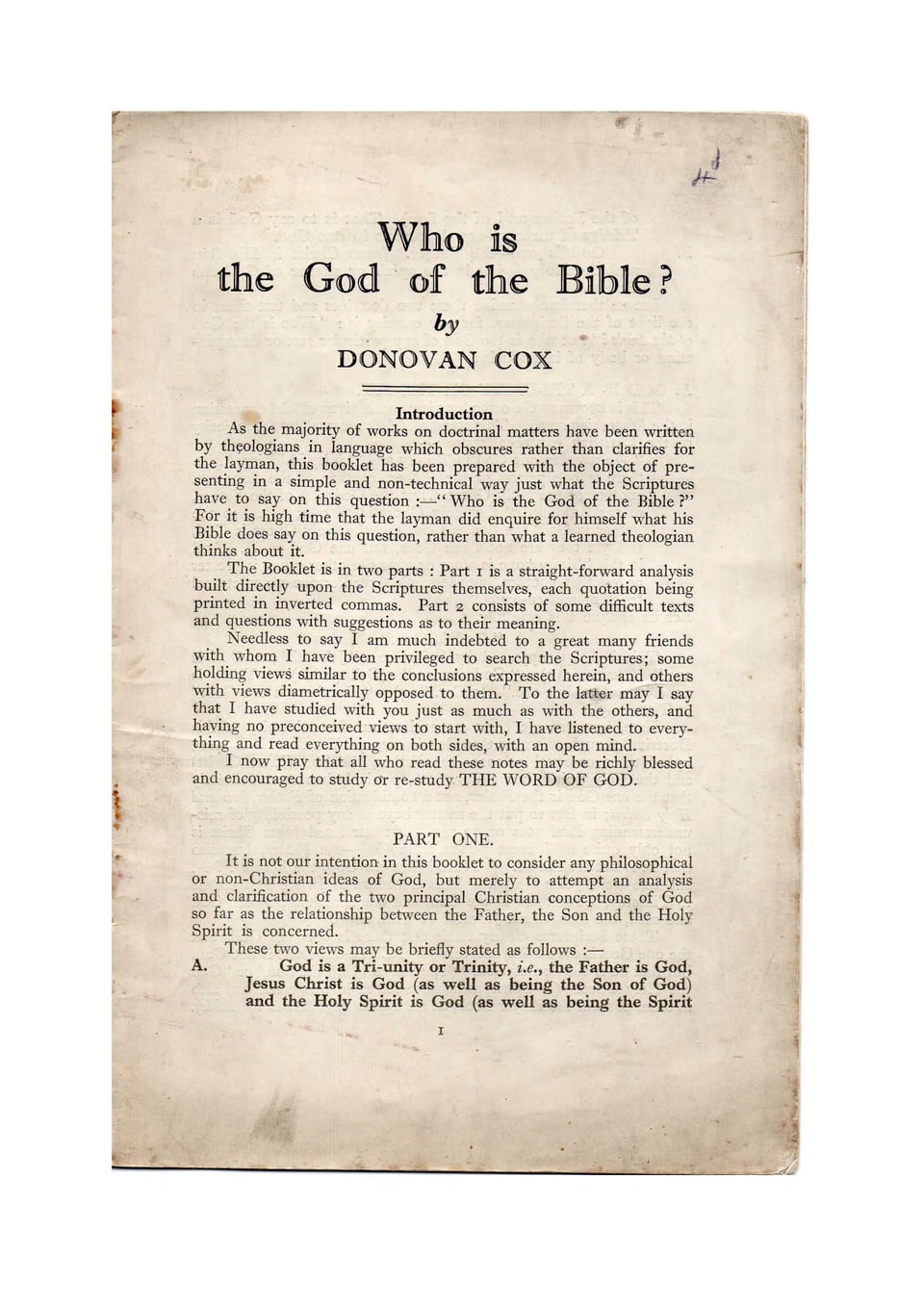
Who is the God of the Bible?
b y
DONOVAN COX
Introduction
As the majority of works on doctrinal matters have been written by theologians in language which obscures rather than clarifies for the layman, this booklet has been prepared with the object of presenting in a simple and non-technical way just what the Scriptures have to say on this question :—"Who is the God of the Bible?" For it is high time that the layman did enquire for himself what his Bible does say on this question, rather than what a learned theologian thinks about it.
The Booklet is in two parts : Part 1 is a straight-forward analysis built directly upon the Scriptures themselves, each quotation being printed in inverted commas. Part 2 consists of some difficult texts and questions with suggestions as to their meaning.
Needless to say I am much indebted to a great many friends with whom I have been privileged to search the Scriptures; some holding views similar to the conclusions expressed herein, and others with views diametrically opposed to them. To the latter may I say that I have studied with you just as much as with the others, and having no preconceived views to start with, I have listened to everything and read everything on both sides, with an open mind.
I now pray that all who read these notes may be richly blessed and encouraged to study or re-study THE WORD OF GOD.
PART ONE.
It is not our intention in this booklet to consider any philosophical or non-Christian ideas of God, but merely to attempt an analysis and clarification of the two principal Christian conceptions of God so far as the relationship between the Father, the Son and the Holy Spirit is concerned.
These two views may be briefly stated as follows :—
God is a Tri-unity or Trinity, i.e., the Father is God, Jesus Christ is God (as well as being the Son of God) and the Holy Spirit is God (as well as being the Spirit of the Father and of the Son).
That is to say God is a Trinity of three co-equal persons in one God.
God is one—the Father. Jesus Christ is His Son and the Holy Spirit is the spirit or power of God the Father.
Let us therefore examine these two doctrines and test them in the light of the Scriptures, for our enquiry is : " Who is the God of the Bible ?" not who is the God of any particular sect or denomination or body of individuals?
A. GOD IS A TRI-UNITY OR TRINITY.
This is known as the orthodox view and is given official expression in the Athanasian creed. This creed, which is accepted by the majority of the Christian churches, states :—
"We worship one God in Trinity and Trinity in Unity . . . there is one person of the Father, another of the Son; and another of the Holy Ghost. But the Godhead of the Father, of the Son and of the Holy Ghost is all one; so the Father is God, the Son is God, and the Holy Ghost is God, and yet they are not three Gods, but one God . . . And in this Trinity none is afore or after the other, none is greater or less than another, but the whole three Persons are co-eternal together and co-equal."
Let us analyse this carefully.
"God is One."
This is fully supported by Scripture : "Jehovah our God is one." (Deut. 6:4). "God is one." (Gal.3:20). "There is none other God but one." (1 Cor.8:4). "For there is one God." (1 Tim.2:5).
Here, however, we come up against our first difficulty as this Doctrine, though affirming that God is one, specifies that He is made up of three co-equal persons—the Father, the Son (Jesus Christ) and the Holy Spirit; but 1 Cor. 8:6, particularizes most definitely that the one God is the Father, not a combination of Father, Son and Holy Spirit; in fact to put the matter beyond any possibility of misunderstanding Paul goes on to shew that our Lord Jesus Christ is not only quite a different person from God—the Father, but also that he is not God at all. "There is but one God, the Father . . . and one Lord Jesus Christ." This is confirmed in the first epistle to Timothy, "For there is one God, and one mediator between God and men, the man Christ Jesus." (1 Tim. 2:5).
These Scriptures clearly teach that there is only one God, that the one God is the Father and that Jesus Christ our Lord is not God, but that he is the Son of God. (The words 'God the Son,' or 'God the Holy Ghost' (or Spirit) which are found in this creed and also in other parts of the Prayer Book, do not appear anywhere in the Bible).
"Father and Son Co-eternal."
God (or the Father—1 Cor. 8: 6), has always existed and the word 'eternal' may properly be applied to Him but not to His Son; in fact the very word 'Father' signifies one from whom life proceeds and 'Son' one to whom life is given by the Father.
There must therefore have been a time when the Father existed and the Son did not, because Jesus himself tells us through his Revelation to John that he (Jesus) was "the beginning of the creation of God." (Rev. 3:14). Also the Apostle Paul tells us that Jesus was "the first born of every creature," (Col. 1:15) and there are many other Scriptures referring to Jesus as being begotten of God. (Jn. 3:16, etc).
Since, therefore, as the Athanasian Creed itself states, Jesus was begotten of the Father (a quite reasonable procedure since this is the proper relationship of Son to Father), or as we have seen above in Rev. 3:14, "Jesus was the beginning of the creation of God," any question of being co-eternal with the Father was never intended to be conveyed either by Jesus himself or the inspired Writers and is Scripturally unsound.
"Father and Son Co-equal."
John in his first epistle tells us that God (or the Father) "sent His only begotten Son into the world." (1 John 4:9, 14). It would be unreasonable to suppose that one co-equal God would or could send another co-equal God.
Jesus himself says, "I can of myself do nothing" (John 5:30). "My Father is greater than I." (John 14:28). Jesus knew and declared that there was only one God—the Father. That is why Jesus said to Mary "Go to my brethren and say unto them, I ascend unto my Father and your Father, my God and your God." (John 20:17). This directly contradicts the idea of equality and is further borne out when we read in connection with the resurrection "This Jesus hath God raised up . . . therefore, being by the right hand of God exalted." (Acts 2:32-33). If Jesus himself were God, which he never claimed to be, how could he have exalted himself by his own right hand. This absurdity is further emphasised in Phil. 2:9. "Him (Jesus) hath God highly exalted and given him a name that is above every name," and Heb. 1:3-4, "He (Jesus) sat down on the right hand of the Majesty on high being made so much better than angels."
These Scriptures clearly show that Jesus is neither God nor co-equal with God and it is of special importance to note that the words "on the right hand of the Majesty on high," prove that he is not himself the Majesty on high, who is God, that is the one God—the Father; also, the words "being made so much better than angels definitely shew a power greater than he, who actually did the work of making him so much better than angels at his resurrection.
For at his birth through the spirit of God " Jesus was made a little lower than the angels (i.e., a man) that he by the grace of God should taste death for every man." (Heb. 2:9). On the other hand, it was at his resurrection that he was highly exalted and made so much better than angels.
This point is further confirmed by Paul's statement " that you may know the mighty power which He (God the Father) wrought in Christ when He (God) raised him (Christ) from the dead and set him (Christ) at His (God's) right hand in the heavenly places far above every name that is named," (Eph. 1:18-21) showing that it was not Jesus' own power which raised him from the dead and set him far above every name.
It should also be borne in mind that Jesus himself told the disciples to pray only to the Father "Our Father which art in heaven, hallowed be thy name, thy will be done . . . ." Surely this would be most disparaging to God the Son and God the Holy Spirit if such Gods existed. We can be quite sure, however, that Jesus knew that there is only one God—the Father, and that our prayers should be to Him, through and in the name of our Saviour and Mediator, Jesus Christ His Son.
We may also not unreasonably ask ourselves : If Jesus was himself God, why did he say, "My God, my God, why hast thou forsaken me?" (Mk. 15:34). He could not forsake himself; and one God could not forsake another co-equal person in the same God.
There are many other Scriptures which shew that Jesus is not on an equality with God, but there is only space to quote two more : Paul in the wonderful fifteenth chapter of his first epistle to the Corinthians tells us that after Christ has reigned over the Kingdom of God on earth until he has put all enemies under his feet he will " deliver up the kingdom to God, even the Father." (1 Cor. 15:24-25). It will be noticed that he does not deliver up the kingdom to God even the Father, Son and Holy Ghost; furthermore it would be unreasonable in any case to suppose that he would deliver the Kingdom to himself, which he would have to do if he were God. It will also be noticed that the very fact of delivering up the Kingdom to God, even the Father, shews that he is not equal to the Father, while the words "God even the Father" substantiate 1 Cor. 8:4 and 6. " There is one God the Father;" and finally, to clinch the matter, Paul tells us in 1 Cor. 15:28, that " The Son shall be subject to God that God may be all in all."
So we find that Jesus Christ :—
Is the Son of God; 2. Is not God (who is ONE THE FATHER); 3. Is not co-eternal with God; 4. Is not co-equal with God.
"Is the Holy Ghost a God Co-equal with God the Father?"
We do well to remember that the translators of the Authorised Version of our Bible believed in the Trinity and instead of invariably translating the Greek word 'pneuma' as 'spirit,' they used, in many cases, the rather objectionable word 'ghost,' thus conjuring up a shadowy and tenuous substance which tends to give an individuality to God's holy spirit or power.
In the first place, if there were a separate 'God the Holy Spirit' co-equal with God the Father, this God would be not a Trinity but a Duality, since we have already seen that Christ is not God but the Son of God. Furthermore, the Virgin Mary conceived of the Holy Spirit; therefore, if there were a separate 'God the Holy Spirit,' he would be the Father of our Lord Jesus Christ.
However, the one God—the Father—implanted the necessary life-seed in the Virgin Mary by his limitless power or holy spirit. He did not implant in her another co-equal God.
As a further illustration of this point we read, "The God of our Lord Jesus Christ, the Father of glory give you the spirit of wisdom" (Eph. 1:17). Surely this does not mean "God the Father of our Lord God the Son give you God the Holy Ghost of wisdom." In fact the word 'spirit' is the Greek word 'pneuma,' precisely the same word which is translated 'ghost' in certain other passages, whenever it will convey the idea of a separate person without looking ridiculous. Whenever the word 'ghost' would make nonsense, the proper rendering 'spirit' is used.
No! The passage means what it says and clearly shews the proper relationship between our Lord Jesus Christ on the one hand, and the one and only God, his God, i.e., the Father (from whom emanates the power or holy spirit of God) on the other.
It will also be remembered that God promised to " pour out his spirit upon all flesh," (Joel 2:28) and this is referred to by Peter (Acts 2:14-18) who explains that this relates to them being " filled with the Holy Spirit," (Acts 2:4). Thus, according to orthodoxy, God the Father poured out another co-equal God—that is, God the Holy Spirit, which hardly seems reasonable.
In fact, these points only need stating, in order to shew the falsity of the theory that there is such a separate personality as God the Holy Ghost (or Spirit).
And, if we investigate the question a little further, we shall find that the Holy Spirit, or power of God the Father is sometimes designated the 'spirit of truth,' or the 'spirit of a sound mind,' or the 'spirit of wisdom;' the 'spirit of understanding,' the 'spirit of God,' the 'spirit of glory,' the 'spirit of Christ,' etc., for the translators knew how absurd it would look if they put the 'Ghost of truth,' the 'Ghost of a sound mind'. . . . the 'Ghost of glory,' the 'Ghost of Christ,' etc. But, if we take the Trinitarian theory to its logical conclusion, we cannot escape the fact that if there is a separate God the Holy Spirit, then He in turn, must be a multiple God himself.
No such difficulty arises when we realise that the Scriptures clearly shew that the Holy Spirit is the mighty power or influence of God the Father Himself, and these phrases, 'the spirit of truth,' 'the spirit of wisdom,' etc., are different phases or facets of that wondrous power.
Let us now turn to the alternative view point which was set out on page 2, viz :
B. GOD IS ONE—THE FATHER. JESUS CHRIST IS HIS SON AND THE HOLY SPIRIT IS THE SPIRIT OR POWER OF GOD.
"God is One—The Father."
This has already been shewn to be scripturally correct, (see 1 Cor. 8:4 and 6, also 1 Cor. 15:24, 25, 28 and 1 Tim. 2:5, together with Eph. 4:6, Philemon 3, Matt. 19:17, Rom. 3:30, 16:27, Mark 12: 29, 32, Jas. 2:19, 2 Jn. 3, etc.)
"Jesus Christ is His Son but is not God."
This also has clearly emerged from our examination of the Trinitarian doctrine. We have already seen that Jesus Christ was "the beginning of the creation of God," (Rev. 3:14) and that God "sent His only begotten Son into the world." (1 Jn. 4:9, 14). Jesus himself has told us "I can of myself do nothing," (Jn. 5:30) and we read that he was born a human being through his miraculous conception (Matt 1:18-25; Luke 1:26-35), "Made a little lower than the angels." (Heb. 2:9). Then at the resurrection God raised him from the dead (Eph. 1:20) and because of his loyalty and obedience to the Father in tasting death for every man, (Heb. 2:9) God highly exalted him (Phil. 2:9), even to His right hand, making him so much better than angels (Heb. 1:3-4); and this same Jesus who ascended into heaven through the mighty power of God, will come again (Acts 1:11) to reign over the Kingdom of God on earth until he has put all enemies under his feet; then he will deliver up the Kingdom to God, even the Father (1 Cor. 15:24-25) and God will wipe away all tears and there shall be no more death. (Rev. 21:4).
"The Holy Spirit is the Spirit or Power of God."
It is only necessary to make the statement in order to recall that our previous consideration has shown this to be so. (See pages 5 and 6).
THE ORIGIN OF THE TRINITARIAN DOCTRINE
The thoughtful seeker for truth may well ask "Wherever did this doctrine of a Trinity of three co-equal persons in one God come from seeing that it is scripturally incorrect?"
In Hislop's remarkable book, "The Two Babylons" we see that the false Papal doctrines are based on the doctrines of Babylon; and, just as might be expected, we find that ancient Babylon had their Trinitarian doctrine. To express the theory of Trinity in Unity they utilised the equilateral triangle just as some Romish churches do now. The Papacy has in some of its churches an image of a triune God with three heads on one body. The Assyrians also had a triune emblem with the head of an old man (the Father), a zero or circle for "the seed" or Son, and the wings and tail of a bird for the spirit.
"The Religious Dictionary," of which the Rev. Dr. Lyman Abbott, a professed Trinitarian was one of the compilers and editors, on page 944 says :—
"It was not until the beginning of the fourth century that the Trinitarian view began to be elaborated and formulated into a doctrine and an endeavour made to reconcile it with the belief of the church in one God . . . out of the attempt to solve this problem sprang the problem of the Trinity . . . Trinity is a very marked feature in Hindooism, and is discernible in Persian, Egyptian, Roman, Japanese, Indian and most ancient Greek mythologies."
THE TRINITARIAN DOCTRINE WITH ITS THREE GODS IN ONE GOD WAS A DEVICE OF THE ROMAN CHURCH BORROWED FROM BABYLON TO APPEAL TO THE PAGANS WHO ALREADY HAD A TRINITY OF HEATHEN GODS, WHILE AT THE SAME TIME THEY AVOIDED ANTAGONIZING THE CHRISTIANS WHO BELIEVED IN THE ONE TRUE GOD.
The general acceptance of this doctrine since those days and the tenacity with which it is still held, is based upon the superstitious fear first inculcated by the Roman clergy, and later also by the Protestant clergy, under the threat that whoever denies the Trinity is doomed. And in case there is anyone who considers this to be an unreasonably strong and unwarranted statement it is only necessary to turn again to the Common Prayer Book and to read the Athanasian Creed which explicitly states that "Whosoever will be saved must believe in the Trinity otherwise he shall perish everlastingly." So firmly entrenched is this false doctrine which was promulgated by the Protestants as a legacy from the Papacy, and which is still held so tenaciously, that belief in this incomprehensible and unscriptural doctrine is made a test of orthodoxy. Whoever disbelieves it is declared to be a heretic. We praise God, however, that in these last days, at the end of the present age, all things (including ecclesiastical doctrine) shall be shaken, so that only that which cannot be shaken (the truth) may remain. (Heb. 12:27).
If there are some who consider unorthodoxy shocking because it is unorthodox, it would be as well to recall that Galileo was unorthodox when he declared the earth to be round although the great men of his day believed it to be flat. In fact he was imprisoned by the orthodox but that did not prevent him from being right. Let us, therefore, cast away prejudice and preconceived ideas; beliefs which we have held since childhood merely because they have been taught us, and let us get right away from the opinions of man and back to the Word of God, our precious heritage, the Bible. Let us ask our heavenly Father in prayer, that he will open our eyes to the plain truths therein through the power of His Holy Spirit and in the name of His only begotten Son, our Saviour and coming King, the Lord Jesus Christ.
PART TWO.
DIFFICULT TEXTS CONSIDERED
"For there are three that bear record in heaven, the Father, the Word and the Holy Ghost and these three are one. And there are three that bear witness in earth." (1 John 5:7 and 8).
Perhaps it ought to be said immediately, that although I know many Trinitarians, they rarely quote this text to support their beliefs, although it is the only place in the Bible where there is a definite statement purporting to shew that God is a Trinity.
Their reason is not far to seek. The words from "in heaven" to "in earth" are an interpolation and are not to be found in the older MSS. The Revised Version of our Bible leaves the words out. Even with the Authorised Version, a good reference Bible such as 'The Companion Bible' or 'Scofield' will give a marginal note explaining that the words are an interpolation.
A typical note appears in 'Scofield :' 'It is generally agreed that this verse has no authority.' 'The Companion Bible,' on page 1876, says, 'omit all words from "in heaven" to "in earth" (ver. 8) inclusive. The words are not found in any Greek MSS. before the 16th Century. They were first seen in the margin of some Latin copies. Thence they have crept into the text.'
Neither Dr. James Moffatt, nor Ferrar Fenton, nor Dr. R. F. Weymouth, nor Dr. Robert Young, includes this text in his translation.
The words do not appear in the oldest Greek MSS., viz., the Vatican MSS. No 1209, nor the Sinaitic MSS., nor the Syriac. They are not in any of the Arabic, Ethiopic, Coptic, Sahadic, Armenian or Slavonic MSS. The only exception is the Vulgate (Latin) and even in this version many of the most ancient copies exclude them, Out of several hundreds of the older MSS., the only one which includes these words is in Trinity College, Dublin.
Thus the Papal influence can be seen, firstly in the Vulgate and secondly in Roman Catholic Dublin.
"Go ye therefore and teach all nations, baptizing them in the name of the Father and of the Son and of the Holy Spirit." (Matt. 28:19).
Does our Lord say "three persons in one God" or "three co-equal persons?" No. Then have we any right to infer that he meant it; for it is no more than an inference. After all we believe in all three : we believe in the Father, the Supreme One God; we believe in the Son of God, the Lord Jesus Christ; we believe in the Holy Spirit of God, the divine power by which Jesus Christ and the Apostles were enabled to work miracles.
But such belief does not, of necessity, carry with it the belief in a Trinity of co-equal, co-eternal persons.
Surely it is reading more into the Scripture than is actually there, to consider that a person or power is God because we are baptized into it, or in the name of it. For in that case Moses and John the Baptist would be God (1 Cor. 10:1, 2: Acts 19:3). The Greek for 'unto' in 1 Cor. 10:2 and Acts 19:3 is 'eis,' exactly the same word as is used in Rom. 6:3, Gal. 3:27, Acts 8:16, Acts 19:5.
Thus the meaning of the text is plainly that those so baptized will accept nothing as a part of their Religion except that which proceeds from God the Father and which is either revealed through His Son, the Lord Jesus Christ, or through the inspiration or power of the holy spirit of God working externally through miracles and internally through the prophets and others so inspired.
Furthermore, of course, if this text necessitates three co-equal persons, then the Spirit being a person (and God) it is only reasonable to deduce that the water and the blood are also persons (and God) as they are not only linked together in 1 Jn. 5:8 but in addition are shewn as three agreeing in one.
"I and my Father are One." (John 10: 30).
Some students, starting usually from the preconceived idea that Jesus is God, see in this scripture a confirmation of their belief. If, however, their theory is correct and if the fact that Jesus states that he and his Father are one proves their equality with each other and if that in turn proves that Jesus is God, then we shall find ourselves in grave difficulties.
Jesus in prayer to the Father said :—
"I pray . . . for them which believe on me . . . that they all may be one, as thou Father art in me and I in thee, that they also may be one in us that they may be one, even as we are one : I in them and thou in me." (John 17:20-23).
If, therefore, Jesus' statement in John 10:30 ("I and my Father are one") shews us that Jesus is God co-equal with the Father, then his statement in John 17:20-23 equally proves that all members of the true church are God co-equal to the Father, thus expanding the Trinity to an Infinity.
Jesus, however, was under no such illusion; he knew that God the Father was the only God, but he also knew that there was complete harmony or oneness of spirit and purpose between himself and the Father. He carefully illustrated this in John 17:20-23, by speaking of the oneness (or harmony of spirit) of the true church which could not be oneness of person. He also shewed how this oneness of harmony was to be achieved. As he was at one with the Father through doing the Father's will, "Not my will, but thine be done" (Lk. 22:42), so each member of the church will come into perfect harmony with the Father and with the Son by setting aside their own wills and accepting the will of Christ, which is the will of the Father. Jesus is shewing here that this unity between himself and his Father was brought about through the spirit of God which dwelt in the Son; similarly the Spirit-filled church will be in unity with Christ and thus with God.
That this is the real meaning of the 'oneness' our Lord is referring to put beyond all doubt when it is realized that the Greek for one in Jn. 10:30 and in Jn. 17:20-23 is hen (neuter) meaning one design or purpose—a thing not a person. If Jesus had meant that he and his Father were one God then the Greek word for one must have been 'heis,' the masculine gender.
"He that hath seen me hath seen the Father." (John 14:9).
Many of those who quote this as a proof that Jesus is God (i.e., God the Son co-equal with the Father) are inclined to overlook certain points :—
(a) That Jesus goes on to say "Believest thou not that I am in the Father and the Father in me? The words that I speak unto you I speak not of myself; but the Father that dwelleth in me, he doeth the works." (John 14:10).
We have seen in the previous 'difficult text' that this means oneness of purpose or harmony of spirit, so that the implication of the words "He that hath seen me hath seen the Father" is obviously in the same sense, as we are assured by the Apostle that "No man has seen God at any time" (John 1:18), because it is impossible for man, an earthly being, to see God who is Spirit.
But Jesus doing the will of the Father fully represented God; he was indeed "the image of the invisible God" (Col. 1:15) "the express image of His person." (Heb. 1:3). He was the best, the closest, the most positive representation of God that it was possible to give to mankind, so that he could truly say "he that hath seen me hath seen the Father." He was the perfect image of the invisible God and hence the best conception or illustration that could be presented.
(b) Jesus was "the image of the invisible God" and for this reason could say "he that hath seen me hath seen the Father," but surely this does not mean that Jesus was therefore God, because we have to remember that God purposed making man in His image (Gen. 1: 26), but this hardly gives man the right to look for equality with God. (c) We also read that the Church of Christ will be like Christ (I Jn. 3:2). Therefore, if Christ is God, then each member of the Church will also be God.
(d) In fact, if the words "He that hath seen me hath seen the Father" are to be taken in the absolutely literal sense, then Jesus was actually stating that he was God—the Father : but according to Trinitarians, Jesus was the second person of the Trinity, viz., God the Son, therefore the Son was in fact the Father and there were not two persons at all; but at the same time the Son was his own Father and was greater than himself. The absurdity to which this logical deduction, based on the doctrine of the Trinity, leads us clearly shews the falsity of that doctrine.
It is very clear from this that there is nothing in the words, "He that hath seen me hath seen the Father" to indicate that he was in fact the Father, or that he was God.
"Thought it not robbery to be equal with God." (Phil.
2: 6).
If the implication here is that Jesus claimed equality with the Father, such a claim would be in direct contrast to his own statements "My Father is greater than I." (John 14:28); "I can of mine own self do nothing," (John 5:30) and several other texts already quoted. Furthermore, if the reader will only study the entire chapter carefully, it will be realised at once that the Apostle was urging the Church to be lowly and humble. He assures his readers that this humility of mind was the disposition of Jesus and says, "Let this mind be in you which was also in Christ Jesus." (Phil. 2:5). If the mind which was in Christ Jesus was to grasp the Father's honour and glory, and to think it not robbery to do so, then the same mind in the Lord's Church would mean that every member should be grasping after the Father's glory.
But this is quite wrong; the fault lies with the translation which implies a meaning exactly opposite to the Apostle's thought and is entirely out of harmony with the rest of the chapter. The proper meaning of the Greek is more correctly expressed by "thought not by robbery to be equal with God."
Thus it is clearly shewn by the context both preceding and following, that nothing be done for vainglory, that Christ was very humble-minded and that we also should be humble-minded and so walk in his footsteps.
This humility is shown
This humility is shewn in verse 7 where the words "made himself of no reputation" are literally "emptied himself." Now it appears quite clear that he emptied himself of his own will because we read in Jn. 5:30 "I seek not mine own will, but the will of the Father, which hath sent me," and as we have already noted in Phil. 2:5 above, the exhortation to the Church was "let this mind be in you which was also in Christ Jesus;" that is to say, "empty yourselves of your own wills and do the will of the Father, even as Christ did."
Those who have Scofield's reference Bible will find according to the marginal note that the sentence should read "Thought it not a thing to be grasped after to be equal with God." The same sense is given by our Revised Version and by the American Revised Version. In other words Jesus never thought of grasping after equality with God; he knew that God—the Father was greater than he, and he came to do the will of the Father.
"In the beginning was the Word (Logos) and the word was with God and the word was God." (John 1:1).
It seems only fair to state here that there are two schools of thought regarding the 'LOGOS.' If the view is taken that the word (logos) of God was not a person (Jesus) but was exactly what it says, viz., "the word of God" (God spake and it was done, Ps. 33:9) i.e., the wisdom or power of God (see also Ps. 33:6, Neh. 9:6, etc.,) then, of course, the Scripture, not referring to Jesus, cannot shew that Jesus is God.
On the other hand if we assume that the 'word' (logos) does refer to Jesus, it does not do more than indicate that he was a god or mighty one as distinct from THE God (i.e., the Father).
"Before Abraham was I am." (John 8:58).
"God said unto Moses I am that I am; and he said, Thus shalt thou say unto the children of Israel, I am hath sent me." (Ex. 3:14). Now the Trinitarian suggestion is that the words 'I am' have such a special significance in themselves that when Jesus says "Before Abraham was I am" he is automatically claiming to be God, by using these words (I am) of himself.
These same words occur in two other places in this very conversation and once in the next chapter. "For if ye believe not that I am he, ye shall die in your sins." (John 8:24). "Then said Jesus unto them, when you have lifted up the Son of Man, then ye shall know that I am he, and that I do nothing of myself." (John 8:28). "Some said this is he; others said, he is like him; but he said I am he." (John 9:9).
Jesus is saying "I am he, the promised Messiah" but they rejected him.
Had the translators added the word "he" to John 8:58—"Before Abraham was I am he" as they have done in the other three passages all exactly the same in the Greek (ego eimi), it would have been clear from the context that he was referring to himself not as God but as the promised Messiah predicted and pre-determined before Abraham "the Lamb slain from the foundation of the world." (Rev.13:8), "who was fore-ordained before the foundation of the world." (1 Peter 1:20).
This is clearly shown in John 8:56 where Jesus says "Abraham your father, ardently desired that he might see my day," (i.e., not God's day but Messiah's coming) and he saw and was glad. (Abraham looked forward prophetically, in faith).
In actual fact the words "I am" (Greek—"ego eimi") appear in other parts of the New Testament relating to other people. For example Paul in 1 Cor. 15:9 says "For I am the least of the Apostles," the words 'I am' being exactly the same in the Greek (ego eimi) as Jesus used of himself. In Luke 1:19 we find the words "I am Gabriel" (ego eimi). In Acts 10:21 Peter says "I am he whom you seek (ego eimi). Further than this we even have Paul saying of himself "I am what I am" (1 Cor. 15:10—eimi ho eimi) which is even nearer to the words of Exodus 3:14.
Actually of course, those words "ego eimi" or "Eimi ho eimi" do not prove that Gabriel, or Paul or Peter are God any more than the same words prove that Jesus is God. In fact, they do not represent nor are they a translation of the Hebrew in Exodus 3:14 where in reply to Moses' enquiry God says, "ehyeh asher ehyeh (Heb.)" "I am that I am" or more nearly "I will be what I will be" (indicating the unsearchableness of God and impossible to translate literally) which is translated in the Septuagint not merely by the quite ordinary Greek words "ego eimi" but "ego eimi Ho on"—"I am the being."
In Exodus 3:14 again we find that the significance of this is confirmed because the Hebrew 'ehyeh' translated 'I am,' in the sentence 'I am hath sent me' is translated in the Septuagint not by the words "ego eimi" (the words used by Jesus in John 8:58) but the words "HO ON""The Being." The significant Greek words relating to God in this particular text are therefore "Ho on" and not the common words "ego eimi" used by Jesus and which also appear elsewhere.
Is Jesus Jehovah?
There are one or two texts which appear to convey this idea, if they are taken individually without studying the teaching of the Scriptures as a whole.
The idea, however, obviously arises from the confusion which the Trinitarian doctrine invariably and inevitably causes.
The Apostle Paul tells us quite clearly, "Him (Jesus) hath God highly exalted and given him a name that is above every name," (Phil.2:9) and "He (Jesus) sat down on the right hand of the Majesty on high."
We notice that Jesus was exalted by God and sat on the right hand of God, and this is confirmed in Matt. 22:44, Acts 2:34, 35 Heb. 1:13 and 10:12, 13. Now if we turn to Psalm 110:1 we find a foreview of this "And the LORD said unto my Lord, sit thou on my right hand" and if we examine this further we shall find that the literal rendering is "And JEHOVAH said unto Adon," etc.
If Jesus is Jehovah, then either he is sitting at his own right hand or else he raised someone else (Adon) to sit at his (Jesus) right hand. The absurdity of this is obvious as soon as it is stated.
But the Scriptures are quite clear that JEHOVAH is none other than the one and only God—the Father, and Adon is His dearly beloved Son, the Lord Jesus Christ, who is sitting at the right hand of Jehovah. This, of course, is in perfect harmony with all the other Scriptures we have been studying and supports the statement that "JEHOVAH thy God is ONE" (Deut. 6:4) and "There is only ONE God—THE FATHER"(1 Cor. 8:6). Thus JEHOVAH is the one God, the Father and is not Jesus Christ who we are told by the prophet Isaiah is "the servant of Jehovah" (Isa. 53:11); this is confirmed by Jesus himself who tells us that he came to do the will of the Father. (Jn. 5:30, etc.)
Thy Throne O God is for ever and ever. (Heb. 1:8).
This is, of course, a quotation from Psalm 45:6, where the Hebrew word for 'O God' is 'Elohim.' Now this word 'elohim' together with 'theos,' its Greek equivalent in Heb. 1:8, although frequently and properly applied to GOD HIMSELF, may also be applied to those who are not the Supreme God; so that the application of 'elohim' to Christ no more proves that he was the supreme God, than the use of 'elohim' for Moses (Ex. 7:1) and for others (see Judges 13:21, 22; 16:23. 1 Sam. 2:25) entitles them to equality with God.
In the same way the use of the word 'theos' in connection with Christ is no stronger proof that he was a person in a Triune God than it is that the adversary of God and of Christ who is called the God (theos) of this world (2 Cor. 4:4) was also a person in such a Trinity, or that men, of whom Christ himself quoted 'Ye are Gods' (Jn. 10:34 quoting from Ps.82:6) are entitled to equality with God. Furthermore it will have been noticed by those who turn up the Scripture referred to in Jn. 10:34 that Jesus goes on to say in verse 36, "because I said, I am the Son of God." Please remember the Jews had just challenged him with making himself God. His reply is surely a clear denial of this. Had Jesus, in fact, been God he would surely have said so and not attempted to mislead them with a half truth.
However, we are fully satisfied that Jesus spoke the whole truth when he said I am the Son of God.
Furthermore if we return to Hebrews 1:8 and, instead of taking the verse by itself, read also the next verse, we notice the words "therefore God, even thy God, hath anointed thee . . . above thy fellows." So Jesus could not have been the supreme God seeing that we have here a God superior to him who anointed him. God (or the Father) was, of course, the Anointer, whereas Jesus, the Christ (i.e., the Anointed) was by this very fact shewn to be, not the supreme God but the Anointed of God.
As Jesus received worship, does this prove that he is God? We read that when the wise men saw the young child with Mary his mother, "they fell down and worshipped him," (Matt. 2:11) and again after the resurrection of Jesus when the disciples met him "they held him by the feet and worshipped him" (Matt. 28:9).
Now it is certainly quite clear from Exodus 20 that religious worship is only to be given to God; but homage or respect is also quite properly paid to those in authority.
For example homage was paid by Moses to his father-in-law (Ex. 18:7). We also find that the congregation worshipped David the king (1 Chron. 29:20).
Now, it is interesting and important to note that the Greek words used in Matt. 2:11 are "kai pesontes prosekunesan auto" literally "and falling down (or prostrating) they did homage to (or honoured) him." The Greek word for "honoured" or "did homage to" is "prosekunesan" and is exactly the same word as that used in the Septuagint in Ex. 18:7 regarding Moses and his father-in-law and in 1 Chron. 29:20 regarding the congregation and king David.
You will find that both sacred and secular authors use this word "prosekunesan" to signify the homage which was commonly paid to kings and other superiors, both by Jews and Pagans throughout all Asia.
As we have already seen, the translators of the Authorised Version mistakenly believed that Jesus was God and thus used the word worship for "prosekunesan" when relating it to Jesus, but translated it did obeisance to in the case of Moses and his father-in-law!
A further point to be noted is that in the passage taken from 1 Chron.29:20 we find that the congregation worshipped JEHOVAH and the king (David) which again indicates that "prosekunesan" has a much wider meaning than the religious worship of God.
And finally we never find Jesus worshipping the Holy Spirit or a Triune God. He always directed his prayers and praise to the one true God—the Father.
And His Name shall be called Wonderful, Counsellor, the Mighty God, the Everlasting Father, the Prince of Peace. (Isa. 9:6).
There are many, including Trinitarian scholars, who do not consider that this prophecy relates to Christ at all. Others consider that in any case the translation is somewhat extravagant; the Septuagint for example reads "His name is called the messenger of the great counsel."
However, taking the text as it appears in the A.V. surely this has a remarkable dispensational application to Christ. We are all agreed that when Christ gave up his life for us by dying on the Cross he was 'Wonderful.' Then after being raised from the dead by the mighty power of God (Eph. 1:18-21) he became the mediator or 'Counsellor'; when he returns he will certainly do so as a 'a mighty one' and will sit on the throne of his father David and reign over the House of Jacob for the age as the Father of the age ('everlasting Father' is more correctly translated 'agelasting Father') and then when he hands over the kingdom to God the Father and himself becomes subject to God (who will Himself be King of peace), Christ fulfils his final role as Prince of peace, the Son of the eternal King.
Was Joseph the father of Jesus?
The suggestion that Joseph was the father of Jesus has been largely responsible for the fear which has caused many good Christians to cling to the Triune God. They believe that they are faced with only two alternatives (a) that Jesus is God or (b) that he was the son of Joseph; they naturally and properly reject the latter alternative as unscriptural and feel bound therefore to accept the other. As we have shewn, however, Jesus was neither; he was conceived of the Holy Spirit and was, therefore, the Son of God, born of the virgin Mary.
If we go back to the first book of the Bible we find that God indicates that Christ would be of the seed of woman, not man (Gen. 3:15); this is confirmed by Paul "God sent forth his Son made of a woman." (Gal. 4:4). In the first chapter of the first Gospel we have an account of the birth of Jesus (Matt. 1:18-25). The 18th verse shews that Mary was found to be with child through the power or Holy Spirit of God, and that this was when she was espoused to Joseph but before they came together. The 25th verse confirms that Joseph "knew her not" till she had brought forth her first-born, and called His name Jesus. This is a clear statement, made twice over for good measure, that Joseph and Mary had no marital relations until after the birth of Jesus. In verse 20 we find that Joseph is reassured that no other man is the father of Mary's child-to-be; an angel of the Lord appearing unto him in a dream and telling him that the child which was conceived in her was no man's child but was of the Holy Spirit of God.
To clinch matters more securely the 23rd verse refers back to a prophecy of Isa. 7:14 "Behold a virgin shall be with child."
Now someone may say "Yes that seems clear and definite enough but what about the genealogy shewn in the first sixteen verses; doesn't this shew that Joseph begat Jesus ?"
And the answer to that is "No, that is precisely what it does not shew. It shews that ' Abraham begat Isaac and Isaac begat Jacob . . . . and Josias begat Jeconias and Jeconias begat Salathiel . . . . and Matthan begat Jacob and Jacob begat Joseph the husband of Mary of whom was born Jesus.'"
It is very plain that the word "begat" which appears all through the generations, is definitely not used when we come to Jesus. We do not read that Joseph begat Jesus; no, here we have the introduction of Mary—the mother of whom was born Jesus. And fortunately, we know that the words "of whom" must refer to Mary and not to Joseph because in the Greek the word is "hes" feminine, not "hou" masculine, as it would have been if referring to Joseph. Why then is Joseph's genealogy referred to at all? Well, there are several reasons, but the one which is of the greatest importance for our present purpose is that it shews that Joseph, although of the line of David, was descended through Jeconias, Matt. 1:12, 16, who was cut out of the ruling line when God said that "no man of his seed shall sit upon the throne of David," Jer. 22:30. But Jesus, the Christ, is the rightful heir to the throne of David which he could not be if he were the son of Joseph of the line of Jeconias. Thus Joseph's genealogy is shewn in order to emphasize the impossibility of his being the father of Jesus. For confirmation of this we turn to the Gospel of Luke and we find there the same salient points; verse 27 speaks of the "virgin," verse 35 confirms that the birth is due to the power or Holy Spirit of God and that Jesus was therefore the Son of God. Verse 34 clinches the fact that Mary "knew not a man;" in other words she had had no relationship with any man (including Joseph) which would have resulted in the birth of a child by any normal means, and in verse 32 we find that this child was to be called the Son of the Highest and the Lord God shall give unto him the throne of his father (ancestor) David; an impossibility if he was born of Joseph, a descendant of the disinherited Jeconias.
And for those who are puzzled by the genealogical table in Luke 3:23-38, it should be explained that this is the genealogy of Mary, not Joseph, the word son being used as in 1 Sam. 26:21 where Saul cried out "Return my son David." Now David was not his son, but son-in-law. It will be noticed that the word "begat" does not appear. In Hebrew family trees it was the custom always to shew the name of the male, so that in the case of a woman she would normally be represented by her husband. We know, of course, that Joseph was not the son of Heli, because he was begotten by his father Jacob.
He was, however, the son-in-law of Heli, who actually begat Mary, his daughter, of whom (ex hes) was born Jesus, through the power or holy spirit of God.
"But the Comforter, which is the Holy Ghost, whom the Father will send in My Name." (John 14:26).
The translation of the Greek word "pneuma" ('spirit') as 'Ghost' has already been dealt with on page 5, but it should now be noticed that the Holy Spirit is to be sent by the Father, which indicates that it is an influence or power wholly under the Father's control; and not a person separate from the Father, equal to Him in power and glory, as the creeds of men falsely assert. All God's powers are fully under his own control, hence the declaration that the Father would send his Spirit. Moreover, the Holy Spirit is to be sent in Jesus' name—just as a servant or representative is sent in his master's name. Here the Trinitarians are brought up against the paradox of one co-equal God (The Holy Spirit) being sent by another co-equal God (The Father) in the name of another co-equal God (The Son). Surely a ridiculous and thoroughly unscriptural position.
However, if as we have seen, there is only one God (The Father); this text fully supports His superiority. The Holy Spirit is His Spirit (or power) sent at the instance and in the name of Jesus because the work of redemption is being carried out by the Father through the Son, and the Holy Spirit of God the Father is the power through which the benefits of Christ's mediatorial work are applied to mankind.
As a matter of interest it may be asked by some why, in the text under review, the word "which" is applied to the Holy Spirit and "whom" to the Comforter; actually this is simply because the Greek word "pneuma" (spirit) is neuter and the pronoun is therefore also neuter and is translated "which." In the same way, the Greek "paracletos" (comforter) is masculine gender and the pronoun is therefore masculine in the Greek and translated "whom." Grammatically, therefore, both words could equally well be translated as "which" or "whom." Thus the final choice of word would naturally be "which" in both cases, as we have already seen that the Holy Spirit is not a person separate from the Father but is, in fact the Father's own spirit or power.
"Whosoever speaketh against the Holy Spirit, it shall not be forgiven him, neither in this world, neither in the world to come." (Matt. 12:32).
This is a difficult Scripture to understand, but the theory of the Trinity certainly makes it even more difficult; because in the previous verse, we are told that "all manner of sin and blasphemy shall be forgiven except blasphemy against the Holy Spirit." In other words, if there are three co-equal Gods, sin or blasphemy against either the first or second person (the Father or the Son) will be forgiven but sin or blasphemy against the third person will not be forgiven either in this age or in the age to come; this would indicate that the third person is not co-equal with but superior to the other two persons, since blasphemy against him is more serious.
It is quite clear, therefore, that in this text the Holy Spirit cannot refer to a separate person; and, on the assumption that it refers to the holy power or spirit of God, what meaning does the text actually convey?
Our Lord Jesus Christ had just been using his God-given power (the Holy Spirit) conferred on him by the Father, to cast out a devil (properly translated a ' demon'). The Pharisees who saw the miracle and could not deny it, sought to turn aside its force by claiming that it was performed by Satanic power. Our Lord stated however, "I cast out demons by the Spirit of God" (Matt. 12:28) and further shewed that if Satan cast out Satan he is divided against himself; how then would his kingdom stand? (Matt. 12:26).
Our Lord pointed out that they had not blasphemed against himself but against the holy power or spirit of God which was operating in him. To have spoken evil against Jesus through misinterpreting his motives would naturally have been a less serious offence. But wilful and persistent blasphemy in the light of a proved demonstration of the power of God was the most serious offence they could commit. Such wilful sin against the full light of the power of the Holy Spirit of God will not be forgiven either in this age or in the age to come. Unfortunately, the power of Papal teaching grafted into the Athanasian crede, coupled with this particular text, has caused many splendid Christians to believe that they will be eternally damned if they do not believe in the separate personality of the Holy Spirit as a God, coequal with the Father.
"And lo, the heavens were opened and he saw the Spirit of God descending like a dove and lighting upon him, and lo a voice from heaven saying, 'This is my beloved Son in whom I am well pleased.'" (Matt. 3: 16-17).
First of all we notice that Jesus did not see God the Holy Ghost descending like a dove nor even the Holy Ghost of God, but the holy power or spirit of God the Father. That is to say God used a dove, or what looked like a dove, as a material sign to those around Jesus to demonstrate the fact that he was anointing Jesus with his holy spirit. As a matter of fact there is no reason to suppose that the dove was actually used as a vehicle for the physical transference of God's power or spirit to Jesus; if this power were, in fact, an actual God—namely the third person of the orthodox Trinity it would not only be unlikely but most repugnant to think that God the Holy Ghost was actually inside a dove (which is what those Trinitarians are really asserting who use this text to support their theory).
It will also be noted that the voice from heaven did not say "this is my beloved co-equal God the Son," but "this is my beloved Son in whom I am well pleased." A very natural and beautiful thing for the Almighty, Omnipotent, one and only God the Father to say about His Son who was carrying out His will in so humble and self-sacrificing a manner, but it would have been a rather condescending statement to make about a co-equal God. What this text does actually shew us is that the Father is quite separate from the Son and is clearly greater than the Son and that as He blessed Jesus through His Holy Spirit so He will similarly bless those of us who strive to do His will and follow in the footsteps of Jesus.
Grace be with you, mercy and peace, from God the Father, and from the Lord Jesus Christ, the Son of the Father, in truth and love. (2 Jn. 3).
MORTON EDGAR.
27 AYTOUN ROAD. S.1.,
GLASGOW, SCOTLAND.