The World's Hope (1894)
Download: PDF — The World's Hope (1894)
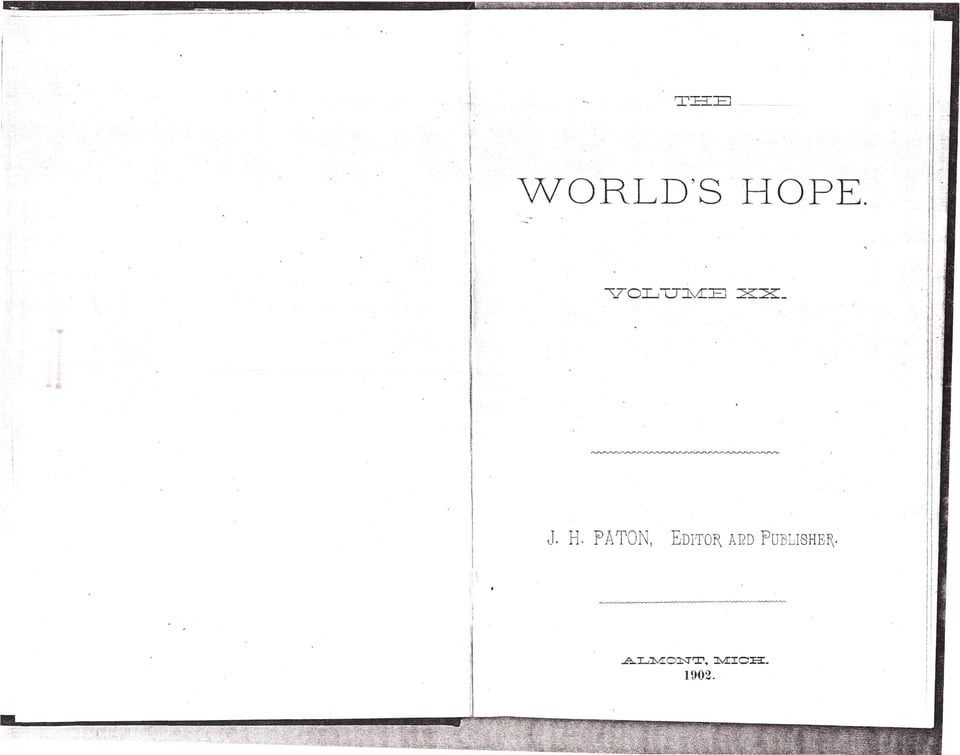
WORLD'S HOPE.
VOLUME XX.
J. H. PATON, EDITOR AND PUBLISHER.
ALMONT, MICH. 1902.
The whole creation was subjected to vanity in hope, and shall be delivered.—Rom. viii. 19-21.
Vol. 20., No. 1.
ALMONT, MICH., JANUARY 1, 1902.
$1.00 a year.
THE WORLD'S HOPE.
A new year's greeting to all our readers, both old and new! On entering the twentieth year of editorial work, I am reminded of the experience in connection with choosing a name for the paper which I felt moved to publish. I wanted one which would indicate the character or mission of the paper, and that would be different from all others, so that it would be emphatically its own.
Many names had been given to various publications, expressing more or less clearly the phase of truth they were designed to promulgate,—such as "Millennial Harbinger," "Zion's Hope," "Herald of the Morning," "Zion's Watch Tower," "Zion's Day Star," "World's Crisis," and hundreds of others.
The general trend of the teaching of the multitude of religious publications had been to emphasize the glory of the Church often called "Zion,"and the hopelessness of the world; and even those who recognized the truth of the Lord's coming to reign, and that his day was dawning, saw but
little hope in it all for the world of mankind.
It was under the influence of the deep-rooted assurance that the object of the Lord's coming is to bless mankind, and while praying for a name, that The World's Hope was brought to my mind; and in connection with it was suggested the picture which stands with the name on the title page of the paper. It may be seen at a glance that it represents (though crudely) Christ as the Master of men, standing, as "the Seed of the woman," ready to crush the serpent's head.—Gen. iii. 15. This application of the Lord's power to destroy sin and death, and to bless mankind with righteousness and life, is indeed the world's hope.
On making search in a Cyclopedia of names of publications, I could not find that this name had ever been used before, and I was satisfied with it then, and have never since had cause to regret its use. It gives room enough for the development of every phase of truth relating either to the Church or the world.
Soon after THE WORLD's Hope began to be published, an aged brother, who had not yet learned that the mission of Christ is to save the world, declared in my hearing that the name of this new paper was a "fraud." "The world," he said, "has no hope. The apostle says that it is 'without God, and without hope,'"—referring to Ephesians ii. 12. I did not blame the brother; but on looking at the passage and its context, my view of the plan of God was confirmed.
The apostle was contrasting the condition of the Gentiles (nations) before and after the atoning sacrifice of Christ was made. "At that time," he says, "ye were without Christ, being aliens from the commonwealth of Israel, and strangers from the covenants of promise, having no hope, and without God in the world: but now in Christ Jesus ye who were far off are made nigh by the blood of Christ. For he is our peace, who hath made both [Jews and Gentiles] one, and hath broken down the middle wall of partition between us; having abolished in his flesh the enmity, * , for to make in himself of the two [Jews and Gentiles] one new man, so making peace; and that he might reconcile both [Jews and Gentiles] unto God in one body by the cross, having slain the enmity thereby: and came and preached peace to you [Gentiles] who were far off, and to them that were nigh."—Vs. 12-17.
There is nothing in this to prove that the world has no hope in Christ, but the very opposite is proved. All mankind are put upon the same level, by the reconciling work of Christ. They were afar
off, but are now made nigh. They are not even called upon to "make their peace with God," "for he [Christ] is our peace." He made peace, and came and preached it, as an accomplished fact. The province of faith is not to make the gospel true, but to receive "the truth, as it is in Christ Jesus."
The gospel is based on the "finished" work of Christ—that is, finished in his own Person as the world's Representative—what was done in him being the key of hope of what will be done in all whom he represented, in duetime. Eternal life is not an offer, but a gift—"the gift of God, through Jesus Christ our Lord."—Rom. vi. 23. Faith receives and applies the gift, and faith works by love, and leads to obedience. "We love him because he first loved us." "If ye love me, ye will keep my commandments." And we know that his requirements are not grievous. His service is reasonable.
Christians do not obey the Lord in order to gain eternal life, but because the Lord has given them eternal life in Christ. A good tree does not bear good fruit in order to become a good tree, but because it is a good tree. The son does not obey in order to come into the family, but because he is in the family. A slave may work to win his freedom, but the son works from love because he is free.
The passage in Ephesians ii., which appears so clearly to show that the peace and reconciliation were wrought out for us in Christ Jesus, and are therefore to be received by faith, is not the only one that teaches this. Romans v. 10 says that "When we were enemies, we were reconciled to God by the death of his Son."
Of course, this reconciliation (or at-one-ment) is received by faith. Faith, being a principle of life and godliness, brings into our minds the spirit of what Jesus did for us in himself. Faith assures us of our relation to Christ and of what he is to us and what we are to him; but it does not create the relation, nor add anything to what Christ has done for us. It does not create the truth, but by it we know the truth, and the truth—which was true before we believed it—makes us free. "Being justified [by the atoning sacrifice—Rom. iv. 25] by faith we have peace with God through our Lord Jesus Christ."—Rom. v. 1.
The Spirit applies the truth, and produces its fruit--"love, joy, peace, longsuffering, gentleness, goodness, faith, meekness, temperance: against which there is no law."—Gal. v. 22, 23. We are not saved by good works, but to good works.—Eph. ii. 8-10. Dead men cannot work. Life manifests itself by works. The grace (loving favor) of God brings salvation to all men, and teaches and inspires men who know the truth to deny ungodliness and worldly lusts, and to live soberly, righteously and godly in this world, and to look for the blessed hope.—Titus ii. 11-14.
Let no one belittle the importance of good works, for while we are not given life for our works, the object of the gift of God in Christ is to "redeem us from all iniquity, and to purify unto himself a peculiar people, zealous of good works."—Ver. 14. The mission of
Christ is to save from sin.—Matt. i. 21. What we were—and it is a dark picture—may be seen in Titus iii. 3; but the wonderful change was wrought by the appearing of God's kindness and love:—"not by works of righteousness which we have done, but according to his mercy he saved us, by the washing of regeneration, and renewing of the Holy Spirit, which he shed on us abundantly through Jesus Christ our Saviour; that being justified by his grace [not by our works] we should be made heirs according to the hope of eternal life."—Vs. 4-7. And yet we are warned to be careful to maintain good works, because they are good and profitable unto men.—Ver. 8.
What salvation is can never be appreciated until we realize that men are to be saved from sin to righteousness, and from death to life. It means not only ceasing to sin, but also the destruction of the nature that suggests sin. It means not only learning to do right, but also the development of the new nature which suggests right doing. And the gospel is the power of God unto salvation. The love of God revealed in Christ is the motive, the inspiration, to all that is good and true. When Peter learned the lesson, given him in the vision of Acts x., he uttered the word, "What God hath cleansed, that call not thou common," and he applied it broadly when he said: "God hath shewed me that I should not call any man common or unclean."—Ver. 28. Then does it not follow that in God's great plan as revealed in Christ, he has cleansed all mankind? What was done in Christ is the gospel at the root.
God sees the end from the beginning, and therefore speaks of what is going to be as if it were already done. And whoever can by faith look at man from God's point of view, will see the gospel at the top; and he will never say that the world of mankind, for whom Christ died and rose, has no hope. The world's hope is all centered in Christ, and means the full application of His death and life to mankind.
NOTES ON SUNDAY-SCHOOL LESSONS.
The Promise of Power.—Acts i. 1-11. (Lesson for January 5.)
GOLDEN TEXT.—While he blessed them, he was parted from them, and carried up into heaven.—Luke xxiv. 51.
INTRODUCTION. Again we come to the New Testament, and for six months our lessons will be in the "Acts of the Apostles," which is the Title in the Greek of the fifth book in the New Testament. It relates especially to the acts of Peter and Paul, and of others incidentally. It might properly be called "The Acts of the Holy Spirit," through the apostles. It was written by Luke—an educated Greek—a physician, who traveled with Paul on several of his missionary tours, and remained with him in Rome till the end of his first imprisonment. It was probably written at Rome, about A.D. 63, and covers about thirty years of the first history of the Church. Its language was Greek—not the classical Greek, but the speech of the common people in and about the eastern Mediterranean. The Acts is the story of the origin and early development of the Church of Christ. Such wonderful results could not have come, but for the fact that back of them as their Source was the risen and glorified Jesus, manifested by the Holy Spirit—mentioned fifty times in this record. The subject of the book is the continued work of the ever-living Saviour. It is a record of gospel activity and victories.
I. THE RISEN JESUS.—Vs. 1-3. Here we have the connecting link between the Gospels and the Acts. The writer refers to his "former treatise," (Luke i. 1-4), both that and this being addressed to Theophilus—a "lover of God." The Gospel related what Jesus began to do and teach; the Acts tells what he continued to do and teach. That makes the ascension the close of his earthly life; this makes it the beginning of the heavenly life.
After Jesus had by the Holy Spirit given commandments unto his chosen apostles, he was "taken up," or "received up."—R. V. The first implies the power that carried him, the second, those who met and welcomed him on his arrival.
Is heaven a high place? or a high condition? We cannot exclude the idea of place from our thought of heaven; but wherever it is, it must be the condition of its inhabitants that makes it heaven. There are Bible indications that the heaven of God and the angels is not far away, as to place, but rather a spiritual state which is invisible to mortals. (See "The Lord's Coming," Section 4, in DAY DAWN.)
After the passion (death) of Jesus, he shewed himself alive by many proofs, appearing to his disciples ten or eleven times during forty days, and teaching them many things concerning the kingdom of God. He was not merely seen, but he made himself appear,—"showed himself alive." Though the change from the natural body condition to the heavenly or spiritual body condition appears not to have been complete until the ascension, yet it is evident that during the forty days he was invisible to the natural eye, except when he used his power to appear. The difference between the old and the new conditions of Christ is seen in this: Before his death, it was a miracle if he vanished; and after his resurrection, it was a miracle if he appeared.
"Infallible proofs" is one word in the Greek meaning to prove beyond a doubt. The evidence was irresistible, even to those who were inclined to doubt. "Doubting Thomas" served us well by calling forth evidence adapted to the need of such as he. The object of the appearing of Jesus to his disciples was not only to prove the fact of his resurrection, and make them his credible witnesses, but also to prepare them for their ministry, by opening to them the Scriptures, which they did not, and could not, understand before. Luke xxiv. 32, 44-48.
The apostles' teachings are notimaginations nor speculations, but revelations. Reliable history and fulfilled promises unite to prove that the Christ is a real and ever-living Friend and Life-giver.
II. THE PROMISE OF POWER.—Vs. 4-8. Before his ascension, being with his disciples, Jesus charged them to tarry at Jerusalem, until the Spirit, promised by the Father, through the Son, should come upon them and endue them with power.—Luke xxiv. 49; Isa. xliv. 3; Joel ii. 28, 29; John xiv. 16, 26; xv. 26. They were not able to preach the truth successfully without the Spirit to help them to understand it, and to demonstrate their ambassadorship by miracles. The truth of Christ's resurrection was the grain, which was made into bread by the coming of the Holy Spirit. (Thus the types of the "wave sheaf" and the "wave loaves" were fulfilled.—Lev. xxiii.)
Why should the Spirit be given at Jerusalem? It was the capital of the typical church. As Christ's death and resurrection occurred there, it was appropriate that the evidence of his continued life and work should be given there. The unity of the Church—of which Israel was a type—was to be expressed—Jerusalem being the center of gathering. And a great annual feast was due, at which the gathered nation would hear the gospel, and from which
the believers would carry it home. John baptized with water—the symbol of the higher and better baptism by Christ. John pointed to this (Matt. iii. 11) which Jesus said was about to be fulfilled. "Ye shall be baptized with [or in] the Holy Spirit." Jesus baptized in the Spirit, as John baptized in water. The element is not the baptism. Holy Spirit had come before, but never before had it come upon the whole Church; besides, now it meant more then ever, because it was to be the result and proof of the victory of Christ.
"Not many days hence." It was ten. It was "not many," that they might hope, but that they might watch and pray he did not say how few.
At one of Jesus' visits, his disciples asked him if he would now restore the kingdom to Israel. They knew that such a restoration was often promised. They probably expected the immediate deliverance from the Roman power, and its overthrow. They knew nothing of the age-long suspension of Israel, and the dispensation of suffering for the development of the church to reign with Christ. They thought the glory must come immediately. It will not do to say they were wholly wrong; for Jesus did not correct their idea of the restoration, but only declared that the Father had not yet revealed the time, and that the Holy Spirit would not only fit them for their work, but also lead them (or the Church of which they were the nucleus) into all the truth in due time.—See "Times and Seasons," in DAY DAWN.
Waiting in prayer is often the best preparation for working. Spiritual power to do our work is of the utmost importance. Verse 8 is one form of the great commission.
III. THE ASCENSION.—Ver. 9. When he had finished speaking, and while they were looking, he was "taken up," and a cloud received him out of their sight.
He was blessing them when he began to ascend.—Luke xxiv. 51. Which way is up from the earth? Did he go far away? or was the upward movement to illustrate the change to a higher condition? It does not say what kind of a cloud received him. It may have been the symbol of the Father's presence, like the cloud in the wilderness. Jesus was hidden from mortal sight. He had entered into the highest, or inmost, condition—the third heaven—represented by the "holiest" in the typical tabernacle.
Why did Jesus ascend? He had said it was expedient for his disciples that he should go away.—John xvi. 7. Only thus could the Holy Spirit come. His ascension—the absolute victory of the Man Christ Jesus—secured that gift for man. Bodily, he could only be in one place at a time; by the Spirit he can be in all places at once. He went, as our Forerunner, to prepare a place for us, and by the Spirit he prepares us for the place.
IV. THE PROMISED RETURN.—Vs. 10, 11. The disciples were looking and wondering. "Two men" — angels in human form — appeared to them. "White apparel." This is not as angels have appeared "in glory;" neither as they appeared to Abraham and others, as men "in the flesh." The "white" appears to be the manifestation of the middle condition, into which Jesus arose, and from which he ascended.
The angels told them the "same Jesus" should return. This was not fulfilled at Pentecost. He is personal, and no change in his condition can destroy his personality. Nowhere else in the Bible in the Greek phrase hon tropon translated "in like manner." It refers rather to the certainty than to the manner of his return. But should the "manner" be observed, it will be in the obscurity and quietness of that grand occasion. The world did not see him.
The disciples were specially privileged. "Without holiness no man shall see the Lord." We cannot see him as he is until made like him. He will surely come again personally to the middle condition from which he ascended; but the walk by faith will not end in natural sight.
The ascension was followed by a ten days' prayer-meeting. As they returned to Jerusalem, their hearts were full of faith, hope, love and joy.—Luke xxiv. 52, 53. In the upper room, and in prayerful expectation, they waited for the fulfillment of the promise.
The Promise of Power Fulfilled.—Acts ii. 1-11. (Lesson for Jan. 12.)
GOLDEN TEXT.—The promise is unto you and to your children.—Acts ii. 39.
INTRODUCTION.—This lesson is closely related to the last one. In that we saw the promise; in this we see it fulfilled. The coming of the Spirit—being the fruit of Jesus' victory — was in some respects greater than his coming in the flesh. In an important sense it was the coming, or manifestation, of Christ. Speaking of the promise, now about to be fulfilled, he said: "I will not leave you comfortless [orphans]; I will come to you."—See John xiv. 15-23. Again he said: "Lo, I am with you always." The Spirit came in Jesus' name.—John xiv. 26. Paul speaks of the indwelling Spirit as "Christ in you, the hope of glory."—Col. i. 27. As the Spirit enables us to mortify the deeds of the body, and thus follow Christ in sacrifice, it follows that the coming of the Spirit fulfills the coming of the High Priest to slay the goat, which followed the bullock—the leading sacrifice.—Lev. xvi.
This lesson includes the gift of the Spirit and its effect on the people. He came to give life, light and spiritual power.
I. THE ASSEMBLY ON PENTECOST. Ver. 1. The word pentecost means the fiftieth day. This was a harvest festival, celebrated fifty days after the presentation of the "wave sheaf."
The day of pentecost had fully come—was shining in its full glory. In Acts i. 12-15, we learn that the disciples returned from the ascension scene to Jerusalem, that in the "upper room" they held the continual prayer meeting, that there were 120 in all—both men and women—and that they were in one accord. They were in a good condition to receive the blessing, and they expected it, though they must have been ignorant of its effects. It is probable that this was the first assembly of its kind. The presenting of the "wave sheaf" and the "wave loaves" both occurred on the first day of the week. Lev. xxiii. So of their antitypes. A glorious new beginning—the first fruit being the Lord's.
II. THE PROMISE FULFILLED.—Vs. 2-4. The answer to the prayers of that united company came suddenly. No doubt they were greatly surprised,—as people generally would be were their prayers answered. There was an audible sign—a sound as, or like, the noise of a mighty wind. It filled the whole house—probably both the sound and the Spirit which it represented. There was also a visible sign—tongues parted asunder like as of fire—which sat upon each of those present. Did not this include the 125? Was not this the baptism of the whole Church, even as all Israel were baptized unto Moses in the cloud and in the sea?—1. Cor. x. "And they were all filled with the Holy Spirit, and began to speak with other tongues, as the Spirit [not Ghost] gave them utterance."
Here was a great symbolic manifestation of the Spirit power, and its effect on the people. When they were filled, they began to speak out. Is this not always so? If the Spirit could make these people speak in foreign tongues, should it not be easy to speak in one's own language, out of a full heart, under
the influence of the quickening and warming Spirit? What can it mean to be filled with the Spirit but to have all one's faculties under his control?
The wind, or air, used to represent the Spirit, is invisible, but is wonderful in its effects. It is mighty. It is gentle. It is pure. It is all-pervasive. It is the breath of life.
The symbol of fire represents the Spirit's work in several ways. It is the light—the revealing power. It purifies. It is the great Comforter. It is the symbol of zeal for God and the right.
The symbol of the tongue is for expression, and suggests the missionary spirit and the success of the gospel of Christ which it speaks.
The symbol of the dove—which appeared at the baptism of Jesus—suggests innocence, gentleness, tenderness and love. The lion and the lamb united in Christ—suggest the union of power and love. The Lamb enthroned will manifest the love of God in his glorious reign. Does not the gift of the Spirit include all good effects?
III. THE RESULTS.—Vs. 5-11. The new dispensation had begun. The Spirit not only filled and controlled the young Church, causing it to speak out with power, but it—as designed—affected others. Here at Jerusalem were devout men from every part of the known world. Some who had been abroad were now at home. Many who lived in the various countries had come up to the great feast. These were people of the Jewish faith—not Gentiles. This new thing was soon noised abroad, and a multitude soon gathered; and all were astonished to hear these unlearned Galileans speak in every needed language—all the various languages of the multitude. No wonder they were amazed and confounded, and led to cry out: "What meaneth this?"—Ver. 12.
But in some the mocking spirit was manifested; and they gave the apparent
(Continued on page 9.) THE WORLD'S HOPE.
PUBLISHED SEMI-MONTHLY AT
ALMONT, LAPEER COUNTY, MICHIGAN.
Entered at the Almont P. O. as Second Class matter.
J. H. PATON, EDITOR AND PUBLISHER.
Terms of Subscription, Including Postage:
For One Year... $1.00
For Six Months... .50
To Foreign Subscribers... 1.25
Sample to any address... Free
All money should be sent to the Editor, and all drafts and money orders made payable to him. Any large amount should be sent by postal order, draft or registered letter. For sums less than one dollar, one-cent or two-cent postage stamps may be sent, when postal notes cannot be obtained.
Address all communications to
J. H. PATCN,
ALMONT, LAPZEE CO., MIUR.
By observing the date, with the name, on your wrapper or paper, you may know your standing in our subscription book. "Mar. 02,""June 02,""Sep. 02,"or "Dec. 02," shows the month to the end of which you have paid, or have been credited. A star () with the figures, as "Dec. 02" shows that you have not paid, but that we have heard from you, and that you have promised to pay. Those who are unable to pay, and have asked for the paper free, are credited as if they had paid. If the date is in the past, or "Dec. 01," it calls for renewal. We want to hear also from all our free readers. If we make mistakes, (to which editors, as well as others, are liable,) please notify us at once, and we will gladly correct them.
DRAW all foreign Money Orders on the Post Office at Romeo, Mich., and all others on the Post Office at Almont, Mich.
THE HOPE is sent free to those unable to pay the whole or a part of the price, on account of the free-will offerings of others.
For missionary purposes, the Hope will be sent in any quantity for one cent each.
Any one who will pay one dollar in advance on his own subscription for the Hope may send as many new subscriptions as can be secured, at the rate of two for one dollar. This reduced rate does not apply to renewals and in case of such reduction, the price must accompany the order. Here is a good opportunity for agents or missionaries. Let all do what they can.
Did your subscription expire with 1900? If so, help us by renewing now.
CONTENTS.
THE WORLD'S HOPE...1
NOTES ON SUNDAY-SCHOOL LESSONS
The Promise of Power, (Jan. 5)...4
The Promise of Power Fulfilled, (Jan. 12.)..6
EDITORIAL ITEMS...8
EDITOR'S APPOINTMENTS...8
THE LORD, OR WORLDLY SUCCESS...9
SIX GOOD OFFERS...10
EXTRACTS FROM LETTERS,
A Great Comfort...11
Instruction and Encouragement...11
Convinced of Truth...11
Silver-Lined Clouds...11
A PARABLE...12
PLEA FOR WIDER PRAYER UNION...13
LIBELS ON GOD THE FATHER...16
EDITOR'S APPOINTMENTS.
Jan. 5, Buchanan, Mich., 10:30 a. m. and 7:00 p.m.
Jan. 8, and 9, Chicago, Ill., 6006 Green St. 7:30 p. m.
Jan. 12, Open for special arrangements.
Jan. 12, Open for special arrangements. Jan. 19, Washington, Mich., 10:30 a.m., and Almont, Mich., 3:30 p. m.
Jan. 25, & 26, Peck, Mich., Saturday 7:30 p. m. and Sunday 10:00 a. m. and Yale, Mich., Sunday 3:00 p. m. and 7:00 p. m.
Those in the several localities seeing this please tell others.—EDITOR.
THE SABBATH is made into a 16 page tract. Price ten cents a dozen postpaid. Keep the silent workers busy.
THE GREAT REVELATION, or God's Love, Purpose and Plan, is a book of 96 pages; paper cover, 10 cents.
THE EASTER GOSPEL, is a 16 page tract, based on 1. Cor. xv., and is the Gospel of Resurrection. Price 15 cents a dozen or $1.00 a hundred.
WE would remind our friends of the books we have. THE GOLDEN LINK, 1.00; DAY DAWN, 1.00; PERFECT DAY, 50 cents; and the new MOSES AND CHRIST, 50 cents, all cloth bound, will all be sent for $2 00 received at one time.
WE ARE AGENTS for all papers and magazines, and would be pleased to receive orders for what you want.—ED.
Renewals of subscription are always in order. An extra dollar sends the HOPE to two new readers for a year.
(Continued from page 7.) confusion the worst possible meaning— charging that the speakers were drunk filled with new wine. Ver. 13.
Peter's answer to their criticism, stands connected with next lesson.
THE LORD OR WORLDLY SUCCESS.
I SEND the following thoughts on the words of our Lord: "Lovest thou me more than these?"
We are all familiar with the story of our Lord's preaching to the multitude on the shore out of Simon Peter's boat, and of his reward to Simon for the use of his boat in the miraculous draught of fishes, taken in daylight after a night of fruitless toil. The preaching of our Lord and the miracle following so impressed Simon that he cried out: "Depart from me, for I am a sinful man, O Lord." But our Lord said: "Fear not, Simon; from henceforth thou shalt catch men." Thus Peter received his commission, and, forsaking the fish, he followed Christ.
After our Lord's resurrection, before he finally ascended, the disciples saw him at intervals, and he taught them many things. But, showing how little they understood our Lord's mission, they appear not to have realized that there was a great work for them to do—that they were indeed to be fishers of men. They asked him if he were going to restore the kingdom to Israel. This shows that they had no idea of the spiritual kingdom which our Lord came to establish. Their conception was an earthly kingdom. They must have been in a state of uncertainty, for our Lord was not always with them; and as he had been crucified on account of his preaching, they doubtless were afraid to go out as before, preaching the glad tidings of the kingdom. It is not surprising, therefore, that Peter said: "I go a-fishing." What did he mean? To go out for a day? No, but to return to his old occupation of fisherman. It
would be an outlet for his energy, at least. The others at once said: "We will go too." They went, and once more they "toiled all night, but caught nothing."
In the early dawn our Lord stood on the shore and called to them: "Children, have you any meat?" They replied: "No." He then directed their operations, and now they caught a great multitude of fishes. Quick to discern the One who loved him, John said to Peter: "It is the Lord!" Peter at once sprang into the water and swam to the shore, too eager to be with our Lord to wait till the boat reached the shore. This shows that Peter was not afraid of our Lord, nor unreconciled because of his denial of his Master before the Jewish Council.
We must remember that our Lord had said: "Seek ye first the kingdom of God, and food and raiment will be supplied." His question, "Have ye any meat?" is therefore significant, for they had forsaken his work to go back to fishing.
When they came to the shore, these hungry, tired men found another surprise awaiting them. There were a fire and fish and bread already prepared. By whom but our Lord? Perhaps they remembered a lesson he had once taught them: "When a servant comes in from the field labor, does his master bid him sit down and dine? I trow not. Rather the master bids him serve first, and dine after his master has eaten." So much for earthly masters' treatment of their servants. But here the order was reversed. The disciples had been at work for themselves, and yet, when they came to shore, he had made ready their breakfast and said, after the fish were drawn up on the beach, "Come and dine," himself handing them the food he had prepared, reminding them again of his promise to reward faithful servants by girding himself and making them sit down to eat. We are told that no one dared to ask him, "Who art thou?
knowing that it was their Lord." His rebuke was silent, but most effective.
George Tinworth has a moulding in Terra Cotta of the disciples counting the great catch of fish, while our Lord stands by looking calmly on the scene. But in his hand holding his robe, the nail-prints are very noticeable. Some of the men are glancing upward at him while stooping over their prize, as if they were perplexed by his grave manner.
And then, the fish being counted, great success being assured, our Lord put to Peter that thrice-repeated question, "Simon, son of John, lovest thou me more than these?"
We have doubtless heard very often that our Lord meant, "Lovest thou me more than these other disciples love me?" or "Lovest thou me more than thou lovest these other disciples?" and that the question was three times given because of Peter's thrice denying Him. But, as pointed out, Peter was certainly reconciled to our Lord, and he had received special notice on the morning of the resurrection.
What then did our Lord mean by that question: "Lovest thou me more than these?" He gave them great success in fishing, and then, placing Himself in contrast with this worldly success, he bade Peter choose----between his Lord and the fish. Three times did he give Peter the choice. And Peter's evident distress is easy to understand. To each question he replied: "Thou knowest that I love THEE." And each time he said this our Lord pointed him back to his forsaken duty: "Feed my lambs;" "Tend my sheep;" "Feed my sheep." Then he addressed solemn words to Peter, forewarning him of suffering, but added: "Follow ME." F. J. T.
Do you want a bound volume for 1901? If so, please send in your order. The binder has promised that we shall have them by Jan. 15. Price, $1.15.
SIX GOOD OFFERS.
In planning for holiday (or birthday) presents, or missionary work, remember our list of books. We now have something new-- THE GOLDEN LINK in paper cover. Single copy, 50 cents. Look over the following offers, all postpaid.
OFFER NO. 1.—Two copies of GOLDEN LINK, (or two of DAY DAWN) and one Moses AND CHRIST, all paper cover, for $1.00.
OFFER NO. 2.—One GOLDEN LINK, one DAY DAWN, and one Moses AND CHRIST, all paper cover, for $1.00.
OFFER NO. 3.—Four copies of Moses AND CHRIST in paper cover, for $1.00.
OFFER NO. 4. One GOLDEN LINK. one DAY DAWN, one PERFECT DAY, and one MOSES AND CHRIST, all cloth bound, for $2.00.
OFFER NO. 5.—The retail prices of these books are as follows: GOLDEN LINK, cloth bound, 1.00, in paper cover, 50 cents; DAY DAWN, the same; Moses AND CHRIST, cloth bound, 50 cents, in paper cover, 30 cents; PERFECT DAY, cloth, 50c. Pick out three dollars' worth of any of these books, and we will send them to any address for 2.00.
OFFER NO. 6.—To new subscribers, THE WORLD's HOPE for one year may take the place of the GOLDEN LINK, or the DAY DAWN, in offers 4 and 5.
THE revised edition of MOSES AND CHRIST has 286 pages. It deals mainly with the Gospel in Genesis, and is brimfull of God's love for mankind. The price is 30 cents in paper cover, 50 cents in cloth binding-one-third off to agents or when $2.00 is sent at one time. The last 96 pages is really a little book of itself, "The Great Revelation, or God's Love, Purpose, and Plan." In the new edition will be found a half-tone likeness of the Editor. We are prepared to fill orders promptly.
GOD'S TRIUMPH, our missionary booklet, (64 pages), giving a brief statement of God's revealed purpose, has been prepared by special request for the benefit of new readers. Price, five cents a single copy; or we will mail six to six addresses for twenty-five cents.
"The Easter Gospel," revised (almost new), we have in tract form-16 pages. Price 15 cents a dozen, or $1.00 a hundred. Who will help to put them in circulation?
EXTRACTS FROM LETTERS.
A Great Comfort.
AFTER so long a time I again write you a few lines. I was very glad and thankful to hear of Sister Paton's recovery—to know that she is still spared to her family.
You will find a dollar inclosed to pay for my paper another year. It is all the preaching I have. It is a very great comfort to me. I love its teaching. May God abundantly bless you, and give you understanding, that you may rightly divide the word. And may he bless all the HOPE family.
LAPEER, MICH.
MRS. I. H.
Instruction and Encouragement.
At last I am able to send you a dollar on my subscription; which is past due. I appreciate your kindness in continuing to send it. It is a source of instruction and encouragement to me. It helps to keep me in touch with the blessed hope of the gospel of the coming kingdom.
I was very much pleased with Bro. Chase's articles several weeks ago. They were good logic, and seemed to me to be according to the plain teaching of the Scriptures too. It is strange how blind most professed Christians are. How littie they know about the Bible! Even the ministers know very little of their real meaning.
The Lord bless you and the Hope is my prayer. S.M.W.
MEDFORD, MASS.
Convinced of Truth.
I BECAME acquainted with your very valuable paper last Spring and have read it with increasing interest ever since. I used to be a Unitarian, or rather a Free Thinker, for many years. I was brought up in the Lutheran faith in Norway, but that could not satisfy me intellectually, so I commenced to read Unitarian books and papers; but I must testify that the Hope has convinced me of the Bible truth. I have also read DAY DAWN and found it very good. Now I should like to get MOSES AND CHRIST, and some of your other books. For the inclosed stamps, please send me MOSES AND CHRIST. I should also like to get "Young's Concordance," and the "Emphatic Diaglott." I want to study these things more thoroughly. A. T.
THIEF RIVER FALLS, MINN.
Silver-Lined Clouds.
I SEE I am a year behind with my subscription. The reason is, I have been so unsettied since the death of my dear husband, that I could not tell where I would be; but I have now decided to stay in Romeo. I have been away some of the time, so have not had all the papers, but some one has read them, and, I hope, been benefited by them.
I am as much interested as ever in the precious truth taught in them. They are bright spots in my lonely way, and enable me to see the sunshine through the dark clouds that have been hanging over my head for the past year; and today I can rejoice in our Father's great love for all his children. His ways are ways of righteousness. Glory be to his name!
May Heaven continue to bless you in teaching the truth and giving light to those who are ready to receive it.
Inclosed you will find $2.00 for 1901 and 1902. M. FROST.
SEND FOR
THE GOLDER LIRK,
OR SHADOW OF SIN.
A book of 418 pages, by Ermina C. Stray, published by the LARGER HOPE PUBLISHING Co.
"A Story of Our Times." Do not fail to read it.
Price, cloth bound, $1.00, paper cover, 50 cents. Address:-
LARGER HOPE PUB. Co.
Almont, Mich.
A PARABLE.
LET us visit a small island in a vast ocean, so far from the mainland that, except at rare intervals and under peculiar circumstances, no one gets a glimpse of it.—Acts vii. 55.
The inhabitants of the island are all illoyal rebels and condemned criminals. A few have heard of and accepted the King's free pardon, and are going to live with him, but are left a while to represent him and do good to their fellow-islanders.-Rom. iii. 19; John iii. 18; Mark iv. 19; Matt. vi. 34.
The King has decreed: 1. No one shall permanently dwell upon the island. All who are unpardoned will be transported to the penitentiary. Those who have received their naturalization papers of royal life will share the kingdom with his Son, their Deliverer and Master. Rev.xxi.8; Heb. ix.27. A ship visits the island and the marshall calls one and another, who are obliged to embark, leaving friends, home, business and all possessions behind.—1. Tim. vi.7.
No one can tell when the call may be given or the Son may return specially for his own; but the order hangs in the court house, "Be ye ready."
No one is allowed to be idle. Each must work and all thrifty islanders can obtain more wealth than is necessary for their living. So the King has agreed to receive all surplus wealth into his unfailing savings bank; and to encourage the obedient, he has promised one hundred dollars on every dollar deposited with him.—Matt. xix. 29.
One would think that at least all the royalists would be careful to send to the King's bank all they possibly could; but, most wonderful to say! most of these are just as eager as the unpardoned islanders to amass wealth for themselves, to live well, to build fine houses, and to get what is lyingly called "real estate." And——the King's Son——calls them——"fools." — Luke xii. 20, 21.
Many put into spurious banks and clubs, to be well thought of, vainly thinking they are thus laying up treasure on the mainland.
A few send on small deposits that they can spare, which cause no self-denial. A very few send on all their income not absolutely needed for the food, clothing and well-being of the King's creatures and King's business under their charge.—Mark vi. 33, 34.
Oh! how the islanders and most royalists dread the ship marshall's bugle! The ship always sails through the dark night. In the morning the royalists appear in the royal hall to give account of themselves, of their management of the King's business, and to know the state of their affairs.—2. Cor. v. 10. Those who have toiled, often in hunger and cold, weariness and self-denial, to accumulate wealth to deposit with the King, hear the welcome, "Well done, good and faithful servant, enter thou into the joy of thy Lord."—Matt. xxv. 21. But, alas! the majority are merely "brands plucked out of the fire;" their garments had been spotted by the flesh,—that is, they had lived to please themselves; their life work was an awful failure. How terrible is their loss! How ashamed are they before him whose name they bore, but whose example they had not followed.—Zech. iii. 2; Jude 22, 23; 1. Cor. iii. 13-15; 1. John ii. 28; 2. Cor. viii. 9; 1. Pet. ii. 24.
Dear reader, be wise. Begin today to lay up treasure for yourself in heaven. By God's grace for one year, this year, give all your income (except food, raiment and necessary expenses for God's family and God's business in your care) to God's poor and to make known the glad tidings of God to those for whom Christ died.--Matt. vi. 19-34; 1. Tim. vi. 6-9, 17; Heb. xiii. 5. Be a faithful steward waiting for your Lord.
704 Hamilton St. H.VEYSEY TOLEDO, O.
Renew your subscription.
PLEA FOR WIDER PRAYER UNION.
[The following Address was delivered by the Rev. J. B. Paton, D. D., of Nottingham, England, at the Annual General Meeting of the Ministers' Prayer Union of the Free Church of Scotland, held in Edinburgh, May 30, 1900. Afterward "it was unanimously agreed that the brethren present at this meeting,—representing the 650 ministers and missionaries of the Free Church of Scotland enrolled in this Prayer Union,—having heard the statement and appeal by Dr. Paton, express their cordial sympathy with his proposal, and their fervent desire that, on the eve of the new century, and in view of the solemn and ever-growing responsibilities which now devolve upon the ministers of all Evangelic Churches, all these ministers, in this country and in the Colonies and America, may be led to form a Covenant or Concert of Prayer, as they did during last century with manifest and marvellous evidence of God's gracious approval and blessing. *
"It was further agreed that the hearty thanks of the meeting be accorded to Dr. Paton, and that he be requested to take what steps he may think best in the way of approaching representative ministers of the Evangelical Churches referred to."
In pursuance of this plan, my cousin John sends me a copy of the address, which is here published. The Prayer Union which he represents is one formed by the "National Council of Free Churches." He tells me that the ministers of the United Presbyterian Church are now combined with the ministers of the Free Church in one Prayer Union, that such a Union has been formed in the Established Church of Scotland, and that the Presbyterian Church in America is likely to follow the good example. The expressed hope is that the interest in this matter may increase until all Evangelical Churches shall be united in a Divine fellowship. He asks for correspondence from ministers interested, and may be addressed at 22 Forest Road West, Nottingham, England.
I regard this movement as a sign of the approach of the time when the essential oneness of all believers in the Lord Jesus Christ will be realized—on account of which the sectarian spirit will die out, and the denominational walls gradually crumble away. While this invitation is only for "Ministers," I see no reason why all who love the Lord and believe in prayer should not have a share in this divine fellowship. —EDITOR.]
THE ADDRESS.
Dear Brethren,
As one of a body of ministers who formed in England three years ago a Concert or Union of prayer, I wish to express the joy we felt on hearing of the formation of your Prayer Union in the Free Church of Scotland, and to say also what comfort and encouragement we felt when we knew that you had adopted the same hour for communion in prayer that we in England had found most convenient and helpful. That hour, you will remember, was the hour also chosen by ministers in America and England who joined in that great concert of prayer which was vitally associated with the revival of religion last century, and with the birth of the great Missionary Societies at the close of the century.
I am glad to tell you that we have reason to hope that the National Free Church Council in England will send out an invitation to the ministers of all the Free Churches of England, asking them to unite together, ere they enter upon the new century, in a Union or Fellowship of prayer similar to your own.
I wish to say also that the desire has come to some of us to seek a yet larger fellowship in prayer with our brethren in America and the Colonies, who hold with us the great office of the ministry in Evangelical Churches, so that the ministers of all Evangelical Churches in the English-speaking world, and through them their Churches, may enter the new century knit and bound together in this covenant and communion of united prayer. It may be too much to expect that an invitation to our brethren in America and the Colonies should be sent by the members of your Prayer Union; and yet surely it would be most fitting if such an invitation were sent from you in Scotland. Was it not from Scotland last century that the first suggestions and invitation was sent to America, which was reiterated and enforced with such splendid "Persuasives to Special and Extraordinary Prayer" by Jonathan Edwards, and then, reverberating to England, gave birth to the concert of prayer amongst many ministers there? And your Church, born as it was in a time of great spiritual revival, and eminently endowed with spiritual grace, has given example and leadership in many ways to the other Churches of Christendom. It has done so because your leaders, from Chalmers and McCheyne downwards, have been pre-eminently men of prayer. If, however, such a direct invitation be too much to expect, I believe that at any rate you will be delighted to express by a resolution which you may adopt this morning, and which may be communicated to our brother ministers in America and the Colonies, your great desire to be associated with them in such a holy covenant and fellowship of prayer, as we all enter together the new century, bearing the common responsibilities of the sacred office with which we have been intrusted by our Redeeming Lord, the Head of the Church.
Now it may be asked, what is the need, and what the advantage, of such a concert and fellowship of prayer amongst the ministers of the Church of Christ? Is not the answer to be found in those vast and solemn responsibilities which rest upon them individually. and collectively? For we are brothers of a common lot, holding the same office of high degree, an office involving arduous labor and much sacrifice. On the fidelity and devotion of her ministers the very life and prosperity of the Church depend; and with the Church are bound up the highest issues and interests of humanity. This immense burden of responsibility rests upon the Church's ministers collectively as well as individually. Surely then, bearing this burden together, they ought to uphold and encourage one another in bearing it, by the closest fellowship with each other and with their Lord, and by continuous prayer to Him who has called them to their office, and in whom alone is their abiding sufficiency.
But it may be further asked, Why should an appeal for such a concert of prayer be made now? What is there in the condition and aspect of our time to make this special call so urgent now? In answer to this question I would give three reasons, which, using President Edward's phrase, I may call "Three Persuasives to Special and United and Extraordinary Prayer" by all the ministers of our Churches.
First, the new difficulty and trial that beset us in our foremost duty as ministers, namely, the preaching of the Gospel of the grace of God, and the winning of men to repentance and faith in our Lord Jesus Christ. I know that the unbelief of men in every age has wrung from the hearts of the true prophets and ambassadors of God the cry, Who hath believed our report? But a new and subtle and evil influence is at work in the hearts and minds of the men of our time, which gives a keener edge and a deadlier power to this unbelief. Your Moderator sketched with luminous hand the wide-sweeping revolutions of thought in every department of religion occasioned by the general acceptance of the doctrine of evolution, and he vindicated with masterly power some essential truths of the Christian faith against the hostile attacks of evolutionary critics. But deeper than any change in opinion is the change in attitude
and temper of mind, in reference to the Christian doctrines of Redeeming Grace, wrought by the popular and erroneous conceptions of the meaning of this doctrine of evolution which have filtered down through the press among all classes of the people. The belief that sin is not wholly evil, but is a necessary product, probably a temporary product, of the process by which man passes from lower to higher stages of development; and that redemption is but the final achievement of that process, when man shall have sloughed off from his nature the tiger and the ape, and shall be liberated from the evil that has beset his earlier growth:—such a belief, which is widely, though it may be vaguely held, cannot prepare the mind to receive the Christian doctrine of sin and of salvation, but rather, like an opiate, its influence dulls and deadens the hearts of men as we preach to them that which is the very essence of our Gospel. We say to them that man's nature is akin to God's, and can find its only satisfaction and rest in the fellowship and service of God; but that an alien and malign power has beset and enslaved his nature, dragged it darkly down away from God, and so working its ruin and death. Or we speak to them of the marvellous grace of God in Christ; we proclaim the yearning compassion and pity of the Father's heart over His lost and wandering children, and show how these have broken down the mystic barrier between eternity and time, and have intervened in the sad drama of human history in order that here, in the very prison-house of our captivity, in this death-shadowed world, He might seek and save and bless His own, who are infinitely dear to Him. Are not these two truths the very sum and essence of our Gospel—the two central columns of the fabric of our Faith—which we must preach because necessity is laid upon us? Yea! woe is unto us if we do not preach them. And they are truths, too, which in the last issue and final court of appeal, find their most certain witness and authentication in the heart of man. But how shall we speak these truths convincingly in this world of modern unbelief, so dead and unresponsive, drugged by the subtle opiate of our time? How shall we gain the clear vision, the fervency of faith, the force of conviction, the fire and unction of the Holy One, whereby we can make these great truths of the Gospel burn and shine again in the souls of men? How, indeed, unless with humble and continuous and importunate prayer we pierce into the Eternal Light, and feel in our own hearts the beating of the Eternal Love—the pulsing of those infinite compassions which broke upon our world in the breaking heart of the Beloved Son?
How, unless we are able to see sin as it is seen by the holy eyes of God, and long with the longing of God to redeem men from its curse?
Secondly, there has dawned upon our age a new vision and conception of the Church of Christ. Many of you, I think, will have felt with me how imperfect is the definition and idea of the Church expressed in a number of our Protestant Standards and Confessions. And herein, perhaps, may be found one of the causes of the weakness of our Protestant Churches. You know how, in these Confessions, the Church is spoken of as the assembly where the Word of God is duly preached, and the Sacraments are rightly administered. These are the two notes of the Church which alone are expressed or emphasized. How meagre is that conception of the Church compared with the glowing figures of the Church presented to us in the Apostolic writings, especially with that figure, so often repeated, of the Church as the Body of Christ, the immortal Body in which He ever lives upon earth to fulfill His Father's will, and to finish His work! Surely then, if the Church be the Body of the Lord, it will have some likeness to that mortal body in which He tabernacled with us, not only proclaiming the holy love of the Father here among men, but revealing and commending that love, and making it known and felt by men, through the mighty works—all of them wonderful works of love—by which He healed their diseases and comforted their sorrows. Must not the Church of Christ now, in like manner, not only proclaim and reveal in faithful speech and testimony the righteous love of God among men, but also interpret and commend and enforce that love, making it intelligible and real to them, bringing it home to them and making it true, by those "greater works" which our Lord promised that His Church, being endued with power from on high, would do in the world? By these works the Lord in His Church would now, as of old, undo the cruel and heavy bonds under which sin has bound our fellow men, and assuage their bitter sorrows. As upon Christ Himself, so the Spirit of the Lord comes upon His Church, in gracious baptism, and clothes her with the lustrous evidences of her Divine mission, as she now, like Him, heals the broken-hearted, preaches deliverance to the captives, and recovering of sight to the blind, and sets at liberty them that are bruised. Thus the Church appears to us as the gathering together in the world of those who are brought into the obedience and fellowship of Christ, who take upon them His blessed yoke of ministry, and who are compacted together in one body,
being quickened and drawn and held together by His, Spirit. It is the union of men and women who, as they are touched in every fiber of their being with His love, enter the Church that they may serve Him, and be fellow-workers with Him in the redeeming of the world.
But if this be the mission and ministry of the Church of Christ upon earth, how glorious, and yet how responsible and arduous, must be the duties of her ministers, those who are not only to teach and preach the doctrine of the Church, but are to be its leaders and inspirers! Are not these duties summed up and set before us in that wonderful passage (Ephesians iv. 11, 12), where, according to the true rendering in the Revised Version (and it seems to me that this is perhaps the most important correction that has been given us in that Version) we are told that prophets and evangelists and pastors and teachers are given to the Church (and all these offices are now centered in the work of the minister), "for the perfecting of the saints," that is, of those who are being sanctified through the faith of Christ and the fellowship of the Church, "UNTO THE WORK OF THEIR MINISTRY?" Here we see that the minister has to nourish and instruct and train every member of the Church, seeking with the help of its other officers to give each member his proper place and service in the great united ministries of the Church, so that they may all be perfected thereby. But who, we may well ask, is sufficient for these things? The burden of these great responsibilities may well bend and bow us down in abiding and earnest prayer, so that in our weakness and our great need we may find our sufficiency of God, and that we, "having always all sufficiency in all things, may abound unto every good work."
Thirdly, we are standing on the threshold of a new century. It looms before us with strange and awful portents. Men feel that it will be a fateful century in the history of mankind, in which momentous issues will be decided. The vast industrial masses of the people are now emancipated from political vassalage, and hold in their hands political power, giving them all the forces which government can create and wield. They are also being loosened and liberated in all civilized countries from ancient customs and traditions which have hitherto held and trained them. There is among them the stir and unrest of new ambitions and new desires and new ideals. We seem even now to stand amid the rush of mighty forces pouring into the new century to determine there the destinies of our race.
Amid the tumult of present controversy there are seen to be two great forces arraying themselves for strenuous and it may be final conflict.
On the one hand there is materialistic socialism, which ignores or denies the highest sanctions and aspirations of the human spirit: which is ready to sacrifice both the independence and freedom of the individual, and the sanctity or even the existence of the family, in order that it may construct a human society in which, as they conceive it, the material advantages and comforts of life may be more equally distributed. On the other hand we see the Church of Christ, with that old Gospel which was heard first on the hills of Galilee, re-born upon her heart and lips, "The Kingdom of Heaven is come nigh unto you:" the Church, which also seeks to reconstruct human society, but according to the pattern which was shown her on the mount; and for her the mount is Calvary: the Church, which would reform and transform human society into one holy brotherhood, the family of the one Father in heaven, so that His will may be done here upon earth as it is done in heaven.
Which of these forces shall prevail in the coming conflict, the day of the Lord which is at hand? Will not this depend in large measure upon the fidelity and devotion and unconquerable courage of the ministers, the leaders of the Church, the captains of the Lord's hosts? Surely, then, as we listen to the cries of these mighty forces uplifted against each other, we may hear sounding above them all the trumpet voice of our Lord calling to us, that we humbly and fervently unite together in continuous prayer, and that in this prayer we link ourselves in the closest and most blessed fellowship with Him from whom alone come the wisdom and the conquering grace needful for this solemn hour of awful perils and glorious opportunities. So may we who are ministers of the Church enter into, and abide faithfully in, this covenant of prayer with one another and with Him till our warfare be accomplished, and over this dark world, amid opening heavens, the angels' song again be heard proclaiming, "Glory to God in the highest, peace on earth, goodwill among men."
On account of special circumstances and work our first number for 1902 is a little late, but renewals are coming in quite rapidly, and we are starting upon the work of the new year happily and hopefully. We would like to hear at once from all our readers, and to add to our list a large number of new subscribers. Let all interested ones do their best.—EDITOR.
LIBELS ON GOD THE FATHER.
Dr. Madison C. Peters, of New York, preached yesterday morning and evening in the Woodward Avenue Baptist church. In the morning he chose as his text, "Our Father." He said:
"Our religion and our character will depend very largely upon our thoughts of God. We see God as our thoughts represent him. What made the dark ages so dark, but the idea they had of God? Their notion of God was one of hatred, persecution and fire, and the people lived up to it. The persecuting savages of the middle ages were honest; they believed that God himself was the persecutor of men who differed from the established order of things, and they believed that if they were not God-like in their hatred, he would hold them responsible in the last day. In the thoughts of the people, God was a tyrant.
"What a strange view, for instance, to take of the character of the Father in heaven, that he could permit the little ones who were taken out of the world before they came to years of discretion to be shut out forever from his presence, because no consecrating drops of water had fallen upon their foreheads. Or what a further libel on God the Father, that he has provided an atonement for his special friends; that while Jesus died for the whole world, he did so effectually for a certain number. Who shall dare fix with mete and bound the love and power of God? I feel deeply on this subject. I want the truth to be known about God. Shake off from your souls all these popular false thoughts about the dear Father. Know God, not through the man-made creeds, but through the incarnate Christ. Believe that "Whosoever will," no matter how unlovely, no matter how lost, may come. Believe that He is the Father of all who call upon His name, no matter in what language or by what form they worship Him. They that worship Him in the beauty of holiness are His children. Believe that He is the Father of all men, and that tho the balances swing unevenly here, God will somehow, somewhere, see that all wrong is set right and justice done to every creature."
…