Herald of the Morning, 1879
Download: PDF — Herald of the Morning, 1879
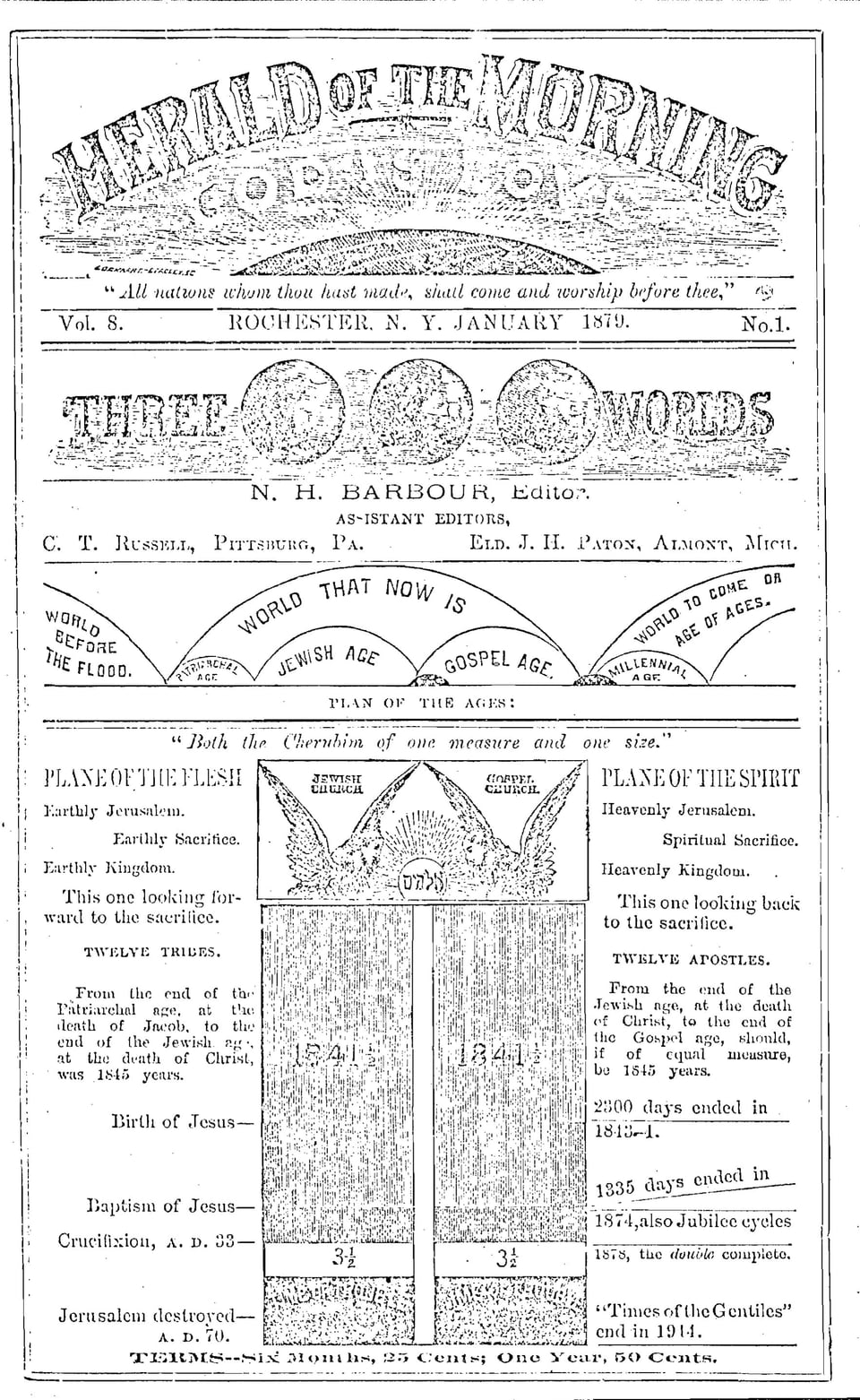
AS-ISTANT EDITORS,
C. T. RUSSELL, PITTSBURG, PA.
ELD. J. H. PATON, ALMONT, MICH.
PLAN OF THE AGES:
"Both the Cherubim of one measure and one size."
PLANE OF THE FLESH
Earthly Jerusalem.
Earthly Kingdom.
This one looking forward to the sacrifice.
TWELVE TRIBES.
From the end of the Patriarchal age, at the death of Jacob, to the end of the Jewish age, at the death of Christ, was 1845 years.
Birth of Jesus-
Baptism of Jesus— Crucifixion, A. D. 33-
Jerusalem destroyed— A. D. 70.
PLANE OF THE SPIRIT Heavenly Jerusalem.
Spiritual Sacrifice.
From the end of the Jewish age, at the death of Christ, to the end of the Gospel age, should, if of equal measure, be 1845 years.
Heavenly Kingdom.
This one looking back to the sacrifice.
TWELVE APOSTLES.
2300 days ended in 1843-1.
1874,also Jubilee cycles
1878, the double complete.
"Times of the Gentiles" end in 1914.
LETTERS containing money to Dec. 28th. This is a receipt for their contents.
This is a receipt for their contents.
J H Paton. D Hammack. J Williams. C A Conde. N Manning, A D Jones. H B Rice. J Amon. A E Case. W Bates. W J Owen. N Crabtree. Van Waters. II Fellows. S Wright. S P Day. S M Bond. D Koontz. E D Smith. A J Flaharty. E Y Jenners. E P Atwater. J Umstadt. W H Whitman. H Lininger. S S Walker. A J Thompson. A Hunt. B S Morse. W H Hacking. W Lindsey. J B Beckner. D Myres. R D Logan. N L Thayer. H C Halfpenny. R Deering. L B Bristol. J Ray. E Priest. S Howlett. S E Haywood. S Ryan. Eld M Beck. D D Lathrop. F A Souders. H F Maynard. E H Brown, S W Annis. T C Upson. W Connell. L Johanneson. A B Sage. T Churchell. F M Hunter. J H Gerey. J Rodgers. D S Dean. C R Green. J Hall, Jr. S Page. C A McKernon. W F Johnston.
The following are all Mrs. Mrs. B C Bancroft. M J Bliven. J Wilson. R B Sims. M A Belding. M G Partridge. D B Wolfe. C E Hendry. M C Beals. H Hall. M A Durkee. V R Lane. H Wilson. E A Corker. J Williard. D White. A E Sarvis. E Chase. M B Maldon. E Cummings.
CORRESPONDENCE.
COLCHESTER, VT.
I read and re-read the HERALD, and the more I read, the more I love the glorious subjects discussed in its pages; it seems a long time to wait from month to month.
There are many I would like to interest in the blessed truth of the presence of the Son of man as Lord of the harvest, and his soon coming as Bridegroom.—How solemn, and yet how glorious.
Few of our ministers in charge of churches find time to study any theology only that of the school to which they belong; and, if they had the time, many would be disinclined to do so, lest they become unpopular and lose their place and living. I have introduced the subject, cautiously, the past season where I have been supplying, in different places; but have found few who have an ear for these things. Perhaps I am not yet able to present the subject in as favorable a light as could be desired. Still if the way is opened, I shall gladly give my time and little talent to the propagation of this most glorious of all the great truths of God's word. Do you print, or have you on hand,
any chart like the title page of the paper only large enough to be used before an audience? Such a chart would be a great help in a presentation of these subjects.
The Spirit leading, we mean to do all we can, that the light may shine: Yours in hope of the coming glory, C. R. GREENE.
We have no printed charts, excepting the small ones made in 1876; and which are not complete, up to present developments. The large ones we use for lectures, are made by hand, and are rather expensive; but I am preparing one, and hope to get the form ready for printing, in two or three weeks. This chart will be about five feet wide, with figures large enough to be seen in all parts of a moderate sized lecture room; "three worlds, or plan of the ages," cherubim, and "two dispensations," printed in colors. The cost, by mail, will be from 1; 50cts, to 3,00; according to quality of paper, and style of mounting. This chart should be in the possession of all who can afford it, as suspended on the wall of your room, it will be a constant preacher.
Send your orders at once.
I do not see every thing you advocate, still I do see you have a host of truth which is very beautiful. God bless you.
SPRINGFIELD, MASS.
V. N. Johnson.
NOTICE.
OBJECT AND MANNER of our Lord's Return.
A pamphlet of 64 pages, by C. T. Russell. Just the book to place in the hands of those who are hungry for truth. Price 10 cents, or $1 per dozen.
Eld. J. II. Paton, of Almont, Mich., C. T. Russell, 82 Fifth avenue, Pitts. Pa. S. H. Withington, Springwater, N. Y. B. W. Keith, Dansville, N. Y., and myself; at Rochester, N. Y., will gladly respond to any call for meetings where a church, or hall, can be provided.
As this No. begins a new volume, and doubtless most of our six months' subscribers will wish the paper continued to them, I would say, as scrip is becoming very scarce, those who send less than one dollar, can, if more convenient to themselves, send 3cts postage stamps.
We give an extra 8 pages for this No.
BOOK OF REVELATION. Coming Time of Trouble.
The last subject was the seven trumpets, which shadow forth the events by which the Roman empire was to be broken, divided, and finally destroyed. The last three are called woe trumpets, (Rev. 8:13),—the first woe trumpet being the fifth trumpet. This was fulfilled, as has been shown, by the Saracene invasions of the eastern part of the empire, beginning in 1299, and continuing until the final siege and fall of Constantinople; the siege beginning in 1449, thus making 150 years, or five prophetic months, during which they were to torment, but not kill. (Rev. 9:5.) The second woe trumpet, and sixth of the series, beginning in 1449, at the last siege of Constantinople, was to sound for an "hour, and a day, and a month, and a year," (verse 15), making 391 years and fifteen days, and therefore ended in 1840, when the affairs of the Ottoman empire virtually passed into the hands of the Allied powers. The seventh trumpet, therefore, began to sound in 1840; and, according to those prophetic measurements, will continue until the end of the times of the Gentiles in 1914.
This trump is called the "trump of God," and "last trump," because in the final destruction of Gentile governments, and the setting up of the kingdom of God, events of "that great day" are to transpire. "And the seventh angel sounded, and there were great voices in heaven, saying: The kingdoms of this world are becoming (Ginomai, more properly rendered, shall become) the kingdoms of our Lord and his Christ. And the nations were angry, and thy wrath is come," etc. (Rev. 11: 15.)
The seventh trumpet opens with a proclamation, and closes with the time of trouble so often referred to in prophecy. This proclamation is the last message of the gospel of grace, "the mystery of God." But in the days of the voices of the seventh angel, when he shall sound, (begin is a supplied word) the mystery of God shall be finished." (Rev. 10:7.)
This proclamation that the kingdoms of this world are to become the kingdoms of our Lord, and his Christ, in the beginning of the sounding of this trumpet, we understand to be the advent premillennial proclamation, which began at about 1840,
under what is known as the Miller movement, and has continued, in one form and another, until the present day. And has been the fulfilment of the "great voices," with which this trumpet opens. When the mystery of God is finished, by the completion of this last proclamation, then comes the time of trouble, angry nations, and wrath of God.
As the seventh trumpet sounds for about 74 years, "this generation (of threescore years and ten, or fourscore years)—Ps. 90:10—shall not pass away until all these things be fulfilled." Of the 74 years, 38 have already passed since the beginning of the sounding of this trumpet, and we have therefore entered the last half, or time of trouble.
According to these arguments the coming of Christ, in all its stages, occupies nearly the whole "of the days of the voice of the seventh angel." Hence it is "at the last trump" the Lord himself descends with a shout; "the shout" 1 Thes. 4:16, synchronizing with the "great voices" with which this trumpet opens; and "the voice of the archangel," Michael, with the time of trouble, angry nations, wrath of God, time of the dead that they should be judged, etc., under the last half of the sounding of the trumpet. (Compare Rev. 11:18, and Dan. 12:1, with 1 Thes. 4:16.) It is during this time of trouble the nations are to be "dashed in pieces as a potter's vessel." But the friends of the Bridegroom are to understand the situation, and know what is going on, (John 15:15); instead of being totally in the dark, in relation to those things concerning the day of the Lord, as so many are now teaching.
The seven churches of chaps. 2 and 3, are, as has been shown, a prophetic history of the seven phases of the gospel church; the last one of which, the Laodicean, goes into this time of trouble, and is spued out of the mouth of God, (Rev. 3:16.) The Philadelphia church, the one which preceded this, God said he would "keep from the hour of temptation, which shall come upon all the world, to try them that dwell upon the earth." The Philadelphia church was the church of the reformation, and has passed away, and so has been kept from this hour of trial, which is coming upon us. This fiery ordeal through which the Laodicean church is to pass, during the great day of his wrath, is doubtless the most severe that any phase of the church has ever experienced ; hence, the language of Christ to his disciples, "Ye shall hear of wars and rumors of wars ; see that ye be not troubled ; for all these things must come to pass, but the end is not yet."
And of Paul to the Thessalonians, "Be not soon shaken in mind, or be troubled, . . . as that the day of Christ is at hand ; for that day shall not come except there come a falling away first, and that man of sin be revealed, etc."
Every phase of the church has had some special trials, and we, of the Laodicean church are to have ours. And having had more light, may expect to pass a more fearful ordeal.
But are we not to escape all these things that are coming on the earth, and stand before the Son of man? Not the Laodicean church, I answer, but only a few from among them. The great mass, although building on Christ, build with "hay, wood, and stubble;" while only the few build with material which can stand the fire. "And the day that cometh shall try every man's work, of what sort it is." The few will pass through, without the smell of fire on their garments, while all others "will suffer loss, their works be burned, and they themselves saved, so as by fire."
The day of Christ is at hand, or, indeed, has come; hence, we cannot say "be not troubled, as though that day were at hand," for both the day, and the trouble is upon us; but we can say, "Now the just shall live by his faith, and if any man draw back, my soul shall have no pleasure in him."
In the harvest, or end of this age, Christ says, the angels are to first gather the tares in bundles, and then gather the wheat. This gathering of the wheat cannot be translation, that not being the work of angels. And yet they are gathered, not as we understand, to a locality, but to a condition; that represented in Rev. 15:2; "As it were a sea of glass mingled with fire." Although this company pass through the furnace, yet the fire has no power upon them. He will give his angels charge, and no evil shall besal them. This condition, according to our measurements, will commence in the autumn of 1881. And from that point, we believe the supernatural protection named in Ps. 91, will be given.
But while on this sea of glass, mingled with fire, they are not idle; they have a song to sing, or a proclamation to make,
and one which will go to all nations; "all nations shall come and worship before thee, for thy judgments are made manifest." This company, when gathered on the sea of glass, represent the church of the firstborn, as the living are always made to represent the whole church, "Lo I am with you always, even to the end of the world." They are represented as having the harps of God, and have a song to sing, (verse 2.) And this seems to synchronize with the company of Rev. 14, the 144,000, having the harps of God, and singing a song which no others could sing. They also synchronize with the first angel's message (Rev. 14:6): Having the everlasting gospel to preach to all nations, and saying, The hour of his judgment has come. The saints on the sea of glass sing, or proclaim that all nations shall come, because of his judgments. A "song" is a proclamation; and the first angel's message is to all nations, and because of his judgments. Without doubt, all who are ever to be gathered into this "high calling," will be gathered in the time of harvest, and the gospel of grace will be ended. But the angel flying through the midst of heaven, having the everlasting gospel to preach, and saying, The hour of his judgment is come; is distinct from the gospel of grace, which is exclusively for the bride, or to "take out a people for his name."
The book of Revelation is a book of symbols; an angel with a proclamation, whether it be an angel of one of the seven trumpets, or any other, have their fulfilment by events transpiring on the earth.
The three messages of Rev. 14, and also that of chap. 10, have their fulfilment under the sounding of the seventh trumpet; but the angel of the 10th chap. represents a double movement. He is clothed with a cloud, representing a degree of obscurity; and yet his feet are as pillars of fire, and his face as the sun; and a rainbow, a token of promise, about his head. He has an open book, which proves to be sweet in the eating, but bitter in the digestion. This 10th chapter is thrown in between the end of the sixth trumpet, chap. 9, and the description of the seventh trumpet, chap. 11: 15; and represents the advent movement, which proclamation is proved to be the opening message of the seventh trumpet. That message, claiming that the vision was closed up and sealed till the time of the end, (Dan. 12,) also proved that the "time of the end" had come, and the book was now open.
That message has been sweet, but the cloud was around it, we did not see all the truth on the manner of the advent, hence the bitterness of disappointment has been mingled with the sweetness. With the eating of the little book, and its digestion, the mystery of God will be finished, as he has declared unto his servants the prophets, (verse 7.) But the last verse gives something to follow the eating, and the digestion, "Thou must prophecy again, before many peoples, and nations, and tongues, and kings," (verse 11.) This, we understand, synchronizes with the "every nation, and kindred, and tongue, and people of Rev. 14. 6; and also with the song for all nations" of the 15th chap.
This bringing together the song by those on the sea of glass, mingled with fire, as the representative company of Rev. 14: 1-5, and the second message of the angel of chap. 10; 11, and the angel of chap. 14: 6, as all one and the same, may appear to some as far fetched; but it is not. Those on the sea of glass are clearly a company of overcomers, and are isolated from the rest of mankind while the seven last plagues are being poured out. They also have a song to sing, which is equivalent to a proclamation. And that proclamation is in reference to God's judgments, and all nation's worshiping. While the angel's message of Rev. 14: 6 is precisely the same. Again, those on the sea of glass are clearly not all of the gospel church, that is, do not include the dead in Christ, for they are represented as overcoming what did not exist in the early stages of the church, "the image of the beast; number of his name," etc. But the living church always represents the "kingdom of heaven," the whole church, or church of the firstborn. The 144,000 of Rev. 14, also represent the church of the firstborn, and like those on the sea of glass, they have the harps of God, and sing a new song, that is, have a new message, and yet their numbers cannot be increased, none others can sing that song. Those on the sea of glass also have the harps of God, and sing a song, and their numbers cannot be increased, since "the door is shut," and no man was able to enter the temple until the plagues were fulfilled. The company of Rev. 14 are represented as "before the throne," etc. The company on the sea of glass are those who escape the judgments that come on the earth; and
those Christ said (Luke 21:36) "stand before the Son of man." But, whether these are the same or not, the company on the sea of glass, with their song, synchronizes most perfectly with the first angel's message of the three, of Rev. 14. And the angel of chapter 10 is certainly connected with the opening of the seventh trumpet (verse 7), and therefore with the "great voices" (Rev. 11:15), or proclamation of the change of dynasty; or kingdoms of this world becoming the kingdoms of our Lord and of his Christ. And this transfer involves their being broken to pieces (Dan. 2:44). or "dashing in pieces" of the nations. (Ps. 2.) And these "great voices," or proclamation, also synchronize with the open book proclamation of the 10th chapter, with its sweet and bitter, and which has been so clearly fulfilled by the advent movement. And altogether, it makes perfect harmony with the prophetic periods, which give the location and duration of the "days of the voice of the seventh angel," as beginning in 1840, and ending with 1914. Such a proclamation has been made, and the claim was that it was with an open book; that is, that the "sealed book" (Dan. 12:4) was now "an open book." And following this proclamation comes the time of trouble, the "angry nations" and "wrath of God." But the same "angel," that is the company who help to swell the great voices of a coming kingdom of our Lord and his Christ, must prophesy again after that first message "is finished." And this "prophesying again before many peoples, and nations, and tongues," must therefore be a new song, since the old, old story, or "mystery of God" will then have been finished. This gospel of the kingdom is never spoken of as an everlasting gospel. On the other hand it is to end when preached as a witness to all nations, (Matt. 24:14.) But the "seed," which is to bless all nations, begins this work, to all nations, as soon as their "one body" is complete. And the song from the sea of glass, and the proclamation of the "angel" of Rev. 14:6, and the prophesying again of Rev. 10:11, are clearly one and the same.
We had long supposed the 144,000 of Rev. 14, were the glorified church of the firstborn, and so we once thought of the company on the sea of glass; but the book of Revelation is a book of symbols. And much that we once supposed was to be fulfilled in the spirit world, we now understand is to transpire on our earth, and among men, and before the saints are translated.
In brief, we are satisfied the resurrection of the dead in Christ, and translation of the living, is to be far down into this time of trouble, and at (to us) an unknown point of time. Certainly not until the "great winepress of the wrath of God" is trodden; since Christ treads the winepress alone, (Isa. 63: 8, and Rev. 14: 20;) while in the conquest of the nations, his called, and chosen and faithful, are with him, (Rev. 17: 14.) We believe the "winepress" will be trodden in this country, and not in Europe; and for the following reasons: The gospel which rose in the east, is setting in the west. The proclamation of the first advent was, in its beginning, confined to the little province of Judea, so this proclamation of his second coming has been mainly confined to this country. The old Roman empire represents "that great city that reigns over the kings of the earth," and "the winepress was trodden without the city." The gathering of the "wheat," according to the prophetic measurements, will be finished in the autumn of 1881. And, from present light, we look for the overcomers, those who are to sit with Christ on his throne, to occupy the position on, "as it were, a sea of glass mingled with fire," at that point of time, and onward, until the winepress is trodden. We had supposed when these things first began to open up last spring, that the saints were to be in the condition represented as on the sea of glass, now, during the three and half years of gathering; but as the advancing light increases, the evidence becomes clear that when that condition obtains with one, it will obtain with all. And from that time, or the autumn of 1881, the 91st Ps. "He shall give his angels charge over thee," etc., will begin to have its fulfilment. From that time onward, we believe no one of the company of overcomers need die, even though they reach that point tottering, as it were on the verge of the grave. "There shall no evil befall thee," (verse 10.) Death has a sting, it is an evil, "The sting of death is sin." "Thou shalt not be afraid for the terror by night, nor for the arrow that flieth at noonday; a thousand fall at thy side, and ten thousand at thy right hand; but it shall not come nigh thee." This, we understand, is the time when "the just shall live by his faith,
but if any man draw back, my soul shall have no pleasure in him." "Let him that is on the house top not go down to save his stuff, remember Lot's wife. He that shall seek to save his life, shall loose it. But whosoever shall lose his life, (that is, cast it from him, have no fear, no care, as we lose our burdens when we cast them on the Lord,) shall save it." This will indeed be "an hour of temptation," "For the day that cometh shall try every man's work of what sort it is, gold, silver, precious stones; hay, wood, or stubble." The overcomers will stand the test; others will suffer loss. And the counsel to the Laodicean church is to-day most appropriate, "I counsel thee to buy of me gold tried in the fire, that thou mayest be rich," (Rev. 3:18.)
The overcomers, as before stated, are not to be idle. They have a song to sing, and the truth they have is the outward and apparent cause of escape from every evil; Or at least it is the basis of their faith, by which they live, "Under his wings shalt thou trust; his truth shall be thy shield and buckler, (verse 4.)
On the resurrection and harvest of the gospel age, our views are somewhat modified. When the subject of "the harvest" first came out, in the spring of 1875, we supposed the harvest meant the gathering of all the fruit of the gospel age, and therefore included the dead in Christ. We now believe the parable of the tares and wheat represents only the living church, all through the gospel age, as well as in its ending; that only the living tares are bound in bundles, and only the living wheat are to be gathered on to "as it were a sea of glass." That this gathering precedes translation, and therefore precedes the resurrection of the dead in Christ; and that in all these prophecies and parables, the living church is made to represent the whole church; just as in the harvest of the Jewish age, it was only the living generation who were separated, as chaff and wheat; the wheat gathered into a new condition, and the chaff burned in the fire; the fire being the thirty-three years of judgments by which that nation were destroyed. Hence, it seems, the time for the resurrection of the dead in Christ, and the translation of the living, is entirely unknown, only that it transpires between the treading of the winepress, and the gathering of the nations up to Jerusalem, for the great battle. It is at that battle he comes with all his saints; hence, they must have been taken to meet the Lord in the air, prior to that.
Therefore, although we can be in the light as to the coming of the day of the Lord, know when it began, the outline of its events, when it terminates, and the outcome of all these judgments; that they will cause "all nations to come and worship before thee," the only true God, (Rev. 15:4;) that although the nations are dashed in pieces, yet "the people shall be turned to a pure language, and worship God with one consent." (Zeph. 3:8). Yet of the day and hour of our translation, we are still, and doubtless will remain entirely ignorant. And as man must eat and drink; through all these most terrible judgments, some will be found "grinding in the mill" when that glad moment shall come.
In these, and indeed all the views advanced from 1843 to the present time, there has been with us no change in the terminus of any prophetic period; but there has been a constant growth in the knowledge of things pertaining to each step, or new stage of development. When "the harvest" of the gospel age, as brought to view in Matt. 13, was first seen, in 1875, we saw only part of the truths belonging to "the time of harvest," with a clear and well defined outline, and there was a crowding of events. We knew the harvest of the Jewish age had reference only to the generation of Jews then living; and should have seen that the harvest of the wheat and tares of the gospel age had reference only to the last generation of this age. But supposing, as we then did, that the gathering of the wheat by the angels meant the translation of the saints, we also had to suppose that the dead in Christ were involved in the work of the harvest. But as these things are being more clearly defined, we can now see that the resurrection and translation of the saints are not due until after the work of the harvest by the angels is ended; and after the test through which this living generation are to pass, "The Lord whom ye seek shall suddenly come to his temple, . . . but who may abide the day of his coming? and who shall stand when he appeareth? For he is like a refiner's fire, and like fullers' soap, and he shall sit as a refiner and purifier of silver." "The day that cometh shall try every man's work of what sort it is." Hence, while Christ is treading the winepress, the saints, like the three Hebrew captives, are
to be in the fiery furnace, but under supernatural protection, and the resurrection may not take place until the fiery ordeal to the living saints is ended.
KNOWLEDGE.
Notwithstanding the indifference of the christian world, in regard to many things taught in Scripture, and the consequent ignorance in regard to God's plan of salvation; a thorough and increasing knowledge is a necessity to the church; and this general indifference, is a mark of the decay of the last phase of the church.
"My people are destroyed for lack of knowledge; and 'because thou hast rejected knowledge, I will reject thee."
As the Scriptures are largely made up of prophecy, to be understood by those who walk in the light, as fast as fulfilled, constant study and progression in the knowledge of the truth, is required, especially by teachers of the Word; "study to show thy self approved unto God, a workman that needeth not to be ashamed, rightly dividing the word of truth," (1 Tim. 2:15). "Continue thou in the things which thou hast learned, knowing of whom thou hast learned them and that from a child thou hast known the holy Scriptures, which are able to make thee wise unto salvation, through faith, which is in Christ Jesus," (2 Tim. 3:). The same thought is expressed in Prov. 2:1-4, "If thou apply thine heart to understanding; yea, if thou cries after knowledge, and liftest up thy voice for understanding; if thou seekest her as silver, and searchst for her as for hid treasurers; then shalt thou understand the fear of the Lord, and find the knowledge of God." Why all this exhortation to earnest study, if it is not vital? Our future life depends upon the knowledge thus acquired. The only possible way to know God fully, and to know Christ at all, is through one or both of his "Two Witnesses," "And this is life eternal, that they might know thee, the only true God, and Jesus Christ whom thou hast sent." Whosoever shall call on the name of the Lord shall be saved. How then shall they call on him in whom they have not believed? and how shall they believe in him of whom they have not heard? and how shall they hear without a preacher? and how shall they preach except they be sent? So then faith cometh by hearing, and hearing by the word of God, -Rom. 10:13, 17.
Wherefore I also, after I heard of your faith in the Lord Jesus, and love unto all the saints, cease not to give thanks for you, making mention of you in my prayers; that the God of our Lord Jesus Christ, the Father of glory, may give unto you the spirit of wisdom and revelation in the knowledge of him; the eyes of your understanding being enlightened; that ye may know what is the hope of his calling, and what the riches of the glory of his inheritance in the saints, etc. (Eph. 15:18.
Isa. 33:6 says: And wisdom and knowledge shall be the stability of thy times, and strength of thy salvation; the fear of the Lord is his treasure. "The fear of the Lord is the beginning of wisdom."
Ye therefore, beloved, seeing ye know these things before, beware lest ye also, being led away with the error of the wicked, full from your own steadfastness. But grow in grace, and in the knowledge of our Lord and Saviour Jesus Christ. (2 Pet. 3:17,18.)
Not only does our future life depend upon a knowledge of the word of God; but it is also the means appointed of God to complete and qualify us for the work of the future, (the real work of the saints as "kings and priests," is after their translation).
And he gave indeed the apostles, and the prophets, and the evangelists, and shepherds and teachers, for the complete qualification of the saints for the work of service, in order to the building up of the body of the anointed one, till we all attain to the unity of the faith, and of the knowledge of the Son of God, to a full grown man, to the measure of the full stature of the anointed one. Eph. 4:12, 13. (Emphatic Diaglott.)
All Scripture, divinely inspired, is indeed profitable for teaching, for conviction, for correction, for that discipline which is in righteousness; so that the man of God—the church—may be complete, thoroughly fitted for every good work. 2 Tim. 3:16, 17. (E.D.) Now we can see, all through both Old and New Testament Scriptures, knowledge is highly exalted, and a lack of it accounted dangerous. The common teaching is, if we will be good and do good, we shall be safe; but we can neither be nor do, in the Bible sense, except in accordance with the instructions of the Bible.
We are taught to have faith in God; that without faith it is impossible to please God; but knowledge is the basis of faith.
But study alone will not secure the requisite knowledge. That will give the mere letter, and the letter kills. (2 Cor. 3:6.) The Holy Spirit is promised as a leader to guide into all truth; then we shall understand the "deep things of God;" the real, spiritual meaning; which is a complete harmony of all parts of the word. This is the spirit that giveth life.
The object of the truth is to sanctify, separate from the world and unite to God. Jesus prays: Sanctify them through the truth. Thy word is truth. Such a result requires a knowledge, not only of the so-called practical part of the word, but all of it. The many ignore the idea that an understanding of the prophecies is necessary; but we are told that we have a more sure word of prophecy, unto which we do well to take heed. (2 Pet. 1: 19.)
Jesus says: If ye love me, ye will keep my words; and we read: The testimony, words of Jesus, is the spirit of prophecy. (Rev. 19: 10.) Many will admit this in a general way; but will contend that we can know nothing about time.
Peter seemed to think differently. Speaking of receiving the end or result of our faith; our salvation, he says: Of which salvation the prophets have inquired and searched diligently, who prophecied of the grace that should come unto you; searching what, or what manner of time the spirit of Christ which was in them did signify, when it testified beforehand the sufferings of Christ, and the glory which should follow; unto whom it was revealed, that not unto themselves, but unto us they did minister the things which are now reported unto you by them that have preached the gospel unto you with the Holy Spirit sent down from heaven; which things the angels desire to look into, (1 Pet. 1: 9-12.) If all things were written for us, can we safely neglect to take heed?
Daniel when giving a time prophecy, says: The wise shall understand, (Dan. 12:10.) And Jesus when asked as to when certain things would take place, in referring to Daniel, adds: Whoso readeth, let him understand, (Matt. 24:15.) But it requires a continual taking heed, with the same spirit of Christ which was in the prophets, to guide into all truth, if we would understand. Or, as John Wesley put it: All at it, and always at it.
B. W. KEITH, Dansville, N. Y.
RICH MAN AND LAZARUS.
Not unfrequently are we asked, when showing that the trial, or probation of the great mass of the human family is in the next age, when the saints shall judge the world, when as joint heirs with Christ, they enter upon "the glory that is to follow," and sit down with him on his throne, etc. what do you understand to be Christ's teaching when speaking of the "rich man and Lazarus?
Let us inquire first, Is it a narrative of a fact, or is it a parable? because, if it is a fact it would imply much that is rediculous, among others, the following absurdities; Lazarus is not said to be admitted to Abraham's bosom on account of faith, nor yet of works, but simply because he was poor; no other qualifications are mentioned. If this is the narration of an actual occurrence, it would justify every very poor sick miserable person in expecting to go to Abraham's bosom; not on account of faith in Christ; but because of having evil things in this life, he should be comforted hereafter.
Again, if the two places, heaven and hell are referred to, it teaches that they are located uncomfortably near to each other, and the occupants of the two places converse; and the saints would see and talk with their former relations and friends. Which, if our sensibilities are not destroyed, but rather increased, must forever be a source of unpleasant emotions. We have no sympathy with Jonathan Edward's conclusions that the saints will become so hardened that fathers and mothers will look over the battlements of heaven and seeing their children writhe in agony, will turn in holy glee and sing louder than before, the praises of God.
No, love and pity will never be blotted out so long as there is suffering; but rather be intensified, when we come into the likeness of him of whom it is written. "Greater love hath no man than this," etc. If so nearly located as Lazarus and the rich-man, it could not be true that "former things shall not be remembered nor come into mind." He will wipe all tears from off all faces.
For the above, and other reasons, almost all commentators accept this as a parable, and not the relation of an actual fact. If a parable, we know the rich-man means some class he is made to represent; so also with Lazarus, Abraham's bosom, hell, the drop of water, etc. they represent other things than what the words express. This is true of all parables; "wheat and tares," does not
mean wheat, but represents something else. Our Lord explained some of his parables, and left others unexplained. This of the rich-man is one he left unexplained, we may differ therefore conscientiously as to its meaning. In presenting my views I do not say they are right, and all others are wrong, but simply state what, with present light, I understand the Master to teach.
The rich-man represents the Jewish nation at the time of Christ's preaching. The purple, represents royalty; the fine linen, purity, and together, represent the Jews as a royal priesthood. Up to this time they fared sumptuously every day. They had been the recipients of the choicest of God's favors;—"What advantage hath the Jew? much, every way; chiefly because unto them were committed the oracles of God." Christ in his ministry, came to his own, and his own received him not; when sending out his disciples, he charged them,—"Go not in the way of the Gentiles, and into any city of the Samaritans enter ye not." When the Syrophenician woman came beseech ing him for her daughter, he refused to take of the children's bread and give it to dogs; thereby calling the Jews children, and the Gentiles dogs; but finally, because of her great faith, he granted her the favor, as a crumb from the children's table.
Lazarus represents the Gentiles, poor, " without God and without hope in the world.
The condition of things then existing, terminated by "death," at the death of Christ; "for if one died for all, then were all dead." The Jews ceased to be God's royal people. They have been "tormented," while Gentiles are "recenciled to God," and, introduced into the bosom [family] of Abraham. The torment into which the rich man went, is fitly represented by the troubles which have come upon them since they rejected Christ; and during which time God has showed them "no favor." Lazarus also died and was carried by angels into the bosom of Abraham: If any man be in Christ he is a new creature; that is, he has died to the world, and the angels are ministering spirits, "sent forth to minister for them who shall be heirs of salvation." Hence, they have a hand in conveying Lazarus into the family of "the father of the faithful."
If the two tribes represent the rich-man, may not the ten tribes represent the five brethron, who have Moses and the prophets?
The thoughts conveyed to me by this parable, are much the same, as by Rom. 11: 19,20; "because of unbelief the natural branches were broken off, and the wild branches grafted in."
In this parable, Christ does not refer to the final gathering of Israel, doubtless because it was not pertinent to the subject; but Paul does; "If the fall of them be the riches of the world, and the diminishing of them the riches of the Gentiles," etc.
C. T. R.
THOUGHTS ON LAW.
That the Creator has a right to govern, is self-evident. His will is the proper basis of thought and action. That will expressed is God's law. The law is spiritual, (Rom. 7:14), and was ordained unto life; but is found to be unto death, (verse 11). If thou wouldest enter into life, keep the commandments, said the Master. The commandment is counted weak, because it was found to be unto death, when it was ordained to life. Its weakness, however, was not native, but through the flesh; the flesh is weak; and the law was given to prove that weakness. The inability of the natural man to keep the law, is the basis of man's enmity to God; the carnal (fleshly) mind is enmity against God, it is not subject to the law of God, neither indeed can be. So then they that are in the flesh cannot please God, (Rom. 8:7, 8). The law then, in fact, has no power to give life; but it has power to prove the weakness of the flesh, and kill the natural man. Hence the natural man can not attain to eternal life, under any conditions. But the flesh, though doomed to death, is a stepping-stone to a higher life.
For what the law could not do, because it was weak (on account of the flesh), God, sending his own Son, in the likeness of sinful flesh, and for sin, condemned sin in the flesh, that the righteousness of the law might be fulfilled in us, who walk not after the flesh, but after the Spirit, (Rom. 8:3,4).
Then though the natural man is not subject to the law of God, nor can be, yet the spiritual man, "the inner man," the new creature in Christ, must be in harmony with the law of God. He could not properly be said to be subject to it, for the divine life, Christ formed in us, is equal to that law, which is spiritual, just and good. And it is evident, from facts given us, that out of harmony with God's law, there is no eternal life; the very object of Christ's work being
to bring us into harmony with the divine law. While man is in the mere natural state, he is unable to overcome the flesh, and hence is not accountable to the law only so far as it relates to natural life. And until he is begotten of the Spirit and so made a partaker of the divine nature, he has no life to lose but the natural. Christ's divinity was not from the human, but from the Divine Parent, that man might gain a higher nature, that is the divine, and consequent immortality.
Sin is a characteristic of the flesh, and Christ condemned sin in the flesh. Men are not counted in the flesh, but in the spirit, if the Spirit of God dwell in them, (Rom, 8:9). And yet they live a life in the flesh, by the faith of the Son of God. This inner life, or 'inner man,' is Christ formed within. I am crucified, the old man, nevertheless I live, yet not I, but Christ liveth in me (Gal. 2:20). And if Christ be in you, the body is dead because of sin, but the spirit is life because of righteousness. Flesh sins; but he that is begotten of God, that is the inner man, cannot sin because His seed remaineth in him, (1 John 3;9). Hence Paul could say of the natural tendency to sin, "Now then it is no more I that do it, but sin that dwelleth in me; for I know that in me (that is in my flesh) dwelleth no good thing," — Rom. 8:17, 18. "Now if I do that I would not, it is no more I that do it, but sin that dwelleth in me," (verse 20). For I delight in the law of God after the inner man; but I see another law in my members warring against the law of my mind, bringing me into captivity to the law of sin which is in my members." Here is a warfare which is impossible before the divine nature, or Spirit is imparted. And the work of christian life is to mortify, through the Spirit, the deeds of the body. The crucifixion of the flesh with the affections and lusts, is the cause of the sufferings of this present time, which are not worthy to be compared with the glory which shall be revealed in us. If we suffer with Christ, we shall also reign with him. To the overcomers, Christ has promised a seat with him in his throne. Hence the victory which secures the crown, is not merely a separation from the world, but the world the flesh and the Devil are to be placed under foot.
"Until the law, sin was in the world, but sin is not imputed, where there is no law." John says, "sin is the transgression of the law." How then could sin be in the world before the law was given?
If it is proper to speak of light and heat as latent, or undeveloped, it is proper to speak of law in the same way; all the light which can be produced from oil, is in the oil before produced. All the spiritual light the church is getting is as old as the Bible, and the truth contained therein is much older than the book. It is not true because written, but written because true. God's will unexpressed way, on the same principle be called the unwritten or unspoken law. The principle of right is doubtless coexistent with God; that principle violated, is sin; and in this sense, sin was in the world before the law, which law, "was added because of transgression." But sin is not imputed, where there is no law. That some things God has commanded were not expressions of eternal principles, is evident. They grew out of the immediate circumstances, and perish with the using. For convenience we may call them positive laws, to distinguish them from moral law. Of such it would be proper to say they were right because they were given. Positive laws are none the less tests of loyalty, than the moral law, but rather more so. Of this class are the ceremonies, such as the command to Abraham to slay his son. To keep the sabbath was a test in God's dealings with the Jews, but after the resurrection of Christ, it is never mentioned as a law for the church; nor is the sin of sabbath breaking ever hinted at. In the New Testament baptism is made binding, while under the old covenant it was not required. Positive laws change with the circumstances, but moral laws are unchangable. Moral law is in some sense written in man's nature, (Rom. 2:15), so that he knows right and wrong to some extent, but no man ever would think of what we have denominated positive law. But man's consciousness of right is so dim that he is as one "alive, without the law," "but when the commandment came, sin revived and I died." Thus sin "by the law is made exceedingly sinful, and by the law is the knowledge of sin."
Though the command to Adam, "Thou shalt not eat of it," was a positive law, yet he violated the moral law; he coveted what was not his, and was a thief. The atonement by Christ secures for the natural man recovery or reconciliation. The new, or risen life imparted to man, will when developed, secure harmony with all eternal principles. The righteousness of the law will be fulfilled in us, who walk after the spirit.
The supposition that the ten commandments are in and of themselves the law of God, is fallacious. The whole duty of man is not embodied in them, however much is justly said of their value. A perfect expression of all man's duties, would be like the acts of Christ all written, voluminous indeed. Love to God and man are not commanded in the decalogue. The two great commandments of the law enunciated by Christ, contain them, and are as much superior to the decalogue, as a rule of life, as Christianity is superior to Judaism. J. H. P.
THE COMING OF THE LORD
I have lately examined an English work re-printed in this country; and as the views advocated are rapidly growing into favor, I wish to notice some of the inconsistencies in their principle of interpretation. The book contains the addresses of sixteen different speakers, being, as I understand, a report of the Prophetic Conference held in England, just prior to the one of a similar nature recently held in N. Y. City; the two bodies being mainly in sympathy. Our American brethren, however, confined their investigations to such narrow limits that comparatively few unscriptural positions were advanced; not so however, with our English friends. But as the views advanced in this report, have many adherents on this side, I give space to criticise.
There is one point on which there is the utmost harmony on both sides of the water, viz. the absolute ignorance of the bride as to even an approximate knowledge of the time of her marriage. The statement is repeatedly made that there is nothing between the departure of the Lord Jesus, as he ascended from Bethany, and his coming for his church; no prophecy, no signs, absolutely nothing; all the signs, prophecies, etc. referring to the Jews, and a later stage of the advent. Hence, they claim that the true church have been at all times or should have been in momentary expectation of his return. This is a wholesale way of disposing of Scripture, it is true; but they are not without some plausible application of texts which seem to lend support to their position. One text in particular they use with effect,
"For this we say unto you by the word of the Lord, that we which are alive and remain unto the coming of the Lord shall not prevent them that sleep, . . . for the dead in Christ shall rise first; then we which are alive and remain, shall be caught up together with them to meet the Lord in the air" (1 Thes.
4:17). This, they say, teaches that the apostle believed some of the persons to whom he was speaking would live until the Lord came. We who are alive, etc. That being true, proves that the risen Jesus labored under the same mistaken idea, 'Go ye into all the world and preach the gospel to every creature; lo I am with you always, even to the end of the world." Do our learned brethren really think that Jesus supposed some of the individuals to whom he was speaking would remain until the end of the age? Go ye, lo I am with you, etc. Was the Lord mistaken? or did he not use the right language? I confess my surprise that they can take such a position: Truly "the wisdom of their wise men has perished."
These very brethren make a special point of the unity of the one body. And that one body, complete in all its members, they, with us, believe, is THE Christ. Do they not know that the church never dies? some of its members fall asleep; but the church, always addressed as "we," "you," or "ye," were to live till the Lord come; "Lo, I am with YOU to the end of the world." "Behold, I shew you a mystery; we shall not all sleep." Was that false? It was, if "we" referred only to those members of this one body then living. Nor will it do to say, that Paul, or rather the Spirit, might have supposed that the "we" referred only to that fraction of the one body then living; unless you are willing to admit that Jesus made a similar mistake. And this unscriptural and weak argument on the "we,' of 1 Thes. 4:17, was made the very bulwark of their position to prove that the apostles did not expect to die; and this wonderful argument is impressed on the reader no less than four times in the one address.
If our readers will bear in mind that the church is spoken to, and therefore addressed as ye, you, or we; and the world spoken of, or as the third person, they, or them, it will help in 'rightly dividing the word.' It comes as a thief on them, and they shall not escape, but ye brethren, etc. Again, "as a snare shall it come on all them that dwell on the face of the whole earth, watch ye therefore, that ye may escape," etc.
"The day of the Lord," say they, and the "day of Christ," are one and the same; we admit it:—"That ye be not soon shaken in mind, . . . as that the day of Christ is at
hand, (2 Thes. 2:2). Our brethren render this, is come, and predicate their argument mainly on the idea that the Thessalonians were expressing a fear that the day of Christ had come, and they were not gathered. But how exceedingly weak to suppose any such thing. There was Paul, their spiritual teacher still with them. Is it likely they would think he was left? and must he prove to them that the day had not come and that he himself was left? would he not have said, believing as our friends say that he believed, we are all here yet, but may be gone before this epistle reaches you.
What he did say, was, "Be not soon shaken in mind, . . for that day shall not come except," etc. But they claim that that day is not coming on the church, that the saints are to be taken before that day comes. If this is true, why did Christ warn his disciples, "Take heed . . best that day come upon you unawares;" but, Lord, it is not to come on us at all, they might have said. And why should the apostle say that it will not come as a thief on the church, and will come as a thief on the world; and assign as the reason, that they are the children of the light? And notice the class to whom he speaks, and of whom he speaks:—"But of the times and seasons, brethren, ye have no need that I write unto you; for yourselves know perfectly that the day of the Lord so cometh as a thief in the night. For when they, (the third person, the world), shall say, Peace, and safety, then cometh sudden destruction on them, and they shall not escape; but ye brethren, are not in darkness that that day should come upon you (why not have stopped here, if that day is not to come on the church? But that is not true, it comes on both the world and the church; the one are to be in the light, "so that day will not come on them unawares," or as a thief, while on the other, it does come as a thief, and they shall not escape the things that are coming on the earth; but the former class will escape, "for he shall give his angels charge, and no evil shall betall them."
Again, our brethren, who ignore all ideas of duration, for the gospel age, and give all measurements and signs to the restoration of the Jews, are very inconsistent in many ways; for the measure of time to the turning away of blindness from Israel, is also the measure of 'the fulness of the Gentiles.'
When Christ commissioned his church, and promised to be with them to the end of the age, and the commission itself demands that the work should be world-wide, how inconsistent for us to believe that they should have looked for his immediate return.
Again, these learned gentlemen tell us the 2nd and 3rd of Revelation are a prophetic history of the church in its seven phases. How could John, on the Isle of Patmos, have looked for the end, in his day, with all that prophetic history before him?
Again, one of these writers, W. Kelly, states, with the exception of the first three chapters, all of the book of Revelation is in the future, and belongs after the rapture of the saints. And in this he has many sympathisers both in England and this country.
These writers lay great stress on, "After this, I looked," etc. (Rev. 4;). That is, after the scenes of chaps. 1, 2, and 3, which all agree, bring us to the end of the gospel age. And therefore they reason that as the 4th chap. is the opening scene of the judgement on the nations, and is followed by that judgment, as presented under the seals, all of the book that follows the opening of the seals, must be after the saints are removed.
If this reasoning is sound, why should not all the book of Daniel, after the 2nd chap. follow in chronological order? Chap. 2nd brings us to the same result that the seven churches, and seven judgment seals do, viz. to the conquest of the nations, and end of Gentile times, (see Dan. 2: to verse 44). After that, he had other visions; and if it does not say, "Come and see," it does say, "I saw;" and "After that." The same ground is gone over no less that four times in Daniel, but each time some new features are brought out. So it is in Revelation: and there is no more propriety in saying that all the beasts, trumpets, etc. which follow the first chain of prophecy in Revelation, is after, in point of time, than there is in Daniel.
Remember, they say, the church may be taken any day, and that they certainly will be caught away before the sounding of the first trumpet. But what saith the Scriptures?—" Behold, I show you a mystery, we shall not all sleep, but we shall all be changed, . . at the last trump; for the trumpet shall sound, and the dead in Christ shall rise first," etc. Query! will the last trump sound before the first one?
Our brethren who labor so zealously to convince the church that " that day will come on them unamares," in spite of Christ's warning to the contrary, (Luke 21: 34), and claim that " no signs, or prophecy intervene between the ascension, and the return of Christ for his bride, and therefore, their true position has been to expect him every day and every hour since then, have uphill work, to oppose so much Scripture. Possibly they think the trumpet of 1 Cor. 15: has no relation to the seventh trumpet of Rev. but let us see: When the dead in Christ are raised, this mortal puts on immortality; death is swallowed up in victory, the saints are fashioned like unto Christ's glorious body; they see him as he is, and are like him. He is their great reward, they are one with him, and therefore have in him "all things." Is not this the great reward, "the crown of righteousness which he, the righteous judge, shall give at that day"? All this is given at the resurrection of the dead in Christ. Jesus also affirms that we are to be, "recompensed at the resurrection of the just." And this is "at the last trump." "And the seventh angel sounded: and there were great voices in heaven, saying, The kingdoms of this world are become (ginomia, shall be) the kingdoms of our Lord and his Christ. And the nations were angry, and thy wrath is come, and the time of the dead that they should be judged, and that thou shouldest REWARD thy servants the prophets, and the saints, and all that fear thy name, small and great," (Rev. 11:15-18). Comment seems unnecessary, they cannot escape these Scriptures showing that this trumpet and that of 1 Cor. are one and the same; unless there are two last trumps, and the saints are to be rewarded at both of them. Then there was prophecy to be fulfilled between the ascension of our Lord, and his return for his bride. And all contrary teaching is calculated to lead men astray, discourage our taking heed to "the more sure word of prophecy; whereunto ye do well that ye take heed as unto a light shining in a dark place;" and if persisted in, will certainly cause "that day," to come upon them unawares.
The parable of the wheat and tares belongs to the gospel church, and not to the Jews, as these men try to make out; "the harvest is the end of the age. And in the time of harvest" he sends his angels to gather first the tares, and bind them in bundles. And while that invisible work of angels is being accomplished, the "wheat" remain at their business in the mill, the field, etc. And being children of the light, that day does not come on them unawares. They know the harvest is in process, and that the bride is "making herself ready." And notwithstanding, in the days of the Son of man, it is to be as it was in the days of Noe, and men plant and build and know not, still the true children of the light, know the time of their visitation.
THE SABBATH.
Few of those who observe the "Lord's day," or first day of the week, seem to have any reasonable understanding of why they do so. If asked, probably their first answer would be, Because God commanded it; overlooking the fact that we do not keep the day he commanded:—"The seventh day is the sabbath of the Lord thy God, in it thou shalt do no work." Consequently we do not keep the day God required in the ten commandments.
rose from the dead, bringing life and immortality to light. We remember that day with joy as the beginning of the new creation; the birth-day of man's immortality; made sure by the resurrection of "the first-born. And with Peter, we can say, "Blessed be the God and Father of our Lord Jesus Christ who hath begotten us again unto a lively hope (hope of life) by the resurrection of Christ from the dead." This day christians delight to consecrate to the worship of God. Not as servants obeying a command, for God has no where commanded it, but as sons of God might celebrate the laying of the corner stone of creation, "When the morning stars sang together, and all the sons of God shouted for joy." It is a willing service, a free-will offering, which as under-priests, (1 Peter 1:5), we render; thus offering "spiritual sacrifices," "the fruit of our lips," our reasonable service, acceptable with him. We are no longer servants, under law, but children under grace. And no longer look to the law of carnal commandments, that is, law which merely regulates the conduct of the outer man; but we as children, are under the law of love. If ye love me keep my commandments. This is my commandment, that ye love one another; for love is the fulfilment of the law; that is the true spirit of the law. All can see that to those actuated by the law of Christ, the carnal commandments would be useless. If I love you, none need tell me not to kill you; for instead of desiring to kill, I should seek to save your life. And how should I steal from; or bear false witness against you? No no! If I love you I could do none of these things. And knowing God, and loving him, how could I worship any other? LOVE fulfills it all! thou shalt love the Lord thy God with all thy heart.
We see then, that the carnal commandments were only for the carnal seed. The christian is so far above them that they do not reach his case. The law was a schoolmaster to bring us to Christ; but when we enter his school we are free from the law; "we are no longer under the law, but under Christ." But, says a brother, Christ taught that not one jot of the law should fail till all be fulfilled. True! And I can show that it did not pass away until it was fulfilled. Now you will agree with me that all the law was not fulfilled at once; and that some of the features are yet to be fulfilled. (I do not refer to the ten commandments alone, but to the whole system, including the types). As an illustration of types fulfilled, and yet to be fulfilled, take that of the day of atonement; this shadow in the law represents in one day's work, the entire gospel dispensation; and what the high priest did typically, Christ, our High Priest is doing really. The high priest offered bulls and goats, and took their blood into the holy place, to make the atonement. Christ, our High priest, entered into the holy place "not made with hands," to appear in the the presence of God for us. As the typical high priest did not remain in the holy place, but came out and blessed the waiting people, so Christ comes out to bless the people. "And in him shall all the families of the earth be blessed." This blessing of the people, is a part of the type yet unfulfilled; but it surely will be, "for it is easier for heaven and earth to pass, than one jot of the law to fail till all be fulfilled."
…