Herald of the Morning, 1878
Download: PDF — Herald of the Morning, 1878
Vol. 7.
ROCHESTER. N.Y., July, 1878.
No.1.
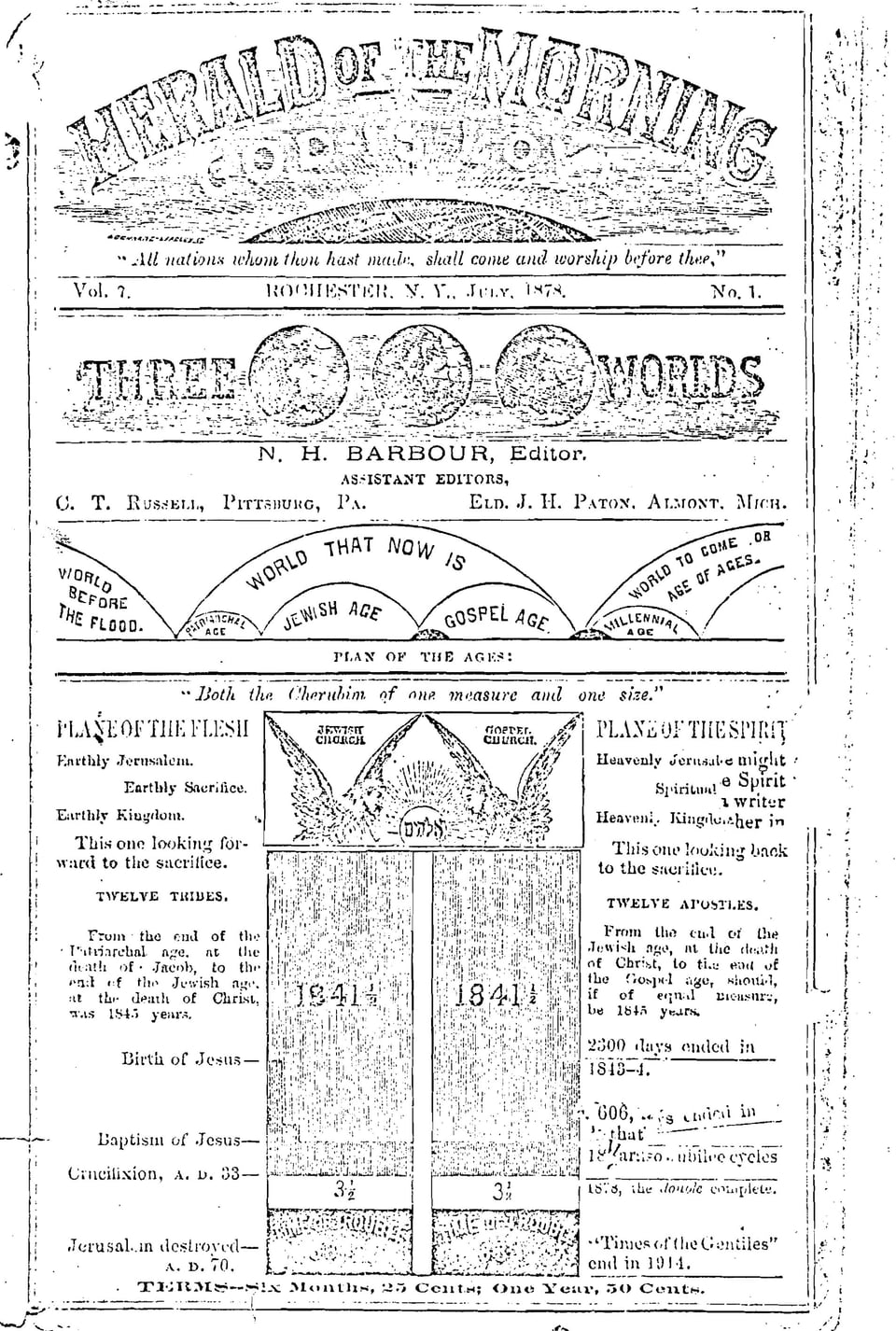
HERALD OF THE MORNING
"All nations whom thou hast made, shall come and worship before thee."
Vol. 7. ROCHESTER, N. Y., July, 1878. No. 1.
N. H. BARBOUR, Editor.
ASSISTANT EDITORS,
C. T. RUSSELL, PITTSBURG, PA. ELD. J. H. PATON. ALMONT. MICH.
THREE WORLDS
N. H. BARBOUR, Editor.
ASSISTANT EDITORS,
C. T. RUSSELL, PITTSBURG, PA. ELD. J. H. PATON, ALMONT, MICH.
WORLD BEFORE THE FLOOD.
WORLD THAT NOW IS
JEWISH AGE
GOSPEL AGE.
WORLD TO COME OR AGE OF AGES.
MILLENNIAL AGE
PLAN OF THE AGES:
"Both the Cherubim of one measure and one size."
PLANE OF THE FLESH
Earthly Jerusalem.
Earthly Sacrifice.
Earthly Kingdom.
This one looking forward to the sacrifice.
TWELVE TRIBES.
From the end of the Patriarchal age, at the death of Jacob, to the end of the Jewish age.
PLANE OF THE SPIRIT
Heavenly Jerusalene might
Spiritual Spirit writer
Heavenly Kingdaughter in
This one looking back to the sacrifice.
TWELVE APOSTLES.
From the end of the Jewish age, at the death of Christ, to the end of the Gospel age, should if of equal measure.
was 1845 years.
Birth of Jesus—
Baptism of Jesusbe 1845 years.
Crucifixion, A. D. 33-
Jerusalem destroyed A. D. 70.
2300 days ended in 1843-4.
606, this ended in
18 ariso .. ubilee cycles
1873, the double complete.
"Times of the Gentiles" end in 1914.
TERMS--Six Months, 25 Cents; One Year, 50 Cents.
LETTERS containing money.—This acknowlegment is a receipt for their contents.
knowlegiment is a receipt for their contents.
Rev H T S Lewis, N. Y. J McDonald, N. Y. J O Peterson, Minn. Rev J C deBruynkops, Minn. J Shultz, Md. G. H Hutchins, Kan. N Hines, Ala. Mrs H Brown, Ind. Mrs L T Cram, Mass. Wm. Bates, Conn. S McPherson, O. J Burt, N. Y. J A Settle, Ill. Dr R W Moses, Oregon. G O Bailey, Ill. Dr V Caillot, Ind. A Gregory, N. Y. J A Mayo, Mass. E C Russell, Oregon. C R Green, Vt. P Suter, Md. A J Marsh, Wis. L Fogg, Me. S M Darrow, Pa. A M Meyer, Ind. J C Rockwood, Mass. E Bartholomew, Ct. J T Callett, N. J. J Clark, R. I. H J Keetman, Iowa. J J Uinstadt, Mo. Mrs M A Durkee, Minn. T H Harvey, O. S E Hooker, Vt. T Tyler, Mich. T L Barnes, Pa. W S Allison, Ind. Mrs J G Mallby, Ct. W Patterson, N. Y. S Barnhill, Ind. R B Hill, Pa. L J King, Ind. Eld W F Carson, Iowa. L Snodgrass, W. Va. A N Samson, N. J. E Cummins, N. H. W C Shane, Ky. Mrs E A Corker, N. Y. W T Gibson, Fla. D D Lathrop, Pa. H C Deunis, Tenn. Mrs J Mansfield, Ill. Wm Bailey, O. S M Miller, Pa. C Wire, Ill. Mrs L. B Lamb, Minn. Mrs M A Hause, Minn. Wm Bates, Ct. Mrs C Sprague, Mass. E C Doane, Ill. M A Ing, Ct. Mrs A Storey, Ill. H Shute, J Ogilney, Ind. H E Warren, N.
sle, Del. Mrs J P McNiel, Ind.
Mrs E Chase, Minn. S Lindenbager, Ind.
J Evans, Va. R Matchett, Pa. B D Godfrey, Mass. L Burbank, N. II. M Lordway, O. Wm Bates, Ct. Mrs M G Partridge, O. Mrs E G Morse, N. J. A Winslow, Va. E N Graves, Ill. Avis Hamlin, O. R M Smith, Mass. J L Larrabee, Mass. M N Smith, O. E P Atwater, Ct. S Titus, Mass. Mrs L Roberson, Mich. Eld C Bradley, Iowa. J W Drew, Mich. C A Benis, Mass. J Dudley, Mrs P Hibbard, N. Y. T J Storer,
O. Miss L J Rogers, N. Y. J L Rich-E Parish, Ct. mb, Minn. Rev J C deBruynko nn. J Childers, W. Va. H Wood, ass. G W Allen, Cal.
Mrs. D. B. Wolf, Ohio. Mrs C E Pickering, Iowa. Mrs M E Higgins, O. Sarah A Blethen, Mass. J W Hale, Mich.
John Mustadt, Mo. W A Hunter, Kan.
B C Bancroft, Mass. M Seaton, N. J. Z
A Waterhouse, Maine. F A Sonders, P Mrs H B Railsback, Ind. John Fonde MD, Pa. S J Bacon, N. Y. H G Bradley, O. Mrs Warren Hicks, N. Y. J Tavender, N. Y. James Rowan, N. Y. Robert C Laing, Mo. A Boynton, N. Y. Samuel Overturf, Iowa. Dr J Fondey, Pa. Lewis Mead, N. Y.
Notice?—Evidences that we are at the close of the gospel age, are so numerous, that few can examine them carefully and not be convinced of the truth of our position. And the question as to what great changes are before us, is forcing itself upon both the church and the world. There can be no doubt but that a time of trouble, such as the world has never yet experienced, is approaching, and that it is the immediate precursor of the millennial age. And to this agree both the chronology, the prophetic periods, and the signs of the times. Just what we are expecting in the next thirty-seven years, is, first, the gathering of the spiritual element of the churches into the light of present truth; a sanctifying or separating work, by which the church is to get the victory over the world, "And this is the victory that overcometh the world even your faith." Second, the translation, or glorification of the chosen bride of Christ. Third, the return of the Jews to Palestine, in the midst of the overtuning of Gentile governments, falling of thrones, etc. Fourth, the battle of the great day. Fifth, the ushering of the millennium.
If there are those who would like to hear on these great subjects, if they will provide any place, church or hall, there are those who will gladly speak to the people on these subjects. And those who would like to make arrangements for a series of meetings, may communicate with the following persons:—Eld. J. H. Patton, of Almont, Mich.; C. T. Russell, 82 Fifth Avenue, Pittsburgh, Pa.; S. H. Withington, Springwater, N. Y.; B. W. Keith, Dansville, N. Y.; or with myself, at Rochester, N. Y. Meetings in grove, or tent, or hall, or church; wherever a series of meetings can be held, will be responded to.
We have been compelled to leave out correspondence, answers to questions, and some articles already in type, because of the two long leading articles in this number of the paper.
ARE WE RIGHT?
Truth, present truth, is the means ordained of God for the sanctification of the church: and at each great step, in the plan of the ages, the then present truth becomes especially important. And believing that we are now passing through the most glorious change the world has ever witnessed, we feel, before God and man, that it is a duty to make these things a specialty in all our teachings. Men may find fault, they may ridicule, or pity; friends may turn against us, as they have at each and every advance along this shining pathway; but none of these things move us. Our face is like a flint, and whatever others may do, we mean to keep step with the advancing light.
The impression that great changes are at hand, that the advent of the Son of God is an impending event, is becoming very general through christendom. And the question for each one to decide is, which is the wiser course, to shut our eyes, try and be as good as we can, and take our chances as to "that day" coming upon us unawares, or to investigate, with a determination to know all that God has revealed in relation to it. The larger number will, of course, choose the former, and glide on with the stream, and be overtaken unawares; the few will boldly strike out against the tide of opposition, and 'search as men search for silver,' and these "will find the knowledge of God," escape those things that are coming on the earth, and stand before the Son of man.
Those who would full you to sleep with the song of "Age-to-come," and make you unmindful of the bridge over which you are passing, in other words, the present truth that leads to age-to-come, are as dangerous, or even more so, than are those who sing of death, as the gate to endless joy. They are more dangerous because they have more truth. But, it may be asked, Can truth be dangerous? Yes, I answer. If you were journeying over an unknown and dangerous pathway, full of snares and pit-holes, and some of your leaders were continually calling your attention, and keeping your mind on some distant object, you would be very likely to stumble and fall. The Scriptures are "a lamp to our feet, and a light to our path;" and are not designed to shine far into the future, and we are to "take heed as to a light shining in a dark place." God does not use symbols without meaning. If you
had a lamp to your feet, shining in a dark place, would you as a wise man, try to keep your eyes on some distant object, or on your immediate surroundings? The Bible, ever inculcates the importance of present truth. Hence, purely Age-to-come teaching, even though it be true, is a snare of the Devil; and is keeping thousands in darkness on the all important present truth.
But, say the great mass of christian teachers, both among millinarians, and those opposed to age-to-come views, if you mean by present truth, an understanding of our exact position in the stream of time, we do not believe any one can know this.
Here is where we differ. The universal teaching of Scripture, is that in all great dispensational changes, God has had a chosen few who understood the situation, and knew what their Lord was doing:—"Surely the Lord God will do nothing but he revealeth his secrets to his servants the prophets." "And those things that are revealed, belong to us, and to our children, for ever." The whole plan of the ages, is therefore revealed, and is to be understood just as fast as it becomes due; that is, just as fast as it is fulfilled. That prophecy can be understood only as fast as it is fulfilled, is proven both by the universal failure of all who have attempted to explain it in advance, also by direct Bible testimony:—"I speak these things, that when they come to pass ye might believe," is the teaching of him whose Spirit was in the prophets. Hence when a writer would instruct me on prophecy, whether in relation to a personal "man of sin," a personal antichrist, a personal Elijah, or two individuals, as "My two witnesses;" and tells me they are still future, and they are about to explain an unfulfilled prophecy, I desire to hear no more on that subject. All such speculations are worthless. This, of course does not apply to prophetic measurements; if it is Monday, we have a right to prophesy and say, in five days more the week will end. When for instance a period like the "times of the Gentiles," is clearly defined; a positive statement that all was given to them as at the captivity, b. c. 606, it requires no inspiration to determine that "seven times" (prophetic), or 2520 years, will end with a. d. 1914. But the details, or nature of future events are seen only by the eye of inspiration, and never by the prophetic student.
Again, when a prophecy is fulfilled, some suppose and teach, that it should be so decided and emphatic that no doubt, or difference of opinion can exist.
I have seen this laid down as an axiom, by the most superficial writers, who issue some tract or pamphlet of startling wonders about to transpire. I have also seen it advanced by men of sterling merit, in some respects, and who ought to be ashamed of such superficial ideas.
These remarks are called out by a work by Dr. Seiss, of Phila. in which he not only asserts this false position, but would have us believe that the "two witnesses," "the man of sin, and the Elias, are personal characters, men or saints, who are to enact some wonderful career. Think of some man, or even angel from heaven, filling the prophecy concerning Elias,—"Elias truly shall first come and restore all things," (Matt. 17:11.) Now, associate this with Acts 3:20, 23, "And he shall send Jesus Christ, whom the heaven must receive until the times of restitution of all things." Here we have Christ coming at the beginning of the times of restitution of all things; the church of the first-born, his body united to him, as the power to sit on the throne, and yet this one perfect SEED in whom all nations are to be blessed, must be set aside, while some personal Elias takes it upon himself to "restore all things."
But to the statement, "that all fulfilled prophecy must be so marked and absolute in its nature, that no room for doubt, or difference of opinion can exist." I would suggest that the writers look at the facts at the first advent. Certainly there was some prophecy fulfilled there. And we can point to a long series of predictions which were thus literally fulfilled, as well as to some which are being so at this very day; and yet, then, as now, the great mass of the recognized people of God, not only found room to doubt, but continued in darkness, in relation to such fulfilled prophecy. Isaiah predicted that a virgin should conceive and bear a son, and yet the fulfilment of that prophecy left some room with the Jewish nation for doubt. Prophecy had pointed to Bethlehem Ephrata as the place of his nativity, and yet he was called a Nazarine. The prophet predicted to Jerusalem the approach of her lowly king, riding on an ass; and yet the very nation for whom the prophecy was made, and who saw its fulfillment, have found room to doubt, and even hold a different opinion of that fulfilled prophecy to the present day.
Prophecy declared, "If ye think good give me my price; and if not forbear. So they weighed for my price thirty pieces of silver." (Zech. 11:12.) And its fulfilment was so obscure that it is difficult even now to put the facts and prophecy together.—Prophecy records, "Out of Egypt have I called my Son." "And he arose and took the young child and his mother by night, and departed into Egypt; and was there until the death of Herod, that it might be fulfilled." (Matt. 2:15.) Certainly this prophecy, fulfilled with the special purpose of keeping that fulfilment a secret, gave plenty of room for doubt, or even ignorance of the fact. But we need not multiply illustrations, so far from being clear and well defined to the world, all the fulfilment of prophecy at the first advent, and indeed since then, have been unrecognised by the uninstructed; while those who were in the light, that is, were being led of the Spirit, have been able to comprehend only by a kind of evidence the world could not receive. And this because prophecy is designed, not for the world, but for the church. And only the part of the church who are truly led of the Spirit, have ever understood it. Witness the facts of the two on their way to Emmaus; and indeed of all to whom it was given to understand the mysteries of the kingdom at the first advent. And once again prophecy is being fulfilled in a special manner, before the eyes of this present generation, and on precisely the same principle. All who are truly led of the Spirit, will be led into a knowledge of this present truth, while all others will remain as ignorant, as were the Jewish nations in the former case.
The truth in relation to fulfilled prophecy, is never forced upon the church; hence, those who are opposed to investigation, will never see it, until the stage of development at which all the world will recognize it. Hence, again we ask, Is it right, to search, to take heed to the more sure word of prophecy? Or had we better shut our eyes, and merely "try to be good?"
THEN AND NOW.
Jesus was begotten and born in fulfilment of prophecy. Thirty to thirty-one years after, he was appointed by the Holy Spirit at his baptism; then three and a-half years of a special work to the Jewish church began and was finished, and still they knew it not. Thus the first house of Israel, the house over which Moses presided as a "servant" stumbled.
So prophecy predicts the second house were to stumble; "whose house are ye, if ye hold fast," etc. After that house of servants were "cast off," and their dispensation ended, so that they were no longer heirs (Gal. 4:30), still there was a "remnant according to the election of grace," who were not cast away. In other words, the "wheat" out of that generation were not cast off, but were gathered, on and after the day of Pentecost. This is clearly taught in Romans, 11:1-5. And the apostle includes himself as one of that "remnant." And this remnant, on their acceptance of Christ, were entitled to all the gospel had to confer. That is, there was no difference between those who accepted Christ during his three and a-half years of ministry, and before the end of their dispensation, and those who, like Paul himself, were of that elect remnant, and accepted him after that dispensation ended. Hence, our position being true, i.e., that the gospel dispensation is now ended, the parallels prove that the "wheat" to be gathered out of this generation of the gospel church are entitled to share equally, in the "high calling," whither brought into the light of present truth before the end of this dispensation, or, during whatever period of time God has set apart for the gathering of the wheat after the dispensation ends.
Now, if the reader will look at the title page, he will see just the present whereabouts of the gospel church. The Scriptures clearly teach the equality of these two dispensations in all their measurements. From the death of Jacob, at the end of the one-man, or patriarchal age, to the death of Christ, at the end of the twelve-tribe, or Jewish dispensation, was a period of just 1845 years. (This is not reckoned by Bishop Usher's chronology, in the margin of our Bibles, but by the real Bible chronology, as published so often in these columns; a chronology by which this wonderful harmony is found to obtain among all the prophetic measurements). Christ was crucified in the spring of A. D. 33. And from the spring of A. D. 33, to the spring of A. D. 1878, is another period of just 1845 years; hence, at that time the gospel dispensation was of equal measure with that of the preceding one. Now, let our readers who have not yet seen the evidence of the exact equality of the two dispensations take it for granted, for the present, in order that they may see some of the beauty of the parallels, and also the prophetic Scriptures; and at some future time the opportunity may be presented for them to critically examine this evidence.
For the present, then, the subject will be presented just as if the reader accepted the fact of this equality; that as the twelve-tribe dispensation, ending at the death of Christ, was just 1845 years in duration, so the gospel dispensation, having now continued an equal period, is also at an end. Do not start back at this, you know the Jewish church did not believe their dispensation had ended, at the death of Christ, or on the day of Pentecost; and yet notwithstanding they did not recognise the fact, still it was true. And it is a clearly Scriptural position that the gospel dispensation will end in a manner equally surprising to the gospel church. Many will feel as if this could not be true; and really think they have Scripture to prove that the gospel dispensation must end with the advent of Christ in the clouds, and to be seen by "every eye." But they have no such Scripture marking the end of the gospel age. Men must not jump at conclusions. The Jews, who knew and believed the prophecy of Gabriel to Mary (see Luke 1:30-33), could have proven, to all appearance, that their dispensation never would end, and yet it ended, and ended without their knowing it. And this blindness which happened to them, was to continue "until the fullness of the Gentiles be come in."
And we can prove that the gospel dispensation is also now ended. But as the Jewish church in mass, did not recognise the fact in their own case, so it is with the gospel church. And now, as then, this fact will be recognised only by a remnant.
"Even so at this present time also, there is a remnant according to the election of grace." (Rom. 11:5.)
As it was after the end of their dispensation, this "remant" were gathered out of that forsaken church, so it is after the end of the gospel dispensation this elect remnant, the true spiritual element, the "wheat," found in all the sects composing the gospel church, are to be gathered. And we are now in that gathering time.
Now look at the measurements. From the death of Jacob to the death of Christ, was the time during which the tribe of Judah was to hold the sceptre (see Gen. 49:10).
This was the measure of the twelve-tribe dispensation, and was a period of 1845 years. Christ as a Jew, preached three years and a-half; and his was a harvest work, "whose fan is in his hand, and he shall thoroughly purge his floor." Therefore he began to preach, and the harvest of that age began three years and a-half before the end of their dispensation. In other words, from the beginning of the twelve-tribe dispensation to the beginning of its harvest, was a period of 1841 years and six months. Jesus was born thirty years before he began to preach, therefore, from the beginning of that age, to the beginning of the first advent, was thirty years less than 1841 years and a-half, or 1811 years and six months. Again, from the death of Christ, in the spring of A.D.33, to the destruction of their nationality, in A.D.70, was about thirty-seven years.
Now, look at some facts here. From the beginning of the gospel dispensation at the death of Christ, in the spring of A. D. 33, to the autumn of 1844, at which time we claim that the first stage of the second advent began, was a period of just 1811 years and six months. And to the autumn of 1874, when we claim the harvest of the gospel age began, was 1841 years and six months. And from the spring of A. D. 33, to the spring of A. D. 1878, where we claim the gospel dispensation ended, was just 1845 full years. Now, if the "chernubs with faces turned inward, toward the mercy seat;" the one looking forward to Christ, in all its typical ordinances, and the other looking back to the cross, to the death and resurrection of Christ for all its hopes, "for if Christ be not risen then they that have fallen asleep in Christ are perished;" if, I say, these were to be of one measure and of one size." then the gospel dispensation is now ended, and naught remains but "gathering the wheat into the barn." (Matt. 13: 30.)
Some may think these exact parallels are but the result of a well digested and carefully got up theory. But this is not the case, for all these measurements fixing the various dates which go to make these parallels, were made, some of them before any one of the parallels were seen; and all of them before these parallels were seen in their present completeness. For instance,
the 1843-4 movement was based on the ending of the 2300 "days" of Dan. 8:14; and was made at the exact point to parallel the movement at the begetting and birth of Jesus, and with no knowledge whatever of the "two dispensation" argument. Hence all can see that the 1843-4 movement, or the argument of the 2300 days ending there was not designed, of man, at least, as a part of this system of parallels. Nor was the next movement, that of 1873-4, started with a design to parallel, in point of time, that of the beginning of Christ's ministry; for at that time not one of these parallels, or the argument drawn from them had been seen.
The chronology, showing the end of the 6000 years in the autumn of 1873, taught by Bowen, Elliott, Cummings, and many others, can hardly be supposed to be a premeditated part of a then unknown theory. And the argument on the 1335 days of Dan. 12: dating from A. D. 538, or 9, and ending in 1873 or 4, was held by thousands before any of these parallels were seen, and by many who never saw them. Again, the jubilee argument of 50x50 years, or a jubilee of jubilees, measuring from the last typical jubilee prior to the Babylonian captivity, and pointing to the tenth day of the seventh month of 1874, as the time for our High Priest to leave the Holy Place, could not be bent to suit a theory, since there is absolute data by which to determine the date of their last jubilee; from which 50x50, or 25-00 years end in exact harmony with these arguments. Again, the seven times, or "times of the Gentiles," that is, 2520 years, commencing at the captivity, B. c. 606, at which time the crown was removed from the line of David, and the whole earth was given up to the Gentiles, ends with A. D. 1914, or just 37 years from the present time, 1878; and so marking the exact parallel to the destruction of Jerusalem, 37 years after their dispensation ended
There is but the one parallel, that of the equality of the two dispensations themselves, and which makes the gospel dispensation due to end this present spring, against which an objection of its being made for the occasion, could have any weight. And to this, I can only say, the chronology on which so many other of these parallels depends, gives the duration of the twelve-tribe dispensation as 1845 years; and from the day of Pentecost in A. d. 33, to this present spring, is an exactly equal period of time. Again, the fact that a parallelism between the two dispensations does certainly obtain in all the details of worship, cannot be denied.
The former was organized on the basis of twelve tribes, and the latter, on that of twelve apostles. The first ended with a closing work called a "harvest" (John 4:35); so does the second (Matt.13:30). The Jewish age ended with the first advent, the gospel, with his second. Did the former have its tabernacle, temple and sacrifice; so has the latter its "tabernacle not made with hands," its living temple, its "spiritual sacrifices." Had the old covenant its priesthood, its incense, its vail, and its holy of holies; so has the new. Was there the Mount Zion of Arabia, and the earthly Jerusalem; so there is "the Mount Sion the city of the living God the heavenly Jerusalem. Indeed there is no feature of the old dispensation but has its parallel in the new: "see thou make every thing after the pattern shewed thee in the holy mount;" And certainly, these parallels are not far-fetched; nor are the facts in relation to their equality of measurement. And when all the beauty and completeness of these parallels are seen, they become an exceedingly strong argument in support of our position.
The movement having reference to the second advent of the Messiah, began in the message of 1343. And now that we are near the end, it is apparent that the past is an exact fulfilment, not only of the parable of the "ten virgins," (Matt. 25:), with its two parts, the one prior to the tarrying of the Bridegroom, and the other under the midnight cry, but it has paralleled in point of time, each movement of the first advent. How did it happen that the 1843-4 movement occurred at just an equal distance this side the death of Christ, as was that of the preparatory stage at the first advent, this side the beginning of their age? How did it happen that a movement like that of 1873-4, occurred at the exact time to parallel the second stage of the first advent at the baptism of Jesus? How does it happen a prophetic measurement should mark off a period of three and a half years, just at that point, and all this light come out on the harvest of the gospel age, just where it would parallel, in point of time, a similar work at the end of the Jewish age? And how does it come about that an argument clear and positive, like that of the "Times of the Geniles," ending with the year A.D. 1914, hap
pens to be just 37 years further on, so as to parallel the destruction of Jerusalem, occuring 37 years after the end of their age? And let it be remembered, each and all of these parallel points of time were arrived at by prophetic and chronological measurements before the parallel was seen.
Now is it more probable that all these are purely a matter of chance, than that all were arranged of God in the great plan, as type and antitype? There is a "double," running all through the Bible, two Adams, two Jerusalem, two kind of children, those "after the flesh," and those "after the Spirit;" two dispensations, the former given expressly as a typical, or pattern dispensation. Two births, that of the flesh, and that of the Spirit; making the two stages in man's development before reaching the perfect condition; and hence, the two advents, and two natures of the second Adam.
To attack any one of these parallels in detail, and show a plausible reason for giving it some other application, does not touch the real strength of our position, any more than to object to the placing of a hewn stone that fitted one and only one place in the building, because it might have been the design of the architect for that stone to have remained unused, would prove that the laborers had made a mistake in placing that stone into the nich where its dimentions proved that it belonged. This thought was suggested by a flimsy criticism on some of these points in one of our exchanges; in which the editor in an off hand manner tells his readers that it is not likely Isa. 40:2, "Cry unto her that her appointed time [margin] is accomplished, and her iniquity pardoned, for she has received double at the Lord's hand, for all her sins," has any reference to time; and then, after this logical conclusion, coolly dismisses further investigation as too unimportant for a place in his paper. Truly these things are "foo'ishness to the natural man, neither can they know them.
The only argument worthy the name, ever brought against the position taken on the 2300 days, as applied in 1843, is the fact that what they expected to transpire at the end of the "days" did not transpire.
In the 1843-4 movement we had as yet seen none of the parallels, nor any thing of the manner of the advent. We supposed that where those "days" ended the whole work, in all its stages, instead of merely beginning, would be consummated. This was our mistake, while the application of the prophetic period was not a mistake.
I have no more doubt that in that movement,. we had the right principle of interpretation. the subtracting the "seventy weeks" of Dan. 9:, from the 2300 days of Dan. 8:, than I have of the truth of the prophecy. The relation of the vision of the 8th, to that of the 9th chapter, is placed beyond all criticism, by the language in verses 21, 23, and 24.
The vision of the 8th chapter is called, "the vision of the days" (verse 26—The same word rendered "days," verse 14, being here rendered "evening and morning." The vision of the 8th chapter is the only one in which Daniel had seen Gabriel (see verse 16). And the angel distinctly refers to this vision of the 2300 days, in verse 23, "Understand the matter, and consider the vision: Seventy weeks are determined, or cut off, as it should be rendered, upon thy people, and on thy holy city. And the advent of Christ proved that those "weeks" were fulfilled a day for a year, or as 490 years. Cut off 490 from 2300, and 1810 remain. Therefore the remainder of that 2300 day period ended 1810 years after the end of the seventieth week. But as the work of that seventy weeks was cut short so as to end in the middle of the last week, so the work due to begin 1810 years after, was hastened an equal period of time. And 18-10 years from the crucifixion, terminated in 1843.
The argument on " The times of the Gentiles" ending with the year 1914, is neither far fetched, or the principle of application peculiar to this theory. That a day stands for a year, in prophecy, has been endorsed by all, or nearly all Bible expositors: and that a "time," means a solar year, and that the "time, times, and half a time," of Daniel and Revelation are synonymous with the "forty and two months," and "a thousand two hundred and three score days," and means 1260 solar years, has also been the teaching of the great body of expositors. Hence, whatever may now be said for, or against this day-year theory, all must admit that it is not peculiar to us.
If three and a half prophetic "times," are 1260 literal years, "seven times," means 2520, or twice 1260 years. And in Lev. 26:28, it is taught, and four times repeated, in that chapter, that literal Israel should be chastised "seven times." And measuring from the captivity in Babylon, a point
clearly marked as the beginning of universal Gentile dominion, not only by the fact that the crown was removed from Zedekiah the last of the Jewish kings, at that time, but by the fact that God, at the same time gave all the earth into the hands of Nebuchadnezzar. And from B. c. 606, 2520 years, or seven prophetic times, will end in A. D. 1914; just 37 years from this present spring; thus making the end of "the times of the Gentiles" an exact parallel to the end of the Jewish nationality at the destruction of Jerusalem.
Again, If all these parallels were built on the day-year theory even, the fact of their arranging themselves into this wonderful system of parallels would more than rival the wonders of the great pyramid, as proof of their eminating from the divine mind. But they do not all rest on that theory; three of them, the chronology, the jubilee argument, and that of the equality of the two dispensations, are independent of that theory; and yet they are in perfect harmony with the other three, which are based on that theory. While all of them harmonize with certain facts and movements of the past forty years.
Such an array of evidence on any other subject, would carry conviction before any tribunal in the world; but spiritual things have an element outside of, and beyond the reach of the natural mind; and yet, we can but believe that the real spiritual element in the church, will be enabled to see and be brought into the light of present truth, before the gathering time shall be ended.
3 1-2 YEARS.
The change in the character of this movement, through which we have just passed, is doubtless as yet not fully understood by some who are in full sympathy with most of the other views. So far as the Elijah type (2 Kings 2:) is concerned, we are just at the parallel, after he had crossed the Jordan, with nothing before him but translation; but so far as the parallels between the Jewish and the gospel dispensations are concerned, we are just in a parallel condition with the 'remnant according to the election of grace,' of whom the apostle speaks in Rom. 11:1,5.
Christ, who was "sent but to the lost sheep of the house of Israel," came to bring division; and he accomplished the work his Father sent him to do. And that division between "wheat and chaff," and the scattering, even of the wheat, was fortold in prophecy, as "sheep having no shepherd."
And yet that "wheat," that "remnant according to the election of grace," was to be gathered, out of that rejected generation, and that gathering began on the day of Pentecost. And Paul, and many others, from that special generation who had seen the division, were gathered in the following 31-2 years. And we have to admit that gathering did not begin till Pentecost; and therefore not before, but after the end of their dispensation; and in order to parallel that, the gathering of the "wheat," out of the last generation of the gospel church, must of necessity be after the end of this age.
As to the time, we have the following to offer: "Seventy weeks are determined on thy people and upon thy holy city; ... know therefore and understand that from the goingforth of the commandment to restore and to build Jerusalem, unto the Messiah the Prince, shall be seven weeks and threescore and two weeks" (Dan. 9:24, 25). Here are 69 weeks, of the 70 determined on the Jews.—Christ, and Messiah, is the same word in the original, "and being interpreted means the Anointed (margin of John 1:4). Jesus was Anointed at his baptism (Acts 10:38). Therefore the 7 weeks, and 62 weeks, ended at his baptism. "And after threescore and two weeks shall Messiah be cut off" (verse 26). It was a half week after the 62 weeks, that He was "cut off." The word here translated "after," is ah-yhar, a word never rendered "at the end of," like kehtz, in Dan. 12:13; but is often rendered afterwards; and means an indefinite period after. "And He shall confirm the covenant with many for one week, and in the midst of the week He shall cause the sacrifice and oblation to cease (verse 27). The literal of this word is 'the half,' in the half of the week. Christ made the sacrifice to cease, in the one half of the week, but the covenant must be confirmed with many, for one week. This leaves the last half of the 70th week yet unexpired at the death of Christ; and yet that seventy weeks was determined on the Jews. Hence they were in some sense, God's representative people for 3 1-2 years after the Pentecost, and yet holding a different relationship at the end of that time. Hence, no matter whether history records any event, or not, we have Bible authority that they had favor shown them after the end of their dispensation, both in this prophecy, and also
in the fact that Christ commanded special favor to them, after his resurrection.
Now comes the question. What was that 31-2 years extension of favor to that rejected house for? We may know by seeing what was accomplished. The 'wheat' from that living generation was gathered. But at the end of that 70 weeks, all favor, according to the conditions of the prophecy, should cease, or else more than 70 weeks was determined on them.
Then if the parallels hold, there must be an extension of favor to the gospel church, after this dispensation ends. But this does not touch the question as to what disposal was made of the wheat, after the gathering, this, the work of the Spirit, being outside of the parallels. But the gathering, is by the angels. And in our last paper we showed what the gathering, in the present case implies, viz. a condition of victory over the world; and which is due to the living church only at the end of the dispensation; and to individuals who have died, when, like Paul, they had "finished their course," and was ready to be offered."
On the day the gathering began, the day of Pentecost, more than three thousand were gathered out of that rejected Jewish church.—Remember, the parallels go only to the gathering of the wheat, and do not reach the work of the Spirit; their being begotten at that time, or born, at the present expected change, being alike the work of the Spirit. The gathering in the present case, into the barn, if the wheat are called "children," would represent the house, "Whose house are ye, if ye hold fast ... to the end;" Therefore all who were ready, and in the light of present truth, (perhaps more than three thousand), were counted as overcomers, and, having reached the end, were unconditionly in the house, the day the gathering began. And yet, before the end of the gathering time there may be brought in some, who like Paul, have hitherto zealously opposed the truth. The mass of the church have doubtless stumbled; being the Laodicean church, God will "spew them out of his mouth." But there may yet be "seven thousand," as the "remnant according to the election of grace." Read Rom. 11: 1-7, where Paul, who certainly was "wheat," proves by a reference to his own case, that there was a reminent, from that church to share in the high calling, while "the rest were blinded." And by refering to Elijah, gives a hint, possibly, as to the number.
And it is not unlikely the parallels may hold, even to the number chosen. God grant the number may not be less out of this generation, of those who shall overcome, and stand on "as it were a sea of glass." and have the song of the restitution in their mouth:—"All nations whom thou hast made, shall come and worship before thee (Ps. 86:9, and Rev. 15:4)-
THE CHURCH Walking with the World'
The Church and the World walked far On the changing shores of time, [apart The World was singing a giddy song, And the Church a hymn sublime. "Come, give me your hand," said the merry And walk with me this way; [world, But the good Church hid her snowy hands And solely answerd "Nay," I will not give you my hand at all, And I will not walk with you; Your way is the way that leads to death; Your words are all untrue.
"Nay, walk with me but a little space," Said the World, with a kindly air;
"The road I walk is a pleasant road, And the sun shines always there;
Your path is thorny and rough and rude, But mine is broad and plain;
My way is paved with flowers, and dews, And yours with tears and pain;
The sky to me is always blue; No want, no toil I know;
The sky above you is always dark; Your lot is a lot of woe;
There's room enough for you and for me To travel side by side."
Half shyly the Church approached the And gave him her hand of snow; [World And the old World grasped it and walked Saying in accents low, [along, "Your dress is too simple to please my taste; I will give you pearls to wear, Rich velvets and silks for your graceful And diamonds to deck your hair." [form, The Church looked down at her plain white And then at the dazzling World, [robes, And blushed as she saw his handsome lip With a smile contemptuous curled. "I will change my dress for a costlier one," Said the Church, with a smile of grace; Then her pure white garments drifted away
And the World gave, in their place, Beautiful satins, and shining silks, Roses and gems and costly pearls; While over her forehead her bright hair fell Crisped in a thousand curls.
"Your house is too plain," said the proud I'll build you one like mine; [old World,
Carpets of Brussels and curtains of lace, And furniture ever so fine."
So he built her a costly and beautiful house; Most splended it was to behold;
Her sons and her beautiful daughters dwelt Gleaming in purple and gold; [there
Rich fairs and shows in the halls were held, And the World and his children were there.
Laughter and music and feasts were heard In the place that was meant for prayer.
There were cushioned pews for the rich and To sit in their pomp and pride; [the gay,
But the poor, clad in shabby array, Sat meekly down outside.
"You give too much to the poor," said the Far more than you ought to do; [World,
If they are in need of shelter and food, Why need it trouble you?
Go take your money and buy rich robes; Buy horses and carriages fine:
Buy pearls and jewels and dainty food; Buy the rarest and costliest wine:
My children they dote on all these things, And if you their love would win,
You must do as they do, and walk in the That they are walking in. [ways
Then the Church held fast the strings of her And modestly lowered her head, [purse,
And simpered,: "without doubt you are right Henceforth I will do as you've said." [sir;
So the poor were turned from her door in And she heard not the orphan's cry: [scorn
But she drew her beautiful robes asside, As the widows went weeping by.
Then the sons of the World and sons of the Walked closely hand and heart, [Church
And only the Master, who knoweth all Could tell the two apart.
Then the Church sat down at her ease and I am rich, and my goods increase; [said,
I have need of nothing, nor aught to do But to laugh, and dance, and feast."
The sly World heard, and he laughed in his Aud mocking said, aside— sleeve
"The Church is fallen, the beautiful Church And her shame is her boast and her pride."
The angel drew near to the mercy-seat,
And whispered in sighs her name,
Then the loud anthems of rapture were
hushed,
And heads are covered with shame.
And a voice was heard at last, by the
From him who sat on the throne, [Church
"I know thy works, and how thou hast said,
I am rich; and hast not known
That thou art naked, poor, and blind,
And wretched before my face;
Therefore, from my presence I cast thee out,
And blot thy name from its place."
SELECTED.
THE PROSPECT.
When a short time since our expectations of translation failed of realization, doubtless all who understood the foundation upon which those hopes were based felt somewhat disappointed; yet we did not for a moment feel cast down. We realized that what God had so plainly declared must some time have a fulfilment.
We felt that we wanted to have it just in God's time and way. We have not, and hope we never shall, have any desire to arrange the matter for him, but we are very desirous of having all the light which it pleases Our Father to give upon our pathway, and which he promises will "shine more and more unto the perfect day." In other words, it has been, and still is, our aim not to make a pathway for ourselves, but to make use of the "lamp" of revelation ("Thy word is a lamp") in walking in the pathway which our Father made for us. When, therefore, we were not translated, it was an evidence to us that it was not God's time for it; and our hearts responded Amen; thy will be done, O God: and we can say with brother Paul, "I know in whom I have believed, and am persuaded that he is able to keep that which I have committed unto him." And we realized that "All things work together for good to those that love God, to them who are called according to his purpose."
WHEREIN DID WE ERR?
Was it in looking for translation? No. Men may scoff at the idea, but some day the church will be translated. Whenever it comes it is to be the end of the church's career. As St. Paul testifies, "Behold I show you a mystery. We shall not all
sleep, but we shall all be changed, in a moment, in the twinkling of an eye," etc. Did the failure to realize translation prove either the object or manner of our Lord's coming, as we have advocated them to be erroneous? By no means. The same Scriptures still teach that Jesus comes to be glorified in his saints—to be united with his church—to exalt her as his bride to the throne, that through the second-Adam and his wife the regeneration of the world may be accomplished, and through them all things be restored which were lost through the first Adam and his wife. (Roman. 5: 17-19.) As "God hath spoken by the mouth of all his holy prophets since the world began." (Acts 3: 21.)
We know, too, "The day of the Lord so cometh as a thief in the night"—stealthily—quietly. And Jesus, speaking of his parousia (personal presence) declares that in his parousia men will be eating and buying and marrying, and know not, (Matt. 24:38,) as it was in the days of Noah, so shall it also be in the days of the Son of man. The world will go along in his days as ever, and know not. (Luke 17:26.)
Did our disappointment prove that we were in error as to the time—our chronology wrong? The Bible chronology taught us that the 6000 years from Adam were full in the fall of 1873. Here we believe the 7th thousand-or Sabbath began--chronologically, while other prophetic lines taught us that that blessed age had its beginning in a night of peculiar darkness-a time of trouble of forty years, during which all the kingdoms of the world would be thrown down, and the world prepared for the reign of Christ and his bride, when "a king shall reign in righteousness and princes shall rule in judgment."
Just at the right time 1873, the present financial trouble had a beginning. It began small, but has ever since been increasing and spreading, until now the entire civilized world is affected by it. The world laughed at our predictions, and assured us that six months would see matters all right again; but we are nearly five years into it now, and the cloud is still darker. "Men's hearts begin to fail them for fear, and for looking after those things coming upon the world."
This point at least seems clearly marked, and we cannot lay it aside without some good reason. Again, it is so scripturally strong that neither its friends nor enemies are able to overthrow it.
We found various clear prophetic lines of teaching in perfect accord with the chronology. The jubilee, etc., etc. Among the clearest and simplest of these teachings was the one which showed us that the Jewish age was a pattern of the gospel age; that they two would be of equal size and measure; that what they had, priests, holy of holies, tabernacle, etc., foreshadowed ours, the true, etc. (See writings on "Double," "The Two Covenants," etc.) This system of parallels has been of late one of the chief sources of light on our pathway. It taught as that the gospel dispensation would in some sense end this spring, as this was the point of time parallel to the giving up of the Jewish church, when Christ wept over them, gave them up, and left their house desolate. We did not discern, as we now do, that their harvest was a seven years' work, divided into equal parts, and devoted to entirely different kinds of work. During Christ's ministry of three and a-half years, John's statement, "His fan is in his hand, and he will thoroughly purge his floor," had its fulfilment. He did a separating work—divided the wheat of that age from its chaff. As he said: "Think not that I am come to send peace, but rather division." "And there was a division among the people concerning him." (Jno. 7: 34.) When the dividing work was accomplished, and before the wheat was gathered, Christ gave up their—Jewish—house at his death, when the vail was rent, and the glory of the Lord departed from their temple; but John also said, "He shall gather the wheat into his garner." When was this accomplished? We had supposed that this gathering was accomplished in the one day of Pentecost, which followed Christ's ministry: but we now see that while some of the wheat of that age was there gathered into the garner, the gospel dispensation, yet those were not all the wheat. No, the gathering of the wheat required time, and we shall show had three and a-half years allotted to it, making the harvest seven years long.
EVIDENCE OF SEVEN YEARS JEWISH HARVEST.
The prophecy of Dan. 9:24-27, is the only time prophecy which points to the first advent of Christ. The angel informs Dan. (v.24) of a period of time set apart upon
Daniel's people [Jews] and city; and that in this seventy weeks certain things would be accomplished, (v. 24.) The angel then sub-divided these seventy weeks as follows, 7-62-1. The 7 weeks (= 49 years.) (This time is given "a day for a year.") and has been so fulfilled. 1 day = 1 year, 1 week, (7 days) = (7 yrs.) During these 7 weeks = 49 years, the temple was rebuilt upon the return from the Babylonian captivity. The street and wall was to be built (during these seven weeks) even in troublous times. (For description of the trouble in building of it, see "Ezra" and "Neh.") After these seven weeks building, sixty-two weeks. = (434 years.) would reach to Messiah, and was fulfilled at the baptism of Christ. When God bore testimony to his sonship, and he was appointed by the descent of the Spirit, and introduced to Israel by John, the sixty-nine weeks reach to this point; and as there were seventy in all set apart to that people, it follows that there was one week or seven years of that time of favor still due to them. Now, with regard to this work, vs. 26 declares Messiah will be cut off (put to death) after the sixty-two weeks, but does not tell us how long after; it being after, however, necessitates its being in their last week—the seventieth. (Leave the remainder of vs. 26, it is parenthetical, and describes the war by which the Roman army destroyed their city and temple thirty-seven years after.)
Verse 27 takes up this seventieth or last seven years of God's favor—7 and 62 = 69 weeks reach unto Messiah. "And he shall confirm the covenant with many for one week, and in the midst of the week he shall cause the sacrifice and oblation to cease." How does this agree with its fullfilment? Perfectly. Christ, during his three and a-half years ministry, showed that people special favor. He neither went himself nor suffered his disciples to go to the Gentiles, etc. This was the first half of their week. Here although he gave them up as a house, yet he continued to show them favor after the establishment of the spiritual house—the gospel; and in the new commission to the apostles, after his resurrection, when telling them to preach the gospel to every nation, he charges them, "beginning at Jerusalem." Why begin there where he had just been laboring, and had finally given them up? Ah! he was to confirm the covenant one week, and there was three and a-half years still due them; until their seventy weeks of favor were run out, the gospel was not preached to the Gentiles.
Cornelious evidently was the first converted Gentile, as Paul declared Acts 13:46. "It was necessary that the word of God should first have been spoken to you," [Jews.] We should not know just how long the gospel favor was confined in this especial sense to them, were it not for this statement of the covenant being confirmed one week.
In the midst of the week he shall cause the sacrifice and oblation to cease. Who caused it to cease? Messiah. How? By becoming himself the true sacrifice. God recognized that bullock, or ram, or lamb as a sacrifice, because it pointed to Christ as the anti-typical "Lamb of God," the true sacrifice which taketh away the sins of the world; but the moment Christ died, all sacrifice ceased. From that time forward the Jews, or any one else, may burn a bullock or lamb, but it is not a sacrifice, for God having provided the true, no longer recognizes or accepts any other.
We find, then, that a work went on among the Jews for three and a-half years after Christ's ministry. We have seen that the work he did was to separate wheat from chaff, and that "There was a division among the people concerning him," the latter half of their week was devoted to the gathering of that separated wheat "into the garner," the gospel dispensation, and that quite a quantity of wheat must have been in that house when Christ gave it up, etc., is evident, when we learn that 3,000 were converted on the day of Pentecost (Acts 2: 41, and 5: 14), and there was added to the church daily such as should be saved—and the entire latter half of their seventieth week was devoted to this gathering of them. Let me illustrate
THE CHANGE FROM THE JEWISH to the gospel dispensation. Suppose you are a merchant. Your present place of business is old. You are about to remove to a new store across the way. You go through your old premises with your servants, and separate such articles of furniture, etc., as you may consider fit and suitable for the new store. [So Christ and his disciples separated by the "fan" of truth the wheat from the chaff—the wheat being suitable and proper to gather into the barn, the chaff unfit.] When you have all
things ready for your new store, you transfer your sign and presence from the old to the new, and the servants bring into the new the previously selected valuables from the old. So when the separating work in that house was complete, the glory of the Lord's presence was withdrawn from their temple—"the vail rent"—the house left desolate, while that presence was transferred to the new house, the gospel, and God now dwells in the new temple—the gospel church—"Whose temple are ye." (1 Cor. 3:17.) It was into this new garner that the Jewish wheat came in the gathering time, (not chaff converted into wheat,) and among the wheat thus brought in, we recognize "our beloved brother Paul."
As you would protect your old store until all the valuables were brought into the new, so God continued his favor to them during all the seventieth week, while he removed their wheat. This is a pattern, as all the other features of their dispensation have been, of the end of the gospel age.
Our harvest, like theirs, has two special kinds of work. 1st. A separation between wheat and tares, by the tares being bound in bundles. 2dly. The gathering of the wheat, while the tares are burning. We have all along recognized the separation as the work of the three and a-half years just ended. We realized there would be a complete separation between the true Christians and the tares or hypocrites. We had an idea, however, that this truth with which we are intimately connected, was doing all of this separating. We certainly believe that as a truth it did do some of this work, but we think we can see now that while God has used this as one, yet he has had many other lines of truth doing similar service, but all in one way or another under his guidance, bring about a division of the people, not that we have ever attempted to divide, but as it were, in spite of all we could do to the contrary, a division of classes took place. Now, look around you into every church—of every denomination—What do you see? I see an ever widening gulf separating between two classes—between the merely nominal Christian, who is such because it is essential to respectability in this our day, but who is restive, even under the modified restraint which the church exacts, and desires to bring the church down to the level of a "moral club," composed of the respectable of society, by means of which they may enjoy weekly a moral essay, from which should be excluded all reference to any personal imperfections of its members, or anything which might hurt the self-satisfied feeling of the "club."
The separation, we say, between this class and the ones mentioned in Mal. 3: 16-17, they that shall be his "jewels," the saints—the sanctified—those unwilling to bow the knc to mammon, by indulging in christian lotteries, fairs, etc., thereby to minister to the pride of the eye and heart; who would prefer to see the virgin espoused to Christ await the coming of her Lord clothed in the clean white robe of Christ, separate from the world, than to see her living sumptuously in the world's embrace, adorned with sham jewels.
That this work has been accomplished in the three and a-half years of the harvest just ended, we thoroughly believe, but as there, so here, there is a "gathering into the barn" to be done, and the pattern teaches us that it will require three and a-half years for this part of the harvest work; but remember this is not setting a time for translation, the translation not being due until all are gathered, and how long after we know not, but presume soon thereafter. But, says one, I thought the gathering "into the barn" was translation.
So we all did, and that was the mistake; we supposed the separation took three and a-half years, and the gathering one moment. We now find that the gathering here, as in the end of the Jewish age, takes three and a-half years; and know that the "gathering into the barn" is not translation, but a work that precedes it. Translation, or the changing of the living, (1 Cor. 15:51,) is the work of the Spirit (Phil.3:21). "He that raised up Christ from the dead shall also quicken your mortal bodies by his Spirit which dwelleth in you." (Rom.8:11.) "The angels then will not translate us, but they do gather us into the barn." (Matt.13:30.) What, then, is it to be gathered into the barn? It is the reaching of a position of rest and safety, and security, when we have fought the good fight—run the race—finished the course—got the victory. The place or condition in which we wait for the reward.
Paul, and all the saints who have died, reached this position of victory and security at death (2 Tim. 4:7), but with those
"who are alive and remain," there will be a time when they shall be counted to have finished their course, and will be gathered into the barn. The thought is carried out in the figure of the temple, or "house," by St. Paul, Eph. 2: 20-22, where he likens individual christians to stones being builted together growing into a holy temple for the habitation of God through the Spirit, drawing upon the Jewish temple, the shadow or type. Paul, and every believer in Christ, is a stone in preparation for a place in this great temple, while in the quarry and undergoing the hammering and trimming and polishing, trials, afflictions, etc., which our Father, the great architect, sees to be necessary. We are (now) counted, although unfinished, as parts of that great house. "Whose house are ye, if ye hold fast . . firm unto the end." We are now of the house conditionally, if we are "rightly exercised" by the present trials and afflictions, and allow them to prepare us for a place in this temple. None of these stones are laid in the temple until they are finished. Paul was counted such just when about to die, and "we which are alive" will reach a point when we will be complete, and be placed in position in the temple before translation, just as the type, Solomon's temple was finished, every stone laid in its place before "The glory of the Lord filled the house (temple) of God." (2 Chro. 5: 13.) So, also, must each one of us be fitted, polished, finished and laid, or gathered into this spiritual house before it is filled with the glory of God—"made like unto Christ's glorious body"—translated.
…