Six Sermons (1856)
Download: PDF — Six Sermons (1856)
O
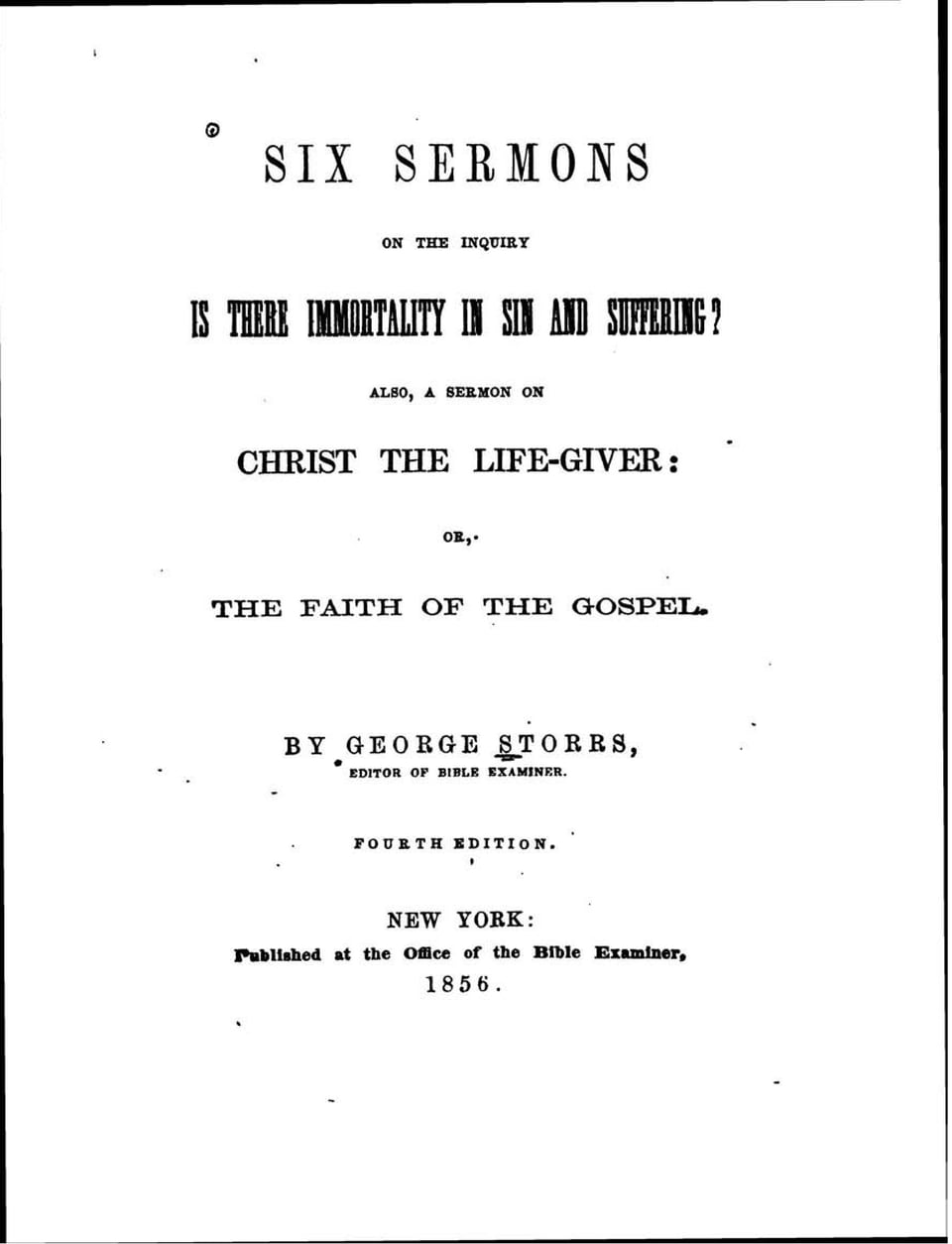
SIX SERMONS
ON THE INQUIRY
IS THERE IMMORTALITY IN SIN AND SUFFERING?
ALSO, A SERMON ON
CHRIST THE LIFE-GIVER:
THE FAITH OF THE GOSPEL.
BY GEORGE STORRS, EDITOR OF BIBLE EXAMINER.
FOURTH EDITION.
NEW YORK:
Published at the Office of the Bible Examiner. 1856.
HARVARD COLLEGE LIBRARY
1857 EcL 2-6
life of descent , F . Bursa
Entered, according to Act of Congress, in the year 1858, by GEORGE STORRS,
In the Clerk's Office of the District Court for the Southern District of New York.
CONTENTS. '
A BIOGRAPHICAL SKETCH; or, Brief Notice of the author of the Six Sermons: his birth—parentage—religious teaching, p. 5; exercises of mind when young—religious experience, 7; first marriage, 8; impression to preach, 8; joined the Methodist Episcopal Church and commenced preaching, 8; withdrew from that church, 9; first awakening of his mind to doubt man's natural immortality, 9; his previous standing, 10; his Three Letters to a Methodist Preacher, 11; origin of the original Six Sermons, 11; unexpectedly led to preach to multitudes which gave a rapid spread to his views, 13; fifteen thousand of the Six Sermons scattered in the winter of 1842-3; more laborers come into the work, 15.
SERMON I.
Introductory Remarks, 19.—The Question at Issue, 21.—Examination of the arguments in proof of man's immortality, 21.—The belief of all nations, 22.—Archbishop Whately's remarks on this point, 23-27. The heathen Philosopher's belief amounts to Annihilation, 26.—The desire all men feel for immortality, 28—The soul immaterial, &c., 29.—What is immateriality? 29—The soul indestructible, 31.—The Philosophy of the question, 33.—Is it the will of God men shall be immortal if wicked? 32.—What man lost by the Fall, 32-35.—The Tree of Life, 35.—Watson's remarks thereon, 36.—Facts from God's word, 38.—Eternal, Eternity, Eternal Life, 38, 39. Principles of interpretation, 40.—Meaning of the term death, 41.—The term immortal occurs but once in the Bible, 41.—Contradiction in poetry, 52.—Immortality, the phrase found but five times in the Bible, 43.—Beauty of Scripture on the theory advocated, 44.
SERMON II.
The old Serpent's discourse, and its destroying nature, 45.—The terms employed to denote the punishment of the wicked, 47.—Objections answered, "Worm dieth not," 51.—"Hell fire" Gehenna, 54.—"These shall go away into everlasting punishment, 56.—Pain and punishment not necessarily identical, 58.—"Kolasin" of this text, 59.—Paul's commentary on the text, 59.—Sodom and Gomorrah, 62.—Concluding remarks, 63.
SERMON III.
Searching the Scriptures, 65.—Examination of Rev. 14:9-11. Is this language spoken of all wicked men? 68.—Does it relate to any beyond this life? 70.—It is fulfilled "on the earth?" 71. Rev. 20:10, considered, 72.—The devil to be destroyed, 73...Summing up of the argument of the advocates of man's immortality, 74.—Watson on immortality, 74. Other objections considered, 74.—The benevolence of God obliges Him to inflict the greatest possible punishment, 75.—Such a punishment uncalled for and useless, 77.—"Sin an infinite evil," 79.—"Destruction no punishment at all," 79.—Folly of such an objection, 79.—Henry's notion of "damnation," 80.—Benson outstrips Henry, and finds it impossible to obtain satisfaction to Divine justice, 80-82.—Concluding remarks, 82.—Faith defined, 83.
SERMON IV.
Prove all things, 85.—Province of reason, 85-87.—Further objections. "The fathers believed in the endless torments of the wicked, 87.—Corruption of Christianity by its defenders, Mosheim, 88.—Attempt to unite heathen philosophy with Christianity, Enfield, 88.—Jews believed in endless torments, 89.—Isa. 33:14, considered, 89.—Jews belief not proof, 90.—Testimony of New Testament, 91.—John the Baptist, 91.—Jesus Christ, 91-94.—Peter's testimony, 94.—James', 95.—John's, 96.—Jude's, 96.—Paul's, 97-104.—Concluding remarks, 105.
SERMON V.
Further objections considered, 108.—Destruction not so terrible as endless misery, 108.—"Puts an end to the sinner's misery,"109. "Spiritual death is the penalty," 110-115. The preposition "in," Gen.2:17, examined, 114.—Destruction of sins or happiness, 115.—Dan.12:2, considered, 116. John 5:28, 29 noticed, 116.—The Doctrine held by the Arians, &c., 117. "Gone half way to Universalism," 118.—"If this doctrine is true why not found out before? 120.—Benson on the misery of the wicked in hell, 123.
SERMON VI.
Isa. 57:16 considered,129.Evil of common theory of immortality,131. Beauty of texts destroyed,132-137.Extravagant notions of Adam's perfection considered,138-150.God's works always progressive,138.The creation of man,140.Adam's intellectual nature,141.Adam's ignorance,141. Adam's holiness,142.His temptation,148.Character cannot be known without trial,147.Adam's failure,with remarks on inherent depravity 149-152.Assembly's Catechism,150.Conclusion,152.
CHRIST THE LIFE-GIVER : OR THE FAITH OF THE GOSPEL.
The Syriac version of the New Testament, 153—Its translation by Prof. Murdock, 154. The true meaning of the terms Saviour, save, and salvation, 154.An examination of various texts where these terms occur, 155-164.
A BIOGRAPHICAL SKETCH;
OE,
BR 2F NOTICE OF THE AUTHOR OF THE SIX SERMONS.
GEORGE STORRS, the subject of the following remarks, was born in Lebanon, N. H., December 13th, 1796. He was the youngest of eight children. His father, Col. Constant Storrs, was originally from Mansfield, Conn.; and was an industrious mechanic, serving, for a time, in the American Revolution as a wheelright. After the war of the Revolution he was married to Lucinda Howe, who was half-sister to the late Richard Salter Storrs, for many years minister of Longmeadow, Mass. After their marriage they removed to New Hampshire—the country being then a wilderness—and located in Lebanon, on Connecticut River; and by industry and economy became, what, in those days, was called a wealthy farmer. To them were born seven sons and one daughter. The mother of these children was ever watchful over their religious instruction, while the father was most studious to promote their temporal welfare. The mother invariably gathered her children around her, particularly on the Sabbath, to give them instruction in things pertaining to God, and our Saviour, Jesus Christ. She was not disposed to leave their religious education to the min1ster, or any other less interested in their welfare than a Mother.
The Congregational and Calvinistic ministry was about the only preaching in Lebanon for many years. Very few of any other denomination ever preached there. The strong tendency to fatalism, in the Calvinistic preaching of that period, was a subject which the mother of these children did not fail to endeavor to counteract in the minds of her offspring, and to impress upon them unceasingly, that if they would seek the Lord he would be found of them. Such pious labor was not lost.
Though this family of children grew up to maturity, four of them died before their father; and six had gone down to the grave before their mother: two only survived her.
GEORGE's mind was often deeply exercised on the things of religion from a child. Many anxious desires filled his heart that he might be a Christian. Early had his mother taught him to acknowledge "Our Father, who art in Heaven," and point him to "Our Saviour, Jesus Christ." Experimental religion, however, was a mystery to his mind, though one that he often anxiously desired to solve. Secret prayer was often resorted to, but he heard sometimes from the pulpit that, the man who cursed and swore was as likely—yea, more likely, to be converted than he who went to his closet to pray for the salvation of God. Such teaching made George feel sadly, as he thought his case was more hopeless than boys who he knew to be very profane, while he feared an oath. This influence, however, was counteracted by the vigilant instruction of his mother. Happy for him that he had such a mother. But for her instruction he has often thought and felt that he would never have been brought to a saving knowledge of God and His Christ. The sweet and heavenly strains of prayer, poured forth by that mother when she took George to her closet, and sought the mercy of God in Christ for him; made him forget or disregard the false teaching of the mere Theologian. Such scenes told on his heart not to be obliterated.
The preaching of the torments of hell never won his heart, though it often filled him with a dread of God, which was calculated more to drive him from God than to draw him to such a being. From fifteen to seventeen years of age was the most thoughtless period of his life. None of the terrors of preaching had any tendency to win him to the service of God; but at the close of the time last mentioned, in meditation, alone, far removed from all excitement, he became so affected with a sense of the goodness of God to him, that he resolved henceforth to seek the Lord till he should find Him. If he could pray for nothing else, he determined to pray daily that God would show him his need of a Saviour, which theoretically he understood, but experimentally he had not realized. His resolution being made, he pursued noiselessly and alone his purpose, light gradually breaking upon his mind till he was led to bow to Jesus, and come to God by him and found mercy. Months had passed away and no mortal but himself knew the exercises of his mind: he did not even communicate to his mother the revolution going on in himself. He took occasion, however, to listen to any persons who seemed disposed to converse on spiritual subjects, and often felt his heart encouraged by such conversation, though he took no part in it, but was an interested listener, unknown to them. This state of things continued for a year or more. During this period his only sister died. After her death his anxiety increased to be in a state of reconciliation with God, yet all his exercises were kept within his own bosom, except on one occasion to ask his mother---who was at the time confined by a fever---some indirect questions relating to God and Christ: after which he retired alone, and was overwhelmed with a sense of the love of God. Still he travelled on alone, sometimes believing and sometimes doubting. After months had passed away in this manner, he expressed to his mother, one day, that he much liked to hear a man talk who always talked sweetly about Jesus. His mother said to him---"George, do you think you are a Christian?"
This was said with an anxious look which made him feel that a mother's heart was deeply interested. It was a question so unexpected that he almost faltered in answering it; but at length said, his mind was much interested on the subject. His mother replied—"I have long thought it was." This was as unexpected as her question, as he had no suspicion that any one thought him specially serious.
From that time himself and mother had frequent conversations, and she often prayed with him and for him, being a mother indeed, in more senses than one. He has never ceased to bless God for that mother.
At the age of nineteen he united with the Congregational Church, and about twenty others near his age united at the same time, who were the fruits of a revival at this period. Three years afterwards he was happily married to one of like faith in Christ. Two years passed and that wife was confined on a bed of sickness and suffering, which can never be known except to those who were witnesses of the scene. Four and a half long years of sickness, suffering and trial were then endured which terminated in her death. She died most triumphantly, though a most painful death. Her husband stood by her bed-side and closed her eyes, when the dying struggle was over.
Prior to her death, Mr. Storrs had had his mind exercised with the conviction that God had called him to preach the gospel of Christ. He had exercised his gifts in the prayer and conference meetings of the church for years; and the thought had often occurred, that possibly he might have to proclaim Christ more publicly, and as a minister.
During the time of his wife's sickness, he was induced to hear a Methodist minister preach for the first time since he was interested in the things of religion. That minister he invited to his house, and also another of the same denomination. Their visits became a source of comfort to himself and wife. Ever after an intimacy existed between him and the Methodists; and about the time of his wife's death he united with that Church, and soon after commenced his labors as a minister of the gospel.
He joined the Methodist Traveling Connection in 1825, being then twenty-nine years old. The same year his second marriage occurred with a daughter of Col. Thomas Waterman, of Lebanon, N. H. His father-in-law was the first child ever born in Lebanon, and to the close of a long life one of the most prominent men in that town, being highly esteemed by all. Mr. Storrs traveled and preached among the Methodists till 1836, when he took the relation of a Local Preacher, but traveled more extensively than ever. For three years he spent most of his time lecturing and preaching on the subject of slavery, in a time which tried men's souls; as nearly the whole Methodist E. Church was hostile to an agitation of that subject. That hostility manifested itself specially through the Bishops, who endeavored by every possible means to suppress the discussion of the subject. That opposition convinced Mr. Storrs that individual responsibility was the true ground to occupy, and he could not submit to leave his responsibility in the hands of Bishops, nor any body of men, however good they might be. Without going into details of matters which led to such a result, he withdrew from said church entirely, in 1840, after a connection with it of sixteen years.
At this point it may be necessary to say, that Mr. Storrs never had a charge preferred against him for immoral or disorderly conduct at any period of his connection with the Congregational or Methodist Churches. And in severing his connection with them he was not actuated by hostility to them but by a deep conviction that his responsibility was to God alone.
In 1837—three years prior to his withdrawal from the M. E. Church—his mind was first called to a consideration of the subject of the final destiny of wicked men as being, possibly, an entire extinction of being and not endless preservation in sin and suffering. This was by a small anonymous pamphlet put forth, as he learned, by Henry Grew, of Philadelphia. He read it to pass away a leisure hour while passing from Boston to New York. It was strange to him that so plausible and scriptural an argument could be made in defence of a doctrine, which he had always regarded as unworthy of a serious consideration; for he had never doubted that man possessed an immortal soul.
A new train of thought had now been waked up in his mind; but he proceeded with great caution in examining the subject, and in conversing with any one upon it. He searched the Scriptures carefully, and sought every opportunity to get information from ministers, in particular. As the inquiry continued, the strongest arguments urged against this, to him, new view, served to carry his mind into the conviction of its truthfulness and scriptural basis. After several years investigation, conversation and correspondence with some of the most eminent ministers, and looking to God for direction he became settled that man has no immortality by his creation, or birth; and that "all the wicked will God destroy"—utterly exterminate.
He had counted the cost before he came to this conclusion. He had stood high in the denomination with which he was connected, and was greatly beloved by the ministers in the Conference, with which he had passed so many years. That Conference had given him, always, the most gratifying evidence of its confidence and esteem. Though he had, previous to the time now spoken of, taken a "local relation" he still enjoyed a high place in the affections of those ministers, and was ever happy to enjoy association with them.
To take a position, then, which should sever himself from them, and separate himself from the relation which had so long existed, with the certainty that he must for ever after be excluded from their pulpits, if not from their Christian regard, was a trial to his mind which could not have been endured except under a deep sense of the truth of that position which he now felt called to advocate and defend. Relying upon God, he chose to follow his convictions of truth to any and all other considerations; and he took his stand in defence of the doctrine, that there is no immortality out of Christ, and therefore wicked men will be consumeddestroyed-or cease from life-be no more "be as though they had not been."
He wrote three letters to a prominent and able minister of the Methodist E. Church, with whom he had been intimate. In reply, he acknowledged that he could not answer Mr. Storrs' arguments; and he never undertook it. On the contrary, after a few months, they had an interview, and examined the subject together, which resulted in his advising Mr. Storrs to publish the letters he had written him, but with a request to withhold his name. Accordingly, in the spring of 1841, four years after his attention was first called to the subject, two thousand copies of the "Three Letters" were issued from the press and sent abroad. This was not done without counting the cost.
At this period he was residing in Montpelier, Vt. ; and expected likely he would never be called to preach anywhere again only as he did so on his own appointments, and near his then residence. Contrary to this expectation, he shortly after had an invitation to visit Albany, N.Y., which he did; and after preaching in that city three Sabbaths concluded to remove his family to that place in August, 1841. There he ministered to a small congregation, who came together on the principle of "Receiving one another as Christ had received them." The Bible was the only creed—Christian character the only test. For eight months he preached there without dwelling distinctly on his new views of Christian doctrine, though he had frankly told them what his views were, and circulated among them the "Three Letters" he had previously published.
He now felt called upon to come out more fully and distinctly on the subject, and he determined to do so. This gave rise to what has ever since been called the "Six Sermons," the special history of which we will here state.
Early in the spring of 1842, he determined to give one sermon that should embody all that might be desirable to present in relation to it. The appointment was made one week before hand, and public notice given in the city papers.
Monday previous to the time appointed he went to his study, and there spent the entire week in investigation, meditation, and prayer. Thus was the "First Discourse" prepared. Never had he a deeper and sweeter sense of the Divine presence and blessing; and of being engaged in a work well pleasing in His sight; and he could as well doubt any other part of his Christian experience as to doubt that.
He found before the first week in his study was ended, that two discourses at least would be necessary to present the subject in a proper light. The time came for the first discourse to be delivered: it was Sabbath evening, and the house, for the first time since his mintry there, was full.
He informed the congregation that as his subject was a peculiar one, and he was liable to be misrepresented in what was said, he had determined to do what he had never done before—i. e.; read nearly all he had to say. At the close he gave out to preach another sermon on the same subject the next Lord's day evening. His second week was spent in his study in the same manner that the first had been; and thus was the "Second Discourse" prepared; but found there must be a third; and so did the matter proceed till he had prepared and preached the "Sixth Discourse;" and the history of the first week in his study is the history of the six weeks, each of which was spent in the same manner as the first. All this was without any reference to ever publishing. After the Discourses were ended, several who had listened to them desired their publication. Accordingly he spent several weeks more in revising, reviewing, and preparing them for the press, and they came forth in May or June.
Such is the origin of his "Six Sermons," as they are now called. And he has never doubted, from that day to this, but what it was of God. His opponents, therefore, may not expect him to be easily shaken, whatever reaction they may suppose will take place; or though they may think the views are "making very little progress." They have made ten thousand times more progress than Mr. Storrs ever expected in his life time.
A brief history of that progress may not be uninteresting.
A few weeks after the "Six Sermons" were first published, at Albany, Mr. Storrs was visited by a man who was preaching the views of Wm. Miller on the second advent. He gave him the use of the "House of Prayer" in which to present those views. As the attention was deep, and the subject one of so much importance, if true, it was consented that he might repeat his course of Lectures in their place of worship, and Mr. Storrs became partially convinced of the correctness of the views advocated; so much so that he solicited the services of the late Charles Fitch, formerly a Congregational minister, who had embraced the views of Mr. Miller, to visit Albany and preach to the people on the subject. Accordingly a Tent meeting was appointed for that place, and thousands came out to hear that holy man of God, Mr. Fitch, who labored unceasingly and with great power in preaching the coming of the Lord. During his ministry there Mr. S. became settled that the doctrine he preached was true. Under this impression, he left his stated ministry in Albany to travel and preach; and for the next three months, in the fall of 1842, preached to thousands on thousands in relation to the coming of the Lord. Thus, without seeking it, the providence of God had given him an influence over a multitude of minds, both ministers and laymen. He did not however introduce his peculiar views directly into his ministrations in public. He had no desire to do so. But as it was known that he held these views he was constantly met with inquirers, both ministers and private Christians, to whom he frankly stated his belief that "all the wicked will God destroy." The Six Sermons were sought for and read, and the truth on that subject spread while he kept silent, publicly.
At length the "organ" of Mr. Miller's views, "The Signs of the Times," Boston, Mass., came out strong against a minister who felt it his duty to preach what the end of the wicked would be as well as to preach the coming of the Lord.
That paper several times published remarks censuring that minister; and Mr. S. felt that as he held the same sentiments he was bound not to keep silence and let him suffer alone. Accordingly, in Dec., 1842, under a deep conviction that God called him thereto, he revised the Six Sermons, and published an edition of five thousand in newspaper form, in the city of New York, where he was then preaching, and scattered them over the United States, at his own expense. A few weeks after that he gave them another revision and published ten thousand more and scattered them in the same manner. Thus was the seed sown, and it sprung up in all directions.
In the spring of 1843, he was invited to Philadelphia to preach on the advent, and thousands came out to hear. It was well known what his sentiments on the end of the wicked were, and there was an evident desire to hear something on that subject. Instead, however, of preaching on the subject, he had the Six Sermons stereotyped in the quarto form, and printed two thousand copies; these were distributed among the congregation to which he was then preaching; and there is little doubt but that most who then read were either convinced of the truth, or had their prejudices so far removed as to feel no opposition.
In the fall of 1843, he went to Cincinnati, Ohio, and spent several months. There also and in Indiana, some five or six thousands of the Sermons were scattered; and we know that the seed took root in that region.
It is proper and right that we should here state that Mr. Miller uniformly opposed Mr. Storrs' views on the immortality question.
The views maintained in the Six Sermons, in the winter of 1843 and 1844 had taken strong hold of many minds; and in Jan., 1844, Charles Fitch, of whom we have previously spoken, wrote Mr. Storrs a letter commencing as follows— "CLEVELAND, Ohio, Jan.
25, 1844.
Dear Br. Storrs :—As you have long been fighting the Lord's battles alone, on the subject of the state of the dead, and of the final doom of the wicked, I write this to say, that I am at last, after much thought and prayer, and a full conviction of duty to God, prepared to take my stand by your side."
He then went on to state his "thorough conversion" to the views in question. This letter was indeed a cordial to Mr. Storrs. Mr. Fitch was a pleasant and powerful preacher, and carried with him a mighty influence. This letter from him was a dreadful blow to the opposers of the doctrine of the Six Sermons among the advent believers.
In May of the same year he wrote Mr. S. again, and commenced by saying—"I have received a long letter from Br. Litch, touching the state of the dead, the end of the wicked, &c. It would be exceeding pleasant to me, to be able to please him, and the dear brethren who agree with him, for I love them all, and could rejoice to concede anything but truth, to be able to harmonise with them in my views. But there is a friend who has bought me with his blood, and I take more pleasure in pleasing Him, than in pleasing all the world besides. I never preached my present views touching the state of the dead, and the destruction of the wicked, until fully convinced that I could no longer withhold them without displeasing my blessed Lord and Master."
He wrote another letter in July, 1844, giving a particular account of his "first impressions"—"the process of conviction," and his "conversion" to these views. In this faith Mr. Fitch lived and labored a few months; but his abundant labors brought on sickness, and in October, 1844, he fell asleep in Jesus, in the glorious hope of soon awaking at the voice of the Son of God.
About the same time as Charles Fitch, many other ministers in various parts of the country came into the same views, and their number has steadily continued to increase to the present time.
In 1843 the Six Sermons were republished in England and circulated in various parts of that country, and must have attracted some attention, as they are referred to by several writers on both sides of the question there. About this time Dr. Lees, of Leeds, broke ground in England against the endless-torture doctrine, and man's natural immortality. Near the same point of time, Mr. Dobney, a Baptist minister, published his excellent work on "Future Punishment," in England, which has been republished here, and has been the means of bringing many to the truth. Mr. White, a Congregationalist minister, also published his "Life in Christ," taking the same side with Mr. Dobney; and several other ministers in England are on the same ground, and among those who favor it is Archbishop Whately; also Wm. Glenn Moncrieff, lately a minister in the Congregational Church in Scotland; and last, not least in labor, J. Panton Ham, Congregational minister, Bristol, England. The work is clearly spreading on the other side of the Atlantic.
But to return to this country. These truths are spreading all through the western States; both ministers and laymen are taking hold of them, and sinners are converted through their influence that could not be reached by the old horrible doctrine—"Ye shall not surely die"—"Ye shall be kept alive eternally, and tormented." In North Carolina Dr. Lee and Eld. Pritchard, both Baptist ministers, are doing battle for the truth on this subject. Dr. Lee has there scattered several hundred copies of the Six Sermons.
Dr. Pope, in the State of Missouri, has not been idle ; but has circulated many of the Six Sermons and other works. More recently a number of ministers in various places, have espoused the cause of Life and Immortality only through Christ; and the conflict is waxing warmer continually.
For the sentiments contained in the Six Sermons, as now revised and much enlarged, Mr. Storrs alone is responsible, as he has steadily refused to let any man, or any body of men, hold any responsibility for him or his views.
It has not been, nor is it now, his object to establish a sect; as he has steadily refused to be recognized as in, what is called, a church relation with any body of men. He does, not, however, make his views of his independent responsibility a standard for the action of others; he desires all to act in harmony with their convictions of what truth and duty requires of them, as responsible to God.
It may be proper in this place to say, that he labored statedly in the city of Philadelphia from Nov. 1844, to April, 1852, employing nearly all his time among that people, but never seeking for, or consenting to, an organization such as all sects labor to establish. He believed that love was the bond of union, and that when that would not bind a people together they had better separate. For the last two or three years of his residence in Philadelphia he was called more to visit different parts of the country, and finally concluded to remove to New York, as a more central position for visiting abroad.
The "BIBLE EXAMINER" was started by him in 1843, as an occasional issue, at his own expense. It was continued in that way till 1847, when it was issued regularly each month, then in quarto form. With 1848 it was changed to a super-royal sheet of sixteen pages, and continued monthly till 1854, when it was issued semi-monthly. Its object is expressed by its motto---"No Immortality, or Endless Life except through Jesus Christ alone." In 1852 and 1853, in addition to issuing the Examiner, Mr. Storrs traveled thousands of miles, east and west, preaching to many people on the Life Theme. Since the Examiner has been issued twice each month, his labors have been nearly confined to it, and preaching in New York and vicinity. Thus situated, he resolved on a revision and enlargement of the "Six Sermons." While uncertain whether to attempt to publish them in this revised form, his plates for the quarto Six Sermons were destroyed by fire. He then resolved to go forward with the work he had been contemplating, which resulted in the issue of the volume here presented to the reader.
A Phrenological description of Mr. Storrs, given in 1849, may conclude this account of the author of the Six Sermons. It is as follows :—
Mr. Storrs' physical and mental constitution is durable; he has considerable force and energy of character, with fortitude, firmness and perseverance. He thinks for himself, but is open to conviction; will not be forced, but may be persuaded. He is naturally confiding, but experience may have, to a considerable extent, corrected this predisposition to believe, confide in, or give credence to. He is a man of enlarged views, liberal sentiment, and a benevolent disposition. His object is truth, and this he strives to obtain, no matter at what sacrifice. He consults duty before expediency; and would sooner stand alone with truth, than go with the multitude and be in error; yet, he is not dogmatical in the advocacy of what he conceives to be the truth, but is rather persuasive, conciliatory and argumentative. He is a warm friend, a good companion, and an excellent counsellor.
He takes comprehensive views of things, examines both sides of all questions of a scriptural character, and decides according to the weight of evidence. While he uncompromisingly advocates what he believes to be truth, in opposition to this and past ages, he does not sit in judgment on his opponents, but leaves them in the hands of God, to whom they must give account, and unto whom they stand or fall.
SIX SERMONS.
IS THERE IMMORTALITY IN SIN AND SUFFERING?
BY GEORGE STORRS.
SERMON I.
"May we know what this new doctrine whereof thou speakest is? For thou bringest certain strange things to our ears : we would know, therefore, what these things mean."—Acts xvii. 19, 20.
PAUL, the apostle, in preaching the gospel, came to Athens; he there beheld an altar incribed "TO THE UNKNOWN GOD." At the idolatry he saw, his spirit was stirred within him; hence he disputed daily with them that met him. He encountered certain philosophers—wise men, no doubt,—at least in their own estimation—and some of them said: What will this babbler say? Others said, he seemeth to be a setter forth of strange Gods. Doubtless they thought he was a heretic of the blackest stamp; yet they seemed disposed to hear him, before they passed final sentence upon him. In this respect they manifested a better disposition than many of the present day, who are so wise in their own estimation, that no one can advance a thought to which they will listen, unless it has first received the approbation of some doctor of divinity.
Not so with the men of Athens; strange as the things were that the Apostle taught, they were desirous to know what the new doctrine was. Not that it was new in itself, but only new to them.
Various errors exist among men in regard to revealed truth. These errors go to show how imperfect we are in knowledge—the mistakes committed in our education—the reluctance of the mind to investigate—and a want of moral courage to step aside from the track marked out by learned men, as they are thought to be, but who, most likely, have conducted their own investigations under the influence of the fear of being denounced as heretics, if they should be led to results unlike to those who are reputed for wisdom. But "if any man will be wise, let him become a fool that he may be wise," is the language of the apostle.
We honor God only so far as we have right conceptions of His character, government and purposes, and act in accordance with them. If we believe God will reward, or punish men contrary to His own word, we dishonor Him, however much sincerity we may possess. Truth and the honor of God are inseparable: and we cannot glorify our Heavenly Father by erroneous opinions. Yet, most professed Christians, if pressed on the subject, can give little better reason for what they believe, on many points, than that such has been the instruction they have received from men.
It is a solemn duty to study our Bibles, and form our opinions of what they teach for ourselves, as we must answer for ourselves. But in this study the adoption of correct principles of interpretation is of the first importance. Without this, our appeal to the word of God may only serve to confirm us in error.
The plainest truths of the Bible have been wrapped in darkness by pretending that the language of the Scriptures has a mystical or secret meaning.
that does not appear in the words employed. Such a principle of interptetation is a libel on the Bible. That Book professes to be a revelation; and the Saviour says, "If any man will do his will, he shall know of the doctrine." The language of the Bible, then, should be explained as the language of any other book, i.e., according to its plain and obvious meaning: unless there is a clear necessity for departing from it. A strict adherence to this principle is necessary, if we would be saved from the wildest errors, and see the children of God united in one. With these remarks I proceed to
THE QUESTION AT ISSUE, OR POINT IN DEBATE.
The question is not, whether man can be immortal, nor whether the righteous will be immortal. These points are admitted and abundantly proved by the Bible; but the question is—Will the wicked who live and die in their sins, continue eternally, or without end, in a state of conscious existence? Or, once more—Is the punishment God has threatened to sinners an eternal state of suffering and sin? This involves the question of immortality. For if all men can be proved to be immortal, it seems to follow from the Bible, that the finally impenitent will be left in a state of endless suffering and sin.
THE ARGUMENTS IN PROOF OF MAN'S IMMORTALITY.
These are mainly three, viz : First—The desire all men feel for it. Second—That the soul is immaterial, uncompounded, indivisible, hence indestructible, and therefore immortal.
Third-That God wills the immortality of all men.
To these, perhaps, another should be added, viz :—"All nations and people have believed the soul immortal." To this last argument, I answer—There is no evidence that all nations and people have believed it. There is evidence to the contrary. In the "Dialogue on the Immortality of the Soul"—found in "Plato's Dialogues"—Socrates, having spoken of the nature of the soul, says—"Shall a soul of this nature, and created with all these advantages, be dissipated and annihilated as soon as it parts from the body, as most men believe?" Here the fact is brought out, that so far from its being a general belief that the soul is immortal, the exact reverse was true in Socrates' day. Socrates is supposed to have believed the souls of the good were immortal, and would ascend to the Gods at death. With respect to bad men, it is not so clear what his opinion was in regard to the final result with them. It seems, however, that he thought after they left the body, they wandered awhile in impure places, in suffering, "till they again enter a new body, and in all probability plunge themselves into the same manners and passions, as were the occupation of their first life. "For instance," continues Socrates, "those who made their belly their God, and loved nothing but indolence and impurity without any shame, and without any reserve, these enter into the bodies of asses, or such like creatures. And those who loved only injustice, tyranny and rapine, are employed to animate the bodies of wolves, hawks and falcons. Where else should souls of that sort go? The case of the rest is much the same. They go to animate the bodies of beasts of different species, according as they resemble their former dispositions.
The happiest of all these men are those who have made a profession of popular and civil virtues, such as temperance and justice; to which they have brought themselves only by habit and exercise, without any assistance from philosophy and the mind. It is probable, that after their death, their souls are joined to the bodies of politic and meek animals, such as bees, wasps and ants."
Surely, one would think that this is little short of annihilation itself. Socrates, after speaking of those who lived, "following reason for their guide," &c., says—"After such a life, and upon such principles, what should the soul be afraid of? Shall it fear, that upon its departure from the body, the winds will dissipate it, and run away with it, and that annihilation will be its fate?"
On this subject, Archbishop Whately, in his Lectures on "Scripture Revelations Concerning a Future State," speaks thus:—
"Among the heathen philosophers, Plato has been appealed to, as having believed in a future state of reward and punishment, on the ground that the passages in his works in which he inculcates the doctrine, are much more numerous than those in which he expresses his doubt of it. I cannot undertake to say that such is not the case; for this arithmetical mode (as it may be called) of ascertaining a writer's sentiments, by counting the passages on opposite sides, is one which had never occurred to me; nor do I think it is likely to be generally adopted. If, for instance, an author were to write ten volumes in defence of Christianity, and two or three times to express his suspicion that the whole is a tissue of fables, I believe few of his readers would feel any doubt as to his real sentiments. When a writer is at variance with himself, it is usual to judge from the nature of the subject, and the circumstances of the case, which is likely to be his real persuasion, and which, the one, he may think it decorous, or politically expedient, to profess.
"Now in the present case, if the ancient writers disbelieved a future state of reward and punishment, one can easily understand why they should nevertheless occasionally speak as if they did believe it; since the doctrine, they all agreed, was useful in keeping the multitude in awe. On the other hand, would they, if they did believe in it, ever deny its truth? or rather (which is more commonly the case in their works) would they allude to it as a fable so notoriously and completely disbelieved by all enlightened people as not to be worth denying, much less refuting, any more than tales of fairies are by modern writers?
"Even Aristotle has been appaled to as teaching (in the first book of the Nicomachean Ethics) the doctrine of a future state of enjoyment or suffering; though it is admitted by all, that, within a few pages, he speaks of death as the complete and final extinction of existence, "beyond which there is neither good nor evil to be expected." He does not even assert this as a thing to be proved, or which might be doubted; but alludes to it merely, as unquestioned and unquestionable. The other passage (in which he is supposed to speak of a state of consciousness after death) has been entirely mistaken by those who have so understood it. He expressly speaks of the dead, in that very passage, as "having no perception;" and all along proceeds on that supposition.
But many things appear good or evil to a person who has no perception of them at the time they exist. For example, many have undergone great toils for the sake of leaving behind them an illustrious name, or of bequeathing a large fortune to their children: almost every one dislikes the idea of having his character branded with infamy after his death; or of his children coming to poverty or disgrace: many are pleased with the thought of a splendid funeral and stately monuments; or their bones reposing beside those of their forefathers, or of their beloved friends; and manv dread the idea of their bodies being disinterred and dissected, or torn by dogs.
Now no one, I suppose, would maintain that all who partake of such feelings, expect that they shall be conscious, at the time, of what is befalling their bodies, their reputation, or their families after death; much less, that they expect that their happiness will, at that time, be effected by it. In fact, such feelings as I have been speaking of, seem to have always prevailed, even the more strongly, in those who expected no future state.
"It is of these posthumous occurrences that Aristotle is speaking, in the passage in question. But he expressly says, in that very passage, that "it would be absurd to speak of a man's actually enjoying happiness after he is dead;" evidently proceeding (as he always does) on the supposition that the dead have ceased to exist.
"The ancient heathens did but conjecture, without proof, respecting a future state. And there is this remarkable circumstance to be noticed in addition; that those who taught the doctrine (as the ancient heathen lawgivers themselves did, from a persuasion of its importance for men's conduct,) do not seem themselves to have believed what they taught, but to have thought merely of the expediency of inculcating this belief on the vulgar.
"It does not appear, however, that they had much success in impressing their doctrine on the mass of the people : for though a state of future rewards and punishments was commonly talked of among them, it seems to have been regarded as little more than an amusing fable. It does not appear, from the account of their own writers, that men's lives were ever influenced by any such belief. On the contrary, we find them, in speeches publicly delivered and now extant, ridiculing the very notion of any one's seriously believing the doctrine. And when they found death seemingly unavoidable and near at hand, as in the case of a very destructive pestilence, we are told, that those of them who had been the most devout worshippers of their gods, and had applied to them with various superstitious ceremonies for deliverance from the plague, finding that the disease still raged, and that they had little chance of escaping it, at once cast off all thoughts of religion; and, resolving to enjoy life while it lasted, gave a loose to all their vicious inclinations.
This shows, that even those who had the firmest faith in the power of their gods, looked to them for temporal deliverance only, and for their preservation in this life, and had not only no belief, but no suspicion even, that these Beings had any power to reward and punish beyond the grave ;—that there was any truth in the popular tales respecting a future state.
"It may be thought, however, by some, that the wisest of the heathen philosophers, though they did not hold the notions of the vulgar as to the particulars of a future state of rewards and punishments, yet had convinced themselves (as in their writings they profess) of the immortality of the soul. And it is true that they had, in a certain sense; but in such a sense as in fact makes the doctrine amount to nothing at all. They imagined that the souls of men, and of all other animals, were not created by God, but were themselves parts of the divine mind, from which they were separated, when united with bodies; and to which they would return and be reunited, on quitting those bodies; so that the soul, according to this notion, was immortal both ways; that is, not only was to have no end, but had no beginning; and was to return after death into the same condition in which it was before our birth; a state without any distinct personal existence, or consciousness. It was the substance of which the soul is composed, that (according to this doctrine) was eternal, rather than the soul itself; which, as a distinct Being, was swallowed up and put an end to. Now it would be ridiculous to speak of any consolation, or any moral restraint, or any other effect whatever, springing from the belief of such a future state as this, which consists in becoming, after death, the same as we were before birth. To all practical purposes, it is the same thing as annihilation.
"Accordingly the Apostle Paul, when speaking to the Corinthians (1 Cor. xv.) of some persons who denied the "Resurrection of the dead," (teaching, perhaps, some such doctrine as that I have just been speaking of,) declares, that in that case his "preaching would have been vain."
To deny the "resurrection" is, according to him, to represent Christians as "having hope in this life only," and those "who have fallen asleep in Christ, as having perished." (v. 18, 19.) As for any such future existence as the ancient philosophers described, he does not consider it worth a thought.
"Such was the boasted discovery of the heathen sages! which has misled many inattentive readers of their works; who, finding them often profess the doctrine of the immortality of the soul, and not being aware what sort of immortality it was that they meant, have hastily concluded that they had discovered something approaching to the truth; or, at least, that their doctrine was one which might have some practical effect on the feelings and conduct, which it is plain it never could. And such, very nearly, is said to be the belief entertained now by the learned among the East Indian Bramins, though they teach a different doctrine to the vulgar."
Thus, then, it appears there is no truth in the oft repeated assertion that all nations and people have believed in man's immortality, or an endless conscious survivance of a fancied entity called the soul. It was not true of the ancient heathen philosophers themselves, much less of the mass of the people.
So far from all nations and people believing the soul immortal, there were a large class among the Jews who did not believe it, viz. : the Sadducees, who said, "There is no resurrection, neither angel nor spirit."
It may be replied—"The Sadducees were infidels, but the nation at large believed in the immortality of man; for the Pharisees taught it." I reply-These two sects were both extremes: the first denying any future life, and the other making a future life dependent on what we now call transmigration of souls, rather than a real resurrection: and that idea probably arose from their notion of the soul's immortality.
These two sects are alike condemned by our Lord; and his followers are warned to beware of their doctrine: see Math. 16: 6-12. Both sects were corrupt in doctrine and in practice. Enough has now been said to show that all nations and people did not believe in the immortality of man.
I proceed to take up the three main arguments in support of man's immortality.
The desire all men feel for it. This argument can avail nothing, unless it can be proved, that what men desire they will possess. But men desire many things they never obtain. All men desire happiness; but does it, therefore, follow that all men will be happy? Certainly not. So, neither does it follow, because all men desire immortality, that therefore, they are immortal, or will all attain it. We might as well argue that because all men desire to be rich, therefore they are rich, or will certainly be so. The desire for immortality is, without doubt, a strong principle implanted in us by the author of our being, to excite us to a course of living that shall secure that invaluable blessing, which He designed to bestow upon man, if he would walk in obedience to to the law of his God.—Hence, the dread of the loss of it was to influence men in enduring whatever of trial might be their lot, during their sojourn in this state of probation; and, properly considered, will be a mighty stimulous to enable us to suffer even unto death, if need be, that we may gain ETERNAL LIFE.
It is said—" The soul is a simple essence, immaterial, uncompounded, indivisible, indestructible, and hence immortal."
Here is surely an array of words that might deter a timid man from investigation; but, following the apostolical injunction, I proceed to prove, or examine, these assumptions.
) How do those who take this position know the soul is a simple essence? Again, What is a simple essence? can they tell us? Or, is it merely a phrase to blind the mind and hinder investigation? Surely the phrase communicates no idea to the mind of man—it is too vague to give any instruction—it is too subtile to admit of being the subject of thought, and therefore it must pass for an unfounded assumption.
) What is immateriality? Strictly speaking it is, not material—not matter. In other words—it is not substance. What is that which has no substance?—What kind of creation is it? If the Creator formed "all things out of nothing," it would seem that man's soul has taken the form of its original, and is nothing still; for it is not matter, we are told. If it is said—"It is a spiritual substance"—I ask, What kind of substance is that, if it is not matter? I cannot conceive, and I do not see how it is possible to conceive, of substance without matter, in some form: it may be exceedingly refined. I regard the phrase, immaterial, as one which properly belongs to the things which are not: a sound without sense or meaning: a mere cloak to hide the nakedness of the theory of an immortal soul in man; a phrase of which its authors are as profoundly ignorant as the most unlearned of their pupils.
) It is said—"The soul is uncompounded." If that is true, then it follows that it is uncreated. I can form no idea of a creation without compounding.
If not compounded it is only what it was: no new idea is produced. Then, if the soul exists at all, as an entity, it must be a part of the uncreated: that is, it must be a part of God. If a part of God, how can it sin? Can God be divided against himself? But how is that God who is "without body or parts" to be separated into the millions of souls that have inhabited, and do inhabit this earth? And then these parts of God often meet in the battle field, slaying each other! Horrid work, truly, for parts of God to be engaged in! But we cannot stop here. Millions of these parts of God sin against other parts of God, and are sent to hell to be tormented eternally, and eternally to curse and blaspheme the other parts of God! Such is the inevitable result of the theory I oppose, disguise it as its advocates may.
) "The soul is indivisible," it is affirmed. Then, if a part of God, it is an undivided part of God; and there is not, and cannot be, in the nature of the case, but one soul to the whole human family. If the soul is indivisible, how could Abraham give or communicate a soul to Isaac? It could not be an offshoot from his own, for that would make his soul divisible, and our opposers say it is "indivisible." I cannot see, if Abraham communicated Isaac's soul to him, but what it must still have been Abraham's soul in Isaac, if the soul is not divisible; and then I do not see how there can be more than one soul for the whole human family; and as that is "indivisible," it is a family soul; hence it follows that the action of any one man must be the action of the family soul; so if one man sins, it is a family sin, or if one man acts virtuously it is a family virtue. Again, as the soul is "indivisible," all men must have the same common destiny: say, for example, if Abraham should be lost, Isaac must be lost, for the soul can't be divided!
and so whatever is the fate of the first man, Adam, must be the fate of all his race, or else the soul must be divisible; and then, what would become of the theory of its indivisibility?—Happy for man, however, we have the assurance that Abraham, Isaac and Jacob are saved, and that proves Adam and Eve were, and that all their posterity must inevitably be so too—for "the soul is indivisible!" Thus our opposers take a short and certain rout to universal salvation. Can they get out of that dilemma without abandoning their theory?
There is no avoiding these conclusions only by affirming that a soul is created for each new-born child. But if created, is it holy or unholy? If holy, does God place holy souls in unholy bodies to pollute and defile them? If souls are a new creation at birth, how is Adam's moral depravity transmitted to his posterity? as theologians affirm it is. But if they are created unholy, is any soul of man blameworthy for his moral depravity? These are questions for the theologians to solve who maintain the indivisibility of the soul: questions which are no longer to pass by any man's mere affirmation. Give us proof—"thus saith the Lord," for these assumptions about the soul.
) Shall it be affirmed the soul is "indestructible?" If so, it it because God has determined it shall not be destroyed, or because he lacks power to destroy it. If it is the first, give us Scripture testimony of such determination. I hesitate not to say, there is no "thus saith the Lord" for any such assumption. If it is said, God cannot destroy it—I ask, did he create it? If so, does it take a greater exertion of power to destroy than to create?
or, did God so exhaust his omnipotence in the act of creation that it is not now equal to the work of reducing back to its original state that which he has made? If I were to affirm God's inability to destroy anything he has created I might justly be charged with being "infidel." As it is, my opposers might more justly be charged with atheism; for they, in fact, deny Jehovah's omnipotence, which is equivalent to a denial of his being.
If to make their assumptions stronger they use the term annihilate, and say, "nothing can be annihilated therefore man cannot be;" I answer, this position is wholly untenable, and is a deceptive play upon words. If a man dash in pieces a bottle, or burn a house to ashes, or consume a lamb in the fire, are not the bottle, the house, the lamb, annihilated? Say not, the elements of which they consisted still exist: they—the bottle, the house, the lamb—do not exist, as such: that form is annihilated. So when man ceases to exist, as man, he is annihilated. Not the elements of which he was formed: but as man he is no more. On the subject of annihilation, however, I may speak more at large in another place: I will only add now—If "God created all things out of nothing," as the theology of the age affirms, then he can, if he will, reduce all things back to nothing, or omnipotence has ceased to be omnipotent.
The attempt to prove the immortality of the soul, from its supposed indestructibility, is without force or truth; and with it falls the whole catalogue of assumptions, with which it is connected. He who created can destroy—"Fear him who is able to destroy both soul and body in hell"—in gehenna.
The Philosophical argument for the immortality of man's soul, when stript of all its useless attire, stands thus :—
There are only two primary substances, viz : matter and spirit.
Matter has no power of self-motion, or self-determination, however it may be organized.
Therefore, wherever we see matter endowed with this power, there must have been added to it an immortal spirit or soul, that is immaterial, &c.
This is the soul of all the philosophical arguments that have ever been put forth to prove man has an immortal soul. If the position is true it endows every animal, insect, or crawling worm upon earth with an immortal and immaterial soul just as really as man; and strips Jesus Christ of all the glory of bestowing immortality upon man by his work and meditation.
Having examined the first two arguments in favor of the natural immortality of men, and shown, as I think, that they have no foundation in truth, the ground of argument is narrowed to the one point, viz :
Is it the will of God that wicked men, who die in their sins, shall be immortal?
In determining this question, no man will be called master or father that now lives or ever did live. It will weigh nothing in my mind, what any of the (so-called) "fathers," have said or written; but what saith the testimony of God? "To the law and to the testimony; if they speak not according to this word, it is because there is no light in them."
First, I call attention to what man lost by the fall. In order to understand this, let us look at man prior to the fall. He was a probationer. For what? Not for life merely, as he was in the enjoyment of that. I conclude it was for eternal life, or, life uninterrupted by death—figured and set forth before his eyes by the "tree of life"—as death, the opposite, was set forth by the "tree of knowledge of good and evil."
Each of those trees, I conclude, were signs; the one of Life, the other of Death—not of man's body merely, but of the whole man; or, in other words, "Life and Death" were "set before" him. Eternal life must depend upon the development of a moral character in harmony with his Maker. If a development is made hostile and unharmonious, he is assured he shall not live, but shall "surely dte." Thus permanent disorder is guarded against in God's universe, and man had before him a standing call and warning—a call to obedience and Life; a warning against disobedience, or sin and Death. He disregarded the warning, and slighted the call—he sinned. Now, "The Lord said, lest he (man) put forth his hand, and take of the tree of life, and eat, and LIVE FOR EVER, he (God) drove out the man, and placed a flaming sword which turned every way, to keep the way of the tree of life." That is as clear as language can express it, the Lord God determined, or willed, that man should not be immortal in his sin; or, in other words, by sin man failed to secure a title to immortality, and was cut off from the "tree of life;" or, the sign God had given him of eternal life, was "hid from" his "eyes."
That this loss relates to the whole man, and not to the body merely, as some suppose, I prove from the fact, that if it related to the body only, then there is not a particle of evidence in the transaction, of pronouncing sentence upon man, by his Maker, that any penalty was threatened to the soul—supposing man to possess such an entity—or inflicted upon it. There is surely none in the context; and it appears to me, that if the exclusion from the tree of life, lest man should eat and live for ever, does not relate to the entire man, there is no evidence there that the denunciation of God against him affected any thing but his body.
…