Man's Nature and Destiny (1855)
Download: PDF — Man's Nature and Destiny (1855)
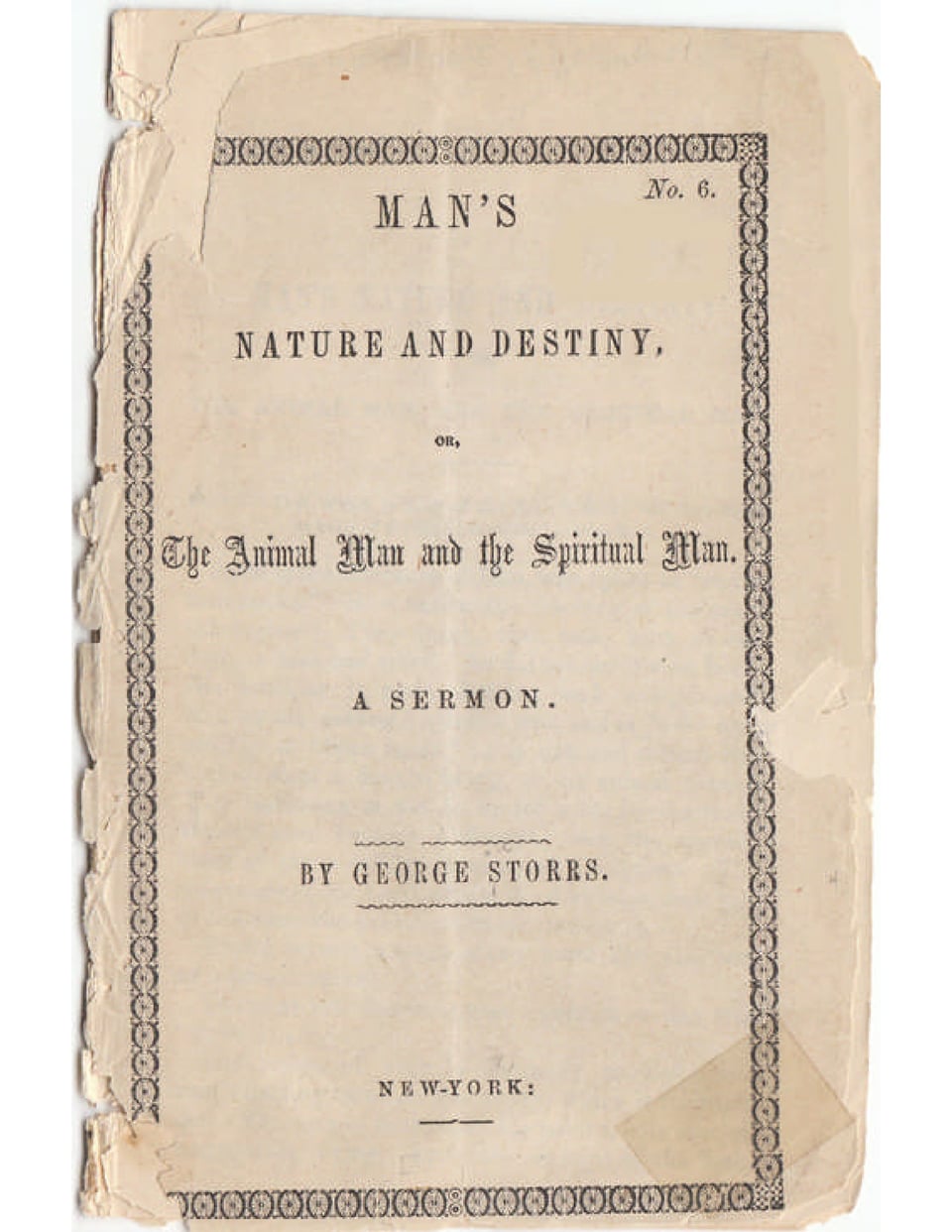
MAN'S
NATURE AND DESTINY.
The Animal Man and the Spiritual Man.
A SERMON.
BY GEORGE STORRS.
NEW-YORK: MAN'S NATURE AND DESTINY;
OH
THE ANIMAL MAN AND THE SPIRITUAL MAN.
TEXT. That which is born of the flesh is flesh; and that which is born of the Spirit is spirit."—John, 3: 6.
Such is the utterance of Him, who spake as "never man spake." How unlike the teaching of the mere theologians! They teach, that man, born of the flesh, is flesh and spirit. So did not our divine Lord. His teaching is plain, distinct, and unequivocal. Man by his natural birth is a unit, and is flesh: and, until he is "born again," he is not, and cannot rise higher than a fleshly being, or an animal nature. This testimony is not to be set aside by the traditions of men, heathen philosophy, nor the specula tions of those calling themselves Christians. The utterance of our Lord admits of no evasion, and woe to the man who presumes to contravene it.
THERE IS THE ANIMAL MAN: SUCH ARE ALL MEN BY NATURAL BIRTH.
THERE IS THE SPIRITUAL MAN: SUCH IS NO MAN TILL " BORN AGAIN. "
The origin of each is distinctly marked; and man's destiny turns on the nature which is triumphant. The man of flesh, is, in his nature, only mortal, corruptible, dying. Such are all born of the flesh.
Hence the necessity that a man "must be born again," before he can be spiritual, or possess a nature that is undying; without which spiritual nature, "he cannot see the kingdom of God;" for that "kingdom is an everlasting kingdom," "which shall never be destroyed." See Dan. 2:44, and 7:27. To inherit such a kingdom, a spiritual, or undying nature, is essential, and can only be the result of a new birth, of, or by the Spirit of God. Without such birth, no intellectual development, no rites, forms, ceremonies, or ordinances will be of any avail; as none of them can stand in place of the new birth; for, the Spirit of God, alone, can produce a spiritual nature. "That which is born of the flesh is flesh:" nothing more, nothing higher.
That man has spirit, is true; and so have the lower order of animals. We read in the Scriptures of "the spirit of the beasts," as well as "the spirit of man." Both have spirits: both have "the spirit of life:" but to have spirit and to be spiritual is not identical: or, the possession of spirit is no evidence of an entity surviving in death, or that either man or beast is dual.
That by the phrase, "the flesh," is often meant man, in his entire natural being, we shall show from the Scriptures.
In Gen. 6:3, the following language occurs : "The Lord said, my Spirit shall not always strive with man, for that he also is FLESH." Again, verses 12 and 13, "And God looked upon the earth, and behold, it was corrupt, for all FLESH had corrupted his way upon the earth: and God said unto Noah, The end of ALL FLESH is come before me; for the earth is filled with violence through THEM; and I will destroy them with the earth."
Also, verse 17, "Behold I, even I, do bring a flood of waters upon the earth, to destroy all flesh, wherein is the breath of life, from under heaven; and everything that is in the earth shall die." In the account of the flood, chap. 7 : 21-23, the following expressive language is employed—"And all FLESH died, that moved upon the earth, both of fowl and of cattle, and of beast, and of every creeping thing that creepeth upon the earth, and every man; all in whose nostrils was the breath [of the spirit] of life, of all that was in the dry land, died: and every living substance was distroyed, which was upon the face of the ground, both of MAN, and cattle;" **** and Noah only remained alive, and they that were with him in the ark."
Here, we see that man is distinctly called flesh; and, so far as his nature is concerned, he is placed on a level with the animals around, and is subjected to the same destiny. Nothing is said of his possessing a nature differing from theirs, or of an end, or doom, that is different: both live by the breath in their "nostrils;" and both men and beasts are subjected to the same death, and by the same means: all are FLESH; all have "the breath of the spirit of life" [margin]; all are destroyed, or died. Such is inspired testimony; and no word is uttered indicating a spiritual nature in men, that would survive in death, any more than in beasts.
This Scripture is in harmony with the Mosaic account of man's origin Gen. 2:7, compared with verse 19, of the same chapter. "The Lord God formed man of the dust of the ground:"**** and out of the ground the Lord God formed every beast of the field, and every fowl of the air."
Nor is the term "living soul," verse 7, peculiar to man. Precisely the same phraseology is five times employed in Gen. 1 and 2, in speaking of the fowls, of the beasts, and of the creatures that live in the waters. The Hebrew nephesh hayah, translated "living soul," chap, 2: 7, is the same expression employed at the 19th verse, and in chap. 1, at verses 20, 21, 24, and 30, translated "living creature," and "life," where it is spoken of beasts, fowls, creeping things, and the various inhabitants of the waters: so that there is the clearest evidence, from the inspired account of creation, that man, in his natural constitution, is an animal being: or, an organized, fleshly being, made alive by breath in his "nostrils," like every other "living creature," which the "Lord God made out of the dust of the ground." His pre-eminence over inferior animals, was in his capacity for an intellectual development, of which the others were incapable. This higher capacity formed a basis for a moral development, by the appliance of law to his understanding, requiring a conformity to his MAKER's will, which was to decide whether man should rise into the spiritual, and live forever; or, if manifesting his preference for the animal, should sink under its control and die. The test, or trial of man, related to him as an intellectual animal: it was to eat or not to eat; a purely animal action; the consequence of which, his intellect was perfectly capable of comprehending. If he partakes of the forbidden fruit, he thereby manifests a preference to his own will, and disregards that of his MAKER: hence falls under the control of his animal appetites, and thenceforth follows the animal, or fleshly desires, and becomes subject to the law of animal nature, which is to decay, corruption and death: ultimately, returning to the dust from which he was taken, and to the condition in which the elements of his being were, before he was organized and vitalized.
From such a total dissolution there was no element in his nature to preserve him: for he "is flesh," and not spirit.
That by "flesh," man, as man, is intended in our text, is further evident from New Testament authority. Thus, John 1:13, speaking of those who become "sons of God," it is said, "Which were born not of blood, nor of the will of the flesh, nor of the will of man, but of God." Again, 1 Peter 1:23, he saith, "Being born again, not of corruptible seed, but of incorruptible, by the word of God, which liveth and abideth forever. For all flesh is as grass, and all the glory of man as the flower of grass." Thus man is distinctly marked, as "corruptible" in his origin and natural tendency: and nothing but a new birth, by an agency out of himself, can save him from a total dissolution and decay, like the "flower of grass:" and all this, because he is "flesh," or an animal being by natural generation. "That which is born of the flesh is flesh."
The apostle Paul is as distinct in his utterance, on this subject, as Peter; and more so, if possible. Speaking of the two Adams, 1 Corin. 15, he says, "There is a natural"—psuchikon, animal—"body, and there is a spiritual body: and so it is written, The first man Adam was made a living soul" [a "living creature," as we have before noted] ; "the last Adam was made a quickening spirit. Howbeit that was not first which is spiritual," [surely this is affirming the first Adam was not spiritual], "but that which is natural"—psuchikon, animal; "and afterwards that which is spiritual.
The first man in of the earth, earthy; the second man is the Lord from heaven. As is the earthy, such are they also that are earthy," ["that which is born of the flesh is flesh"] ; "and as is the heavenly, such are they also that are heavenly;" ["That which is born of the Spirit is spirit."]
Can language more clearly affirm the animal, and corruptible nature of the first Adam and his offspring; clearly defining them as animal and earthy; and excluding all idea that they possess a spiritual nature? while it is shown, that the second Adam is the spiritual; and that He alone, can be the medium of a spiritual nature to any man born into this world: hence, "ye must be born again." This necessity, Paul clearly states 1 Corin. 2: 14—"but the natural"—psuchikos, the animal "man receiveth not the things of the Spirit of God: for they are foolishness unto him: neither can he know them, because they are spiritually discerned." The animal man, or he who is only born of the flesh, is as incapable of comprehending and beholding the beauty and excellence of spiritual things, as a blind man is to understand and comprehend the beauty and glory of the firmament of heaven, or of the landscape that lies before him. He has no spiritual development—no spiritual element in his nature; and all his boasts of such a nature, are as absurd and baseless as the boasts of a blind man, who should talk of his clear sightedness, while his empty gaze is towards the fields, or upward toward the vault of heaven. "Ye must be born again," or you have no spiritual nature, and are b't animal, corruptible, dying beings. Intellectual we may be—toweringly so; but this alters not our animal nature.
Moral we may be, as men count morality; but yet, of ourselves, we can no more rise out of our animal nature than the ox can fly. Still, it remains the truth of God, "that which is born of the flesh is flesh;" and unless we are "born again"—"born of the Spirit"—we will die as animals, and perish with them.
But some will say—"That is degrading man, and taking away his nobleness—his God-likeness." We are heartily glad the truth has reached the intellect, which is the only inlet of hope for man's rescue from his animal condition. Man is proud: lifted up with the conceit that he is a very noble and God-like being "I will be as God," his proud and sensual heart cries out—"I shall live as long as God lives," he affirms. Confident of his unending nature, he scorns to take his place at his Maker's feet, with penitence for his sins, and humiliation at his utter helplessness and worthlessness. He will have help, if help he needs, in a lordly way. This being abased, placed among animals, as an animal, mortal, dying being, to him is insufferable! and whoever assigns him to such a position he deems beneath his notice, and counts him fit only for a mad house, or to be crucified! "What I place me among brutes!" he cries. That is a hopeless case, truly: and if man was left to his own resources to mend, patch, and renew his being, his case would be utterly without hope. Much has been done in that direction, and many schemes have been set on foot, by which the world was to be converted into a "band of brothers;" but all such schemes have been abortive; for in every case, sooner or later, the ani mal has shown its propensity, and that man is but flesh after all his culture and improvement.
Train man as you will—educate him as you will,—improve him as you may, he can rise no higher than a respectable animal among his fellow animals. After all his cultivation—and we highly approve of such cultiva tion—he is still but an animal being, mortal. and dying.
Is not man's case then hopeless? Is there any way by which he can be raised out of, or above this mere animal and perishing condition? We answer with joy, he may be delivered: but his deliverance is not of himself, nor by any, or all, his natural powers. These, if made his reliance, will utterly fail him. Hope there is, through the mercy of God; but it is in and by the second ADAM—the spiritual head of a new creation. "Ye must be born again:" not by "the will of the flesh," "but of God—of the Spirit." "God so loved the world, that He gave his only begotten Son, that whosoever believeth in Him should not perish, but have everlasting life." Here, we have opened up to us the only hope of man, of a triumph over the animal nature, and the implanting and developing a spiritual one. Christ is the head—the fountain—the only Medium, by which man can be raised above an animal being.
"THAT WHICH IS BORN OF THE SPIRIT IS SPIRIT."
Here opens up for man the only hope for a spiritual nature, and immortality. As his animal nature was opened by his creation, and birth of the flesh, into animal life; so must a spiritual nature be opened by his re-creation, and being "born again of the Spirit," into spiritual life. Without this birth, he is no more possessed of a spiritual nature, than he could have been possessed of an animal one without creation, or being "born of the flesh."
"If any man be in Christ, he is a new creature:" literally, "a NEW CREATION."
Christ is the head of the new creation, or new birth and spiritual nature, as Adam was the head of the first creation, or animal nature. The children of the first Adam are flesh, because "born of the flesh:" the seed of the second Adam are spiritual, because "born of the Spirit;" which Spirit was in Christ without measure; for "God giveth not the Spirit by measure unto him." John 3:34. "For in him dwelleth all the fulness of the God head bodily." Col.2:9. And He is "the head over all things to the church; which is His body, the fulness of Him that filleth all in all." Eph.1:22,23.
The spiritual nature of man, if he ever attains to such, is a derived one: it flows not from himself, but is the offspring of a union with Christ—"the Lord from heaven"—the spiritual Adam—the regenerator; who, by communicating the Holy Spirit, which dwells in Himself, produces in all, who are united to Him by a living faith, a spiritual nature; or, makes them "partakers of the divine nature;" 2 Peter 1:4. He communicates to His members a participation of the fulness of the Holy Spirit that dwells in Him; and there is now opened up in them spiritual senses, and they discern spiritual things; for which, they had previously no more perception than a blind man has of colors, or a deaf man of sounds.
"The law of the Spirit of life" is "in Christ Jesus." It is that, alone, which can make us "free from the law of sin and death;" which "law of sin is in" our members," or fleshly nature. "It is the Spirit that quickeneth; the flesh profiteh nothing."
Without the renewing work of the Spirit of God, in Christ, we perish—go to nothing—have no enduring life; for, "God hath given to us eternal life, and this life is in His Son: he that hath the Son hath life; and he that hath not the Son of God hath not life." 1 John 5:11, 12. John informs us, that "This is the record," or, "testimony," that "God gave of his Son," which if a man believe not, he "hath made God a liar." Hence those who affirm that man has eternal life in himself, and is immortal, treat God's testimony as if it were false; and thus, though it may have been done ignorantly, they commit a great and dreadful sin. Let them beware of repeating it.
That spiritual life, which alone constitutes a spiritual nature, and is eternal, is not of man, "born of the flesh;" but, first in Christ; and from Him communicated to such, and to such only, as are united to Him by a living, active faith; so that they receive, by Christ, the Holy Spirit of God, and are "born of the Spirit:" thus becoming spiritual; which work of spiritualizing is perfected, and made permanent, "at the last day," by the reliving from the dead, or a divine "change, in a moment, in the twinkling of an eye, at the last trump." 1 Corth. 15:51—54. For, "If the Spirit of Him that raised up Jesus from the dead dwell in you, He that raised up Christ from the dead shall also quicken your mortal bodies by His Spirit that dwelleth in you." Rom. 8:11. The animal nature dies, and from that death there is no revival into life, except by the Spirit of God, which Spiri dwells only in such as are united to Christ, the spiritual head of the new creation; and who, by virtue of their union with Him, have had the "renewing of the Holy Spirit; which God sheds on" the believer "abundantly, through Jesus Christ our Saviour."
Titus 3:5,6. By this work, the person united to Christ, is "born again," and "is a new creature," "a new creation."
The foundation for a future and endless life, then is not in man's creation, or birth of the flesh-for that can rise no higher than its fountain, which is flesh, and perishable: but the foundation is in the implantation of a new nature, which is spiritual and divine, because the work of the Spirit of God, through Christ, wrought effectually only in such as are united to Him.
"That which is born of the flesh is flesh; and that which is born of the Spirit is spirit." The new and divine life must be begun in this present state, or life. And with it commences a struggle between the flesh and the spirit. The spiritual must maintain the ascendency, and keep the animal, or "body under." In other words, though the animal, or fleshly nature still lives, it must be made to serve, and not allowed to rule. In all animal men the animal propensities rule and govern them, or are only so far controlled as decency or profit, may dictate. There is no restraint to their animal desires that cannot be traced to one or the other of these causes. At any rate, there is no struggle for a mastery of their desires from any divine or spiritual principle within; for, they have none. Gratification is allowed without control, except from lack of means, or opportunities; or at the best, from fear of bodily or mental injury. "The carnal mind"—and the animal man has no other—"is enmity against God: for it is not subject to the law of God, neither indeed can be. So then, they that are in the flesh"—not born of the Spirit— "cannot please God."
"For they that are after the flesh, do mind the things of the flesh:" and "to be carnally minded is death." "For if ye live after the flesh, ye shall die." Rom. 8:5-8,13.
But being "born again, of the Spirit," the spiritual nature must now assume the reins of government: and will do this, or the renewing Spirit will be withdrawn. Its government is a galling yoke to the animal nature, which hitherto has refused all control from any such source, and has taken its own way. The spiritual nature, we have said, is a derived—an implanted—an ingrafted one. The animal one is not yet destroyed, and will not be during this present life. In itself, and in its place, it not only is not evil, but can be made to serve a most useful end. But as a master, it is "evil, and only evil, and that continually." It must, therefore, be controlled, kept under, "mortified," while the spiritual is perfecting, and until it is perfected "at the last day." A struggle, therefore, commences with the introduction of the spiritual into man's constitution, which forms the ground of the largest portion of the Christian's warfare, during his state of trial. To overcome, subdue, and keep under his animal nature, he needs, and must exercise, constant watchfulness, and much prayer: for, it is only "through the Spirit" that he can "mortify the deeds of the body," (Rom. 8:13,) and maintain the government over it.
"The lust" (desires) "of the flesh, the lust of the eyes, and the pride of life," are all to be watched against, and subdued; so that the animal man shall no farther be indulged than the natural and unperverted use designed by man's CREATOR. So far, and no further, is there safety : all beyond this, is " enmity against God " and the spiritual nature ; and when allowed to go beyond, and possess a controlling and commanding power, it " quenches the Spirit," or " grieves the Holy Spirit of God," and the work of the new birth is arrested ; while the flesh, or animal man, gains strength and power by indulgence, and hurries down the current to corruption and death.
Here we have distinctly marked the two natures, possessed by all in whom the Spirit of God has begun its re-creating work; and we have traced out the ground of the struggle between these natures. It is one of which the mere animal man is in utter igno rance; and the idea is "foolishness unto him," because he has no spiritual discernment. 1 Corth. 2:14. But not so with the man who has come to Christ, and re ceived of Him the regenerating Spirit of God. He has now developing a new—a divine life; called, "the life of God:" Eph. 4:18. Now he seeks to live in conformity with the wants and enjoyments of this new element, or nature; and if he remains steadfast in this course, and does not "draw back," a constant warfare is maintained against the unreasonable and sinful demands of his animal nature; which conflict must be continued till that nature dies. If "faithful unto death," in steadfast resistance of all the sinful—that is, forbidden gratifications of the flesh, or animal nature—he receives "a crown of life," and puts on immortality, incorruptibility: perfectly clothed, and entirely renewed, he enters on that life in which the animal nature is utterly excluded, or totally changed, and his entire being is spiritual; so that "he can die no more:" sin and death have "no more dominion over him." He now enters on a life as shoreless as eter nity itself; and as free from sorrow and pain, as if they had never existed in the universe of God.
See Rev. 7:16,17; and 21:4.
In the view we have taken of the double nature of the believer in Christ, we have a solution of many Scripture expressions, which it would seem difficult otherwise to explain. The natural man, or he who is born only of the flesh, is a unit; and all his tendencies are in one direction, viz: to the earth, and earthly things. All his labor, and inquiry, is, "What shall I eat? What shall I drink? and wherewithal shall I be clothed?" What earthly grandeur, or enjoyment can I attain? Such is the hight of his aspirations: and any restrictions on these, he considers an encroachment on his liberty, and deserving of his resistance. In his nature, however, there is an intellectual capacity, which, when developed, opens a moral consciousness, and makes it possible, by the appliance of an agent out of himself, for him to receive an ingrafted nature that is spiritual. Such ingraftment is only by the Spirit of God, and is being "born again." It is as really a new life, or new development, as his birth of the flesh was a life which before he had not, and as that developed animal life.
All animal men "walk after the flesh." 2 Peter 2: 10; "the lusts"—desires "of the flesh," they will do; 1 John 2: 16. They will not submit to any control, in this matter, from the authority of God. This was seen in our first parents—Adam and Eve. One restraint, and only one, was laid on their animal nature. The fruit of one tree was forbidden them; of all others they might "freely eat." Their desire for the fruit of the "tree of knowledge of good and evil" was not sin, in itself; they could not but desire it, from their animal constitution.
If there had been no desire, there would have been no temptation to eat of it, and no necessity of a prohibition to prevent their eating. By the prohibition man was to discover conformity to the will of his CREATON—and thus develop holiness, or a subjection of his animal appetites to the will of God; or else show his determination to have his own will, in an unrestrained use of whatever his desires craved. Thus, desire—lust—became the occasion of man's sinning, though it was not sin in itself; and by the subjection of it to the will of God, might have been the occasion of holiness in man. But, as a fact, lust, or desire, became man's adversary—that which led him into "the transgression of the law" of his God, and he fell under the control and government of the flesh and its lusts; and was subjected to the laws of a mere animal life, which are mortality, corruption, and death. His posterity, being the offspring of such parents, cannot, by natural birth, rise any higher than the fountain from which they flow: they, too, are animal, mortal, corruptible, dying. This constitutes the necessity of a new birth—"Verily, verily, I say unto you, except a man be born again he cannot see the kingdom of God"—"Marvel not that I said unto thee, Ye must be born again;" for, "That which is born of the flesh is flesh; and that which is born of the Spirit is spirit."
Man having fallen, through allowing himself to be governed by his animal desires or lusts, and his posterity, sharing his animal nature, sin against God by continuing to live after that nature, notwithstanding God has provided, by His Son, to implant in them a spiritual element, by which their desires. or animal nature, can be subjected, and made to serve, instead of ruling, as it now does.
"Whosoever committeth sin transgresseth also the law"—which law, prohibited an unlicensed indulgence of animal desires—"for sin is the transgression of the law: and ye know that he"—Christ, the second Adam—"was manifested to take away our sins"—the sins of such "as receive Him"—"and in Him is no sin."—His desires, when found "in the likeness of sinful flesh," (Rom. 8:3), never overstepped the will of God: hence, He remained without sin, and "in him is no sin." Not only so, but "whosoever abideth in him sinneth not: whosoover sinneth"—literally, "continueth to sin"—"hath not seen him, neither known him. Let no man deceive you: he that doeth righteousness is righteous, even as He is righteous: he that committeth" [i.e. practiceth] "sin is of the devil"—the adversary: under the government of the lusts, or desires of the flesh—"for the devil sinneth from the beginning." It was lust, or desire, which sinned by demanding an unrestrained indulgence. "For this purpose the Son of God was manifested, that he might destroy the works of the devil"—or, the lusts of the flesh, by implanting a spiritual nature now, which should "bring under" the "body" and "mortify the deeds" thereof, till the time shall come for its entire change to "a spiritual body, when all its animal desires will be destroyed. "Whosoever is born of God doth not commit" (or, practice) "sin; for His seed"—the "incorruptible seed," the seed of God, 1 Peter 1:23—"remaineth in him; and he cannot sin,"—the lusts of the flesh cannot govern him, as they did while possessed of an animal nature only—"because he is born of God:" is a new creation; having a new relation to God, or is spiritual.
"In this the children of God are manifest, and the children of the devil"—the adversary, or the children of the flesh: those who are "born after the flesh," and are governed by their lusts, or fleshly nature, who are children of the flesh, the grand adversary to all spiritual things, and to a spiritual control. As in the "allegory" of Ishmael and Isaac, "He that was born after the flesh persecuted him that was born after the Spirit, even so it is now:" the offspring of the flesh opposes and wars against the offspring of the Spirit: there is not, and cannot be peace between them: one or the other will rule. "If ye live after the flesh ye shall die;" but, "if ye through the Spirit do mortify the deeds of the body ye shall live." See Rom. 8:13. Gal. 4:22-29, and 1 John 3:4-19.
The conflict, in him who "is born of the Spirit," against the flesh, will end only at death; nor will the victory be complete till the resurrection from the dead to immortality, incorruptibility, and endless life. The strife by the flesh is for present indulgence, without restraint. The warfare of the spirit—of the new man—is, for untrammeled life; freedom from the control of the desires of the flesh, that it may fully develop itself. When that victory is achieved, and is perfected, the trial is over forever, and the spiritual is installed as a conqueror, and receives "the crown of life, which the Lord hath promised to them that love Him." See James 1:12; and Rev. 2:10.
The conflict during the state of trial, may be illustrated by that which existed between the house of Saul, king of ancient Israel, and the house of David, after the latter was anointed to be king in place of Saul.
Saul's wrath was kindled against his youthful rival, and he sought by every possible means to destroy him. So does the fleshly nature of man manifest its impatience at the introduction of a rival nature, and seeks by all possible devices, and pleas, to maintain its dominion, and to overthrow its rival. As David, however, gradually grew stronger, Saul grew weaker; till after a long and severe struggle, Saul dies, his house falls, and David and his house come to the throne, and that throne is established forever. So will the spiritual implantation, in all faithful believers, through the divine power from which it emanated, finally triumph, and be crowned an eternally reigning king, unto God and the Lamb.
Whoever would be a partaker of this grace, must come to Christ for it. From no other source can it be derived. Refuse, reject, or neglect Him, and you sink, under the curse of the law, to corruption and death, where "the wrath of God abideth on" you, and ye "shall not see life." DEATH," the wages of sin," and the fruit of the flesh, will remain on all such, in eternal and unbroken power. See John 5: 40. Rom. 6:23. John 3:36.