The Unity of Man (1850)
Download: PDF — The Unity of Man (1850)
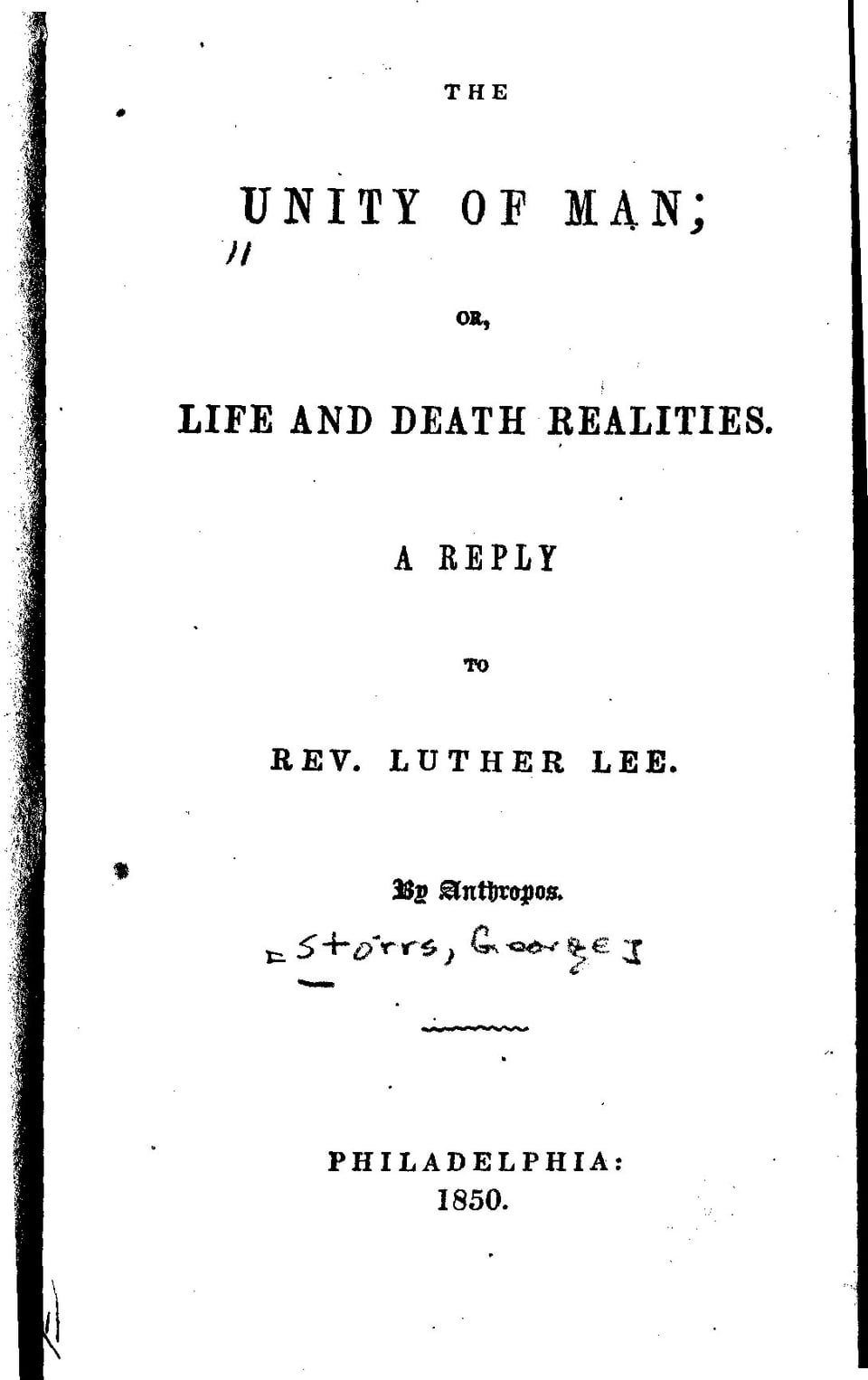
THE
UNITY OF MAN;
OR,
LIFE AND DEATH REALITIES.
A REPLY
TO
REV. LUTHER LEE.
By Anthropos.
= Storrs, George J
PHILADELPHIA: 1850.
UNITY OF MAN.
The Rev. Luther Lee, Editor of "The True Wesleyan," published at New York, having come out with an elaborate defence of inherent immortality, the consciousness of the dead, and eternal torments, it was thought that his position in his denomination, his standing as a writer, and his reputation as a Logician, called for a reply. The public will judge whether I have fairly met his arguments. ANTHROPOS.
CHAPTER I.
Mr. Lee proceeds to give us the properties of matter, and all he says about the essential properties of matter, is just as applicable to a stone as to any part of the human body. He gives us the essential properties of inanimate matter, and finding no consciousness, no reason, no intelligence in this, he rushes to the illogical and unphilosophical conclusion, that organized living matter cannot think! This foundation—his starting point, is wrong, and his superstructure worthless. The question is, not whether a stone can think, but whether a living man, organized from the elements of nature, thinks by his brain. When Mr. Lee has proved that thought is not an essential property of matter, he has gained nothing. I can prove that sound is not an essential property of a musical instrument, but what will that prove? Will it prove that the harmony of 1* 5
598248 sounds is not dependant upon the organization of the wind (or other musical) instrument?
Take the wood of which an instrument is made, and there is no music in it. Let it be organized, and yet there is no music. What is the reason? Why music is not an essential property of wood; this is matter, and there is no music in matter; what is wanting now to produce the "concord of sweet sounds?" We must have the atmosphere, for where there is no atmosphere sound cannot be produced. But the atmosphere is matter, and there is no music in matter? Ah, says Mr. Lee, an intelligent mind is necessary to the production of sound. Yes; but there is no music in the mind. The mind has the power of producing what is not an essential property of itself. And it has the faculty of appreciating the harmony of sounds produced. Now for the application of this illustration: There is no sound, or harmony of sounds, in an instrument, none in the atmosphere, and none in the mind; but, by combining the three we have what was not in either separately. So, there may be no thought, no reason, no intelligence in inanimate matter; but when that matter is organized, as we see it in man, who will affirm it cannot manifest thought? But it may be objected that, in the case supposed, there is an intelligent mind operating upon the instrument and the atmosphere, producing the result.
Let us take another, then; and we will suppose the case of a watch. There is no time in the materials of which a watch is made; and, yet, when organized by an intelligent mind, it will indicate the hour, minute, and second. The maker winds it up, and it continues to perform its functions until it runs down. So with man; there may be no reason, or thought in the component parts of his constitution separately considered; but when organized, and put in motion by the spirit of life in the atmosphere, breathed into his nostrils by his Maker, he awakes to consciousness, to thought and reason.
ON IMMORTALITY.
Mr. Lee has not to be informed, I trust, that by combining, chemically combining, two substances, a third can be produced, possessing none of the properties of the two elements used. He has not to be informed, I hope, that man is chemically formed or organized and that the light of analogy makes it highly probable, to say the least of it, that matter, thus chemically combined, is capable of manifesting mental functions.
Mr. Lee makes "indestructibility," an essential property of matter; perhaps he means annihilation; for "indestructibility" is certainly not a property of matter.
One word as to what Mr. Lee and other natural philosophers term the essential properties of matter. It must be evident to those who reflect, that philosophers have only given us the essential properties of some forms of matter; for Inertia is certainly not an essential property of all matter. We have no evidence that inertia is an essential property of light; on the contrary light seems to be self-moving and ever-acting. This is true of caloric, galvanism, electricity, and magnetism. May it not be true, in a much higher sense, of the aura that pervades the brain and nerves?
One word as to the use of terms. The word nature embraces all created things, animate and inanimate. Thus we have organized and unorganized nature. The organized is again divided into the vegetable and animal. Matter is nowhere in the scriptures, contrasted, or put in opposition to spirit. Spirit is not the antithesis of matter. Animal stands opposed to spirit. We use the term matter as expressive of that which is tangible, or of which the senses take cognizance. But matter exists in ten thousand forms, and is capable of almost endless combinations and sublimations. The term spirit, when used in relation to the wind, to man, and to angels, seems to express different modifications of matter. The word immaterial—
598248 not material, not matter does not appear to be applicable to anything in the universe.
But, for the sake of argument, let us suppose that there is an immaterial thing in existence; how will you prove it? You cannot see it, for if you can see it, it is no longer im-material. You cannot smell it, nor hear it, nor feel it; it is not tangible to any of the senses; how, then, will you define it? The fact is, that which is immaterial has a name but no local habitation.
Matter may be regarded as embracing all that God has created, but under this generic term we have various orders, classes and species of matter; thus we have matter in its simple, or elementary form, then in its compound form, without regard to chemical affinity; then we have it chemically constituted, without relation to life; then in its organized form, in relation to vitality, as seen in the vegetable kingdom, and in the lowest orders of animalculæ; then in its more refined and exalted form as we see it in the human constitution; and lastly, in its highest degree of refinement and sublimation, called spirit, of which the angelic nature is a specimen. God is alike the creator of all forms of matter; or, if Mr. Lee likes it better, he is the creator of matter and spirit; and why should we affirm intelligence of one and not of the other? How does Mr. Lee know that volition is an essential property of spirit? The fact is, he assumes this, and then argues that gross matter, no matter how organized, cannot think. If God has created beings purely spiritual, they must have been created before they were endowed with consciousness, volition and thought; and therefore thought, &c., would not be an essential property of spirit. Mr. Lee does not know the essential properties of all matter, and therefore cannot affirm that thought is not an essential property of some forms of matter. God who formed matter can make of it what He wills to make; He can combine, refine and organize it in a
thousand proportions and forms, with a view of its manifesting as many functions. From the same original elements of matter He can make a thousand different kinds of fruit—the orange, the apple, the pear, the cherry, &c., &c. Yet these are all matter, but how different their qualities? And as is the organization, so is the quality of the fruits whether of acidity or sweetness.
And so it is in the animal world. Out of matter God makes bones, muscles, ligaments, nerves of motion, nerves of sensation, arteries, veins, glands, &c. Here we have matter in various forms, and each form has its own peculiar function, which it possesses in virtue of its organization. The man, therefore, who affirms that matter in none of its forms can think, neither understands what he says, nor whereof he affirms. I shall return to this question in my next article.
CHAPTER II.
Mr. Lee says,—"If matter can think, thought must be an essential property of matter, or it must be the result of some peculiar modification of matter; neither of which can be maintained If thought be an essential property of matter, every part and particle of matter must think. If thought be essential to matter, what does not think is not matter."
Mr. Lee's logical powers fail him here, for it does not follow "if matter can think," that "thought must be an essential property of matter." The "essential property" of a thing is that "property" without which it cannot exist. Both matter and spirit can exist without thought, consequently thought is not an essential property of either. It is possible, however, for "thought to be the result of some peculiar modification of matter." But what sort of reasoning is this? "If thought be essential to matter, what does not think is not matter!"
We might as well argue thus: Inertia is an essential property of matter.
And that which does not possess this property is not matter.
But light, electricity, &c., do not possess inertia. Therefore they are not matter.
Thus according to the received principles of natural philosophy, we see that light, &c., is not matter; it must, therefore, be spirit, and consequently intelligent; for Mr. Lee holds thought, &c., to be an essential property of spirit; and then, according to his own mode of reasoning, "if thought be an essential property of" spirit, "every part and particle of" spirit "must think!" Thus his whole theory, when exhibited in the light of reason, vanishes into thin air.
Mr. Lee asks the question—"Is thought the result of some modification (of) matter?" His whole reasoning on this question amounts to this—that matter cannot think, because it is matter! This is the alpha and omega of his argument. Now, I ask Mr. Lee, what are the attributes of organized matter, in its various modifications? He answers—"Indestructibility, Divisibility, Impenetrability, Inertia." &c. This is not the whole answer; it does not meet the case. And the question recurs—what are the properties of matter? Now, in order to meet this question fully, let us state a few principles. And,
1st. Spirit is defined to be that which has the power of self-motion, volition, consciousness thought, reason, and intelligence. And,
2d. Matter is defined as above. (See indestructibility, &c.) Now, we affirm that the true answer is not given in either case. Let us see. Here are four nerves: the function of one is to transmit sounds; the function of another is to transmit light; the function of another is to transmit odors, and
the function of another is to transmit the sensation of taste. These nerves are matter, yet they have different properties. One will transmit sounds, but will not and cannot transmit light. This proves that matter may be so organized as to possess different functions. This is true not only of sound and sight, but of taste and smell. Here are two nerves; the one a nerve of motion, and the other a nerve of sensation. They have different functions, but they are both matter. In all this there is no addition to matter, nor subtraction from matter; but matter, by being modified in its organization, develops new properties and functions. There is no infidelity or atheism in this philosophy, for we maintain that matter only possesses those properties with which God has endowed it. Mr. Lee's argument, on this point, is all lost. Man is not God, and therefore it is presumption to argue from the nature of one to the nature of the other. The nature of God is unorganized, while the nature of all other beings is organic. This fact proves them to be material.
But let us come to the point more closely. It is admitted that man thinks, feels, and acts; but how does he do this? Mr. Lee says, "By his rational soul." That is, by his spirit or mind. Now, what are the functions or faculties of man? Let us look at them: Here is amativeness, or the sexual feeling. But this, according to Mr. Lee's philosophy, is not an essential property of matter; and therefore it belongs to the spirit or "rational soul." Here then we have mind, immateriality, immortality, desiring sexual intercourse. But, then, this function is not confined to man, but the whole animal world possesses the same. They, therefore, have the same "rational soul." Mr. Lee, perhaps, may say this is mere instinct. Very well, is instinct a property of matter? Here you are stranded again! Take another human faculty love of offspring. Is this a function of matter, 12
PHILOSOPHICAL ARGUMENTS
or spirit? Of matter it cannot be, according to Mr. Lee's theory; therefore it must be of spirit: so we have the "immortal spirit" exercising the parental function! And the beasts have the same faculty, therefore they have the same spirit!
Take another case. Man has the faculty of love, combativeness, destructiveness, love of gain, &c. &c. Are these functions of matter or spirit! Of matter
ON IMMORTALITY.
ter, his paper is matter, his eyes are matter, his ears, his nose, his palate, his nerves, his lungs—they are all matter, merely possessing impenetrability, inertia, &c.! Of what account are they? Surely it was a work of supererrogation to create them! The steam he uses in printing is matter, the locomotive is propelled by matter, the magnetic wire is matter, the electric fluid is mat-
they cannot be, according to Mr. Lee's theory; therefore they must be properties of spirit; and thus we have the "immaterial spirit" in love with human flesh, quarrelling, disputing, destroying, seeking gain, &c. &c.
But it may be said that the animal propensities are not attributes of the spirit; then, pray, of what are they attributes? Of matter? This would be fatal to your whole theory! For love, anger, sexual feeling, and the love of gain are not among your "essential properties of matter." But if man possess an immortal mind, which is the
ter! All is matter!
But, if man be in possession of immortality, he inherits it. And Mr. Lee says—"matter can only act as it is acted upon." Now look at the laws of generation. Here we have matter acting upon matter, producing what? Transmitting what? "Immateriality," says Mr. Lee. That which is material can give birth, then, to that which is im-material! Matter can produce that which is not matter. 'But,' will Mr. Lee say, 'the mind begets mind-spirit begets spirit?' Then it has "divisibility" which is a property of matter? Man has the power of transmitting the elements of his own
seat of all the affections, moral and mental powers, of what use is the body? of what use is matter? of what use are the five senses? of what use is the brain? Just none at all! According to Mr. Lee's philosophy, a man is just as perfect without matter as with it; and, in fact, more perfect:—more perfect in the ratio that spirit is superior to matter! Of what use are impenetrability, divisibility, inertia, &c., in the economy of man? Matter is of no account. These are its only properties! away with it, it is not fit to live! yea, it does not, and cannot live! Man can live, and think, and reason; love, be amative, desire gain, hate and destroy without it!
organization, and if immortality be a part of his organization, he can transmit this. This is selfmultiplication—"divisibility"-matter!
Again, life itself is transmitted, together with diseases of various kinds. And here we come to a very important consideration, viz: That which has no constitutional function cannot be diseased. If matter therefore, in none of its forms and modifications, has any attributes or functions, it can never be diseased. And as the body of man is matter, it cannot be diseased! We never hear of marble or stone being diseased. The diamond is not sub-
Certainly God degraded Himself by making anything out of it! Why did He create it? Why don't He annihilate it? Mr. Lee's hand and pen, which he uses in advocating error, are made of it. His mouth and organs of voice, which he uses in speaking, are made of it. What a pity! His Bible is made of matter, the baptismal element is matject to fever, but vegetables and animals, including man, are liable to disease and death
We come back to the conclusion then, that organized matter is capable of manifesting a variety of functions, which are susceptible of derangement or disease.
But, upon Mr. Lee's hypothesis, disease cannot 2 exist, for matter, having only the properties he ascribes to it, is not susceptible of disease, and immortality cannot be diseased; and, therefore, we come fo the happy conclusion, that there is no such thing as disease!
This is certainly the long-looked for philosophers' stone!
But the truth is, all parts of man are subject to derangement, disease, and death; and still all is matter; but if the mind be "immaterial" or immortal, it can not be deranged or diseased. And here we leave this argument for the present.
In Mr. Lee's article No. 4, he introduces a long quotation from Mr. Watson, in which it is argued, that because "God is spirit" the mind of man is of the same nature. This argument is not only a lame one, but altogether out of place in this connection; so we shall merely observe respecting it, 1st. That the nature of God is not the subject of discussion.
2d. That God only hath immortality. And,
3d. That men are exhorted to seek for it, which would be absurd if they had it.
CHAPTER III.
Mr. Lee argues that "the soul, the rational man, cannot be the body, nor any part of it, as is proved from the identity which the mind is conscious of maintaining from the dawn of existence to life's final close."
"The soul, or rational man," then, according to Mr. Lee's philosophy, is "not the body, nor any part of it!" Mr. Lee is not so good a philosopher as Paul. See 1 Cor. xii: 12-26. Here Paul teaches us that "the body is one"—it is a unit, but "hath many members." Again, he says, "the body is not one member, but many." He teaches us that the "hand," the "foot," the "ear," the
"eye," are all members of the body; hence he says—"But now are they many members, yet but one body." The truth is, all the parts of man are members or attributes of his body; and if you take away any one, you make a schism in it. But Mr. Lee says—"the soul is not the body, nor any part of the body." Of course, then, according to Paul's reasoning, it—"the soul"—can say to the "hand, I have no need of thee:" to the foot, the ear, the eye; and, indeed, the whole body, I have no need of any of you! for I am not of the body!!
Mr. Lee speaks of "the soul" as the "rational man:" then there is a man connected with the "soul," which is not "rational!" Such is the confusion of this Babel of theology and philosophy.
But if it be true that "the soul is not the body, nor any part of it," then no injury or disease of the body can disturb the functions or powers of the soul; for the reason that it "is no part of the body." Let us throw this into the syllogistic form, thus:
That which "is no part of the body" cannot be injured or deranged by disease of the body.
But the "soul is no part of the body."
Ergo—It can never be injured or deranged by disease of the body.
This is Mr. Lee's position; but is it a true one? We shall soon see. What does Mr. Lee mean'by "the soul, the rational man?" He doubtless means the mind. Is it true that no disease of the body can injure or derange the mind? This is not true, as we shall see in the course of these articles. In view of all the facts in the case, we are compelled to come to the following conclusion:
Whatever is "a part of the body" can be deranged or destroyed by disease of the body.
But the "soul"—the mind-can be deranged, &c. by disease of the body.
Ergo—The mind is a part of the body.
I shall leave this part of the question just now, for the purpose of examining Mr. Lee's great argument on "consciousness."
Let it be remembered then, that Mr. Lee predicates "identity and self-consciousness" of the immortal soul or mind, and not of "the body, nor any part of the body." Mr. Lee argues that as the body, in all its parts, is the subject of constant waste and decay, it cannot be the subject of identity and consciousness.
The soul is immortal—our identity and consciousness are always the same—these, therefore, are attributes of the soul, which is not subject to any change.
Here we have both sides of the question fully before us.
Let us look at this a little. Mr. Lee says—"consciousness is that notice which the mind takes of its own operations and modes of existence." This may be true in a qualified sense, but it is not susceptible of the use Mr. Lee wishes to make of it. Mr. Lee contends that the mind is immortal; if so, it cannot be deranged, diseased, destroyed. If Mr. Lee's position, therefore, be a true one, a man should never lose his identity nor consciousness. Is this a fact? Far from it; for there are many cases on record of persons losing their identity, and becoming the subject of double consciousness. Why is this, if consciousness be an attribute of an "immortal soul." Mr. Lee says—"we cannot say consciousness is that notice which the brain takes of its own operations and modes of existence." But, why can we not? Can Mr. Lee give a reason? When the skull is fractured, and pressure is made upon the brain, all consciousness is suspended. Why is this, if consciousness be not connected with the brain? If consciousness were an attribute of a mind immortal, this phenomenon would not follow from such a cause.
this consciousness of identity." Suppose this were so, what would it prove? Would it prove that the brain is not the seat of consciousness? Is Mr. Lee, apart from the knowledge of the fact, conscious of having any brain? Does this prove that he has none? Is he conscious of having a heart, whose office is to propel the blood? Can he tell by his consciousness that his heart is the centre of the circulation? The brain may be the seat of personal identity, and give rise to consciousness without our being able, by reflecting on our modes of existence, to determine its location. But, the truth is, if we can determine anything by consciousness, we should certainly be induced to localize it in the brain. And, so far as we are conscious of our own identity and thoughts, we refer them to the brain; and learn, by reflecting upon our own feelings and sensations, to refer them to the encephalon. Mr. Lee contends he has an immortal soul: is he conscious of such a possession? Is he conscious of having an incorruptible mind, and does he know, by reflection, that this is the seat of his identity and consciousness?
But Mr. Lee urges the continual change of the particles of the body, as an objection to consciousness being dependant upon organization.
This argument is not new-I have met with it frequently before. A person at the age of seventy may have changed ten times; and there are corresponding changes in the mind. Every organ, of course, is subject to the same waste and renovation. This applies to all parts, external and internal—the hardest and softest. It applies to the heart and blood vessels generally. And yet all the organs preserve their identity and sameness of organization, unless diseased. The process of absorption and deposition is so gradual, so admirable, so complete, that the organization retains its identity. In childhood this process is very rapid, but deposition exceeds absorption; hence the increase in bulk, in size, &c.
This excess of deposition continues till maturity; after which, the process of waste and renovation are about equal, till old age supervenes, when the waste exceeds that of renovation; and the man, unless previously cut off by disease, gradually wears out, and sinks into the grave. In this case, there is a second childhood; the mind again becomes imbecile and childish.
In childhood, but few mental powers are manifested; but, as the individual approaches puberty, new powers come into play; and, when manhood is attained, we see a corresponding change in the mind. The judgment is now mature, and the mental powers acute. But in old age all this is reversed—a second childhood obtains, and imbecility reigns! And, as we have before observed, there is a corresponding change in the organization. The brain is shrunk, and the mental fires decay. But now let us look on the other side of this interesting question. Suppose Mr. Lee's argument to be correct, then it follows, the mind being immortal, that every incident, every impression, every feeling, every thought, must be retained; memory must be perfect; nothing can be forgotten. If the mind be immortal, memory must be immortal. If the mind be deathless, the memory must be deathless. If the mind be incorruptible, the memory must be incorruptible. We defy Mr. Lee to evade this. But what are the facts in the case? The memory is defective—it is neither immortal, deathless, nor incorruptible! And yet it is an attribute of the mind. But if the mind—the soul—the spirit, be immortal, not an idea—not an impression—not an incident—not an event—not a word—not an act—not a feeling—not a sentiment—should be erased from its tablet! Get over this who can: Mr. Lee cannot. When Mr. Lee explains how partial memory, partial or total insanity, partial or total idiocy can be reconciled with the idea of mental immortality, it will be time enough to bestow upon his
difficulty, concerning identity, additional arguments.
In conclusion, Mr. Lee says, speaking of the "conscious-smitten sinner," "I am guilty; not my feet, not my hands, not my brains, not any part of my material body, but I, myself, am guilty: it is not my body, but myself; and this I, this self, denotes the thinking moral man—the soul, which, of course, cannot be the body, nor any part of it."
Let us change this, and see how it reads—thus: "I am guilty; not my feet, not my hands, not my brains," nor my immortal soul, "but myself," &c. According to Mr. Lee's philosophy, "the soul" alone, by which he means that which is immaterial, is guilty before God and man. How, then, will you punish the guilty one? If the soul be immaterial, it is intangible, and can never be brought to trial before any human tribunal. Why punish the body for the sins of the immortal soul? This is punishing the innocent for the guilty. According to Mr. Lee, the body is no more guilty than the telegraph wires, along which a slander is transmitted! Why hang a man if this be true? Why punish him in any way? His immortal soul is alone guilty—"not his body, nor any part of his body!" not even his "brains!" I would ask Mr. Lee if a man can be guilty without brains? And, if not, why this puerile argument? I affirm that MAN in the CONCRETE, and not in the ABSTRACT, is guilty. Not his feet, hands, brain, nor "soul," but the man as such; and in this light he is held responsible by all law, human and divine.
CHAPTER IV.
Mr. Lee's last philosophical argument is that, "nothing but spiritual good can satisfy the human mind—the phenomena developed in the progress of the body and mind, prove them not to be identical."
Let us analyze the proposition. And, 1st. "Nothing but spiritual good can satisfy the human mind." How does this harmonize with Mr. Lee's previous declarations?—with mental philosophy?—and with the facts in the case?
It does not harmonize with Mr. Lee's previous remarks upon the "essential properties of matter." He has given us what he conceives to be these "essential properties," and, of course, all other properties in his estimation, belong to spirit. How then can he say, consistently, that "nothing but spiritual good can satisfy the human mind?" Amativeness is either a property of matter, or spirit. According to Mr. Lee's theory, it cannot be a property of matter; and must, therefore, be a property of spirit! Does it desire "spiritual good?" And we might make the same enquiry about a variety of the elements of the "human mind."
Neither does it harmonize with mental philosophy. The mind is made up of a number of elements, some of which relate to things physical, others to things of a moral character, and others to intellectual objects. Facts are opposed to his proposition, for the "human mind," as is demonstrated by observation, has a multiplicity of desires which do not relate to "spiritual good."
2d. Who asserts that "the body and mind are identical?" No man in his senses! Vision is an element of the "human mind," but vision and the body are not "identical." The brain, medulla oblongata, medulla spinalis, and the nerves departing from these centres, belong to the body—they are organs of the body; and motion, sensation, feeling, sentiment, and intellect are functions of these organs, and attributes of the body. The cerebrum is a part of the man—the organ of thought, &c., thought is an attribute of the man, and an element of mind. Matter is thus endowed with affective, moral, and intellectual functions.
"The spirituality of the human soul," says Mr.
Lee, "may be inferred from the nature of its desires," &c. This only carries us back to a former point, so we will leave it and proceed. Mr. Lee says, "All men desire happiness," and that "the greater portion seek it where it is not to be found."
Indeed! One would suppose, if the mind were immortal, that its desires would all be pure, properly directed, and only centered on that which is good; and that men would "seek happiness" only where it could be found.
But Mr. Lee explains by saying, "the reason is, they seek it in the gratification of their animal propensities." Are there "animal propensities,"" properties," or attributes of matter? If not, what argument is there in all this?
The fact is, all Mr. Lee says under this head is in perfect harmony with our view of the subject; but altogether incompatible with the immortality of the mind.
Man finds his happiness in all the physical, moral, and intellectual objects to which he has elements of mind adapted. These elements of mind inhere in organized material organs. And therefore, although "man" be "only matter," "compounded of the elements of the material world," the "centres of attraction" are just as numerous as the elements of his mind. And therefore, "that matter (man organized of matter) should seek" the gratification of all its powers, whether this be in "fountains of spiritual bliss," or in objects of sense, is neither "absurd" nor "unphilosophical;" but, on the contrary, in perfect accordance with "its own essential laws," and the "essential properties of its own nature."
Mr. Lee says, "The fact that the world of matter never did, and never can satisfy the desires of the human soul, is one of the clearest proofs that the soul is not itself matter." Now, in my estimation, this "proof" amounts to no "proof" at all. Let us see: "The fact that the world of matter" ever has, and ever will (in man's present state) "satisfy the desires" of a majority of "human souls, is one of the clearest proofs that the soul is itself matter."
Now, what has Mr. Lee gained by his so-called "proof?" Just nothing at all! So it is not true that "the world in any and all its forms, cannot satisfy the desires of one human soul." For the majority of mankind are satisfied with "the world in any and all its forms of pleasure, without regard to the "spirit world." "Give it," (the soul) says Mr. L., "all the elements of earth, sea, and air, moulded into every possible form, and it would grasp the whole, and thirst and famish still, and pant for higher bliss," &c. This is contrary to facts, for multitudes of men, "who have their portions in this life," neither desire nor seek for "higher bliss." And, if they "grasp the whole, and thirst and famish still," it is for more of the same nature. Tell me that such a soul is "immortal?" "The reason is," to use the language of Mr. Lee, "the soul is matter"—not "spirit." "Were it" spirit, all its desires would be in harmony with its nature.
Mr. Lee says, "It" (spirit) "originally came from God, and hence can be happy in God alone, as God dwells in us, and we in God." Let us try this statement: matter "originally came from God, and hence can be happy in God alone, as God dwells in us, and we in God." This is just as good an argument as Mr. Lee's, and both may pass for what they are worth; but so far as the "origin" of them is concerned, the reader can see that if one be good evidence, so is the other.
Mr. Lee asks, "But does God dwell in matter, and matter in God?" We reply, that God "fills heaven and earth;" and as the heavens and the earth are matter, "God dwells in matter." He fills the vast universe. It has not inaptly been said that "his centre is everywhere, and his cir cumference is nowhere." And so far as it re
spects "matter dwelling in God," I will say that man is matter; and "in God he lives and breathes, and has his being." "Matter," then, in the form and capacity of man, "can have fellowship with the Father and the Son;" "can have communion with the eternal spirit;" can drink joys from the fountain" of all joy. Mr. Lee bases another argument on "the desire of knowledge in connection with the capacity of the mind to improve."
This argument will only hold good in relation to a part of mankind, for there are many who have neither the "desire" nor the "capacity" to improve. It is, therefore, of no avail, for either immortality is hereditary, or it is not; if it is, all men have it; but, if it is not, none have it.
But Mr. Lee admits that "the soul commences its career without knowledge." Now, only think of an "immortal mind"—self-conscious, self-intelligent, possessing all the attributes of intelligence, knowledge, and wisdom. "commencing its career without knowledge!" The very idea is absurd! But Mr. Lee says, "its capacity furnishes the basis of the argument." This merely brings us back to those who have no "capacity to learn," and thus the argument fails.
Mr. Lee has foiled himself—he has precipitated himself overboard, and carried all his arguments with him! Hear him: "The mind, in its present state, is dependant upon the BODILY ORGANS for primary ideas!!" This admission is fatal to his whole theory! What is the meaning of it? Why, it means this—that the "IMMORTAL MIND" is DEPENDANT upon MATTER "FOR PRIMARY IDEAS!" Mind dependant upon matter for ideas! "Ideas" do not "inhere in mind," then, as Mr. Lee first taught us. They must "inhere" in matter, for mind is "dependant upon the bodily organs for primary ideas." Yes, and I will add, for all "ideas," "primary" and secondary. But Mr. Lee limits this to "the present state." Very well, that will answer our purpose; but how does he know but the same arrangement may obtain in the next "state?"
But what and where are "the bodily organs, upon which "the soul is dependant for primary ideas?" Mr. Lee mentions two—the eye and the ear; but these are not all. The brain is full of them. The "soul is dependant" on the brain "for primary ideas." Now, friend Lee, let us shake hands and be good friends, for we have met at the same focal point.
I hope that we shall hear nothing more about materialism from that quarter; but, that henceforth, life, mind, intelligence, all the mental phenomena, will be predicated upon organization; and that eternal life, immortality, and incorruptibility will be proclaimed through Jesus, who is "the resurrection and the life."
CHAPTER V.
Mr. Lee says—" Its (the spirit's) improvement, is a distinct matter from the improvement of the body."
What does he mean by the "improvement of the body?" Does he mean the growth of the "body?" What does he mean by the "body?" Does he mean the whole physical organization, or a part of it? If he uses the term as indicative of the whole organism, then it is equivalent to the man; which would be to make "the improvement of the spirit a distinct matter from the improvement of the man." Understanding Mr. Lee, therefore, to mean the physical constitution, the question recurs—does he mean by "the improvement of the body" its growth in bulk or size? If so, I would remark, that stubborn facts establish the law, that other conditions being equal, the development of mind is in the ratio of the development of the physical organization. What are these "other conditions?" The
answer to this question is found in the fact, that there are several systems of organs, giving rise to different functions, and modifying the manifestations of mind. The ample development of the glandular system does not increase the mental power but modifies it. The excessive development of the muscular system does not import mental activity; but it gives durability to body and mind. The sanguineous and nervous systems impart physical and mental activity.
Again, a person may be born with an organization unfavorable to the development of much mind they may be idiotic; but, in this case, the nervous system will be defective. Again, they may be diseased, and, from this cause, imbecile. Again, education may have been partial and defective; the muscular system may have been cultivated at the expense of the nervous; and then, "the body may grow and flourish in all the perfection of health, and the mind make little or no progress." Again, the nervous system may be developed at the expense of the sanguineous, and "the body," or man, "be of exceedingly frail structure, pale and wan;" but it is not true that "a giant mind may develop itself from within." The mind of such a person may possess great vivacity, sprightliness and brilliancy, but it will be wanting in strength, depth, power and durability. But, in all this, the law holds good, that, as is the organization, so is the mind.
Mr. Lee says—"Some of the greatest geniuses the world has ever produced, have had but just body enough to hold the soul." This is a mere fancy sketch, containing no argument. A man, however, may be a "genius," with little or no talent. Again, Mr. L. says—"These facts certainly indicate that the soul and the body, are not one and the same thing!" Truly! who ever contended that they were "one and the same thing!" The one may be an attribute of the other, and both may be mortal—both matter—Mr. Lee's "facts" to the contrary notwithstanding!
Mr. Lee tells us, that "the body comes to maturity and begins to decline, at an age when the mind has but just commenced its career of improvement." This is a fallacy, for the "career of improvement" begins almost with our birth. "A sound mind in a sound body" is a sentiment, which embodies the truth upon this subject. The nervous system may be healthy, unimpaired and elastic, when the muscular and glandular have declined; and the mind may thus be proportionably active, when the physical strength is partially gone. But when there is a general decay of the whole organization, the mind goes down with the body. And whether a man shall be a dotard at "fifty, sixty, or seventy," depends upon the strength, soundness and durability of the whole constitution.
Mr. Lee alludes to the doctrines of phrenology, and informs us that nothing is gained by admitting their truth—that phrenologists "will not make this the issue, and base their science on the doctrine of materialism, to stand or fall with it." If by "materialism" Mr. Lee means matter, I affirm that phrenologists do base their science on "materialism;" for they base it on the anatomy and physiology of the brain—which is matter; while, at the same time, they may not follow up their principles to their legitimate results. I shall not reflect upon the motives of those phrenologists, who have labored to popularize, and harmonize phrenology with sectarian theology. But, for one, fearless of all consequences, I do make the issue, and base the phrenological doctrines upon the material organization of man, independent of all "immateriality," immortality, or incorruptibility; and I challenge all phrenologists, no matter who, nor where they are, whether in Europe or America, to disprove the correctness of this position.
This is the only view that will, or can harmonize with the volume of Revelation; and every effort to harmonize the sublime science of mind, with the paganized traditions of modern sectarianism, degrades both it and them!
Yes, sir, a voice speaks from the highest heavens, and proclaims to all the sons of men, that they are mortal, having not one spark of immortality, but corruptible and perishing; and mental science—the science of man—sends back the sound, all is mortal!
We shall now examine Mr. Lee's concluding philosophical argument, which is this: "The mind often develops itself in greater power and glory, just at the moment of death, shining out from an emaciated body, already wan and cold."
Here Mr. Lee rallies all his powers, concentrates all his forces, and pours along his logical troop! We shall pay particular attention to this argument, not on account of its strength, but on account of its commonness.
"The mind often develops itself in its greatest power and glory, just at the moment of death." This, as a proposition, is monstrous; as an argument, absurd; and as a fact, is not true. "The mind develope its GREATEST POWER and GLORY, at the moment of death!" Did ever the mind of a man, "at the moment of death," develop the powers of a Solomon?—a Bacon?—a Locke?—a Herschell?—a Franklin? Here are specimens of mind in its "greatest power." Did ever the mind of man, "at the moment of death," when the "emaciated body" was "already wan and cold," develope the "glory"—the eloquence of a Cicero, or a Demosthenes? The answer is, and must be, in the negative. But Mr. Lee says—"It is true that in some cases the mind appears to decay with the decaying body, but to prove that it is the body or any part of it, this would have to be always so without exception, which is not the case." Mr. Lee has the
PHILOSOPHICAL ARGUMENTS
argument here by the blade, instead of the handle, and cuts himself rather than his opponent! The mind should never "appear to decay with the decaying body," if it be immortal! If it be neither "the body nor any part of it," there should be no "exception" to the "power" and "glory" of its development "at the moment of death," "which," as Mr. Lee says—"is not the case." And now I
denly, retains his senses to the end; or, if not dying suddenly, he gradually wastes away by consumption of the pulmonary organs, and dies in possession of a degree of mental power.
Death by coma may either be sudden, or more or less protracted according to circumstances.
These are some of the reasons why some persons die in the possession of some mental power, and
will explain to Mr. Lee why it is, that some minds are more brilliant in death than others.
It depends upon the nature of the disease, and its seat. There are some diseases which preternaturally excite the brain, and consequently, the mental powers. We witness this in various forms of fever. And sometimes this febrile condition becomes so exalted and intense, that the patient becomes eloquent, musical, furious and insensible by turns, according to the nature of the case. In this condition the patient's animal, moral, or intellectual faculties may be principally excited and
others perfectly insensible. These phenomena are perfectly plain upon the view we take of the constitution of man; but can Mr. Lee, or any one else, explain them upon his hypothesis? "The mind may kindle up at the moment of death, and blaze out with intellectual fire," but it is the mere flickering—the mere flashing up, of the waning intellect, which, like the dimly burning taper, gives signs of its extinguishment! "The body" may be "wan, cold and helpless," and the mind will shine as dimly, and burn as faintly as the expiring lamp! An occasional out-burst—an occasional flash, is not the strength, power and glory of a giant mind; but
develop their functions accordingly. They may shout, pray, sing, or curse, swear and rage, just as their different faculties are the seat of the most intense cerebral action. Some, in this condition may "die shouting glory! glory!! glory!!!" and others die perfectly frantic and furious.
Again, in disease of the heart and lungs, the integrity of the mind is partially maintained till death closes the scene; but this is because the brain is not immediately involved in the disease, and therefore it manifests its functions, though with less power, to the last.
Another cause, already hinted at, is, the fact
the sure indications of a speedy dissolution.
Mr. Lee speaks of "the mind, being roused by the prospect of heaven, or seized with the terror of impending perdition," as "flashing with the fires of immortality," and "shedding a living glare as it quits its house of clay and enters upon the destinies of the spirit world!"
The whole of this is a beautiful delusion! a sublime absurdity!! There is no truth-no argument-no logic in it. This going to "heaven" at death, or down to "perdition," are old wives' fables. They are pagan traditions, newly vamped by the
that death sometimes commences at the heart, and at the lungs. The first is called death by anæmia —the want of a due supply of blood to the heart. In this case the faculties may be retained to the last for the reason already given.
The same remarks apply to death by apnæa, privation of breath. The person, being cut off sud-
Mother of Harlots and abominations of the earth.
No, gentle reader, man is mortal, death is the extinction of life and sense and mind; and nothing but the resurrection can restore these attributes to man. So we come back to our starting point—no organization, no life; no life, no mind.
And here we leave Mr. Lee, to the mercy of his own ill-fated philosophical arguments. 3*
CHAPTER VI.
Having examined Mr. Lee's philosophical argument, I now proceed to his scriptural.
His first argument is based upon Gen. 35:18, "And it came to pass, as her soul was in departing, (for she died,) that she called his name Ben-oni."
The reader will please bear in mind that the subject before Mr. Lee's mind is the "immateriality of the soul," and that this text has been adduced to prove it! But if he can see any connection between it and the subject, he can see far better than I can. Her "soul departed," ergo, it is immortal! Truly, this is an "age of reason." Mr. Lee says, "Her body did not depart. Her brains did not depart!" And was there nothing else which could "depart," and which, in scripture language, is termed the "soul?" Could not her breath—her life depart, and "her body" and "brains" remain? This text proves only one thing, and that is the departure of the woman's soul, life, or breath; and has no bearing whatever upon Mr. Lee's question.
But Mr. Lee thinks his doctrine of "immateriality," is taken for granted in the Bible! This is begging the question. The Bible, so far as I know, takes nothing for granted: and, even if it did, this would not do away with the necessity of Mr. Lee's proving his position, by proving that the Bible takes it for granted. Let him not assume this, but prove it.
His second proof is Numbers 16:22, where God is spoken of as the "God of the spirits of all flesh." What has this to do with Mr. Lee's "immaterial soul?" I admit that God is "the God of the spirits of all flesh," because "in Him we live, move, and have our being;" but this does not prove that "the spirits of all flesh" are the "immaterial souls" of all flesh. Inasmuch as "the spirit of life," or "breath of life," which inflates the lungs,
oxygenizes the blood, and gives life to the flesh. is from God; He is emphatically the "God of the lives of all flesh." And, I apprehend, this is the meaning of the passage. In Numbers 27:15,16 there is a passage of similar import.
Mr. Lee's third argument is Job 14:22. "But his flesh upon him shall have pain, and his soul within him shall mourn." Were I disposed to be hypercritical, I might analyze this thus: First, we have the "flesh;" second, the "him;" and third, the "soul." The "flesh" is not the "him," because it is upon him; and the soul is not the "him," because it is in "him." It follows, therefore, according to this mode of reasoning, that neither the "flesh" nor the "soul" constitutes the "him," or man. How will this tally with Mr. Lee's theory? This shows the folly of all such reasoning. The simple meaning of the text is this: The "flesh upon" his person "shall have pain, and his heart within him shall mourn."
His fourth proof is Job 31:30, "Neither have I suffered my mouth to sin, by wishing a curse to his soul." Here, again, I may ask the question, What has this to do with the "immortality of the soul?" The term soul is often used as a Hebraism for the person, and as often used for life; so that the text and context must determine its signification in any given case. In the text before us, it evidently means life, or the person of whom life was an attribute.
His fifth argument is chapter 32:8, "But there is a spirit in man, and the inspiration of the Almighty giveth them understanding." This is the most plausible scriptural argument yet offered by Mr. Lee, but this does not prove his point. Mr. Lee himself admits that this "appears to be an allusion to God's breathing into man the breath of life, after he had formed him of the dust of the ground, by which he became a living soul." In addition to this admission on the part of Mr. Lee it is remarkable that the spirit is represented as being without knowledge until the "inspiration of the Almighty gives them understanding."
Mr. Lee makes another important admission, which I hope the reader will remember. It is this: "Man here denotes the visible, tangible frame, the body; in this there is a spirit." Very well; "man," then, is the "body," animated by "a spirit"—"the breath of life," and God gives them "understanding." Thus Mr. Lee has helped us to the refutation of his argument.
Mr. Lee's sixth proof is Proverbs 19:2, "that the soul be without knowledge is not good." He thinks "this text clearly implies the existence of an intelligent soul, distinct from the body." But how can an "immortal soul," which is self-conscious—self-intelligent, "be without knowledge?" Here Mr. Lee is caught in his own snare! I regard this text, therefore, notwithstanding what Mr. Lee says about the definite article, as being similar, in this respect, to the passage, "the soul that sins, it shall die;" and as referring to man, in relation to that attribute of his nature which is the seat, or sensorium of the mind.
His seventh argument is based on Eccles. 12: 7, "Then shall the dust return unto the earth as it was: and the spirit shall return unto God who gave it." This clearly refers to God's "creating man of the dust, and breathing into his nostrils the breath of life;" and has no more to do with the "immateriality of the soul," than the blood of man. When man dies, that which came from the earth, returns to the earth; and that "breath of life" which God "breathed into his nostrils" returns to him in the expanse of Heaven. In point of fact, however, the body is not less from God than the spirit, or "breath of life." Both are from Him. And this same author, Solomon, as well as Moses, speaks of the beasts as possessing the same "spirit
of life." "They all have one breath; all are of the dust, and all turn to dust again."
Mr. Lee's eighth proof is Ezek. 18:4, "Be hold, all souls are mine: as the soul of the father, so also the soul of the son is mine." Why did not Mr. Lee quote the whole verse? Why did he omit the last clause? Was it because the whole verse would not answer his purpose? "The soul that sinneth, it shall die," was too strong for Mr. Lee! He reminds me of a person, who is running along a beautiful lawn, where everything is pleasant to the eye, and grateful to the senses; but suddenly an awful precipice presents itself, and the man starts back with horror at the impending danger! So Mr. Lee, conscious of the truth of his position, passes rapidly from text to text, hoping to fortify his favorite doctrine of "immateriality," when suddenly and unexpectedly he treads upon the very brink of a logical abyss, where all his arguments are in danger of being precipitated to the gulf below. He pauses, starts back, and retreats!! with the words sounding in his ears, and vibrating along the fibres of his brain,—"THE SOUL THAT SINNETH, IT SHALL DIE!" This text, so far from helping Mr. Lee, is fatal to his whole theory; for it affirms that the sinful soul shall die, which is incompatible with his view of the subject.
His next argument is founded on Zech. 12:1, where God speaks of forming "the spirit of man within him." There is no difficulty here, according to our view, whether we understand the term "spirit" to apply to the life or the mind. Both life and mind are "formed," developed, or manifested "within" the man. But Mr. Lee takes a liberty which the rules of logic do not allow him. He proves that man has a soul or spirit, but its nature he takes for granted. He is not required to prove that man has a "spirit," but to prove that spirit "immortal." This he has failed to do; for to do this it is not enough to prove that the spirit is a distinct entity from the body; but he must also show that it is necessarily immortal.
This he can never do.
His tenth argument is based on Rom. 8:16, where Paul speaks of the witness of the Holy Spirit "with our spirit." On this I remark that neither God nor man "bears witness," except by words or signs addressed to the minds of men. "The spirit bears witness with our spirits," minds, or hearts, if you please, that we are the children of God: but this "witness" is in his word, and addressed to our understandings; and not to our feelings or passions. The christian has better evidence of his being a "child of God," than a mere impulse, or feeling, which is the sport of a thousand circumstances. When his heart, his life, his words, &c. are all in harmony with the Gospel, then it is that "the spirit," by that word, "bears witness" with his mind, his conscience, that he is born of God.
His next proof is 1 Cor. 2:11, "For what man knoweth the things of a man, save the spirit of a man which is in him?" This belongs to a class of texts already examined, and means no more, I apprehend, than that a man is alone conscious of the operations of his own mind.
Mr. Lee refers to chap. 6:20 as a proof "For ye are bought with a price; therefore glorify God in your body, and your spirit, which are God's." This proves that men can glorify God "in the body," although "matter," which, I suppose, is more than Mr. Lee would willingly admit. The text clearly teaches us the whole man, "soul, body and spirit," should be devoted to His cause. That all the physical, moral and mental powers should be consecrated to his service. I see nothing in this to favor the popular theory.
He then refers us to 2 Cor. 4:16, where Paul speaks of all "outward" and "inward man." I am willing that Peter shall explain Paul. See
1 Peter 3:3, where he defines the "inward" or "hidden man" to be "the heart."
His fourteenth proof is 2 Cor. 7:1, "Let us cleanse ourselves from all filthiness of the flesh and spirit." Apart from the absurd idea that "filthiness" is here ascribed to an "immaterial spirit," it must be evident to those who think for themselves, that the apostle meant no more than that they should put away all evil—all immoral contaminations, and be holy in life, temper and disposition.
Mr. Lee's final argument in the article I am reviewing, is James 2:26, "For as the body without the spirit is dead, so faith without works is dead also." In this passage, it is perfectly evident the term "spirit" signifies "breath," the breath of life; and it is so rendered in the margin. This text is against Mr. Lee, and proves that, after the expiration of the breath, there is not an "immortal spirit" animating the body; but that as "faith without works is dead," so "the body without breath is dead also."
in Mr. Lee's concluding article on the immateriality of the mind, he argues thus: "The same words which are applied to man to describe his spiritual nature, are applied to God," "and any criticism which will invalidate the evidence in proof that the human soul is spirit, and not matter, will equally weaken the argument in support of the idea that God is a spirit."
Now, kind reader, that you may see the force of this argument, I will apply it to another matter, thus: "The same words which are applied to" the wind,"to describe" its "spiritual nature, are applied to God,""and any criticism which will invalidate the evidence in proof that the"wind "is spirit and not matter, will equally weaken the argument in support of the idea that God is a spirit."
This is Mr. Lee's argument, only it is applied to the wind instead of man; and the reader can at once see its fallacy.
I could give examples as Mr. Lee has done, but this is unnecessary. We might as well argue that because certain terms, generally applied to other objects, are used in relation to God, that their natures were similar, as to argue that because the term spirit is applied to man, therefore his spirit is like God's—immortal. The terms "sun," "soul," "heart," "wings," "shadow," &c. are used in relation to Jehovah; but who would thence infer that He is of the same nature with the "sun," or that His "soul" and "heart" are of the same nature with the "soul" and "heart" of man?
Does Mr. Lee really believe that God has a "soul" and a "heart?" If so, He is a compound being, and no compound is eternal. These words are used in reference to Him, in an accommodated or figurative sense; so also is the term spirit when applied to man—to the wind—to the breath of life—to the mind—and to the life itself.
"God is a spirit" in the highest sense of the word; but when this term is applied to the wind, and to man, it is used in a subordinate sense. As well might Mr. Lee argue that because the same word is applied to the beasts, therefore, they have "immortal spirits." Mr. Lee's argument, to be valid, must hold good in all cases to which the term is applied; or else, if there be an exception, I shall maintain that man is an exception.
Mr. Lee refers to the text, "the spirits of just men made perfect," which, I apprehend, applies to persons raised from the dead, and not to men in the flesh. He also quotes the text, "God is spirit; and they that worship him must worship him with spirit and with truth," to follow his reading. What is the meaning of the passage? It is this; that mere outward forms—the "drawing nigh unto God with the lips, while the heart is far from him"—is not acceptable worship. His worship must proceed from the heart—be pure, sincere, and according to the "truth;" for "in vain do you worship me, teaching for doctrine the commandments of men." But the text contains not the slightest proof that the spirit of man is immortal, which is the point to be proved. Mr. Lee has signally failed in this part of his argument; indeed, we may say of them all, that they contain the elements of their own refutation. He set out to prove the "immateriality of the soul," and the reader can judge how far he has succeeded. Sometimes he affirms "immateriality" of the "soul," and then of the "spirit:" he quotes a text to prove this of the "soul," and, anon, of the "spirit;" so we are, after all, at a loss to know whether he affirms "immateriality" of both, or of one. The popular theory presents a chaotic system—a confused mass—a perfect Babel, without order and without light. The advocates of it talk of "spiritual substances," and yet deny the existence of spirit-matter, as though there was any difference between "substance" and "matter!" But I have gotten through with Mr. Lee's arguments, and must await his next article.
CHAPTER VII.
In Mr. Lee's article No. 9, he takes up the question of "the conscious existence of the soul, after the death of the body." His argument is "from the immateriality of the soul." He tells his readers that "the foundation for this argument has been laid in preceding numbers, in which the immateriality of the human soul has been proved." Those of our readers, who have read his articles, and our Review, will doubtless be prepared to determine whether Mr. Lee has "proved" the "immateriality of the soul." I humbly conceive he has not "proved" it, nor is it in his power to "prove" it, by all the argument he can bring to bear upon the question.
…