The Bible Examiner — Vol. 4, No. 6 (1849)
Download: PDF — The Bible Examiner — Vol. 4, No. 6 (1849)
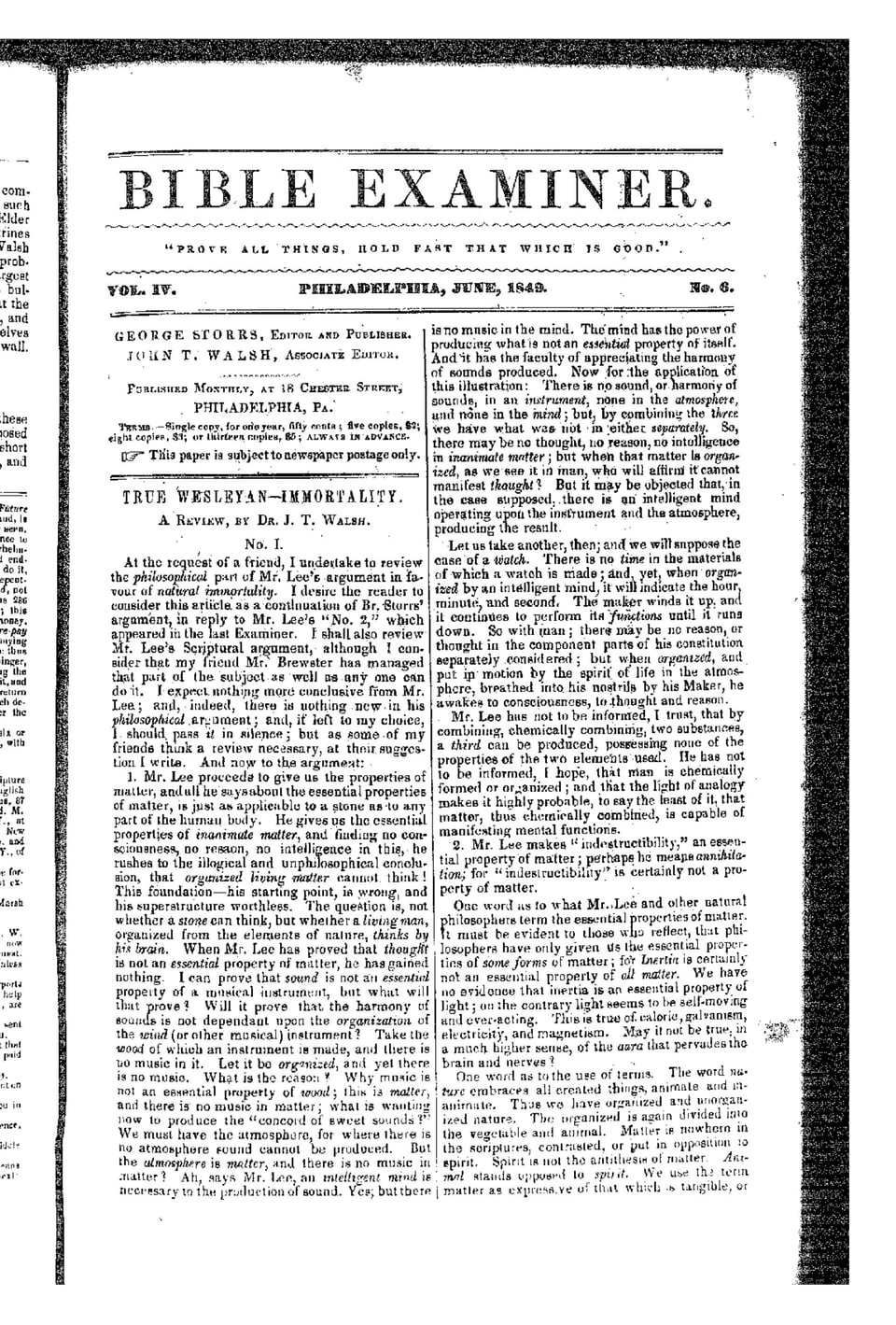
BIBLE EXAMINER.
"PROVE ALL THINGS, HOLD FAST THAT WHICH IS GOOD."
PHILADELPHIA, JUNE, 1849.
VOL. IV.
No. 6.
GEORGE STORRS, EDITOR AND PUBLISHER. JOHN T. WALSH, ASSOCIATE EDITOR.
PUBLISHED MONTHLY, AT 18 CHESTER STREET PHILADELPHIA, PA.
THRUS. — Single copy, for one year, fifty cents; five copies, $2;
eight copies,3; or thirteen copies,5; ALWAYS IN ADVANCE.
This paper is subject to newspaper postage only.
TRUE WESLEYAN-IMMORTALITY.
A REVIEW, BY DR. J. T. WALSH.
No. I.
At the request of a friend, I undertake to review the philosophical part of Mr. Lee's argument in favour of natural immortality. I desire the reader to consider this article as a continuation of Br. Storrs' argument, in reply to Mr. Lee's "No. 2," which appeared in the last Examiner. I shall also review Mr. Lee's Scriptural argument, although I consider that my friend Mr. Brewster has managed that part of the subject as well as any one can do it. I expect nothing more conclusive from Mr. Lee; and, indeed, there is nothing new in his philosophical argument; and, if left to my choice, I should pass it in silence; but as some of my friends think a review necessary, at their suggestion I write. And now to the argument:
Mr. Lee proceeds to give us the properties of matter, and all he says about the essential properties of matter, is just as applicable to a stone as to any part of the human body. He gives us the essential properties of inanimate matter, and finding no consciousness, no reason, no intelligence in this, he rushes to the illogical and unphilosophical conclusion, that organized living matter cannot think! This foundation—his starting point, is wrong, and his superstructure worthless. The question is, not whether a stone can think, but whether a living man, organized from the elements of nature, thinks by his brain. When Mr. Lee has proved that thought is not an essential property of matter, he has gained nothing. I can prove that sound is not an essential property of a musical instrument, but what will that prove? Will it prove that the harmony of sounds is not dependant upon the organization of the wind (or other musical) instrument? Take the wood of which an instrument is made, and there is no music in it. Let it be organized, and yet there is no music. What is the reason? Why music is not an essential property of wood; this is matter, and there is no music in matter; what is wanting now to produce the "concord of sweet sounds?" We must have the atmosphere, for where there is no atmosphere sound cannot be produced. But the atmosphere is matter, and there is no music in matter? Ah, says Mr. Lee, an intelligent mind is necessary to the production of sound. Yes; but there
is no music in the mind. The mind has the power of producing what is not an essential property of itself. And it has the faculty of appreciating the harmony of sounds produced. Now for the application of this illustration: There is no sound, or harmony of sounds, in an instrument, none in the atmosphere, and none in the mind; but, by combining the three we have what was not in either separately. So, there may be no thought, no reason, no intelligence in inanimate matter; but when that matter is organized, as we see it in man, who will affirm it cannot manifest thought? But it may be objected that, in the case supposed, there is an intelligent mind operating upon the instrument and the atmosphere, producing the result.
Let us take another, then; and we will suppose the case of a watch. There is no time in the materials of which a watch is made; and, yet, when organized by an intelligent mind, it will indicate the hour, minute, and second. The maker winds it up, and it continues to perform its functions until it runs down. So with man; there may be no reason, or thought in the component parts of his constitution separately considered; but when organized, and put in motion by the spirit of life in the atmosphere, breathed into his nostrils by his Maker, he awakes to consciousness, to thought and reason.
Mr. Lee has not to be informed, I trust, that by combining, chemically combining, two substances, a third can be produced, possessing none of the properties of the two elements used. He has not to be informed, I hope, that man is chemically formed or organized; and that the light of analogy makes it highly probable, to say the least of it, that matter, thus chemically combined, is capable of manifesting mental functions.
Mr. Lee makes "indestructibility," an essential property of matter; perhaps he means annihilation; for "indestructibility" is certainly not a property of matter.
One word as to what Mr. Lee and other natural philosophers term the essential properties of matter. It must be evident to those who reflect, that philosophers have only given us the essential properties of some forms of matter; for Inertia is certainly not an essential property of all matter. We have no evidence that inertia is an essential property of light; on the contrary light seems to be self-moving and ever-acting. This is true of calorie, galvanism, electricity, and magnetism. May it not be true, in a much higher sense, of the aara that pervades the brain and nerves?
One word as to the use of terms. The word nature embraces all created things, animate and inanimate. Thus we have organized and unorganized nature. The organized is again divided into the vegetable and animal. Matter is nowhere in the scriptures, contrasted, or put in opposition to spirit. Spirit is not the antithesis of matter. Animal stands opposed to spirit. We use the term matter as expressive of that which is tangible, or of which the senses take cognizance.
But matter exists in ten thousand forms, and is capable of almost endless combinations and sublimations. The term spirit, when used in relation to the wind, to man, and to angels, seems to express different modifications of matter. The word immaterial—not material, not matter, does not appear to be applicable to any thing in the universe. But, for the sake of argument, let us suppose that there is an immaterial thing in existence; how will you prove it? You cannot see it, for if you can see it, it is no longer im-material. You cannot smell it, nor hear it, nor feel it; it is not tangible to any of the senses; how then, will you define it? The fact is, that which is immaterial has a name but no local habitation.
Matter may be regarded as embracing all that God has created, but under this generic term we have various orders, classes and species of matter; thus we have matter in its simple, or elementary form, then in its compound form, without regard to chemical affinity; then we have it chemically constituted, without relation to life; then in its organized form, in relation to vitality, as seen in the vegetable kingdom, and in the lowest orders of animalcule; then in its more refined and exalted form as we see it in the human constitution; and lastly, in its highest degree of refinement and sublimation, called spirit, of which the angelic nature is a specimen. God is alike the creator of all forms of matter; or, if Mr. Lee likes it better, he is the creator of matter and spirit; and why should we affirm intelligence of one and not of the other? How does Mr. Lee know that volition is an essential property of spirit? The fact is, he assumes this, and then argues that gross matter, no matter how organized, cannot think. If God has created beings purely spiritual, they must have been created before they were endowed with consciousness, volition and thought; and therefore thought, &c., would not be an essential property of spirit. Mr. Lee does not know the essential properties of all matter, and therefore cannot affirm that thought is not an essential property of some forms of matter. God who formed matter, can make of it what He wills to make; He can combine, refine and organize it in a thousand proportions and forms, with a view of its manifesting as many functions. From the same original elements of matter He can make a thousand different kinds of fruit—the orange, the apple, the pear, the cherry, &c., &c. Yet these are all matter, but how different their qualities? And as in the organization, so is the quality of the fruits whether of acidity or sweetness.
And so it is in the animal world. Out of matter God makes bones, muscles, ligaments, nerves of motion, nerves of sensation, arteries, veins, glands, &c. Here we have matter in various forms, and each form has its own peculiar function, which it possesses in virtue of its organization. The man, therefore who affirms that matter in none of its forms can think, neither understands what he says, nor whose he affirms. I shall return to this question in my next article.
A REVIEW BY J. T. WALSH.—No. II.
Mr Lee says If matter can think, thought must be an essential property of matter, or it must be the result of some peculiar modification of matter, another of which can be maintained. If thought
be an essential property of matter, every part and particle of matter must think. If thought be essential to matter, what does not think is not matter."
Mr. Lee's logical powers fail him here, for it does not follow "if matter can think," that "thought must be an essential property of matter." The "essential property" of a thing is that "property" without which it cannot exist. Both matter and spirit can exist without thought, consequently thought is not an essential property of either. It is possible, however, for "thought to be the result of some peculiar modification of matter." But what sort of reasoning is this? "If thought be essential to matter, what does not think is not matter!" We might as well argue thus:
But light, electricity, &c., do not possess inertia. Therefore they are not matter.
Inortia is an essential property of matter.
And that which does not possess this property is not matter.
Thus according to the received principles of natural philosophy, we see that light, &c., is not matter; it must, therefore, be spirit, and consequently intelligent; for Mr. Lee holds thought, &c., to be an essential property of spirit; and then, according to his own mode of reasoning, "if thought be an essential property of" spirit, "every part and particle of' spirit "must think!" Thus his whole theory, when exhibited in the light of reason, vanishes into thin air.
Mr. Lee asks the question—"Is thought the result of some modification (of) matter?" His whole reasoning on this question amounts to this—that matter cannot think, because it is matter! This is the alpha and omega of his argument. Now, I ask Mr. Lee, what are the attributes of organized matter, in its various modifications? He answers—"Indestructibility; Divisibility, Impenetrability, Inertia," &c. This is not the whole answer; it does not meet the case. And the question recurs—what are the properties of matter? Now, in order to meet this question fully, let us state a few principles. And.
2d. Matter is defined as above. (See indestructibility, &c.) Now, we affirm that the true answer is not given in either case. Let us see. Here are four nerves: the function of one is to transmit sounds; the function of another is to transmit light; the function of another is to transmit odours, and the function of another is to transmit the sensation of taste. These nerves are matter, yet they have different properties. One will transmit sounds, but will not and cannot transmit light. This proves that matter may be so organized as to possess different functions. This is true not only of sound and sight, but of taste and smell. Here are two nerves; the one a nerve of motion, and the other a nerve of sensation. They have different functions, but they are both matter. In all this there is no addition to matter, nor subtraction from matter; but matter, by being modified in its organization, develops new properties and functions. There is no infidelity or atheism in this philosophy, for we maintain that matter only possesses those properties with which God has endowed it. Mr. Lee's argument, on this point, is all lost. Man is not God, and therefore it is presumption to argue
1st. Spirit is defined to be that which has the power of self-motion, volition, consciousness, thought, reason, and intelligence. And,
from the nature of one to the nature of the other. The nature of God is unorganized, while the nature of all other beings is organic. This fact proves them to be material.
But let us come to the point more closely. It is admitted that man thinks, feels, and acts; but how does he do this? Mr. Lee says, "By his rational soul." That is, by his spirit or mind. Now, what are the functions or faculties of man? Let us look at them: Here is amativeness, or the sexual feeling. But this, according to Mr. Lee's philosophy, is not an essential property of matter; and therefore it belongs to the spirit or "rational soul." Here then we have mind, immateriality, immortality, desiring sexual intercourse. But, then, this function is not confined to man, but the whole animal world possesses the same. They, therefore, have the same "rational soul." Mr. Lee, perhaps, may say this is mere instinct. Very well, is instinct a property of matter? Here you are stranded again! Take another human faculty—love of offspring. Is this a function of matter, or spirit? Of matter it cannot be, according to Mr. Lee's theory; therefore it must be of spirit: so we have the "immortal spirit" exercising the parental function! And the beasts have the same faculty, therefore they have the same spirit!
Take another case. Man has the faculty of love, combativeness, destructiveness, love of gain, &c. &c. Are those functions of matter or spirit! Of matter they cannot be, according to Mr. Lee's theory; therefore they must be properties of spirit; and thus we have the "immaterial spirit" in love with human flesh, quarrelling, disputing, destroying, seeking gain, &c. &c.
But it may be said that the animal propensities are not attributes of the spirit; then, pray, of what are they attributes? Of matter?. This would be fatal to your whole theory! For love, anger, sexual feeling, and the love of gain are not among your "essential properties of matter."
But if man possess an immortal mind, which is the seat of all the affections, moral and mental powers, of what use is, the body? of what use is matter? of what use are the five senses? of what use is the brain? Just none at all! According to Mr. Lee's philosophy, a man is just as perfect without matter as with it; and, in fact, more perfect:—more perfect in the ratio that spirit is superior to matter! Of what use are impenetrability, divisibility, inertia, &c., in the economy of man? Matter is of no account. These are its only properties! away with it, it is not fit to live! yea, it does not, and cannot live! Man can live, and think, and reason; love, be amative, desire gain, hate and destroy without it! Certainly God degraded Himself by making anything out of it! Why did He create it? Why don't He annihilate it? Mr. Lee's hand and pen, which he uses in advocating error, are made of it. His mouth and organs of voice, which he uses in speaking, are made of it. What a pity! His Bible is made of matter, the baptismal element is matter, his paper is matter, his eyes are matter, his ears, his nose, his palate, his nerves, his lungs—they are all matter, merely possessing impenetrability, inertia, &c.! Of what account are they? Surely it was a work of supererogation to create them! The steam he uses in printing is matter, the locomotive is propelled by matter, the magnetic wire is matter, the electric fluid is matter! All is matter!
But, if man be in possession of immortality, he inherits it. And Mr. Lee says—"matter can only act as it is acted upon." Now look at the laws of generation. Here we have matter acting upon matter, producing what? Transmitting what? "Immateriality," says Mr. Lee. That which is material can give birth, then, to that which is imaterial! Matter can produce that which is not matter. 'But,' will Mr. Lee say, 'the mind begets mind—spirit begets spirit?' Then it has "divisibility" which is a property of matter? Man has the power of transmitting the elements of his own organization, and if immortality be a part of his organization, he can transmit this. This is self-multiplication—"divisibility"—matter!
Again, life itself is transmitted, together with diseases of various kinds. And here we come to a very important consideration, viz: That which has no constitutional function cannot be diseased. It matter therefore, in none of its forms and modifications, has any attributes or functions, it can never be diseased. And as the body of man is matter, it cannot be diseased! We never hear of marble or stone being diseased. The diamond is not subject to fever; but vegetables and animals, including man, are liable to disease and death.
We come back to the conclusion then, that organized matter is capable of manifesting a variety of functions, which are susceptible of derangement or disease.
But, upon Mr. Lee's hypothesis, disease cannot exist; for matter, having only the properties he ascribes to it, is not susceptible of disease, and immortality cannot be diseased; and, therefore, we come to the happy conclusion, that there is no such thing as disease! This is certainly the long-looked for philosophers' stone!
But the truth is, all parts of man are subject to derangement, disease, and death; and still all is matter; but if the mind be "immaterial" or immortal, it can not be deranged or diseased. And here we leave this argument for the present.
In Mr. Lee's article No. 4, he introduces a long quotation from Mr. Watson, in which it is argued, that because "God is spirit" the mind of man is of the same nature. This argument is not only a lame one, but altogether out of place in this connection; so we shall merely observe respecting it, 1st. That the nature of God is not the subject of discussion.
2d. That God only hath immortality. And,
3d. That men are exhorted to seek for it, which would be absurd if they had it.
SCRIPTURAL PSYCHOLOGY--NO. IL
In Genesis xlii, 21, we read: "And they said one to another, we are verily guilty concerning our brother, in that we saw the anguish of his soul, when he besought us, and we would not hear; therefore is this distress come upon us." This is an allusion to Joseph's being sold by his brethren. They acknowledge their guilt. They tell us of "the anguish of his soul," when they were about to sell him to the Ishmaelites, and he "besought them not to do it. Did Joseph have an immortal soul, which was filled with "anguish" at the prospect of being sold? Immortal souls are not the subjects of "anguish;" they are incapable of sorrow or pain. We learn then that Joseph himself was filled with "anguish," and not his immortal soul.
In the 17th chapter, 14th verse, we have the following: "And the uncircumcised male-child, whose flesh of his foreskin is not circumcised, that soul shall be cut off from his people." Here the term "soul" is evidently used as equivalent to "male-child," which, if uncircumcised was to be cut off from Israel.
In Genesis xii. 5th. we read of "the souls" Abram and Lot had "gotten in Haran." Again, "the king of Sodom said to Abram, give me the souls, and take the goods to thyself." Chap. xiv. 21.
"Esau took all the souls of his house," and "went into the country from the face of his brother Jacob;" and these "souls" are defined as "his wives, his sons and his daughters." Chap. xxxvi. 6. The "souls" of Jacob by Leah—"all the souls of his sons and his daughters were thirty and three." xlvi. 15. By Zilpha, "sixteen souls;" by Rachel "fourteen souls;" by Bilhah "seven souls." "All the souls that came with Jacob into Egypt, who came out of his loins—were sixty and six." Now, if these were immortal souls they came "out of Jacob's loins," and, consequently, immortality is transmissible!
"Two souls were born to Joseph in Egypt;" are immortal souls "born" of the flesh? Men are born of corruptible seed; is that which is immortal and incorruptible, developed from a corruptible germ?
Having examined every passage, or nearly every one, in Genesis where the term soul occurs either in the common version or the original, I will now pass to Exodus. Chapter xii. 16, "And in the first day there shall be a holy convocation, and in the seventh day there shall be a holy convocation to you: no manner of work shall be done in them, save that which every soul must eat, that only may be done by you." "Save that which every" person or man "may eat" is the proper rendering; and Webster so translates it.
Chapter xxiii. 9. "Also thou shalt not oppress a stranger; for ye know the soul of a stranger, seeing ye were strangers in the land of Egypt." Mr. Webster renders the term "soul" in this passage, "heart." "Ye know the heart"—the feelings of a stranger.
Ch. xxx. 12. "When thou takest the sum of the children of israel after their number, then shall they give every man a ransom for his soul to the Lord." A ransom for his life; and the reason is given—"that there may be no plague among them."
In chapter xxxi. 14, The Lord in speaking of the sabbath, says "Whoever doeth any work therein, that soul shall be cut off from among his people." Here it signifies person. It has the same meaning in chap. xij. 15, also, in verse 4th, and in chap. xvi. 16. In chap. xxx. 15, where it speaks of making "atonement for souls," it signifies life. See also, 16th verse. The word soul occurs but seldom in Exodus; the above; I believe, are the principal places. Let us turn to Leviticus.
In the following places it is used for person or persons: iv. 2, 27; v. 1, 2, 4, 15, 17; vi. 2; xvii. 11, 12; xvii. 11; xxini. 30; xxvi. 15, 43. In the 11th verse of this chapter, where the phrase—"and my soul shall not abhor you," it is used in reference to God, and is equivalent to "and I shall not abhor you." In the 17th chapter of Leviticus, 10th verse, we have the following: "And whatever man there may be of the house of Israel, or of the strangers that sojourn among you, that eateth any manner of blood, I will even set my face against that soul that
eateth blood, and will cut him off from among his people." It certainly requires no extraordinary perception to see the meaning of "soul" in the above sentence. What follows throws additional light on the psychology of man. "For the life of the flesh is in the blood; and I have given it to you upon the altar, to make an atonement for your souls," (your lives;) "for it is the blood that maketh an atonement for the soul," or life.
Here we have the important truth, that" the life of the flesh is in the blood." The blood, so to speak, is the menstruum or vehicle of life. The blood, as we have elsewhere stated, is electric and magnetic, as an analysis of its constituent parts will show; but we shall not give an analysis of it at this time. When this position is denied, however, it shall be forthcoming.
Moses was a divine physiologist; he understood the Homoean philosophy, or philosophy of man, far better than Pythagorus, Socrates, Plato, or any of the moderns, who ascribe life, intelligence, and every other mental attribute to an "immortal soul."
ON ATONEMENT.
Far be it from us, that we should be charmed away from the Cross of Christ by any human eloquence or philosophy. What is the doctrine of that Cross whence emanates the life-cry to a lost world? It is, that God has made the soul of his Son "an offering for (our) sins," Isa. 53: 10; that he has "laid on him the iniquity of us all," 6 v.; that "he lure the sin of many," 12 v.; that "he was wounded for our transgressions," and "bruised for our iniquities," 5 v. He was "cut off, but not for himself." Dan. 9: 26. If this language does not reveal the "vicarious" sufferings and death of the Son of God, which some persons affirm is a "pernicious doctrine," what confidence, I ask, can we have in any of the words of the scriptures? The Saviour himself and his apostles confirm the obvious import of the words of the prophets. "I lay down my life for the sheep." John 10: 15. "The Son of man came to give his life a ransom for many." Mark 10: 45. "Christ died for our sins;" Cor. 15: 3; "is sacrificed for us," 1 Cor. 5: 7, "that by means of death, for the redemption of transgressions," &c. "to put away sin by the sacrifice of himself." Heb. 9: 15, 26. "Bare our sins in his own body on the tree." 1 Peter 2: 24. Without this great and glorious truth of the "vicarious" suffering of the divine Son of the Infinite, "the grand problem" of life for a lost world, finds no solution in the combined wisdom of angels or men.
It was the defence of this very doctrine, that "our Lord Jesus Christ gave himself for our sins," that called forth the anathema of the inspired apostle, "though we, or an angel from heaven, preach any other gospel—let him be accursed." Gal. 1: 3-8. This is the only platform on which our Father's wondrous love places its lever to raise a fallen world.
Justice is "offended," and must be satisfied, or sinners cannot be saved. God is the just God as well as the Saviour. How he can be just and save transgressors of his righteous law, is itself a grand problem, solved only by the Cross of Christ. From perverted views of "offended Justice," we may turn aside, but we may not turn aside from the oracles of God. "Awake, O Sword, against the man that
is my fellow, saith the Lord of hosts, smite the Shepherd," &c. "He shall magnify the law and make it honorable." "Whom God hath set forth to be a propitiation, through faith in his blood, to declare his righteousness, for the remission of sins that are past—that he might be just and the justifier of him which believeth on Jesus."
The doctrine of vicarious suffering and death was shadowed forth by all the sacrifices under the law, particularly by the scape goat. These were types of "the Lamb of God which taketh away the sins of the world." The doctrine may be rejected by the wisdom of this world, yet it pleases God by the foolishness of its preaching, to save them that believe. HENRY GREW.
FUTURE STATES.
By REV. REGINALD COURTENAY, A. M.
(Continued from page 79.)
ON THE INTERMEDIATE STATE,
It yet remains for us to consider some passages of the New Testament which have been much relied on in proof of an intermediate state of consciousness. Our Saviour thus exhorts his disciples; "Fear not them which kill the body, but are not able to kill the soul: but rather fear him, who is able to destroy both soul and body in hell;" that is, "in Gehenna." "What," asks an eminent divine, "can be more clear? If the soul had such a necessary dependence on the body, that when this dies itself must needs die with it, then he that kills the body would with the same stroke murder the soul too. But our Saviour tells us that this is impossible for man to do, the soul remaining even after the death of the body, and being out of the reach of any created power, that is able to destroy it. If it be said that this is meant only of the utter destruction of the soul, which no man is able to effect, God having promised a resurrection to life again, this will appear to be only a wretched shift to avoid the force of the plainest text. For in this sense our Saviour might as well have denied that it is in the power of man to kill the body of another man, that is, to destroy it utterly and finally, because God will raise it again at the last day. But our blessed Lord grants, that the body may be killed by man in the same sense whereby he denies that the soul can be destroyed by him, and therefore speaks not this only with reference to the resurrection."
It may nevertheless be fairly maintained, consistently with the view of the future states which has been advocated above, that our Lord is here speaking with reference to the resurrection only; and wholly passes over without notice the interval between death and judgment. Shortly after, in the same discourse, he prepares his disciples to bear persecution, by a similar mode of encouragement. "He that findeth his life shall lose it, and he that loseth his life for my sake shall find it." And in another place, to exactly the same purpose, "He that loveth his life shall lose it, and he that hateth his life in this world shall keep in unto life eternal." These passages sufficiently explain what is meant by "not able to kill the soul." Dr. Bull believed that the soul of the renegade, as well as the soul of the martyr, lives after the death of the body. But if so, what is meant by "he that loveth his life shall lose it?" Even on Dr. Bull's
supposition, it must signify, not the loss of life in the intermediate state, wherein good and bad men alike live, but the destruction of the soul in Gehenna. Because man cannot effect this, it is said that he is unable to "kill the soul." Agreonably with that doctrine, implied in almost every page of the New Testament,—"It is appointed unto men once to die, and after this the judgment,"—they are said to lose, or to keep their lives, in reference to the destruction which will be inflicted, or the immortality which will be conferred on the soul, on that awful day.
St. Luke reports the words of our Lord somewhat differently. "Be not afraid of them that kill the body, and after that have no more that they can do; but I will forewarn you whom ye shall fear; Fear Him, who after he hath killed hath power to cast into Gehenna; yea, I say unto you, Fear Him." Here there is no allusion to an interval between death and judgment; and not only they who have killed the body have no more that they can do, but God himself, it appears, doth nothing, until the day arrive for the execution of his judgments. Throughout all these passages the things contrasted are, life temporal, and life eternal; death temporal, and death eternal,—and we are not to fear them which kill the body, or inflict temporal death; but Him only who can kill the soul, or inflict eternal death.
Dr. Bull however maintains, as we have seen above, that since the bodies of the wicked rise again, men can no more be said to be able to kill the body than to kill the soul; except in reference to the different states of the soul and body before resurrection. If the resurrection of the wicked unto damnation were in Scripture represented as a temporary return to life, this argument would be unanswerable. But the bodies even of saints are in Scripture termed mortal bodies, and may be killed: though the Almighty can and will at the last day quicken them by His spirit. The temporal life of a sinner being taken away, nothing remains but for him to be "cast into hell;" while the temporal life of the righteous being lost, he still "hath eternal life," in that he has the promise not given to the sinner, "I will raise him up at the Last Day." And so St. Paul labored;—"if by any means he might attain unto the resurrection of the dead."*
"That the soul is alive after our death," says Jeremy Taylor, "St. Paul affirms: 'Christ died for us, that whether we wake or sleep, we should live together with him.' Now it were strange that we should be alive and live with Christ, and do no act of life." Strange indeed: but Christ died for us, and rose again, that we through death and resurrection might have that eternal life. Then, when we rise, he will "come again and receive his disciples to himself, that where he is, there may they be also: then shall they, and not before, 'ever be with the Lord.'
Whatever obscurity and difficulty there may be in the subject here treated of, it arises from the singular use in Scripture, of the terms life and death. To kill the body, and send the soul into Hades, a suffering which may be inflicted on the righteous as well as the sinner, and to destroy the body and soul in the flames of Gebenna, are both called in Scripture, Death. The temporal existence common to all, no less than the spiritual and eternal existence of saints in heaven, is termed Life.
That there is an intermediate consciousness has sometimes been collected from the account of the translations of Enoch and Elijah, and the appearance of the latter, with Moses, at the transfiguration of our Lord. The former of which facts, it shall nevertheless be said, does most strongly point to a conclusion directly opposite, which the difficulty concerning Moses cannot reverse, but at the utmost merely neutralize or obscure. Enoch, we are told "walked with God; and he was not, for God took him," and this St. Paul explains by saying that Enoch "was translated, that he should not see death." Here to be taken to God, and to die, are represented as directly opposite things. Enoch was saved from Hades, from the power of corruption, from the state of "the dead who cannot praise the Lord;" and admitted to his presence in heaven. Of Elijah we learn that he likewise "was taken up into heaven;" without seeing death, without any dissolution of the body, or banishment of the soul to Hades. In both of these cases, undoubtedly, the translation to heaven was a great and a singular reward for singular piety and devotedness. Yet if, apart from resurrection and ascension into heaven, it be, as some believe, a great privilege to be delivered from the burden of the flesh; a privilege involving nearer communion with God, what advantage had Enoch or Elijah? And how can it be said, that God took them, rather than any other departed saints? It may be said, that they were at once admitted to that superior blessedness which God will confer on all his saints when their bodies are raised in glory at the Last Day.* But the account of Elijah's appearance at the transfiguration precludes this idea. It is true that our Saviour's appearance at that time was such as to give the three favored disciples some conception of his future glory. For it was the fulfilment of his promise made a week previously, "There be some standing here which shall not taste of death, till they see the Son of Man coming in his kingdom." And St. Peter says in reference to the wonderful scene, "We have not followed cunningly devised fables, when we made known to you the power and coming of our Lord Jesus Christ, but were eye witnesses of his majesty." But still it is plain that his full glory and majesty was not then revealed, even to the chosen disciples. For St. John writes, "we know not what we shall be; but we know that when Christ shall appear, we shall be like him, for we shall see him as he is." And this, though St. John had beheld Christ not only at his transfiguration, but also in those greater splendours which he records in the book of Revelation; and though St. Paul, who had ample intercourse with the other apostles, had been favoured with repeated visions of Christ. It is plain then that though the glorious appearance which our Lord put on was, in conjunction with the voice of approval from heaven, a sufficient proof and manifestation of the glories of his future kingdom, yet it was not a full display of them. Jesus indeed "was not yet glorified;" he had not as yet "ascended into heaven that he might fill all things;" nor testified that "all power was given unto him in heaven and in earth." It is not to be supposed then that they who appeared with him had as yet received their full glory. It would therefore be difficult for those who believe in an intermediate consciousness to say in what respect these persons were in a more favored state than other departed saints. And though any one is at liberty to conjecture that some superior degree of blessedness was conferred on Enoch and Elijah, the declaration concerning the former, "He was not, for God took him,"—seems to imply a difference not in degree but in kind, between the fate of Enoch and that of the rest of the dead. For if it be contended, that God "took" Enoch and Elijah, without death, but that this does not forbid us to believe that he "takes" others, to a similar reward, after their death: we may reply by asking—On this supposition, how does it appear from Genesis that Enoch did not die? The children of Rachel "were not," when they were taken from their mother by death; and therefore when it is written that Enoch "was not," this would rather show that he departed this life in the ordinary way. We can learn that he was translated only from the words, "God took him."
When however the question arises, Whence, from what blisful region did Elijah come, in what form did he appear? much, and indeed insuperable difficulty arises from the appearance of Moses with him. For Moses was not translated that he should not see death; he died upon Mount Nebo. His appearance with Elijah might indeed lead us to conclude that both came from the same world or state, and that the condition of Enoch and Elijah therefore differed not at all from that of the rest of the blessed dead, who die in the Lord. But this notion is wholly incompatible with the fact, that while the translation of the former was a reward, the death of Moses was a punishment. Yet how could it be a privation to Moses to be admitted, rather than to the earthly Canaan, to the heaven of Enoch, and Elijah? And how can we suppose that the disembodied spirit of Moses, dwelling in Hades, enjoyed the same life (if life at all,) as they, whose especial reward was that they should not see death; but who were raised, body and soul, to some heavenly region? Surely it is probable that Moses and Elias came from different regions; had been in different states. We are not told whether the two wore similar forms. But the power which called Moses' spirit from the grave could render him visible to the eye, for a special purpose, as was Samuel at Endor.* Such similarity of aspect decides nothing with respect to the condition of their souls. It is in the very highest degree improbable that a disembodied soul in Hades should be in the same state as the soul which was raised to heaven, and had never dwelt, as far as we have reason to believe, in any other than a corporeal habitation.
If however any one is inclined to conclude, from his appearance at the transfiguration, that Moses was honored after death with translation
The soul, separate from the body is not an object of sight (since at a man's death all that was formerly visible of him remains before our eyes in the corpse), so that nothing can be inferred respecting a separate state of the soul, from the visible appearance of Moses and Elias, which the apostles witnessed." — Lectures on a Future State. That is, nothing can be inferred from the fact of their visibility; though we may nevertheless draw conjectures from the fact of their then consciousness.
into the heaven of Enoch and Elijah, this will by no means render it probable that other departed saints enjoy a similar blessedness to that of these distinguished servants of God.
This conclusion is strengthened by the accounts which the Scriptures have given us concerning the miraculous raising of the dead. For nothing can be collected from these accounts to show, or even faintly suggest, that the souls of the persons raised were summoned from a world of consciousness. They appear to have awakened as from a profound and dreamless sleep. If they had been recalled from the heaven of Enoch and Elijah, would they have foreborne to speak of it; to reveal somewhat concerning this glorious state or place of the dead? Yet tradition, full of fond and vain fiction as it is, does not even profess to record a revelation of this kind; nor even offer us as gennine one single testimony; by any of these persons, in proof of an intermediate consciousness.
Further; it would be hard to imagine in what way resurrection could be a blessing, or indeed how it could be other than a severe trial and affliction, except on the supposition that the dead are, literally, "in a land where all things are forgotten." Let us turn to the case of Lazarus. He "sleep;" and our Saviour proceeded to Bethany, to "awake him out of sleep." Did this mean, to summon his soul from the lower heavens; nay, as some would suppose, from the society of angels, and just men made perfect, and bring it back to reoccupy its frail tenement of clay in this world of sorrow and sin? Surely this would be consistent neither with the words, nor the gracious design of our Saviour.
If it be objected that St. Paul has said, "to die is gain;" this can be equally well explained either on the supposition of an intermediate consciousness, or of a momentary hiding in the grave until the indignation be overpast: while on the other hand, the apparent discordance between the words of St. Paul; and the fact of our Lord's raising the dead, is certainly the less, when we adopt the supposition that they were raised from a state of mental torpor.
IS THIS AGE FINAL, OR PREPARATORY No. II.
ISAIAH ELEVENTH CONSIDERED.
On this chapter immense labor has been bestowed to harmonize it with the theory of the burning up of the world in 1843; but still it reads just as it always did, and shows conclusively an age in this world that has never yet been seen, and never can be, if there is not a dispensation yet future differing essentially from any that has ever gone before. Here is presented to us a Branch out of the root of Jesse. None will doubt but that the Son of David—the Son of God—is here intended. Under his government the animal creation will become changed so as to be harmless and docile; and "the sucking child shall play on the hole of the asp, and the weaned child shall put his hand on the cockatrice's den. They shall not hurt nor destroy in all my holy mountain: for, THE EARTH SHALL BE FULL OF THE KNOWLEDGE OF THE LORD, AS THE WATERS COVER THE SEA. And in that day [when the earth is thus full of the knowledge of
the Lord] there shall be a root of Jesse, which shall stand for an ensign of the people; to it shall the Gentiles seek; and his rost shall be glorious." That is not all: "It shall come to pass in that day that the Lord shall set his hand again THE SECOND TIME to recover the remnant of his people which shall be left from Assyria," &c. Not the gathering of spiritual Jews, but his people whom he had once before gathered: not a gathering from Babylon, as will soon be seen: that gathering was not in "that day" just spoken of: "And he shall set up an ensign for the nations, and shall assemble the outcasts of Israel, and gather together the dispersed of Judah from the four corners of the earth." Here the language distinctly marks the two nations into which the posterity of Jacob were divided in the days of Rhehoboam, son of Solomon; one nation was called Judah, and the other Israel, and sometimes Ephraim, from the principal tribe of the nation of Israel. This latter nation was not "scattered," but was "cast out" of the land of Israel into Assyria, some hundred years before Judah was carried captive into Babylon. Israel was therefore called "outcasts," as in the text before us: see also 2 Kings 17:20. Nor was "Judah dispersed" to the "four corners of the earth" till their Temple was destroyed by the Romans. The promise in this text, therefore, clearly relates to their gathering subsequent to that destruction; and as no such gathering ever has taken place, it must still be future, and is not "conditional," and is as certain as a "Thus south the Lord" can make it. If any doubt remained, the next verse would dispel it: "The envy also of Ephraim shall depart, and the adversaries of Judah shall be cut off: Ephraim shall not envy Judah, and Judah shall not vex Ephraim."
Before Ephraim of Israel was carried away into Assyria, there was continual strife, contention, and war between the two nations. When one shall be assembled and, the other gathered, this envy and vexing each other shall be known no more. And let it never be forgotten, these things are to be done "in that day" when "the earth shall be full of the knowledge of the Lord;" of course future, and a glorious day. In that day, verse 16, "There shall be a highway for the remnant of his people, which shall be left, from Assyria; like as it was to Israel in the day that he came up out of the land of Egypt." Here we see what the first "recovering" was, which is alluded to, verse 11, where it is said, "The Lord shall set his hand again the second time to recover the remnant of his people," &c. It was their being brought up out of Egypt, and it is "the remnant" of the same people of whom the prophet speaks.
The prophet then goes on to tell us what that people will say when gathered: "And in that day thou shalt say, O Lord, I will praise thee: though thou wast angry with me, thine anger is turned away, and thou comfortest me. Behold, God is my salvation! I will trust, and not be afraid: for the Lord JEHOVAH is my strength and my song; he also is become my salvation. Therefore with joy shall ye draw water out of the wells of salvation. And in that day shall ye say, Praise the Lord, call upon his name, declare his doings among the people, make mention that his name is exalted. Sing unto the Lord; for he hath done excellent things: THIS IS KNOWN IN ALL THE EARTH. Cry out and shout, thou inhabitant of Zion: for great is the Holy One of Israel in the midst of thee."—Isaiah 12.
This subject is made so plain by the prophet that it does really seem wonderful that any should call in question, the meaning of the prophecy, or attempt to spiritualize it. That it applies to any events that have ever yet occurred, cannot be shown. That it is not a conditional promise is equally manifest. So surely as the Branch of Jesse's root ever reigns on earth, so surely, "in that day," will these things come to pass: so we believe.
BIBLE EXAMINER.
PHILADELPHIA, JUNE, 1849. ENDLESS LIFE ONLY IN CHRIST.
BIBLE EXAMINER.—All the numbers for 1848 can still be supplied. No subscription will be received for a less time than one volume. Any person who will send us two new subscribers with one dollar current money, free of expense, shall have, as a premium, one copy of Dobney, in paper cover, or, three copies of the Six Sermons, 18mo. pamphlet of 120 pages: or, three copies of the "Christian Psalmody" in paper covers. Please state distinctly which you will have, and how they shall be sent.
"CHRISTIAN PSALMODY, OR PSALMS AND HYMNS FOR THE USE OF ALL CHRISTIANS" is the title of the new Hymn Book we are publishing, and which will be ready for delivery before our distant subscribers receive this paper. The authors of this compilation have labored to present it free from those objections which are justly urged against other selections; and they flatter themselves that no intelligent christian will find cause for objection to the work. The work is designedly small, and yet, sufficiently large to give variety. The largeness of a Hymn Book is no recommendation, as most congregations confine themselves to a select few out of the mass. In that now presented the compilers have labored to embody this select few.
The work is got up neatly, 24mo., 128 pages, in paper covers, at 15 cents single copy; 1 per dozen, or,8 per hundred. Cash always with the order.
Br. Wr. G. Mosek, of Springfield Mass., we are afflicted to learn, died of the Small Pox, in its most malignant form, Friday, May 18th. Br. R. E. Ladd writes, that "He fell asleep as he had lived a consistent, humble christian, and in full hope of a glorious immortality at the coming of Christ." We would mingle our tears with those of his afflicted wife and children; and we offer for their consolation that Jesus our "Lord" will soon be "here," and He
is "the resurrection and the life;" so that our beloved brother will sleep but a short time before he will hear that same voice that called Lazarns out of the grave, saying "William come forth." "I will raise him up at the last day" is the promise of our soon coming Lord and Life.
THE TRUE WESLEYAN AND IMMORTALITY.—We ask our readers carefully to examine the "Review," by our Assistant Editor, of the articles of Rev. Luther Lee, Editor of the Wesleyan. Here are two master minds; one on each side of the question. We would gladly publish the articles of the True Wesleyan entire if our room would admit; though we really think, by giving Br. Lee's article "No. 2." entire in the last Examiner, we have given the gist of his whole argument on the philosophy of man's natural immortality. What he has said since is only an amplification of the same points, which when stripped of all their dress are summed up thus:
There are only two primary substances, viz.: matter and spirit. 2. Matter has no power of self-motion or self-determination, however it may be organized. 2. Therefore, wherever we see matter endowed with this power there must have been added to it an immortal spirit or soul.
This, we say, is the very soul of all the Wesleyan has said on the philosophy of immortality; and, if it is true, it endows every animal, insect, or crawling worm upon earth with an immortal soul, just as really as man; and strips Jesus Christ of all the glory of bestowing immortality upon us by his work and mediation.
The "Review," when finished, will be transposed into a book, 18mo.: and we hope friends will be prepared to give it a wide circulation in that form, especially among the readers of the "True Wesleyan." The price of the work will be given when we find what it will cost.
DEFINITE TIME FOR THE ADVENT OF CHRIST.—We see by some of our exchanges, an effort is again made to fix such a time. Whether that discovery will ever be made we shall not argue now; but one thing to our mind is perfectly clear, and that is,—no such discovery will ever be made by the modus operandi now in use: viz., That the "70 weeks," of Dan. 9th, terminated within the period of the first advent, or three and a half years after. Nothing is plainer to us than that the 70 weeks include all the time till "the holy city" was given up to the Gentiles; or, to that time when Jerusalem was compassed about with armies. Our Lord commanded his disciples to "begin," their work "at Jerusalem;" and he never told them to leave it out of their labor till "ye shall see Jerusalem compassed about with armies;" then, and not before, terminated the "70
weeks determined upon thy people AND thy holy city, to finish transgression." Then their iniquity was "filled up;" and then the "condemnation to the fire of Gehenna" came upon the city and people; and in the middle of one week, following the 70, the sacrifice and the whole Jewish ritual was made to cease, by the destruction of the temple and its services. Till the advocates of definite time abandon their premises, about the end of the 70 weeks, they labor in vain.
SUPPORT FOR THE EXAMINER.—Just as our paper was going to press, we received the following communication, which we insert by request of the writer, who has long been known by many of our readers.
DEAR BRO. STORRÉ,—I am sorry to see by your last paper, that the Examiner has received so feeble a support: in view of which, allow me to ask your readers if they are aware that Bro. Storrs, from affluence, has become poor since he embraced the great truths of life and death? Do they really know that he has devoted as much time as has been necessary to the supervision of the paper without receiving money enough to pay the printer? Are they willing that it shall now go down without an effort to succor it? I trust not—but that we all, according to our ability, may do something to sustain and extend its influence.
The Examiner may not, upon all points, advocate the views we hold and desm important, but are we for that to withhold our support? Are not the enemies of the glorious truths we believe withering up on every side? and by mistatements and every device of the adversary doing all they can to disparage the truth, and those who uphold it? Whatever may be the opinion of others, it is my firm belief, that the Examiner advocates a view of the divine law of the utmost importance, and one intimately connected with those of the resurrection and the glorious appearing of the Great God and our Saviour Jesus Christ.
The paper has contained single articles worth the subscription; and I hope that soon we shall have a weekly instead of monthly, to scatter broad cast these truths through the length and breadth of the land. I would suggest, as Bro. Storrs is not wont to put forth appeals for aid in every paper, that all the friends will hear the call that has been made, and send each according to his ability, as the Lord hath prospered him.
Yours, in the hope of Endless Life, HENRY A. CHITTENDEN.
N. B.—All who are able, should get as many copies of Dobney as possible, and circulate in their respective neighborhoods. They will thus not only help Bro. Storrs, but give circulation to one of the
most important theological works ever published. One hundred thousand copies ought to be scattered immediately. H. A. C.
PREACHING every Lord's day by the Editors of this paper at Commissioners Hall, Third St. below Green, morning and evening.
THE SECOND ADVENT OF CHRIST—We learn that one objection to the Examiner is, that we do not say enough on the above topic. We firmly believe that event is now "nigh, even at the door;" but we have no idea of attempting to find out an exact day or year for its occurrence, unless events future should shed more light on prophecy and prophetic numbers than has ever yet been elicited; and we think the propensity to do it tends to an intolerant spirit that ill becomes those who are looking for the advent. The leading advent paper (we mean of Mr. Miller's school) said in March 1844—"There are none of the prophetic periods, as we understand them, extending beyond the Jewish year 1843. The above we shall ever maintain as the immutable truth of the word of God, and therefore, till our Lord come, we shall ever look for his return as the next event in historical prophecy." Yet, the same paper made large professions of its wisdom in discovering that the tremendous events of 1848 were a wonderful fulfilment of prophecy, giving evidence that they had always been right in their theory: and they say, in 1849—"We hail the emancipation of the sons of Abraham from their long, cruel, and ignominious political and religious bondage to the Gentile powers of earth, as another evidence of God's faithfulness in fulfilling his word," &c. Now what is all this but saying, indirectly, (for they never "confess" directly) "We thought, in 1844, there was no more historical prophecy to have a fulfilment prior to the advent, but great things have come to pass that we looked not for: nevertheless, we will turn these things to our account, and make the most of them to keep up the appearance of the truth of our theory."
After the "Jewish year" 1844 had passed away, one of the conductors of the paper, of which we have spoken, held the following language in his Harmony of Prophetic Chronology, and Time of the Advent to be Known, in which he leaves the "Jewish year 1843" and stretches out the period to the "end of 1847." "Those who are brought to view as the subjects of the wrath of God at the Second Advent, are those who reject the testimony of God on the time of that event." Yet, "the time" of this leader has all failed; but his developments since have painfully shown that his uncharitableness, and that of his associates, has not failed. We see that these leaders have been mistaken both in time and in events; and yet they have severely denounced us for "not following" them.
After 1844 we looked for and expected to see the breaking in pieces of the monarchies of Europe before the advent; and were not taken by surprise when the French revolution of 1848, and the events following, occurred. We believed, before their occurrence, that such "historical prophecy," or prophetic events, would occur before the "return" of our Lord.
We believe that many "historical prophecies" are still to have a fulfilment on this earth, before the "new heaven and new earth" of Rev. 21; but how many of them are to be prior to the second advent, or personal return of our Lord, we do not know. Were we believers of the school above referred to—that is, believers in the theory that denies the return of the literal posterity of Jacob "to the land wherein their fathers have dwelt"—that maintains the burning of the whole globe at the precise time of the advent, immediately to be succeeded by the new heaven and new earth, and the ending of probation to all the human family, without regard to the unavoidable ignorance of many—we say, were we believers in such positions, we could not, with our present light, believe that the advent would occur for many years to come, unless we were to account many of the prophecies as "cunningly devised fables."
While we by no means approve or condemn all that is published in those papers claiming the peculiar name of "Advent" Papers, we have thought they furnish as much reading on that topic as would answer the largest desires of the class of our readers who feel that subject to be the one on which they delight most to dwell; and we have supposed that these readers of the Examiner take one or other of those papers, which are published weekly. We have always avowed, that the principal object of the Bible Examiner is the full discussion of the Immortality question. And while one of the advent papers, viz., "The Harbinger and Advocate," published at Rochester, N. Y., by Elder Joseph Marsh, gives a considerable amount of matter on the immortality question, there is no paper that enters so largely into the subject, or that has the means of doing it, as the Examiner, and this at a price that places it within the reach of all.
We intend to have more variety as soon as we can find room for it. Yet, we believe our paper is not without variety; and supplies a place that no other in the nation does or can. The development of the spread of the great truths we advocate, of no immortality to man out of Christ, nor without a resurrection from the dead, in England, within the last few years, has disposed us to occupy a large portion of our paper with extracts from that source, to the exclusion of much that would otherwise have appeared in our columns on other topics. We consider, however, whatever others may think, that
this question of immortality lies at the foundation of every other truth of the Bible relating to salvation; and that no one can fully understand what man needs, and what the gospel proposes to do for him, that does not understand this subject; nor can he see either the importance or value of the second personal advent of Christ, unless he understands this truth, viz., "If no resurrection, there is no future life," and "if no second personal advent of Christ, then there is no resurrection;" and, consequently, our immortality and future life depends upon that advent and the resurrection by Christ, who is the "resurrection and the life." But our immortality or future life, neither of them, depend upon Christ or his advent, if men are possessed of immortality by creation, or natural generation; and, as a consequence, there would be no use in the resurrection; and the coming of Christ again would be a matter of very little importance. Hence we feel safe in saying, as a general thing, those who believe the common theory of man's natural immortality do not and cannot feel the value of those grand gospel truths—the personal advent of Christ, and the resurrection of the dead.
MORAL DEPRAVITY-ORIGINAL SIN. No. II.
We now proceed with our examination of those texts which are supposed to sustain the position of the "Assembly's Catechism," as presented in our previous number. It is an easy matter to throw together a number of texts that seem to prove the common theory; and if time-worn traditions are to settle the meaning of those texts, without the aid of other portions of scripture, or the use of the faculties God has given us to search the scriptures, as those who must give account for themselves, we might conclude the Assembly of Divines and their adherents are right in their declaration, that we all inherit a morally depraved nature from Adam, "utterly indisposed, disabled, and made opposite unto all that is spiritually good, and wholly inclined to all evil, and that continually."
…